The Dutch Chain
The Dutch households that sheltered Pte Thomas Murphy, 6 October 1944 – 3 January 1945.
A narrative account of the evasion, told from the Dutch side and organised by the people who took him in. The same evidence as the record, arranged to be read rather than searched. Sources are listed at the end.
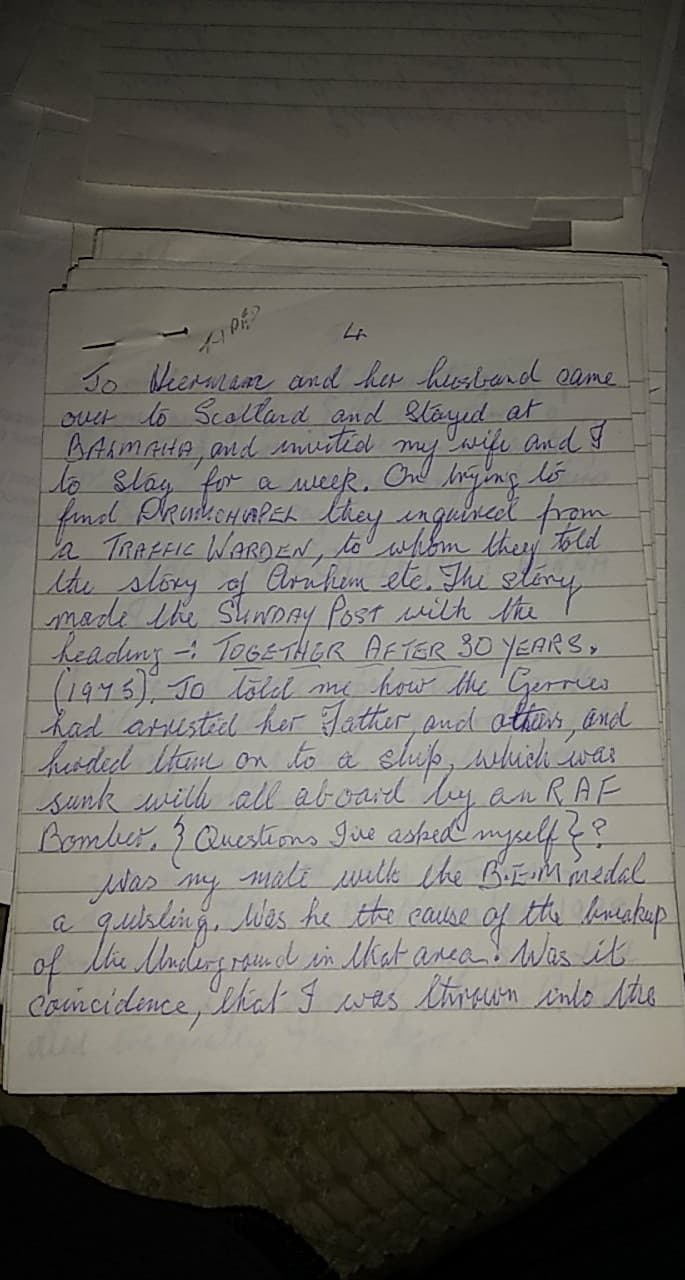
Jo Veerman and her husband came over to Scotland and stayed at Balmaha, and invited my wife and I to stay for a week.
Thomas Murphy's memoir, page 4, c.1998. Held by the family.
Summary
Thomas Murphy was a British paratrooper, wounded at Arnhem and taken prisoner. He escaped from a German-run hospital at Apeldoorn on 6 October 1944 and spent eighty-eight days moving through the occupied Netherlands before being recaptured on 3 January 1945. He survived the war.
He survived it because at least eleven Dutch households sheltered him in that time. A few of them can be named; most cannot. One of the people who fed him, Jacob Veerman of Achterveld, was dead within five months of him leaving the house.
The man
Thomas Murphy, born 11 November 1920 in Kelty, Fife. Enlisted into The Black Watch at Cowdenbeath on 1 August 1939. Before coming to the Netherlands he served in Palestine, Aden, Crete (where he was on the receiving end of the German airborne invasion of May 1941), Egypt, the siege of Tobruk, India and Italy.
He volunteered for airborne forces while serving in India. At Arnhem he was 23, a private in 156 Parachute Battalion, 4th Parachute Brigade.
Arnhem and Apeldoorn
18 September 1944, the date of the 4th Parachute Brigade's lift, and the date his companion Walsh gave in his own debrief; the family's copy of his service record says the 19th. 156 Battalion dropped on Ginkel Heath near Ede.
He was wounded at Oosterbeek. The family record says 24 September, on Paul Krugerstraat, but no independent source confirms the day or the street. The Germans took him to Apeldoorn, to the Willem III Kazerne, which was being used as a British hospital administered by captured RAMC officers and held about a thousand wounded men.
Security was poor and escapes were frequent. James Hardy, a medical orderly held there, estimated that as many as two hundred men got out in ten days, with around ten recaptured.
6 October 1944, at dusk. Murphy and another wounded man of his battalion, Pte Samuel "Sammy" Walsh, took a stretcher and carried it between them past the guard on their building as though performing an ordered task. They lay up in a disused building near the perimeter until dark, then climbed the fence.
They moved west to clear Apeldoorn, intending to turn south for the Rhine. They had no Dutch and no route.
The chain
Every address below comes from the official British MI9 debriefs of Hardy and Walsh, taken in January and March 1945, not from later recollection. Dutch names appear as the British recorded them, so some are phonetic and some are cover names.
7 October: a farm near Kootwijk
A farmer and his wife took them in at daybreak, gave them breakfast, and kept them in the house until 0900, which was when a contact passed the house each morning.
Their names are not recorded.
7–14 October: Kootwijk
A poultry farmer, English-speaking and very deaf. His wife also spoke good English. Three sons, aged approximately three, five and six.
They sheltered the two escaped soldiers for a week. The farmer then judged the house too close to the Apeldoorn–Amersfoort railway line to be safe and arranged through the underground to have them moved.
Those three boys were born around 1938 to 1941.
14–21 October: Garderen: De Ruif
The house the British knew only as "Uncle Joop's" was De Ruif, the country house of Dr Johannes Petrus Kruimel (1900–1976), an orthopaedic surgeon at the St Joannes de Deo and St Antonius hospitals in Utrecht. He had been in the Veluwe pilot line since May 1943 under the codename "Oom Joop", introducing himself to the evaders as "Joe Smith". He kept a guestbook in which the people he hid wrote farewell notes. He was awarded the American Medal of Freedom in 1947, and a care home in Garderen is named after him (Airborne Magazine nr.27; Omroep Gelderland).
Thomas Murphy is named in the Dutch account of that house. "Omstreeks 8 oktober 1944 arriveren Samuel Walsh … en Thomas Murphy … Walsh en Murphy vertrekken op een gegeven moment omdat het te vol wordt". Walsh and Murphy arrive, and leave when it gets too full (Airborne Magazine). ⚠️ The MI9 reports, taken at the time, put the arrival on 14 October, not 8.
Also hiding in the house: Jonkheer Hubert Louis Marie van Nispen tot Sevenaer (1879–1958), the mayor of Laren near Amsterdam, who had refused to work with the NSB administration and had been in hiding with his family since February 1943 (Wikipedia). Walsh's report calls him only "the Burgermeister of a township near Amsterdam". Murphy's memoirs are the only British source that names him: "Mr Van Nispen Sevenaar who was on Burgemeister Von Amsterdam".
The men who arrived as Murphy and Walsh left were Captain Alexander "Lippy" Lipmann Kessel, the Arnhem surgeon, with three colleagues from 16 Parachute Field Ambulance (Airborne Magazine; Kessel).
On 23 October 1944, two days after Murphy and Walsh were moved on, Germans quartered at Elspeet came to Garderen to requisition a car. Van Nispen's son had lit a fire in the hideout under the stable that afternoon; inspecting it, the Germans found a transmitter and a pilot's equipment. They razed De Ruif with fire and hand grenades, after first removing the furniture, glassware, paintings, crystal and silver. The Van Nispens escaped (Airborne Magazine).
21–26 October: Elspeet: Sterrehoveke
"Derek" was Dirk van Eysinga, living during the war with freule Ima van Eysinga — his great-aunt in Hardy's report, his aunt in the Dutch sources, at Sterrehoveke on the Krommesteeg in Elspeet. With Dr Kruimel and Huib de Jongh he hid weapons there, and, with his aunt's knowledge, onderduikers, pilots, paratroopers and escaped doctors. He was part of the Veluwe pilot organisation run by the MI9 agent Dick Kragt and the Jewish onderduiker Joop Piller. After the war he became Dutch ambassador to Romania (Elspeet history, citing Jeanne Dijkstra, Elspeet, baken van verzet, 2017).
The other woman of the house, Hardy's "niece, a lady of about 40", may be Liesbeth Verweij, whom the Dutch sources describe as Ima van Eysinga's governess or companion, and who wrote an unpublished account of the household (Airborne Magazine). ⚠️ That identification is an inference; the account is documented, and it names Tom Murphy among the Willem III escapers who passed through (Omroep Gelderland).
Derek verified the British by examining a paybook and asking questions about the British Land Army.
Here Murphy and Walsh met Pte James Hardy, a medical orderly of 16 Parachute Field Ambulance, from Adderbury in Oxfordshire. Hardy stayed with Murphy almost to the end, and his debrief of 13 January 1945 is the reason most of the people in this document are recorded at all.
The Germans had visited the house before, so the men spent their days in the surrounding woods gathering firewood.
26 October – 6 November: Leuvenum
A safe house run by a man the British called "Brummager". Also present:
- Eric Blok, a former second lieutenant of the Dutch Army.
- "Adrian".
- "Emmy", a girl of nineteen, who handled contact with the outside world, food and supplies.
- P/O Brentford, RAF, shot down over Berlin, who had escaped a camp near Leipzig and been five months in hiding.
Sgt Keith Banwell of 10 Parachute Battalion was brought there on 29 October.
6/7–14 November: Harskamp
Baron Mackay, understood by the British to be of Scots descent, and listed by name, "baron Mackay in Harskamp", among the Veluwe households that took in Allied evaders (Omroep Gelderland). ⚠️ Which Mackay, and which estate, is not yet identified.
He hid the party in a chicken hut on his estate, bedded on straw bales. The Baron or his wife brought food out three times a day.
There were three houses on the estate and the Germans occupied two of them. The men did not leave the hut for a week.
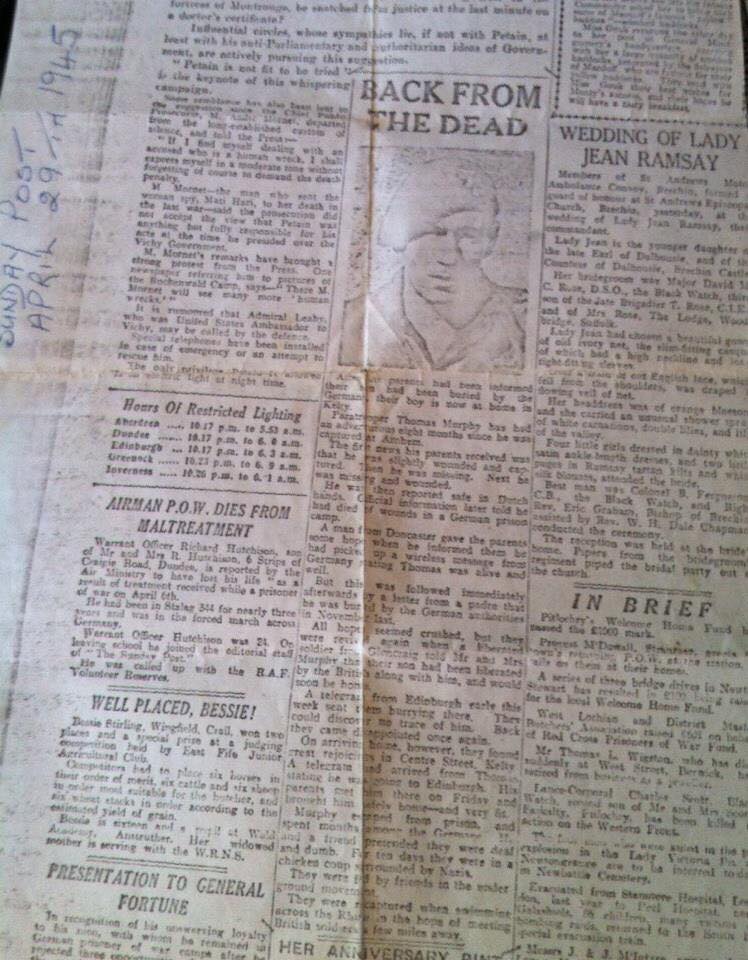
This is independently corroborated: the Sunday Post of 29 April 1945, published four days after Murphy reached home, reports that "for ten days they were in a chicken coup surrounded by Nazis" and that they were fed by friends in the underground. The same article records that to move in civilian clothes without Dutch, the men pretended to be deaf and dumb.
14–17 November: Rockelsche Zand
"Willem" and an unnamed Dutch policeman moved them by Red Cross ambulance and handed them to a guide known as "Jan".
Jan was arrested by the Germans around 16 November 1944. ⚠️ His fate is unknown.
Word of the arrest was carried to the hidden men by a local poacher, not a member of the resistance, but in contact with it.
17/18 November: Operation Pegasus II
The planned mass crossing of 116 men.
Four young resistance men arrived on bicycles at about 1830. The party rode two to a machine. All three guides drew too far ahead in the dark, and at a fork in the road four men. Murphy among them, took the wrong turning and lost the party. They waited at the fork, then searched for two or three hours whistling the recognition signal, the first two bars of Lili Marlene, without response.
Of the 116 participants, seven reached the south bank. Two participants and one American rescuer were killed; a Dutch guide died of his injuries days later.
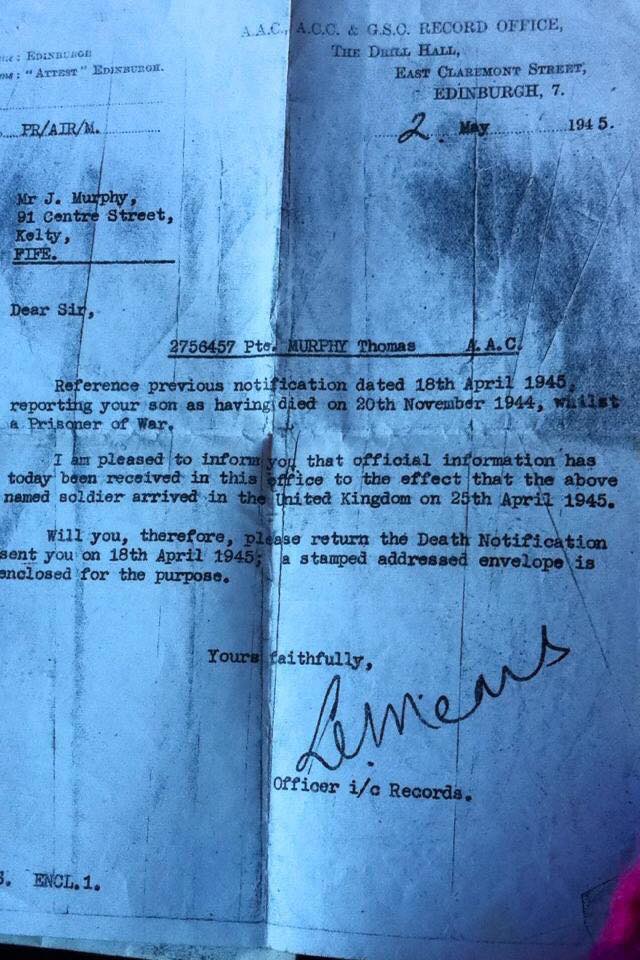
Because Murphy did not reach the rendezvous, the British Army subsequently recorded him as having died on 20 November 1944. A death notification was issued to his father, and a padre wrote to his parents saying he had been buried by the German authorities in November.
18–25 November: Otterlo and Roekel
A second attempt on 18 November from a farm near Otterlo, guided by Willem and the policeman, failed when the transport did not arrive. The party sheltered in the dug-out near Roekel, ten men in a space built for far fewer, then moved to a farmhouse and a barn near Otterlo.
On 25 November, guided by "Ghys" and "Jan (3)", Murphy and Hardy cycled pannier-fashion towards Barneveld.
Achterveld: the Veerman family
Hardy's report of 13 January 1945:
Jacob VEERMAN, farmer, aged 43, of a farm at approximately map position 475955 near Achterveld. Married, with four daughters and three sons. Eldest daughter: Joanna, aged 17. Youngest son: "Yap" (Jaap), aged 5.
Jacob Veerman, born 3 August 1900 in Den Haag, farmed Klein Achterveld on the road between Achterveld and Barneveld, and was a member of the OD (Ordedienst) in Barneveld. He had a wife and seven children, the four daughters and three sons Hardy counted.
The eldest daughter was Johanna Maria Veerman, called Jopie, born 1 December 1927 in Achterveld. She turned seventeen while Murphy and Hardy were on the farm, which is the age Hardy gives.
The identification is based on the surname, the place, the number of children, and the eldest daughter's name and age.
The farm had sheltered Allied aircrew since 1943, brought in by Jan Dijkstra of De Glind. The Dutch account records three pairs of airmen hidden for varying periods, along with Jewish onderduikers including a woman and her daughter, and states that everyone hidden at Klein Achterveld survived the war. It names none of the Allied evaders and describes them all as "pilots".
Murphy and Hardy stayed a full month, approximately 25 November to 23 December 1944. Hardy recorded that they were very well fed and cared for and that the family did everything possible to make them comfortable. Ghys and Jan visited three times with soap, shaving materials and news.
Before they left, Murphy was given a revolver. That is in Hardy's 1945 report, not only in the memoirs: "Both MURPHY and I had revolvers by this time. Mine was given by KOEN and MURPHY's given him by Jacob VEERMAN" (Hardy). Hardy carried his to the Allied lines. Murphy was still carrying his when the Germans took him ten days later, and by his own account it is part of why they treated him as a spy rather than a soldier. Who gave it to him is disputed. Hardy says Jacob Veerman. ⚠️ Murphy's memoirs say three times, consistently, that it was "Mr Veerman's brother, who was in the Dutch Police", Jopie's uncle, who handed over his own police revolver as they left Barneveld. Jacob did have brothers, Arie and Leendert Jan (genealogy), and Hardy separately mentions an unnamed Dutch policeman in this network. The "oom Gerrit" at Ede that Jopie hid with is not one of Jacob's brothers, so he is a different uncle, most likely on her mother's side. Which brother, if either, was the policeman is unresolved.
What happened to the Veermans
Three weeks after Murphy and Hardy left, and for a reason the Dutch record gives as unconnected to either of them:
24 January 1945. The SD came to the farm for Jopie, who was working as a courier for the resistance. She was in hiding with her uncle Gerrit at Ede. They arrested her father instead and put it about that he would be released if she gave herself up.
She gave herself up, and he was not released.
Jacob Veerman was interrogated at Apeldoorn, held at the Sipo prison on the Weteringschans in Amsterdam, transferred to Kamp Amersfoort on 6 March 1945 and on to KZ Neuengamme, arriving 18 March 1945.
On 3 May 1945 he was aboard the Cap Arcona in the Lübecker Bucht when RAF aircraft attacked the ship with rockets. It burned and sank, and he drowned, five days before the German surrender and the day after the British Army wrote to Kelty to confirm that Thomas Murphy was alive.
He left a wife and seven children.
Jopie Veerman was one of the 116 women of the Vrouwenmars: women from resistance families across the central and north-eastern Netherlands, brought to Kamp Westerbork in March and April 1945 from four SD prisons. About 75 of them, from Putten, Barneveld, Ermelo, Ede and round about, came via the Willem III Kazerne at Apeldoorn, the same building Murphy had escaped from four months earlier. ⚠️ That Jopie was among that group is an inference from where she lived; the source says only that she "ended up in Kamp Westerbork". On 11 April 1945 the 116 were marched out on foot and driven for three nights under guard by retreating troops until they were liberated near Grijpskerk on 14 April, two days before Murphy was liberated.
She came home ill in May 1945. She married and became Johanna Maria Vanhaelen. She died on 9 September 1977, aged 49.
Her family has published a photograph of her, a young woman with a bicycle, credited to Jacques Vanhaelen.
Amerongen: the Esveld family and the ferry
23 December 1944. Moved to Amerongen and taken after dark to the house of Gerald Esveld, a garage proprietor, who had two sons and a daughter. The British recorded the sons' names phonetically as "Koen" and "Beent".
These are Coen Esveld and his brother Berend, resistance name "Flip". Hardy says it was Koen who took him and Murphy to the ferry across the Rhine; the Dutch account of the Amerongen crossings names Coen Esveld as the man who ran evaders over that ferry, with his brother along on one run (Geschiedenis Magazine). Same surname, same town, same brothers, same job.
Coen, with a resistance man named Chris Cornelisse, ran evaders across the river on the Amerongen–Eck en Wiel ferry, which operated throughout the occupation, three parties of six men. One of Amerongen's three ferrymen warned Cornelisse when Germans were aboard.
On the third crossing two Germans boarded at the last moment and began looking closely at the evaders' British boots, Dutch civilians having been unable to buy shoes for years. Coen said to Cornelisse "Jij die en ik die", and the two of them put the Germans over the side. No further crossings were made by ferry.
Murphy and Hardy crossed on 2 January 1945 without incident, wearing civilian suits lent by Koen with their uniforms in bags strapped to the bicycles. The ferry cost ten cents.
Recapture: 2/3 January 1945
They cycled to Kesteren and joined a party, "11 Allied personnel" in the commanding officer's words, though his list runs to twelve names including theirs, and three Dutchmen, who set out on foot at 1830 across the frozen, flooded Betuwe.
At about 2100 they encountered a German patrol and froze until it passed. Later, on a road, they were fired on at very close range with automatic weapons and the party scattered. They were fired on again from three mutually supporting positions using Bren guns and British mortar flares, captured Allied equipment, which is the likely reason Murphy believed he was approaching Canadian troops.
Three men reached a British forward post of the Recce Regiment, 49th Division, near Dodewaard. Hardy was awarded the Military Medal, partly for crossing the ice alone under fire during this action.
Capt. Noble, Sgt Banwell and Pte Murphy were lost and not seen again by the others. How Murphy was taken he told two ways: the Sunday Post of 29 April 1945, four days after he came home, says he was "recaptured when swimming across the Rhine in the hope of meeting British soldiers"; his own notes fifty years later say he and a companion took cover in brickwork, were grenaded, came to in a house with Germans next door, and were "escorted back over the ferry". ⚠️ Both are his, and they do not describe the same moment. The newspaper line is a reporter's sentence from a man four days home, and its geography is loose: the party had crossed the Rhine by ferry the day before, and the British were beyond the Waal. His own account matches what the others reported, a party fired on at close range on the flooded, frozen Betuwe and scattered. What both versions agree on is the only thing that matters here: he was caught trying to reach the British lines.
What followed is his own account and nobody else's. He says he was treated as a spy rather than a combatant, having escaped from a hospital and been taken carrying a Dutch revolver and wearing overalls over his uniform; that he was issued an identity card marked "Spione Voorsicht / Noch nich verhoort" (spy, caution, not yet questioned); that he was questioned again and again, marched out under armed guard at two and three in the morning, and told he would be shot.
He says he disclosed nothing about the organisation. No document can prove a silence, but everything on record points the same way. He was carrying the freshest possible knowledge of the line: the Esvelds and the Amerongen ferry two days earlier, the Veermans, the guides. None of them was touched on his account. When the SD did come to Klein Achterveld, three weeks later, the Dutch record says they came for Jopie as a resistance courier, not for an escape line, and they did not know she was no longer there. The Germans' own questioning fits: his interrogator, he says, kept trying to trap him on how he had survived from September to January, which is not a question you ask a man who has told you.
He says he was held at Stalag XI-B, Fallingbostel, the camp is his word alone. Fallingbostel was liberated by the 11th Hussars on 16 April 1945, and he reached the United Kingdom on 25 April. His parents, who had been holding his death notification since the 18th, met him at Edinburgh. The notification was formally withdrawn on 2 May 1945.
Afterwards: what the British recorded
After the liberation, Allied military intelligence compiled an index of Dutch people who had helped Allied servicemen, and graded each one. It is now a file at the British National Archives, about 8,000 names, graded from 1 for the head of a major escape line, which seven people received, down to 5 and 6, which were the common grades. Grades 1 to 4 carried the American Medal of Freedom; grade 5 carried the Eisenhower Certificate.
Most of the households in this account are in it (British helper index):
| As indexed | Address given | Grade |
|---|---|---|
| "VEERMAN Dick" | Achterveldscheweg 34, Achterveld | 5, posthumous |
| ESVELD-STRUBBE, M.G. | Overstraat 360, Amerongen | 5 |
| ESVELD, Berend Albert | A 12 Rijksstraatweg, Leersum | 5 |
| CORNELISSEN, Christiaan | Rijnstraat 472, Amerongen | 5 |
| CORNELISSE, Leendert | Amerongen B 519 | 5 |
| van NISPEN van SEVENAAR, Hubert L.M. Jhr | Stationsweg 23, Laren | 5 |
| "KRUIMMEL, J. Dr." | Biltstraat 176, Utrecht | 4 |
The Achterveld entry is the farm's address and the award is posthumous, which fits Jacob Veerman. ⚠️ The index gives the first name as "Dick", where Hardy's report and the Dutch sources both say Jacob. Kruimel's grade 4 is the Medal of Freedom he received in 1947, and the address is the Utrecht hospital where he was a surgeon.
⚠️ Baron Mackay, who hid the two men in the chicken hut at Harskamp, is not in the index at all. The page runs from Machielsen to Macklenbergh with no Mackay between them.
1975
Jo Veerman and her husband visited Scotland in 1975, staying at Balmaha on Loch Lomond and spending a week with the Murphys. Looking for Drumchapel in Glasgow they asked a traffic warden for directions and told him the Arnhem story, which reached the press. Murphy records the paper as the Sunday Post and the headline as "Together After 30 Years". ⚠️ The article has not been found.
It was during this visit that Jo told him what had happened to her father: that he had been put aboard a ship which was sunk with all aboard by an RAF bomber. Murphy had known the essentials of the Cap Arcona from her since 1975; the Dutch record now confirms them.
What is still unknown
If these can be answered, the answers are in Dutch archives.
- Who was the Veerman brother in the Dutch police? Jacob's brothers were Arie and Leendert Jan, so he is one of those two, and the "oom Gerrit" at Ede that Jopie hid with is a different uncle, probably on her mother's side. Did he give Murphy the revolver, and was he among those Murphy believed the Germans "rounded up" afterwards?
- Did Thomas Murphy sign the De Ruif guestbook? Wolter Noordman has worked from it.
- What became of "Jan", the guide arrested around 16 November 1944?
- Who were the deaf poultry farmer at Kootwijk and his wife, and what became of their three sons?
- Who was "Emmy", nineteen, at Leuvenum?
- Why does the British helper index record the Achterveld award under the first name "Dick", and why is Baron Mackay not in it at all?
- Which Baron Mackay, and which estate at Harskamp?
- Was Jopie among the women brought to Westerbork through the Willem III Kazerne?
Jacob Veerman's granddaughters Joke and Alie, and his great-granddaughter Aline, visited Neuengamme in May 2024 with a group from Leusden to research him (RTV Utrecht). Hardy's report, quoted above, is a British intelligence document from January 1945 that lists their grandfather's children and names his eldest daughter.
Sources
Every external source is listed, with where it came from, on the sources page.
| Claim | Source |
|---|---|
| The escape, the chain, every Dutch name and address | MI9 escape and evasion reports of Pte James Hardy MM (ref IS9/WEA/1/270/2351, taken 13 January 1945) and Pte Samuel Walsh (taken 7 March 1945), official British debriefs. Hardy · Walsh |
| The final crossing and who was lost | Extract from the report of Capt. V. R. Schjelderup MC, 1st Bn The Canadian Scottish Regiment, ref IS9/WEA/1/271 |
| Jacob Veerman, birth, arrest, camps, the Cap Arcona | Digitaal Monument Neuengamme, quoting José Huurdeman, Ondergronds in de Tweede Wereldoorlog: verhalen uit de Gelderse Vallei, Veluwe en Krimpenerwaard (Historische Kring Leusden, 2019) |
| Jopie Veerman, dates, the Vrouwenmars, the photograph | TracesOfWar.nl, citing I. van Doorn & H. Sennema, Vrouwenmars 1945 (2025) |
| The Vrouwenmars | Stichting Vrouwenmars 1945 |
| The Esveld brothers, Cornelisse, the ferry | Geschiedenis Magazine, "Ongezien de Rijn over" |
| Kruimel, De Ruif, the guestbook, the burning, Murphy named | Somford, "Op zolder bij Oom Joop", Airborne Magazine nr.27, 2023 |
| Van Eysinga, Sterrehoveke, the Verweij diary naming Murphy | Omroep Gelderland on Noordman, 2019; elspeethistorie.nl |
| Van Nispen tot Sevenaer | Wikipedia |
| The Veerman descendants at Neuengamme | RTV Utrecht, 4 May 2024 |
| Reported dead 20 Nov 1944; alive 25 April 1945 | A.A.C. Record Office letter, 2 May 1945, scan |
| The chicken hut, the deaf-and-dumb ruse, the swim | Sunday Post, 29 April 1945, scan |
| The 1975 visit, the revolver from the uncle | Thomas Murphy's memoirs, c.1998, reproduced with the record |
The full research file, with the evidence grading, every discrepancy and the archive shopping list, is the record.