What has been added to these pages, newest first. Each entry links to where the new material
sits in the record, so nothing has to be re-read to find it.
13 September 2026
Every page he wrote, photographed. Thirty-seven scans, all on the papers page with a
description each, and downloadable there as one PDF. Before tonight the family had twelve
phone photographs, several unreadable. What the new pages add:
The twelve-page memoir, from enlistment to the Amerongen ferry, most of it never read before: Crete, Tobruk, the Mauretania, Ranchi and a priest from Lochore, the parachute course and "13 deaths by Roman candles", Taranto and Popski's Private Army, the flight to Arnhem, and his own account of the escape from Apeldoorn: the stretcher, the wire, singing along a railway, the haystack, the lady with her washing (the escape).
Lt Donaldson. He wrote that he and "Sam Welsh" carried their wounded officer into a house, and that the Germans shot him there. Walsh's 1945 debrief, which nobody in the family had read, tells the same story from the other side (Walsh's report). That page also settles his platoon: 11 Platoon, C Company.
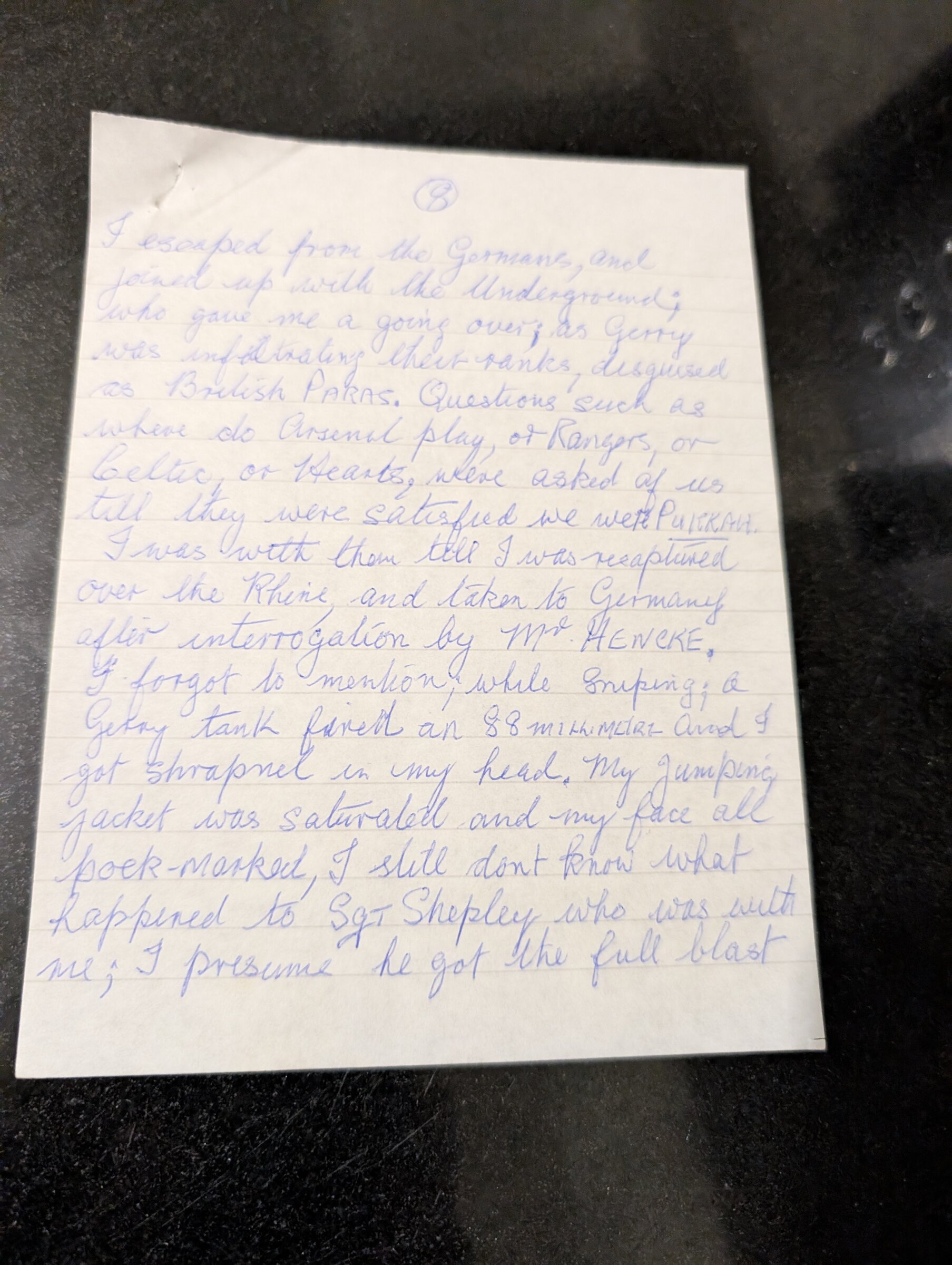
The head wound explained. "Shotgun wounds" in the notebook were shell splinters from an 88 mm tank round while he was sniping, with a Sgt Shepley beside him (his page 8).
He names the Esveld family of Amerongen himself, matching the MI9 report (Amerongen).
Belsen, the pension, and why he cut off the Airborne. The notebook pages on Fallingbostel and Belsen; the Musselburgh pension board and its £30; and a single page on meeting a fellow Arnhem soldier in Edinburgh who had been questioned by MI6 about him (after the war).
A third man in the net. Capt. Charles Noble, an army doctor captured in the same firefight as Thomas Murphy and Tex Banwell on 2/3 January 1945, wrote his own report in 1945. It puts the interrogation centre at Velp, which is the memoir's "GWELF"; describes eight weeks of solitary and Gestapo prisons for a man taken "in civilian clothes"; reaches Stalag XI-B at the end of February, which fits the memoir's "from February"; and records, in April 1945, that Banwell was in that camp and was then "sent back to Gestapo in Holland" (the interrogation; Banwell). Noble never names Murphy, so none of this is proof about him personally; it is the same treatment of the same three men.
"GWELF" is Velp, and the road after it. The SD prison at Velp, in the seized Rotterdamsche Bank, is on a plaque. The Dutch guide who led the January crossing was taken there "with some of the Allied men", tortured, and moved after three weeks "with seven Allied soldiers" to the Wolvenplein prison in Utrecht and then De Kruisberg at Doetinchem, the route Noble gives to the day, and Noble is on the Doetinchem memorial's list of Allied prisoners. Whether Murphy was one of the seven is not recorded anywhere; it is the natural reading of the numbers (the interrogation).
The airman's memoir. Bob Porter, the Canadian bomb-aimer in the same party, published his story in 1997 and it is online. "There were seven of us plus the three paratroopers … No one introduced anyone." He was taken to Arnhem, told he was a spy who could be shot, questioned at three in the morning, then Utrecht, then Doetinchem. He never saw Murphy after the firing started and never names him, which is why the record says the route is documented for the Canadians and the doctor and only fits for Murphy (the party).
"Captain King" was Gilbert Sadi Kirschen, a Belgian SAS captain, the officer the Veluwe line reported to. Documented in the standard reference list of agents (named associates).
"The Germans rounded up the Uncle and others." There was a round-up, in December 1944, in the villages around the Veerman farm while Murphy was in it, and every man taken died in the camps, one of them an eighteen-year-old courier from De Glind. But no Veerman was among them, and the Dutch record gives a cause that has nothing to do with the revolver (the round-up).
The German side. No German paper about Murphy has been found, and the SD's own files from Velp did not survive. What survives is the policy: the orders, put in evidence at Nuremberg, under which captured paratroopers went to the SD and recaptured British escapers "might be turned over to the SIPO and SD" at the high command's discretion. They describe his case; they are not a record of it (the German side).
His boyhood, in his own hand, and the army service list with every date now readable, which settles the drop date at 18 September 1944 and opens a new question about his enlistment date (still open).
10 September 2026
The site goes live with three pages: the record, the Dutch chain and the sources. The record carries a timeline of the seven months he was dead on paper; the Dutch chain carries a map of the eleven households that hid him.
5 September 2026
The research that the site is built on, done in one sitting from the family's papers outward:
Two MI9 escape reports from 1945 found that name him: Pte James Hardy's, which follows him from Elspeet to the night he was recaptured, and Pte Samuel Walsh's, the man he escaped Apeldoorn with (named associates).
The family that hid him for a month at Achterveld identified as the Veermans, and what happened to Jacob and Jopie Veerman afterwards (Achterveld).
"Uncle Joop", "Derek" and the Burgemeester put to real names from Dutch published history, and two Dutch accounts found that record Thomas Murphy by name in October 1944 (Garderen, Elspeet).
The camp corrected from Stalag II-B to Stalag XI-B, Fallingbostel, from his own typed notes (liberation).