Maj. Geoffrey Powell
Scarborough 25 Dec 1914 ◐ – 5 Jan 2005 ◐
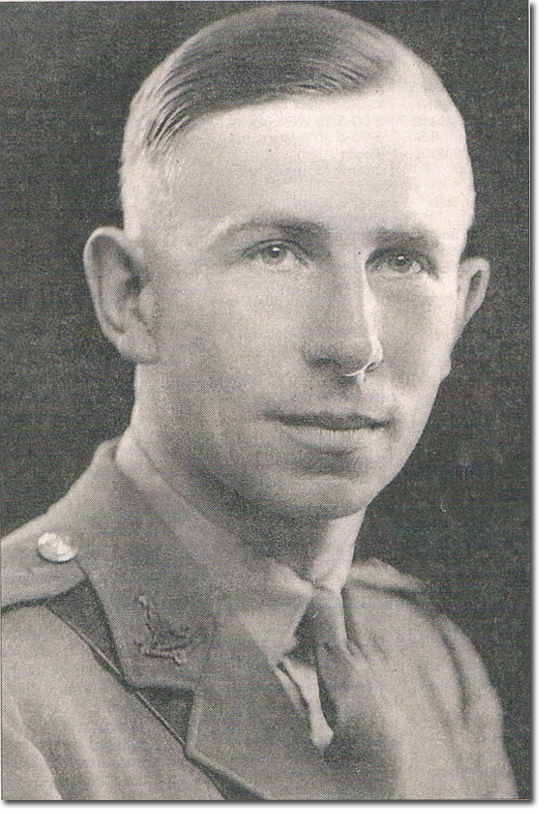
Maj. Geoffrey Powell (69721)
About: Regular officer of the Green Howards who commanded C Company of the 156 Parachute Battalion at Arnhem, Murphy's company, and took over what was left of the battalion. Murphy's memoir has "Mr Powell" (◐ him) make him a sniper; Powell won the Military Cross, and afterwards served in MI5 and wrote the history of the battle.
Unit or role: OC C Company, 156 Para Bn; Green Howards (Alexandra, Princess of Wales's Own Yorkshire Regiment), attached to the Army Air Corps; Captain (temporary Major) in the Gazette of 1944.
Where: Arnhem and Oosterbeek, 18 to 25 September 1944; later the Security Service in London, and from 1977 Chipping Campden, Gloucestershire.
Evidence: ✓ The Pegasus Archive's biography; London Gazette 36785, p. 5130; Walsh's report; IWM's interview of 27 February 1991. ◐ His life from Debrett's, The Times and Contemporary Authors is held only as search snippets, as marked below.
◐ Debrett's People of Today has him born on 25 December 1914, the son of Owen Welch Powell of Scarborough (died 1964) and Ada Jane, née King (died 1968), educated at Scarborough College and later the Open University (BA); The Times has him born in Scarborough "soon after the German naval bombardment of the town in December 1914", the only child of a businessman and his wife Kitty, wanting the Royal Navy but failing its special entry examination, and taking a Territorial commission in the Green Howards while working as an estate agent (Debrett's; The Times; search snippets only). A Green Howards history page has the same day and place: "born on Christmas Day 1914 in Scarborough a few days after the German naval bombardment of the town" (britishempire.co.uk). The Writers Directory also has "b. 1914" and "Has written as Tom Angus" (the entry).
◐ Debrett's gives his career as: second lieutenant, Territorial Army, 1936 to 1939; regular second lieutenant in the Green Howards, 1939; Parachute Regiment in India, the Middle East and north-west Europe, 1942 to 1945, with the MC in 1944; Staff College, Camberley, 1946; brigade major in Java and Malaya, 1946 to 1949; US Command and General Staff College, Fort Leavenworth, 1951; commanding "II Bn KAR" in Kenya, 1957 to 1959 (below); Colonel, General Staff, at the War Office, 1959 to 1962; Brigade Colonel, Yorkshire Brigade, 1962 to 1964; retired in 1964 and attached to the Ministry of Defence until 1976; Deputy Colonel of the Green Howards, 1982 to 1984 (Debrett's; search snippets only).
◐ The Times fills in the war years before Arnhem (the obituary; search snippets only). War was declared as he was leaving for India to join the 2nd Green Howards in the Punjab, and he volunteered for airborne forces; he went to Egypt with the 4th Parachute Brigade and had a staff attachment with the 7th Armoured Division in the Western Desert in 1942, then commanded a company of 156 Para in Tunisia, where a broken leg from a training drop kept him out of Italy. The Pegasus Archive has him "a founder member of the 151st Battalion when it was formed in India", renamed the 156th (Pegasus Archive); in the IWM's summary of his interview he recalls "volunteering for service with Parachute Regiment in India, 1941" and "how battalion changed its name from 151st to 156th Bn" (IWM).
◐ During the briefing for Operation Comet, the Pegasus Archive has him whisper to "his fellow Company commander, Major John Waddy", "This will get you either a Victoria Cross, or a wooden one" (Pegasus Archive); Tim Saunders's Hell's Highway has the same remark "as recounted by Geoffrey Powell" of "a company commander" at "one battalion briefing" (the hits; search snippets only).
With Murphy: C Company at Arnhem
Link to the section With Murphy: C Company at ArnhemThe flight. Walsh's report names his stick: "Other members of the stick: Major POWELL, 'C' Coy, 156 Bn - Fate unknown. Pte. DRAKE, 'C' Coy, 156 Bn - Fate unknown", from "Dakota, near GRANTHAM, 18 Sep 44, 1100 hours approx." ✓ So Walsh, a Bren gunner of 11 Platoon, flew in with his company commander (Walsh; his page). Nothing says whether Murphy was in the same aircraft.
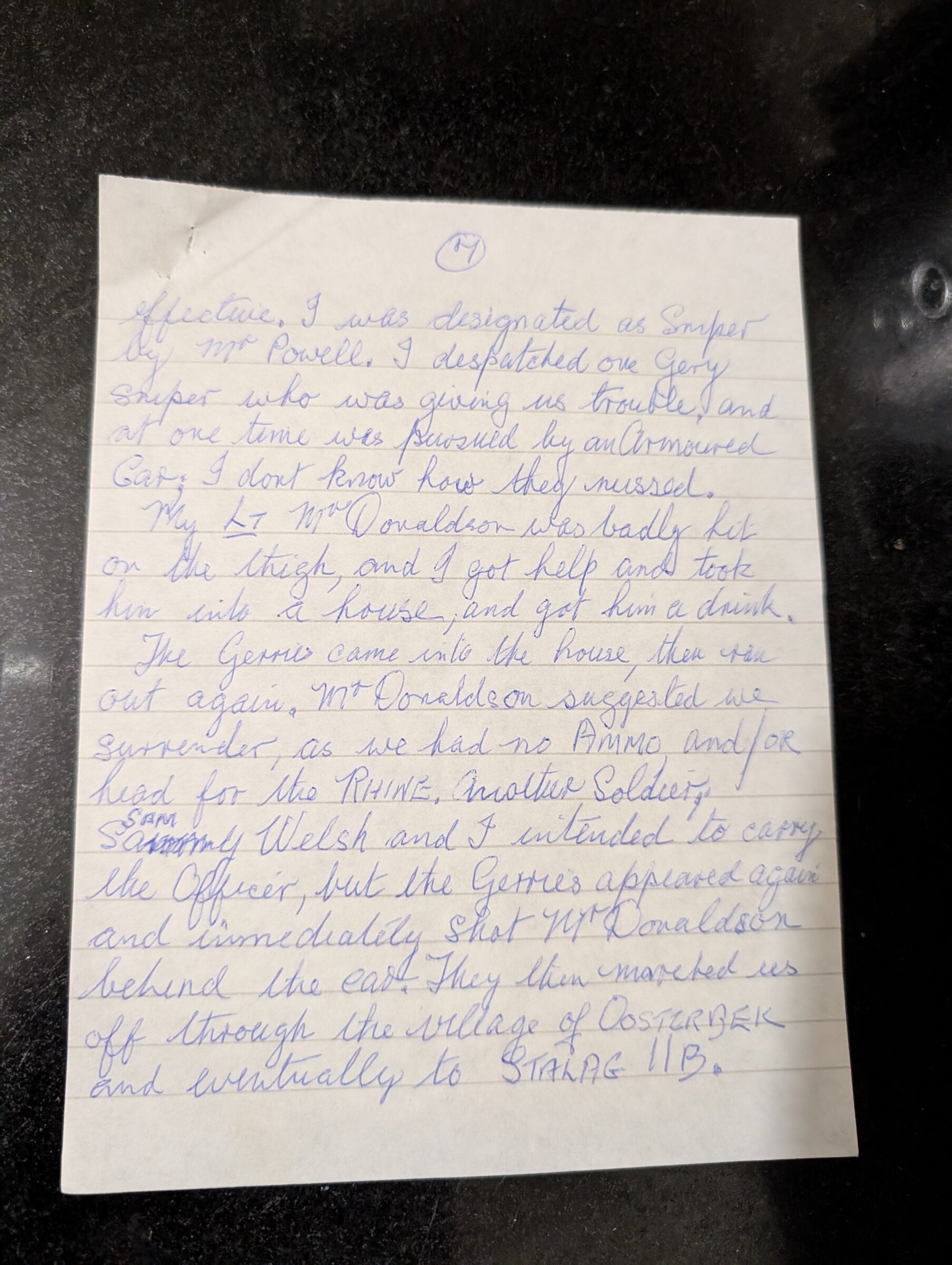
Murphy's sniper. Murphy wrote that he "was designated as Sniper by Mr Powell":
effective. I was designated as Sniper by Mr Powell. I despatched one Gery [sic] sniper who was giving us trouble, and at one time was pursued by an Armoured Car; I dont know how they missed.
— Thomas Murphy, memoir, page 7, c.1998
The days, by the Pegasus Archive's biography, a compilation that thanks Philip Sturtivant and gives no sources for the day-to-day events (Pegasus Archive):
- Monday 18 September. After the drop C Company led the battalion east; by nightfall No. 10 Platoon was beside LZ-L, "4.5 miles from Arnhem", halted by fire, and the company was ordered back a mile for the night.
- Tuesday 19th. A dawn attack found the ground abandoned; C Company went into reserve while A and B Companies attacked along the Dreijenseweg, and "was the only effective fighting force that remained in the 156 Battalion". It was strafed by German fighters and mortared, and Powell watched Flt Lt Lord's burning Dakota drop its load: "That bugger got a VC". Late in the afternoon the order came to withdraw south of the railway; "a large portion of the 156, including one of C Company's platoons", carried on towards Wolfheze "and were not seen by the Battalion again".
- Wednesday 20th. The brigade moved towards the Oosterbeek Perimeter.
- C Company attacked over its right flank and "a number of men were killed, including Lieutenant Donaldson, the only remaining officer in the Company besides Powell".
- Short of ammunition, Powell went back to battalion headquarters, where his commander "ordered him to withdraw as the Battalion was preparing to push in another direction"; he collected ammunition from the RSM and returned to C Company.
- Later "Geoffrey Powell got a message informing him that the Brigadier wanted to see him": Hackett told him the brigade major, the intelligence officer, Lt-Col Des Voeux and his second-in-command had all been killed within the last quarter of an hour, and ordered him to take a hollow.
- He did, with about twenty-five men and Major Page's twelve, and at about 18:00 Hackett had them break into the Perimeter with the bayonet.
- Thursday 21st to Monday 25th. Powell was given the 40 to 60 men left of the battalion, holding houses along the Stationsweg in the north-east of the Perimeter; he met Urquhart at the Hartenstein on the Thursday evening; on the Friday a barrage from XXX Corps's 64th Medium Regiment came down near them, "out of harms way", their first sign that relief was near; and tanks drove them out of their houses the same day. On Monday he was told the Division would withdraw that night, and his men left their positions at 20:15.
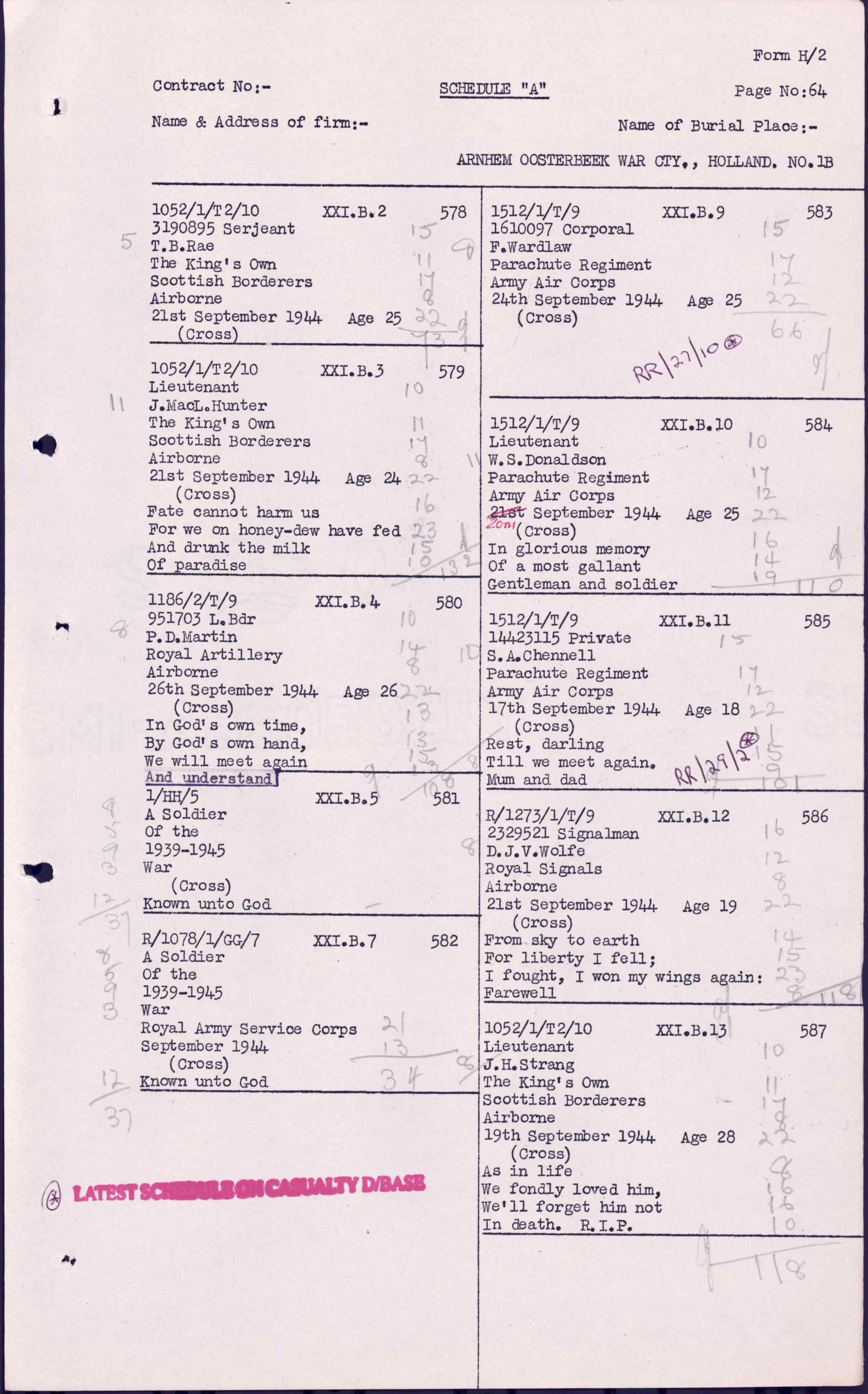
⚠︎ Walsh's day and Powell's. On this page C Company is in the Perimeter by the evening of the 20th, and the 21st is a quiet day of holding houses. Walsh's report has C Company "went in to attack a German MG position in the neighbourhood of OOSTERBEEK" at midday on the 21st, with Donaldson hit then. The two do not fit, and the page does not say which platoon of C Company went on towards Wolfheze on the 19th (the Kew catalogue has Walsh "captured: Wolfheze"). Not settled (Donaldson's page).
Robert Kershaw's A Street in Arnhem quotes him as C Company's commander in 156 Para's fight at Arnhem (the line before it, "We pressed on with this attack in three separate single company attacks", is Major John Waddy of B Company): he "suddenly received the 'startling' order from the battalion Signals Officer to fall back"; and he "suspected that 'as I expected, little by little cohesion was starting to break'" (the hits; the longer passages). ◐ From the Archive's full-text index, not read on the page, and the hits give no dates.
◐ The Times's obituary has him wounded earlier in the battle, in command of what was left of 156 Para once two companies were separated and the commanding officer killed, and holding a sector south of the "Ommershol" crossroads (as the OCR reads the name) for six days; his Military Cross citation, it says, called him "a gallant leader of men and a source of inspiration to all those around him", and was written for a DSO that was not approved (The Times, 10 January 2005; search snippets only).
The withdrawal, night of 25/26 September
Link to the section The withdrawal, night of 25/26 September◐ An Arnhem-escapes book quotes him on the order to withdraw: "I gathered my men together; they were tired, dirty, but still determined and their weapons were clean and serviceable. There were 33 - all that remained of our battalion" (the hits; search snippets only, from an untitled Archive copy that quotes him from elsewhere). His own words on the night are in Max Arthur's Forgotten Voices of the Second World War; they match the Imperial War Museum's summary of his interview of 27 February 1991, which lists "his dealing with hysterical NCO; crossing River Nederrijn in Royal Canadian Engineers manned boat" (the IWM item; the book's extract; search snippets only):
We had very detailed orders on how to pull out. We left in groups and we had glider pilots as guides to lead us to the river. The way was marked with white tape and Bofors on the opposite bank fired over our heads to give us the line. We held on to the airborne smock of the man in front. The intelligence officer led, I was in the rear. About halfway to the river, we hit a German position and my column got split. I arrived at the river with fifteen men. There were no boats. We crouched under the bank up to our knees in water. [...] We moved along the river, hoping to pick up a boat. We could see some people starting to swim but none of my party did. We passed one boat with the crew dead around it. Then we met another boat with a Canadian crew and outboard. In we piled. I was the last.
— Major Geoffrey Powell, C Company, 156th Parachute Battalion · Max Arthur, Forgotten Voices of the Second World War · Ebury, 2004 · the extract
◐ The Times tells the same night: the first boat he found "was full of holes and the Sapper crew dead", a second was afloat, he sent half his men over, and "brought his final 15 men across", the last organised group of 156 Battalion to return to the south bank (same obituary). The Pegasus Archive's biography has "15 men who were all that remained of the 156 Battalion", and that he "ordered them to form up in three's" for the march to the reception centre (Pegasus Archive).
The IWM interview
Link to the section The IWM interviewThe Imperial War Museum's sound archive holds three reels of an interview with him, recorded by Conrad Wood on 27 February 1991 (catalogue number 11901, 90 minutes). Its catalogue summary runs from India in 1941 through the drop, "attack on German forces' stop line positions", "loss of company members crossing railway line", "rescue of wounded staff officer by Brigadier John Hackett", "order to capture hollow in ground", the break-out and the withdrawal. It names no private of the company (IWM; the reels are not held).
The Military Cross. ✓ The London Gazette has the Military Cross in its supplement dated 9 November 1944: under "The Military Cross", in the War Office list of awards "in recognition of gallant and distinguished services in the field", "Captain (temporary Major) Geoffrey Stewart Powell (69721), The Green Howards (Alexandra, Princess of Wales's Own Yorkshire Regiment) (attd. Army Air Corps)" (supplement 36785, p. 5130; read on the page image). The notice gives no deed or place; the citation is not in it. The Pegasus Archive prints one:
At ARNHEM after his Commanding Officer had become a casualty, Major Powell took command of the remnants of the battalion. Up to this time he had conducted himself with the greatest gallantry. For the remaining six days he retained control of his unit and also of men of other units in the area under the most difficult conditions. Heavy fire from mortars, artillery and self-propelled guns never stopped his activity in getting round his section of the perimeter and encouraging his men to greater efforts. Throughout the whole period of the ARNHEM battle, in spite of being wounded, this officer showed himself to be a gallant leader of men and a most capable fighter and one whose bravery was a source of inspiration to the men under his command and to all those around him.
— Military Cross citation, Major G. S. Powell, as printed by the Pegasus Archive · the page
The same page quotes Hackett: "This was a great fighting man in a great tradition, that of the company officer in a British county battalion of the line, competent, courageous, and self-effacing" (Pegasus Archive). The Green Howards page has a shorter form, "a great fighting man whose bravery inspired all around him", and says "for the next six days his depleted battalion fought a rearguard action, hungry and exhausted" (britishempire.co.uk). ⚠︎ The two wordings of Hackett's are not the same; neither page says where they come from.
The books. He wrote the battle's history twice: Men at Arnhem (1976), from inside C Company, and The Devil's Birthday (1984), an account of the whole of Market Garden, reviewed in the Dutch press in 1986 (NRC Handelsblad, 20 September 1986). Men at Arnhem was published under the name "Tom Angus", with every person in it renamed, and the Pegasus Archive calls it "a fictional tale" (Pegasus Archive); the copy searched names none of the men in this story (the note). The Pen & Sword reprint of 17 February 2003 is advertised with "an introduction in which he identifies the men who fought with him in those eight terrible days at Arnhem in September, 1944", and calls the book "semi-fictional": "the names used are an invention and a little of the chronology has been altered in the interests of a smoother narrative, but all of the events portrayed are quite real" (Pen & Sword); another listing says the introduction "gives the real names of the men he served with at Arnhem" (historyofwar.org). ◐ The copy searched is the 1976 text with its invented names; the 2003 introduction has not been seen, and if it names Murphy or Donaldson it is the one place Powell's own hand would.
His life
Link to the section His life◐ Debrett's gives a son and a daughter, and The Times of 17 June 2002 has a book, Three Hundred Years of Service, by Powell "and Brigadier" Powell, "his son" (the hits); Debrett's has him marry in July 1944 (Debrett's). The Green Howards page has the marriage in 1944 too, and his son a Green Howards officer (britishempire.co.uk). The Times headlines its obituary "Soldier who distinguished himself in the Battle of Arnhem and later turned to writing and MI5 work".
◐ The Times fills in the rest (the obituary; search snippets only). After Arnhem and six months at the Staff College he went in 1946 to Java as brigade major of 49 Indian Brigade, was mentioned in despatches, saw a short time in Malaya, and served on Field Marshal Templer's staff. At 49, knowing promotion was unlikely, he applied to the Civil Service administrative class and, at the same time, to the Security Service; he took the Security Service post when it was offered and spent twelve years in its London office, on security policy and then counter-espionage. On leaving MI5 in 1977 he founded the Campden Bookshop in Chipping Campden. The Green Howards page has him return to the 2nd Battalion in 1954 as a company commander in the Canal Zone and in Cyprus, command "the 11th Bn King's African Rifles" in 1957, work at the Ministry of Defence until he left the army in 1963, and join the Security Service (britishempire.co.uk).
◐ His books, from Debrett's: The Green Howards (1968), The Kandyan Wars (1973), Men at Arnhem (1976), Suez: The Double War (with Roy Fullick, 1979), The Book of Campden (1982) and The Devil's Birthday (1984); he was a vice-president of the Campden and District Historical and Archaeological Society and a Fellow of the Royal Historical Society. His publisher, Leo Cooper, writes that he "came to me via an old school friend who had married into the family", that "his memoir of taking part in the battle of Arnhem duly reached me and I read it at a sitting", and that it "was called Men at Arnhem (my suggestion) and was a vivid account of the battle seen from a company commander's point of view"; "happily now he has surrendered the author's anonymity. He is no longer Tom Angus but really is Geoffrey Powell" (Cooper, All My Friends Will Buy It; search snippets only). A note on contributors to History Today in August 1987 has him "author of The Devil's Birthday: The Bridges to Arnhem (Buchan & Enright, 1984)" (the entry).
◐ Two more books, both from Leo Cooper and neither in Debrett's list of 1995: Plumer: The Soldier's General (1990) and Buller: A Scapegoat? (1994). The Times obituary names both among his books, Country Life reviewed Buller by "Geoffrey Powell (Leo Cooper, £21)" on 19 January 1995, and a reference book on the First World War cites Plumer as "by Geoffrey Powell (Leo Cooper, London 1990)" (the three snippets; search snippets only). The same August 1987 History Today carries an article by him, "John Buchan's Richard Hannay", on William Edmund Ironside as Buchan's model, which a later book cites as "Geoffrey Powell, 'John Buchan's Richard Hannay', History Today, August 1987" (the snippets; snippets only).
◐ Contemporary Authors has him twice: in volumes 61 to 64, as "POWELL, Geoffrey Stewart 1914- (Tom Angus)", born 25 December 1914 at Scarborough, with the Military Cross, The Green Howards (Hamish Hamilton, 1968), The Kandyan Wars and Men at Arnhem "under pseudonym Tom Angus"; and in volume 235, as an obituary notice, "1914-2005", which lists among its sources The Times of 10 January 2005 and, as far as its jumbled columns can be read, a Daily Telegraph of 14 February 2005 (the snippets; snippets only).
◐ Campden. The Campden and District Historical and Archaeological Society's Campden: A New History (2005) is "Dedicated to the Memory of Geoffrey Powell Soldier, Historian and Writer and successively Chairman, Vice President and President of CADHAS", and its acknowledgements say it "was inspired by our late President, Geoffrey Powell". It has the Campden Bookshop "founded in the 1970s" by a partner "in partnership with Geoffrey Powell", and flourishing for the rest of the century under a succession of owners (the snippets; snippets only, the book is lending-only). So Debrett's vice-president of 1995 became its President before he died.
His death
Link to the section His death◐ The Green Howards page has "Colonel Geoffrey Powell died on 5 Jan 2005" (britishempire.co.uk). The Times ran his obituary in its issue of 10 January 2005, and on 17 January a reader's letter said it "rightly emphasised his military career and the diversity of his intellectual interests", adding that friends "will also remember the loyalty of those friendships, his Christian faith, humour and charm and his stimulating company on enjoyable long walks", and "the gift of 60 years of happy marriage" (the letter; search snippets only). The letter dates the obituary "January 9"; the Archive's copy is the issue of the 10th. The date of 5 January is on one page and no document; the Daily Telegraph obituary named in Contemporary Authors would be the next place to look.
Where the sources disagree
Link to the section Where the sources disagree- The day Donaldson was killed, and where C Company was on the 21st. See "The days" above and Donaldson's page.
- When he volunteered for the Parachute Regiment. 1941, in the IWM's summary of his interview; 1942, in Debrett's ("Parachute Regiment … 1942 to 1945") and on the Pegasus Archive's page (IWM; Debrett's; Pegasus Archive). ◐ A catalogue summary of an interview is not his date for it.
- Who founded the Campden Bookshop. The Times has him founding it on leaving MI5 in 1977; the Society's history has it founded "in the 1970s" by a partner "in partnership with" him (The Times; Campden: A New History). ◐ Not in conflict if the partner started it and he joined, but neither source says so.
- Who published Men at Arnhem. The book's own title page has "Leo Cooper : London" and "published in Great Britain, 1976 by Leo Cooper Ltd." (the full text, leaf 5); Contemporary Authors of 1976 has "Seeley Service & Co., 1976" (snippets). ✓ The title page of the book itself is the one to follow; Seeley Service may be the parent house, which nothing held says.
- His mother's name. Debrett's has Ada Jane, The Times obituary "Kitty" (Debrett's; The Times); ◐ Kitty may be a pet name, and nothing here settles it.
- Which battalion of the King's African Rifles. Debrett's has "CO II Bn KAR", The Times "Ilth Battalion The King's African Rifles" as its OCR reads it; the Green Howards page has "the 11th Bn King's African Rifles" (Debrett's; The Times; britishempire.co.uk). ◐ The 11th, if Debrett's "II" is an OCR slip for "11"; nothing says so.
- Ministry of Defence or MI5, and when he left the army. Debrett's has him retire in 1964 and be "attached to MoD 1964-76"; The Times has twelve years at MI5, leaving in 1977; the Green Howards page has him at the Ministry of Defence until he left the army in 1963, then twelve years in MI5 (same sources). ◐ The spans nearly coincide, but no source says the one post was the other.
- The date of his obituary. The Archive's issue is 10 January 2005; a reader's letter calls it "January 9" (the letter).
- Hackett's words about him. Two wordings, on the Pegasus Archive's page and the Green Howards page (above).