Captivity and home
Interrogation, the prisons, Stalag XI-B, and the Army's notice to his family that he had died.
Recapture, interrogation, captivity
Link to the section Recapture, interrogation, captivityFrom the memoirs (typed pp.1–3; notes; ms), read beside the one contemporary account from inside the same net, Capt. Noble's (Noble). Noble never names Murphy, so nothing below is ✓ for Murphy personally; where Noble describes the same treatment of the same group it is marked ◐. Everything else is ⚠︎ his word alone, see His own account, tested claim by claim.
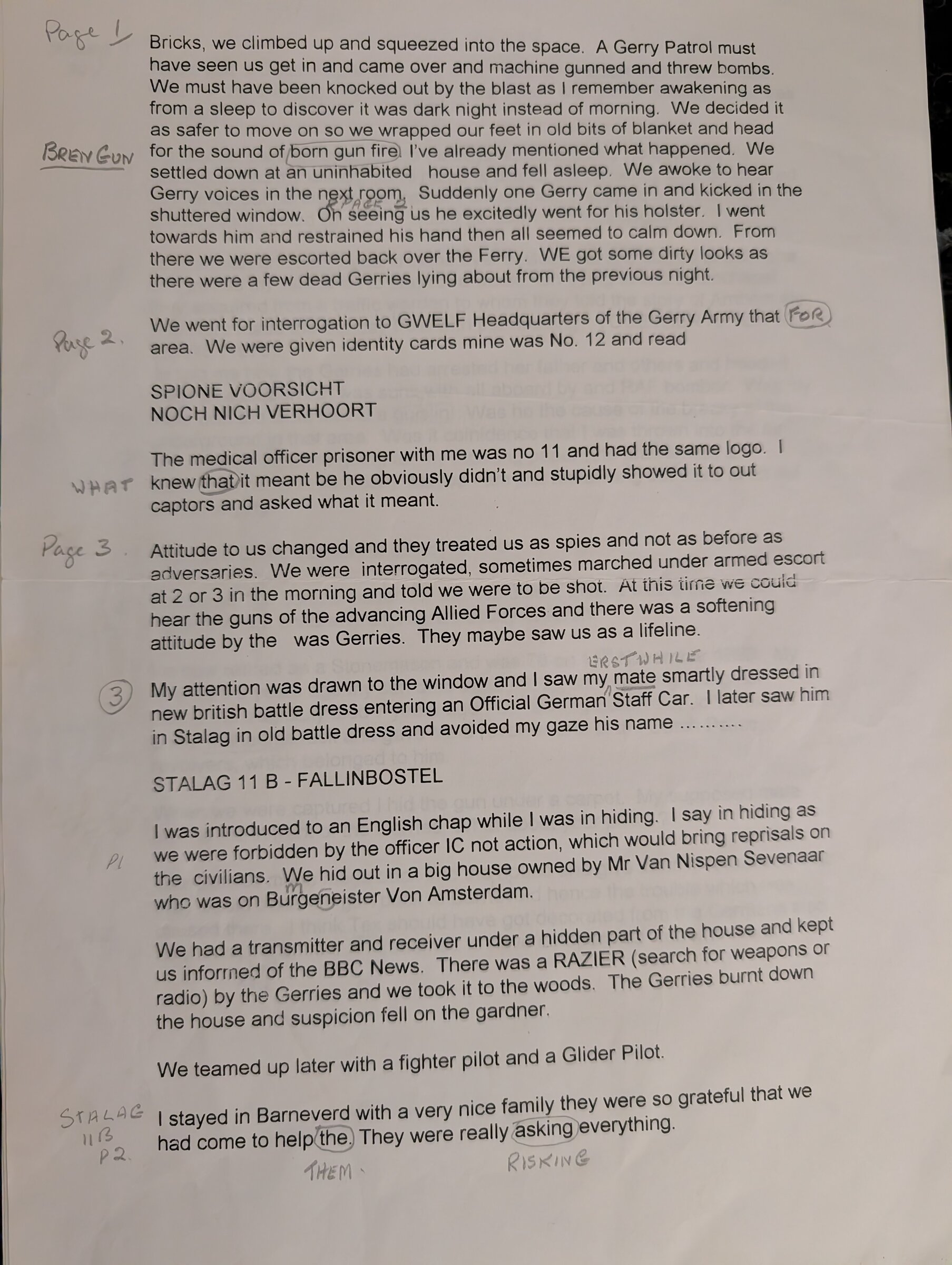
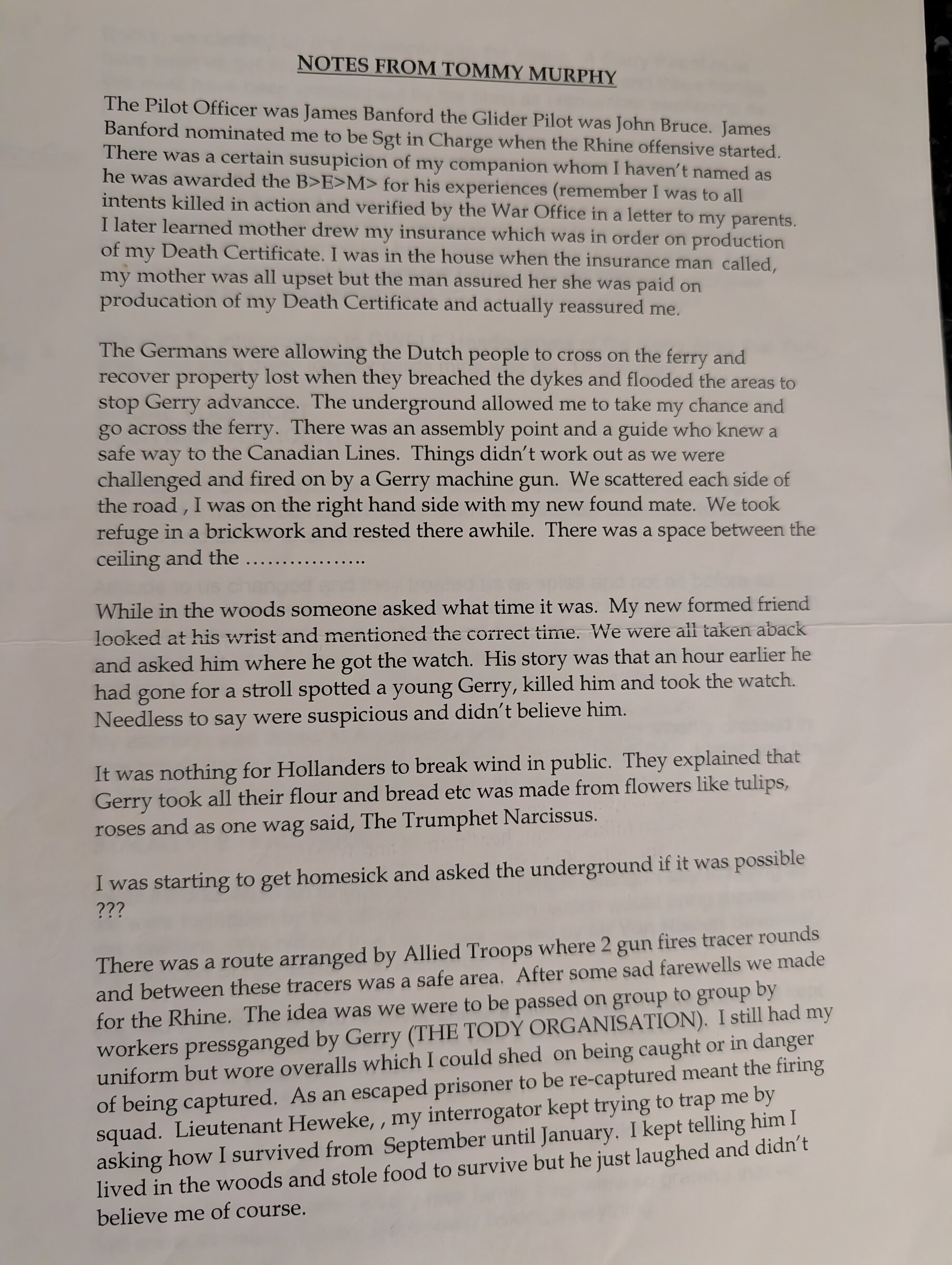
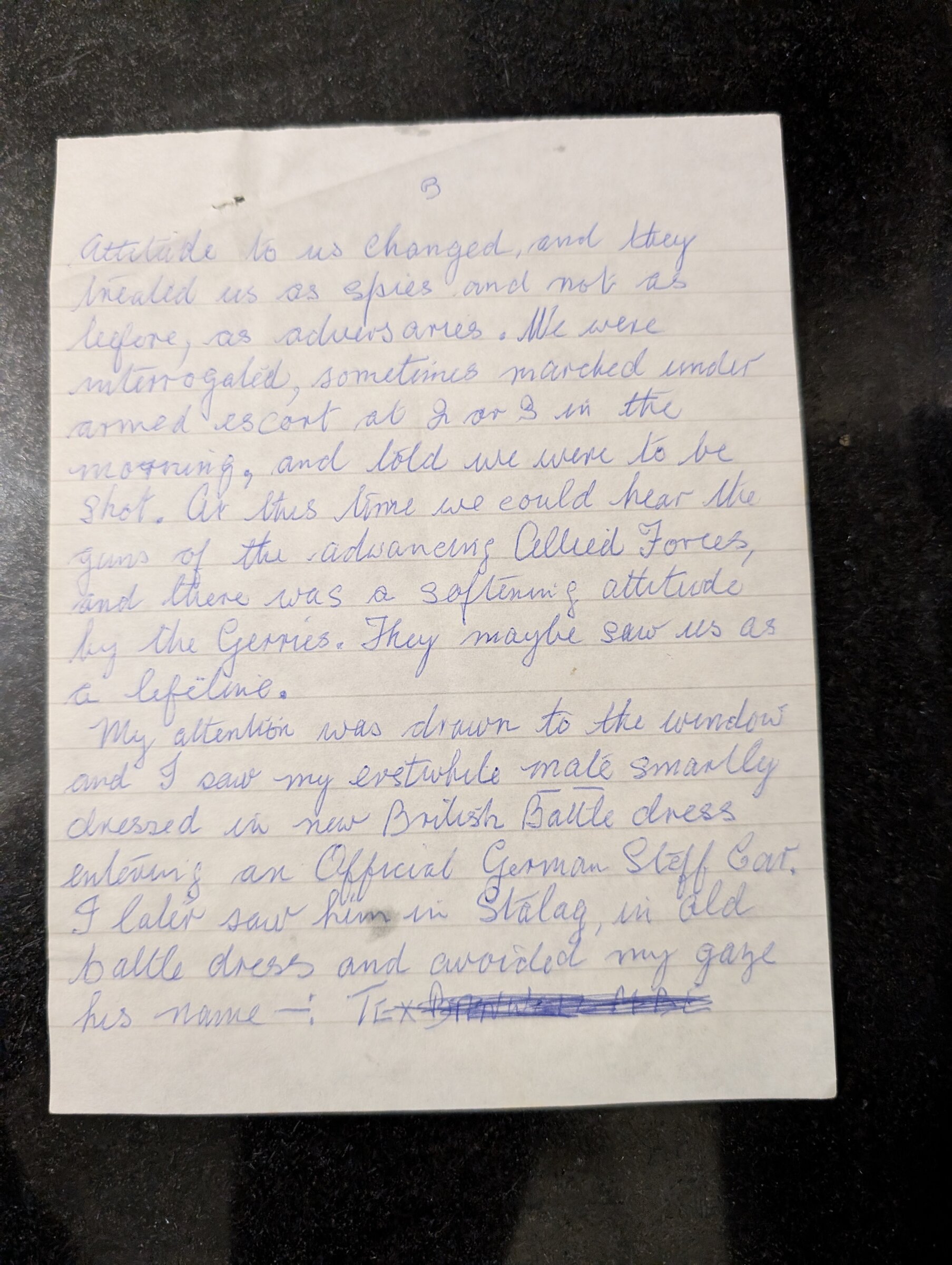
- Taken prisoner having escaped from a POW hospital and carrying a revolver, and treated as a spy rather than a combatant. He writes that he "still had my uniform but wore overalls which I could shed on being caught" (notes), so not plain civilian clothes.
- ⚠︎ Noble's own later account (unpublished private papers, shared with us privately) has the same dress for himself. The German officer who took him said "you have got an army uniform under these overalls and it’s all wet and I suggest that you take it off"; he kept it on, and called that "a major mistake". His report of 1945 has him taken "in civilian clothes" over uniform (Noble).
-
Interrogated at what he calls "GWELF Headquarters of the Gerry Army for that area". ◐ Velp.
- Noble, taken in the same action, was "taken to the RHQ and from there sent to Div HQ, Counter Intelligence at VELP, having been captured in civilian clothes"; his questionnaire answer on where he was interrogated is "Arnhem (Velp, 1st Parachute Div, Counter Intelligence)" (Noble). Banwell was interrogated at Velp too (Banwell; Tiemens), and Murphy has Banwell beside him at the capture. Two of the three are documented at Velp; "GWELF" is his spelling of it.
-
Velp was where the SD held and questioned people: Rauter's SD prison occupied the seized Rotterdamsche Bank on the Hoofdstraat from November 1944 to April 1945, with its headquarters, cells and interrogation rooms in two villas, Den Heuvel and De Kleiberg (Wikipedia NL). A plaque on the bank reads:
In memory of all who fell at the hands of the German occupier in the Rotterdamsche Bank, November 1944 – April 1945.
Dutch originalTER HERINNERING AAN ALLE GEVALLENEN VAN DE DUITSE BEZETTER IN DE ROTTERDAMSCHE BANK NOVEMBER 1944 – APRIL 1945
— Plaque on the former Rotterdamsche Bank, Hoofdstraat, Velp · Nationaal Comité 4 en 5 mei
-
The guide Maljers was taken there "with some of the Allied men" (Maljers). ⚠︎ No document places Murphy himself there by name.
-
Identity cards.
- His was No. 12, and read "SPIONE VOORSICHT / NOCH NICH VERHOORT" (Spione, Vorsicht, noch nicht verhört: spy, caution, not yet interrogated). The medical officer with him was No. 11 with the same marking.
- ◐ That officer is very probably Capt. Noble of 133 Field Ambulance: Schjelderup lost exactly three men in the firefight, "Capt. NOBLE, Sgt. TEX (?) [Banwell], Pte. MURPHY" (The crossing and recapture), Murphy says Banwell was there when he was captured ("When we were captured, he told the Germans I had a gun", ms), and Noble is the only medical officer among the three. Murphy never names him.
- ⚠︎ Noble's later account has him given "a card with ‘Spion van Dyk’ on it", which by day, in a Feld Gendarmerie house at Arnhem, read "Spion van Dyk, brot und wasser". It gives no number, and late memory is all it rests on; it is a second spy card from the same net.
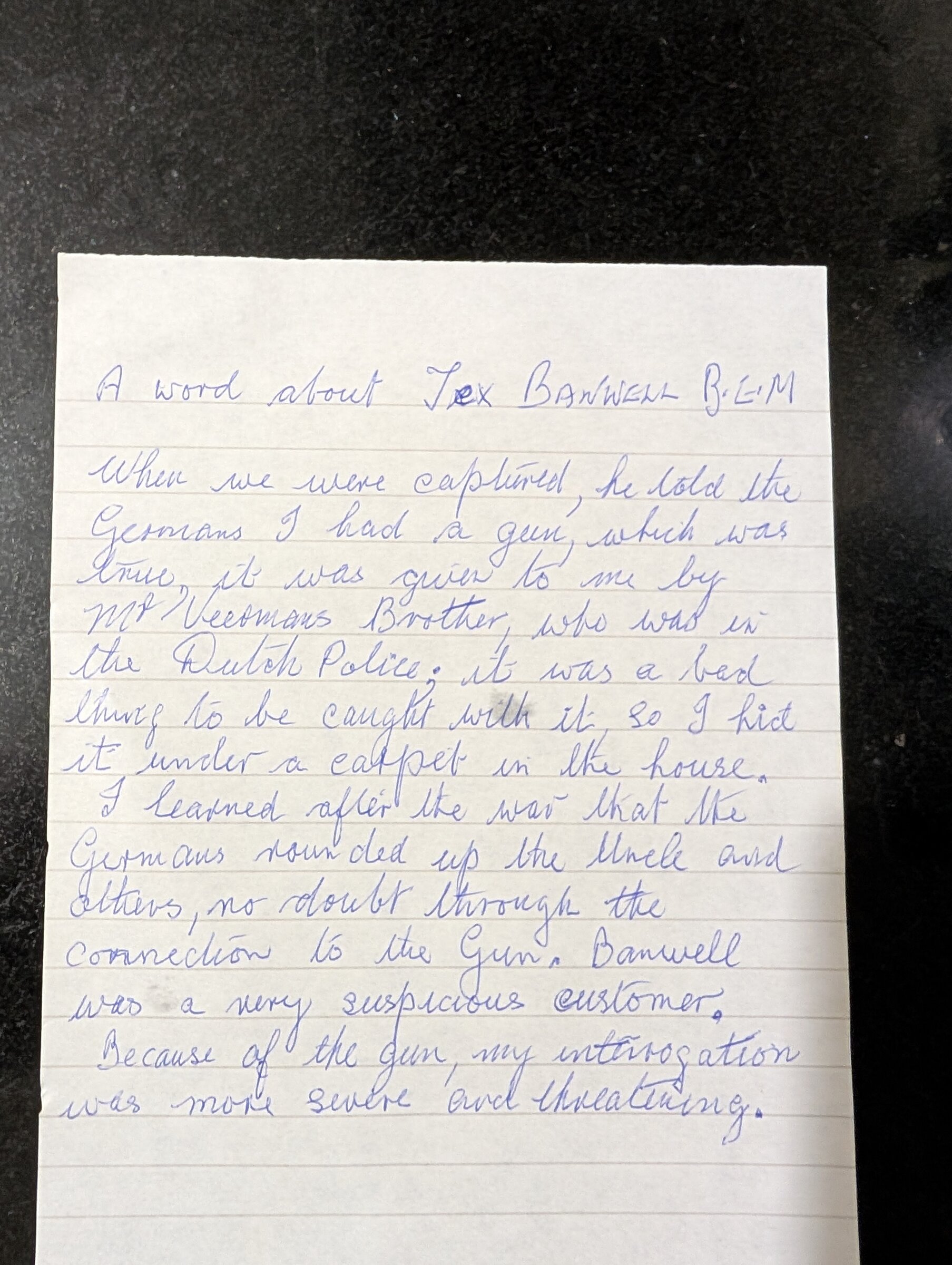
"Told we were to be shot"
Link to the section "Told we were to be shot"He wrote: "We were interrogated, sometimes marched under armed escort at 2 or 3 in the morning, and told we were to be shot." Three other accounts of those weeks run alongside his, and then stop short of him.
-
◐ Noble, captured in the same action:
For the next 8 weeks I was kept in strict solitary confinement, the last 5½ weeks being in the Gestapo Prison at Utrecht and Doetinchem. Interrogation was intensive during the first 2 weeks
— Capt C.B. Noble, his report (Noble)
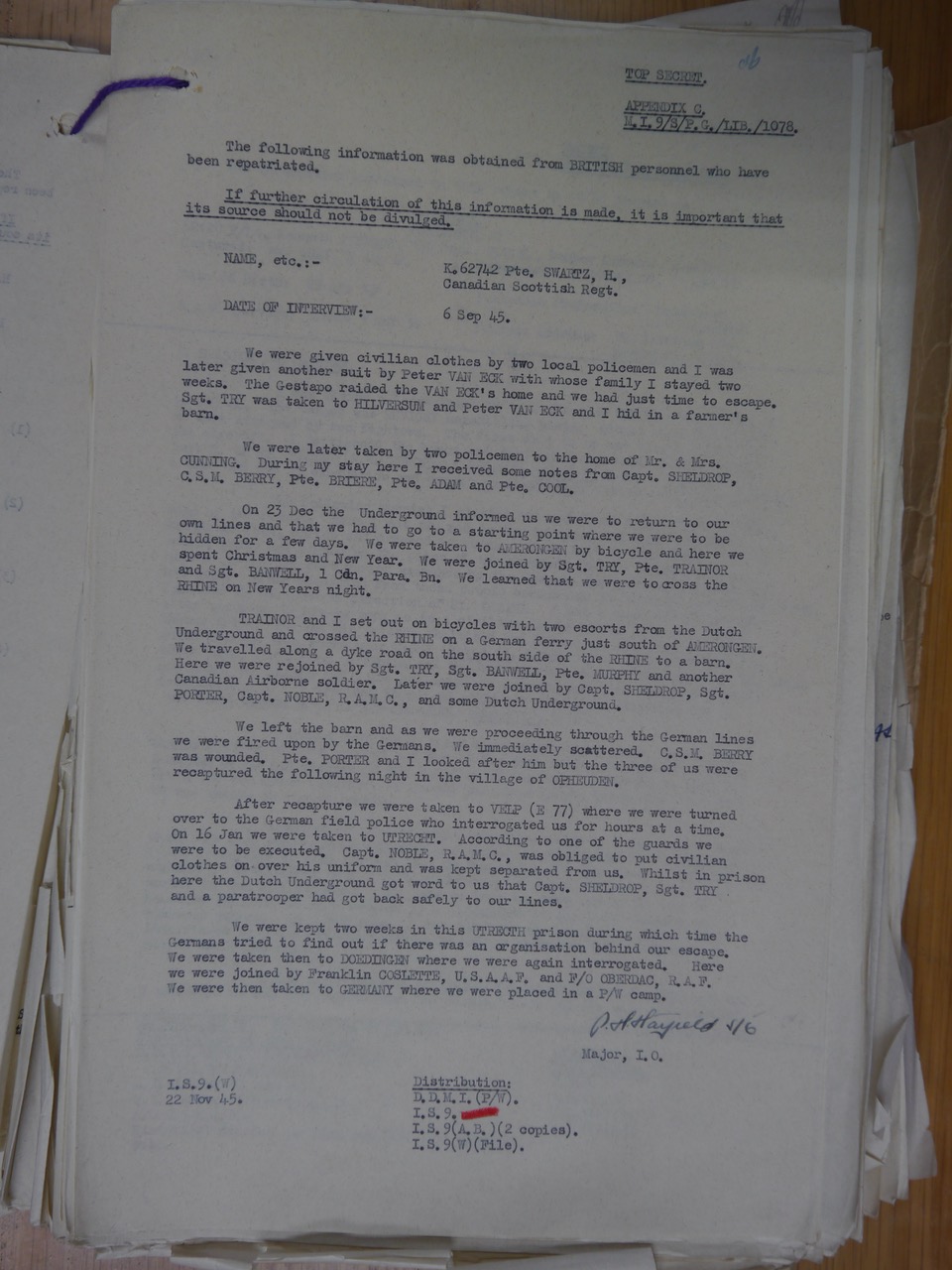
And in his questionnaire, "Methods: Prolonged questioning. Threatening." His dates: the Gestapo prison at Utrecht 18 January to 7 February 1945, Doetinchem 7 to 25 February, then "Dulag, Stalag XIB Falingbostel" from 28 February (Noble). ⚠︎ Swartz, taken in the same party, has "On 16 Jan we were taken to UTRECHT", with Noble held apart from the Canadians there (Swartz's Appendix C), two days before Noble's 18 January; Noble's own dates are marked approximate (Noble's page).
-
⚠︎ Noble's later account, told long after the war (unpublished private papers, shared with us privately), has a different road from his report, and more of it:
- The men who took him were "Luftwaffe personnel of the Hermann Goering Division"; they rowed him back over the Rhine to a headquarters "in Rhenen or Wageningen", where at three in the morning they were still at their New Year party, and their commandant took him "to their interrogation centre, because this was Luftwaffe, in Roosendaal".
- He was "interrogated every night in this house in Roosendaal" and taken each morning "with my hands tied on my back through Velp down to Arnhem" to a Feld Gendarmerie prison in a house, for "approximately three weeks"; the interrogator was "a Lieutenant Enk". They suspected he had come through from the British lines, and for a time that he was "Michael Dark, who was in charge of the SAS in the area around Wageningen".
- The Feld Gendarmerie man, through a young Obergefreiter acting as interpreter, told him that if he did not talk he was "going to go to the Sicherheitsdienst and finish up in some horrible place somewhere in Germany".
- His report has "Div HQ, Counter Intelligence at VELP" of the parachute division, and questioning "intensive during the first 2 weeks" (Noble). "Roosendaal" is in neither 1945 document. ◐ His "Roosendaal" is very likely Rozendaal, the village beside Velp, misspelt: the Wehrmacht had radio and radar direction-finding stations near Rozendaal (Velp in the war), and the town of Roosendaal is in North Brabant, nowhere near Velp or Arnhem.
-
⚠︎ Noble's later account of Utrecht and Doetinchem.
- He walked under guard from Arnhem to Ede and went on by cattle truck to Utrecht. At a first prison, "the wrong prison", the Canadians came in, whom he had not seen at Velp: "There were about five of them … These were the ones who had been on the dyke when we had been shot at".
- At the Wolvenplein, in prison clothes, "I was in the cell there for three weeks", alone: "The others were kept in two cells." Swartz has him "kept separated from us" (Appendix C).
- Then the Gestapo headquarters in the Nassaustraat, and that night by truck to Doetinchem: "a very unpleasant two weeks where there was no food. It was very cold, with one blanket in a wet cell". There he gave his name to Dutch staff, asking them to "Tell your people that I am here", which ◐ fits Frederik's contact (below). Then he was declared a prisoner of war and sent to Fallingbostel for a week.
-
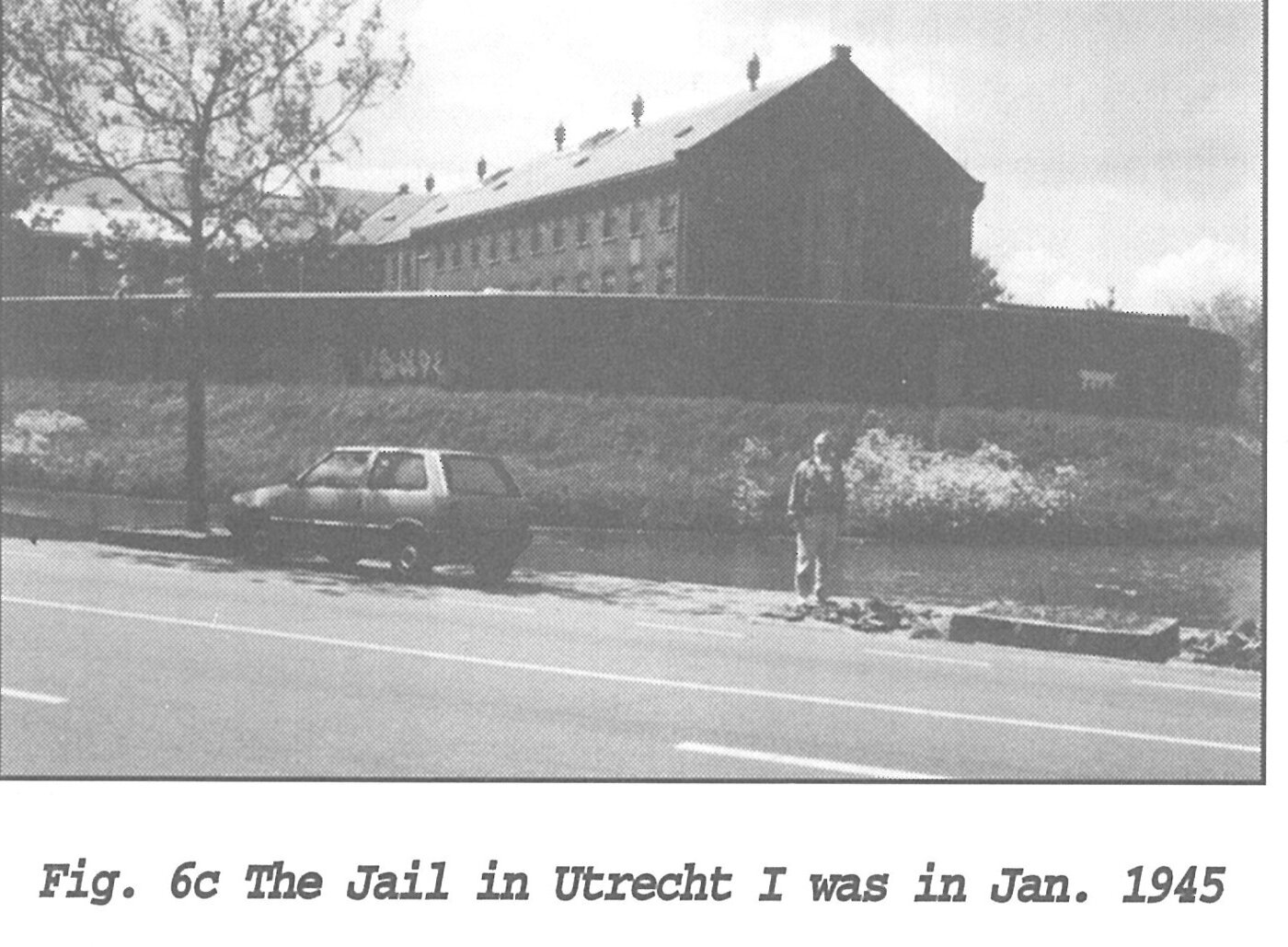
◐ The Dutch side has the group moving together: Maljers "with seven Allied soldiers" from Velp to the Wolvenplein prison in Utrecht after about three weeks, then to De Kruisberg at Doetinchem (Maljers). Noble is on the Doetinchem memorial foundation's list of Allied prisoners of De Kruisberg, "Charles Noble, Britse arts" (British doctor) (Doetinchem Herdenkt), which describes the place:
From 5 September 1944 to 27 March 1945 the Sicherheitsdienst held hundreds of people prisoner at De Kruisberg: men and women of the resistance, and Allied servicemen.
Dutch originalVan 5 september 1944 tot 27 maart 1945 hield de Sicherheitsdienst honderden mensen gevangen op De Kruisberg: mannen en vrouwen uit het verzet en geallieerde militairen.
A Canadian airman held there in December 1944 called it "an S.D. special prison for transients going to GERMANY" (Warren).
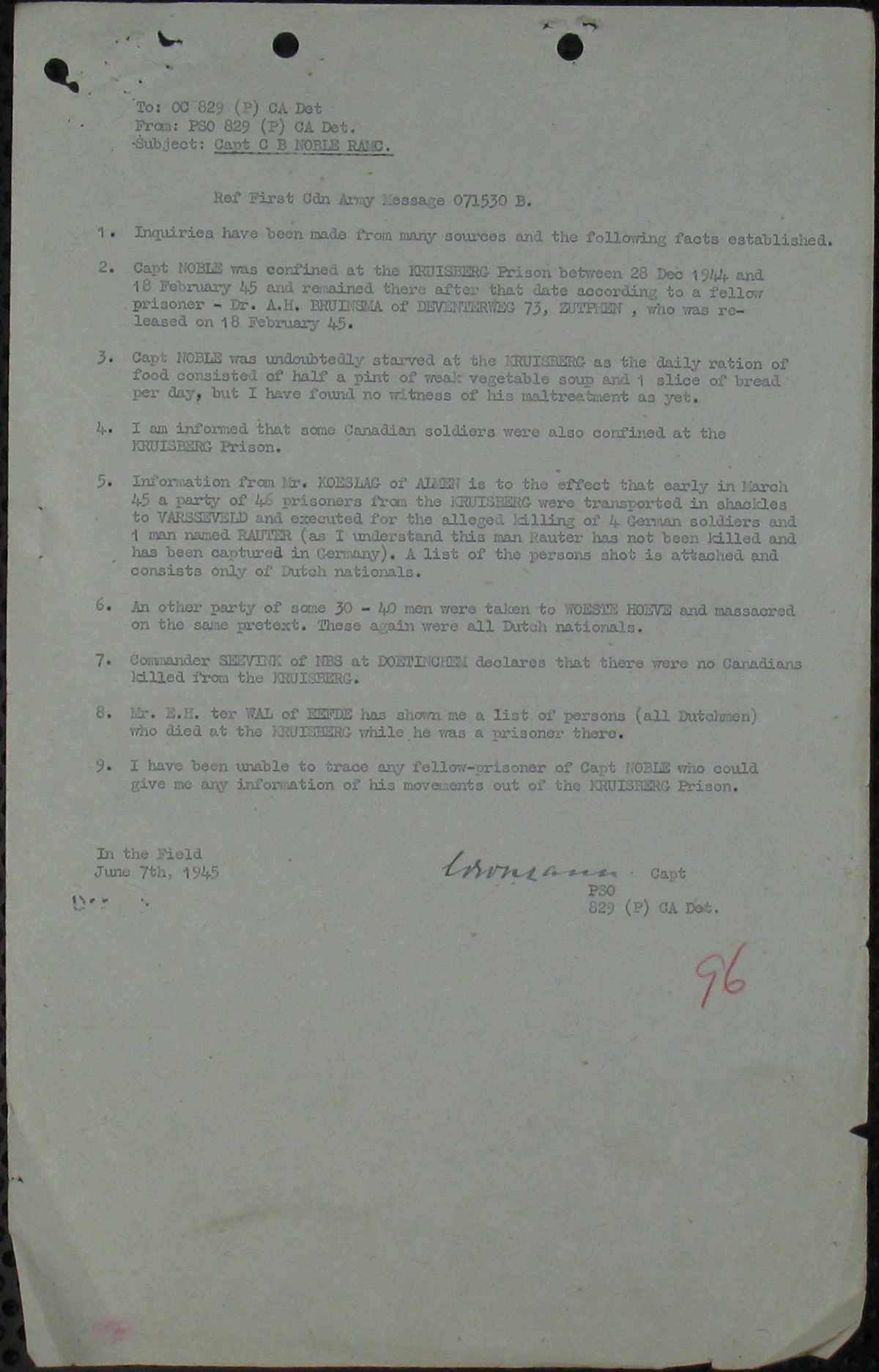
◐ Someone outside was trying to reach them. A helper from Aalten, "Frederik" (G. J. te Gussinklo), told the Americans that he had been in touch with ten Allied soldiers and officers held there, and by bribing an N.S.B. guard brought them food every day; a long account came out from "Captain Noble (van de R.A.M.C.)" of treatment "meer dan beestachtig" (worse than bestial), and a raid on the prison was being planned with the K.P. at Zutphen when the guard was caught and the contact was lost. The file names only Noble and a Flight-Sergeant Levick, "Briefjes met andere namen verloren gegaan" (notes with other names lost), so whether Murphy was among the ten is not known (Reussink's file, p. 8).
-
◐ Porter walked the same road and wrote it down (Porter):
- "a day or so" near the front, then "Wilf, Louis, Harvey, Marcel Briere, the Army Doctor and myself were taken to Arnhem" and held "in a house that the Germans had taken over" (p. 151);
- "They kept referring to us as spies and threatened to shoot us many times. They always let us know that we had no rights under the Geneva Convention" (p. 155);
- interrogation "at three or four o'clock in the morning" (p. 157);
- "a week or so" at Arnhem, then "a big prison in Utrecht called 'Wolvenplein Prison' where we were very well guarded, one for each of us … run by the German SS" (p. 159);
- "at least three weeks" there (p. 162); then Doetinchem, "the end of January" (p. 165).
- His letter to his mother of 15 May 1945, printed in the book, has the same road four months after it: "we were taken to Dodewaard and then to Felp", "interrogated for hours at a time, day or night", by men "trying to find out which Dutch people had hid us and helped us" (p. 224), and until the prisoner-of-war camp "we were always referred to as spies and terrorists" (p. 225) (chapter 11).
-
◐ And the one man among them who was treated as a soldier. Porter on the British army doctor:
had a double guard as he was always trying to escape … He had a little more freedom to do things than we had, as he was a major, and had been captured in uniform and with ID. The Germans were not threatening to shoot him and treated him as a proper POW
— Bob Porter, The Long Return, p. 153
⚠︎ Porter's doctor does not match Noble on two counts: Noble was a captain, and by his own report was taken "in civilian clothes" over uniform and kept in strict solitary (Noble's page). Porter may have taken the Germans' treatment of an officer and a doctor for proof that he had been caught in uniform. - ⚠︎ Noble's later account has him in the house at Arnhem by day, in a little room with a fire, and "a Canadian sergeant pilot as my servant", who had to make the fire and the bed. Porter, a Canadian flight sergeant but a bomb-aimer, has the doctor held "in the same house as us" (p. 153); neither names the other. - ⚠︎ The same account has Noble in civilian clothes over his wet uniform (above), and the Feld Gendarmerie giving him "a new jacket, new flannels and a new raincoat so that at least I was looking respectable", which may be what Porter saw as a man "perfectly dressed".
-
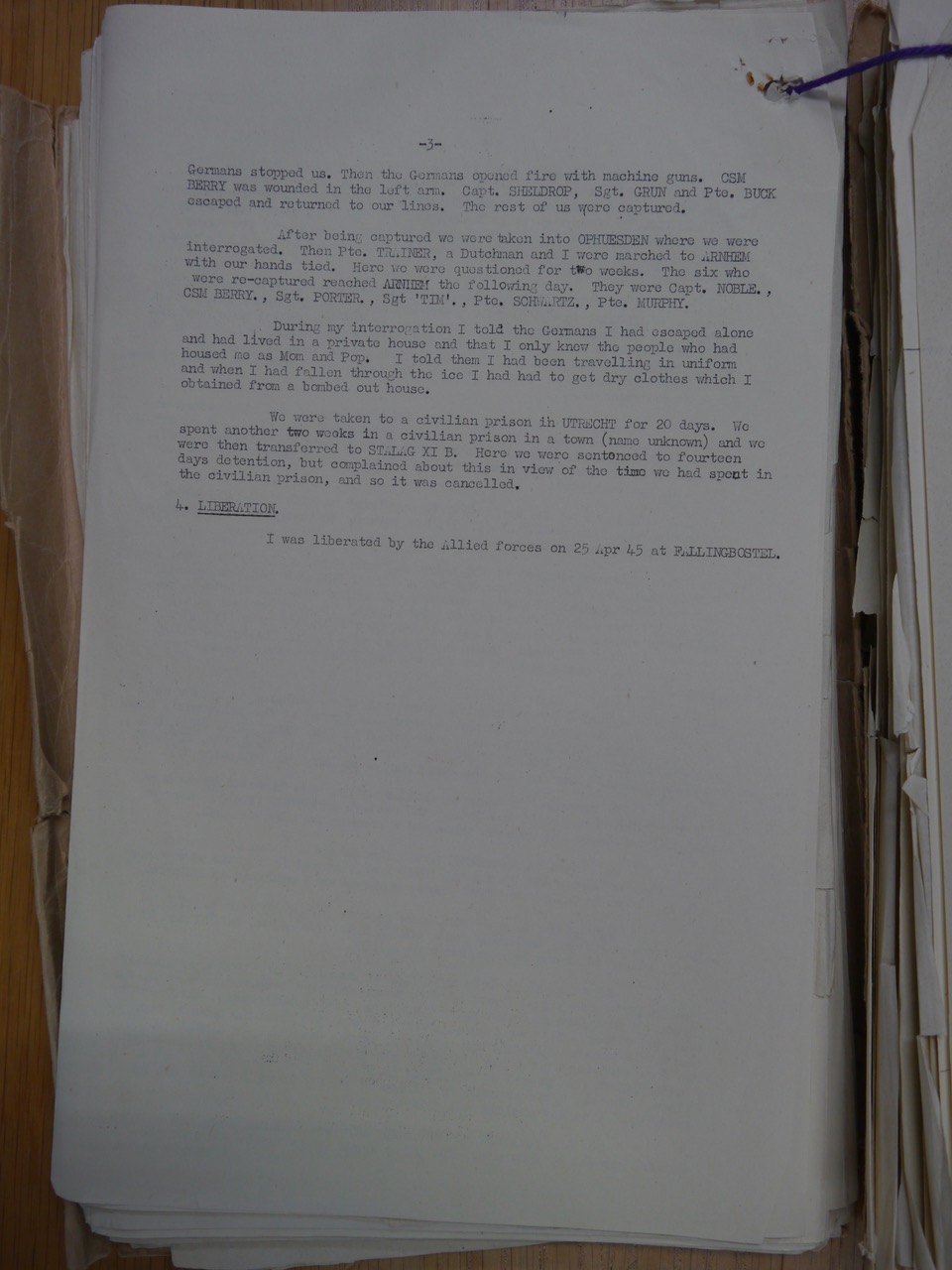
◐ One fellow prisoner puts him at Arnhem. Pte Marcel Briere's MI9 report of June 1945: "The six who were re-captured reached ARNHEM the following day", and the six end with "Pte. MURPHY" (the photograph, p. 3; The Canadians' own reports). Velp, where Noble and Banwell were questioned, adjoins Arnhem, and it fits Murphy's own "GWELF".
- The report does not date "the following day", or say where or with whom each was taken. Briere himself, Trainor and a Dutchman were marched to Arnhem ahead of the six.
- ◐ Four of the six put themselves at Velp in their own accounts: Noble, Berry, Swartz, and Porter in his letter ("Felp"); Murphy has his party taken to "GWELF" (above). ⚠︎ "Tim" rests on Briere alone.
- ⚠︎ Porter's book has a different six: "Wilf, Louis, Harvey, Marcel Briere, the Army Doctor and myself were taken to Arnhem" (p. 151), with Briere and Trainor, no Murphy and no "Tim" (Porter; Porter's page). Not reconciled: Briere's is a report of June 1945, Porter's a book written fifty years on.
-
⚠︎ Where the evidence stops.
- After the ambush Porter saw Berry, Trainor, Swartz, Briere and "the doctor from the Army", and "we didn't see any of the others" (p. 150); he never mentions Murphy or Banwell again.
- So the Wolvenplein and De Kruisberg are documented for five Canadians, Noble and the guide, and Arnhem for Murphy by Briere alone. Murphy is not on the Kruisberg list, which is a handful of names out of hundreds; he names neither prison; and nobody who was in them says he was. ⚠︎ Noble's later account has "about five" Canadians join him at Utrecht and names no British soldier with them. The British enquiry of June 1945 into Noble's treatment at the Kruisberg heard that "some Canadian soldiers were also confined" there, and names neither Murphy nor Banwell (the report).
- That he was one of Maljers's "seven Allied soldiers" fits the numbers, five Canadians, Noble, and one of Murphy or Banwell, and fits his own "marched under armed escort at 2 or 3 in the morning", which is Porter's "three or four o'clock" from the same weeks. It is a reading, not a record.
- The NBS intelligence service's lists of the Wolvenplein's prisoners survive at Het Utrechts Archief, item 113 for January–April 1945 and item 114 for September–October 1944 and February–April 1945, with those executed, transported or released; they are scanned but not open online, and would settle it (the catalogue).
-
The other Allied names on the Kruisberg list are not from the party: Johnny Warren, the Canadian airman held there in December 1944 (Warren), who was one of the seventeen who jumped from the moving train between Doetinchem and Ruurlo on the transport of 1/2 February 1945; Frank Coslett, an American; and Peter Whittaker, an RAF flight sergeant, hidden with a resistance group near Markelo, who was another of the seventeen who jumped from that train and was hidden at Halle until the liberation (Doetinchem Herdenkt; Peter Whittaker).
More from his account
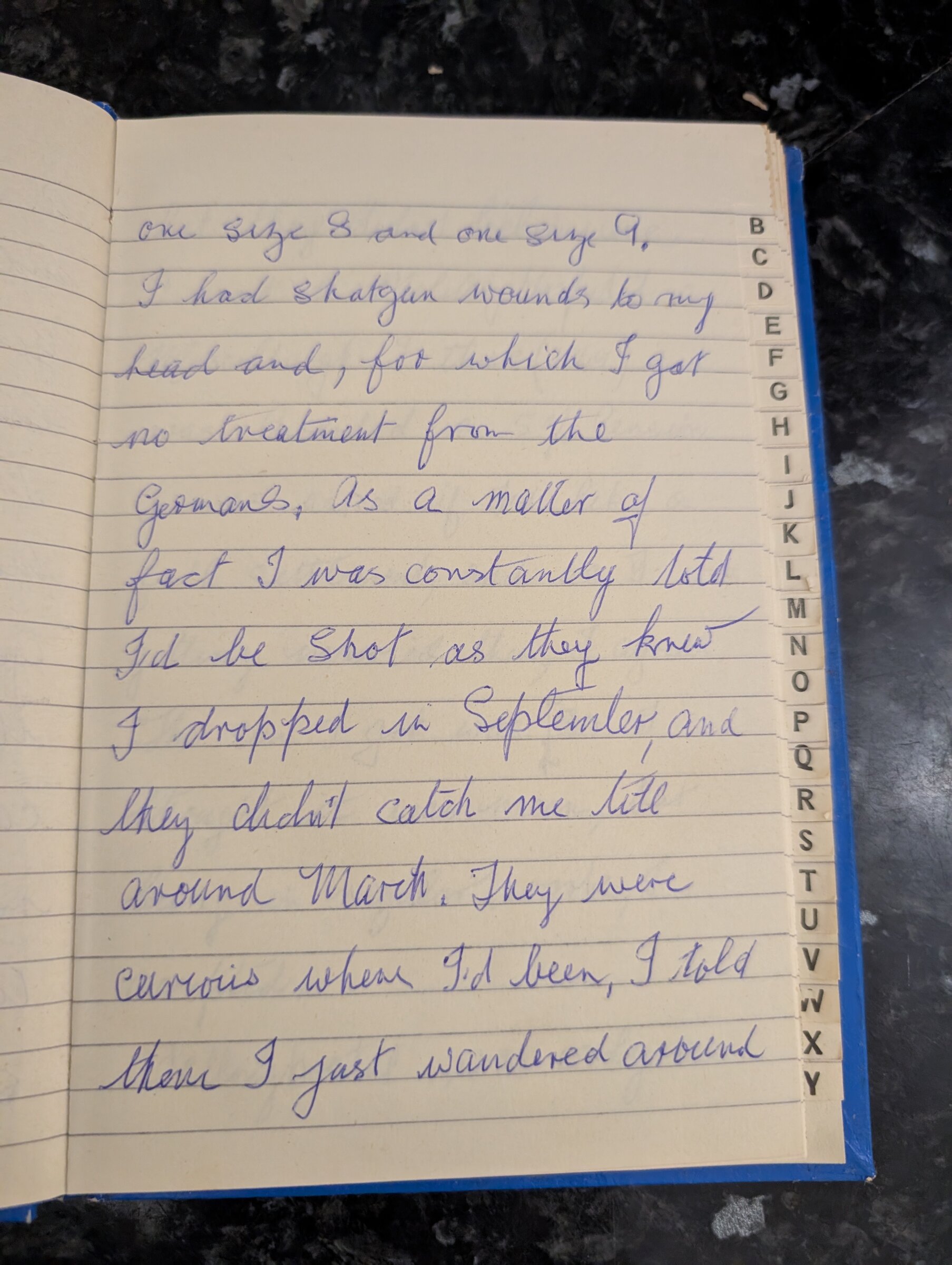
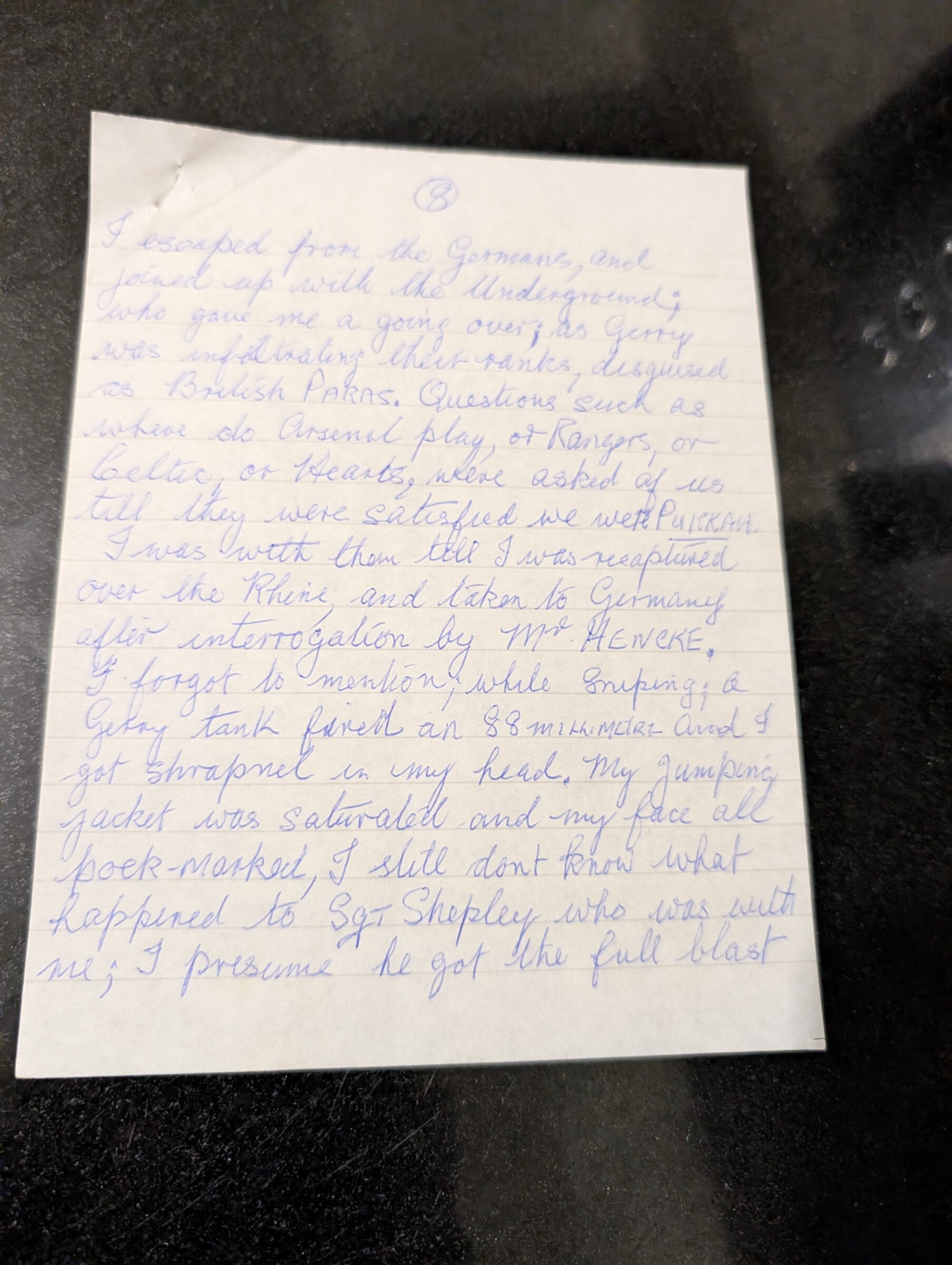
Link to the section More from his account- Interrogator named as Lieutenant Heweke, who "kept trying to trap me by asking how I survived from September until January. I kept telling him I lived in the woods and stole food to survive."
- Gave away nothing about the organisation.
- He says he disclosed nothing, though he was carrying the freshest possible knowledge of the line: the Esvelds (Gerald, Mrs Esveld, Flip and Coen) and the Amerongen ferry that same day, the Veermans (Jacob, Aaltje and Jopie), the guides.
- Not provable from a document, but consistent with everything on record: the Esvelds, Cornelisse and the guides who had passed him along were not arrested afterwards (Maljers, who led the crossing, was caught in the ambush itself), the Veerman arrest seven weeks later was for courier work (Achterveld), and the interrogator's line of questioning, as he reports it, was still trying to find out how he had survived.
- "Shotgun wounds to the head", untreated (notebook). Explained by his own p.8: shell splinters from an 88 mm round while sniping at Arnhem (Arnhem), carried untreated through the whole evasion.
- The interrogator is "Lieutenant Heweke" in the notes and "Mr Hencke" in the memoir (p.8): ◐ probably one man, spelt from memory, though no second source names him (Heweke).
- The "Tody Organisation" pressganging workers. Organisation Todt, which used forced labour on a vast scale (Wikipedia).
The German side
Link to the section The German sideNo German document about Murphy has been found: his POW card is not among the 232 Murphy cards in WO 416 (The National Archives, Kew), and the SD's own files from Velp did not survive in German hands. What does survive is the policy, in the orders the Nuremberg prosecution put in evidence against Keitel, and it describes his situation. A Keitel order of about September 1942 "provided that captured paratroopers were to be turned over to the SD" (553-PS); the Commando Order of 18 October 1942 (498-PS) was reaffirmed on 25 June 1944 after Normandy, when it had "become difficult to decide which paratroops should be considered sabotage troops under the terms of the order, and which should be considered as engaged in normal combat operations" (531-PS, 551-PS); and under the order that sent recaptured escapers of other nations to Mauthausen to be killed, "Americans and British who were recaptured might be turned over to the SIPO and SD, upon decision of the 'W.Kdos' from the OKW" (L-158) (Nuremberg summary, the US prosecution's volume, which cites the documents by number). ✓ That is the machinery. An escaped British paratrooper, recaptured in civilian clothes over uniform, armed with a Dutch police revolver, in a party that included Banwell, who had been "in communication with Capt. KING [an SAS officer] through the Underground" (Hardy), was exactly the case those orders left to the SD's discretion, which is where Noble's "Div HQ, Counter Intelligence at VELP" and the Gestapo prisons put him. ⚠︎ It explains the treatment he and Noble describe; it is not a record of it.
Liberation: April 1945
Link to the section Liberation: April 1945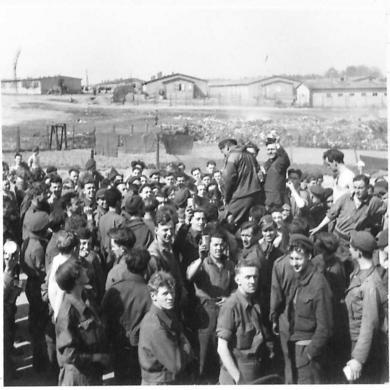
Camp: Stalag XI-B, Fallingbostel, his own typed notes: "STALAG 11 B - FALLINBOSTEL" (typed pp.1–3). This corrects the family's long reading of "Stalag II-B", which is Hammerstein in Pomerania (Wikipedia).
⚠︎ Arnhem prisoners are documented at the adjacent Stalag 357 (Oerbke), where they arrived in November 1944 under RSM John Lord (Wikipedia). The Arrowhead Club page, quoting a source it names, has the paratroops enter "the neighbouring Stalag XIB", where RSM Lord "took the conditions and discipline in Stalag XIB as a personal challenge" (The Arrowhead Club), and Lewis Kemp, taken at Arnhem, has himself at "Stalag 11b at Fallingbostel" under RSM Lord (Grier's page). Murphy was taken in January, not September, so he need not have gone with them; for him, his own note saying XI-B is the only evidence.
Liberation: 16 April 1945, by B Squadron 11th Hussars and the Reconnaissance Troop of the 8th Hussars, met at the gate of Stalag 357 by "a guard of Airborne troops, impeccably attired and led by RSM Lord" (Wikipedia). "The total freed from Stalags XIB and 357 was some 10,000 British and American prisoners, and 12,000 Allied nationals" (The Arrowhead Club). ⚠︎ German local histories give 13 April for the British arrival at the camp (relikte.com; German Wikipedia, whose own photograph caption says 16 April); the British accounts, the IWM photograph and the Canadians' liberation questionnaires all have the 16th. Bergen-Belsen was liberated the day before, 15 April 1945, by the British 11th Armoured Division (Wikipedia); ⚠︎ the distance between the two sites is not in either source. The memoir's dogs carrying human arms is his word alone; the geography makes it possible.
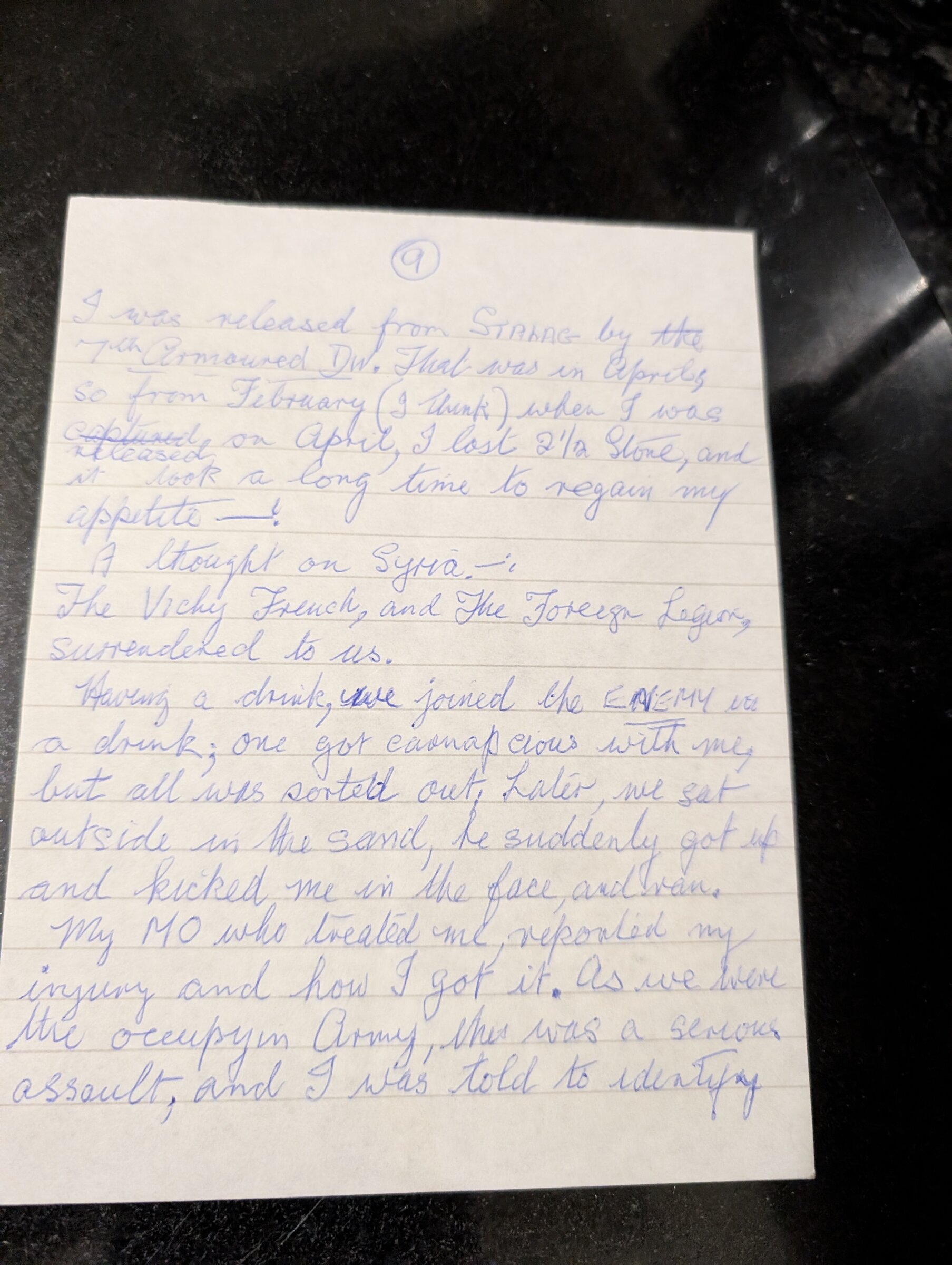
His own account: "I was released from Stalag by the 7th Armoured Div. That was in April, so from February (I think) when I was captured [struck out, "released" written beneath], on April, I lost 2½ stone, and it took a long time to regain my appetite" (p.9). ✓ The 11th Hussars who reached the Fallingbostel camps were 7th Armoured Division's (Arrowhead Club). ◐ "February": he was captured in January, and his own typed notes say so, but Noble, taken in the same net, reached Stalag XI-B on 28 February after eight weeks in German hands in Holland (Noble). Read as the month he arrived at the camp, which is where the 2½ stone came off, "from February" is right. ⚠︎ Murphy's own route between 3 January and the camp is undocumented.
◐ Another man of his battalion was freed there the same day: Thomas Lorne, shot and taken on Pegasus II in November, is in Kew's catalogue at Stalag XI-B, liberated 16 April 1945. No source puts the two together in the camp.
Of Belsen, his memoir says:
I've omitted the gruesome details, but the worst I seen, was when I was liberated, and went down the road to Belsen camp. It was horrendous (man's inhumanity to man). Amputations were many; I saw a dog run past me with an arm in its mouth
— Tom Murphy, his memoir, p. 10 (the page)
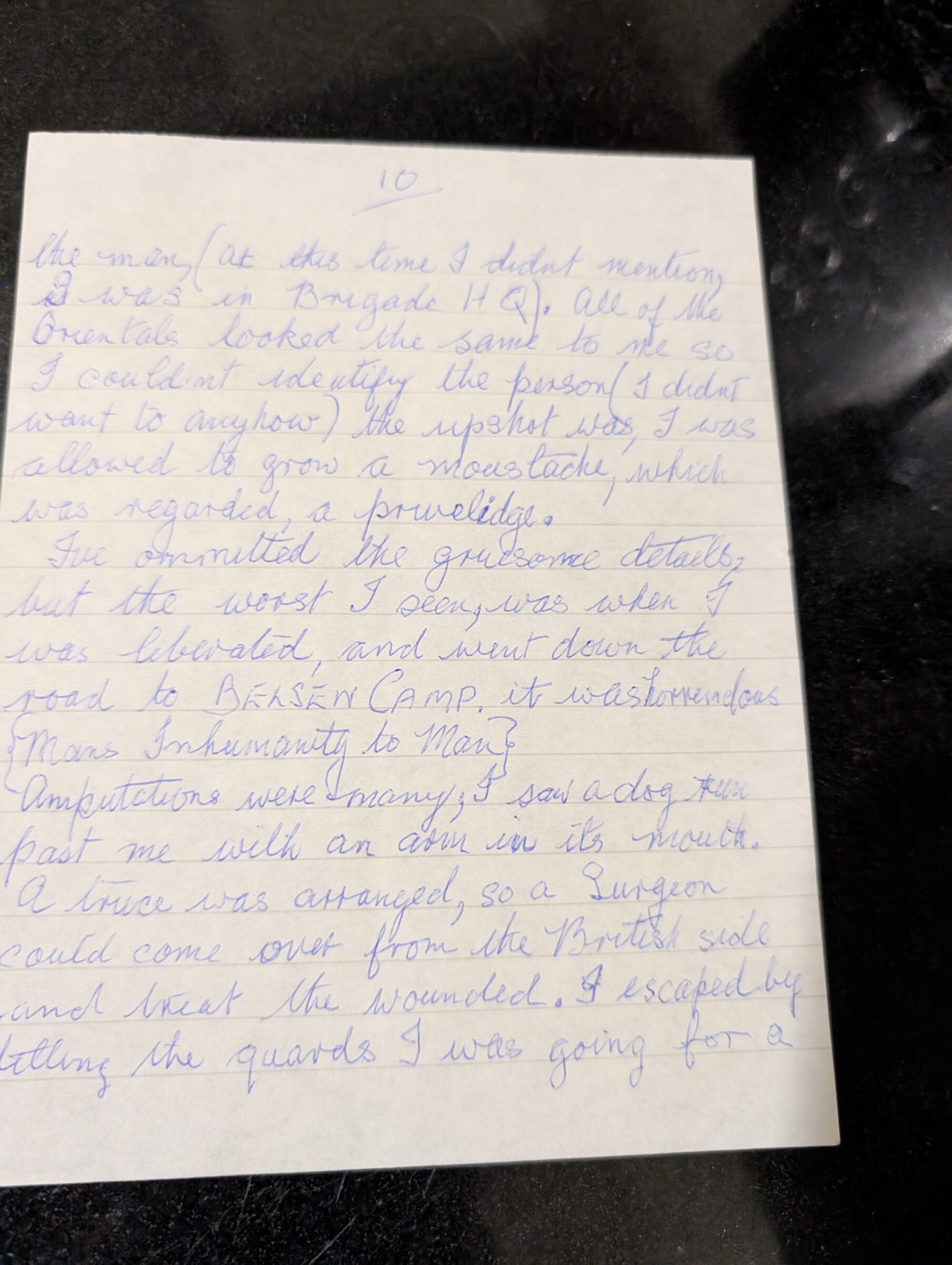
The notebook adds:
Fallingbostel was only a short walk to Belsen camp and what I saw there, still stays with me. They even brought around 20 Jews into our camp one cold morning, and hosed them down, naked. I just hid there and watched
— Tom Murphy, his notebook (the page)
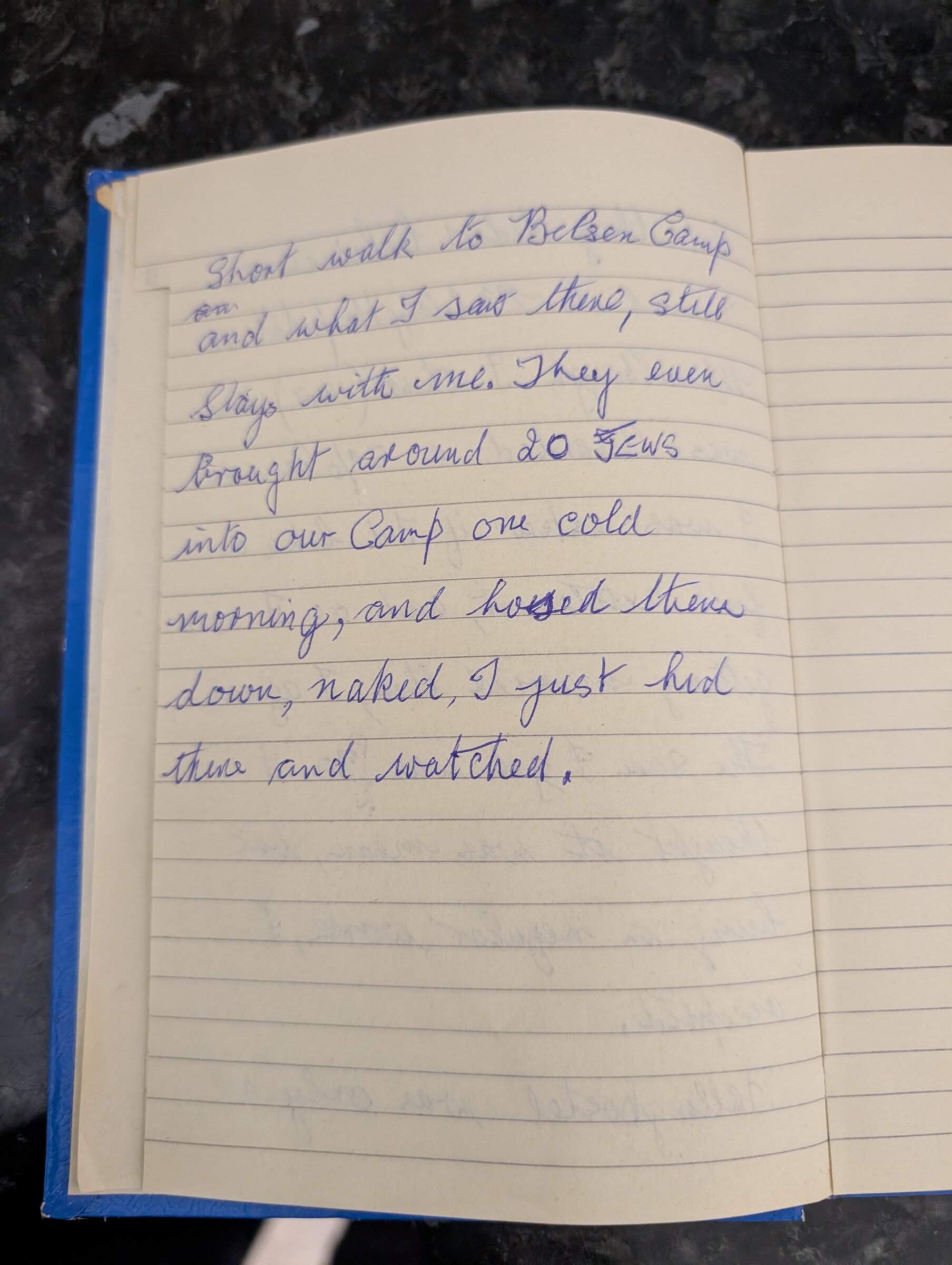
⚠︎ His word. How far apart the sites are is not in any source held, so "a short walk" is not checked here; the two camps were liberated a day apart by the same army.
The men taken with him
Link to the section The men taken with him✓ Two of the Canadian privates taken in the same net on 3 January, Harvey Swartz and Marcel Briere, were also liberated at Fallingbostel on 16 April 1945, by their MI9 liberation questionnaires; their sergeant major, Wilfred Berry, was liberated near Lübeck on 2 May (the catalogue entries). So his note's camp is where the other ranks of his party ended up. ⚠︎ How they got there is not the same road as his: the Canadians were still in Holland at the end of March (Porter, p. 176), weeks after Noble reached the camp. The questionnaires themselves, with their accounts of the capture and the prisons, are at Kew and not yet read (What we still don't know).
He arrived in the United Kingdom on 25 April 1945 (Record Office letter).
Killed on paper: the death notification
Link to the section Killed on paper: the death notification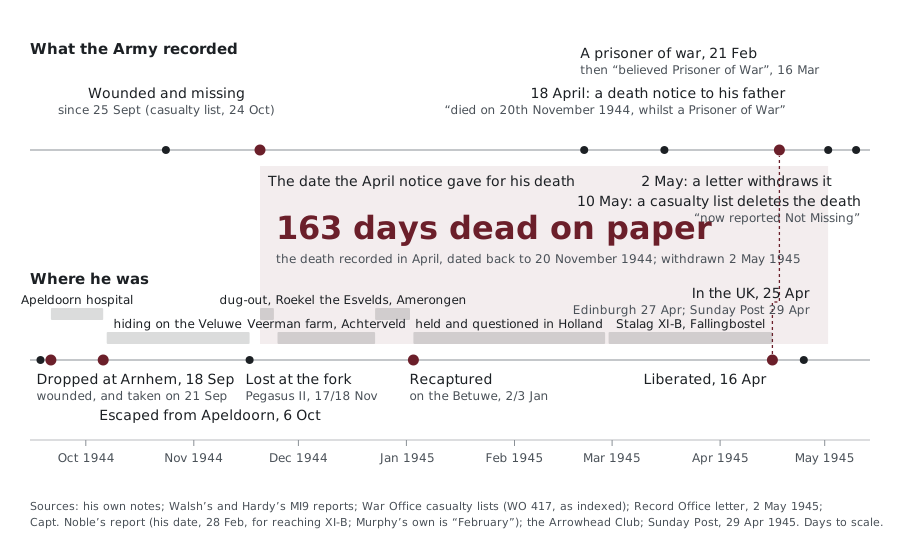
| Date | Event | Source |
|---|---|---|
| 24 Oct 1944 | His parents and his sister, Mrs Lyons, ask in the Edinburgh Evening News for news of him: "reported missing in Sept. slightly wounded in the head" | Edinburgh Evening News |
| 24 Oct 1944 | War Office Casualty List 1585: "Wounded and Missing" since 25 September, 156th Battalion | WO 417, as indexed |
| 17/18 Nov 1944 | Fails to make the Pegasus II rendezvous | Hardy |
| 20 Nov 1944 | The date the Army recorded as his death, "whilst a Prisoner of War" | Record Office letter |
| 2/3 Jan 1945 | Actually recaptured | Hardy |
| 15 Feb 1945 | Mrs Lyons announces in the same paper that he "is now a prisoner in Germany", thanking all who had asked | Edinburgh Evening News |
| 21 Feb 1945 | Casualty List 1687: "Now reported Prisoner of War in German hands (Germany)" (⚠︎ indexed under the Dorsetshire Regiment; the image is unseen) | WO 417, as indexed |
| 16 Mar 1945 | Casualty List 1707 corrects it to "Wounded and Missing believed Prisoner of War" | same |
| 16 Apr 1945 | Liberated | Wikipedia |
| 18 Apr 1945 | Death notification issued to his father, two days after he was freed | Record Office letter |
| 25 Apr 1945 | Arrives in the UK | same |
| 27 Apr 1945 | Parents meet him in Edinburgh ("on Friday") | Sunday Post |
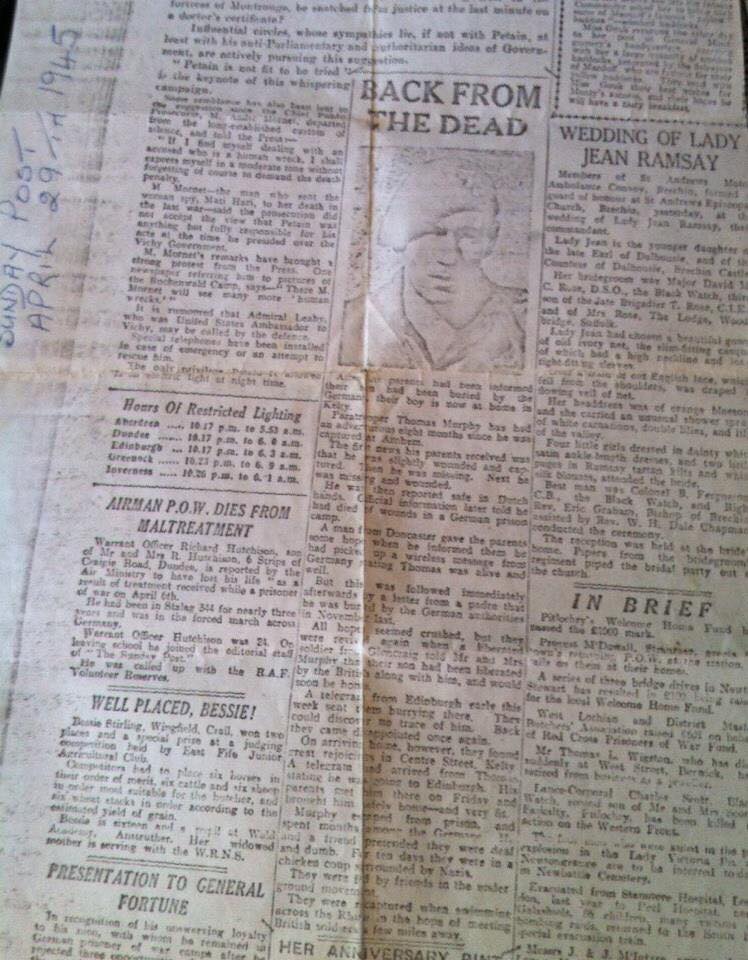
| 29 Apr 1945 | Sunday Post, "Back From The Dead" | scan |
| 2 May 1945 | Record Office formally withdraws the notification and asks for it back | scan |
| 2 May 1945 | Casualty List 1746, the same day as the letter: "Now reported died whilst Prisoner of War in German hands location unknown", 20 November 1944 | WO 417, as indexed |
| 3 May 1945 | Jacob Veerman drowns on the Cap Arcona | Neuengamme |
| 10 May 1945 | Casualty List 1753 deletes the death, "Soldier arrived in United Kingdom": "now reported Not Missing" | WO 417, as indexed |
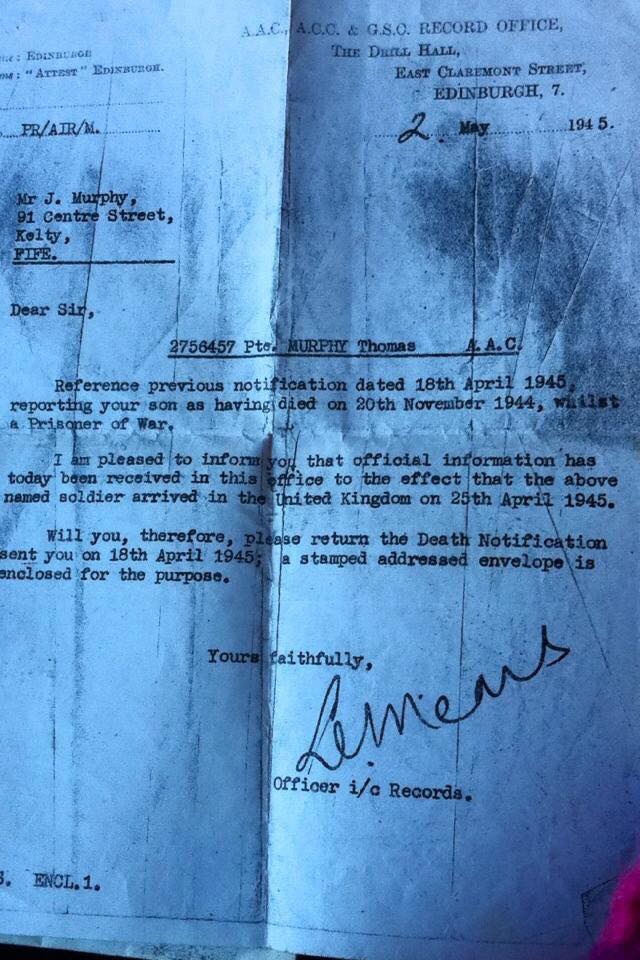
The letter itself:
2756457 Pte. MURPHY Thomas, A.A.C. — Reference previous notification dated 18th April 1945, reporting your son as having died on 20th November 1944, whilst a Prisoner of War. I am pleased to inform you that official information has today been received in this office to the effect that the above named soldier arrived in the United Kingdom on 25th April 1945. Will you, therefore, please return the Death Notification sent you on 18th April 1945; a stamped addressed envelope is enclosed for the purpose.
— A.A.C., A.C.C. & G.S.C. Record Office, East Claremont Street, Edinburgh · to Mr J. Murphy, 91 Centre Street, Kelty · 2 May 1945
What his parents were told, in order (Sunday Post). First that he was slightly wounded and captured; then missing; then missing and wounded; then safe in Dutch hands; then that he had died of wounds in a German prison camp. A man in Doncaster picked up a wireless message from Germany saying Thomas was alive and well. Then came a padre's letter saying he had been buried by the German authorities in November. Then a liberated soldier from Glencraig, a Fife village two miles from Kelty, told them their son had been freed alongside him. A telegram sent them to Edinburgh, where they found no trace of him. They came home to Kelty to find a telegram waiting, from Thomas.
◐ He also recalled that his mother drew his life insurance on his death certificate (notes). The death notice itself is documented. What the family believed went back and forth: in October 1944 his parents and his sister, Mrs Lyons, of Edinburgh, asked in the Edinburgh Evening News for news of him (the appeal), and on 15 February 1945 she announced there that he "is now a prisoner in Germany", thanking all who had asked (the notice). ◐ Which of the Sunday Post's steps that notice answers, the wireless message from Germany or another, is not said; the padre's letter and the death notification of 18 April came after it.