The papers
Everything the family holds in Thomas Murphy's own hand or typed from it, and the two 1945 documents, photographed in full. Click any page for the full-size scan. The whole set is also available as one PDF.
He wrote in c.1998, aged 78, on loose leaves and in a notebook, in the hospital where he was then living, and he was keen to get it down. His carer there typed the leaves up for him; the pencil corrections to the typing, made against his pages, are in another hand. Where the typed and handwritten versions differ, the record quotes the handwritten one.
Downloads
- Everything, as one PDF, all 37 pages in order, about 20 MB.
- The Sunday Post cutting, 29 April 1945
- The Record Office letter, 2 May 1945
- The army service list
- Every page below opens at full size when clicked; save it from there.
1945
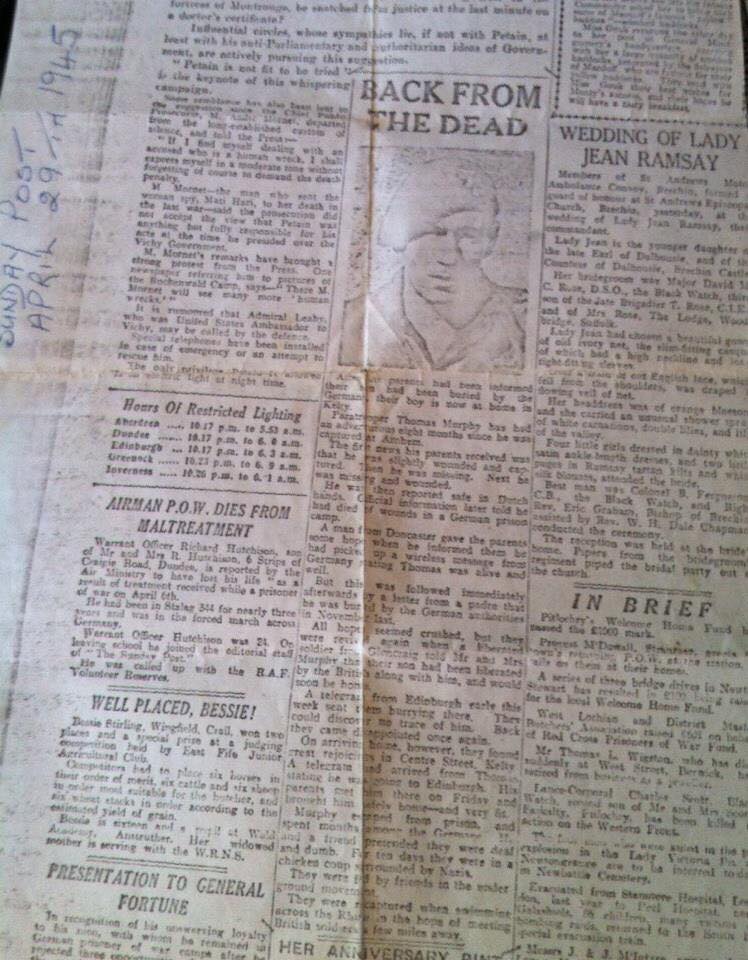
Sunday Post, 29 April 1945, "Back From The Dead", with his photograph, published four days after he reached home.
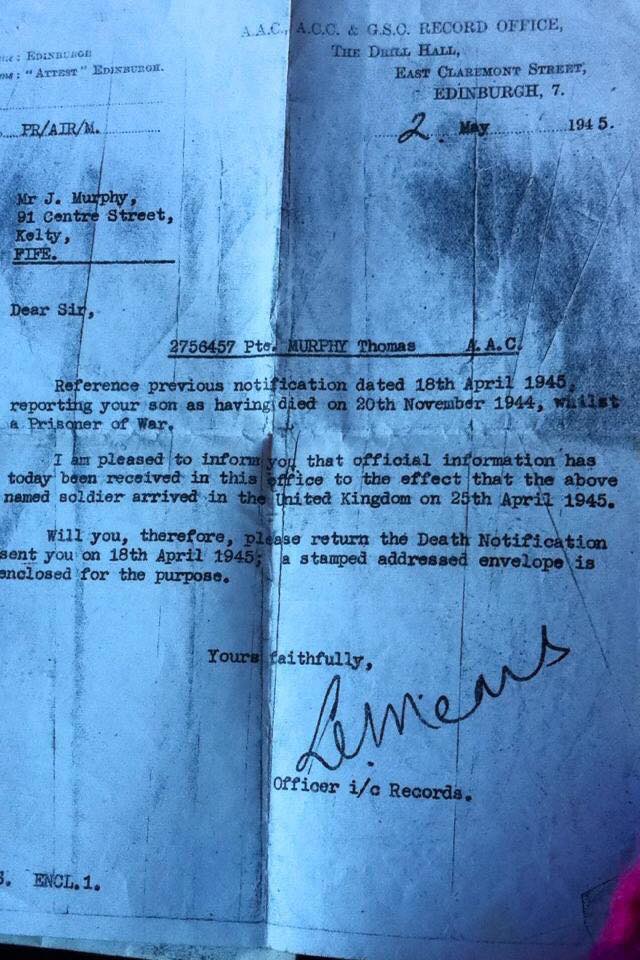
A.A.C. Record Office, Edinburgh, to his father, 2 May 1945: the letter withdrawing the death notification of 18 April, which had reported him dead on 20 November 1944.
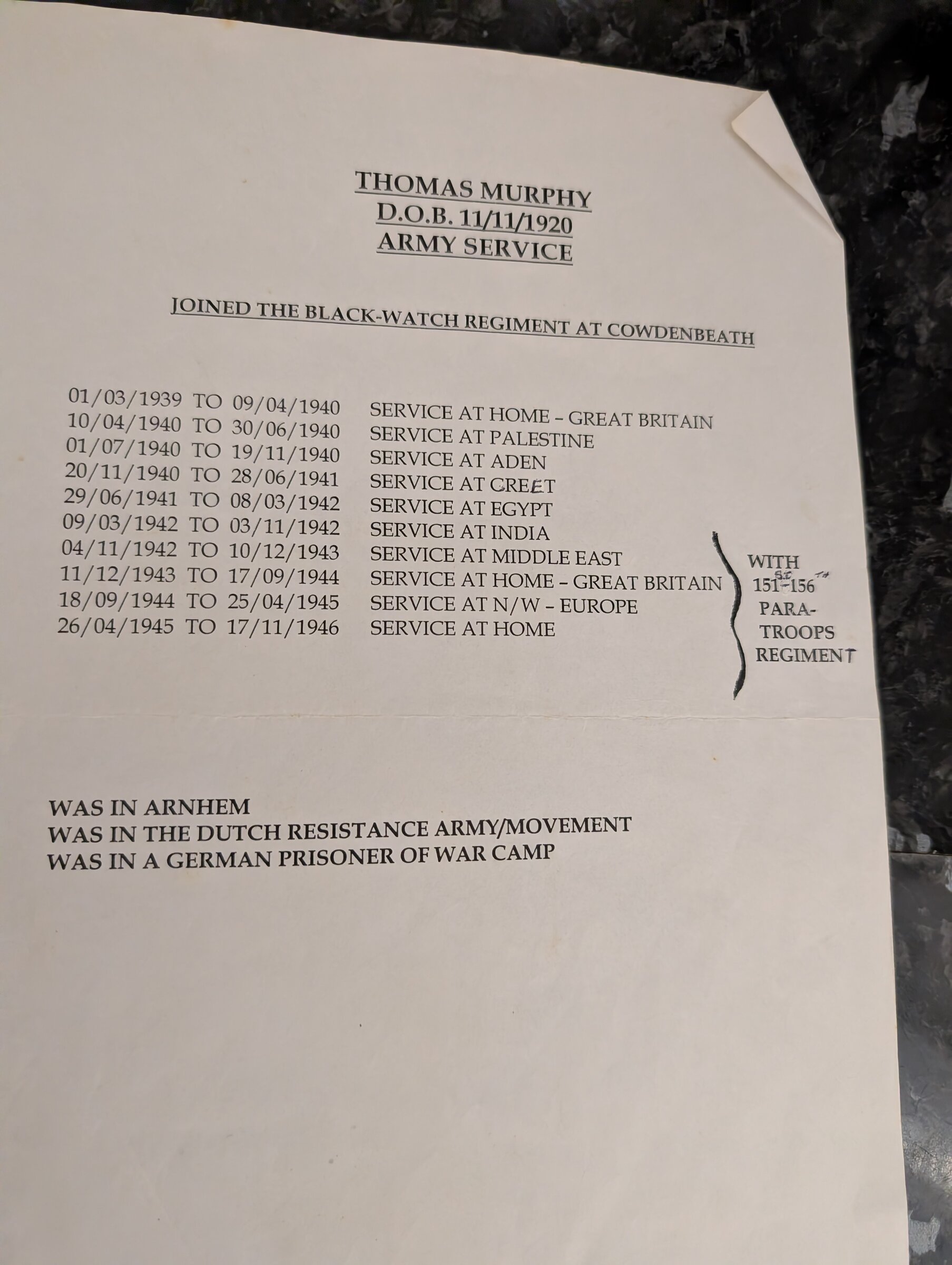
The typed army service list: date of birth, "joined the Black-Watch Regiment at Cowdenbeath", ten dated postings from 1 March 1939 to 17 November 1946, and the bracket "with 151st–156th Para-Troops Regiment".
The memoir: twelve handwritten pages
Numbered 1 to 12 in his hand, from enlistment to the Amerongen ferry. The typed transcript follows.
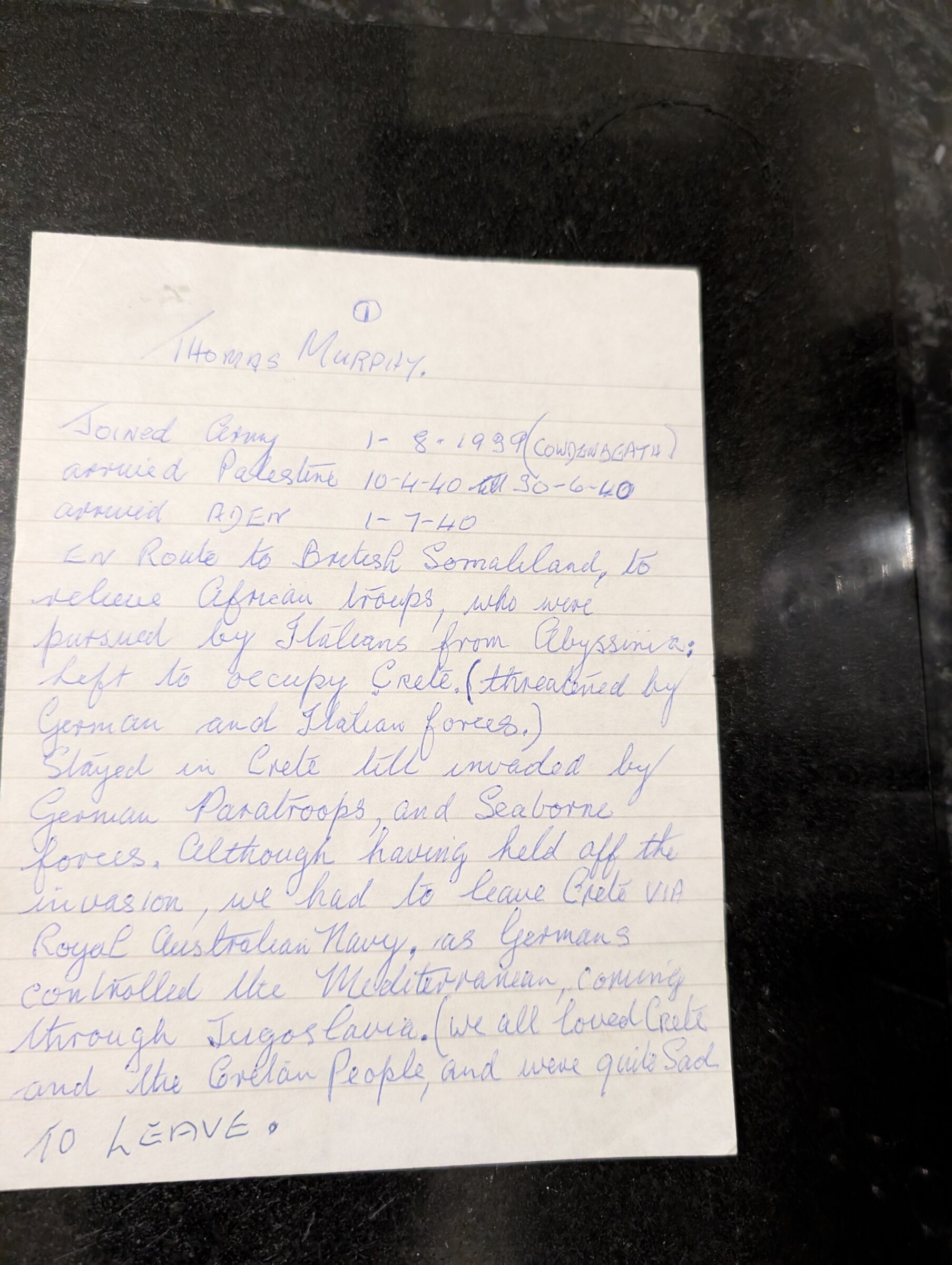
Page 1. "Joined Army 1-8-1939 (Cowdenbeath)"; Palestine, Aden; en route to British Somaliland; Crete, held until the German airborne and seaborne invasion, then out by the Royal Australian Navy. "We all loved Crete and the Cretan people, and were quite sad to leave."
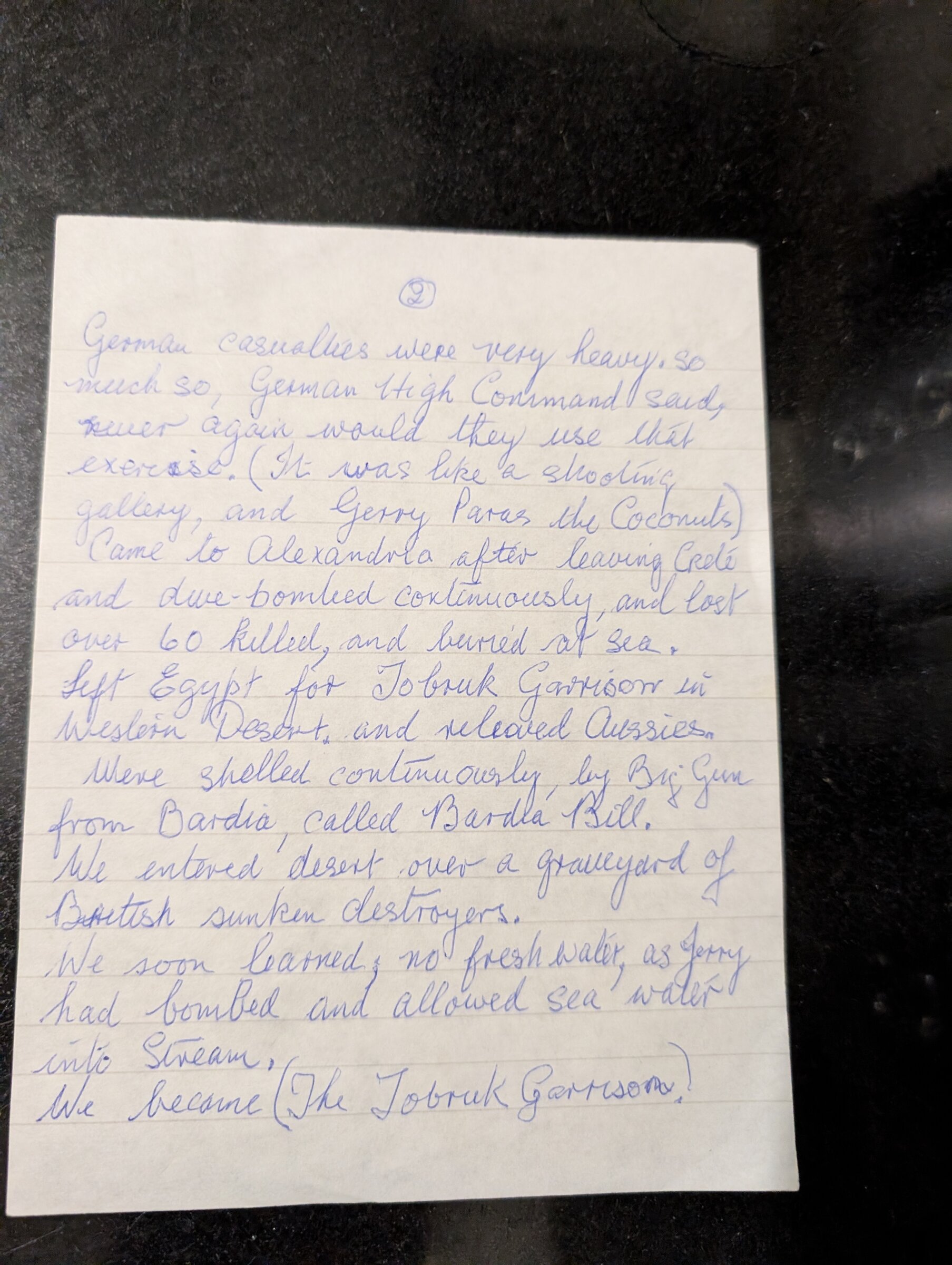
Page 2. German losses on Crete, "a shooting gallery, and Gerry paras the coconuts"; dive-bombed to Alexandria, "over 60 killed and buried at sea"; Tobruk, relieving the Australians; "Bardia Bill"; no fresh water. "We became the Tobruk Garrison."
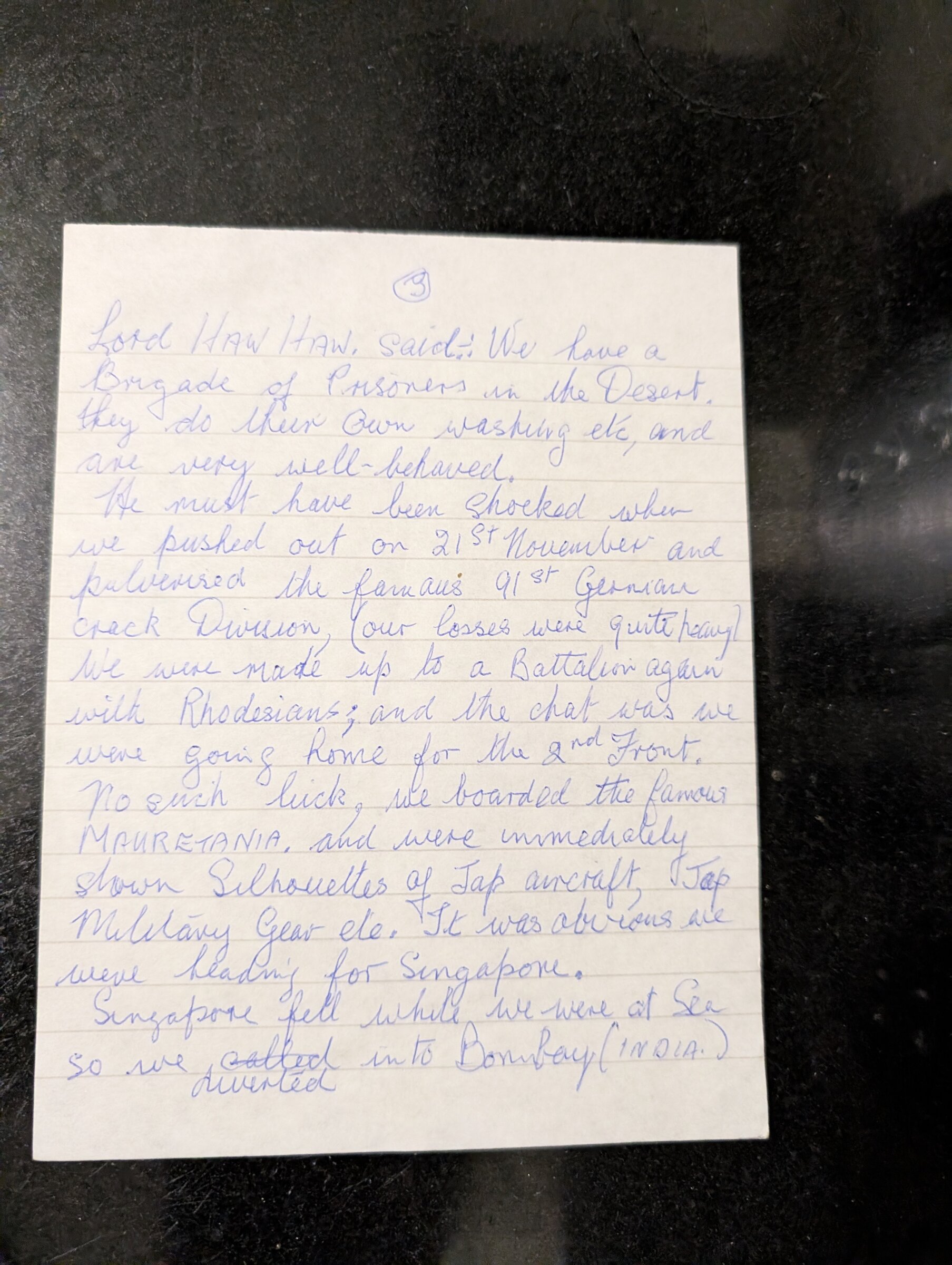
Page 3. Lord Haw-Haw on the "Brigade of Prisoners in the Desert"; the breakout of 21 November 1941; made up to a battalion again with Rhodesians; the Mauretania, silhouettes of Japanese aircraft, "it was obvious we were heading for Singapore. Singapore fell while we were at sea, so we diverted into Bombay."
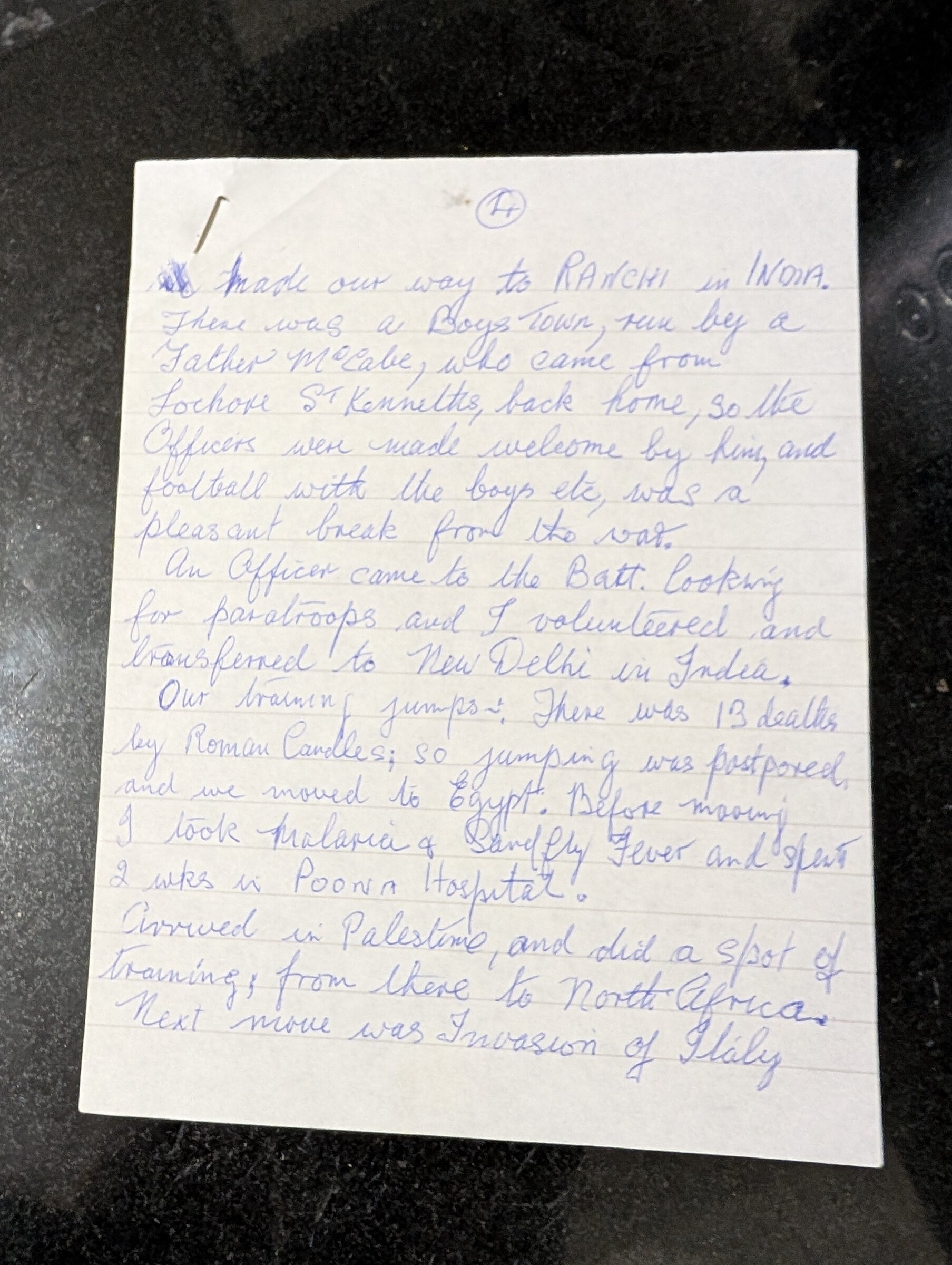
Page 4. Ranchi; a boys' town run by Father McCabe "from Lochore St Kenneth's back home"; an officer looking for paratroops, "I volunteered and transferred to New Delhi"; thirteen deaths in training by "Roman candles", jumping postponed, the move to Egypt; malaria and sandfly fever, two weeks in Poona hospital; Palestine, North Africa, Italy.
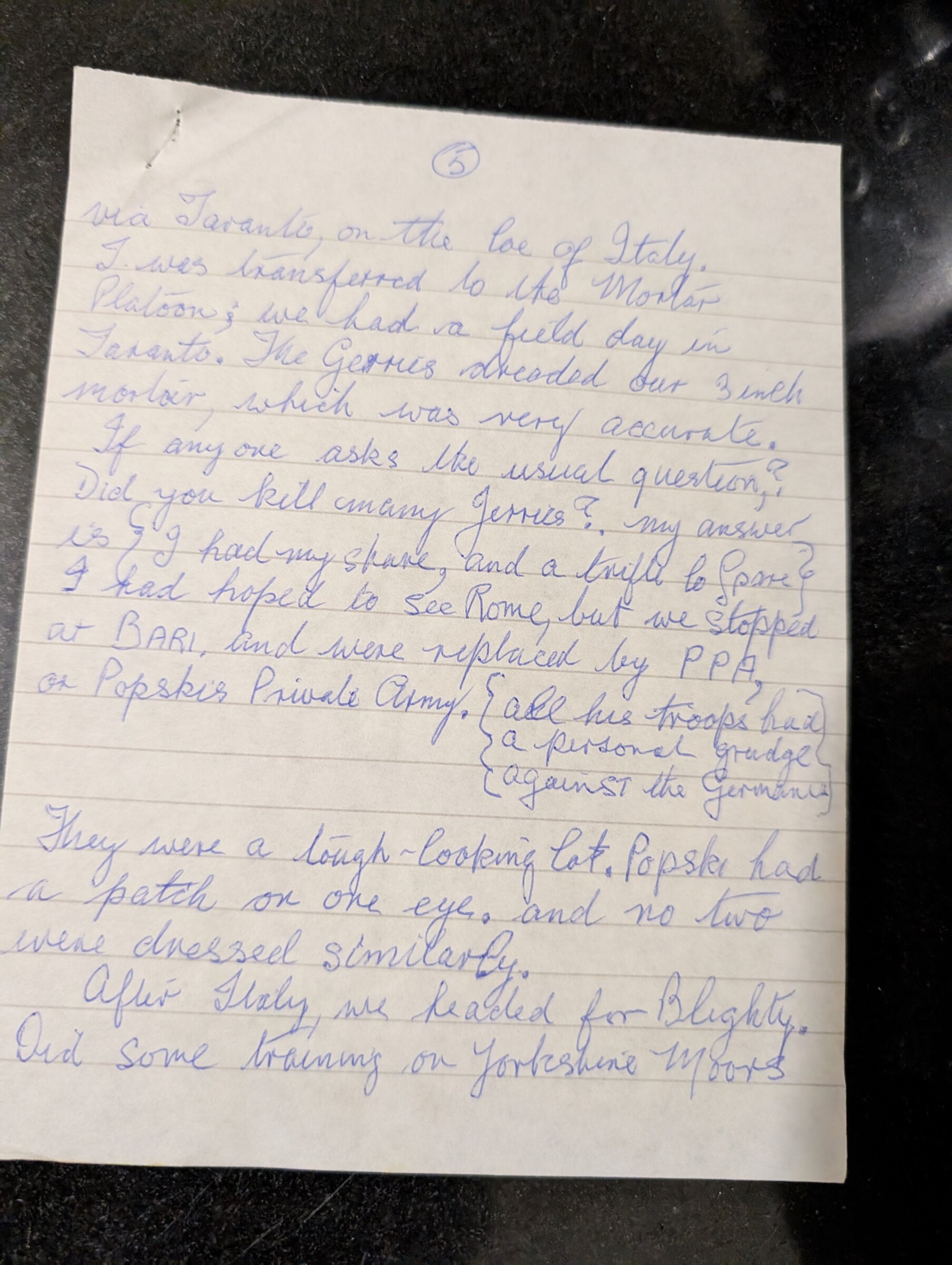
Page 5. Taranto; "I was transferred to the Mortar Platoon"; the 3-inch mortar; "Did you kill many Jerries? My answer is, I had my share and a trifle to spare"; Bari; relieved by Popski's Private Army, "a tough-looking lot"; home to Blighty and the Yorkshire Moors.
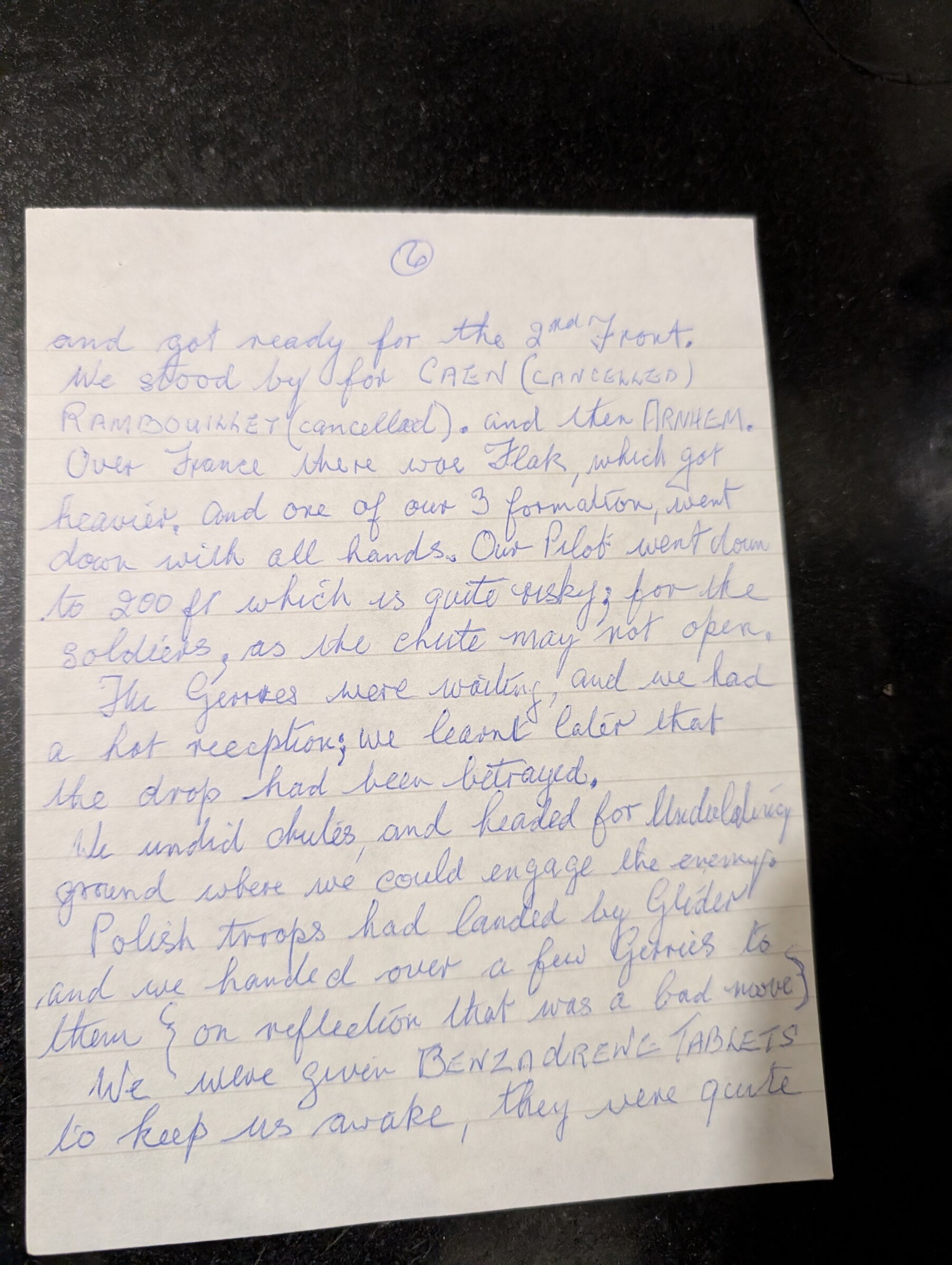
Page 6. Stood by for Caen (cancelled), Rambouillet (cancelled), then Arnhem; flak over France, one aircraft of the three lost with all hands; the pilot down to 200 feet; "we learnt later that the drop had been betrayed"; Polish glider troops; Benzedrine tablets.
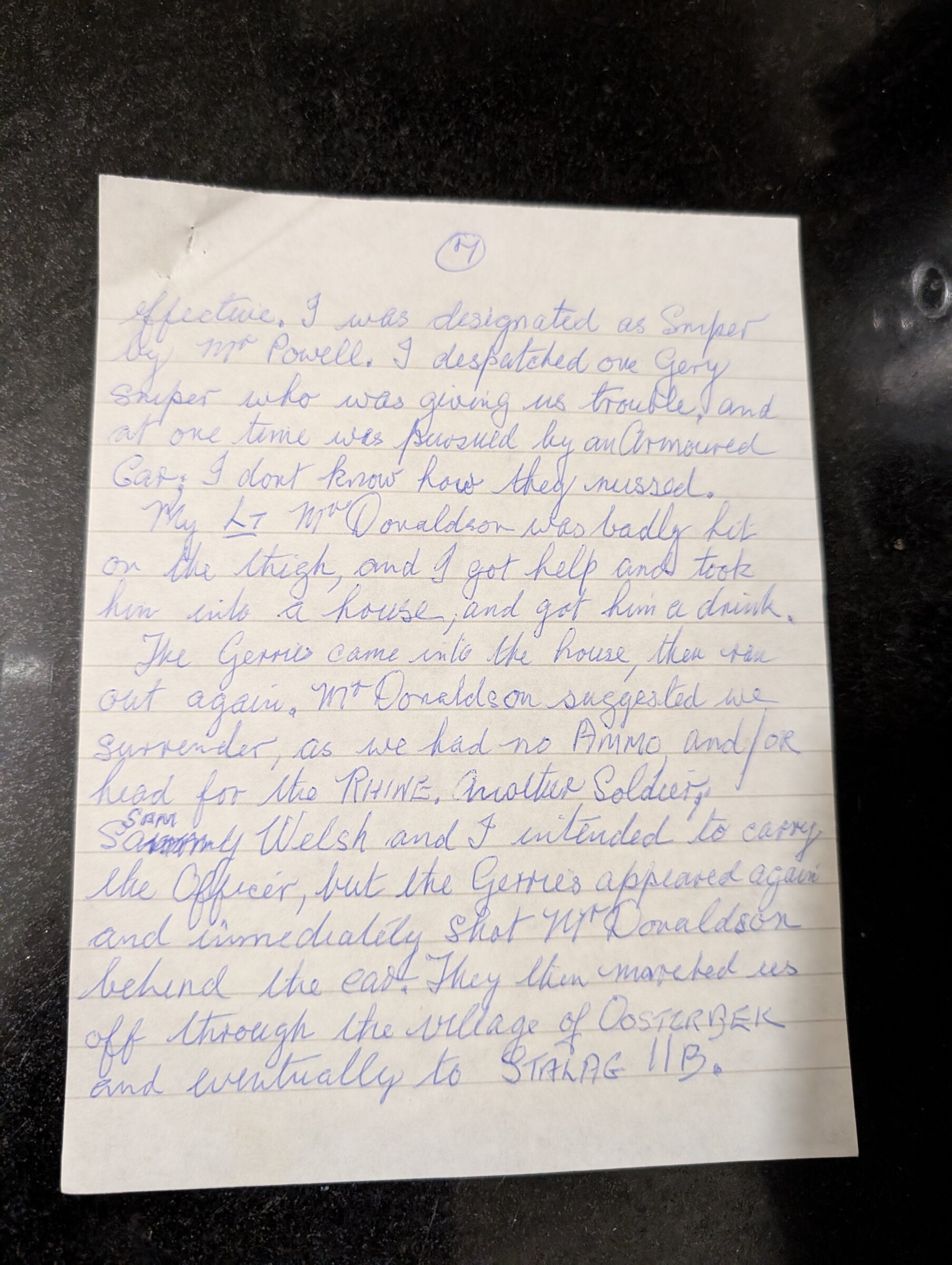
Page 7. "I was designated as Sniper by Mr Powell"; pursued by an armoured car; Lt Donaldson hit in the thigh, carried into a house; "Sam Welsh and I intended to carry the officer, but the Gerries appeared again and immediately shot Mr Donaldson behind the ear"; marched through Oosterbeek.
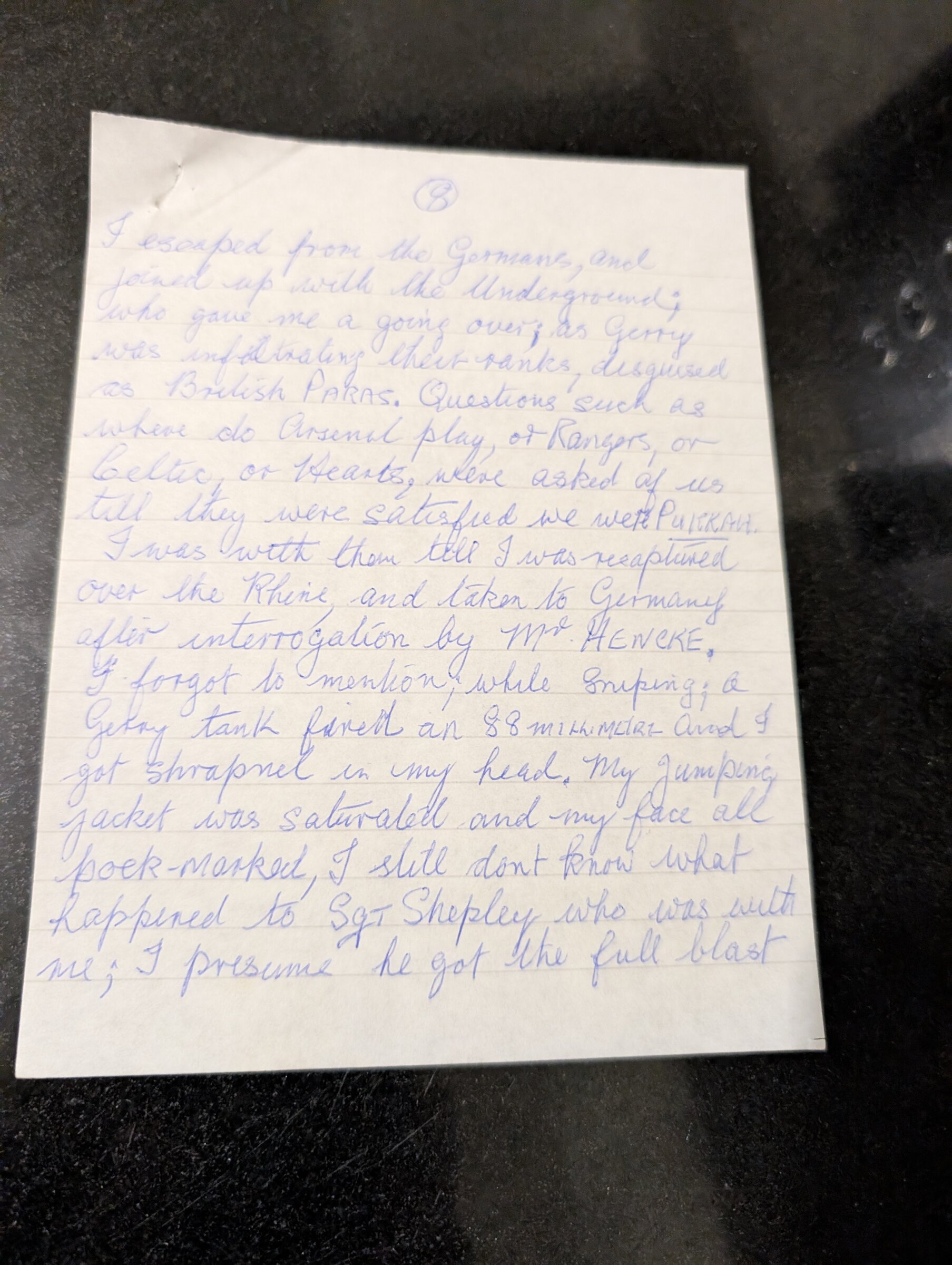
Page 8. The escape and the underground's vetting, "where do Arsenal play, or Rangers, or Celtic, or Hearts", until "they were satisfied we were pukkah"; recaptured over the Rhine, interrogated by "Mr Hencke"; the 88 mm shell while sniping, "I got shrapnel in my head"; Sgt Shepley, "I presume he got the full blast".
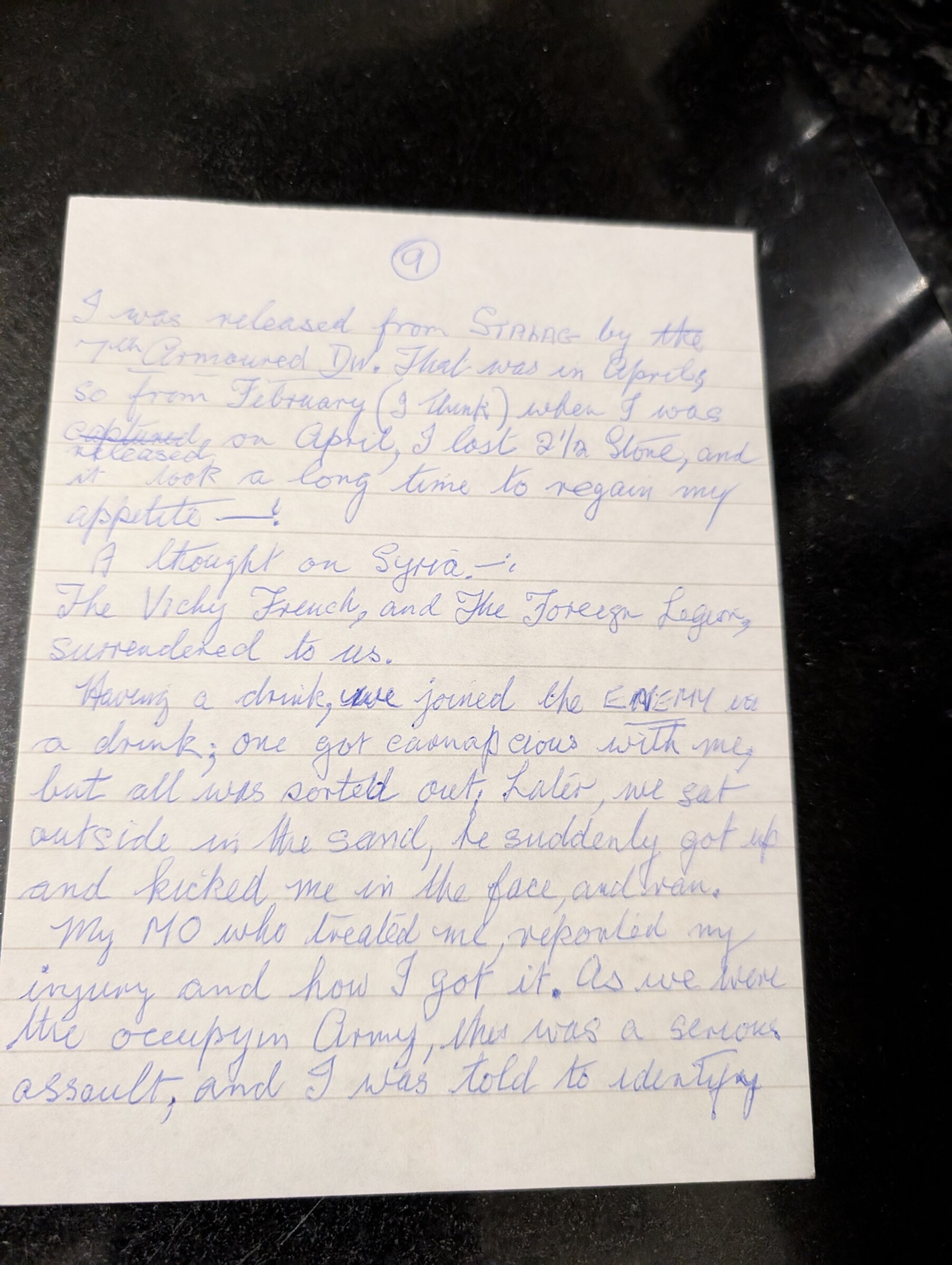
Page 9. Released from the Stalag by the 7th Armoured Division in April; two and a half stone lost; "A thought on Syria": the Vichy French and the Foreign Legion surrendering, a drink with the enemy and a kick in the face.
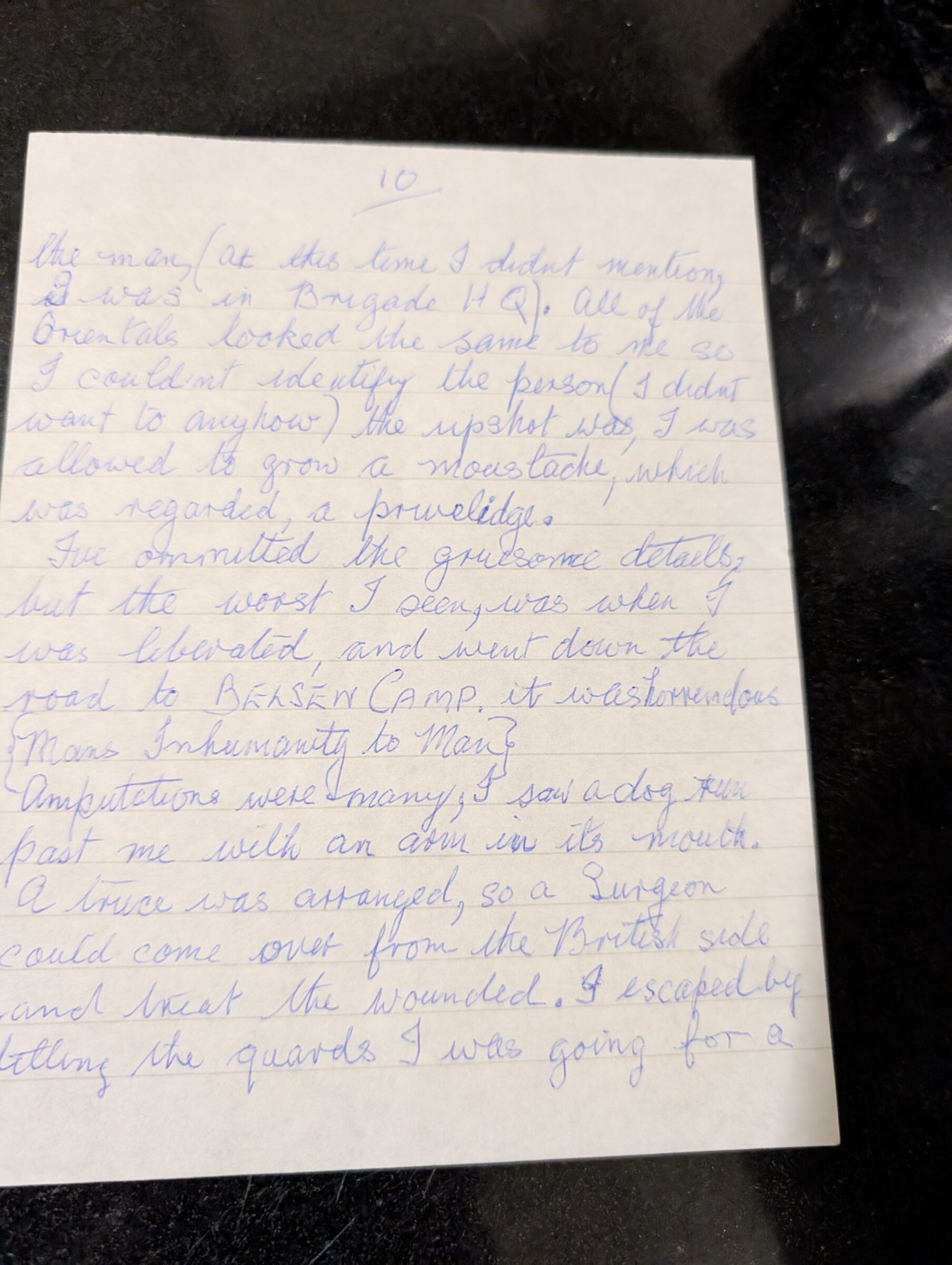
Page 10. Brigade HQ and the moustache; "the worst I seen, was when I was liberated, and went down the road to Belsen camp"; the dog with an arm in its mouth; the truce for a surgeon from the British side; the escape begins.
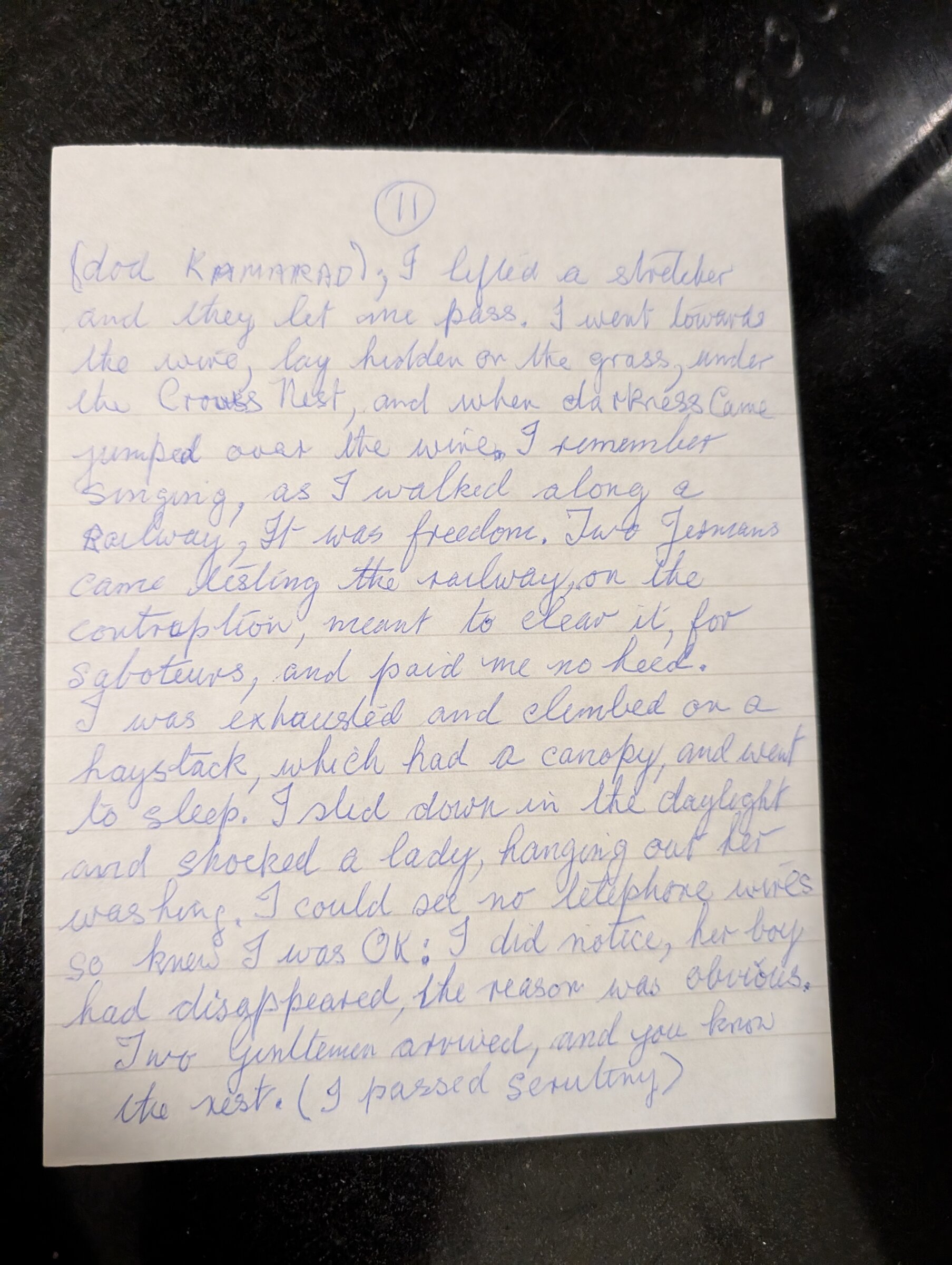
Page 11. The stretcher, the wire, the crow's nest, over at dark; singing along a railway, "it was freedom"; the haystack; the lady hanging out her washing, "I could see no telephone wires so knew I was OK"; "two gentlemen arrived, and you know the rest."
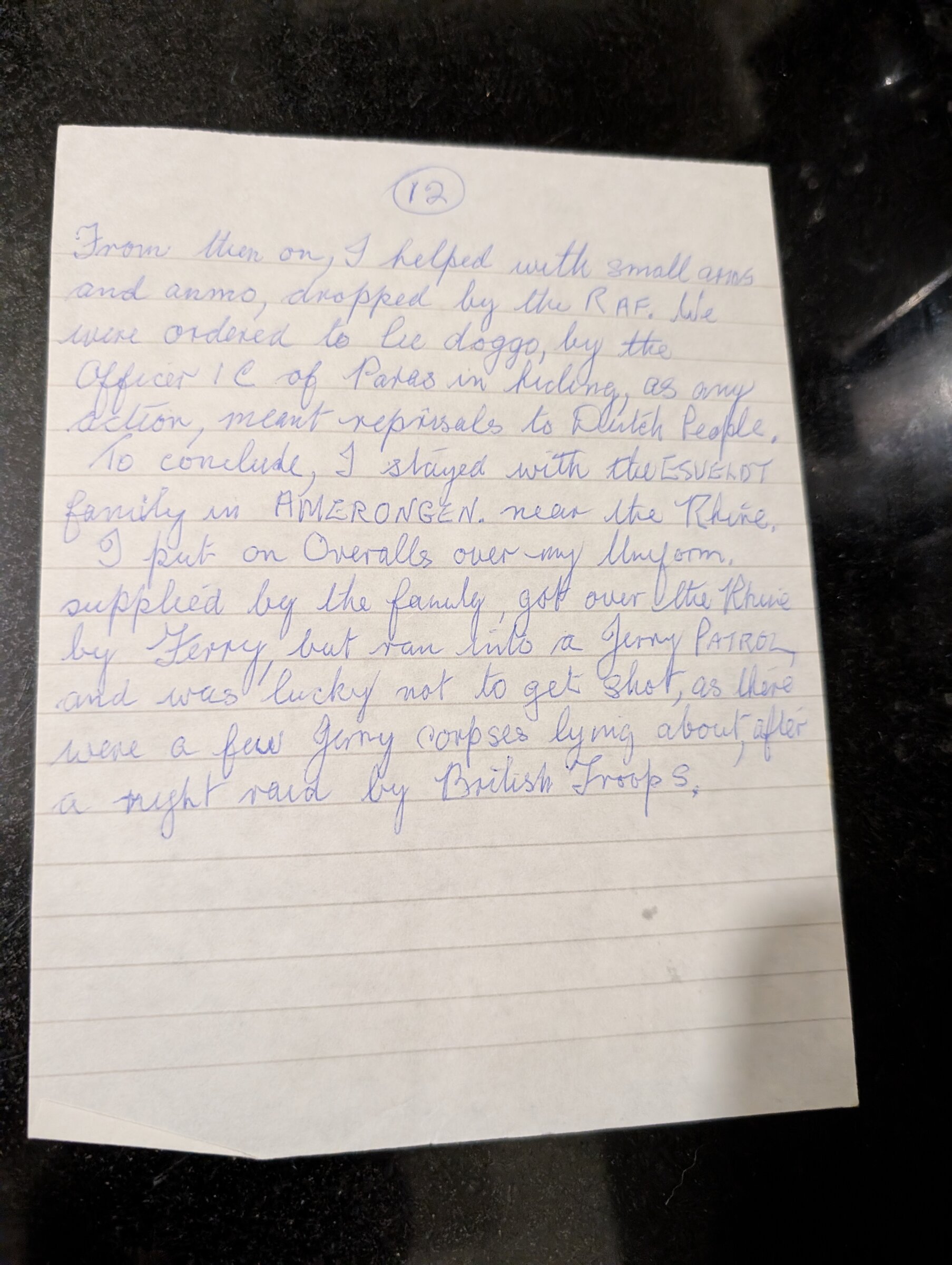
Page 12. Small arms and ammunition dropped by the RAF; ordered to lie doggo to spare the Dutch reprisals; "I stayed with the Esveldt family in Amerongen near the Rhine"; over by ferry; the German patrol and the corpses from a night raid.
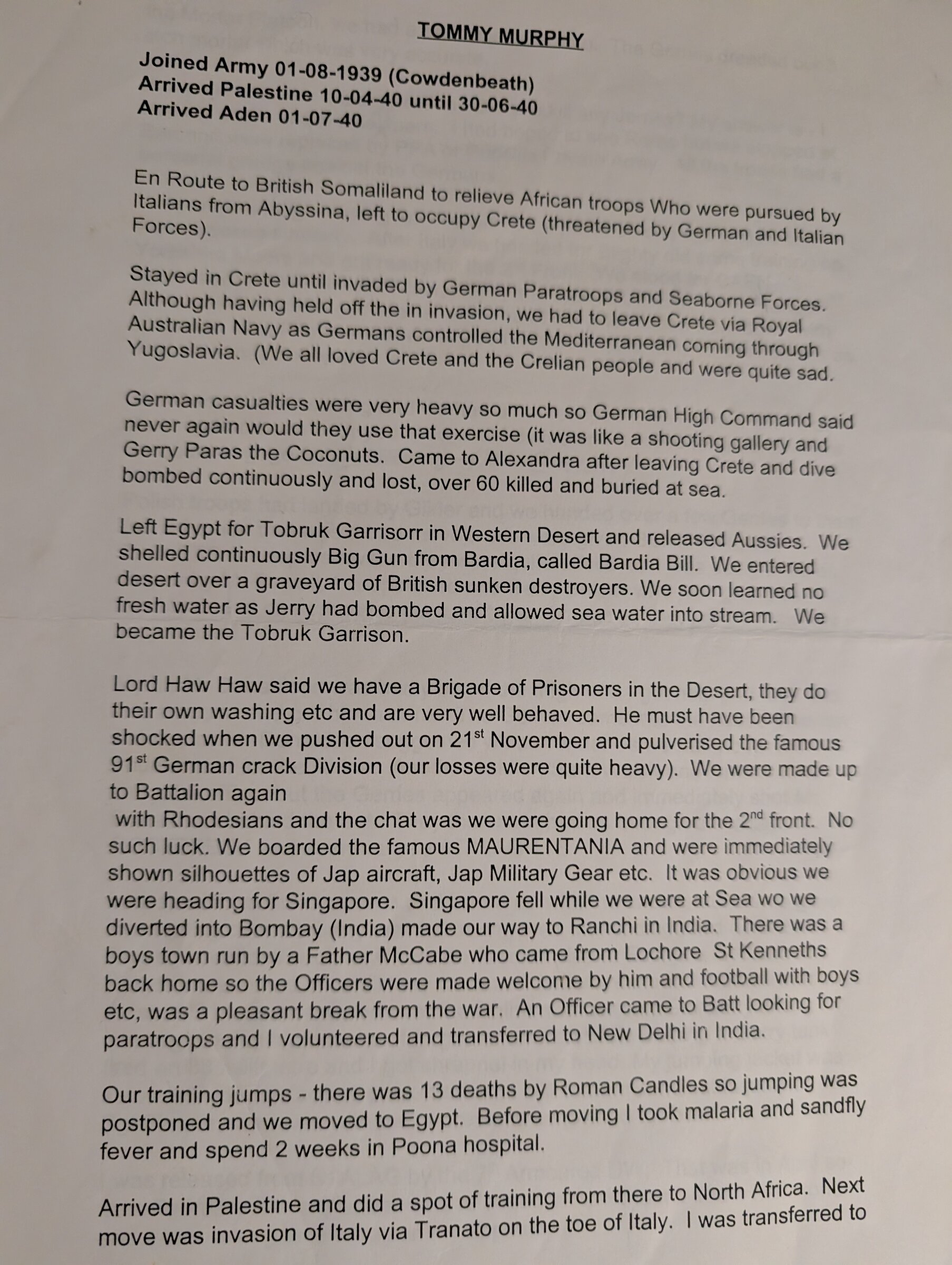
The typed transcript of pages 1 to 4, headed "Tommy Murphy": "Joined Army 01-08-1939 (Cowdenbeath)".
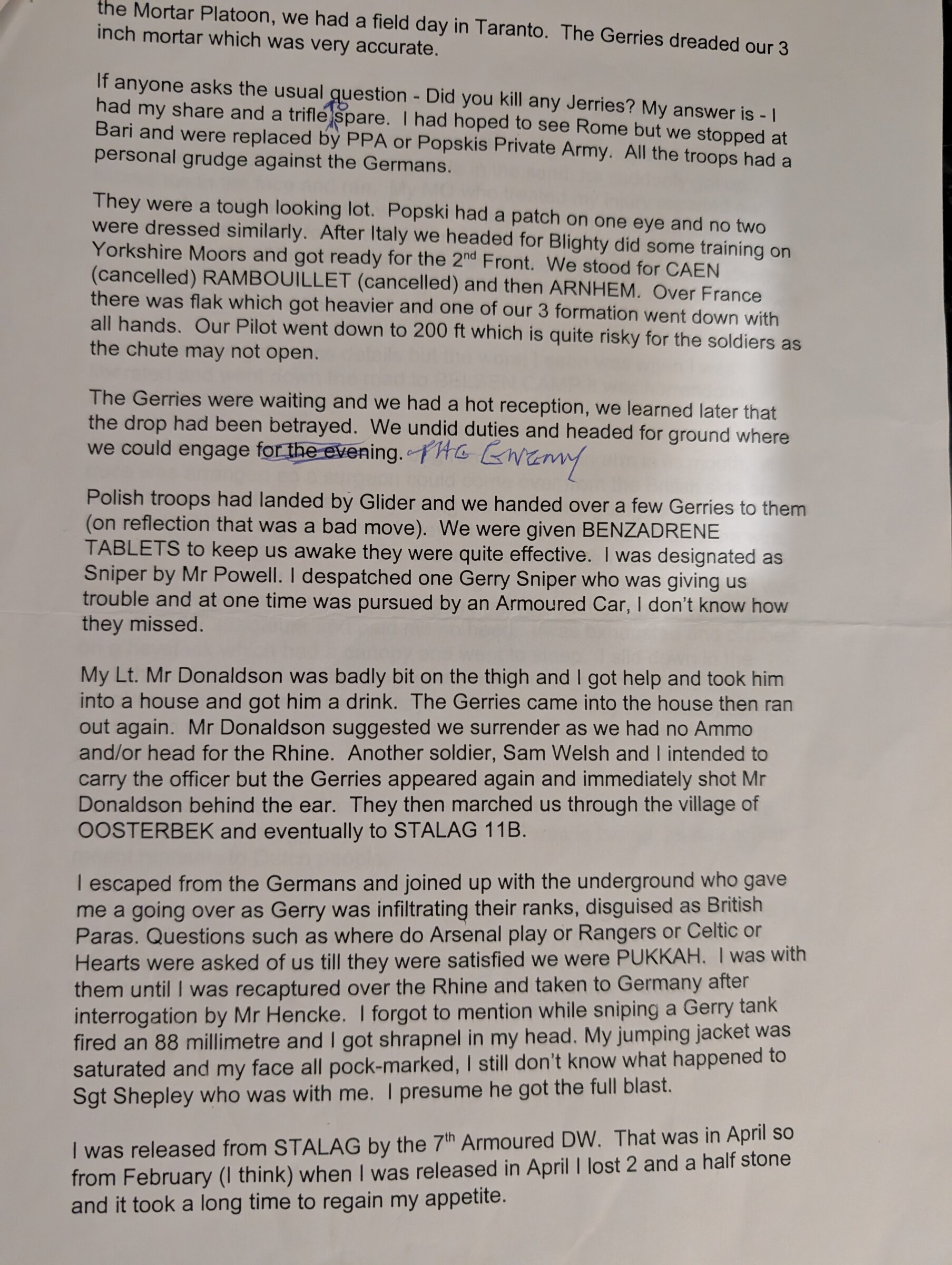
Typed transcript, pages 5 to 9, with a pencil correction, "the enemy", where the typist wrote "the evening".
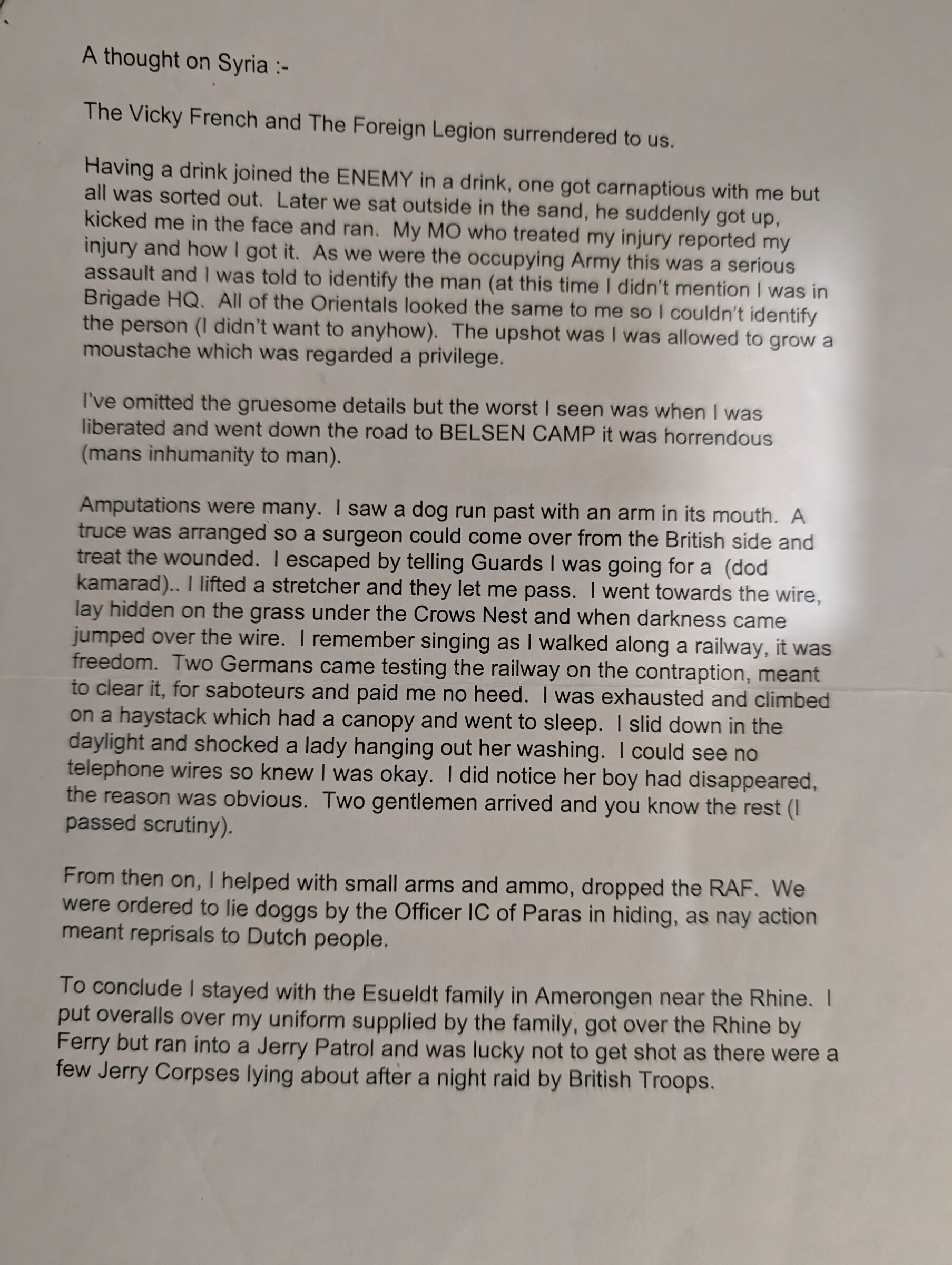
Typed transcript, pages 9 to 12.
Captivity and after: the second set
A second run of handwritten pages, headed "Stalag 11B Fallingbostel", covering the recapture, the interrogation, the Veermans, Tex Banwell and the years after. Typed up as six pages.
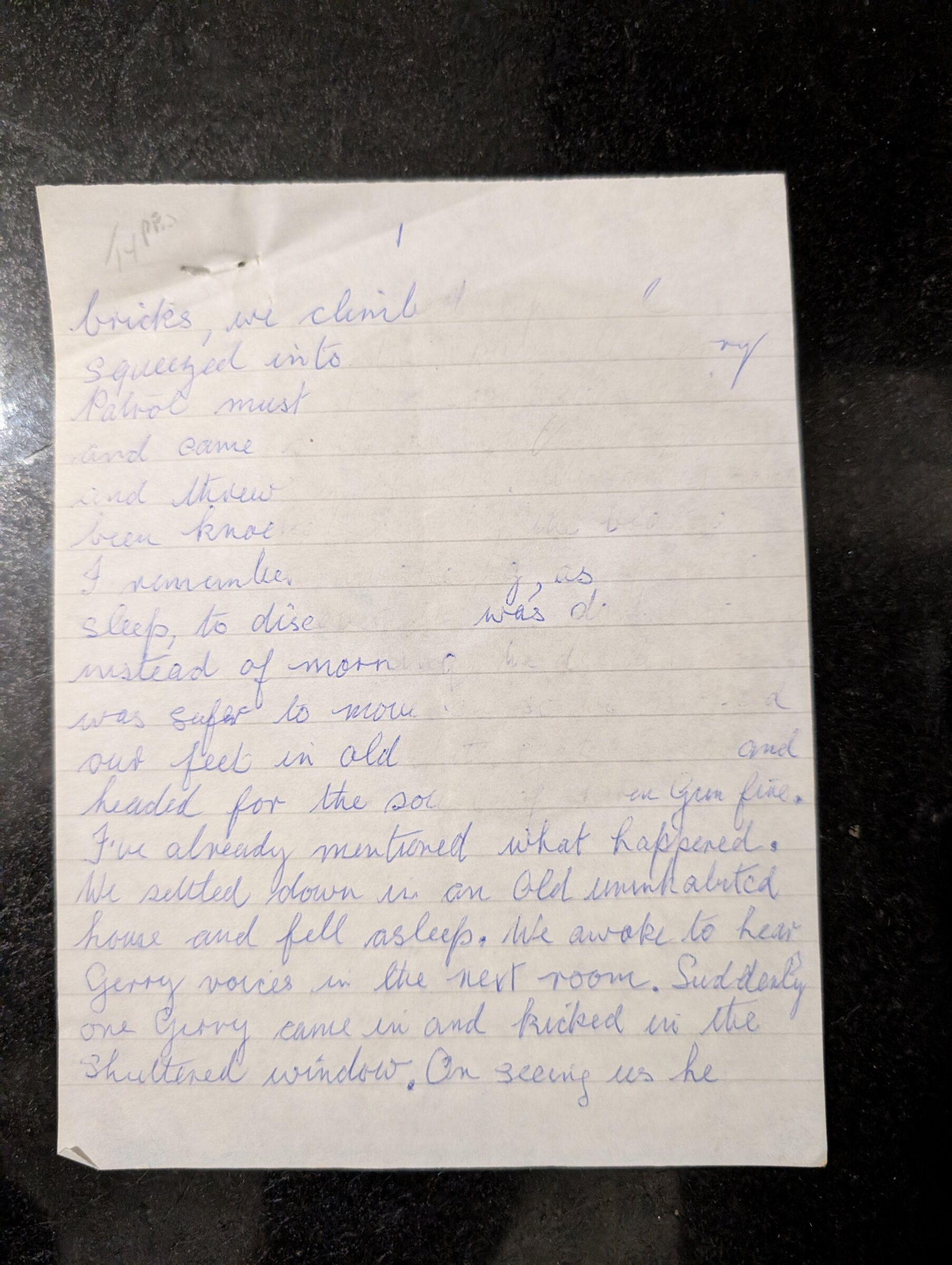
Page 1. The brickworks, the uninhabited house, the German who kicked in the shuttered window. The typed transcript below carries the full text.
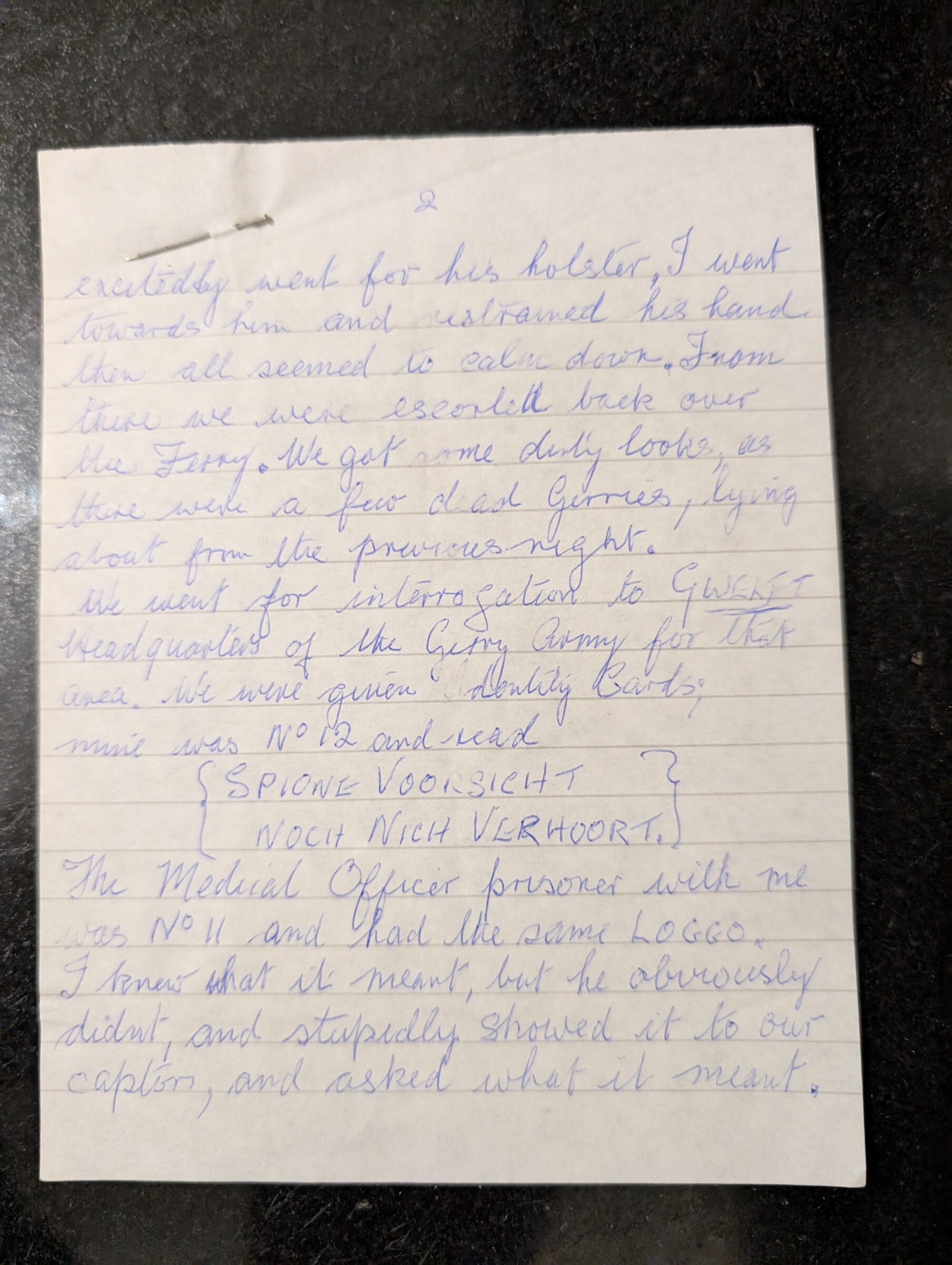
Page 2. Restraining the German's hand; escorted back over the ferry past "a few dead Gerries"; interrogation at "GWELF Headquarters"; identity card No. 12, "Spione Voorsicht / Noch nich verhoort"; the medical officer who showed his to the captors and asked what it meant.
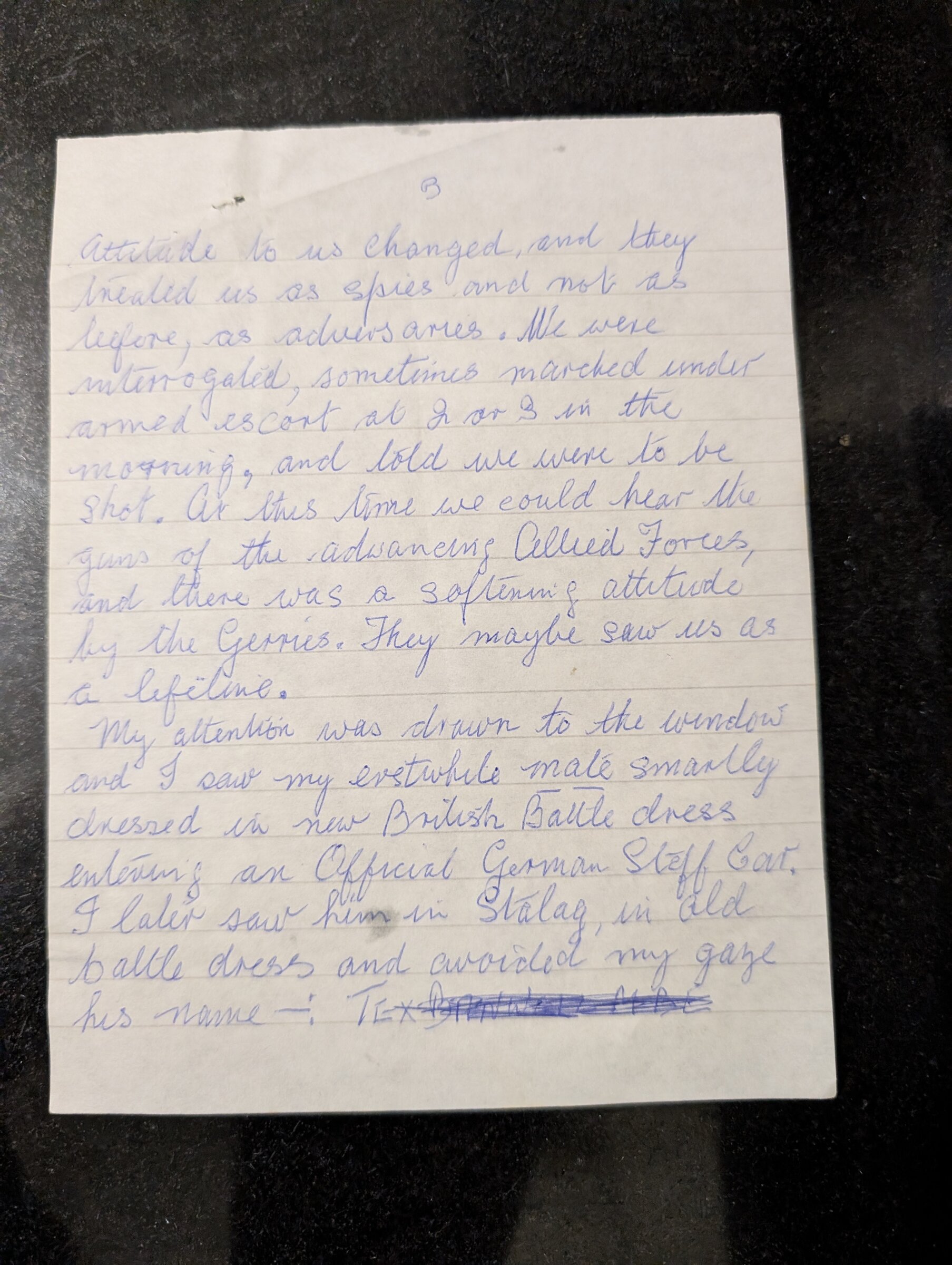
Page 3. Treated as spies; marched out at two or three in the morning and told they would be shot; the guns of the advancing Allies; "my erstwhile mate smartly dressed in new British battle dress entering an official German staff car"; the name written and scored out.
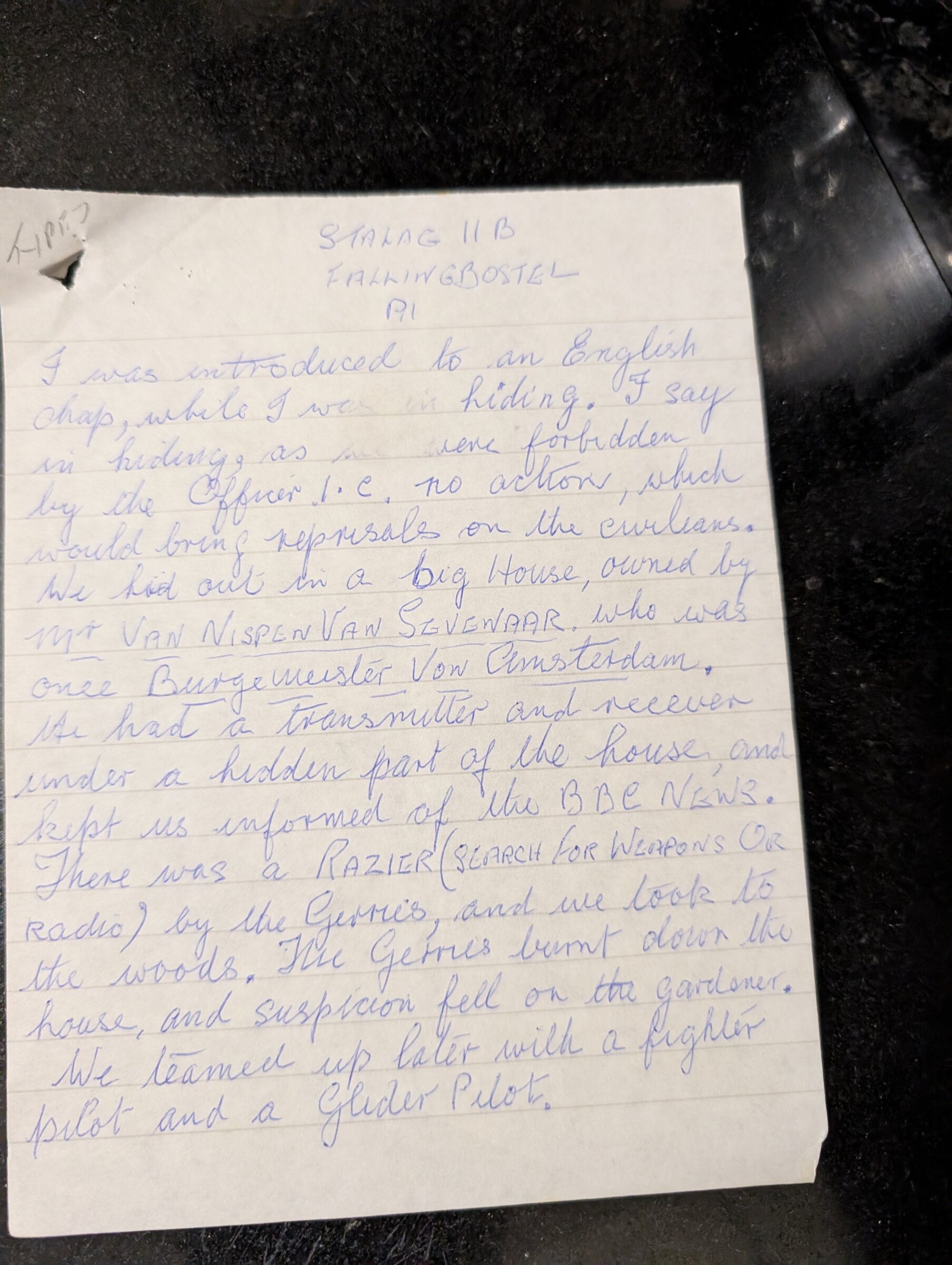
Headed "Stalag 11B Fallingbostel, P1". The English chap met in hiding; forbidden by the officer in charge from any action that would bring reprisals; the big house of "Mr Van Nispen van Sevenaar, who was once Burgemeister von Amsterdam"; the transmitter, the razzia, the house burned, "suspicion fell on the gardener"; the fighter pilot and the glider pilot.
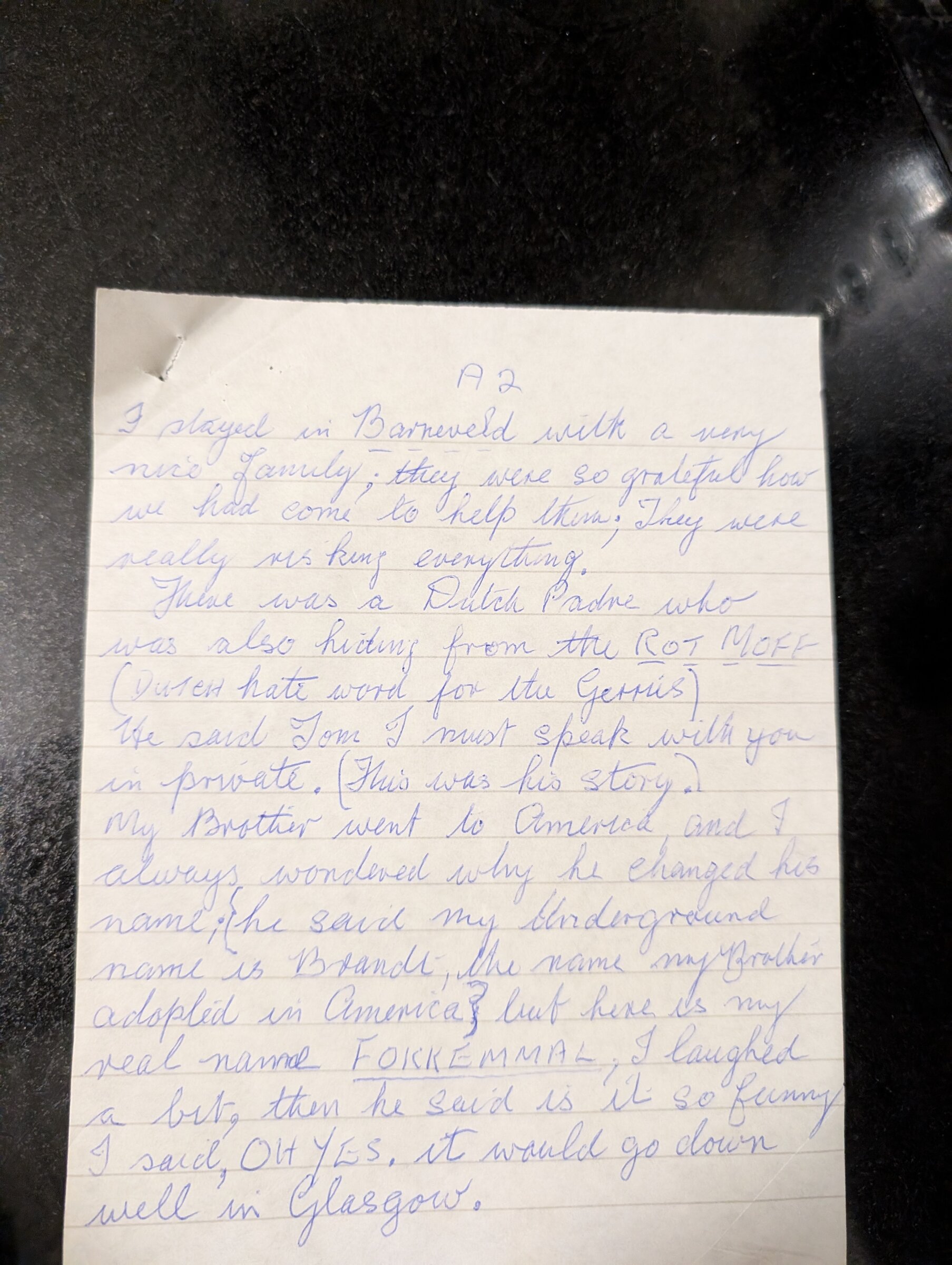
Page A2. "I stayed in Barneveld with a very nice family … they were really risking everything"; the Dutch padre hiding from "the Rot Moff", whose brother in America had taken the name Brandt, and his real name, which "would go down well in Glasgow".
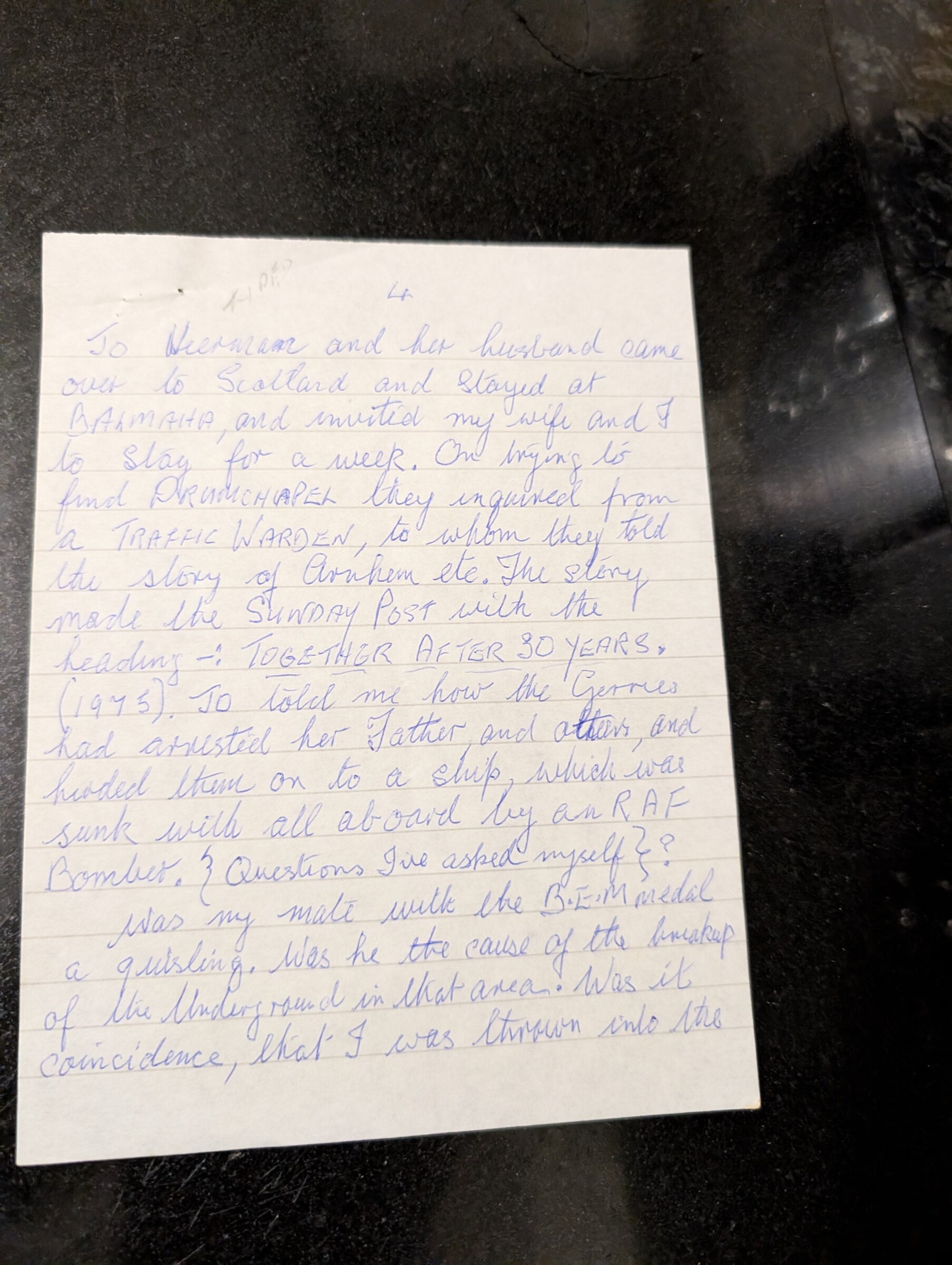
Page 4. Jo Veerman and her husband at Balmaha in 1975; the traffic warden in Drumchapel; "Together After 30 Years"; what Jo told him about her father and the ship; "Questions I've asked myself": the BEM, the underground, the car.
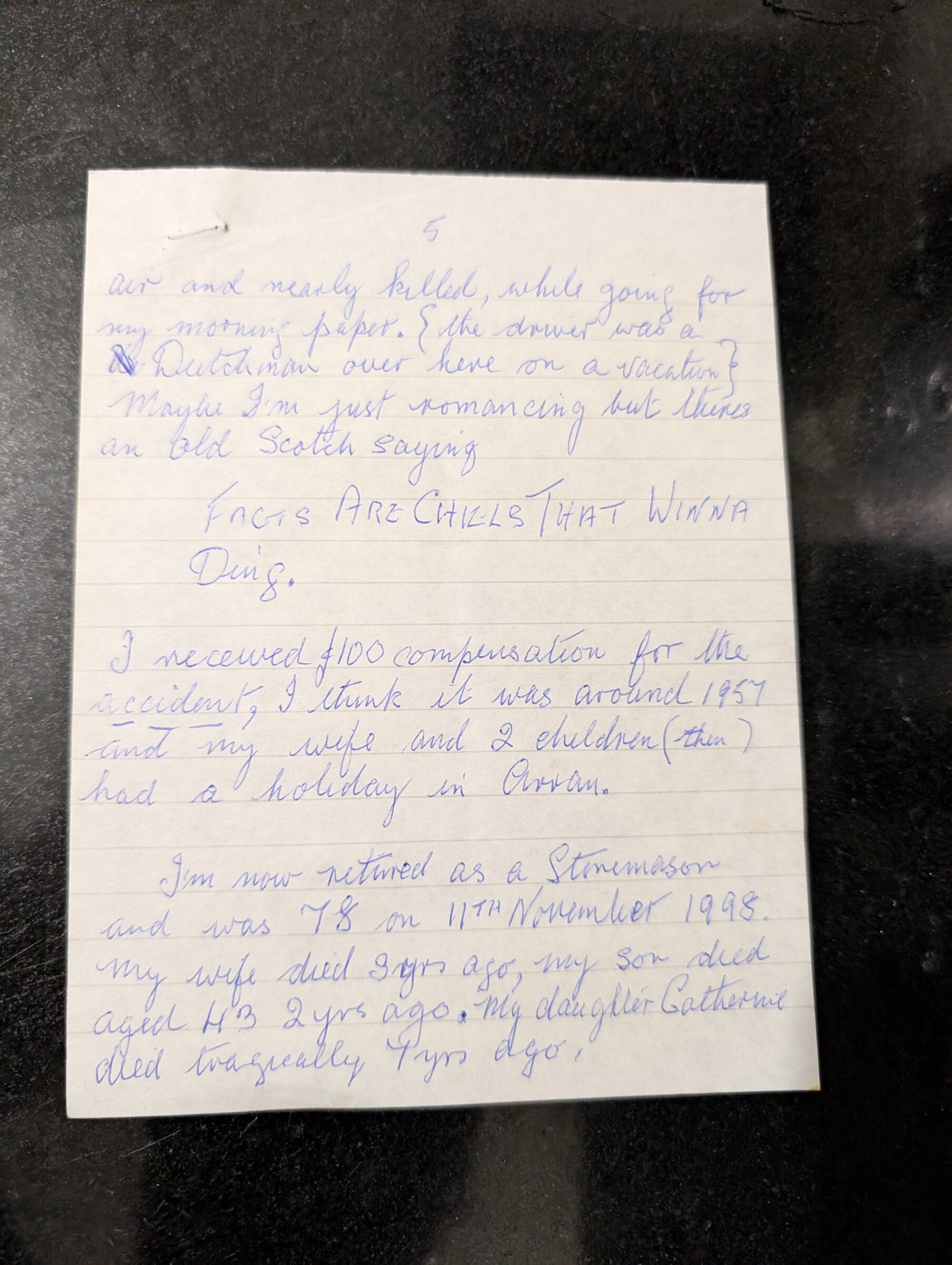
Page 5. The Dutchman on holiday; "Facts are chiels that winna ding"; £100 and a holiday in Arran, about 1957; "I'm now retired as a Stonemason and was 78 on 11th November 1998"; his wife, his son, his daughter Catherine.
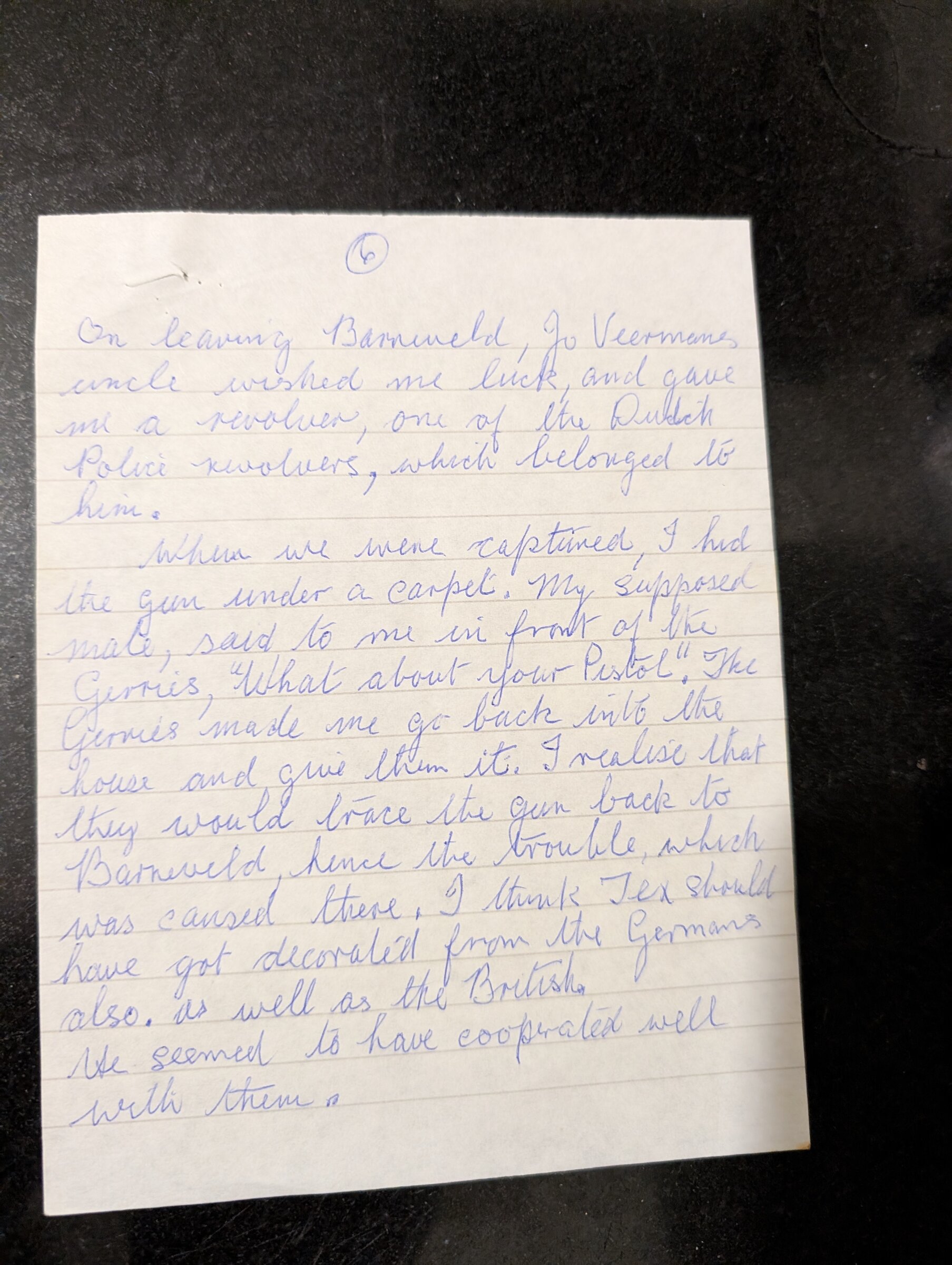
Page 6. Jo Veerman's uncle and the Dutch police revolver; the gun under the carpet; "What about your pistol?"; "I think Tex should have got decorated from the Germans also, as well as the British."
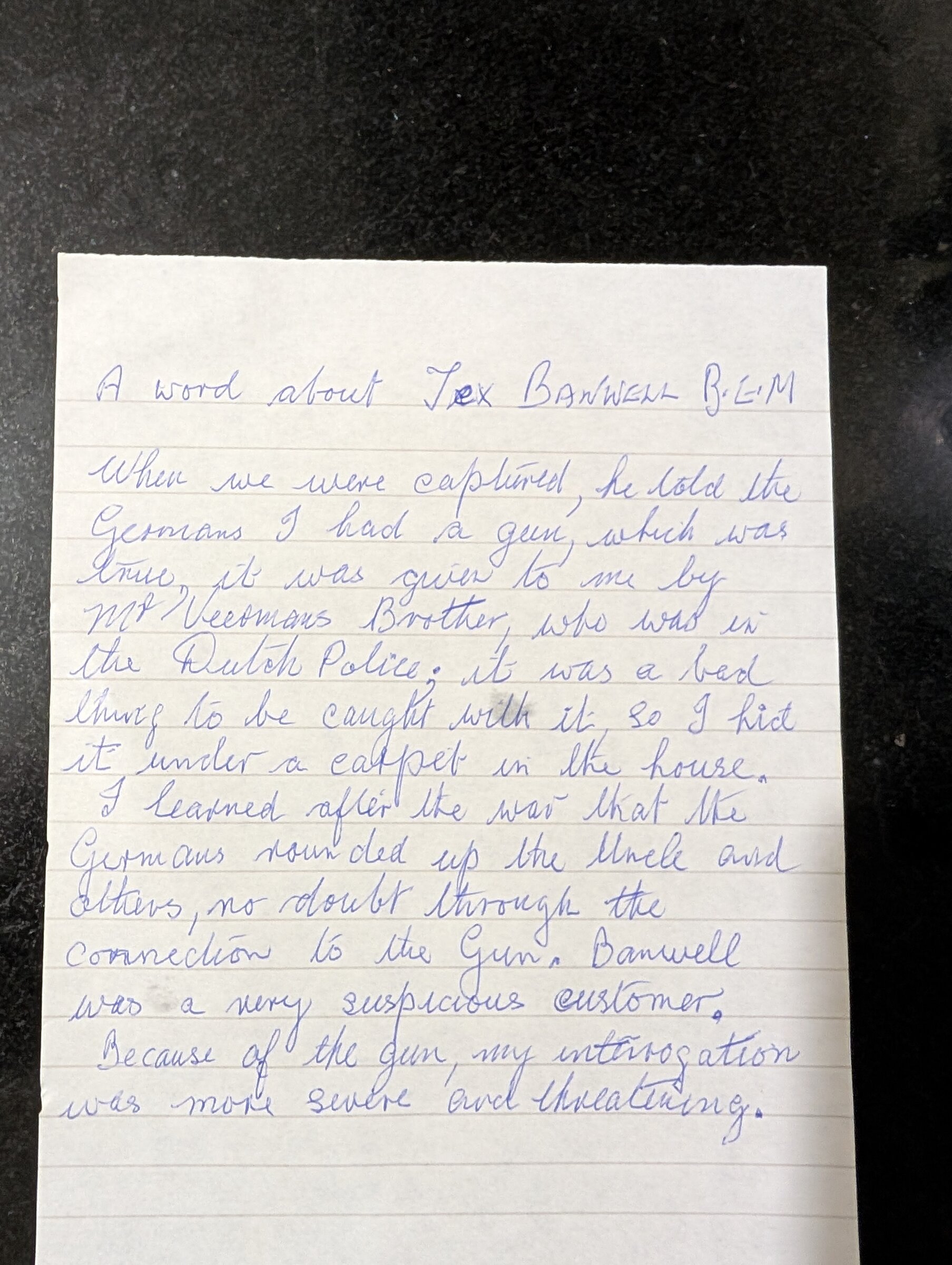
"A word about Tex Banwell B.E.M." The gun from "Mr Veerman's brother, who was in the Dutch Police"; "the Germans rounded up the Uncle and others, no doubt through the connection to the gun"; "Because of the gun, my interrogation was more severe and threatening."
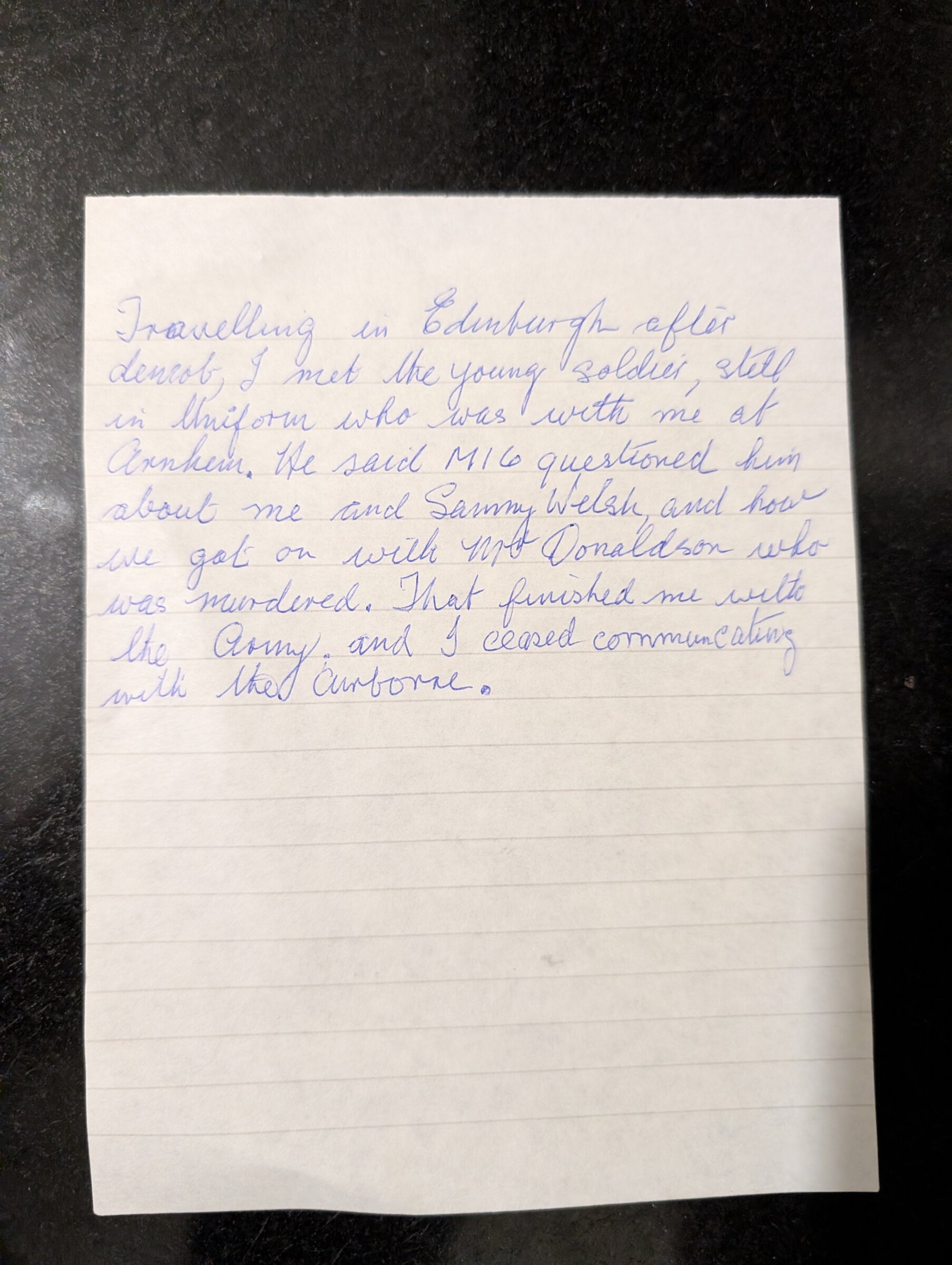
A single page. In Edinburgh after demob he met a young soldier who had been with him at Arnhem, who said MI6 had questioned him about Murphy, Sammy Walsh and Mr Donaldson "who was murdered". "That finished me with the Army, and I ceased communicating with the Airborne."
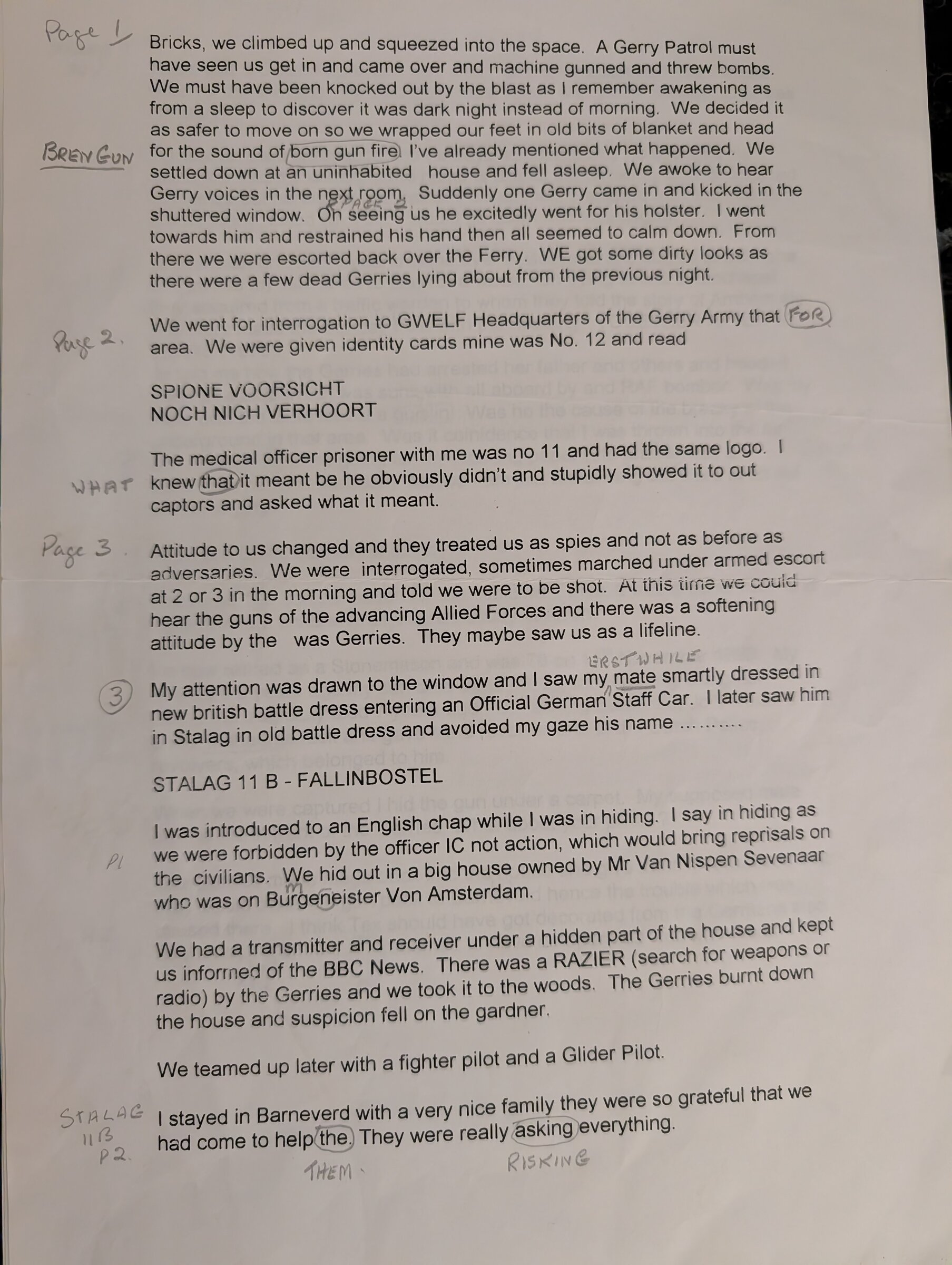
The typed transcript, pages 1 to 3, with the pencil corrections: "Bren gun" for "born gun fire", "erstwhile" before "my mate", "them" and "risking" in the Barneveld line.
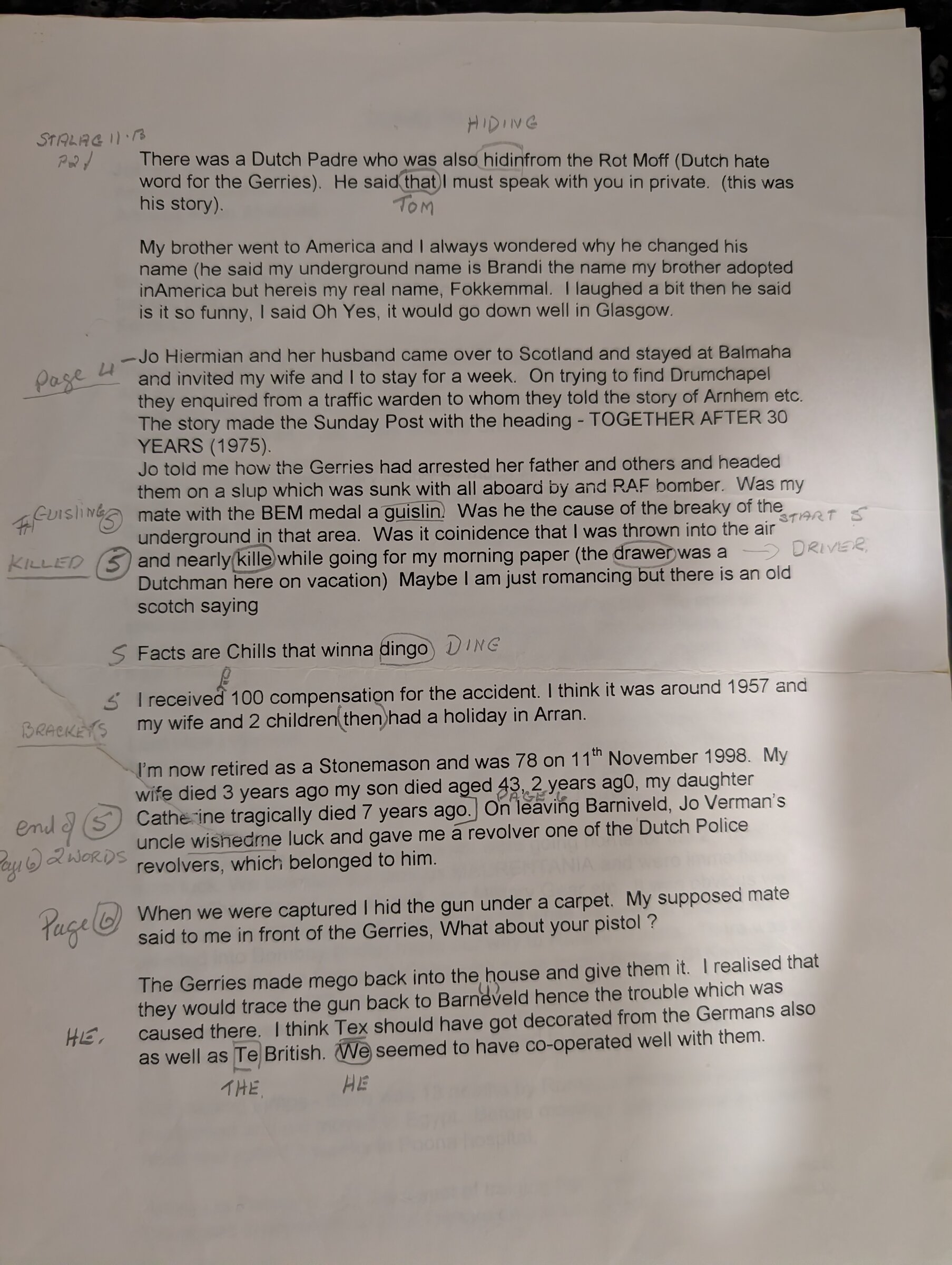
Typed pages 4 to 6, with the pencil corrections: "hiding", "Tom", "quisling", "killed", "driver", "ding", "he".
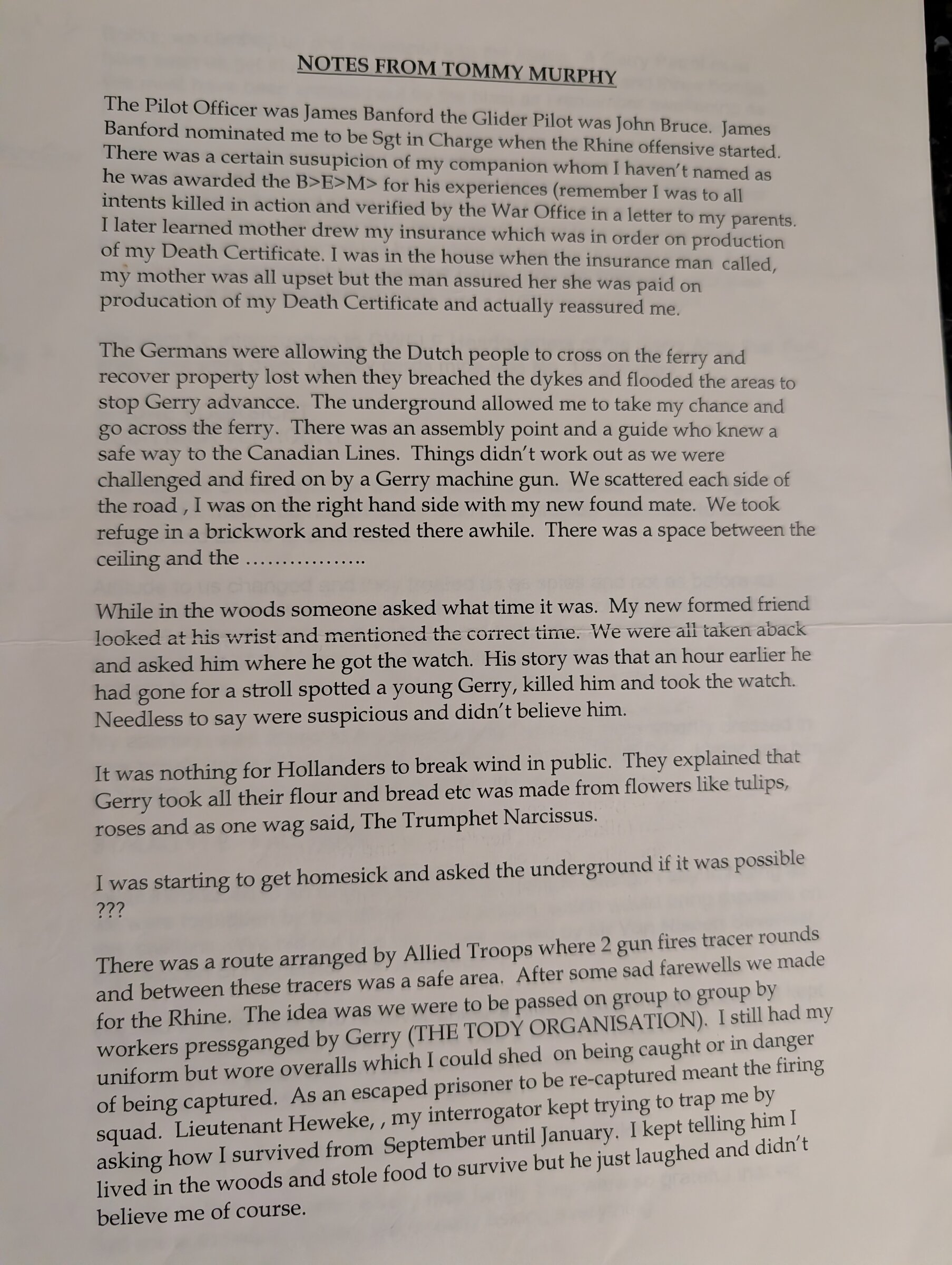
"Notes from Tommy Murphy", typed. "James Banford" and "John Bruce"; the BEM; his mother and the insurance; the ferry and the flooded dykes; the man with the dead German's watch; bread from tulip bulbs; the tracer corridor; the Todt Organisation; uniform under overalls; Lieutenant Heweke.
Loose pages and the notebook
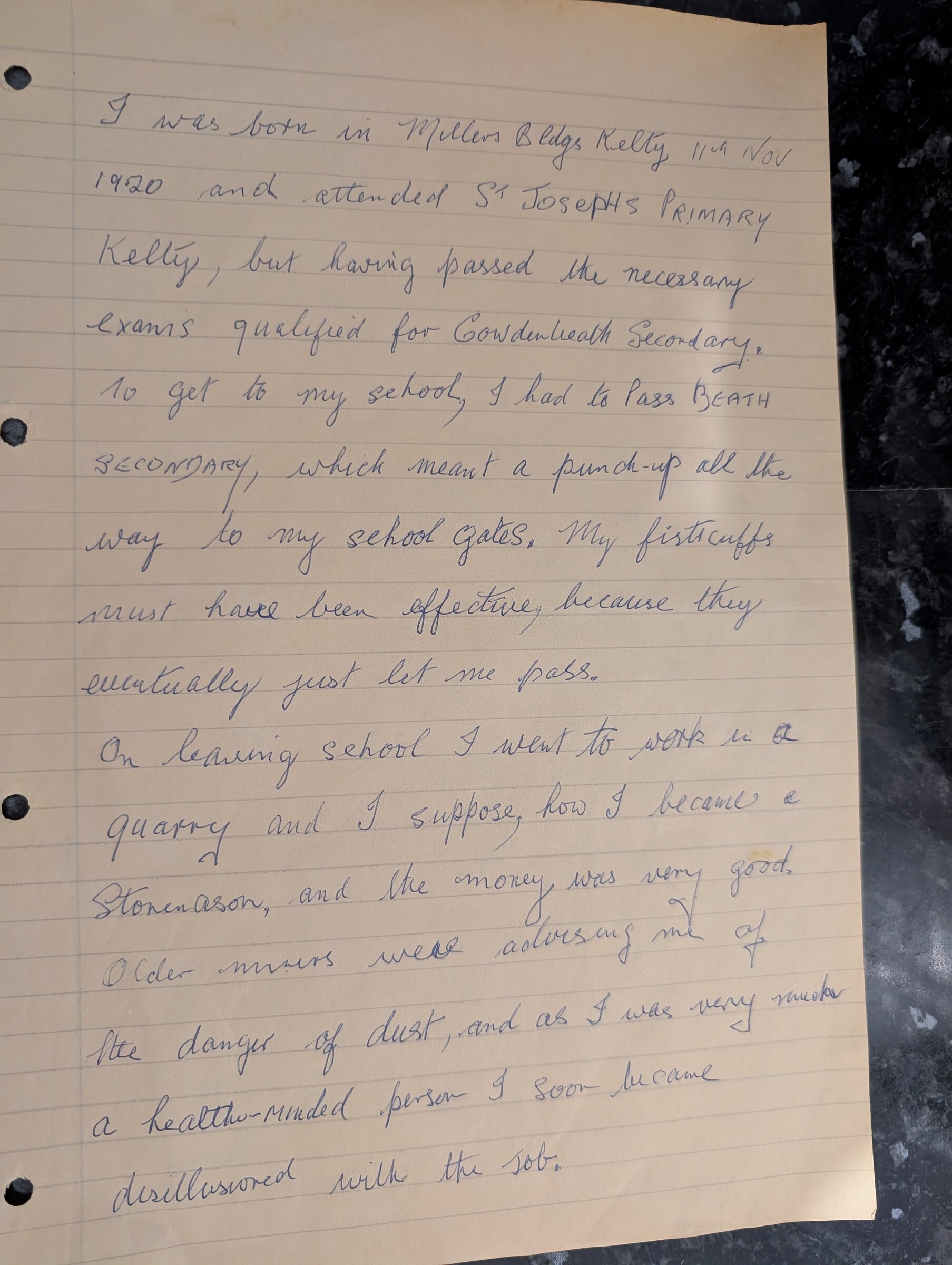
Born Millers Buildings, Kelty, 11 November 1920; St Joseph's Primary; Cowdenbeath Secondary and "a punch-up all the way to my school gates" past Beath Secondary; the quarry, "how I became a Stonemason", the older miners' warnings about dust.
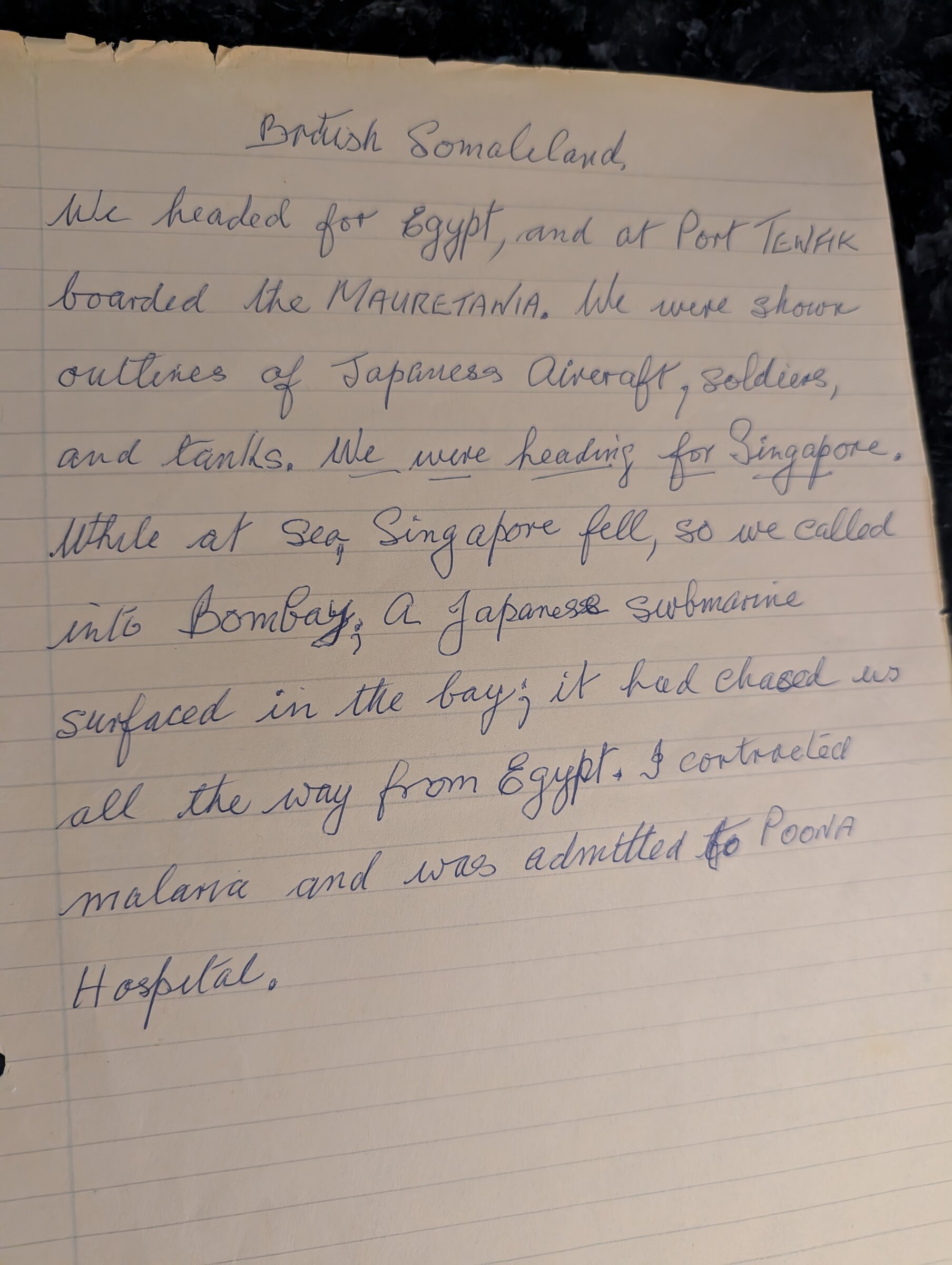
Headed "British Somaliland", an earlier draft of the voyage: Port Tewfik, the Mauretania, Singapore falling at sea, Bombay, the Japanese submarine "which had chased us all the way from Egypt", malaria and Poona Hospital.
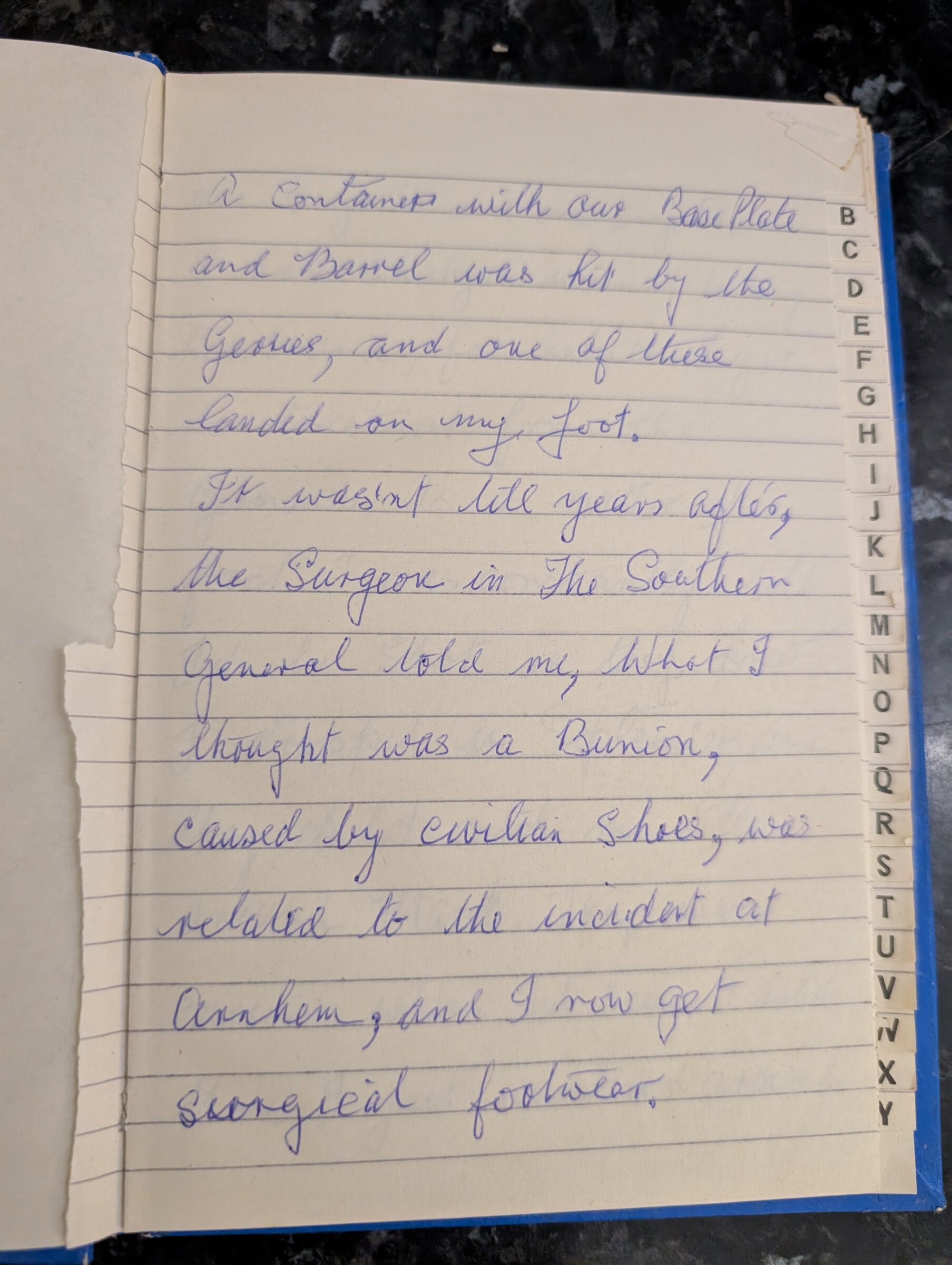
Notebook. A container with the mortar base plate and barrel hit by the Germans, one of them landing on his foot; years later a surgeon at the Southern General told him what he thought was a bunion "was related to the incident at Arnhem", and he was given surgical footwear.
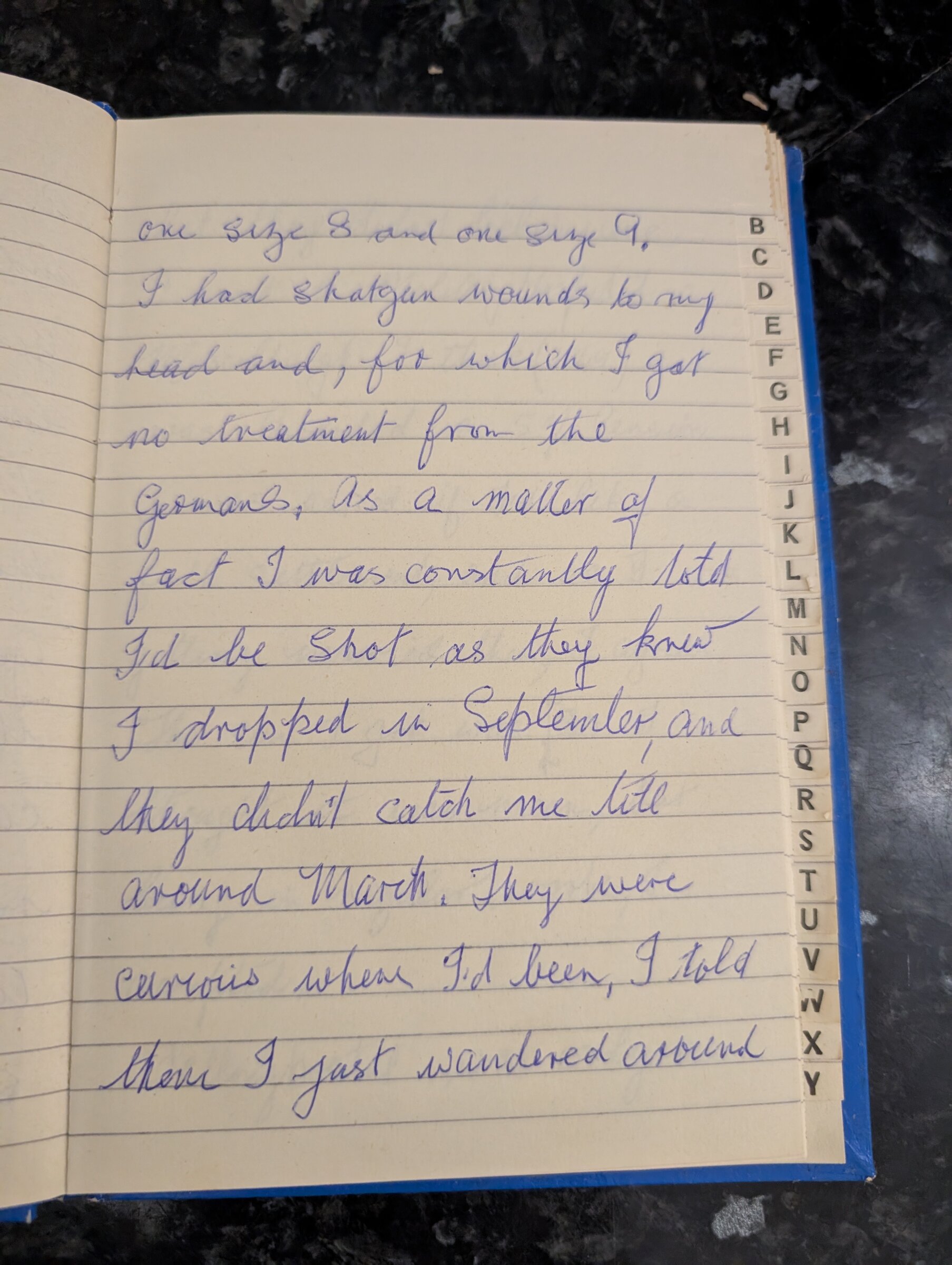
Notebook. Boots "one size 8 and one size 9"; shotgun wounds to the head, untreated; "constantly told I'd be shot as they knew I dropped in September, and they didn't catch me till around March"; the cover story, "I just wandered around".
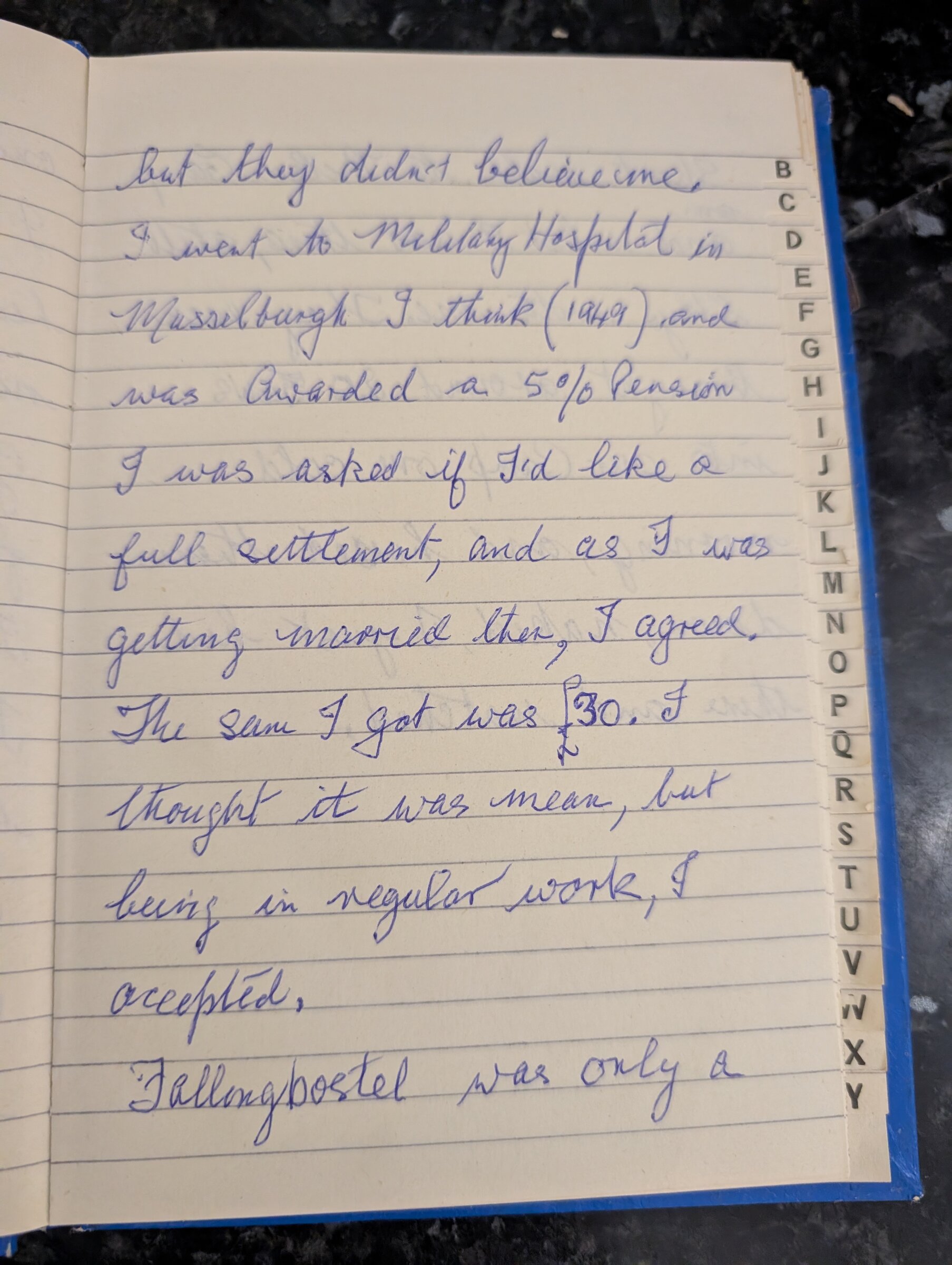
Notebook. "But they didn't believe me." The Military Hospital at Musselburgh, "I think (1949)"; a 5% pension; the offer of a full settlement as he was getting married, "the sum I got was £30. I thought it was mean, but being in regular work, I accepted." Fallingbostel "was only a" …
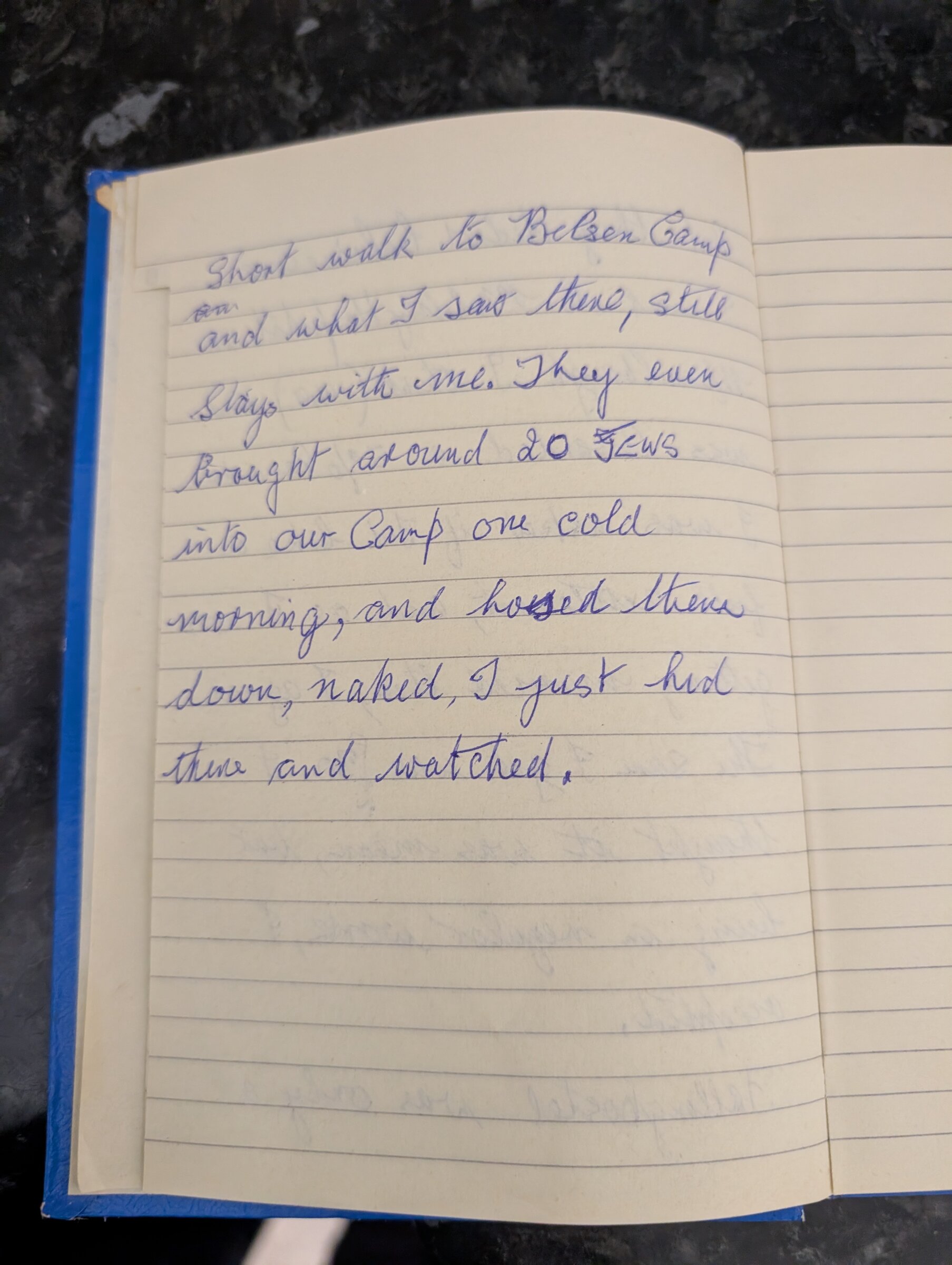
Notebook. "… short walk to Belsen Camp and what I saw there, still stays with me. They even brought around 20 Jews into our camp one cold morning, and hosed them down, naked. I just hid there and watched."