Jhr Hubert van Nispen tot Sevenaer
Zevenaar 6 Aug 1879 – 11 Mar 1958
Jhr H. L. M. VAN NISPEN TOT SEVENAER (1879–1958)
About: Mayor of Laren from 1909 to 1943 and again in 1945–46 (and of neighbouring Blaricum from 1913 to 1922), who was in hiding with his wife and son at Dr Kruimel's house De Ruif at Garderen in October 1944, when Murphy and Walsh were there. Murphy names him; the British reports do not.
Unit or role: Civilian: mayor of Laren (North Holland) from 1909, and of Blaricum 1913–1922; Officer of the Order of Orange-Nassau (1930); dismissed by the occupier on 29 May 1943.
Where: Laren; from December 1943 at De Ruif, Garderen, which Dr Kruimel had let to the family; after the fire of 23 October 1944 in hiding at Apeldoorn, his son at Achterveld.
Evidence: ✓ Wikipedia; Boeree, Kroniek van Ede (1947), pp. 162–163 (read on the page images: p. 162); Airborne Magazine; Tijding, 17 May 1945; the family's helper files (the father's, the son's); ✓ his Dutch award card; ✓ the family entry in Nederland's Adelsboek (1915, 1949, page images read)
Born at Zevenaar on 6 August 1879, he went to the gymnasium at Arnhem, trained in local government at the town hall of Ewijk, passed the examination for candidate town clerk in 1904, and worked at the town hall of Westervoort until he was appointed mayor of Laren in 1909 (De Gooi- en Eemlander, 26 July 1949). ✓ He was also mayor of neighbouring Blaricum from 1913 to 1922 by Wikipedia (Wikipedia); the Adelsboek of 1915 has him "burgem. van Laren en Blaricum" (1915, p. 429, page image read). ✓ Nederland's Adelsboek has him born at Huize Sevenaer, the tenth of eleven children of Jhr. Raphaël Alexander Johannes Boudewinus Maria van Nispen tot Sevenaer, heer van Sevenaer and wethouder of Zevenaar (1835–1885), and Adriana Wilhelmina Gijsberta de van der Schueren (1837–1906) (1915, p. 429, page image read; his parents on 1949, p. 272, page image read). ✓ His wife was Louise Renée Maria Pelgrom von Motz, born at Arnhem on 7 May 1888, daughter of Mr. Willem Reinout Karel Lodewijk Maria Pelgrom, heer van Enghuizen; they married at Zevenaar, civilly on 31 August and in church on 1 September 1909, and a daughter was stillborn at Laren on 7 June 1916 (1915, p. 429 for the church wedding; 1949, p. 274 for the rest, both page images read). The Staatscourant has her as L. R. M. Pelgrom van Mots: a Zevenaar expropriation list of 1948 has "L. R. M. Pelgrom van Mots, vr. van Jhr. H. L. M. van Nispen tot Sevenaer te Laren" (wife of; Staatscourant, 16 September 1948; OCR only).
✓ By royal decree of 24 April 1930 he was made an Officer of the Order of Orange-Nassau, as "burgemeester der gemeente Laren (N.H.)"; the card gives his names as Hubert Louis Marie, born at Zevenaar on 6 August 1879, of the Stationsweg, Laren (his award card, Nationaal Archief 2.02.32).
The Laren expulsion, February 1934. On Saturday 24 February 1934 the Laren police broke up a meeting of young left-wing activists from several countries at the camp house De Toorts; the foreigners were taken to cells in Laren and elsewhere, and four young men held at the Laren police station were taken to the German border at Zevenaar. The press argued over it for months, and the mayor answered in print. Both accounts are given here as each side stated them; the page does not settle between them.
- ✓ The event. The meeting was of the "Commission Centrale Internationale des Jeunes", part of the "Ligue Communiste Internationaliste" (Bolsheviks-Leninistes), according to the Correspondentie-bureau (a news bureau), which said the foreigners were held to be removed from the country (Het Volk, 27 February 1934; OCR only). Het Vaderland calls it "de conferentie van het Socialistisch Jeugd Verbond" (the conference of the Socialist Youth League) (Het Vaderland; OCR only).
- Seven of those taken to Amsterdam were put over the Belgian border, and the four held at Laren were taken to the German one (Het Volk), handed over to the border commissioner at Zevenaar (Haagsche courant, 31 May 1934).
- Het Vaderland of 28 February says they were put over the German border "op last van den burgemeester van Laren, jhr van Nispen tot Sevenaer" (on the order of the mayor), and quotes Vooruit that it was not understood why. Vooruit adds that he was known, in "een soortgelijk geval" (a similar case), to have taken care that the person concerned was led "over de Belgische grens" (over the Belgian border) (Het Vaderland; the opening read on the page image, the Vooruit remark OCR only).
- ✓ The accusation, as printed. The lawyer Benno J. Stokvis, who acted for those arrested, told Het Volk that he asked the mayor to let them choose another border, as the Aliens Act allows; the mayor gave no direct answer, and Stokvis called what followed "een verkapte uitlevering aan Duitschland" (a disguised handing-over to Germany). The Amsterdam police and the procureur-generaal had both told him the decision lay with the mayor (Het Volk; OCR only).
- This is the lawyer's account to a newspaper whose own report called the mayor's act "schromelijke willekeur" (shocking arbitrariness).
- ✓ His answer, as printed. He told the Gooische Post the group were "heel gevaarlijke sinjeurs" (very dangerous men), not "romantische jongelui" as the MP Vliegen had said, that nobody had objected to going to Germany, and that talk of three of them in concentration camps named no place (De Avondpost, 6 May 1934; OCR only).
- In an interview with the Handelsblad, reported on 31 May, with police inspector Hoogvorst present, he called several of the N.R.C.'s newer claims "een leugen" (a lie), among them that two of the four had said repeatedly that everything depended on whether they were taken to Germany, and said there was "geen twijfel over de uitwijzing naar Duitschland" (no doubt about expulsion to Germany) given the practice at Laren and elsewhere of sending unwanted Germans home (Haagsche courant, 31 May 1934; OCR only).
- He added a December case, a stateless former croupier whom the government ordered out: reproached for having let the man's German residence permit lapse while seeking a Nansen passport for him, which made expulsion to Germany impossible, he said "humaniteitsoverwegingen" (considerations of humanity) had applied (same article).
-
◐ What a journalist wrote in 1991. Vrij Nederland puts the expulsion officially on the mayor and gives the police chief's own words beside it:
Officially the expulsion was on the order of mayor Van Nispen tot Sevenaer, who believed he was acting in the spirit of the Minister of Justice Van Schaik. But the then police chief in Laren, the NSB man J. Hoogvorst, left no doubt about it. "We thought an example should be made," he told the Nieuwe Rotterdamsche Courant.
Dutch originalOfficieel geschiedde de uitzetting op last van burgemeester Van Nispen tot Sevenaer, die meende te handelen in de geest van de minister van Justitie Van Schaik. Maar de toenmalige korpschef in Laren, de NSB'er J. Hoogvorst, liet er geen misverstand over bestaan. 'We vonden dat er maar eens een voorbeeld moest worden gesteld,' zei hij tegen de Nieuwe Rotterdamsche Courant.
— Jeroen Terlingen · Vrij Nederland, 19 October 1991 · the article; OCR only
- The article's sentence before says that only the Laren police handed four German youths straight to the German border police. ◐ The Haagsche courant of 31 May, above, calls Hoogvorst police inspector; the NSB membership rests on Terlingen alone.
- It gives the fate of the four from the recollection of Willy Brandt, who was at the congress and was held in Amsterdam: Hans Goldstein was released at once and emigrated to Palestine; Kurt Lieberman and Heinz Hoose got six years' penal servitude and survived the war; Franz Bobzien, a teacher from Hamburg, was tortured by the Gestapo and sent to Sachsenhausen, where he died in 1941 (same article).
- That is a 1991 account, with no source given for the minister's part. No 1930s or 1940s record of Bobzien's death is held.
He refused to co-operate with the NSB administration. On the orders of the Sicherheitspolizei the police of Hilversum tried to arrest him on the night of 8/9 February 1943, but he had already got away; he came back in April, was put on forced leave, and on 29 May 1943 was dismissed and banned from the district (Wikipedia). His own account, given at Laren in May 1945, has the trouble start in 1942 with the Beauftragte of the Rijkscommissaris, who wanted friendlier treatment and Nazi propaganda, then his dismissal in May 1943, the official residence emptied by November, and Dr Kruimel of Utrecht making his house at Garderen available that December (Tijding, 17 May 1945). Kruimel had let De Ruif to the family (du Bois and Holvoet).
◐ A photograph in a Vrij Nederland article on Laren in the war has the mayor seated with the police corps, beside brigadier F. Vreeswijk and inspector W. A. N. Boog; the caption is undated, and the article is about Laren, not Murphy (Terlingen, 19 October 1991; OCR only).
His son, Hubert R. R. L., born at Laren on 29 May 1919 and entered in the Adelsboek as a landbouwoeconoom (agricultural economist), was with the family at De Ruif and gave the Americans the household's account in 1946: "De eerste piloot kwam op 1-1-44. De laatste vertrok op 21 Oct 44" (the first pilot came on 1 January 1944; the last left on 21 October), and "springers" (parachutists; the typed English copy has "agents") as well as airmen, among them "Ham (Dubois), Bacon", most staying a few days and some a few weeks, and a cellar for them (the son's file, p. 4). The office noted from the son that "The Fliers were brought to the house by Dr Kruimel, Dr Eskes, Nol Burger … Mostly Dr Kruimel fetched them again. A few times the son of Mr van Nispen accompanied him in these trips" (the father's file, p. 3).
With Murphy
Link to the section With MurphyMurphy and Sam Walsh came to De Ruif in October 1944, around 8 October by the guestbook and the Dutch accounts, on the evening of 14 October by Walsh's report, and left about 21 October by Walsh, ⚠︎ about 10 to 11 October by Liesbeth Verweij, and by 19 October at the latest by Hardy, who found Murphy at Elspeet that evening (Walsh; Hardy; Airborne Magazine; Where, and with whom). Walsh found "the Burgermeister of a township near AMSTERDAM together with his wife and son" living with Uncle Joop (Walsh). Murphy names him himself, the only British source that does (below). Liesbeth Verweij, who came to De Ruif to fetch Murphy and Walsh to Sterrehoveke, ate there with the seven paratroopers and the Van Nispens before they set off (Noordman, p. 301; Liesbeth Verweij's account).
How Murphy wrote of the house
Link to the section How Murphy wrote of the house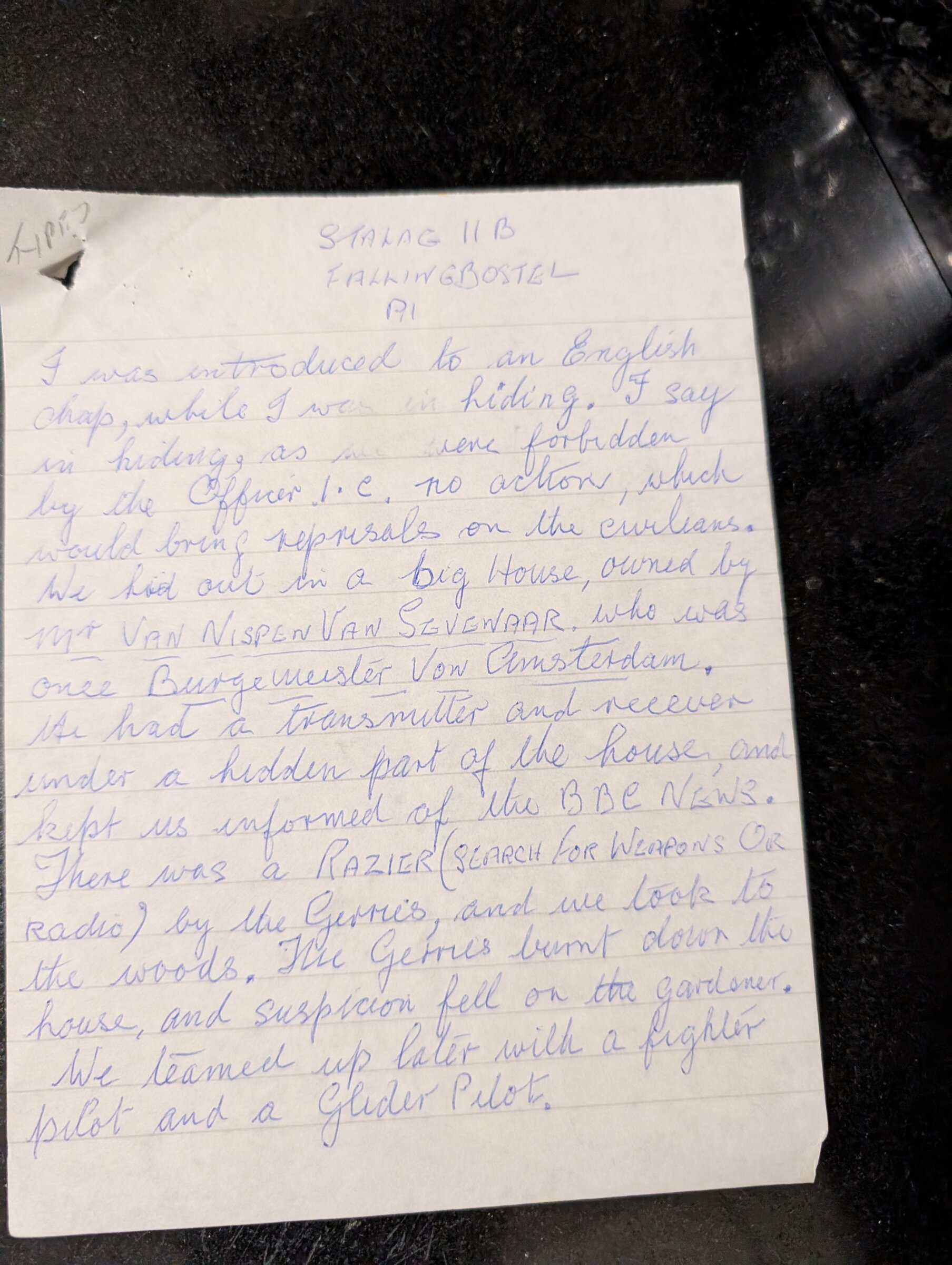
On the first page of his Fallingbostel notes:
I was introduced to an English chap, while I was in hiding. I say in hiding, as we were forbidden by the Officer I.C. no action, which would bring reprisals on the civilians. We hid out in a big House, owned by Mr VAN NISPEN VAN SEVENAAR. who was once Burgemeister Von Amsterdam. We had a transmitter and receiver under a hidden part of the house, and kept us informed of the BBC NEWS. There was a RAZIER (SEARCH FOR WEAPONS OR Radio) by the Gerries, and we took to the woods. The Gerries burnt down the house, and suspicion fell on the gardener.
— Tom Murphy, his Fallingbostel notes, p. 1 · the page
⚠︎ That is his word alone, and it differs from the Dutch and the British records in four places. The house was Kruimel's, not Van Nispen's: Walsh calls it "owned by a member of the Underground known to me as Uncle JOOP", and the family's own account has Kruimel making the house available (Walsh; Tijding). The town was Laren, not Amsterdam; Walsh has "a township near AMSTERDAM". And the Dutch accounts of the fire name a fire lit in the bunker, by a young resident in Boeree's words and by the mayor's son in the Airborne Magazine's (below); the accounts of the fire read here (Boeree, the magazine, the family's forms) name no gardener, and none speaks of anyone being suspected of betraying the house. Fourth, Murphy has himself there for the search ("we took to the woods"); by Walsh, who heard of it from Harding, by Verweij and by Hardy, he had already left. Murphy does not say who suspected the gardener, or why.
The one fixed point in it is the house burning down after a search, which Walsh heard of from Sgt Harding, who stayed on at De Ruif after Walsh and Murphy left, about 21 October by Walsh (⚠︎ about 10 to 11 October by Liesbeth Verweij, and by 19 October at the latest by Hardy, who found Murphy at Elspeet that evening; below): the Germans "had accidentally discovered the cellar and radio set" and "in reprisal burned down the house"; Uncle Joop "was also away at the time and the Burgermeister and his family were not molested" (Walsh). The family's own forms say the head of the family got away "ternauwernood" (only just), and the son was arrested a few days later (below).
What the household wrote down
Link to the section What the household wrote downThe household wrote the men down for the Americans in 1945 and 1946. The father's list, on the back of his form of 26 July 1945, gives each man's home address, and ends with Tex Banwell, Walsh and "Th. Murphy, 91 Centre St. Kelty Fifeshire Scotland." (the father's file, p. 3). The son's list has "K.D. Banwell", "Samuel Walsh 4389314" and "Thomas Murphy" with his number, 2756457, corrected by hand, on the back of his form of 31 May 1946 (p. 5 of the son's file); the typed English copy swaps the two men's numbers (p. 3). Jeane van Galen, who lived with the family and helped the lady of the house, listed the same three, with Murphy's number right (her file, p. 3). Among the people they knew who helped Allied men, both forms name "A. Heg, Barneveld" (◐ Aart van de Heg), with Dr Kruimel of Utrecht, Dr Eskes and Nol Burger of Garderen and H. van Poelgeest of Harderwijk (the father's file, p. 4; the son's file, p. 2). ◐ The interviewer's note on the father's form of 26 July 1945 reads: "The whole family worked in this matter, the wife of Mr van Nispen, his son and his maid. He should like that all members, the maid included, would get an award" (the father's file, p. 2). The note does not name the maid; that she is Jeane is our reading.
✓ Lipmann Kessel, who came with three other medics as Murphy and Walsh left, found "a white-haired man, equally distinguished in appearance ... the burgomaster of a small town near Amsterdam", evacuated, and a hostess dressed severely in black (Kessel, 1959, p. 91). The whole story of the house is on Garderen.
On 23 October 1944, after Murphy had left (two days after by Walsh; ⚠︎ about twelve by Liesbeth Verweij, and at least four by Hardy), Germans quartered at Elspeet came to requisition a car, found the hideout, a transmitter and a pilot's equipment, and burned the house (Airborne Magazine). The son's form: "Het huis werd toevallig ontmaskerd op 23 Oct.44 en dezelde [dezelfde] middag in brand gestoken. Alle bowoners [bewoners] ontsnapten, doch het hoofd van het gezin ternauwernood" (the house was discovered by chance on 23 October 1944 and set on fire the same afternoon; everyone living there escaped, the head of the family only just). It was the son who was arrested a few days later at a temporary hiding place, questioned at Elspeet without result and freed by the resistance at Harderwijk about ten days later (the son's file, pp. 4–5; Van Nispen's own account). The father went into hiding at Apeldoorn and the son at Achterveld, and the father saw the liberation at Apeldoorn (Tijding, 17 May 1945).
✓ Th. A. Boeree's Kroniek van Ede (Frouws, 1947) tells the day from the Ede side. It has De Ruif "tijdelijk bewoond door den heer van Nispen van Sevenaer, ontslagen burgemeester met diens gezin" (for the time lived in by Mr Van Nispen van Sevenaer, dismissed burgomaster, with his family; p. 162), and for the discovery: "Nu had een der jeugdige bewoners van de Ruif bedacht, dat de bunker erg vochtig was, en daarom had hij er een vuurtje in gestookt" (one of the young residents of De Ruif had thought the bunker very damp, and so had lit a little fire in it). Smoke still rose through the open hatch when a Feldgendarmerie patrol, looking for hidden cars, appeared; Boeree calls it "een domme streek van het jongmensch" (a foolish trick of the young man). The Germans found the stair and the door, and in the hiding place a few hand grenades, some English uniforms and a radio, and judged it a "terroristennest" (nest of terrorists). The family, at lunch, fled before the Germans reached the house; Dr Kruimel's family was not there. The Germans sent for a removal van, declared house and contents forfeit, loaded everything and set the house on fire; and Holvoet, who lodged close by, had to leave on that 23 October (p. 163). Both pages checked on the page images. Boeree does not say which resident lit the fire; the Airborne Magazine piece (cited above) has the burgomaster's son make the fire ◐, and Boeree's "jeugdige" (young) fits a son of 25 but does not show it.
He came back to Laren on Tuesday 15 May 1945, in a Canadian uniform and with a beard nobody at the town hall recognised him under, and left as mysteriously. The next day, Wednesday 16 May, he was brought in by jeep to a wagon of girls in white, a guard of honour of two sections of the Binnenlandse Strijdkrachten, the fire brigade and two bands, and the town staff's speech said his wife and son could not be there yet. A Major Hartshoorn, speaking for the military administration, "memoreerde het feit, dat Burgemeester van Nispen een voorname plaats in de ondergrondsche beweging ingenomen heeft" (recalled that the mayor had held a prominent place in the underground movement) (Tijding, 17 May 1945). He served as mayor again until April 1946. At his farewell, after 37 years, the people of Laren gave him more than ƒ10,000 so that he could stay in the village, because he had lost everything he owned "bij illegaal werk op de Veluwe, waar hij ondergedoken was" (in resistance work on the Veluwe, where he was in hiding) (Algemeen Handelsblad, 8 April 1946). Kew holds a file described as "Special Investigations Branch investigation: Jonkheer Hubert L M van Nispen van Sevenaer, Burgomeister of Laren, The Netherlands. With photographs and plan", dated 11 October 1945 to 11 November 1950 (WO 32/22191, former reference PUS/BM/73/50; the catalogue entry). ⚠︎ The file has not been read, and the catalogue says nothing of what was investigated. ◐ The "BM" in its former reference is also the series reference of the British awards to Dutch helpers (for example BM/4056 for Aart van de Heg's King's Medal), and the file's dates end months before his King's Medal was presented on 22 June 1951, so it may be an inquiry connected with the award.
◐ On his 75th birthday in 1954 Het Parool wrote that, banished from Laren, "Hij ging in Garderen wonen, waar hij in totaal 25 geallieerde vliegers heeft geherbergd" (he went to live at Garderen, where he sheltered 25 Allied airmen in all), and had only just got away when the Germans set the villa on fire (Het Parool, 7 August 1954; OCR only). The number is the paper's; at De Ruif he was a guest in Dr Kruimel's house, not its host. The British gave him the King's Medal for Courage in the Cause of Freedom, presented on 22 June 1951, by Stichting Kroon's list of awards, which notes that his death notice speaks of a Medal of Freedom instead (Decorandi). He died on 11 March 1958: "overleden te Arnhem op 11-3-1958" (died at Arnhem), by his Dutch award card (the card); Stichting Kroon has him die at Huis ten Doelen, Zevenaar, where it says he was born (Decorandi).
Where the sources disagree
Link to the section Where the sources disagree- The arrest of 1943. Wikipedia has the Hilversum police come for him on the night of 8/9 February 1943 and find him already gone (Wikipedia); his own speech of May 1945 has him go to Zevenaar, where he and his son "werden … gearresteerd, maar wisten weer te ontkomen" (were arrested, but managed to get away again) (Tijding).
- How many were Germans, and what the four said. Het Volk and Terlingen have four German youths; Het Vaderland, quoting Vooruit, has "drie Duitschers en een Poolsch onderdaan" (three Germans and a Polish subject), and says some had escaped from a concentration camp (Het Vaderland, 28 February 1934).
- Whether the four objected to Germany is not consistent even in his own answers: on 6 May he called it "volkomen onjuist" (entirely untrue) that they objected, and on 31 May he describes an objection that rested on the passport remark making their return to the Netherlands harder (De Avondpost; Haagsche courant). No third account of what was said at Laren is held.
- When he left office. Wikipedia has him dismissed and banned on 29 May 1943, and his own speech of 1945 has the same dismissal in May 1943, after trouble that began in 1942 (above). ◐ Vrij Nederland has "Toen burgemeester Van Nispen tot Sevenaer in 1942 ontslag nam en werd opgevolgd door de NSB'er Knipscheer" (when mayor Van Nispen tot Sevenaer resigned in 1942 and was succeeded by the NSB man Knipscheer) (Terlingen, 19 October 1991; OCR only). The article gives no source for the year; the only dated record held is May 1943.
- Where he was born. Huize Sevenaer in the Adelsboek, Huis ten Doelen, Zevenaar, in Stichting Kroon's list; his award card has Zevenaar only (Adelsboek 1915, p. 429; Decorandi; the card). ◐ Not settled; the date, 6 August 1879, and the town agree everywhere.
- Where he died. At Arnhem on his Dutch award card (the card); at Huis ten Doelen, Zevenaar, in Stichting Kroon's list (Decorandi). Both have 11 March 1958.
- Why the Germans came to De Ruif. Airborne Magazine has Germans from Elspeet who wanted a car in Garderen (article); his own speech of May 1945 has "de Grüne Polizei op 23 October" (the Green Police) paying the family a visit (Tijding); Boeree has a Feldgendarmerie patrol looking for hidden cars that was drawn by the smoke of the fire in the bunker (p. 163). ◐ Not in conflict: the magazine and Boeree both have a search for cars and the fire; the Elspeet garrison, the Feldgendarmerie and the Green Police are three descriptions that are not reconciled.
- Whose house it was, and what the man was mayor of. Murphy has De Ruif "owned by Mr VAN NISPEN VAN SEVENAAR. who was once Burgemeister Von Amsterdam"; Walsh has it owned by "Uncle JOOP" with "the Burgermeister of a township near AMSTERDAM" living in it, and Van Nispen's own speech has Kruimel making it available to him (Murphy; Walsh; Tijding). ✓ Kruimel's house, Laren's mayor.
- Who lit the fire. The Airborne Magazine has the mayor's son light a fire in the hideout that afternoon; Boeree has "een der jeugdige bewoners" (one of the young residents), without naming him (article; Boeree, p. 163). ◐ The magazine, from 2023, names the son; Boeree, in 1947, does not. The son's own form for the Americans does not say.
- When Murphy and Walsh came, and when they left. Around 8 October in the guestbook and the Dutch accounts, 14 October in Walsh's report. Walsh has them leave about 21 October for Elspeet; Liesbeth Verweij has the two fetched the evening after the plan was made "omstreeks 10 oktober" (about 10 October), and Hardy found Murphy already at Elspeet on 19 October (Noordman, p. 301; Hardy). Not settled (Where, and with whom).