Lt Abraham du Bois, “Ham”
Sloten 12 Apr 1916 – Woeste Hoeve 8 Mar 1945
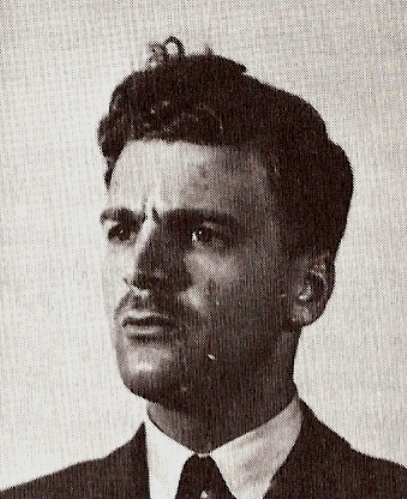
About: A Dutch officer who reached England in 1940 and, as the agent "Ham" ("Martien" at Ede), was dropped near Garderen in October 1944 to gather the scattered paratroopers and prepare the Rhine crossing that became Pegasus II; the SD took him on 1 December 1944 and he was shot at the Woeste Hoeve on 8 March 1945 (Boeree, pp. 161–162; War Ministry card).
Unit or role: Reserve first lieutenant of the infantry (the Bronze Lion card); dropped for I.S.9, MI9's field branch, and the Dutch Bureau Bijzondere Opdrachten (Decorandi). His task, as Boeree prints it: "het bijeenbrengen van de verspreide parachutisten en het voorbereiden van een crossing van de Rijn" (gathering the scattered paratroopers and preparing a crossing of the Rhine) (Boeree, p. 162, checked on the image; the Elspeet history's typed copy of the passage has "over de Rijn", the copy).
Where: Sloten, Amsterdam, Alkmaar, and from 1934 his parents' house at Heiloo; in October and November 1944 Garderen, then the farm Wester Wetering at Ede; held at the Wormshoef, Lunteren, the Rotterdamsche Bank at Velp and the Kruisberg, Doetinchem (scan 3; Boeree, pp. 166, 188).
Evidence: ✓ Boeree, Kroniek van Ede (1947), pp. 161–162, 166–167, 175–177, 181, 188, 199–203, 232–234 (checked on the page images); ✓ the War Graves Foundation's file on him, 1946 to the 1980s (Nationaal Archief 2.19.255.01, 16496A); ✓ his file with the Americans (US National Archives 286652147, pp. 5–23); ✓ Kragt's report, p. 4; ✓ Coslett's declaration, pp. 34 and 35; ✓ "In memoriam Bram du Bois", Studenten onder de bezetting (1946), pp. 257–259; ✓ his Dutch award card; ✓ the Erelijst, p. 429; ✓ Dekkers and Vroemen, De zwarte herfst (1984), pp. 226–228; ✓ Kirschen's Six Friends Arrive To-Night (1949), as "Ham" (pp. 90, 95–96, 104–110).
✓ Abraham du Bois was born at Sloten, North Holland, on 12 April 1916 (the Foundation's index card of 1946; Ede's answer of 1953).
- ✓ The Foundation's questionnaire names his father, Abraham du Bois, born at IJzendijke on 26 September 1889, a chief clerk (hoofdcommies) and by 1953 secretary of the Hoogheemraadschap Noordhollands Noorderkwartier, the regional water board at Alkmaar, and his mother, Sara Cornelia de Vuijst, born at Breskens on 8 November 1888 (scan 3). The father's own hand on the Americans' form of April 1946 gives his trade as "hoofdcommies van waterschap" (his file, p. 19).
- ✓ The family went from Sloten to Amsterdam on 1 January 1921, to Alkmaar on 23 February 1922 and to Heiloo on 12 September 1934, and both parents were at Regulierslaan 1 in 1953 (scan 3; scan 4).
School, the law and 1940
Link to the section School, the law and 1940The Ede book's chapter on him, photocopied into the Foundation's file, tells his schooling and 1940 (scan 6; the book's title is not on the copied pages, which are 170 to 173, with 174 missing): he went through the gymnasium at Alkmaar and began to read law. The Foundation's form says he had been a jur. cand. since January 1939 and that his studies were broken off by the mobilisation of August 1939 (scan 2).
- ✓ He was called up in 1939 as an ensign and made second lieutenant, and was an officer of the 2nd Infantry Regiment, the Peel division, when the Netherlands capitulated in May 1940.
- ✓ The book has him withdraw to Breda with ten men, break through Zeeuws-Vlaanderen and reach Brest on Saturday 22 June, and the lorries of the group cross to England on the Dutch ship Flensburg at the end of June (scan 6; scan 7).
- ✓ Boeree's short life of him has the same schooling and call-up, and has him "een van de weinige commandanten, die zijn manschappen met hun wapens via België en Frankrijk naar Duinkerken bracht en hen in Engeland afleverde" (one of the few commanders who brought his men with their weapons through Belgium and France to Dunkirk and delivered them in England) (p. 161, checked on the image). Where Boeree and the Ede book differ, see the disagreements.
England, Canada and the first drop
Link to the section England, Canada and the first drop- ✓ Boeree: in England he took a special course and was sent to Canada to recruit volunteers for the Princess Irene Brigade; there he was introduced to Princess Juliana and "mocht eens met haar kindertjes spelen" (was allowed to play with her little children once); back in England as a first lieutenant and trained as a parachutist (p. 161).
- ◐ The Ede book adds a parachute course in Canada, a talk on Radio Boston in May 1942, training by the Special Air Service as an agent and MI 9 (scan 7). The Foundation's own form says only that he volunteered for the British bureau I.S.9 and was dropped in October 1944 on a special task (scan 2).
- ✓ 17 September 1944. The October drop was his second. Kluiters has him a Jedburgh agent of team DANIEL II, dropped on 17 September 1944 near Son in North Brabant, the day Market Garden began, "arrested, but escaped; returned" (Kluiters); Stichting Kroon's list has "De eerste keer met een S.A.S. Jedburgh-missie op 17 september 1944" (Decorandi). Boeree has the drop "bij Vechel", and him taken prisoner after two or three days, escaping from a transport and rejoining his own side (p. 161).
- ◐ Something left at Son. A note in ink on the Americans' letter of April 1946 to his father, struck through in pencil, reads "case is about 3.000,- glds and letter of farewell left behind in Son (N.B.) by victim" (his file, p. 19, read on the image). Who wrote it and what became of the letter the file does not say.
With Murphy
Link to the section With MurphyMurphy and du Bois are not known to have met. Their paths came close twice: at De Ruif, the house at Garderen where Murphy was hiding when du Bois landed (◐, by Walsh's report), and on the Pegasus II nights, a crossing du Bois had helped prepare and Murphy's party set out on and never reached.
The drop, 17 October 1944
Link to the section The drop, 17 October 1944✓ Boeree: at 2.55 on the morning of 17 October he and his radio operator Raymond Holvoet came down at Boeschoten, Garderen, after a message "via Capt. King" on the 16th that the drop would be the next day; the 24 containers fell wide and mostly stuck in the trees. He came down "met de schuilnaam Arnold, die hij veranderde in Martien" (with the cover name Arnold, which he changed to Martien) (pp. 161–162; the date is disputed, below).
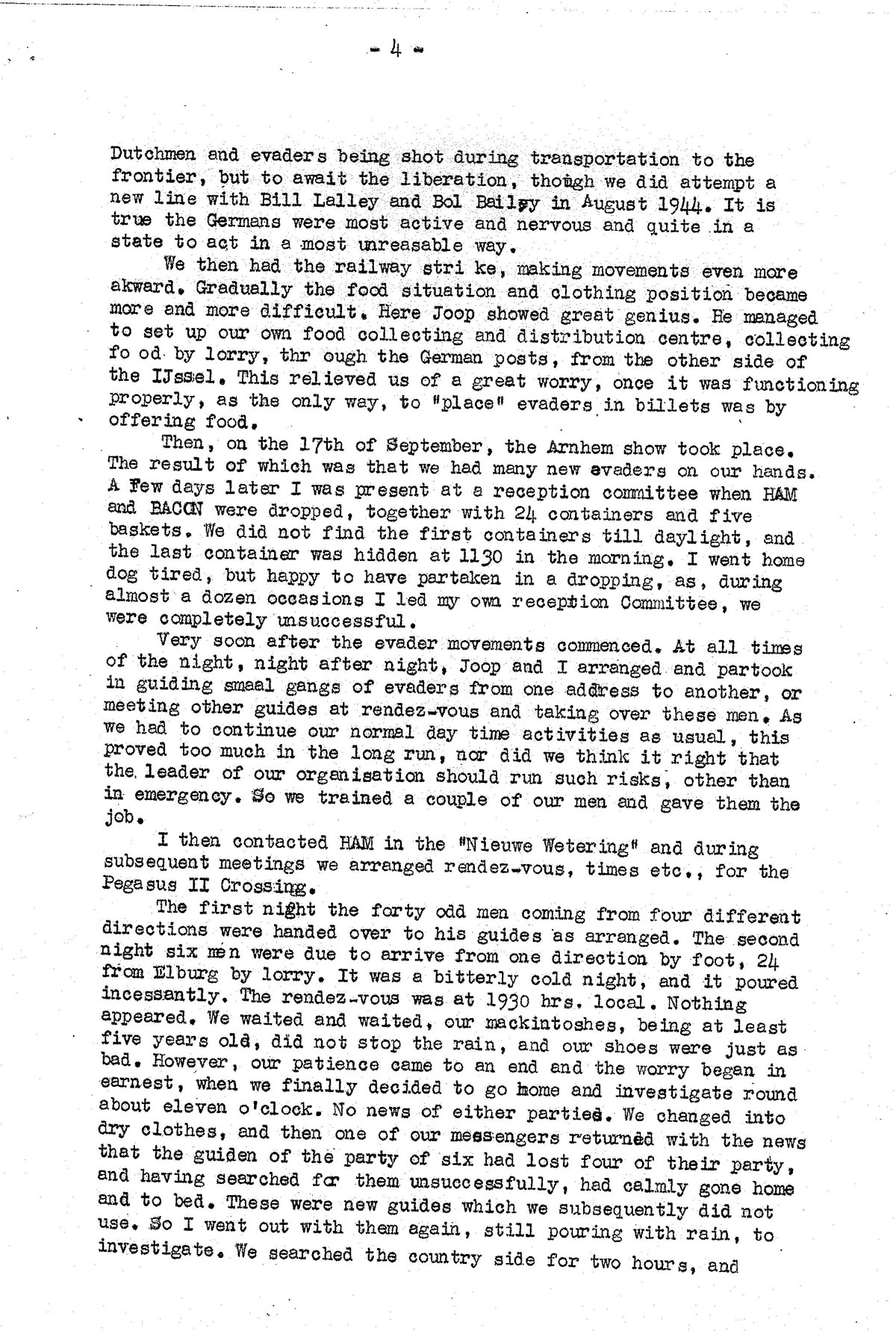
- ✓ The reception. The Elspeet history has the drop arranged by Dirk Last, "Zwarte Kees" (Elspeet history); ◐ Jan Roskam names a Dick Last, "Zwarte Kees", as the wireless operator of Kragt and Piller, and the two are taken to be one man on the name and the alias alone (Dekkers and Vroemen, p. 273). Kragt's report: "A few days later I was present at a reception committee when HAM and BACON were dropped, together with 24 containers and five baskets"; the first containers were not found till daylight and the last was hidden at 1130 (his report, p. 4; Dick Kragt).
- ✓ To De Ruif. He and Holvoet were taken by "Tinus (den hoofdonderwijzer J. A. v. d. Bovenkamp) en Nol (Burger)" to a bunker by the country house De Ruif, Dr Kruimel's; that afternoon King and his assistant Roelof visited and agreed where the weapons should go; that evening "ging Martien naar het huis van Nol, terwijl Holvoet werd ondergebracht bij Huber" (Martien went to Nol's house, while Holvoet was put up at Huber's) (Boeree, p. 161; Nol Burger; Johannes Kruimel; Gilbert Kirschen).
- ✓ The bicycle raid. At dawn on the 18th twelve Germans came to Nol's door for the bicycle requisition; Barend the courier put him in the hide above the sliding doors, where he stayed all morning (pp. 161–162).
- He then put on a civilian suit; before leaving he swapped his splendid English clothes for something less showy, since in the fine suit he stood out almost more than in uniform (p. 161).
- Arnoldus Burger of the Putterweg, Garderen, wrote on 8 March 1946 that "Lt. du Bois, who was dropped here, stayed in our house for some days" (Burger's letter, p. 4, image-checked; his table, p. 3).
- ◐ Huber. Lambertus Huber of Garderen told the Americans on 14 June 1946 that "About Oct. 12th 1944 the 1st Lt. Dubois and the Sgt. operator S.A.S. Raymond Henderson (real name Raymond Holvoet, a Belgium) were dropped in the "Chimpansee" field", that "1st Lt. Dubois went rather soon to Ede", and, wrongly, that he was "shot when trying to cross the Rhine" (Huber's form, p. 8). Major Windham-Wright wrote that Huber "also sheltered Sgt. Henderson (S.A,S.Regt.) for 10 days and Lt. Dubois" (his memo, p. 3).
Ham and Bacon at De Ruif
Link to the section Ham and Bacon at De Ruif- ✓ Lipmann Kessel met the pair at De Ruif, by his own book: two men in airborne smocks that "looked as if they'd just been issued brand-new", "'I'm known here as "Ham",' he explained, dead seriously, 'and my colleague is called "Bacon".'", and "'We've only just come over. Last night we were both at a dance in Oxford.'" (Kessel, 1959, pp. 92–93; Lipmann Kessel). Kessel names neither and gives no date.
- ⚠︎ Noordman prints Kessel's account with his party reaching De Ruif on the evening of 17 October and the two agents "net de afgelopen nacht" (just the night before) dropped (Noordman, p. 309); Walsh has himself and Murphy move on about 21 October to make room for a party of six R.A.M.C. officers who were expected, and does not mention Ham or Bacon (Walsh's report).
- ✓ Jeane van Galen's list of the men she helped, at De Ruif, runs "S.Walsh 4389314 | " T.Murphy 2756457 | " Maurits, Jupitair, Ham, Bacon" (her file, p. 3; Jeane van Galen). The son of the house told the Americans the same: "Besides pilots we also had the agents Ham (Dubois), Bacon (born in Flandria), Maurits, Jupitair", and that the last pilot left on 21.10.44 (Van Nispen's form, p. 2; Van Nispen tot Sevenaer).
- ◐ Murphy was at De Ruif until about 21 October, by Walsh's report (STORY: October; Walsh's report). The house's lists put Murphy and "Ham" there in the same weeks; no source says they met.
The Wester Wetering, October to November 1944
Link to the section The Wester Wetering, October to November 1944- ✓ To Ede. After a few days he went, with some paratroopers under Piet Hoekstra by way of W. Zandbergen at Voorthuizen, to King, who sent him on to Ede "omdat wij hier midden in het parachutistenland zaten" (because we sat here in the middle of paratrooper country); after a while Sister Den Hartog took his uniform away (Boeree, p. 162; Sister Den Hartog).
- ✓ The farm.
- He reached the Wester Wetering on the rainy evening of 20 October as a stranger who knew only the password "Roelof", and Max was suspicious; when the farmhand fetched a projectile, probably British, he took it apart expertly, which made Max wonder whether he had had a course, claimed he was armed, and was not, and stayed to take an active part in the planning (Boeree, pp. 166–167).
- The American report on A. M. Jochemsen, ◐ whose farm on the Rijksweg at Ede it very probably was (Jochemsen's report does not name the Wester Wetering; Noordman puts Aart Jochemsen, "Max", at the Wester Wetering, p. 142), says "Several times between the 20th of October and the 1st of December 1944 his house was used as a headquarters by Lt. du Bois and Bill Wildeboer" (Jochemsen's file, p. 16).
- ✓ The drops. He had asked for arms and uniforms for his paratroopers. When the signal came in early November, "De zeug heeft biggen", the first drop was on a meadow in the Fliert at Nederwoud, near Evers's farm; Bill and Martien led, and Martien saw to the lights. The aircraft came only on the third evening, with 22 containers; he unpacked them in a chicken-house on wheels and divided the take, half to Ede and half to Lunteren, and checked the pistols before the start of that third drop (Boeree, pp. 175–177).
- ✓ Wildeboer. The Americans' summary on Dirk ("Bill") Wildeboer of Ede, 23 November 1945, says that "Despite the fact that there was constant friction between several of the dropped agents of British Military Intelligence units, they were in perfect agreement that Wildeboer was a number 1 helper", known to "Agents Capt King, Capt Kay, Lt. van der Woerdt, Lt. Dubois and Capt van Loenen" (◐ Hendrik van Loenen) (Wildeboer's file, p. 48, read on the image). It names none of the agents as party to the friction.
- ✓ Jan Aartsen's house, Lunterscheweg 28. Jan Aartsen of Ede, whose form gives "Pax Intrantibus" as the address known to the Allied men, has a helper file graded 5. The summary sheet of 31 October 1945 says "Sheltered Lt. du Bois (Ham) several times. Several times English officers had a meeting in their house"; a separate slip repeats it (the form, p. 4; summary, p. 2; slip, p. 3; read on the page images with the contrast raised). The file gives no dates for the stays and does not name the English officers.
- ◐ The Ede sources put the staff quarters of the Ede resistance with the Aartsen family on the Lunterscheweg in September 1944 (Boeree, p. 97; the Ede manuscript, pp. 32–33), before du Bois reached Ede; nothing dates his own stays there.
- ◐ Menno de Nooy, 1984. De Nooy, second in command of the Ede organisation by the Americans' card (his card), told Dekkers and Vroemen about him (De zwarte herfst, p. 226, read on the page image):
- du Bois "werd hier gedropt als Martien. Zijn opdracht was het coördineren van de crossing" (was dropped here as Martien; his task was to coordinate the crossing);
- "Daar heb ik hem eigenlijk dag en nacht bij geholpen. We waren altijd samen" (of the second crossing, which he says du Bois did entirely: I helped him with it practically day and night; we were always together), and De Nooy cycled round the district to find the men and register them.
- What De Nooy says of the two crossings is under the disagreements.
- ⚠︎ De Nooy also remembered du Bois telling him "'Ik ben na de oorlog niet meer geschikt voor de maatschappij. Ik ben een silent killer. Ik ben een beroepsmoordenaar geworden'" ('after the war I'll be no use to society any more. I am a silent killer. I have become a professional killer'), and that he made no contact with his parents after the drop, so that they did not know he was back in the country (pp. 227–228, from the text layer; the capture of p. 227 is too small to check it). One man's memory, forty years on.
Pegasus II, 17 and 18 November 1944
Link to the section Pegasus II, 17 and 18 November 1944✓ Kragt's report: "I then contacted HAM in the "Nieuwe Wetering" and during subsequent meetings we arranged rendez-vous, times etc., for the Pegasus II Crossing. The first night the forty odd men coming from four different directions were handed over to his guides as arranged" (p. 4). ◐ The "Nieuwe Wetering" is very probably the Wester Wetering; Noordman's Dutch of the same report has "boerderij Wester Wetering" (Noordman, p. 117).
- ✓ The message to Maguire. Boeree tells it twice.
- At about four on the 17th he came to Wolfswinkel, where the chicken-houses had been emptied, wanting to tell Maguire "dat onderweg de troep met 60 man werd versterkt" (that the column would be strengthened by 60 men on the way), and on the way to Rap's said he feared for the whole thing: the troop at Wekerom looked far from uniform, with many Dutchmen in Allied uniform, and he feared the SD had heard of it (p. 199).
- On p. 181, at the column's assembly, "Ook Martien kwam met het bericht voor Maquire, dat bij Westerrode nog een twintig à dertig deelnemers zich bij de troep zouden voegen" (Martien too came with the message for Maguire that twenty or thirty more would join the column at Westerrode).
- Ede's own history has the same twenty or thirty (Ede manuscript, p. 46; text; Hugh Maguire).
- ✓ At van den Brink's. That evening the second party was to gather at the forester van den Brink's house on the Otterlo–Ede road. "Bij de woning van van den Brink zaten Joop van Amstel en Frans Hals met 15 man, daar waren ook Martien en Bart van der Hoeden" (Boeree, p. 200; Joop Piller; Dick Kragt; H. van de Brink). When a car with about 20 Feldgendarmerie stopped on the road, he sent Bart van der Hoeden to meet the car from Elburg and stop it with a light signal (p. 201).
- ✓ Left to him. At about half past ten they heard machine-guns and saw flares where the first column had gone; "Frans Hals ging naar huis, hij liet aan Martien over, zich uit de moeilijkheden te redden" (Frans Hals went home and left it to Martien to get himself out of the difficulties). Then 24 of the 40 Elburg men arrived; he put them in the wood with the others and hoped to lodge them the next day at the Schaapskooi or at Kootwijkerbroek (pp. 200–201).
- ⚠︎ The same page then has Frans Hals come with the Elburgers and go to Kootwijkerbroek, so Boeree has him both leave before they arrive and arrive with them.
- ✓ When Rap came home at about half past three with the news that the crossing had failed, "Geheel ontmoedigd ging Martien met zijn helpers over Meulunteren en Nederwoud naar Ede terug" (quite disheartened, Martien went back to Ede with his helpers by Meulunteren and Nederwoud) (p. 201).
- ✓ In Kirschen's book, 1949. Gilbert Kirschen calls the operation "Pegasus", the second mass escape, "organised by Ham, the details of which had all been arranged between himself and Brigade via us"; "Nearly a hundred men" should have crossed the night before (p. 104, under 20 November, read on the image; Gilbert Kirschen). London's signal that day was "Pegasus a washout following unforeseen difficulties. Five repeat five men succeeded in crossing Rhine." On 21 November a letter from Ham gave the details, after the north bank had been "evacuated to a depth of ten kilometres":
The only chance was to risk everything and make a dash for it. Major MacGuire, who was in command of the escapers, had decided to take the chance. Leaving his men in uniform and spacing them out in single file, he had hoped to get through the German lines unobserved. But his luck was out. The parachutists walked straight into a German patrol, and after a short engagement the majority of them had been captured or, taking to the woods, had got back to their hideouts.
— Gilbert Sadi-Kirschen, from a letter of Ham's · Six Friends Arrive To-Night (1949), p. 105 · the page, read on the image
"MacGuire" is Hugh Maguire. The letter is known only as Kirschen retells it.
◐ Murphy's party. Hardy's report has Murphy, Hardy, Banwell and Branford (Hardy spells him "Brentford") lose the rest of their party of six at a fork in the rain on the night of 17 November; fetched on the 18th, they met another party of evaders, "about 20 in all", by the road, and Hardy then writes that they had "missed the main body through the failure of the transport" (Hardy's report). Those twenty are very probably the Elburg men du Bois put in the wood (Dick Kragt sets out the case); no source names du Bois to Murphy's party.
After Pegasus II
Link to the section After Pegasus II- ◐ The ransom for Holvoet.
- The Elspeet history: on 3 December 1944 du Bois met Kirschen ("Captain King") in a wood to talk about the failed operation, and mentioned that he was in touch with a senior SD officer who might, for a large sum, treat Holvoet as a prisoner of war and not a secret agent;
- Kirschen warned him it might be a provocateur and asked London, and on 4 December came a telegram, "Laat "Ham" (Codenaam voor du Bois) onmiddelijk zijn besprekingen betreffende "Bacon" (codenaam voor Holvoet) stopzetten. Hij stelt zich persoonlijk aan gevaar bloot" (let Ham stop his talks about Bacon at once; he is putting himself in danger); it came too late, du Bois having just been arrested (Elspeet history; Raymond Holvoet).
- The site names its sources as books, not the telegram itself. On the dates, see below.
- ✓ Kirschen's own book, 1949, has the same story in his diary, with the message in English (pp. 109–110, from the text layer; no image of these pages is held):
- On 2 December "Ham gave me a rendezvous at the corner of a certain wood to discuss the new escape operation he was planning; Pegasus II it was to be called", for small groups, since all movement was forbidden in the evacuation zone; Ham said he had bribed a Gestapo chief to have Bacon treated as a prisoner of war.
- On 4 December came "Tell Ham discontinue negotiations concerning Bacon. Risks running own neck into noose.", and the answer "Too late, Ham's been arrested."
- ◐ Kirschen's "Pegasus II" is this later plan of December, which never ran; what the other sources call Pegasus II, of 17 and 18 November, is his "Pegasus" (above).
- Who Ham was, to Kirschen. "We never knew Ham's real identity. Roelof said that from his accent he might have been a Dutchman who had lived a lot abroad" (p. 110).
- ✓ The Ham of the book is du Bois all the same: Kirschen himself, in his boxed piece in Dekkers and Vroemen, writes "de Nederlandse S.A.S.-agent Martien, werd geassisteerd door de Belgische seiner Raimond Holvoet. Hun codenamen waren Ham en Bacon" (the Dutch SAS agent Martien was assisted by the Belgian signaller Raimond Holvoet; their code names were Ham and Bacon; p. 235).
- In the book he was dropped with Bacon, whom Kirschen knew as Holvoet ("Bacon I recognised as Holvoet", p. 90, read on the image), and the American files have "Ham (Dubois)" (Van Nispen's form, above) and "Lt. du Bois (Ham)" (Aartsen's file, above). By 1984 Kirschen called him Martien (below).
- ✓ The earliest account held is Kessel's book (1959), which has Kirschen tell him, in February 1945, of the ransom attempt:
I saw him two days before it happened. He was feeling very relieved because he thought he'd managed to do something for his partner Bacon. Somehow he'd made contact with a big noise in the Gestapo. In return for a large sum, this man had promised to get Bacon re-classified as a prisoner-of-war.
— Gilbert Kirschen, as Lipmann Kessel prints him · Surgeon at Arms (1959), p. 184 · the extracts
- ✓ Kirschen himself told it in 1984, in a piece printed in De zwarte herfst:
When the Germans had picked up that operator, Martien came to me to ask whether there were any chances of freeing Holvoet. I put the problem to my chief in England, but was told I had to be careful.
Dutch originalToen de Duitsers die seiner hadden opgepakt, kwam Martien bij me om te vragen, of er mogelijkheden waren om Holvoet te bevrijden. Ik heb dat probleem aan mijn chef in Engeland voorgelegd, maar kreeg te horen dat ik voorzichtig moest zijn.
— Capt. Gilbert Sadi Kirschen · in C. A. Dekkers and L. P. J. Vroemen, De zwarte herfst (1984), p. 235 · the extracts
The arrest, 1 December 1944
Link to the section The arrest, 1 December 1944The Ede book in the Foundation's file: after Holvoet's arrest on 27 October (he was executed at the Katerveer in Zwolle on 10 April 1945), du Bois worked from the Wester Wetering of the Jochems family to prepare Pegasus II with Captain Kirschen and Bill Wildeboer, commander of the B.S. at Ede (the book, p. 173; image-checked). Of the raid (the book calls him Bram, as does a fellow prisoner):
He was also there when the farm was raided on 1 December by the SD from De Klomp and from Ede. Bram tried to flee but was hit by two bullets in his right ankle and taken to a hospital at Lunteren. There a nurse, by putting his leg in plaster, managed to prevent his foot being amputated. After that Bram was taken first to the Wormshoef at Lunteren and on 7 December to Velp, where he was shut up in an emergency prison of the SD in the Rotterdamse Bank on the Hoofdstraat.
Dutch originalHij was daar ook aanwezig toen de boerderij op 1 december werd overvallen door de SD uit De Klomp en uit Ede. Bram heeft nog geprobeerd te vluchten, maar werd door twee kogels in zijn rechterenkel geraakt en naar een ziekenhuis in Lunteren vervoerd. Daar heeft een verpleegster, door Brams been in het gips te zetten, weten te voorkomen dat zijn voet werd geamputeerd. Hierna werd Bram eerst naar de Wormshoef in Lunteren gebracht en op 7 december naar Velp, waar hij werd ingesloten in een noodgevangenis van de SD in de Rotterdamse Bank aan de Hoofdstraat.
— Ede resistance book (title not on the copied pages) · p. 173 · Nationaal Archief 2.19.255.01, 16496A, scan 9 · the page
- ✓ Boeree's account (pp. 232–234): two men who knew a great deal asked for Martien at the farm one day and said they would come back at four the next afternoon. He wondered whether it was a trap; Tonny of the B.S., who was to look the place over with him, was seized for forced labour, and he went alone.
- The two men recognised him by a prisoner's description, fired a pistol shot as the agreed signal, and he ran; he fell over a wire, was shot at and lightly hit, and was carried to the farm on a ladder.
- Boeree names the two as Johnny de Droog and Emiel Rappard of the SD, with Heinemann waiting in a car 500 m off; Wachendorff said he was a prisoner-of-war officer and took the case; Kooyman of the SD said he was well treated and fed at the Wormshoef. Boeree gives no date, but puts it after the last week of November (p. 232).
- ✓ From the resistance side.
- Dekkers and Vroemen's De zwarte herfst (1984), p. 227: Menno de Nooy says "Martien" was betrayed ("verraden werk") and that "van twee kanten de SD kwam aanzetten, van De Klomp en van Ede" (the SD came from two sides, from De Klomp and from Ede); he was shot in the ankle running across the meadow, and the SD and the Wehrmacht quarrelled over whose prisoner he was. The lure by two men is Mrs Nijhoff's, below.
- ◐ De Nooy's appointment. Du Bois came one morning to De Nooy's mother and said he had an appointment at the Westerwetering "met een paar verzetsmensen uit Wageningen" (with a couple of resistance men from Wageningen) and wanted De Nooy there at three that afternoon; De Nooy, stopped on the way by men of the Organisation Todt, heard afterwards from his brother what had happened (pp. 226–227; p. 227 from the text layer).
- ⚠︎ Mrs D. Nijhoff-van der Meer, a resistance woman of Ede, has him lured there by two men. Max Jochems and his wife stood with Henk Wildenberg at an upstairs window and saw him run; he tripped over a wire and was hit, and "De twee zogenaamde verzetsmannen uit Wageningen hebben Martien die niet ernstig was gewond, op een ladder naar binnen gehaald en aan de S.D. overgedragen" (the two so-called resistance men from Wageningen carried Martien, who was not seriously wounded, in on a ladder and handed him over to the SD) (p. 227).
- ◐ Max Jochems is very probably A. M. Jochemsen, "Max", of the Wester Wetering (above); she has him hide and, late that evening, leave with his family for Renswoude. ⚠︎ Jochemsen's own recommendation (below, "The records") has him arrested on 1 December and his large farm burned down, which does not fit Max hiding and leaving for Renswoude; either they are not one man or one account is wrong.
- ⚠︎ Who betrayed him. De Nooy says "Johnny den Droog heeft hem verraden" (Johnny den Droog betrayed him), "met grote stelligheid" (with great certainty), in the book's words (p. 227). Neither he nor Mrs Nijhoff says how they knew. Boeree names the two men at the farm as Johnny de Droog and Emiel Rappard of the SD (above).
- Henk Wildenberg, by Mrs Nijhoff, was taken with Martien to the Wormshoeve, questioned and beaten, and taken bound with sixteen others to Amersfoort (p. 227).
- Paul Hellmann's Klein kwaad (2011), in his own narration (he walked round Ede with the widow; the book does not say what the account rests on), has him arrested "bij een bijeenkomst van verzetsmensen" (at a meeting of resistance people), held at Amersfoort "tot de bevrijding" (until the liberation), and home on 8 May 1945 (Hellmann, pp. 73–74, from the text layer; he spells it Wildenburg).
- ◐ That the two books' Wildenburg and Wildenberg are one man is our match, by the name, the Ede resistance, the Wormshoef and the return on 8 May 1945. See the disagreements.
- ✓ The records.
- The War Ministry's index card of late 1946: "B.S. Ede", "Detachement Londen", taken by the Germans on 1-12-1944, shot at the Woeste Hoeve on 8 March 1945 as a reprisal, with "Kruis van verdienste" written in where the typed "Geene" (none) is struck out (scan 12).
- Jochemsen's report: "upon the arrest of Lt. du Bois on the 1st of December he was himself arrested, his large farm completely burned down" (Jochemsen's file, p. 16).
- MI9's citation: "He was betrayed at the beginning of December when the house he was operating from was surrounded by the Germans. He attempted to fight his way out but was wounded and captured" (his file, p. 21).
Velp and the Kruisberg
Link to the section Velp and the Kruisberg- ✓ The Wormshoef and Velp, with Sister Den Hartog. Boeree has Sister Den Hartog hear in the Wormshoef that Martien had been taken, as had Kauffeld and Van Vemden; on 7 December Martien went with them and others to Velp, where at the Rotterdamsche Bank she and Martien had the two cells opposite the vault; on 26 January she was confronted with Martien, who said he knew her; on 6 February they were moved to the Kruisberg (pp. 188, 203; Sister Den Hartog).
- At the Wormshoef he complained that she had kept a diary, through which the SD had learned things; she says she read a few things aloud from it and then fell silent (p. 203; p. 188).
- ✓ The uniform.
- At Velp he told Van Vemden he badly needed his uniform back, to prove he was a soldier; it was at Knottenbelt's.
- When Van Vemden was released on 20 January he promised to see to it; twice he set out, and both times he was followed; then Bettink took it over and Flip got the suit to the Ortskommandant at Ede, who did not pass it on; it was fetched back and handed in at Velp (Boeree, p. 203).
- Johnny de Droog came to talk to the prisoners now and then and told Martien his chances were good, as a soldier and not a spy; Boeree thinks it a lie (p. 203).
- ✓ The next cell. Frank Coslett, the American navigator the SD had taken on 24 December 1944, was held in a solitary cell in the cellar of the Rotterdam Bank until about 10 February 1945, and on 13 November 1945, as Captain, signed a declaration for Mr D. Wildeboer of Ede (Wildeboer's file, pp. 34 and 35; checked on both page images):
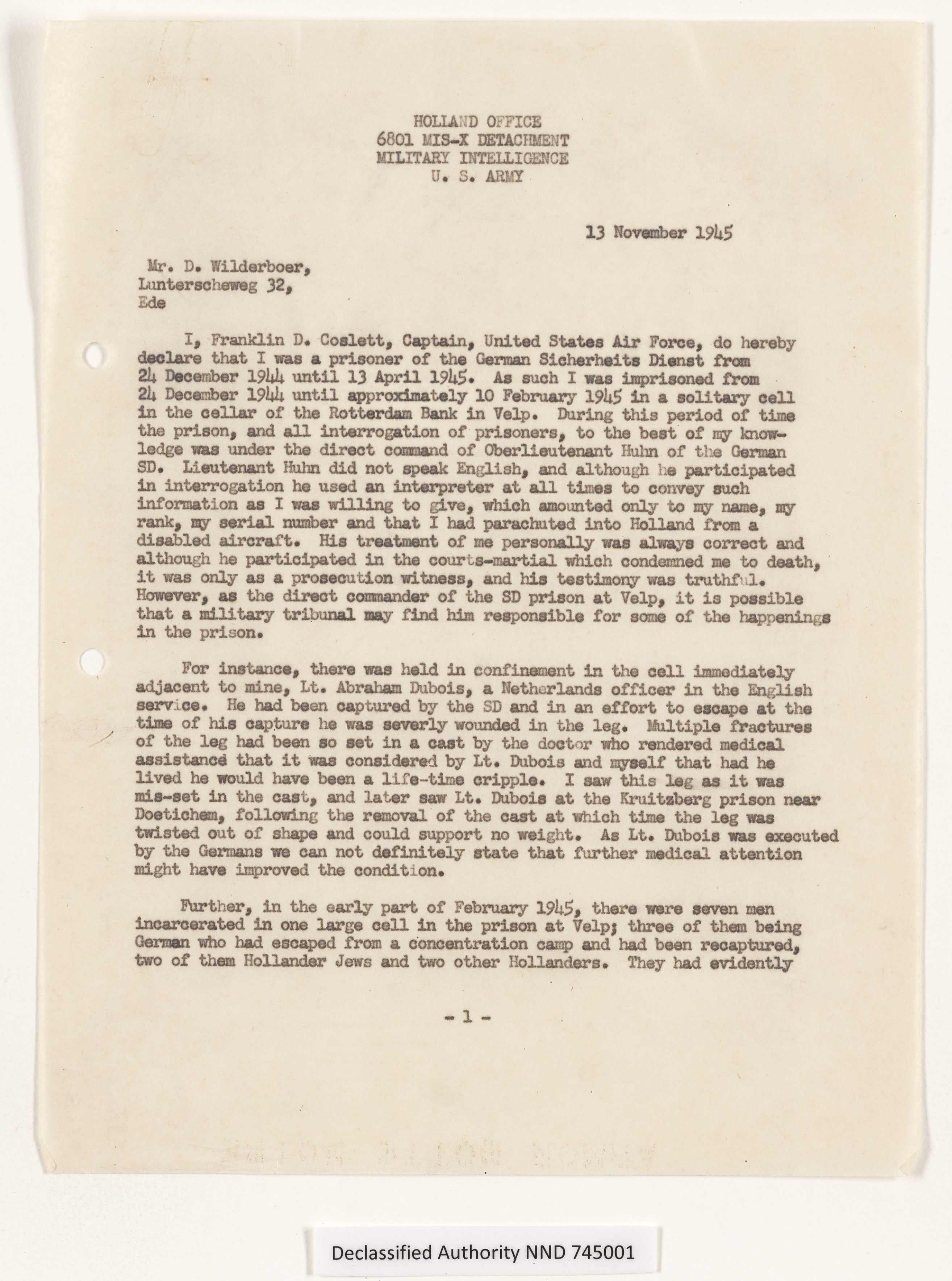
For instance, there was held in confinement in the cell immediately adjacent to mine, Lt. Abraham Dubois, a Netherlands officer in the English service. He had been captured by the SD and in an effort to escape at the time of his capture he was severly wounded in the leg. Multiple fractures of the leg had been so set in a cast by the doctor who rendered medical assistance that it was considered by Lt. Dubois and myself that had he lived he would have been a life-time cripple. I saw this leg as it was mis-set in the cast, and later saw Lt. Dubois at the Kruitzberg prison near Doetichem, following the removal of the cast at which time the leg was twisted out of shape and could support no weight. As Lt. Dubois was executed by the Germans we can not definitely state that further medical attention might have improved the condition.
— Franklin D. Coslett, Captain · declaration for D. Wildeboer · Holland Office, 6801 MIS-X Detachment · 13 November 1945 · the declaration, p. 34
The declaration also says the Velp prison and its interrogations were, as far as Coslett knew, under Oberlieutenant Huhn of the SD, who "although he participated in the courts-martial" that condemned Coslett to death took part "only as a prosecution witness" (p. 34), and that in early February 1945 seven men in one cell were shot after trying to saw their way out (p. 35; Coslett's page). ✓ Another prisoner, Jan Gysbertus Wijnveld of Arnhem, has in the Americans' summary of his form, dated 12 June 1946 and typed up in the first person, "When I was arrested at Velp at the Rotterdamsche Bank I nursed A. du Bois (Martien) who missed one leg" (Wijnveld's summary, p. 2; image-checked; see the disagreements).
✓ A fellow prisoner, in print, 1946. The Foundation's form points, under "Bijzonderheden", to "het boek "Studenten onder de bezetting", blz. 257" (scan 2), a book of students' wartime accounts edited by F. W. Blase and published at Amsterdam by Kirchner in 1946 (the title page). Pages 257 to 259 are a chapter, "In memoriam Bram du Bois", headed "Voor zijn ouders" (for his parents), which the contents give to J. J. Gerritsen; the chapter's own pages carry no byline (the contents; the chapter, transcribed; all three pages read on the images). The writer knew him in a cellar prison and wrote when the mourning card came, so from memory and for the family.
- ✓ The arrest and the cell. "O, Bram, en men had acht schoten door je heen gejaagd, toen je werd gearresteerd en men liet je liggen, tien, twaalf weken in een smoorhete cel" (they had put eight shots through you when you were arrested and left you lying ten, twelve weeks in a sweltering cell) (p. 257). ⚠︎ Eight shots against the two bullets in the ankle of the Ede book; see below.
- ◐ Which cellar. A tiled cellar "waar nooit daglicht doordrong" (where daylight never came) with glaring electric lamps, and a cell "anderhalve meter breed en twee meter lang" (1.5 m by 2 m) (p. 257). It fits the cellar of the Rotterdamsche Bank at Velp, but the chapter names neither Velp nor the bank.
- ✓ The nights. When the Germans were busy upstairs the writer would come and sit at the foot of his bed and have him tell of "dat wonderlijke, avontuurlijke leven" across the sea; they read the Psalms and the Sermon on the Mount together, and du Bois, "jaren ouder dan ik" (years older than me), was afraid of dying (pp. 257–258).
- ✓ The night of the sentence. "die nacht, toen we zekerheid kregen, gefusilleerd te worden" (that night when we became certain we would be shot): then the sentence was put off and seemingly cancelled. The writer was not with him at the end: "Mij echter heeft God weer weggestuurd, de wereld in" (God sent me away again, into the world), he writes, thanking God for it (p. 259). No date is given for either.
- ✓ His names. The writer remembers him as "Martin" and "Bram" (same page).
- ⚠︎ Who the writer is. Boeree lists a Dr. Gerritsen among those taken to Velp with Martien on 7 December (Sister Den Hartog). Nothing connects him to J. J. Gerritsen, who writes as the younger man in a book of students; the two are not assumed to be one.
The Woeste Hoeve, 8 March 1945
Link to the section The Woeste Hoeve, 8 March 1945✓ After the attack on Rauter, "werden Martien, Heijen, Streefland en Marinus van den Born naar de Woeste Hoeve gebracht en daar neergeschoten" (Martien, Heijen, Streefland and Marinus van den Born were taken to the Woeste Hoeve and shot there); Boeree's "Het heeft niet mogen baten" (it was no use) follows de Droog's assurance that his chances were good (p. 203). The Elspeet history has him shot there on 8 March 1945 "met vele anderen" (with many others) (Elspeet history); Jan Thijssen was shot there the same day (Het Parool, 31 December 1945: "Lange Jan, gefusilleerd op 8 Maart 1945 te Woeste Hoeve", the column). Kirschen, 1984: "Na de aanslag op Rauter is hij, met een aantal andere gijzelaars, bij de Woeste Hoeve gefusilleerd" (Dekkers and Vroemen, p. 235). The Alkmaar police commissioner, answering the Foundation on 24 September 1953, wrote that he was "verschillende malen in Nederland 'gedropt'" (dropped several times in the Netherlands) and "In 1944 neergelaten om strategische punten te verkennen" (let down in 1944 to reconnoitre strategic points), was "op de Veluwe door de Duitsers aangehouden" (stopped by the Germans on the Veluwe), shot at the Woeste Hoeve on 8 March 1945, and politically reliable (scan 4).
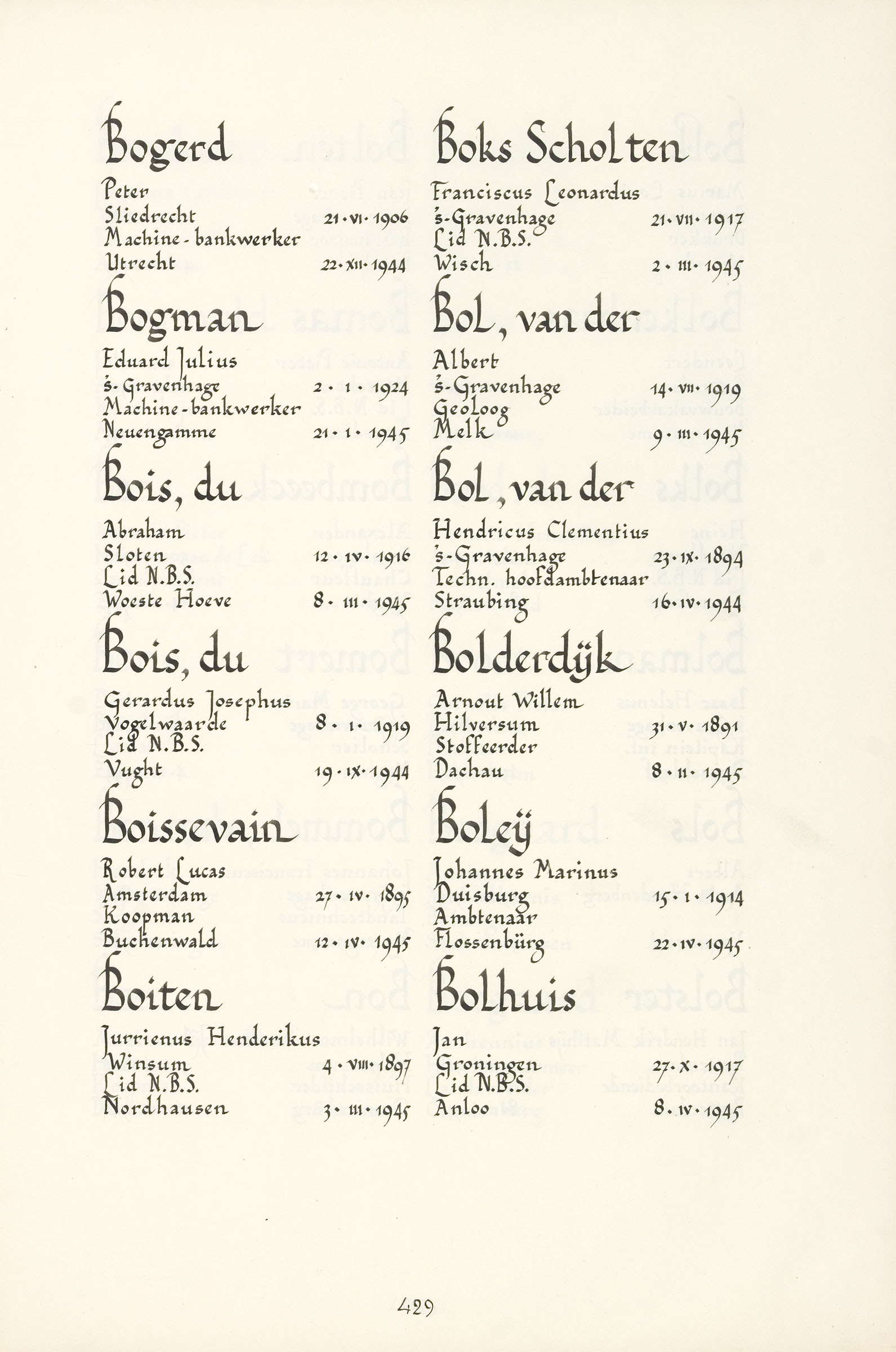
✓ The Erelijst, the Dutch roll of honour of the war dead, has him on p. 429: "Bois, du / Abraham / Sloten 12·IV·1916 / Lid N.B.S. / Woeste Hoeve 8·III·1945", a member of the Binnenlandse Strijdkrachten (the page, read on the image; the website's record, which has "Student" where the page has "Lid N.B.S.").
Where he lies
Link to the section Where he lies- ✓ The funeral at Ede.
- Of the men shot at the Woeste Hoeve, an Ottawa newspaper of 1945 reprinted in the Ede book says the bodies were buried at Apeldoorn, and that his brother found the grave, identified him and moved him to Ede on 25 July, "where full military honors were accorded him" (scan 7; image-checked).
- The clipping is a report of a letter, and also has him in the "Royal Netherlands Air Force", which nothing else here supports; it has him shot "in company with 116 others", the number the Woeste Hoeve monument gives (117 in all), as the student's tribute quotes it (p. 257).
- The book's own caption, "Begrafenis in Ede op 25 Juli 1945", is on the next page (scan 8, OCR only).
- ◐ The student's tribute describes salvos over the grave, the colours folded over the coffin and "de fonkeling van een erekruis" (the glint of a cross of honour) (p. 259); it reads as the funeral at Ede in July 1945, but gives no date or place.
- ✓ The Foundation's form of 11 December 1950 has the remains "tenslotte bijgezet in het monument op de Paasberg te Ede" (finally placed in the monument on the Paasberg at Ede) (scan 2); Ede's answer to the Foundation's request of 20 August 1953 gives the mausoleum, "graf no. 11", with a date read as 27 November 1945 (scan 3; handwriting, ◐).
- ✓ His name is on the mausoleum on the Paasberg, which Paul Hellmann describes as built in memory of 44 resistance dead, 29 of them buried in it and 15 remembered on plaques. Visiting it, Henk Wildenburg's widow pointed it out to him: "Kijk, hier zie je de naam Abraham du Bois, op 8 maart 1945 is hij doodgeschoten bij de Woeste Hoeve" (look, here you see the name Abraham du Bois; he was shot at the Woeste Hoeve on 8 March 1945) (Hellmann, Klein kwaad (2011), p. 72, read on the image).
- ✓ A later typed letter from the Foundation's director to a burgomaster, undated in the copy, refuses a sister's request to move him to the Ereveld at Loenen: the mausoleum is a municipal monument, Ede holds the rights, the Foundation counts the grave as definitively laid out, and a primary school adopts the mausoleum each year (scan 5; image-checked).
His estate
Link to the section His estate- ✓ In March 1946 a major of the N.M.A. staff at The Hague wrote "as the executor of 1st. Lt. Abraham du Bois, who was shot by the Germans on 8/3/45", asking after 3,500 guilders of his which he had directed to be handed over to his family (his file, p. 15).
- ✓ An unsigned note in ink on the back of that copy says the unit concerned had gone to Hamburg and that the money "had been turned over to a canadian Lt. on 3rd of oct. in order to be exchanged", the Canadian since demobbed and the outfit disbanded (p. 16, read on the image).
- ✓ On 10 April 1946 Captain Franklin Coslett, the man from the next cell at Velp, now of the Americans' Holland office, wrote to "den HeerA. du Bois" at the Regulierslaan, Heiloo, asking the name of his next of kin; the father filled in his own name, "father", and his trade (p. 19, read on the image). The struck-through note about Son, above, is on the same sheet, with a sister's name and age, not given here.
- ✓ The British. I.S.9 (A.B.) Holland recommended him on 12 February 1946 for "CERTIFICATE 17 POSTH.", for October to December 1944, with a citation that he "volunteered to be dropped into Holland in October 1944 on a special mission to aid the Allied evaders after ARNHEM", "played a large part in the first successful crossing of the Rhine, when approximately 140 troops were evacuated to the British lines", and "Had he survived he would unquestionably have been one of the most successful evasion agents in Holland" (his file, p. 22, read on the image).
- Kew holds "Abrahan du Bois, Lieutenant, born: 12 April 1916 … Award: Posthumous Certificate 17: Reference: BM/3263" (WO 208/5275/2326; the catalogue entry; not digitised) and a posthumous commendation for three months' service (WO 208/5454/121; the catalogue). The entries do not say whether they are one award or two.
- The British index of Dutch helpers lists "du BOIS, Abraham Lt.", certificate 14586, Regulierslaan E2, Heiloo, award grade "4 (posthumous)" (the sheet, read on the image; the index).
- ✓ The Americans. On 22 February 1946 Coslett recommended, "In the cases of Lt Abraham du Bois (Posthumous) and Lt van der Weert", first a Bronze Star and secondly the Medal of Freedom, since both "were dropped into Holland as military officers and come into the scope of an actual military award" (his file, p. 5, read on the image).
- The American form of 26 February 1946 carries the MI9 citation (12 February 1946, above), under the name of Major Windham Wright and the date 18 January 1946, which is earlier than the certificate (p. 21, read on the image).
- It became the basic Medal of Freedom: Captain Charles A. Byron's recommendation of 10 May 1946, for October to December 1944, was approved the same day by Lt Col R. H. Betts after review by a board of officers (p. 23).
- Dutch clearance was asked on 31 July and given on 28 August 1946 (p. 6): the Interior Ministry's letter lists "Abraham du Bois, Regulierslaan E 2, Heilo (posthumous)" among those for whom "clearance is given" (the letter in Rijk van Ginkel's file, p. 7; image-checked).
- General Orders 313, 1 November 1946, awards "Abraham du Bois -- October, 1944 to December, 1944" the Medal of Freedom without palm (p. 11); Stichting Kroon's list has it presented at Utrecht on 12 March 1947, posthumously (Decorandi), where A. M. Jochemsen received his the same day.
He continued working for evaders after this time and attempted a second crossing with 40 men in November. This unfortunately ran into a German patrol and the attempt was abandoned. He was betrayed at the beginning of December when the house he was operating from was surrounded by the Germans. He attempted to fight his way out but was wounded and captured. He was subsequently shot in March 1945.
— I.S.9 (A.B.) Holland · citation for Certificate 17, posthumous, 12 February 1946, used again on the American form of 26 February 1946, which has Maj. Windham Wright's name and the date 18 January 1946 · his file, pp. 21–22
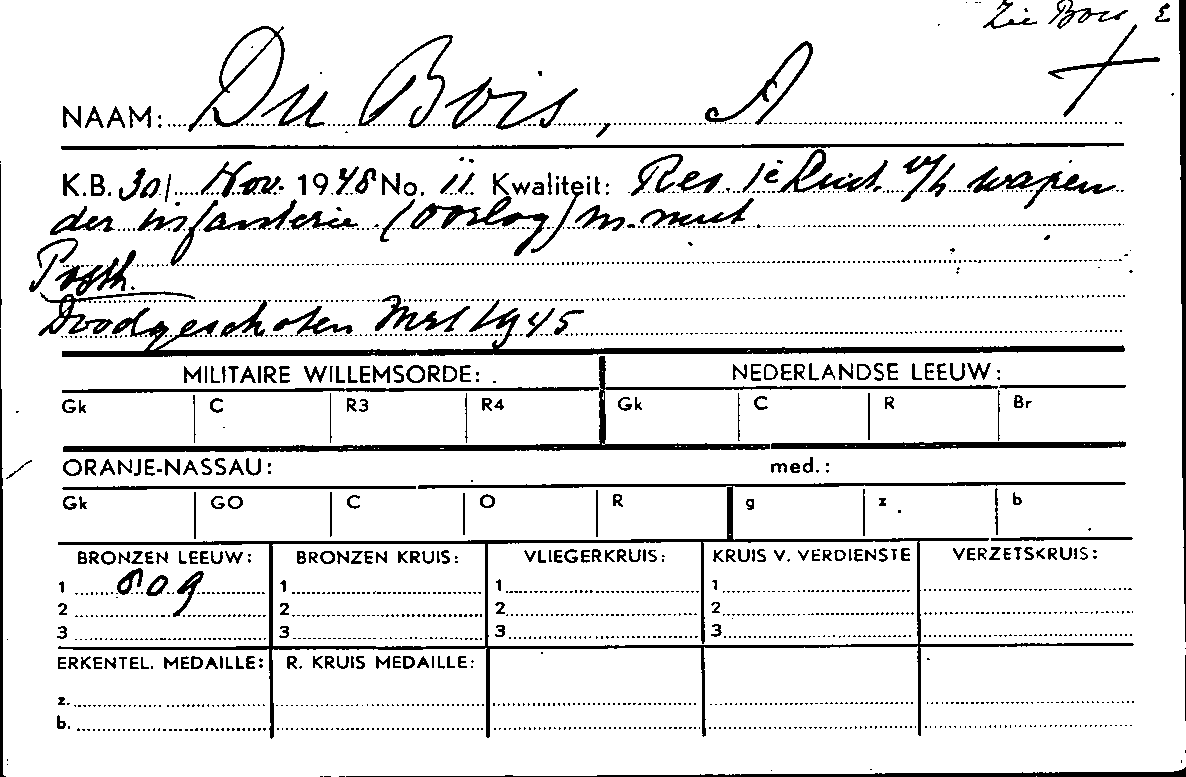
✓ The Dutch. The Netherlands gave him the Bronze Lion, posthumously, by royal decree of 30 November 1948, no. 11, as a reserve first lieutenant of the infantry, on the War Ministry's proposal; its register number is 809 (the card). A second card, filed under B, says the same (the twin card), and so does Stichting Kroon's list, "Bronzen Leeuw K.B. no. 11 van 30 november 1948 (postuum)", which adds the Resistance Memorial Cross (Decorandi). The cards carry no citation, and none has been found.
His parents after the war
Link to the section His parents after the war- ✓ His mother died at Heiloo on 3 December 1954 (registered on the 7th), the daughter of Jannis de Vuijst and Anna Blok, with her husband Abraham du Bois as the surviving partner (the civil record, index record from Open Archieven, no scan; what it is).
- ✓ The Dutch Chancery of Orders has a card for his father: "Heiloo, Regulierslaan 1", secretary of the water board, made a knight of Orange-Nassau in 1957, who died at Heiloo on 17 December 1969 (the card, Nationaal Archief 2.02.32).
- ✓ His father's death notice in the Algemeen Handelsblad of 20 December 1969 names him "weduwnaar van Sara Cornelia de Vuijst in de ouderdom van 80 jaar" (widower of Sara Cornelia de Vuijst, aged 80), at Heiloo, Regulierslaan 1, with the funeral set for Alkmaar's general cemetery on 22 December (the notice, image-checked); De Telegraaf printed the same notice that day (De Telegraaf). The card, the form and the notice are one man.
Where the sources disagree
Link to the section Where the sources disagreeThe landing. 16 October (the Elspeet history, and Stichting Kroon's list, Decorandi); "about Oct. 12th" (Huber, p. 8); 02.55 on 17 October (Boeree, p. 161); the night of 16/17 October near Boeschoten (Kluiters); "17 oktober 1944 bij Garderen" (the box on p. 230 of Dekkers and Vroemen, extracts); the night of 17/18 October near Boeschoten (the Ede manuscript, p. 44); 18 October near Garderen (L. de Jong, deel 10b, p. 551, note 1; image-checked); 02.55 on 18 October (the Ede book, scan 8, OCR only).
- ◐ Boeree's own chain fits his date: King visited that afternoon, he slept at Nol's that night and the Germans came to Nol's door on the morning of the 18th (p. 161). The Ede book has Boeree's time, 02.55, a day later.
- ⚠︎ Not settled: the night of 16/17 and the night of 17/18 October each have several sources, and Huber's 12 October and Kragt's "A few days later" after 17 September stand apart.
When he was taken. The Elspeet history has him meet Kirschen in a wood on 3 December 1944 and be arrested just before London's warning of 4 December reached him (Elspeet history); ◐ Stichting Kroon's list has "op 4 december 1944", without saying where it comes from (Decorandi). Against that, 1 December is in Jochemsen's recommendation (p. 16), in Kluiters, in De Jong (deel 10b, p. 551, note 1), on the War Ministry's card, "1-12-1944 door de Duitsers" (scan 12), and in the Ede book, an SD raid on the farm on 1 December (scan 9); MI9 has "the beginning of December" (p. 21).
- ✗ So 3 and 4 December do not stand as the day of arrest; the meeting with Kirschen may be right and dated late, or the Elspeet date loose. Kessel's book has Kirschen see him "two days before it happened" (p. 184), which fits the arrest of 1 December and the Elspeet date being loose.
- ◐ Kirschen's own book of 1949 tells the Elspeet story with the meeting in the wood on 2 December and London's warning, "Too late, Ham's been arrested", on the 4th (pp. 109–110, text layer); the site and the book are very probably one source, and the book's dates are a day off the site's and still after 1 December.
- ⚠︎ Menno de Nooy has him taken before Pegasus II (below), a fortnight earlier than every record above.
- ⚠︎ Jochemsen's report also seems to put du Bois in his house in July and August 1944, months before the drop (p. 16).
- ◐ The Ede book's "Wester Wetering" and "familie Jochems" are very probably the farm of Jochemsen on the Rijksweg and Kragt's "Nieuwe Wetering"; Noordman's Dutch of Kragt's report already reads "Wester Wetering" (Noordman, p. 117).
Dunkirk or Brest, Veghel or Son. Boeree has him bring his men to Dunkirk in 1940 (p. 161); the Ede book has him reach Brest on 22 June and sail on the Flensburg (scan 6). For 17 September 1944 Boeree has "Vechel" (Veghel), and Kluiters and the Ede book have Son, both in North Brabant (Kluiters; scan 8, OCR only); the note in the Americans' file has something of his "left behind in Son" (p. 19). Boeree gives no source for either. Menno de Nooy, in 1984, also has him cross to England "in mei 1940 bij Duinkerken" (at Dunkirk in May 1940) (Dekkers and Vroemen, p. 226).
What he did for Pegasus II. De Jong's note says the operator's set failed after one day, "zodat du Bois geen medewerking kon verlenen aan 'Pegasus II'" (so that du Bois could not help with Pegasus II) (deel 10b, p. 551, note 1; image-checked); Piller told the commission in 1949 that the operator "maar één dag gewerkt" (worked only one day) (the report, p. 275). De Jong later corrected the note himself: the operator was Raymond Holvoet, who "ook … in december '44 gearresteerd" (also arrested in December '44) and shot near Zwolle in April 1945 (deel 13, p. 153; image-checked), where the Ede book has Holvoet arrested on 27 October and executed at the Katerveer in Zwolle on 10 April (scan 9). ⚠︎ That is against Kragt's report, in which du Bois fixes the rendezvous and times for the crossing, Boeree, who has him at the assembly point that night, and MI9, which has him play "a large part" in the first crossing (p. 22). ◐ Kessel's book has an American in the barn on the night of the crossing say "Ham on his own is presumably responsible for tonight's show" (p. 126), which is against De Jong's note. ◐ The same passage has the man it speaks of betrayed by name of farm and "they shot him in the leg", the details of du Bois's own arrest on 1 December, so the words may be Kessel's later telling and not a record of that night. ◐ Two recent books agree with the older accounts, in search snippets of the Archive's OCR only: Jelle Hooiveld's Dutch Courage (2016) has "Du Bois' mission, code-named Pegasus II, was to organise the crossing of the group"; Helen Fry's MI9 (2021) has MI9 borrowing "two ex-SOE agents, Raymond Holvoet and Abraham DuBois" (Hooiveld; Fry).
- ✓ Kirschen's book of 1949, whose set carried the arrangements, has the November crossing "organised by Ham" and a letter from Ham about its failure on 21 November (pp. 104–105, read on the images): against De Jong's note.
- ⚠︎ Menno de Nooy, who says he helped du Bois day and night, told Dekkers and Vroemen in 1984 both that "de tweede heeft hij helemaal gedaan" (the second he did entirely) and that "Martien heeft 'Pegasus II' niet kunnen meemaken, want hij is voor die tijd gepakt" (Martien could not be there for Pegasus II, because he was taken before then) (p. 226, read on the image). The first agrees with Kragt, Boeree and Kirschen; the second is against the arrest of 1 December in every record (above) and against Ham's letter of 21 November.
The two crossings. MI9's citation credits him with "a large part in the first successful crossing of the Rhine, when approximately 140 troops were evacuated", Pegasus I of 22 to 23 October, and "a second crossing with 40 men in November" (p. 22). The 40 is far below every other count of the 17 November attempt (Pegasus II and Roekel), and nothing else here gives him a part in Pegasus I, which the Americans credit to Wildeboer (Wildeboer's file, p. 48).
- ⚠︎ Menno de Nooy: "Aan de eerste heeft hij niets kunnen doen. Ik geloof dat hij hier aankwam toen 'Pegasus I' al achter de rug was" (he could do nothing for the first; I believe he arrived here when Pegasus I was already over) (Dekkers and Vroemen, p. 226, read on the image).
- ◐ Kirschen's book first mentions Ham and Bacon in its entry for 22 October, after London's word that everyone had arrived safely (p. 90, read on the image); it gives Ham no part in that crossing.
The leg. The Ede book says he was hit by two bullets in the right ankle, and that a nurse at Lunteren put the leg in plaster and so kept the foot from being amputated (scan 9). Coslett, who saw it, says the leg had multiple fractures, was set badly in the cast, and at the Kruisberg was twisted and could bear no weight (p. 34). Jan Gysbertus Wijnveld, who nursed him at Velp, says he "missed one leg" (p. 2). ◐ The first two agree that the leg was kept and crippled; Wijnveld's words, in a summary typed 18 months after December 1944, are the odd one out, and nothing else here has an amputation.
Eight shots, or two. The Ede book has two bullets in the right ankle (scan 9), Dekkers and Vroemen a shot in the ankle on the meadow, and Boeree a light wound; the 1946 student's tribute has "acht schoten" through him at the arrest (p. 257). ⚠︎ The tribute is a friend's memory of what he had been told; the others are accounts of the arrest itself and agree with Coslett's single broken leg. Mrs Nijhoff-van der Meer, in Dekkers and Vroemen, has him "niet ernstig ... gewond" (not seriously wounded) at the farm (p. 227).
Henk Wildenberg's last weeks in prison. Mrs Nijhoff-van der Meer has him leave Amersfoort when all the prisoners were sent by train to Germany on 16 April 1945, escape on the way with a few others and be caught by a German patrol, and come back to Ede on 8 May 1945 (Dekkers and Vroemen, p. 227); Hellmann, in his own narration, has him held at Amersfoort "tot de bevrijding" (until the liberation) and home on 8 May 1945 (pp. 73–74). ⚠︎ Both are second-hand; they agree on the day he came home. The two books spell him Wildenberg and Wildenburg.
When he went to Velp. Boeree has him go there on 7 December 1944, with Sister Den Hartog, and so does the Ede book (p. 188; scan 9); Boeree's other passage has all of them sent on to Velp "Even voor Kerstmis" (just before Christmas) (p. 203). ⚠︎ Boeree gives both dates, and the Ede book agrees with the first.
His mother's age. The Foundation's form has her born on 8 November 1888, which makes her 66 when she died on 3 December 1954; the civil record of the death gives "67" (the record), which fits a birth in 1887. Not settled, and the birth record of Breskens is not held.
When he left the Velp cellar. Boeree has him moved to the Kruisberg on 6 February 1945, with Sister Den Hartog (p. 188); Coslett, in the next cell, gives "approximately 10 February 1945" for his own move out of the cellar (p. 34). ◐ Four days apart; neither says how it knew.