What's new
New finds about Private Thomas Murphy of 156 Parachute Battalion, newest first. Each entry links to where the new material sits in his story, so nothing has to be re-read to find it.
31 October 2026
Link to the section 31 October 2026With thanks to Tom's nephew Thomas Murphy, who named everyone in the family photograph taken at Kelty in 1945, and to Liz Moore again, for the photograph of Tom and Joan's wedding.
With thanks to Lisan Koppenol again, who got James Hardy's birth and death dates from ScotlandsPeople: they settle where the man who crossed the Rhine with Tom came from.
With thanks to Jacques Vanhaelen, for his family's memories of the Veerman farm and the photograph of the hiding place in the barn loft.
- Tom's family. The wedding photograph of Tom and Joan, July 1948, and who stands where in the 1945 photograph of the family at Kelty (his family).
- The hospital in the Willem III barracks at Apeldoorn. Two doctors' own accounts of the weeks Tom was held there:
- Col. Warrack's diary of the hospital, day by day, with his roll of the medical staff, which marks Pte Hardy "believed escaped" (Warrack's diary), and his own plan of the hospital block (the roll and the plan).
- Lt-Col Herford's report of the same weeks, printed in 1952: the hospital trains, the story both doctors doubted of four men shot escaping from one of them, and how he got out through the theatre window (Herford's report).
- Three men who got out of the barracks grounds in the days before Tom went, from their own escape reports and the forms of the Dutch families who hid them in Apeldoorn (three who got out; the Dutch families).
- The Veerman farm. The revolver Tom carried is now told from every side, and is probably Jacob's brother Leen's (the revolver); the hiding place in the barn (the hide); Jacob's arrest on 24 February 1945, now borne out by a police report of 1950 and the resistance memorial book of 1951; and Leen's own arrest in October 1943 (Leen Veerman). The round-up of December 1944 is now told with the men taken from the neighbouring farms (the round-up).
- The crossing of 2 January 1945. The Canadians' own reports and Porter's book name different men brought into Arnhem after the recapture, one with Tom and one without, and the pages now set the two side by side (the crossing and recapture).
- New pages for Pte William Gordon of Tom's own company; the brothers Henk and Wim van der Mheen, the Lunteren guides (whose name the site had wrong); Hermannus Rakers, the Groenekan policeman who hid four of the Canadians; Mrs Rolandus Hagedoorn of Amerongen, who hid Capt. Noble before the crossing; Peter Thorne, who escaped from Stalag IVB with James Branford; and three more of the Barneveld and Ede helpers, Johannes Roskam, Aart van de Heg and A. Morren (everyone, A to Z).
- More on the people along the way. Much fuller pages for almost everyone: Tom's platoon and company at Arnhem; the doctors and orderlies at Apeldoorn; the helpers at De Ruif and Elspeet, among them the Dutch agent Du Bois; Emma Vroege's own papers; Dick Kragt's and Joop Piller's lives after the war; and the Canadians and the people who hid them.
- Easier to read. Each person's dates, where they are known, now sit under their name, every person's page opens with a short summary of who they were and where the evidence comes from, and many more abbreviations explain themselves when you hover over or tap them.
17 October 2026
Link to the section 17 October 2026With thanks to Lisan Koppenol again, who sent a transcript of the escape report Capt Roger Schjelderup gave to MI9 on 1 February 1945, a file at Kew that has never been put online, and photographs of the reports three of the other Canadians gave on their release in 1945, which the late John Howes had passed to her.
With thanks to Tom's niece Liz Moore, who sent the family's cuttings, photographs and family tree.
With thanks to Carel Plantagie, grandson of Jacob Veerman of the Achterveld farm (his mother, Dilly, is one of the children in the family's photograph), who sent the Veermans' photographs from about 1940 and the lead to the rest of Arie Veerman's life.
- Tom's family. A portrait of Tom, the family at Kelty in 1945 and eight of the Murphy children, from Liz; his parents, and all ten children of John and Catherine Murphy, with his brother Christopher's death confirmed in the records (his family).
- The note in the sideboard. A Sunday Post cutting of January 1972 tells how Flip Esveld, of the Amerongen family who hid Tom over Christmas 1944, found a note with Tom's name and home town under a drawer of their sideboard 27 years after the war, and traced him through the Town Clerk of Kelty. The 1974 Daily Express tells much the same of Jo Veerman two years later (after the war). Flip very probably spent his late teens in Canada, at a coal mine in Alberta (Flip Esveld).
- The Canadians who crossed with him. Schjelderup's own report lists Tom by name in the party that set out on 2 January 1945 and among the men lost in the firing. Two of the others' reports, photographed at Kew, have Tom with them before the crossing, and one has him among the six men brought into Arnhem the next day (the Canadians' own reports). Their pages have their own stories, photographs of them at the house where they hid, and what the British Columbia papers printed of them in 1944–46 (Roger Schjelderup; Armando Gri).
- "Killed" on paper, step by step. The five War Office casualty-list entries for Tom, from wounded and missing to died as a prisoner to not missing after all. The timeline beside them now runs from the drop at Arnhem to his homecoming, the Army's record above where he really was, and each point on it opens the part of his story, or the record, it comes from (killed on paper).
- The Veermans before the war. Carel's photographs of Jacob and Aaltje with family and friends about 1940, and of the seven children, with his names for each of them, and the rest of Arie Veerman's life (Achterveld; Jacob Veerman).
- The farm behind the front. In April 1945 the Canadian advance stopped at Achterveld while the talks on feeding the western Netherlands were held in the village school. The war diaries of the two Canadian battalions there, with pages from them, follow the truce from 28 April to the end of the fighting on 5 May; the Patricias' headquarters stood a short way west of the Veerman farm, where German and then Canadian soldiers slept in the family's shelter (the farm behind the front).
- Pegasus II. Its date settled from both sides, and pages for Maj Hugh Maguire, who led it, Maj John Coke, killed near Ede the next day, and Thomas Lorne of Tom's own battalion (Pegasus II).
- His papers. The back of the Cairo photograph, and the 1974 cutting beside the 1972 one, with every page now two to a row (his papers).
- More on the people around him. New pages for Kik, the guide who took Tom to the Rhine (Freerk Stob of Amerongen), the two doctors of the Apeldoorn hospital, Berend Dijkman, Sister den Hartog and Father McCabe; and much fuller pages for many others, among them Dick Kragt, Joop Piller, Jan Thijssen, Frank Coslett, Peter Whittaker, the Verhoef brothers, and Tex Banwell's own war, with award papers from Kew (everyone, A to Z).
- Easier to find your way. The place pages now keep to Tom's own story, and what happened to each of the people in it is told in full on their own page; the People page and every person's page have an A to Z down the side; hover over an abbreviation such as MC or POW, or tap it on a phone, to see what it stands for; and the box at the foot of each person's page now asks about that person, with a full Dutch translation.
9 October 2026
Link to the section 9 October 2026With thanks to Jacques Vanhaelen, son of Jopie Veerman of the Achterveld farm where Tom hid for a month at the end of 1944, who sent his family's story, their family tree, the newspaper cutting of his mother's reunion with Tom in 1974, his photographs of the farm and two pages of the family's 1974 album.
And thanks again to Lisan Koppenol, who found Baron Mackay's own account, put right which of the Van Nispens was arrested, and pointed us to Bob Porter's disguise as a deaf-and-dumb Dutchman and to the tulip-bulb bread the Dutch told Tom about (his own account).
- Jo Veerman found him again, in 1974.
- The Daily Express of 25 July 1974 reported their reunion by Loch Lomond. It calls Tom "Flip", which was in fact Flip Esveld's code name, and has Jo find him through a note under a sideboard, as a 1972 paper says Flip did (see 15 October).
- His own notes put the visit in 1975; the paper settles it as 1974, and the cutting is now on his page, with Jopie's son Jacques's memory of the evening at the campsite (after the war).
- The Sunday Post's "Together After 30 Years" is still missing; it must be the issue of 28 July or 4 August 1974, so if anyone has a copy, please get in touch (the 1974 newspaper articles).
- Photographs from Jopie's family. Jacques's photographs of the farm as it is now, the hide in the barn, the bus stop named in Jacob's memory and the war memorial with his name (Jacob Veerman); the Veerman family just after the war; and two pages of the Vanhaelens' 1974 album: Tom with his wife and daughter at the Vanhaelens' tent by Loch Lomond, and a visit to "David" in England (Achterveld; afterwards; after the war; Jopie).
- David from the farm. The "David" Jopie and her husband visited in 1974 was very probably Flt Lt David Ward, the RAF bomb aimer hidden on the farm just before Tom, who set out on the same Pegasus II crossing, was shot and captured, and escaped from a German hospital (David Ward).
- The Achterveld family's own story. How the hide behind the hay worked, which of the children was which, and what the family went through after Tom left (Achterveld; afterwards; Jopie).
- Jacob Veerman's last months. The war-graves file on him, and the man from his own village who saw him aboard the Cap Arcona on the morning it was sunk (Jacob Veerman).
- His family in 1944 and 1945. His parents and his sister, Mrs Lyons, asked in the Edinburgh Evening News in October 1944 for news of him, and in February 1945 she announced he was a prisoner (killed on paper). His brothers and sister are now on his page, and A Book of Fife Heroes tells his homecoming in April 1945 (after the war).
- Who is in the photograph. By his niece Liz Moore's account, the picture labelled "Tom and 2 Aussies" was taken by his brother Michael, and the two with him were men of 156 Battalion, which would put it in India in 1942 or 1943 (the photograph).
- The Baron in his own words. Baron Mackay, who hid Tom's party in a chicken hut at Harskamp, told the story himself to a Dutch newspaper in 2002 (the Baron's own account).
- The papers behind the medals. Nineteen award recommendations held at Kew, for fifteen men in the story. Among them: Pte Hardy's Military Medal, won partly on the night of the crossing (the crossing); Brigadier Hackett's, which tell of his brigade's fight at Arnhem and his escape from the hospital (John Hackett); and the RSM of the Apeldoorn hospital Tom escaped from, credited with running it "for 900 men wounded at ARNHEM" (Lionel Bryson), with a new page for the colonel in charge of it (Arthur Marrable).
- The medal Tom wrote about. Tom wrote that his companion "was awarded the B.E.M. for his experiences". Tex Banwell's recommendation at Kew shows that his British Empire Medal, in 1969, was for twenty years in the Territorial Army (Tex Banwell).
- How the officers got home. The lists of the two helpers who ran the crossings over the Lek to Sliedrecht, Klaas Heijboer and Pieter Visser, name Brigadier Hackett, Colonel Warrack and Captain Lipmann-Kessel, and with them Haller and Branford, who had been in hiding with Tom (the Sliedrecht line).
- Fuller pages for everyone in the story.
- About 110 of the pages for the Dutch families, guides and soldiers now tell each person's whole story, with a source for every part of it, and over sixty open with a picture: a photograph, a guestbook page they signed, or the document that tells their part, such as the page of each Kew recommendation that matters (everyone in the story).
- Among them Coen Esveld, one of the guides of the party Tom set out with: his death record has him found dead at Dodewaard on 29 June 1945 (Coen Esveld).
- The pages of the men taken in the December round-up near Achterveld now say, from the camp records, how each of them died (the December round-up).
- Pictures on his own story. Bob Porter's photograph of the brickworks where the party gathered on 2 January 1945 (Porter's account), and an Army Film Unit photograph of Stalag XI-B at Fallingbostel, taken on 16 April 1945, the day the camp was liberated (liberation).
4 October 2026
Link to the section 4 October 2026- Where the men taken with Tom ended up. Two of the Canadians captured with him on 3 January, Harvey Swartz and Marcel Briere, were freed at Fallingbostel on 16 April 1945, the camp Tom names in his own notes, on the day it was liberated. Until now his own note was the only evidence for his camp (the men taken with him).
- Thirteen at the crossing. Sgt Gri, one of the three who got through, told the Canadian air force in February 1945 that he was "one of 13" that night, and Capt Schjelderup described the last he saw of the others, out on the ice under machine-gun fire (how many set out).
- The Canadians who crossed the Rhine with Tom. Six of the seven had escaped from a prisoner train as it left Utrecht in October 1944. Their own pages now tell how they were taken, how they got out, the Dutch families who hid them until Christmas, and what became of them: Roger Schjelderup, Armando Gri, Wilfred Berry, Marcel Briere, Harvey Swartz, Louis Trainor and the airman Bob Porter.
- Papers still to read at Kew. Gri's own escape report, and the liberation questionnaires of three men taken with Tom, each with an account of the capture and the prisons that may mention him (what we still don't know).
- The Red Cross card. The Red Cross in Geneva takes no ordinary requests for Second World War records until 25 January 2027, when its request form reopens (Red Cross).
3 October 2026
Link to the section 3 October 2026With thanks to Lisan Koppenol, a Dutch researcher, whose note led us to these files.
- The Dutch families who hid Tom, in the Americans' files.
- After the war the US Army asked Dutch helpers to list the Allied men they had hidden, and those forms survive at the US National Archives.
- The files of thirteen of the families and helpers on Tom's road record him, or his party, in 1945 and 1946, among them Pieter Hoekstra, who may have moved him to Garderen, the Van Nispens at De Ruif, who listed him with his home address in Kelty, Jeane van Galen who lived with them, Ima van Eysinga at Elspeet, and Joop Migchelsen at Kijkuit.
- Each is linked to its page in the archive (what they recorded), and so is everyone else each file names: Sammy Walsh, Hardy, Banwell, Branford and Haller, and the American, Canadian and RAF airmen hidden in the same houses (everyone else they listed).
- The forester's letter about the banknote. The forester at Kijkuit wrote in 1947 asking for an invasion guilder the six men had signed, and listed the signatures, "Thomas Murphy" among them; it may be the Airborne Museum's note or a second one (the forester's guilder).
- The Veermans' own record of the month, with the page: the family's form for Jacob names "THOMAS MURPHY … parachutist" and gives the month Hardy did (the family's own record). The family's statement puts Jacob's arrest on 24 February 1945, not January, for courier work, and says the Germans learned only afterwards that he had hidden Englishmen, which was probably why he was sent to Germany (why he was arrested).
- Mrs Esveld's account of Tom at Amerongen, given in May 1945, with the page; and what became of her son Gerrit, very probably the "Coen" named earlier, who took him to the ferry and was killed on a later crossing (Mrs Esveld's account).
- Who kept the dug-out near Roekel: very probably Van Vemden, named here on 1 October, whose own letter of 1946, as J. van Vemde, is here (the keeper of the dug-out).
- The night of the crossing in the guide's words: Adriaan Maljers's own statement, with the page (Maljers's own statement).
- More names: "Emmy" at Kijkuit was very probably Emma Wilhelmina Vroege of Hulshorst (Leuvenum); and two men given here before as "very probably" now stand on their own files: "Deaf Jan" was Johan Anne Cornelis van Oldenbarneveld (Kootwijk), and Bram Baar was Hilbrand Johannes Baar, "in charge of the daily safety" of the men's camp (Leuvenum).
- Tex Banwell's trail, from the helpers' forms. The form made out after Dries Klooster's death for his household at Barneveld has "K.D. Barnwell" there on 20 November 1944, a day before one book has him captured at Wageningen, and Joop Doornebosch at Leersum hid a "Tex", very probably him, for three to four weeks before Amerongen (Tex Banwell). Three forms from Staverden put him there briefly, one of them in mid-October (Banwell at Staverden).
- A photograph of the Arnhem drop: British paratroops jumping from Dakotas over the outskirts of Arnhem on 17 September 1944, the day before Tom's, from the Imperial War Museums (Arnhem).
1 October 2026
Link to the section 1 October 2026- A banknote signed in hiding. The Airborne Museum's archive holds a one-guilder note of 1943 signed by six British soldiers hidden "in a hole in the ground" on the Veluwe, and its catalogue lists "Private Thomas Murphy, 156 Battalion" among them, with the five men he was hiding with. It was given by the widow of a man who brought the six their food. The note itself is not scanned yet; the archive does that on request (the banknote).
- A map of his route, from Apeldoorn to the Rhine, with most of the houses and hiding places put where the two men with him told British intelligence they were, in January and March 1945 (the map).
- Dr Kruimel's own letter of September 1945, saying the Germans had "completely destroyed" De Ruif, the house where Tom wrote his poem, with a picture of the letter (the letter).
- The Dutch people who helped the men left behind by the failed crossing of November 1944, from
the town of Ede's own history of the war:
- the forester Van de Brink, in whose wood the latecomers hid, and Van Vemden and Kauffeld, of Wekerom and Roekel, arrested six days later for helping them, near the dug-out where Tom hid next (the helpers at Roekel).
- The same history names Kragt's two men in Harskamp, Marten van Beek, a policeman, and Willem van Dijk, who may be the "Willem and the policeman" who moved Tom on (though Van Dijk went by "Piet"), and the Harskamp constable G.J. Michels, whom Kauffeld thanked for his help before, during and after his arrest.
- The Veerman family. A Leusden paper in 1970 remembered Jacob Veerman as "a good man" and named the baker who, by the paper, provided the paratroopers' rye bread, Hein Schouten (the paper); and the camp card of Leendert Veerman, very probably Jacob's brother, held at Vught in 1943–44, is here (the card).
- More names from the records.
- The guide of the last night was Adriaan Maljers ("Dirk" to the men he led), who after the war refused compensation for his imprisonment;
- Baron Mackay of the chicken hut was very probably Eric Rijnhard Alexander Mackay;
- "Deaf Jan" was very probably Johan Anne Cornelis van Oldenbarneveld;
- Bram Baar of Kijkuit was very probably the Hilbrand Baar of the war dead register, arrested in January 1945 and executed in March;
- and the grades the British gave eight more of the helpers after the war can now be read: Maria Westerwoudt, Lady van Eysinga, Bram Baar, Joop Migchelsen, Gerrit van Ee, Adriaan Maljers, Berry Melis and Willem van Dijk (the helpers register).
30 September 2026
Link to the section 30 September 2026- His own words, in his own hand, from October 1944. While he was hidden at Dr Kruimel's house at Garderen, Tom wrote a poem about the Black Watch, "The Ladies from Hell", into the family's guestbook in his own hand, and thanked "my Dutch friends for their kindness & hospitality shown to me in time of need", signed "Pte Thomas Murphy … ex Black Watch". Sammy Walsh's page is opposite. Both pages are here, with the poem written out (the guestbook).
- A photograph of him as a young man, with a tennis racket (the record).
- How the Dutch saw him. Liesbeth Verweij, who hid him at Elspeet, wrote it down after the war: "Tom, a Scot … serious and cool-headed, with a typically English sense of humour". The alarm word "Coffee", the attic, the Persian carpets, and the night march when he stopped in the woods to press a tin of dubbin on the guide for his creaking bicycle (Sterrehoveke; the night march).
- The farmer who hid him for his first week has a name: Johan van Oldenbarneveld, "Deaf Jan", with his photograph, and pictures of De Ruif before the Germans burned it, Sterrehoveke, the forester's house in the woods and Baron Mackay's chicken huts (the Dutch chain).
- The Canadian record of the night he was lost. The Canadian Scottish Regiment's war diary for January 1945 has the crossing of 2 January and the German post where the party broke up, told by the two Canadians who got through (the crossing).
- All of this comes from Wolter Noordman's book Schuilplaats de Veluwe, which gives him a chapter, and from the Canadian war diary. What they point to and is still to be followed up, from a second guestbook at Elspeet to a card index of the men in the failed crossing of November 1944, is listed in the leads.
25 September 2026
Link to the section 25 September 2026- English translations beside every Dutch and German quotation.
- Jacob Veerman's letter from Kamp Amersfoort, 14 March 1945, in English and Dutch, and Alie Veerman's account of the raid on the farm, both from Achterveld's 2025 booklet (what happened to the Veermans).
- Noordman's Schuilplaats de Veluwe: its contents page shows chapter 22 is about Walsh and Tom. The chapter is not yet read (the books).
- The guides on 2 January named as Coen Esveld and Dirk Maljers, from a history of the resistance round Amerongen (the crossing).
- Capt. Noble's arrival at Stalag XI-B on 28 February added to the record (liberation).
- Jo Veerman's 1974 visit told the right way round: she and her husband stayed at Balmaha and had Tom and his wife to stay for a week. The Sunday Post ran it as "Together After 30 Years", and no copy has been found. If you have one, please use the "Get in touch" box below (after the war).
- Five books searched through the Internet Archive: Kessel, Heaps, Roy, Warrack and Powell. None names Tom (the books).
19 September 2026
Link to the section 19 September 2026The camp files themselves, read page by page. Yesterday's entry said the Arolsen index had been searched. Since then the German forms behind it have been downloaded and read, and they carry more than the index does.
Albert van Meerveld was delivered to Amersfoort on 15 December 1944 and Fokke Dijkstra on the 19th, and both were signed out on 2 February 1945 on the same transport into Germany. The two men were moved together, which nobody on this side knew. Fokke had turned eighteen a week before. The Neuengamme papers give the ends: Pieter Veenendaal at Hausdeich 60 in Hamburg, and the two Verhoef brothers from the Klettersteeg farm, who died at Wöbbelin three days apart in March 1945, of dysentery, one of them four days after his twenty-sixth birthday (the round-up).
Four of the forms are now on the page itself, so you can see the German paperwork rather than take our word for what it says: Wouterus Verhoef's Amersfoort card with Terrorist typed on it, his death certificate, and the registration cards for Fokke Dijkstra and Albert van Meerveld. They are held by the Arolsen Archives, and each one links back to its page there.
A man we had wrongly set aside. A third Verhoef in the index, Wouterus, was described here yesterday as a different arrest of no consequence. His own file says otherwise. He was a farmer of Stoutenburgerweg 28 at Barneveld, Catholic, married, with eleven children. The Germans took him on 7 October 1944 and wrote one word on the card for why: "Terrorist". He was held four days at Amersfoort, sent on to a camp, and died at Neuengamme at five in the morning on Christmas Day 1944, aged 65. He was not the father of the two young men from the Klettersteeg — different parents entirely — so he is a separate family losing a separate man, two months before them.
Two Van Eysingas in the Vught records: Dirk and his brother. Two Van Eysingas turned up in the Vught records with consecutive prisoner numbers, and it looked as though one might be "Derek", the man who hid Tom at Elspeet. One is. The card of the man born and living at Leiden is Dirk's own: his birth date and his Leiden address, as he gave them to the Americans in 1946, and he was in Vught from August to October 1943. The other, born at The Hague, is his elder brother Tjalling, booked in with him as the next number; the family entry in Nederland's Adelsboek of 1941 has them as brothers. Why either was held is not on the cards (Dirk van Eysinga).
⚠︎ One thing to say about Tom's own absence from this archive, because it reads worse than it is. A British soldier would not be in it in the first place: it records Nazi persecution, and a man held as a prisoner of war was the German army's paperwork instead, which is at Kew. The search was worth running because he said he was held as a spy rather than a soldier, and that could have put him in these records. It did not.
18 September 2026
Link to the section 18 September 2026Wolter Noordman has died. He was the Dutch researcher who worked from the guestbook kept at De Ruif, the house at Garderen where Tom hid for a week in October 1944, and he was the person most likely to be able to say whether Tom ever signed it. His publisher told us on 18 September; they could not say when he died, and no notice has been found.
So the record now says that, and the question changes. The pages of the guestbook printed in a 2023 magazine article start on 12 October 1944 and do not carry Tom or Sam Walsh, which leaves the page before. What matters now is who holds Noordman's research, and who holds the guestbook itself, which belonged to the Kruimel family rather than to him (the guestbook).
Photographs, and a map of the night he was taken. Bob Porter, the Canadian airman who crossed the Rhine with him, published his memoirs in 1997, and the book has pictures in it that nobody in this family had seen. He drew a map of the ground and marked it: where they started, at Amerongen on 2 January; where they left the river bank; where they were captured on the 3rd; and where they were interrogated. He also photographed the Dutchman who led them, whom the British knew only as "Dirk", twice, once at the time and once after the war in army uniform. That man was Adriaan Maljers. He was caught with them, beaten, his feet left bleeding in the ice, and sentenced to death, and Porter "always thought" he had died in a camp. He had not (the crossing).
There is also a photograph of the family who hid the Canadians in the same village that Christmas, Mr and Mrs Cornelissen and Nellie, sixteen, whom Porter calls their daughter (Amerongen).
Three more faces, and the document that changed a date. Cpl Arthur Shepley, the man who was beside him when the tank round came in and whom he assumed for the rest of his life had been killed by it, has a photograph on the Parachute Regiment's database (the wound). So do two of the Dutchmen taken in the round-up going on around the farm while Tom was hidden in it: Dries Klooster, at whose house the arrest happened, and Albert van Meerveld, who was arrested there, held in the same Apeldoorn barracks Tom had escaped from, and dead in a camp by March (the round-up). And the schedule that cut Lt Donaldson's headstone is now on the page: you can see "21st September 1944" struck out and "20th" written above it in red, which is the whole of the reason the Commission's date differs from the day Tom and Walsh described (Lt Donaldson).
The German paperwork for the men taken next door. The Arolsen Archives in Germany hold what survives of the Nazi camp records, and their index has now been searched for everybody in this story. It does not have Tom, and it does not have Jacob Veerman. What it does have is the other end of the December round-up: Pieter Veenendaal of Leusden and the Verhoefs (Jan and Johan) of Barneveld and Achterveld have prisoner files at Neuengamme; Fokke Dijkstra, the seventeen-year-old courier, is prisoner 9607 at Amersfoort with five documents in his file, and Albert van Meerveld, the helper the doctor knew as "Ape", has four. The Dutch account of what happened to those men can now be checked against the camps' own registers (what the index holds).
Two absences are worth saying plainly. There is no Arolsen record of Jacob Veerman, although twenty-five other Veermans have files, and none of Jopie's months at Westerbork. And of thirteen Thomas Murphys in the index, not one is a camp or prisoner-of-war record. That is the same silence the British archive shows, from the German side.
The December round-up is now where it belongs. The arrests going on around the farm while Tom was hidden in it, who was taken, on what day, and what became of them, used to be buried inside the section about Tex Banwell. It now sits with the month in hiding, as its own piece (the round-up), and the Banwell section keeps only the verdict: the arrests started three weeks before Tom was captured, so they cannot have followed from anything the Germans learned when they took him.
How the doctor was treated. Porter was held in the same house as the army doctor taken that night, and says the doctor "had been captured in uniform and with ID. The Germans were not threatening to shoot him and treated him as a proper POW", while the rest of them were told over and over that they were spies with no rights. The doctor's own report says he was taken in civilian clothes over his uniform, so Porter may have been judging by how the Germans treated an officer (the interrogation).
Two Dutch papers we could not read before. Every scanned document in the archive has been put through optical character recognition, so their words can now be searched. Two of them matter: the report of Dick Kragt, the agent London dropped on the Veluwe, written up in July 1945 and covering his whole war; and the account of the two agents who worked the radio from De Ruif, which says that Uncle Joop lived in Utrecht and had let the house to the Van Nispen family, and that the agent's job there was "gathering the scattered paratroopers and preparing a crossing of the Rhine" (Garderen).
Kragt's report also tells the Pegasus II nights from the organiser's side, the rain, the lorry that never came because its gas generator failed, and a Sergeant Haller who "almost embraced a German sentry" in the half-dark, which is very probably the Sgt Haller who was hiding with Tom that month (Pegasus II). And Porter's dedication, thanking the people who hid him, names the guide as "Dirk Maljers (Langbroek)", which gives him a first name the Dutch page does not and a village on the wrong side of the river, so there is one more thing to settle about the man who led them out.
The sources page has a clearer explanation at the top of it: what is listed there, what is kept privately, and why a good many of the sources are about the war and the people around him rather than about Tom himself.
14 September 2026
Link to the section 14 September 2026Two lots: what the war records at Kew and the Commonwealth War Graves Commission hold, and the Dutch side from the Dutch records, most of it about the family that hid him for a month.
From the war records:
- Lt Donaldson has a grave, and you can stand at it. Arnhem Oosterbeek War Cemetery, plot 21, row B, grave 10. He was 25, married to Geraldine, and his family chose the words on the stone: "In glorious memory of a most gallant gentleman and soldier" (his grave and the paperwork).
- The official date of his death may be a day out, and the other date is the day Tom described.
- The Commission's website says 20 September 1944. Most of its own records say the 21st, including the register printed for families and the 1956 registration form, and one adds that he died of wounds rather than being killed outright. The 20th survives from a correction made in red pen when the headstone was cut. The 21st is the day Tom described and the day Walsh described (the five documents).
- It is not proof: the same office wrote the 21st onto one form in red and the 20th onto another, so this is one for the Commission to settle.
- He was first buried not in a cemetery but in a scatter of graves where the bodies were found, and lifted from there in September 1945 (the five documents).
- Sergeant Joyce did not die. Walsh's report says the sergeant beside him was shot through the chest and died within minutes. He did not: German prisoner records hold Sgt Patrick Joyce at Stalag 357, the camp next door to Tom's at Fallingbostel, liberated the same morning. A third man from that firefight came home, and it is a reminder that even the careful official accounts get things wrong (Sgt Joyce).
- No German record card for Tom. The Germans kept card indexes of their prisoners of war, and about 200,000 of those cards were captured in 1945 and sit at Kew today. There is none for Tom. What that does and does not mean is on the record page (the archive list).
- He almost certainly signed on in Fife, not Dundee. Army numbers were handed out in local batches. The men holding the numbers either side of his are all Scots, and of the two near neighbours whose birthplace is recorded, one was born at Lochore and one at Kelty itself, where the family lived. The Parachute Regiment's own database says he enlisted at Dundee; the family papers say Cowdenbeath, twice, and the numbers agree with the family (the service number).
Also added: the file at Kew where the War Office worked out that he was alive after all, the three Arnhem war-crimes investigations that are the place to test how Donaldson died, and the Burgemeester's own account of the raid on the Garderen house, printed in a Dutch paper in May 1945.
From the Dutch records:
- The Veermans, from the registers. Jacob Veerman was a Den Haag shopkeeper's son who married a Landsmeer girl, Aaltje Bakker, at Barneveld in 1927; Jopie, born ten months later, was named for her grandmother. While Tom and Hardy were in the house the family was in mourning for Jacob's mother, and his father died there on 10 January 1945, a week after Tom was recaptured and six weeks before the SD came for Jacob (the month in hiding).
- An uncle may have been taken too. Tom wrote that the Germans "rounded up the Uncle and others" at Barneveld. At Neuengamme in 2024 Jacob's granddaughter said they were also remembering "my grandfather's brother and his nephew", who were held in the same camp and are not among its dead. Which brother, and when, is still to find (the month in hiding).
- Jacob Veerman is on the Dutch roll of honour. The Erelijst van Gevallenen, kept in the Dutch parliament, carries him on page 727 in the group Verzet, resistance, and you can see the hand-lettered page. Kamp Amersfoort's own prisoner register has him too. What the family learned from Jo in 1974 now rests on the Dutch state's records, not only on a book (the entry).
- Jopie's life after the war. Her death notice in the Barneveld paper, September 1977: she had married a Belgian, Jean-Baptiste Vanhaelen, lived near Brussels and was buried there; three children and a grandchild signed it, and so did her mother, who had remarried and was living in Barneveld. So the couple who came to Balmaha in 1974 came from Belgium (what happened to the Veermans).
- Uncle Joop died at home. Dr Kruimel's death notice, May 1976, is datelined "De Ruif": he was living in the rebuilt house the Germans had burned in October 1944 (Garderen).
- Two more of the December 1944 round-up have names. The doctor captured with Tom wrote that a house in Barneveld was raided and a helper called "Ape" taken. He was Albert van Meerveld, "Ab Prins", arrested at Dries Klooster's house on 8 December 1944, tortured in the barracks Tom had escaped from, and dead in a Neuengamme subcamp by March. Klooster died at Nijkerk in April 1945 (the round-up).
- The men at Amerongen, seen a week before the crossing. The Canadian airman in the party wrote about Christmas 1944 in the village: the families who hid them, a Sten gun wrapped under the tree, and then "an English Private, a Sergeant and a Captain, (who was also a Medical Doctor Paratrooper,) who were also going to go with us". He names nobody, but the party had one doctor captain, one British sergeant and two British privates, so these are men of Tom's party, seen by a stranger before the night that split them (Amerongen).
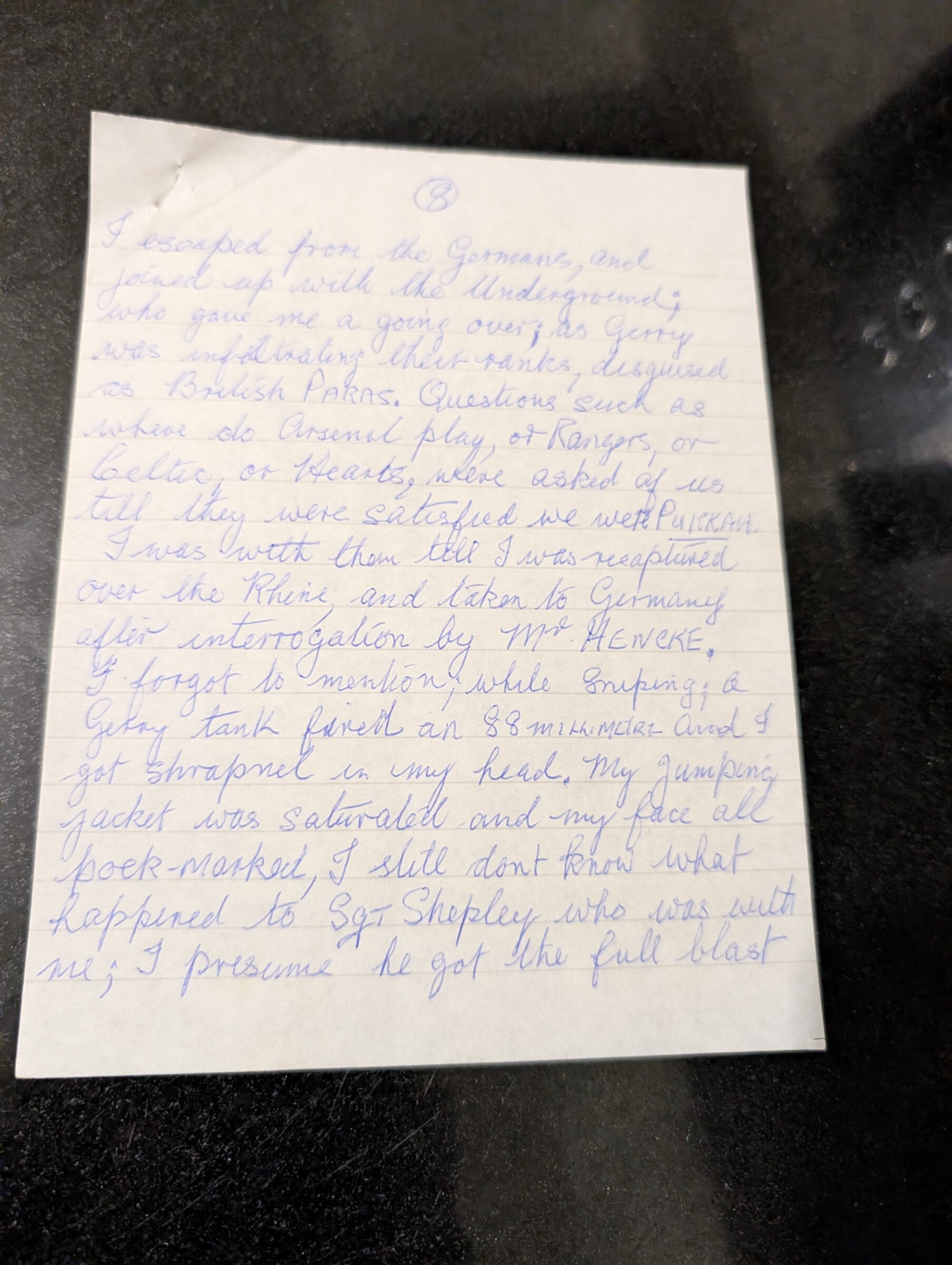
- "Sgt Shepley" survived. The sergeant beside Tom when the shell splinters hit was Arthur Shepley, a lance-sergeant of the battalion, wounded and taken prisoner four days later and home in April 1945. Tom presumed for fifty years that he had "got the full blast" (Shepley).
- Hardy's Military Medal was gazetted on 20 September 1945, and the recommendation, written within weeks of the night Tom was caught, is a free download from Kew (the archive list).
- On Tex Banwell, a verdict on each thing Tom said, one refuted, one confirmed, one consistent with the record, the rest his word alone, set out in a table at the top of the section so nothing there is taken as fact without a source (Banwell).
And a new place on the record page for things he said out loud and never wrote down, remembered by whoever he said them to. The first is the sniper he chose not to kill, and what it cost (things he said).
Also: the surgeon Lipmann Kessel's memoir is free online and does not name Tom, but describes a crossing from Amerongen over the ice six weeks after his; the German archives turn out to hold nothing for him, and the Black Watch museum says it has little on men of his war, so the free question to its archivist comes before any paid search; and the list of what to do next has been reordered around what can actually be done from a desk in Glasgow.
A photograph of him. Tom with two other soldiers, labelled by the family "Tom and 2 Aussies". It was on his ParaData page, where the family put it, and now heads the record and is on the papers page, where it can be saved.
Three more pictures on the Dutch page. Jacob Veerman, from his memorial page at Neuengamme; Uncle Joop Kruimel cutting an airman's hair at De Ruif; and two pages of the De Ruif guestbook from October 1944, where Kessel and the other Arnhem medics thanked "Joe". Tom and Walsh are not on those pages; the one before may tell whether they signed.
And there is now a way to write in. Every page has a "Get in touch" link at the top and a box at the foot of it: if you knew him, or your family sheltered him, or you have a photograph, a letter or a name that belongs here, the address is there. It says so in Dutch as well, because some of the people these pages are about are Dutch, and their grandchildren are still in Achterveld.
13 September 2026
Link to the section 13 September 2026Every page he wrote, photographed. Thirty-seven scans, all on the papers page with a description each, and downloadable there as one PDF. Until then the family had twelve phone photographs, several unreadable. What the new pages add:
- The twelve-page memoir, from enlistment to the Amerongen ferry, most of it never read before: Crete, Tobruk, the Mauretania, Ranchi and a priest from Lochore, the parachute course and "13 deaths by Roman candles", Taranto and Popski's Private Army, the flight to Arnhem, and his own account of the escape from Apeldoorn: the stretcher, the wire, singing along a railway, the haystack, the lady with her washing (the escape).
- Lt Donaldson. He wrote that he and "Sam Welsh" carried their wounded officer into a house, and that the Germans shot him there. Walsh's 1945 debrief, which nobody in the family had read, tells the same story from the other side (Walsh's report). That page also settles his platoon: 11 Platoon, C Company.
- The head wound explained. "Shotgun wounds" in the notebook were shell splinters from an 88 mm tank round while he was sniping, with a Sgt Shepley beside him (his page 8).
- He names the Esveld family (Gerald, Mrs Esveld, Flip and Coen) of Amerongen himself, matching the MI9 report (Amerongen).
- Belsen, the pension, and why he cut off the Airborne. The notebook pages on Fallingbostel and Belsen; the Musselburgh pension board and its £30; and a single page on meeting a fellow Arnhem soldier in Edinburgh who had been questioned by MI6 about him (after the war).
- A third man in the net.
- Capt. Charles Noble, an army doctor captured in the same firefight as Thomas Murphy and Tex Banwell on 2/3 January 1945, wrote his own report in 1945.
- It puts the interrogation centre at Velp, which is the memoir's "GWELF"; describes eight weeks of solitary and Gestapo prisons for a man taken "in civilian clothes"; reaches Stalag XI-B at the end of February, which fits the memoir's "from February"; and reports, at second hand in April 1945, that Banwell had been in that camp and was then "sent back to Gestapo in Holland" (the interrogation; Banwell).
- Noble never names Murphy, so none of this is proof about him personally; it is the same treatment of the same three men.
- "GWELF" is Velp, and the road after it. The SD prison at Velp, in the seized Rotterdamsche Bank, is on a plaque. The Dutch guide who led the January crossing was taken there "with some of the Allied men", tortured, and moved after three weeks "with seven Allied soldiers" to the Wolvenplein prison in Utrecht and then De Kruisberg at Doetinchem, the route Noble gives, and Noble is on the Doetinchem memorial's list of Allied prisoners. Whether Murphy was one of the seven is not recorded anywhere; it is the natural reading of the numbers (the interrogation).
- The airman's memoir. Bob Porter, the Canadian bomb-aimer in the same party, published his story in 1997 and it is online. "There were seven of us plus the three paratroopers … No one introduced anyone." He was taken to Arnhem, told he was a spy who could be shot, questioned at three in the morning, then Utrecht, then Doetinchem. He never saw Murphy after the firing started and never names him, which is why the record says the route is documented for the Canadians and the doctor and only fits for Murphy (the party).
- "Captain King" was Gilbert Sadi Kirschen, a Belgian SAS captain, the officer the Veluwe line reported to. Documented in the standard reference list of agents (Kirschen).
- "The Germans rounded up the Uncle and others." There was a round-up, in December 1944, in the villages around the Veerman farm, beginning while Murphy was in it, and every man taken died in the camps, one of them a seventeen-year-old courier from De Glind. But no Veerman was among them, and the Dutch record gives a cause that has nothing to do with the revolver (the round-up).
- The German side. No German paper about Murphy has been found, and the SD's own files from Velp did not survive. What survives is the policy: the orders, put in evidence at Nuremberg, under which captured paratroopers went to the SD and recaptured British escapers "might be turned over to the SIPO and SD" at the high command's discretion. They describe his case; they are not a record of it (the German side).
- His boyhood, in his own hand, and the army service list with every date now readable, which settles the drop date at 18 September 1944 and opens a new question about his enlistment date (still open).
10 September 2026
Link to the section 10 September 2026The site goes live with three pages: the record, the Dutch chain and the sources. The record carries a timeline of the five and a half months he was dead on paper; the Dutch chain carries a map of the eleven households that hid him.
5 September 2026
Link to the section 5 September 2026The research that the site is built on, done in one sitting from the family's papers outward:
- Two MI9 escape reports from 1945 found that name him: Pte James Hardy's, which follows him from Elspeet to the night he was recaptured, and Pte Samuel Walsh's, the man he escaped Apeldoorn with (Hardy; Walsh).
- The family that hid him for a month at Achterveld identified as the Veermans, and what happened to Jacob and Jopie Veerman afterwards (Achterveld).
- "Uncle Joop", "Derek" and the Burgemeester put to real names from Dutch published history, and two Dutch accounts found that record Thomas Murphy by name in October 1944 (Garderen, Elspeet).
- The camp corrected from Stalag II-B to Stalag XI-B, Fallingbostel, from his own typed notes (liberation).
- Every claim in his memoirs tested against the record, one by one (his own account, tested).