Warrant Officer Peter Thorne
London 15 Mar 1923 ◐ – Doetinchem 2 Feb 1945
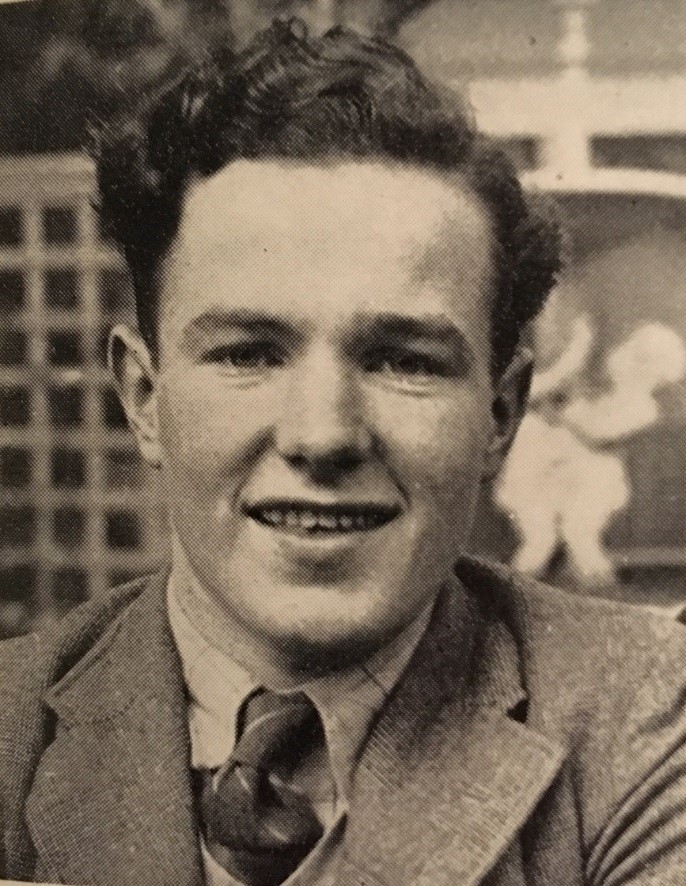
Sgt. P. Thorne, R.A.F., as the Canadian airman Jean Louis Warren names him in his escape report of 1945.
About: RAF navigator, shot down over Hamburg in 1943. Escaped Stalag IVB in May 1944 in a party with the airman James Branford, who was later on the run with Murphy; taken at Laren in November 1944, and died of his injuries on 2 February 1945 after jumping from the Kruisberg train; he was mentioned in despatches in June 1946.
Unit or role:
- RAFVR, navigator, service number 1324224 (London Gazette, 13 June 1946, p. 2818).
- A warrant officer on his headstone (the foundation's photograph) and in the Dutch war graves foundation's record (Oorlogsgravenstichting); a sergeant in Warren's report and Kew's catalogue of it (Warren; WO 208/3326/2996), in the Dutch papers of October 1945 and in the Gazette of 1946 (below), "F/Sgt Peter Thorne" in the text of Jimmy Taylor's book.
- By Taylor, the foundation and the war graves record, 102 Squadron, Halifax JB864 (102 (Ceylon) Squadron in Taylor) (Taylor, p. 435; Doetinchem Herdenkt; Oorlogsgravenstichting).
- By Taylor and Kew's catalogue of his German prisoner-of-war card, prisoner of war No 222444 at Stalag IVB (Taylor, p. 435; WO 416/361/394).
- The Laren family who hid him called him "little Peter" (Koeslag Sr's table, p. 14).
Where: Home, "14 Liverpool Road, Kingston, Surrey" on the Koeslag table and "14 Liverpool Rd., Kingston Hill, Surrey" on Albertus Koekkoek's list (Koeslag, p. 14; Koekkoek, p. 16). Stalag IVB at Mühlberg; hidden at Hengelo, Zenderen, Hertme, Enschede and Nijverdal in Twente, then at Laren, Verwolde and Harfsen in Gelderland; held at Deventer, the Oxerhof outside it, and De Kruisberg at Doetinchem; buried at Doetinchem, row 1, grave 12 (Oorlogsgravenstichting); born in London by Kew's catalogue of his prisoner-of-war card (WO 416/361/394), at Kingston Hill, Surrey, by the foundation.
Evidence: the strongest sources; every other source is linked where the page uses it.
- ✓ His headstone at Doetinchem (as photographed for the foundation), and ✓ the Oorlogsgravenstichting's record of his grave (the record).
- ✓ The London Gazette of 13 June 1946 (p. 2818, with the list's heading on p. 2817).
- ✓ Warren's escape report, as transcribed by the Pegasus Archive (Warren).
- ✓ The helper files of the Koeslag family of Laren, 1945–46 (Koeslag Sr's questionnaire of 13 July 1945, its supplement and tables; Koeslag Jr's).
- ✓ The lists of the helpers Plomp, Seigers and Koekkoek, and the forms of twenty more helpers in Twente and round Laren who name him, 1945–46, in the US National Archives (each linked under His road through Twente).
- ◐ The appeal for news of him of 5 October 1945 (signed by Thorne's family and the RAF's MRES, giving Whittaker's report) and its answer of 9 October (the information that reached the Wisch town hall at Varsseveld), each printed in De Nieuwsbode of Doetinchem (5 October; 9 October) and De Graafschapper of Winterswijk (5 October; 9 October).
- ◐ Kew's catalogue entry for his German prisoner-of-war card, WO 416/361/394 (the entry), the card itself not seen.
- ◐ The report of the American Col. Glenn E. Duncan, who came through Haeck's line, with what Warren told him of the train (E&E 2970, pp. 11–12).
- ◐ The foundation's article on him, Stichting Doetinchem Herdenkt, a 2020 compilation of family tradition, the Air Historical Branch's file and Braakman, and its pages on the Kruisberg transport and the prisoners.
- ◐ Three books:
- ◐ Branford's MBE citation (London Gazette, 17 August 1945).
- Hardy's report and Hilbrink's file.
Who tells his story. No report of his own is held, and he did not live to write one; nor is his service record, his German prisoner's card (Kew's catalogue entry for it is, below) or his grave's entry with the Commonwealth War Graves Commission (the Dutch war graves foundation's is). What we have is what others wrote:
- The airman Warren, who escaped with him and was in prison with him.
- The Dutch families and helpers who hid him, in their forms for the Americans of 1945–46.
- The Doetinchem memorial foundation, whose article on him by Paul Hilferink and Arie Kappert (printed in the Kronyck van Deutekom en Gander, February 2020) draws on Bosch van Rosenthal's memoir of De Kruisberg, the Air Historical Branch's file and a book by Braakman (Doetinchem Herdenkt).
- Its English version's list adds Brett-James's Mill Hill book and Clutton-Brock's Footprints on the Sands of Time, so it shares two sources with Taylor (the Air Historical Branch's file and Clutton-Brock), and where the two agree, on the Hamburg raid, JB864 and Stalag IVB, that is not independent (Doetinchem Herdenkt).
- Jimmy Taylor, himself a prisoner of war, who first met him "in bizarre circumstances in 1941" and calls him "my friend Peter Thorne".
- Taylor found his photograph in early 1994 in Hennie Noordhuis's Dutch book on Borne, had the article translated, and says his pages on him are "a compilation of the information" from the secretary of the 102 Squadron Association, a Dutch air historian, the Ministry of Defence's Air Historical Branch, Oliver Clutton-Brock's Footprints on the Sands of Time (2003) and his crewmate John Slater (Taylor, p. 434; p. 435; p. 436).
His birth.
- The headstone and Taylor give his age at his death as 21, so he was born between 3 February 1923 and 2 February 1924 (our arithmetic).
- Taylor's heading for him has 1923–1945 and the foundation has him born in 1924 at Kingston Hill, the son of Thomas and Elsie Lilian Thorne, a pupil of Mill Hill School in London from 1933 to 1940 (Doetinchem Herdenkt).
- ◐ Kew's catalogue of his German prisoner-of-war card gives the day: "Date of Birth: 15/03/1923. Place of Birth: London.", with his number 1324224, Stalag IVB and PoW number 222444, the camp and number Taylor gives (WO 416/361/394).
- The date fits the headstone's age and Taylor's year; it excludes the foundation's 1924 only if the card's day is right, since a birth between 1 January and 2 February 1924 would also fit the stone; London does not rule out Kingston Hill, but only London is the card's.
- The card itself, three cards not digitised, has not been seen.
His full name. The Dutch war graves foundation (Oorlogsgravenstichting) gives his full name as Peter Selwyn Courtney Thorne, the "P S C" of his headstone (the record).
Training and squadron. By Taylor, "After qualifying as a navigator in Canada in 1943, F/Sgt Peter Thorne flew on anti-submarine patrols in Whitleys with P/O John Slater as an air-gunner; they dropped depth-charges on two submarines, which they damaged." Later that year he and Slater joined 102 (Ceylon) Squadron, flying Halifax IIs from Pocklington in Yorkshire (Taylor, p. 435, read on the page image). The foundation has his training "partly conducted in the United States" and the squadron at Pocklington too (Doetinchem Herdenkt).
Shot down over Hamburg.
- Taylor has him navigating Halifax JB864 on the raid on Hamburg of the night of 27/28 July 1943, with 786 aircraft, of which 17 were lost; JB864 was hit by flak or by a night fighter, his informants disagreeing. Four of the crew were killed, "probably [?] the ensuing crash at Keekekamp"; Thorne, Slater and the bomb aimer, F/O E. W. Slipp, baled out, were picked up by the Germans and met in the guardroom at Fühlsbüttel airport, Hamburg (p. 435, the page image; the cursor of the screenshot hides the word after "probably", so the [?] is ours).
- From the interrogation camp, Dulag Luft, the two officers went to Stalag Luft III and Thorne to "an NCOs' Camp at Stalag IVB, becoming POW No 222444" (p. 435).
- The foundation has the same raid and the same three who baled out, and the crew of seven: pilot F/O G. McF. Clarke, flight engineer Sgt H. G. Bartle, navigator Sgt P. S. C. Thorne, bomb aimer F/O E. W. Slipp, wireless operator Sgt C. A. Bailey, air gunners Sgt D. Harrison and P/O W. J. Slater (Doetinchem Herdenkt).
- The four who did not bale out (so, by elimination, Clarke, Bartle, Bailey and Harrison) died in the crash at Sasel on the edge of Hamburg, the aircraft having been brought down by flak at about 02.00 on 28 July (Doetinchem Herdenkt).
- ⚠︎ Koeslag Sr's table has him shot down "Dec'43 Hamburg" (p. 14).
- The Doetinchem foundation has him shot down after a raid on Hamburg, landing safely by parachute and taken prisoner, and escaping from the camp a year later (Doetinchem Herdenkt).
- Koeslag Sr's supplement for the Americans has him "shot down in Hamburg, captured and brought to Leipzig" (the supplement, p. 15).
- ◐ The camp near Leipzig is how Hardy's report describes the camp Branford escaped from, Stalag IVB (Hardy; James Branford).
The escape from Stalag IVB, May 1944
Link to the section The escape from Stalag IVB, May 1944Taylor writes that he tried four times to escape, "in vain", and the fifth time, in May 1944, went "with five others", hoping to catch a train to Switzerland (Taylor, p. 435).
The appeal signed by his family and the RAF's MRES in the Dutch papers in October 1945 has one attempt only, "hetgeen echter mislukte. Hij werd hiervoor gestraft" (which failed; he was punished for it), and his family hearing from him regularly until 6 August 1944, "waaruit bleek, dat hij het goed maakte" (which showed he was well), and nothing after (De Nieuwsbode, 5 October 1945, read on the page image).
The one account by a man who was with him is Warren's. Warren and Pilot Officer J. Brandford (◐ James Branford, as the Gazette spells him) had got out of the camp on 1 May 1944 with a French working party and hidden for three days in a cemetery:
On the third day we heard that the Germans were going to search the cemetery so we made for a wood on the outskirts of ESTERVERDA where we were joined by Sgt. P. THORNE, R.A.F. and a private in the British Army and two Frenchmen. We stayed in the woods for four days, going down to the railway yards daily to see if there was a train for SWITZERLAND. … The morning of the fifth day we got on a car loaded with rolls of paper that was going to HOLLAND. It took us five days to get to HOLLAND. We had enough biscuits to last out, but no water for the last two days. When we were getting close to HOLLAND we started to make a hole in the box car with a small pocket knife and managed to make it large enough by the time we arrived at HENGELO, Holland.
— MI9 · Sgt J. L. N. Warren, RCAF, 434 Squadron · escape report, dated 21 April 1945 in Kew's catalogue · the Pegasus Archive's transcription
There they "dropped off the train and split up in twos", Warren going with Brandford (Warren). Kew's catalogue of Warren's report, dated 21 April 1945, lists "Sergeant P Thorne" and "Pilot Officer J Brandford" among the other names in it (WO 208/3326/2996).
◐ Branford's MBE citation seems to tell the same journey from his side, without names, and differs on detail: he escaped "later in April, 1944" (Warren has 1 May), and at a marshalling yard he and a companion joined "some more escapers" and boarded a truck; "Six were in the party and, for four days, they travelled in the truck" (Warren has five days, Taylor three) (London Gazette, 17 August 1945, p. 4186). The citation does not say the party was Warren's; that is our identification.
◐ On it the six were Warren, Branford, Thorne, the British private and the two Frenchmen: Warren lists them, the citation counts six, and Taylor's "five others" makes the same number.
The foundation's article has Thorne escaping with three other prisoners, a fifth attempt, meeting "P/O Brandford and Sgt Warren" in the wood, five days in a goods train, and the party splitting in two at Hengelo, Thorne in one group and Brandford and Warren in the other (Doetinchem Herdenkt). "ESTERVERDA" is as the transcription spells it.
Taylor's version of the journey is different in its detail: "they were locked into a goods train going west by a friendly French forced-labourer. Three days later, half-starving, they cut a hole in the floor and dropped out, finding themselves in Holland" (p. 435). Koeslag Sr's supplement has him escape and flee "to Czecho-Slovakia" before hiding himself in a train going to Holland (p. 15); see Where the sources disagree.
In hiding in Twente, May to September 1944
Link to the section In hiding in Twente, May to September 1944Koeslag Sr set down for the Americans in 1945 what he knew of Thorne's road to his farm:
Peter Thorne was shot down in Hamburg, captured and brought to Leipzig, escaped and fled to Czecho-Slovakia. He hid himself in a train going to Holland, left the train in Hengelo (O). He has been a "onderduiker" and was helped by Jules Haeck, Berfel[?]weg 115, Hengelo (O) (Haeck was shot). From there he went to Zenderen, Nijverdal and brought to the house of Koeslag by [J.?] Kroeze (Hengelo (O)).
— A. J. Koeslag Sr, Laren · supplement to his questionnaire for the Americans of 13 July 1945 · p. 15
The initial before "Kroeze" is unclear on the scan; "J." is read from the Koeslags' table, which has "J. Kroeze, Hengelo" (p. 14).
- Hengelo. ✓ Haeck's own file settles the name and street: "HAECK, Jules, Berfloweg 115, Hengelo", born on 1 September 1894 at Croix in France, "executed by the Gestapo in November 1944 for his pro-allied work", and recommended for a posthumous Medal of Freedom (Haeck's file, p. 13). He is the "J.Haeck Berfloweg 115 Hengelo" to whom the helper C. C. Hilbrink passed Branford and Warren after hiding them for 42 days from May 1944 (Hilbrink's file, p. 7).
- His file's numbered list has "40.Peter Thorne,14 Liverpool Rd.Kingston Hill,Surrey,England." after "39.A.M.Kuhn", and the last names of another of its lists include Warren, Branford, Duncan, Kuhn, Thorne and Weaver, in that order (p. 19; p. 26).
- The Koeslags' second table has him come to them from "Hengelo - escort Jules Haak" (p. 19). The foundation's article has the resistance group "Haeck", active in Twente, helping him into hiding, and him moving between several addresses until his arrest (Doetinchem Herdenkt).
- Zenderen. Albertus Koekkoek, a helper at Zenderen, lists "122. Peter Thorne, 14 Liverpool Rd., Kingston Hill, Surrey, E.", the line after "121. A.M.Kuhn" (his list, p. 16, read on the image). ◐ It is the same list as Haeck's, renumbered: both run Duncan, Kuhn, Thorne, Weaver, and both type Kuhn's town "Paigutan, S.Devan" (Haeck, p. 19), so the two count as one source.
- Kuhn and Delden. Jan Hendrik Seigers, ◐ the Ommen contact man (his form, p. 33; more on Charles Noble's page), lists two men of the "8th army" who had escaped from Germany (English, p. 36; Dutch, p. 34):
- "Alfred Kuhn, 8th army, escaped from Germany, caught again 28/6", the Dutch copy adding "weer gepakt te Delden 28/6" (caught again at Delden, 28 June);
- on the next line, "Peter [pencilled: Thorne], 8th army, escaped from Germany, evaded arrest when Kuhn was caught". The surname is pencilled over "Peter" on the English copy only (checked on the image).
- ◐ It is Thorne: Johannes Plomp of Hellendoorn wrote on his form "Alfred was arrested and Peter Thorne perished when he tried to escape", and his list has "Alfred (surname unknown)" (p. 2; p. 3).
- ⚠︎ Seigers's "8th army" does not fit Thorne, an airman. ◐ Kuhn may be Warren's "private in the British Army", but no source says so; Koekkoek's list gives him an English address, as typed "Paigutan, S.Devan. E." (Paignton, Devon), which fits a British man without settling that he was the private.
- The later forms: van Oosterwijk's table has him "Alfred KUAN, militair" of the "Engelsch Leger" (English army), ter Horst's file "Br., Ex.P.W.from Germany", and Reckman's "now with the UNRA at Hamburg" after the war (van Oosterwijk, p. 3; ter Horst's file, p. 3; Reckman, p. 8); Panhuysen and Vloedbeld have him RAF (under His road through Twente).
- Nijverdal and Hellendoorn. Plomp, of Sanatoriumweg, Hellendoorn, who organised the moving of airmen with helpers at Hengelo and Almelo, has "Thorne Peter" on his list with the remark "Met with an accident when he tried to escape." (p. 3, read on the image; p. 2). Taylor has him hidden by the resistance at Nijverdal, "finally being sheltered in Hengelo and Enschede by the Resistance centred near Borne when, no doubt, Peter acquired the nickname of 'Little Peter'" (p. 435).
- Warren went on from Hengelo to Borne and Nijverdal and names Thorne next only in the prison at Deventer (Warren), so ◐ the two were not together in hiding.
His road through Twente, stop by stop
Link to the section His road through Twente, stop by stopTwenty of the forms the helpers filled in for the Americans in 1945 and 1946 name him. Below they are set out in the order of the dates they give, which is our ordering: several forms give no date, and the dates they do give overlap (see Where the sources disagree). Most are summaries typed up by the Americans' office from a helper's form, a month or more after the war.
- Hengelo, May 1944. Andries Roelvink of the Oelerweg had "P. Thorne, Sgt.", RAF, shot down in "July 43" at Hamburg, for 2½ days in May 1944, "after being fetched from Twekkelo(near Hengelo) from a farm, by my son", and passed him on to "Hr. De Bakker, present location unknown"; his table has the Kingston Hill address (Roelvink, p. 2; p. 3).
- Nijverdal, from 30 June. A. G. Arnold of the "Cambellweg" [sic] No 30, Nijverdal, has "Peter S.C. THORNE", RAF, "Fled from Germ. Concentration" [camp], with him from 30 June 1944 for 10 days (◐ a "45" is struck over the typed "'44" on the scan, in pencil or type is unclear, so the year is not firm), received from "Jaap de JONIG, Oranjestr.", Nijverdal, "informations through v.ASSELT" (Arnold, p. 18). His form names W. van Asselt of the Smidsweg, Nijverdal, as the man who could give full information (p. 10).
- Zenderen, from 8 July, with Kuhn. Willem Reckman, B 66, Zenderen, has Thorne, RAF, "'43 Hamburg, ex P/W Stalag Luft 3" [sic], hidden from 8 July 1944 for 42 days, received from "Jules Haeck via Cor Hilbrink, Oldenzaal" and passed to "Jan Ebbes, Saasveld, the[n] to Snitker, Enschede". On the next row is "Alfred Kuhn", from 1 July, "arrested by Germans, escaped, now with the UNRA at Hamburg" (Reckman, p. 8; p. 7). Forty-two days from 8 July is 19 August (our arithmetic).
- Borne and Hengelo, with Kuhn, undated.
- Dr R. M. A. Panhuysen and H. J. P. Vloedbeld, both of the Korte Wensinkweg, Borne, sheltered "Peter Thorne" and "Alfred Kuhn R.A.F.", Vloedbeld for three days, both dating it "'43" (Panhuysen, p. 2; Vloedbeld, p. 3). ✗ Not 1943: he was in Stalag IVB until May 1944 (above). Panhuysen's sheet has him "U.S.A." [sic].
- At Hengelo, Benno ter Kuile "Had 2 fliers in his house for recreation for a couple of nights; one of the[m] was Kuhn, the other was Peter Thorne", and A. H. van den Berg of the Oelerweg "sheltered 2 flyers for 2 days", "Peter THORNE RAF" and "Alfred (?) RAF" (ter Kuile, p. 4; van den Berg, p. 2).
- The arrest at Zenderen, and Hertme. J. M. van Oosterwijk, the sergeant at Borne (Wachtmeester der Koninklijke Marechaussee on his letter, der Rijkspolitie on his table of 14 February 1946), answered the Americans' newspaper appeal in January 1946 with the one account held of how Kuhn was taken. It sits here, ahead of Snitker's 15 August, because his letter's chain runs Zenderen, Hertme, Enschede, Hengelo, although his table dates it September 1944; the table has "Peter PHORNE" [sic] passed to "H. Oude-Engberink, Hertme, A. 51" (the letter has A No 59) (his table, p. 3). His letter:
In the autumn of the year 1944 PIETER THORNE, pilot, and ALFRED KUHN, soldier, both of English nationality, were arrested by the German S.D. during a walk at Zenderen, municipality of Borne. These men had been in hiding at Zenderen. At the arrest the pilot THORNE managed to get away and fled. KUHN was taken along by the S.D. and locked in a cell of the police station at Borne. … On the evening of the same day … the undersigned was asked whether he could not find shelter for the pilot THORNE. … he succeeded in placing the pilot THORNE with the farmer H. OUDE ENGBERINK, living at Hertme, municipality of Borne, A No 59. The said Engberink gave THORNE ten days' lodging and food. THORNE very much wanted to be put somewhere he could talk English. … After the tenth day THORNE was taken to Enschede. There he was placed with a family who could speak to him in his mother tongue. From Enschede THORNE was taken to Hengelo (O) and then to Doetinchem, where he must have jumped from the train and must have died of the injuries he received.
Dutch originalIn den Herfst van het jaar 1944, werden te Zenderen, gemeente Borne, door de Duitsche S.D. gearresteerd, tijdens een wandeling, PIETER THORNE, piloot, en ALFRED KUHN, militair. Beiden van Engelsche Nationaliteit. Deze personen waren te Zenderen, gemeente Borne, ondergedoken. Bij de arrestatie wist de piloot THORNE te ontkomen en vluchte weg. KUHN werd door de S.D. mede genomen en ingesloten in een cel van het Politiebureau te Borne. … In den avond van den zelfden dag waarop beiden, voornoemd,waren gevangen genomen en waarbij THORNE wist te ontvluchten, werd aan ondergeteekende gevraagd of hij geen onderdak voor den Piloot THORNE kon krijgen. … het is aan hem mogen gelukken den Piloot THORNE geplaatst te krijgen bij den landbouwer H. OUDE ENGBERINK, wonende te Hertme, gemeente Borne, A,No 59. Genoemden Engberink heeft aan THORNE tien dagen huisvesting en voeding verleend. THORNE wilde graag ondergebracht/daar waar hij Engelsche conversatie kon houden. … Na den tienden dag is THORNE over gebracht naar Enschede.Daar is hij geplaatst in een gezin die hem in zijn moedertaal konden toe spreken. Van Enschede is THORNE gebracht naar Hengelo(O) en vervolgens naar Doetinchem alwaar hij uit den trein moet zijn gesprongen en aan de bekomen verwondingen moet zijn overleden.
— J. M. van Oosterwijk, Wachtmeester der Koninklijke Marechaussee, Borne · letter to the Military Intelligence Service · 14 January 1946 · p. 7
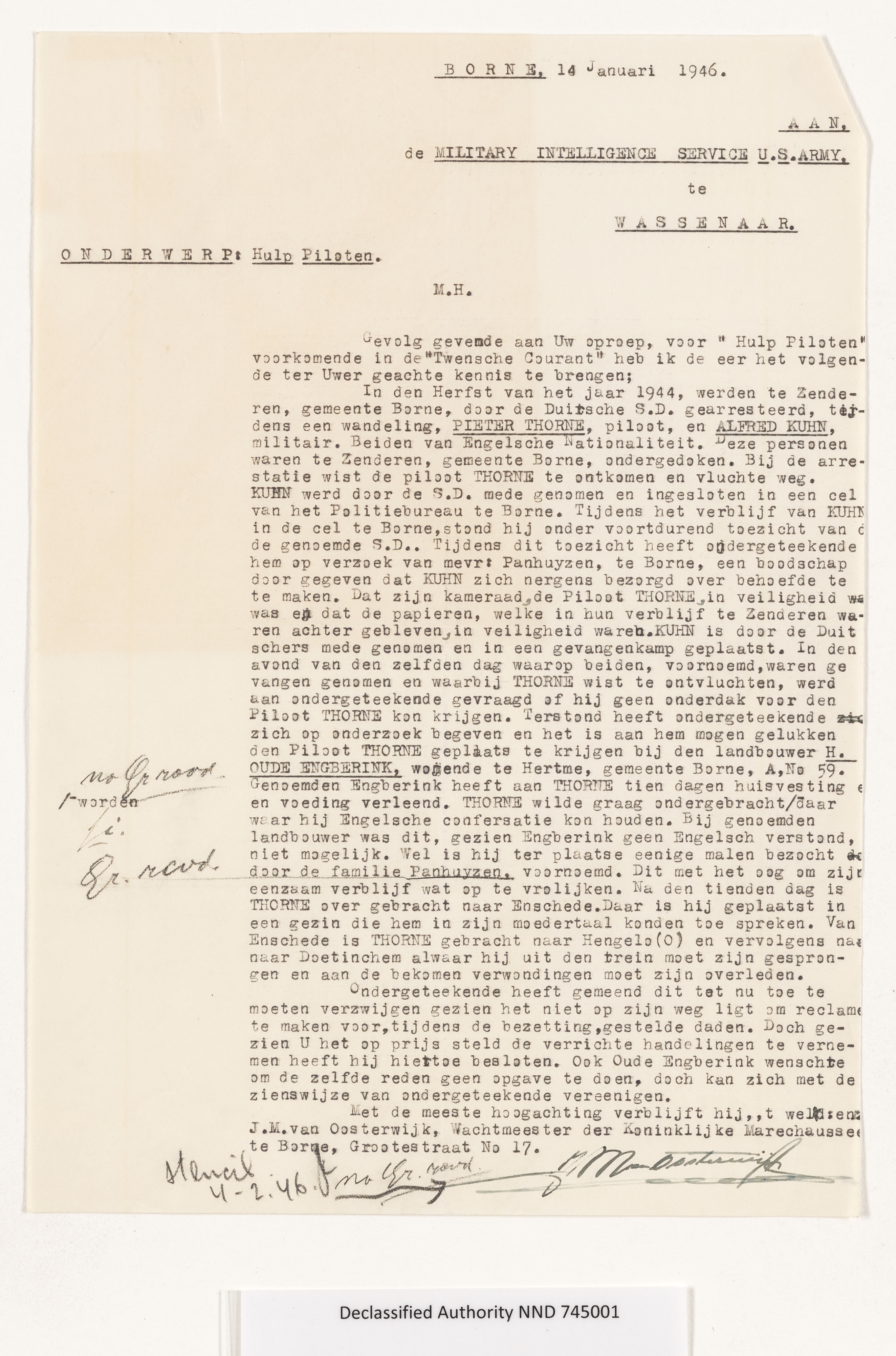
- In the cell at Borne, the letter goes on, van Oosterwijk passed Kuhn a message at the request of "mevr: Panhuyzen, te Borne" that his comrade was safe and that the papers left at their hiding place at Zenderen were safe; Kuhn was taken to a prison camp. The Panhuyzen family visited Thorne at Hertme. ⚠︎ How this fits Seigers's "caught again 28/6" at Delden and Reckman's "arrested by Germans, escaped" for Kuhn is not settled (under Where the sources disagree).
- Enschede, from 15 August. Willem Snitker of the Laareschsingel, Enschede, "Provided food, shelter and clothing for Peter S. C. Horne" [sic], and his table has him, RAF, Hamburg, 14 Liverpool Road, Kingston Hill, for 14 days from "15-8'44", received from "Rekman B 66, Zenderen" and passed to "Albert Koek, Hessenweg, Enschede" (Snitker, p. 6; p. 2).
- Hengelo, August. H. J. B. Jelten of the Javastraat, Hengelo, has "Peter Thorne RAF August '44, 6 weeks", and his form "food and shelter to Thorne for 5 weeks"; he names Jules Haeck among the helpers he knew (Jelten, p. 2; p. 3).
- The chain, without dates.
- Gerretje Piksen of the Smidsweg, Nijverdal, has "Peter Thorne, 1324224", RAF, received from "Prins, Vondelstr. Hengelo" and passed to "van Asselt, Nijverdal", with his service number, the only helper's table that gives it (her table, p. 17); Gerrit Piksen's list of names, same house, has the same name and number too (p. 3).
- A table in the file of Johannes ter Horst has "11. Peter Thorne" after "10 Alfred Kuhn, Br., Ex.P.W.from Germany", received, by its ditto marks, from "Jan Seigers, Ommen", with nothing in the column for whom he went on to (ter Horst's file, p. 3). The page does not say whose table it is; ◐ it fits Seigers's own list, which has Kuhn and "Peter" too (above).
- A table in the file of Harry Tummers has "Peter Thorne, RAF" from "Hengelo. Marang" to "Heerlen.", the first of a block of airmen received from Marang at Hengelo, Ted Weaver (on Haeck's list with him) next, all marked by ditto to Heerlen or Maastricht (Tummers, p. 39). ⚠︎ No other source sends him south, and the page does not say when or whether he went; every other source keeps him in Twente and Gelderland.
- To Laren. Egbert Enserink of Harfsen, who died in a German camp, "escorted this pilot to Koeslag", by the table his widow sent in (Enserink, p. 11; p. 4). Johan Volgers Dinius of Deventer, of the Laren group, has "Peter Thorne(Kingston England)" hidden "June/Nov.44", 150 days, received from "? Hengelo (O)", and "arrested and perished during escape" (Dinius, p. 4).
At Laren, September to November 1944
Link to the section At Laren, September to November 1944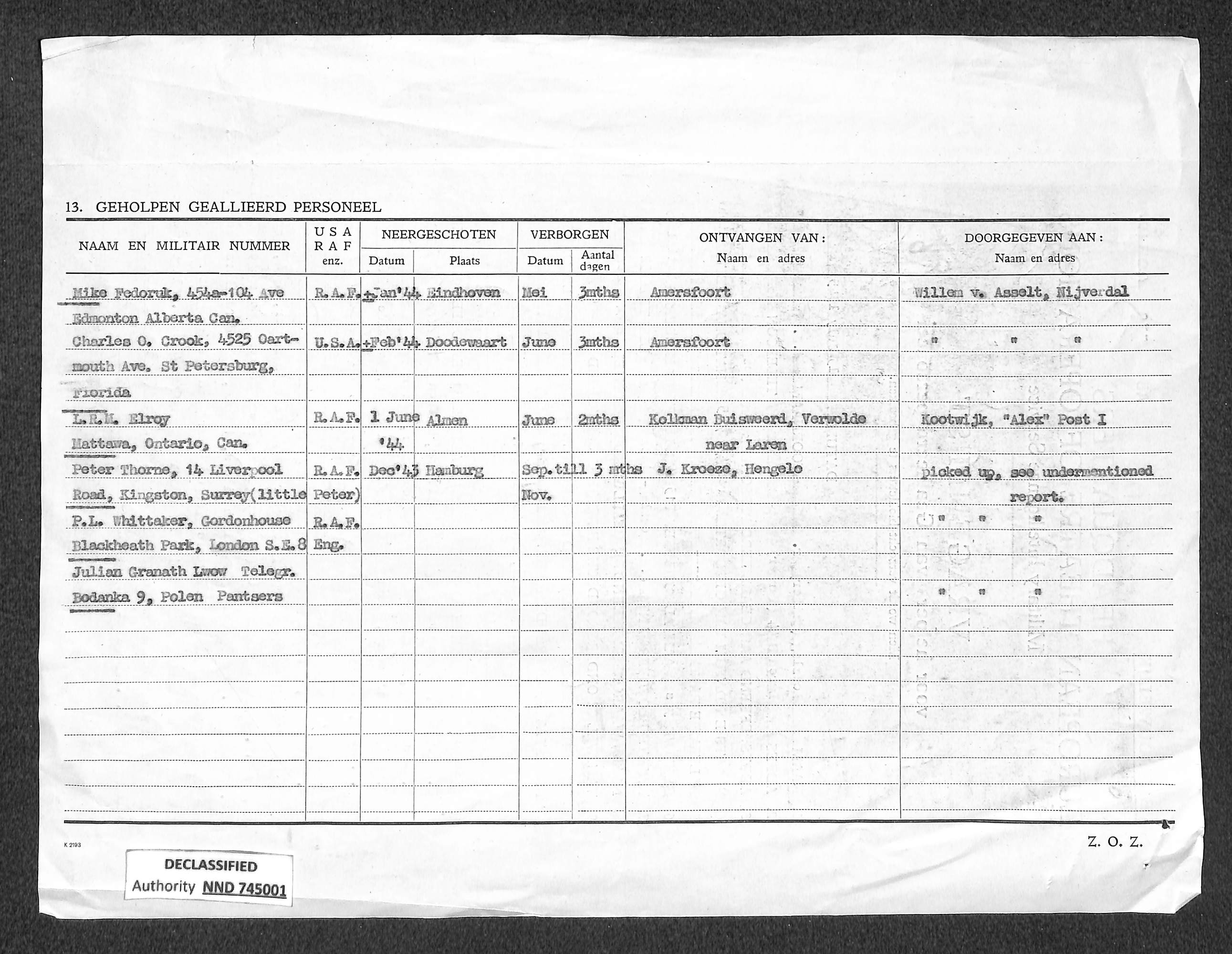
- ✓ A. J. Koeslag Sr, a farmer of Laren B 44, lists "Peter Thorne, 14 Liverpool Road, Kingston, Surrey(little Peter)", RAF, hidden "Sep. till Nov.", three months, received from "J. Kroeze, Hengelo", and in the last column "picked up, see undermentioned report" (p. 14, read on the image). His second table has "Peter Thorne (died)", 60 days (p. 19).
- The Americans' recommendations name him twice more:
- ✓ The one for Koeslag Sr names Thorne among the six men of "the only list of pilots which escaped the notice of the S.D. when the farm was attacked", with Whittaker and "Julian Granath" (p. 10). ◐ The quote sits oddly beside p. 13, where Thorne is taken in the attack on the farm; the likeliest reading is that the SD missed this list, since Koeslag Jr's file has the list of about 40 pilots found and seized in the raid (Koeslag Jr, p. 12); that reading is ours.
- The one for his son Appie says he guided "about 60 pilots", and has Thorne on the partial list of them below (p. 12).
- A list in the son's file of "NAMES AND ADDRESSES, STILL IN OUR POSSESSION, OF ALLIED PERSONNEL HELPED BY US." has "Peter Thorne, 14 Liverpool Road Kingstone Surrey Engl." (p. 29, read on the image).
- Buisweerd. Braakman has him at Buisweerd, Jan Kolkman's farm, when Peter Whittaker came there, a few days after he was shot down on the evening of 23 September 1944 (p. 107), with "lieutenant Guthrie, Captain James, the sergeants Johnny Warren and Peter Thorne, and the Polish tank driver Julick Granat" (Braakman, p. 108). ◐ Wilson's "two sergeant escapers from Stalag IVB", met by Whittaker in the same barn, are very probably Thorne and one other, Wilson naming neither (Wilson, p. 25).
- Verwolde and Harfsen, with Granat. M. J. Bielderman of Verwolde, Laren, "Provided food, shelter and clothing for Julian Granath and Peter Thorne, RAF, for approximately 7 days" (Bielderman, p. 4); Gerhard Wichers of Harfsen lists "Peter Thorne, 14 Liverpool Road, Kingstone Surrey" and "Julian Granath", and "We kept the pilots in a hiding place near the farm for 2 days and two nights" (Wichers, p. 3; p. 2). Neither form gives a date.
- The chicken run. Thorne and Granat were moved out of the "pilots' lair", a hidden camp in the bog at Verwolde, when German soldiers were reported to be planning a hunt near it, and Whittaker joined them; for three weeks the three of them lived "in a chicken run in a thicket near Koeslag's farm", which Whittaker called "uneventful" (Braakman, p. 109; p. 107).
Taken at Laren, 2 November 1944
Link to the section Taken at Laren, 2 November 1944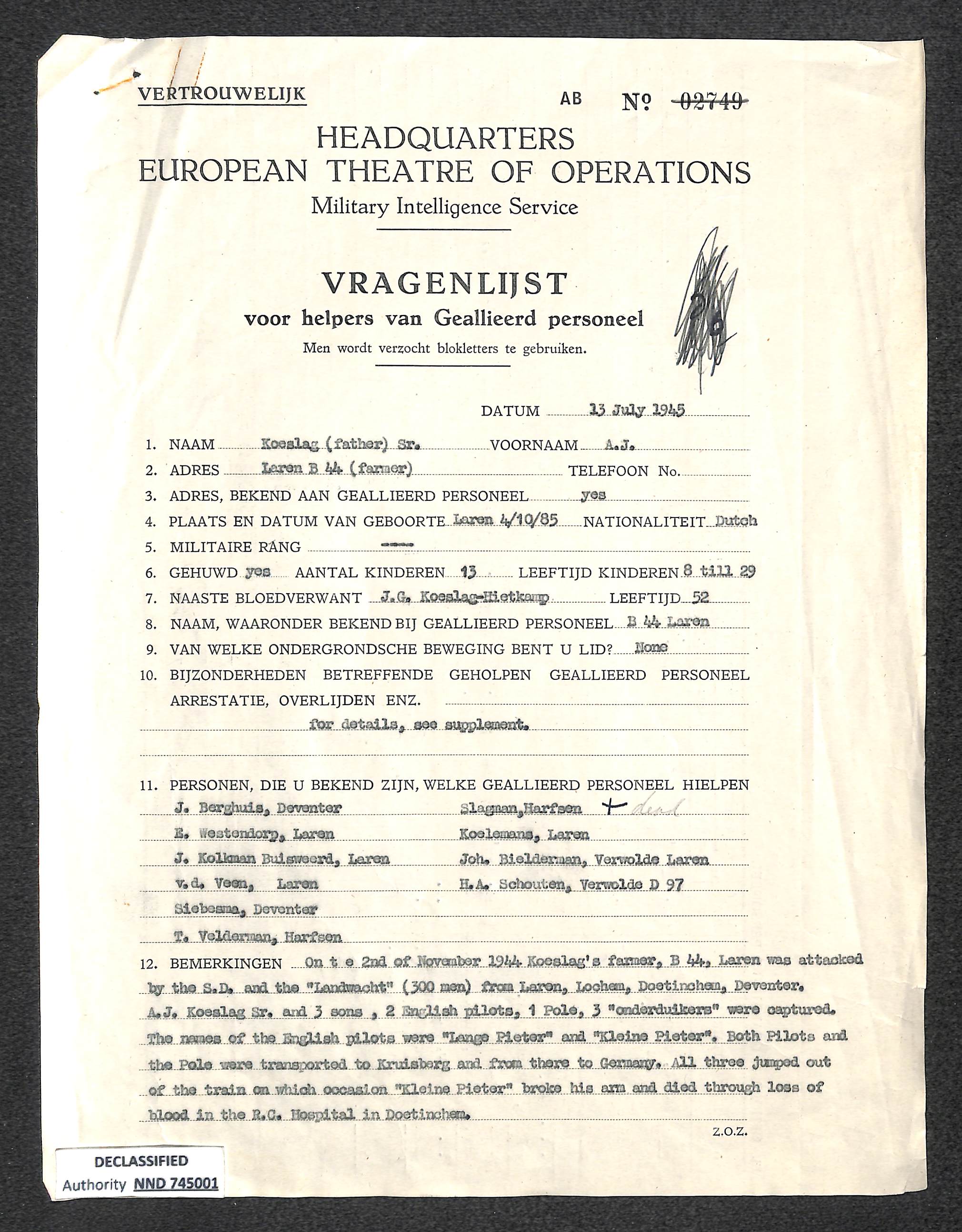
Long before sunrise on 2 November hundreds of Landwacht and SD men surrounded Albert Koeslag's farm. A young neighbour, Bertus, went to warn the men who had spent the night in the hiding place in the chicken coop on his father Derk's farm, "resistance workers, the British serviceman Pete Whittaker and Peter Thorne, and the Polish soldier Julick Granat", and was caught on his way home (Braakman, p. 109). Koeslag Sr's own form, of 13 July 1945, has what followed:
On t[h]e 2nd of November 1944 Koeslag's farmer [sic, farm], B 44, Laren was attacked by the S.D. and the "Landwacht" (300 men) from Laren, Lochem, Doetinchem, Deventer. A.J. Koeslag Sr. and 3 sons , 2 English pilots, 1 Pole, 3 "onderduikers" were captured. The names of the English pilots were "Lange Pieter" and "Kleine Pieter". Both Pilots and the Pole were transported to Kruisberg and from there to Germany. All three jumped out of the train on which occasion "Kleine Pieter" broke his arm and died through loss of blood in the R.C. Hospital in Doetinchem.
— A. J. Koeslag Sr, Laren · questionnaire for the Americans, section 12 · 13 July 1945 · p. 13
✓ "Kleine Pieter" is Thorne: the family's table has "(little Peter)" on his row (p. 14). ◐ "Lange Pieter" (long Peter) is very probably Whittaker, the other Peter taken with him, and the supplement's "Big Peter" the same man: "The Pole and Big Peter were released. Later on the Pole was caught again. We do not know what happened to Big Peter." (p. 15).
Other accounts of the raid.
- Taylor has them "betrayed to the Landwacht" on 1 November, and, in his summary of the Dutch article he had translated, "betrayed and recaptured on 2nd November 1944"; neither says by whom (Taylor, p. 435; p. 434).
- The Doetinchem foundation's entry for Appie Koeslag has "Inval op de boerderij na verraad" (a raid on the farm after betrayal), undated; ◐ it may tell of his own arrest, on 21 November by the family's supplement, since by his own file he fled the raid in which his father was taken (Doetinchem Herdenkt; the supplement, p. 15; Koeslag Jr, p. 12).
- ⚠︎ The English version of the foundation's article on Thorne has "betrayed by a local neighbour"; its Dutch text has no such phrase, and no source held names anyone (Doetinchem Herdenkt).
- The article also has the men run into the fields, find themselves outnumbered and surrender, Thorne kicking away a pistol they had kept (Doetinchem Herdenkt).
- ◐ It gives the Koeslag family's tradition as its source for the end of the story, and none for this.
- The foundation's entries for Hans Knegtmans and Obbe Spijkerman have the two arrested in a raid on Erve Buisweerd, on the border of Laren and Markelo, which it does not date, where "Peter Thorne (Brits), Jülick; Granat (Pools) en Peter Whittaker (RAF)" were also lodged (Doetinchem Herdenkt).
Deventer, the Oxerhof and De Kruisberg
Link to the section Deventer, the Oxerhof and De Kruisberg- Deventer.
- Taylor has the prisoners taken first to Laren, then to the SD prison in the Landwacht's headquarters at Deventer, where "for a week, 24 men were crammed into a cell 18ft x 8½ft; later, he was in a cell 12ft x 6ft with 13 men"; a Landwacht man, "Rottenführer Kuehne", brought them extra food (Taylor, p. 436).
- The foundation's article has fourteen men in a cell of 2 by 3 metres, with a tin in the corner for a toilet and no exercise (Doetinchem Herdenkt).
- ✓ Warren, taken at Gorssel and brought to the same Landwacht prison, met him there: "There I met Sgt. THORNE again and also Sgt. WHITTAKER, R.A.F. who had broken his arm, but the Germans refused him medical aid."
- The Oxerhof. Warren has the prisoners moved after a month to "OXELHOFT, near DEVENTER" for about a month; Taylor has Thorne moved in December to "Oxelhoft prison in Deventer"; the foundation has him in De Oxerhof, south of the town, its article on him dating the move to the middle of November (Warren; Taylor, p. 436; Doetinchem Herdenkt; the article).
- De Kruisberg. At De Kruisberg, Doetinchem, the SD held hundreds of prisoners, resistance men and women and Allied servicemen, from 5 September 1944 to 27 March 1945 (Stichting Doetinchem Herdenkt).
- The foundation has Thorne brought there on 14 December 1944, the day Warren gives for his own move, "to an S.D. special prison for transients going to GERMANY" (Doetinchem Herdenkt; Warren).
- Taylor has January 1945, and "Here the conditions were awful, with beatings and torture and little food" (p. 436).
- ◐ Whittaker's "Early in the eighth week of our stay at Doetinghem" for the day of the train (Wilson, p. 133) fits 14 December: seven weeks from it is 1 February.
The train, 1/2 February 1945
Link to the section The train, 1/2 February 1945◐ By the foundation, on 1 February 1945, 94 men were marched under heavy guard from De Kruisberg to Doetinchem station; the train left after midnight, and between Doetinchem and Ruurlo 17 of them escaped through a hole in one of the two cattle wagons. "De Brit Peter Thorne raakte daarbij zwaargewond en overleed later in een Doetinchems ziekenhuis" (the Briton Peter Thorne was badly injured in it and died later in a Doetinchem hospital). The other 77 reached Neuengamme on 5 February (Doetinchem Herdenkt).
The foundation's article on Thorne adds (Doetinchem Herdenkt):
- The men were told at about 13.00 to get ready, set off for the station at about 17.00 and found a locomotive, a coach for the guards and three goods wagons, their doors left open so that relatives could talk to them and hand in parcels.
- Thorne and Warren decided at once to escape, and ate the whole loaf each man had been given for the journey.
- Granat forced the wagon's ventilator at about 02.00 (the article has how they got out from the Koeslag family's tradition).
- Warren says the guards fired at once, which Bosch van Rosenthal, who jumped later near Beltrum-Zieuwent, does not mention.
Warren was on the train:
We knew that if we got to GERMANY there was no hope for us, so we were determined to try to escape en route. We ate our full ration immediately we got on the train to help us get back a little strength and set to work prying open a small window in the car. We got the window open and in the night five of us dropped off the train. There were guards along the line and they immediately started firing, so everybody ran. I heard later that Sgt. P. THORNE, R.A.F. (home address Liverpool Hill, KINGSTON, Surrey) had been wounded and sent back to prison at DOETINCHEM, and Sgt. WHITTAKER, R.A.F. had gone on with the train to GERMANY.
— MI9 · Sgt J. L. N. Warren, RCAF · escape report, dated 21 April 1945 in Kew's catalogue · the Pegasus Archive's transcription
Julick Granat, the Polish tank driver who had been hidden with Thorne, forced the hatch and jumped first; the Germans saw him and he was taken again (Doetinchem Herdenkt). Braakman, from the Laren side, tells what happened next:
The British navigator Peter Thorne followed him. With a supreme effort, aided by those around him, he also managed to get out through the opening. But as he jumped from the cattle car his overcoat caught on the outside of the carriage, causing him to hang upside down. He tried to pull himself up, but fell back down again and was then jerked free. He died as a result of the injuries he sustained when he hit the ground.
— Jan Braakman, The War in the Corner (2012, translated from the Dutch) · p. 129 · the page
"Others witnessed the accident, but it didn't prevent them from attempting the dangerous jump" (Braakman, p. 129); Whittaker and Appie Koeslag were among the seventeen (p. 130). The foundation's own entry for him has the coat too, with his legs caught under the train and his lower legs lost; Koeslag and Taylor have his arm:
On 1 February he was marched with 93 other Kruisberg prisoners to the train that was to take them to Neuengamme. After it left, Julick Granat (see) managed to force a hatch in the wagon. Through the hole 17 men jumped from the moving train. Peter Thorne, however, caught his coat and ended up with his legs under the train. With that he lost his lower legs. He was found and taken to the Sint-Jozef hospital in Doetinchem. There he died. He was buried in the general cemetery on the Loolaan. There his grave is still one of the 14 war graves.
Dutch originalOp 1 februari werd hij met 93 andere Kruisberggevangenen afgemarcheerd naar de trein die hen naar Neuengamme zou brengen. Na vertrek wist Julick Granat (zie) een luik in de wagon te forceren. Door het gat sprongen 17 mannen uit de rijdende trein. Peter Thorne bleef echter met zijn jas haken en belandde met zijn benen onder de trein. Daarbij verloor hij zijn onderbenen. Hij werd gevonden en naar het Sint-Jozefziekenhuis in Doetinchem gebracht. Daar overleed hij. Hij werd begraven op de Algemene Begraafplaats aan de Loolaan. Daar is zijn graf nog steeds een van de 14 oorlogsgraven.
— Stichting Doetinchem Herdenkt · Van De Kruisberg naar Neuengamme, entry "Thorne, Peter" · the page
What Whittaker saw
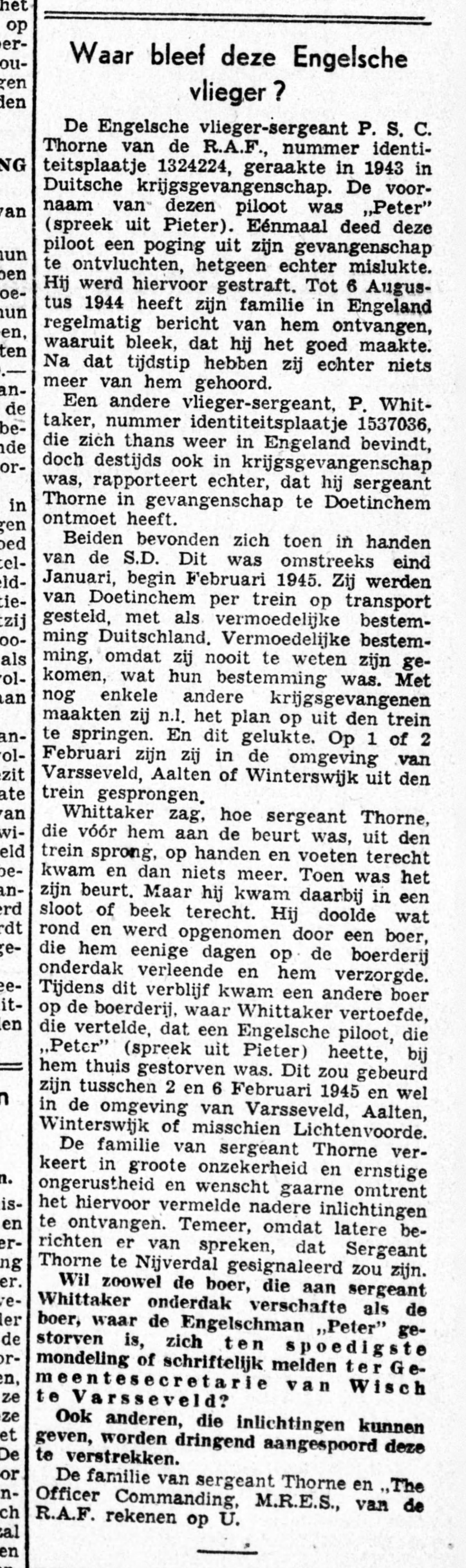
Link to the section What Whittaker sawPeter Whittaker, who jumped after him, reported what he saw to the RAF. His words are held only as his report was given in an appeal for news of Thorne, "Waar bleef deze Engelsche vlieger?" (Where did this English airman go?), printed on 5 October 1945 in De Nieuwsbode of Doetinchem and, under the heading "Uit bange dagen" (From anxious days), in De Graafschapper of Winterswijk. The appeal was from Thorne's family and "The Officer Commanding, M.R.E.S., van de R.A.F.", the RAF's Missing Research and Enquiry Service, and asked the farmers concerned to report to the town hall of Wisch at Varsseveld (De Nieuwsbode; De Graafschapper, p. 3):
Another sergeant airman, P. Whittaker, identity disc number 1537036, who is now back in England but was then also a prisoner of war, reports however that he met Sergeant Thorne in captivity at Doetinchem. Both were then in the hands of the S.D. This was about the end of January, beginning of February 1945. … On 1 or 2 February they jumped from the train in the area of Varsseveld, Aalten or Winterswijk. Whittaker saw how Sergeant Thorne, whose turn came before his, jumped from the train, landed on his hands and feet, and then nothing more. Then it was his turn.
Dutch originalEen andere vlieger-sergeant, P. Whittaker, nummer identiteitsplaatje 1537036, die zich thans weer in Engeland bevindt, doch destijds ook in krijgsgevangenschap was, rapporteert echter, dat hij sergeant Thorne in gevangenschap te Doetinchem ontmoet heeft. Beiden bevonden zich toen in handen van de S.D. Dit was omstreeks eind Januari, begin Februari 1945. … Op 1 of 2 Februari zijn zij in de omgeving van Varsseveld, Aalten of Winterswijk uit den trein gesprongen. Whittaker zag, hoe sergeant Thorne, die vóór hem aan de beurt was, uit den trein sprong, op handen en voeten terecht kwam en dan niets meer. Toen was het zijn beurt.
— De Nieuwsbode (Doetinchem) · "Waar bleef deze Engelsche vlieger?" · 5 October 1945, p. 1 · the article
The appeal goes on: Whittaker landed in a ditch or a brook, wandered, and was taken in by a farmer who sheltered him for some days; while he was there another farmer came and said that an English pilot called "Peter" had died in his house, between 2 and 6 February 1945, somewhere near Varsseveld, Aalten, Winterswijk or perhaps Lichtenvoorde; and later reports had Thorne seen at Nijverdal. Both farmers were asked to come forward.
◐ The answer four days later names two farmers, Berentschot and Mellendijk; they may be the very two the appeal asked for, so that one of them was the source of the house story and then gave the hospital version, but nothing held says so. ⚠︎ The farmer's story reached the paper at third hand, and the answer of 9 October (under His death) puts his death in the hospital at Doetinchem. Whittaker's own report as the books print it is on his page.
On the same train, and among the 77 who stayed on it to Neuengamme, were three men taken in the SD's December round-up near Murphy's hiding place: Johan Verhoef, Laurens Liezenberg and Jan Rothuizen, who are in the foundation's list of the men who went on, Neuengamme numbers 70941, 70939 and 70940 (Doetinchem Herdenkt).
His death
Link to the section His death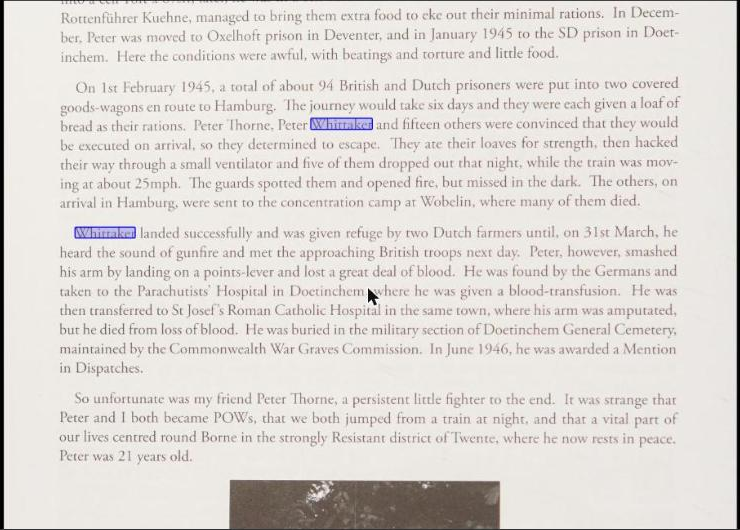
✓ He died on 2 February 1945, the date on his headstone (below).
◐ He died in the Roman Catholic hospital at Doetinchem, of the injuries from the jump (the date and the burial at Doetinchem are ✓, above and below). Two records of 1945 say so, neither of them a witness's:
- Koeslag Sr, himself a prisoner by then, has "broke his arm and died through loss of blood in the R.C. Hospital in Doetinchem" (July 1945, p. 13).
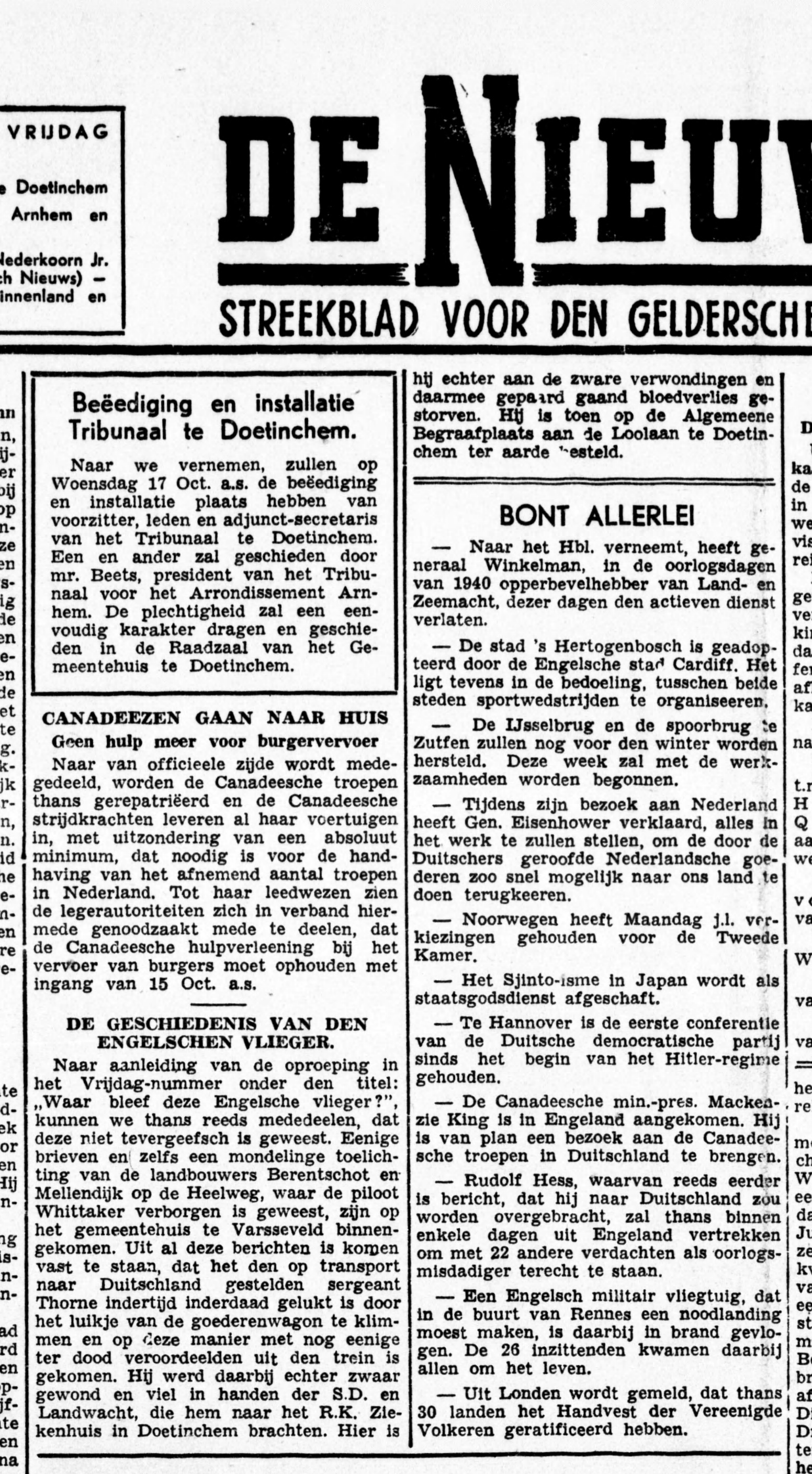
- The answer to the appeal, printed on 9 October 1945, from letters and a spoken account by the farmers Berentschot and Mellendijk of the Heelweg, where Whittaker had been hidden, that reached the town hall at Varsseveld (the block below).
One may stand upstream of the other. The foundation says Koeslag told an officer of the RAF's Missing Research and Enquiry Service in October 1945 that Thorne died of the injuries, and that the 9 October article backed him up; the appeal of 5 October was issued with that same service; and the October answer names its informants as letters and the two farmers, not Koeslag. Koeslag Sr's form has a broken arm, where the foundation has the legs lost, and the helpers' lines further down say only "accident".
That it was the Sint-Jozef is the foundation's and Taylor's (Doetinchem Herdenkt); Taylor has a Parachutists' Hospital first (his block below). ◐ That the SD and the Landwacht found him and took him there is the 9 October paper's alone. The foundation's article takes it from that article, which it calls the Graafschap-bode of 9 October 1945: Delpher files De Nieuwsbode under that title, but the masthead of that issue reads "DE NIEUWSBODE", Doetinchem, Tuesday 9 October 1945 (the article's file, checked on the whole page).
The article also has Koeslag tell an officer of the RAF's Missing Research and Enquiry Service in October 1945 that Thorne died of severe injuries from the jump, and has him die on the evening of the 2nd, which none of the 1945 papers gives (Doetinchem Herdenkt). The foundation reads Warren as having heard that Thorne was hit by bullets; Warren's own report, in the block above, has only "wounded".
Some letters and even a spoken account from the farmers Berentschot and Mellendijk on the Heelweg, where the pilot Whittaker had been hidden, have reached the town hall at Varsseveld. From all these reports it has been established that Sergeant Thorne, put on transport to Germany, did indeed at the time succeed in climbing through the hatch of the goods wagon, and in this way got out of the train with some others condemned to death. But he was badly injured in doing so and fell into the hands of the S.D. and the Landwacht, who took him to the R.C. Hospital in Doetinchem. There, however, he died of the severe injuries and the loss of blood that went with them. He was then buried in the General Cemetery on the Loolaan at Doetinchem.
Dutch originalEenige brieven en zelfs een mondelinge toelichting van de landbouwers Berentschot en Mellendijk op de Heelweg, waar de piloot Whittaker verborgen is geweest, zijn op het gemeentehuis te Varsseveld binnengekomen. Uit al deze berichten is komen vast te staan, dat het den op transport naar Duitschland gestelden sergeant Thorne indertijd inderdaad gelukt is door het luikje van de goederenwagon te klimmen en op deze manier met nog eenige ter dood veroordeelden uit den trein is gekomen. Hij werd daarbij echter zwaar gewond en viel in handen der S.D. en Landwacht, die hem naar het R.K. Ziekenhuis in Doetinchem brachten. Hier is hij echter aan de zware verwondingen en daarmee gepaard gaand bloedverlies gestorven. Hij is toen op de Algemeene Begraafplaats aan de Loolaan te Doetinchem ter aarde besteld.
— De Nieuwsbode (Doetinchem) · "De geschiedenis van den Engelschen vlieger" · 9 October 1945, p. 1 · the article
De Graafschapper of 9 October, under "De Engelsche vliegersergeant Thorne", gives the same information more briefly and adds one point: he was taken into the hospital at Doetinchem "als gevolg van den gemelden sprong uit den trein en de reeds vroeger bekomen verwondingen" (as a result of the jump from the train and of the injuries he had received earlier) (De Graafschapper, 9 October 1945, p. 2).
No other source held mentions earlier injuries. ◐ The two papers' answers are one source, the information that reached the Wisch town hall, printed twice; the "others condemned to death" are theirs, and Taylor has the men "convinced that they would be executed on arrival" (Taylor, p. 436).
Three of the helpers' forms of 1945–46 report his death in a line each, none of them a witness's:
- A. G. Arnold of Nijverdal, that after three recaptures (his count, taken up under "Where the sources disagree") the fourth time "is hij op transp. naar Duitschl. uit de trein gesprongen en verongelukt. overleden en begraven te DOETINGHEM 1/2-'45" (he jumped from the train while being taken to Germany and had an accident; died and buried at Doetinchem, 1/2-'45) (Arnold, p. 10).
- ◐ Arnold's "1/2-'45" is read as 1 February 1945; it could be the night of 1/2 February.
- J. G. Koeslag of Laren, "Peter Throne [sic] had an accident at Doetinchem" (J. G. Koeslag, p. 2).
- Andries Roelvink of Hengelo, "Deceased February 1945 owing to bad luck while leaping from running train which was to take him to Germany. So wrote me his father." (Roelvink, p. 2).
What Duncan heard from Warren
Link to the section What Duncan heard from WarrenThe American Col. Glenn E. Duncan, shot down in July 1944, came through Haeck's line (he is on Haeck's list, above) and met Warren after Warren's escape from the train. Back in Allied hands at Arnhem on 14 April 1945, he filled in the War Department's questionnaire on men still missing, one form for Thorne. He had it from Warren, and says so:
( if Sgt. John Warren comes back o.k. He has full information.) Sgt. Warren was in Doetinghem, Gld- Holland prisen with above person. They were on Train moving from the prison to Germany when Sgt. Warren escaped & I later met. Sgt Thorne also jumped from Train but was injured & captured By Germans. Location of capture East of Doetinghem. The train had gone almost to the German border when Sgt. Thorne jumped. So the capture was in Area of Dinxperlo, Gld. Holland.
— Col. Glenn E. Duncan, USAAF · War Department Casualty and Missing Persons Questionnaire, question 7, in his E&E report 2970 · 1945 · pp. 11–12
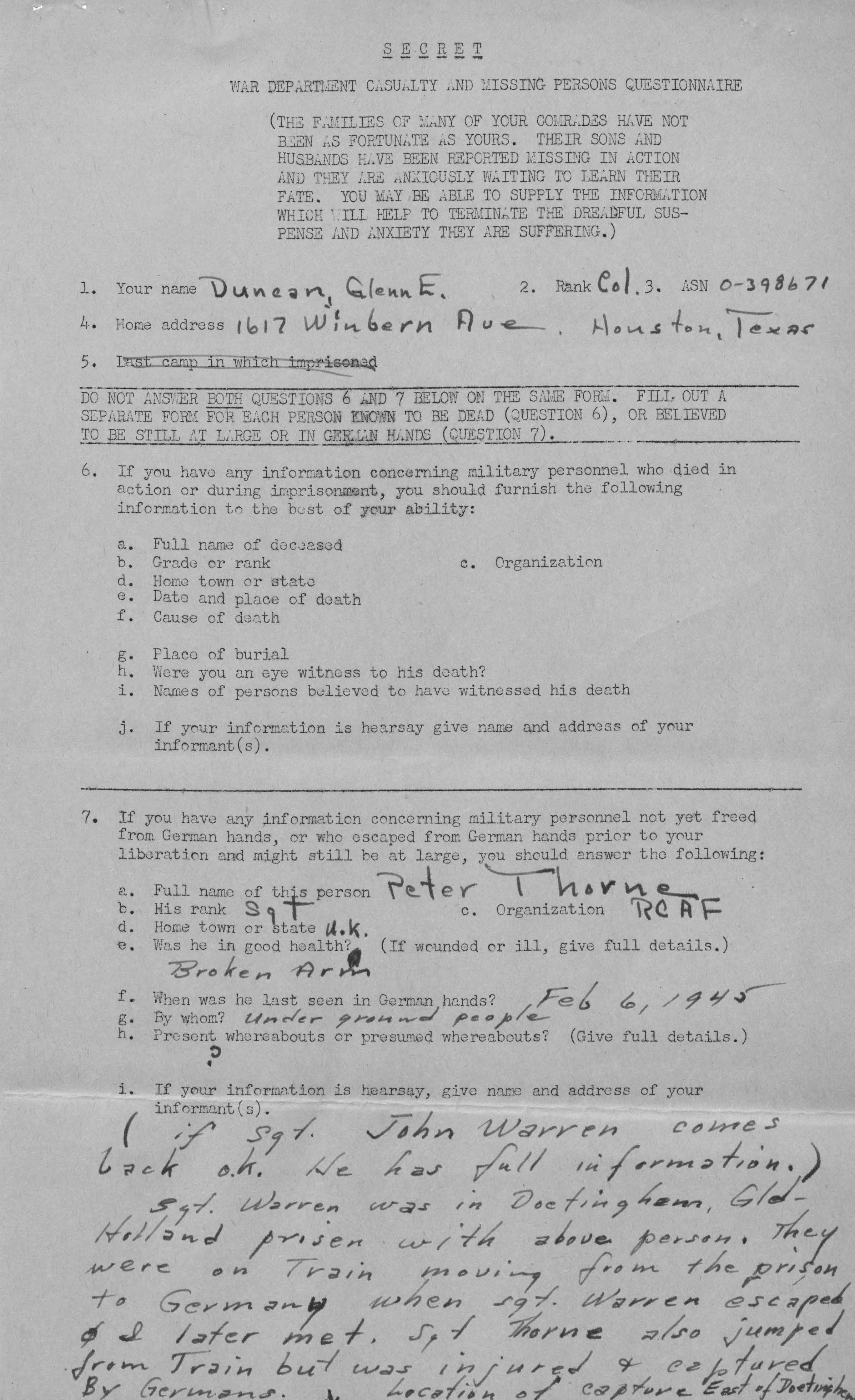
The same form has him a sergeant, "RCAF" [sic], of the "U.K.", his health "Broken Arm", last seen in German hands on "Feb 6, 1945", "By whom? Under ground people", whereabouts "?" (p. 11). It is hearsay at second hand, and Duncan does not say Warren saw the capture; Warren's own report has only that he "heard later" that Thorne had been wounded (above). ◐ Warren was RCAF, and in his report it is Whittaker, not Thorne, who had the broken arm at Deventer (Warren), so Duncan may have crossed the two men on the rank-and-service and arm entries.
Taylor has more:
Peter, however, smashed his arm by landing on a points-lever and lost a great deal of blood. He was found by the Germans and taken to the Parachutists' Hospital in Doetinchem, where he was given a blood-transfusion. He was then transferred to St Josef's Roman Catholic Hospital in the same town, where his arm was amputated, but he died from loss of blood.
— Jimmy Taylor, One Flight Too Many · 2011 · p. 436 · the page
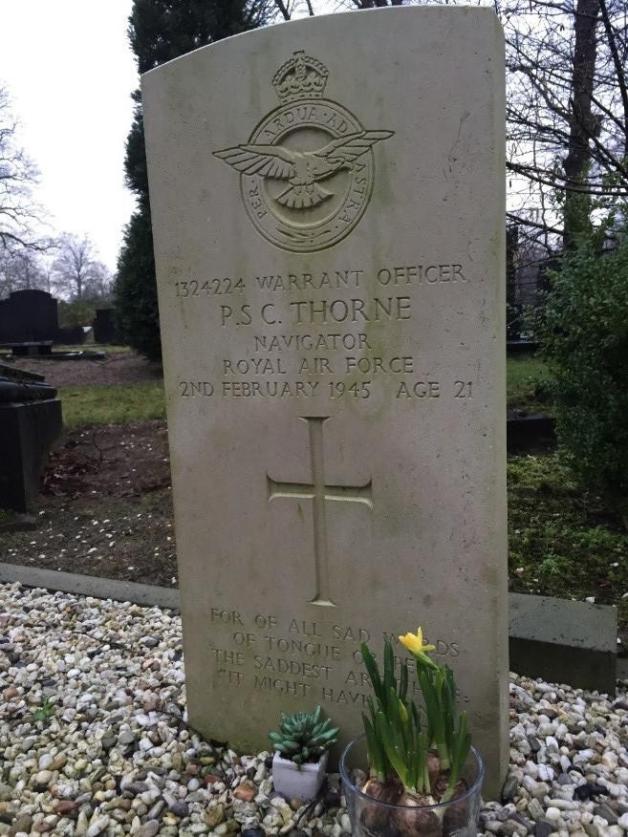
✓ The date, 2 February 1945, is on the headstone: "1324224 WARRANT OFFICER P S C THORNE NAVIGATOR ROYAL AIR FORCE 2ND FEBRUARY 1945 AGE 21". Taylor read the same date there in November 1994: "The inscription said he had died on 2nd February 1945" (p. 435, read on the page image); the train had left Doetinchem after midnight that night. No CWGC record or death certificate of his is held.
Burial, and what is said of him
Link to the section Burial, and what is said of him- ✓ He is buried at Doetinchem, in the general cemetery on the Loolaan, one of its fourteen war graves by the foundation, "in the military section of Doetinchem General Cemetery, maintained by the Commonwealth War Graves Commission" by Taylor (p. 436), whose p. 434, summarising the Dutch article he had translated, ends "he was buried in the cemetery at Doetinchem" (Doetinchem Herdenkt; the prisoners page, "(Brits navigator) overleed na sprong. Begraven op Loolaan."; the article; Taylor, p. 436; p. 434).
- ✓ The Dutch war graves foundation has the grave in the Doetinchem (Loolaan) General Cemetery, row 1, grave 12, and his aircraft as Halifax JB864 (the record); the story added to the record by a visitor in 2021 is sourced to the Doetinchem foundation, so it is not a further source. The burial on the Loolaan was in print by 9 October 1945, in the answer to the appeal (above).
- Taylor found the grave in November 1994 (p. 435, read on the page image):
- He had gone back to Borne for the filming of "Beyond the Ignorance" and asked Hennie Noordhuis to take him to the cemetery, "in a section established by the British War Graves Commission".
- Two lines at the foot of the stone he took to be his family's choice: "For of all sad words of tongue or pen, / The saddest are these, 'It might have been.'"
- The foundation too has the family choosing the verse, and names the poet as John Greenleaf Whittier (Doetinchem Herdenkt).
- ✓ He was mentioned in despatches: the London Gazette lists "1324224 P. S. C. THORNE, R.A.F.V.R." among the Sergeants under the heading "Air Ministry, 13th June, 1946. The KING has been graciously pleased to give orders for the publication of the names of the following personnel who have been mentioned in despatches", with no citation (p. 2818; the heading, p. 2817; both read on the page images). Taylor has him "awarded a Mention in Dispatches" in June 1946 (p. 436), and the foundation's article the Gazette of 13 June 1946 (Doetinchem Herdenkt).
- Taylor, who also jumped from a train at night, closes: "So unfortunate was my friend Peter Thorne, a persistent little fighter to the end." (p. 436). Writing of the liberation of Hengelo, he names Whittaker as "the companion of Peter Thorne when they made their desperate escape from a cattle-truck, which resulted in Peter's sad death" (p. 635).
- The Doetinchem foundation lists him among the seventeen who escaped from the train, and links from its transport page to its article on him, "De noodlootige sprong van Peter Thorne" (Peter Thorne's fatal jump), "Freedom within sight" in its English version (the prisoners page; the transport page; the article). It ends by inviting visitors to the grave at the Loolaan.
His road and Murphy's
Link to the section His road and Murphy'sNo source puts him with Murphy, and nothing says they met. Two parts of his story cross Murphy's:
- The escape. ◐ He was one of the six in the truck from Stalag IVB with James Branford, on Warren's account and the count in Branford's citation (above). Branford is Hardy's "P/O. BRENTFORD", in the house in the woods where Hardy and Murphy were hidden that autumn, and one of the eight who set out with Murphy for Harskamp at midnight on 6 November 1944 (Hardy; more on his page).
- The train. ◐ He was on the Kruisberg transport of 1/2 February 1945 with Johan Verhoef, Laurens Liezenberg and Jan Rothuizen, three of the men taken in the SD's round-up of December 1944 at Achterveld, while Murphy was hidden at the Veerman farm at Klein Achterveld (Doetinchem Herdenkt; Huurdeman; Hardy; more in The December round-up).
- ◐ Both are compilations, and no transport list or camp register is held. They differ on Jan Verhoef, Johan's elder brother: the foundation's list has him among the 77 with the unfinished number "709xxx", Huurdeman sends him first to Kamp Amersfoort.
Where the sources disagree
Link to the section Where the sources disagree- When he was shot down. The night of 27/28 July 1943 in Taylor, who has it again on p. 434, and in the foundation's article; "Dec'43" on Koeslag Sr's table (p. 435; p. 434; Doetinchem Herdenkt; p. 14).
- Among the other helpers' forms, "Dec.43" again on Dinius's table, "July 43" on Roelvink's and "'43" on Reckman's (Dinius, p. 4; Roelvink, p. 3; Reckman, p. 8).
- All say Hamburg, and his family's appeal of October 1945 has him a prisoner from 1943 (De Nieuwsbode, 5 October 1945). ◐ July 1943, in two sources that agree on the crew and the raid; his own records are not held.
- The crash and the hit. The four dead crew lie "probably" at Keekekamp in Taylor, and at Sasel in the foundation; the aircraft was hit by flak (Lusink, and the foundation's Dutch text) or by a night fighter (Slater) (p. 435; Doetinchem Herdenkt). ⚠︎ Not settled.
- Where he trained. Canada in Taylor, "partly" the United States in the foundation (Taylor, p. 435; Doetinchem Herdenkt). ⚠︎ Not settled.
- When and where he was born. 15 March 1923, London, in Kew's catalogue of his German prisoner-of-war card; 1923 in Taylor's heading; 1924, at Kingston Hill, in the foundation; the headstone's age of 21 on 2 February 1945 fits a birth from 3 February 1923 to 2 February 1924 (WO 416/361/394; Taylor, p. 434; Doetinchem Herdenkt). ◐ 15 March 1923: a wartime record, as catalogued, that fits the stone; the card itself has not been seen and no birth record is held. Kingston Hill and London need not conflict.
- His rank. ◐ Warrant officer at his death, by the stone.
- Sergeant in Warren's report and Kew's catalogue of it, and in the foundation's crew list of 1943 (Warren; WO 208/3326/2996; Doetinchem Herdenkt).
- Flight sergeant in Taylor's text (p. 435).
- Sergeant in the records of 1945 and 1946: "vlieger-sergeant" (sergeant airman) in the Dutch papers of October 1945, among the Sergeants in the Gazette of 13 June 1946, and sergeant on his German card as Kew catalogues it (De Nieuwsbode, 5 October 1945; the Gazette, p. 2818; WO 416/361/394).
- Warrant officer on his headstone, in the Dutch war graves foundation's record and in the headings of Taylor and the foundation (Oorlogsgravenstichting; Taylor, p. 434).
- His escapes before May 1944. Four failed attempts in Taylor, the fifth succeeding (p. 435); one, which failed and for which he was punished, in his family's appeal of October 1945 (De Nieuwsbode, 5 October 1945). A. G. Arnold of Nijverdal has him escape, be "drie keer op nieuw gevangen genomen en ontvlucht" (three times recaptured and escaped again), and jump from the train the fourth time, which may count his escapes after Stalag IVB, not before (Arnold, p. 10). ⚠︎ Not settled.
- The journey from Stalag IVB. All three accounts that count have six men and a goods wagon or truck.
- Warren, who was there: out of the camp on 1 May, joined by Thorne in a wood, five days on a wagon of paper rolls, a hole cut with a pocket knife, off at Hengelo (Warren).
- Branford's citation: April 1944, four days in the truck, left because of hunger, heat and thirst (London Gazette, p. 4186).
- Taylor: May 1944, locked in by a French forced labourer, three days, a hole in the floor (p. 435).
- The Koeslags: by way of Czechoslovakia (p. 15). ◐ Warren's is the only first-hand account.
- Whittaker in May 1944.
- Taylor has the escapers joining "Peter Whittaker and a group of other escapers on a farm" on reaching Holland in May 1944, and a few lines earlier calls "F/Sgt Peter Whittaker DFM" a fellow prisoner in Stalag IVB whose escape route crossed Thorne's several times, on Clutton-Brock's account (p. 435).
- ⚠︎ The 617 Squadron gunner Whittaker, who jumped from the train with Thorne, was shot down in September 1944 (Bateman, p. 122; Braakman, p. 107), so he can have met Thorne only in the autumn, at Laren. No source held says whether Taylor's Whittaker is another man or the same man misdated.
- Peter Whittaker's page grades the same Taylor passage the same way.
- The order of his hiding places. Hengelo, Zenderen, Nijverdal, then Laren in the Koeslag supplement (p. 15); Nijverdal first, then Hengelo and Enschede, in Taylor, whose p. 434 has Enschede and Hengelo only (p. 435; p. 434). ⚠︎ Not settled.
- The helpers' own dates, set side by side, overlap: Hengelo in May (Roelvink); Nijverdal from 30 June for 10 days (Arnold); Zenderen from 8 July for 42 days, to 19 August (Reckman); Enschede from 15 August for 14 days, received from Reckman (Snitker); Hengelo in August for five or six weeks (Jelten); Laren from June or September to November (Dinius, Koeslag Sr) (all under His road through Twente). Dinius's 150 days from June cannot be at Laren while the Twente forms have him there; ◐ it may count from his first contact with the chain.
- van Oosterwijk's road runs Zenderen, Hertme, Enschede, Hengelo, then Doetinchem, with no Laren at all (p. 7); every other source has him taken at Laren in November.
- How long at Laren. "Sep. till Nov., 3 mths" on Koeslag Sr's first table, "60 days" on his second (p. 14; p. 19). September to early November is about two months, which fits the second. Dinius, of the same Laren group, has "June/Nov.44", 150 days (Dinius, p. 4).
- Warren at Buisweerd. Braakman puts "Johnny Warren" with Thorne at Buisweerd in the autumn (p. 108).
- Against it: Warren's own report has him eight weeks on a farm outside Gorssel until he was arrested there, and meeting Thorne "again" only in the Deventer prison (Warren); the foundation has him found by the Germans at Slagman's farm at Gorssel on 14 October 1944 (Doetinchem Herdenkt).
- For it: Koeslag Jr's list of "ALLIED PERSONNEL HELPED BY US" has "Johnny Louis Warren, Murray Bay Quebec Canada", with Guthrie, E. A. James and Rupert, three of Braakman's other Buisweerd names (Koeslag Jr, p. 29); ◐ it is very probably Warren, whose report gives a private address in Quebec.
- Koeslag Sr's list of helpers has "Slagman, Harfsen" (p. 13); the foundation's Slagman is at Gorssel, and that the two are one man is ours.
- Warren's report does not exclude his passing through Buisweerd: its "again" at Deventer can mean the wood in Germany as easily as Laren.
- Dinius's table, from the same Laren group, has "Johnny Warren RAF Dec.43 Hamburg", no dates of hiding, "helped to escape" (Dinius, p. 4); ◐ the shot-down date and place look like Thorne's copied up a row: Warren's own report has him lost on the Cologne raid of 17 November 1943 (Warren, section 1). The table has a separate row, "Johnny", September 1944, Laren, 20 days, from Kolkman, between Warren's and Whittaker's, which the page does not otherwise explain: another candidate for the Johnny at Laren.
- ⚠︎ Not settled: the Koeslags count Warren among the men they helped, but his own report names no farm at Laren.
- When and where Kuhn was taken, and Thorne got away.
- Seigers: Kuhn "caught again 28/6" at Delden, Peter "evaded arrest when Kuhn was caught" (p. 36; p. 34).
- Reckman: Kuhn at Zenderen from 1 July, "arrested by Germans, escaped" (p. 8).
- van Oosterwijk: both arrested on a walk at Zenderen "In den Herfst van het jaar 1944" (in the autumn of 1944), September on his table; Kuhn kept, Thorne escaping (p. 7; p. 3).
- ◐ Two arrests of Kuhn would fit Reckman's "escaped"; one arrest misdated by one of the others would fit as well. van Oosterwijk's Hertme and Enschede would fit between Reckman's 42 days and Snitker's 15 August if his "autumn" is wrong by a month; that reading is ours. ⚠︎ Not settled.
- Whose farm Buisweerd was. Jan Kolkman's in Braakman and on Koeslag Sr's list of helpers, "J. Kolkman Buisweerd, Laren"; "Erve Buisweerd van de familie Koeslag" in the foundation's entry for Spijkerman (Knegtmans's names Buisweerd without an owner) (Braakman, p. 108; p. 13; Doetinchem Herdenkt).
- The day he was taken.
- 2 November 1944 on Koeslag Sr's form of July 1945, in Braakman and in the Dutch article Taylor had translated (his p. 434); 1 November in Taylor's own text (p. 435); "begin november" in the foundation's article (p. 13; Braakman, p. 109; Taylor, p. 434; p. 435; Doetinchem Herdenkt).
- "October" in Wilson, who has the camp Whittaker and two Stalag IVB escapers were sheltering in surrounded in October and does not mention the Koeslag raid (Wilson, p. 133; p. 25).
- ◐ 2 November, by the family whose farm it was, written down in 1945.
- ⚠︎ Wilson's "October" is a month in a book summarising Whittaker's report, which we hold only as the books print it, and may mean the earlier marsh camp. Warren, taken at Gorssel on 14 October by the foundation, met Thorne and Whittaker in Deventer afterwards, which does not decide it.
- When he came to De Kruisberg. 14 December 1944 in the foundation, the day of Warren's own move; January 1945 in Taylor (above). ◐ 14 December.
- The train. ⚠︎ Not settled; the foundation's list of the seventeen names fourteen of them.
- The wagons: two box cars in Warren, two covered goods wagons in Taylor, two cattle wagons (veewagons) in the foundation's transport page, three cattle cars in Braakman, three goods wagons in the foundation's article on Thorne (Warren; Taylor, p. 436; Braakman, p. 129; Doetinchem Herdenkt).
- How many got off: five, at about 02.00 in Warren (he left the train at 02.00) and the foundation's article, "that night" in Taylor; seventeen in the foundation's transport page and Braakman (same sources).
- When and where: leaving on 1 February after midnight, or at three in the morning of 2 February in Braakman; "1 or 2 February", near Varsseveld, Aalten or Winterswijk, in Whittaker's report as the appeal of October 1945 gives it (De Nieuwsbode, 5 October 1945).
- His injuries. ⚠︎ Not settled.
- His arm: broken (Koeslag Sr, July 1945), or smashed on a points lever and amputated in hospital (Taylor). His legs: caught under the train, losing his lower legs (the foundation). Braakman has his coat catching and his fall, without saying which injury.
- Whittaker, as the appeal gives his report, saw him land "op handen en voeten" (on his hands and feet) and then nothing more (De Nieuwsbode, 5 October 1945).
- The answer of 9 October has him "zwaar gewond" (badly injured) and dying of the injuries and the loss of blood, and De Graafschapper's version adds injuries "reeds vroeger bekomen" (received earlier) (De Nieuwsbode, 9 October 1945; De Graafschapper, 9 October 1945).
- Where he was taken, and where he died. ◐ The hospital, on the two 1945 records, one possibly upstream of the other (under His death).
- The Roman Catholic hospital at Doetinchem in Koeslag Sr and the answer of 9 October 1945; the Sint-Jozef in the foundation and Taylor, Taylor adding the Parachutists' Hospital first.
- What Warren heard: "sent back to prison at DOETINCHEM" (Warren).
- In a farmer's house near Varsseveld, Aalten, Winterswijk or Lichtenvoorde, between 2 and 6 February, in what a farmer told the farmer who sheltered Whittaker, as the appeal of 5 October repeats it (De Nieuwsbode). The appeal was asking whether this was true, and the answer four days later does not repeat it.
- What Warren told Duncan: "injured & captured By Germans", east of Doetinchem, "in Area of Dinxperlo", the train having gone "almost to the German border" (Duncan, pp. 11–12). ⚠︎ Dinxperlo is in no other source; the 1945 papers and the foundation have the train going by Varsseveld, Winterswijk or Ruurlo.
- Warren heard too that Whittaker "had gone on with the train to GERMANY"; ✗ Whittaker jumped and was hidden in the Achterhoek until the liberation (Peter Whittaker).
- When he died. "Feb 6, 1945", as the day he was last seen in German hands, on Duncan's form from what Warren told him (p. 11), which fits neither the stone nor the train; February 1945 in Roelvink's form; "1/2-'45" in Arnold's. 2 February 1945 on the headstone, which Taylor read too, and in the foundation's article, which has him dying on the evening of the 2nd; "later" in its list entry; Braakman gives no time. ✓ 2 February; ◐ the evening.
- Where he rests. Doetinchem, in the foundation, on the headstone's photograph, and in Taylor's pp. 434 and 436 on the burial; but Taylor ends on "Borne in the strongly Resistant district of Twente, where he now rests in peace" (p. 436). ✓ Doetinchem: the visit Taylor describes on p. 435 is to "this cemetery", the one named at the foot of p. 434; his closing sentence is the one outlier.
- His address. "14 Liverpool Road, Kingston" (Koeslag Sr), "Kingstone" (Koeslag Jr), "Kingston Hill" (Koekkoek), "Liverpool Hill, KINGSTON" (Warren). ◐ 14 Liverpool Road, Kingston Hill, Surrey.
- Seigers's list puts the same address on the line of "Capt Charles B. Noble, 8th army, 14 Liverpool str. Kingston Hill, Surrey", three lines below "Peter [Thorne]" (p. 36).
- ◐ It is very probably Thorne's address, misplaced in the list: four other sources give it for Thorne, and Noble's own was Hamilton (de Kempenaer, p. 3; more on his page).