October on the Veluwe
A deaf poultry farmer at Assel, Dr Kruimel's house De Ruif at Garderen, and Sterrehoveke at Elspeet.
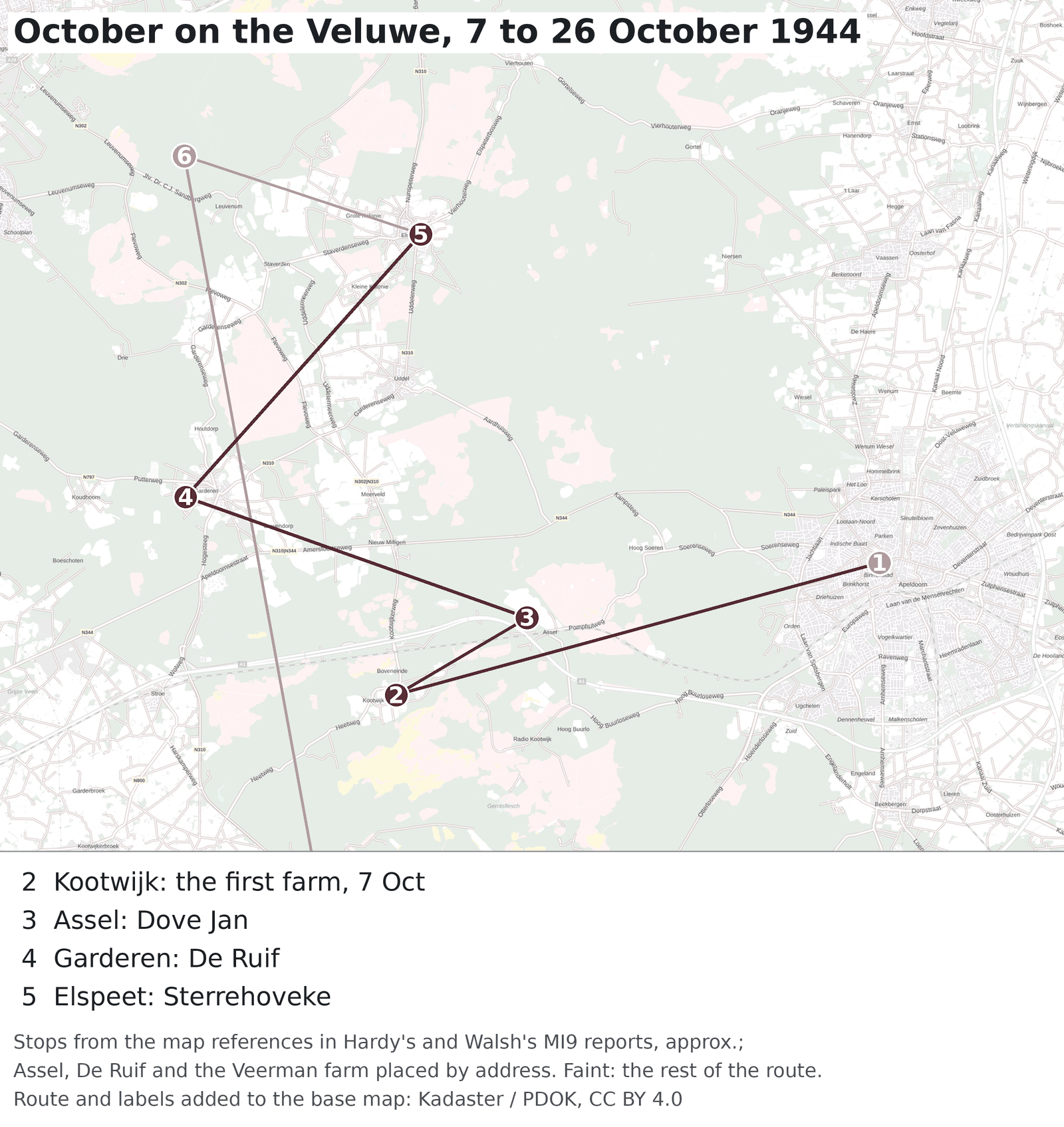
On the run: the Dutch chain, October 1944 – January 1945
Link to the section On the run: the Dutch chain, October 1944 – January 1945Eighty-eight days from the escape to the ferry crossing, and at least eleven households.
Where, and with whom
Link to the section Where, and with whom| Date | Place | Host / contact | Detail | Identified as |
|---|---|---|---|---|
| 7 Oct 1944 | Kootwijk area | Unnamed farmer and wife | Took them in at daybreak, gave breakfast, held them until 0900 when a contact passed the house daily (Walsh) | ⚠︎ Unknown |
| 7–14 Oct | Kootwijk area | Unnamed poultry farmer, English-speaking, very deaf, married, three sons aged approx. 3, 5 and 6; wife also spoke good English. ◐ The Apeldoorn birth notices make the three about 7, 4 and 2 that autumn (C.J.A. Plak). | One week. Too close to the Apeldoorn–Amersfoort railway (Walsh) | ✓ Johan van Oldenbarneveld, in the local resistance as "Dove Jan" (Deaf Jan), on a small farm on the Westerwoudt family's estate at Assel: "'Dove Jan' heeft meer vliegers en para's opgevangen, onder anderen Tom Murhpy [sic] en Sam Walsh" ('Deaf Jan' took in other airmen and paras too, among them Tom Murphy and Sam Walsh) (Noordman, p. 139). Noordman's chapter on Walsh and Murphy calls him "J.A.G. van Oldenbarneveld, genaamd Tullingh, in Assel/Kootwijkerbroek" (p. 299), and his photograph is captioned "J.A.C. van Oldebarneveld genaamd Tullingh" (p. 183); the British helper index has "v.OLDENBARNEVELD, JAC.", Kootwijk 2, Assel (index), so J.A.C.; civil records give one J.A.C. of the right generation: Johan Anne Cornelis van Oldenbarneveld genaamd Tullingh, born at Arnhem about 1895, a shipping-line paymaster, remarried in 1934, died at Warnsveld in 1972 (Open Archieven); ✓ the same man: the questionnaire filled in for him for the Americans on 17 July 1945, signed by R. van Ginkel, gives Johan Anne Cornelis (typed "Cornelia"), born 29 April 1895, of Kootwijk no. 2, his wife C.J.A. Plak, and records that he "picked up" near Kootwijk "2 Eng. parachutists, escaped from the hospital 't Loo" (his file, p. 5). The Germans had raided him once already, at the end of May 1944, when he was hiding American airmen and a Jewish family (p. 140) |
| 14–c.21 Oct ⚠︎ | Garderen | "Uncle Joop", "the Doctor", believed a pre-war surgeon | Large house on the village outskirts; also hiding there, "the Burgermeister of a township near AMSTERDAM" with wife and son. Sgt Harding (10 Para) joined. The Germans later found the cellar and radio and burned the house (Walsh: Hardy does not mention the Burgemeester) | ✓ Dr Johannes Petrus Kruimel and De Ruif, Garderen |
| c.21–26 Oct ⚠︎ (Walsh; Verweij and Hardy put them there from c.10–11 Oct, the dates disagree below) | Elspeet | "Derek", hiding at the home of his great-aunt, "an old lady and very deaf"; "living with her was her niece, a lady of about 40" | Murphy and Walsh join Hardy (Walsh); ⚠︎ Hardy found Murphy already there on 19 Oct. Moved to make room for RAMC officers. Days spent in the woods gathering firewood (Hardy; Walsh defers to Hardy for this period) | ✓ Dirk van Eysinga and Sterrehoveke, Elspeet |
Kootwijk: Dove Jan
Link to the section Kootwijk: Dove Jan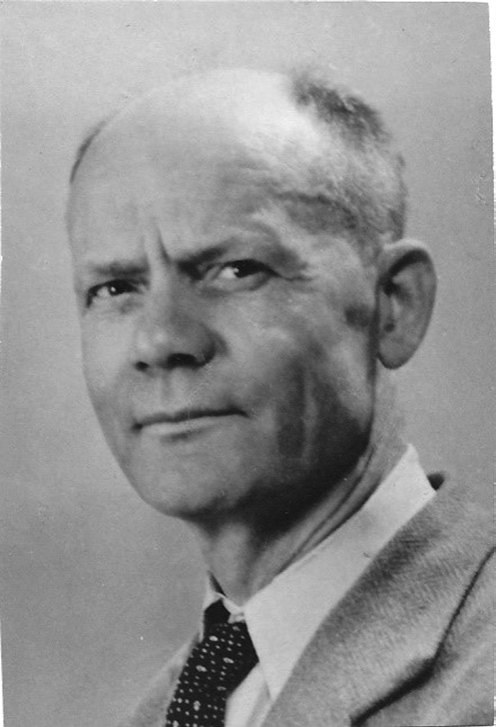
Dove Jan, the deaf poultry farmer, and his wife sheltered the two escaped soldiers for a week. Walsh writes that, the house being fairly close to the Apeldoorn–Amersfoort railway line, it "was not considered very safe, so our friend arranged with the Underground to find new billets" (Walsh). At the end of May 1944 the Germans had raided him once already, when he was hiding American airmen and a Jewish family. He, his family and the airmen got away; what became of the Jewish family, the witness did not know (Noordman, pp. 139–140, 299).
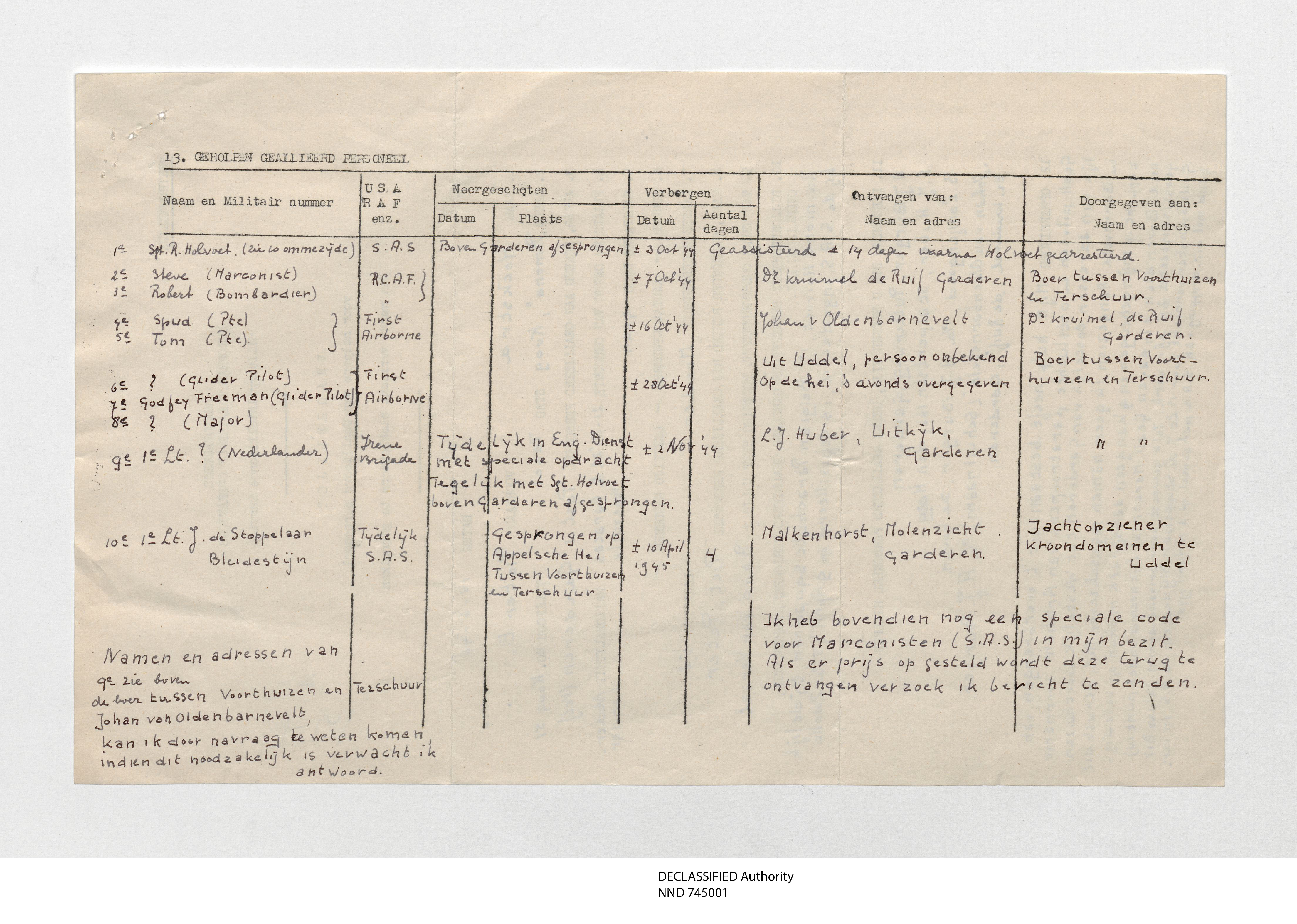
Pieter Hoekstra of Garderen listed for the Americans, by hand, the men he had moved, and among them two privates of the First Airborne, "Spud" and "Tom", received from "Johan v Oldenbarnevelt" and handed to "Dr Kruimel, de Ruif Garderen" at about 16 October 1944 (his file, p. 9). ⚠︎ Hoekstra took that name for a cover name: among the helpers he knew he lists "'Johan van Oldenbarnevelt' (Schuilnaam) p/a A.J. Burger" (cover name, care of A.J. Burger of Garderen) (p. 8). It is Dove Jan's real name, and also the seventeenth-century statesman's, so ◐ the man is very probably Dove Jan all the same. ◐ "Spud" was Murphy's army nickname (Subject), so the pair is very probably Murphy and Walsh, with "Tom" set against the wrong man; Hoekstra was writing from memory in 1946, and his date carries a "±". ⚠︎ Dove Jan's own list has the two paratroopers six days, in October, and sends them on to "Dr. Eskens" ("Alex") of Nieuw-Milligen, ◐ Dirk Eskes, one of those who brought men to De Ruif (Garderen), with "Murphy" and "Kelly Schotland", ◐ Kelty heard as Kelly (his file, p. 4). So Hoekstra may have moved them, or Eskes may have: the two forms disagree.
Garderen: Uncle Joop, De Ruif, and the Burgemeester
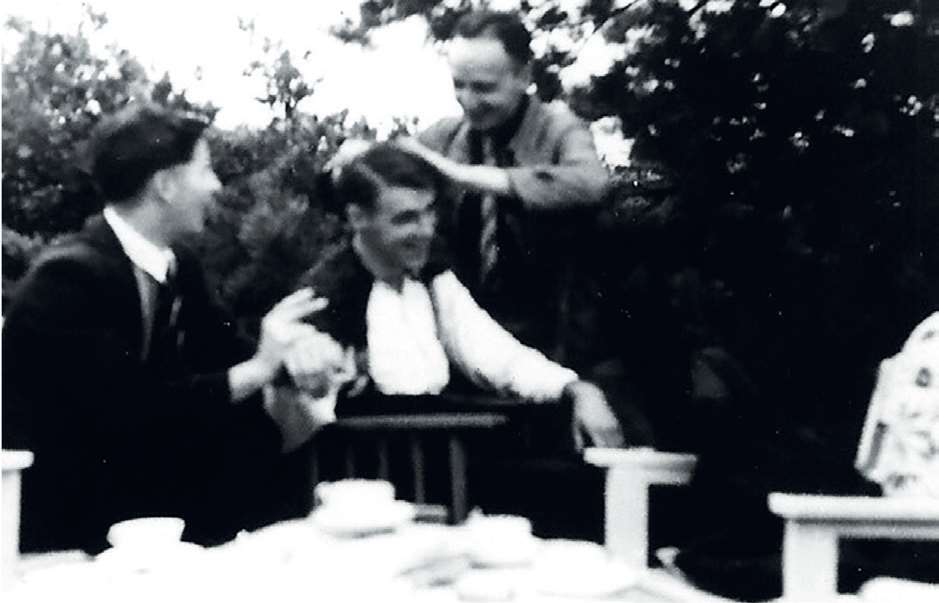
Link to the section Garderen: Uncle Joop, De Ruif, and the BurgemeesterThe house the British knew only as "Uncle Joop's" was De Ruif. Uncle Joop is Dr Johannes Petrus Kruimel (born 23 April 1900, Bodjonegoro, East Java): orthopaedic surgeon at the St Joannes de Deo and St Antonius hospitals in Utrecht, with a country house, De Ruif, at Garderen. In the Veluwe pilot line from May 1943 under the codename "Oom Joop", introducing himself to evaders as "Joe Smith". He kept a guestbook at De Ruif in which the people he hid wrote farewell notes. Awarded the American Medal of Freedom on 12 March 1947, about which, per the note on his helper form, he was "unhelpful in producing any further information concerning his activities". He died on 23 May 1976, aged 76, and was buried privately at Garderen; the notice, signed by his executor, is datelined "De Ruif" and does not say where he died (Barneveldse Krant, 25 May 1976). A residential centre for the elderly in Garderen, Dr. Kruimelstaete, opened under his name in 2009 (Airborne Magazine nr.27; Omroep Gelderland; Elspeet history).
A second account of the house, written by the people who ran the radio in it, adds what the magazine leaves out:
Dr Kruimel himself lived in Utrecht and had let the house to the Van Nispen tot Sevenaer family.
Dutch originalDr. Kruimel zelf woonde in Utrecht en had het huis verhuurd aan de familie van Nispen tot Sevenaer.
— The story of the agents du Bois and Holvoet, elspeethistorie.nl
That is why the Burgemeester's household was living there when Murphy arrived. The agents Abraham du Bois ("Ham") and Raymond Holvoet ("Bacon"), dropped nearby, were brought to Kruimel's bunker on landing, and du Bois's own task is set out plainly: "het bijeenbrengen van de verspreide parachutisten en het voorbereiden van een crossing over de Rijn" (gathering the scattered paratroopers and preparing a crossing of the Rhine). That is the operation Murphy was in the middle of (du Bois and Holvoet).
Thomas Murphy is named in the Airborne Magazine article:
Around 8 October 1944 Samuel Walsh … and Thomas Murphy arrive … They escaped on 6 October from the Airborne Hospital in the Willem III barracks in Apeldoorn. A few days later Sergeant Harding of the 10th Parachute Battalion arrives at De Ruif. Then Captain Alexander William Lipmann Kessel appears … At some point Walsh and Murphy leave, because it is getting too full.
Dutch originalOmstreeks 8 oktober 1944 arriveren Samuel Walsh … en Thomas Murphy … Ze zijn 6 oktober ontsnapt uit het Airborne Hospital in de Willem III-kazerne in Apeldoorn. Een paar dagen later komt Sergeant Harding van het 10th Parachute Battalion aan bij De Ruif. Vervolgens verschijnt Captain Alexander William Lipmann Kessel … Walsh en Murphy vertrekken op een gegeven moment omdat het te vol wordt.
— Somford, "Op zolder bij Oom Joop", Airborne Magazine nr.27, 2023
Walsh's report says they were moved "to make room for a party of six R.A.M.C. officers who were expected" (Walsh); the Dutch article names four who came.
Those were Capt. Alexander "Lippy" Lipmann Kessel, the Arnhem surgeon, author of Surgeon at Arms (1958; 2nd ed. 1974), with Lt Peter Allenby, S/Sgt Albert Allen and Maj. Cedric Longland of 16 Parachute Field Ambulance (Airborne Magazine; Kessel; ParaData, Kessel; Longland). Kessel's book names neither Murphy nor Walsh (Regimental and published).
The De Ruif guestbook
Link to the section The De Ruif guestbook⚠︎ On the guestbook. Noordman, who worked from it, warns that a name in the De Ruif guestbook does not mean the man was housed at De Ruif, most were placed at farms round about, and "een aantal para's verbleven er enige dagen in het najaar van 1944" (a number of paras stayed there a few days in the autumn of 1944) (Omroep Gelderland). Murphy was one of those who did stay: Walsh's report puts them in the house itself.
✓ He signed it. Noordman's book prints the pages, and they are in his own hand: a poem about his old battalion over two pages, his thanks, and his name, with Walsh's page facing (Noordman, figs. 189 and 193, pp. 293 and 300).
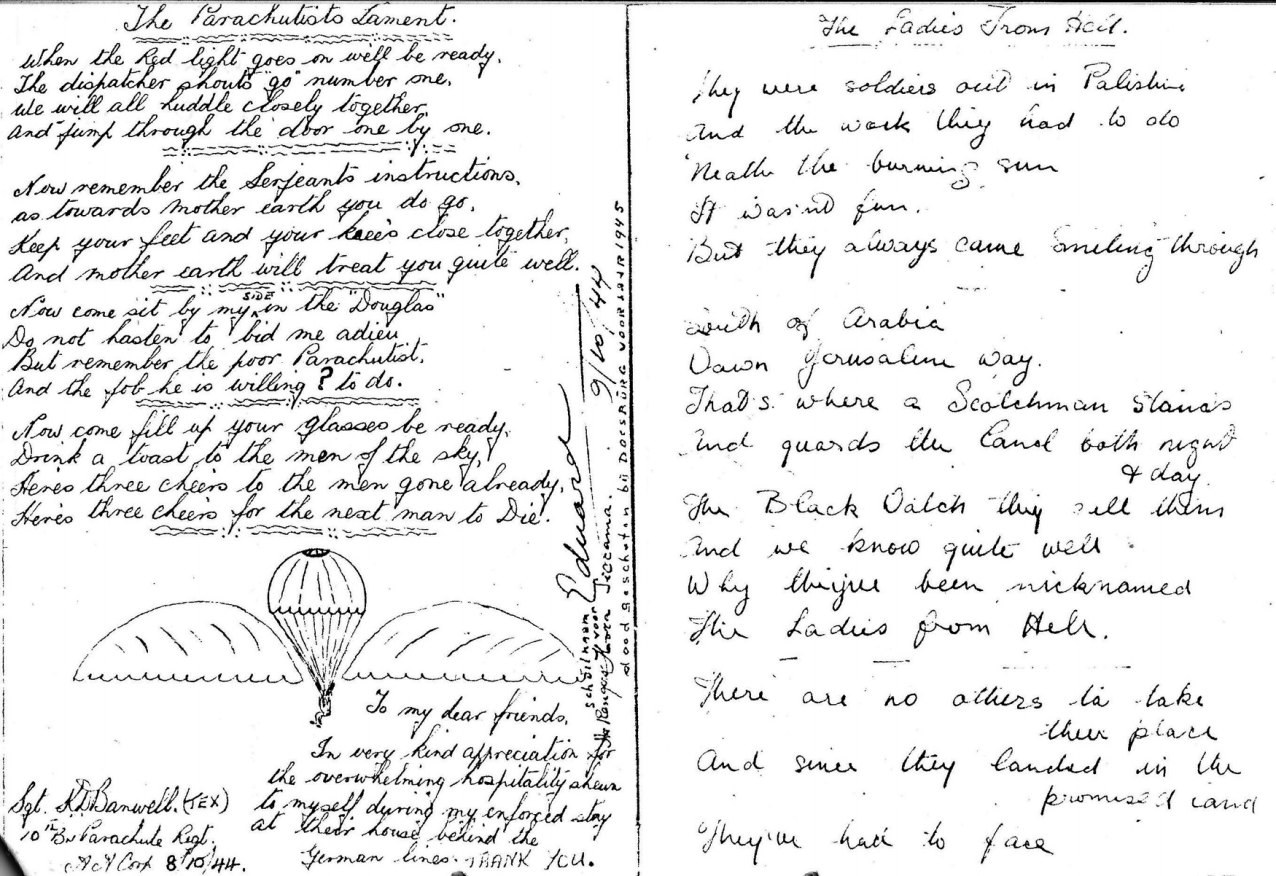
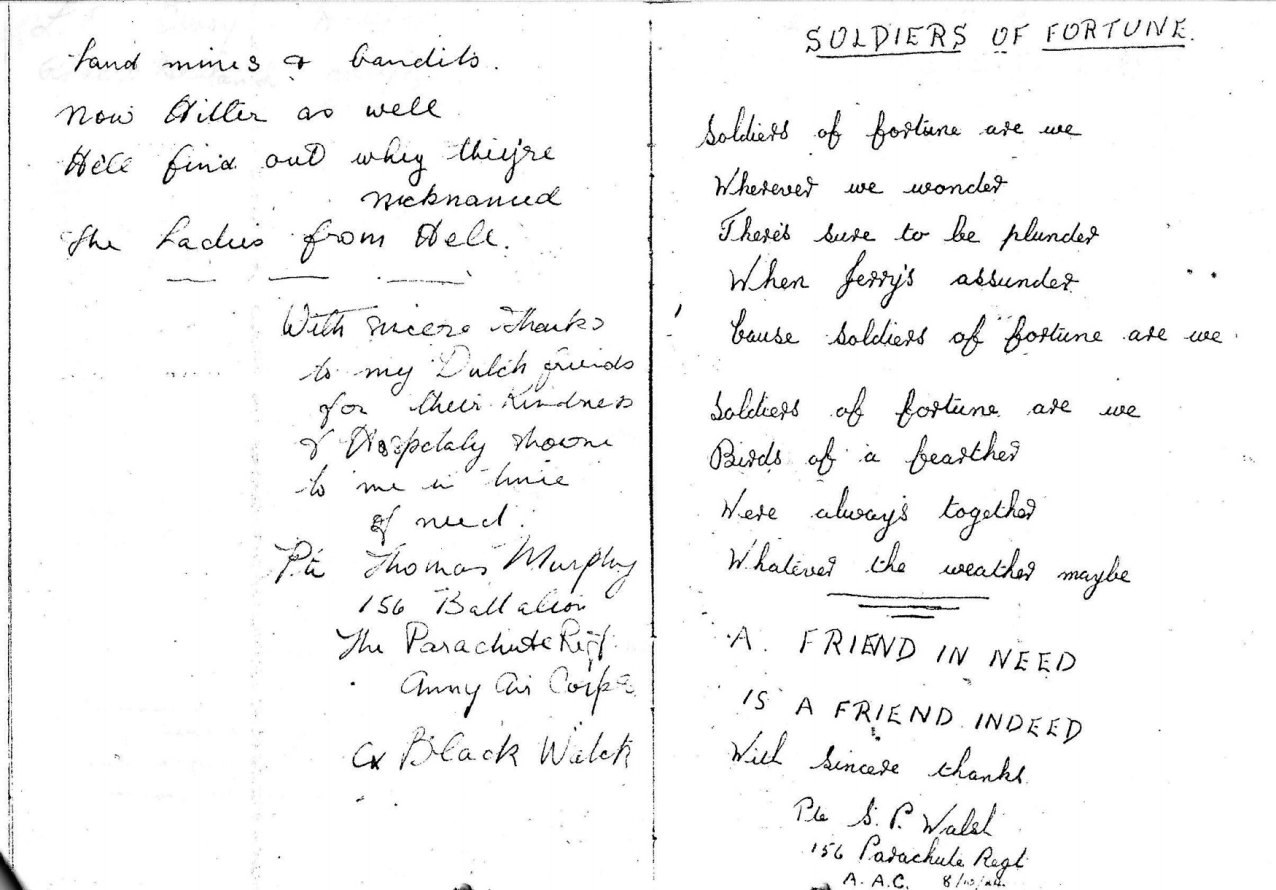
His pages, as written:
The Ladies from Hell.
They were soldiers out in Palestine
And the work they had to do
'Neath the burning sun
It wasn't fun.
But they always came smiling throughSouth of Arabia
Down Jerusalem way.
That's where a Scotchman stands
And guards the Canal both night & day.
The Black Watch they call them
And we know quite well
Why they've been nicknamed
The Ladies from Hell.There are no others to take their place
And since they landed in the promised land
They've had to face
Land mines & bandits.
Now Hitler as well
He'll find out why they're nicknamed
The Ladies from Hell.With sincere thanks to my Dutch friends for their kindness & hospitality shown to me in time of need.
— Pte Thomas Murphy, 156 Battalion, The Parachute Regt, Army Air Corps, ex Black Watch, the De Ruif guestbook, October 1944 (Noordman, pp. 293, 300)
"Ladies from Hell", Die Damen aus der Hölle, was the name the Germans are said to have given the kilted Highland battalions in the First World War (Highlanders' Museum). ◐ Whether the verses are his own or a barrack-room song he knew by heart is not known; they are in his hand and signed as his. The title was in circulation: a different poem of the same name, on the Highland soldier in the Middle East and North Africa, was written by Capt. Lionel Leslie of the Cameron Highlanders (Highlanders' Museum). Walsh wrote "Soldiers of Fortune" ("Birds of a feather / We're always together / Whatever the weather maybe"), then "A friend in need is a friend indeed. With sincere thanks", signed Pte S. P. Walsh, 156 Parachute Regt, A.A.C., and dated.
Up the margin of Banwell's page is "Eduard 9/10/44", which Noordman says is in the own hand of jonkheer W.J.H.D. Rengers Hora Siccama, a lawyer in the resistance, whose hiding name it was, adding that "De toevoegingen zijn van dokter Kruimel" (the additions are Dr Kruimel's): ◐ his statement alone, not checkable from the reproduction; Noordman takes it Siccama helped move Banwell. He died at Apeldoorn on 1 February 1945 and lies in the Ereveld at Loenen (Noordman, p. 292). ⚠︎ The note on the page says he was shot near Doesburg in spring 1945; the book's text says Apeldoorn.
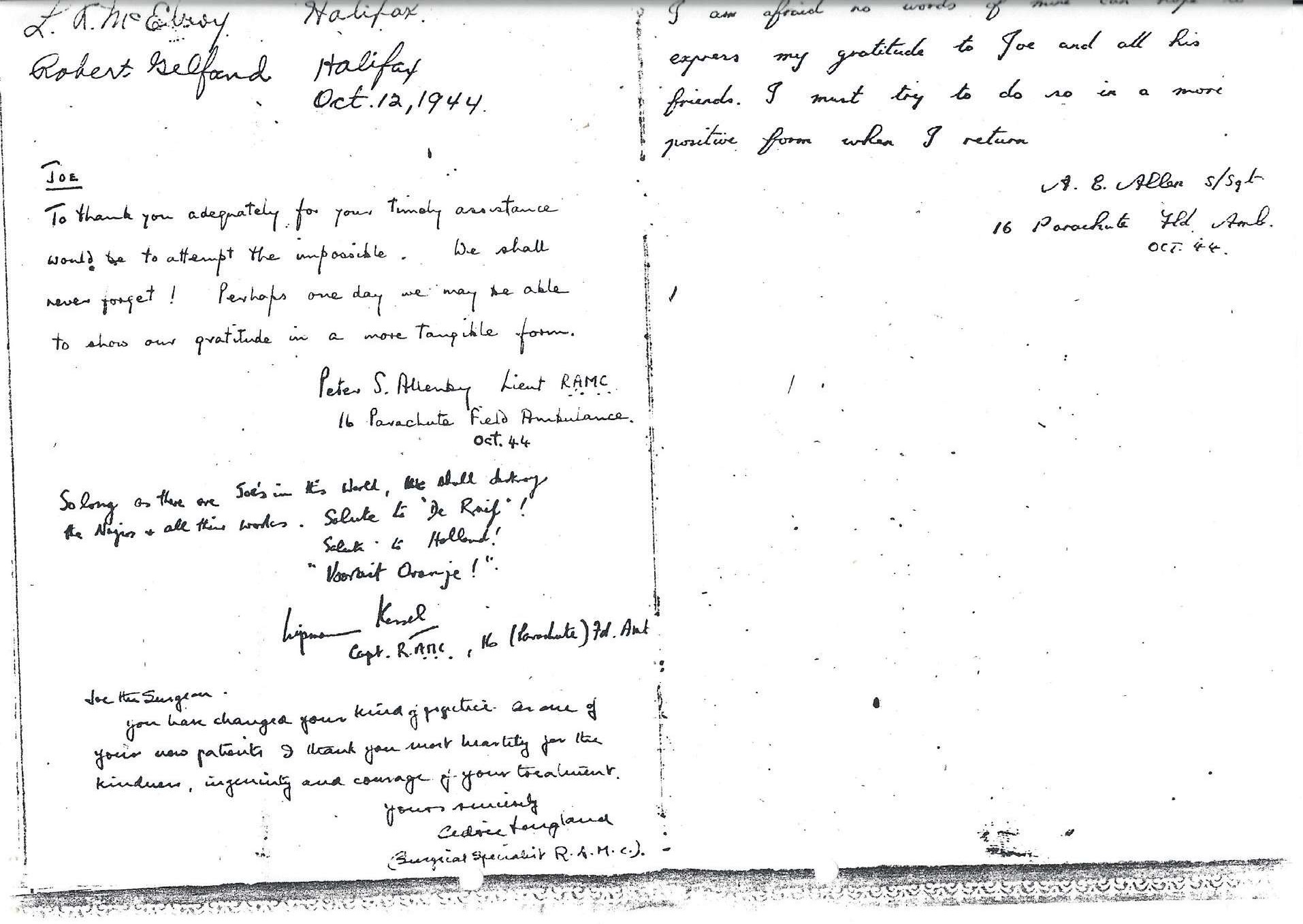
The Airborne Magazine spread from the same month (the two pages, image via Noordman) has two Halifax airmen dated 12 October 1944, then Allenby, Kessel, Longland and Allen of 16 Parachute Field Ambulance, and no Murphy or Walsh. "Joe" is thanked by Allenby, by Kessel ("So long as there are Joe's in this world, we shall destroy the Nazis & all their works. Salute to 'De Ruif'! Salute to Holland! 'Vooruit Oranje!'"), by Longland, "Joe the Surgeon … you have changed your kind of practice", and by Allen. Their pages are printed separately, Walsh's dated 8 October and Murphy's undated; ◐ where they sit relative to the 12 October page is not known, since Noordman printed from copies. Wolter Noordman, who worked from the guestbook, has died (his publisher, 18 September 2026); his book lists only "copies" of it, and who holds the original is not known (Dutch).
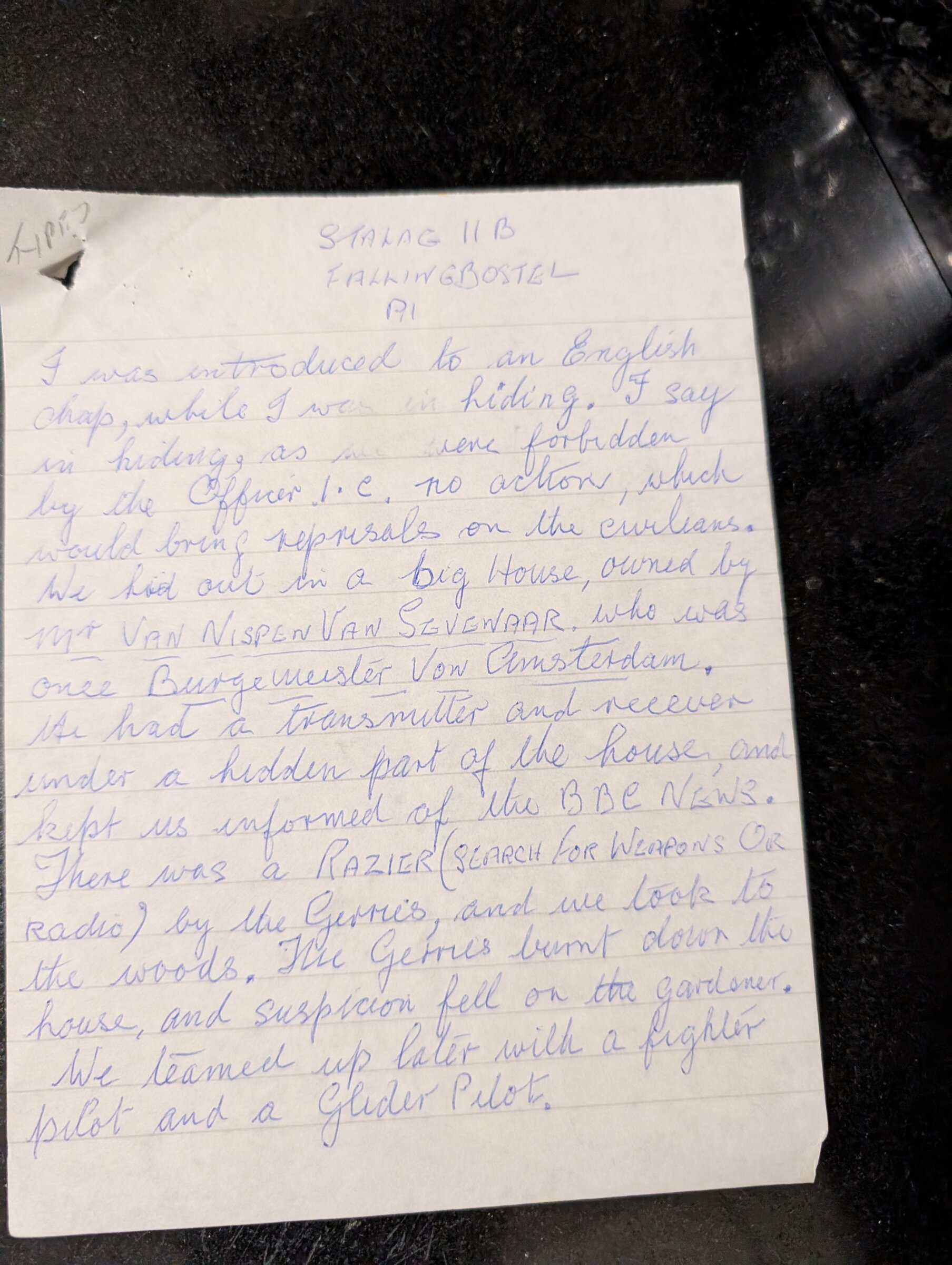
The Burgemeester is Jonkheer (a Dutch title of nobility) Hubert Louis Marie van Nispen tot Sevenaer (1879–1958), mayor of Laren, near Amsterdam, as Walsh's report says, from 1909 to 1943 and again 1945–46. He refused to co-operate with the NSB administration and escaped an arrest attempt on the night of 8/9 February 1943; he came back in April, was put on forced leave, and was dismissed on 29 May 1943 and banned from the district. He lost everything in the war (Wikipedia). Murphy names him himself, the only British source that does: "Mr Van Nispen Van Sevenaar, who was once Burgemeister von Amsterdam" (Stalag p.1; the typed copy has "Sevenaar who was on Burgemeister").
The burning of De Ruif, 23 October 1944. Germans quartered at Elspeet came to Garderen to requisition a car. That afternoon Van Nispen's son had lit a fire in the hideout under the stable. When the Germans inspected it they found a transmitter and a pilot's equipment. They razed the house with fire and hand grenades, after first "securing" the furniture, glassware, paintings, crystal and silver. The Van Nispens escaped (Airborne Magazine).
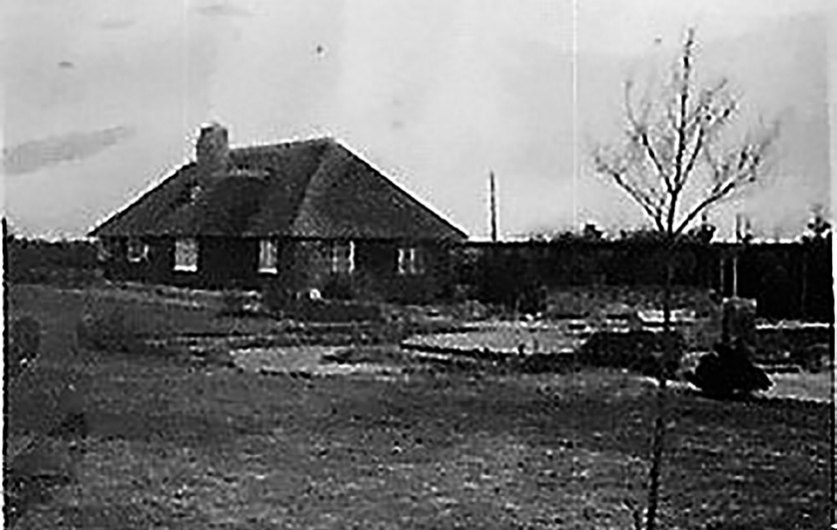
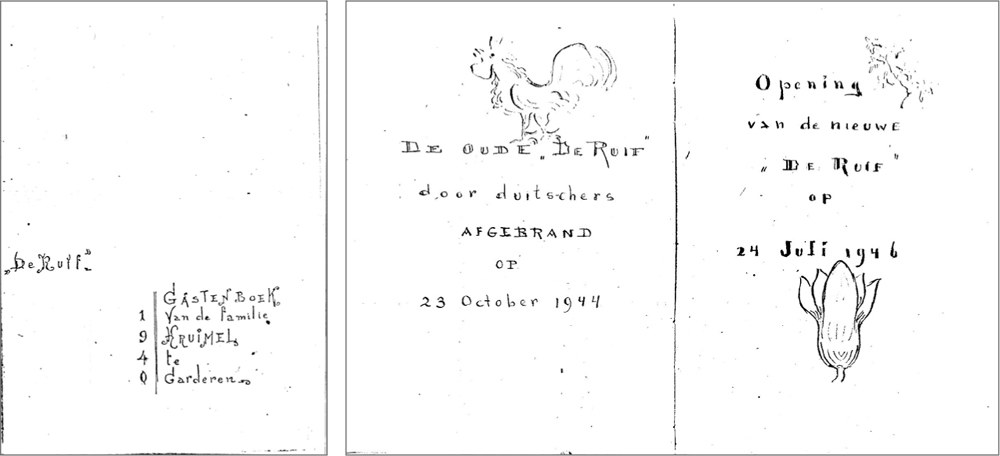
Van Nispen's own account
Link to the section Van Nispen's own account✓ Van Nispen told the story himself nearly seven months later, and a Laren paper printed it. He had walked into his own town hall the previous afternoon in Canadian uniform and a beard, and nobody recognised him. He came home properly on 16 May 1945, in a jeep, to a wagonload of girls dressed in white, two bands and a guard of honour. In his speech he ran through the occupation years. He was dismissed in May 1943 and had left the official residence by November; that December Kruimel made the Garderen house available ("Dr Kruimel of Utrecht made his house at Garderen available"), and "as a result the Grüne Polizei honoured the Van Nispen family with a visit on 23 October" 1944. He then went into hiding at Apeldoorn and his son at Achterveld, the village where Murphy would spend his month with the Veermans (Jacob, Aaltje and Jopie) (Tijding, 17 May 1945; see the note). It is a contemporary Dutch report, in May 1945, of the burgemeester's own speech, about seven months after the fire.
The family told the Americans the same in 1945 and 1946, with the names. The son's form, of 31 May 1946: "Het huis werd toevallig ontmaskerd op 23 Oct.44 en dezelfde middag in brand gestoken. Alle bewoners ontsnapten, doch het hoofd van het gezin ternauwernood" (the house was discovered by chance on 23 October 1944 and set on fire the same afternoon; everyone living there escaped, the head of the family only just). The son himself, Hubert, born at Laren in 1919, was arrested a few days later at a temporary hiding place, questioned at Elspeet without result, and freed by the resistance at Harderwijk about ten days later ("Zelf werd ik enige dagen later … gearresteerd", I myself was arrested a few days later); "De eerste piloot kwam op 1-1-44. De laatste vertrok op 21 Oct 44" (the first pilot came on 1 January 1944; the last left on 21 October; he does not say who) (the son's file, pp. 4–5). The father's form of 26 July 1945 lists the men with their home addresses, among them "Th. Murphy, 91 Centre St. Kelty Fifeshire Scotland", Walsh and Banwell, and the office noted from the son: "The Fliers were brought to the house by Dr Kruimel, Dr Eskes, Nol Burger … Mostly Dr Kruimel fetched them again" (the father's file, p. 3). Jeane van Galen, who lived with the family at De Ruif and helped the lady of the house, listed the same three, on the same day as the son and in the same order, so not independently, with Murphy's number right: "T.Murphy 2756457" (her file, p. 3).
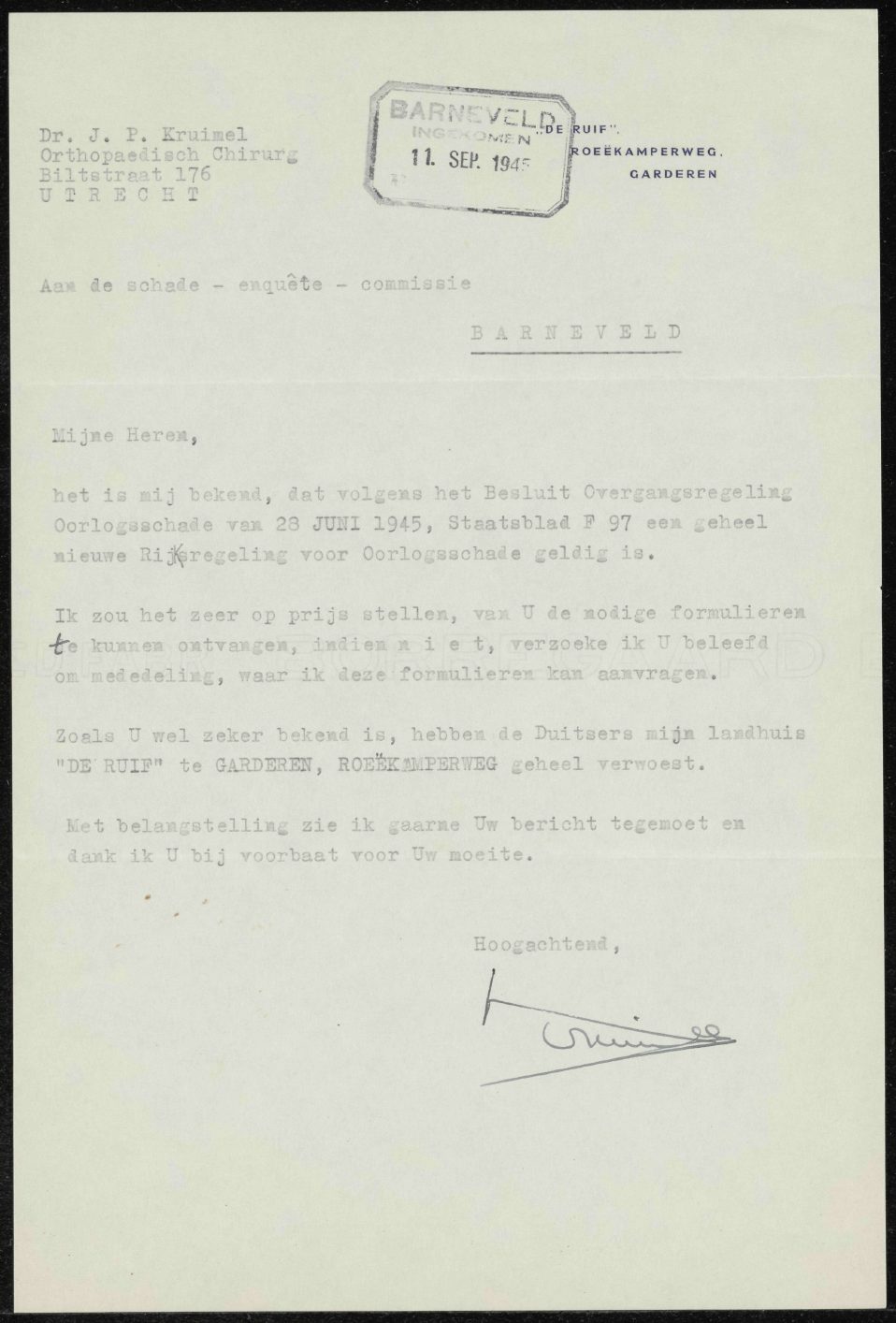
Kruimel's letter
Link to the section Kruimel's letterKruimel wrote it down himself the following September, asking Barneveld's war-damage committee for the claim forms:
As you will surely know, the Germans completely destroyed my country house "De Ruif" at Garderen, Roeëkamperweg.
Dutch originalZoals U wel zeker bekend is, hebben de Duitsers mijn landhuis "DE RUIF" te GARDEREN, ROEËKAMPERWEG geheel verwoest.
— Dr J.P. Kruimel to the war-damage committee, Barneveld, received 11 September 1945 (the letter, Gemeentearchief Barneveld 002/1558)
On Walsh's account Murphy and Walsh had left two days before the fire: "About 21 Oct it was arranged that we should move" (Walsh).
Tex Banwell was also at De Ruif, from after 30 September to 22 October (Airborne Magazine), see Tex Banwell.
✓ Kessel's memoir describes the household as he found it, on a date it does not give (our extract is headed "about 21 October", which is ours; Walsh has Murphy and Walsh told to move "About 21 Oct"): a hostess "of about fifty-five", "dressed very severely in black", with "the kind of correct, good looks which I felt belonged to the Almanach de Gotha", who said her husband "has often been [in England] on business"; "a white-haired man, equally distinguished in appearance ... the burgomaster of a small town near Amsterdam", evacuated; two men in brand-new airborne smocks who introduced themselves as "Ham" and "Bacon" and had been "at a dance in Oxford" the night before; and "Tex ... Sergeant, Tenth Batt." The four medics slept in Kruimel's bunker, "a good fifteen feet deep", and left, when the guide "came back for us at six", because "since the Putten affair the area was buzzing with Grüne Polizei", "saying good-bye to our hostess and to Tex, for whom something else was being arranged" (Kessel, 1959, pp. 90–101). Kessel names none of them, but the burgomaster is Van Nispen, whom Walsh and Murphy also place there, and the two agents are du Bois and Holvoet, dropped on 16 October (Elspeet history); their "last night" is their joke or Kessel's memory. ⚠︎ Ede's wartime history dates the drop a night later, "in de nacht van 17 op 18 oktober" (on the night of 17/18 October), near Boeschoten by Garderen (Ede manuscript, p. 44), which, with Noordman's earlier date for the medics' arrival (below), would make Kessel literally right; the sources are not reconciled here. The same page has Holvoet arrested at Garderen on 27 October, four days after De Ruif burned.
⚠︎ Noordman dates the medics a few days earlier. His chapter on Kessel has them out of the Willem III barracks on 16 October (Warrack's book and Kew's entry for Kessel's report have Sunday 15 October: Lipmann Kessel) and fetched to De Ruif by Dirk Eskes and Kruimel the evening they were found in the woods, which Noordman puts on 17 October; Nelly Eskes, whose memory it is, gives no date. His text of Kessel has "We bleven twee dagen in Garderen" (we stayed two days in Garderen) (Noordman, pp. 307–311). On Walsh's dates that would put them in the house with Murphy and Walsh for several days, not arriving as they left; on Verweij's and Hardy's (On the run), Murphy and Walsh had gone by the 17th; Noordman's Dutch text of Walsh has the house full because "nieuwe gasten waren gearriveerd" (new guests had arrived, p. 300), where the MI9 report says the officers were "expected". Kessel's own book gives no date for their arrival or their leaving (pp. 90–101); the dates on offer run from Noordman's 16–17 October to Walsh's "About 21 Oct". Not settled.
Banwell at Staverden
Link to the section Banwell at Staverden⚠︎ Two more witnesses at Staverden, Albert Groen and the Foppen and Bos households, have Banwell with them only briefly after De Ruif, and their dates do not sit easily with his guestbook entry of 8 October; the details are on his page.
Elspeet: "Derek", Sterrehoveke, and the Van Eysingas
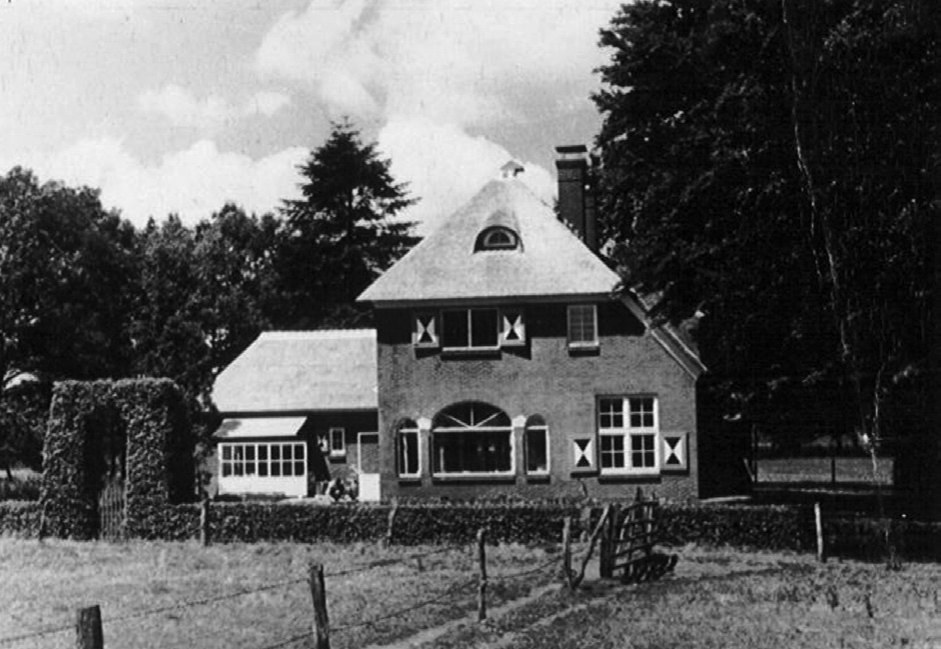
Link to the section Elspeet: "Derek", Sterrehoveke, and the Van Eysingas"Derek" is Dirk van Eysinga, who lived during the war with freule (the Hon.) Ima van Eysinga at Sterrehoveke on the Krommesteeg in Elspeet. With Dr Kruimel and Huib de Jongh he hid weapons there, and, with her knowledge, onderduikers (people in hiding), pilots, paratroopers and escaped doctors. He was a member of the Veluwe pilot organisation (PTO) set up after Market Garden under the MI9 agent Dick Kragt ("Frans Hals") and the Jewish onderduiker Joop Piller ("Joop van Amstel"). After the war he became Dutch ambassador to Romania. He died at 63 (Elspeet history, citing Jeanne Dijkstra, Elspeet, baken van verzet (Barneveld, 2017)).
⚠︎ The household. Hardy calls the old lady Derek's great-aunt; the Dutch sources call her his aunt ("tante Ima"). Hardy's "niece, a lady of about 40" is the other woman of the house, Liesbeth Verweij. Noordman's source list says who she was: a daughter of the writer Albert Verwey, "een vriendin en gezelschapsdame" (a friend and companion) of jonkvrouw E.H.J. (Ima) van Eysinga (1881–1958), who lived with her at Sterrehoveke for a long time; his captions call her gouvernante (governess) (Noordman, pp. 280, 346). She was not a relative, so Hardy's "niece" is his guess, and she was not about 40 either: her own form for the Americans gives her birth as Noordwijk, 16 January 1891, so she was 53 that October (her file, p. 2). She wrote up the household's resistance work in the autumn of 1944, round Elspeet, Hulshorst and Garderen: Airborne Magazine calls it never-published herinneringen (recollections), Spannende tijden op en rond Sterrehoveke; Omroep Gelderland a dagboek (diary); Noordman a "Manuscript … Niet gepubliceerd" (manuscript, unpublished), shown to him by jhr. C. van Eysinga of Sint Nicolaasga (p. 346), and elsewhere "een boekje" (a little book) written straight after the war (p. 301).
Liesbeth Verweij's account
Link to the section Liesbeth Verweij's accountNoordman quotes her account of Murphy and Walsh at length (Noordman, pp. 301–303). There were seven paratroopers at De Ruif at once, so two were to go to Sterrehoveke, around 10 October. A round-up that day kept Dirk indoors, so she cycled to De Ruif herself to arrange it with Kruimel. ◐ An Elspeet man interviewed in 1980 put that raid "een week na de onvergetelijke razzia in Putten" (a week after the unforgettable raid on Putten), which was on 1–2 October, and called the house of "de familie Ysinga aan de Krommeweg" (◐ the Van Eysingas', Sterrehoveke) "een verzetscentrum" (a resistance centre) with "een ondergrondse schuilkelder" (an underground shelter) for emergencies (Nunspeter Courant, 1 May 1980, p. 11); it is one man's memory, thirty-six years on. At six the next evening she was back, and ate with the seven paratroopers and the Van Nispens; when Kruimel came home at a quarter past seven they set off along the cycle paths, she riding about twenty metres ahead to give warning, Tom and Sam behind her, Kruimel at the rear: "maar Engelsen zijn geen helden op de fiets" (but the English are no heroes on a bicycle), and in the dark she lost them for well over a quarter of an hour. They slept on Persian carpets in the attic, with the stairs pulled up after them. Kruimel stayed the night and wrote in the house's own guestbook, "Keep smiling; ook in tijden van gevaar" (even in times of danger). Of their days:
Life with Tom and Sam was regular and disciplined. They were not allowed to get up until Dirk called them. If there was danger, the word "Coffee" was called upstairs. Dirk said it was unbelievable how quickly, deftly and silently they would vanish behind the water tank, after rolling up the Persian carpets. … Tom, a Scot, had a head wound that still had not healed. He was a miner by trade, serious and cool-headed, with a typically English sense of humour.
Dutch originalHet leven met Tom en Sam was regelmatig en gedisciplineerd Zij mochten niet opstaan voor Dirk hen riep. Was er onraad dan werd het woord: 'Coffee' naar boven geroepen. Dirk zei dat het ongelofelijk was zo vlug, handig en geruisloos ze plachten te verdwijnen achter het waterreservoir, na de Perzische tapijten opgerold te hebben. … Tom, een Schot, had een hoofdwond die nog steeds niet genezen was. Hij was van beroep mijnwerker, ernstig en koelbloedig en met een typisch Engels gevoel voor humor.
— Liesbeth Verweij, in Noordman, Schuilplaats de Veluwe, p. 302
⚠︎ "A miner by trade" is what she understood; his own page has him in a quarry, and a stonemason (Subject). By day the two gathered firewood in the surrounding Elspeet woods, each taking a different path there.
After about a week Murphy and Walsh met Pte James Hardy here, a medical orderly of 16 Parachute Field Ambulance, "Jack" to Verweij, who arrived with a red beret, a camouflage uniform and an appetite, and played sentimental English songs on the piano (Noordman, p. 302). On first meeting him, Derek had verified Hardy by examining his paybook and asking questions about the British Land Army; Hardy adds that the three kept out of the house as much as possible because the Germans had visited the house before (Hardy). Hardy stayed with Murphy almost to the end, and his debrief of January 1945 is the reason most of the people in this story are recorded at all. Some ten days later word of a house-to-house search sent the three of them to Kijkuit (On the run).
Thomas Murphy is named in the Van Eysinga papers besides. Noordman, who worked from the family archive, on the names in it:
These were escapers from the King William III barracks, such as John Haller, Tom Murphy, James Hardy, Sammy Walsh, Lipmann-Kessel, Cerediq Longland, Allenby and Allan. It is a hasty scribble, but there are also moving poems and a longer list of names.
Dutch originalHet ging hierbij om ontsnapten uit de Koning Willem III-kazerne, zoals John Haller, Tom Murphy, James Hardy, Sammy Walsh, Lipmann-Kessel, Cerediq Longland, Allenby en Allan. Het is een haastige krabbel, maar er zijn ook indringende gedichten en een langere lijst met namen.
— Noordman, Schuilplaats de Veluwe, foreword, p. 8; also in Omroep Gelderland, 4 December 2019
The spellings are his: Cerediq is Cedric Longland, and Allan is S/Sgt Albert Allen. ◐ The poems and the list were left by the men themselves, and Sterrehoveke kept a guestbook of its own (Kruimel wrote in it), so a second entry in Murphy's hand may be among the Van Eysinga papers (Dutch).
So he is on record by name in October 1944 in the De Ruif guestbook, in his own hand, and again in the Sterrehoveke papers, which Verweij wrote up straight after the war.
And a third time in the house's own forms for the Americans. Ima van Eysinga's lists "Sam Walsh 156 Bn. Parach. Regt" and "Tom Murphy 156 Bn. Parach. Regt", received from "Dr. Kruimel 'De Ruif', Garderen" and passed on to "Joop Michelsen, Erick Blok, Hulshorst"; Hardy came to them from "Mrs. van Asbeck-Patijn 'Roode Koper', Leuvenum". The forms give no dates (her file, p. 3). Liesbeth Verweij filled in a form of her own, and it lists the same three men, received from and passed to the same people: "Tom Murphy, 156 Bn. Parach. Regt." (her file, p. 3).
The dates disagree
Link to the section The dates disagree⚠︎ Date discrepancy at Garderen. The MI9 reports put arrival at Garderen on 14 October after a week at Kootwijk. Airborne Magazine says "Omstreeks 8 oktober 1944 arriveren Samuel Walsh … en Thomas Murphy" (around 8 October 1944 Samuel Walsh … and Thomas Murphy arrive). The MI9 reports are contemporary; the Dutch article is 2023, reconstructed from the guestbook. The article also gives Murphy as "Bren gunner, C Coy" and Walsh as "HQ Coy, 2nd Parachute Battalion". Walsh's own report says he was "a Bren Gunner with C-Coy of the 156 Para Bn". The Dutch author had the names right and the wrong Walsh: ParaData carries a namesake, a Pte Samuel Walsh of HQ Company, 2nd Parachute Battalion, batman to Padre Egan, taken wounded on 17 September and never an evader (ParaData), and that is the unit the article gives. Murphy's Walsh is 4389317, a Green Howards number, of 156 Bn.
Most of the Dutch evidence points to the earlier date. Walsh dated his entry in the De Ruif guestbook "8/10/44", and so did Banwell, whose page faces the start of Murphy's poem (Garderen). Noordman, who worked from copies of the guestbook, opens his chapter on the pair with "Omstreeks 8 oktober 1944" (around 8 October 1944) (Noordman, p. 296). Liesbeth Verweij fixes the move from De Ruif to Sterrehoveke at "omstreeks 10 oktober" (around 10 October); a round-up put it off, and she brought them over the evening after she went to arrange it (p. 301). Hardy, who reached Sterrehoveke from Kijkuit on 19 October, found Murphy already there, in his MI9 report ("Here also I met Pte. MURPHY", Hardy) and in Verweij's account, where Hardy arrives "after about a week" (p. 302). Against all that is Walsh's own report: a week at the farm near Kootwijk, Garderen from the evening of 14 October, and Elspeet from about 21 October, "where Pte. HARDY … was living". ⚠︎ Not settled. Only Walsh's report and Hoekstra's form (below) support the later dates, and the MI9 dates in the table above are his. ◐ The lower edge of Walsh's guestbook date is clipped in the printed scan; Banwell's is clear.