Bill Lalley
Grand Rapids ◐ 19 Mar 1922 – after 2008
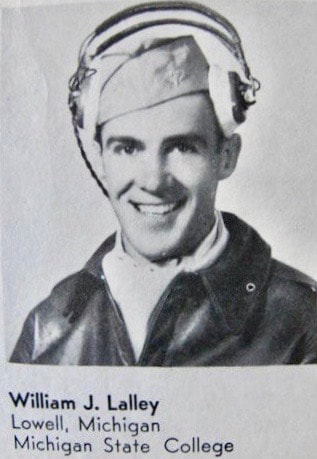
About: An American B-17 co-pilot shot down on 29 April 1944, hidden at Stroe with help from Dr Kruimel before Murphy's time, who went down the escape line with the Mosquito pilot Robert Bailey and was put into the Antwerp jail on 11 August 1944. He was a prisoner of the Luftwaffe until Moosburg was freed on 29 April 1945.
Unit or role: 2nd Lt, co-pilot, B-17 42-3513, 326th Bomb Squadron, 92nd Bomb Group, service number 0-705028 (KU 1677; One Way Ticket to Berlin, p. 115; Bowman, p. 83).
Where: Lowell, Michigan. Shot down at Nieuw Millingen, Gelderland; hidden at Stroe, then at Breda; taken at Antwerp; Dulag Luft, Stalag Luft III at Sagan, Nuremberg and Moosburg; later Holland, Michigan.
Evidence: ✓ the German loss report and his Dulag Luft card (KU 1677); ✓ Airborne Magazine; ✓ Jeane van Galen's file, p. 3; ✓ his evader card (NARA 631849418); ✓ the helpers' own forms (Van den Top, Loose, Lems); Noordman, Schuilplaats de Veluwe, pp. 145–161, his own account; the Lowell museum's page and the Grand Valley State University interview outline for his life after the war.
Born, trained, crewed. ✓ Born on 19 March 1922: his Dulag Luft questionnaire has "Date of birth: 19 March, 1922", and the Secret Field Police's request to the Antwerp prison to take him in the same date and "Mich. U.S.A." (the questionnaire, PDF p. 19; the form, PDF p. 20). ◐ In Grand Rapids: the Grand Valley State University outline of his interview of 30 October 2008 has him born there in 1922, his father dying when he was six months old, and his mother taking him and three siblings to Lowell (outline; the record). The museum's page has him graduating from Lowell High School in 1940 and from Michigan State College (the page); the outline has the University of Michigan first, then Michigan State, and a degree in business administration after the war.
In his own words he was called up from the Air Force College Reserve Program, graduated from flight school in January 1944, and got his wings and commission as a second lieutenant (One Way Ticket to Berlin, p. 117; Noordman, p. 146). He was put with a crew about to go overseas: the pilot 2nd Lt Russell M. Munson, the navigator Margosian and the bombardier Clark (Noordman, p. 146; "Clarke" in One Way Ticket, p. 117). They reached England in early April 1944 and joined the 92nd Bomb Group at Podington (Noordman, p. 146; One Way Ticket, p. 115, which has the aircraft as B-17G 42-3513, MACR 4260).
Shot down, 29 April 1944. ✓ The German loss report KU 1677 has the Fortress shot down on 29 April 1944 at 14.40 at Nieuw Millingen, reported by "Transport Amsterdam". It lists ten men, seven as captured at first, and adds Margosian (1st addition, 1 June 1944), Eugene John Glisynski (2nd, 11 August) and "LALLEY William John, Lowell, Mich., 2.Lt. 0-705028, gef. Dulag-Luft" (3rd, 13 September 1944) (KU 1677, PDF p. 3). His own Dulag Luft questionnaire, stamped as received at Wetzlar on 30 August 1944, has the aircraft with the 92nd Group and 326th Squadron, his post "2nd Lt. Co-Pilot", ten aboard, "How many of them did escape: Two", and in blue pencil "Angriff auf Berlin" (PDF p. 19).
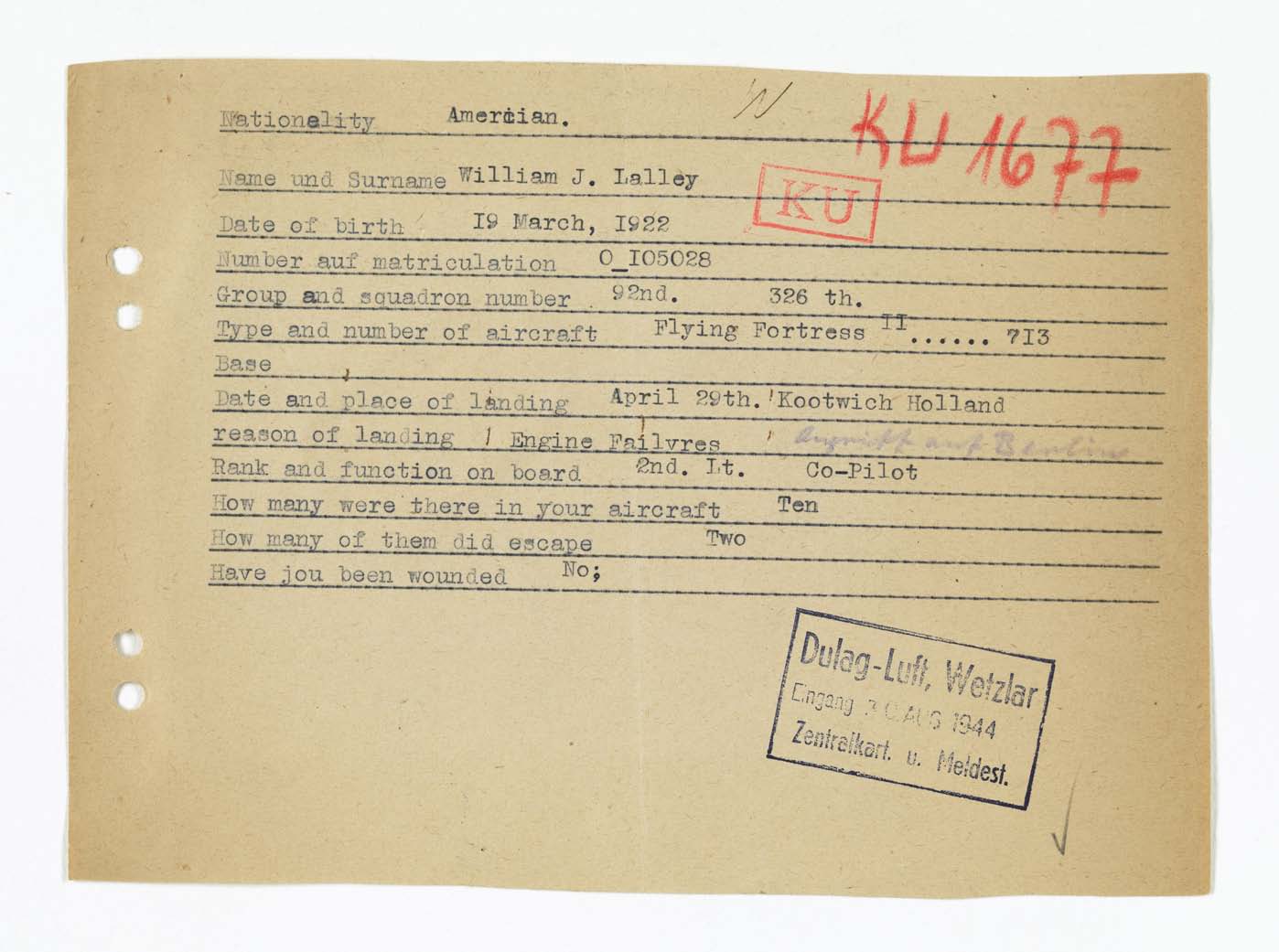
By his own account two engines were knocked out over Berlin and a third failed on the way back, so that they left the aircraft at about 800 metres; he came down in a tree, freed himself, and hid in the woods, spending the night in a haystack and eating raw eggs (Noordman, pp. 146–147). Noordman, after the Dutch police report, has the aircraft coming down at about a quarter to three in the hamlet of Meerveld by Uddel, on Van Hierden's land; all ten men baled out and landed in different places, and eight were taken prisoner that day around Assel, Kootwijk and Harskamp, while two got away without knowing of each other, Glisynski and Lalley (Noordman, p. 137). The Van den Top family told Noordman they collected Lalley on the Sunday evening, 30 April, near Kootwijk, after he had wandered there since the Saturday afternoon (p. 146). ◐ The "Kootwich Holland" of his questionnaire is Kootwijk.
Hidden at Stroe. By his account a young couple on bicycles took him home, hid him in an outhouse and then in the wood, until a man he called "Pa" collected him on the crossbar of his bicycle; at the house in Stroe he was introduced to "Moe", Edith, a Jewish girl in hiding, and "Dick", a British agent who set up escape routes and who questioned him closely and warned him not to trust everyone (Noordman, pp. 147–148). Noordman's text names them as "Pa" and "Moe" Van den Top (p. 148), who had two sons, Johan and Jaap (see Where the sources disagree for the Lowell museum's version). For a few days his gunner Gene Glisynski shared the house, and then the P-47 pilot William Connie O'Barr (Noordman, pp. 148–149). He believes Bailey arrived after that (Noordman, p. 150). ◐ Th. A. Boeree's Kroniek van Ede has two Ede helpers going to Gerrit Jan van der Top at Stroe and finding "een piloot, een heel stille kerel, die daar al een week of zes zat, maar van der Top wilde hem niet missen" (a pilot, a very quiet fellow, who had been there about six weeks, but Van der Top did not want to lose him); six weeks from 30 April is about mid-June, so he is very probably Lalley. The same page has two Americans, "E. J. Slisynski" and "William C. O. Bar", taken from Van der Top's to a farm at Ede for fourteen days (◐ Glisynski and O'Barr, with Boeree's descriptions of their roles not matching Lalley's) (Boeree, p. 88).
Who he was in the helpers' papers. "William John Lalley (B-24, co-pilot, 2nd Lt) 212 Vergennes Road, Lowell, Michigan, U.S.A. no. 0-705028", who came down at Nieuw Millingen (her file has no more) from the same aircraft as the gunner Eugene Glisynski (Nelly Eskes-Buis's file, p. 7). That he and Bailey were together at Stroe is borne out by two other accounts: Mrs Eskes-Buis has Bailey leave G. J. van den Top's house at Stroe "together with William John Lalley, … who was already staying at van den Top's house", with "Joop", ◐ Kruimel, as their guide (p. 7), and Bailey's own account, quoted by Bowman, has him meet "Bill Lalley, a Fortress pilot from Lowell, Michigan" and the two taken prisoner together (Bowman, p. 76). ✓ Bowman's note 22 makes him "2nd Lt William J. Lalley … co-pilot of B-17 42-3513 of the 326th Bomb Squadron, 92nd Bomb Group", flown by 2nd Lt Russell M. Munson, shot down on 29 April 1944 on the Berlin mission and crashed at Millingen; "Munson and the other eight members of the crew survived to become prisoners of war" (p. 83). ◐ Millingen is very probably the Nieuw Millingen of Mrs Eskes-Buis's form and of KU 1677.
Van den Top's own form. G. J. van den Top of Stroe filled in his own table: "William J. LALEY co-pilot", U.S.A., "Nw. Milligen", hidden from "30/4 '44" for "85 days", "collected by himself", passed on to "Joop and Dick" (his table, p. 3; image-checked), and the Americans' summary of 2 January 1946 has "William J. Laley, USA - 85 days" (p. 4). The same table has "Bob BAILEY, Capt. Mosquito, R.A.F.", shot down at Renswoude, June '44, 8 days, "collected by himself", and "Eugene GEZINSKI", U.S.A., from Nw. Milligen, the gunner of Lalley's aircraft by Mrs Eskes-Buis's form. ✓ That is the long stay at Van den Top's that her form and Bailey's account describe, starting the day after the crash. ◐ Eighty-five days from 30 April ends on 24 July, the day Noordman's printing of Bailey's account has the two leave Stroe on a tandem (Noordman, p. 167).
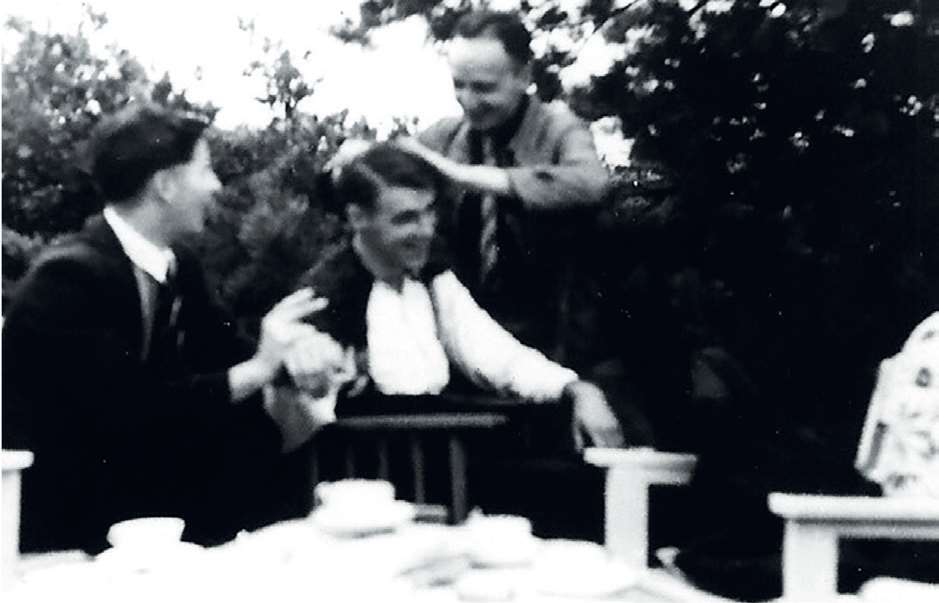
The haircut. Noordman prints a photograph captioned "Lalley wordt door Kruimel geknipt, …" (Lalley being cut by Kruimel, see also his story that follows; fig. 95, p. 150), a second photograph of the same haircut with Bailey in it (fig. 106, p. 168: "V.l.n.r.: Bailey, Lalley en Dr. Kruimel hebben veel plezier vanwege de knipbeurt van Lalley", left to right Bailey, Lalley and Dr Kruimel having great fun at Lalley's haircut), and, beside fig. 95, the message Lalley left in the Kruimel family's guestbook (fig. 96, p. 150) (Noordman).
With Bailey, Breda and Antwerp
Link to the section With Bailey, Breda and AntwerpBailey's own account (Bowman, from The Mossie, August 1997; pp. 75–77 checked against the images when the extracts were made) has the two meet at Van den Top's house in Stroe some days after D-Day, Bailey going on to Dr Dirk Eskes, until, about mid-July, word came from Stroe that papers were ready and Bailey was to "return to pick up Bill Lalley" (p. 76). Their travelling papers described Bailey as a "deaf and dumb basket maker"; the two rode a tandem, neither having done so before, behind a lone cyclist, spent a night in separate houses, and next day went by train with two guides, waiting some hours in the station-master's apartment at Arnhem, to Breda, where Bailey went to Gerry and Arie Zanen at 8 Artillery Straat and "Bill was taken elsewhere" (pp. 76–77). In Bowman's text both men are at Antwerp (Lalley has Connell join them as they left Breda, Noordman p. 151), and an office where a man calling himself a leader of the Belgian Resistance turned out to be in the hands of the Gestapo had Bailey and Lalley "bundled roughly down the stairs to a waiting car", to the Antwerp jail, cell 42, with the Lancaster navigator Viv Connell (pp. 77–78, text layer only). Bailey's page, In hiding, tells the same journey from his side. What happened to Lalley after the jail is under After below.
Breda.
- ✓ Bailey puts Lalley at "J.W. Loose aan het Pastoor Pottersplein" in Breda, the day they arrived, while he went to the Zanens (Noordman, pp. 167–168). Lalley's own evader card names "John Loosa, 61 Pastoor-Potters Place, Breda, Holland - Stayed about 2 weeks; food and shelter" (the card, read from the image). So "Bill was taken elsewhere" in Bowman is the Loose household, ◐ one family under two spellings.
- ✓ Loose's own form, J. W. Loose of Pastoor Pottersplein 61, filled in on 2 January 1946:
- Box 12 says "sheltered 3 Americans / First 2 were taken to Sprang. / Last One was crossed by the Chaam policemen." (three lines) (p. 2, read from the image).
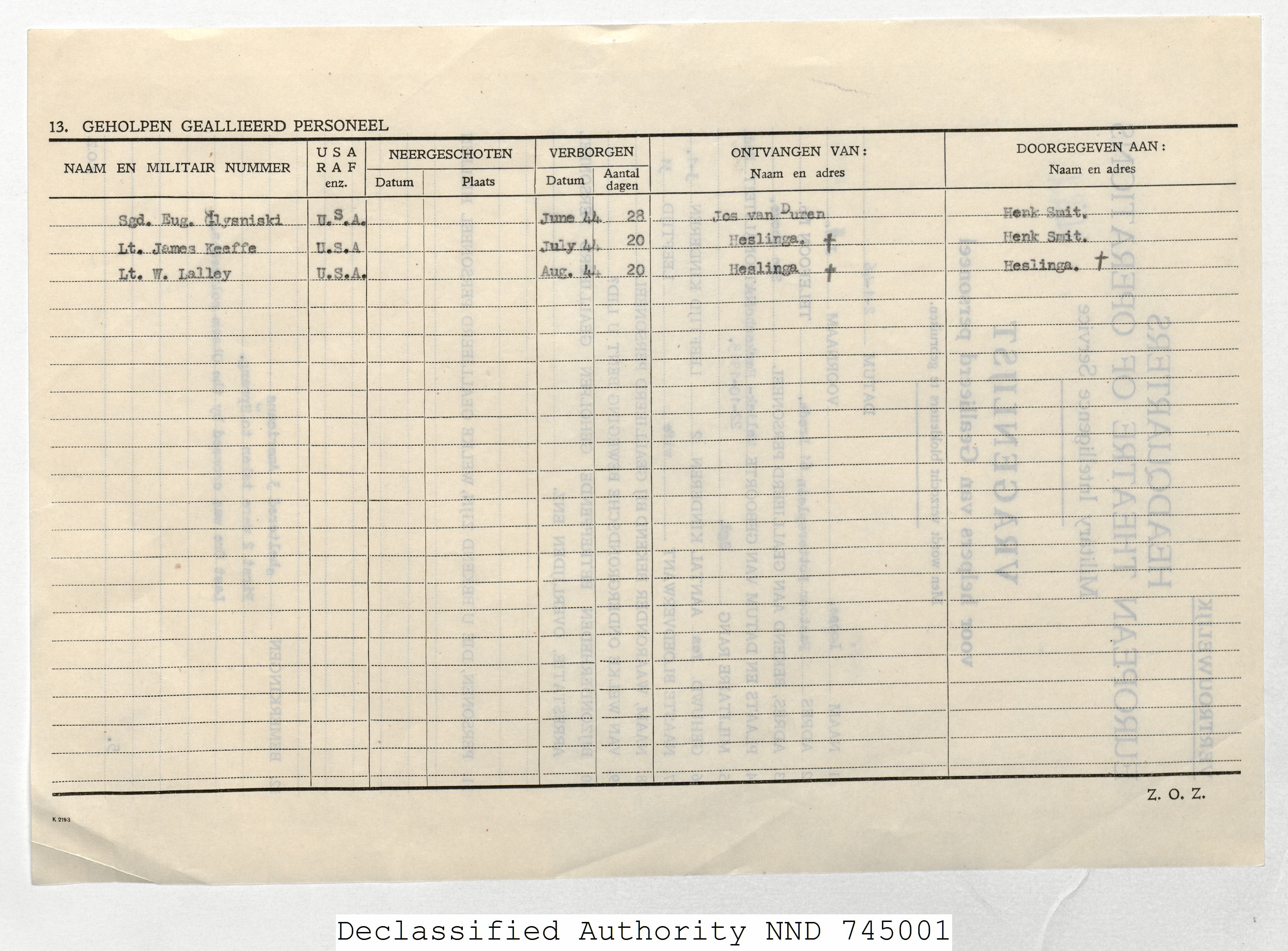
- Its table has "Lt. W. Lalley, U.S.A.", August, 20 days, received from Heslinga and passed to Heslinga, each Heslinga marked with a dagger; the two men above him are Sgt "Eug. Glysniski" (the first letter overtyped), June, 28 days, and Lt James Keeffe, July, 20 days (p. 3, read from the image).
- ◐ "Eug. Glysniski" is the gunner Eugene Glisynski, and Lalley is the third of the three, so "the last one" crossed by the Chaam policemen would be him. Noordman has the other reading: Glisynski, the first man on Loose's list, was "vermoedelijk rond 18 juli" (presumably around 18 July) taken over the border by the marechaussees Lems and Monnier via Baarle-Nassau (p. 145). Loose's "First 2 were taken to Sprang" does not fit that (Noordman).
- ◐ Lalley himself remembers Breda only "vaag" (vaguely): separate addresses, "ongeveer drie weken" (about three weeks), then Connell joined them as they left Breda (Noordman, p. 151).
- Lems, the marechaussee at Chaam who passed airmen to Belgium with his colleague Monnier, lists "32. Pilot-officer William J. LALLEY, Super-Fortress, American", with Bailey as 30 and Connell as 31 (Lems's list, p. 5, read from the image); to "Sjefke of the White Brigade", who "took them straight to Antwerp" (p. 3).
- A. H. Vermeeren of Ulvenhout lists "2nd Lt. William T. LALLEY", USA, "25-7-44", 8 days, "All transport by LEMS" (his table, read from the image); Bailey and Connell stand under the same ditto marks. Noordman's guess for the Baarle-Nassau night is Vermeeren's farm, Hondsdonk (Noordman, p. 168).
Antwerp, 10–11 August 1944.
- ⚠︎ Lalley writes of the two young women who brought them to a flat in Antwerp: "Geen twijfel mogelijk, dit zijn Pauline Vlaming en haar vriendin geweest." (No doubt possible, these were Pauline Vlaming and her friend) (Noordman, p. 151). It is his memory of some fifty years on, and Bailey's account in Bowman does not name her (see below).
- The next day Pauline came back with two men of about thirty; he went with the men through the city to a large old building, where one questioned him about where he had been shot down and who had helped him on the route (pp. 151–152).
- Bailey, in Bowman's version, has a young woman guide who took them to a flat on the evening of 10 August, and does not name her (Bowman, pp. 76–77).
- Lalley goes on: a guide led them to a second building where he saw German uniforms, up to an office, and then down again and in at another door, where the two guides turned rough and one pulled a pistol, called them fools and threatened to shoot them as spies for being captured in civilian clothes; one spoke English with an American accent and said he had lived in Chicago (Noordman, pp. 152–153). ⚠︎ "Vermoedelijk" (presumably) this was the Belgian traitor Prosper Dezitter, he writes (p. 153), a guess and not an identification.
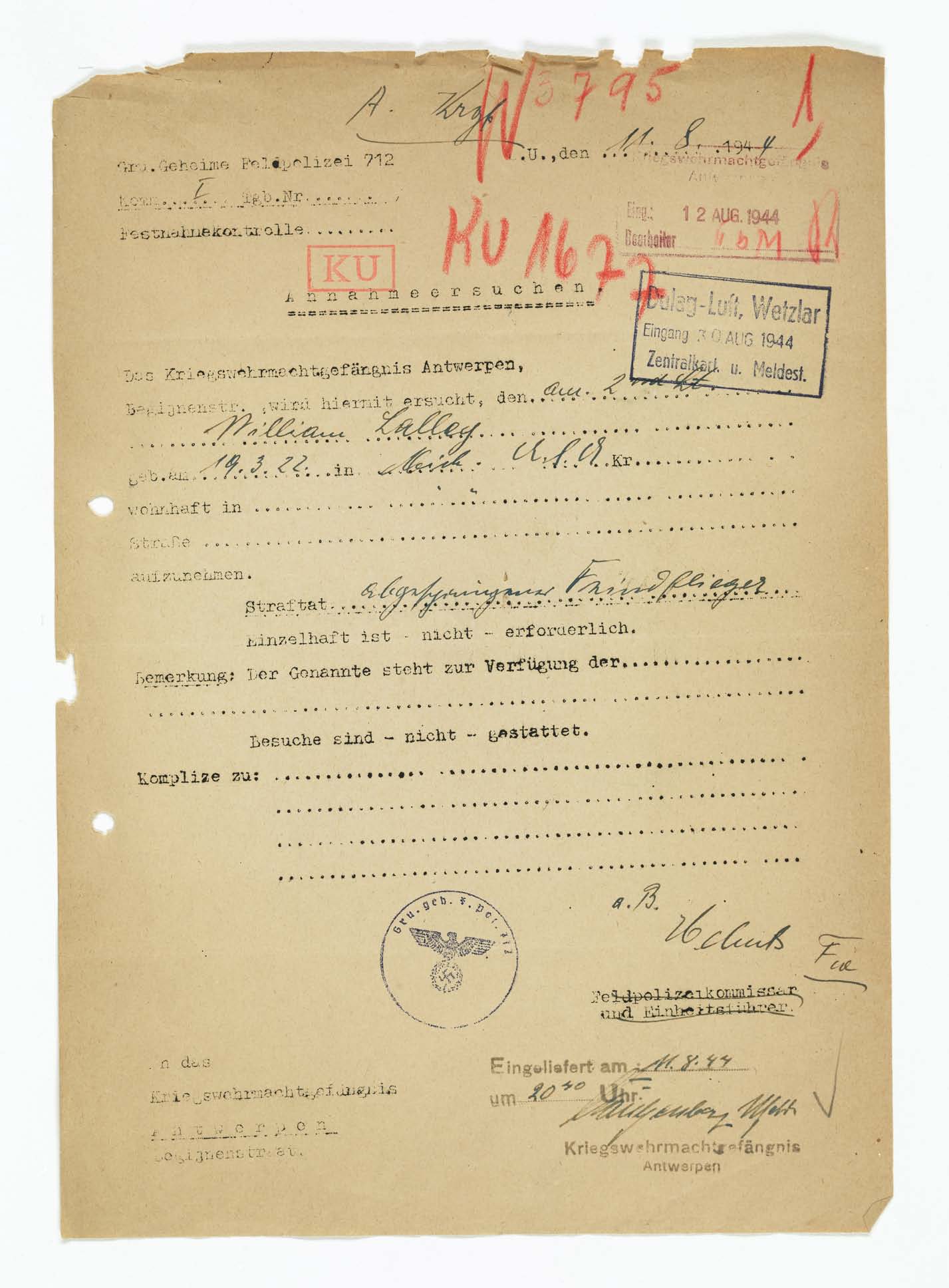
- ✓ The German papers have him taken in (PDF p. 20; p. 21):
- The Geheime Feldpolizei group 712 asked the Wehrmacht prison in the Begijnenstraat, Antwerp, on 11 August 1944 to take in "2nd Lt. William Lalley, geb. am 19.3.22 in Mich. U.S.A." under the charge "abgesprungener Feindflieger" (parachuted enemy airman), "Einzelhaft … nicht erforderlich", "Besuche … nicht gestattet".
- The form says he was brought in at 20.40 on 11 August and the prison stamped it the next day; its route slip has "Zugang: am 11. 8. 1944 um 2040 Uhr" and "Zelle: 3795".
- ◐ 3795 is written in red at the top of the form as well, so it reads as his number in the jail rather than a cell.
- In prison he and Bailey were registered, then held in a cell of 15 by 20 feet on the second floor with a window high in the wall, three straw mattresses and fleas (Noordman, p. 153).
The woman he names. ⚠︎ Lalley says in the same account that a Canadian researcher, collecting the stories of airmen caught on this route at Antwerp, had "de jonge vrouw opgespoord die ons verraden had" (traced the young woman who had betrayed us) and sent him photographs of her; and that on 11 October 1948 the Antwerp military court stripped Pauline Vlaming of her civil rights, titles and decorations, sentenced her to death and seized her property, that on 29 June 1951 the Special Criminal Chamber (Bijzondere Strafkamer) of the Breda district court gave her fifteen years on the same charges, and that a Belgian royal decree of 3 October 1964 pardoned her fully (Noordman, p. 160). The 2016 book prints the same passage from Lalley's account without her name on that page (the sentence of the Breda court to fifteen years and the pardon of 3 October 1964: One Way Ticket to Berlin, p. 126). The Lowell museum's page also names her and says she betrayed him, adding "She not only betrayed Lalley, but hundreds of other U.S. Airmen" and calling her "a Dutch National, part of the underground" (the page); it gives no source. ⚠︎ We have not seen the court records. Set beside it: Bailey's account does not name her; Lalley's identification of the two women is a memory of some fifty years on ("Geen twijfel mogelijk", no doubt possible, he writes, p. 151); and the court dates are his retelling of what the researcher found.
Prison and Frankfurt.
- ✓ After the Antwerp jail Lalley's account has about three weeks there, then the St Gillis prison in Brussels, held apart, interrogated again and threatened with execution as a spy; then Frankfurt am Main as a prisoner of the Luftwaffe, solitary confinement for refusing more than name, rank and number, and then another camp with many others, where the Red Cross handed out parcels and forms with the same questions (Noordman, pp. 153–154).
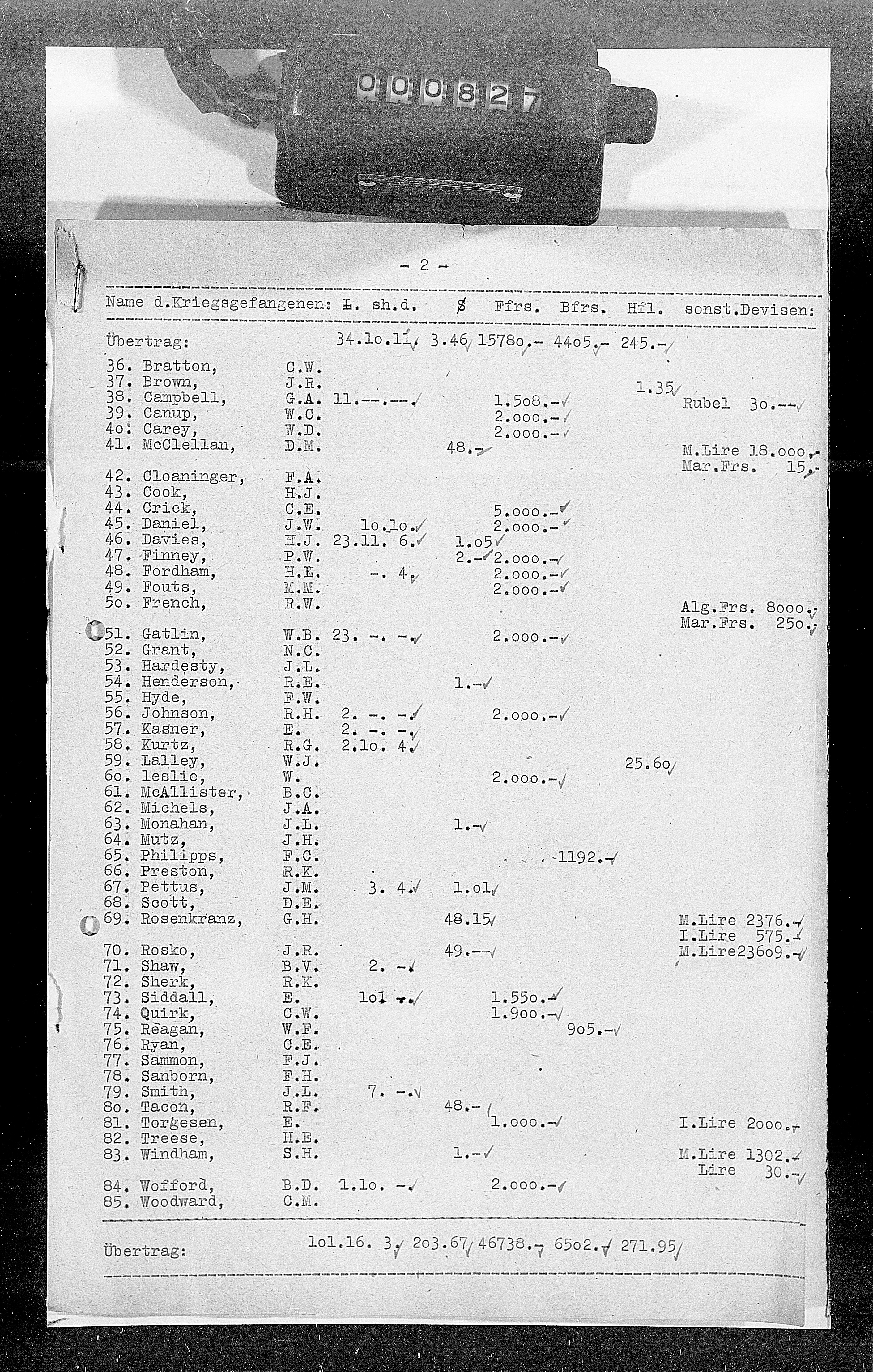
- ◐ The Dulag Luft at Wetzlar has "59. Lalley, W.J." and "2. Bailley, R.K." in its list of the prisoners sent to Stalag Luft III, Sagan, on 28 August 1944 (the list is dated 29 August) (T84 roll 376, frames 833–834). Initials only; it fits Bailey's own dates (Dulag Luft on 26 August, Sagan two days later: Bailey).
Camps and liberation.
- From Frankfurt a transfer by train to Stalag Luft III at Sagan, which he describes (pp. 154–155).
- In the middle of January 1945 the camp was marched out in snow, "de dodenmars"; he reached Spremberg, was taken by rail to Nuremberg and then marched south (pp. 156–157).
- ✓ He was freed at Moosburg on 29 April 1945, a year to the day after he was shot down, when American tanks reached the camp; he was flown from Landshut in a C-47 to Camp Lucky Strike near Le Havre and then home by ship (pp. 158–159). His card has a handwritten "5 May 45" with no label (the card, p. 2 of the list; see Where the sources disagree).
- Back in America he was flown to Chicago to meet his brother Jack, who worked at the Gardner hospital; waiting with the others off the plane, he was walked past by his brother until he called to him. He then went to the Gardner hospital, where all returned prisoners had a medical inspection; he left the army at the end of 1945, never flew again, and writes that he stayed in the military reserve until 1961 (p. 159).
Later life.
- ✓ He moved to Holland, Michigan in 1953, where he met the man who had commanded the tank battalion that freed his camp (Noordman, p. 159; the Lowell museum's page).
- ◐ The Grand Valley State University outline has him taking a degree in business administration at Michigan State, marrying and working for Donnelly in Michigan until he retired, with no mention of the FBI (outline); the museum's page says that "Bill spent his life working as an FBI agent and was a personnel director at the Donnelly Corp.", and served as president of the West Ottawa School board (the page).
- ◐ The file on the FBI's investigation of Harry T. Moore's death has an investigation made on 25 January 1952 by "Special Agent WILLIAM J. LALLEY" (the file section, OCR). The identification with Bill Lalley rests on the museum's "FBI agent" and the name.
- He kept in touch with the Van den Top family, the household where he was hidden longest, and went back to Stroe with his wife in the spring of 1997, finding the house again (Noordman, pp. 160–161). He left a written diary of his war, a copy of which the museum holds, and the museum's page says his gravestone reads "Loved by all" (the page).
- Years later, tracing Bailey through the same researcher, he was put in touch by LeBlanc with "his wife", read here as Bailey's wife (◐: "his" is not spelled out), who wrote that Bailey had had "a successful career in the RAF, and commercial aviation before succumbing to M.S."; the two never met again (Noordman, p. 160; One Way Ticket, p. 126).
Where the sources disagree
Link to the section Where the sources disagreeWhere he came down. His Dulag Luft questionnaire has "April 29th. Kootwich Holland", the German loss report Nieuw Millingen at 14.40, Noordman from the Dutch police report Meerveld by Uddel at about 14.45 for the aircraft, and, from the Van den Top family, a collection of Lalley himself near Kootwijk on the evening of 30 April (PDF p. 19; PDF p. 3; Noordman, pp. 137, 146). ◐ "Kootwich" is read here as Kootwijk; the questionnaire gives where he came to ground, the other two where the aircraft crashed; the sources do not say how far apart Meerveld, Nieuw Millingen and Kootwijk are.
Who "Joop and Dick" were. Van den Top's table passes all five men on, Lalley and Bailey among them, to "Joop and Dick"; the repository's convention for that pair is Joop Piller and Dick Kragt. ⚠︎ Mrs Eskes-Buis has "Joop", ◐ Kruimel, guide Bailey and Lalley out of Stroe (her file, p. 7), so in July 1944 the "Joop" may be Kruimel. Not settled. Lalley's own "Dick" at Stroe is the British agent who questioned him (Noordman, p. 148), and he adds that the researcher identified the underground leader who first questioned him as Dick Kragt (Noordman, p. 160; One Way Ticket, p. 126).
When he was free. Lalley's account has Moosburg freed on 29 April 1945 (Noordman, p. 158); his evader card has a handwritten "5 May 45" under a red stamp (the card). ◐ The card's date is probably the day his return was recorded, not the liberation; no source says.
How long at Breda. The card has Loosa's household for "about 2 weeks" (the card); Loose's own form has "Aug.", 20 days (p. 3); Lalley remembers about three weeks (Noordman, p. 151); Bailey has fourteen days at Zanen's and goes into Belgium on 9 August (Zanen's form, Bailey's page); Vermeeren has "25-7-44", 8 days. ◐ The tandem ride from Stroe was on 24 July and the arrest in Antwerp on 11 August, so nothing longer than about seventeen days fits, and the card's two weeks is the nearest. ⚠︎ Not settled.
The Antwerp jail. Lalley has about three weeks before St Gillis (Noordman, p. 153); Bailey's account in the same book has two (p. 170), Bowman's text three. ◐ Three weeks from the admission on 11 August is 1 September, after the Sagan transport of 28 August that has both men on it, so the shorter figure fits the German list and Bailey's dates (Antwerp, then Brussels, Frankfurt on 26 August, Sagan two days later). ⚠︎ Not settled.
The cell. Bowman has cell 42 (pp. 77–78); the prison's own slip has "Zelle: 3795" (PDF p. 21), which looks like a number for the man (above).
How long he stayed in the reserve. Noordman has him staying in the military reserve until 1961 (p. 159); the Grand Valley State University outline has that "He signed up for the reserves, but eventually found that he no longer had time for it", without a date (outline). ◐ The outline is a summary of his interview of 30 October 2008, and the two may describe different things; neither says more.
His aircraft. Mrs Eskes-Buis calls it a B-24 (p. 7); the German report has "Fortress", Bowman a B-17, 42-3513, and Bailey a "Fortress" (the extracts), and so does the caption of Kruimel's photograph, "co-piloot van een B-17 Flying Fortress" (the article).
Who "Pa" and "Moe" were. Noordman has "Pa" and "Moe" Van den Top with two sons, Johan and Jaap, and has the house in 1997 lived in by "Jaap van den Top en zijn vrouw Mini" (pp. 148, 160; One Way Ticket, p. 126). The Van den Top who filled in the helper form is Gerrit Jan, born 1 September 1893 (his form, p. 4). The Lowell museum's page has the 1997 visit to "Yap "Pa" Van den Top and his wife Mini "Moe", still living in the house" (the page). ◐ The museum has put the son and his wife into the roles of Pa and Moe: Pa and Moe are Gerrit Jan and his wife, Jaap and Mini the couple in the house in 1997.
The Lowell museum's account. It has Lalley meeting Kragt, who "was unable to help as some members of his group had been exposed" and warned him that many in the Dutch underground were being captured (the page); Noordman has the warning from "Dick" himself, and no word of being unable to help (p. 148).