Dick Kragt
Datchet 18 Jul 1917 – Norway 8 Jul 2008
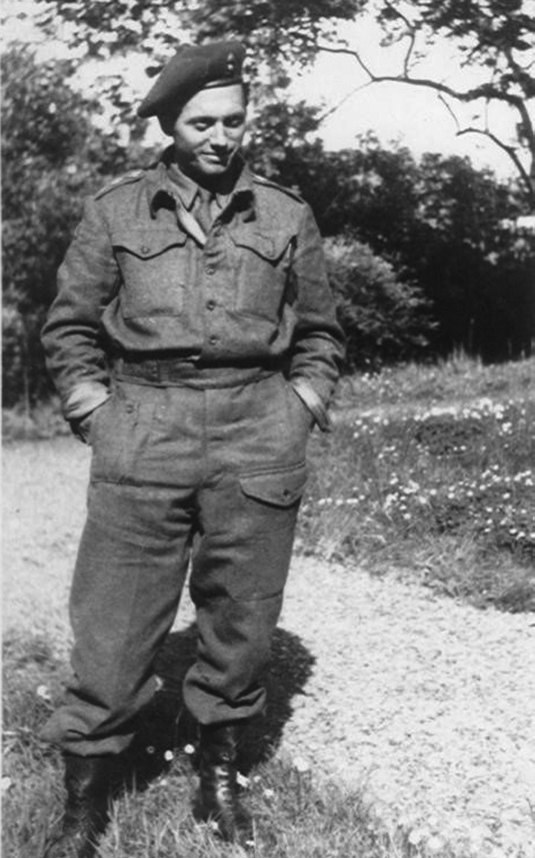
Dignus "Dick" KRAGT ("Frans Hals", "Capt. Kay", "Dick"), British Army, Intelligence Corps, no. 345755 (his file with the Americans, p. 6; the London Gazette, 1948); his partner on the Veluwe was Joop PILLER ("Joop van Amstel").
About: The British MI9 agent, parachuted onto the Veluwe in June 1943, who with Joop Piller ran the line that hid Allied airmen and, after Arnhem, paratroopers. He planned the Pegasus II rendezvous of November 1944, which Murphy's party set out for and missed, and later sent men out by the Sliedrecht route.
Unit or role: A British intelligence officer of Dutch background, lieutenant, assigned to IS9; MI9 agent, mission LEMONTREE (Kluiters; his file with the Americans, p. 6). In service from 5 December 1940 (Capt. Coslett's memorandum, 22 February 1946, p. 22); temporary captain by 1948 (the London Gazette).
Where: The Veluwe: Epe and Emst in 1943 (De Jong, deel 7, pp. 946–947), then "the BARNEVELD area" (his report, p. 3 of the report), with houses at Essen and Kootwijkerbroek (Niermans's form; Noordman, p. 281).
Evidence: ✓ his own report, "the activities of Frans Hals", 22 July 1945, in his file with the Americans, pp. 31–35 (a copy at pp. 40–44, and on the Elspeet history site); Elspeet history; ✓ his controller Airey Neave's account, 1969 (Saturday at M.I.9, pp. 279–280); Kluiters; ✓ his helper file with the Americans, US National Archives 286668976 (summary, pp. 6–7); ✓ his Dutch award card; ✓ Hackett's escape report and the forms of Vonkeman, Bol, Niermans and Low; ✓ the commission of inquiry's report, 1950, pp. 274–275; ◐ In the Shadows (2022), from the Archive's full-text index; ◐ Lopez, The Man Who Made Vermeers (2008), pp. 15–16.
Dignus Kragt was born at Datchet, England, on 18 July 1917, and had lived nine years in Holland and spoke Dutch as a native (American summary, p. 6). In 1946 his next of kin was his mother, Mrs E. M. Kragt, of 13 Pembridge Crescent, London W11, and to the form's question on his own occupation he wrote "WOT ?" and drew a face peering over a wall (p. 5). On his own questionnaire for the Americans he gave his birth as "DATCHET, 18 JULY 1917", his nationality "ENGLISH", his rank "1 LT.", himself unmarried with no children, his mother "EDITH M. KRAGT", aged 60, as next of kin, the names he was known by as "DICK" and "FRANS HALS", and his underground movement as "ENGLISH INTELLIGENCE" (his questionnaire, p. 36); its table of helped personnel says only "ARRIVED BY PARACHUTE JUNE 23, 1943 / OVERRUN BY ARMY APRIL 17, 1945" (p. 37).
Noordman, who corresponded and spoke by telephone with him in 1995 and 1997 and also drew on an interview with him in De Koerier, the Dutch air force's monthly, of 8 March 1969 (Noordman, list of sources, pp. 336–343), has a Dutch father and an English mother, a boyhood in Eindhoven, where he went to school and took his HBS diploma at seventeen, a return to England in 1934 to work for Philips, and a trip back to Eindhoven for further company training in 1939, cut short after barely ten days by the call home when the war broke out; called up, he was at first left in his job in Philips's radio department, then asked to help the Intelligence Service and trained in counter-espionage, and at the end of 1942 it was decided to drop him in Holland (p. 110). ◐ Neave has him a radio engineer at Philips's Mitcham works who "knew Holland reasonably well but had not been there since the death of his father some years before", and Warrack has him working "at Philips at Eindhoven, and later" representing them in England and volunteering for the Intelligence Corps in 1942 (Neave, p. 279; Warrack, Travel by Dark, p. 183; page image).
◐ His mother's naturalisation is also in the London Gazette's list of 5 November 1937: "Kragt, Edith Matilda; Netherlands; Housekeeper; St. Helen's Cottage, 14, The Mount, Hampstead, N.W.3. 27 October, 1937" (the Gazette, issue 34451, p. 6892); it is hers by name only, as with the Kew entry below. A search of every Gazette naturalisation list from January 1938 to April 1939 found no Kragt (the search). Kluiters has him dropped on the night of 23/24 June 1943 between Epe and Vaassen, losing his transceiver (Kluiters). The Americans' summary:
On June 23 1943 he was parachuted into Holland with instructions to assist evaders in housing, food supply and transport. Many difficulties beset his path from the very first, having in his landing lost his original radio transmitter and other necessary operational equipment. However he made contact with helpers almost immediately and it is noteworthy that he, for the longest time of any accredited agent in Holland, was able to remain out of the hands of the enemy and still carry on his work.
— US National Archives · RG 498, helper file of Dignus Kragt · summary, 7 January 1946 · the archive's copy
The evaders' reports knew him as "Dick", "Frans Hals" and "Capt Kay", and Brigadiers Hackett and Lathbury wrote well of him (p. 6).
His own report: the drop and the first year
Link to the section His own report: the drop and the first year✓ Kragt wrote his own account on 22 July 1945, signed "Frans Hals": "REPORT ON THE ACTIVITIES OF FRANS HALS from the 23rd of June 1943 till 18th April 1945", five typed pages, two copies of it in his file with the Americans (pp. 31–35, read on the images; the second copy at pp. 40–44). The same five pages are on the Elspeet history site (p. 1, p. 2, p. 3, p. 4, p. 5). Page numbers below are the report's own.
- The drop. He embarked "at approximately 1130 hours" on 23 June 1943 on a Halifax commanded by "Squadron Leader GRIFFITH", "to make my fourth attempt within a fortnight to get my D.Z.", jumped on the green light and came down on "a plot of land bounded on three sides by houses and a broad canal on the fourth side in the village of VAASSEN (near Apeldoorn)" (p. 1).
- His pack was not to be found: it "landed in a tree between two houses, and was discovered by the quisling occupant of one of them, who immediately informed the German authorities, though his neighbour tried to dissuade him from doing this" (p. 1).
- He hid his suit and parachute under weeds, lay up all the next day in tall grass by a brook, and walked by compass to the house "VOSSEBES", reaching it at five the next morning; at the name "Stephan de Kat" he was "most cordially received, with the news that the parcel dropped the previous night must have been mine", by then in the hands of the German Ortskommandant (pp. 1–2).
- The dug-out and the first helpers. On "Friday (?) the 25th", a raiding day, his host sent him to "an underground dug-out" in the woods twenty minutes' cycle away, his wife guiding him (p. 2). His chief in London was "SAM BROWNE (not of Dance-band fame)". To reach him, Koos, Joop and Leo "proved most useful": Joop he had met "in the dug-out" and, after several meetings, "decided to employ as my right-hand men in the organisation I was to build up", and Leo he glosses as "C. van 't Land, local grocer" (p. 2).
- The parenthesis follows "Joop", but "men" is plural, so the report may mean Koos, Joop and Leo.
- To prove himself he met Jos, glossed "Gerrit van de BORN", in a café full of Germans; Jos wanted his photograph for another agent who claimed to know him, Kragt refused and "asked to see a photograph of him" instead, and he "turned out to be Gerard (BORSE-BUISMAN)" (◐ "him" is the other agent by our reading), who gave them a wireless link to London until his arrest in February 1944 (p. 2).
- "In November Theo made his appearence [sic], minus equipment, bearing fl.50.000.- which he had hidden in a hayrick", money that paid off Kragt's debts (p. 2).
- With Joop and Lies. For five months, except six weeks, he was "the guest of Joop and Lies, who looked after me most lovingly"; the six weeks began when "we found the body of a dead man near to our dug out", after which they stayed at van den Boogert's house and found a second house, where they "lived there happily for 2½ months" (pp. 2–3). Noordman names the dead man as the forester Schrijver (Noordman, p. 114).
The flight from that house, in his words:
Unfortunately the Gestapo were a little too quick, as we had to depart in a hurry, leaving everything behind. This was due to a Jew boy after his arrest proclaiming that Koos had filled in his "persoonsbewijs". On this information Koos was arrested. "Leo", on hearing this, within five minutes of it actually happening, immediately dispatched a courier to warn us of this, only just in time, as less than half an hour later the S.D. were in our house, but found the birds flown.
— Frans Hals (Dick Kragt) · report on his activities, 22 July 1945, p. 3 · his file with the Americans, p. 33
- ◐ What Koos said. It is Kragt's statement of what he heard, written two years on; no interrogation record of Koos has been read:
It appears that Koos was at first so nervous, that he told them everything he knew of any local activities, after which fact he pulled himself together again, and showed he was a brave man. But the damage had been done and he was shot some months later.
— Frans Hals (Dick Kragt) · report on his activities, 22 July 1945, p. 3 · his file with the Americans, p. 33
- Noordman names Koos as J. J. van den Boogert of Epe, a baker, and says he was executed at Delft on 15 August 1944 (Noordman, pp. 113, 115); De Jong calls him a distribution official (below).
- The Americans' file on him says that he "was given as contact address for Dick (Lt. Kragt) when he parachuted into Holland" and "Was closely connected with van Amstel in evasion activities. Should have GRADE V Posthumous." (his file, p. 4; Joop Piller).
- Barneveld. The SD emptied the house and knocked a hole in the wall looking for "the 'secret transmitter'", on "the day of Theo's arrival in Holland"; "After several weeks we managed to find a fairly suitable house in the BARNEVELD area, and by not disclosing our whereabouts to more than a very few persons, managed to keep our address 'clean' for almost a year" (p. 3).
- Checking the lines. Every rumoured route was checked with London by wireless before men went down it, which "caused a lot of friction with the underground"; once the underground sent men down lines without an answer and "these men did not arrive", after which "our advice was always respected" (p. 3).
- May to September 1944. In May 1944 the line to France was "brûlée"; after the invasion they decided to await the liberation rather than risk men at the Belgian frontier, "though we did attempt a new line with Bill Lalley and Bol [sic] Bailey in August 1944" (Bill Lalley; Robert Bailey) (pp. 3–4). Joop "showed great genius" in setting up their own food collection by lorry "from the other side of the IJssel" (p. 4).
- Ham and Bacon. "A few days later" than 17 September "I was present at a reception committee when HAM and BACON were dropped, together with 24 containers and five baskets", the only successful drop his report records: on the "almost a dozen occasions I led my own reception Committee", he writes, "we were completely unsuccessful" (p. 4; Abraham du Bois; Raymond Holvoet).
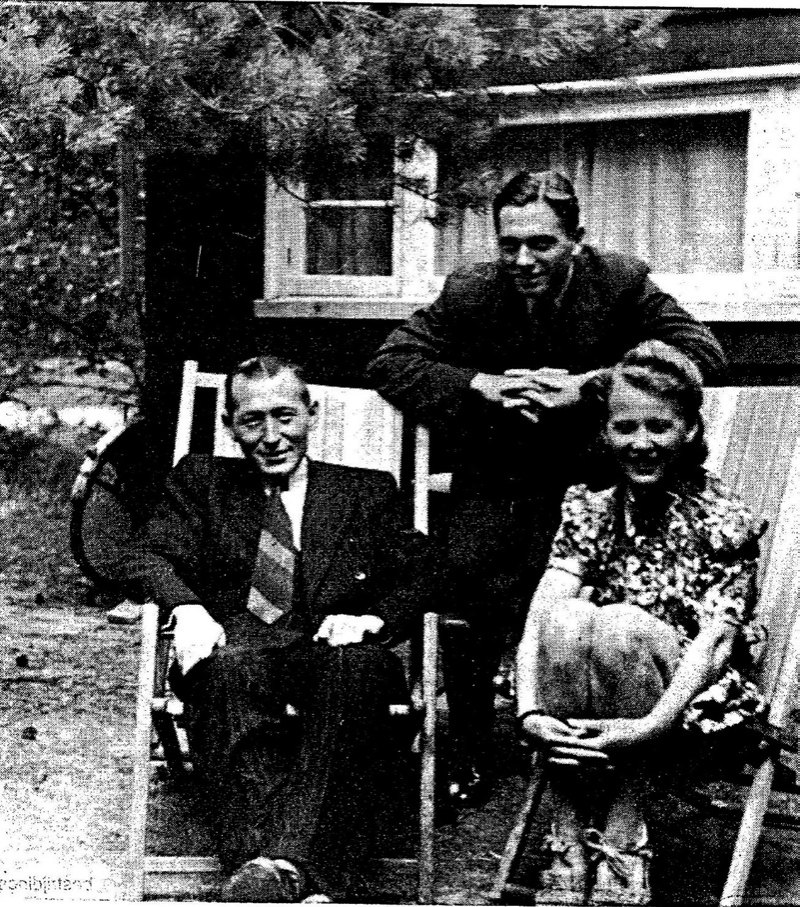
◐ Noordman's version. Noordman prints a first-person "Kragt vertelt" (Kragt tells) that follows the report closely (he does not say where it comes from), with details the report lacks: Halifax JD180, NF-O, of 138 Squadron, flown by Squadron Leader Frank Griffiths; the operation code-named "Lemontree"; the first of the three turn-backs caused by flak over Deventer; a potato field where the report has a plot of land; the luggage ending with the Ortskommandant of Epe; the dug-out near Gortel; the identity card whose lions faced each other and a moustache that had to go (Noordman, pp. 110–112). He also has the second house kept "zes weken" (six weeks) where the report has two and a half months (p. 114). Where the two differ, the report is the contemporary one.
His controller's account, 1969
Link to the section His controller's account, 1969✓ Airey Neave, who sent him, wrote in Saturday at M.I.9 that "The first was Dignus Kragt, known as 'Frans Hals' or 'Dick'", a British subject with a Dutch father and an English mother who had worked for "Phillips [sic] at their Mitcham Works" and in 1942 volunteered "to set up an escape line for Room 900 over the Dutch-Belgian frontier"; "Dick Kragt was a brave and persistent agent, and a trained radio operator", to be dropped near Epe and to link up with Comet (Neave, p. 279, read on the page image).
Kragt was dropped without a reception committee, for none existed, at Vaassen near Apeldoorn on June 23rd, 1943. Vaassen was eight miles from the agreed target, the Wesselse Veld west of Epe, so he had good reason for complaint. The aircraft had returned on three nights as the pilot could not find the dropping zone.
— Airey Neave · Saturday at M.I.9 (1969), p. 280 · the page
- Neave writes that the War Office would not at first let an escape agent take a wireless set, that he himself was against an organiser working his own set, and that he promised Kragt an operator, though "it was November 1943 before I was able to send one" (p. 280).
- "In 1968, Kragt recalled to me his unnerving arrival in Holland": at two-thirty in the morning in a garden at Vaassen, his baggage parachute, "containing his wireless set, clothing and money", in a tree "beneath the bedroom window of a Dutch quisling" (p. 280; p. 281 not read).
- ◐ M. R. D. Foot and J. M. Langley, MI9's historians, have the same blind drop "not far from Deventer … in a smart suburban area", the kit "handed straight over to the Germans by the Dutch collaborator into whose garden it fell", and that he "made courier contact with 'Comet', got a wireless operator in the end, and did sterling work in the autumn of 1944" (MI9 (1979; 2011 edition), p. 234, read on the page image).
- ◐ Richard Fuegner's Dawn of Courage (2008) has him dropped "in suburban Vaasen near Apeldoorn" and sending "over 100 airmen across the border into Brussels" in the fourteen months before Arnhem (p. 137, read on the page image).
His arrival in the histories
Link to the section His arrival in the historiesIn the Intelligence Corps's history (2022). ◐ Michael Ashcroft's In the Shadows (Biteback, 2022) gives him an entry of some six pages in its Second World War chapter (pp. 79–84; the index has 79–85); what follows is from the Internet Archive's full-text index, assembled from its highlights and not read on the page, because the lending copy is closed (the passages).
- He was born at Datchet on 18 July 1917, the son of Hendrik Gijsbertus Kragt, a merchant and company director from Rotterdam who died in 1934, and Edith Matilda Eberl, the British-born daughter of a naturalised Austrian innkeeper from Windsor; the family went often to Holland, so he spoke Dutch "flawlessly". He trained as a radio engineer and worked for Philips at its Mitcham factory, and early in 1943 was commissioned into the Intelligence Corps and attached to MI9, under Airey Neave.
- ◐ Kew has a naturalisation certificate, AZ10826, issued on 26 October 1937 to Edith Matilda Kragt, "From the Netherlands. Resident in London", noted "Re-admission" (HO 334/147/10826, catalogue entry only). It is his mother's by name alone; "re-admission" is what a British-born woman who had become Dutch by marrying a Dutchman would be given, which fits the book. It dates from October 1937, the year before De Jong's "English nationality in 1938" for Kragt himself (below).
- The book has him volunteer to be the first agent put into the Netherlands after the Englandspiel was exposed, to parachute "blind", without a reception committee, and to link up with the Comet escape line; the mission was LEMONTREE and his alias "Frans Hals" (✓ Kluiters has the mission name). It was to be alone, with his own set, the War Office being reluctant to let him take one.
- It took four attempts. The first, on the night of 10 June 1943, in a 161 Squadron Halifax from Tempsford piloted by P/O Higgins, met anti-aircraft fire over the drop zone 7.5 miles north-north-east of Apeldoorn, east of Epe, and a German night-fighter that damaged the tail and the port engine, and after three passes the drop was aborted.
- The second, on 19 June, was turned back by high winds; the third, on 22 June, flown by P/O Wilkinson, met a flak ship and unsafe winds and was aborted.
- ✓ That is De Jong's three turn-backs before the fourth flight of 23/24 June (below); the dates of the first three are in this book alone.
- ◐ The fourth, the next night, 23 June, was in a 138 Squadron Halifax flown by Squadron Leader Griffiths.
- He landed "in a suburban area between Epe and Vaassen, 8 miles from the target", his transmitter and containers lodged in a tree in the garden of a collaborator, who gave them to the Germans.
- After lying about eighteen hours in tall grass by a brook he went at night to the house of a Resistance couple, who took him to an underground dugout where he met "Jacobus van den Boogert, known as Koos, and Joop Piller, a Jewish resistance worker in Emst" (Joop Piller has the meeting from his side; the sources differ on who sheltered him first: see the end of this page).
- ◐ In November 1943, the book says, MI9 dropped a Dutchman, Jean Temmerman, as his wireless operator with a replacement set; and by September 1944 he had sent "more than 100 aircrew" down the line to Brussels. ✓ De Jong has an operator dropped in mid-November 1943 who proved useless (below); the name Temmerman is in this book alone among the sources on Kragt. The book dates Pegasus I to the night of 22 October 1944, "more than 100 men".
- ◐ Kirschen's own book has a Belgian wireless operator "called Temmerman" offered by his headquarters in November 1944 to relieve his own operator, then meant for Ham, and on 10 December "the famous Temmerman" to be sent as assistant to an escape organiser called Rembrandt (Six Friends Arrive To-Night, p. 105, read on the image; p. 106 and p. 113, text layer). Whether he is the man In the Shadows means, a year out, is not shown.
In the Dutch official history. L. de Jong, Het Koninkrijk der Nederlanden in de Tweede Wereldoorlog (NIOD edition, CC BY 3.0 NL; the passages, with translations), tells his arrival and first months in deel 7 (pp. 944–947; pp. 945 and 947 checked on the images, p. 946 read there too):
- MI9, wary of SOE, arranged the mission with the Bureau Inlichtingen instead; BI suggested a drop west of Epe, near Emst, where the distribution official J. J. van den Boogert was known to MI9 to help Jewish hiders, and his address was given as the contact address (p. 945). ✓
- Kragt was born in England in 1917 to a Dutch father and an English mother, took English nationality in 1938 and "still spoke perfect Dutch" (p. 945).
- Three flights had turned back; on the fourth, in the night of 23 to 24 June 1943, he landed in the garden of a house at Vaassen and lost his luggage, "including his transmitter"; half an hour later he lay in a dry ditch with a map, a compass, a pistol, five hundred guilders and a poor identity card (p. 945).
- ✓ That agrees with Kluiters and with the Americans' summary above.
- ⚠︎ It does not agree with Jan Roskam's memory in 1984 that he was dropped near Ede "in 1942", in an NSB man's garden (Dekkers and Vroemen, p. 273).
- A radio operator dropped for him in mid-November 1943 proved useless; in a panic, thinking he must flee a bull, he threw his set into a ditch (p. 946).
- ✓ Via the LO Kragt met Nel Lind of the Fiat Libertas group, who arranged a meeting between him and the B.I. agent van Borssum Buisman (p. 946); until van Borssum Buisman was arrested in February 1944, Kragt and Piller could check their "pilots" through his set, and in the end they got transmitters of their own from England, with no operator, and found theirs in occupied territory, Dirk Last (p. 947).
- Roskam names the operator "Dick Last, whom we knew as Zwarte Kees" (Dekkers and Vroemen, p. 273).
- De Jong has Piller, hiding with his family in a cottage on a friend's holiday camp at Emst, take over the helping of Kragt, who "moved in with him" (p. 946); Piller's statement of 3 December 1945 (p. 17) has Kragt report to the contact address at Epe and be taken straight to Piller's house.
- When van den Boogert was arrested in October 1943, "Kragt and Piller had to leave Emst in haste" and found new addresses at Barneveld, from where the work went on (pp. 946–947). Piller dates the arrest to November 1943 in that statement (p. 18; Joop Piller).
- In deel 9 (pp. 959–960, text layer only) MI9's two agents of 1943 are Beatrix Terwindt, dropped through SOE and at once taken, and "Dignus Kragt", dropped through BI, who "assisted by the Jewish hider Joseph Piller stayed active until the liberation" (deel 9).
- His and Piller's lines (p. 947; deel 10b, p. 544, checked on the image):
- "Pilots" came mostly through the LO and the LKP and were placed near Kootwijkerbroek, Piller having found fifty to sixty addresses there.
- Through the Maastricht Vrij group alone, "it seems", at least 120 were sent to Belgium; De Jong adds that "presumably not all of those hundred and twenty or more came from Kragt and Piller" ("Vermoedelijk zijn niet al die honderdtwintig of meer van Kragt en Piller afkomstig geweest"), but that with their regular helpers (six or seven men) the pair got tens more out by other routes.
- Only two agents sent by the secret services kept operating in occupied Holland for almost two years, June 1943 to April–May 1945: Louis d'Aulnis and Kragt (p. 947).
Before the commission of inquiry, 1950
Link to the section Before the commission of inquiry, 1950The parliamentary commission on the wartime government's policy printed what its witnesses told it of Kragt in its report (Enquêtecommissie Regeringsbeleid 1940–1945, Verslag, deel 4 A en B, 1950; the pages; pp. 274–275 checked on the page images). The paragraphs are the commission's summaries of each witness ("De heer J. Piller heeft over Dignus Kragt verteld"), not verbatim records. Of Piller's testimony on Kragt:
- ✓ Kragt was parachuted for I.S. 9 "op 23 Juni 1943 … tussen Epe en Vaassen", lost his transmitter and everything with it, came to Piller the next day, and "zij hebben practisch de gehele oorlog samengewerkt"; their work was confined to the Dutch part of the pilot line; "Tussen de 100 en 200 piloten zijn weggebracht". ✓ That agrees with Kluiters, De Jong and the Americans' summary.
- ✓ Until September 1944 he had to use whatever other sets he could, and then got his own through Belgian agents (on the next page the same summary has "Zelf had Kragt geen zender", Kragt himself had no transmitter, which sits awkwardly beside that, p. 275); the code name was "Frans Hals", and "Captain Kay" the name Kragt also used in England. Piller says Kragt worked for Captain Neave.
- ✓ Piller says the B.I. agent van Borssum Buisman, who sent his telegrams, left England on the same day as Kragt, though not in the same aircraft, and did not know Kragt had gone to Holland.
On the Pegasus crossings Piller says there was "direct bij de luchtlanding van 17 September 1944 een crossing geweest bij Ede, welke gelukt is" (a crossing at Ede right at the airborne landing of 17 September 1944, which succeeded), and then:
Afterwards, in November 1944, about 130 men were to be brought over, who walked into a trap. All but 36 came back to the organisation of Messrs Piller and Kragt. An attempt had then been made by the pilots and the paratroopers between Arnhem and Ede to break through the lines. Only three got through.
Dutch originalDaarna, in November 1944, zouden er ± 130 man overgebracht worden, die in de val zijn gelopen. Op 36 na zijn zij allen bij de organisatie van de heren Piller en Kragt teruggekomen. Er was toen een poging ondernomen door de piloten en de para-troopers tussen Arnhem en Ede om zich door de linies heen te slaan. Slechts drie zijn er door gekomen.
— The commission's summary of J. Piller's testimony · Enquêtecommissie Regeringsbeleid 1940–1945, Verslag, deel 4 A en B (1950), p. 274 · the pages
✓ "Slechts drie" is the commission's wording, in the third person, of what Piller told it; ⚠︎ it does not agree with Piller's own statement to the Americans (6 over, about 37 taken) or with De Jong's seven in the Betuwe (Joop Piller).
Three other witnesses name him in the report:
- ✓ G. A. van Borssum Buisman, a Bureau Inlichtingen agent, said he had forwarded telegrams for two British agents working outside the B.I.: one "voerde de schuilnaam Frans Hals; dat was Dick Kragt, die speciaal bemoeiing had met de pilotenlijnen", for whom he once received a telegram in a foreign code whose addressee he did not know, "Frans Hals was nl. zijn verbindingsmiddelen kwijtgeraakt" (p. 274).
- The other was Captain Sam Brown (Kragt's own report names his chief in London as "SAM BROWNE", p. 2; no source says whether it is the same man). ✓ That agrees with Nel Lind's account of the link (below).
- ◐ J. C. Wannée said he had had indirect contact with "Dignus Kragt (Dick Kay)", who "opereerde onder de naam Frans Hals" (p. 274).
- He thought Kragt came to Holland "in de loop van Augustus 1943", while he himself was arrested at the end of September, so that it was "alleen een contact … om er later op voort te bouwen"; "Dignus Kragt heeft zeer veel gewerkt".
- ⚠︎ August is not June; Wannée says "naar hij meent". His own report for the Americans has Nel Lind getting in touch with "Frans Hals, a well-known personality" (his file, p. 34, checked on the image; arrested 29 September 1943).
- ✓ Dr J. M. Somer of the B.I. said it gave agents to Neave's M.I.9 and that "captain Kay (Frans Hals)" had contact with the agent van der Weert, whom the B.I. had ceded to M.I.9 (p. 275).
- His task was to look after the pilots; the work went on after the line at Eindhoven jammed, and after Arnhem many had to be taken to the liberated area.
- The report itself, in its own voice, says the English agent with whom van Borssum Buisman had contact, Dignus Kragt, belonged to M.I. 9 (p. 447, text layer only).
The report's Bijlage 16, the German counter-intelligence officer Schreieder's note on his Englandspiel, names "Frans Hals" in German: he first heard it in September 1943 from arrested members of the passeur organisation "Luctor et Emergo", with which Frans Hals "(Capt. Kay)" had contact over collecting and passing on downed airmen, and he adds that Frans Hals "auch an der Vorbereitung des – misglückten – crossing bei Ede (17. auf 18.11.1944) beteiligt war" and "bis zur deutschen Kapitulation gearbeitet hat"; under October 1944 he says Dubois "bereitete mit Frans Hals das Crossing bei Ede v. 17/18.11.1944 vor, das von dem engl. Major Maquire geführt wurde, aber missglückte", about 100 airmen being scattered by a Wehrmacht unit that stumbled on them (Bijlage 16, pp. 31, 33, read on the page images; Hugh Maguire). ◐ The September 1943 date fits Nel Lind's August link; ✓ the Pegasus II date fits Kragt's part in it.
The hearings themselves, 1949 and 1950
Link to the section The hearings themselves, 1949 and 1950The summaries above are the commission's rewording. The witnesses' own answers are in the printed hearings, deel 4C-I and 4C-II, each question numbered; the passages below are read on the page images, with the transcripts in the 4C-II file and the 4C-I file.
Joseph Piller, 25 May 1949. ✓ Pages 1320 to 1324 of deel 4C-II (p. 1320, p. 1322, p. 1323, p. 1324). He opens with the drop and the first day:
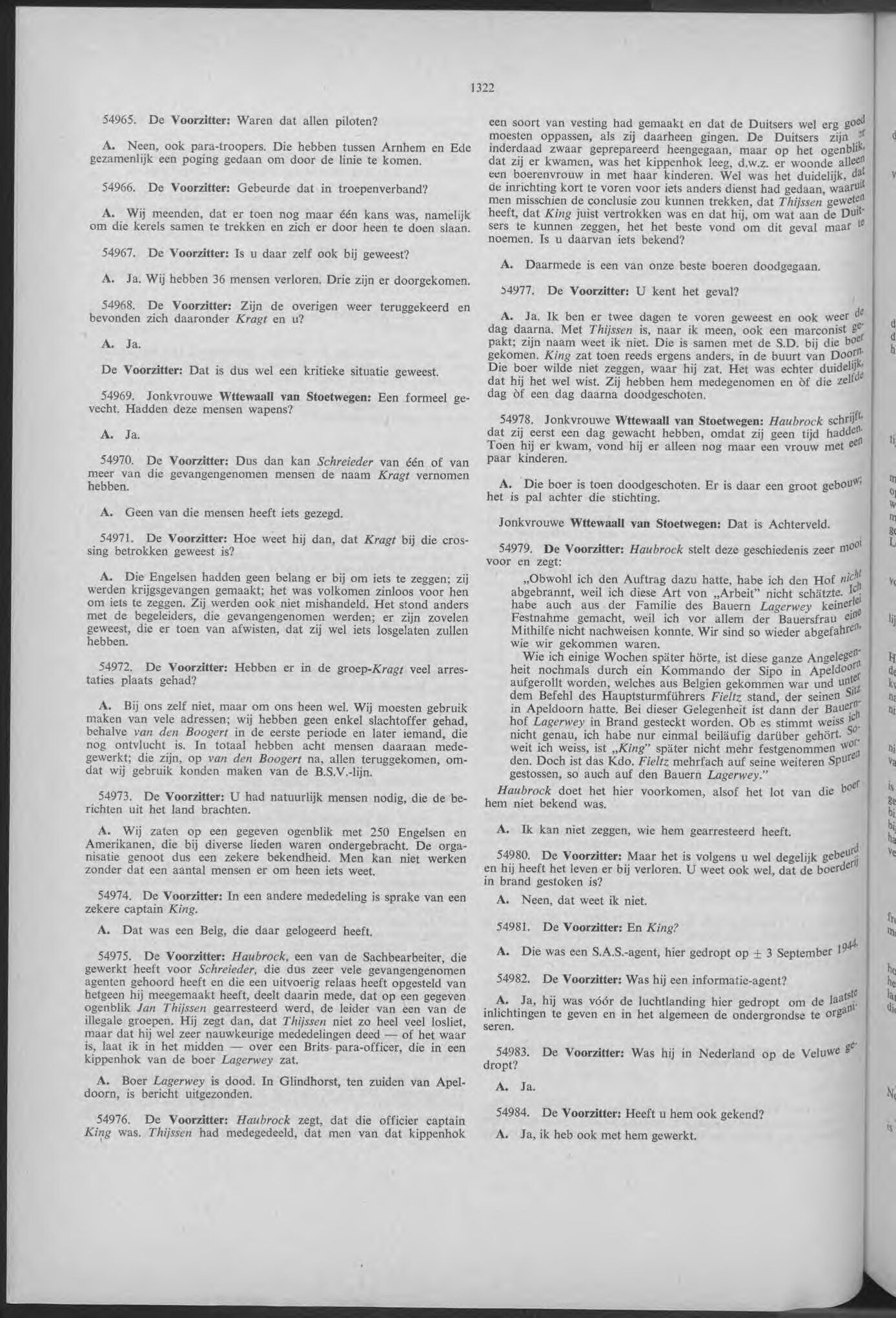
On 23 June 1943 Kragt was dropped for I.S. 9, a department of the English Intelligence Service, between Epe and Vaassen. On landing he lost his transmitter with everything that went with it; the next day he came to me and worked with me practically the whole war.
Dutch originalOp 23 Juni 1943 is voor I.S. 9, een afdeling van de Engelse Inlichtingendienst, gedropt Kragt, tussen Epe en Vaassen. Bij het landen is hij zijn zender kwijtgeraakt met alles, wat er bij hoorde; hij is de volgende dag bij mij gekomen en heeft practisch de gehele oorlog met mij samengewerkt.
— Joseph Piller · hearing before the commission, 25 May 1949 · Enquêtecommissie Regeringsbeleid, Verslag deel 4C-II (1950), p. 1320, question 54929 · the transcript
- ✓ First days and the searches.
- He says he met Kragt on 24 June 1943 (questions 54932 to 54935), that Kragt had been given the address of a friend who could not take him himself (54930), and that Kragt had only to do with I.S. 9 (54932).
- Kragt had "sat in a shelter cellar" until the matter of the lost pack calmed down and then stayed with Piller "the whole war" (question 55018).
- The Germans searched Piller's house two or three times: in October 1943, "when Nel Lind was arrested" (he does not know whether the two were connected), in September 1944 and at the end of February 1945 (55019 to 55020).
- ✓ Kragt was the son of a Dutchman who lived in England, spoke "foutloos" (faultless) Dutch, and took English nationality "in his 21st year" (54939 and 54940); van Borssum Buisman left England the same day but in another aircraft, knew Kragt from England, and had not noticed he could speak Dutch, thinking he would be dropped in France (54938 and 54939).
- ✓ "Frans Hals" was the name Kragt was given in England, his code name; only four people knew it in Holland, Nel Lind, van den Boogert, van Borssum Buisman and Piller; the Germans probably had it from van den Boogert's arrest in 1943, which is Piller's own assumption, and Nel Lind, who knew the name too, may have given it at her arrest (◐, questions 54957 to 54960). "Captain Kay" was a name Kragt "also used in England" (54962); ◐ Piller says Kragt never used "that name" himself, which we read as "Kay" (54963).
- ✓ They sat first at Epe, had to leave in October 1943 and went to Barneveld (54956). After Arnhem the party of paratroopers went on by Apeldoorn, Woudenberg, Amerongen, Doorn, Groot-Ammers and Sliedrecht, "in six or seven groups", crossing the river at Sliedrecht (54950): the Sliedrecht line below, from Piller's side. At one time they had "250 Engelsen en Amerikanen" placed with various people; eight people worked in the group and only van den Boogert was lost (54972 and 54973).
- ⚠︎ Transmitter: Kragt lost his, other sets were used "until September 1944; then we got our own" (54945), but asked whether a set was dropped, Piller says someone came with one "at the end of 1944", through Belgian agents (54946 to 54948). The two answers may be two events: a set at Langbroek from late September 1944 (below) and an operator, Dirk Last, from January 1945 (the Americans' file on him, p. 13).
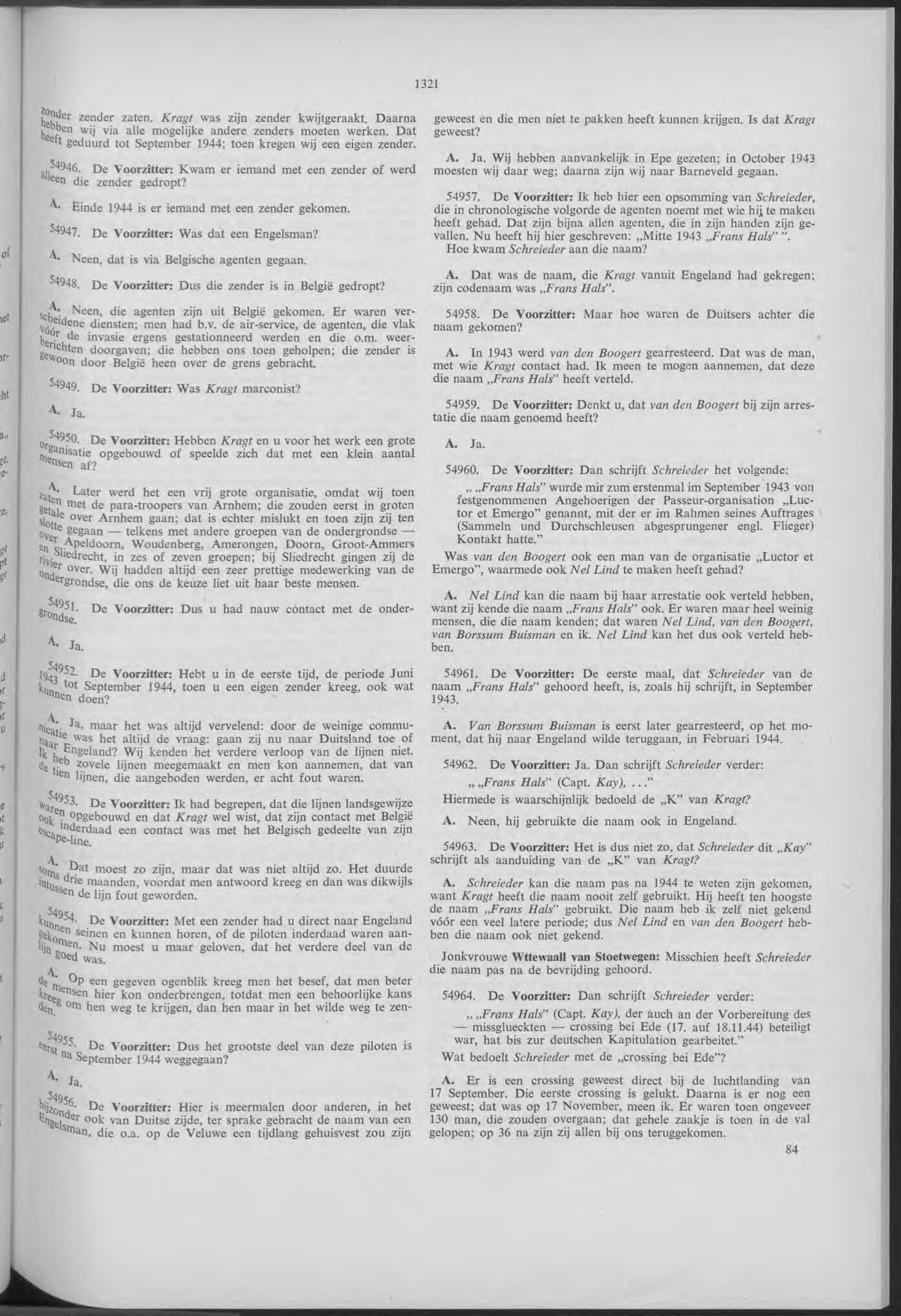
- ◐ On the failed crossing of 17 November 1944 he says about 130 men were to go over, that "we lost 36 people, three got through", and, asked whether the rest came back "and were Kragt and you among them", answers "Ja" (54964 to 54968).
- Asked in 54967 "Is u daar zelf ook bij geweest?" (were you there yourself?), he answers "Ja. Wij hebben 36 mensen verloren. Drie zijn er doorgekomen." (p. 1322).
- ⚠︎ That puts both men out with the column, against Piller's own statement of 1945, in which the men were handed over at Ede to "Bill van Ede" (p. 17), and against Schreieder, who has Kragt only in the preparation (above). The commission's summary has "all but 36 came back to the organisation" and does not say whether Kragt went out with the party.
- ◐ Operator "Theo" and Terwindt.
- A man dropped "about October 1943" to be Kragt's operator, a German by parentage but Dutch in fact, "lost his things", alias "Theo", sent by I.S.-9 and "at first meant for B.I.", studying in Switzerland by 1949 (54990 and 54991). That is the operator De Jong dates to mid-November 1943 and In the Shadows names Temmerman; the hearing gives no name.
- Kragt was dropped "blind", wanting no reception committee (54995), and was asked to find out what became of Beatrix Terwindt; they looked into it, Piller thinks in August 1943, and found she had been taken straight after her drop (54996 and 54997); the chairman notes she was dropped before Kragt (54990).
Nel Lind, 4 May 1949, in deel 4C-I. ✓ Printed pp. 969 to 971 (p. 969, p. 970, p. 971; the transcript, questions 48922 to 48927 and 48950).
- She met, in March to September 1943, "a parachutist who was not of Colonel Somer's service and whose service name was Frans Hals", an agent "sent solely to help the English pilots over safely", "dropped, I think in June 1943, on the Veluwe", who worked with "a young man from Terschuur, van den Born, who helped many pilots". She knew Gerbrands's contact with England through the O.D. was also used for Frans Hals's telegrams, and had met Frans Hals after the war.
- Asked his name, she telephoned her brother-in-law at Amersfoort and gave it: "De werkelijke naam van 'Frans Hals' is Dick Kay. Hij is op het ogenblik weer in Holland." His stay at her sister's house, and several visits in 1945, are what the answer rests on.
- ◐ Van den Born is probably Gerrit van den Born of Amersfoort, Langestraat 87, who "came into contact with Lt Kragt and worked closely with him" (below).
- He is very probably also the Jos, glossed "Gerrit van de BORN", of Kragt's own report, the contact who vetted him in the summer of 1943 (report, p. 2); Noordman captions his photograph "Gerrit van den Born. Zwartebroek, 5 januari 1910 – Voorthuizen, 8 maart 1954" (fig. 62, p. 114).
- Lind calls him "a young man from Terschuur"; none of these sources puts the three together.
- ⚠︎ She had him fourteen years in the Netherlands (the Americans have nine), and did not know whether he was English or Dutch.
- ✓ She dates her own arrest to 27 September 1943 (48951), two days before Wannée's (29 September, his file); ◐ her contact with Frans Hals therefore falls in the summer of 1943, as Wannée's "only a contact" does. ⚠︎ Piller dates the seizure at his house in October 1943 to the time of her arrest (above), which she puts in September.
Four more witnesses, in deel 4C-II. ✓ Each read on the page.
- J. C. Wannée, 17 May 1949, p. 1210 (page, question 53185): "Dignus Kragt, Dick Kay. Hij opereerde onder de naam Frans Hals", of English nationality, living in England, "Boakham 426, Londen" (the address on the Americans' own letters, as "Boakham 426", p. 2). Kragt came "in the course of August 1943 — I think", Wannée's group was arrested at the end of September, so it was "only a contact"; "Hij heeft zeer veel gewerkt", and for details he should ask Piller, "who knows everything about this parachutist and in fact worked parallel with him".
- G. A. van Borssum Buisman, 9 June 1949, p. 1451 (page, question 57483): the one agent working outside the B.I. had the code name Frans Hals, "dat was Dick Kragt", and "had special concern with the pilot lines"; the other was Captain Sam Brown. The commission's summary of this hearing (p. 274) follows it closely, in the third person.
- Dr J. M. Somer of the B.I., 24 February 1950, p. 1853 (page, questions 76138 to 76141): asked about the agent Schreieder calls "captain Kay", also known as Frans Hals, he says he "had contact with van der Weert" and that Gerbrands too had contact with Kay; asked by the chairman whether Kay was an agent of the B.I., Somer answers "Neen" (76139); "the English service M.I. 9 had no Dutch counterpart, but the people were recruited from the B.I.".
- His task was the pilots, which went on after Eindhoven jammed, "sometimes hundreds at once" after Arnhem, "but there were also enormous failures"; Captain Koch was the B.I.'s liaison officer at M.I. 9. The date is that of Somer's sitting as the page heading gives it (◐: no later heading intervenes before p. 1853).
- K. H. Schilp, 10 May 1949, p. 1045 (page, question 50037), asked about "a certain captain Kay", a purely English agent in the Netherlands: "I have heard the name; otherwise I know nothing more of it. It is probably a pseudonym." ⚠︎ The question plainly means Kragt, but the "captain Kay" Schilp had heard of may be another: in the same volumes "captain Kay" is also the name of the commandant of the Grendon Hall wireless school (deel 4C-I, p. 210, question 20280, read on the image; p. 13, question 14795, text layer only).
In English-language books of 1998 and 2003
Link to the section In English-language books of 1998 and 2003The CIA's Studies in Intelligence has him, with Piller, as the type of an MI-9 agent (✓ page 107 of the article, the fourth page of the PDF, read from the page image; the extract is the text):
One such MI-9 agent was Dick Kragt, who parachuted into Holland in 1943. He lost his equipment, including his radio, but continued on, armed only with a Colt.45. He managed to link up with a Dutch Jew named Joop Piller, living in the town of Emst, and they built a network designed to hide, protect, and eventually smuggle downed airmen out of Holland.
— Stewart Bentley · "The Dutch Resistance and the OSS" · Studies in Intelligence 41, no. 5, Spring 1998, p. 107 · the article
✓ That agrees with Kluiters, the Americans' summary and De Jong above, and Joop Piller has the other side of it. ◐ Bentley's own book, Orange Blood, Silver Wings (2007), repeats the passage almost word for word and adds that "Kragt was misdropped into a turnip field next to the church in the village of Baasen, near the town of Ede" (p. 5, read on the page image), the same "Baasen" as Heaps (below); and that Neave's "Pegasus II" was "supervised by Dick Kragt", who, "With no communications of his own, … had to rely on Captain Sadi-Kirschen's radio for outside contact" (p. 125; Gilbert Kirschen). Graham Pitchfork's Shot Down and on the Run (2003) adds to the same picture; ◐ its lines are from the Archive's full-text index, not read on the page (the hits; the longer passages):
- "Neave arranged to drop a Dutch agent, Dick Kragt, blind — that is, without a reception committee on the ground", and "he was dropped in the wrong place, and he lost his radio, the crucial link with Room 900".
- "However, Kragt was a tenacious individual who eventually established contact with Comet, and he was able to pass over 100 aircrew"; ◐ In the Shadows (above) also has the Comet line as his objective, from the search index only; no helper form, report or Dutch source here names Comet.
- "Dick Kragt, who had been the coordinator on the Dutch side for both Pegasus operations, made new arrangements", which agrees with the pages on Pegasus I and II.
Foot and Langley on the autumn of 1944. ✓ Read on the page images (MI9, 1979; the 2011 edition).
- After Arnhem, "Dick Kragt, 'Fabian' of the Belgian SAS, and an MI 9 operator called 'Ham' provided some chances of contact with these men", beside a telephone line from the Ede power station to Nijmegen (p. 247). The book treats Kragt and "Fabian" as two men: "Kragt and 'Fabian' both communicated through London ('Ham' had fallen into enemy hands)" (p. 250; "Fabian" is ◐ Gilbert Kirschen, Warrack's "Fabian King", Travel by Dark, p. 194; page image).
- For operation "Windmill", an agent called "Harrier" and an American parachutist crossed the river on the night of 10/11 October 1944 "and went to stay with the Ebbens family in Tiel, an address provided by Kragt"; "Harrier" was arrested on 17/18 October, the American "vanished altogether; and both his Ebbens hosts were shot" (p. 248). The hosts shot were Harrier's at Tiel; the book does not say what Kragt knew of the house beyond the address.
- ◐ Foot's Resistance (1977) has "an efficient line [run] to Brussels by Dignus Kragt ('Dick')" and that "Kragt hid some thirty more survivors in the marshes"; from the Archive's search text only, p. 271, the page itself not available to read (the hits).
In Leo Heaps's The Grey Goose of Arnhem (1976). ◐ Read from the text layer of the Archive's lending copy, not on the page images (the text).
- On p. 24 (Heaps) Heaps has "Dick Kragt – who used the code name of Franz Hals" sent out on "a disorganized, ill-fated mission" and dropped "near Baasen, not far from the town of Ede in June 1943", his radio set landing "many miles away" and being "later retrieved by the Germans". According to Kragt, "the impatient Canadian pilot switched on the green light ten minutes too soon because he had a date in London in three hours".
- His survival "was due to his ingenuity and joining forces in the town of Emst with Joop Piller, a Dutch Jew", who "corrected some glaring mispronunciations and changed a faulty identification card that showed the Dutch lions facing the wrong way". ⚠︎ "Baasen, near Ede" is not the drop between Epe and Vaassen (Kluiters, Piller's testimony above) or at Vaassen (De Jong), though Roskam also put the drop near Ede.
- Heaps writes "May 1943" on p. 192 against June on p. 24. The pilot's date in London is Kragt's own account as Heaps gives it, and no other source has it.
- On Pegasus II (p. 192) "the conscientious Dick Kragt, the IS9 agent in occupied Holland, also opposed the idea", never having had a chance "without the wireless set he had lost"; "the man whom IS9 sent to help Kragt arrived drunk according to Joop Piller, and proved a disastrous security risk for the Resistance" and was sent back to England; Kragt depended on Kirschen for radio and "the two men were not on very good terms". The count of the missing is in Joop Piller.
- After it "Kragt, that enterprising IS9 agent, carried on independently" (p. 196), and the doctors at Maarn "had been led to the Huis te Maarn by Dick Kragt" (p. 211; the page has the Idenburgs' house above, Caspers).
A family on the Nijkerkerweg at Barneveld. Wat bewoog u? (2007), in its chapter of interviews with Wijnand van den Berg, who lived at Ede when it was published, has a run-in heading "Verraad" (betrayal) over "Het verblijf van Dick Kragt bij de familie Van den Berg aan de Nijkerkerweg in Barneveld kreeg een onverwacht slot. Op een avond (begin 1945) werd er heel hard op de deur gebonsd" (Dick Kragt's stay with the Van den Berg family on the Nijkerkerweg in Barneveld came to an unexpected end. One evening, early in 1945, there was loud banging on the door). Elsewhere in the chapter the narrator says "we" went by farm cart to Kootwijkerbroek and stayed there until the liberation on 17 April, and that Kragt "came along to our hiding place, but was not often at home in those last months of the war" (the hits). ◐ From the full-text index, not read on the page: the hits run on past the banging: Dick was in the house, and "Er viel een briefje op de mat: 'Meester Van den Berg, u bent verraden, zorg dat alles weg is, maar dan …'" (a note fell on the mat: "Meester Van den Berg, you have been betrayed, make sure everything is gone, but then …"; the quotation breaks off there in the hit, and the note reads as a warning) (the longer passage); who knocked is not in them, and the family's other members are not named. The book also calls him "sergeant in the British army (Intelligence Service Nine)", who "spoke Dutch as well as English"; ⚠︎ a rank not found elsewhere (lieutenant in the American summary, captain on the Dutch award card).
With Murphy
Link to the section With MurphyMurphy's path crossed Kragt's line three times in November 1944, each time on the record of someone else: the night walk from Kijkuit on 6/7 November, which ended at Kragt's whistle; the Pegasus II nights of 17 to 19 November, in which Kragt's own report has a party of six losing four men in the rain, ⚠︎ which may be Murphy's party (below); and the move out of the barn in the Otterlo area on 25 November, by a "DICK". No source has Murphy name him. Heimen van Esveld of Kootwijkerbroek, who had all his men from "Joop and Dick", lists Haller, Branford and Walsh among them (his list, p. 8; Heimen van Esveld), and his file says "For further investigation refer to: Dick Kay" (p. 13). The American summary has about 120 evaders he had been in contact with crossing the Rhine into Allied hands on Pegasus I in October 1944, and gives him a part in Pegasus II, about 100 men, whose failure the members of the party put down to the lack of understanding and leadership of "the Major who was in charge of the actual operation"; he also "contacted other English operatives in the area" including "Capt King", "Ham", "Bacon" and "Jupiter" (p. 7).
Signpost 215, 7 November 1944
Link to the section Signpost 215, 7 November 1944On the night of 6/7 November 1944 Murphy, Hardy, Walsh, Haller, Banwell and Branford were walked from the forester's house Kijkuit in the Leuvenumse Bos towards Harskamp by Dirk van Eysinga and Huib de Jongh ("Lou"), with Joop Migchelsen leading the first stretch (Story: Kijkuit and Harskamp). ◐ Noordman's narration (2019, secondary) gives the purpose: the men at Kijkuit were to go by night to the area of Kootwijkerbroek "en daar overgenomen zouden worden door Dick Kragt" (and be taken over there by Dick Kragt) (Noordman, p. 293). Liesbeth Verweij, from what Dirk told her at six that morning, has the end of the walk:
At about five the agreed whistle signal of 'Frans Hals' sounded. Our group was then resting in the bushes by signpost 215. At the host's in Kootwijkerbroek Lou had to talk a great deal of loud Dutch at the 'six evacuees', to draw the villagers' attention away from their being Allied men.
Dutch originalTegen vijf uur klonk het afgesproken fluitsignaal van ‘Frans Hals’. Onze groep lag toen uit te rusten in het struikgewas bij paddenstoel 215. Bij de gastheer in Kootwijkerbroek moest Lou veel en druk Hollands praten tegen de ‘zes evacués’, om de aandacht van de dorpelingen af te leiden dat het om geallieerden ging.
— Liesbeth Verweij, in Noordman, Schuilplaats de Veluwe (2019), p. 294 · the book
- ✓ Hardy's report has the stop from the evaders' side: they reached Harskamp about 2100 on 7 November, "having broken our journey at the house of a man called DICK (?) for a meal and a rest on route. It was dark when we got there and I do not know where it was" (Hardy's report).
- ◐ Noordman makes the house Kragt's lodging with the Broekhuijzen family at Kootwijkerbroek: "Het gezelschap uit de Kijkuit werd in de vroege morgen van 7 november opgepikt door evasion-agent Dick Kragt en meegenomen naar zijn onderkomen bij de familie Broekhuijzen in Kootwijkerbroek" (the party from Kijkuit was picked up early on 7 November by the evasion agent Dick Kragt and taken to his lodging with the Broekhuijzen family in Kootwijkerbroek) (Noordman, p. 281). Hardy's "DICK (?)" and Verweij's "Frans Hals" are the two contemporary-side sources; the surname and the family are Noordman's.
- The two guides worked for Kragt. ◐ Reports on them typed for the Americans by the Frans Hals organisation (by their wording; each carries only illegible initials) call Dirk van Eysinga "one of the liaison officers for the FRANS HALS organisation to various groups of underground workers" and say Lou "Acted as liaison-officer to various underground units on behalf of the FRANS HALS organisation" (Van Eysinga's file, p. 3; De Iongh's file, p. 3; Dirk van Eysinga; Huib de Jongh).
The party of six, 17 to 19 November 1944
Link to the section The party of six, 17 to 19 November 1944Kragt's report tells the Pegasus II nights from the organiser's side (his file, pp. 34–35; the report's pp. 4–5). He met "HAM" (du Bois) "in the 'Nieuwe Wetering'" and fixed "rendez-vous, times etc., for the Pegasus II Crossing"; on the first night "the forty odd men coming from four different directions were handed over to his guides as arranged" (Abraham du Bois). Then:
The second night six men were due to arrive from one direction by foot, 24 from Elburg by lorry. It was a bitterly cold night, and it poured incessantly. The rendez-vous was at 1930 hrs. local. Nothing appeared. … then one of our messengers returned with the news that the guiden [sic] of the party of six had lost four of their party, and having searched for them unsuccessfully, had calmly gone home and to bed. These were new guides which we subsequently did not use. So I went out with them again, still pouring with rain, to investigate. We searched the country side for two hours, and returned home, utterly dejected. Fortunately our scouts found them the next day.
— Frans Hals (Dick Kragt) · report on his activities, 22 July 1945, pp. 4–5 · his file with the Americans, pp. 34–35
The lorry had not come either, "owing to engine failure, a not uncommon thing with these gas generators". The report goes on:
So it was arranged these six men and the lorry would arrive on the main Otterloo - Ede road just north of Ede. The next night after an exciting yourney [sic] there in semi-daylight, (when John Haller almost embraced a German sentry) we waited for the lorry till nearly nine o'clock. It did not turn up, untill [sic] too late for the party, which had left. It gave us quite a headache to arrange for these men to be given shelter and food.
— Frans Hals (Dick Kragt) · report on his activities, 22 July 1945, p. 5 · his file with the Americans, p. 35
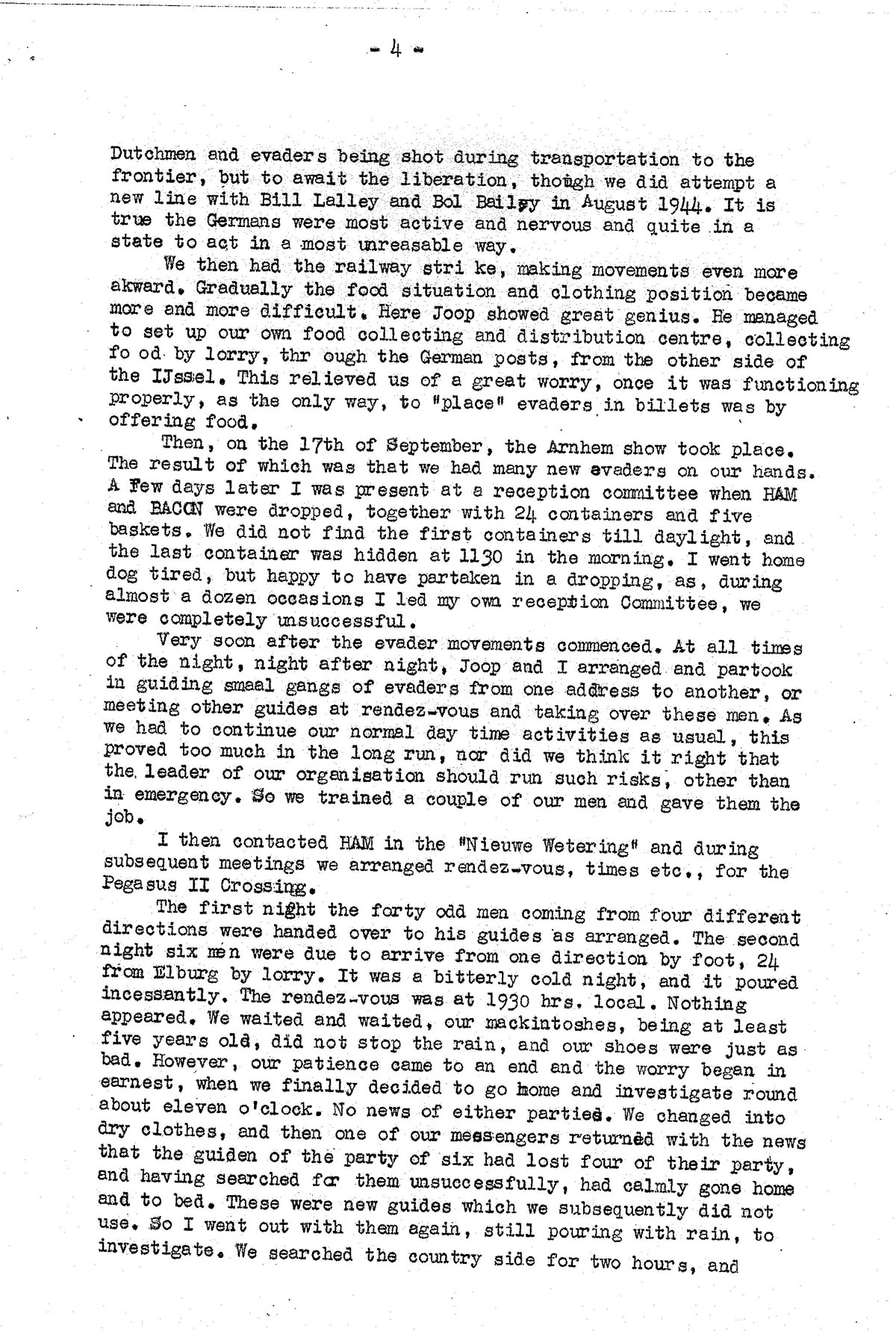
◐ Murphy's party, by our reading. Kragt names no one but Haller. The MI9 reports of the six fit his account in content, not in dates (below):
- Hardy has the six, on bicycles with three guides, losing the others at a fork in the rain on the night of 17 November: "BANWELL, BRENTFORD, MURPHY & I took the wrong fork and lost the rest of the party"; they searched "two or three hours" and sheltered at a farm (Hardy's report).
- At about 1730 on the 18th "WILLEM and the Dutch Policeman whom I had met before" fetched them, to a point where "WILLEM said a lorry was to pick us up", which "did not turn up".
- They met "another party of evaders, about 20 in all", and "had by this time missed the main body through the failure of the transport".
- Walsh has the split the other way: only Hardy and Branford lost, and the guides taking "Sgt. BANWELL … Sgt. HALLER, John … Pte. MURPHY and myself to a house at approx. posn 560984 … and moved to the rendezvous … the next day" (Walsh's report). Kragt's "lost four of their party" agrees with Hardy's count, not Walsh's.
- The glider pilot "Sgt. JOHN" of Hardy's party was Sgt Bernard John Frederick Haller (Walsh's report, with the compiler's note; Bernard Haller); Kragt's "John Haller" at the Otterlo–Ede road is very probably he.
- Where they differ: Kragt's six were due "by foot", where Hardy has them cycling; and Kragt's night count (a first night of forty men, "the second night", "the next night") gives no dates, so the 17th and 18th are Hardy's.
- ⚠︎ The dates do not settle the match.
- Hardy lost the others at the fork in the rain on the night of 17 November, and Kragt's search in the rain was on his "second night"; that is the same night only if his first night, the handover of the forty men, was 16/17 November.
- Schreieder puts the crossing on 17/18 November (Bijlage 16, p. 31); Boeree has it for the night of 17/18, with 75 men gathered "op de avond van 16 November", and, in the chapter on Frans Hals, for "de avond van 17 November" (Boeree); De Jong has it for the night of 17 to 18 (deel 10b, p. 552).
- If Kragt's first night, the forty handed over, is the assembly of the 16th, his second night is the 17th, Hardy's night at the fork; if the assembly was the 17th, it is the 18th. ◐ Kragt gives no dates, and his forty is not Boeree's 75. The Ede manuscript (pp. 45–46) has it for the evening of the 17th, and the page on Operation Pegasus II gives Noordman's date, a night later still (Operation Pegasus II). The match on four lost and John Haller is from content, not dates.
- Noordman prints the same passage in Dutch, from the report, with "zes man lopend" (six men on foot) and the lorry to deliver the six on the Otterlo–Ede road (Noordman, pp. 117–118).
The rest of the Pegasus II nights from Murphy's side, and the lorry party left in the wood, are told in Operation Pegasus II and on Gerrit van Ee's and Eb van Omme's pages. Noordman has the men left in the wood fetched on the evening of 20 November by Eb van Omme and Gerrit van Ee with horse and cart (Noordman, p. 285). Kragt's organisation reported afterwards on two of the helpers who dealt with the remnants:
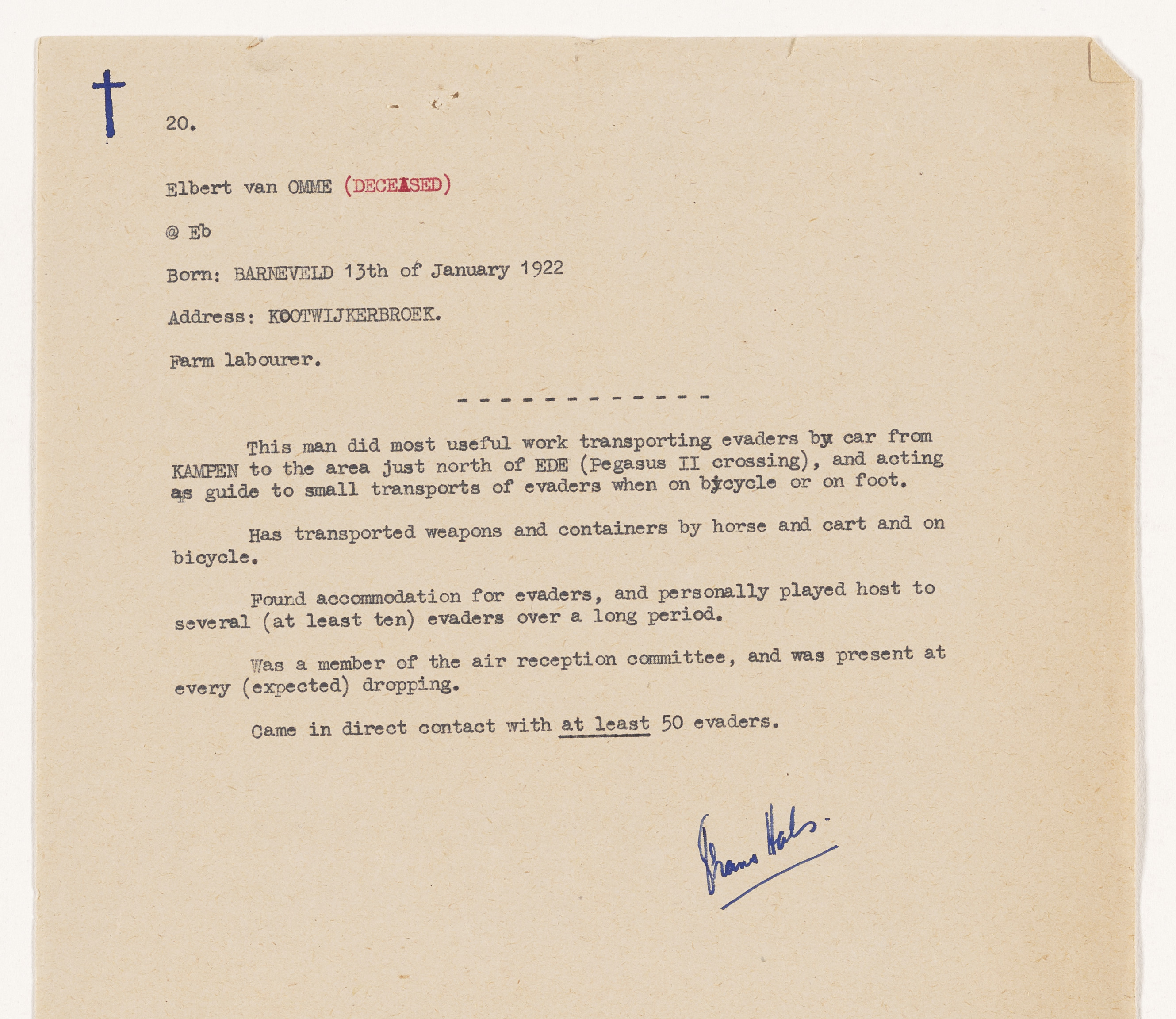
- ✓ Kragt signed, as "Frans Hals", the Americans' report on Elbert van Omme of Kootwijkerbroek, who "did most useful work transporting evaders by car from KAMPEN to the area just north of EDE (Pegasus II crossing)" (Van Omme's file, p. 6, signature read on the image). ◐ That is the road and the place of Kragt's lorry; the report does not say Van Omme drove it on the night.
- ✓ The organisation's unsigned report on Willem van Dijk of Molenweg 5, Harskamp ("@ Piet"), says he "Gave most useful service before, during, and after the unfortunate PEGASUS II crossing ( looking for the 'remnants' of this crossing)" (Van Dijk's file, p. 4; Willem van Dijk).
- When arrested by the SD a few months before the liberation "he did NOT disclose one word of the organisation's existence", and escaped with a hacksaw baked into a loaf of rye bread (same).
- ◐ Ede's research notes have Kragt's trusted men at Harskamp as "v. Beek en Willem v. Dijk" (Ede 1006/493, p. 7), and Ede's war history names them Marten van Beek, "bij de politie in Arnhem", and Willem van Dijk (Ede manuscript, p. 43; Marten van Beek); whether they were Hardy's "WILLEM" and "Dutch Policeman" is not settled (Story: Kijkuit and Harskamp).
- ◐ An undated typed slip in A. E. Kauffeld's file, in the office's third person, says of the men he helped, about 35 in all, that they "came after the failed crossing from 18-11-'44 and came in the hands of Frans Ha Hals [sic]" (his file, p. 4). J. van Vemde wrote that he and Kauffeld were arrested by the SD on 24 November, with 10 to 12 men from the crossing kept in his hiding place by his house until then (Van Vemde's file, p. 8); ◐ very probably Hardy's party among them (The keeper of the dug-out).
Out of the barn, 25 November 1944
Link to the section Out of the barn, 25 November 1944◐ After the dug-out, Hardy and Murphy were taken on 24 November "to a barn somewhere in the OTTERLO area", where Pte Davison, an RAF officer and four American aircrew were hiding; "the following evening DAVISON, MURPHY and I were taken by DICK and another member of the Underground to a nearby farm", and from there cycled to the outskirts of Barneveld (Hardy's report; Leslie Davison). ◐ The barn at Harskamp, J. van Essen's, is Noordman's alone (p. 285; J. van Essen); Hardy places it only in the Otterlo area.
- Two of the four Americans, Lts Sidney Willig and Harold Bonekat, listed their helpers in their escape report. After "VAN EE, lived near STROE" (23 November) and Teus Roskamp, called a veterinarian (24 November), comes "DICK", "speaks High Holland Dutch and good English. Wore a British uniform. Was head of underground in area of BARNAVELD", who "Provided new civilian clothing, made arrangements for helpers and food. Furnished tobacco, transportation, and contacts", and "ROSKAMP, JOHN", who "is 'DICK's' right-hand man" (E&E 2976, Appendix C, p. 1, PDF p. 7, read on the page image; Sidney Willig; Harry Bonekat; Teus Roskamp).
- ◐ The Americans' "DICK" is possibly Kragt: head of the Barneveld underground, a Dutch speaker in British uniform, and his right-hand man a Roskam, as the Hague summary has Johannes Roskam working with "'Dick' (Frans Hals)" (below).
- ⚠︎ The description does not fit the other pictures of him on this page: the report has 5'7", 140 lbs, 25 years old and blonde, where Kragt was 27 and Warrack's Dick, the man we take to be Kragt, is "of medium size, very stocky, with dark hair, blue eyes", in plus-fours and German jackboots, not a British uniform (Warrack, Travel by Dark, p. 183; page images top, bottom).
- ◐ Whether Hardy's "DICK" of 25 November is the same man the Americans' report does not say. Noordman puts the Fortress crew in Hardy's barn, and Hardy's "shot down on 21 Nov" fits Willig's crew (Noordman, p. 285); if they shared the barn, the two "DICK"s may be one. No source says it was Kragt in person.
The lorry party's barn, November 1944
Link to the section The lorry party's barn, November 1944Capt. Charles Noble was in the lorry party from the Elburg side: about twenty men taken by lorry to the Ede–Otterlo road, where "we were left at the wrong spot and so missed" the main column (Noble's report; Charles Noble). ◐ That is very probably Kragt's "24 from Elburg by lorry", and the party of "about 20" that Hardy's group met by the road on the 18th (Hardy's report); Banwell stayed with it when Murphy went on (Tex Banwell). ⚠︎ The two disagree on why it was late: Kragt has the lorry fail "owing to engine failure"; Noble, gathered with about twenty others in a barn near Elburg on "On or about Friday, 17th Nov", has "The transport, however, was stopped by a Wehrmacht Control [Point] and it was not until the following morning that we left in a lorry, disguised as labourers". After two nights in a wood a cart took them to a barn:
They arranged for us all to be taken away on a cart at about 10 o'clock to a barn where we spent 5 days. The following day a person named 'DICK', who seemed connected with British Intelligence arrived and arranged for food and clothing to be brought. The name of the owner of the barn can be supplied by him.
— Capt. C. B. Noble, RAMC · MI9 report · Pegasus Archive transcript
◐ Noble's "DICK" is very probably Kragt: the man whose report says it gave him "quite a headache to arrange for these men to be given shelter and food" (his report, p. 5). Noble gives no surname.
⚠︎ Noble's own later account (unpublished private papers, shared with us privately), told long after the war, has the lorry from Elburg pass German checkpoints with the men posing as "workers from the Ijssel-limit going home on the weekend", and "it turned out later we were late". It does not name "DICK": in the barn "Our presence was reported to London", and he thought they were "supplied with underwear and some cigarettes".
His line on the helpers' forms
Link to the section His line on the helpers' formsJohannes Roskam of Barneveld. The Americans' Hague office summed up his helper file on 22 June 1946 (pencilled "Grade 4"; the lines checked against the image): Johannes Roskam, of Lunterseweg 110, Barneveld, a former Knokploeg man, "had to dive under in September 1944" and found shelter at the farm of H. van Esveld at Essen, "the start of his pilot-work, which was very important and done in co-operation with Joop Piller (Capt. van Amstel) … 'Dick' (Frans Hals), Evert Bruinekreeft" and others; practically all the airmen on the files of those Kootwijkerbroek and Voorthuizen helpers "passed through Mr. J. Roskam's hands". He was also one of the escorters of "an important body of paratroopers and pilots" who tried "a collective crossing of the Rhine in autumn 1944", and one of those who looked after them "when this crossing turned wrong" (the summary, p. 4). ◐ That crossing is very probably Pegasus II, though the summary does not name it. His brother Teunis Roskam of Stroe, whose own form of 20 June 1946 (Grade 5) gives his brother Johannes's code name as "Jan", has in its remarks (the American interviewer's third person) that the brother ("Joop", not Piller) "did important pilot-work" as "a co-operator of DICK and JOOP PILLER" and that Teunis's own task was finding hiding places, and that he escorted some eight pilots in all (Teunis Roskam's form, p. 2). ◐ The "Jan Roskam" of 1984 in De zwarte herfst, "Jan de Hollander", who says he was at Van Esveld's and that Piller and Kragt "were always in touch with England" (Dekkers and Vroemen, p. 273), is very probably the same man: same name, same farm, same code name "Jan"; no source says so.
Houses and men on the helpers' forms, 1943 to March 1945.
- ✓ Bol, Barneveld. Jacob Bol, "Baas" (p. 4, OCR text layer only) to the men he hid, lists as received from and passed to "Frans Hals" (the second copy has "Joop en Dick") Cook and Moore of the Airborne from 30 October 1944, 17 days, Major Maguire from 8 November, Kessel and Ridler from 19 November, Goggin of the RAF, two Americans from 27 November, Warrack and Low from 27 December and four Belgian SAS men from 22 February 1945 (his form, p. 5; p. 17). The days differ between the copies.
- ✓ Van Rheenen, Kootwijkerbroek. Jean van Rheenen lists "D. Simpson, Syston, Leicester", a glider pilot shot down near Arnhem, hidden from 10-11-44 for 5 days, received from and passed to "Joop and Dick" (his form of 17 July 1945, p. 5, checked on the image). ◐ The Sgt A. Simpson of Piller's own list and the "S/sgt. A.Simpson G.P.R. pilot ?" of Niermans's (below) may be the same man; the initial differs from "D. Simpson" here.
- ✓ Van Beek, Harskamp. Martinus ("Rinus") van Beek wrote on 17 February 1946 that "after making contact in 1944 with Dick Kay we organised (Pilots Transport Orgn.)", that they transported over 200 men, and that "all details have been given regularly to D. Kay"; "all details about our work is known to Capt. Dick Kay, Capt. van Amstel (J. Piller) and Jhr. van Eysinga, leader of the P.T.O. North Veluwe" (his form, p. 2; Martinus van Beek; Dirk van Eysinga).
-
✓ Niermans, a courier. Karel Niermans, "Karel" to the men, member of "I.S.", has in his form's remarks, the interviewer's third person (his form, p. 4), that he lived "in the house of capt. Kay and capt Piller at Essen, and later at Barneveld", "worked in the Frans Hals organisation", and carried 10 to 15 paratroopers by bicycle between September 1944 and April 1945, helping too "with hiding weapons, droppings at night etc.".
-
✓ Bronkhorst, Kootwijkerbroek. Gerrit Bronkhorst of Esvelderweg 4 lists Kenneth Buckley, Robert de Lange and Jan Falkowski, RAF, 16 days, received from and passed to "Joop en Dick" (table, p. 4). The Americans' summary card of 27 December 1945 has "Capt KAY" where the helper's voucher goes (p. 2), and his form has "Frans Hals" pencilled at the top (p. 3; all three checked on the images).
- ◐ Buckley is also on Chris Cornelisse's list from 22 March. A "de LANGE S.R." (U.S.A.; Bronkhorst's Robert de Lange is RAF, so that match is ◐) and Falkowski are on Woltman's table at Apeldoorn too, with Falkowski shot down on 5 March (Woltman, p. 16), so the 29 March on Falkowski's row is most likely the day he reached Bronkhorst. Our reading.
- ✓ Evers, Kootwijkerbroek. Maas Evers of Wencopperweg 34 lists Sgt Maj David Morris, 1st Airborne Division, from 7 November 1944 for 5 days, received from "Joop and Dick" (table, p. 3; the summary has "Norris", p. 4; checked on the images). ◐ Woltman has "D. Morris", a regimental quartermaster sergeant, from 2 October for 32 days, which runs to about 3 November (Woltman, p. 16); nothing says they are one man.
- ⚠︎ Goorhuis, Kootwijkerbroek. Lt Noyes Richey and Lt Charles Ramlow, "end Sept.", 50 days, received from and passed to "Joop and Dick" (his table, p. 7, checked on the image). Heimen van Esveld has Ramlow for 28 days and Richey for 5, so the counts disagree; ◐ 50 days from the end of September runs to mid-November, the time of Pegasus II, in which Ramlow went (Hugh Maguire).
- ◐ Van Lagen, Kootwijkerbroek. Rik van Lagen of Westerningeweg 16 wrote only that he "Received through Joop and Dick 5 airmen", known by first names, "Alfred, Jim, Charles, Tom and Jack", the last "Captain, [?] of a squadron bombers" (his form, p. 3, checked on the image).
- His table is blank, and the Americans pencilled "Insufficient info, no confirmation" beside his remarks (p. 3) and graded him 5 (cover, p. 1). A torn slip in the file names "D. Kragt" beside a remark that someone "does not mention him" and that he is "not in", partly legible (p. 2).
- No surnames, no dates: none of the five is identified, and nothing ties "Tom" to Murphy, who was not an airman.
- ✓ Van Doorn, Ede. Hendrik van Doorn, a sergeant in the Gezagstroepen and of the N.B.S. at Ede, wrote on 25 March 1946 that he "transported food and military clothing from Brigadier Lathbury to the concentration place for the crossing of the 23rd October 1944" (his form, p. 2, checked on the image; no award).
- In November 1944 he helped "Bill" steal 40 hectolitres of coke "destined for Captain Kea and Joop van Amstel" for the hidden airmen.
- ◐ Captain Kea is Kragt, by the sound and the pairing with van Amstel; the crossing is Pegasus I, which the American summary credits with about 120 evaders he had been in contact with (above).
- ◐ Van den Top, Stroe, 1943 and 1944. Gerrit Jan van den Top's table passes five men on to "Joop and Dick": John Justice (October 1943, 4 days), Bill Lalley (typed Laley; from 30 April 1944, 85 days), Conny O'Bar (June 1944, 5 days), Eugene Gezinski (5 days) and Bob Bailey (June 1944, 8 days) (p. 3, checked on the image; summary, p. 4).
- Bowman's "Dick, a British agent", who came with Van den Top to the Lagerweij farm at Renswoude to question the evading pilot Robert Bailey in June 1944 (Bowman, p. 76; Noordman, Bailey's account), fits Kragt.
- ◐ Lalley's own account, in Noordman's Dutch, has "Dick" introduced to him at Stroe as "een gedropte agent uit Engeland" (an agent dropped from England), apologising for the strict questioning, afraid the escape line would soon be infiltrated, and warning him "niet alles en iedereen te vertrouwen" (not to trust everything and everyone); years later a Canadian researcher "identified the underground leader, Dick Kragt, who first questioned me" (Noordman, pp. 148, 159–160; One Way Ticket to Berlin, p. 126, transcribed in the page file; Bill Lalley). The identification is the researcher's, passed on by Lalley.
- The Lowell Area Historical Museum's page, which repeats him, has Lalley meet Kragt, who "was unable to help as some members of his group had been exposed" (the page).
- ⚠︎ "Joop" in 1944 may be Dr Kruimel, "Oome Joop", whom Mrs Eskes-Buis has guiding Bailey and Laley out of Stroe: not settled (her file, p. 7; Bill Lalley; Dove Jan for O'Bar and Gezinski).
Frans Hals at Pegasus II, in Boeree's chronicle. ✓ Checked on the page images (Boeree, pp. 199–200). Boeree has the Ede group's story of the preparations:
- "Om hen definitief weg te krijgen, bedacht Frans Hals een plan" (to get them away for good, Frans Hals thought of a plan): a transport-aircraft landing at an old airfield at the Noorderhei, each plane taking 40 men; the terrain was surveyed and the plan approved in England, "maar blijkbaar hadden de Duitschers het radiogram ontcijferd" (but apparently the Germans had deciphered the radiogram).
- When the message came through that "het wordt een uur later licht" the Germans surrounded the field with anti-aircraft guns, and "Frans Hals kon nog op het nippertje het vliegtuig afbestellen" (could just in time cancel the aircraft).
- The crossing of the Rhine was then fixed for the evening of 17 November, the assembly point the forester van den Brink's house at the foot of the Herteberg, where "Frans Hals zou daar komen met de mannen uit Essen en Kootwijkerbroek".
- On p. 199 it is "Frans Hals en Joop van Amstel" who gathered the paratroopers, with the courier Puck, at Kootwijkerbroek (Joop Piller); and at van den Brink's house on the night, "zaten Joop van Amstel en Frans Hals met 15 man" (p. 200).
◐ The Noorderhei plan is not in any of Kragt's or Piller's own accounts on this page: a transport-aircraft landing, called off at the last minute, is Boeree's story, from the Ede side. ◐ That Kragt was at the assembly point fits the Americans' summary (a part in Pegasus II) and Schreieder's "bereitete mit Frans Hals das Crossing bei Ede vor", though neither puts him there; it is not in his own report in these words.
More helpers' forms, 1943 to 1946. Each checked on the image (15 October 2026) unless marked.
- ✓ Uelen, Emst. Johan Uelen of Oranjeweg E 140 II, Emst, wrote on 1 May 1946 that Kragt was dropped "above Vaassen" and "brought to me by Koos v.d. Boogaert" (his form, p. 2).
- "I sheltered him till 15.7.1943 when I had to dive myself"; "Capt. D. Kay went to Koos v.d. Boogaert when I had to dive". He gives Kay's London address as 13 Pembridge Crescent.
- ⚠︎ That has a different first shelter from Piller's and De Jong's (see the end of this page).
- ✓ Brouwer, Nijkerk. Arend Jan Brouwer, a contact address of the LKP, wrote on 3 August 1945 that his address was "used as a transit-centre for allied personnel", where he sheltered about six men for a day, and was "courier-address at the same time for about one month, where messages from Frans Hals were brought and get to and from his wireless-operator" (his form, p. 5).
- ✓ Van Borssum Buisman's other end: Nel Lind. Nel Lind, of the Luctor et Emergo group, wrote, in Dutch, that in "Aug. '43" she "kwam … in contact met de Eng. agent 'Frans Hals', die zijn zender had verloren" (came into contact with the English agent "Frans Hals", who had lost his transmitter) (pp. 21–22, p. 22).
- She was the link between him and van Borssum Buisman, "die Frans Hals's telegrammen verstuurde" (who sent Frans Hals's telegrams); Frans Hals promised to check pilots' arrival regularly "in zijn code" (in his code).
- She knew "de parachutist Frans Hals" (the parachutist Frans Hals) was to come to Amersfoort in the week of the raid on the Boissevain house, in August 1943 (p. 23). ✓ That is the first-hand side of what De Jong, Schreieder and van Borssum Buisman say above.
- ✓ Last and Eggink, the operator. Dirk Last's file has an unsigned sheet in the first person ("while working for me"), ◐ the voice of the man he worked for (p. 13).
- "Dirk worked for the FRANS HALS – organisation from January 1945 till the liberation of DE VALK (BARNEVELD) on April 16th of that year"; twice the house he was working in was surrounded by Germans; he was also "a member of a reception committee for air-droppings".
- The Americans' remark has him first an operator for B.I. agents, then for Frans Hals, "five times raided" (p. 8).
- Jaap Eggink's table has "'Kees' operator of Frans Hals" received from Barneveld and passed to Appel, Nijkerk, and the "transport of Kees's wireless set from Langebroek to Barneveld" (p. 3); ◐ Langbroek is where Piet de Springer and the Swaluwenberg farm were, and Kragt's radio worked from there from late September 1944 (Swaluwenberg's form, p. 2: "26 Sept. Dick came with another sender … Dick stayed till Newyear"; the "end of November" line there is struck through).
- ◐ Noorlander, Kootwijkerbroek. G. A. Noorlander's claim form of 12 February 1946 says that after the Arnhem landing, when the electricity was cut off, "we lent our 6 Volt vibrator set (Philips) to Captain D. Kay" (p. 4).
- Owing to German billeting at the farm where he stayed, the set was hidden in the ground for about a month and damaged by damp; "Capt. Kay made a new one" from the parts that survived. f 435.75 claimed.
- Witnesses: "Captain D. Kay" and a Mr Broekhuizen, Essenerweg 70, Essen (district Barneveld) (p. 5, the witness's first name read as G. J. through a smudge). Essenerweg 70 is also the address Piller gave in July 1945 (Joop Piller).
- ✓ Visser, Apeldoorn. J. C. Visser ("Uncle Kees", of the L.O.), a reserve first lieutenant who directed a motor and boat service, "Helped Captain D. Kay (Dick) with the transports from Apeldoorn to Barneveld" and held "the correspondence address for the contact between Dick and the persons who had sheltered allied personnel", and another, under the code name P. Jansen, for those who looked for food (his form, p. 3).
- ✓ Wolzak, Eerbeek. The Americans' card on C. A. Wolzak, N.B.S. commander at Eerbeek, dated 17 January 1946 and headed "Capt Kay, 4 January 1946": twelve evaders housed in a cottage on his land "from October to December of 1944, this being consequent to the successful Pegasus 1 and the unsuccessful Pegasus 2", transported on by him (p. 3). The twelve include "Pvt T. Lorne", "156 Para Regt" on the card (Thomas Lorne), and "Pvt W. Ross", "Para"; ◐ that Ross was of 156 Parachute Battalion comes from Lorne's account, not from the card.
- ✓ Bruinekreeft, Kootwijkerbroek. The Hague office's summary of Evert Bruinekreeft's file, dated 22 June 1946 (the Roskam summary above is of the same day), names "Capt. van Amstel (Joop Piller), 'Dick' (Frans Hals), Roskam Teunis and Johannes" and says he was "responsable for the financial part of the work and for the distribution of food" (p. 17).
- Airmen assembled at his house before every transport. In "the unsuccessful crossing of abt. 120 paratroopers in autumn 1944" he took over 24 men in a car and then, over more than 20 km, carried a paratrooper at a time on the back of his bicycle.
- After the crossing "turned wrong" some of them found their way back to his house; German soldiers billeted next door searched it, and he went into hiding until the liberation. "A total number of 100 to 150 allied airmen (perhaps even more) came through B's house."
- ✓ Van den Born, North Veluwe. The Americans' summary of 9 March 1946 on Gerrit van den Born, leader of a network in the North Veluwe and Amersfoort area, says he "came into contact with Lt Kragt and worked closely with him", and once spent four days collecting documents and materials to help in a drop (p. 22).
- A draft of the recommendation, corrected by hand, has "Lt. Dingus Kragt, an important Allied agent in Holland", with whom he "arranged with Allied intelligence for a parachuting of vital supplies needed in the evasion work", his task being "to insure the security of the drop points as well as to have the points sufficiently manned" (p. 7).
- ✓ De Nooy and Wiegeraadt, Ede. The Americans' summary card of 19 December 1945 on Menno de Nooy ("Tony"), second in command at Ede, has him "very well known to Brigadier Lathbury, Brigadier Hackett, Major Tatham Water, Capt Kay and other officers of I.S.9" during the planning of Pegasus (p. 18).
- Marten Wiegeraadt's form has an RAF flying officer, "Robert K. Baley", moved from Renswoude to A. M. Jochemsen at Ede in August 1944, and "After 3 days he was given to Frans Hals in cooperation with Wildenberg" (p. 15). The same page has Wiegeraadt take Brigadier Lathbury and Major Tatham-Warter on 6 October 1944 "to Capt. Frank, B.S. Ede".
- ✓ He is Robert Bailey: Boeree's Kroniek van Ede has the same hand-over from the Ede end, "werd doorgegeven aan Capt. Dick Kay, bijgenaamd Frans Hals, die bezig was de piloten te registreeren en te verzamelen" (was passed on to Capt. Dick Kay, nicknamed Frans Hals, who was busy registering and collecting the pilots), after three days, in August, following a stay "bij Lagerweij" at Renswoude (Boeree, p. 88, read on the page image; the farm is the "Wester-Wetering" on the Rijksweg, Wiegeraadt's "Westerwetering").
- The three days and the name Frans Hals are the same in both. ⚠︎ Boeree's "in Augustus" cannot be right on Bailey's own dates: he left Stroe on 24 July, was at Breda from 26 July to 9 August and was taken at Antwerp on 11 August (Robert Bailey). Bowman's "Dick" at Renswoude in June is a separate meeting, above.
- ◐ Goudriaan, Barneveld. T. G. Goudriaan's table has a row "Dick Kay = Redman" hidden "jan. 44" [as typed; it can only mean January 1945] for 14 days, received from "? Rouwenhorst, Barneveld" and passed to the same, the question marks typed (p. 3): Captain Theo Redman, one of the doctors with Warrack and Kessel, at Barneveld for 14 days in January [1945].
- ✓ Te Winkel, Barneveld. Maria te Winkel's table has Graham Warrack ("Warricks", colonel, airborne) and John Low, pilot, from 19 to 29 December 1944, 11 days, "Brought and fetched by 'DICK' (Capt. Kay)" (p. 3).
- ⚠︎ Bol has Warrack and Low from 27 December and Low's own report has him at Gerrit van Omme's from 4 January (below): three helpers, three sets of dates.
- ◐ Van Veldhuizen, Barneveld, and Soel. Neither names a man he took from Kragt.
- Albertus van Veldhuizen's reply to the Americans lists some 25 pilots helped, among them Riley, Rittler, Boyd, Maguire and Mensies, and says the pilots were "also handed on to Lt. van Amstel and Capt. Kay", help given from August 1944 to 15 April 1945 (p. 5).
- Gerrit Soel of Stolwijk, known at Kootwijkerbroek as "Gerard", lists "Captain Dick, Lieutenant Van AMSTEL, J. ROSKAMP, E. BRUINSCHREEFT, Wijnand v.d. BERG" and says he worked "as a guide and with transporting of pilots for about a year" (p. 3).
- ◐ Stearns, 1944. The escape report of Lt Carroll A. Stearns Jr, a fighter pilot, says he "was in the hands of the FRANS HALS organization during most of his stay in HOLLAND. The chief was known to him as DICK, and his assistant was JOEP" (Appendix C, p. 6).
- It puts him at Dr W. W. Wolffensperger's house at Doornspijk from 5 June to 22 August 1944, with Herman van Essen at Epe and at a camp near Vierhouten.
- ✓ That is an evader's own words for the line and its two heads before Market Garden, and Piller's own form gives his organisation as the "Frans Hals organisation" (p. 13); Stearns is also on the Sliedrecht forms below, so he was still on the Veluwe in the winter of 1944–45.
- ✓ Pouw, Voorthuizen. The only row of Hendrik Pouw's second form's table has "A. Banwell, 1e Airb. Div., from train 20-9-44 [the day as read on the image; p. 3 of his file has 28 Sept], 10 days", received from "jumped out the train near Stroe" and passed to "Frans Hals" (p. 7, checked on the image on 11 October); Tex Banwell has the rest. ◐ It puts Banwell, at Voorthuizen, into Kragt's line in the first days after the train; nothing in the form says where "Frans Hals" took him.
- ✓ Verwey, Elspeet. Liesbet Verwey, who lived with Lady van Eysinga, gave her organisation as "Pilot transport Org. 'Jupiter' and 'Frans Hals'" and named Dr Kruimel (Utrecht), H. de Jongh (Rotterdam) and Jhr Mr D. van Eysinga (Leiden) as helpers she knew (her form, p. 2, transcribed 3 October; the lines read again on the image on 15 October). It ties Johannes Kruimel's Utrecht address to the two organisations on a helper's own form.
- ◐ Van de Berg, Epe, a check through Kragt. A torn slip in Hendrikus van de Berg's file says "Thorough check necessary", "v.'t Land does not mention names, only refers to Dick Kay", "not mentioned by Wilgenburg", and (struck out) "Write C. v't Land for confirmation" (p. 6).
- Cornelis van 't Land of Epe, leader of the LKP in Gelderland, has in his form's remarks (the Americans' typing, not his own words) "Further details can be obtained from Dick Kay", and the same remarks note he sheltered and transported at least 30 pilots, with no names (p. 2); the American office was checking helpers through Kragt's knowledge.
- ⚠︎ Not Kragt: the Kauffeld letter. A letter thanking A. E. Kauffeld (addressed to Ede; his own form has Roekel, pp. 5 and 7) for his hospitality "to Captain Kay, Lt Kiek, and myself" (p. 9) is from the Americans' MIS-X detachment, dated 29 July 1945, a week after Kragt's own report was written.
- It is signed by Captain Franklin D. Coslett, Air Corps (Frank Coslett), who writes as one of the American staff, naming a Lt Kiek beside him, and nothing shows that this "Captain Kay" is Kragt rather than an American officer of the same name or sound. Left out of the account above.
- ✓ Buitenhuis, Apeldoorn. The Americans' summary card on Jan Buitenhuis, dated 14 December 1945 and headed "Capt KAY", says he "was extremely active in transporting evading personnel for the organization set up by Lt. Dick Kragt" and housed evaders at his own home for one to fourteen days (p. 7).
- It lists as helped Edward Brown, Peter Quillan, Frank Manzer, Tudor Griffith, John Berry, John Smith, Jack Larson, Dereck Ridler, George Polk, Rex Dale and Jan Falkowski; his own table has "John BARRY" passed on to "Dick (Capt. Kay)" (p. 20).
- The "organization set up by Lt. Dick Kragt" is the Americans' own phrase for the line.
-
✓ Three men who escaped from the Willem III barracks at Apeldoorn in the days before Murphy left it (1 to 5 October 1944), Spr A. W. Gauntlett, L/Cpl Johanson and Pte J. Reid, were sheltered in Apeldoorn by Gerrit Huiskamp's group and passed on through Cornelis van der Zee "to Mr. J. Buitenhuis who transported them further on to the South. where they crossed the Rhine" (Van der Zee's form, p. 5, read on the image). Huiskamp's own form names him only as "the name of Buitenhuis, which name is certainly know by you" (p. 4).
- Reid's report has "we" taken to the rendezvous on 23 October (he had been in another house since 16 October; Gauntlett's gives no date for it) and both reports have them leaving Holland on 24 October; ◐ the nearest operation is Pegasus I, the crossing of the night of 22/23 October, which the reports do not name (Apeldoorn and the escape).
- ◐ Van der Zee gives only "J. Buitenhuis"; he is taken here to be Jan Buitenhuis (above) because Van der Zee's list of helpers gives "J. Buitenhuis" the address Rostocklaan 43 in Apeldoorn (p. 4) and Jan Buitenhuis's own file has the same address (p. 7, p. 11). No page gives a first name beside Van der Zee's.
- ◐ Neither the Americans' card on Buitenhuis (above) nor, by its OCR, any other page of his file names them.
-
✓ Gerrit Huiskamp of the Ordermolenweg, Apeldoorn, a group commander (Tamboer's form lists him as "Groupscommander", p. 2), "Helped with the escaping from King Willem III barracks where he was kept in prison", and hid Gauntlett and Johanson from "1-10" 1944 for 23 days and Reid from "12-10" for 12 days: "He came to us by himself, what was a good thing for us, because he could nurse the two others who were wounded" (his form, p. 4, read on the image). His contact man, Cornelis van der Zee, who made identity cards, wrote:
All of them escaped out of the Willem III Kazerne at Apeldoorn. They were sheltered by Mr. G. Huiskamp , I was contact man to give them through to Mr. J. Buitenhuis who transported them further on to the South. where they crossed the Rhine.
— Cornelis van der Zee, Apeldoorn · his form for the Americans, 20 June 1946 · US National Archives, RG 498 · his file, p. 5
-
◐ More helpers of the group. A. J. W. de Bruin of the Brinklaan had Gauntlett and Johanson, "Prisoner of War Willem III Barracks Apeldoorn", from 1 to 14 October, from and back to Huiskamp (his form, p. 3; the scan is faint). H. H. Tamboer of the same group lists the three, Reid as "F. REID", and wrote that "According to A.W.Gauntlett, who had been here in Nov.'45, the three pilots safely arrived in England" (his form, p. 2; p. 5). No source puts either of them with Murphy.
- ⚠︎ The dates do not agree. Huiskamp has Reid from 12 October, Reid's own report 5 October; Van der Zee has them all over the Rhine "half Oct. 1944" (p. 4), Reid's report the rendezvous on 23 October and both men's reports leaving Holland on 24 October. Huiskamp's day counts (1 October + 23 days, p. 4; 12 October + 12 days, p. 2) and the reports' 24 October fit Pegasus I (above). Not settled.
Who worked for the "Frans Hals" organisation: more helpers' forms, 1943 to 1946. ✓ Each read on the page image. Several forms carry "Frans Hals" or "Source: Frans Hals" typed or pencilled at the head; ◐ read as the Americans' referee mark, like the "refer to Dick Kay" on others below, but no source explains it.
- Apeldoorn. Henri J. Bouman and Herman Gorter shared Wendenlaan 16 (forms of 20 July 1945, both marked "Source: Frans Hals"). The pilots "were mostly collected by J. Buitenhuis", Mrs Bouman sheltered them, Buitenhuis and Bouman transported them; Gorter's house was "a sort of HQ for SF and N.B.S." in the last days, Clutton and Menzies there about ten days before the liberation (Bouman, p. 3; Gorter, p. 3). Dr Heeringa, his form headed "Frans Hals", operated on a bullet wound "in a German occupied hospital" and treated others at the Buitenhuis and Bouman houses (p. 3).
- Nijkerk, Doornspijk and Amersfoort. The forms of Gerrit Visser and P. H. Pellicaan of Nijkerk and Dr Derk Jan Bruins of Doornspijk are headed "Frans Hals", and each names "G. v.d. Born (Jos, Tonny), Langestraat 87, Amersfoort" as a helper, the address of Gerrit van den Born above (Visser, p. 4; Pellicaan, p. 3; Bruins, p. 2).
- On 6 March 1944 Visser hid an airman, Hopkins, from a Liberator in a dry lock under branches while about 200 Germans searched, and took him home at seven that evening.
- Bruins assisted at an operation on a pilot by a Zwolle surgeon and "lodged several pilots on transit".
- Voorthuizen, Kootwijkerbroek, Wekerom and Harskamp. W. Hendriks of Voorthuizen had an American, A. A. Zimmerman, from Kamphuis from "15-11" for 2 days and passed him to Frans Hals, ◐ so about 17 November 1944, the day of the Pegasus II crossing; the form gives no year (p. 5); Klaas Visser of Voorthuizen received five airmen, shot down at Millingen, from Frans Hals in December 1944 and passed them to P. Versteeg at Kootwijkerbroek (p. 4).
- Elbert van Donkersgoed of Voorthuizen had "F.Mc. Nought" of the "1e Airb. Div." for 4 days at the "end of Nov.", come "by himself", and passed him to "Frans Hals"; ◐ late November 1944, since McNaught's own report has him walking alone from near Ede on 26 November to Dick on 1 December; ⚠︎ it has lodging on only two of those nights, so four days at one house is not reconciled with it (his table, p. 3, read on the image; McNaught's report; Frank McNaught).
- Jan Cornelis Veldhuizen of Wekerom and Jan Cornelis Veldhuis of Elburg are one man (born 9 August 1893, Blaakweg 12; forms of 19 December 1945 and 10 April 1946). He took four men, among them Parsons, Blakemore and CSM Duffy, in February 1945 "from" and "to" the "Frans Hals organisation"; he and his wife "looked after Dirk Last for a while" (Veldhuizen, pp. 3 and 4).
- The second form says the marconist "Keesje" pseudo Dick Last lived in his house and that "Capt. D. Kay knows all the details about me", with the Americans' pencilled "Kay's information: Veldhuis hided 2 or 3 pilots for 1 or 2 days" (Veldhuis, p. 2).
- Roelof Rab of Harskamp: "Capt. D. Kay knows all the informations about me. Gave always place to transmit information"; Kay's information, "hided 1 or 2 pilots during 1 or 2 nights" (p. 2).
- Couriers and a man shot. S. A. van Dongen of Amersfoort, an L.K.P. courier known as "Stoef", "has been courier of Frans Hals", later for "Frans Verheul (Cpt. F. Beckers)", wireless operator of the 1st Canadian Army (p. 2); Beckers is the operator "for Frans Hals" on van Schuppen's file, below (p. 5: "Captain Beckers … (wireless operator) (for Frans Hals)", from the end of February 1945).
- A young woman of the Politieke Opsporingsdienst at Harderwijk, born 1924 and known as "Puck", was "messenger to the FRANS HALS organisation", cycling forty to sixty miles a day in the winter of 1944 to 1945 and acting as guide and fore-runner to pilot transports (p. 3); ◐ the courier Puck of Boeree's p. 199, above; Piller's own file has "de koerierster Puck de Jong" (p. 18), which firms up the link.
- Johannes Kelderman of Lunteren, "Bill's adjutant", was shot on 20 March 1945 after an arrest at a dropping; "He knew much about Frans Hals and other allied agents, the hiding-places etc." and betrayed none of it; he "played a big part in the crossing of Nov. 18th 1944" (p. 2).
- Kampen and Nunspeet, 1943. Johannes Snoep of Kampen, sentenced to death for sabotage and shot "when trying to escape" on 12 October 1944: "Liaison with Derick IV and Frans Hals. Obtained addresses of 42 pilots to be given to Frans Hals" (p. 2).
- Koendert Schulting of Kampen, on 24 March 1946: airmen at a house in Nunspeet "were to be moved on by the Organisation 'Frans Hals'", but had already gone (p. 4).
- G. Paardehaar, writing from Davos on 26 November 1945, has two American gunners who stayed on 10 October 1943 in van Dijk's house at Kampen talked to there by "the english agent Frans Hals" (p. 17); ⚠︎ that is the month Piller says he and Kragt left Epe, and the letter does not say the agent was Kragt in person.
- The Wolf transport firm. J. B. van Wees's handwritten form has him in the illegal transport firm "Wolf" under A. J. C. Horstman, of the B.S. Veluwe district under ir. P. C. Kruyff, "mede dienstig aan I.S.9 onder leiding van kapt. Dick Key & Joop van Amstel" (also serving I.S.9 under Capt. Dick Key and Joop van Amstel; names read from handwriting, ◐) (p. 2).
- In Harinck's file the Americans pencilled that "Horstman (Wolf) (4) close cooperator of Dick Kay", who "took care of 2 cars which transported 40 evaders from Oud-Reemst to crossing-rendezvous, Oct 44" (p. 4); an RAF man from Arnhem, 18 days, went to Horstman at Velp (p. 3). ◐ October 1944 is Pegasus I.
- Referee notes. Hessel Fokke Kamminga of Zeist, district commander of the B.S. and L.O., lists as helpers known to him C. Bauer of Zeist, H. D. Idenburg of the Huis te Maarn and "Dick" (prob. Dick Kay), a line struck through in the typescript (p. 4); the Maarn house is in the Caspers pages above.
What De Jong says of Pegasus II. Kragt and Piller thought it unworkable, but Neave set their advice aside, partly because the Dutch who were helping the Airbornes should not be kept in danger longer than necessary (deel 10b, p. 551, checked on the image). On the aftermath, Piller said thirty-six were missing apart from those who crossed (p. 553), and after the failure about sixty Airbornes were still hidden on and near the Veluwe, "van wier verblijfplaats Kragt en Piller via hun contacten op de hoogte waren" (whose whereabouts Kragt and Piller knew through their contacts) (p. 554). To find them and other "pilots", six secret agents were sent in (ingezet) in December, January and March by BI together with IS9; one could send nothing, one only military information, and the other four did their work, but how many airmen they brought out is unknown (p. 554). The February and April details are under After.
◐ In Kessel's book. After Pegasus II Kessel, in hiding on the Veluwe, writes that "Dick" came over to question them: "He'd already heard from London that Pegasus had been a wash-out and that only five men had got through" (p. 137), and that "From Dick we picked up scraps of information about the failure of Pegasus", among them that "When Shorty was shot in the thigh, Peter had apparently insisted on staying with him and others who were wounded" and that "Staff, too, had been recaptured" (p. 153; Shorty is ◐ Cedric Longland, Peter ◐ Peter Allenby) (Kessel, 1959). The book gives no surname, but ✓ its "Dick" is Kragt on its own details: Anglo-Dutch, parachuted in by British Intelligence, who with Joop and Lise formed the group with the code name "Frans Hals" (p. 114), with a Dutch father, work at Philips in Eindhoven before the war, the Intelligence Corps and a first drop in May 1943 (p. 153) (Kessel, 1959, full text); Kragt's own report also has him guiding Kessel out later (Lipmann Kessel).
Warrack's "Dick", December 1944 to January 1945
Link to the section Warrack's "Dick", December 1944 to January 1945Col. Graeme Warrack's Travel by Dark, his account of hiding on the Veluwe after his escape, gives "Dick" more room than any other evader's book read for this page. ◐ Warrack gives no surname; the man is Kragt by our reading, since Warrack's Dick is a British agent who had worked for Philips, lives with "the contact Joop" and his wife Lies, and is irked at having no wireless set, and Kragt's own report has him guiding Warrack out (Warrack, Travel by Dark, the 1976 edition, read on the page images, pages as printed; Graeme Warrack).
- The first meeting (pp. 183–184). At Top's farm "a British agent would visit us": "This was Dick, the man who had contacted Shorty and Lippy". Warrack was told he was "half Dutch, spoke the language like a native", "flown over from England in May 1943" (⚠︎ June in every other source) with the name of Joop van Amstel; after Arnhem "some 400 Airborne soldiers … filtered into their hands". Dick found him "quite a good billet for you at Barneveld" (p. 184) and visited twice (p. 185).
- The crossing that slipped (p. 194, bottom). Warrack had asked Derek Ridler and Lippy (Kessel) if he might stay with them (p. 193); cycling back to Rie's house, Dick told him, "'We tried to get you out last night, but the crossing was put off'", because "'An agent called Fabian King was due to go back last night. He had room for one other'"; the order of priority was "'Operational necessity: doctors, glider pilots, soldiers, airmen—in that order.'"
- The false paratrooper (p. 195, bottom). Dick and Warrack questioned a Dutch youth who claimed to be a liaison NCO; "All he knew was the name of Tex Banwell, an evader who had been recaptured after Operation Pegasus" (Tex Banwell). Dick took him aside and found he was "a 'good' Dutchman and very keen to get over to liberated Holland". ◐ The scene falls around Christmas 1944 by Warrack's order of events, before Banwell's capture of 2/3 January; Warrack wrote in 1963, knowing how Banwell's story ended.
- The Amerongen attempt (pp. 204–211). "Dick and Joop had a plan of their own" for parties of six; then Dick announced a new one, by "a crossing point near Amerongen", a farm near Maurik and Tiel (pp. 204, 205).
- He led Warrack, Ridler and Kessel out at 2.30 in the morning by bicycle on icy roads; Kessel, after repeated falls, was taken back by the second guide, and the rest went on through Scherpenzeel to the viaduct at Maarsbergen (pp. 207, 208).
- There Dick talked to the guide, then came over and told them "'The crossing is off. There is ice on the river bank'" (p. 208: top, bottom). Dick brought them back to a farm near Barneveld (pp. 209, 210) and then to the cottage at Maarn (p. 211).
- Dick and Fabian King (pp. 212–213). Warrack writes that King and Dick "had been at daggers-drawn for some time", that "Dick, who was a sergeant, considered that he was in charge of escapers, but he had no wireless set and was irked at having to ask King to send any message he wanted to convey to England", and that when Dick asked to go with King's party to report in person, King "remained adamant", and Dick "went back to stay with Joop" (Gilbert Kirschen).
✓ Kragt's report has the same episode from his side: "Several plans were then put forward to evacuate groups of men, until I finally decided to evade myself with Fabian's party. At the last stage this was frustrated by an order from London" (report, p. 5). ⚠︎ The two give different reasons he stayed: an order from London (Kragt) or King's refusal (Warrack). Heaps too has Kragt and Kirschen "not on very good terms" (above). Warrack's "sergeant" is wrong by every official record (lieutenant to the Americans, captain to the Dutch); Wat bewoog u? has the same rank (above).
The Sliedrecht line
Link to the section The Sliedrecht line✓ On the Lek crossing in January and February 1945, two books by people on the same journey agree with his own report. Elsa Caspers, the courier at Maarn (her file with the Americans: "Elsa helped with the crossing of General J.W. HACKETT"), has one of the six Airborne men whom Henny Idenburg fetched from Maarsbergen on 15 January 1945 turn out to be Kragt: the man "decided not to go any further", "returned a few days later on his own, but this time speaking fluent Dutch", "told Henny he had come along to test their escape line", and afterwards "saw to it that groups of escapers linked up at a certain meeting point" (the Maarn test of 15 January is from the extract's text layer only, pp. 66–68; Caspers, To Save a Life, p. 68). On 3 February, "Earlier in the day Dick Kragt had taken the two other British officers along the same route" over the Lek at Ammerstol to Groot-Ammers, travelling separately from Brigadier Hackett and Caspers (pp. 71, 73). Hackett calls him "Vandyck", "then known operationally as 'Frans Hals'", says "I was very much in Dick's debt", and has him conducting the doctors from the house near Doorn, Kessel and Warrack among them, a little ahead of him that morning (Hackett, I Was a Stranger, pp. 172, 174, 216). The two accounts are told in full on Hackett's page, with the Biesbosch canoes that took them down from Sliedrecht on the night of 5/6 February. ◐ Hackett has Vandyck "worried" that the canoe route was not one his own control knew of (pp. 147–149), and has John Snoek finding it, while Caspers has Kragt testing the Maarn line, so Kragt's own report, "A few days later Brigadier Hackett and I met, and we discussed various plans, the result of which was the Sliedrecht route" (report, p. 5), reads as at most a joint arrangement; neither book says Kragt founded it.
De Jong has the route differently, and corrected himself: "Kragt was told of the existence of the escape route through the Biesbos", in his view it was quite possible to take Airbornes in civilian clothes, with false papers, to Sliedrecht, guided by Dutch helpers and cycling from their hiding places; "in February General Hackett, who had recovered his strength in Ede, and two other officers were the first to take this route, and thirty-seven other Airbornes followed them. All got across safely"; in early April Kragt was told to stop, the liberation of the Veluwe being at hand (deel 10b, p. 554, checked on the image). In deel 14 he adds that his description does not make clear that "Kragt at first rejected this escape route" (p. 1083, checked on the image). ✓ Both fit Hackett's book, where the route is found by others and Kragt is worried it is not his control's (John Hackett); ◐ they sit less easily with Kragt's own report, where the route was "the result" of plans he discussed with Hackett (report, p. 5).
Hackett's report of 7 February 1945. ✓ The brigadier's own account was given to I.S.9 on 7 February, a day or two after he reached the British lines. It is one first-hand account, not a settlement of whose route it was: Kragt's own report, De Jong and Caspers (above) and van Schuppen (below) differ. His courier John Snoek found the Sliedrecht crossing; when he told Kragt, "FRANZ HALS was sceptical about the plan and wanted much more detail", and next day "expressed his concern at my willingness to adopt a plan which to him seemed insufficiently supported by known details or evidence of success", being, in view of Hackett's rank, "most unwilling to agree to an attempt about which he knew so little", a stance Hackett called "eminently reasonable" (p. 12). Kragt had plans of his own for the brigadier, a crossing "by LOBIT" and an aircraft; after Snoek's second trip he "agreed that our route was worth taking", Hackett "urged F.H. to come down with us and seize the opportunity of an introduction with a view to using this route for later parties", and "though this interfered with his plans he finally agreed". Warrack, Kessel and Kragt "set off the next morning (3rd) at 4.30" (p. 14), where Warrack has the guide arrive at the cottage at 3 a.m. and the three follow him out (below); the two times are not reconciled; Hackett adds from Maarn that "I understand that FRANZ HALS will now be staging other parties there" (p. 13). So Kragt suggested first trying the route with a private soldier, then went over it himself with two of the officers, and then used it; ◐ that fits De Jong's "at first rejected" (above) better than Kragt's own "the result of which was the Sliedrecht route". John Hackett has the rest of the report.
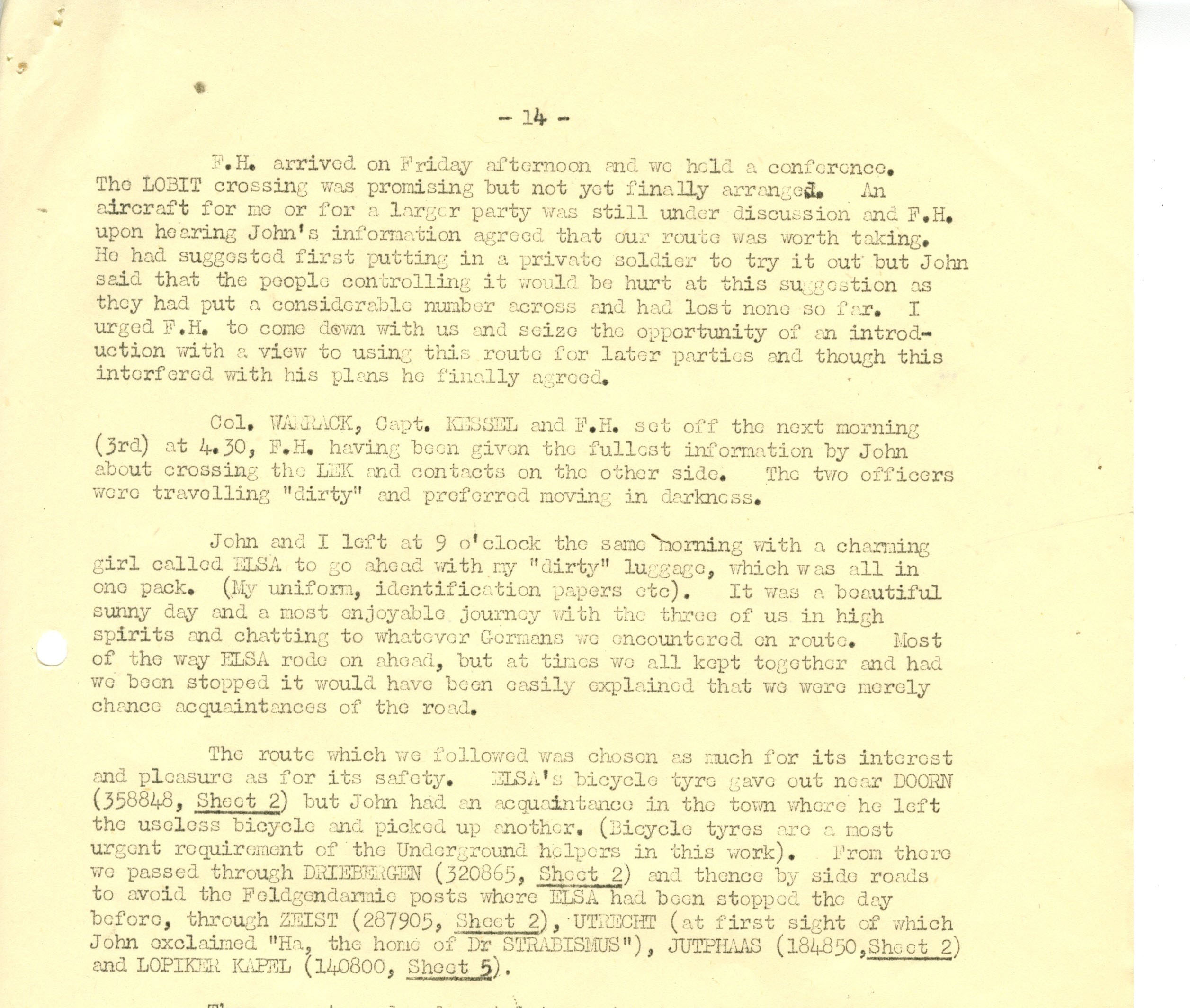
Warrack's side of the journey. ◐ In Warrack's book (as above, no surname) "our friend Dick turned up with good news. Brigadier Hackett was coming to Doorn soon" (p. 229), but "didn't know any details as yet and so couldn't give his approval to our going with Hackett" (p. 229, bottom). Dick then "insisted that if we did try to make a break-out in this fashion, the Brigadier should issue a certificate stating that we were being moved on his responsibility and without Dick's consent" (pp. 232, 233), and the party was to travel "by night with Dick as our escort" (p. 233). At three in the morning "Dick, Lippy and I followed him [the guide] out into the wind and pouring rain" (p. 234, bottom) (Warrack, Travel by Dark).
Caspers, the next day. ◐ The ride back is told twice, by what is by our reading one woman with three names: Loek Caspers, who wrote Kragt's obituary in 2008 for the Documentatiegroep '40-'45, and the courier "Elsa" of the memoir above, who is Nellie Cato Caspers on her file with the Americans (above). Both have the same ride the day after the crossing, with Kragt, over the Lek by the Ministry of Works' boat, and Hackett says "Elsa" was an operational name (p. 216). Geschiedenis Magazine calls Loek Caspers a courier from the age of nineteen, with "Loek" her cover name, and has her dying the week before 14 August 2019, aged 95 (the article). ⚠︎ Our own extract of the memoir says the opposite, "Not to be confused with Loek Caspers, author of Vechten voor vrijheid (2007)" (the extract), and her American file gives Driebergen, not Maarn; the identification is not settled. In the obituary: "Zelf fietste ik met hem op 4 februari 1945 van Groot Ammers naar Maarn" (I myself cycled with him on 4 February 1945 from Groot-Ammers to Maarn), over the Lek, where crossing was strictly forbidden, in the boat of a Rijkswaterstaat skipper whom "Dick kende" (Dick knew), with ice still lying along the Lek and floating in it (the obituary, from the Wayback Machine's capture of 22 January 2021). In the memoir she rode back with Kragt the next day, a Sunday, and he "had obtained a boat from the Ministry of Works" (p. 74, text layer; 4 February 1945 was a Sunday, and Rijkswaterstaat is the Ministry of Works). Both are her own recollection, written 50 and 63 years after the event, so if she is one woman they are one witness telling one ride twice, not two sources.
- She has Kragt check the safety of the reception houses at Leersum, Doorn and Maarn, and once nearly caught with staff maps rolled up in his bicycle bag, which he told the Germans was wallpaper, talking so movingly of how hard wallpaper was to come by that "Ze vergaten te kijken of het echt behang was" (they forgot to look whether it really was wallpaper).
- By her account the crossings went over the Rhine between Overlangbroek and Amerongen and through the Betuwe until the fighting there in January 1945 closed that way, and the Biesbosch route came into use at the beginning of February.
The Sliedrecht line on the helpers' forms. ✓ Five forms from the Groot-Ammers end (Dogterom, De Heer, De Heer-de Bruin, Van Duuren and De With), all checked on the images, list largely the same parties, and name Kragt as the man who gave them over:
- Marrigje Dogterom of Groot-Ammers, a courier and guide of the transports, lists some forty names, Ridler, Redman, Goggin, Low, Lockett, Boyd, Branford, Ramlow, Kubly, Murrell, Stearns, Geary, Christie, Stoner and others among them, and closes: "All these persons are received from Dick Kay (Veluwe) and given to P. Visser, Sliedrecht" (p. 3); the ones marked with a cross, among them Falkowski and Olszewski, "shot the 9th of March 1945", were given to the Canadian commander at Meerkerk on 8 May 1945.
- Jan Jacobus de Heer's table has Hackett "received from" J. Snoek, Ede, on 3 to 6 February 1945, and Warrack, Kessel, Ridler, Redman, Goggin, Low and the rest from "Dick Kay ('Frans')", all passed to P. Visser, Sliedrecht (p. 12).
- Cornelia de Heer-de Bruin's list, from Low on, has the same (p. 13).
- Kars van Duuren's has Hackett from "J. Snoek, Nagtegaallaan, Ede" and Carr, Davies, Batterbury, Redman, Goggin, Low, Lockett and others from "Dick Kay S.A.S." (p. 8).
- Klaas de With's has "Dick Kay S.A.S." for Carr and the rest down to the two Polish airmen (p. 8).
- Dirk L. van der Brugge's table has much the same names, from "Dick Kay S.A.S." to "P. Visser Sliedrecht" (p. 12). Frank McNaught, "F.M. NAUGHT 11th Batt. Rgt" there, is on De With's, De Heer's, De Heer-de Bruin's and Dogterom's lists too.
- ✓ De Heer's and Dogterom's forms fit Hackett's report: Snoek brought the brigadier, and Kragt the others. ⚠︎ Van Duuren's form has Warrack and Kessel, too, from Snoek (their two rows are ditto-marked under Hackett's "J. Snoek") and the rest from Kay, so it disagrees with De Heer's and with Hackett's report on those two.
- ◐ Redman is on three of them (Dogterom's, De Heer's and Van Duuren's), so those helpers have him go by the Sliedrecht route, as one of Kragt's parties; no source here says on which day, and Goudriaan's January row (above) puts him at Barneveld first. The forms date Kragt's parties little beyond February to May 1945 (De With has "verborgen: 18 Feb. 45" for Rilert).
The Biesbosch and the Amerongen end. ◐ Gerrit van Schuppen's file, of Amersfoort, says that after the failed crossing of 17/18 November 1944 about 40 men fled to Barneveld and stayed at their addresses until about January 1945, when "Captain Kay took up contact with the 'Biesbosch'"; people of van Ginkel (district commander of the N.B.S.) and of the group of Cor Lof then took the men to Amerongen and Scherpenzeel, "where they were taken over by Jan Oke", which got "the greater part" of them away, "abt. 25 to 30 men"; he also housed "Captain Beckers, 1st Can. Army (wireless operator) (for Frans Hals)" from the end of February 1945 (his file, p. 5). Hendrik van Loenen, whose network ran the crossings through Hoogland at Amerongen, wrote in his own report that he had "contact gezocht met Frans Hals" and agreed that he would arrange the crossing of the evaders, for which he "Jan O.K. (heer N. Hoogland uit Amerongen) aangenomen" (engaged Jan O.K., Mr N. Hoogland of Amerongen) (Cornelisse-van Brink's file, p. 14; Nico Hoogland). The Americans' card on B. A. M. de Groot of the Cawton group says he "Acted as courier between the Cawton group and Dick Kay group" (p. 4).
- ⚠︎ This is a third account of who opened the Biesbosch route, beside Hackett's (Snoek found it, Kragt agreed to it after doubt) and De Jong's: van Schuppen and van Loenen make the Biesbosch and Amerongen crossings an arrangement between Kragt and the Cawton group from about January 1945, run by Hoogland from Amerongen. The accounts need not conflict: Sliedrecht was one end, Amerongen and the Biesbosch another. Neither of the two helpers dates the arrangement more closely.
Lt John Low, 10 to 17 February. ✓ The American pilot John Low, who had been at Gerrit van Omme's at Barneveld since 4 January, wrote that the last time he saw "DICK" was at 1400 hrs on Saturday 10 February 1945, when he "came to give me instructions for crossing", and that there were "approx 60- 70" evaders "under DICK's control in the BARNEVELD area" in December 1944, most of them RAF and USAAF, with Dick knowing of about 20 more near Amsterdam and 30 on the IJssel (Low's statement, p. 39). The Americans' summary of his route says that he left on 10 February "with DICK as guide", by bicycle to Maarsbergen, Schalkwijk on the 12th and Groot-Ammers on the 14th, where "Subject was here guided by KLAAS and KARS" and "evidently they are in close contact with DICK", to Sliedrecht on the 15th and by boat on the 17th (p. 9). The two pages sit oddly together: he last saw Dick at 1400 on the 10th, yet left that day with Dick as guide.
The last weeks: notes to Klaas Heijboer, April 1945
Link to the section The last weeks: notes to Klaas Heijboer, April 1945The Americans' summary of Klaas Heijboer's file, on the Lek crossing group at Groot-Ammers, says "Constant communication was held by this group with Lt. Dick Kragt ("Frans Hals") and another officer of the Special Forces" (Heijboer's file, p. 29); Heijboer's own questionnaire has communication "Every other day … through couriers namely Dick Kay and Capt. S.F. [?]" (p. 2). Two of Kragt's notes to him survived and Noordman reproduces them:
- ◐ 3 April 1945. A handwritten note headed "3/4/45", "Waarde Klaas", signed "Dick": by our reading of the handwriting, the situation had so changed in a few days "dat wij momenteel geen jongens meer weg kunnen sturen" (that we cannot send any more boys away at present), and the other side had asked them to send no more, the liberation being at the door (Noordman, fig. 63, p. 117). Noordman prints no transcription of it.
- ✓ 10 April 1945. A typed note headed "Dinsdag 10/4'45" (Tuesday 10 April 1945), "Waarde Klaas", which Noordman calls Kragt's last courier note to Heijboer (Noordman, fig. 162, p. 247). Noordman's list of sources has both notes, and a recommendation Heijboer wrote for an award to Kragt (p. 344).
- Noordman transcribes its passage on a Polish airman, "(Nico Hoogland)" being his gloss; his transcription is slightly normalised (the image has "toesturen, dat zij hem door moeten sturen"), and "(I. Olszewski)" is a handwritten addition in the margin of the note (Noordman, p. 326; fig. 162; Nico Hoogland):
Now there is a Polish squadron leader at Amerongen (I. Olszewski). I shall send word to them at once tomorrow that they must pass him on. Now it is the famous 'JAN OK' (Nico Hoogland) who has to arrange it!
Dutch originalNu zit er in Amerongen een Poolse Sqdrn. Leader (I. Olszewski). Ik zal morgen meteen bericht naar hen sturen, dat ze hem moeten doorsturen. Nu is het de befaamde ‘JAN OK’ (Nico Hoogland), die dit moet regelen!
— Dick Kragt to Klaas Heijboer, 10 April 1945, as Noordman transcribes it · Schuilplaats de Veluwe (2019), p. 326 · the book
- The note also plans to send "de Majoor" and a "Lt. DAVIES" of the Airborne separately "over de [struck] lijn die wij de vorige weken geregeld hebben" (over the line we arranged in the past weeks), and its last full sentence on the reproduction is "Via Jan OK zal ik nooit iets mondeling meegeven" (I shall never send anything by word of mouth through Jan OK).
- ◐ Noordman reads its tone as showing that Kragt and Hoogland did not get on (p. 326).
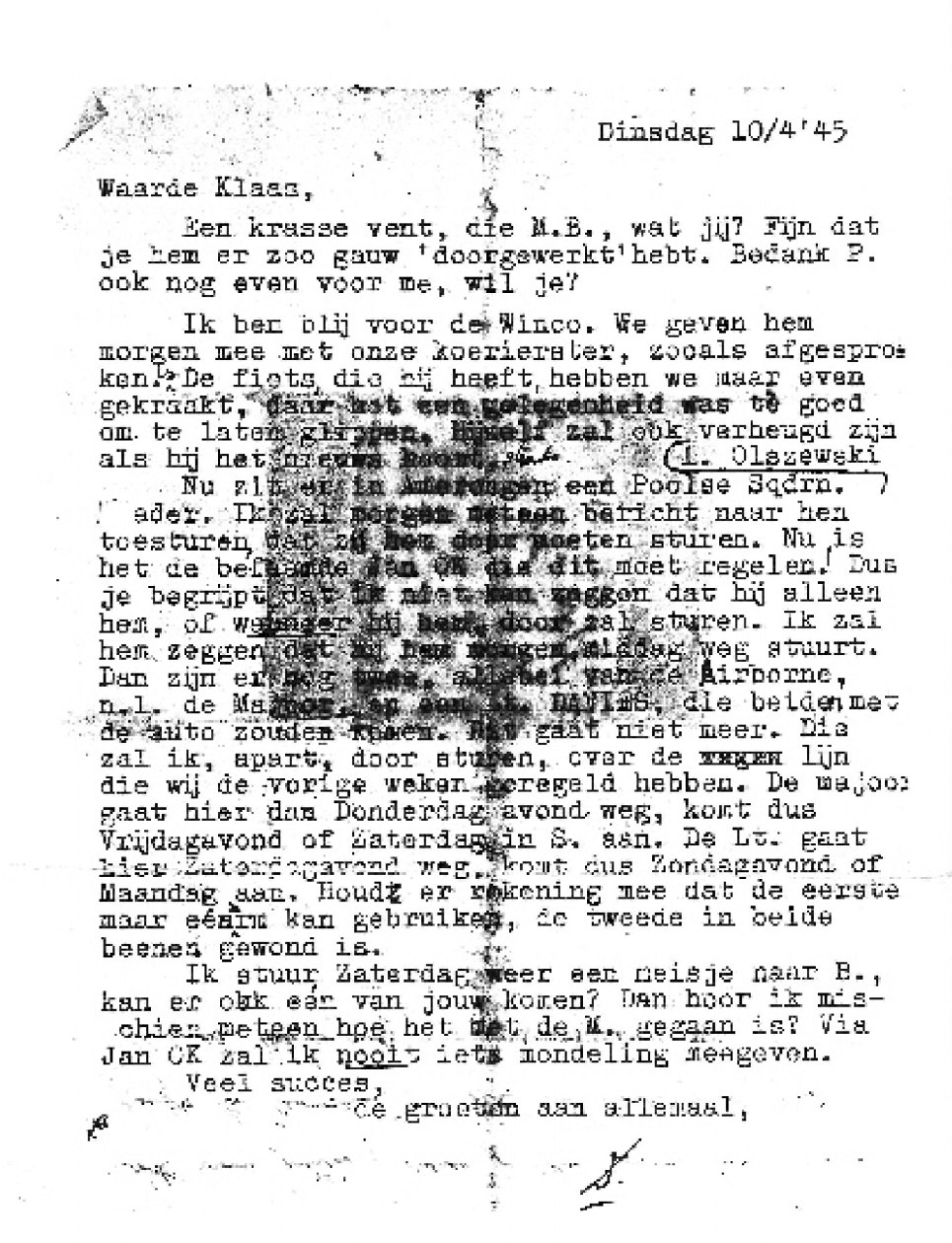
A farm at Voorthuizen, and the raid of 12 April 1945. ◐ Willem Vonkeman's farm at Voorthuizen ("Klein Harselaar", named on p. 9) was, on the Americans' action report of 19 October 1945, "Dick Kay's H.Q." which "was burnt down by the S.D." (the report, checked on the image). An unsigned "advice" of 21 July 1945 says two Landwacht men tried after the war proved the raid on it "was a sequence of the fact, that headquarters of the Frans Hals org. were settled in Vonkemans farm" (p. 4). The family's supplement tells the raid: on Thursday 12 April 1945 at half past seven twelve men of the Landwacht and the SD, one German and three Dutchmen among the SD, surrounded the farm and questioned a farmhand about "a pilot organisation", beating him badly and the widow's daughter Annie too; "Neither ... told anything, this fact helped to save the archives of the Frans Hals organisation and as a result also the life of Joop van Amstel's family", who had lodged at the farm from 19 January to 12 April and were among those ordered into the kitchen; the son Willem Vonkeman and a servant hid in the house (p. 9; p. 10; Joop Piller). ⚠︎ The supplement has the SD threaten to burn the farm and says nothing of its burning; the summary's "burnt down" is unexplained. Kragt's own report ends on 18 April, six days after.
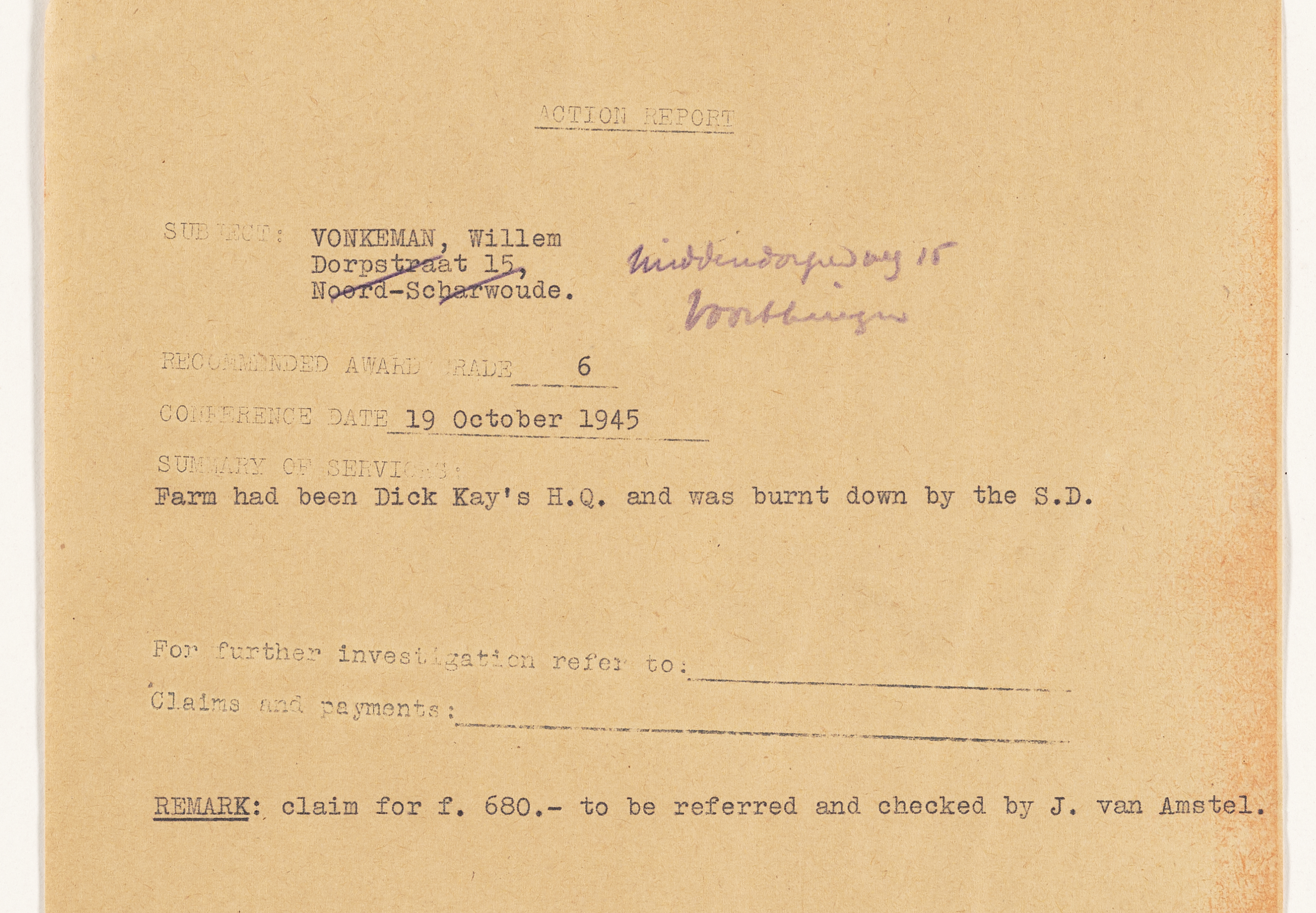
Seven men from the Achterhoek. ◐ Undated. A. G. Hopink of Zevenaar, a reserve major, wrote for the Americans in 1946 that J. W. van Loon of Doesburg had guided "6 Belgians and one Norwegian pilot from Enghuizen (Castle at Hummelo) and Keppel via Angerlo-Giesbeek-Rhedenscheveer (river crossing) Ellekom-Dieren-direction Laag Soeren", by bicycle, "in cooperation with Dick and Joop (Lt. Kragt and J. van Amstel)"; they "were supposed to cross the lines at de 'Biezenbosch'", and Hopink did not know whether they had got through (Hopink's letter in Van Loon's file, p. 23).
After the liberation
Link to the section After the liberationHis report ends "On April 18th (?) I was liberated, having completed a one year and ten months period in enemy occupied territory" (report, p. 5); the Americans' memorandum of 22 February 1946 has him "in active service in the front lines until 16 April 1945" (p. 22), and their summary has the area overrun on 17 April (p. 7).
- Vouching for the helpers. His organisation typed numbered reports on its people for the Americans: he signed Elbert van Omme's, no. 20, "Frans Hals" (above); Huib de Iongh's is no. 16 and Dirk van Eysinga's no. 17, each with illegible initials, and Willem van Dijk's, no. 22, is unsigned (Van Eysinga, p. 3; De Iongh, p. 3; Van Dijk, p. 4). The office checked other claims against him: "For further investigation refer to: Dick Kay" on Heimen van Esveld's file (p. 13), and the "Kay's information" notes and the Van de Berg slip (above).
- A trip to Frankfurt, March 1946. On 13 March 1946 the Americans' Holland office supported "The proposed trip to Frankfurt, Germany of Lieutenant D. Kragt", whose orders came from Major P. Windham Wright of "I.S. 9 (A.B.) Holland and Denmark" (p. 38).
- The Americans' file closed. A memo to Major Squires notes him as "Living out of Holland. Case closed for 6801 MIS-X Detachment. Frankfurt and MA England will award Medal", and is marked by hand "DECORATED IN LONDON BY M/A / CASE FINISHED / FILE" (p. 45).
The British and American awards. ◐ In the Shadows says that "In 1947, the British government awarded him the King's Medal for Courage in the Cause of Freedom" and that "The following year, he was awarded the Medal of Freedom with Gold Palms by the American government", and prints the citation, which runs from 23 June 1943 to 17 April 1945 (the passages):
First Lieutenant Dignus Kragt, British Army, for exceptional heroism in connection with military operations against an enemy of the United States … for twenty-two months Lieutenant Kragt built up and directed an underground chain in enemy-occupied territory which recuperated, fed, clothed and housed hundreds of Allied airmen and led them back to friendly territory where they rejoined their fighting units.
— Michael Ashcroft · In the Shadows (Biteback, 2022), the Kragt entry, from the Internet Archive's full-text index, not read on the page · the passages
The King's Medal for Courage is not otherwise on this page. ✓ The printed order settles the palm and the date. General Orders 335 of US Forces, European Theater, dated 21 November 1946, para III.1, awards "the Medal of Freedom with gold palm" to "British Army / First Lieutenant Dignus Kragt -- 23 June 1943 to 17 April 1945", the same period as the book's citation (Kloosterziel's file, p. 12, read on the page: the last digit of the year is cut off at the page edge, and the Army Commendation dates in para II, which run to 20 October 1946, fix it as 1946). The same page is in the files of van Riel, Felix, Terwindt, van den Eynden and van Rij and in the Czechoslovak cases file, read there on the OCR only.
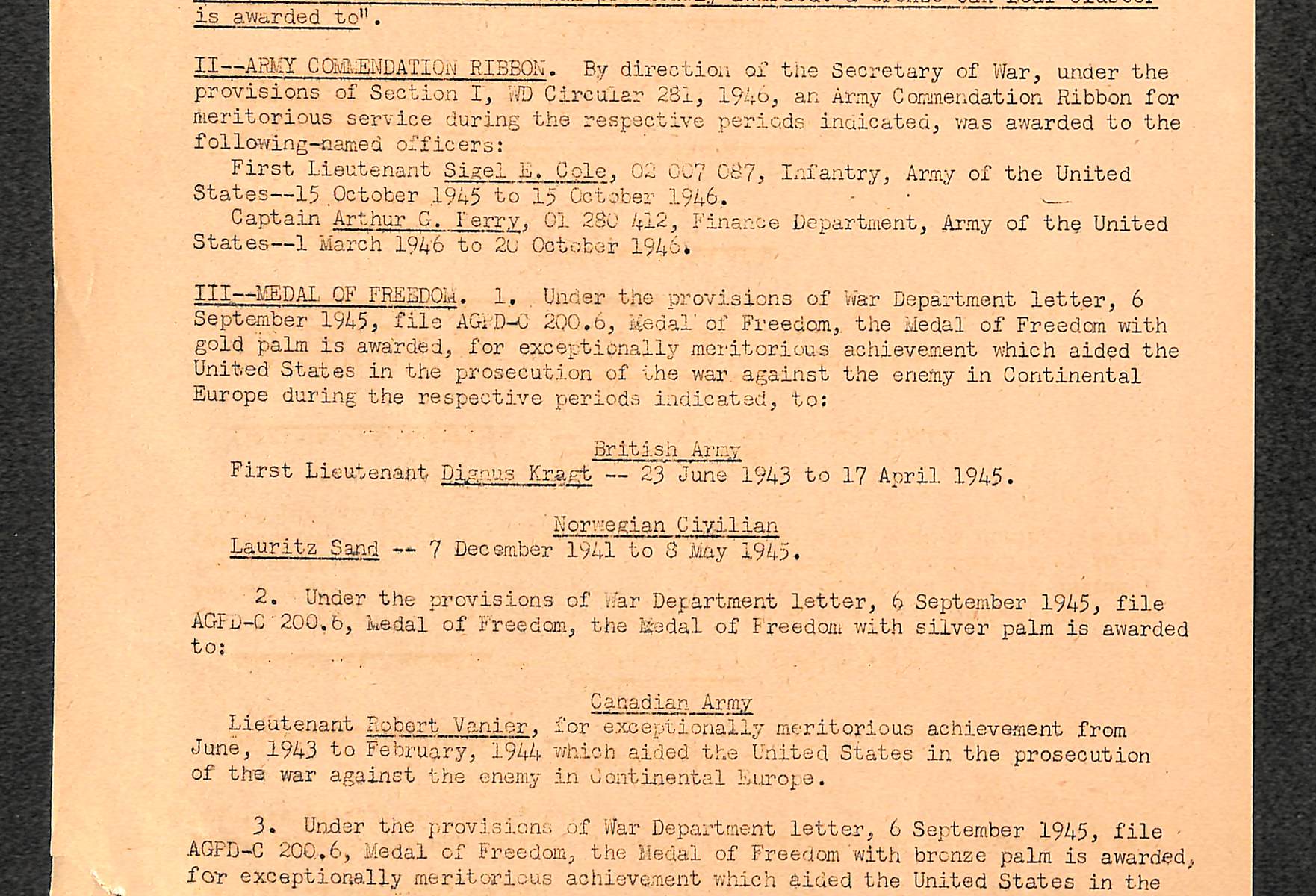
✓ That is gold palm, as the Americans recommended (28 February 1946, p. 14) and as In the Shadows says. ⚠︎ Major Squires's note, quoted in a letter of 15 January 1947 (p. 3), "Awarded by GO 335 with Silver Palm", is a slip: the silver palm is para III.2 of the same order, which on this page lists one man, Lt Robert Vanier of the Canadian Army. The book's "the following year" is not borne out either, since the order is of 1946; 1948 is the year of Kew's recommendation, WO 373/148/713, "Foreign to British: USA", the Gazette notice dated 23 July 1948; digitised at Kew, but the file itself is not held (the catalogue entry).
His work ended on 17 April 1945, when the Allies overran his area, "making a total of 22 months of active service behind enemy lines" (p. 7). The Americans graded him 1 and recommended a military decoration equal to the DSO, for which IS9 was putting him forward (pp. 1, 7). He was in Britain when the grade-1 awards were presented, and was given the Medal of Freedom with gold palm by General Orders 335 of 21 November 1946 (above); the Americans' own records date the award to 4 December 1946, when the orders and citations went to Col. Ackerman (pp. 2–3). ✓ The Netherlands gave him the Bronze Lion by royal decree of 20 December 1951, no. 31, as "Kapitein van het Britse leger" (captain of the British Army), on the War Ministry's proposal; its register number is 1121. The card has him Dignus, born at "Datchet (Engeland) 18-7-1917", and on its back, in July 1952, "Regional Manager for Norway K.L.M. Royal Dutch Airlines", living at Snarøya, outside Oslo (his award card, Nationaal Archief 2.02.32; Noordman also has the Bronze Lion, Noordman, p. 119). The card carries no citation. ◐ Kew holds the British recommendation file for the same award, WO 373/144/2, in which he is "Captain", service number P/345755, Intelligence Corps, "Foreign to British: Netherlands", with the date 15 February 1952 (the catalogue entry; digitised at Kew, but the file itself is not held). ◐ In the Shadows quotes a Bronze Lion citation, from the Archive's search index (not read on the page): he "greatly distinguished himself as the originator and leader of an escape organisation to England for Allied pilots shot down over the Netherlands", and used the escape route to pass military information on the enemy to the Resistance up to the liberation (the passages). In 1964, for the chapter Evert Werkman added to the Dutch edition of Warrack's Travel by Dark, he said of the evaders: "Vaak konden ze niet fietsen" (often they could not ride a bicycle) (Algemeen Handelsblad, 18 July 1964). Bowman's Mosquito Mayhem has the Mosquito pilot Robert Bailey, hidden at Renswoude in June 1944, visited by "Mr Van Den Topp from Stroe in Gelderland and 'Dick', a British agent", who "questioned me for some time to establish that I was an evading RAF pilot" (Bowman, p. 76, checked on the image); ◐ Kragt, by name, role and district; Bowman does not say so. Het Parool in December 1945, on the radio service at the farm "Het Schip" near Barneveld, has the radio reports passing "more and more into the hands of British officers, among whom Captain 'Dick' took an important place", and Captain Dick carrying three complete sets there in his bicycle panniers, dropped the evening before (Het Parool, 31 December 1945; ◐ Kragt by name and role; the passage OCR only, not checked against the image). At the Van Esveld farm at Kootwijkerbroek, the signaller Bob Peatling met "the secret agent Dick Kragt, parachuted", who spoke very good English and, Peatling says, "could not do much as an intelligence man, because he had lost his radio" (Dekkers and Vroemen, p. 212); ⚠︎ that does not square with the sets he and Piller had by then (above); not settled.
Later life
Link to the section Later lifeLater life and death. ◐ From In the Shadows, by the Archive's search index, not read on the page: after the war he went back to Philips and then to KLM Royal Dutch Airlines (✓ the 1952 card has him KLM's regional manager for Norway, ⚠︎ two decades before the books' move there in the mid-1970s); "While holidaying in Norway, he met Karin Rosted and they married in London in 1947", and in the mid-1970s they settled near Oslo. "His wife died in 1995. Dignus Kragt died at Berum, Norway, on 8 July 2008, aged ninety-one"; his neighbours "remembered him as a quiet, unassuming gentleman", and learned of his wartime work only after his death (the passages; the book's printed pages are 79–84, and "page 482" in the search index is not a printed page). ✓ Born 18 July 1917, so he was ninety on 8 July 2008, ten days short of ninety-one: ⚠︎ the book's "aged ninety-one" is a year too many by his birth date. No death record has been seen. Noordman has the same date, 8 July 2008, with no place (p. 119), and the entry on him in Godmanchester at War (2021) has "18 July 1917 — Died 8 July 2008" (the search hits, not read on the page); the place, "Berum, Norway", is in In the Shadows alone.
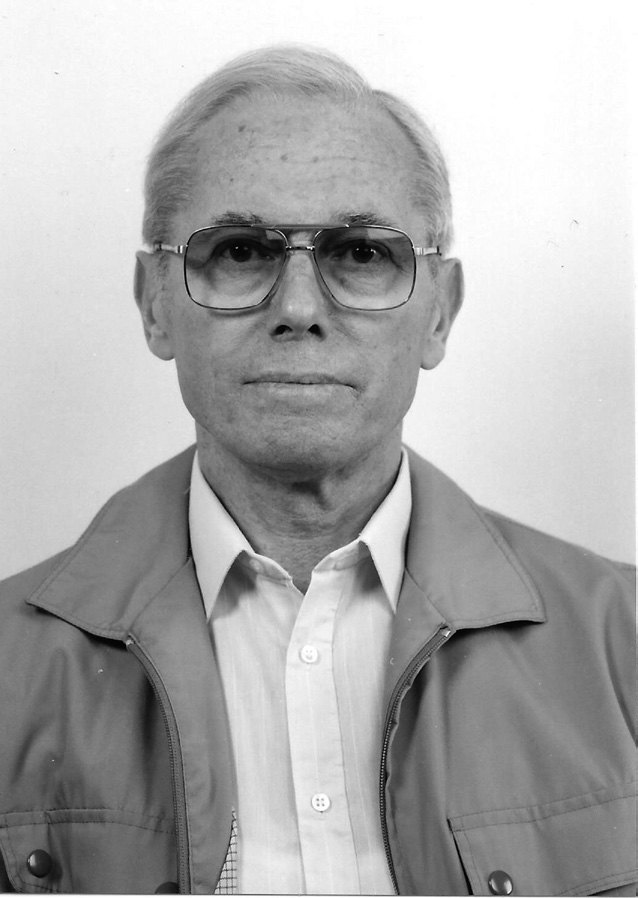
Noordman, who was in touch with him in 1995 and 1997, has him working after the war for IS9's awards bureau, for Philips and for KLM; on holiday in Norway he met Karin Rosted, they married and had a son, and in the mid-1970s they moved to her native Norway; Karin died in 1995; his last visit to the Netherlands was in 1999, for the 55th commemoration of Arnhem, where veterans met the resistance people who had helped them; and he died on 8 July 2008 (Noordman, p. 119). A photograph in the same chapter is captioned "Dick Kragt blikt na de oorlog terug bij airborne dokter Redman. Een van de mensen die hij naar bevrijd gebied hielp" (Dick Kragt looks back after the war with the airborne doctor Redman, one of the people he helped to liberated territory) (fig. 59, p. 111, the picture credited to T. Redman, England, in the list of illustrations, p. 348).
- Loek Caspers's obituary, 16 July 2008. She calls Kragt very careful, cool-headed and modest, someone who hardly ever spoke about the war; after the war he worked for KLM and lived in the Netherlands, married a Norwegian and in later life went to live in Norway, staying there after his wife died (the obituary).
- "Zijn laatste bezoek aan Nederland was bij de 50e herdenking van de Slag om Arnhem in 1994" (his last visit to the Netherlands was the 50th commemoration of the Battle of Arnhem in 1994).
- Het Parool, other papers and the Veteraneninstituut headed their obituaries "Oorlogsheld Dick Kragt Overleden" (war hero Dick Kragt dead). Those obituaries have not been found or archived.
- Hackett. ✓ Nichol and Rennell's Home Run (2007) has Hackett, on his yearly visits to the Netherlands until his death in 1997, meeting again "Dick Kragt, the secret agent he knew as 'Van Dyck'" (p. 442, read on the page image; the note "Dick Kragt, alias Frans Hals, but known to Hackett as 'Van Dyck'", p. 492; John Hackett).
- ◐ Godmanchester at War (2021) has an entry headed "Dignus 'Dick' Kragt Dutch Resistance Dutch Bronze Lion Medal" (index pp. 133–134); from the Archive's search text only, the book not read, and what ties him to Godmanchester is not in the hits (the hits).
The Gemeentearchief Barneveld holds a photograph of him, not online (the catalogue entries).
A "Dick" at Westerhuis. ◐ The Americans' card for T/Sgt James R. Wilson has the line "With Riley & Knowles at farm near WESTERHUIS on 28 Nov 44; moved by "DICK" - CRAVEN (British) IS9(WEA)/1/308/2402." (Wilson's card, read on the image; NARA's "Card List of American Airmen Reported Missing-in-Action, Last Name J-L"). Earlier on the same card "See BLAKEMORE (British …)" points to another evader's British report, so "CRAVEN … IS9(WEA)/1/308/2402" is very probably the report of the RAF flight lieutenant Jack Craven, cited the same way, and not a second name for "DICK" (John Craven). A J. R. Wilson is on the list in Van der Brugge's file, "received from Dick Kay" and passed to Visser at Sliedrecht, and Jack Craven is on Dogterom's list, "received from Dick Kay (Veluwe)" (p. 3), and on the lists of Heijboer (p. 30) and of Visser, which has the men from Heijboer, the stage before him (Van der Brugge, p. 12; Visser, p. 29); ◐ the Wilson entry and the "Dick Kay" of Kliest's report on Craven's page make Kragt the likelier "Dick"; ⚠︎ the other reading, a "Dick" of Gerrit van Ee's farm group (Van de Braak's list), is not excluded, and Craven's report WEA/1/308/2402 at Kew would settle it.
Where the sources disagree
Link to the section Where the sources disagree- Who sheltered him first in June 1943. Piller's statement of 1945 has Kragt brought to his house from the contact address at Epe, and De Jong has him move in with Piller, who was hiding in a cottage on a friend's holiday camp at Emst.
- ✓ His own report has the house "VOSSEBES" first, reached at five in the morning after a day hidden in the grass, then on "Friday (?) the 25th", a "raiding"-day, the dug-out in the woods where he met Joop, and then "five months" as "the guest of Joop and Lies" (report, pp. 1–3). ◐ By our count of his nights, he reached the Vossebes on the morning of 25 June 1943, a Friday, and went on to the dug-out the same day.
- In the Shadows has him make for a Resistance couple's house and then a dugout where he meets van den Boogert and Piller.
- Johan Uelen of Emst wrote that Kragt was "brought to me by Koos v.d. Boogaert" and sheltered by him until 15 July 1943 (Uelen, p. 2; Joop Piller).
- ✓ Piller's own testimony to the commission has both: Kragt "heeft in een schuilkelder gezeten, totdat de zaak tot rust was gekomen in verband met het pak, dat hij verloren had" (sat in a shelter cellar until the matter, in connection with the pack he had lost, had calmed down), and later came to Piller and stayed the whole war (deel 4C-II, p. 1324, question 55018). That fits the dugout in In the Shadows and in Kragt's own report, and leaves room for Uelen's weeks.
- Warrack has him given "the name of a loyal Dutchman, Joop van Amstel" before he left England (Travel by Dark, p. 183; page image), where De Jong has van den Boogert's address as the contact.
- ◐ They can fit together: Uelen's weeks may be those before Piller took him in, but Piller said both things: that Kragt came to him "the next day" (question 54929; his 1945 statement has him taken straight to his house) and that he first sat in a shelter cellar (55018). Van den Boogert was arrested in the autumn, so Uelen's 15 July is not reconciled.
- Who set up the Sliedrecht and Biesbosch routes. Kragt's own report ("the result" of plans he discussed with Hackett), Hackett's report (Snoek found it, Kragt agreed to it after doubt), De Jong (Kragt "at first rejected" it), Caspers (Kragt tested the Maarn line), and van Schuppen and van Loenen's forms (Kragt took up contact with the Biesbosch, Hoogland ran the crossing) are set out above; no source dates the Amerongen arrangement.
- Where he was dropped. Between Epe and Vaassen (Kluiters, Piller's testimony, In the Shadows); at Vaassen in De Jong, "in de tuin van een huis te Vaassen" (in the garden of a house at Vaassen; deel 7, p. 945), and "above Vaassen" in Uelen (p. 2); "in the village of VAASSEN (near Apeldoorn)" in his own report (p. 1); "at Vaassen near Apeldoorn", eight miles from the Wesselse Veld, in Neave (p. 280).
- "Not far from Deventer" (Foot and Langley, p. 234); "near Ede" (Roskam, 1984, p. 273); "near Baasen, not far from the town of Ede" (Heaps, p. 24); "a turnip field next to the church in the village of Baasen, near the town of Ede" (Bentley, 2007, p. 5); "on the Veluwe" (Nel Lind, deel 4C-I, p. 969).
- Lopez has "one day in 1942", giving no source for the year (The Man Who Made Vermeers, p. 16).
- June 1943 in all but Roskam's "1942", Lopez's, Heaps's "May 1943" on p. 192, Warrack's "May 1943" (p. 183; page image), Kessel's "first dropped in Holland in May, 1943" (p. 153) and Uelen's "May-June 1943" (form, field 10); the Ede research notes date the drop 22 June on p. 7 and 23 June on pp. 1 and 2 (Ede 1006/493), and the Ede manuscript has "Op 22 juni 1943 was hij tussen Epe en Vaassen afgesprongen" (p. 43), against 23 June in his report and the rest.
- His rank and his medal. Lieutenant (the Americans, Piller's form), captain (his Dutch award card, "Capt Kay" on the helpers' forms, Uelen's form: "Capt. D. Kay"), sergeant (Wat bewoog u?; Warrack, p. 212; page image); "Captain (temporary)" in the London Gazette of 1948 (the Gazette). Gold palm on the printed General Orders 335 and in the Americans' recommendations, "Gold Palms" in In the Shadows, and "Silver Palm" only in Major Squires's note of 1947, which the order shows to be a slip (above).
- His mother's naturalisation and his own. Kew has Edith Matilda Kragt's certificate of 26 October 1937 (◐ a catalogue entry only, hers by name alone, as above); De Jong has him take English nationality in 1938. Not reconciled; both are consistent with a mother readmitted to British nationality first and the son registered a year later. ◐ Piller told the commission in 1949 that "op zijn 21ste" he took English nationality (at 21, or in his 21st year: 1937 to 1939 by his birth date) (p. 1320, question 54940), which fits De Jong's 1938.
-
How long he had lived in the Netherlands. "Nine years" in the Americans' summary (p. 6); Nel Lind told the commission "veertien jaar" (fourteen years) (deel 4C-I, p. 969, question 48926), and says she did not know whether he was English or Dutch. ⚠︎ Unsettled: In the Shadows has him born in England, the family making "frequent trips to Holland", and no third source gives a figure.
-
The three turn-backs. His report says only that the drop was "my fourth attempt within a fortnight" (p. 1). Neave has the aircraft return three times because the pilot could not find the zone and the third crash-land at Tempsford after cannon fire (p. 280); Noordman has the first broken off by flak over Deventer (p. 110); In the Shadows has flak, then high winds, then a flak ship (above).
- The second house. "Lived there happily for 2½ months" in his report (p. 3); "zes weken" (six weeks) in Noordman's version (p. 114).
- Koos. A distribution official in De Jong (deel 7, p. 945), a baker in Noordman (p. 113).
- Who organised Pegasus II. His report has him and Ham arranging the rendezvous and times (p. 4), and Bentley has the operation "supervised by Dick Kragt" (above).
- Kirschen's Six Friends Arrive To-Night (1949), through whose set the messages went, has it "organised by Ham, the details of which had all been arranged between himself and Brigade via us" (p. 104, read on the image; Abraham du Bois).
- ◐ The two need not exclude each other: Ham as the organiser, Kragt as one of the two who arranged the rendezvous and times.
- The Archive's full-text search of that book finds neither "Kragt" nor "Frans Hals" (the search).
- Why he did not go out with Fabian's party. "Frustrated by an order from London" in his report (p. 5); King's refusal in Warrack (pp. 212–213; page images 212, 213).
- The Elburg lorry. "Engine failure" in his report (p. 5); "stopped by a Wehrmacht Control [Point]" in Noble's (Noble).
- The party of six on the night of 17 November. Four lost in Hardy's report (17 November) and in Kragt's (undated; ◐ the same party), two in Walsh's; "by foot" in Kragt's, on bicycles in Hardy's (above).
- His last visit to the Netherlands. 1994, the 50th commemoration, in Loek Caspers's obituary (the obituary); 1999, the 55th, in Noordman (p. 119).
- When he went to Norway. In the Shadows and Noordman (p. 119) have the move to Norway in the mid-1970s; the Dutch award card has him, in July 1952, "Regional Manager for Norway K.L.M. Royal Dutch Airlines", living at Snarøya (his award card). Not reconciled.