Joop Migchelsen
Hulshorst 16 Feb 1921 – by 16 May 1974
Johannes "Joop" MIGCHELSEN of Hulshorst, timber merchant (his statement of 14 June, ◐ 1945, in his American file, p. 3)
About: A timber merchant of Hulshorst who led a resistance group there. His group kept Murphy and five other Allied men at the forester's house Kijkuit in the Leuvenumse Bos, Murphy from 26 October to 6 November 1944 by Hardy's dates.
Unit or role: Leader of the group, "Joop Migchelsen, aged nineteen, was our leader" in a courier's account (◐ Lavender, The Evaders, snippets, p. 29); "L.O. B.S." as his movement and "Joop" as the name the Allied men knew him by on his own form (p. 2); "Woodmerchant, especially round timber" (p. 3). Grade 5 on the British index of Dutch helpers, certificate 22623 (sheet M/9), and on his American file (p. 1).
Where: Hierderweg 14, Hulshorst, post Hierden (p. 3; telephone "Hierden 3" on p. 2); "near the station Hulshorst" on a helper's form (Jan den Besten's file, p. 3). The men were hidden at Hierderweg 132, a double house (p. 3); ◐ that this is the forester's house Kijkuit of Noordman's book is our reading, from the forester's family and the men in both (Z. van der Vlist).
Evidence: ✓ his helper file with the Americans, US National Archives 286674924 (pp. 1–11); ✓ Hardy's MI9 report, 13 January 1945; ✓ the Sterrehoveke forms (Ima van Eysinga's, Liesbeth Verweij's, p. 3); ✓ his letter of 20 February 1946 in Joseph Reuten's file, p. 8; ◐ Noordman, Schuilplaats de Veluwe, pp. 278, 292–294; ✓ the burial register; ✓ De Telegraaf, 17 May 1974.
Johannes Migchelsen was born at Hulshorst on 16 February 1921, the son of Lambertus Migchelsen, 35, a dealer (koopman), and Heintje van Beek (the birth record, index only). His own statement gives the same date (p. 3), so he was 23 in the autumn of 1944. ◐ A Dutch book on Nunspeet and Hulshorst in the war, read only through the Internet Archive's search snippets, calls him "zoon van een hotelhouder bij station Hulshorst" (son of a hotel-keeper by Hulshorst station) (the snippets); the birth record of 1921 has his father a dealer.
The group
Link to the section The group◐ A courier of the group, Emma Vroege, told its beginning to Emerson Lavender, who printed it under the name "Emmy van Taack" in The Evaders (1992). The book was not borrowed; the passage is rebuilt from the Internet Archive's search snippets:
These people also needed ration cards, false papers and food, so a group of my friends got organized. Joop Migchelsen, aged nineteen, was our leader. We had people working at City Hall who would steal German rubber stamps for authorizing the required papers.
— Emmy van Taack, in Emerson Lavender, The Evaders (1992), p. 29, from the Internet Archive's search snippets, not read on the page · the snippets; the raw text
◐ She was fifteen from June 1940 to June 1941 and he was nineteen until 15 February 1941, so her account of the group's beginning falls between June 1940 and February 1941 (Emma Vroege). The same account has "Joop and the boys" fetch the crates of Sten guns and handguns dropped from Britain and bury them at "a little house in the woods" (the snippets; the raw text, pp. 29–30); ◐ that this Joop is Migchelsen is our reading, from her calling him the leader.
◐ The Nunspeet book has him altering papers: "Via Joop Migchelsen werden de geboortedata in de paspoorten veranderd" (through Joop Migchelsen the dates of birth in the passports were changed), and "Hun ausweissen heb ik bij Joop Migchelsen laten veranderen. Zo werd de letter "J" vakkundig" (I had their identity papers altered at Joop Migchelsen's; so the letter "J" was expertly …); the snippet breaks off there. It also has "Joop en Bertus Migchelsen uit Hulshorst brachten ons naar Ermelo" (Joop and Bertus Migchelsen from Hulshorst took us to Ermelo) (the snippets). The snippets give no dates and say nothing of how Bertus was related to him; ◐ Bertus can be short for Lambertus, his father's name in the birth record.
Another Hierden helper counted himself in Migchelsen's group. Hendrik Bastiaan de Raat, a sergeant, of Harderwijkerweg 495, Hierden, born at Nieuw-Beijerland on 30 August 1908, gave "Joop" as his underground movement on his questionnaire of 17 June 1946, and wrote: "Gave food for pilots to Joop Migchelsen, Hierderweg 14 Hierden." (de Raat's form, p. 2). The line names no men and no dates, so nothing ties the food to Murphy's party.
The people Migchelsen himself named as his helpers, on his form of August 1945 and in his statement, were "Miss Emma Wilhelmina VROEGE 118 Oude weg Hulshorst (food, clothing, comfort)"; "H. BAAR 121 Oude weg Hulshorst (not married) guard of the house where the pilots were sheltered", Bram Baar; "Reinier MOOY 118 Oude weg Hulshorst (transport in the woods)"; and, in the statement only, "Balthazar SIBBES, Hierderweg 14 in Hulshorst", his own address (p. 2; p. 4). Of food and money he wrote "Supplied everything, even tobacco and money", and "During the German occupation I did not smoke, so that I could give all my saved tobacco and cigarettes to Allied personnel" (p. 4).
A pilot at Het Roode Koper, early 1944
Link to the section A pilot at Het Roode Koper, early 1944His statement tells of a pilot lost before Murphy's time. ⚠︎ It is his account alone; no other source held tells it.
In the beginning of 1944 a pilot wandered through the woods near Leuvenum in Hulshorst. One of my assistants took him to the house "Het Rood Kooper" where the Family Patijn was living and then immediately inform[ed] me, At once I took the necessary precautions and only a few hours afterwards I could make my way to "Het Roode Koper" to collect him and shelter him at another address. But when I arrived at "Het Roode Koper" my assistant saw the police coming, afterwards it turned out that Patijn rang up the police because he was afraid and delivered the pilot. If I and my assistant had come sooner , we might have been arrested too.
— Joop Migchelsen, statement of 14 June (◐ 1945), in his American file · his file, pp. 3–4
He did not see the call made: by his account he reached the house as his assistant saw the police coming, and "afterwards it turned out" is all he says of how he learned that Patijn had telephoned. He gives no basis for it; of what became of the pilot he says only that Patijn "delivered" him, and no other source held mentions this pilot. He gave the man's home address as that of a Mrs W. Baber in Chicago (street left out here), and no name for him (p. 4).
The statement puts "the Family Patijn" at the house "Het Rood Kooper" ("Het Roode Koper" on its next page; on the first the page edge may cut a final e from its second word) and has a man of it ("he was afraid") telephone the police; it gives the caller only as "Patijn", with no first name, and no source says which man of the household it meant. The Sterrehoveke forms give Mrs van Asbeck-Patijn's address as "Roode Koper", Leuvenum, ◐ very probably the same house, and have Hardy come to them from her (Ima van Eysinga's file, p. 3; Liesbeth Verweij's, p. 3; Mrs van Asbeck-Patijn); the forms leave their date columns blank, and Hardy dates his walk from Leuvenum to Elspeet to 19 October 1944 (Hardy). Migchelsen's statement does not mention her.
The house at Kijkuit, autumn 1944
Link to the section The house at Kijkuit, autumn 1944His group kept the Allied men in half of a double house in the Leuvenumse Bos:
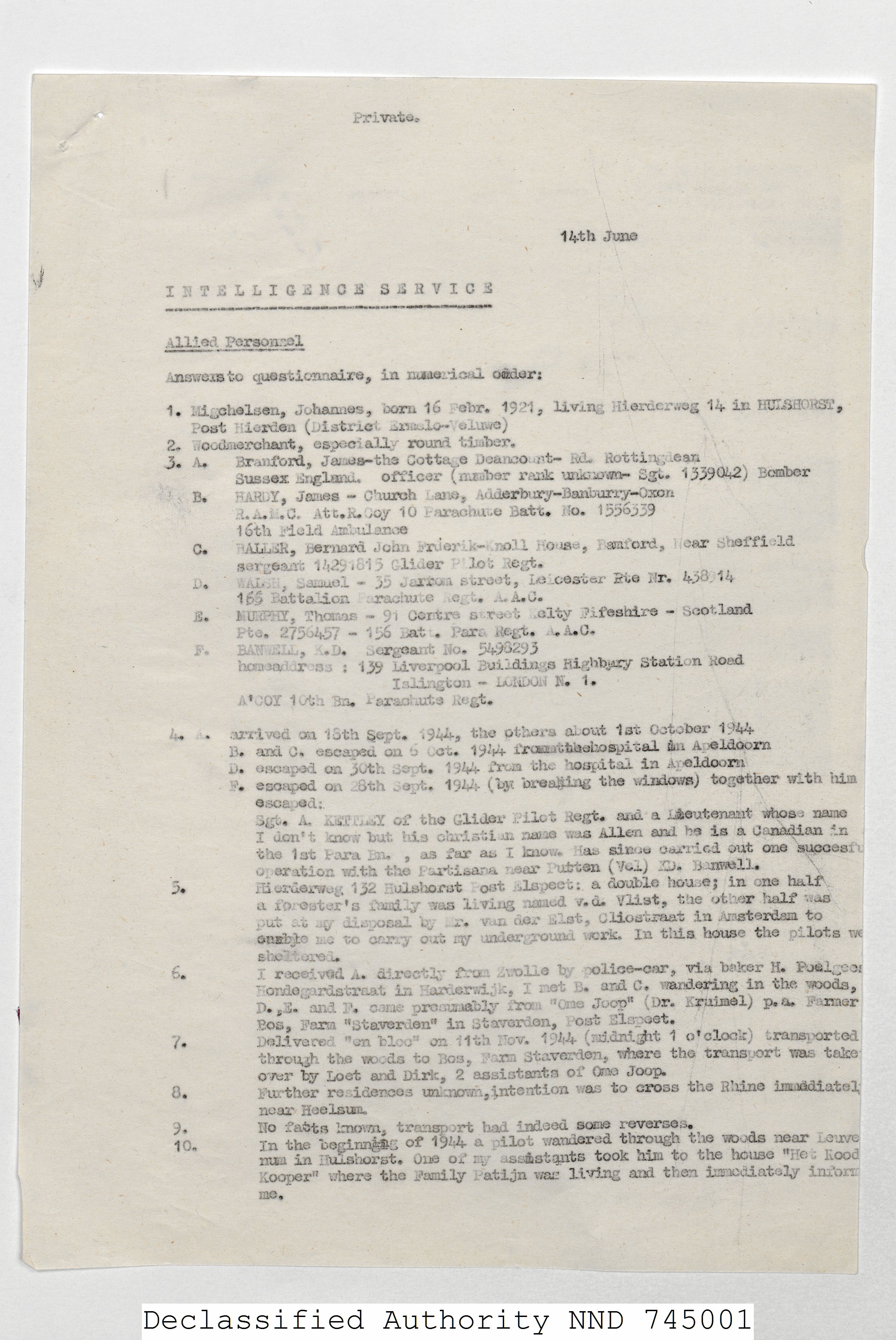
Hierderweg 132 Hulshorst Post Elspeet: a double house; in one half a forester's family was living named v.d. Vlist, the other half was put at my disposal by Mr. van der Elst, Cliostraat in Amsterdam to enable me to carry out my underground work. In this house the pilots we[re] sheltered.
— Joop Migchelsen, statement of 14 June (◐ 1945), in his American file · his file, p. 3
Noordman calls it the forester's house Kijkuit and has the men "onder de hoede van de verzetsgroep van Joop Migchelsen uit Hulshorst" (in the care of Joop Migchelsen's resistance group from Hulshorst) (Noordman, pp. 278, 292). The forester's family was Z. van der Vlist's; on the owner see Mr van der Elst and Mr Jurriaanse.
- James Branford, the first there: "arrived on 18th Sept. 1944", and "I received A. directly from Zwolle by police-car, via baker H. Poelgee[st]" of the Hondegardstraat in Harderwijk (p. 3; the name is cut off at the edge of the page).
- James Hardy and Bernard Haller, on 12 October 1944 (the date is from den Besten's form and Haller's memory in Noordman, p. 270; Hardy's report gives no date after 11 October):
- Jan den Besten of Nunspeet (Harderwykerweg 271, born there in 1917; his form, p. 2) listed "James Hardy Oxford." as hidden by him on "12-10-44" for one day and passed on to "Joop Migchelsen near the station Hulshorst." (p. 3). ◐ He may be Hardy's "JAN (1)": Hardy has a woodcutter take him to "his home in HURLSHERST", without saying which brother he was or giving a surname, and the form says nothing of woodcutting and puts the home at Nunspeet.
- In Hardy's report the two brothers, "JAN (1) and EEVID (?)", took them that night to a meeting place in the woods, where "the two Underground members they took us to were BRAM and JOOP (?)", and "BRUMMAGER and JOOP took us to a house in the woods"; "BRUMMAGER also stayed here but JOOP left us" (Hardy).
- Noordman renders the hand-over "Jan en Evert droegen Hardy en Haller over aan Bram Baar en Joop Migchelsen" (Jan and Evert handed Hardy and Haller over to Bram Baar and Joop Migchelsen) (Noordman, p. 278).
- Migchelsen's own words: "I met B. and C. wandering in the woods" (p. 3). Haller's memory differs (below).
With Murphy
Link to the section With MurphyOn the evening of 26 October 1944 Murphy, Walsh and Hardy came to Kijkuit from Sterrehoveke at Elspeet, walked over by Dirk van Eysinga and, in Liesbeth Verweij's account, her ("Dirk en mij"; Noordman, pp. 302–303); Hardy has "DEREK and his aunt" (Hardy). Hardy found "The same party was still occupying the house", and on 29 October Tex Banwell was brought there (Hardy).
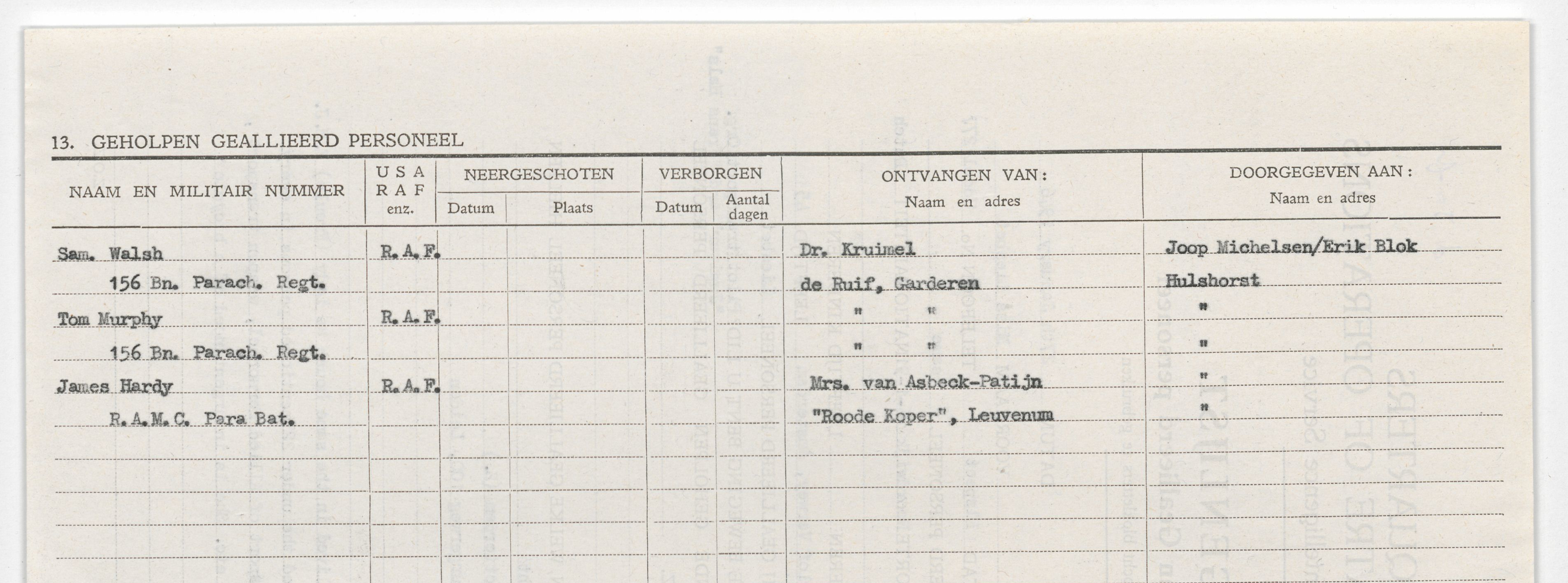
Two helpers' forms for the Americans hand Murphy on to him. Ima van Eysinga's has Walsh and Murphy received from Dr Kruimel at De Ruif, Garderen, and Hardy from Mrs van Asbeck-Patijn at Leuvenum, all passed on to "Joop Michelsen, Erick Blok, Hulshorst" (her file, p. 3). Liesbeth Verweij's lists the same three and passes them to "Joop Michelsen/Erik Blok Hulshorst" (her file, p. 3). Both forms are dated 27 January 1946 and came from one house, Sterrehoveke; both give his name the same way and the same partner, Eric Blok.
His own statement lists the six with their home addresses, among them "MURPHY, Thomas - 91 Centre street Kelty Fifeshire - Scotland Pte. 2756457 - 156 Batt. Para Regt. A.A.C.", and has "D.,E. and F. came presumably from "Ome Joop" (Dr. Kruimel) p.a. Farmer Bos, Farm "Staverden" in Staverden, Post Elspeet": Walsh, Murphy and Banwell, by way of Dr Kruimel and the farmer Bos at Staverden (p. 3). ⚠︎ For Murphy and Walsh that differs from Hardy and Verweij, who walked with them from Elspeet (above).
The night march, 6/7 November 1944
Link to the section The night march, 6/7 November 1944Hardy has the six taken away "At midnight on 6 Nov … by DEREK and LOEW (another member of the Underground) to HARSKAMP", "eight of us including the two guides" (Hardy). Noordman has Kruimel warn the men at Kijkuit to be ready, and three guides, "Huib de Iongh (Lou van Welsum), Joop Migchelsen (Joop) en Dirk van Eysinga (Dirk Bussink)" (Noordman, p. 293). Liesbeth Verweij, who heard it from Dirk when he came home at six the next morning, puts Migchelsen at the head of the column for the first stretch: "Het eerste traject tot Bes, dwars door het Leuvenumse Bos, liep Joop Migchelsen voorop, daarna volgde Lou met een revolver" (on the first stretch to Bes, straight through the Leuvenum woods, Joop Migchelsen walked in front, then came Lou with a revolver) (pp. 293–294). Behind Lou came the six, with Banwell carrying the only Sten, and Dirk at the rear with his bicycle (pp. 293–294). Her account does not say where Migchelsen turned back. The rest of the march, with Murphy's tin of shoe grease and the signpost at Boeschoten, is told on Dirk van Eysinga's page.
His own statement dates the hand-over five days later and puts it at Staverden:
Delivered "en bloc" on 11th Nov. 1944 (midnight 1 o'clock) transported through the woods to Bos, Farm Staverden, where the transport was take[n] over by Loet and Dirk, 2 assistants of Ome Joop.
— Joop Migchelsen, statement of 14 June (◐ 1945), in his American file · his file, p. 3
He added: "Further residences unknown, intention was to cross the Rhine immediatel[y] near Heelsum", and "No facts known, transport had indeed some reverses" (same page). "Loet" is ◐ Huib de Jongh, Hardy's "LOEW" (Huib de Jongh). A second "Loot" is on record in the district: Coslett's E&E report lists a student navigator, "KRUIZBERG (?), LOEDEWYK", "Known as ‘LOOT’ in underground in DOORNSPIJK", who helped Coslett from 29 April to 29 May 1944 (E&E 2968, PDF p. 8); nothing held ties him to Migchelsen's "Loet" of November 1944.
Bram Baar's death
Link to the section Bram Baar's deathOf Bram Baar, arrested in January 1945 and shot at Varsseveld on 2 March 1945 (the war dead register), Migchelsen wrote: "Hilbrand BAAR died, he was arrested because of weapon smuggling and shot as reprisal measure. He was a N.B.S. er." (p. 4). On 2 March 1946 the claim filed for Baar after his death, signed A. Baar, gave as its witnesses "Joop Migchelsen, Hierderweg 14, Hulshorst, Postb. Hierden" and "Emmy Vroege, Boreelstraat 2b, Rotterdam" (Baar's file, p. 5).
◐ The Nunspeet book has "liepen vele verzetstrijders in de val. Joop Migchelsen wist te ontkomen en dook onder meer onder bij" (many resistance men walked into the trap. Joop Migchelsen managed to escape and went into hiding with, among others, …); the snippet breaks off there and gives no date (the snippets).
His losses
Link to the section His lossesBecause they suspected me of Underground work, a surprise attack was carried out on my house, which I had hired temporarily from Mr. de Monchy. Nobody was present then. They stole the whole furniture etc., amongst other things the whole administration of the timber-trade. Owing to this I lost all my belongings about 1000 guilders.-- the food store, intended for "divers" in every sort, clothing etc.
— Joop Migchelsen, statement of 14 June (◐ 1945), in his American file · his file, p. 4
The statement does not say when the raid was or who carried it out. He asked for "a small compensation", if possible, for the tobacco and cigarettes he had given to Allied personnel (p. 4), but not for financial help: "Fortunately I don't need any financial help. The family Migchelsen always provided with pleasure the necessary money, also for the care of the pilots (purchases often in the black market)". He asked instead for help with a driving licence for his timber business, and "a proof in writing that I helped Allied personnel. Owing to my underground work our business has nearly gone down" (same page).
The Americans' file, 1945–46
Link to the section The Americans' file, 1945–46His form for the Americans is dated August 1945 (p. 2). The folder is marked "Grade 5 Conf 26 18.1.46" (p. 1), and the office's summary card, dated 5 February 1946, with "Lt. KIEK 18 January 1946" on it, reads "Provided housing, food and clothing for allied personnel for approximately 5 days. Names not known but case authenticated." (p. 6).
He wrote to the American office at Wassenaar in a letter dated "23 Januari 1945", ✓ a slip for a later year: the letter speaks of the time "na de bevrijding" (after the liberation), and ◐ the reply to it is dated 6 February 1946. He had seen an advertisement asking for Allied personnel to be traced. Months before, he had given Lt Kiek of the I.S. at Wassenaar "een uitvoerig rapport" (a detailed report), on the promise that it would be returned at once, and he had not had it back. "Van allen door mij verzorgde piloten heb ik na de bevrijding een brief gehad, op drie na" (from all the pilots I looked after I have had a letter since the liberation, except three), and he asked whether those three had lost their lives. His trade took him across the German border every day, "dennenbossen-kappen voor de steenkolenmijnen" (felling pine woods for the coal mines), where he was often held up a long time while his papers were checked, and he asked for a declaration that he had looked after many pilots (p. 9).
The declaration came from Captain Franklin D. Coslett of the Holland Office, 6801 MIS-X Detachment, addressed to the passport control authorities on 6 February 1946:
During the recent war, Mr Joop Migchelsen assisted a number of Allied aviators in evading and escaping from the enemy. Naturally, such work was done at great personal risk and endangered his family, as well.
— Franklin D. Coslett, Captain, Air Corps · Holland Office, 6801 MIS-X Detachment, Wassenaar · 6 February 1946 · the letter, p. 7
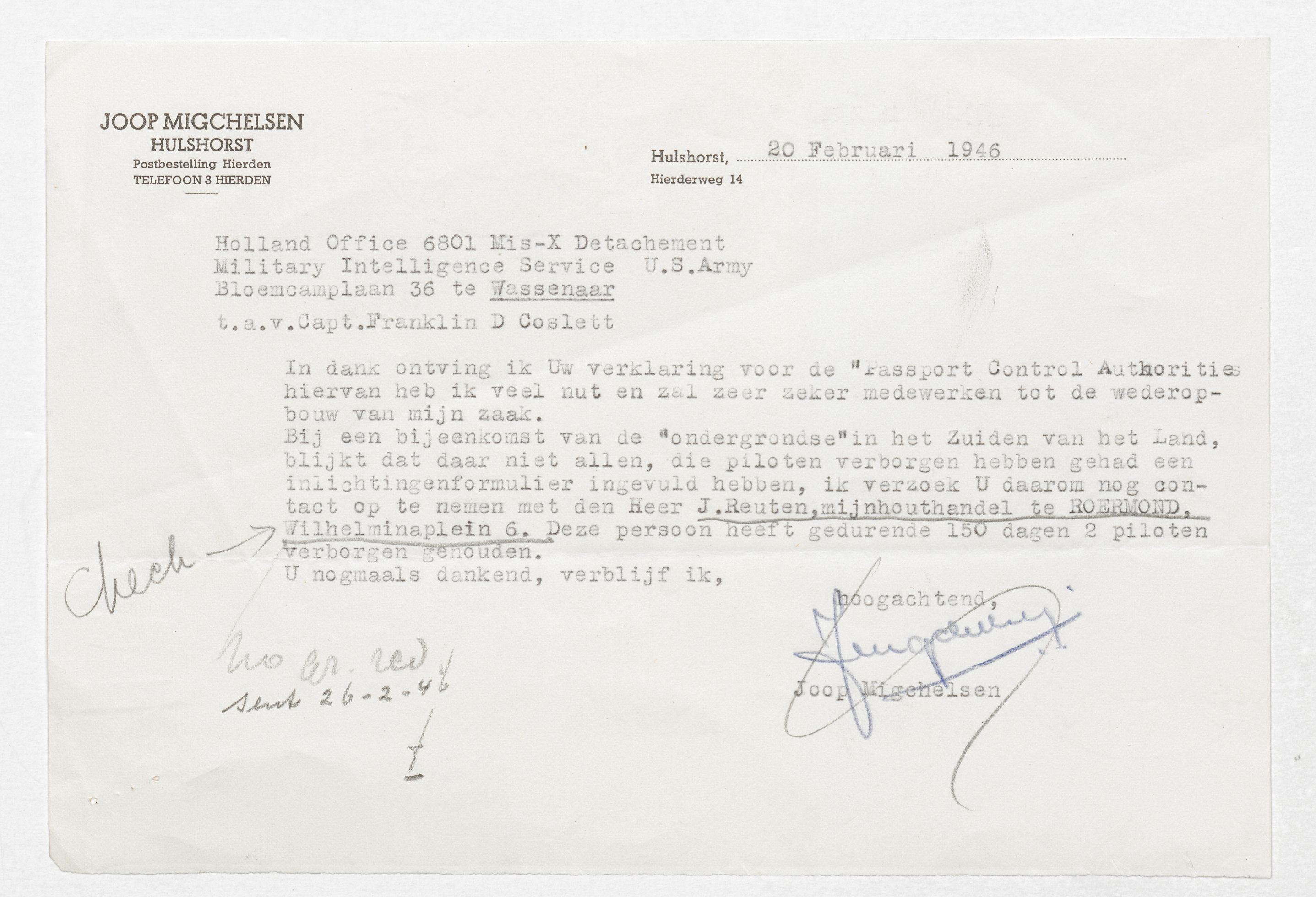
Frank Coslett had been an American navigator shot down near Vierhouten on 29 April 1944 and hidden by helpers at Nunspeet (E&E 2968; Dercksen's file, p. 5). On 20 February 1946 Migchelsen thanked him on his own letterhead: the declaration was of great use to him and would help rebuild his business. At a meeting of the underground in the south of the country he had found that not everyone who had hidden pilots had filled in a form, and he asked the office to contact "den Heer J.Reuten,mijnhouthandel te ROERMOND" (Mr J. Reuten, pit-prop timber trade, Roermond), who "heeft gedurende 150 dagen 2 piloten verborgen gehouden" (kept 2 pilots hidden for 150 days) (his letter, in Reuten's file, p. 8). The office wrote to Reuten on 26 February 1946, "Van den Heer J.Migchelsen te Hulshorst, Hierderweg 14 ontving ik bericht, dat U hulp verleend heeft aan geallieerd personeel" (from Mr J. Migchelsen of Hulshorst, Hierderweg 14, I have had word that you gave help to Allied personnel) (p. 7). Reuten's letter of 28 February does not mention it: he wrote that he had "already sent a same 'vragenlijst'" to another officer "on the 19th inst.", and enclosed a duplicate. He asked for a letter of his own "as I, like Mr J. Migchelsen, am fallowing [sic] wood on the german side of our border, which will be sent to the dutch coalpits in the province of Limburg" (p. 6).
◐ Another helper's form names him, probably: F. W. Buitenbos of Enschede, of the O.D., who moved airmen from around Enschede to Arnhem and Deventer, lists among the people he knew to have helped Allied personnel "Joop Michels,Hulshorst(near Harderwijk)" on his questionnaire of 27 September 1945 (his file, p. 2, read on the image). The first name and Hulshorst fit; "Michels" is very likely the form's misspelling of Migchelsen. Nothing in the form ties Buitenbos to Murphy.
Coslett at Hulshorst
Link to the section Coslett at HulshorstIn August, ◐ of 1945, the Nunspeet helper Albertus Dercksen wrote from The Hague to "Franklin": "Now I heard from Joop Migchelsen that you was at Hulshorst and that he told you that Mr Ijzerman, his son and Opa Bakker were shot by the Germans" (Dercksen's file, p. 6, dated "Aug. 16th"; the year is not on the page, and the file's other papers are of 1945). ◐ "Franklin" is Franklin D. Coslett: Dercksen's own section 13 has "Franklin D. Cosslett", shot down at Vierhouten on 29 April 1944, picked up in the wood and passed to IJzerman of the Molijnlaan, Nunspeet (p. 5). The letter has Coslett write to Mrs IJzerman that he "spoke with her husband for the last time in the prison at Apeldoorn"; ⚠︎ Coslett's own report puts it at Doetinchem, under "ISZERMAN, PIETER, Director of Veluvine Paint Factory" of Nunspeet (◐ the same IJzerman): "Lt. COSLETT saw him in DOETINCHAM … Prison Feb 1945, together with his wife and son" (E&E 2968, PDF p. 8). Dercksen's letter has the wife alive at Nunspeet and the son shot too. The two are not reconciled.
His death
Link to the section His deathDe Telegraaf of 17 May 1974 carried his widow's notice of the sudden death of "JOHANNES MIGCHELSEN", aged 53, dated Hulshorst, 16 May 1974 (the notice has no "heden", so ◐ he died on or before that day), with the burial set for Monday 20 May at the Nieuwe Begraafplaats, Nunspeet (the notice, read from the page image). ✓ The same man as the burial register's: the first name, the village, the burial date and the age (53 in May 1974 for a man born in February 1921) all agree. The burial register of the Nunspeet cemetery records "Johannes (Joop) Migchelsen", born 16 February 1921, buried there on 20 May 1974 (the register).
◐ The Gelderse Houtbeursvereniging, the timber traders' association at Apeldoorn, announced the sudden death of its former secretary and co-founder "JOOP MICHELSEN", aged 53, in a notice dated Apeldoorn, 16 May 1974 (De Telegraaf, 18 May 1974). The spelling is the one the Sterrehoveke forms use; the date and the age match the Hulshorst notice, and he was a timber merchant, so the two are very probably one man; the association's notice does not name Hulshorst.
Where the sources disagree
Link to the section Where the sources disagree- When the six left Kijkuit.
- Midnight on 6 November, for Harskamp, by Hardy's report of 13 January 1945 (Hardy).
- The early morning of 7 November, when Dick Kragt picked them up, in Noordman (p. 281); Verweij has them at signpost 215 by Boeschoten at about five in the morning (p. 294).
- ⚠︎ "11th Nov. 1944 (midnight 1 o'clock)", delivered to the farm Bos at Staverden, in Migchelsen's statement of 14 June (p. 3).
- Who led them out. Two guides, Derek and Loew, in Hardy; three in Noordman's own sentence (p. 293, no source given); in Verweij's account that he prints (pp. 293–294), three, with Migchelsen in front on the first stretch; in his own statement the transport is taken over at Staverden by "Loet and Dirk, 2 assistants of Ome Joop" (p. 3).
- Who fetched Hardy and Haller on 12 October. Hardy has "BRAM and JOOP (?)" (Hardy); Haller remembered two lads fetching them, one whose name he had forgotten, whom Noordman names as Bram Baar, and one who introduced himself as Adriaan de Kok (Noordman, p. 270; Adriaan de Kok); Migchelsen wrote "I met B. and C. wandering in the woods" (p. 3).
- When the men came, and from where. His statement has Branford on "18th Sept. 1944, the others about 1st October 1944", and Walsh, Murphy and Banwell by way of Kruimel and the farmer Bos at Staverden (p. 3). Hardy has Hardy and Haller there after a night in a tobacco shed that follows 11 October, with no date of his own (den Besten's form and Haller in Noordman say 12 October), Murphy and Walsh from 26 October, walked over from Elspeet, and Banwell from 29 October (Hardy).
- How long, and whom. His own statement names six men; the Americans' summary card has "approximately 5 days. Names not known" (p. 6).
- Whose house it was. Mr van der Elst of Amsterdam lent the men's half, in his statement (p. 3); "een boswachterswoning van de heer Jurriaanse" (a forester's house of Mr Jurriaanse) in Verweij's account (Noordman, p. 303).
- Why Bram Baar was arrested. Weapon smuggling, in his statement (p. 4); the other accounts are on Bram Baar's page.
- Banwell's companions on the train. His statement has Banwell escape on 28 September with "Sgt. A. KETTLEY of the Glider Pilot Regt. and a Lieutenant … his christian name was Allen and he is a Canadian in the 1st Para Bn." (p. 3). The statement does not name the lieutenant. ◐ He is Leo Heaps, a Canadian lieutenant attached to 1st Airborne, whose own book names the two who escaped with him as Tex Banwell and Alan Kettley (Heaps, pp. 82, 107; Noordman, p. 292, has the three); ◐ "Allen" may be Kettley's first name moved to the officer.
- His father's trade. A dealer (koopman) in the birth record of 1921 (the record); ◐ a hotel-keeper by the station in the Nunspeet book's snippets (the snippets), which give no date.
- Where Coslett last saw IJzerman. The prison at Apeldoorn in Dercksen's letter; Doetinchem in Coslett's own report (above).