Kijkuit and Harskamp
The forester's house in the Leuvenum woods, a night march south, and a chicken hut on Baron Mackay's estate.
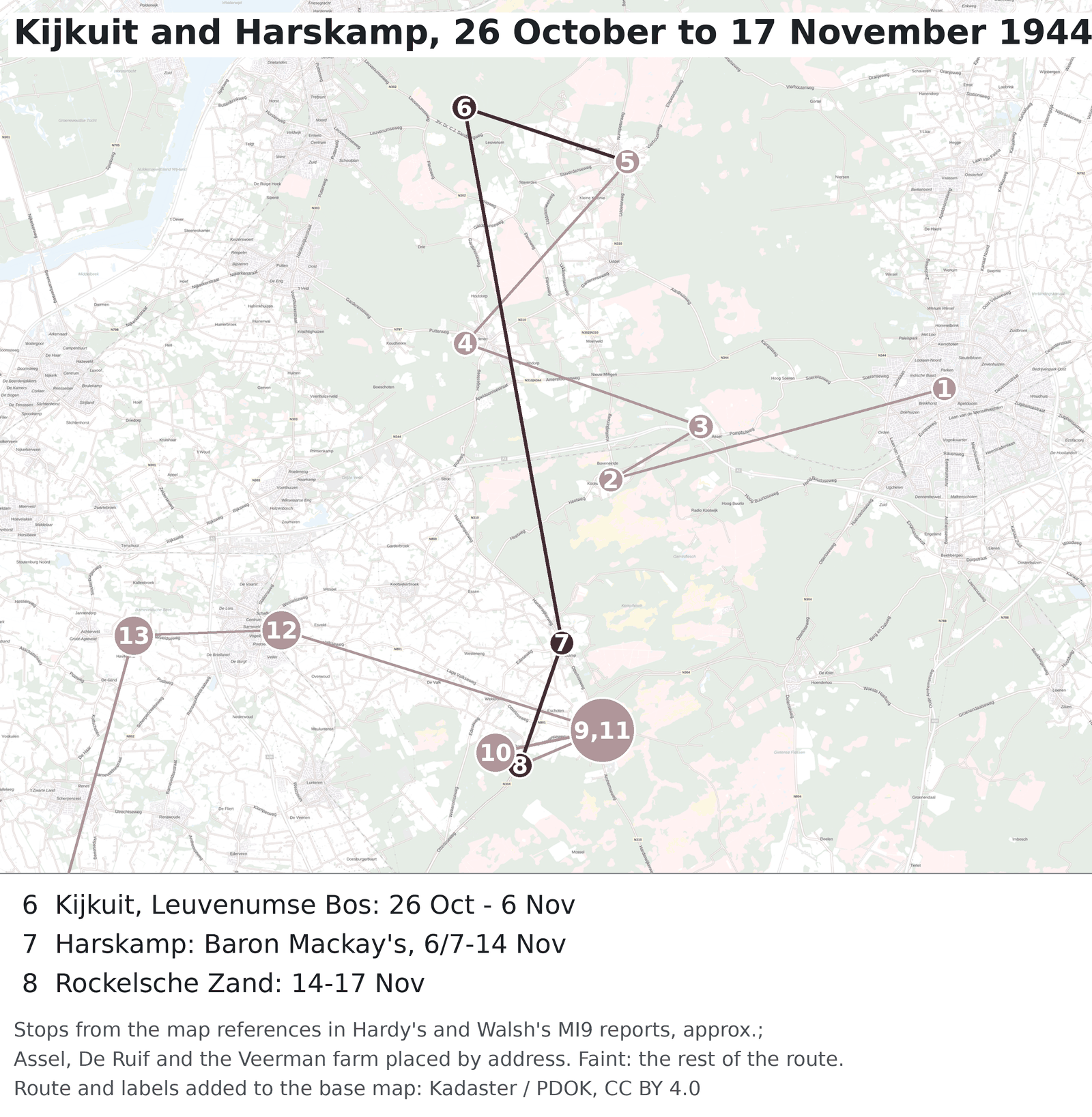
Where, and with whom (continued)
Link to the section Where, and with whom (continued)| Date | Place | Host / contact | Detail | Identified as |
|---|---|---|---|---|
| 26 Oct – 6 Nov | Leuvenum | "Brummager" and household; Eric Blok, ex-2/Lt Dutch Army; "Emmy", 19; "Adrian"; P/O Brentford RAF (Hardy's spelling; James Branford) | Banwell brought there 29 Oct. First mention of "Capt. King" (Hardy) | ✓ The forester's house Kijkuit in the Leuvenumse Bos, ⚠︎ belonging to a Mr Jurriaanse in Liesbeth Verweij's memory, the only source to name him (Noordman, p. 303; Mr Jurriaanse; ⚠︎ Migchelsen's own statement has the men's half lent by a Mr van der Elst of Amsterdam, below), under the resistance group of Joop Migchelsen of Hulshorst. Liesbeth Verweij and Dirk van Eysinga walked Murphy, Walsh and Hardy there from Sterrehoveke on the night of 26 October, and Hardy would not let a woman take him to the door. ◐ "Brummager" is very probably Bram Baar of Migchelsen's group: Hardy's report has "BRAM and JOOP" take them to the house in one place and "BRUMMAGER and JOOP" in another, which we read as one man (the match to Baar is ours), and Noordman renders "BRUMMAGER's house in LEUVENUM" as "het huis van Bram Baar in Leuvenum" (Noordman, pp. 270, 278–281, 302–303). ✓ He is the Hilbrand Johannes Baar of the war dead register: his American file, made out after his death, names him Hilbrand Johannes Baar, known as "Bram", in charge of "the pilot camp in Hulshorst", shot "on 2nd March 1945 in Varsseveld" (his file, p. 2). Hilbrand Baar, born at Haren in 1924, a grocer's assistant at Nunspeet, was arrested at Hulshorst on 13 January 1945, held at De Kruisberg in Doetinchem, and executed with 45 others at Varsseveld on 2 March 1945 (war dead register) |
| 6/7–14 Nov | Harskamp | Baron Mackay, understood to be of Scots descent | Chicken hut on the estate; food three times a day; Germans in two of the three houses; seven nights (Hardy) | ✓ Baron E.R.A. Mackay, whose estate with its chicken huts Noordman prints (Noordman, p. 281; "baron Mackay in Harskamp" among the pilot-line hosts, Omroep Gelderland). ◐ Civil records give an Eric Rijnhard Alexander baron Mackay, a bank employee born in The Hague, married at Ede (the municipality Harskamp is in) in May 1943 (Open Archieven); the initials fit, but nothing there places him at Harskamp |
| 14–17 Nov | Rockelsche Zand | "Willem" and an unnamed Dutch policeman, by Red Cross ambulance; guide "Jan (2)" | Jan arrested c.16 Nov. A poacher carried word (Hardy) | ⚠︎ Unknown. ◐ Candidates for "Willem" and the policeman, none proved: Kragt's trusted men in Harskamp were "Marten van Beek en Willem van Dijk", and Van Beek "was bij de politie in Arnhem" (was in the Arnhem police) (Ede manuscript, p. 43; Plekkringa's notes, Ede 1006/493, p. 7); the British index has a Willem van Dijk at Molenweg 5, Harskamp (index), though his cover name was "Piet", not Willem; and a constable of the Ede police, "agent 1e klas G.J. Michels uit Harskamp" in Ede's manuscript (undated, written for the book Ede 1940–1945), helped the Roekel helper Kauffeld before, during and after his arrest; ◐ but the Ede paper of 6 November 1946 has him stationed at Otterlo in the same time as a sergeant who served there "gedurende de winter 1944—'45" (during the winter of 1944–45), and "thans te Harskamp" (now at Harskamp) (Het Nieuwsblad voor de gemeente Ede; G. J. Michels), so the manuscript's "uit Harskamp" is where he was after the war, not in November 1944 (Operation Pegasus II; Ede manuscript, p. 49) |
Kijkuit, 26 October to 6 November
Link to the section Kijkuit, 26 October to 6 NovemberWhen word came of a house-to-house search in Elspeet, Verweij and Dirk took Murphy, Walsh and Hardy to Kijkuit across the heath on a pitch-dark night, the two of them ahead pushing their bicycles (Hardy); at the path to the door Hardy said, "Let me alone now; I do not want Eric to know I have been taken here by a woman!" (Noordman, pp. 302–303).
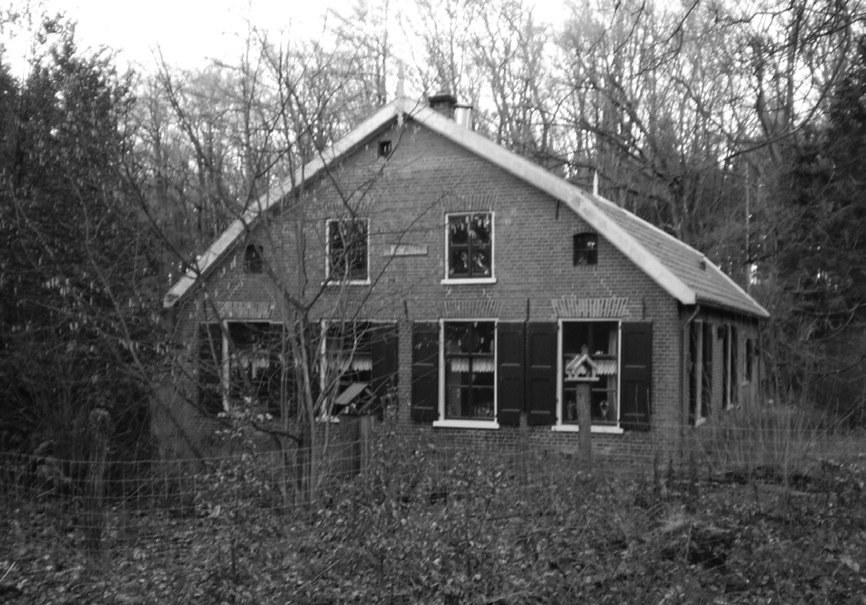
The others at Kijkuit were:
- Eric Blok, a former second lieutenant of the Dutch Army.
- "Adrian".
- "Emmy", a girl of nineteen, who handled contact with the outside world, food and supplies: ◐ very probably Emma Wilhelmina Vroege of Hulshorst, whom Migchelsen named first among his helpers, for "food, clothing, comfort" (his file, p. 2); Bram Baar's file names an "Emmy Vroege" among the witnesses to its claim (his file, p. 5).
- James Branford ("Brentford" in Hardy's report), RAF, a Stirling bomb-aimer shot down over Berlin, who had escaped a camp near Leipzig and been five months in hiding. Murphy remembered him as "James Banford": first name right, surname one letter out.
- "Brummager", as the British heard him: Bram Baar of Migchelsen's group, who stayed with them; Hardy's report calls him both "BRAM" and "BRUMMAGER" (Hardy). He was Hilbrand Johannes Baar, "Bram", of Hulshorst, who "was in charge of the daily safety etc. of the pilot camp in Hulshorst" and "was shot on 2nd March 1945 in Varsseveld", as the American file made out for him after his death says (his file, p. 2); the war dead register has him arrested at Hulshorst on 13 January 1945 and executed at Varsseveld with 45 others (Noordman, pp. 270, 279–280; war dead register).
Harskamp, 6/7 to 14 November
Link to the section Harskamp, 6/7 to 14 NovemberThe move from Kijkuit to Harskamp, on the night of 6/7 November, is told by Liesbeth Verweij of Sterrehoveke from what Dirk van Eysinga told her at six the next morning. In Noordman's narration Kruimel came to Kijkuit to warn them to be ready, and the guides were Joop Migchelsen, Huib de Iongh ("Lou") and Dirk (Noordman, p. 293); Hardy's report has two, Dirk and "Lou". They left Kijkuit around midnight on 6 November (Hardy), six Britons and their guides, for Dick Kragt's base at Kootwijkerbroek. Lou carried a revolver and Banwell the party's only Sten. On the first stretch, through the Leuvenum woods, Dirk brought up the rear pushing his bicycle, and it creaked loud enough to give them away:
Suddenly Tom Murphy stopped and pressed a tin of dubbin into Dirk's hand. By the time Dirk had greased the bicycle, he had lost the party.
Dutch originalPlotseling stopte Tom Murphy en duwde Dirk een doosje schoenvet in de hand. Toen Dirk de fiets gesmeerd had, was hij zijn gezelschap kwijt.
— Liesbeth Verweij, in Noordman, Schuilplaats de Veluwe, p. 294
Schoenvet is leather grease, dubbin, not polish. Dirk caught up by a detour. On the Speulderheide, under a full moon, Murphy and Hardy "hadden moeite met het fietsen" (struggled with the cycling) and fell behind with Lou; when three figures with packs loomed ahead, Banwell sprang in one bound to Dirk's side with the Sten and they passed without a word. At about five in the morning they reached paddenstoel (signpost) 215 by Boeschoten, where Dick Kragt ("Frans Hals") gave the whistle; the six were passed off as "evacués" to the villagers at Kootwijkerbroek (same, p. 294), and Kragt's base there was the Broekhuijzen family's (p. 281). In Kootwijkerbroek Lou kept up a steady stream of chatter in Dutch at "the six evacuees" so the villagers would not notice who they were (p. 294). They reached Harskamp that evening.
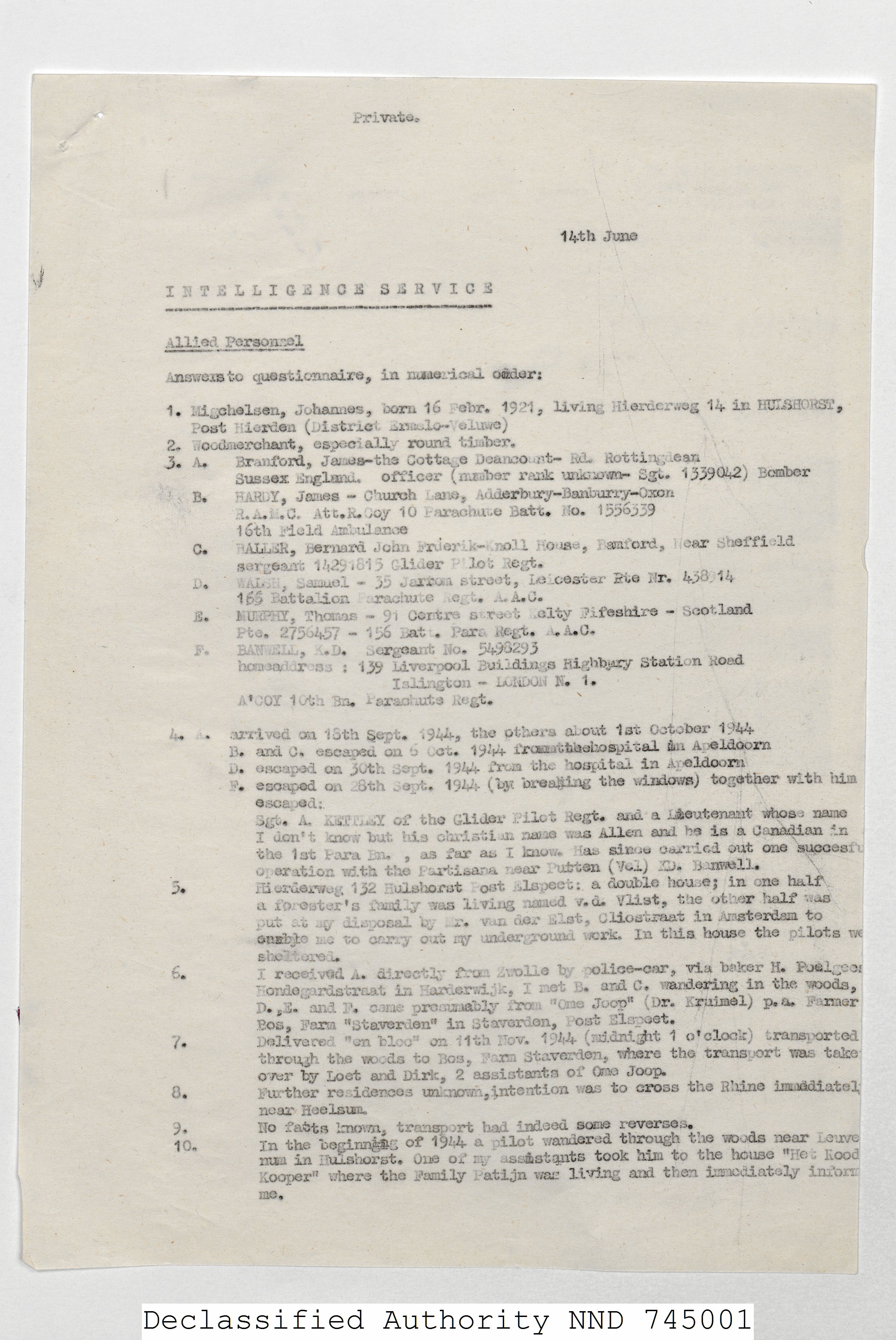
Joop Migchelsen, whose group had kept the six, set it down on 14 June (◐ 1945; the page gives no year), in a statement now in his American file, with each man's home address: "MURPHY, Thomas - 91 Centre street Kelty Fifeshire - Scotland Pte. 2756457 - 156 Batt. Para Regt. A.A.C." The house was:
Hierderweg 132 Hulshorst Post Elspeet: a double house; in one half a forester's family was living named v.d. Vlist, the other half was put at my disposal by Mr. van der Elst, Cliostraat in Amsterdam … In this house the pilots were sheltered
— Joop Migchelsen · statement of 14 June (◐ 1945) · his American file, p. 3
On the owner, see the table above. Walsh, Murphy and Banwell "came presumably from 'Ome Joop' (Dr. Kruimel) p.a. Farmer Bos", care of the farmer Bos at Staverden (⚠︎ Verweij has Dirk and herself walk them over from Sterrehoveke), and all six were "Delivered 'en bloc' on 11th Nov. 1944 (midnight 1 o'clock) transported through the woods to Bos, Farm Staverden, where the transport was taken over by Loet and Dirk, 2 assistants of Ome Joop" (his file, p. 3). ⚠︎ His 11 November is five days later than Hardy's, written at the time, and is set against Hardy's here.
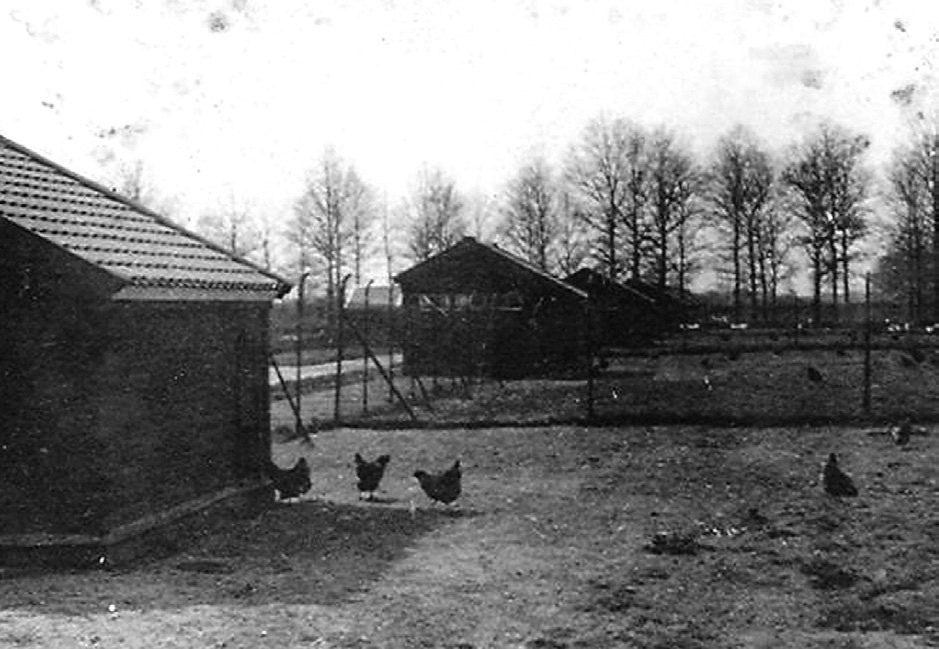
Baron Mackay hid the party in a chicken hut on his estate, bedded on straw bales. The Baron or his wife brought food out three times a day. There were three houses on the estate and the Germans occupied two of them. The men did not leave the hut for a week.
The Baron's own account
Link to the section The Baron's own accountFifty-eight years later the Baron told it himself, at 84, to the Reformatorisch Dagblad, which reported that he and his wife "also hid six English paratroopers":
They had landed on the Ginkel Heath in 1944 and taken part in the failed Airborne invasion, the bridge-too-far operation. The men were hidden in a chicken hut. Through the cracks they could see a German hospital. … At one point we had to take the paratroopers away unseen at night. We crept through the woods to Wekerom. Suddenly we saw two people lying there. It turned out to be a courting couple. Well, that gives you a fright.
Dutch originalZe waren in 1944 op de Ginkelse Hei geland en hadden meegedaan aan de mislukte Airborne Invasion, de brug-te-ver-operatie. Die mannen zaten verborgen in een kippenhok. Ze konden door de kieren een hospitaal van de Duitsers zien liggen. … Op een gegeven moment moesten we die parachutisten 's nachts ongezien wegbrengen. We slopen door de bossen naar Wekerom. Ineens zagen we twee mensen liggen. Bleek het om een stelletje te gaan dat daar lag te vrijen. Nou, dan schrik je wel.
— Baron E. R. A. Mackay, interviewed by J. Visscher · Reformatorisch Dagblad, 3 May 2002, p. 20 · the article; the page
Six is the size of Murphy's party, and a week in a chicken hut with Germans close by is Hardy's week; the article names none of the men. ◐ Not all of the six had come down at Ginkel (Branford was RAF, Haller a glider pilot), which reads as the Baron's shorthand for Arnhem. Hardy has the party taken on from Harskamp by Red Cross ambulance (Rockelsche Zand); the night walk to Wekerom, a village between Harskamp and Ede, may be that same move or another group of his. The same interview has the rest of what he and his wife did: through the war they hid a Jewish girl of six, Ruth Glasroth of Rotterdam, for which Yad Vashem honoured them both (his page).
Kragt's two men in Harskamp were Martinus "Rinus" van Beek (Marten in Ede's history), a policeman from Arnhem, and Willem van Dijk, his brother-in-law (◐ through Van Dijk's marriage in June 1945, very probably to Van Beek's sister), who together collected the weapons left behind after the fighting at Arnhem, going about in police uniform (Ede's war history, pp. 43–44); ◐ they may be the "Willem" and the policeman who came to fetch the party a week later, though Van Dijk's cover name was "Piet".
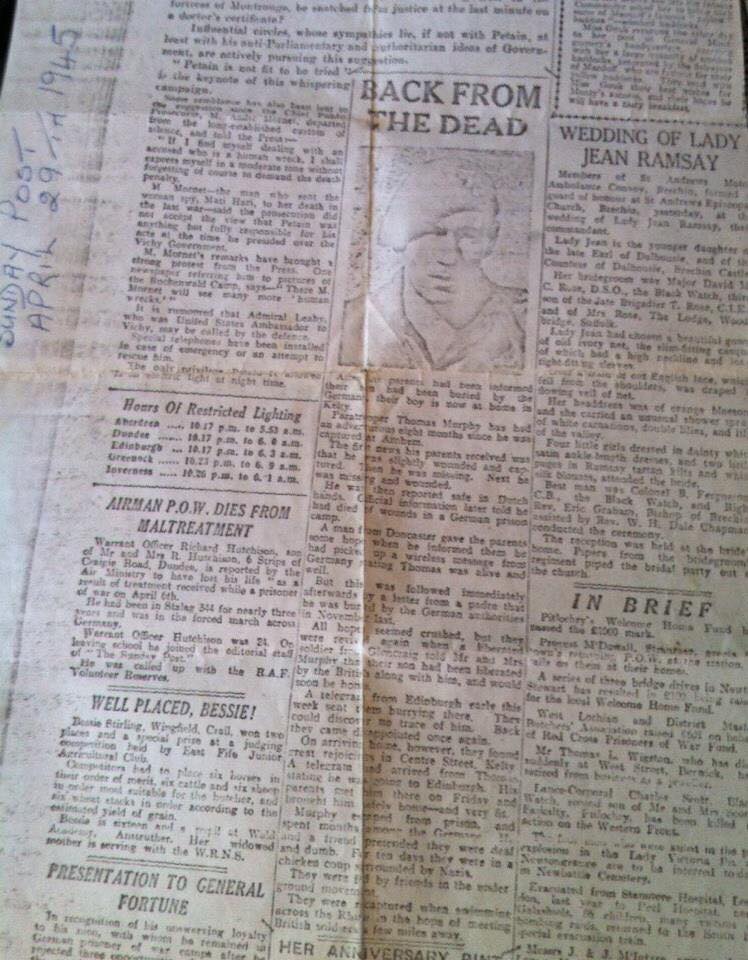
Contemporaneously corroborated. The Sunday Post of 29 April 1945 (scan) reports that "for ten days they were in a chicken coup surrounded by Nazis" and that they were fed by friends in the underground. That is Baron Mackay's estate, in print four days after he came home. Hardy's dates make it seven nights; the paper said ten. The same piece supplies a detail found nowhere else: to move about in civilian clothes with no Dutch, he and his companion pretended to be deaf and dumb (scan). ◐ It was the line's own cover. An American airman moved by the same people in 1944 carried false papers ("basket-maker … deaf and dumb") giving him and his companion as "mandenmakers waren met als bijzonder kenmerk: doofstom" (basket-makers, distinguishing feature: deaf and dumb) (Noordman, p. 150), and the Canadian Scottish war diary says the same of the Canadians hidden that winter: "Those who could not speak any Dutch claimed to be Deaf and Dumb" (Two Came Back!, p. 5). Bob Porter, who crossed with Murphy in January, had it on his own papers: his persoonsbewijs was in the name of "Henk DeGraff" (his spelling; ◐ as a Dutch name it would be Henk de Graaf), and "it stated that I was deaf and dumb"; once, with a stranger staying in the house, he had to keep it up "for five days. It was sure a hard job, requiring a lot of concentration" (Porter, The Long Return, chapter 4, pp. 100–101).
Rockelsche Zand, 14 to 17 November
Link to the section Rockelsche Zand, 14 to 17 November"Willem" and an unnamed Dutch policeman moved them by Red Cross ambulance and handed them to a guide known as "Jan".
Jan was arrested by the Germans around 16 November 1944. ⚠︎ His fate is unknown.
Word of the arrest was carried to the hidden men by a local poacher, not a member of the resistance, but in contact with it.
A banknote the six signed
Link to the section A banknote the six signedThe Airborne Museum's archive, catalogued at the Gelders Archief, holds a one-guilder note of 1943 signed by six British soldiers, and the catalogue gives their names:
Six paras in a hole on the Veluwe. The late husband of the donor lived, or was in hiding, on the Veluwe as a young man in the last years of the war, and was involved in the Resistance. He supplied these six men with food and so on in the months after the battle, when they were hiding in the woods of the Veluwe, in a hole in the ground. … The "six men in a hole" were: Sergeant Keith D. (Tex) Banwell, 10th Battalion, The Parachute Regiment; Private Thomas Murphy, 156 Battalion, The Parachute Regiment; Corporal James Haidy, Royal Army Medical Corps; Private Edward C. Bradford, 1st Battalion, The Border Regiment; Sergeant John Haller, The Glider Pilot Regiment; Private S. (Sammy) Walsh, 156 Battalion, The Parachute Regiment.
Dutch originalZes para's in een hol op de Veluwe. Wijlen de echtgenoot van de schenkster … heeft als jongeman tijdens de laatste oorlogsjaren op de Veluwe gewoond dan wel ondergedoken gezeten. Daarbij was hij betrokken bij het Verzet. Hij heeft deze zes mannen van voedsel e.d. voorzien in de maanden na de Slag toen zij in de bossen van de Veluwe zaten ondergedoken, in een hol in de grond. … De 'Zes mannen in een hol' waren: Sergeant Keith D. (Tex) Banwell, 10th Battalion, The Parachute Regiment; Private Thomas Murphy, 156 Battalion, The Parachute Regiment; Corporal James Haidy, Royal Army Medical Corps; Private Edward C. Bradford, 1st Battalion, The Border Regiment; Sergeant John Haller, The Glider Pilot Regiment; Private S. (Sammy) Walsh, 156 Battalion, The Parachute Regiment.
— Gelders Archief · Airborne Museum collection, toegang 1604, item 350 · catalogue entry
◐ Those six are Murphy's party, so the note very probably carries his signature from his months in hiding; the catalogue lists the names, and nobody here has seen the signatures yet. ⚠︎ "Haidy" will be Hardy, and the museum's "Edward C. Bradford, 1st Border" stands where every other source has the RAF officer James Branford (Bradford's page); until the note itself is seen, the catalogue's reading of the signatures is not the last word. ◐ When it was signed is not stated. The six were together from 29 October, when Banwell joined them at Kijkuit, until 20 November, apart from the night of 17/18; the "hole in the ground" fits the "spot" near the Rockelsche Zand where they waited from 14 to 17 November and were visited (Hardy), better than the house at Kijkuit. The note is not scanned yet; the archive scans on request (Prioritised actions).
The forester's guilder
Link to the section The forester's guilder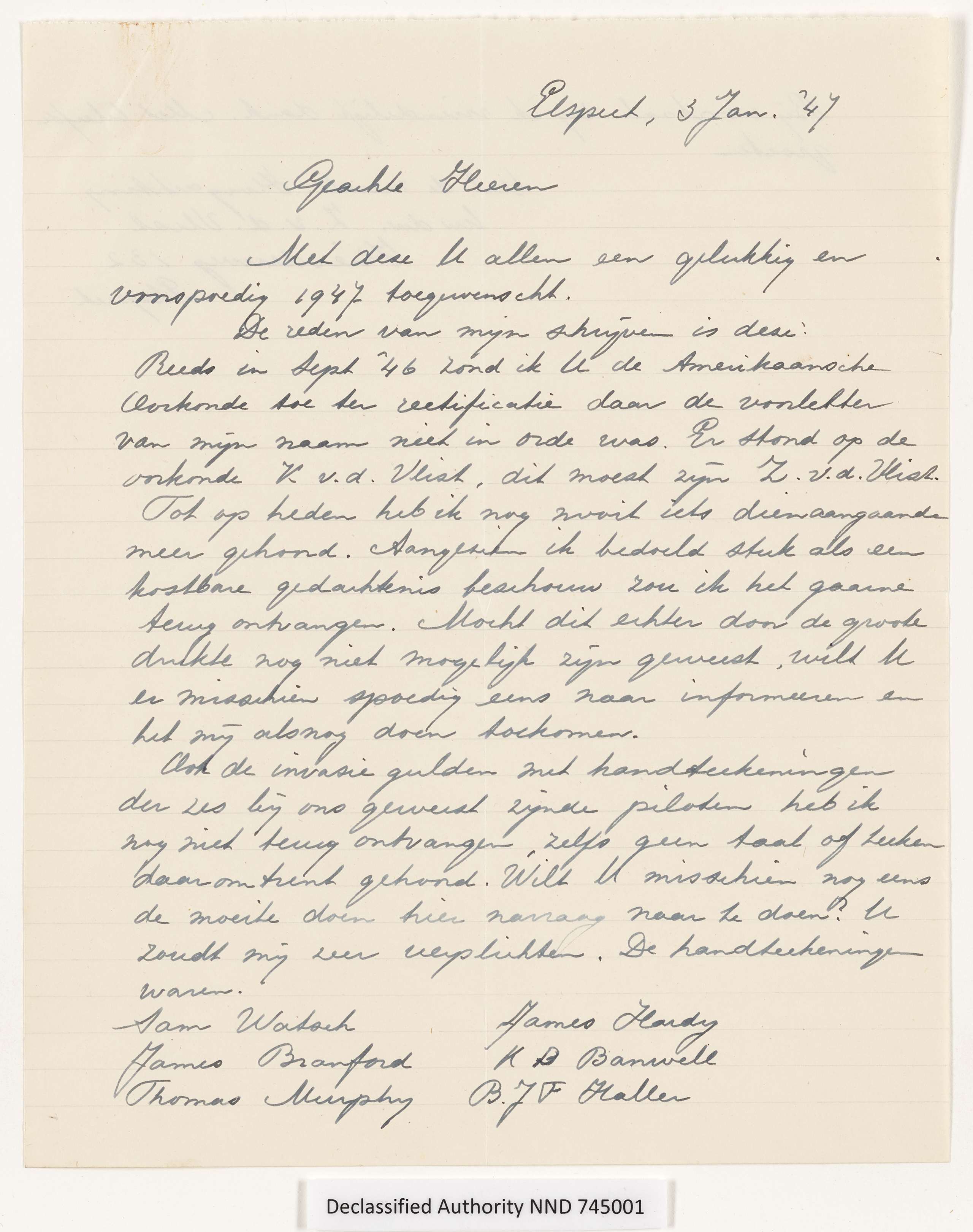
The forester at Kijkuit had a note of his own, or the same one. Z. van der Vlist, whose half of the forester's house the six had lived beside for a fortnight or less, asked the Americans in September 1946 after "een invasiegulden met zes handteekeningen van de piloten die hier vertoefden" (an invasion guilder with six signatures of the pilots who stayed here), sent to their office at Wassenaar about November 1945 by a Mr van Hattem of Elspeet; the office answered that it had passed it on to the British, to I.S.9 (his file, pp. 11, 13). It never came back, and in January 1947 he wrote again, setting the signatures out as they stood:
Also the invasion guilder with the signatures of the six pilots who were with us I have still not had back … The signatures were: Sam Watsch, James Hardy, James Branford, K D Banwell, Thomas Murphy, B.J.F. Haller
Dutch originalOok de invasie gulden met handteekeningen der zes bij ons geweest zijnde piloten heb ik nog niet terug ontvangen … De handteekeningen waren. Sam Watsch, James Hardy, James Branford, K D Banwell, Thomas Murphy, B.J.F. Haller
— Z. van der Vlist to the American office, Elspeet, 3 January 1947; US National Archives, RG 498, helper file of Z. van der Vlist (the archive's copy)
◐ Whether his is the note in the Airborne Museum's collection (above) is not settled. Both are invasion guilders (the museum's is catalogued as a 1943 note printed by the American Bank Note Company; his letter gives no year) with six signatures from the same party, which fits one note. But his went to I.S.9 and had not come back to him by January 1947, while the museum's came from the widow of the man who fed the six in their hole in the ground, which is not the forester's house; and men in hiding often signed more than one. Either way, a letter of 1947 has "Thomas Murphy" among the six signatures, and spells Branford's name right.