Baron Mackay
's-Gravenhage 21 May 1917 – after 2002
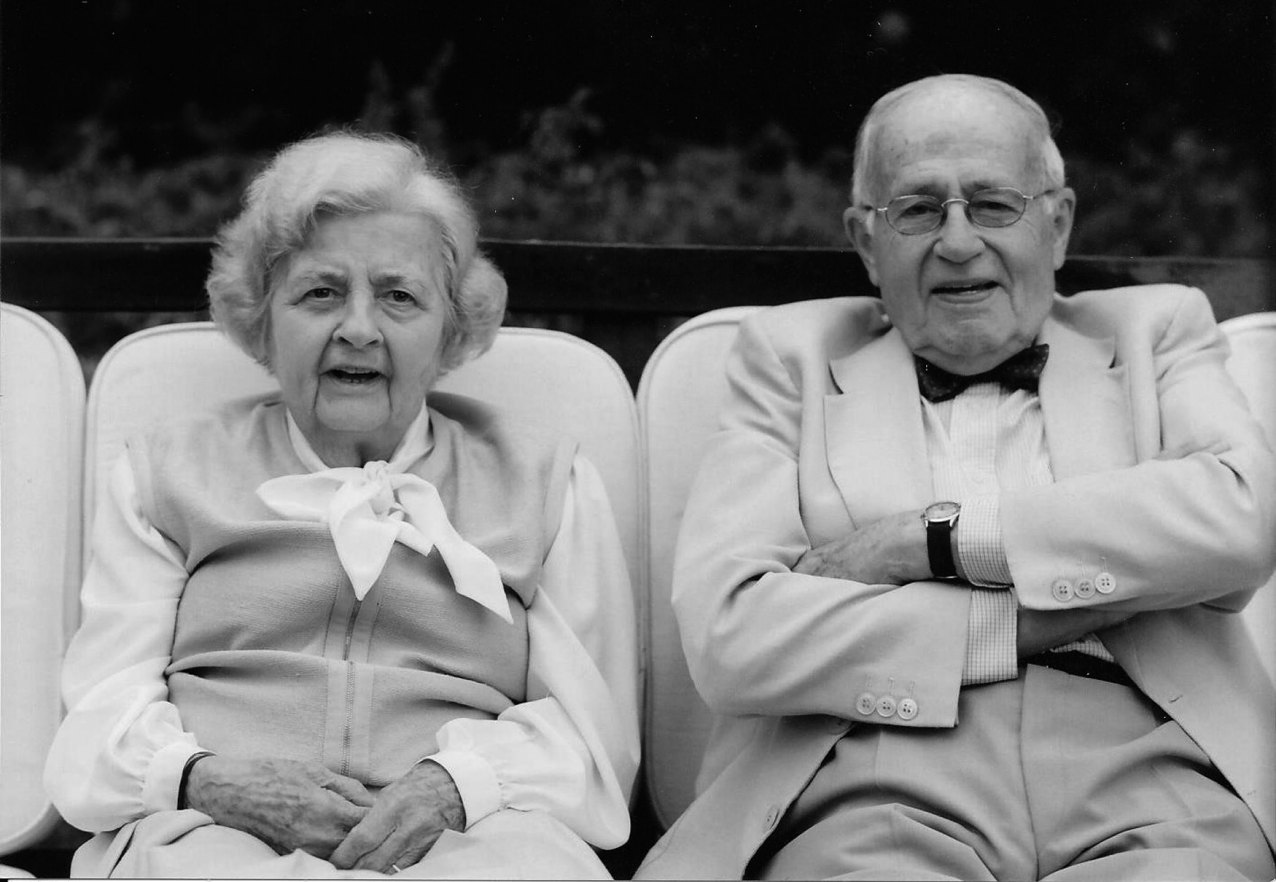
About: Baron Eric Mackay of Harskamp and his wife Gertrud hid a Jewish girl from Rotterdam in the war, and they hid Murphy's party of six in a chicken hut on his estate from 7 to 14 November 1944. Yad Vashem recognised the two of them as Righteous Among the Nations in 1995.
Unit or role: Civilian. An employee of the American Express Company in the Adelsboek, a bank employee in his marriage record; in 2002 he said he had worked half his life abroad in banking and as a management consultant.
Where: Harskamp, on the Veluwe: an estate with chicken huts and three houses, two of them occupied by Germans in November 1944. Yad Vashem's record gives the place of rescue as Arnhem.
Evidence: ✓ Hardy's escape report; ✓ Yad Vashem's record; ✓ Nederland's Adelsboek 1949, pp. 18–19 (his entry read on the page image); ✓ Boeree, Kroniek van Ede (1947), pp. 199–200 (read on the page images); ✓ Reformatorisch Dagblad, 3 May 2002; Noordman, pp. 281–282 and 295; ◐ Open Archieven
✓ Nederland's Adelsboek of 1949 has him as the fifth child of Dirk Rijnhard Johan baron Mackay, born at Winterswijk on 19 December 1876, of the firm of Aug. Volz & Co., and Johanna Elisabeth Blaauw, born at Amsterdam on 23 October 1886, who died at 's-Gravenhage on 15 November 1920. He was born at 's-Gravenhage on 21 May 1917, so he was three when his mother died. The entry gives his work as an employee of the American Express Company, and his marriage as at Ede on 20 May 1943 to Gertrud Mackay, née Brückmann, born at 's-Gravenhage on 5 June 1918, daughter of Paul Moritz Robert Ernst Brückmann and Helene Maria Emilie Kröller. It lists two sons, one born at Harskamp in 1944 and one at Hongkong in 1946; its square brackets give his home when the volume was compiled as Hongkong (the entry, pp. 18–19; the pages read on the images, p. 18 and p. 19). The civil record of the marriage at Ede agrees on the date and the parents, and calls him a bank employee (the record).
✓ The birth at Harskamp in 1944 puts the household there that year. ◐ That fits him to the Baron Mackay of Boeree's chronicle below: our inference, since Boeree gives only "Baron Mackay". The sons are not named here, as both are probably alive.
The girl they hid
Link to the section The girl they hidIn May 2002 he told the Reformatorisch Dagblad that through an acquaintance he heard that a six-year-old Jewish girl from Rotterdam, Ruth Glasroth, needed somewhere to hide; he and his wife took her in, told anyone who asked that she had been bombed out in Rotterdam, and she went to the village school (the article; the page). He said that for this he and his wife received the Yad Vashem distinction.
✓ Yad Vashem's record agrees that the couple were recognised, and gives the date: 27 July 1995, as Righteous Among the Nations, with a ceremony at The Hague and a name on the Wall of Honor. It says the Glasroths, from Poland, were bombed out of Rotterdam in 1940 and taken in by Elisabeth (Bep) Maas, who found them hiding places; that Ruth, "11-year-old" in its words, went to "Baron and Baroness Mackay, a young couple living in Arnhem"; that Gertrud Mackay, who knew Bep Maas, took her in without hesitation and Eric agreed "after some hesitation"; that the Germans searched the house once and Ruth got out through the window, as she had been taught; and that after the war she was reunited with her parents (Yad Vashem, the page as shown on 17 October 2026). The record and the interview differ on her age and on the place (below).
◐ Earlier too. Willem van Dijk and Martinus van Beek of Harskamp wrote to the Americans in 1946 that in the summer of 1942 or 1943 ("dat is ons niet meer precies bekend", they no longer knew exactly) an American pilot from an aircraft shot down there was given "een paar dagen onderdak ... bij Baron Makay te Harskamp" (a few days' shelter at Baron Mackay's at Harskamp) before being taken on to Ede (their letter, p. 6, checked on the image). It is their account of what they did; nothing in the file says what Mackay himself did.
With Murphy
Link to the section With MurphySix men were hidden at the estate from the evening of 7 November 1944 until 14 November: Murphy, Sam Walsh, James Hardy, Tex Banwell, John Haller and James Branford. Hardy's escape report is the only report of the week by one of them that we hold (Branford's Holland report is catalogued at Kew as not surviving, ◐ probably WO 208/5406/7 under the same former reference: his page): Walsh's refers to Hardy's for these days, and Haller's does not mention it. Murphy's own memoirs and notes do not name Mackay or Harskamp.
Hardy's account
Link to the section Hardy's accountHardy has the party taken from the house at Leuvenum at midnight on 6 November (Noordman names it as the forester's house Kijkuit) and, "having broken our journey at the house of a man called DICK (?) for a meal and a rest on route", reach Harskamp at about 2100 on 7 November. Noordman identifies that Dick as Dick Kragt, at the Broekhuijzens' in Kootwijkerbroek (Noordman, p. 281; Dick Kragt):
On arriving at HARSKAMP we were taken to a Baron MACKAY. He was a wealthy man and I understand that he was of Scots descent. We had some refreshment at his house and were then taken to a chicken hut belonging to MACKAY and situated on his estate which was a large one. There were bales of straw in this hut which we utilized for beds and the Baron or his wife brought us food three times a day. As there were Germans occupying two of the three houses on the estate we had to be very cautious and never left the hut during our stay there.
— MI9 · Pte J. Hardy, 16 Parachute Field Ambulance · report IS9/WEA/1/270/2351, interview of 13 January 1945 · the report
He goes on that "LOEW" visited them and said they would probably move in a few days; that on 12 November "the Baron told us that word had come that we were to move the following night, but nothing happened"; and that "By this time the Baron was becoming alarmed as he had heard that more Germans were expected to arrive on his estate." At 1830 on 14 November two men of the Underground, "WILLEM" and a policeman whose name Hardy did not know, took them to a spot "about a mile away" where a "Red Cross" ambulance waited, and it drove them to the Rockelsche Zand (Hardy). ◐ Willem and the policeman may be Willem van Dijk and Martinus van Beek, Dick Kragt's two men at Harskamp, a garage-keeper and a policeman from Arnhem (Willem van Dijk; Martinus van Beek); Van Dijk's cover name was "Piet", not Willem, and nothing says which two men came.
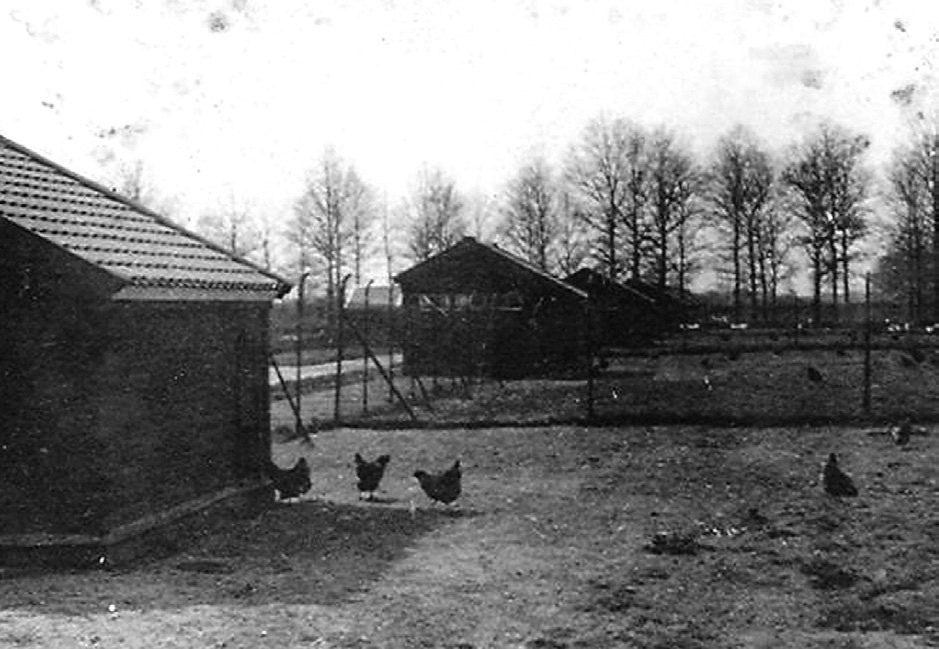
Noordman's book gives the same account in Dutch, a translation of Hardy's report, with the Baron's name and "een van zijn kippenhokken", and adds that the group from Kijkuit stayed about a week in one of the many chicken huts ("Hier verbleven ze ongeveer een week in een van de vele kippenhokken") (Noordman, pp. 281–282 and 295). It prints a photograph of the estate:
His own account, 2002
Link to the section His own account, 2002Fifty-eight years later the Baron told it himself, at 84, to the Reformatorisch Dagblad, which reported that he and his wife "also hid six English paratroopers":
They had landed on the Ginkel Heath in 1944 and taken part in the failed Airborne invasion, the bridge-too-far operation. The men were hidden in a chicken hut. Through the cracks they could see a German hospital. … At one point we had to take the paratroopers away unseen at night. We crept through the woods to Wekerom. Suddenly we saw two people lying there. It turned out to be a courting couple. Well, that gives you a fright.
Dutch originalZe waren in 1944 op de Ginkelse Hei geland en hadden meegedaan aan de mislukte Airborne Invasion, de brug-te-ver-operatie. Die mannen zaten verborgen in een kippenhok. Ze konden door de kieren een hospitaal van de Duitsers zien liggen. … Op een gegeven moment moesten we die parachutisten 's nachts ongezien wegbrengen. We slopen door de bossen naar Wekerom. Ineens zagen we twee mensen liggen. Bleek het om een stelletje te gaan dat daar lag te vrijen. Nou, dan schrik je wel.
— Baron E. R. A. Mackay, interviewed by J. Visscher · Reformatorisch Dagblad, 3 May 2002, p. 20 · the article; the page
He names none of the six. ◐ Six is the size of Murphy's party, and a week in a chicken hut with Germans close by is Hardy's week; not all six had landed at Ginkel (Branford was RAF, Haller a glider pilot), which reads as his shorthand for Arnhem. Hardy has the party taken on from Harskamp by Red Cross ambulance; the night walk to Wekerom, a village between Harskamp and Ede, may be that same move or another group of his. The "German hospital" the men saw through the cracks may be the hospital at Harskamp where Walsh was held on 22 September 1944, with "Dutch nursing sisters working there" (Walsh's report); neither source says so.
Other records of the week
Link to the section Other records of the week✓ Th. A. Boeree's Kroniek van Ede (Frouws, 1947) has him in the run-up to the failed crossing of 17 November 1944, in its account of the Harskamp helpers Van Dijk and Van Beek ("Piet" and "Rinus"). "Zij haalden zeven Tommies van de boerderij van Ooilander en brachten hen naar de boerderij de Harscamp van Baron Mackay" (they fetched seven Tommies from Ooilander's farm and took them to the Harscamp farm of Baron Mackay); later they moved the men to a hunting lodge in the Otterlo wood, and then spread them among the Westeneng farmers (Boeree, p. 199, read on the page image). The book gives no date for the seven and does not say who they were. For the crossing, Van Dijk and Van Beek had to find 200 eggs, 200 sausages and a stock of bandages: "De eieren kregen zij van Baron Mackay" (they got the eggs from Baron Mackay) (p. 200, read on the page image). Boeree has only "Baron Mackay"; the title, the place, Van Dijk and Van Beek, who named him in a 1946 letter to the Americans (above), and the Adelsboek's son born at Harskamp in 1944 make him, ◐ by our inference, the man of this page.
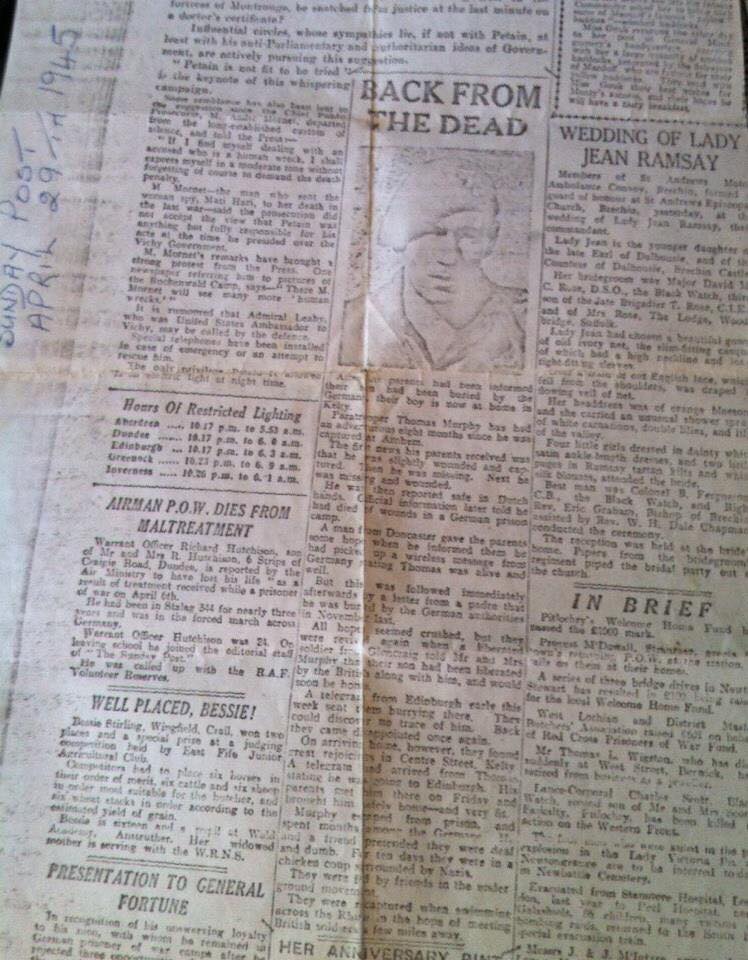
◐ The Sunday Post of 29 April 1945 (scan), four days after Murphy landed in Britain (it has his parents meeting him in Edinburgh on the Friday, two days before), says of him and "a friend" that they "pretended they were deaf and dumb. For ten days they were in a chicken coup surrounded by Nazis" and "were fed by friends in the underground movement". The paper names no place and no helper; the chicken coop and the Germans fit the Baron's estate, and Hardy has seven nights there.
◐ By E. H. Kerkhoven of Wekerom's account to the Americans, in December 1944 he handed over to him a Polish paratrooper wounded at Arnhem. The American office wrote to the Baron on 21 May 1946 to ask him to confirm it and give details, and Kerkhoven added the man's Dutch name in his own hand (the Americans' letter, in Kerkhoven's file, p. 6). No reply from Mackay is in the file.
His second son was born at Hongkong in 1946, and the Adelsboek of 1949 has the family there (Adelsboek). In 2002 he told the Reformatorisch Dagblad that he had lived in Nigeria, India, Pakistan and the United States among other places, worked until he was 79, then gave his time free to small firms in difficulty, and that he was a Remonstrant; the interview was given in his sitting room at the edge of Harskamp, beside a student from the village (the article). Asked why he sheltered people, he said it was not a matter of courage or faith: "Ik wilde vechten tegen grof onfatsoen, tegen zo veel onrecht" (I wanted to fight gross indecency, so much injustice).
Yad Vashem recognised him and his wife as Righteous Among the Nations on 27 July 1995 (record). Noordman lists "Baron E. Mackay, Harskamp" among the people and institutions he consulted for the book (Bronnen, p. 338); ◐ the list gives no detail of what he gave, and Noordman's account of Harskamp quotes Hardy, not the Baron; but the book's list of illustrations credits both photographs of Harskamp, figs. 185 and 186, to "E. Mackay, Harskamp" (p. 350). The same book names "baron Mackay in Harskamp" among the addresses nearby where the Allied men in Dr Kruimel's guestbook were placed (Noordman, p. 8; Omroep Gelderland).
A report of a group of evacuees from Oosterbeek ("Zo trekt half Oosterbeek uit", half of Oosterbeek is on the move) trekking through Otterlo on their way to Harskamp is printed in Jan A. Vos's book on Otterlo with the credit "origineel van Dhr. Eric Mackay, Harskamp" (Vos, Otterlo, 2023, p. 23). ◐ The credit does not say whether the owner of the original is the Baron or a relative of the same name, and the account does not touch Murphy.
Where the sources disagree
Link to the section Where the sources disagree- When he married. In 2002 he told the Reformatorisch Dagblad he and his wife had just married at the start of the war, when he was 23; the Adelsboek and the civil record of Ede have 20 May 1943, a day short of his 26th birthday (the article; Adelsboek; the record). ◐ The documents give the date; "the start of the war" is a memory 60 years on or the interviewer's phrase.
- The girl's age and where she was hidden. The interview has Ruth Glasroth as six and the house a small one in Harskamp; Yad Vashem has her as 11 and the couple "living in Arnhem" (the article; Yad Vashem). ⚠︎ Not settled. The Adelsboek's birth at Harskamp in 1944 fits Harskamp for 1944; it does not date Ruth's stay.
- Seven or six, seven nights or ten. Boeree has seven Tommies brought to the estate, Hardy and the Baron six men; Hardy has seven nights (7 to 14 November), the Sunday Post ten days (Boeree; Hardy; Sunday Post). ◐ Boeree's seven may be another group of Van Dijk's and Van Beek's, or Hardy's six miscounted; the newspaper's ten days is a report five months after the event and names no place.
- His work. A bank employee in the Ede record, an employee of the American Express Company in the Adelsboek, and in 2002 "in banking and as a management consultant" abroad (Adelsboek; the record; the article). ◐ Not in conflict, though Hongkong is not among the places he named in 2002.