Achterveld
A month on the Veerman family's farm. Two months after he left, the SD took Jacob Veerman, and he never came home.
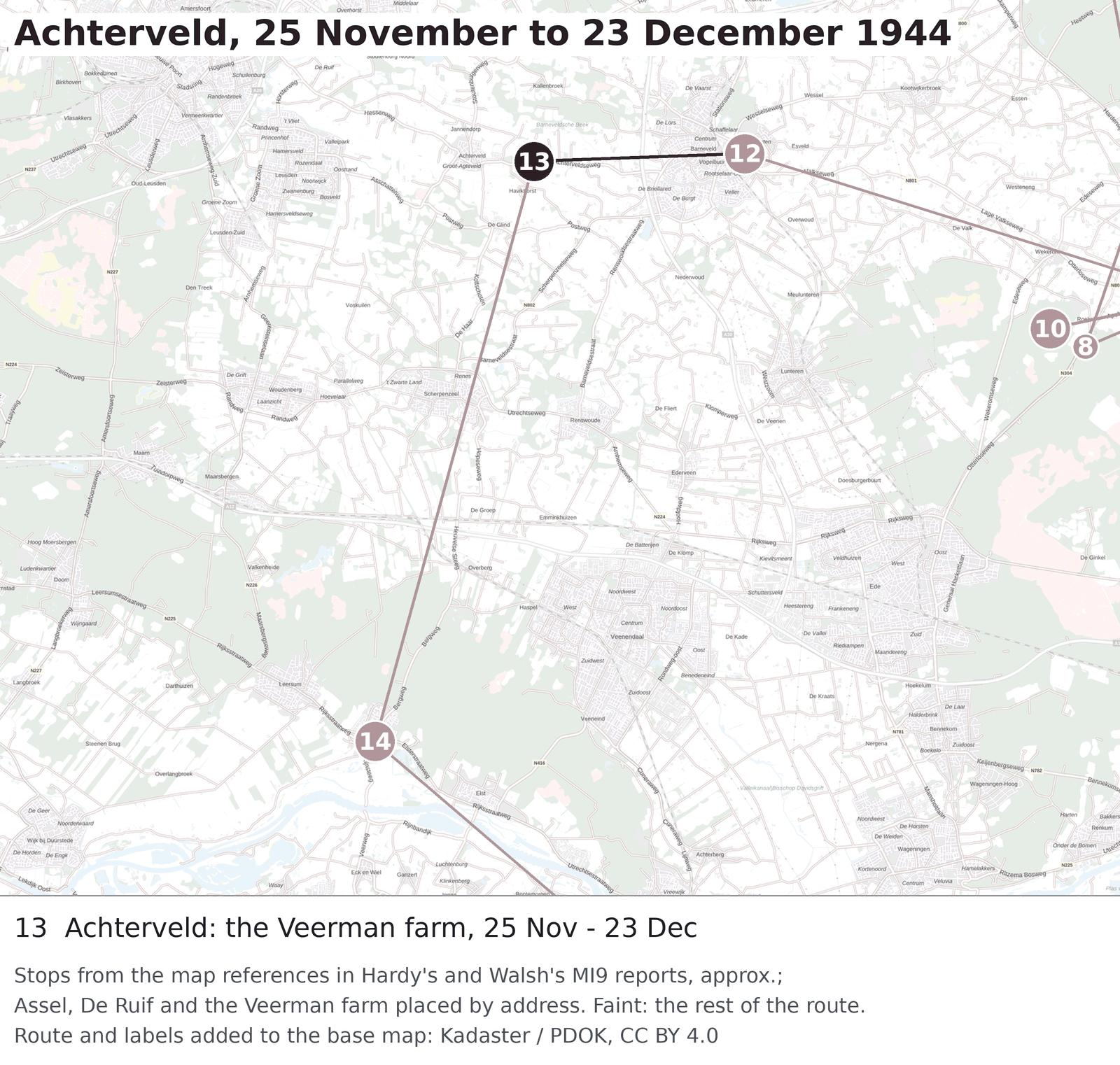
Achterveld: the month in hiding
Link to the section Achterveld: the month in hidingAs they came into Achterveld, Ghys (Gijs van Zijtveld), in Hardy's words, "took us to a farmhouse at approximately position 475955". Hardy on the family who lived there:
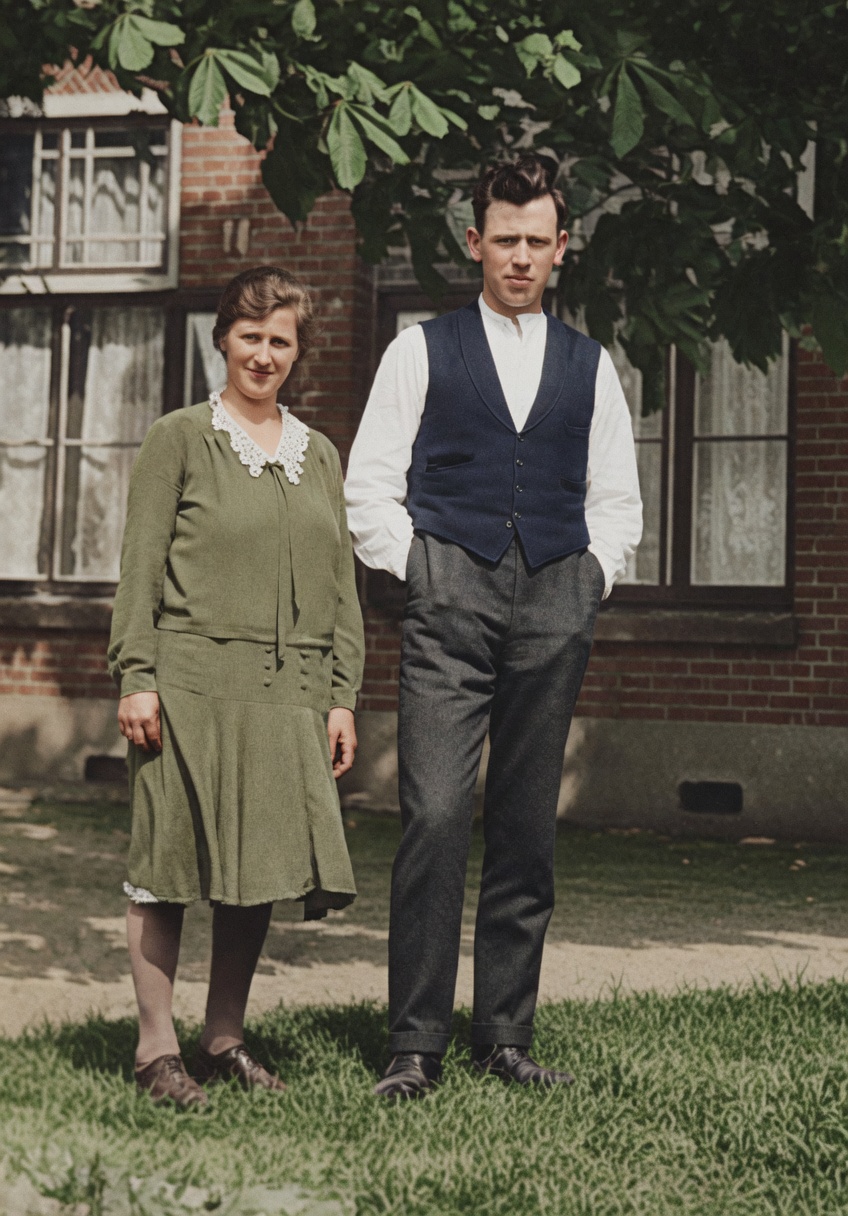
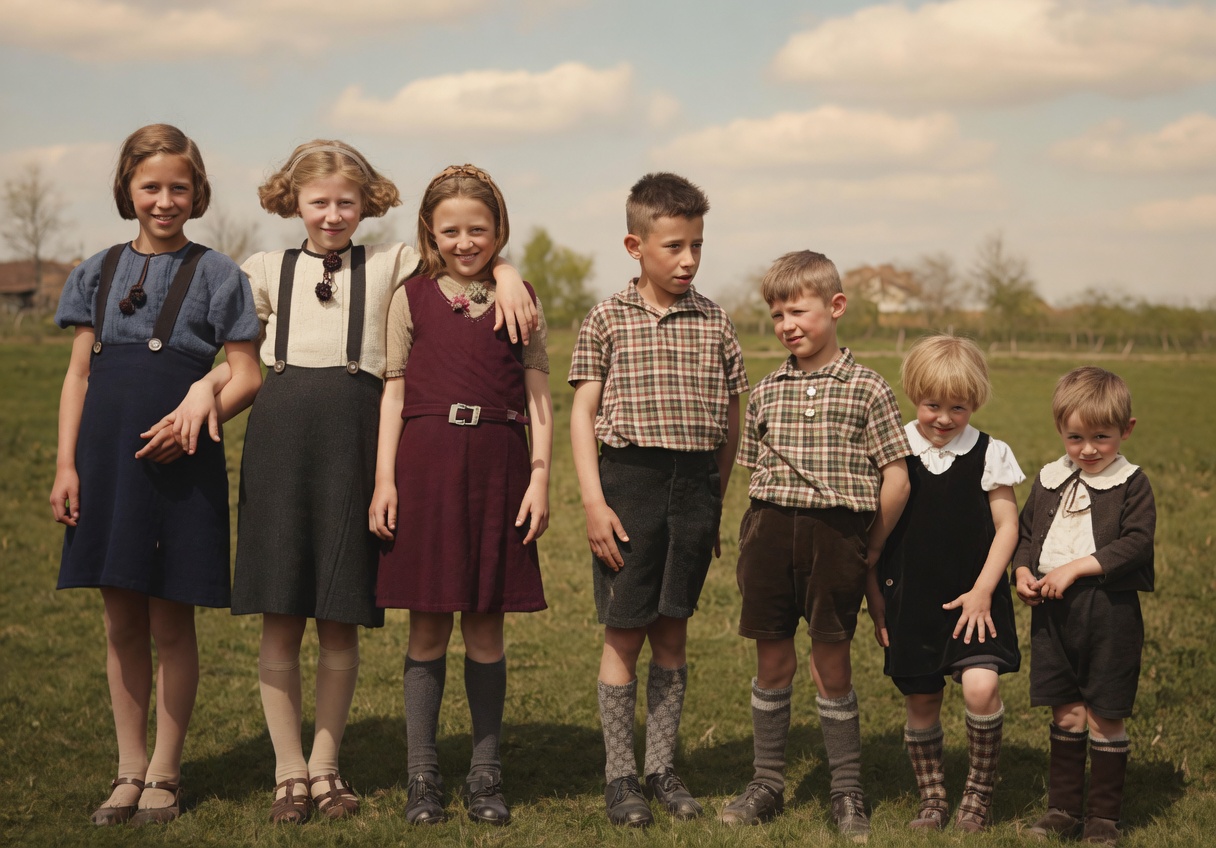
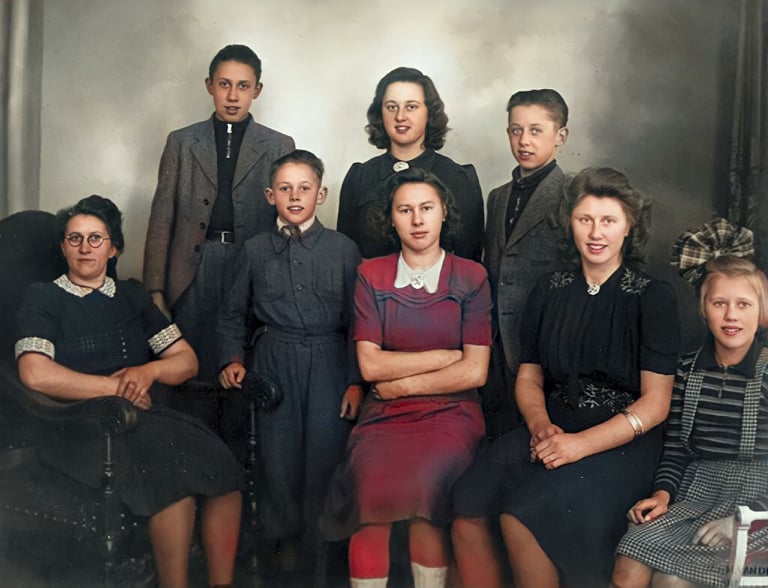
The owner of the farm was called Jacob VEERMAN, aged 43, married, with four daughters and three sons, the eldest a girl of 17 named JOANNA and the youngest a boy of 5 named YAP.
— MI9 · Pte J. Hardy, 16 Parachute Field Ambulance · IS9/WEA/1/270/2351 · 13 January 1945 · the report
The farm and the family
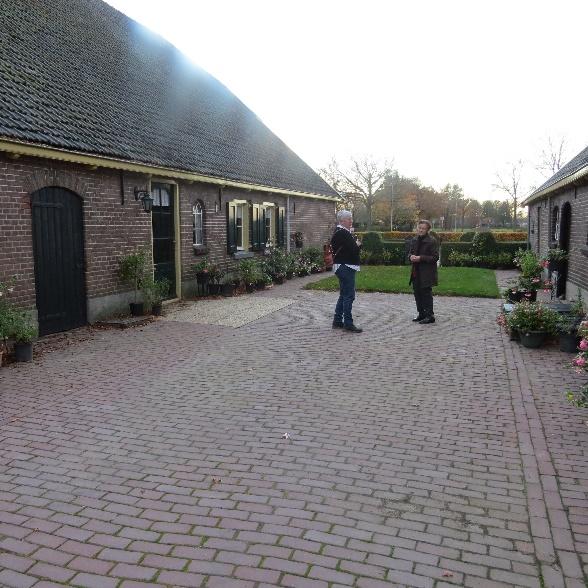
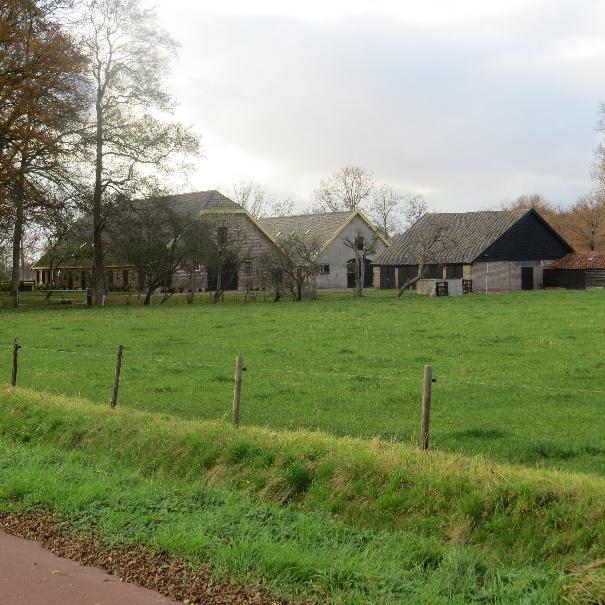
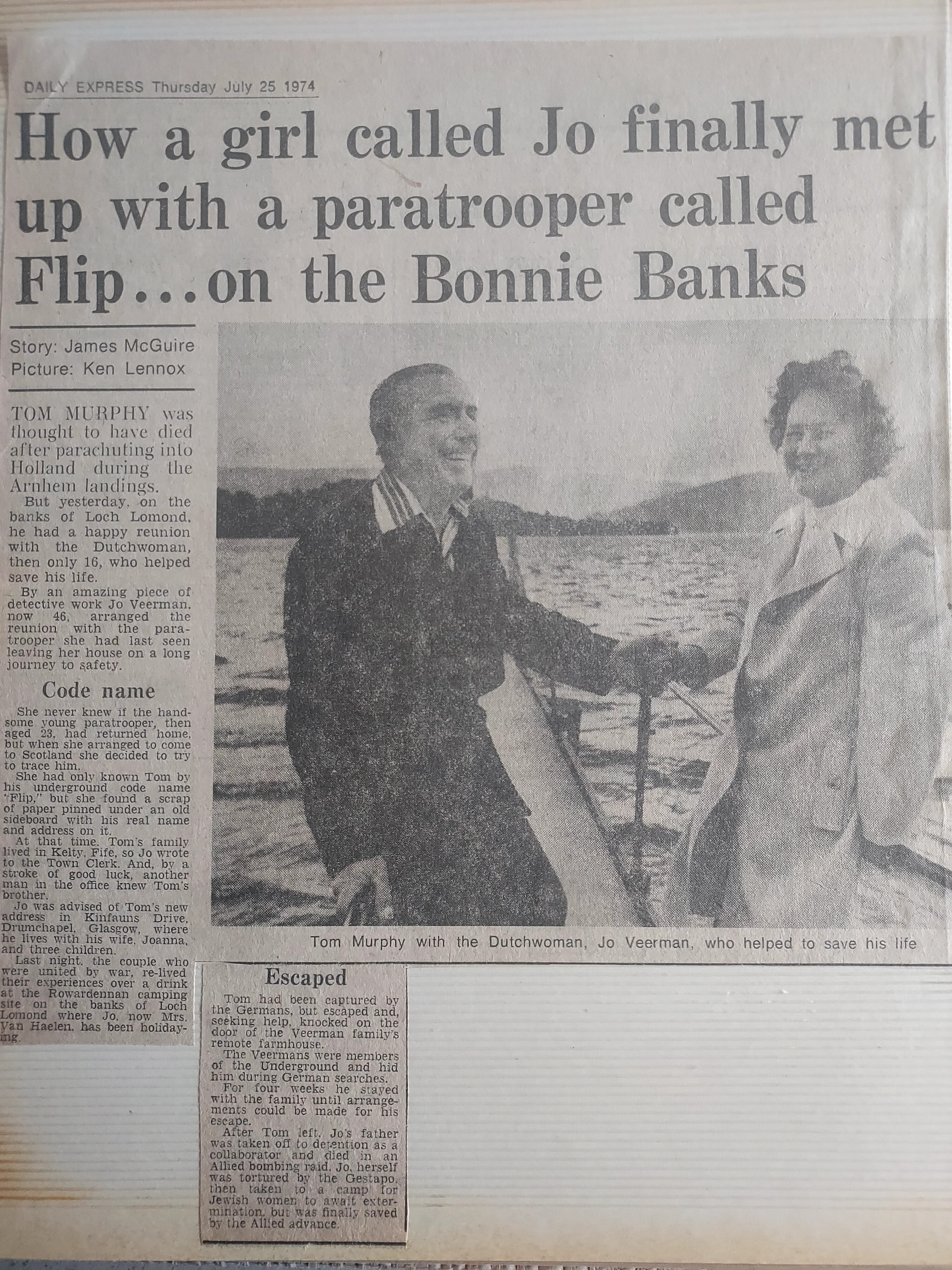
Link to the section The farm and the familyThe farm was Klein Achterveld, Achterveldseweg 34, on the road between Achterveld and Barneveld: an Achterveld address in Barneveld municipality (the family's form; Barneveld claims list, 18 November 1947, p. 1). It was Jacob Veerman's farm. Born at Den Haag on 3 August 1900, he was in the resistance: the OD (Ordedienst) in Barneveld by the account in José Huurdeman's history of the local resistance, Ondergronds in de Tweede Wereldoorlog (2019) (Digitaal Monument Neuengamme, the Dutch Vriendenkring Neuengamme's online memorial), the L.O. and the R.R. by his family's own form (p. 4, item 9). He and his wife Aaltje had seven children (Neuengamme online memorial, quoting Huurdeman). The eldest, Johanna Maria "Jopie", born on 1 December 1927 (TracesOfWar), turned seventeen while Murphy and Hardy were on the farm; the youngest, Jacob, "Jaap", born on 18 August 1936, was eight that autumn, where Hardy guessed five (Jopie's son, Jacques Vanhaelen, October 2026). The family wrote down Murphy's and Hardy's month with them in 1946 (the family's own record), and Jopie met Murphy again in Scotland in 1974 (the Daily Express, 25 July 1974; Jopie Veerman).
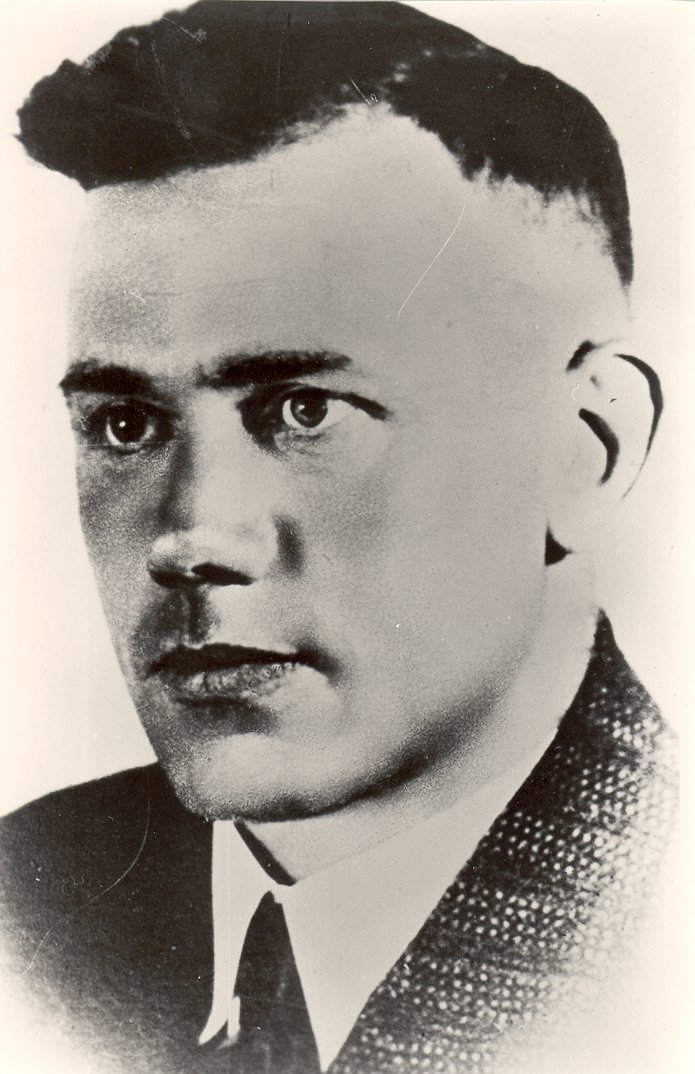
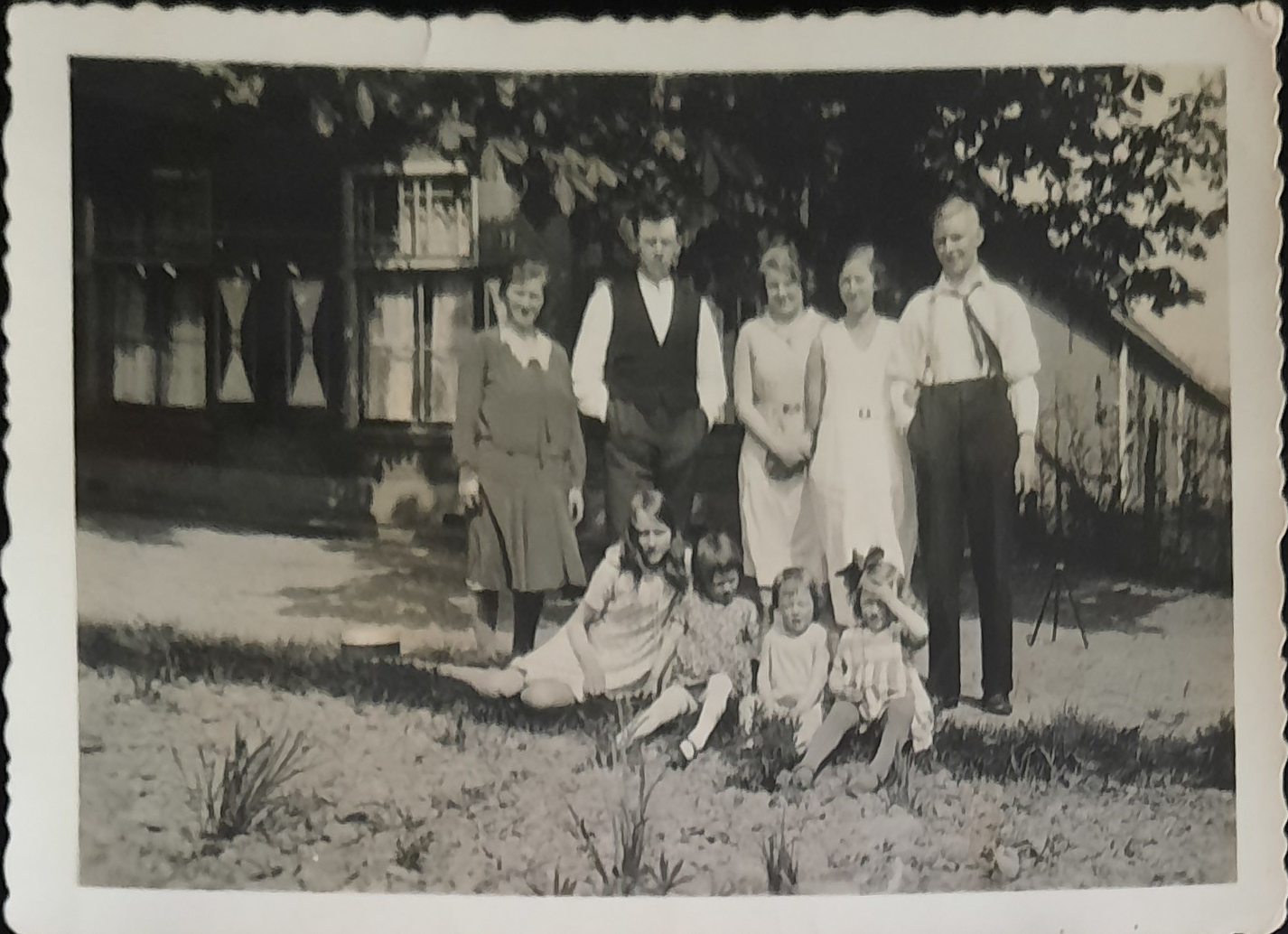
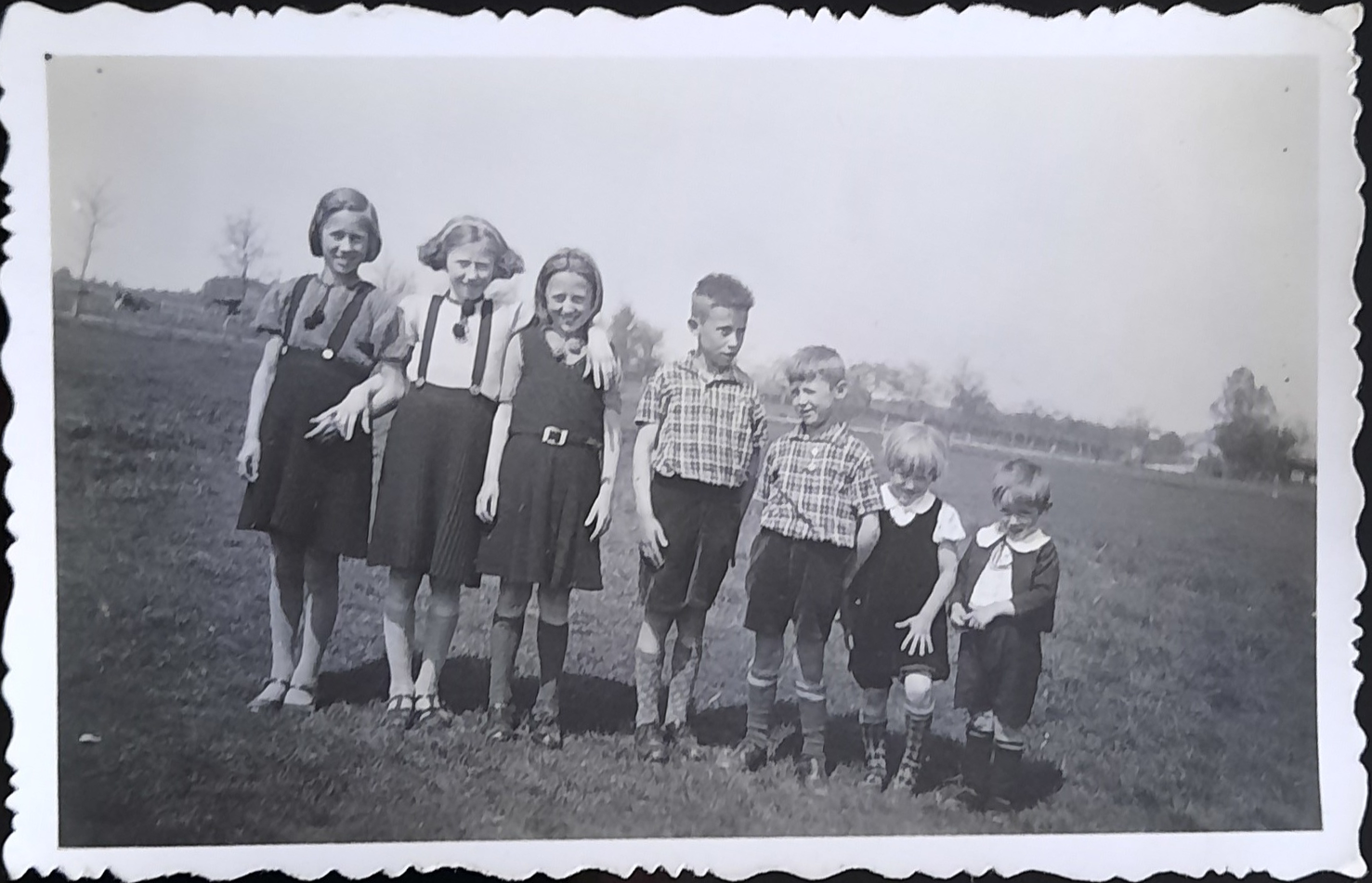
Jacob had married Aaltje Bakker at Barneveld on 2 February 1927, and Jopie was born ten months later. Jacob's mother had died on 23 June 1944. His father Leendert died at Barneveld on 10 January 1945, a week after Murphy was recaptured and six weeks before the SD came for Jacob. His brothers were Arie, a bookkeeper when he married in 1924, and Leendert Jan, a bicycle repairer in 1931 (the records). The rest of the family, from the civil registers, is on Jacob's page.
The hide
Link to the section The hide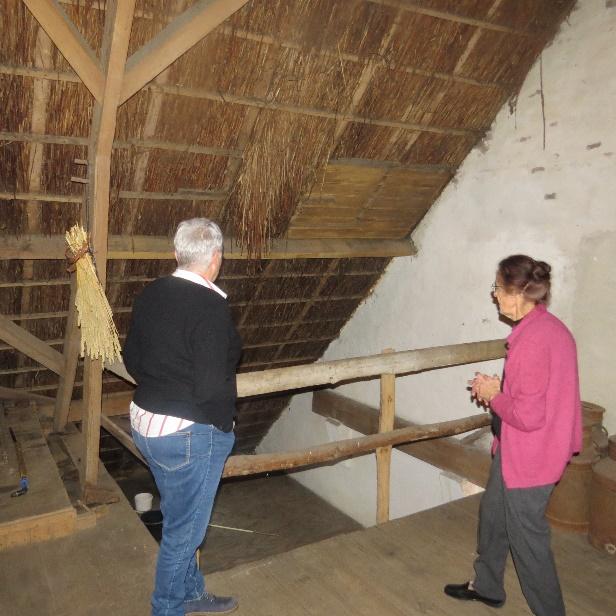
Pilots and Jews were hidden "in a special storage place behind bales of hay": in the barn's white wall a passage led to the room next to it, and on into a wardrobe, so that when the Germans came to search, the people in hiding went through the cupboard and down into "this lowered room" (Jopie's son, Jacques Vanhaelen, October 2026; family knowledge).
The month with them
Link to the section The month with themMurphy and Hardy stayed a full month, approximately 25 November to 23 December 1944. Hardy records that they were very well fed and cared for and that the family did everything possible to make them comfortable. Ghys and Jan (◐ Jan Dijkstra) visited three times with soap, shaving materials and news (Hardy). They were not the first. By Huurdeman's account the farm had sheltered Allied aircrew since 1943, three pairs of airmen for varying periods, brought by Jan Dijkstra of De Glind, with other people in hiding, and everyone hidden there survived the war (Neuengamme online memorial); the family's own table puts the first two there from 20 October 1944 (p. 9), and who they were is on Jacob's page. The Daily Express of 25 July 1974, ◐ very probably from Murphy and Jopie, whose reunion it reports, has the family hiding him "during German searches" and has him there "four weeks" (the cutting, kept by Jopie's family; After the war).
A son of Jacob's, who is living, remembers a doctor called Brand, a refugee from Germany who spoke good English and came often to the farm, taking the shrapnel out of Murphy's head; it is his own memory, which Jacques Vanhaelen passed on in October 2026 (Jacob's page), and no other source has it: Hardy, a medical orderly on the farm with him, does not mention it, and by his family's account the splinters stayed in Murphy's head and face for the rest of his life (Arnhem).
The revolver
Link to the section The revolverBefore they left, Murphy was given a revolver. That is in Hardy's 1945 report, not only in the memoirs:
Both MURPHY and I had revolvers by this time. Mine was given by KOEN and MURPHY's given him by Jacob VEERMAN.
— MI9 · Pte J. Hardy, 16 Parachute Field Ambulance · IS9/WEA/1/270/2351 · 13 January 1945 · the report
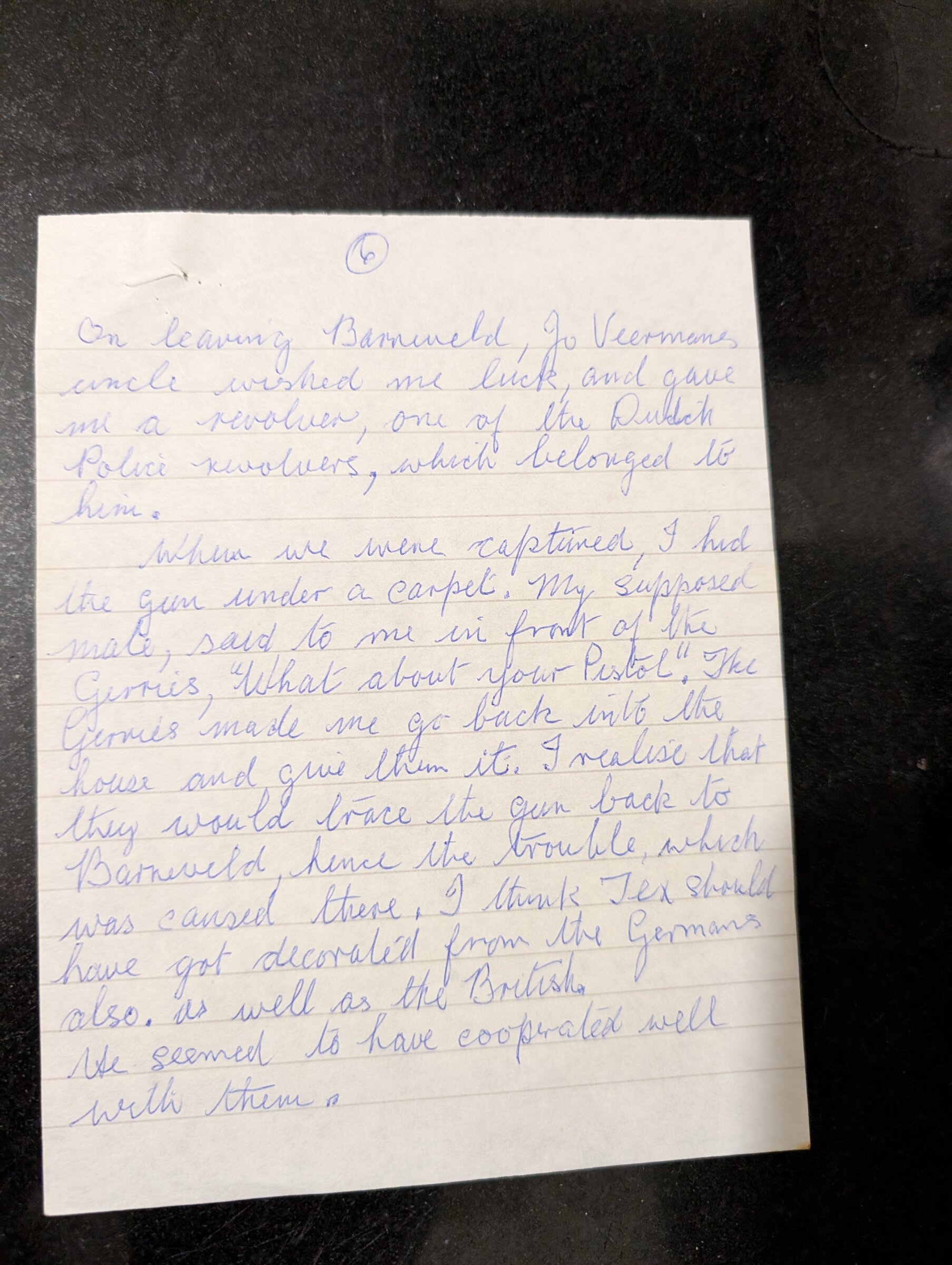
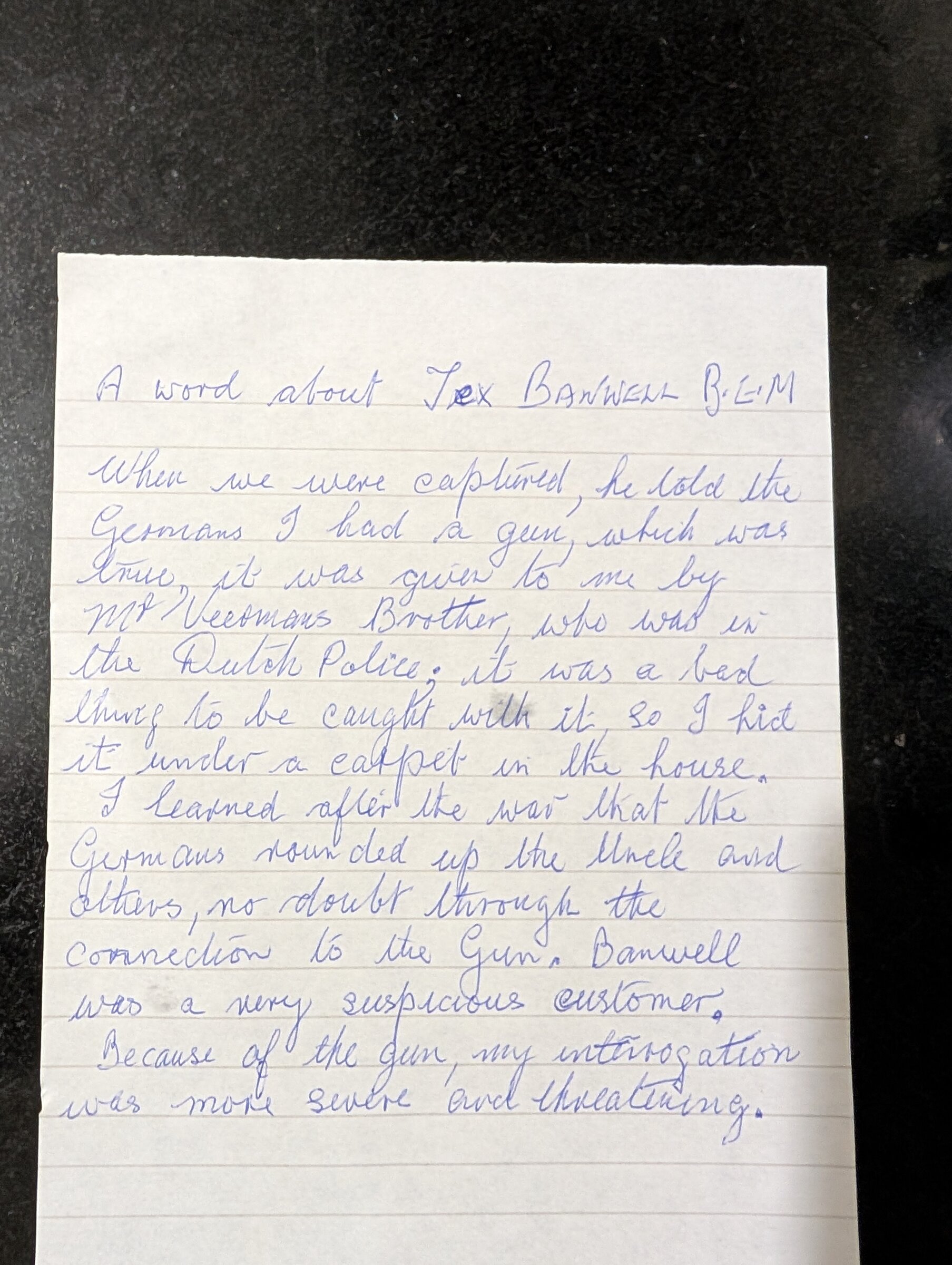
Murphy was still carrying his when the Germans took him on the night of 2/3 January, and by his own account it made his interrogation "more severe and threatening", and he feared they would "trace the gun back to Barneveld" (p.6; his page about Tex Banwell). Who gave it to him is told three ways.
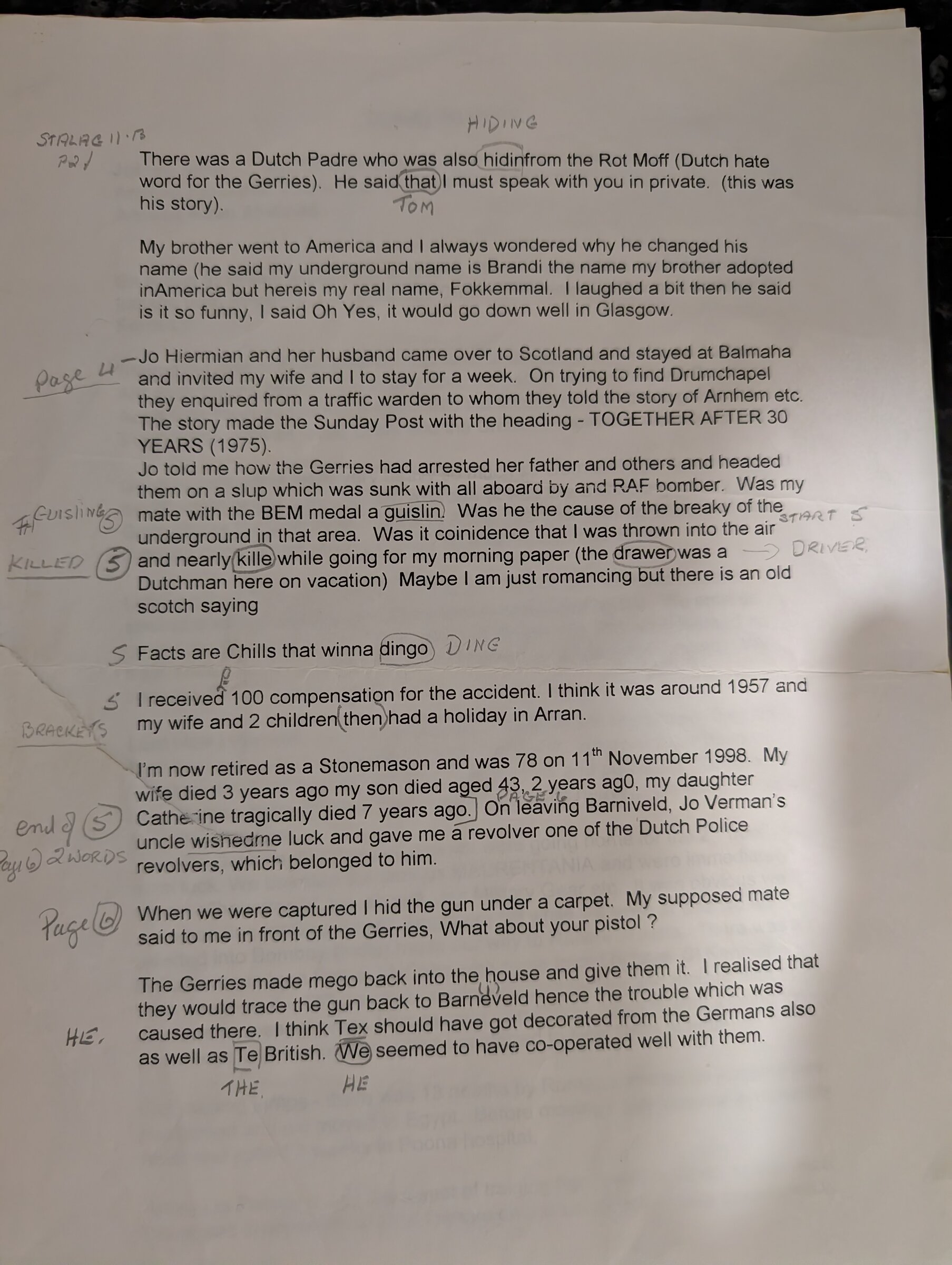
⚠︎ Murphy, in two passages of his notes of about 1998, has it from a policeman in the family, who gave him his own revolver as they left (the typed copy):
On leaving Barneveld, Jo Veermans uncle wished me luck, and gave me a revolver, one of the Dutch Police revolvers, which belonged to him.
— Tom Murphy, his notes, p. 6 (the page)
On the page he wrote about Tex Banwell he names the same man: the gun "was given to me by Mr Veermans Brother, who was in the Dutch Police" (the page); ⚠︎ what that page alleges about Banwell is set out on his page.
A son of Jacob's, who is living and was about eleven at the time, told Jacques Vanhaelen in October 2026 that he and his father fetched it from Jacob's brother Leen (Leendert Jan), a bicycle repairer who kept a number of pistols in a tool cabinet; Jacob hid it on the boy, and when Germans stopped them on the way back and searched Jacob, it was not found. It is his own memory as the boy who carried it; Jacques wrote that he "still remembers very clearly" the pistols in Leen's tool cabinet (Jacques Vanhaelen's email, 18 October 2026).
He writes "Barneveld" for where they set out from; the farm was in Barneveld municipality. Jacob had two brothers, Arie and Leendert Jan, and the marriage registers give their trades: bookkeeper and bicycle repairer (the records). ⚠︎ Those are the trades of 1924 and 1931, not 1944, so neither is ruled out, but neither is a policeman on paper; a brother-in-law would fit his "Jo Veermans uncle" but not his "Mr Veermans Brother". The uncle Jopie hid with, "oom Gerrit" (uncle Gerrit) at Ede (Neuengamme online memorial), was ◐ very probably such a brother-in-law: Gerrit Jan Broekhuis, a baker of Ede married to Jacob's sister, whose page sets out the case. Hardy separately mentions an unnamed Dutch policeman in that network. ✓ After the war Leendert Jan worked for the Politieke Recherche Afdeling, the post-war political investigation service, at Rotterdam, Apeldoorn and Den Haag (Nationaal Archief, staff file; Leendert Jan Veerman): police work, but after the war, and it says nothing of 1944. Jacob's grandson Carel Plantagie knows of no policeman in the family (his email, October 2026).
◐ The revolver was probably Leen's (Leendert Jan Veerman, Jacob's brother). Murphy and the son both put it with Jacob's brother, but the son answered after our question to Jacques Vanhaelen of 16 October 2026 had put Murphy's policeman-uncle version to him, so the two are not independent; Hardy has Jacob himself give it. The rest of the son's account is his alone: by it he was there when it was fetched (the tool cabinet, the boy carrying it, the search), and he calls Leen a bicycle repairer then and a detective in The Hague after the war. Hardy's "given him by Jacob VEERMAN" fits if Jacob brought it home; Murphy has the uncle hand it over himself as they left. It is graded probable rather than confirmed only because no record of the time says so. ⚠︎ No record has Leen a policeman in 1944 (the reasoning in full).
The family's own record
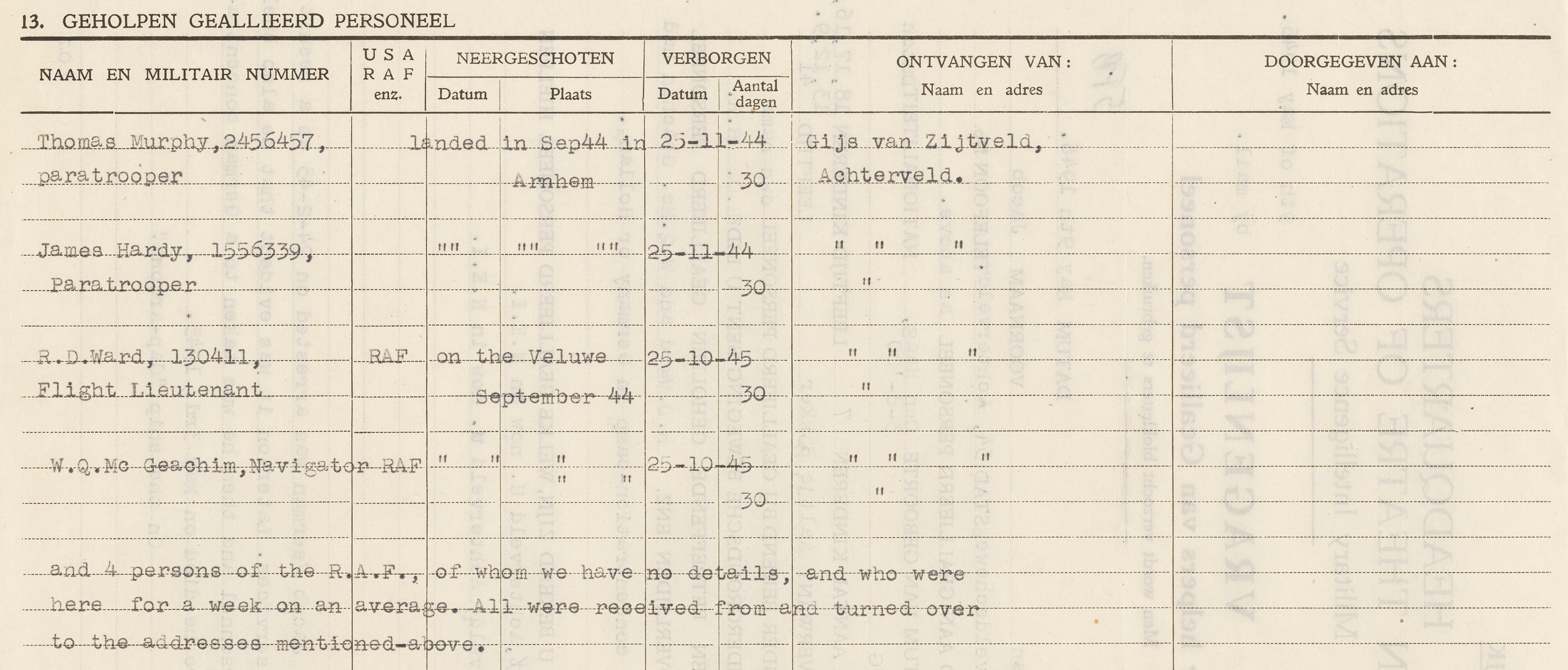
Link to the section The family's own record✓ The family recorded it themselves. In May 1946 they filled in the Americans' questionnaire for Jacob, who was dead, and in the table of Allied men he had helped wrote by hand "THOMAS MURPHY No 2456457. parachutist." (his number is 2756457) and "JAMES. HARDY. No. 1556339. parachutist" (p. 5); the office's typed translation has "Thomas Murphy, 2456457, paratrooper", landed at Arnhem in September 1944, hidden from 25 November 1944 for 30 days, received from Gijs van Zijtveld of Achterveld (their file, p. 3); the Dutch version adds that they were passed on to Jan Dijkstra of Achterveld, and a copy of 24 May gives the stay as "25 Nov. 25 Dec. '44 | 1 month" (p. 7).
The airmen before them
Link to the section The airmen before themThe same table has two RAF men at the farm the month before them, the bomb aimer R.D. Ward and the navigator of his crew, W.Q. McGeachin; it adds four more RAF men, with no names or dates, who stayed a week or about ten days each by two copies of the family's table (p. 5; p. 9). By the family's account Ward and McGeachin both ended up in a concentration camp (p. 4); ✗ neither did: Ward escaped from German military hospitals and McGeachin was a prisoner of war in Stalag Luft 7, a German camp for airmen, and neither is in the Arolsen camp series (the searches; David Ward).
The December round-up around the farm
Link to the section The December round-up around the farmIn the weeks Murphy was in the Veerman house, and the fortnight after he left, the SD were arresting their way through the villages around it. On 8 December 1944, in a raid not on Huurdeman's list, they raided Dries Klooster's house at Barneveld and took Albert van Meerveld, ◐ the "Ape" of Capt. Charles Noble, the doctor later taken with Murphy. Noble had been hidden at the Klooster house, and in early December he was moved to Achterveld itself, ◐ to the house of Fokke Dijkstra's father, whose son, Noble wrote, "was arrested the following week and has not been heard of since" (Noble; Fokke Dijkstra). ⚠︎ Noble's own later account (his unpublished papers), told long after the war, does not name Achterveld: between Barneveld and Scherpenzeel it has "about five days in another farm which was used as a collection point for the British agents who had been dropped and had radio communication with London", a farm he says he kept from his interrogators.
Then the Dutch record has the SD working back through the old billets of Kirschen's Belgian SAS team, "Captain King", after the arrest of the RVV leader Jan Thijssen (Huurdeman). On 15 December 1944 they raided Piet Veenendaal's farm at Scherpenzeel and took, among others, a seventeen-year-old courier, Fokke Dijkstra (⚠︎ at the farm or near it: his page); on the 19th the Verhoef farm on the Klettersteeg at Achterveld, where they took every young man in the house; on 31 December (⚠︎ 5 January 1945 in three other records: Hendrik van de Kuilen) the farm Hardeveld at Leusden, the team's other billet, and on 5 January 1945 the gamekeeper's house next to it. Each raid, who was taken and the camp records are on Piet Veenendaal's page.
What the round-up cost
Link to the section What the round-up costHuurdeman, on those taken, among them the Hardeveld maid and the gamekeeper's wife:
The women were freed after seven weeks, but the men all died at Neuengamme or in one of its subcamps.
Dutch originalDe vrouwen kwamen na 7 weken vrij, maar de mannen zijn allen omgekomen in Neuengamme of in een van de buitenkampen.
— Huurdeman, Ondergronds in de Tweede Wereldoorlog, via the Oorlogsgravenstichting
✓ The camps' own records bear it out (the camp files). Veenendaal died at Neuengamme on 27 February 1945; the Verhoef sons, Jan and Johan, at the Wöbbelin labour camp on 4 and 7 March, of dysentery; Albert van Meerveld at Wöbbelin on 14 March; and Fokke Dijkstra in Germany that spring, aged 18 (⚠︎ the day is not known: his page). The other men's deaths, and each man's papers, are on their own pages (the December round-up).
The arrest, 24 February 1945
Link to the section The arrest, 24 February 1945✓ Jacob Veerman was arrested by the SD on 24 February 1945, by his family's form for the Americans of May 1946, an evacuee lodging at Terschuur who cycled over to the farm that day, the Rijkspolitie's report of 1950 and the resistance's memorial book of 1951 (his file, p. 4; Achterveld booklet, pp. 111–112; Rijkspolitie report, PDF p. 343; Het grote gebod, p. 237); Huurdeman alone has 24 January (Neuengamme online memorial). They had come for Jopie, who was doing courier work; she was hiding with her uncle Gerrit in Ede, so they took her father and put it about that he would be released if she gave herself up. She did, and was sent to Westerbork. He was not released (Neuengamme online memorial, quoting Huurdeman; TracesOfWar). The raid, from inside the house, is on Jacob's page.
Why he was arrested
Link to the section Why he was arrestedThe records give courier work as the reason: Jopie's, by Huurdeman and by the family's L.O.-L.K.P. form of February 1946, which answers that he was taken "omdat zijn dochter koerierster was" (because his daughter was a courier) (the form); Jacob's own, by the family's statement of May 1946, which adds what followed:
Jacob Veerman was arrested by the S.D. on 24 February 1945 for intelligence work. Later it came to light that he had also sheltered Allied personnel, and then he was taken to a German concentration camp, where he died on 3 May 1945. On the ship "Cap-Arcona".
Dutch originalJacob Veerman is 24 Febr 1945 door de S.D. gearresteerd wegens spionage diensten Later kwam aan 't licht dat hij ook geallieerd personeel herbergde, en toen is hij naar een Duits consentratie gebracht, waar hij op 3 Mei 1945 overleed. Op het schip "Cap-Arcona"
— US National Archives · RG 498, helper file of Jacob Veerman · questionnaire of 9 May 1946, section 12 · the archive's copy
The typed Dutch copy of 24 May 1946 gives the work as "Koeriersdiensten voor de R.R. (Rolls Royce.)", courier work for a resistance group of that name, and ends "Waarschijnlijk is Hij hiervoor naar Duitsland gezonden" (probably that is why he was sent to Germany) (p. 8). So his family believed the Germans learned, after the arrest, that he had hidden Allied men; the statement does not say how, or when, or which men. Other records give other reasons: arrests in the RR (the memorial book of 1951: Het grote gebod, p. 237), "his illegal work" (the Den Haag registry, 1955: war graves file, scan 2), and, on a form one of his children filled in in 1955, "proof that father sheltered Englishmen" (scan 3); all are listed on Jacob's page. Nothing found connects the arrest to Murphy.
The camps and the Cap Arcona
Link to the section The camps and the Cap ArconaHe was taken to Apeldoorn (war graves file, scans 17–18; by Jacques Vanhaelen's account he was interrogated there) and went by Amsterdam to Kamp Amersfoort, and from there on to Neuengamme (Neuengamme online memorial). He wrote home from Amersfoort on 14 March 1945, four days before the 18 March on which the Neuengamme memorial has him arriving (⚠︎ the Rijkspolitie's report of 1950 has him arriving on 16 March: his page): "Only now that I am away from you do I realise how much I love you and how good home really was" (Achterveld booklet, p. 84). The whole letter, in English and Dutch, is on his page.
On 3 May 1945 he was aboard the Cap Arcona in the Bay of Lübeck when British aircraft attacked the prisoner ships, and he drowned (KZ-Gedenkstätte Neuengamme; Neuengamme online memorial; Jacob Veerman). That was five days before VE Day, and the day after the Army's Record Office wrote to Murphy's father in Kelty withdrawing the notice of his death (Killed on paper). He left a wife and seven children.
Jopie: Westerbork and the Vrouwenmars
Link to the section Jopie: Westerbork and the VrouwenmarsJohanna Maria "Jopie" Veerman (married name Vanhaelen, 1 December 1927 – 9 September 1977) was one of the 116 women of the Vrouwenmars (the Women's March), brought to Kamp Westerbork between 21 March and 6 April 1945 from four SD prisons; about 75 of them, from Putten, Barneveld, Ermelo, Ede and round about, came via the Willem III Kazerne at Apeldoorn, the barracks Murphy had escaped from on 6 October 1944 (TracesOfWar). ⚠︎ That she was among the Apeldoorn group is our inference: the SD that came for her was Apeldoorn's (the 1950 report). On 11 April 1945 the 116 were marched out of Westerbork, three nights on foot under guard, driven by retreating troops, and liberated near Grijpskerk on 14 April (Stichting Vrouwenmars 1945), two days before Murphy was freed.
The farm behind the front, April–May 1945
Link to the section The farm behind the front, April–May 1945With Jacob gone, German soldiers were quartered on the farm. Their lorries stood camouflaged all round it and their field kitchen outside, and they slept in the family's air-raid shelter; later Canadians slept in the same shelter. Aaltje took in several evacuees as well, and the farm, by Alie's account, had been requisitioned (Alie, the booklet, p. 84). Which German unit it was is not known ⚠︎: the village had a German staff from 6 February to 3 April and then troops falling back from the Veluwe (the booklet, p. 10), and no German record of this front has been found (the search).
The Canadians stopped at Achterveld. On 14–15 April the 1st Canadian Corps was ordered to clear the Germans only "between the Ijssel and the Grebbe Line"; on the evening of the 17th the commander of the 49th Division learned that the corps would advance no farther "owing to political reasons-it was hoped to prevent the enemy from flooding the whole countryside West of Utrecht"; on 22 April Montgomery ordered that the army "will not for the present operate further westward" than its line east of Amersfoort ✓ (Stacey, The Victory Campaign, pp. 572, 580–581, 587). Seyss-Inquart had offered to let food and coal into the western Netherlands if the Allies halted east of the Grebbe Line ✓ (p. 585).
At this time the military situation was such that a too agressive policy towards the enemy in Southern Holland was not considered desirable. The possibility that the Germans would flood the low country ahead of us, and further add to the already desperate plight of the starving population of Western Holland, was, without doubt, the influencing factor that produced the impasse of the next few weeks.
— War diary · The Seaforth Highlanders of Canada · 19 April 1945 · Library and Archives Canada, RG24 vol. 15257
The first Canadians came into Achterveld on the evening of 18 April by the village's own accounts, the parish priest's and the head teacher's (the booklet, pp. 11, 14), and on 19 April by the war diary of Princess Patricia's Canadian Light Infantry, the battalion that held it: "The Village of ACHTERVELD to the west of BARNEVELD was cleared and several PsW taken" ⚠︎ the day differs (PPCLI war diary, 19 April).
By the head teacher's account, written in 1948, the Germans had fallen back on 17 April "achter de bekende linie tussen Achterveld en Hamersveld" (behind the well-known line between Achterveld and Hamersveld), and for days the village lay in "niemandsland" (no-man's-land), "om beurten bevrijd en dan weer bezet" (freed and occupied again by turns) until the evening of 21 April, when Canadians dug in near the school; the skirmishing went on until 28 April (the booklet, p. 14); the Patricias' diary has a company there on 21 April ✓ (PPCLI war diary, 21 April).
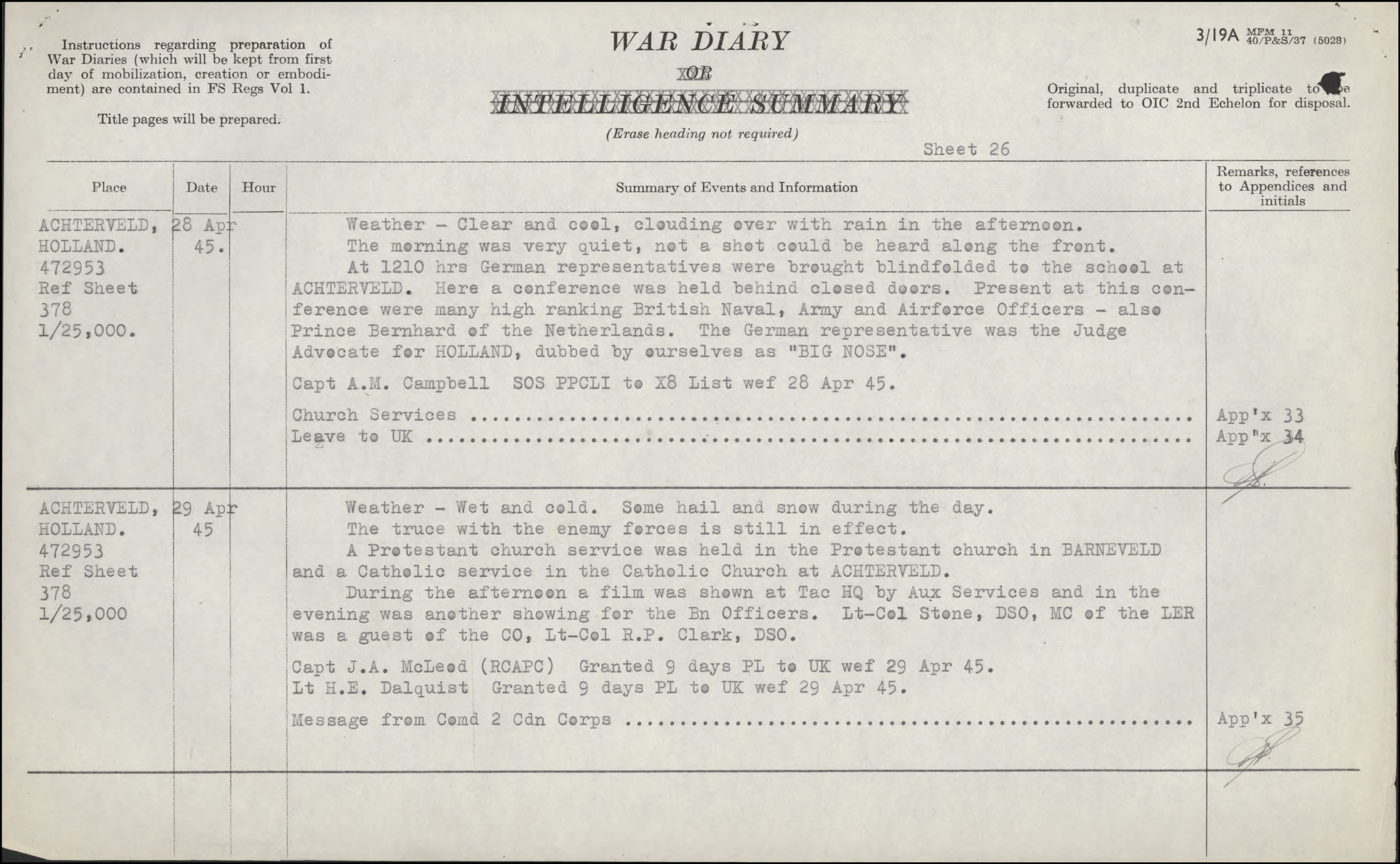
On 23 April the Patricias set up their tactical headquarters "at 472953, just outside ACHTERVELD" ✓ (PPCLI war diary). ◐ That reference lies about 900 metres west of Achterveldseweg 34, and about 360 metres from the farmhouse reference Hardy gave in January 1945. The battalion's forward companies were 2.4 to 2.6 km west of the farm, and the Seaforths, on its left, 1.3 km and more to the south (PPCLI; Seaforth war diary, 23 April; the conversions are ours and good to about 300 metres). So the farm lay inside the Canadian lines, behind the forward companies ◐. Neither battalion's diary names the farm or the family ✓, and which Canadians slept in the shelter is not known ⚠︎.
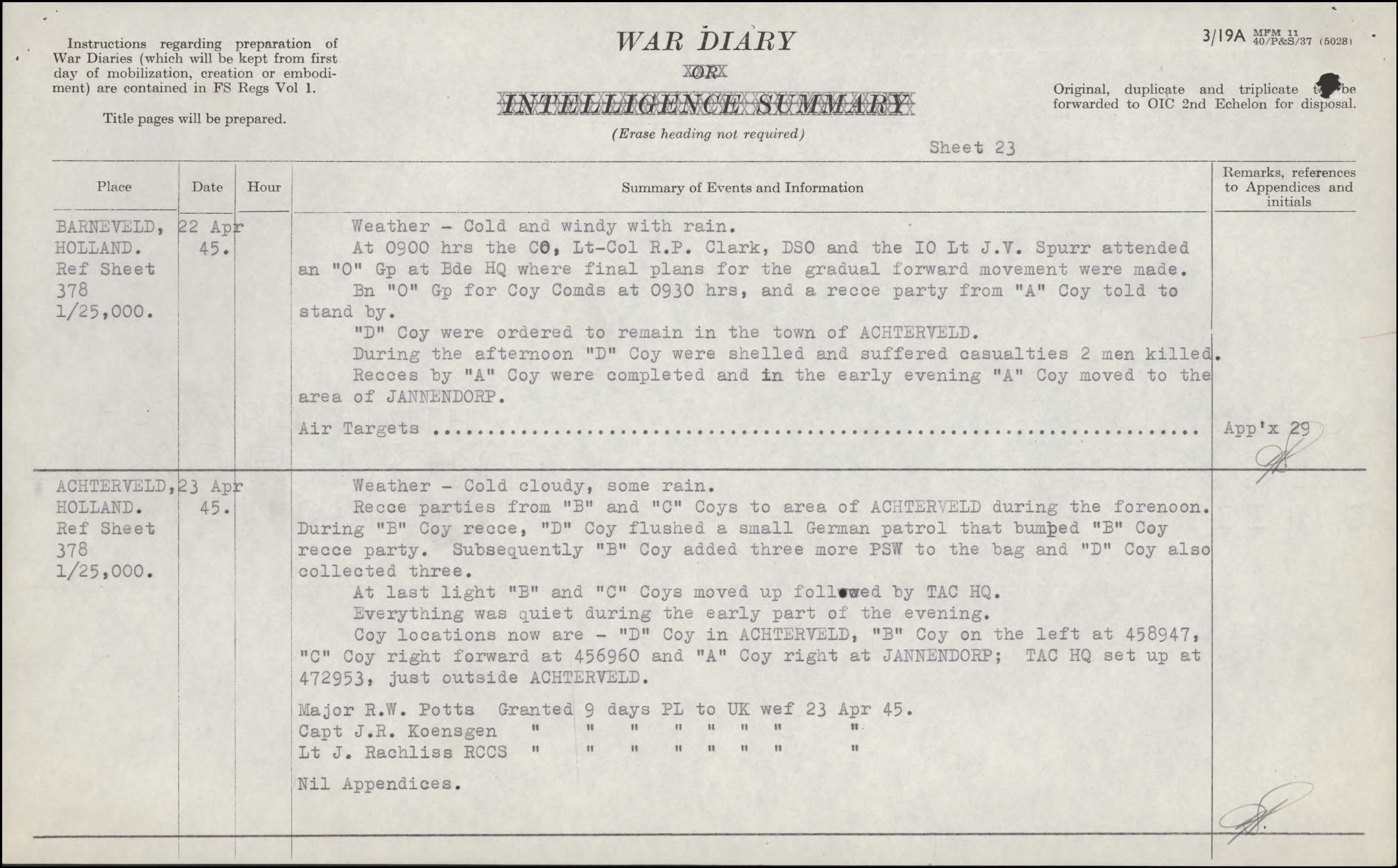
From 8 a.m. on 28 April there was to be "absolutely no firing of any weapons" ✓ (Seaforth war diary, 27 April; Stacey, p. 607). That day German representatives "were brought blindfolded to the school at ACHTERVELD" to talk about feeding the western Netherlands, and on 30 April Seyss-Inquart came himself ✓ (PPCLI war diary, 28 April; 30 April). On 3 May the Patricias had word "that the truce was over"; nothing came of it, and on 4 May the news that hostilities would cease next morning "was very quietly received by the troops" ✓. "At 0800 hrs today hostilities ceased", the diary has for 5 May ✓ (PPCLI war diary, 3–4 May; 5 May). The village heard it on the radio at about nine on the evening of the 4th, and the Canadians then moved off towards Utrecht and Holland ✓ (the priest, the booklet, p. 12).
Jopie after the war
Link to the section Jopie after the warShe came home ill in May 1945. She married a Belgian, Jean-Baptiste Vanhaelen, and it was the Vanhaelens who came to Scotland in July 1974 (After the war). She died in 1977, aged 49. Her life, and her place on the marchers' own list, are on her page.
Jacob's brothers in the camps
Link to the section Jacob's brothers in the camps⚠︎ One of Jacob's brothers was held at Neuengamme too, by an RTV Utrecht report of May 2024: two other members of the family were imprisoned there and had to work in the camp, and Jacob's granddaughter Alie says they were also commemorating "my grandfather's brother and his nephew" there (RTV Utrecht, 4 May 2024). Nothing else found says so. The online Neuengamme memorial, which lists the camp's dead, has Jacob as its only Veerman (the search), so a Veerman brother held there came home. Jacob's grandson Carel Plantagie has never heard of a brother, or anyone else in the family, coming back from Neuengamme (his email, October 2026). Which brother, and when, is not known.
✓ Leendert Jan was held at Kamp Vught from December 1943 to July 1944, home again nearly five months before Murphy came; Ede's notes put his arrest on 21 October 1943, the same day as G. W. van de Woerd of Barneveld, very probably one of the men Jacob's L.O.-L.K.P. form names; no source says why (one unsigned note, his page).
Murphy wrote: "I learned after the war that the Germans rounded up the Uncle and others, no doubt through the connection to the Gun" (On Tex Banwell). His "Uncle" is the policeman he says gave him the revolver. No Veerman was taken in the December round-up (Huurdeman; the December round-up), and nothing found ties any arrest to the revolver. What is known of the brothers, and what the camp registers hold, is on Jacob's page.
Remembered in 1970
Link to the section Remembered in 1970A Leusden paper remembered him on the twenty-fifth anniversary of the liberation, and named the baker who, it says, provided the rye bread for the paratroopers:
Jacob Veerman of "Klein Achterveld", a good man, managed to keep dozens of paratroopers out of the Germans' hands. He stops to talk for a moment with the baker Hein Schouten, who provides the rye bread for the paratrooper-liberators; it is his last conversation. The Grüne Polizei lie in wait for Jacob …
Dutch originalJacob Veerman van „Klein Achterveld" — een goed mens — heeft tientallen parachutisten uit handen van de Duitsers weten te houden. Hij praat nog even met bakker Hein Schouten die zorgt voor roggebrood voor de parachutisten-bevrijders, het is zijn laatste gesprek. De Grüne Polizei wacht Jacob op …
— Leusder Krant, 2 April 1970, p. 8 (Archief Eemland)
⚠︎ "Dozens" was written twenty-five years later: the family's own table has eight Allied men in all (p. 9), and the article has the ship he died on sinking in the Elbe (Leusder Krant, 2 April 1970, p. 8). The article is signed "J. M. Sch." (the page), ◐ very probably Jan M. Schouten, the village historian and Hein's son (Hein Schouten); if so, the bread is a son writing of his father, one family source, and ⚠︎ the article does not say the paratroopers were the men Jacob hid.
The farm today
Link to the section The farm todayThe farm is still standing, much as it was. The bus stop on the road beside it is named after the farm, in Jacob Veerman's memory, and he is on the war memorial at Achterveld (Jopie's son, Jacques Vanhaelen, and his own photographs, October 2026).