Dries Klooster
Doornspijk 18 Aug 1901 – Nijkerk 17 Apr 1945
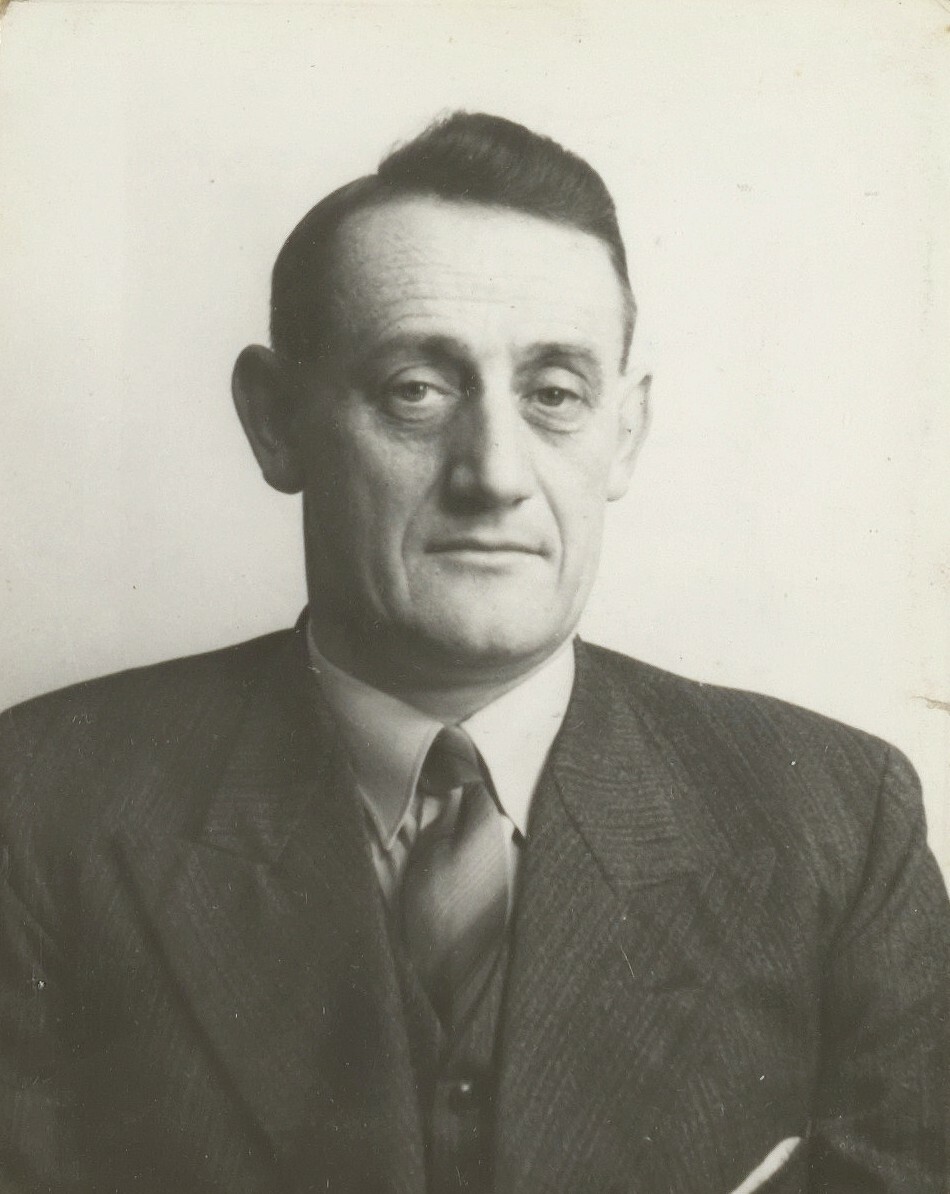
About: A post-office clerk at Barneveld and a resistance man of Group Hein, whose house hid Allied evaders, among them Tex Banwell and Charles Noble of Murphy's story. He was killed by a shell at Appel, near Nijkerk, on 17 April 1945.
Unit or role: Adjunct-commies (assistant clerk) of the P.T.T. at Barneveld; first in the L.O., later the K.P., and a contact of Group Hein, cover names "Oom Loe" and "Lodewijk Hemmes" (the L.O.-L.K.P. form).
Where: Amersfoortsestraat 71, Barneveld; in hiding from December 1944, last at Appel, Nijkerk.
Evidence: ✓ the Oorlogsgravenstichting and its 1955 file on him (Nationaal Archief 2.19.255.01, 79442A); ✓ the L.O.-L.K.P. form for the book of the fallen (NIOD); ✓ his household's form for the Americans, 24 August 1945 (US National Archives 286667328); ✓ the civil registers (Open Archieven); Noble and Kubly, who were hidden by him; ◐ Diet Eman, who lived in his house (Things We Couldn't Say); ◐ the Encyclopedia of the Righteous.
✓ He was born at Wessinge, in Doornspijk, on 18 August 1901, the son of Jannes Klooster, 21, a telegraafwachter, and Jennigje Klein (the birth, index only). The war graves record gives his work as kantoorbediende, lid verzet (office clerk, member of the resistance) (Oorlogsgravenstichting). The Foundation's file of 1955 has his father as James Klooster, born at Kampen on 26 August 1879 (his occupation, "Telegraafwachter?", is a doubtful reading), and his mother as Jannigje Klein, born at Kampen on 27 March 1880 (scan 2). His father Jannes died at Kampen on 23 October 1953, aged 74, the son of Dries Klooster and Martha Strieker (the death).
His registers have him leaving for IJsselmuiden on 3 November 1904, Hasselt on 12 December 1921, Enschede on 4 December 1922 and Hoorn (Gerritsland 52) on 12 August 1926, and then coming with his family to Barneveld, Amersfoortschestraat 67, on 12 October 1933 (scan 3).
✓ He married Johanna Geertruida Kohnhorst at Borne on 21 December 1928, when he was 27, born at Doornspijk, and a kantoorbediende, and she 32, born at Amsterdam, the daughter of Adolf Andries Kohnhorst and Johanna Dogger; the index has his father as a spoorwegwachter, a railway watchman, and the index's remark has her as "gescheiden echtgenote van Georg Hendrik Bakker" (the divorced wife of Georg Hendrik Bakker) (the marriage, index only). The Foundation's file has her born at Amsterdam on 2 May 1896 (scan 2). Her first marriage is on her page.
His work is given as Kantoorbediende Posterijen, a post-office clerk, on Barneveld's form of 1955 and "p.t.t." on the grave form (scan 2; scan 5), and "adjunct Commies P.T.T." on the L.O.-L.K.P. form (NIOD). ◐ The Encyclopedia of the Righteous Among the Nations has him in the postal service and a highly respected citizen of Barneveld (the entry; image-checked). ◐ Diet Eman has him "much beloved in Barneveld, where he worked in the post office" (Eman, p. 346), as her serial in The Banner of December 1993 had it before the book (p. 8). The American airman Ray Kubly, whom he hid, calls him the postmaster: "Mr. Klooster was the postmaster in town and knew lots of people and whom to trust", and his sons ran messages for the underground (Kubly).
His resistance work
Link to the section His resistance work✓ The L.O.-L.K.P. form made out for the resistance's book of the fallen gives his cover names as "Oom Loe" and "Lodewijk Hemmes", and adds "en contact v/d groep Hein" (and contact of the group Hein). He worked "Eerst LO. Later KP. Dropping ploeg en Trouw. Veluwe" (first in the L.O., later the K.P.; the dropping team and, ◐ the reading uncertain, Trouw; the Veluwe), had to go into hiding "i.v.m. LO werk in Nijkerk" (in connection with L.O. work in Nijkerk), helped the K.P. cleaning weapons and so on, and is rated "medewerker LO en KP cat III" (a collaborator of the L.O. and K.P., category III) (the form, read on the image). The resistance's memorial book of 1951 has "Dries Klooster / (Oom Loe) / Tevens: Groep Hein" among the five of the LO-Barneveld (Het grote gebod, p. 237, read on the page); ◐ its title page names a Gedenkboekcommissie and the form is headed "LO-LKP-Stichting, Gedenkboek commissie", so it is very probably the same committee and one source with the form, not a second.
The American report on Albert van Meerveld, written at The Hague on 24 May 1946, has Van Meerveld contacted, about September 1943, by "people involved in evasion-work", among them Hein Sietsma of Nijkerk-Hulk and "Mr. K l o o s t e r , from Barneveld (dead)", and from then on spending "his nights alternatively at Zwartebroek and at Mr. Klooster's, Barneveld" (p. 5, image-checked). The pencil note on Van Meerveld's own L.O.-L.K.P. form has the same: "Meerveld was ondergedoken en sliep bij Klooster" (Meerveld was in hiding and slept at Klooster's) (his form).
◐ Diet Eman of Group Hein made his house her base: "After I left the Bakkers in Eindhoven, my base of operations was at Barneveld, in The Veluwe, at the home of Jo and Dries Klooster, who had seven children", in a passage set in December 1943 (Eman, pp. 151–152). Elsewhere she has lived in the house "for several weeks myself, just after returning from Vught" (p. 345). ◐ The Encyclopedia tells the household as one of the Hein group's hiding places: in mid-1944 Albert van Gelder, a Jew of twenty, was brought from the van Meervelds' home to the Kloosters', who had seven children, and shared the eldest son's bed for three months; he was not allowed outside; the entry says Dries also gave refuge to Allied pilots and to Diet Eman (the entry; image-checked).
With Murphy
Link to the section With MurphyNo source here links him to Murphy, but his house hid evaders of the same crossings, among them Tex Banwell, later captured with Murphy, and the doctor Charles Noble.
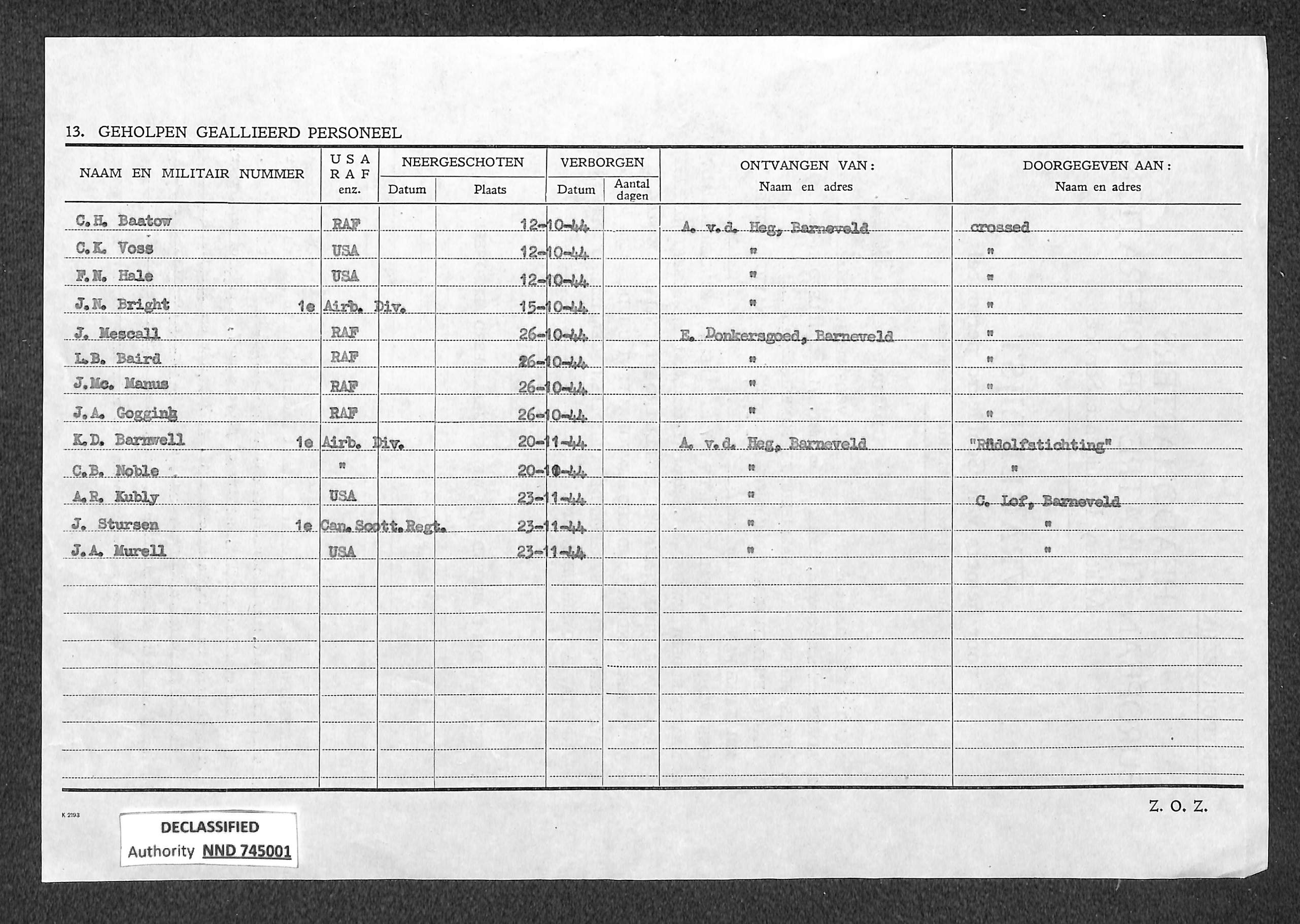
✓ The household's own list. The form made out for his household after his death lists thirteen men by date (his file, p. 3):
- Baatow (RAF), Voss and Hale (USA), 12-10-44, and Bright of the "1e Airb. Div.", 15-10-44, all from A. v.d. Heg, all "crossed";
- four RAF men, Mescall, Baird, McManus and "Goggink", 26-10-44, from E. Donkersgoed of Barneveld, also "crossed";
- "K.D. Barnwell | 1e Airb. Div. | 20-11-44" and "C.B. Noble", both from A. v.d. Heg (◐ Aart van de Heg) and sent on to the "Rüdolfstichting" (◐ the Rudolphstichting, the children's village at De Glind, as Charles Noble's page has it); Noble's date is typed "20-10-44" with the month overtyped, ◐ probably 20-11-44 (Charles Noble);
- A. R. Kubly, J. Stursen of the "1e Can. Scott. Regt." and J. A. Murell, 23-11-44, also from A. v.d. Heg (ditto marks under his name), sent on to C. Lof.
Noble's ten days. ✓ Noble, after five days in a barn with others of his party, was taken "to a house in BARNEVALD on the AMERSFOORT road, where lived the family KLOOSTER":
This man has since been killed in a grenade accident during the liberation. This man and his wife had hidden several Allied personnel in their house from time to time. No doubt other reports have mentioned them. It is to be hoped that something can be done for Mrs. KLOOSTER and the children. Latterly there were two USAAF officers and one Canadian private in the KLOOSTER's house.
— Capt. C. B. Noble, RAMC · escape report, 1945 · the Pegasus Archive's transcript
After ten days "the situation became no longer safe" and he was taken to Achterveld; "That night the KLOOSTER's house was raided and another man who had rendered assistance in the way of tobacco, etc, 'APE' was arrested" (same). ◐ The two officers and the private are very probably Kubly, Murrell and Sjursen, the Americans and the Canadian Scottish man on the household's list: Lof's table has them as "Lt." and "Cpl." and Eman's has both Americans as "2nd. Lt." (Lof, p. 10; Eman, p. 8). Noble's "private" against Sjursen's "Cpl." is the one misfit.
⚠︎ Noble's own later account (unpublished private papers, shared with us privately), told long after the war, does not name the Kloosters. After the barn it has him at "a house in the main street in Barneveld", whose people were "showing tremendous courage and taking great risks for what they thought was a right and proper cause", for "about two weeks with an RAMC other rank whose name I can’t remember". His report has ten days, and "two USAAF officers and one Canadian private" in the house at the end. ◐ That it is the same house rests on its place in his route.
Kubly's four days. Kubly, one of the few to get away when Pegasus II ran into the Germans on 18 November, came to the house after a day in a farmer's barn loft and some days in the attic of a guest-house; the household's form dates him 23 November. After about four days Klooster came home and said they must move: they went to the Lof house, and "The next morning the Germans came looking for us and, of course, the Kloosters denied anyone was there. Mr. Klooster hid under the stairway"; while his wife gave tea to the German left in the kitchen, he slipped out of the house, and "He then had to hide with other underground people until the end of the war" (Kubly). ✓ Cornelis Lof's table has Murrell, Kubly and Sjursen "4-12-44", from "Klooster" (the table, p. 10), the other half of the entry on Klooster's own form. A second American book, Voices of My Comrades, has the same stay "for four days … at the home of the Barneveld postmaster, Dries Klooster, whose two young sons were used 'as couriers and for other Underground activities'", and the Germans coming while Kubly and Murrell were "at the home of Cor Lof" (p. 359); its quoted words are Kubly's own, so it is his account retold.
The raid of 8 December 1944. ✓ The American report on Van Meerveld, whose witnesses include Mrs Klooster, tells it: the Germans came "abt. 4,30 A.M." to arrest Klooster, "whose wife manoeuvred in such a way that the two men had time to destroy and hide compromising documents. Then Klooster disappeared in a specially prepared hiding-place"; and, according to Mrs Klooster, Van Meerveld "refused to go into this hiding-place", saying the Germans were not after him (the report of 24 May 1946, p. 6, image-checked). Van Schuppen adds there that Klooster "was wanted by the Gestapo following the arrest of" Kamphuis of Kootwijkerbroek, Lokker and Schuman of Barneveld, "who are suppoesed [sic] to have given names of their organisation to the Germans" (same). ⚠︎ The report gives it as Van Schuppen's account, and the three as men who "are suppoesed [sic]" to have given names: hearsay, with no source named beyond him. Beside it, the same page has Lokker present at Schuman's first interrogation, and gives him as a witness; and the L.O.-L.K.P. form for Klooster was filled in at the address of "Dr. J.P. Lokker (O.D.)" of Barneveld, ◐ possibly the same man (the form). ◐ Diet Eman has the raid because the Germans "had received a tip that Allied pilots were being hidden there":
Dries, like many others, had created a hiding place in his home, just in case such a raid were ever to occur. He had hidden me there, as well as downed pilots; but we had gotten out before the raid. Dries himself climbed into that hiding space and was able to escape.
— Diet Eman with James Schaap · Things We Couldn't Say · p. 316, checked against the page · the pages
◐ The Encyclopedia has the raid on 8 December, Dries escaping by a hiding place he had made and Ab van Meerveld, visiting, taken (the entry). Van Meerveld died at Wöbbelin on 14 March 1945; his story is on his page. ◐ Noble's "Ape" is very probably Van Meerveld, by name, house and date (Albert van Meerveld).
The other forms that name his house. ✓ Where they give an address it is no. 71 of the Amersfoortsche straat or weg, except Van Haeften's memo, which has "Amersfoortschestraatweg 79"; none names Murphy.
- Diet Eman's own form of 5 February 1946 gives "Amerfoortschestr. 71, Barneveld" as her address known to Allied personnel and lists "Fam. Klooster, Amersfoortscheweg 71, Barneveld" among the people she knew who helped; her table of May 1946 names the men she helped, Banwell among them, and "The addresses were they sheltered are: Klooster Amersfoortschestraat 71 Barneveld" first, then Heine, Rouwenhorst, Heg and Bouwmans; a torn slip adds that the airmen Hale and Vosse "mentioned the Klooster family and know their address" (her form, p. 2; the table, p. 8; the slip, p. 9; table and slip image-checked).
- The American inquiry into Albert van Meerveld names the house again in its list of the men he handled.
- Hale, Voss and Bastow (◐ the household's "Baatow") and Bright, braced together with "Taken by van Meerveld to Klooster's house, Barneveld" (the list, p. 7).
- Three RAF men, Mescall, Goggin and Baird, who "Stayed at Klooster's house and were taken away by Klooster and v.Meerveld to Otterlo" (same).
- Its witnesses are Mrs Klooster, Mrs van der Woerd, Mrs van de Heg and Mr van Schuppen of Amersfoort (p. 5, image-checked); Mr Lokker of Barneveld, also on Van Schuppen's list of the arrested (above), speaks to the arrest of 8 December (p. 6, image-checked).
- The four RAF men's road to his house is on three more helpers' papers.
- E. van Donkersgoed had McManus, Mescall, Baird and Goggin from "Widow Kamphuis Voorthuizen" from 12-10-44 for 14 days and passed them to "D. Klooster, Barneveld" (his table, read on the image).
- Aart Oosterman's table has Goggin, McManus and Baird from E. van Donkersgoed to "Klooster Barneveld" (his table, read on the image; its ditto marks carry R. D. Ward there too, where Van Donkersgoed's own table sends Ward to Frans Hals).
- C. F. van Haeften's memo has the K.P. team's "3rd. trip 4 km. Mecall, Baird, J. Mac Manus, J.A. Goggin on bicycle / From van Donkersgoed to Klooster, Amersfoortschestraatweg 79, Barneveld" (the memo, read on the image).
- Cornelis Lof's table has Murrell, Kubly and Sjursen from "Klooster" on 4-12-44 (p. 10); Aart van de Heg lists "Klooster D" at "71 Amersfoortscheweg" among his contacts (p. 8).
- T. G. Goudriaan of the Valkseweg, Barneveld, had "Bill ?" for two days, received from "Mr. Klooster, Barneveld" (his table, image-checked).
- Cornelis van der Bor of Schaffelaar, who helped about twenty airmen, wrote: "I passed the men on to the family Klooster at Barneveld. On that occasion my bike got requisitioned"; they were the crew of a bomber down between Putten and Voorthuizen, and the letter is undated (his letter, p. 8, image-checked).
- Jacob de Boer of Barneveld lists "D. Klooster, Amersfoortschestraat, Barneveld. (died)" among the people he knew, in his form of 11 January 1946 (p. 2, image-checked).
In hiding, December 1944 to April 1945. ✓ The L.O.-L.K.P. form has him, after the raid, "ondergedoken in Nijkerk" (in hiding in Nijkerk); a pencil note at its foot puts him with a man read as Zandbergen at an address E 33 near Nijkerk, "bekend duikadres" (◐ a known hiding address) of K.P. men (the form, read on the image; the place name is not legible). The household's form of August 1945 has "At a certain moment Klooster had to "dive under" for something else" (p. 2). ◐ Diet Eman has the Gestapo come back to the house in April 1945 and take his wife, Jo, when they found him gone, in the hope he would give himself up: "The Gestapo thought Dries would turn himself in, but we warned him, "Don't do it, don't do it — not with liberation so close at hand." But it was very hard on Dries to know that Jo was in the Gestapo's hands" (Eman, pp. 345–346, checked against the pages). The Encyclopedia has the same: his wife seized and imprisoned to make him come out, Dries wanting to leave his hiding place on a friend's farm and go home, and his friends dissuading him (the entry).
How he died
Link to the section How he died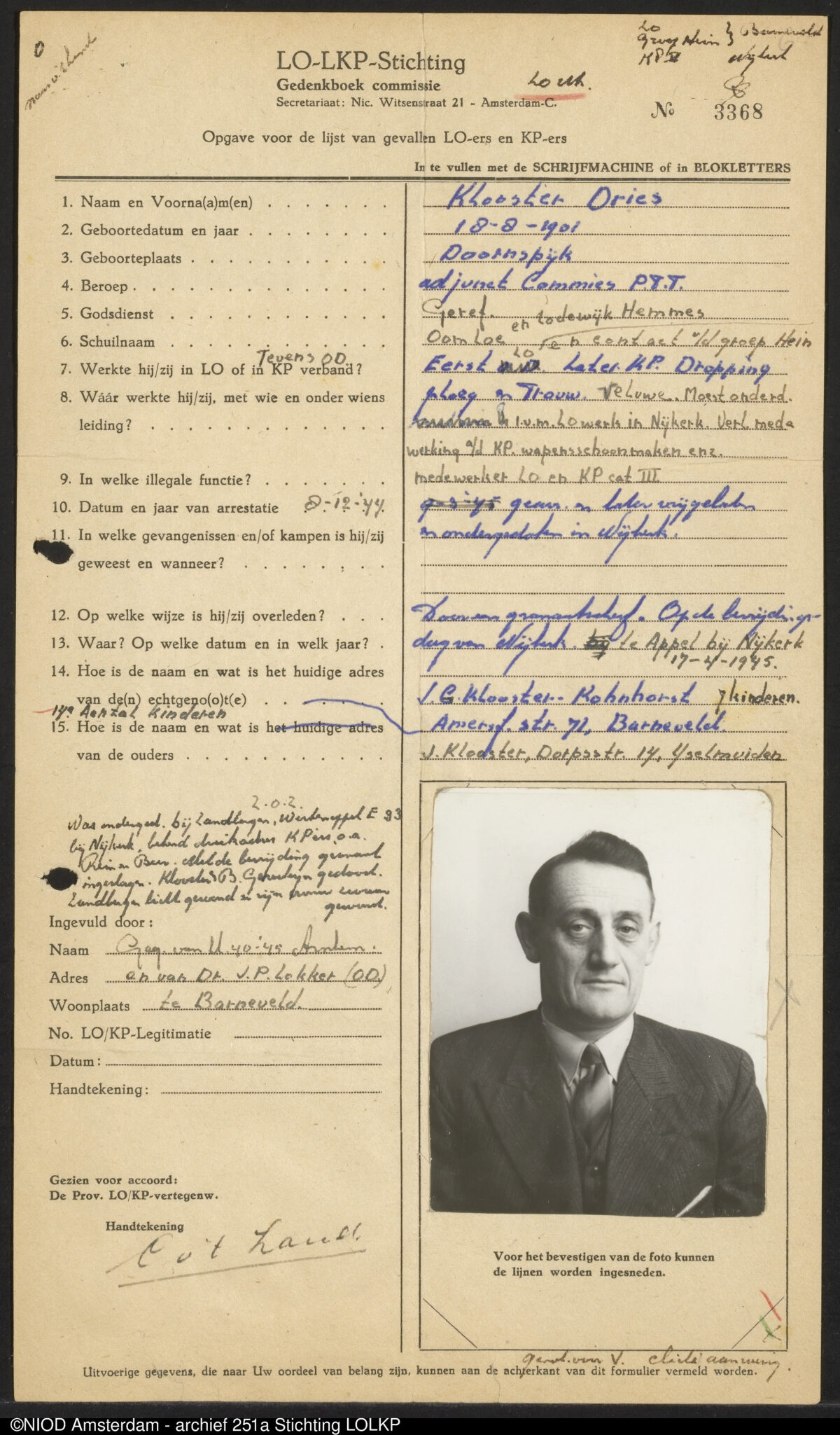
✓ The L.O.-L.K.P. form has him killed "Door een granaatscherf" (by a shell splinter), "Op de bevrijdingsdag van Nijkerk … te Appel bij Nijkerk 17-4-1945" (on the day of Nijkerk's liberation, at Appel near Nijkerk). Its pencil note tells it in more detail (the form, read on the image; doubtful words marked):
Was in hiding with Zandbergen [?], … E 33 near Nijkerk, a known hiding address [?] of K.P. men, among them Rein and Ben [?]. At the liberation a shell struck. Klooster and B. Ge…stein [?] killed. Zandbergen [?] lightly wounded and his wife badly [?] wounded.
Dutch originalWas onderged. bij Zandbergen [?], W[…]appel [?] E 33 bij Nijkerk, bekend duikadres [?] KP'ers o.a. Rein en Ben [?]. Met de bevrijding granaat ingeslagen. Klooster & B. Ge[…]stein [?] gedood. Zandbergen [?] licht gewond en zijn vrouw ernstig [?] gewond.
— L.O.-L.K.P. form for Dries Klooster, pencil note · NIOD, archief 251a · transcript
- ◐ The host. The name is hard to read on the form, but a typed helper's form from Voorthuizen has a Free French airman received from "H.J. Zandbergen, Appel" in November 1944 (E. van Donkersgoed's table, read on the image), so ◐ possibly H. J. Zandbergen of Appel; the table shows only that a helper received a man from a Zandbergen at Appel in November 1944, not that he hosted Klooster.
- ◐ The second man. Very probably the form's "B. Ge…stein" is Barend van Geerenstein: the same day, the same hamlet, a shell, and a host whose name begins Zand-.
- Barend van Geerenstein, 25, a farmer born at Lunteren, died at Nijkerk on 17 April 1945 (the death, index only).
- The Oorlogsgravenstichting has him a man of the Lunteren resistance group who escaped from the SD in March 1945 and hid at Appel (the Oorlogsgravenstichting).
- It quotes the Foundation's report of 1953 on him: "te Appel, gem. Nijkerk ondergedoken bij J. Zandsteeg. Op de dag van de bevrijding, 17-4-45, in de woning van Zandsteeg door een granaat dodelijk getroffen" (in hiding at Appel, Nijkerk municipality, with J. Zandsteeg; on the day of the liberation, 17-4-45, fatally hit by a shell in Zandsteeg's house) (same).
- Whether the host was Zandbergen or Zandsteeg, the two sources differ.
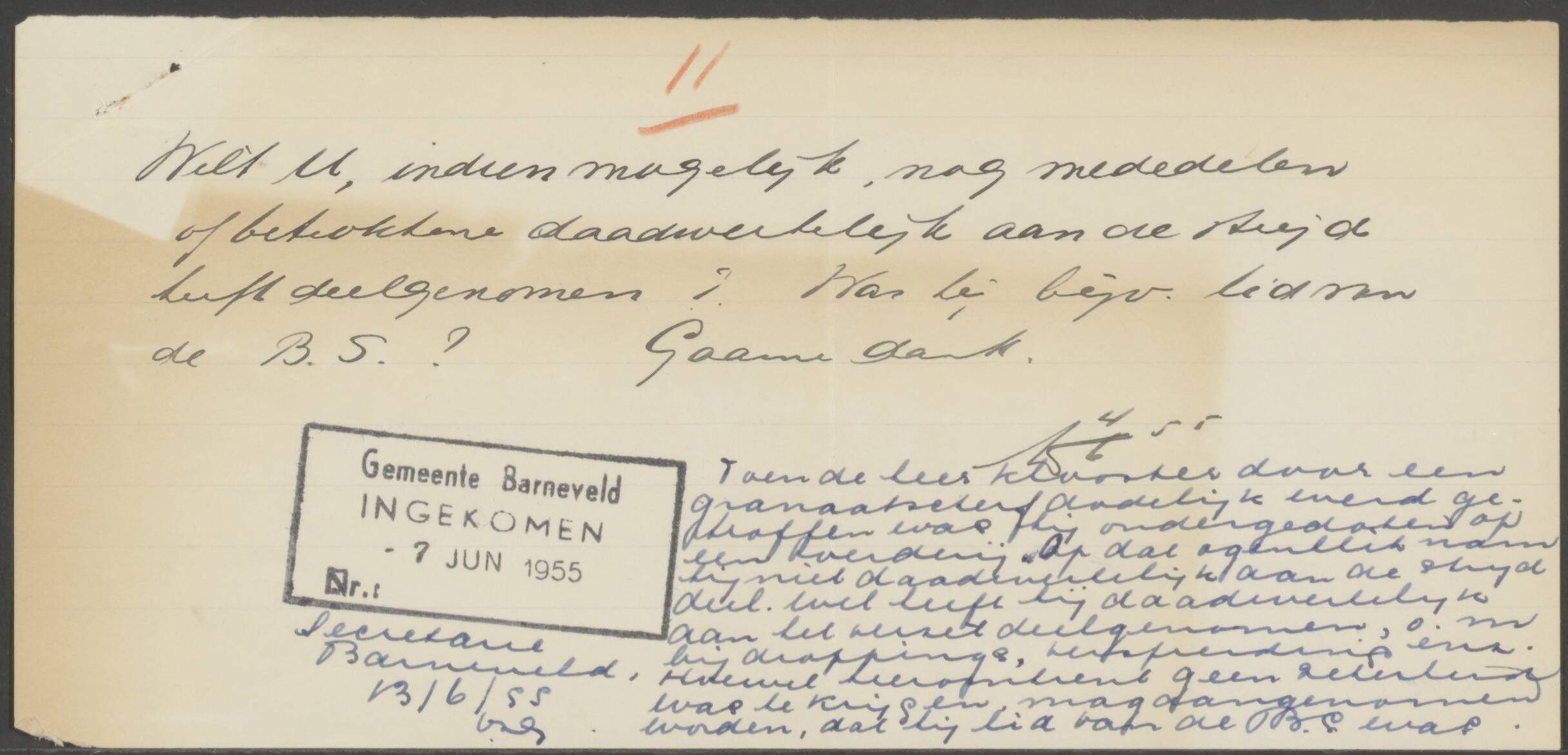
✓ The Foundation's file has the municipality's account. Asked by the Foundation in 1955 whether he had taken part in the fighting, whether for example he was in the B.S., the Barneveld secretariat answered on 13 June 1955:
When Mr Klooster was fatally hit by a shell splinter he was in hiding on a farm. At that moment he was not taking an active part in the fighting. He did, however, take part in the resistance, among other things in drops, hiding people and so on. Although no written statement could be had about this, it may be assumed that he was a member of the B.S.
Dutch originalToen de heer Klooster door een granaatscherf dodelijk werd getroffen was hij ondergedoken op een boerderij. Op dat ogenblik nam hij niet daadwerkelijk aan de strijd deel. Wel heeft hij daadwerkelijk aan het verzet deelgenomen, o.m. bij droppings, onderduiking enz. Hoewel hieromtrent geen schriftelijke [verklaring] was te krijgen, mag aangenomen worden, dat hij lid van de B.S. was.
— Gemeente Barneveld, Secretarie · to the Oorlogsgravenstichting · 13 June 1955 · Nationaal Archief 2.19.255.01, 79442A, scan 4 · transcript
On the Foundation's other forms the cause is "door een granaatscherf getroffen bij de bevrijding van [Voorthuizen?]" (hit by a shell splinter at the liberation of [Voorthuizen?]; the place is a doubtful reading), the questionnaire has him dying at Nijkerk on 17 April 1945, and, on the grave form filled in by a former co-worker, "Appel (bij Nijkerk) 17-4-'45" (scan 3; scan 2; scan 5). ✓ Nijkerk's death register has it: Dries Klooster, 43, "adjunt commies PTT" (an assistant clerk of the post, telegraph and telephone service), born at Doornspijk, son of Jannes Klooster and Jennigje Klein, with Johanna Geertruida Kohnhorst, died at Nijkerk on 17 April 1945, the deed (no. 135) made on 28 April (the death, index only). The Erelijst's printed roll has "Klooster / Dries / Doornspijk 18·VIII·1901 / Ambtenaar / Nijkerk 17·IV·1945" (the Erelijst, p. 562, read on the image).
◐ Diet Eman has a Canadian shell:
He hid in a place called Drie, very close to Nijkerk. By that time the Canadians were already advancing, and we were constantly being shelled; they were shooting long-distance artillery into the area, that's how close the liberation was. One of those shells made a direct hit on the farm where Dries was hiding. The farm was damaged, of course, and Dries was killed — the only one on that farm who was.
— Diet Eman with James Schaap · Things We Couldn't Say · p. 346, checked against the page · the pages
The children heard the news from their pastor (Eman, p. 346). ◐ The Encyclopedia ends: in the heavy fighting of April 1945 the farm took a direct hit from an artillery shell and he was killed (the entry).
Noble, writing in 1945, has him "since been killed in a grenade accident during the liberation" (Noble), and the form made out for his household in August 1945 says "During the liberation he was killed by granat explosion" (the form, p. 2). Kubly has another death altogether (◐ he does not say where he heard it, and by his own account he had left the house the evening before the Germans came):
The Canadians came to town on the last day of the war to get the Germans to surrender. Dries was leading the troops to the command post of the Germans when they threw a hand grenade and killed him.
— A. R. Kubly, 34th Bomb Group, USAAF · Mendlesham Memories · the Internet Archive's copy
Burial and remembrance
Link to the section Burial and remembranceHe was buried on 21 April 1945 at the new general cemetery at Barneveld, section 1, plot B no. 2, a private grave never to be cleared, in good order at the control of 18 June 1955 (scan 2; scan 6). ◐ The Foundation's page calls it "Gem. Begraafplaats De Plantage te Barneveld", vak B/2 (the Oorlogsgravenstichting); the 1955 form has the "nieuwe alg. begraafplaats", section 1, plot B no. 2, so the same plot and very probably one cemetery under two names. His family thanked everyone who had shown sympathy at the death of "onzen lieven Man en Vader" (our dear husband and father), signed "FAM. KLOOSTER. Barneveld, Mei 1945. Amersfoortschestraat 71" (Voor Waarheid, Vrijheid en Recht, 31 May 1945).
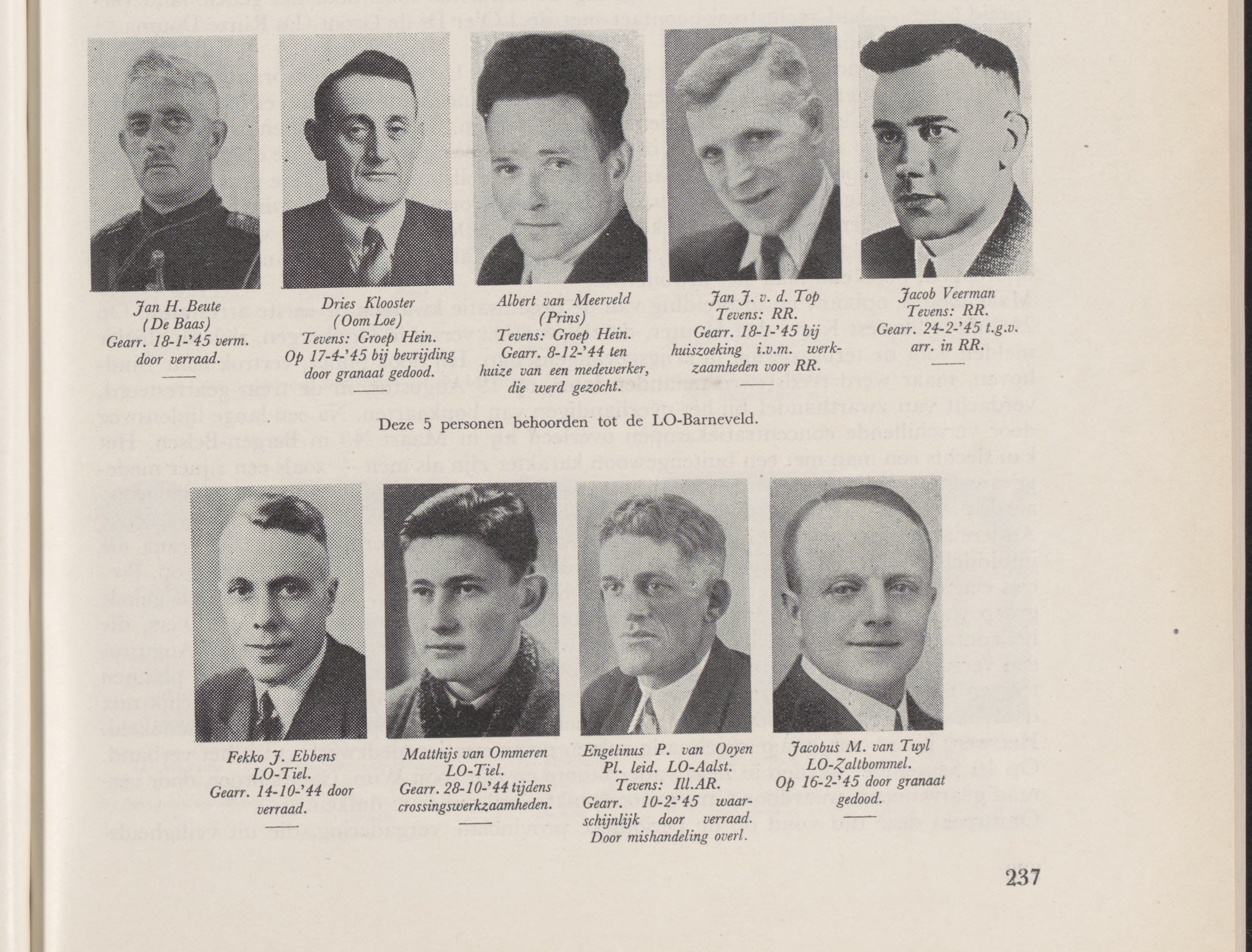
✓ The resistance's memorial book of 1951 puts him among the five fallen of the LO-Barneveld, with Albert van Meerveld and Jacob Veerman: "Dries Klooster / (Oom Loe) / Tevens: Groep Hein. / Op 17-4-'45 bij bevrijding / door granaat gedood" (also Group Hein; killed by a shell at the liberation on 17-4-'45) (Het grote gebod, p. 237, read on the page). Diet Eman's book has his photograph among eight of Group Hein "who died in the service of the Resistance" (Eman, p. 376).
✓ The American award. The British I.S.9 office at Wassenaar listed him on 14 May 1946 among the cases "considered to be in Grade 5", "23. KLOOSTER, Dries. Barneveld, Amersfoortschestraat 71." (the list, image-checked). The Americans graded him "Posth Grade 5", conference 51 of 20 May 1946 (the folder cover), and their list of Grade 5 (Eisenhower) certificates has "(2266) KLOOSTER, Dries (Posthumous), Amersfoortschestraat 71, Barneveld" (the list, p. 86, image-checked).
✓ On 23 May 1979 Yad Vashem recognised Dries Klooster as Righteous Among the Nations (the entry; image-checked; the entry is on pp. 414–415 of vol. 1).
Where the sources disagree
Link to the section Where the sources disagreeHow he died. Three versions, and the weight is with one.
- A shell, in hiding.
- The L.O.-L.K.P. form: a shell splinter at Appel near Nijkerk on 17 April 1945, in hiding at an address E 33 near Nijkerk, a second man killed and the host and his wife wounded (the form); Het grote gebod, very probably from the same committee, a shell at the liberation (p. 237).
- Barneveld's secretariat in 1955, a shell splinter while he was hiding on a farm; the Foundation's forms, a shell splinter at the liberation, at Nijkerk or Appel, on 17 April 1945 (scan 4; scan 3; scan 5).
- The Encyclopedia of the Righteous, a direct hit by an artillery shell on a friend's farm in April 1945 (the entry); ◐ Eman, a Canadian shell on a farm at Drie near Nijkerk (p. 346).
- ◐ The Foundation's 1953 report on Barend van Geerenstein, a shell in the house where he was hiding at Appel, on the same day (the Oorlogsgravenstichting).
- A grenade. Noble and his household's form: a grenade or "granat" explosion at the liberation (granaat can mean a shell, so it may be the same death) (Noble; the form, p. 2).
- ✗ A hand grenade in Barneveld, leading the Canadians. Kubly, who was hidden by him (◐ he does not say where he heard it), has it on the last day of the war, while leading the troops to the German command post (Kubly).
- Against it: the dated forms put him at Nijkerk or Appel, away from Barneveld, on 17 April, and the L.O.-L.K.P. form and four later sources have a shell where he was hiding.
- ◐ His "last day of the war" is very probably the day the Canadians reached Barneveld, the night of 16/17 April, which is the date the Achterveld booklet gives for their arrival (the booklet, p. 10; that Kubly means that day is our reading), nearly three weeks before the war in the Netherlands ended on 5 May.
- ◐ So a shell at Appel near Nijkerk on 17 April 1945. The L.O.-L.K.P. form is undated and its writer is not named as a witness. The earliest dated records are the death register of 28 April 1945 (place and date only) and the 1945 "grenade" and "granat" of Noble and the household's form, which may mean the same shell (the death; Noble; the form). The L.O.-L.K.P. form is the earliest that gives the circumstances; the later accounts may all go back to it or to the family.
Alone or not. Eman has him "the only one on that farm" killed (p. 346). The L.O.-L.K.P. form has "Klooster & B. Ge[…]stein" killed and the host and his wife wounded (the form), and ◐ Barend van Geerenstein was killed by a shell at Appel the same day (the Oorlogsgravenstichting). ◐ The form, the older source, is very probably right.
Where he was hiding. Appel near Nijkerk on the L.O.-L.K.P. form and the grave form (the form; scan 5); Nijkerk in the death register and in Barneveld's answer to the Foundation's questionnaire (the death; scan 2); "a place called Drie, very close to Nijkerk" in Eman (p. 346). ✓ Appel lies in Nijkerk municipality, so the forms and the register need not conflict: the 1953 report has "te Appel, gem. Nijkerk" and the L.O.-L.K.P. form "Appel bij Nijkerk" (the Oorlogsgravenstichting on Van Geerenstein; the form); no source here places a Drie. The host is ◐ read as Zandbergen on the L.O.-L.K.P. form (and a Zandbergen of Appel is on Van Donkersgoed's table), J. Zandsteeg in the 1953 report on Van Geerenstein (above).
The day Nijkerk was liberated. The L.O.-L.K.P. form and the 1953 report call 17 April the day of the liberation (the form; the Oorlogsgravenstichting); the Oorlogsgravenstichting's own story of Van Geerenstein has Nijkerk liberated on 20 April, which he did not live to see (same).
When the house was raided. The American report, Van Meerveld's L.O.-L.K.P. form, the pencilled date on Klooster's own form and the Encyclopedia have 8 December 1944 (the report, p. 6; Van Meerveld's form; Klooster's form; the entry). Kubly has the Germans come "the next morning" after he and Murrell moved to the Lof house, and Lof's table dates their arrival 4 December 1944 (Kubly; Lof, p. 10). ◐ Kubly's search is either a different visit from the raid of the 8th, or his "next morning" is loose; Noble's "That night" does not settle it (Albert van Meerveld works through Noble's days).
How long Kubly stayed. About four days by Kubly and Voices of My Comrades; the household's form dates him 23 November and Lof's 4 December, eleven days apart (his file, p. 3; Lof, p. 10).
Arrested and released? ⚠︎ The line on the L.O.-L.K.P. form for the date of arrest has "8-12-'44" struck out and words read, doubtfully, as "gearr. en later vrijgelaten" (arrested and later released), then "en ondergedoken in Nijkerk"; the date is pencilled again beside the question (the form). Every other source has him escape the raid of 8 December in his hiding place. The reading is not sure enough to set against them.
His work. The war graves record has kantoorbediende, an office clerk (Oorlogsgravenstichting); Kubly has the postmaster; the Encyclopedia has him "employed by the postal service"; the Foundation's forms give Kantoorbediende Posterijen and "p.t.t." (scan 2; scan 5); the L.O.-L.K.P. form and the death register adjunct commies P.T.T.; the Erelijst Ambtenaar, a civil servant (the Erelijst). ◐ A clerk at the post office fits most of them; Kubly's postmaster does not, and the Erelijst's civil servant is wider.
His father's name and work. ✓ Jannes, in the birth deed of 1901, the marriage of 1928 and the father's own death of 1953; the Foundation's form of 1955 has "James", born at Kampen on 26 August 1879, which fits the 74 years of the death record (the records). The father is a telegraafwachter in 1901 and a spoorwegwachter in 1928; ◐ the form's doubtful "Telegraafwachter?" may repeat the job of 1901.
His burial. The Foundation's page says De Plantage; the 1955 documents the new general cemetery at Barneveld, section 1, B no. 2 (scan 2). ◐ The same plot, B no. 2, so very probably one cemetery under two names.
Raid and arrest. Eman has him in the hiding space on 8 December 1944 while Ab van Meerveld, who happened to be there, was taken (p. 316); in her postscript Van Meerveld "went to Barneveld to warn Dries Klooster; but Dries had already disappeared" (p. 379). The American report, whose witnesses include Mrs Klooster, has both men in the house and Klooster getting into the hiding place (p. 6, image-checked).