His own account, checked
Private Thomas Murphy wrote his memoirs of Arnhem, the escape and captivity in his late seventies, more than fifty years on. Here they are set against the records: where the two disagree, and every claim in the memoirs tested against the documents.
Discrepancies
Link to the section DiscrepanciesSettled
Link to the section Settled| Issue | Resolution |
|---|---|
| "Dove Jan"'s name | Johan Anne Cornelis van Oldenbarneveld genaamd Tullingh, J.A.C., by the questionnaire filled in for him in July 1945 (On the run, with the link); Noordman's "J.A.G." (p. 299) is a slip |
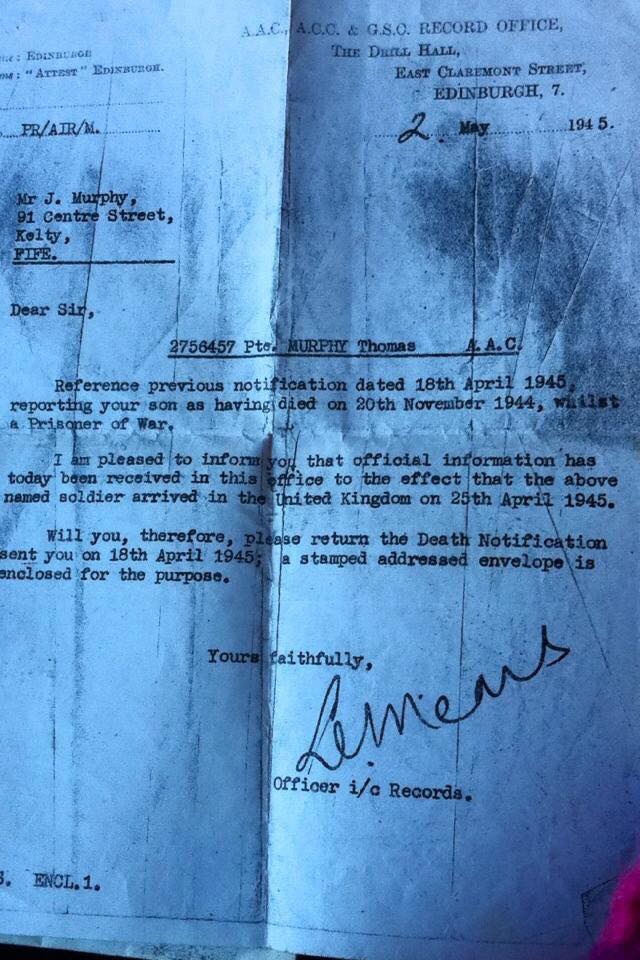
| Service number | 2756457, Record Office letter; TNA WO 422/38420. The 2656457 on pegasusarchive's Hardy page is the compiler's typo; that number belongs to a J E Easton (WO 423/577731) |
| Which camp | Stalag XI-B, his own typed notes. Not II-B (Hammerstein, Wikipedia) |
| "Buried in Germany" | Recorded died 20 Nov 1944; notified 18 Apr 1945; withdrawn 2 May 1945, letter |
| The "third 156 Para man" | There was none, it is Walsh (Walsh) |
| The memoir's date for Pegasus II | Not 20 Nov: that is the Army's recorded death date. The night itself, 17/18 or 18/19 Nov, is still open (Still open) |
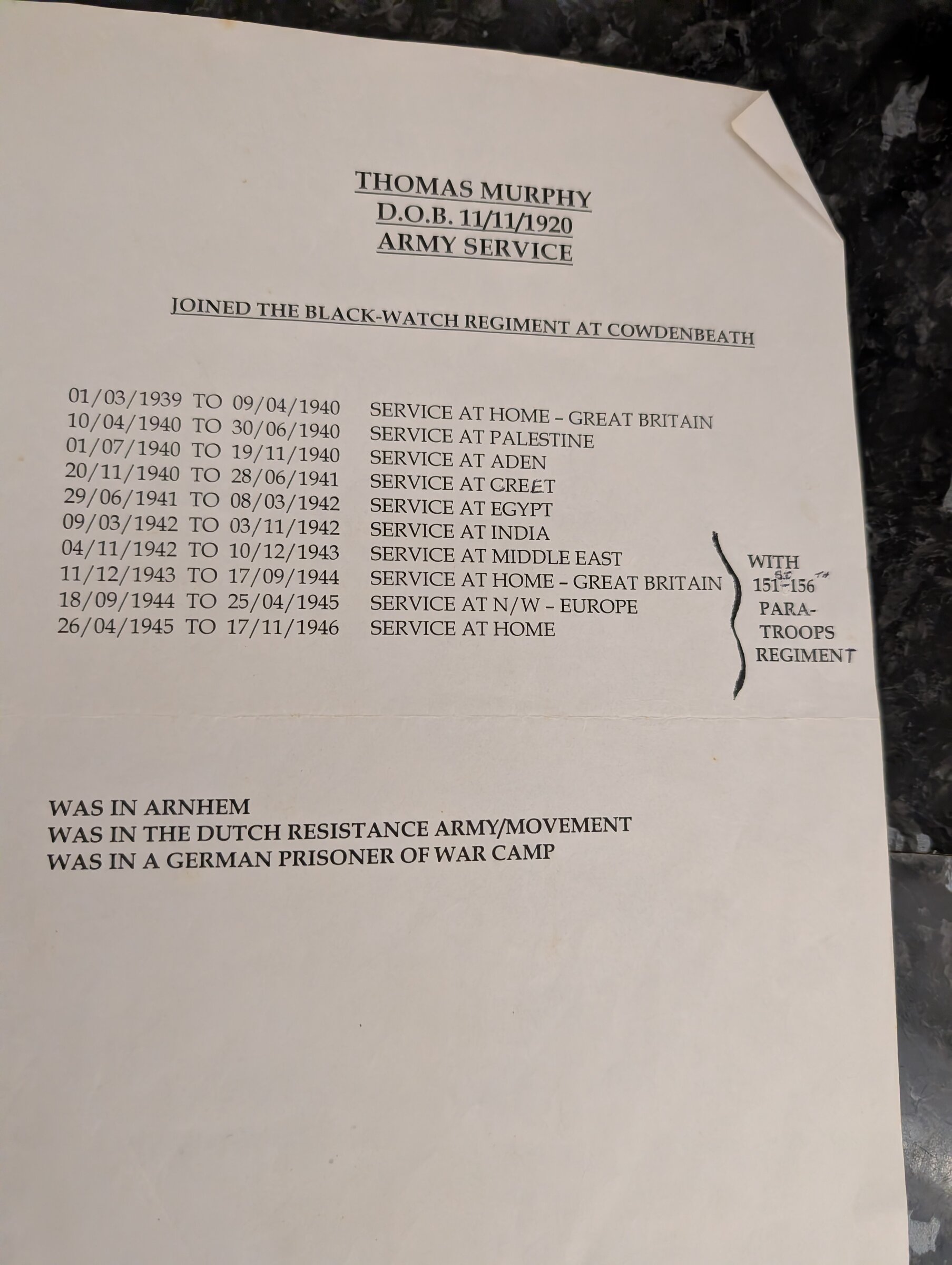
| Drop date | 18 Sep 1944: the service list starts N/W Europe service on 18/09/1944 (scan), the 4th Para Bde lift, and Walsh's own MI9 answer; ParaData gives the 18th too |
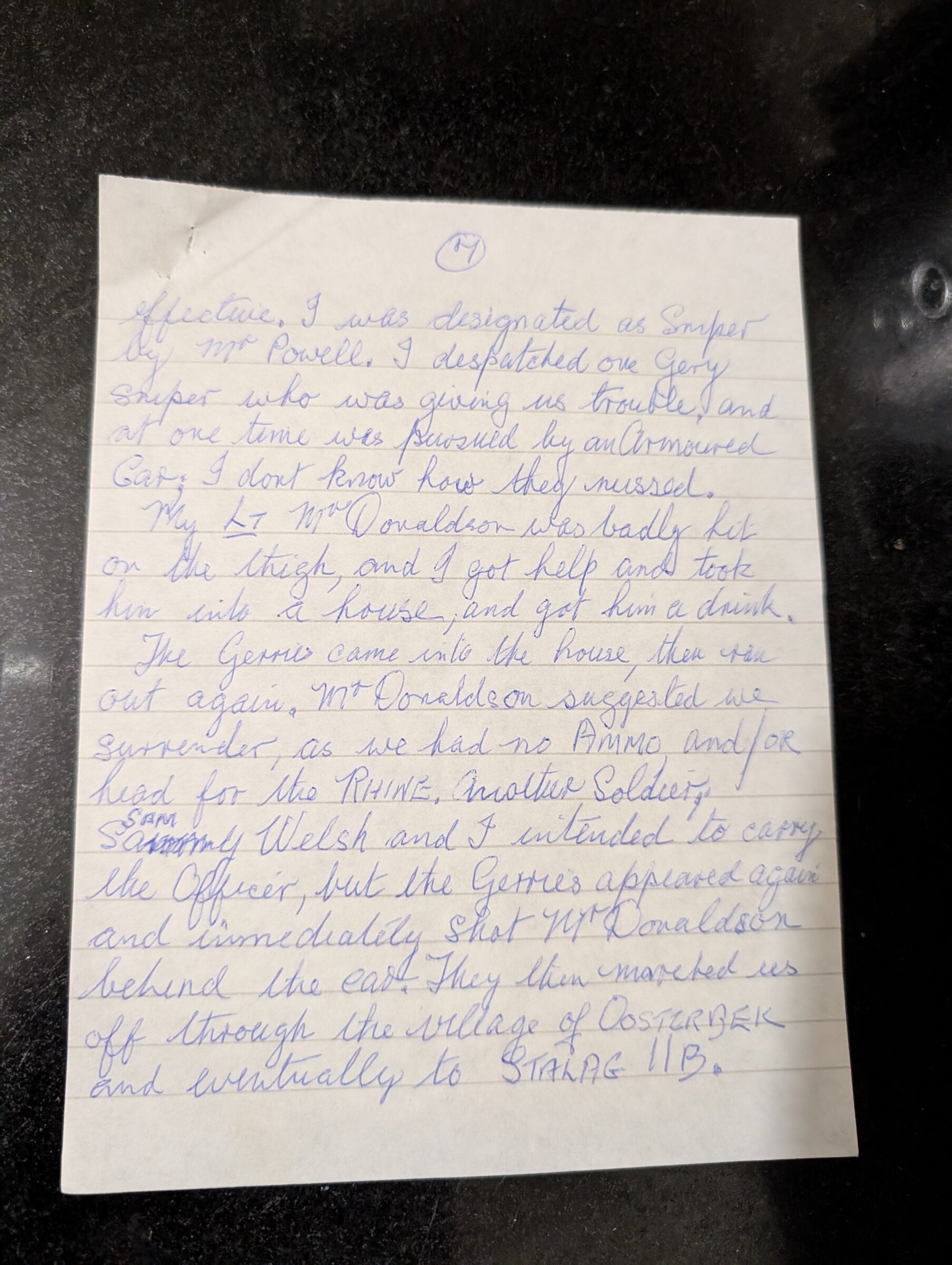
| Platoon | C Company, ◐ 11 Platoon, at Arnhem: his "Mr Donaldson" and "Mr Powell" (p.7) are 11 Platoon's and C Company's commanders per the Pegasus Archive's notes on Walsh's report (Walsh's own words are "my Platoon C.O.") and Powell. The compiler's "Mortar Platoon" was his platoon in Italy, by his own account (p.5) |
| "Shotgun wounds to the head" | Splinters from an 88 mm tank round while sniping at Arnhem, his own p.8; the notebook's "shotgun" is the same wound |
| Uncle Joop, the Burgemeester, "Derek" | Kruimel, Van Nispen tot Sevenaer, Van Eysinga, Garderen, Elspeet |
| 151 → 156 date | November 1942 (ParaData) |
| "Heimen van Esveld" | A helper from Kootwijkerbroek (Dutch helper list), not Amerongen, and nothing connects him to Gerald. ◐ He is connected to the party another way: Haller went back to "Heimen van Esveld in Kootwijkerbroek" after Pegasus II and stayed the winter, and had been there briefly before it (Noordman, p. 271). The British helper index gives him grade 3, one of about 61 in the country (index). ◐ His is probably not the house at 560984 where, by Walsh's version, Banwell, Haller, Murphy and Walsh spent the night of 17/18 November: that reference falls on the Plaggenweg, about 3 km west-north-west of the centre of Kootwijkerbroek and 4.8 km from his house on the Dwarsgraafweg (Walsh; the conversion is ours, good to about 300 m). But the index gives where a helper lived after the liberation, and Walsh's reference is "approx." |
| Walsh's and Murphy's units in Airborne Magazine | Half swapped. Walsh's "HQ Coy, 2nd Parachute Battalion" is the wrong Samuel Walsh from ParaData, a 2nd Bn man taken wounded on 17 September; Murphy's "Bren gunner, C Coy" is what Walsh's own report says of Walsh. Murphy's Walsh is 156 Bn, by his own report, On the run |
| "Sgt Shepley" | ◐ Very probably Cpl Arthur Shepley, the one Shepley we have found (ParaData's roll has not been searched for others): L/Sgt, 156 Bn, wounded and taken 25 September 1944, freed 27 April 1945. Not killed. ⚠︎ ParaData's platoon for him (6 Pl, B Coy) is not Murphy's, Shepley's page |
Date of birth
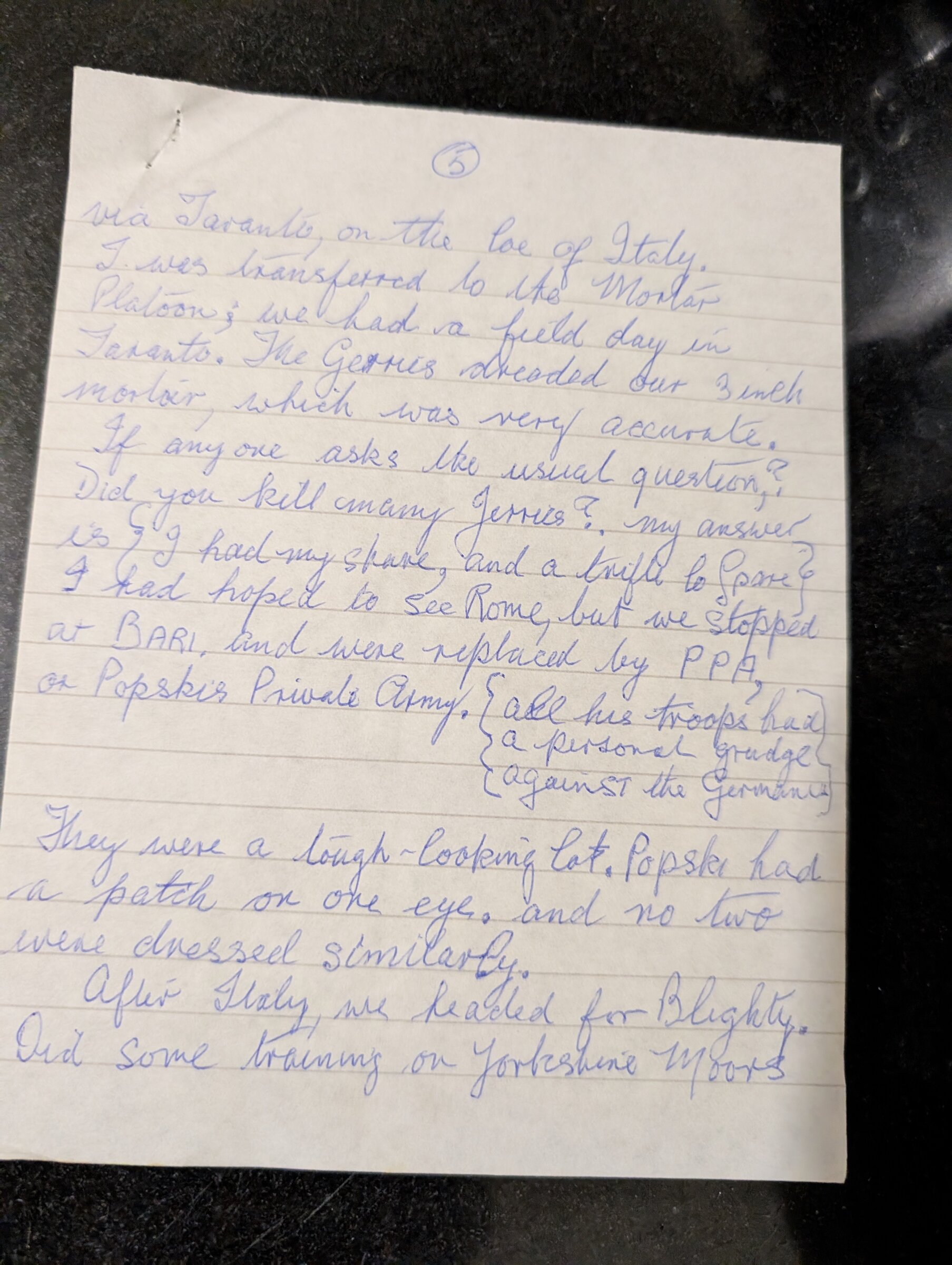
Link to the section Date of birth11 November 1920, the service list ("D.O.B. 11/11/1920"), TNA WO 422/38420, and his own "78 on 11th November 1998" (p.5). ParaData's 1921 matches none of those. ◐ A Thomas Murphy's birth was registered at Kelty in 1920 (ScotlandsPeople index, 410/2/293; the searches); the entry itself, which names the parents, is unseen.
Still open
Link to the section Still open| # | Issue | Options | How to settle |
|---|---|---|---|
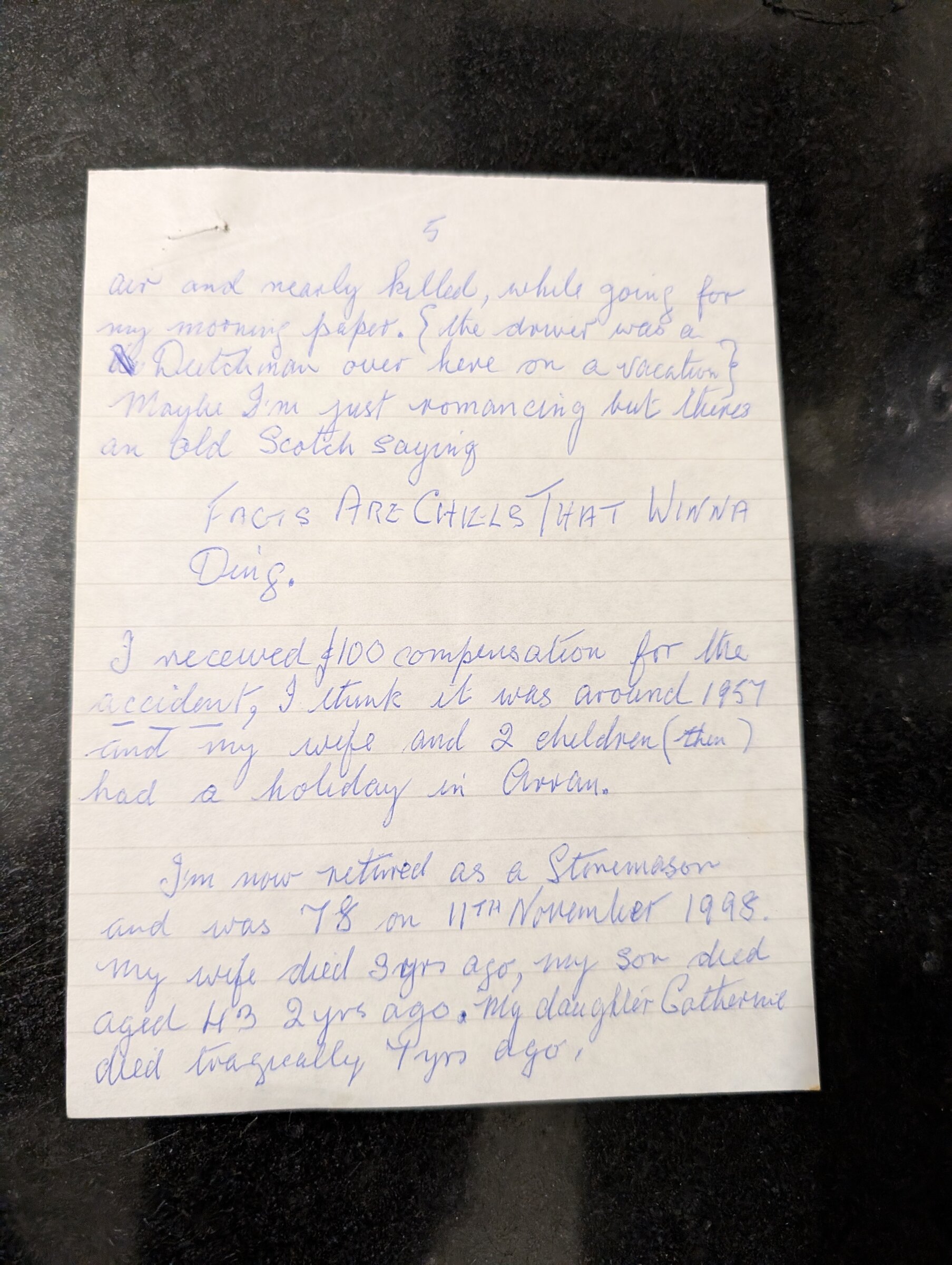
| 1 | Enlistment date | 1 Mar 1939 (service list, a typed document held by the family, typist unknown) vs 1 Aug 1939 (p.1, in his own hand; the typed transcript follows it) | WO 422/38420; Black Watch museum |
| 2 | Date and place wounded | While sniping, by an 88 mm round, Sgt Shepley beside him, no date (Murphy p.8); captured 21 Sep beside Donaldson with Walsh (Murphy p.7; Walsh tells the same minutes without naming him), and Walsh does not list him among the hit that day; ParaData: 24 Sep, Paul Krugerstraat | WO 344; WO 171/1247 |
| 3 | How Lt Donaldson died | ◐ Most CWGC records give 21 Sep, two of them unamended, and one adds "presumed died of wounds"; the website's 20th comes from an amendment made when the stone was cut (Arnhem). Not conclusive: both dates were added in red ink, on two different forms, and nothing held shows who wrote either. Manner still open: shot in the house after the Germans came, Murphy p.7; a single shot from the house, Walsh; carried to safety in a blanket, Grier's page | WO 171/1247; Grier's and Kemp's accounts; the Arnhem war-crimes files, The National Archives, Kew |
| 4 | Place of enlistment | Cowdenbeath (family papers, twice) vs Dundee (ParaData). ◐ The service numbers around his favour Fife, The service number, and where he signed on | Service record; Black Watch museum. Same record settles no. 1 |
| 5 | The 17 Nov split | Hardy vs Walsh | Schjelderup IS9/WEA/1/271; Banwell's report |
| 6 | Who gave him the revolver | Jacob Veerman (Hardy, January 1945) vs Jacob's brother, a Dutch policeman (Murphy, twice in his notes) vs Jacob, who had fetched it from his brother Leen, a bicycle repairer (a son of Jacob's, who is living, through Jacques Vanhaelen, October 2026). ◐ The revolver was probably Leen's, brought home by Jacob; ⚠︎ the policeman is not confirmed for 1944 (Jacob Veerman) | Barneveld and Ede police records; the Broekhuis family (Jacob's grandson Carel Plantagie, asked in October 2026, knows of no policeman in the family); WO 344 |
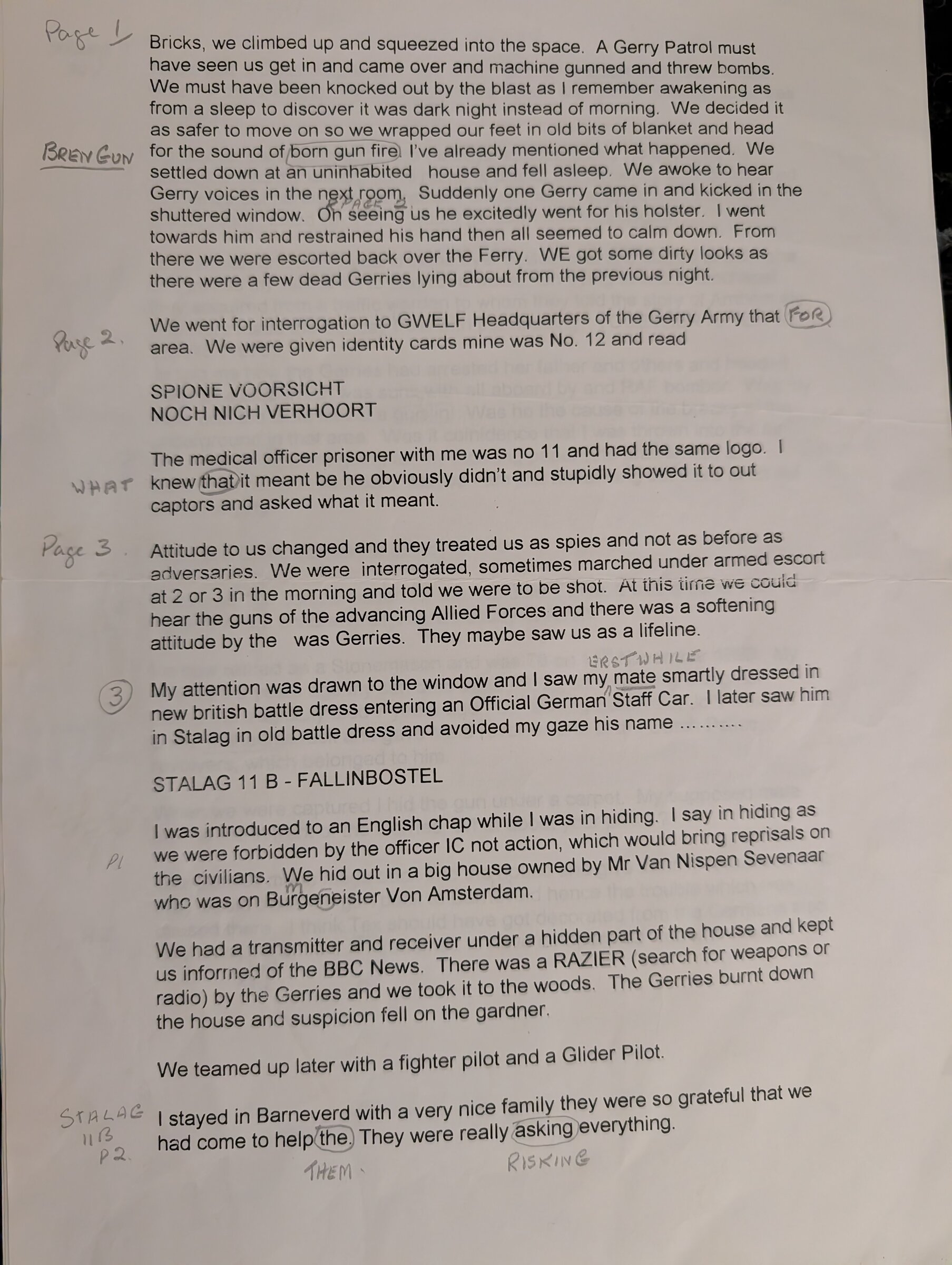
| 7 | How he was recaptured | Swimming (Sunday Post, 1945) vs grenaded in brickwork and taken in a house, then escorted back over the ferry (his typed notes). Noble's account of the same night has the party scattered off a road under machine-gun fire and himself surrounded in a flooded field (Noble); ⚠︎ Noble's own later account (unpublished private papers, shared with us privately), told long after the war, adds a deserted dyke house before the firing and has Noble rolled off the dyke and caught alone in a frozen paddock (The crossing and recapture); neither version of Murphy's is contradicted by them | WO 344 |
| 8 | Arrival at Garderen | 14 Oct (Walsh's MI9 report: a week near Kootwijk first) vs c.8 Oct (Airborne Magazine; Noordman; Walsh's and Banwell's guestbook entries, both dated 8/10/44; ◐ an Elspeet raid "a week after" Putten, which fits Verweij's round-up of c.10 Oct). For the later date, Hoekstra's form (±16 Oct), On the run | Hardy's and Walsh's full reports at Kew; the original guestbook, to see the page order |
| 9 | Shepley's platoon | ◐ Very probably Cpl Arthur Shepley (Shepley's page), but ParaData has him a section commander in 6 Platoon, B Company, and Murphy was in C Company by Walsh's "of my Coy", ◐ 11 Platoon. Which of them was out of place when the round hit, or whether ParaData's platoon is right | WO 171/1247; the Association |
| 10 | "John Bruce"/Haller ("Banford"/"Brentford" is settled as James Branford) | Murphy's name vs MI9 | Haller's MI9 report |
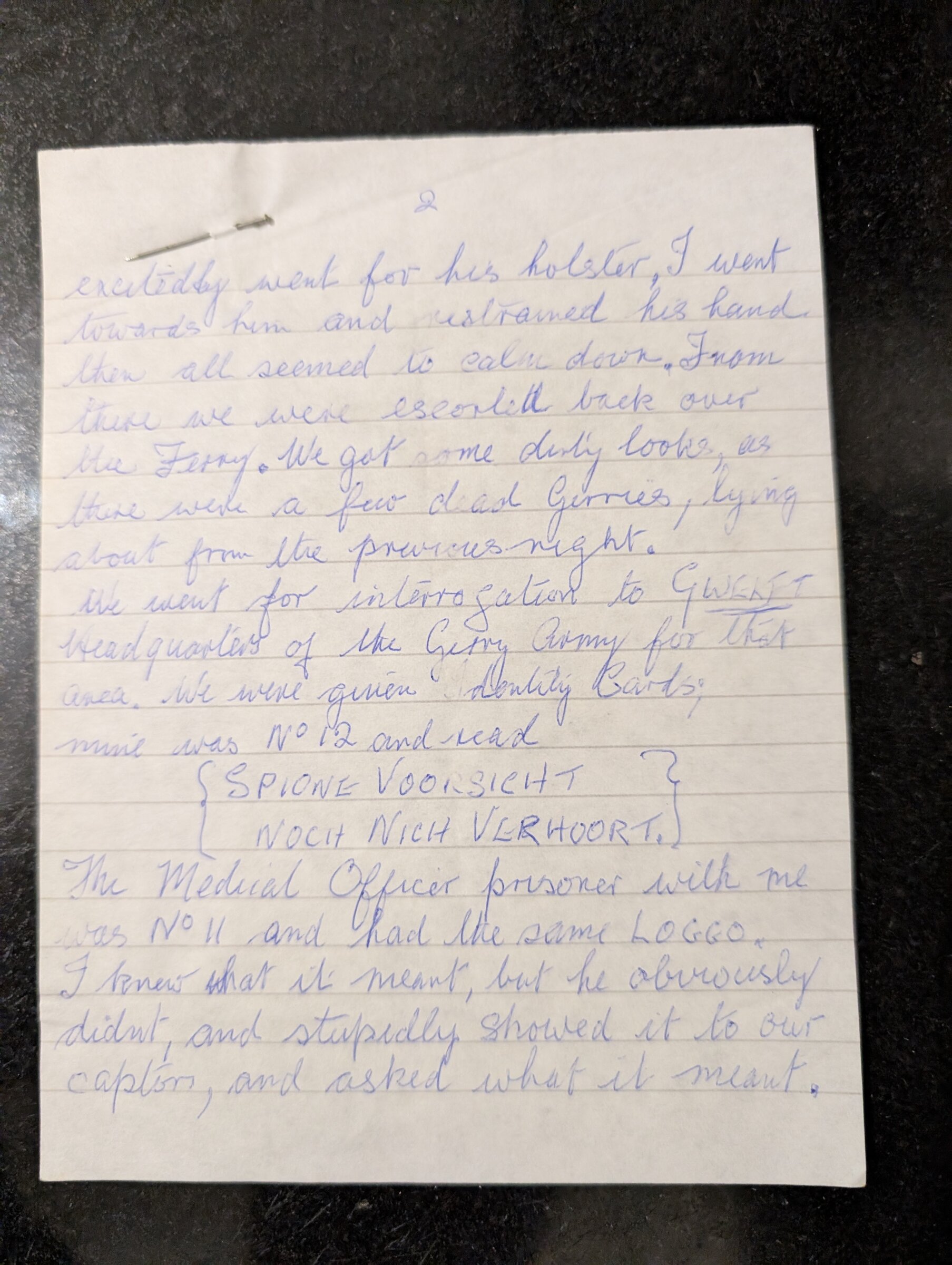
| 11 | "GWELF" headquarters | Velp: Noble and Banwell, taken with him, were both interrogated there (Noble; Banwell). ◐ Nothing places Murphy himself there | WO 344 |
| 12 | Jopie at the Willem III Kazerne | Inferred from where she lived; not stated | Stichting Vrouwenmars 1945 |
| 13 | Michael Murphy | Unknown after Tom's transfer. ◐ Not in Tom's number block: the only Murphys in WO 422/423 with numbers 2756xxx are T (Tom), D (2756718) and J A (2756182), and no M Murphy at all in 275xxxx (Discovery, checked 13 Sep 2026). So "enlisted with him" does not mean the same day at the same desk; he has a different number, and possibly a different regiment. ◐ A Michael Murphy, 8, is on the family's page of the 1921 census at Kelty, so born about 1912–13 (ScotlandsPeople index) | Service record; his birth entry |
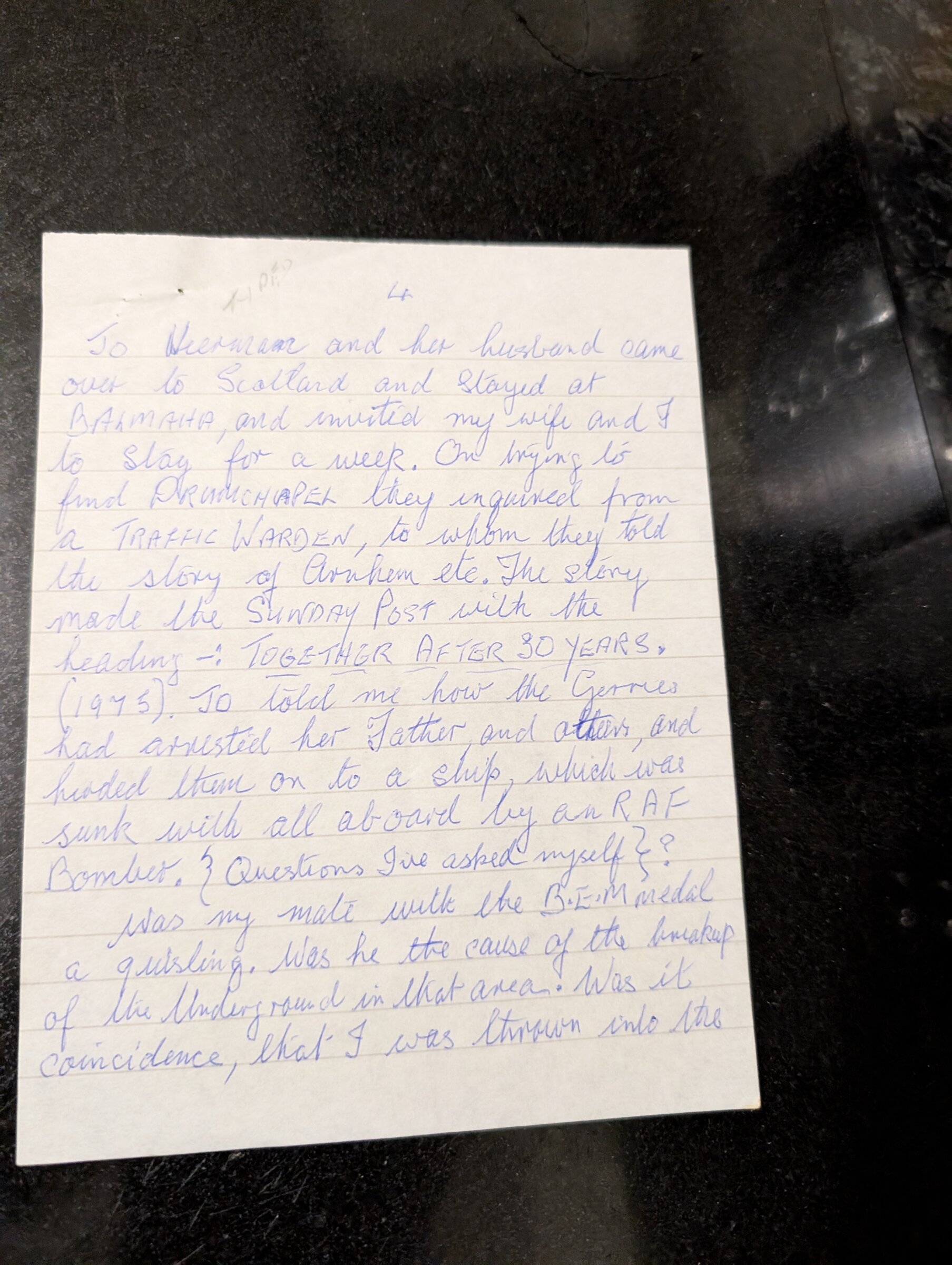
| 14 | The Sunday Post article of 1974 | Sunday Post, headline "Together After 30 Years" (p.4). The family has always known of the article; not yet found in the paper's own run or a family copy. The Daily Express article of 25 July 1974 is found (a cutting kept by the Veerman family), and dates the visit | The newspaper articles of 1972 and 1974; the family |
| 15 | Kessel's party at De Ruif | c.17–19 Oct (Noordman's chapter: Kessel's text has him escaping on 16 Oct (15 Oct in Warrack's book and Kew's entry) and meeting farmhands on the morning of 17 Oct; Nelly Eskes gives no date, only "die avond") vs c.21 Oct (Walsh's date for his own move; Kessel's book gives no date), Garderen | Kessel's and Longland's MI9 reports; Kessel's is at Kew, WO 208/5419/25, not digitised (the catalogue entry) |
| 16 | The night of Pegasus II | 17/18 Nov (Liberation Route; ◐ Ede's own war history and its research notes, Operation Pegasus II) vs 18/19 Nov (Noordman, pp. 176, 198, 311), Operation Pegasus II | Kragt's report; the Ede card index (Dutch) |
| 17 | Hardy's debrief | 13 Jan 1945 (this site) vs "Hardy, James 6-1-1945" in Noordman's list of escape reports (p. 340) | The report at Kew |
| 18 | Hardy's home | Near Banbury, Oxfordshire (his report) vs Hamilton, Scotland ("Two Came Back!") and Glasgow (Haller, via Noordman), The crossing and recapture | ✓ Both: born at Hamilton on 19 November 1913, living near Banbury in 1945 (his page) |
| 19 | The Cairo photograph's year | "Cairo 1940" (Noordman's caption, from Liz Moore, who lent it) vs the service list, which has him in Egypt only from June 1941, The war before Arnhem. ⚠︎ A third reading, from his niece Liz Moore: his brother Michael took it, and the two with him were 156 Battalion men, not Australians (the photograph) | Who wrote "Cairo" and "1940" on the back of the print, and when (the back is held and does not say: the photograph) |
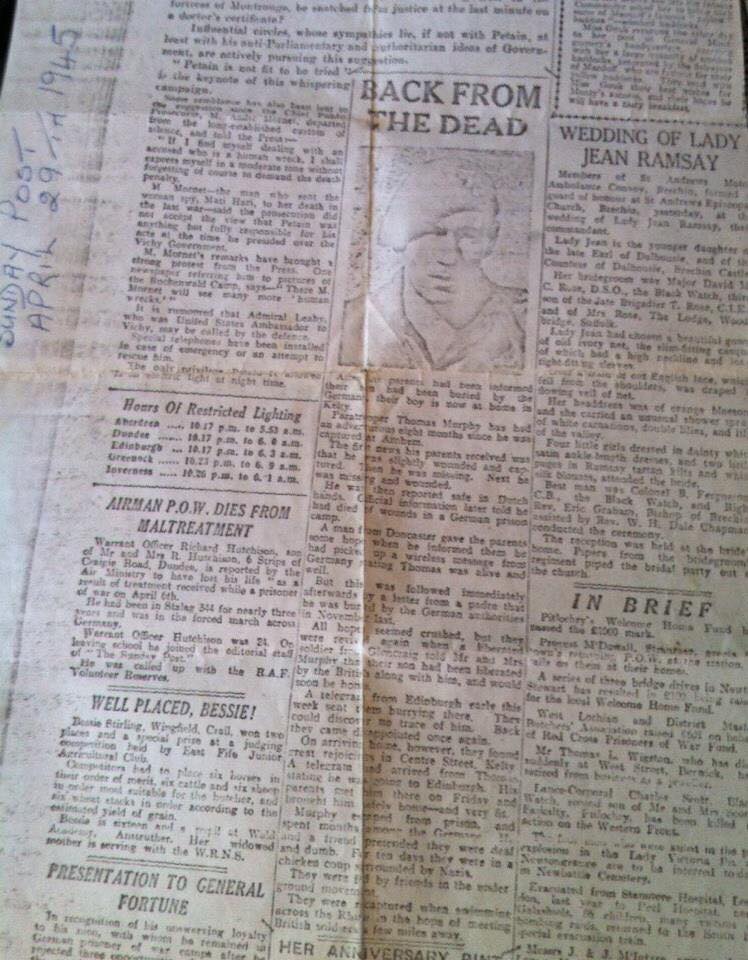
| 20 | The homecoming, April 1945 | His parents went to Edinburgh on a telegram from him and met him there "on Friday" (Sunday Post, 29 April 1945) vs no answer at his mother's house, found her at the local Co-op, and learned there he had been listed as dead (A Book of Fife Heroes, 1998, p. 49, writer unknown) | The family; the BNA for an Edinburgh or Fife notice of his return |
The service number, and where he signed on
Link to the section The service number, and where he signed onThe family papers say he enlisted at Cowdenbeath, twice; ParaData says Dundee. ◐ The numbers around his side with the family.
Army numbers were issued in blocks to recruiting areas, so the men holding the numbers next to 2756457 were signed on in the same place at about the same time. Every one of them is catalogued at Kew:
| Number | Name | Born | Record |
|---|---|---|---|
| 2756455 | J. M. Penman | 14 Dec 1919 | WO 423/620144 |
| 2756456 | W. Alexander | 20 Nov 1919 | WO 423/689995 |
| 2756457 | T. Murphy | 11 Nov 1920 | WO 422/38420 |
| 2756458 | F. Lawrie | 24 Mar 1919 | WO 423/554795 |
| 2756459 | J. Pursley | 5 Sep 1914 | WO 423/665896 |
| 2756460 | C. Campbell | 18 May 1919 | WO 423/825068 |
| 2756461 | F. Anderson | 3 Feb 1922 | WO 423/901050 |
All seven surnames are Scottish. Those records give no birthplace, but two men from this stretch of the sequence turn up again on German prisoner-of-war cards, which do give one, and both were born in Fife, one at Kelty itself and one at Lochore:
- C. Campbell, 2756460 — "Charles Campbell. Date of Birth: 18 May 1919. Place of Birth: Lochore, Fifeshire" (WO 416/55/457). Lochore is the village Murphy's Father McCabe came from, The war before Arnhem.
- Pte Peter Middlemass, 2756363, The Black Watch — "Date of Birth: 11/05/1918. Place of Birth: Kelty, Scotland" (WO 416/254/307). Ninety-four numbers below Murphy's, in Murphy's own regiment and his own village.
Two more Kelty men sit in the same wider range, both Black Watch: Andrew Fotheringham, 2752282 (WO 416/126/219), and William Morton, 2758500 (WO 416/263/433).
⚠︎ This is an inference from a number block, not a document naming a recruiting office. It shows the block was issued in the Fife coalfield, which is where Cowdenbeath is and where Dundee is not. It does not prove which desk he walked up to. WO 422/38420, his service record, settles it outright, and settles the enlistment date with it.
His own account, tested claim by claim
Link to the section His own account, tested claim by claimEverything Thomas Murphy said or wrote that this site relies on, and the evidence for each.
✓ documented, an independent contemporary or archival source says the same. ◐ consistent, no independent source says it, but the documented record fits it. ⚠︎ his word, nothing but the memoir. ✗ contradicted, an independent source says otherwise.
| Claim | Where he says it | Status | Evidence |
|---|---|---|---|
| "Was 78 on 11th November 1998" → born 11 Nov 1920 | p.5 | ✓ | Service list; TNA WO 422/38420 |
| Enlisted Cowdenbeath, 1939 | service list (1 Mar); p.1 (1 Aug) | ◐ | Family papers, not external, and they disagree on the date; the August date is his own hand. ParaData says Dundee |
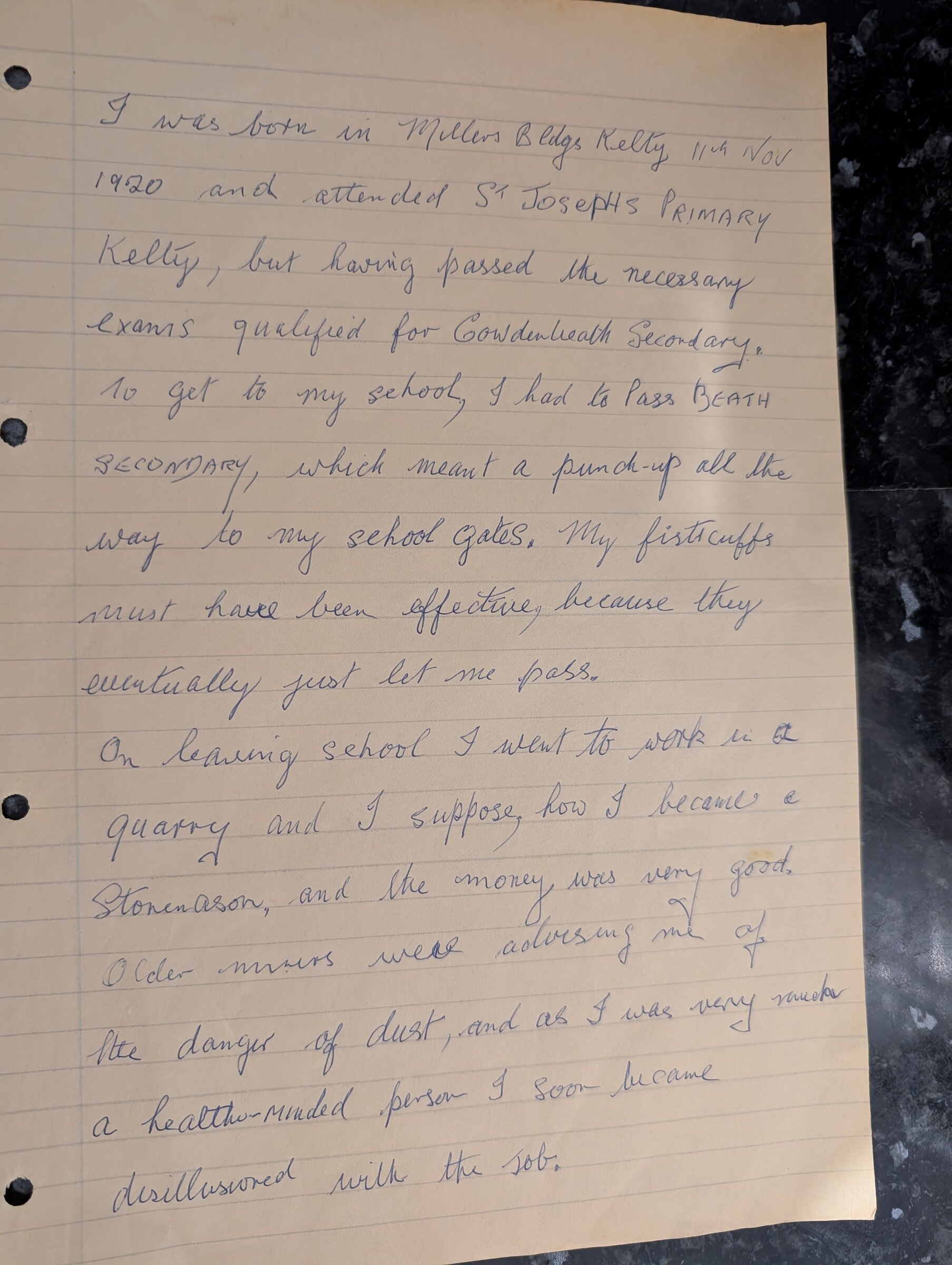
| Born Millers Buildings, Kelty; St Joseph's Primary; Cowdenbeath Secondary; the quarry | boyhood page | ✓ | Family knowledge |
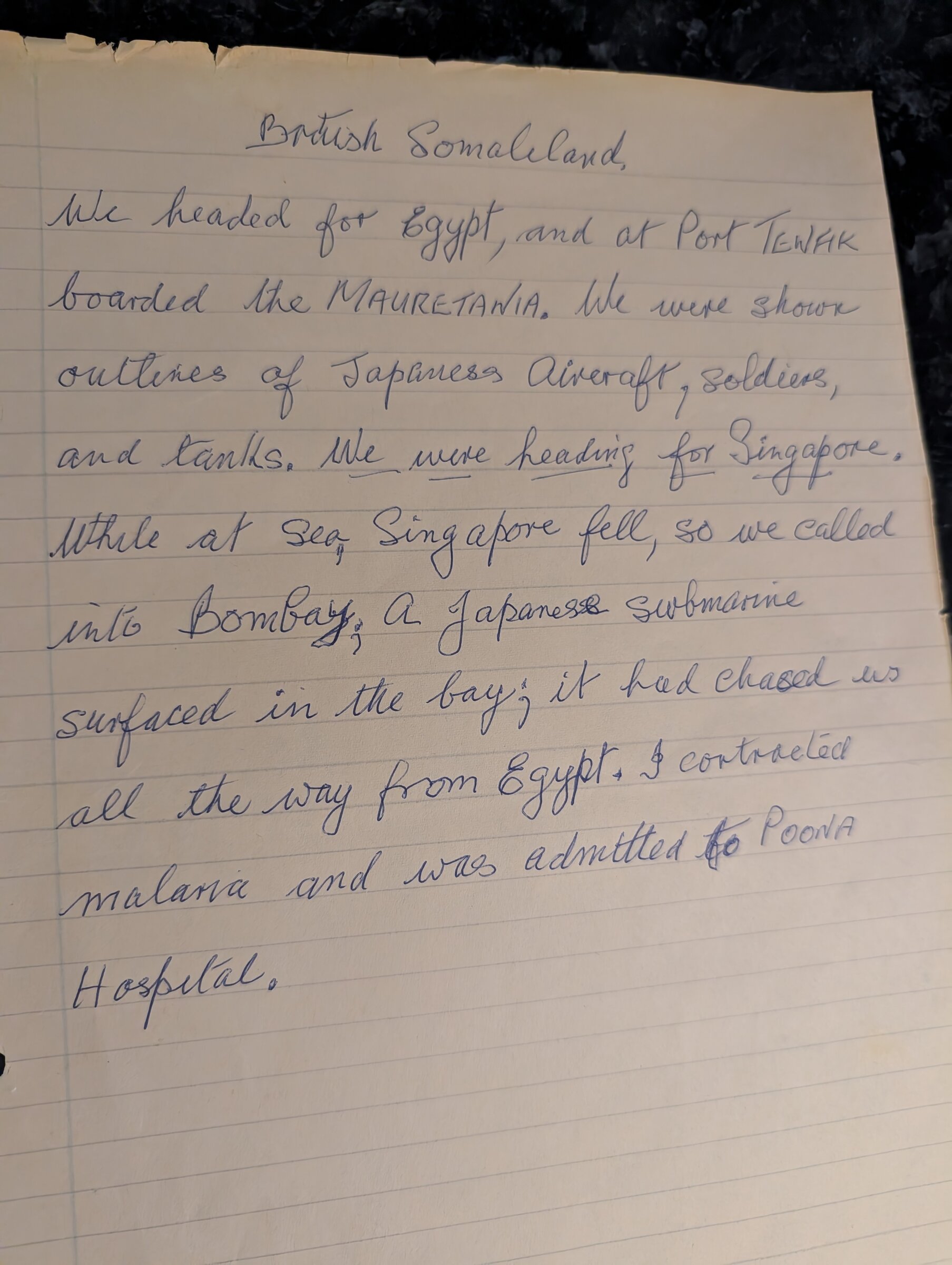
| The Mauretania from Port Tewfik, bound for Singapore; Singapore fell at sea; Bombay; a Japanese submarine; malaria, Poona Hospital | Somaliland page | ⚠︎ | His word. The dates fit the service list (Egypt to 8 Mar 1942, India from 9 Mar; Singapore fell 15 Feb) |
| Somaliland, Crete, Tobruk with the Black Watch | narrative | ✓ | 2nd Bn's movements match (Black Watch Museum); "Bardia Bill" is real (AWM) |
| "Over 60 killed and buried at sea" leaving Crete; the German High Command remark | narrative | ⚠︎ | His word |
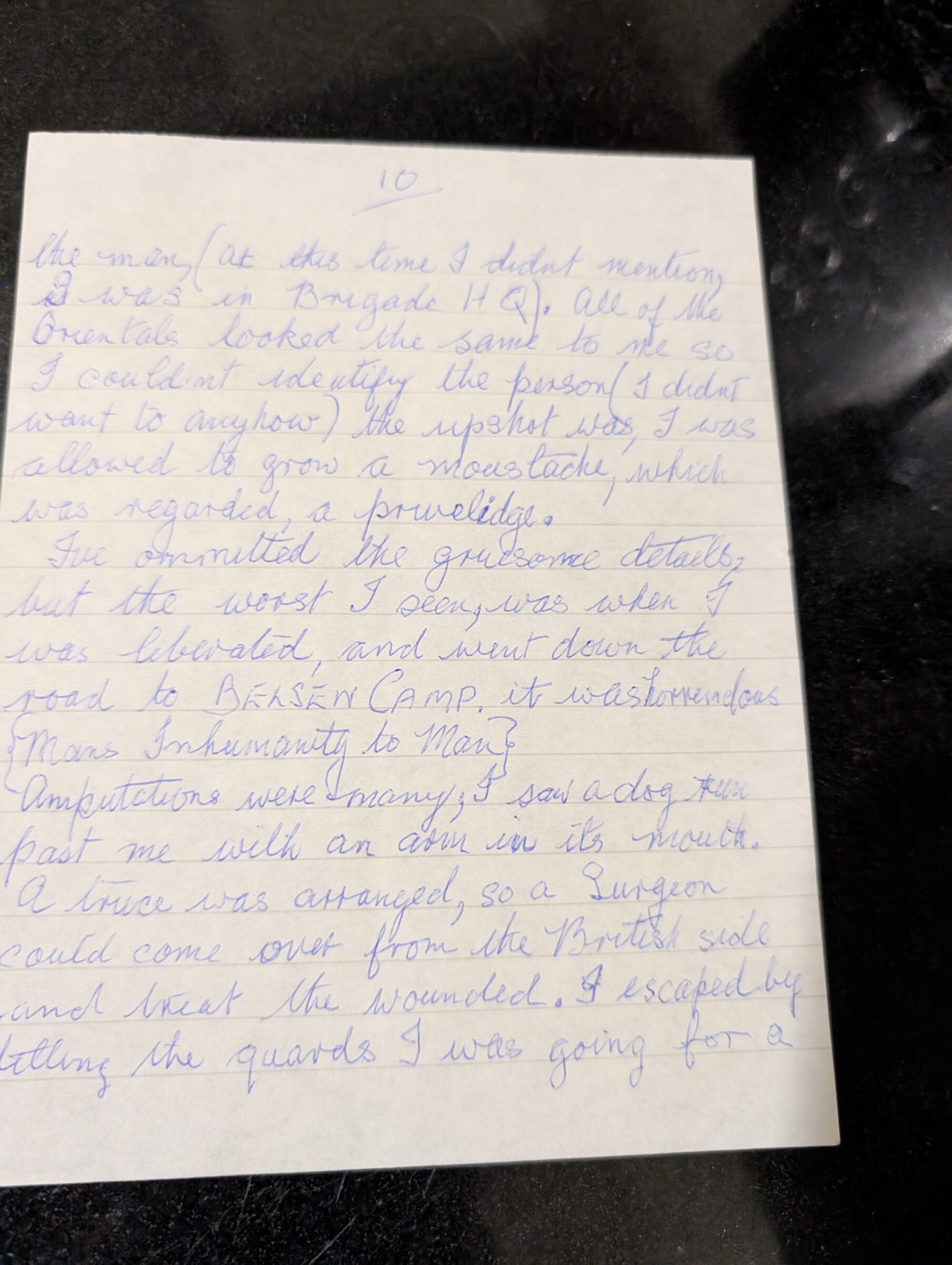
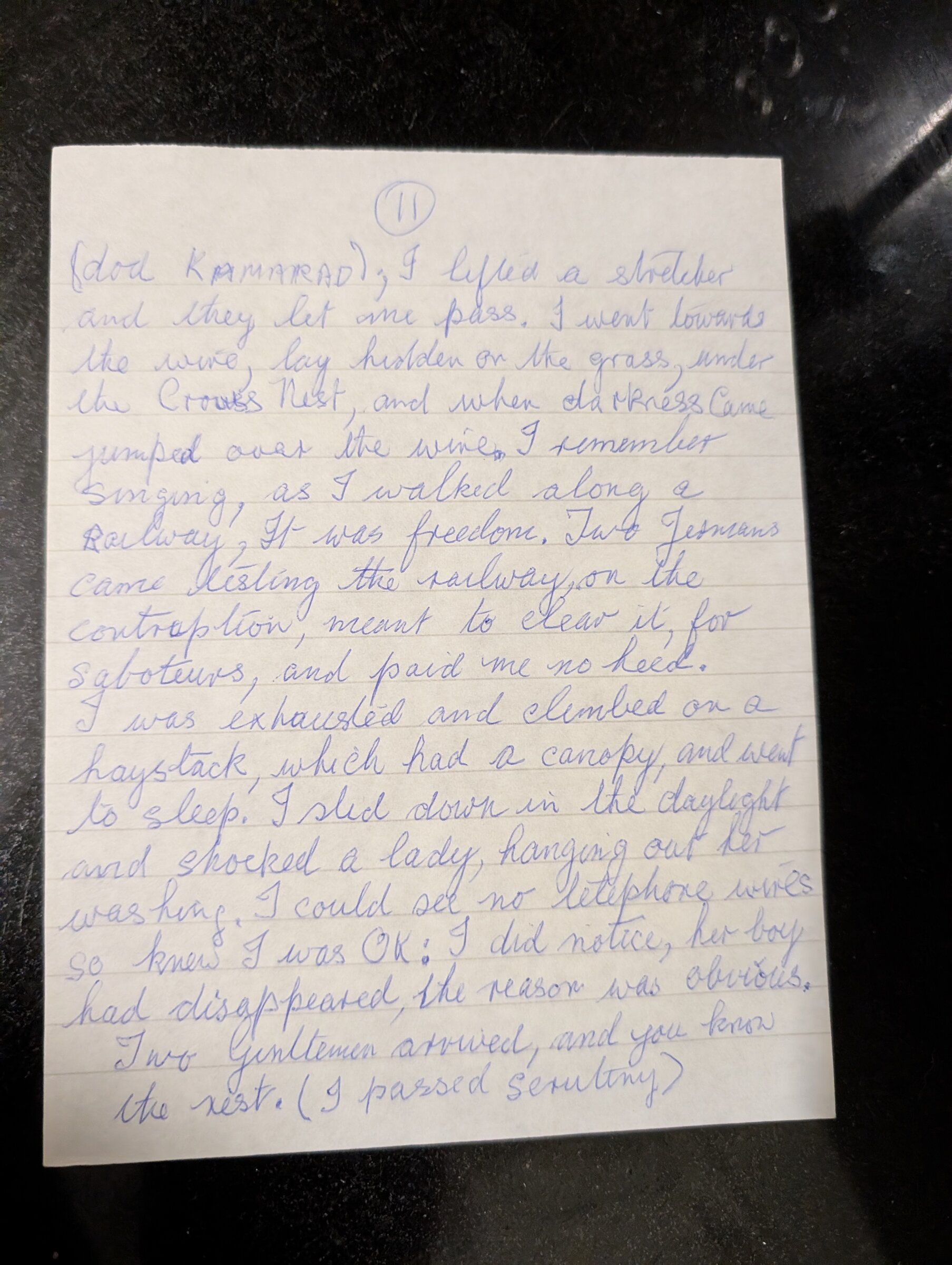
| Escaped Apeldoorn 6 Oct 1944 with Walsh, stretcher ruse | p.10: "I lifted a stretcher and they let me pass … when darkness came jumped over the wire"; ParaData | ✓ | Walsh; Airborne Magazine |
| A truce for a British surgeon to come over; the railway, the haystack, the lady with the washing, "two gentlemen arrived"; the football questions | pp.10–11; p.8 | ⚠︎ / ◐ | His word. The Apeldoorn–Amersfoort railway and the vetting fit Walsh and Hardy |
| "Designated as Sniper by Mr Powell"; despatched a German sniper; pursued by an armoured car | p.7 | ◐ | Powell commanded C Company (Powell); the rest is his word |
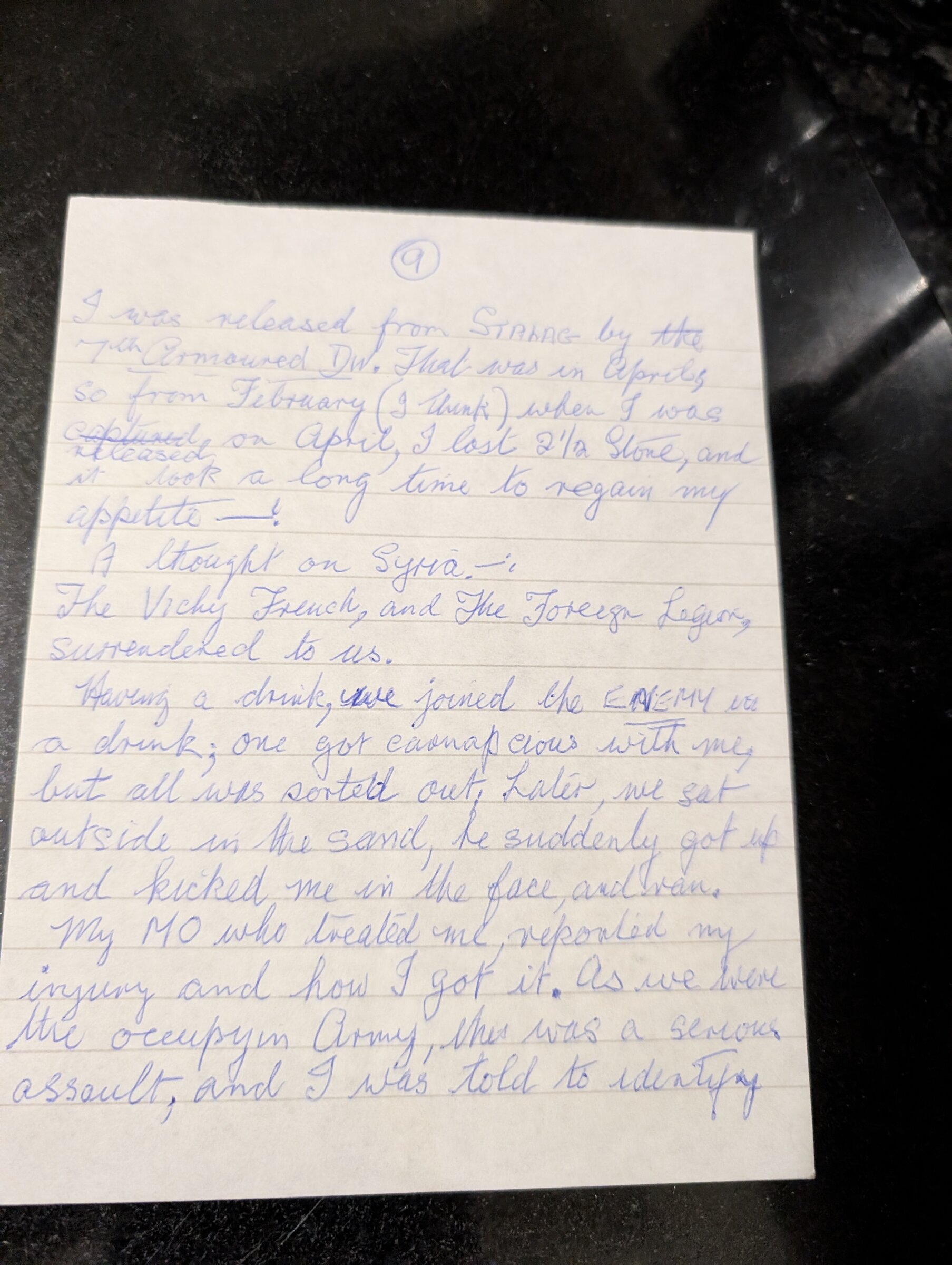
| Lt Donaldson hit in the thigh, taken into a house, shot "behind the ear" when the Germans came; "Sam Welsh and I intended to carry the officer" | p.7 | ✓ / ◐ | Walsh's 1945 report: Donaldson shot through the leg, got to a house, Germans came, "a single shot which definitely came from that house". Walsh does not name Murphy there, and how Donaldson died is still open (Arnhem, Still open) |
| Shrapnel in the head from an 88 mm tank round while sniping, "my face all pock-marked"; Sgt Shepley | p.8 | ✓ / ⚠︎ | Hardy confirms he was wounded, and by October 1944 his family had been told he was "slightly wounded in the head" (Edinburgh Evening News, 24 October 1944); the family remembers the marks: the fragments stayed in his head and face for the rest of his life, dark under the skin, and "pock marks" was what the family called them. Shepley was real and a man of the battalion, Cpl Arthur Shepley (his page); the 88 mm round is his word |
| Stood by for Caen and Rambouillet, both cancelled; flak over France, one aircraft of three lost; the pilot at 200 ft; "the drop had been betrayed"; Benzedrine | p.6 | ⚠︎ | His word |
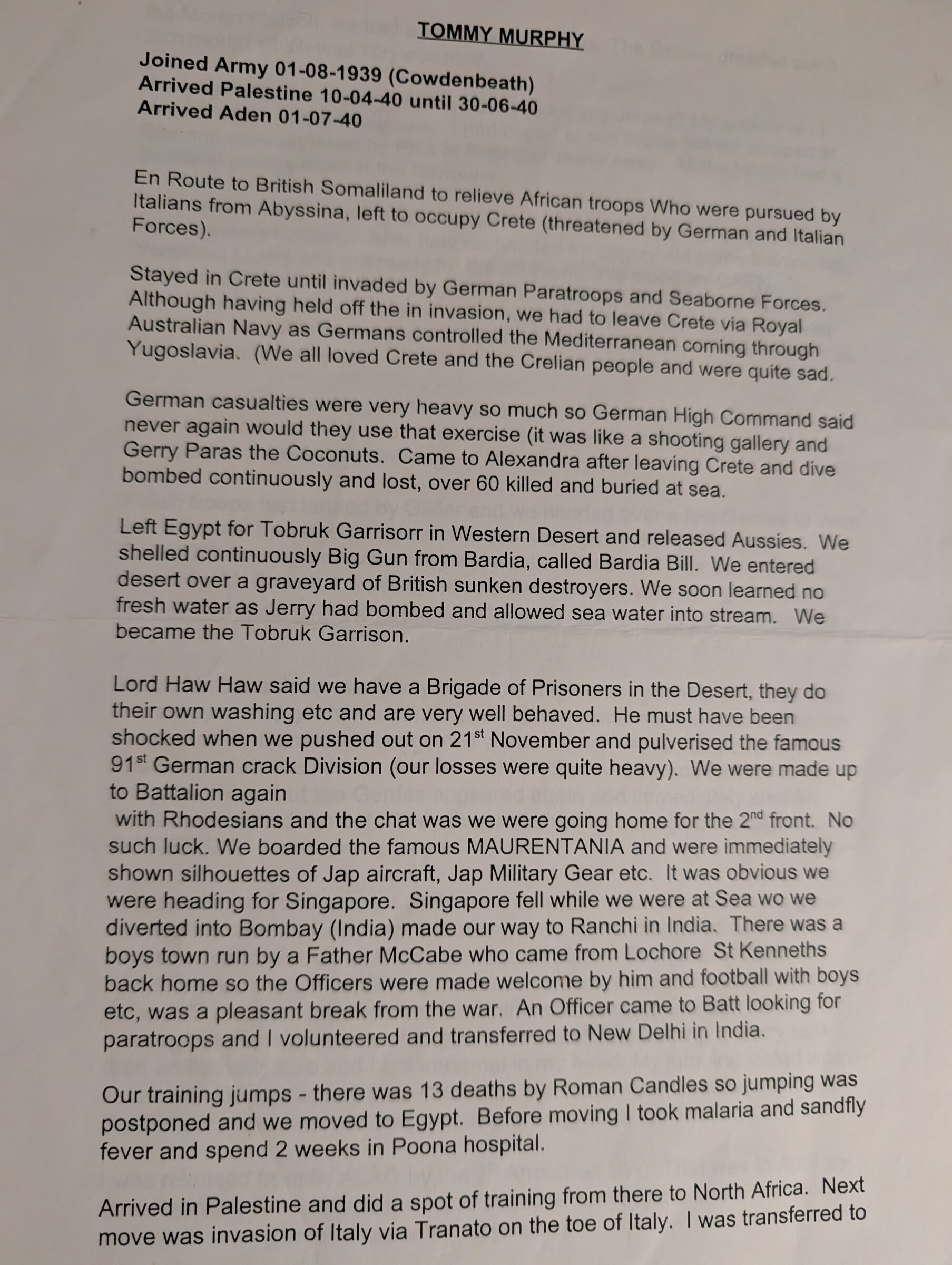
| Ranchi; Father McCabe of Lochore; volunteered at the battalion for paratroops; New Delhi; 13 deaths by "Roman candles"; malaria and sandfly fever, Poona | p.4 | ◐ / ⚠︎ | 151 Bn raised at Delhi from volunteers (ParaData); the rest his word |
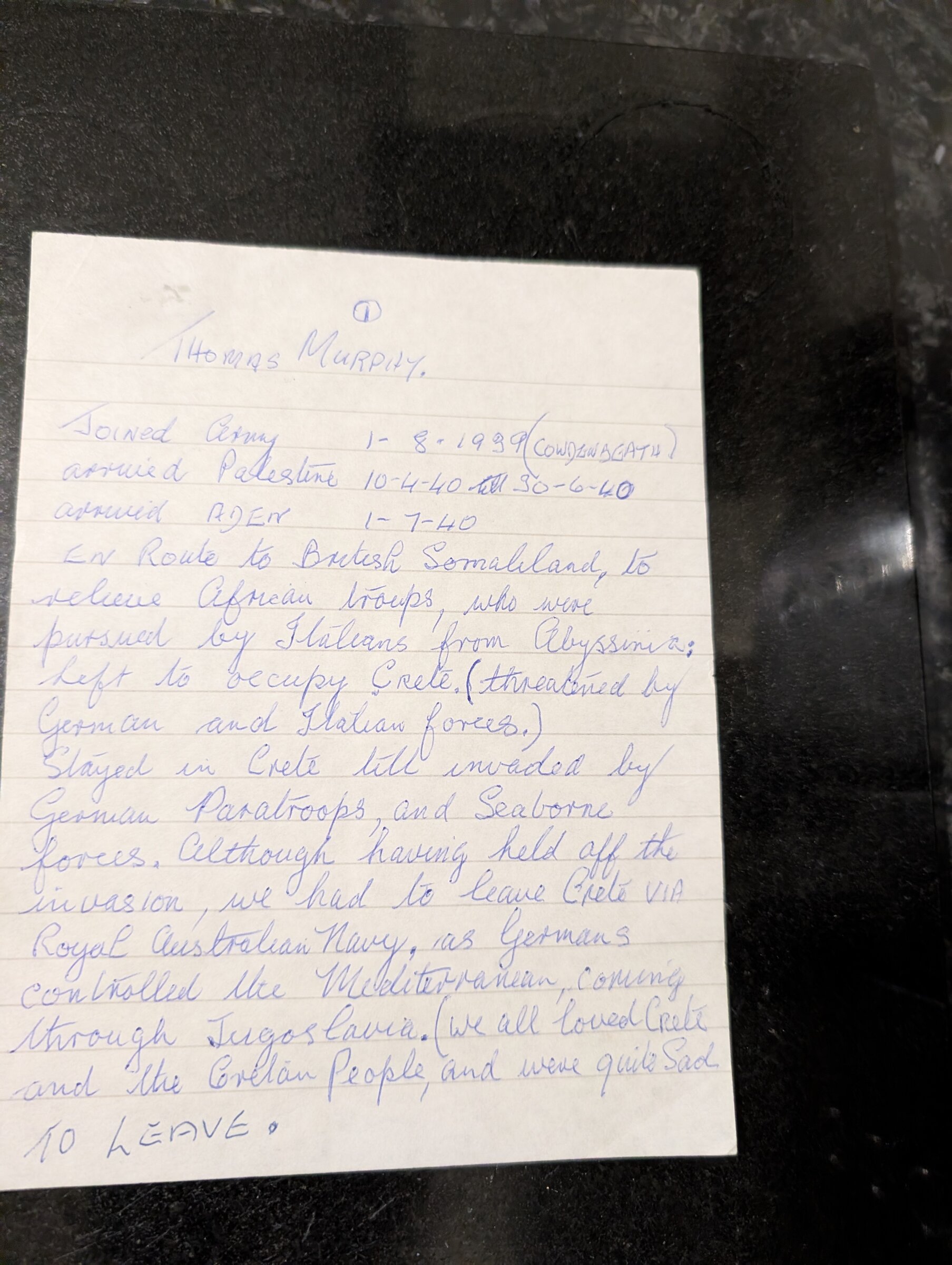
| Taranto, the Mortar Platoon, Bari, Popski's Private Army | p.5 | ✓ / ⚠︎ | Taranto to Bari is the battalion's route (ParaData); the platoon and PPA are his word |
| Lord Haw-Haw; the 21 November breakout; "91st German crack Division"; Rhodesians | p.3 | ✓ / ⚠︎ | The breakout (Black Watch Museum); the rest his word |
| "A thought on Syria": Vichy French and Foreign Legion surrendering; the kick in the face; the moustache | p.9 | ⚠︎ | His word, and not placeable in the service list. The war before Arnhem |
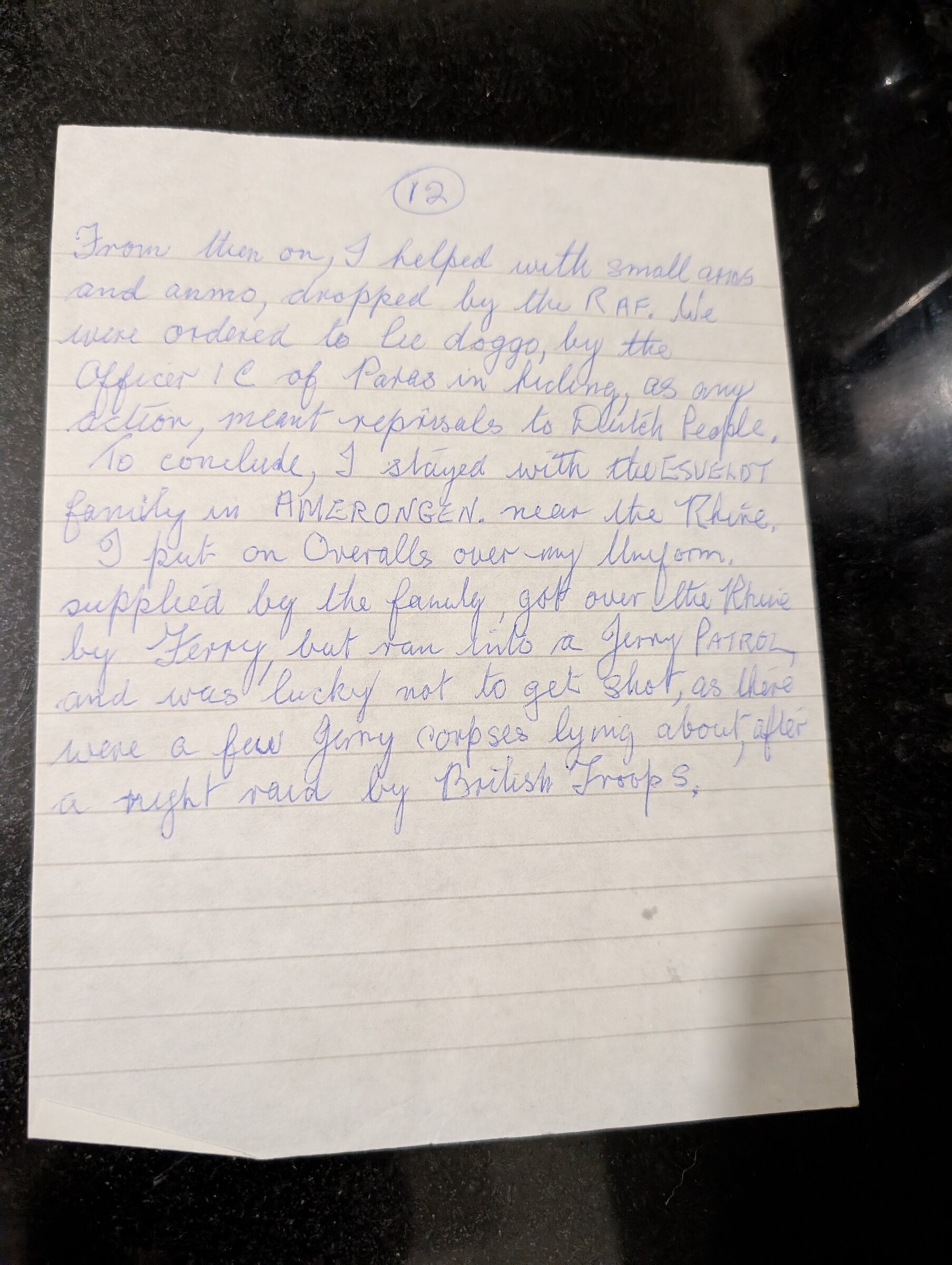
| Stayed with "the Esveldt family in Amerongen"; overalls from the family; over by ferry; a German patrol and corpses from a night raid | p.12 | ✓ | Hardy: Gerald Esveld, Amerongen, the ferry, the overalls |
| Helped with RAF arms drops; ordered to lie doggo by the officer in charge of paras in hiding | p.12 | ⚠︎ | His word |
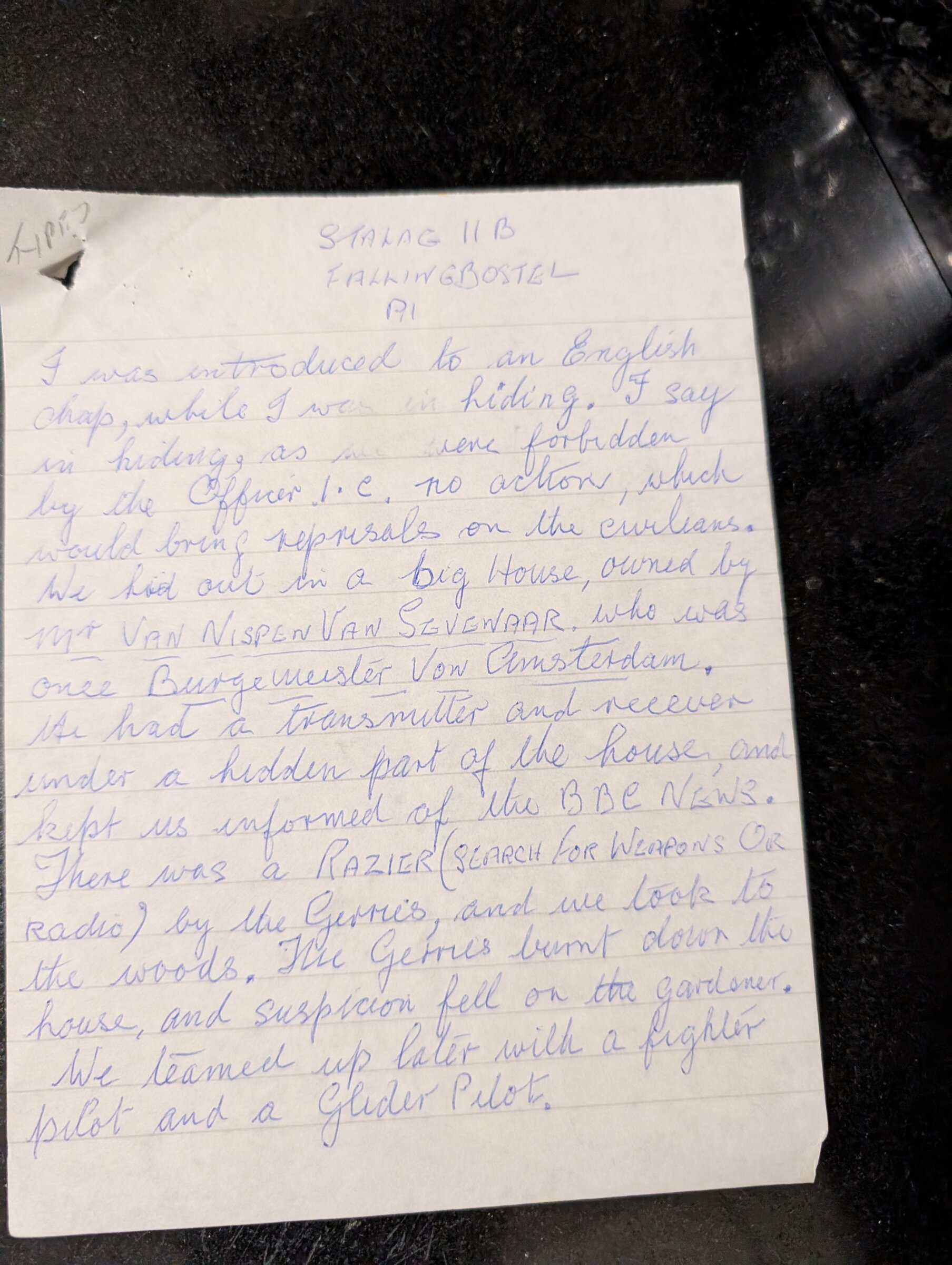
| "Forbidden by the officer i/c not [to take] action, which would bring reprisals on the civilians" | typed pp.1–3 | ⚠︎ | His word |
| Hid in "a big House, owned by Mr Van Nispen Van Sevenaar, who was once Burgemeister von Amsterdam" | Stalag p.1; typed pp.1–3 | ✓ / ◐ | Name right: Van Nispen tot Sevenaer was at De Ruif (Airborne Magazine). He gives the town as Amsterdam; the man was mayor of Laren, near Amsterdam (Wikipedia), which is also how Walsh put it to MI9 in 1945, "a township near Amsterdam". He is the only British source who gives the name at all |
| Transmitter under the house; a razzia (a raid); the set taken to the woods; the house burned; "suspicion fell on the gardener" | typed pp.1–3 | ✓ / ⚠︎ | Transmitter, search and burning documented (Airborne Magazine). The gardener is his word |
| "Teamed up with a fighter pilot and a Glider Pilot" | typed pp.1–3 | ✓ / ✗ | Branford (RAF) and Haller (Hardy); but Branford was a bomb aimer, not a fighter pilot |
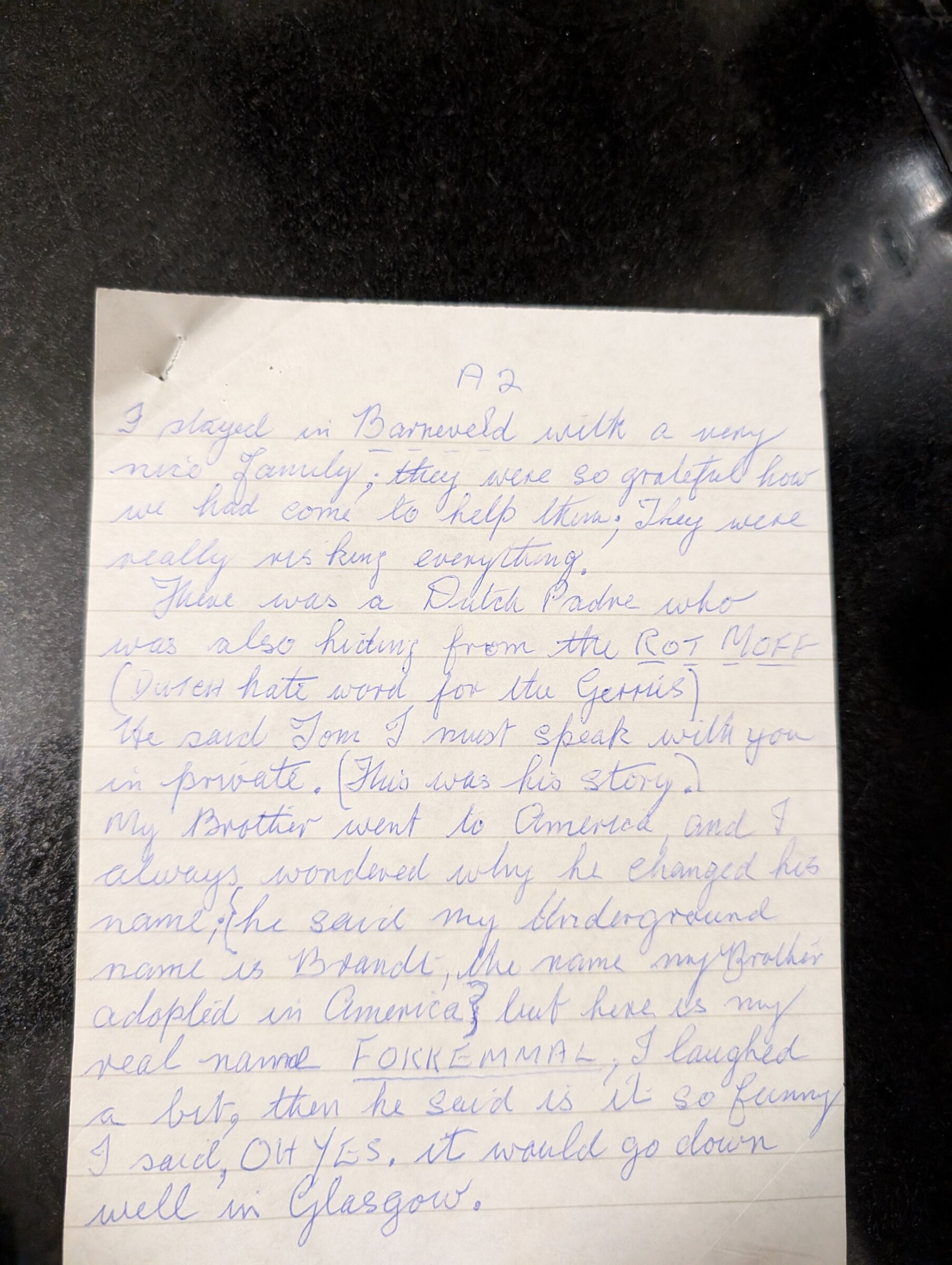
| Stayed in Barneveld with "a very nice family … risking everything" | typed pp.1–3 | ✓ | The Veermans (Hardy; Neuengamme) |
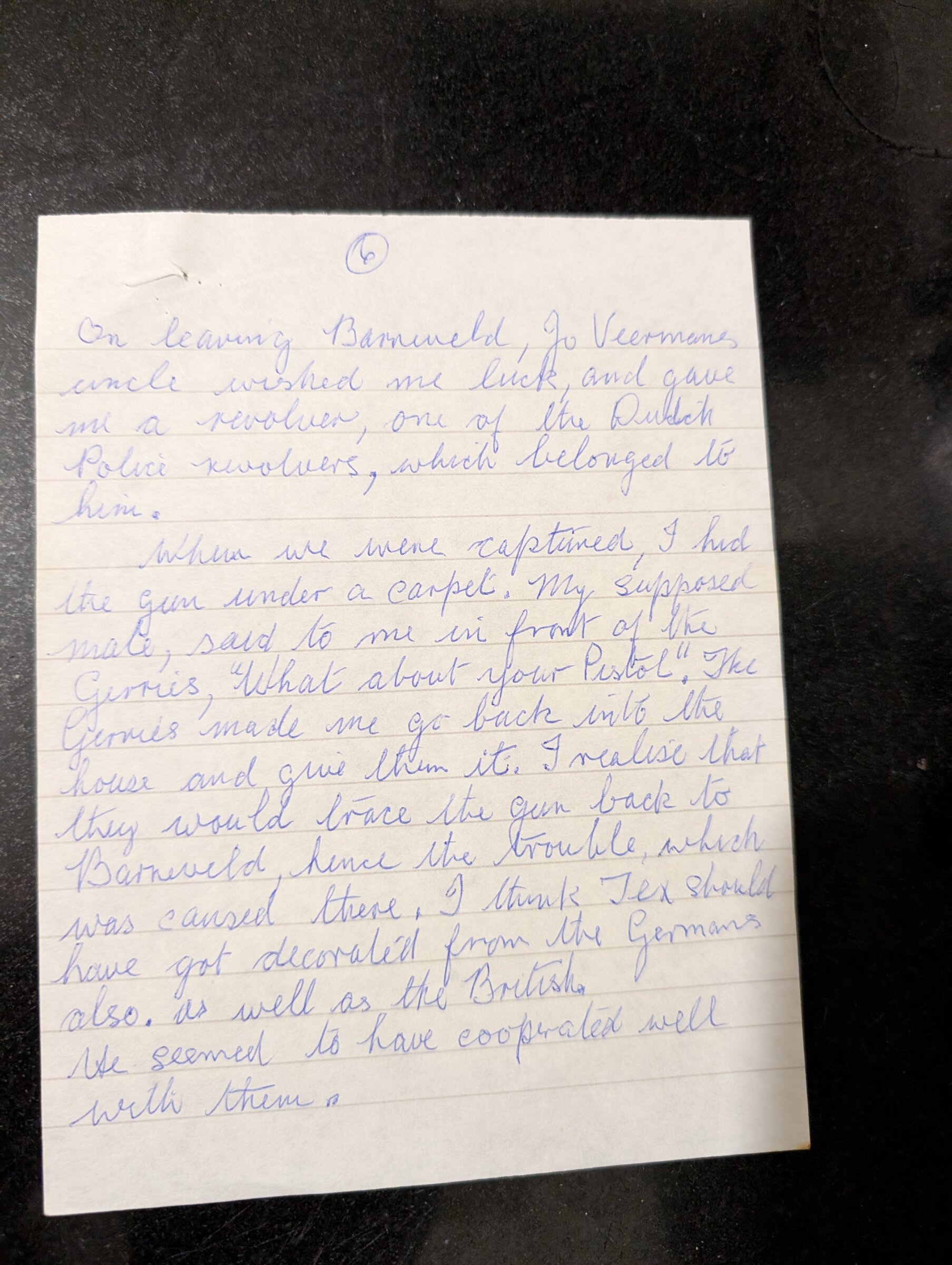
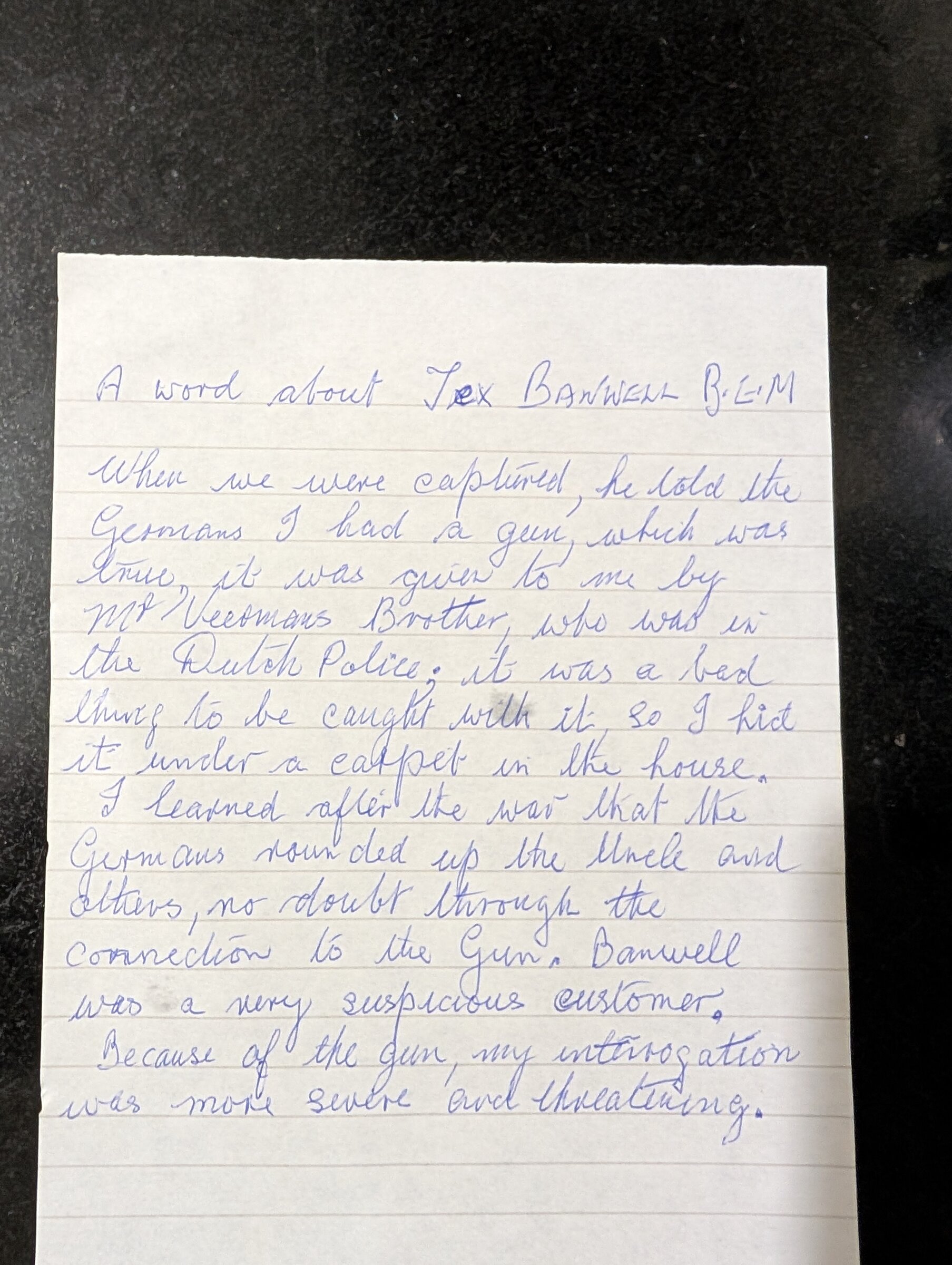
| The revolver came from Jo Veerman's uncle / "Mr Veermans Brother, who was in the Dutch Police" | p.6; typed; ms | ◐ / ⚠︎ | ◐ Probably from Jacob's brother Leen (Leendert Jan). Murphy, in two passages (the typed copy is of p.6), and a son of Jacob's, who is living, both put it with Jacob's brother, but the son answered after our question to Jacques Vanhaelen of 16 October 2026 had put Murphy's policeman-uncle version to him, so the two are not independent; Hardy has Jacob himself give it. The rest of the son's account is his alone (the tool cabinet, the boy carrying it, the search): he told Jacques Vanhaelen in October 2026 that he and his father fetched it from Leen, and he calls Leen a bicycle repairer at the time and a detective in The Hague after the war; Hardy's "MURPHY's given him by Jacob VEERMAN" (Hardy) fits, if Jacob brought it home. It is graded probable rather than confirmed only because no record of the time says so (Jacob Veerman). ⚠︎ "In the Dutch Police": no record has Leen a policeman in 1944; after the war he was in the Politieke Recherche Afdeling (Leendert Jan Veerman). Still open no. 6 |
| Crossed the Rhine by ferry, arranged by the underground; Germans letting civilians cross to recover flooded property | notes | ✓ / ⚠︎ | Ferry: Hardy; Geschiedenis Magazine. The flooded-property detail is his word |
| A "safe corridor" between two guns firing tracer | notes | ⚠︎ | His word |
| Fired on by a machine gun; the party scattered | notes | ✓ | Schjelderup extract on Hardy's page |
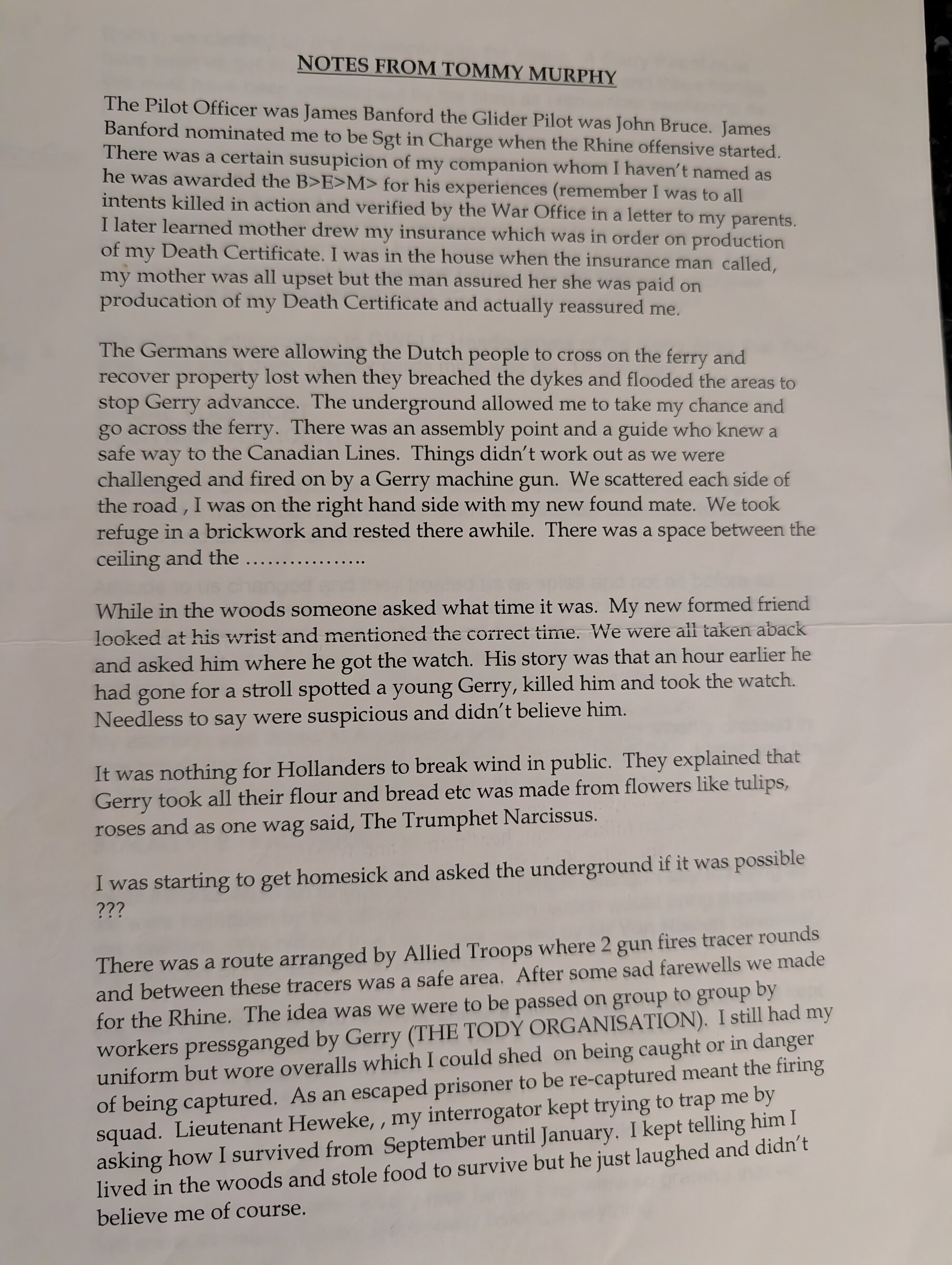
| Took refuge in brickwork, "a space between the ceiling and the …" (sentence unfinished) | notes; typed pp.1–3 | ⚠︎ | His word |
| Grenaded in the brickwork; knocked out; came to in a house; a German kicked in the shutter; "escorted back over the Ferry" | typed pp.1–3 | ⚠︎ / ◐ | His word. The Sunday Post's "recaptured when swimming across the Rhine" (scan) is a reporter's sentence from a man four days home, and the Betuwe that night was flooded and frozen: Noble surrendered in a flooded field, Porter waded "in water six inches to a foot deep" (Porter, p. 146). Still open no. 7 |
| Recaptured while swimming | Sunday Post, from him in 1945; ParaData | ◐ | Contemporary but second-hand, a reporter's words; see the row above |
| A "new found mate" produced a watch taken from a German he'd killed an hour earlier; "needless to say [we] were suspicious and didn't believe him" | notes | ⚠︎ | His word |
| Bread made from tulip bulbs, "The Trumphet Narcissus" | notes | ✓ / ◐ | Tulip-bulb bread was real in the Hunger Winter: the wartime leaflet on tulip bulbs as food gives the recipe, one part wheat flour to two or three of cleaned, minced bulbs, and three bulbs a person a day (the leaflet; Verzetsmuseum). Daffodil bulbs are poisonous (Poison Control), so "The Trumphet Narcissus" was the wag's joke he says it was |
| Pretended to be deaf and dumb | ✓ | Sunday Post, not in the memoirs; the paper got it from him in 1945 | |
| Ten days in a chicken coop surrounded by Nazis | ✓ / ✗ | Sunday Post; Hardy has the hut, but for seven nights, 7–14 Nov (Hardy) | |
| Uniform under overalls, to be shed if caught | notes | ◐ | Hardy wore overalls over uniform too (Hardy); ⚠︎ so did Noble when he was taken, by Noble's own later account (unpublished private papers, shared with us privately): "an army uniform under these overalls" |
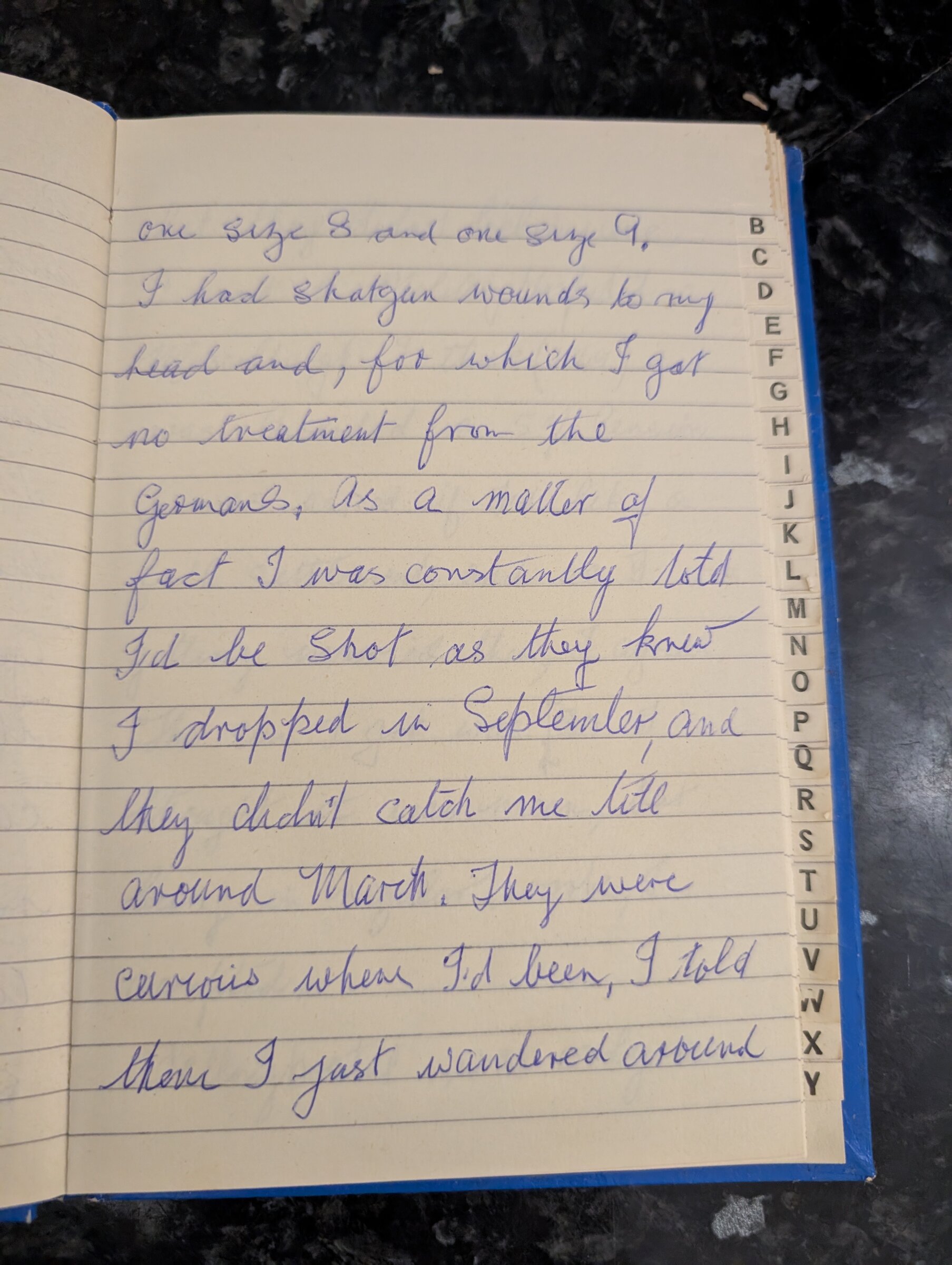
| Mismatched boots, "one size 8 and one size 9" | notebook | ⚠︎ | His word |
| Interrogated at "GWELF Headquarters" | p.2; typed pp.1–3 | ◐ | Velp: Noble and Banwell, captured with him, were both interrogated there (Noble; Banwell). He is not named there himself |
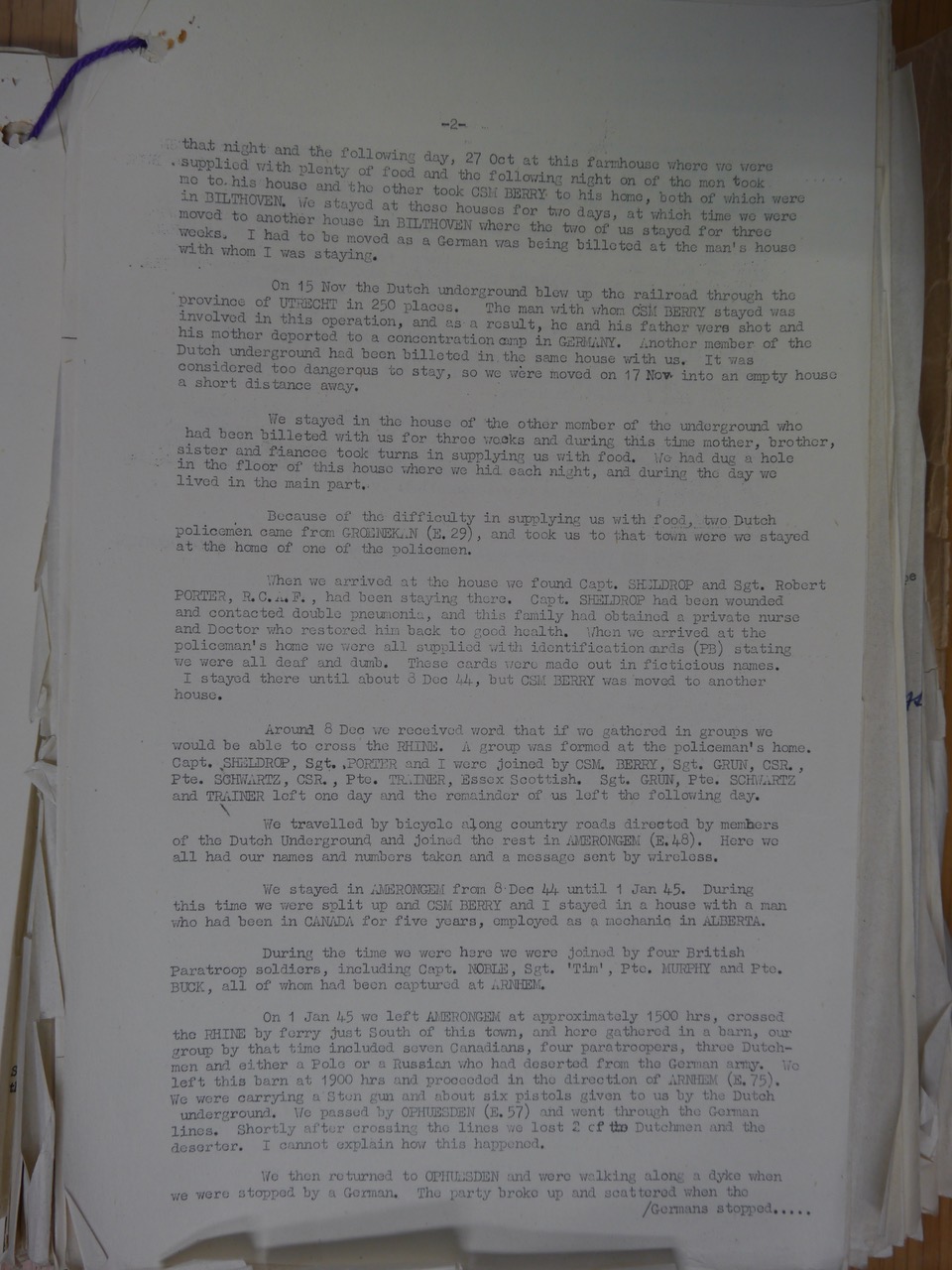
| Identity card No. 12, "SPIONE VOORSICHT / NOCH NICH VERHOORT"; MO was No. 11 | p.2; typed pp.1–3 | ⚠︎ / ◐ | His word. Specific and plausible; unverifiable without German records. The MO fits Capt. Noble, lost in the same firefight (Recapture, interrogation, captivity). ⚠︎ Noble's own later account (unpublished private papers, shared with us privately) has him given "a card with ‘Spion van Dyk’ on it", with no number |
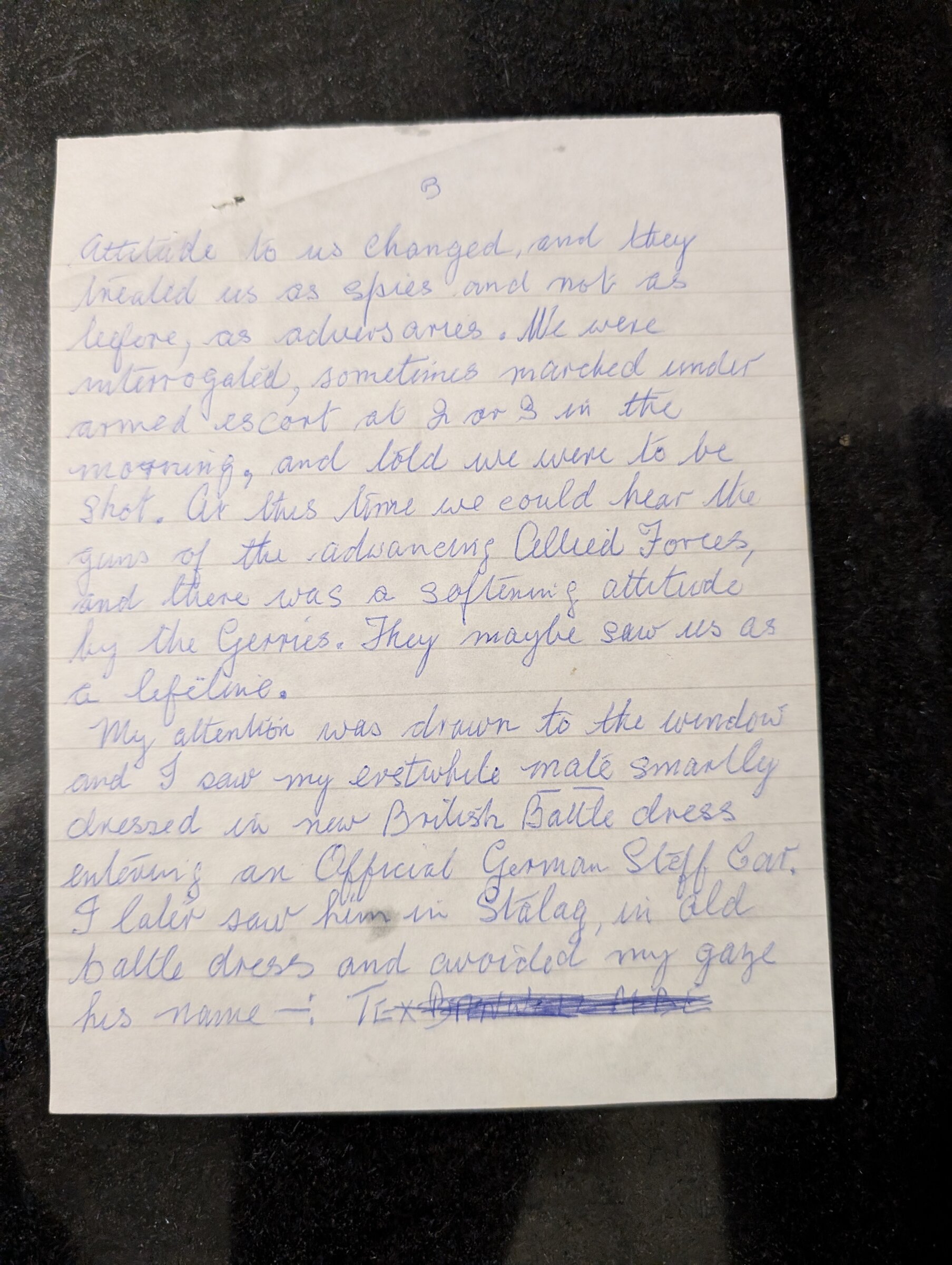
| Treated as spies; marched out at 2–3am; told they would be shot | ms; typed pp.1–3 | ◐ | Noble, captured with him "in civilian clothes": eight weeks' solitary, Gestapo prisons, "Prolonged questioning. Threatening" (Noble). Porter, same net: "referring to us as spies and threatened to shoot us many times", interrogated "at three or four o'clock in the morning" (pp. 155, 157, Porter); his letter of 15 May 1945, "we were always referred to as spies and terrorists" (p. 225, chapter 11). ⚠︎ Noble's own later account (unpublished private papers, shared with us privately), told long after the war: questioned every night, marched by day with his hands tied, and told he would go to the Sicherheitsdienst if he did not talk. Neither names Murphy |
| Interrogator "Lieutenant Heweke"; the cover story "lived in the woods and stole food" / "just wandered around" | notes; ms | ⚠︎ | His word |
| "Because of the gun, my interrogation was more severe and threatening" | ms | ⚠︎ | His word for his own case. Porter, taken from the same party, has the Germans tell them all that "as we were captured in civilian clothes and armed, we were classified as spies" (Porter, p. 150), the weapon the Sten gun Berry left in the shed (p. 148); his letter of 15 May 1945 has "We wore civilian clothes, and had a sten gun, with us. The Germans took a very dim view of this and we knew they could have legally shot us" (p. 223, chapter 11). Briere has the party carrying "a Sten gun and about six pistols given to us by the Dutch underground" (Briere, p. 2). Neither Porter nor Noble says any one man was handled harder |
| Gave nothing away about the organisation | ParaData (supplied by his niece Liz Moore); implied throughout | ◐ | Not provable. The Veerman arrest was for Jopie's courier work (Neuengamme) |
| "Shotgun wounds" to the head, untreated | notebook | ◐ | Hardy confirms he was wounded; his own p.8 says shell splinters from an 88 mm round |
| "Didn't catch me till around March"; "from February (I think) when I was captured" | notebook; p.9 | ◐ | He wrote "(I think)", and on the page he struck out "captured" and wrote "released" beneath it, so the sentence as he left it counts from the camp, which Noble, taken with him, reached on 28 February (Noble). The notebook's "around March" is a month out. Liberation |
| "The guns of the advancing Allied Forces … they maybe saw us as a lifeline" | ms; typed pp.1–3 | ⚠︎ | His word |
| Banwell said "What about your pistol?" in front of the Germans | p.6; typed | ⚠︎ | His word. On Tex Banwell |
| Banwell in new battledress entering a German staff car; later in the Stalag | ms; typed pp.1–3 | ⚠︎ / ◐ | The staff car is his word. ◐ The Stalag: Noble's April 1945 questionnaire, at second hand, can be read to put Banwell in XI-B (Noble). ⚠︎ Noble's own later account (unpublished private papers, shared with us privately), told long after the war, has "a sergeant called Tex" finish up "in a concentration camp", without saying how he knew, which night or which camp (Banwell's page). On Tex Banwell |
| "Banwell was a very suspicious customer … seemed to have cooperated well with them" | ms; p.6 | ⚠︎ | His opinion. On Tex Banwell |
| The gun led the Germans back to Barneveld | p.6; ms | ✗ | Written twice. The Dutch record gives a different cause for every arrest around Barneveld: Jopie's courier work for the Veermans (Neuengamme), Kirschen's abandoned billets for the December round-up (Huurdeman). Nothing found connects any of them to the revolver |
| "The Germans rounded up the Uncle and others" | ms | ⚠︎ | There were arrests all round the farm that December, but no Veerman was among them and the cause was Kirschen's old billets (Achterveld). The only dated arrest of Leen in an archive note is 21 October 1943, a year before Murphy came (his Vught card also has a typed "arrestatie 3.1.44" that nothing explains) (◐, Ede's notes; his page). Separately, Jacob's granddaughter says a brother of his was held at Neuengamme (RTV Utrecht); when and why is not known, and nothing connects him to the policeman Murphy says gave him the gun. That the gun caused it is ✗, the row above |
| Stalag XI-B Fallingbostel | typed pp.1–3; ms heading | ◐ | Camp existed and held Arnhem men; his placement in XI-B rather than 357 rests on his note alone |
| Released by the 7th Armoured Division, in April; lost 2½ stone | p.9 | ✓ / ⚠︎ | The 11th Hussars at Fallingbostel were 7th Armoured's (Arrowhead Club); the weight is his word |
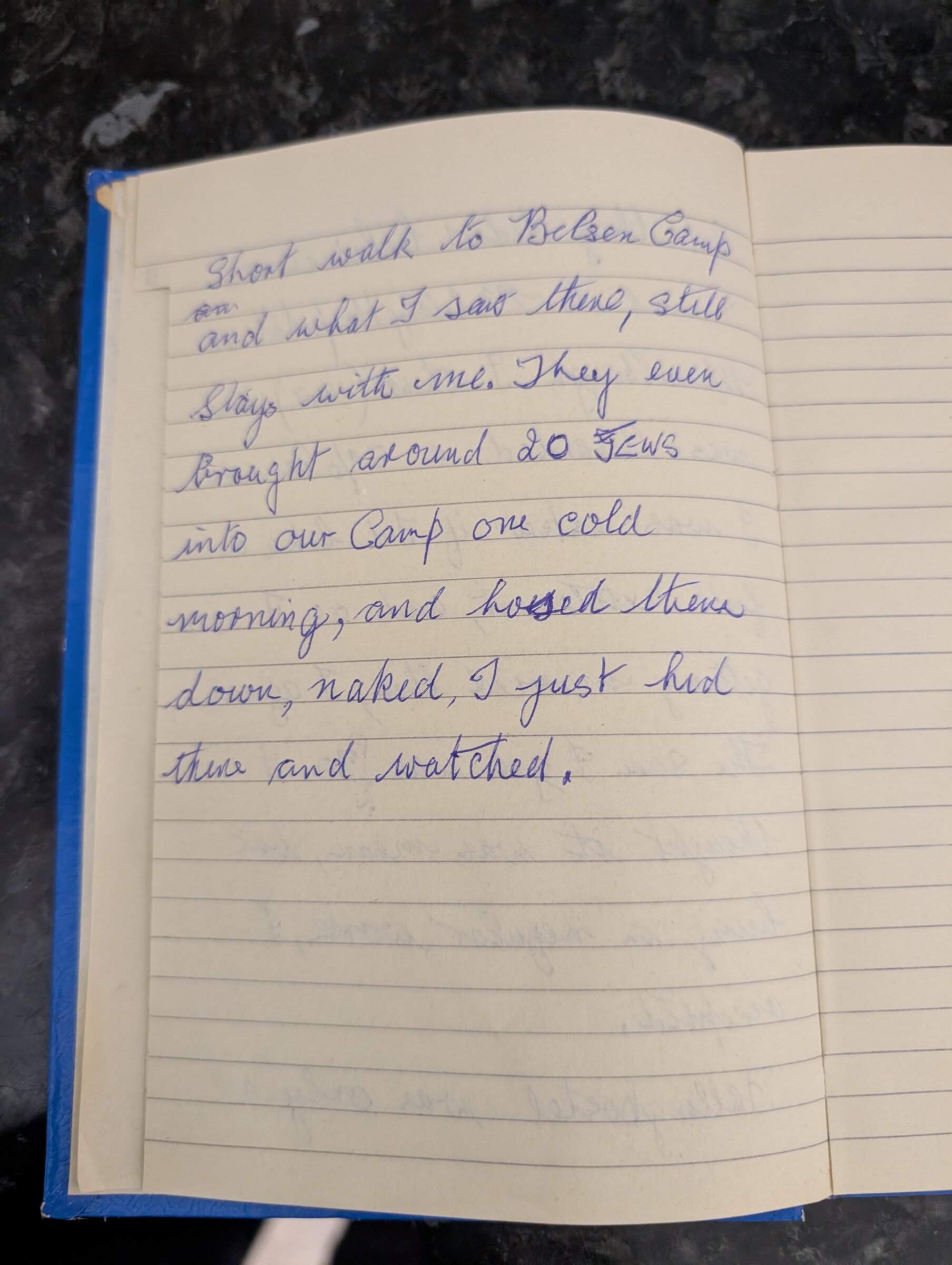
| "Went down the road to Belsen camp"; a dog with an arm in its mouth; twenty Jews hosed down naked in the camp | p.10; notebook | ⚠︎ | His word. Belsen was liberated the day before (Wikipedia). ⚠︎ The distance between the camps is not in an archived source; "a short walk" is not to be read as a measurement |
| "Man's inhumanity to man" | p.10 | Burns, Man was made to mourn. A quotation rather than a claim | |
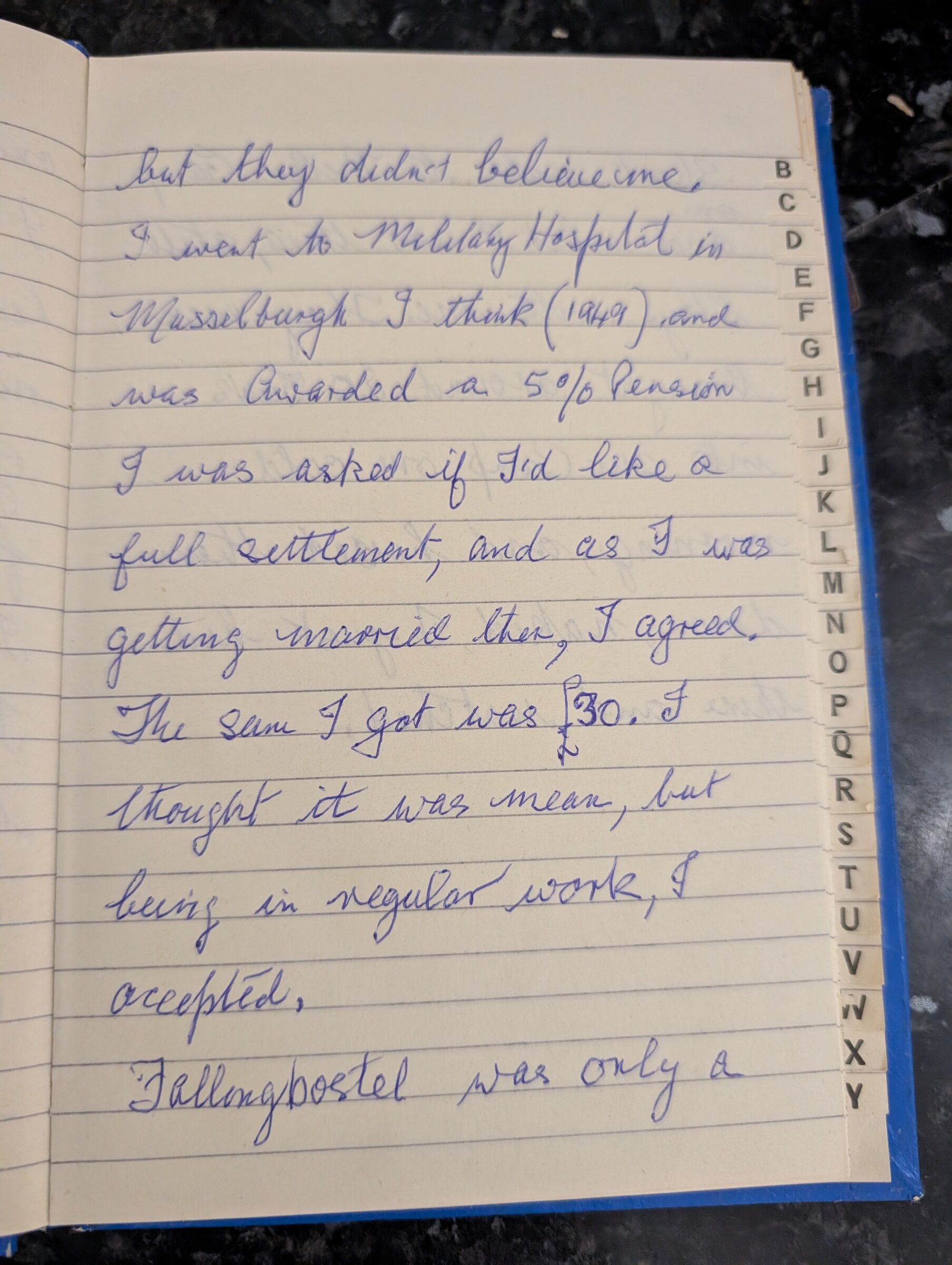
| A 5% pension from the Military Hospital, Musselburgh, c.1949; £30 in full settlement, on marrying | notebook | ⚠︎ | His word; ◐ he married in July 1948 (family knowledge), so his "I think (1949)" may be a year late |
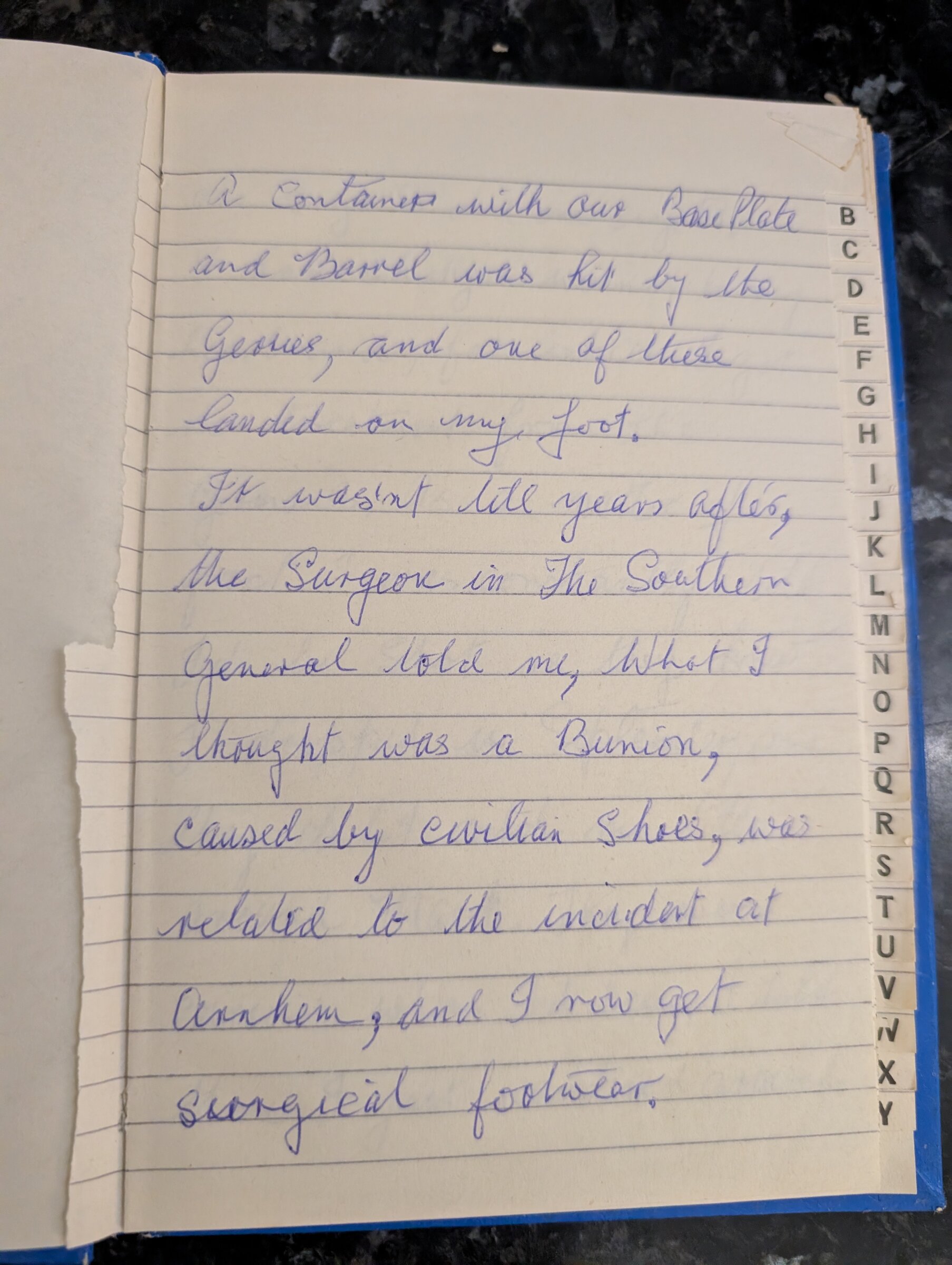
| The mortar container on his foot; the Southern General surgeon; surgical footwear | notebook | ⚠︎ | His word |
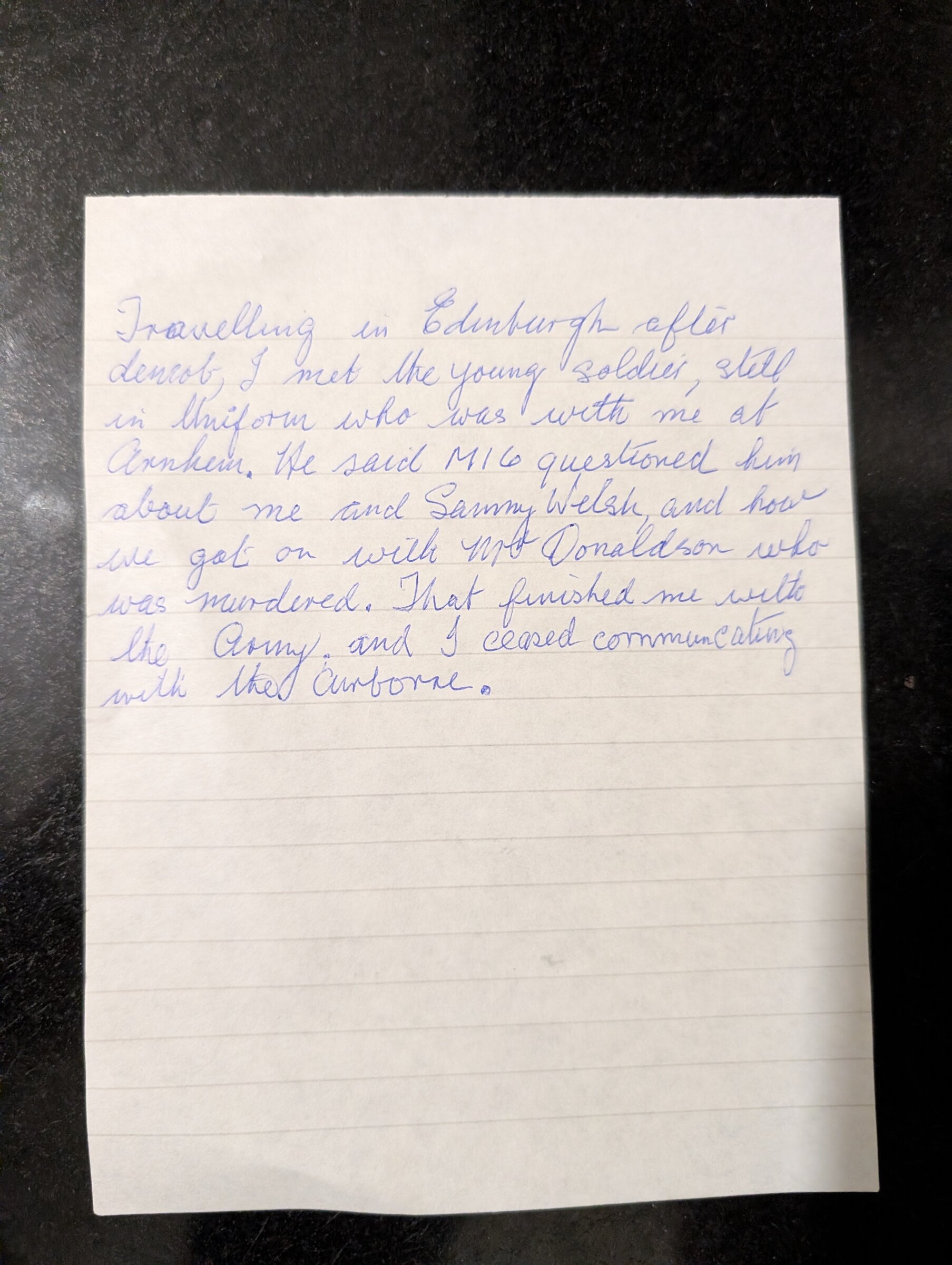
| MI6 questioned a fellow Arnhem soldier about him, Walsh and Donaldson; "that finished me with the Army" | page | ⚠︎ | His word. Unnamed soldier; nothing found |
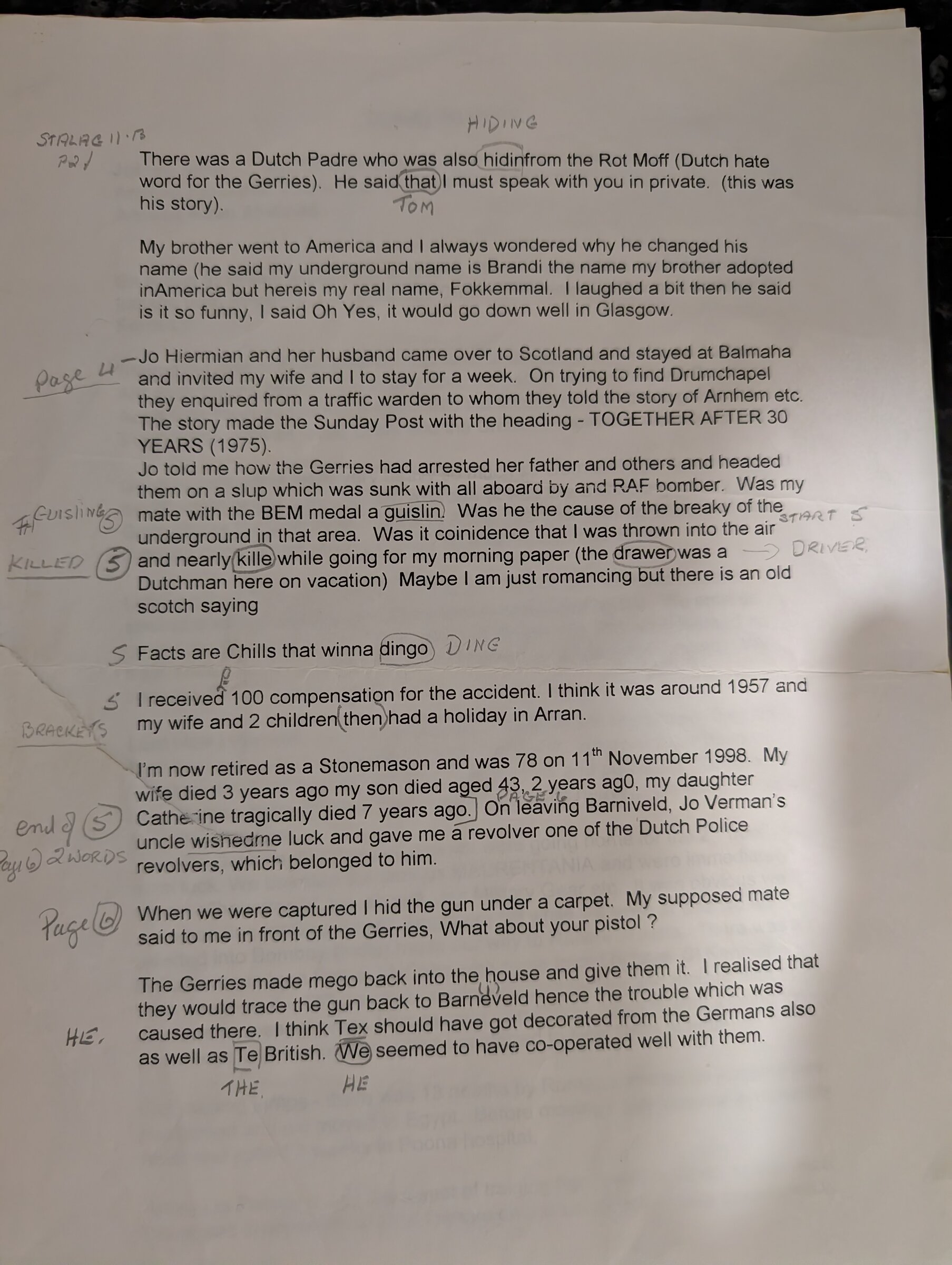
| A Dutch padre in hiding, real name "Fokkemmal", whose underground name, Brandt, was the name his brother had taken in America | A2; typed | ⚠︎ | His word |
| Reported dead; mother drew the insurance on his death certificate | notes | ✓ / ◐ | The death notification is documented (letter); the insurance is his word, and fits it |
| The RAF officer was "James Banford"; the glider pilot "John Bruce" | notes | ◐ | James Branford (Noordman, p. 279; Hardy's MI9 has "Brentford") and B.J.F. Haller: both first names right, Branford's surname one letter out, Haller's wrong |
| Banford nominated him Sgt in charge for the Rhine offensive | notes | ⚠︎ | His word |
| "The Tody Organisation" pressganging workers | notes | ✓ | Organisation Todt (Wikipedia) |
| Hit by a car driven by a Dutchman, "around 1957"; £100; Arran "with my wife and 2 children (then)", and "was it coincidence?" | p.4; p.5; typed | ⚠︎ | His word. ◐ The year is a little out by his own detail: two children "then" puts it between July 1954, when the second was born, and April 1956, when the third was (family knowledge). He sets it among the "Questions I've asked myself", straight after two about Banwell, as if to ask whether it was connected, then half-withdraws it: "Maybe I'm just romancing but there's an old Scotch saying, FACTS ARE CHIELS THAT WINNA DING" (Burns, A Dream; the typed copy has "Chills") |
| Jo Veerman and her husband visited Scotland in 1975 (it was 1974); Balmaha; Drumchapel; traffic warden; Sunday Post | p.4; typed | ✓ / ⚠︎ | The visit is family knowledge, and the year is a year out: the Daily Express reported the reunion on 25 July 1974, "yesterday", at the Rowardennan camping site, a few miles up the shore from Balmaha (a cutting kept by Jo Veerman's family; After the war). The Sunday Post article is not yet found; the traffic warden is his word. A Book of Fife Heroes (1998) has the reunion beginning with an address he had left in a chest of drawers (p. 49), and the Express with "a scrap of paper pinned under an old sideboard": ⚠︎ a Glasgow paper of 23 January 1972, the Sunday Post by Liz Moore's account, tells the same of Flip Esveld two years earlier, a cutting kept by his niece Liz Moore (After the war). The husband was Jean-Baptiste Vanhaelen, and they lived in Belgium (her death notice) |
| Jo told him her father was put on a ship sunk by the RAF | p.4; typed | ✓ | The Cap Arcona (Neuengamme; KZ-Gedenkstätte). What he wrote down in 1998 matches the camp record |
| Stonemason; wife d. c.1995; son d. aged 43 "2 years ago"; daughter Catherine d. c.1991 | p.5 | ◐ | Family knowledge: four children, Frances, Catherine, Martin and Mary. Catherine died in May 1985 and Martin in March 1997, aged 42, so his "7 years" and "43" are a little out |
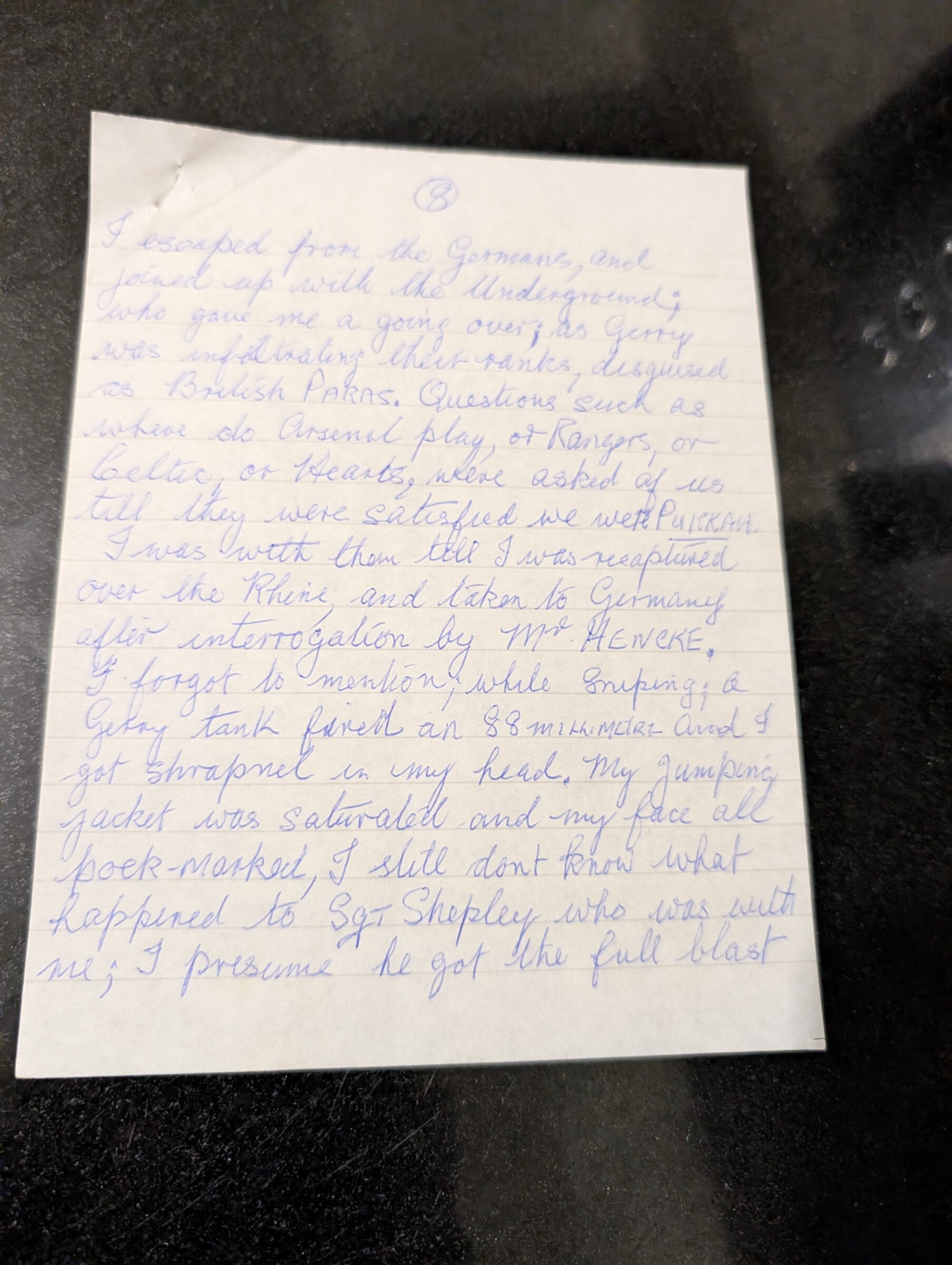
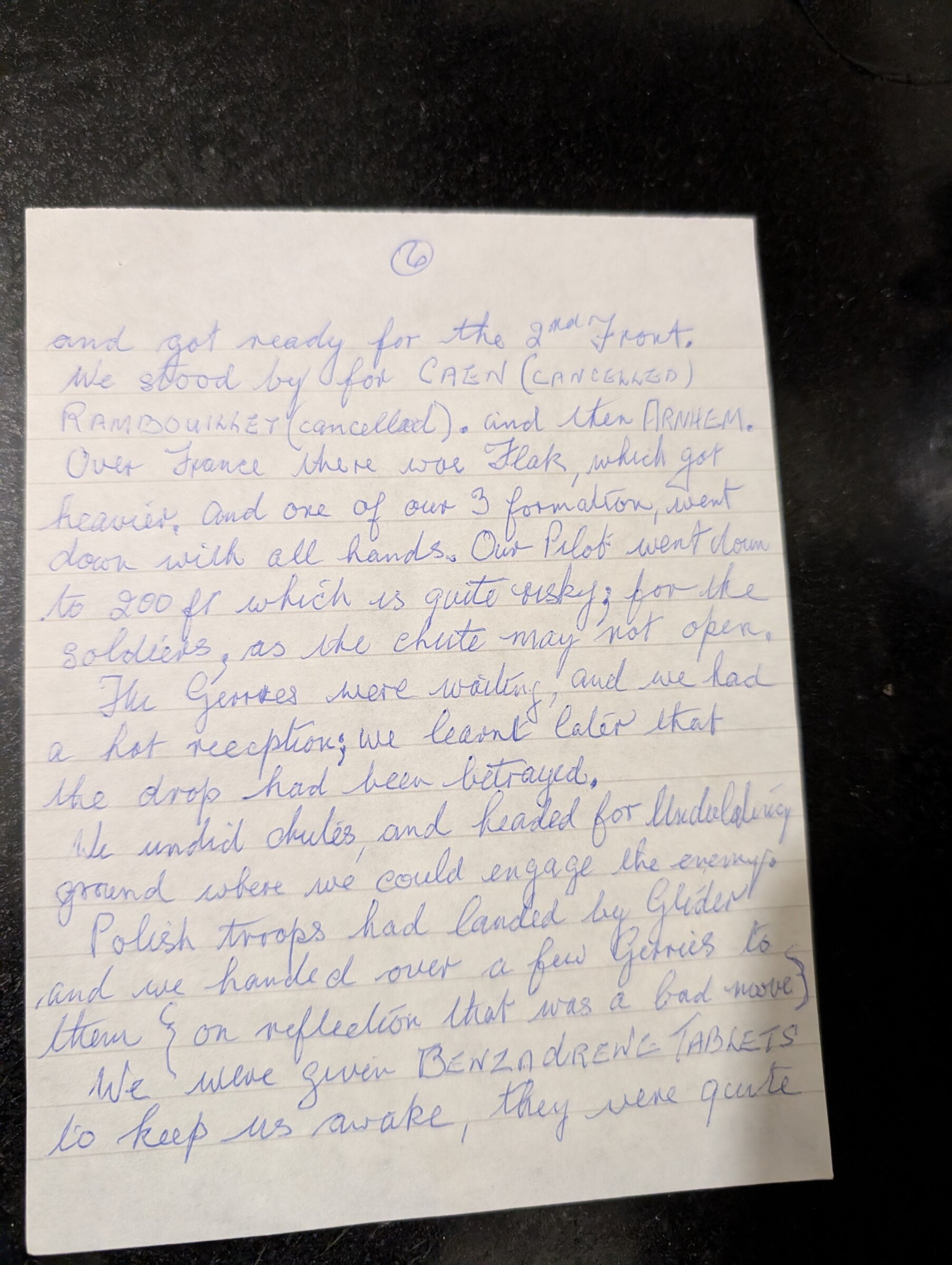
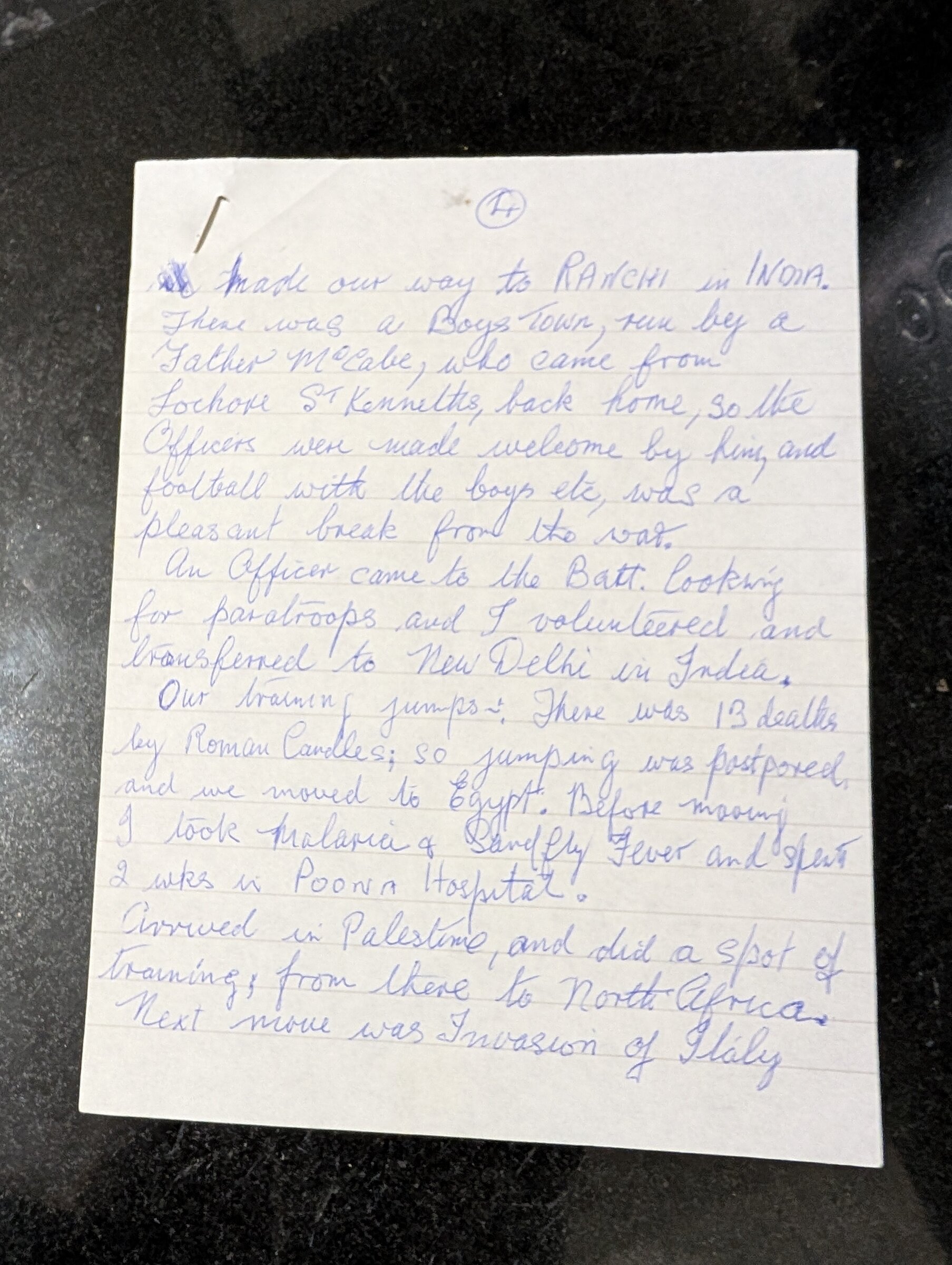
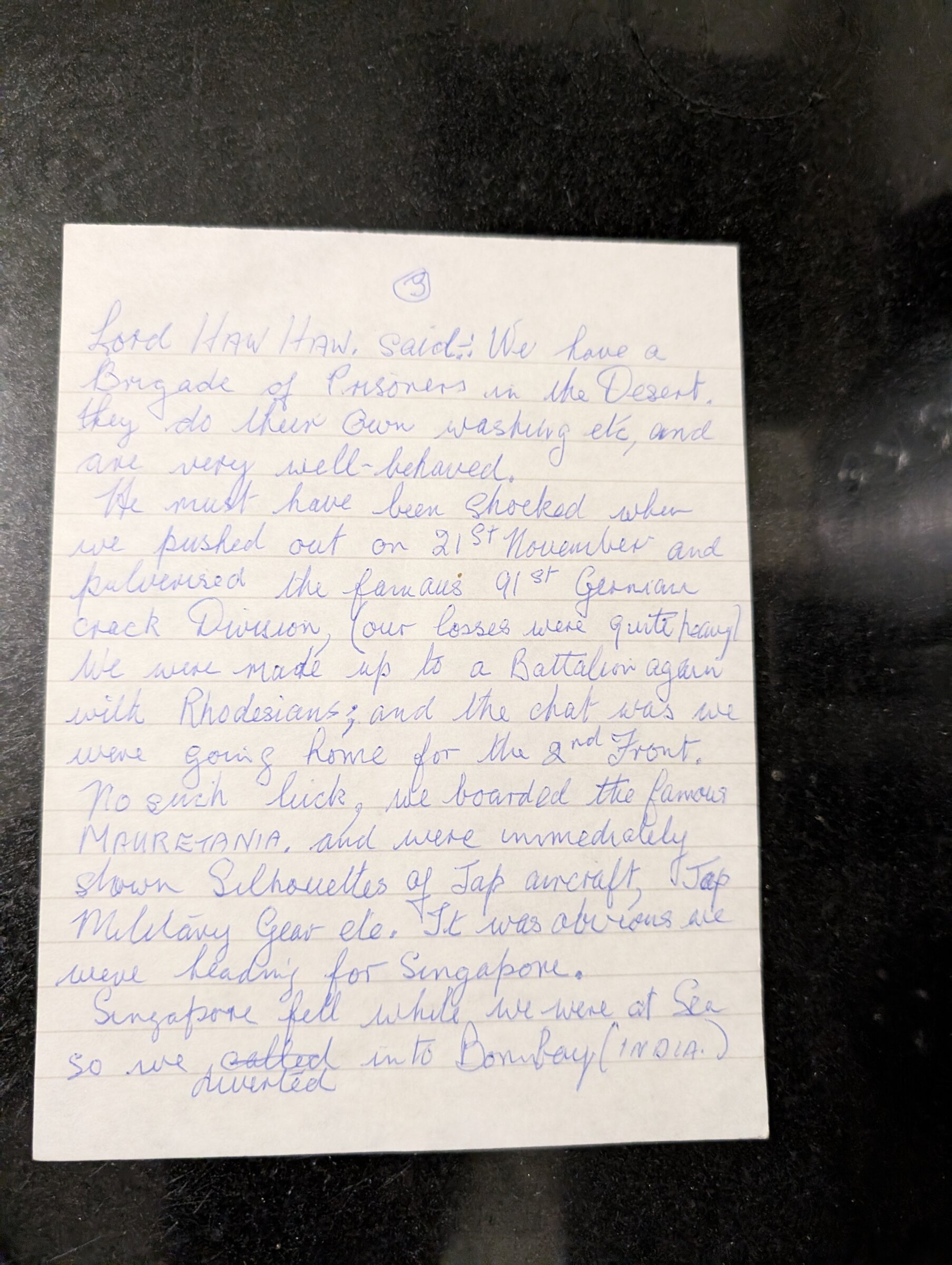
In sum. Wherever an independent record exists for a person, a place or an event, he has it right, including two things nobody in the family had ever been able to check: the name of the Burgemeester at Garderen and what became of Jacob Veerman. Walsh told MI9 in 1945 of Lt Donaldson's wound and of a shot from the house in much the same terms, but how and on what day Donaldson died is still open (rows 3 and 115 above). His mistakes are the kind memory makes: two surnames, the date of Pegasus II, the month he was caught, the distance to Belsen; plus the two matters he himself put as questions: whether the revolver led the Germans to Barneveld, and what the man with the BEM was doing. What happened in the interrogation room cannot be checked from any document.