Capt. Gilbert Kirschen, “Captain King”
Brussels 6 Apr 1916 ⚠︎ – 26 May 1991
Lieut Gilbert Kirschen, 1 Belgian Independent Parachute Squadron, Special Air Service; cover name "Captain King", team FABIAN (Kluiters; Boeree, "Captain King", pp. 157–160)
About: A Belgian SAS officer, dropped on the Veluwe on 15 September 1944 with a team of four to send intelligence to England, who stayed behind the lines until the early months of 1945. His wireless was an outlet for the district's intelligence and for the evaders' arrangements, among them the Pegasus II crossing that Murphy's party missed; Hardy has Banwell of Murphy's party "in communication with Capt. KING through the Underground" (◐ that King is Kirschen; no source has the two men meet).
Unit or role: Lieutenant, acting captain, of the 1st Belgian Independent Parachute Squadron (5 SAS), commanding SAS team FABIAN (Kluiters; WO 373/153/45; his own words in Dekkers and Vroemen, p. 235). A lawyer in Brussels after the war (Steinberg, p. 387), and ◐ before it by Heaps's account.
Where: A farm near Scherpenzeel; a chicken-house on Wuf Lagerweij's farm Hardeveld by De Glind; Jan Evers's farm near Ederveen and Lunteren; then Maarn and Maarsbergen; Rotterdam and Sliedrecht in March 1945, by his own book; the earlier attempts to get out are not settled (when he left).
Evidence: ✓ Kluiters; ✓ his DSO recommendation, WO 373/153/45; ✓ Boeree, Kroniek van Ede (1947), pp. 104, 157–162, 178, 189–190, 193, 204, 241–243, 255, 259, 288 (checked on the page images); ✓ De Jong, Het Koninkrijk, deels 10a, 10b and 13; ✓ the Enquêtecommissie hearings; ✓ the American helper files of Cornelisse, Evers and Wildeboer; Heaps; ✓ his own book, Six Friends Arrive To-Night (1949), pp. 83–113 and 154–160 (pp. 83–98, pp. 99–103, pp. 104–110, pp. 111–113, 154–160, and p. 118)
His name and family. ✓ Kluiters' reference list of agents in the Dutch theatre lists "KING, captain" and "KIRSCHEN, G.-S.J.A." as one man (its alias index prints the two names in columns) and gives this entry:
KIRSCHEN, Gilbert-Sadi J.A.: 19160406 Brussels – 19910526; Belgian; in command of an SAS team; to gather information for operation Market-Garden, to locate V2 sites, and to organize resistance groups; 19440915 (near Nijkerk, Gelderland); mission accomplished/returned in 194502/03: @ code name team FABIAN; captain KING
— Kluiters, Dutch agents 1940 – 1945, a reference list · Kluiters
- ◐ The London Gazette's notice of 1962 for the estate of Marguerite Kirschen, widow, of 128 Avenue Louise, Brussels, who died on 20 March 1962, names as her personal representatives "Etienne Willy Andre Sadi Kirschen and Gilbert Sadi Jacques Albert Kirschen" (London Gazette, 9 November 1962, p. 8797, read on the page image). The forenames are the G.S.J.A. of Kluiters and the Dutch award; the notice does not say how the three were related.
- ◐ A book on Edith Cavell, Pioneer and Patriot, thanks "Gilbert Kirschen, D.S.O., who served in Belgian paratroops based on Britain and gave me permission to quote freely from his father's book" (p. 14, read on the image). The same book has "Maitre Sadi Kirschen" asked to take on Cavell's defence in 1915 (p. 165). That Sadi Kirschen is the father is our reading from the shared name; the preface does not name him.
- ◐ De Jong's "S. Kirschen" is Sadi, by the initial alone: the Dutch book De zwarte herfst prints his own piece under "Gilbert Sadi Kirschen", signed from Lamel in Belgium as an ex-officer of the SAS (Dekkers and Vroemen, 1984, p. 235).
Before the SAS. ◐ Leo Heaps, the Canadian evader who met him in October 1944, writes that he had been a lawyer in Brussels, that his war began with the capitulation of the Belgian Army in 1940, and that he had escaped from France after imprisonment by the Vichy government at Marseille and reached England through Spain and Portugal (Heaps, The Grey Goose of Arnhem, pp. 23–24). No document we hold confirms it.
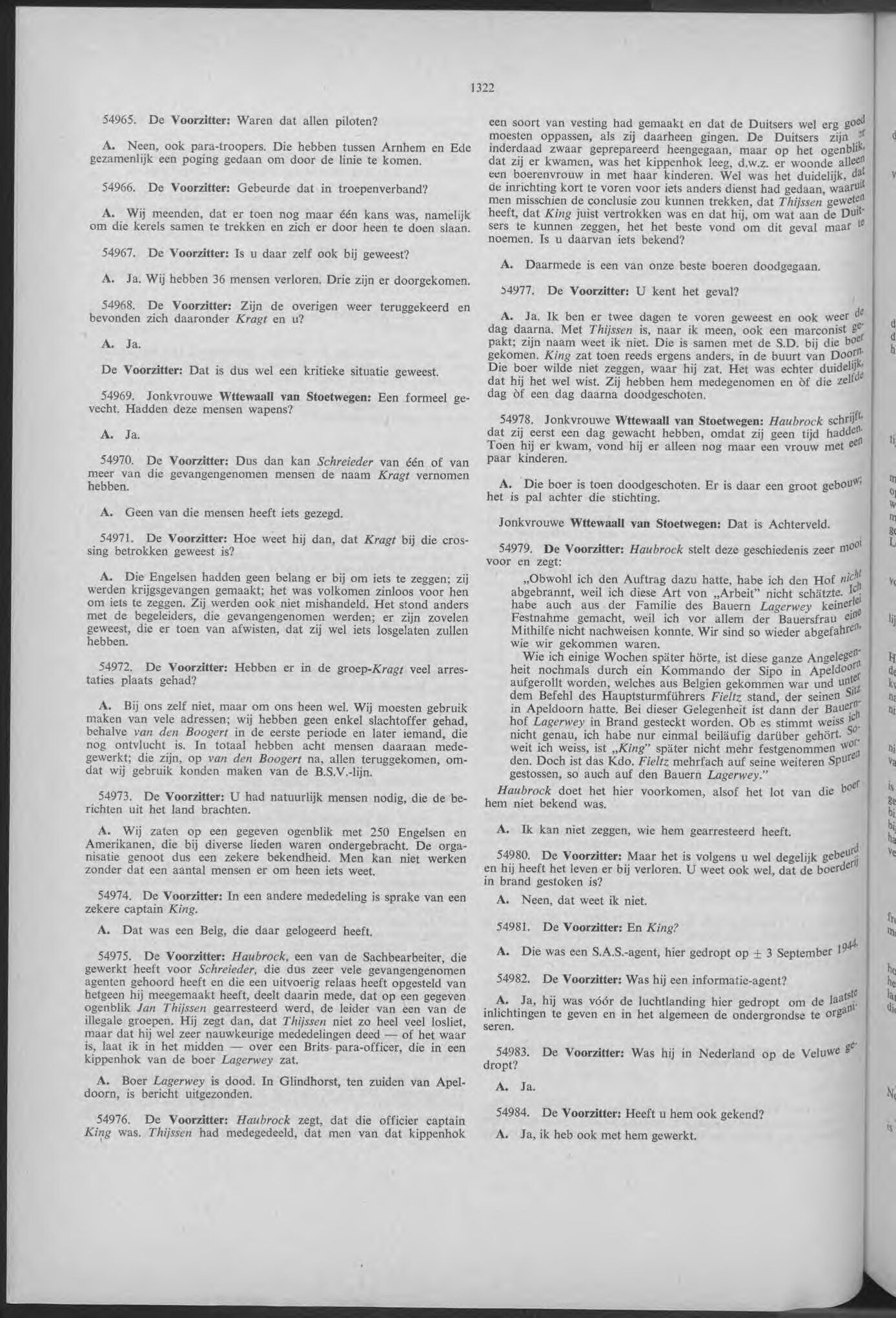
France, August 1944. His DSO recommendation has him dropped "near CHATRES" (Chartres) on "2/3 August" 1944 (a faint stray mark sits before the 2; Operation Bunyan, his 21 men near Chartres, began on 2 August, Operations & Codenames of WWII) with a party to harass German lines of communication, and again near Compiègne on 27 August, when he signalled "the complete proposed German order of battle on the line of the River SOMME" (WO 373/153/45, p. 2). Joseph Piller told the Enquêtecommissie in 1949 that he had been dropped in Belgium too, "bij de inval in België" (at the invasion of Belgium) (p. 1323), and W. J. van Hoorn Alkema that "In Frankrijk en België had hij hetzelfde gedaan en was hij in veertien dagen verlost" (in France and Belgium he had done the same and been relieved within a fortnight) (p. 1713).
On the Veluwe, September to November 1944
Link to the section On the Veluwe, September to November 1944The drop and the team. ✓ L. de Jong's Het Koninkrijk der Nederlanden in de Tweede Wereldoorlog (NIOD edition, CC BY 3.0 NL; the passages, with translations) has him dropped in the night of 14 to 15 September, received by Dijkman of the RVV's Veluwe brigade, who had been warned by Jan Thijssen, and put up in a farm at Scherpenzeel, where Thijssen visited him on the evening of the 15th. His tasks were to report German troop movements and the V-2 sites, find out what fuel the V-2s used, and name targets for the Tactical Air Force (deel 10a, p. 331, checked on the image; the fuel again on p. 436). ◐ That agrees with Kluiters' 15 September; the DSO recommendation has 15/16 September (see where the sources disagree). De Jong then corrected himself in deel 13:
All four members of this team were Belgians; the sergeant and the radio operators had been given another nationality on paper for their protection. Kirschen spoke reasonable Dutch, unlike what we wrote, and was likewise, unlike what we wrote, not briefed about Market Garden.
Dutch originalAlle vier leden van dit team waren Belgen - de sergeant en de marconisten hadden te hunner bescherming op papier een andere nationaliteit gekregen. Kirschen sprak, anders dan wij schreven, redelijk Nederlands en was, eveneens anders dan wij schreven, niet ingelicht over 'Market-Garden'.
— L. de Jong · Het Koninkrijk der Nederlanden in de Tweede Wereldoorlog, deel 13, p. 146 (corrections to deels 1 to 12) · NIOD edition, CC BY 3.0 NL · the volume
- The three with him. ◐ Heaps names them as Corporal Jules Regner, a wireless operator, René Pietquin and Jean Moyse (Heaps, p. 23); the Elspeet history has "Moyse, Pietquin en Regner, allen belgen van een SAS-team" (Elspeet history).
- How the RVV saw it. W. J. van Hoorn Alkema, whom Boeree calls Thijssen's secretary (p. 189; the hearing's heading gives "assistant accountant"), told the Enquêtecommissie that the RVV received him at one of its dropping grounds, that "Die kerels zaten in uniform en spraken geen woord Hollands" (the fellows were in uniform and spoke not a word of Dutch), and that Valkenburg of the RVV's Radiodienst was placed with him as liaison and built a small intelligence group that worked for him alone (p. 1713, read on the image).
- He adds that Kirschen "had een operator bij zich en twee andere mensen, die hij door de linie teruggestuurd heeft. De operator heeft hij behouden tot Februari" (had an operator with him and two other men, whom he sent back through the line; he kept the operator until February) (same page).
In the SAS histories. ◐ From the Internet Archive's full-text index; search hits only, not read on the page, and neither book was borrowed.
- Les Commandos S.A.S. dans la Seconde Guerre mondiale has the drop under the operation name "Regan-Fabian": "Le 15 septembre vers minuit, le lieutenant Kirschen est de nouveau sur la brèche avec trois SAS. Parachutés aux environs de Nikerk, ils doivent surveiller le trafic" (on 15 September about midnight Lieutenant Kirschen is back in action with three SAS men; dropped around Nijkerk, they are to watch the traffic) (the longer passage). ✓ Nijkerk and 15 September agree with Kluiters, and Kirschen with three men makes De Jong's four Belgians.
- Jelle Hooiveld, Dutch Courage (2016): the Belgian SAS "team Fabian, led by Lieutenant Kirschen, remained active", and team Fabian, "under command of Lieutenant G. S. J. A. (Gilbert) Kirschen, was ordered to collect intelligence about German troop movements and the locations" (the longer passage); its notes cite his own Zes vrienden komen heden avond, pp. 98 and 159–60 (the hits).
Arnhem. ✓ On the Monday of the battle, 18 September, Special Forces Headquarters sent him an urgent request to restore contact with Urquhart's headquarters; "Hij zond er twee man op af maar die konden dwars door de Westgruppe niet tot de Airbornes doordringen" (he sent two men, but they could not get through the Westgruppe to the Airbornes) (De Jong, deel 10a, p. 386, note 1, read on the image). ◐ Heaps has Regner and the Dutchman Een sent to Oosterbeek, and Regner reaching the division in time to be evacuated with it (Heaps, pp. 26, 129).
The chicken-house at Hardeveld. Th. A. Boeree's Kroniek van Ede, in a chapter headed "CAPTAIN KING", follows him from the Ede side (pp. 157–160, checked on the page images).
- ✓ "Reeds eenige tijd geleden was G. S. Kirschen, een Brusselaar, gedropt en ondergebracht bij van Ee aan de straatweg Barneveld—Scherpenzeel" (some time before, G. S. Kirschen, a Brusseller, had been dropped and put up at Van Ee's on the Barneveld–Scherpenzeel road). He had brought his helper and picked up two more in Holland, cover names Roelof and Bep, and "Hij noemde zich verder Capt. King" (p. 158).
- Wuf Lagerweij of the farm "Hartevelt onder Leusden" had made a chicken-house into a little dwelling with a sitting-room, bedroom and kitchen, electric light throughout. Evacuees from the Rudolphstichting moved into it on 19 September; when the underground asked for a place for "een paar lui met een zendertje" (a few fellows with a small transmitter), they were offered other lodging and left (pp. 157–158).
- Roelof came to look at it, and that night King moved in; the next afternoon the transmitter was working. Boeree calls it "een brutaal stukje" (a cheeky bit of work): under 1,000 m from the Rudolphstichting, which was full of Germans (p. 158).
- ◐ Heaps tells the same place: "the farm of Wuf Langerwey, outside the village of Glindhorst", three chicken coops alike from outside, Kirschen's with three panelled rooms, a feather bed, electricity and running water (Heaps, p. 25).
His people. ◐ Heaps has Roelof van Valkenburg and Bep Labouchère as his liaison and courier (Heaps, p. 25), which fits Boeree's Roelof and Bep. Jan Evers of Ederveen in 1984 had the Utrecht student jhr. Roelof van Valkenburg of Leusden as the liaison (our English paraphrase of Dekkers and Vroemen, pp. 234–235), and Evers's American claim names "Jhr. R.A. van Valkenburg" of Oudenrijn as a witness (p. 28). Bé Labouchère is named in Geschiedenis Magazine as "Bep".
Heaps and the other evaders. ✓ De Jong has the first evader to reach the Allied lines with news of the Veluwe come through him: Leo Heaps, who had jumped from the train, ended up at Putten with Piet Oosterbroek, and Oosterbroek took him, by way of Dijkman, to "de geheime agent Kirschen ('Captain King')" (the secret agent Kirschen ('Captain King')), whom Dijkman had put in a chicken-house fitted out as a dwelling on a farmyard near Scherpenzeel; Heaps crossed the Waal on 5 October and told Major Airey Neave of IS9 about him (deel 10b, p. 546, checked on the image; Heaps was a lieutenant, by deel 13, p. 153).
- ◐ Heaps's own book has Kirschen telling him that he was the second evader he had met, after the doctor Donald Olliff with 29 orderlies, that "A large traffic jam of evaders was building up with which he did not feel equipped to deal", and that he would ask for two carrier pigeons on the next drop to send the evaders' names to England (Heaps, pp. 129–130).
- ◐ His own book has the doctor under 1 October: Roelof brought "two Englishmen who had escaped from Arnhem" in the night, an R.A.F. sergeant, sole survivor of an aircraft crew, and "a Lieutenant Olyff of the R.A.M.C. who, during the battle, had been cut off with about thirty of his men from the rest of his ambulance unit" and had gone into hiding in the woods until he made contact with the Dutch Resistance; "Olyff stayed the night with us" (p. 78, bottom half, read on the page).
- ◐ Heaps also has Major Tatham-Warter meeting him in his chicken coop twice a week, and, on 7 October at the ground "Bertus" north of Barneveld, "his fourth supply mission" (p. 134), where the DSO recommendation has him arranging supply drops "on two occasions".
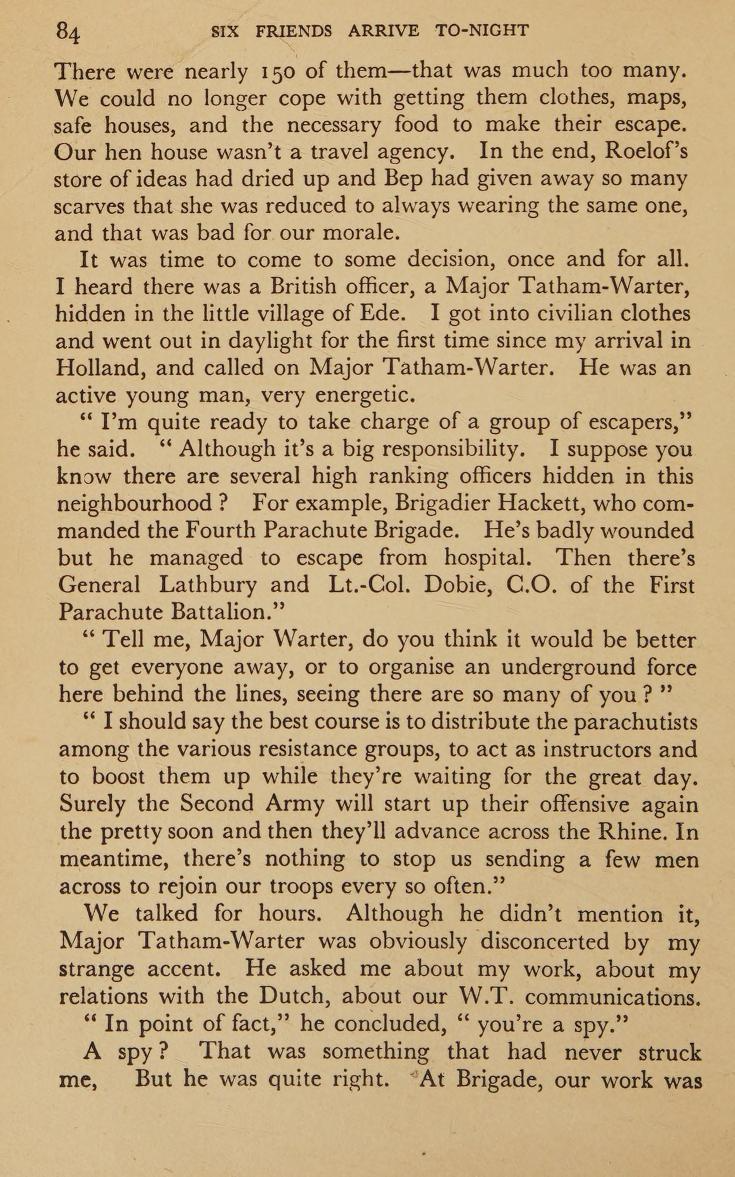
✓ His own book tells it from the chicken-house: "There were nearly 150 of them—that was much too many. … Our hen house wasn't a travel agency", and so he went to Ede in civilian clothes, "out in daylight for the first time since my arrival in Holland", to call on Major Tatham-Warter, who told him that Brigadier Hackett, General Lathbury and Lt.-Col. Dobie were hidden in the neighbourhood (Six Friends, p. 84, read on the image). Later he was asked to organise Hackett's escape through the lines: plans to fly him out failed on the weather, and a crossing near Opheusden fell through two days before he was due to leave, when the Allies withdrew from that sector (p. 118, read on the image; John Hackett).
Pegasus I. ✓ Martin Middlebrook's Arnhem 1944 (1994) has both large crossings "planned with the assistance of Lieutenant Gilbert Kirschen, a Belgian SAS officer who co-ordinated the effort with the Allied forces": Pegasus I on the night of 22 October, when Tatham-Warter led 138 men over, and Pegasus II on the night of 18 November, which failed (Boeree has the crossing for the night of 17/18 November, below; p. 438, read on the image). His DSO citation credits him with the escape of "120 airborne evaders", ◐ very probably Pegasus I, though it names no operation (WO 373/153/45, p. 2). The Ede chapter in the town archive quotes his diary for the 22nd: "Iedereen goed aangekomen, bericht Londen" (everyone arrived safely, London reports) (Ede manuscript, p. 43, read on the image).
✓ Pegasus I (our name for it) in his own book. Under 20 October he has strict orders to get the Arnhem escapers out, and Tatham-Warter and he speeding it up; over the secret telephone to Nijmegen "the details of the escape were worked out directly between Major Tatham-Warter and a certain Major Fraser", who "operated from the British lines". "That evening the mass escape was to take place": 140 parachutists, Lathbury among them, to be gathered at a farm near the Rhine and met by a British patrol (Six Friends, p. 89, read on the image). Under 22 October: "'Everyone arrived safely,' London announced" (p. 90, read on the image). The telephone he had heard of from "Bill, the owner of the house where Tatham was hiding" and "one of the most active members of the Resistance" (p. 85, text layer). His date for the night is against the others' (below).
The Oldenallerbrug. On 18 October Dijkman told him of the ambush at the Oldenallerbrug: his brigade, "tezaam met een paar nog uit Arnhem afkomstige Engelse parachutisten" (together with a couple of English parachutists still from Arnhem), had wrecked a German car from an ambush; as Kirschen put it later, three Luftwaffe officers were killed and a copy of a sketch was made from a paper found on them (De Jong, deel 10b, p. 49, note 2, the note read on the image).
- To him and Dijkman it was "duidelijk dat het hier om een complot tegen het leven van Hitler gaat" (clear that this was a plot against Hitler's life), which De Jong calls "een volledig uit de lucht gegrepen veronderstelling" (a supposition plucked entirely out of the air); Kirschen sent the sketch to England by carrier pigeon and was told it would be passed to the Russians (p. 50, note, read on the image).
- De Jong's own account of the ambush has one man killed on the Dutch side, no German killed, and two German officers and one of the two NCOs wounded (p. 49), so the two accounts do not agree. One of the Englishmen was Tex Banwell ◐, the only Airborne De Jong names there (p. 48). The note cites Kirschen's own book, Zes vrienden komen hedenavond (1946), pp. 125 and 127, which has not been seen.
The intelligence he sent. ✓ Several sources describe him as the outlet for the district's military intelligence.
- Boeree has Bill Wildeboer's staff at the Wester Wetering at Ede mark German positions on overlays over the staff maps, "De tweede gelijkluidende oleaat was aan King gezonden" (the second, identical overlay had been sent to King), so that a change could go by a number; the reports went by courier to King, who radioed them, until the middle of November (pp. 159–160).
- The Americans' summary for Wildeboer: "Capt King says of the man that every day, sometimes even twice a day, he received from Wildeboer a small drawing on which all German positions were indicated" (Wildeboer's file, p. 48).
- De Jong has the reports of section V of the O.D. going "een tijdlang naar de Belg S. Kirschen toe ('Captain King')" (for a time to the Belgian S. Kirschen) in the autumn of 1944 (deel 10b, p. 531), and Thijssen's report of 27 October has the Veluwe brigade doing combat intelligence "in samenwerking met detachement-S[pecial] A[ir] S[ervice]", which De Jong glosses as Kirschen's detachment (p. 609, read on the image).
- Boeree: the B.S.'s intelligence "werden zoowel naar Nijmegen als via Capt. King naar Londen gestuurd" (were sent both to Nijmegen and via Capt. King to London) (p. 288); and he names a courier killed on the Ermelo–Maarsbergen run, Hans Blankenberg, whose messages "waren bestemd geweest voor Capt. King" (p. 104).
- Anthonie Meuzelaar of Ermelo, of the RVV: "Capt. King was always in contact with Berend Dykman Piet Veluwe." (his form, p. 2, checked on the image; Berend Dijkman). C. A. Stoove of Beekbergen: "Also they made use of Capt. KING's sender." (his file, p. 5).
With Du Bois. ✓ On 16 October word came "via Capt. King" that the drop would be the next day; on the afternoon of the 17th King and "diens assistent Roelof" visited Du Bois ("Martien") at De Ruif and agreed where the weapons should go (p. 161). King sent him on to the Wester Wetering at Ede, "omdat wij hier midden in het parachutistenland zaten" (because here we sat in the middle of parachutist country) (p. 162). See Abraham du Bois. The Arnhem helper Arnoldus Burger's list ends with "Lt. A. du Bois, Neth Paratroops", with "Capt. King" in the column of those he was passed to, and the operator Sgt. Raymond Holvoet, whose row there reads "etc." and "arrested" (Burger's file, p. 3).
The move to Evers, and the fire. Boeree has the move from Lagerweij's after the maid's talk had spread round the neighbourhood (pp. 158–160, checked on the images):
- After six weeks Lagerweij told King that everyone knew; Roelof found new lodging with Evers "onder Nederwoud", and on "Woensdag 30 October" the whole kit (uniform, weapons, ammunition, transmitter, luggage) went by a flat horse-drawn wagon, "het toppunt van zorgeloosheid" (the height of carelessness), King, "die geen enkel papier bezat en geen woord Hollandsch kende" (who had no papers and knew not a word of Dutch), armed beside the carter, and the operator Tonny, also without papers, on the rug (p. 158).
- King "had zich tijdig uit de voeten gemaakt" (had got clear in time); the maid told everything at her interrogation, the two farmhands "zwegen en overleefden hun gevangenschap niet" (kept silent and did not survive their imprisonment), and Lagerweij fled with his wife (p. 158). ◐ That is the Hardeveld household of the round-up below; the dates do not agree, and Piller has the farmer shot (below).
- At Evers's, Roelof and Bep lodged in the kitchen, and Evers heard long afterwards that Roelof was a candidaat in de medicijnen (a medical student) (p. 159). The couriers to King there were Kees "de Belg" of Putten, Job van den Bent, the Lunteren constable Mulder on his motorbike, and, after he moved on to Maarsbergen, the brothers Van der Mheen of Nederwoud (p. 160), ◐ Wim and Henk.
- At Evers's he had a little shed as an office with his transmitter, a pot stove and a sack of egg-coal; he stoked it hot and went for a walk, the coal caught, and the shed burned, butane cylinders bursting and cartridges going off. He went to Maarsbergen, Roelof and Bep with him (p. 160). Boeree elsewhere puts the fire down to King's "onvoorzichtigheid" (carelessness) (p. 259).
- ✓ De Jong has him move at the end of October from Scherpenzeel, "waar teveel mensen van de aanwezigheid van zijn zender wisten" (where too many people knew his transmitter was there), to a place near Lunteren, and the set and code book lost there in a fire indoors on 3 November; he still had a reserve set hidden at Maarn, sent an uncoded message "brutaalweg" (brazenly), got a new code book, and resumed from Maarsbergen (deel 10b, p. 551, note 1, checked on the image).
- Jan Evers in 1984: a chicken-house with double walls, burned one Saturday evening with food, ammunition and the set, "We waren alles kwijt, ook de codes" (we had lost everything, the codes too) (Dekkers and Vroemen, pp. 234–235). Kirschen's own piece: he "kon een paar dagen blijven op de boerderij van Jan Evers in Ederveen. Daar is toen mijn uniform verbrand, en ook de radiozender" (p. 235).
- ✓ His own book, 1949, keeps a diary of it (pp. 95–99; pp. 95, 98 and 99 read on the page images (95, 98, 99), p. 97 on its image):
- 25 October: a message from Ede that "The girl who worked at Wuf's farm was going round telling people that allied parachutists were living in her master's hen-run", which "meant a speedy removal"; Roelof arranged new lodgings through "Bill, head of the Resistance in Ede" (p. 95; Wuf Lagerweij).
- 1 November: the evening they were to move into Evers's new hen-house it burned down, with the set, the code book, uniforms and arms; "I had just noticed one of our grenades exploding and then another", while Evers told the neighbours it was "an old hen house I wasn't using any more" (pp. 96–98).
- The second set was hidden at Bart's, where they had stayed their first night in Holland (p. 98); after the fire they went to Bart's, who advised them to go and live with his friend Nico, and the diary of 4 November has them "already three days at Nico's" (p. 99, both pages read on the images).
- 4 November: Lange Jan (◐ very probably Jan Thijssen; the book has only the nickname) told them that "Wuf's maid's chattering has had its effect, and the gallant S.S. with great ceremony surrounded the hen-run you'd lived in for the last few weeks", and found only a family of Dutch refugees in it (p. 99).
✓ The fire is in the American papers too. Jan Evers's claim of 20 August 1945 asks f. 500 for a hen-house that "burnt down" during King's stay "and owing to his presence", with "Capt. G.A. Kirschen" of Brussels as a witness (claim, p. 27; witnesses, p. 28; both checked on the images). The investigating officer's note: "Owing to gossiping the Germans found out the address of King at the Grindhorst and he had to move to Evers, who furnished a hen-house", given up "after about a week" when it burned with the ammunition and weapons; the action report of 3 October 1945 has Evers sheltering "Capt. King and his W/T operator for 8 days in his house and 2 days in the chickenhouse before it was burned down" (p. 29; p. 30).
✓ Aart Roelofsen of the Postweg at Lunteren, an Ede group man, "rendered invaluable assistance to the British dropped agent 'Captain King' (Lt. G. S. Kirschen), hiding his wireless equipment and securing for him safe places from which to broadcast", the American summary of 28 May 1946 says, adding that Kirschen's efforts were "directed toward planning definite operations for the evasion of Allied personnel of the ill-fated Arnhem jump", and that Roelofsen sheltered about 55 evaders himself (Roelofsen, p. 15, checked on the image).
At Maarn. ◐ Heaps has the spare set "hidden at the home of Mrs. Vera Hoogeweegen at Maarn" (Heaps, p. 142); Kirschen's own book has a hostess Vera and her son Androucha, and German soldiers requisitioning saucepans in her kitchen while the set was hidden (Six Friends, p. 118). That the two Veras are one woman is not shown. ◐ De Jong has Thijssen come to him at Maarn on 4 November and quotes Kirschen's notes on the visit, which call the visitor only "Lange Jan", so the identification is De Jong's (Van der Gaag told the commission of "the other Lange Jan", Jan Thijssen): "'Lange Jan' … brengt ons jenever, rookt zijn pijp en vertelt de laatste voorvallen uit de verzetsbeweging" ("Long Jan" brings us gin, smokes his pipe and tells the latest from the resistance) (deel 10b, p. 625, read on the image, citing Zes vrienden, p. 142). De Jong adds that someone in his position could wear uniform at his hiding place, "eerst bij Scherpenzeel, toen bij Lunteren, tenslotte in Maarn", but not when he left it (p. 679, note; text layer only).
With Murphy
Link to the section With Murphy✓ "Captain King" was a name in the line that hid Murphy, though no source has the two men meet.
- Hardy, early November 1944, at the forester's house Kijkuit: he "first heard of Capt. KING" there, with "the impression that he was a paratroop officer from whom we would get our orders", and "Sgt. BANWELL was at that time in communication with Capt. KING through the Underground" (Hardy; Kijkuit and Harskamp).
- Noble, undated: the son of the Achterveld bath-house manager, who took Noble to his father's house, was arrested "the following week" and, Noble believed, "was carrying reports to Capt. Michael KING, SAS" (Noble). ◐ December 1944, early or mid, by our count from his report: Pegasus II, then five days in a barn, ten at Klooster's, then Achterveld.
- ◐ That Hardy's and Noble's King are Kirschen rests on name, "SAS", date and area; no document ties either man to him directly. ⚠︎ Noble's "Michael" is unexplained; no source gives Kirschen that name. Dick Kragt was "captain KAY", not King (Kluiters).
- ⚠︎ Noble's own later account (unpublished private papers, shared with us privately), told long after the war:
- His interrogators suspected for a time that he was "Michael Dark, who was in charge of the SAS in the area around Wageningen and the southern part of the Veluwe", a man with curly hair like his own: the same "Michael" with "SAS", and another surname.
- Between Barneveld and Scherpenzeel he was at "another farm which was used as a collection point for the British agents who had been dropped and had radio communication with London".
- ◐ Whether either is Kirschen or his team rests, again, on area and "SAS" alone.
Pegasus II, the crossing Murphy's party missed. ✓ King agreed with the other side that the men should reach the floodplain by the Heteren ferry on the night of 17/18 November, show a green light three times, and be fetched under artillery cover by twelve motor boats (Boeree, p. 178).
- After the telephone line from Bennekom to Nijmegen was cut on 16 November, Neave could reach the Airbornes "slechts … via de geheime agenten Kragt en Kirschen, maar het radioverkeer met hen vond via Londen plaats, hetgeen telkens tijd kostte" (only through the secret agents Kragt and Kirschen, but radio contact with them went via London, which cost time every time) (De Jong, deel 10b, p. 551, checked on the image).
- Kragt had no set of his own: ✓ Stewart Bentley has him relying "on Captain Sadi-Kirschen's radio for outside contact" (Bentley, Orange Blood, Silver Wings (2007), p. 125, read on the image), and ◐ Heaps has Kragt "heavily dependent upon Kirschen of the SAS for reliable radio transmission. And the two men were not on very good terms" (Heaps, p. 192).
- Piller, Kragt's partner, told the Enquêtecommissie that King "maakte … geen deel uit, maar hij heeft het wel mee voorbereid" (was not part of the November attempt, but did help prepare it) (p. 1323, read on the image).
- Thijssen's secretary "Wim R.V.V." (W. J. van Hoorn Alkema, of the RVV) got from King "een tip, dat er op 17 November een crossing zou zijn bij Ede", a recommendation to the Second Army's intelligence officer and about ten reports in a bag tied round his waist (Boeree, pp. 189–190).
- He was shot in the leg in the crossing (the bullet lodged behind the kneecap) and buried King's papers (same pages).
- Boeree has Jansen, taken in the crossing, questioned "over Bill en Capt. King, waarvan hij natuurlijk niets wist" (about Bill and Capt. King, of whom he of course knew nothing) (p. 193).
- On 21 November Bill (Wildeboer) learned "via capt. King" that only nine men had got over (p. 204). ✓ His own book has London's signal at midday on 20 November, "Pegasus a washout following unforeseen difficulties. Five repeat five men succeeded in crossing Rhine." (Six Friends, p. 105, read on the image). ⚠︎ Nine against five for the same crossing; not settled.
- ✓ "Pegasus", in his book. The operation that had taken most of his time for days was "the second mass escape of parachutists, organised by Ham", its details "arranged between himself and Brigade via us"; "Nearly a hundred men should have crossed the Rhine the previous night", and Lange Jan's former secretary, carrying messages for Prince Bernhard, went with them in British uniform (p. 104, read on the image; "Ham" is Abraham du Bois). ◐ The secretary is very probably "Wim R.V.V." above.
- On 21 November a letter from Ham gave the details: the north bank had been cleared "to a depth of ten kilometres" since Pegasus I, so "Major MacGuire" led his men in uniform in single file, and they "walked straight into a German patrol"; most were taken or got back to their hideouts (p. 105; Hugh Maguire).
- ◐ His "Pegasus II" is a later plan of Ham's, for small groups, which died with Ham's arrest in December (p. 109, top half and bottom half); the crossing of November, Pegasus II everywhere else on these pages, is his "Pegasus".
Murphy's own party never reached the column: two of its guides' bikes carried Haller and Walsh, part of the party took the wrong fork, and by the 18th they had missed the main body (Operation Pegasus II; Gerrit van Ee).
✓ Two American documents tie Pegasus to him. The summary for Marinus van den Born of the Ede group, shot on 9 March 1945, says "a planned operation was evolved by the Ede group in co-operation with the British dropped agent Lt. G.S. Kirschen" to take paratroopers over the Rhine; the first attempt, "Pegasus" (the numeral is overtyped, and reads I), "was successful, and van den Born took an active part as guide", and he was captured in British uniform guiding evaders on 18 November 1944 (Van den Born, p. 11, checked on the image). The recommendation for Chris Cornelisse of Amerongen says that "During the Pegasus and Sliedrecht operations, Chris Cornelissen worked with Lt. Kirschens (Captain King), a British parachute agent whose duty it was to arrange the evacuation of a large number of evaders from the ill-fated Arnhem operation" (Cornelisse's file, p. 15).
After Pegasus II. The Elspeet history: "Op 3 december 1944 ontmoette du Bois Kapitein Kirschen (Captain King) in een bos om over de mislukte operatie 'Pegasus' te praten" (on 3 December 1944 du Bois met Captain Kirschen in a wood to talk about the failed operation Pegasus) (Elspeet history). Of Du Bois and his operator, the Belgian Raymond Holvoet, Kirschen says their code names were "Ham" and "Bacon" (the Elspeet history has Ham for Du Bois), and he recalled in 1984 that when the Germans took the operator Du Bois came to ask whether Holvoet could be freed, that he put it to his chief in England and was told to be careful, and that Du Bois fell into German hands not long after (Dekkers and Vroemen, p. 235; Raymond Holvoet).
✓ His book of 1949 has it as diary (pp. 90–110; pp. 90 and 105 read on the images, the rest from the text layer):
- 22 October: two agents had been dropped to look after escapes, "Bacon and Ham. Bacon I recognised as Holvoet, a W.T. operator I had known in the Belgian S.A.S. squadron" (p. 90). On 24 October a messenger brought word "that Bacon had been caught" (p. 95).
- 2 December: "Ham gave me a rendezvous at the corner of a certain wood to discuss the new escape operation he was planning; Pegasus II it was to be called"; Ham said he had bribed a Gestapo chief to have Bacon treated as a prisoner of war (p. 109).
- 4 December: "Tell Ham discontinue negotiations concerning Bacon. Risks running own neck into noose." and "Too late, Ham's been arrested." (p. 109). "We never knew Ham's real identity", he adds (p. 110); by 1984 he called him Martien (above).
- Asked to name a successor for Ham, he proposed "a member of the British organisation whose job was the repatriation of R.A.F. personnel", "known as Rembrandt", and on 10 December "Brigade agreed to put Rembrandt in charge of future parachute escapes"; his own orders were to cross about 15 December in a small operation called "Beaver" (pp. 112–113, text layer). The pages read (pp. 112–113) do not say who Rembrandt was; the book was not searched for the name. ◐ Kragt's "Fabian King was due to go back last night", in Warrack (below), may be Beaver.
The December round-up, from his old billets
Link to the section The December round-up, from his old billets✓ In the weeks Murphy was at the Veerman farm at Klein Achterveld, and the fortnight after he left, the SD were working back through the places his team had lived. By José Huurdeman's account the team had been at two addresses in De Glind and Scherpenzeel from 15 September to 5 November 1944, and after the SD arrested the RVV leader Jan Thijssen they got hold of the old billet at Piet Veenendaal's:
Although the SAS team had been gone more than a month, the SD carried out a series of arrests.
Dutch originalHoewel het SAS-team al meer dan een maand weg was voerde de SD diverse arrestaties uit.
— Huurdeman, Ondergronds in de Tweede Wereldoorlog, via the Oorlogsgravenstichting
Huurdeman lists the raids that followed (the same text):
- 15 December 1944, Veenendaal's farm, Kolfschoten 35, Scherpenzeel: a man in hiding shot dead trying to run; Veenendaal, Hermanus Lammers, Jacob Boot and the courier Fokke Dijkstra (⚠︎ in or near the farm: his page) taken.
- 19 December, Cornelis Verhoef's farm on the Klettersteeg at Achterveld: the sons Jan and Johan Verhoef and Jan Rothuizen taken, and Laurens Liezenberg across the road.
- 31 December (⚠︎ 5 January 1945 in three other records: Hendrik van de Kuilen), Lagerweij's farm Hardeveld, Postweg 8, Leusden, "de tweede verblijfplaats van het SAS-team": the farmhands Gerrit Kamphorst and Hendrik van der Kuilen and the maid taken; the Lagerweij couple were in hiding (Piller's evidence has the farmer shot, below).
- 5 January 1945, the gamekeeper Bab van Garderen's house next door: his wife and Gerrit Jansen taken.
"De vrouwen kwamen na 7 weken vrij, maar de mannen zijn allen omgekomen in Neuengamme of in een van de buitenkampen" (the women were freed after seven weeks, but the men all died in Neuengamme or one of its subcamps) (same text). The camp records and each man's death are on Piet Veenendaal's page and the men's own; how the round-up touched the Veerman house is in Achterveld.
The winter, and out across the rivers
Link to the section The winter, and out across the riversThe drop at the end of December. ✓ After the Christmas eve drop failed, King had word two days later that it would come that evening; the aircraft, flying far too high, dropped one man, Capt. Henk van Loenen ("Bob"), and "een geheele inventaris voor King, een nieuwe zender en wapens ter vervanging van alles wat in het schuurtje was verbrand" (a whole kit for King, a new transmitter and weapons to replace everything burned in the shed) (Boeree, pp. 242–243). ◐ The date: Boeree's narrative puts it two days after the Christmas eve attempt, 26 or 27 December by our count, though he later calls it "de dropping van 28 December" (p. 259); Kluiters has 28/29 December (Kluiters); ⚠︎ Ede's manuscript history of the resistance has "In de nacht van 27 op 28 november" (in the night of 27 to 28 November) (pp. 53–54, PDF pages 52–53, read on the image), where every other source has December (Hendrik van Loenen). Van Loenen is Hendrik van Loenen, who afterwards had a set "from Capt. King (Fabiau)" (van Loenen's statement, p. 23). After that, Boeree writes, the British seemed to want little news, and "wat er nog binnenkwam werd via Capt. King doorgezonden" (what still came in was sent on via Capt. King) (p. 255).
The doctors and Dick Kragt. ✓ Graeme Warrack, hidden near Barneveld, heard from Kragt in December that "An agent called Fabian King was due to go back last night. He had room for one other. But there was a slip" (Warrack, Travel by Dark, p. 194); later "Fabian King, the agent whose crossing had earlier been postponed, told Dick to get us ready to go south", a plan then cancelled (p. 204).
- Warrack met him at last at a cottage where the new plan "was being worked out by Fabian King", and writes "no doubt that he was a very brave man—he needed to be to do his work—but he had not a prepossessing appearance"; King "had a stoop, wore spectacles and a thin, straggly moustache and spoke very imperfect English" (pp. 211–212).
- "He and Dick had been at daggers-drawn for some time": Kragt, with no set, was irked at having to ask King to send his messages, and when Kragt wanted to come with them King "remained adamant", even after Warrack threatened to report his behaviour to his commanding officer; Kragt went back to Joop, and the party spent the next day "grousing about King's boorishness". Warrack also writes "No doubt there were faults on both sides" (pp. 212–213: 212, top, 212, bottom, 213; the extracts).
- ✓ Kragt's own report: "I finally decided to evade myself with Fabian's party. At the last stage this was frustrated by an order from London" (Kragt's report, p. 5). See Dick Kragt.
The January attempts. ◐ Noordman's version of Lipmann Kessel's account has the attempt organised by "kapitein King, een SAS-officier", with his radio operator and his liaison "Rudolph" (Noordman names him as jonkheer Rudolph van Valkenburg and the operator as Jean Moyse); they left Frans Hals's house at four in the morning of 12 January with Warrack, Ridler and Kessel; Kessel fainted on the road and was taken back, and the rest could not cross (Noordman, pp. 313–314). A second start from the Huis te Maarn on 18 January failed too, and they were back at Maarn on the 24th (p. 314; Lipmann Kessel). Hackett, hidden at Ede, has "Sam" (Kirschen, by his own key) ordered out after 11 January by the Lek west of Renkum and on to the Waal near Tiel, and the party "that had started off with Sam" failing and coming back almost to its starting point (Hackett, I Was a Stranger, pp. 137–138, 149, 216).
The crossing at Amerongen. Hoogland, Cornelisse and Kessel have a party with King crossing the Rhine at Amerongen, undated except for Cornelisse's "about the middle of January". ◐ The January party came back: Noordman has it at Maarn again on 24 January and Hackett has it "forced to come right back, almost to their starting point" (above). Whether any of these crossings is the one he left by is not shown; De Jong has him going out by the Biesbos in March.
- Nico Hoogland of the Kersweg had "Capt. King and 8 men who came out over the Biesbosch" in his house for two days, and took part in "a night-time crossing of the RHINE … at a time when 1500 Germans were quartered in AMERONGEN … with Capt. KING, an Intelligence operative, and eight other military personnel" (Hoogland's file, p. 7; the Hoogland family).
- ◐ Kessel's Surgeon at Arms has "Fabian King", "whose real name was Kirschen", and his operator "Moishe" with Kessel's party at the Huis te Maarn waiting for a boat to meet them near Tiel; the first boatman refuses, and the party goes on to Amerongen, drags a manure boat from a frozen pond and crosses in two trips, then finds the flooded Betuwe and no one at the farm where Jan Stam should have met them (Kessel, pp. 179–190; Lipmann Kessel). The book gives no dates.
Chris Cornelisse's questionnaire tells the crossing from his side:
helped King to find a boat with which they could cross the Rhine. This was about the middle of January and they should go via Tiel. Cornelissen rowed them across in 2 trips
— US National Archives · RG 498, helper file of Christiaan Cornelisse · questionnaire, December 1945 · Cornelisse's file, p. 20
The Sliedrecht line. ◐ Cornelis den Boer of Zwijndrecht, whose summary covers the Dordrecht–Sliedrecht area, lists among the men he helped "Capt. Kirschen R.A.F. 1 Belg. Par. Regt. c/o Mr. King B.L.A. A.P.O. S/717", then "Compagnon of above mentioned address unknown", with Lt. Jack Craven, "Ros Storner", "Christie V. Broek" and "Carl A. Ellement" (den Boer, p. 36, checked on the image). That is the "Sliedrecht operations" of Cornelisse's recommendation; the page gives no date.
✓ His own crossing, March 1945. His book ends the mission at Rotterdam and Sliedrecht (pp. 154–160; p. 155 read on the image):
- At Rotterdam a young guide, "My name is Chris", told him they would not go by the Biesbosch, "Dick's original idea in getting us to Rotterdam", but "via the canals", going on board "not far from here, at Sliedrecht". Moyse reckoned they were "two days off the six months" in Holland and had sent "four hundred and nineteen messages" (p. 155).
- A girl took them to Sliedrecht, where they waited in a cabin by the water with a girl from Dordrecht who was wanted by the Gestapo; two boatmen took them through a lock and over a dyke into the Nieuwe Merwede, past the German post at "Het kop van 't land", and in the morning mist to a sentry's "WHO GOES THERE?" (pp. 157–160, text layer).
- ◐ The Dick of Rotterdam is "about forty" in the book (the search hits), so not Kragt, who was 27; the "Freek" of Wiedijk's file (below) belongs to the same weeks. Major Windham-Wright's letter on the claim of Lambertus Huber of Garderen ends: "Confirmation can be given by evasion agents Dr. Kruimel (Oom Joop) and Capt. Kirschen (Fabian)." (Huber, p. 3).
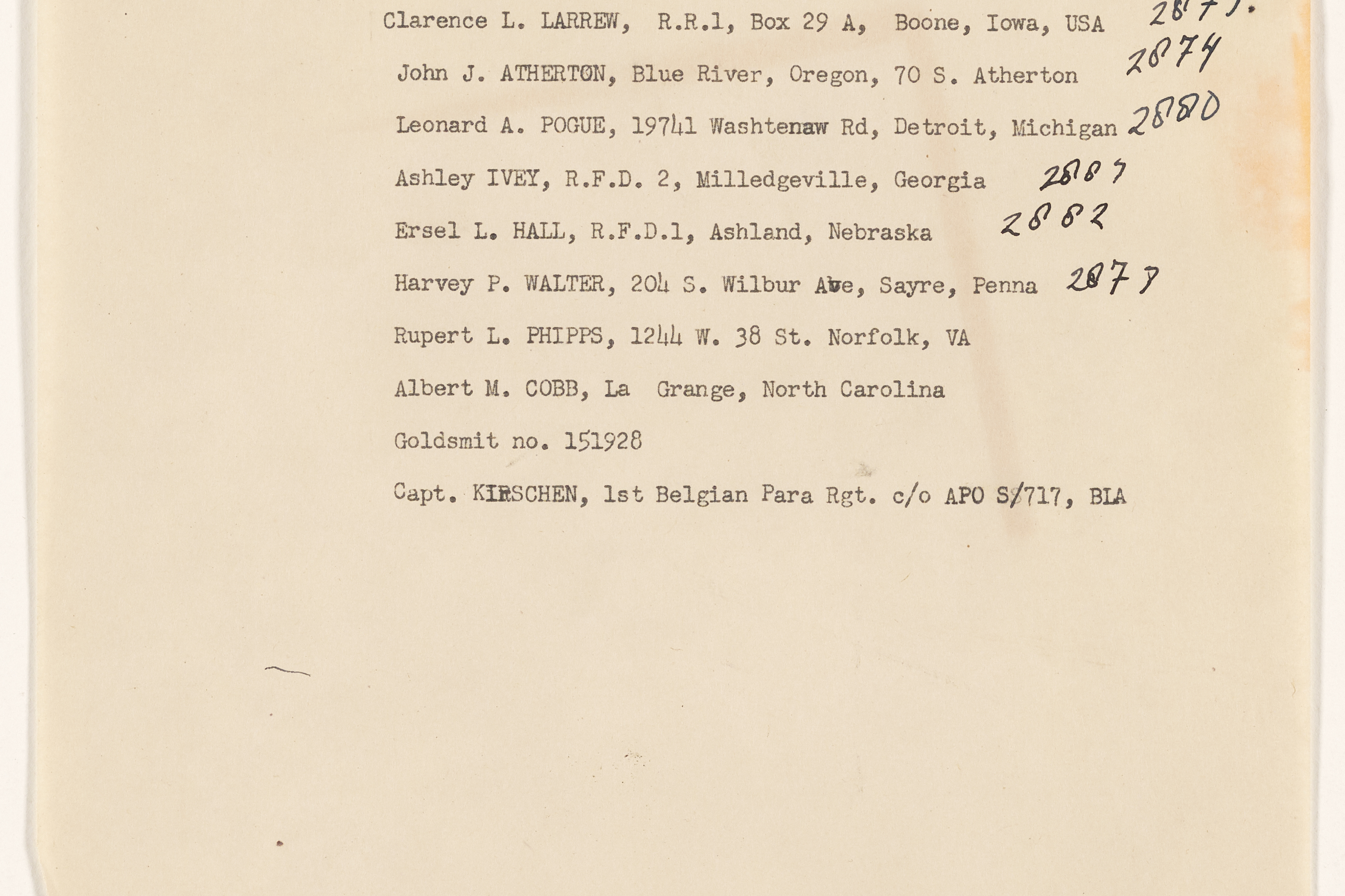
◐ A Zwijndrecht marechaussee's file. Sergeant-major F. Wiedijk of the Marechaussee, "Freek", born at Amsterdam on 31 January 1901 and living at Burg. Doornlaan 16, Zwijndrecht, "acted as a guide for fliers from Amsterdam and Rotterdam to Sliedrecht" and was a transit point for about 15 pilots, "staying mostly one day" (his form, p. 4; the Americans' summary, p. 12; both image-checked). Two pages of his file touch Kirschen.
- A loose typed page, without a heading or a date, lists American airmen with their home addresses and ends "Goldsmit no. 151928" and "Capt. KIRSCHEN, 1st Belgian Para Rgt. c/o APO S/717, BLA" (the page, p. 6; image-checked), ◐ the same "c/o … B.L.A. A.P.O. S/717" address as in Den Boer's list, where "Mr. King" is the c/o name.
- His table of section 13 has a row "Mr. King and companion ?", five days, received from "Kale (bold) Wim and Zwarte (black) Wim, Rotterdam", with no date (the table, p. 5; image-checked).
- ◐ The full-text index of Kirschen's own book has, on the Rotterdam route, "The evening we arrived, Dick had told us that a policeman called Freek would" take them to the lines, and "house of Freek, the policeman" (the search hits; snippets only). That fits Wiedijk; it names no surname.
De Jong's summary of his work: before 17 September his was the only SAS team in occupied Holland; "Kirschen heeft steun verleend aan de illegaliteit op de Veluwe en in de provincie Utrecht en heeft voorts belangrijke spionageberichten doorgegeven - hij is in maart '45 via de Biesbos-route naar het bevrijde Zuiden gegaan" (Kirschen supported the resistance on the Veluwe and in the province of Utrecht and passed on important intelligence; he went in March '45 by the Biesbos route to the liberated south) (deel 10b, pp. 680–681, checked on the images). A second SAS team under the Belgian captain Emile Debefve, with three Belgians and a Dutch commando, Rudy Blatt, was added to his at the end of September and dropped in Drenthe (p. 681).
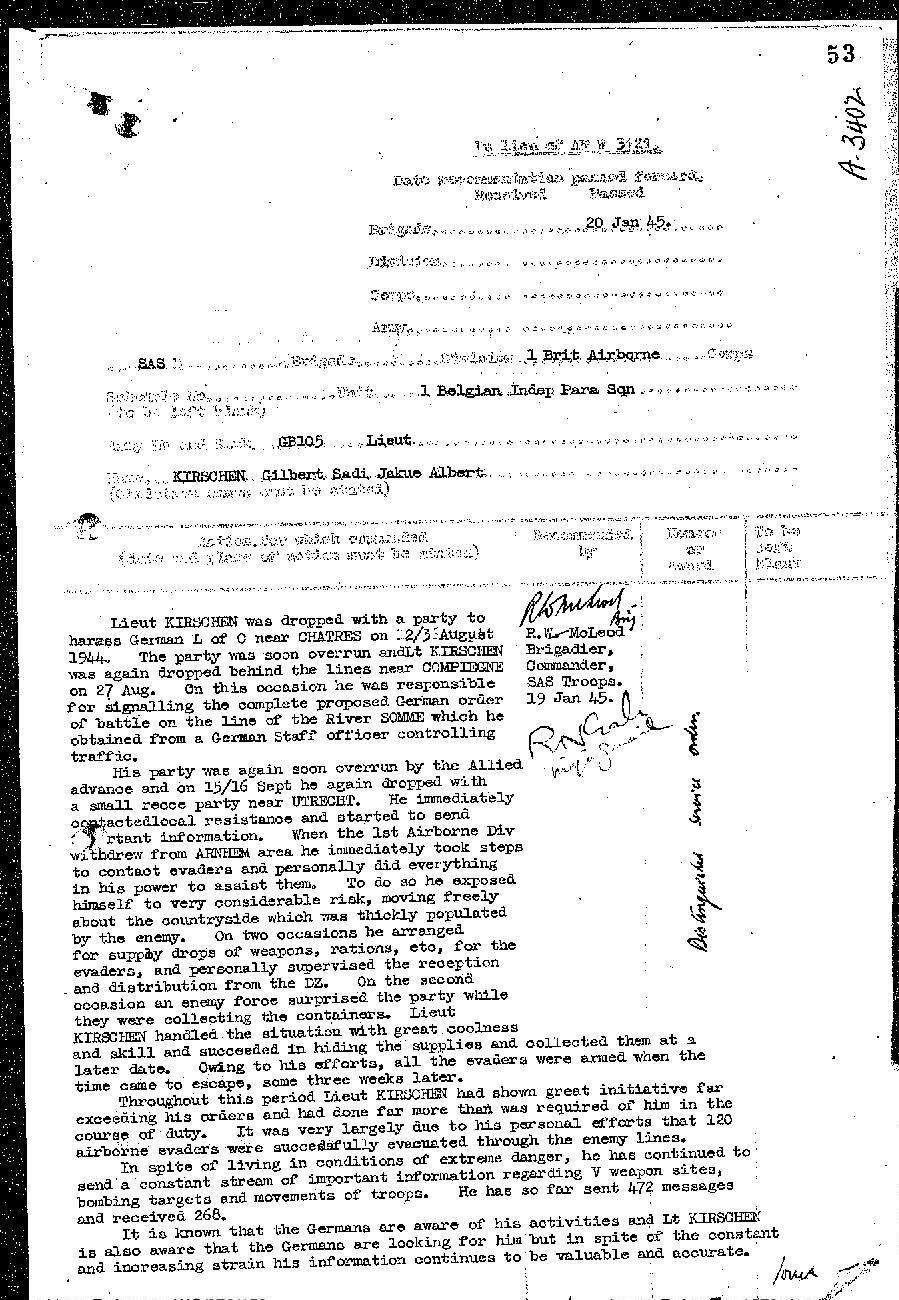
The DSO. In January 1945 he was recommended for the Distinguished Service Order. Brig. R. W. McLeod, commanding SAS Troops, signed on 19 January, a second signature, read as R. N. Gale (the transcription queries "Lt Gen"), under McLeod's in the recommending column, passed it on, and Field Marshal Montgomery signed it as Commander-in-Chief, 21 Army Group; the file does not record the outcome. ◐ He was probably still behind the lines when it was signed: it writes in the present tense, that "he has continued to send a constant stream of important information" and that "the Germans are looking for him" (WO 373/153/45). It gives him as "Lieut", 1 Belgian Independent Parachute Squadron:
His party was again soon overrun by the Allied advance and on 15/16 Sept he again dropped with a small recce party near UTRECHT. He immediately contacted local resistance and started to send [impo]rtant information. When the 1st Airborne Div withdrew from ARNHEM area he immediately took steps to contact evaders and personally did everything in his power to assist them. … On two occasions he arranged for supply drops of weapons, rations, etc, for the evaders, and personally supervised the reception and distribution from the DZ. … Owing to his efforts, all the evaders were armed when the time came to escape, some three weeks later.
— Brig. R. W. McLeod, Commander, SAS Troops · recommendation for the DSO, 19 January 1945 · The National Archives, Kew, WO 373/153/45 · the transcription
The same citation says that he "has so far sent 472 messages and received 268" on "V weapon sites, bombing targets and movements of troops", and "assisted in organising an I.S. 9. network in the area, passing instructions to resistance, receiving agents" (pp. 2–3). John Waddy has the Resistance that "received information via Lieut Gilbert Kirschen of the Belgian SAS that there was now no intention of renewing the offensive in the near future", and "Lieut Gilbert Kirschen, Belgian SAS, had arranged for arms and uniforms to be dropped by parachute to re-equip" the evaders (Waddy, A Tour of the Arnhem Battlefields (1999); ◐ search snippets only).
- ◐ Two printed sources call him D.S.O.: Les Commandos S.A.S. dans la Seconde Guerre mondiale has "Kirschen se voit attribuer la DSO" (the hits; search snippets only), and Pioneer and Patriot thanks "Gilbert Kirschen, D.S.O." (p. 14, read on the image). No Gazette entry for the award has been found.
The Dutch Bronze Lion, 1951. ◐ The Netherlands Institute of Military History's database of gallantry awards has a record for "G.S.J.A. Kirschen", born on 7 April 1916 and died in 1991, reserve captain in the Free Belgian Forces, Team Fabian, "gedropt op 15 september 1944 bij Nijkerk" (dropped on 15 September 1944 near Nijkerk), service "begin september 1944 - eind februari 1945", decorated with the Bronze Lion by royal decree no. 45 of 31 December 1951, register no. 1134 (the record, as served by Open Archieven; index only, the database's own page is gone). The Chancellery's own index of the decorated has "GSJA Kirschen" under the same register number, 1134 (the index record; the register scan not seen). ⚠︎ The NIMH record's remark "Betrokken bij operatie 'Jedburgh'" does not fit a Belgian SAS team and is not explained; the same record names the team as Fabian.
Later life. ✓ A paper on Jews in the Allied armies, given at a conference on Jewish resistance, has "Gilbert Kirschen, now a lawyer in Brussels, was a Captain in a parachute unit and carried out a number of missions over Holland" (L. Steinberg, p. 387, read on the image). He wrote his account of the mission as Six amis viendront ce soir (1946), in Dutch Zes vrienden komen hedenavond and in English Six Friends Arrive To-Night (Heaps's bibliography, p. 229; De Jong, deel 10b, p. 49; two pages of the English edition). Kluiters has him dying on 26 May 1991 (Kluiters).
Where the sources disagree
Link to the section Where the sources disagree- When he left, and by which crossing. ◐ March 1945, from Sliedrecht, by his own book; the earlier attempts are not settled.
- ✓ His book has him at Rotterdam and then over the Nieuwe Merwede from Sliedrecht some six months after his drop, so in mid-March 1945 (pp. 154–160, above), with De Jong's "in March '45" and Kluiters' "194502/03".
- Cornelisse's questionnaire has the crossing he found a boat for "about the middle of January" 1945 (p. 20); Noordman's Kessel has the January attempts failing and the party back at Maarn on 24 January (Noordman, p. 314).
- Piller: "Februari 1945; over de rivieren" (p. 1323); Van Hoorn Alkema: "Tot Februari/Maart" (p. 1713); the Bronze Lion record's service ends "eind februari 1945" (the record); Kluiters "194502/03"; De Jong "in March '45" by the Biesbos (deel 10b, p. 681).
- His DSO recommendation, signed on 19 January 1945, still writes as if he were behind the lines (WO 373/153/45, pp. 2–3). Hoogland's file gives no date.
- Which night Pegasus II was. ⚠︎ Not settled. Boeree has King agreeing the 17/18 November with the other side (p. 178) and Van den Born captured guiding evaders on 18 November (Van den Born, p. 11); Middlebrook has the crossing on the night of 18 November (p. 438). His own book, under 20 November, has the men due to cross "the previous night", the night of 19 to 20 November (p. 104, read on the image). The same open question is on Operation Pegasus II.
- His first billet. Seven accounts:
- Boeree has him put up at "van Ee aan de straatweg Barneveld—Scherpenzeel" before the chicken-house (p. 158); ◐ Boeree's Van Ee is very probably not Gerrit van Ee's family of the Westerhuisweg.
- De Jong has a farm at Scherpenzeel (deel 10a, p. 331); Huurdeman the two addresses of Veenendaal at Scherpenzeel and Lagerweij at Leusden (Huurdeman).
- The Americans' file on Van Lynden has Roelof and a helper take King by car to Piet Veenendaal (p. 8).
- His own book has the first night in Holland at "Bart's" (p. 98); Boeree on p. 157 has a visit to Lagerweij from "Bart, een van de ondergrondsche vrienden" (Bart, one of the underground friends), who was looking for a place for the men with a transmitter (p. 157), ◐ Piet Veenendaal by the resistance name alone (his page).
- Heaps has a hunting lodge the first night and then Lagerweij's (Heaps, p. 25).
- The doctor Olyff or Olliff. Kirschen's own book has Lieutenant Olyff, R.A.M.C., with about thirty of his men cut off from his ambulance unit, brought to the hen-house on 1 October and staying the night (p. 78, read on the page); Heaps has Donald Olliff with 29 orderlies led there on 25 September (pp. 78–79). Whether they are one man, and which date holds, is not settled; Kirschen's book is dated 1949 by the Internet Archive and Heaps's was published in 1976.
- Where the chicken-house was. "Hartevelt onder Leusden" in Boeree (p. 157); "Glindhorst" in Heaps (p. 25) and Piller (answering the chairman, "In Glindhorst, ten zuiden van Apeldoorn", south of Apeldoorn, p. 1322, the volume's OCR text); "the Grindhorst" in the Evers file (p. 29); Postweg 8, Leusden, in Huurdeman; "W. Lagerwey, Achterveld" in Hendrik van Bentum's letter (his file, p. 18). ◐ One farm, by the farmer's name. Piller's "south of Apeldoorn" does not fit De Glind, which lies about 33 km west-south-west of Apeldoorn (our reading of his loose wording).
- What became of the farmer. ⚠︎ Not settled. Piller told the Enquêtecommissie that "Boer Lagerwey is dood", that an operator caught with Thijssen came to the farm with the SD, who took the farmer along and shot him that day or the next ("óf die zelfde dag óf een dag daarna doodgeschoten"), and that "Die boer is toen doodgeschoten" (nos. 54975–54978, p. 1322; the volume's OCR text, not checked on the image). Piller dates nothing, and says King had gone to the neighbourhood of Doorn by then.
- Against it: Boeree has Lagerweij fleeing with his wife (p. 158) and Huurdeman has the couple in hiding on 31 December.
- Haubrock, whose report the chairman reads out, wrote "habe auch aus der Familie des Bauern Lagerwey keinerlei Festnahme gemacht" (made no arrest from the family of the farmer Lagerwey). He found the coop empty and heard some weeks later that another Sipo detachment had burned the farm (nos. 54979–54980, same pages). The Ede manuscript quotes him on the empty coop, vacated 24 hours earlier (p. 49).
- The chairman reports Haubrock's written report as saying that Jan Thijssen, arrested, did not give away much ("niet zo heel veel losliet") but made "wel zeer nauwkeurige mededelingen" (very precise statements) about a British para officer in a hen-house of the farmer Lagerwey; the "of het waar is, laat ik in het midden" (whether true I leave open) is the chairman's own remark (p. 1322, no. 54975, read on the image).
- Haubrock's own words, quoted by the chairman at no. 54979, say that he heard only in passing, and did not know if it was true, that the Sipo command at Apeldoorn under Fieltz burned the Lagerwey farm, and that as far as he knew King was not arrested afterwards.
- The chairman then puts it that the empty coop might mean Thijssen knew King had just left and named the place to have something to tell the Germans (no. 54976). Piller replies only that "Daarmede is een van onze beste boeren doodgegaan" (a farmer of ours died by it). Nothing here is a finding against Thijssen; it is a German report, put by the chairman as a question.
- The fire's date and place. De Jong has 3 November 1944, a Friday, near Lunteren (p. 551); Evers's account of 1984 one Saturday evening (Dekkers and Vroemen, pp. 234–235); the American papers no date, ten days at Evers's against "after about a week" (Evers, pp. 29–30). Heaps has 3 November "at the Evers's fruit farm north of Tiel" (p. 142), which does not fit Ederveen. Van Bentum has King "transported to Ede, about the middle of December 1944. There, his place burnt down" (p. 18). ⚠︎ Not settled; the December date fits none of the others.
- His own book has the evening of 1 November, a Wednesday, the night they were to move in, and the second set hidden at Bart's, where De Jong has the reserve set at Maarn (pp. 96–98).
- Boeree's dates for the move. ⚠︎ "Woensdag 30 October", but 30 October 1944 was a Monday (p. 158); the Ede chapter has the move on 31 October, to J. Evers on the Schansweg at Lunteren (Ede manuscript, p. 49). Boeree has the storm break over those left behind "een paar dagen later", where Huurdeman has the raid at Hardeveld on 31 December.
- His own book has the maid's talk reported on 25 October, the planned move into Evers's new hen-house on 1 November (it burned down that evening, before they moved in), and Lange Jan (◐ very probably Thijssen) telling him on 4 November that the SS had surrounded the empty hen-run and found refugees in it (pp. 95–99, text layer). ◐ That fits Boeree's early-November storm; with Huurdeman's 31 December it would make two visits to the farm, which no source says.
- Pegasus I's night. His book has the escape on the evening of 20 October and London's "Everyone arrived safely" on the 22nd (pp. 89–90, read on the images); Middlebrook has the night of 22 October, Dekkers and Vroemen the night of 22 to 23 October (Middlebrook, p. 438; Dekkers and Vroemen, p. 226). The Ede manuscript quotes the same diary line under the 22nd (above). ⚠︎ Not settled: a safe arrival reported on the 22nd fits his own dates, not a crossing in the night of 22 to 23 October, and no source here says which is wrong.
- His team. De Jong's first edition had an English sergeant, two French-Canadian radio operators and a leader none of whom spoke Dutch; he corrected it to four Belgians, Kirschen with reasonable Dutch (deel 13, p. 146). ⚠︎ Boeree has King knowing "geen woord Hollandsch" (p. 158) and Van Hoorn Alkema "spraken geen woord Hollands" (p. 1713); Jan Evers in 1984 had "een Belgische parachutist van de Special Air Service" (a Belgian parachutist of the Special Air Service) and an Englishman at his farm (Dekkers and Vroemen, p. 234).
- The two men sent to Oosterbeek. De Jong has them unable to get through (deel 10a, p. 386); Heaps has Regner reaching the division and being evacuated with it (Heaps, p. 129); Van Hoorn Alkema has two men sent back through the line (p. 1713). ⚠︎ Not settled.
- Where and when he dropped. The accounts differ.
- Near Nijkerk on 15 September in Kluiters and the Bronze Lion record; "near UTRECHT" on 15/16 September 1944 in the DSO recommendation; "two days before Arnhem began" in Van Hoorn Alkema; "± 3 September 1944" in Piller's evidence (p. 1322).
- Kirschen's own piece of 1984 has "op 15 september 1944 op de Veluwe werd gedropt" (dropped on the Veluwe on 15 September 1944) (Dekkers and Vroemen, p. 235).
- ✓ 15 September, in the Dutch records. ⚠︎ The night is not settled: De Jong has the night of 14 to 15 September; the DSO recommendation, the one contemporary British record, 15/16; Kluiters (a Dutch reference list, in English) and the Dutch award record give the same date and place, 15 September. Piller's figure stands alone.
- His liaison's name. Roelof in Boeree; "jhr. Roelof van Valkenburg" in Dekkers and Vroemen; "Jhr. R.A. van Valkenburg" in the Evers file; "Rudolph" and "jonkheer Rudolph van Valkenburg" in Noordman (pp. 313–314). ◐ One man, very probably, under a cover name and his own.
- His rank. "Lieut" in the DSO recommendation and "Lt. Kirschens (Captain King)" in Cornelisse's recommendation; "Capt. KIRSCHEN" on Wiedijk's page; "reserve-kapitein" in the Bronze Lion record; "Captain" with the cover name everywhere else. ✓ Settled by his own words of 1984: "effectief eerste luitenant bij het Belgische leger, dienstdoend als kapitein bij de Special Air Service" (effectively a first lieutenant in the Belgian army, serving as a captain in the Special Air Service) (Dekkers and Vroemen, p. 235).
- His birth date. ⚠︎ 6 April 1916 in Kluiters; 7 April 1916 in the Bronze Lion record (the record). The year agrees.
- "Michael". ⚠︎ Noble's "Capt. Michael KING" in his report, and "Michael Dark" of the SAS in his own later account, are unexplained; no source gives Kirschen either name.
- Other Captains King. ✗ The "Capt. KING" in Frank McNaught's report is his company commander, Capt. Frank Douglas King of the 11th Battalion, who jumped from their burning Dakota on 18 September (McNaught). ⚠︎ The "Capt. King" in the lists of Jacob Engelaan (Bennekom) and Jacobus Spruyt ("Capt. King RAF") cannot be placed (Engelaan, p. 6; Spruyt, p. 4).