Brigadier John Hackett
5 Nov 1910 – 9 Sep 1997
Brig. (temp.) John Winthrop Hackett, D.S.O., M.B.E., M.C. (52752), 8th King's Royal Irish Hussars (London Gazette, 24 May 1945, p. 2647).
About: Brig. John Winthrop Hackett, of the 8th Hussars, commanded 4th Parachute Brigade, Murphy's brigade, at Arnhem, and was badly wounded at Oosterbeek on 24 September 1944 (Powell; his escape report). Taken out of the St Elisabeth Hospital by the Dutch underground, he hid at Ede from 8 October 1944 to 30 January 1945 and reached the Allied lines by canoe on 6 February 1945 (his report, p. 2).
Unit or role: Brigadier, commanding 4th Parachute Brigade, 1st Airborne Division; a regular officer of the 8th King's Royal Irish Hussars, commissioned in 1931 (his report; Who's Who 1957).
Where: Ede, Torenstraat 5, with the De Nooij women and the Snoek family, 8 October 1944 to 30 January 1945, with a short stay in the house of Lt-Col. Boeree; then Maarn, Groot-Ammers and Sliedrecht (his report, Appendix A; Appendix C, pp. 8, 13–15).
Evidence: ✓ his own escape report, I.S.9/WEA/1/274/2366, interviewed 7 February 1945, with its Appendices A and C (RAMP Reports, pp. 211–231); ✓ his recommendations for the Military Cross of 1941, the DSO of 1942, the bar to the DSO, the mention in despatches and the 1953 CBE (WO 373/27/17; WO 373/20/10; WO 373/53/415; WO 373/64/307; WO 373/161/20); the London Gazette; Who's Who 1957; The Times of 10 September 1997; Kragt's report; his memoir, read from the lending copy (extracts); ✓ the American helper file on the Torenstraat household (the form); ✓ Boeree's Kroniek van Ede, chapters on his stay and his leaving (p. 149; pp. 262–263).
Who he was. ✓ Who's Who for 1957 has him born on 5 November 1910, the son of Sir John Winthrop Hackett, K.C.M.G., LL.D.; educated at Geelong and New College, Oxford (M.A., B.Litt.); commissioned into the 8th K.R.I. Hussars in 1931; in Palestine in 1936 (despatches); seconded to the Transjordan Frontier Force, 1937–39 (despatches twice); wounded in Syria in 1941 and in the Western Desert in 1942; G.S.O. I of Raiding Forces at G.H.Q. Middle East; commander of 4th Parachute Brigade from 1943; in Italy in 1943 (despatches); "Arnhem, 1944 (wounded)"; married in 1942 (Who's Who 1957, p. 1263, read on the page image). His own escape report gives the same date of birth, "5 Nov 10", fourteen years' service, and a home address at Oakham, Rutland (RAMP Reports, p. 211), and The Times has "He was born on November 5, 1910" (10 September 1997, p. 21). ◐ A Home Office certificate of 1950 in the name of a John Winthrop Hackett born on 5 November 1910 in Australia is in Kew's catalogue (After, below).
In the Gazette before Arnhem. ✓ "Offr. Cadet John Winthrop Hackett, from Oxford Univ. Contgt., Sen. Div., O.T.C., to be 2nd Lt." in The Bays, Supplementary Reserve of Officers, 23 September 1931 (22 September 1931, p. 6107); the Military Cross as "Captain (local Major) John Winthrop Hackett, M.B.E. (52752), Royal Armoured Corps (Hussars) (attached Trans-Jordan Frontier Force)" (21 October 1941, p. 6086); the DSO as "Captain (temporary Major) John Winthrop Hackett, M.B.E., M.C. (52752), 8th King's Royal Irish Hussars, Royal Armoured Corps" (13 August 1942, p. 3543); and a mention "in recognition of gallant and distinguished services in Italy", "Brig. (temp.) J. W. Hackett, D.S.O., M.B.E., M.C. (52752)" (24 August 1944, pp. 3926–3927; the heading on p. 3926). The page texts are the Gazette's own PDFs, read against the images.
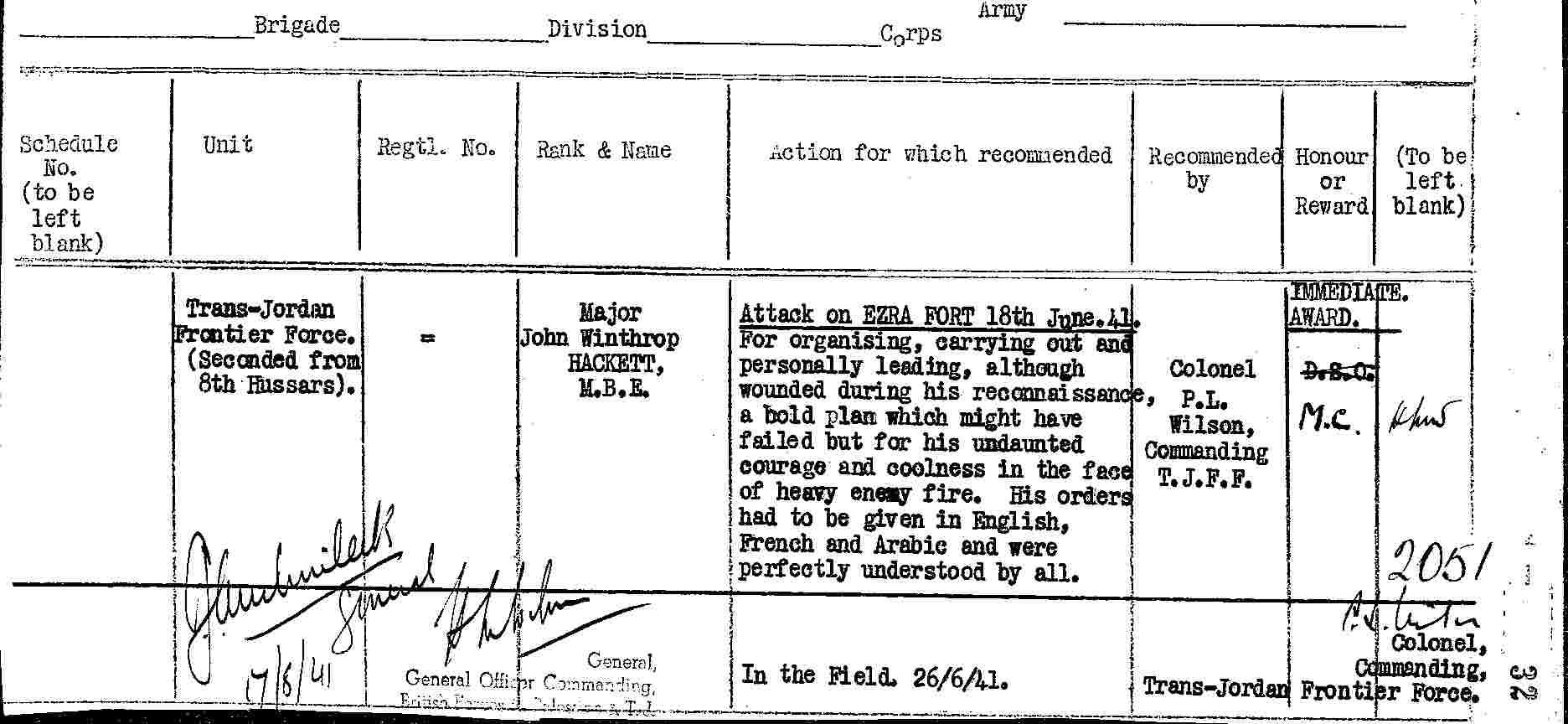
✓ The Military Cross, 1941. Two earlier awards are in Kew's catalogue, and the recommendations for both are held, read on the page images. The first, announced on 21 October 1941 (Kew's entry), is for the attack on Ezra Fort on 18 June 1941, which the catalogue puts in the Syria, Iraq and Iran theatre. The form has him as "Major John Winthrop HACKETT, M.B.E." of the "Trans-Jordan Frontier Force. (Seconded from 8th Hussars)"; it was recommended in the field on 26 June 1941 by "Colonel P.L. Wilson, Commanding T.J.F.F." for an immediate award; the typed "D.S.O." in the award column is struck through and "M.C." written in, and two generals have signed it below the Frontier Force's colonel: one over the printed title "General Officer Commanding, British Forces in Palestine & T.J." (the signature is not legible), the other writing only "General" and the date "17/8/41" (◐, read by eye; the middle figure could be 6 or 8, and a 6 would put it before the recommendation of 26 June; the signature looks like Auchinleck, who was Commander-in-Chief, Middle East, from July 1941 (⚠︎ no source for that date is held here), which fits an 8) (WO 373/27/17).
Attack on EZRA FORT 18th June.41. For organising, carrying out and personally leading, although wounded during his reconnaissance, a bold plan which might have failed but for his undaunted courage and coolness in the face of heavy enemy fire. His orders had to be given in English, French and Arabic and were perfectly understood by all.
— Col. P.L. Wilson, Commanding Trans-Jordan Frontier Force · recommendation for an immediate award, in the field, 26 June 1941 · the form
✓ The DSO, 1942. The second, announced on 13 August 1942, is for 27 May 1942 in the Western Desert, with the 8th King's Royal Irish Hussars of 4th Armoured Brigade (7th Armoured Division, 30 Corps). Kew's catalogue has him under the Royal Armoured Corps; the form gives him as "Capt. (T/Major) John Winthrop HACKETT. M.B.E. M.C.", and says the regiment was attacked at about 0730 "in greatly superior force by the 8th German Tank Regiment in the area Giof el Baar", with regimental headquarters and both Grant squadrons put out of action; his squadron kept together and knocked out at least ten German tanks, covered the left flank of the wheeled vehicles retiring on Sidi Rezegh for the rest of the day in spite of running out of petrol and ammunition ("entirely due to his own initiative that most of this Transport was saved"), and he stayed in action with burns after his tank was hit. It was recommended for an immediate DSO on 27 May 1942 by the regiment's commanding officer, the 4th Armoured Brigade's commander, and the commander of 30 Corps (the margin has "C. W. M. NORRIE"), and signed at the foot by the Commander-in-Chief, Middle East Forces (WO 373/20/10, p. 2; the signatures other than Norrie's are not legible, ◐).
✓ These agree with the "D.S.O., M.B.E., M.C." after his name in the 1945 Gazette entry above, and the 1941 form already has "M.B.E." after his name, so the MBE came before June 1941, and ✓ Who's Who for 1957 has "M.B.E. 1938" (the entry); the recommendation for it is not among the two. The two ranks agree with the catalogue's: "Major" on the Frontier Force form in 1941, and in 1942 a Captain holding the temporary rank of Major.
With Murphy
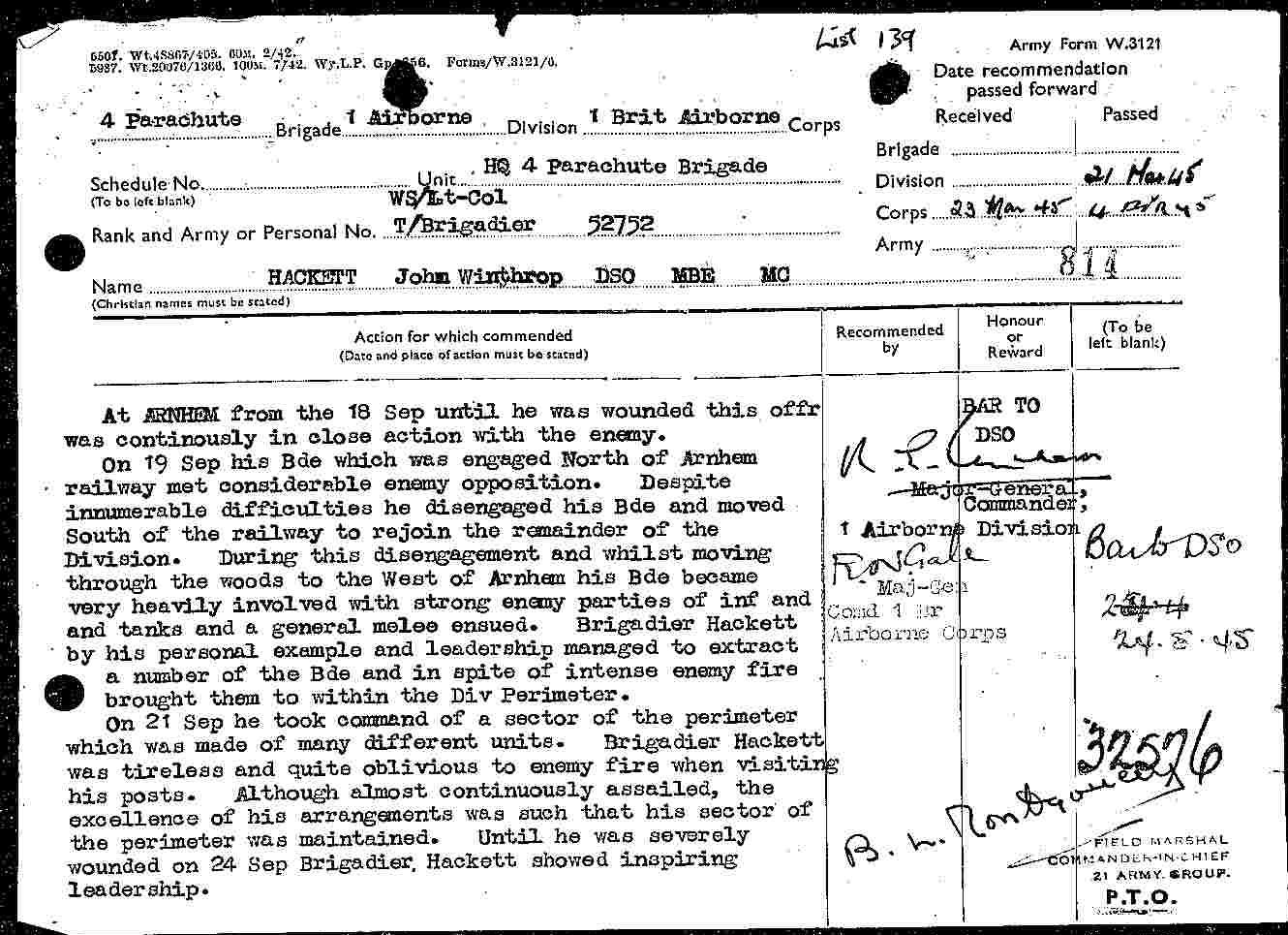
Link to the section With MurphyHe commanded the brigade Murphy's battalion fought in. The recommendation for his bar to the DSO, made by the divisional commander and signed by Gale and by Field Marshal Montgomery, gives his part from 18 September until he was wounded on the 24th, and is marked "24.5.45" (the middle figure unclear), the date it was gazetted (WO 373/53/415, p. 1):
On 19 Sep his Bde which was engaged North of Arnhem railway met considerable enemy opposition. Despite innumerable difficulties he disengaged his Bde and moved South of the railway to rejoin the remainder of the Division. During this disengagement and whilst moving through the woods to the West of Arnhem his Bde became very heavily involved with strong enemy parties of inf and tanks and a general melee ensued. Brigadier Hackett by his personal example and leadership managed to extract a number of the Bde and in spite of intense enemy fire brought them to within the Div Perimeter.
— 1st Airborne Division · recommendation for a bar to the DSO, March 1945 · The National Archives, Kew, WO 373/53/415 · the transcription
✓ He flew from Cottesmore in a Dakota at 10:30 on 18 September 1944 and landed on the Ginkelsche Heide at about 13:00 (his report, p. 211): the 4th Parachute Brigade's lift, in which Murphy's 156 Battalion dropped on Ginkel Heath the same day (Arnhem; the 156 Battalion history). ◐ By his own account Murphy was taken near Oosterbeek on 21 September, while ParaData has him injured there on 24 September (Arnhem). ◐ Fullick's biography has Hackett told at Arnhem that the commanding officer and second-in-command of 156 were among the killed (Richard des Voeux; des Voeux). Nothing found has Hackett and Murphy meet.
20 September, with Murphy's company. ◐ The Pegasus Archive's account of Major Geoffrey Powell, who commanded C Company of 156, Murphy's company (Walsh; Arnhem), has Hackett send for him on the way to the Perimeter: standing behind a small tree under fire, Hackett told him that the Brigade Major, the Intelligence Officer, Lt-Col. des Voeux and his second-in-command "had all been killed within the last quarter of an hour", and that 200 yards ahead "was a hollow filled with Germans" between the brigade and the Perimeter; Powell was ordered to take it. With about twenty-five men and Major Page's twelve he did, the Germans fled, and Hackett's group came in behind, about 150 men in the hollow (Pegasus Archive, Powell; Geoffrey Powell). Murphy is not named in it. The same page gives Hackett's words on Powell, without saying where they were written:
This was a great fighting man in a great tradition, that of the company officer in a British county battalion of the line, competent, courageous, and self-effacing. I saw a good deal of Geoffrey Powell in the last stages of that grim battle in the battered houses and sad groves of Oosterbeek, when he was commanding a little mixed force which included the few men still in action of his own battalion.
— Brig. J. W. Hackett, on Major Geoffrey Powell · as quoted by the Pegasus Archive · the page
On 24 September. ✓ His own report: at about 08:30, near Divisional Headquarters at Oosterbeek, he was hit by splinters from a tree burst, with severe wounds in the abdomen and thigh; he made his way to the R.A.P. at Div. H.Q., where they dressed the thigh without seeing the worse wound, "but I did not draw attention to it as I realised that there was little they could do for me there"; he was taken by jeep to the St Elisabeth Hospital in Arnhem and operated on that evening by Capt. Kessel of the 16th Field Ambulance, who removed a shell splinter from the lower intestine (RAMP Reports, p. 211; Lipmann Kessel).
His own report, February 1945
Link to the section His own report, February 1945✓ I.S.9 interviewed him on 7 February 1945, the day after he reached the lines, and the report runs from p. 211 to p. 231 with its appendices, Appendix A signed on 27 February and the last page of Appendix C on 26 February (RAMP Reports, pp. 211–231; the pages not transcribed here have NARA's own OCR beside each image, read against the image for every line quoted). In outline, in his words where quoted:
The hospital. He was registered "as a Major", introduced so to an S.S. medical officer, and never interrogated; from the third day after the operation he collected clothing and kit for an escape (p. 212; OCR). Patients were moved on to German hands as soon as they could be lifted, so the medical staff kept men on the "danger list" while they were fit to go, "and up to the time of my escape, of the 8th I believe, there were 12 men, mostly officers, got away" (Appendix C, p. 1).
8 October. At 14:00 "PIET VAN ARNHEM" came, with a paper bearing Brigadier Lathbury's signature: "PIET then told me that if I wanted to escape it could be arranged if I were prepared to leave immediately", and sent "BLUE JOHNNY", who came back "with a motor car flying a Red Cross flag. The real name of BLUE JOHNNY, I discovered, is ZWERUS de NOOI"; Kessel dressed his head "with some rather dirty cotton wool and bandages". A German soldier stopped the car on the Arnhem–Ede road and let it go when Piet pointed to "a very sick man". At the house of a De Nooi widow in the Brouwerstraat at Ede he found Lathbury, who had got out of the same hospital ten days before, and Major Tatham-Warter, and met Menno de Nooi, "secret name TONY", a local chief of the L.O.; that evening two De Nooi uncles carried him to a house about five hundred yards away (Appendix C, p. 2). ◐ De Jong names the man who took him out as P. C. Kruyff, and the 1994 interview "Piet Kruyff" (below); the report gives only the cover name.
Torenstraat 5. He was lodged with "three maiden ladies, two elderly (Aunts MIM and COR) and one young middle aged (Aunt ANN)", and the Snoek family, the mother a De Nooi, her son John and daughter Mary; Mary Snoek nursed him with help from "Miss J.G. De NOOI (Aunt ANN)", and the whole family made themselves responsible for his welfare (Appendix C, p. 3; OCR). A trapdoor outside his bedroom led to a hiding place, drilled by the household; his papers made him an evacuee from Renkum injured in an R.A.F. raid; and, as a second line, a tubercular throat, with disinfectant, bandages and an aunt to warn the Germans off. The Germans came to the house three times, and he was in the hiding place each time (pp. 4–5; OCR p. 4; OCR p. 5). On his birthday the family sang "Abide with Me" and "God Save the King" at the harmonium at eight in the morning (p. 5).
His doctors. "During my stay I was attended by a young physician, Dr. KRAYENBRINK an evacuee from ROTTERDAM … calling in a Dr. KNOEK for specialist consultations when complications appeared likely" (Appendix C, p. 4). ◐ These are the Kraaijenbrink and the Knook of the American files (below).
Pegasus I and II. Lathbury visited him often before the first crossing, and took away the documents Hackett had brought from the hospital. Of the second he wrote that "an escape operation by a body of this size and composition which envisages the possibility of fighting by night is unsound", and that, "Though not going myself, and having no part in making these plans", he had said so to all those planning it (Appendix C, pp. 6–7; p. 7; Hugh Maguire). Murphy was one of the men riding to the Pegasus II rendezvous on 17 November, and lost the column at a fork on the way (Hardy; Pegasus II).
The house of Lt-Col. Boeree.
about the end of Dec I was moved in darkness before the 8 o'clock curfew to the house of Lt-Col. BOEREI. About the 5th or 6th Dec BOEREI unwisely went to the WEST WETERING farm to get straw for civilian evacuees, and was arrested … He and his family were very alarmed and as a result, I returned to TOREN St.
— Brig. J. W. Hackett · escape report, Appendix C, p. 8 · I.S.9, 7 February 1945 · the page
◐ The two dates on the page do not fit each other; the stay was short, and Boeree's own book has "an interruption of a few days" (below).
Plans that came to nothing. From mid-December he wrote to "KING", ✓ the Belgian SAS officer Gilbert Kirschen (Gilbert Kirschen), by courier: a crossing with a patrol from the other side, with Warrack and Tony, set for Christmas Day, then the 24th, then put off by the moon, then 7 January, and on 9 January called off; an aircraft "under discussion"; and the "TIEL party", which King would not let him join as not fit enough (Appendix C, pp. 9–11; OCR p. 10; OCR p. 11). Kirschen's own book has the same request from his side (below).
Getting fit. From early December he walked out after dark, and from about 5 January, when the curfew was brought forward, before dawn with Aunt Ann, at thirteen degrees below; he chopped the family's firewood; Tony produced a blank Ausweis with a facsimile of the signature of the Organisation Todt's chief in Ede, and Dr Krayenbrink filled it in to exempt him from work on medical grounds (pp. 10–11; OCR).
The way out. John Snoek, dissatisfied with the planning, went to Gorinchem about 21 January and came back on the 24th with a Dutch crossing run for the N.B.S. from Sliedrecht; Kragt ("FRANZ HALS") was sceptical and "most unwilling to agree to an attempt" so thinly supported, and Hackett told him he proposed to start from Ede by bicycle on Tuesday, 30 January, which he did (pp. 11–12; p. 12). He travelled "clean" as a Dutchman, "wearing the well known button indicating the hard of hearing", with a persoonsbewijs for the province of Utrecht in place of his Gelderland papers, which "gave my true age" (p. 13). At Maarn he found Warrack, Kessel, Ridler and Redman back from the failed Tiel attempt (p. 13).
3 to 6 February. Warrack, Kessel and Kragt left Maarn at 04:30 on the 3rd; he followed at nine with John and "a charming girl called ELSA" carrying his uniform, crossed the Lek west of Schoonhoven in a rowing boat for four ounces of tobacco ("that means he is a little bit deaf", Elsa told the ferryman), and slept at Groot-Ammers. Before Kragt went back he "undertook to send Capts. RIDDLER, REDMAN and a third down within the next few days" (pp. 14–15; p. 15). ◐ The report has only "ELSA"; Elsa Caspers's own file with the Americans has her going on 3 February, with Hans from Ede, with "the General" to cross the Lek near Groot-Ammers (her file, p. 5; Dick Kragt). On the 5th he went on to Sliedrecht with John and a guide, changed into the uniform Blue Johnny had brought out of the hospital, crossed the Merwede at 20:30, and went down the Nieuwe Merwede and the Diep in a two-man canoe with an electric motor until the battery ran out (pp. 15–16; OCR p. 16). "We arrived at the HAVEN position 900510, Sheet 4, at 0230 hrs and there I met an old friend at a Sqn. H.Q. of the 11th Hussars" (p. 16).
The citation, the Dutch history and the house
Link to the section The citation, the Dutch history and the houseEscape. The citation for his mention in despatches, put up "purely from the escape angle" on 9 July 1945, tells it: taken to the St Elisabeth Hospital after he was wounded at Oosterbeek on 24 September 1944, "Brig. HACKETT got himself registered as a Major"; "Only three days after his operation he began collecting clothing and other escape aids"; on 8 October, "although he was still very weak", he "was evacuated by a member of the Dutch Underground to EDE", where he wrote weekly notes on the military situation for an Underground newspaper until December 1944, "when many Dutch workers were arrested"; the journey out began at the end of January, and "He finally reached safety on 5 Feb 45, after a strenuous journey by cycle and canoe" (WO 373/64/307, p. 2). The same minute put Lipmann Kessel up for the MBE and Graeme Warrack for the OBE (p. 1). Warrack's Pegasus Archive page has him cross in February 1945 with Hackett (Warrack); De Telegraaf in 1963 had Warrack reach the Allied lines at Lage Zwaluwe on 6 February, a day after Hackett's citation date (De Telegraaf, 7 November 1963; Graeme Warrack).
Out of the hospital, by the Dutch official history. L. de Jong, Het Koninkrijk der Nederlanden in de Tweede Wereldoorlog (NIOD edition, CC BY 3.0 NL; the passages, with translations), names the man behind the "member of the Dutch Underground" of the citation:
Hackett, who had undergone an operation successfully in the Diaconessenhuis, was smuggled out of the hospital by ir. P. C. Kruyff (leader of the Arnhem illegal group that had been in telephone contact with Oosterbeek and Nijmegen during the fighting) and taken to Ede.
Dutch originalHackett, die in het Diaconessenhuis met succes een operatie had ondergaan, werd door ir. P. C. Kruyff (leider van de Arnhemse illegale groep die in de dagen van strijd bij Arnhem in telefonisch contact had gestaan met Oosterbeek en Nijmegen) het ziekenhuis uit gesmokkeld en naar Ede gebracht
— L. de Jong · Het Koninkrijk der Nederlanden in de Tweede Wereldoorlog, deel 10b, p. 545 · NIOD edition, CC BY 3.0 NL · the volume
✓ De Jong corrected the hospital himself: the operation was at the Sint Elisabeth's Gasthuis in Arnhem, not the Diaconessenhuis (deel 13, p. 153, checked on the image), as the citation above and Kessel have it. ◐ The citation does not name the Underground man; Kruyff is De Jong's name for him. ◐ At Ede he saw a doctor: the helper file of Cornelis Hendrik Knook of Molenstraat 17, Ede (his questionnaire of 15 July 1945; the award conference of 22 October 1945 summed up his service as "Medical assistance by a doctor"), lists under "Classification C" "Brigadier HACKETT, had consultation. (See Quest. Dames de NOOIJ)". It does not say what was done; it points to the de Nooy file, read below (Knook's file, p. 3; the two lines checked against the image). ✓ That file names a doctor, "Dr. K. KRAAIJENBRINK (Questionnaire 4)" (the typed note, p. 3). ✓ His own report has both: "Dr. KRAYENBRINK", who attended him, "calling in a Dr. KNOEK for specialist consultations when complications appeared likely" (RAMP Reports, p. 219); ◐ Knoek is very probably Knook, by the name and Knook's "had consultation". Kraaijenbrink's own questionnaire has not been read.
Four months at Ede. ✓ His own escape report, taken the day after he reached the lines, lists one host in its Appendix A: "The De NOOI family, (including also the SNOEK family), 5, Toren Street, EDE", "8 Oct 44 - 30 Jan 45", "Food and shelter" (RAMP Reports, p. 215; checked on the image). Knook's file points to the same family, and Boeree's Kroniek van Ede, written from Ede, has a chapter on the guest (printed p. 149, checked on the page image; the chapter's cover name is his):
The battle for Arnhem and the clearing of the restricted area brought the de Nooij family in the Torenstraat new guests. First came the family from Renkum, among them Hans. [...] There came another guest, who was brought in very secretly because he was wounded. Brigadier Hackett had been one of the highest leaders of the Airborne troops at Arnhem. [...] With an interruption of a few days he stayed there four months. Hans shortened the long hours for him by teaching him Dutch and playing chess with him. Hackett wrote the military survey for Pro Patria. His cover name was van Dalen.
Dutch originalDe strijd om Arnhem en de ontruiming van het spergebied bracht de familie de Nooij in de Torenstraat nieuwe gasten. Daar verscheen in de eerste plaats de familie uit Renkum, waaronder Hans. [...] Er kwam nog een andere gast, die zeer geheimzinnig werd binnengebracht, omdat hij gekwetst was. Brigadier Hackett was een van de hoogste aanvoerders van de Airborne-troops bij Arnhem geweest. [...] Met een onderbreking van enkele dagen bleef hij daar vier maanden. Hans kortte hem de lange uren door hem Nederlandsch te leeren en samen schaak te spelen. Hackett verzorgde het militaire overzicht voor Pro Patria. Zijn schuilnaam was van Dalen.
— Th. A. Boeree · Kroniek van Ede gedurende de bezettingstijd (Frouws, 1947) · printed p. 149 · the page
Boeree adds that van Dalen was given out as an official of a farmers' loan bank from Oosterbeek and a lung patient, so that a check would find him in bed, and that once he was better he was let out for walks after dark, ten minutes at first and in the end an hour (p. 149). ◐ Bennett's photograph caption, from the Archive's full-text index and not read on the page, has a house "on Stationsweg in Ede where Brigadier Hackett, as an evader, was briefly sheltered by Theodoor Boeree and his family" (the snippets, p. 330): it may be Boeree's "onderbreking van enkele dagen", but neither says so. ✓ His own report has the stay: moved in the dark "to the house of Lt-Col. BOEREI", and back to the Torenstraat after Boeree's arrest at the West Wetering farm alarmed the family (RAMP Reports, p. 223; His own report, above). A reader's letter to The Sunday Times of 18 September 1949, from D. H. Gautrey, passes on a message from "a former Dutch Underground leader, Lieut.-Colonel Boeree, in whose house Brigadier Hackett hid" (the letter, read on the page image); the claim is the letter-writer's. Army magazine of April 1979, also from snippets, has the same host, "the de Nooij family on Torenstraat in Ede", almost four months, and his forged identity as "Mijnheer Johan van Delan" (the snippets, p. 77).
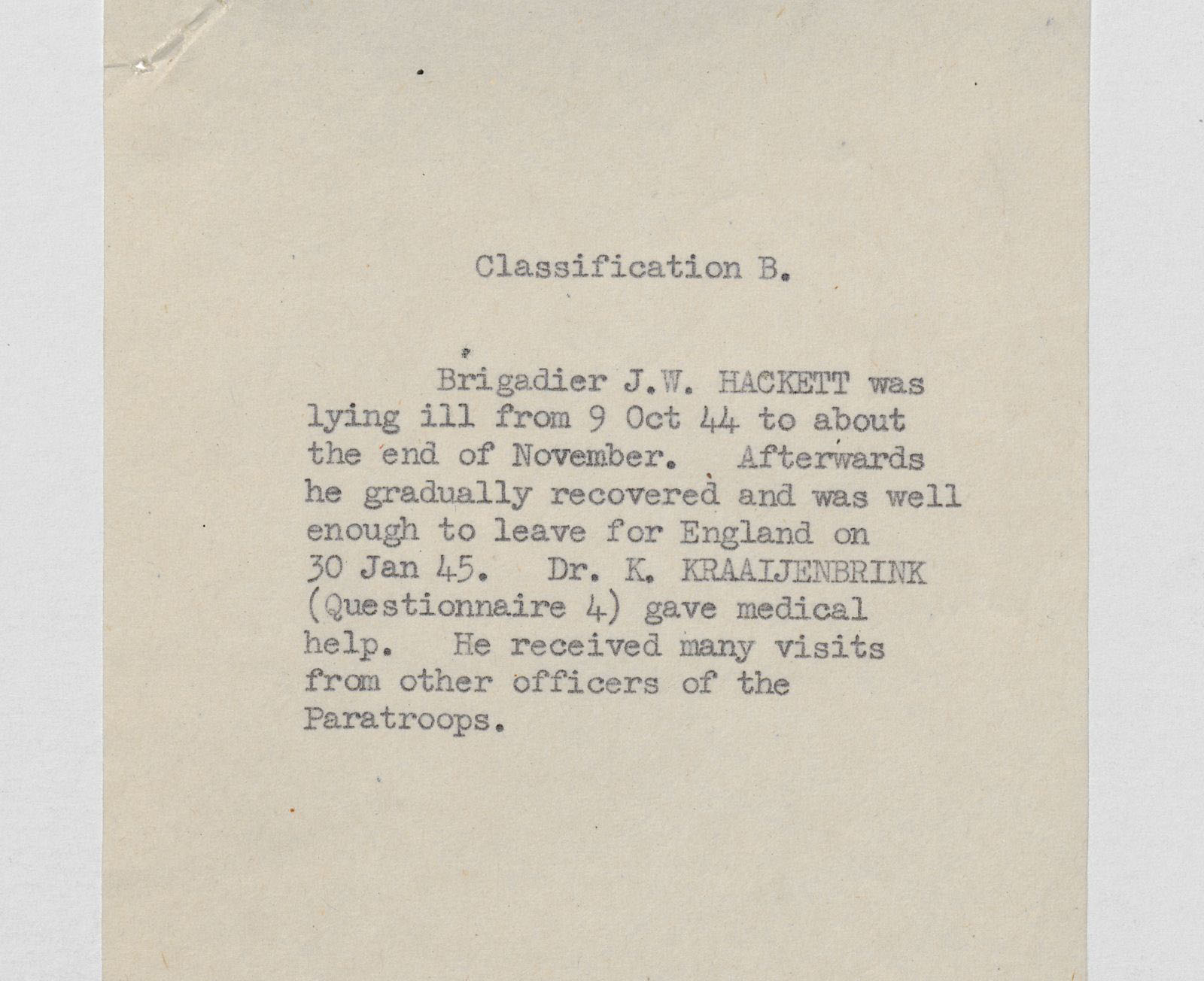
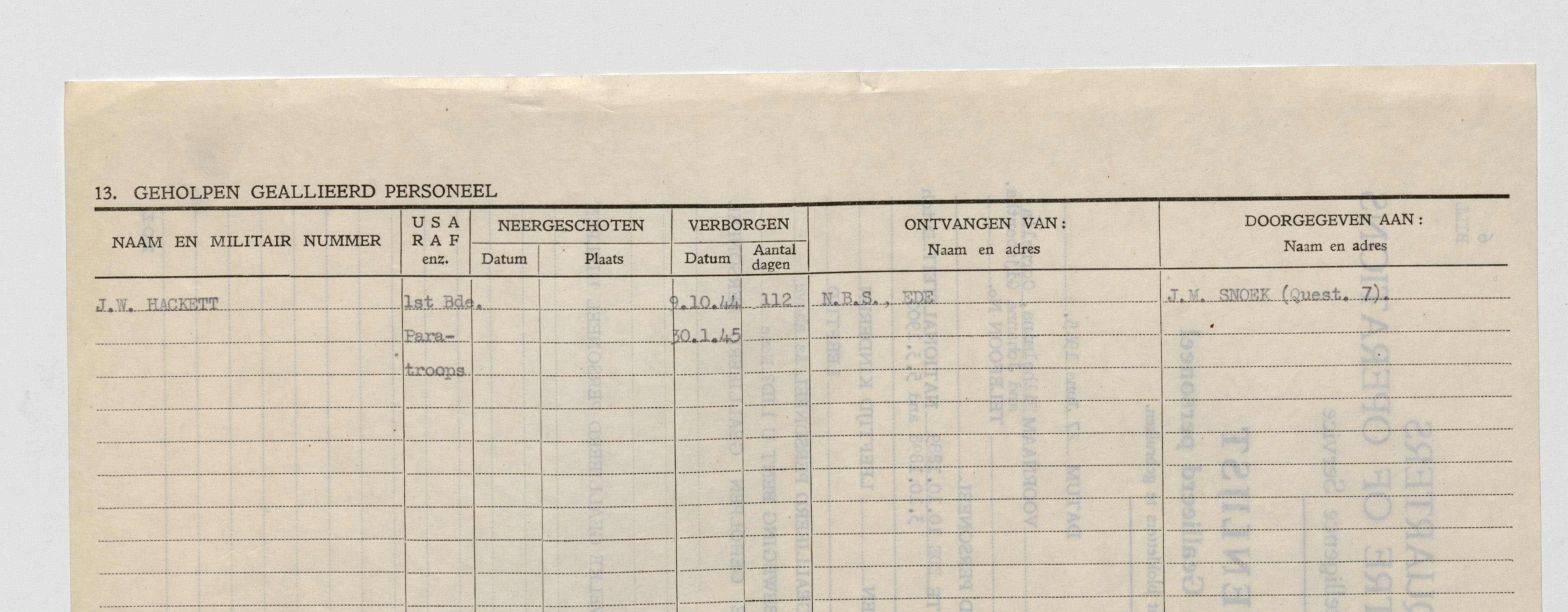
✓ The Americans' file on the house. The helper file the Americans opened on the Torenstraat 5 household is the questionnaire Knook's file pointed to. Their form of 27 June 1945 names three women, Wilhelmina, Cornelia and Johanna Gijsbertha de Nooij, born at Ede on 10 October 1889, 3 October 1898 and 5 March 1900, none married, none in an underground group (the form, p. 4; image-checked). Its table lists one man, "J.W. HACKETT", "1st Bde. Para-troops", hidden from 9.10.44 to 30.1.45, 112 days, received from "N.B.S., EDE" and passed on to "J.M. SNOEK (Quest. 7)" (the table, p. 5; image-checked). A typed note filed with it, headed "Classification B", gives his illness and who helped:
Brigadier J.W. HACKETT was lying ill from 9 Oct 44 to about the end of November. Afterwards he gradually recovered and was well enough to leave for England on 30 Jan 45. Dr. K. KRAAIJENBRINK (Questionnaire 4) gave medical help. He received many visits from other officers of the Paratroops.
— US Army MIS-X Holland Office · helper file of the Dames de Nooij, "Classification B", undated · the transcription
The awards conference's slip says it more shortly: "They sheltered Brig. Hackett for 3 months", dated 3 October 1945, and the conference "was in agreement upon recommendation of subjects for award GRADE 5" (the Action report, p. 7; the same line on a typed slip of 12 October 1945, p. 6). On 20 November 1945 the Holland Office receipted three food parcels and three lots of suit material to "Ladies de Nooy (3)", signed "W. de Nooy" (the receipt, p. 2). The 1994 interview gives the women of the house as the unmarried sisters Mien, Anna and Cor and the widow Rie; Heaps has "three maidenly sisters, Mien, Cor and Ann" in one place and "Cor, Mien and Rie, the three old maids" in another, and no widow (Heaps). ✓ Johanna Gijsbertha is Aunt Ann: Hackett's report has "Miss J.G. De NOOI (Aunt ANN)" (Appendix C, p. 3). ◐ Wilhelmina and Cornelia are presumably Mien and Cor (the report has "Aunts MIM and COR"), and the eldest of the three on the form (1889) fits Heaps's "Mien the eldest"; that is our matching of nicknames to names. The form has no fourth woman: Rie, the widow Snoek-de Nooij, is not on it.
✓ A de Nooij son and a reunion. Boeree's page on the Ede helpers has Paul de Nooij's brother Zwerus, who had been put to work at the St Elisabeth Hospital "toegevoegd aan kolonel Warrick" (attached to Colonel Warrick) until early October, arrested "shortly after the crossing", sent to Amersfoort, and out of the train near Apeldoorn when the camp's prisoners were moved to Germany; "In de Torenstraat had hij een hartelijk weerzien met Brigadier Hackett, dien hij goed kende uit het St. Elisabethsgasthuis" (in the Torenstraat he had a hearty reunion with Brigadier Hackett, whom he knew well from the St Elisabeth Hospital) (Boeree, printed p. 127; checked on the page image). The paper gives no date for the reunion; it falls between his escape from the train and Hackett's leaving on 30 January. ◐ The index of Fullick's biography, in the Archive's full-text snippets, lists "de Nooij, Ko and Zwerus" at pp. 143 and 148 (the hits; index only, the pages not read). Lipmann Kessel has Zwerus's side of the hospital.
◐ The four aunts, in a Dutch column of 1977. On 5 November 1977 De Telegraaf ran a short column on the memoir I was a stranger, drawing on the Times Literary Supplement's review of 21 October: he "komt in Ede terecht bij vier oude dames in een kleine villa met tulen gordijntjes" (ends up at Ede with four old ladies in a small villa with net curtains), "tante Ans, tante Mien, tante Cor en tante Rie", who nursed him until he could get about, took him walking at dusk as "meneer Van Dalen, een invalide en stokdoof" (an invalid and stone deaf), and, with a German strongpoint fifty metres away, were "staunch royalists"; in the end "Verzetsmensen" took him on a rickety bicycle on a bitterly cold January night to another hiding place where he found Lipmann Kessel, and he carried a letter for Queen Wilhelmina "Van tante Ans, tante Mien, tante Cor en tante Rie" (De Telegraaf, 5 November 1977, p. 89; every line checked against the image; the column is second-hand, from the review, and prints "Lopmann Kessel"). ✓ The names are the four of the 1994 interview, and the letter fits his own report: "I brought back with me a joint letter from the family to their Queen" (RAMP Reports, p. 221, read on the image). ◐ Matching the column's night ride to a house where Kessel already was with his journey to Maarn is ours: the report has a day's ride, "in broad daylight as legitimate Dutchmen", "the first day we spent in a snowstorm", and an arrival "that night (30 Jan)" at Maarn, where he found Kessel (p. 228).
✓ Who "Hans" was. Boeree's Hans, of the Renkum family at the de Nooij house, who taught him Dutch and went with him on the journey, is the courier of Hackett's own report, "young John SNOEK" (below). The report puts the Snoek family at the same address; Warrack's book has Hackett staying with people "whose son, Jan, was in touch with Kees, the leader of the Underground in Sliedrecht" (Warrack, Travel by Dark, 1976 ed. p. 232; page image), and Elsa Caspers's statement of 1945 has her going with "Hans from EDE" and the General (her enclosure, p. 5; image-checked). His own report has John Snoek's home village as Renkum, where his mother's shop and house had been burnt down (p. 9; the page's transcript), which fits Boeree's "family from Renkum". J. M. Snoek's own form for the Americans settles it: Johannes Martinus Snoek, born at Gorinchem on 25 May 1920, known to Allied personnel as "Duys" - "Hans", with addresses at Renkum and "Torenstraat 5, EDE" (his form, p. 12); in his table he writes that Hackett "on 9 Oct 44 came to my Aunt's in EDE where I was evacuated … remained there until 30 Jan 45", that in January he found the Sliedrecht route "through an old contact (Kars van DUREN)" and "took him to SLIEDRECHT, by bicycle" (p. 13; image-checked), and the de Nooij form passes Hackett on to "J.M. SNOEK" (above). The report's own "HANS" is someone else, a nurse sent up from Sliedrecht as a courier on 4 February (p. 15).
The same four months, from 1994. ◐ In September 1994, before the fiftieth anniversary, Nieuwsblad van het Noorden printed an interview with Sir John Hackett at his home near Cheltenham, aged 83 (the interview; OCR only, the page image is not served). Most of the article is the reporter's narration; Hackett is quoted directly on the Commons debate that afternoon, on the SS surgeon Skalka's verdict, "Kopfschuss, Bauchschuss, Spritze", on lying there "als korporaal", on Kessel's having saved his life, on the months of hiding having been, for all that he was forced into them, an enormous enrichment of his life, and on being home two days later. In the narration Piet Kruyff took him out of the hospital after ten days, before the patients were moved to Apeldoorn; he was taken in at Torenstraat 5 by four older "aunts" de Nooij, the unmarried sisters Mien, Anna and Cor and the widow Rie Snoek-de Nooij, and stayed over four months; one of them, who had studied English, lent him books. The aunts had since died, Cor last, the winter before, and the house had been pulled down. He had a pass in the name of "Mr Van Dalen" and a badge for the deaf, and walked further each evening on the arm of one of the sisters. He left on 30 January 1945 with Jan, by bicycle in the snow to Sliedrecht, and on 5 February reached Lage Zwaluwe, where it turned out that other Britons in hiding, Lipmann Kessel among them, had crossed with him; these are the reporter's words, not Hackett's. The BBC at Ede passed the news that the escape had worked in the words "De grauwe gans is gevlogen" (the grey goose has flown), and, in Hackett's words, "Twee dagen later was ik thuis" (two days later I was home). ◐ Leo Heaps's The Grey Goose of Arnhem, a popular account, opens in the same Torenstraat house, where "the three old maids who nursed him", Mien de Nooy the eldest, stop him from stealing a Christmas goose from the German troops billeted next door (Heaps, 1977 printing, p. 9; text layer from the lending copy, not checked on the page image). The paper's pictures include one of Hackett with a photograph of the house.
◐ Kirschen's side. Gilbert Kirschen, "KING" of Hackett's report, wrote in his memoir (Gilbert Kirschen):
I was asked to organise the escape of Brigadier Hackett through the lines. He had commanded the 4th Parachute Brigade, and the wound he had received at Arnhem was nearly better. We made the most elaborate plans to get him away by air, but the weather remained hopelessly bad. Then there was a question of getting him across the Rhine near Opheusden. But two days before he was due to leave, the Allies withdrew from this sector leaving the Germans in control of both banks of the river.
— Gilbert Sadi-Kirschen · Six Friends Arrive To-Night (1949), p. 118 · the page, read on the page image
The page has no date. The next lines are "Just recently a group of a dozen paratroopers had tried to cross by a new route; only three had succeeded." ⚠︎ That may be the party of 2/3 January 1945, Murphy's, of whom three got through (Schjelderup's report; The crossing and recapture), but Kirschen gives no date or place, and that party was mostly Canadian soldiers and an airman, with four British paratroopers among them; not settled.
The Sliedrecht line
Link to the section The Sliedrecht line✓ Kragt's report says he set up the Sliedrecht route with Brigadier Hackett a few days after his own departure with Fabian's party was called off, and that "I guided Col. Warrack and Capt. Lipman-Kessel out over that line" (Kragt's report), and Hackett's own book bears it out in the part that can be checked. At the house near Doorn he nominated Kessel and Warrack for his party and arranged that they "should all start off from various points and travel in different ways. Vandyck would leave first, conducting the doctors" (Hackett, I Was a Stranger, p. 172); "Vandyck" is Dick Kragt, "known operationally as 'Frans Hals'" (p. 216). Next morning Kessel "had gone off the night before to join up somewhere with Graeme Warrack and Theo and leave in the early morning guided by Vandyck" (p. 174). Hackett himself went with the courier Elsa Caspers and John Snoek, crossed the Lek by hired boat to Groot-Ammers, and left it for Sliedrecht on Monday 5 February, when Warrack, whom he had met the afternoon before, "had now, we heard, gone on ahead" (p. 183). That night he went down the Biesbosch by canoe with the boatman "Piet", really Koos Meijer, to Lage Zwaluwe, waiting on the way for "the canoe which was bringing Graeme Warrack" (p. 195); there Warrack arrived in the other canoe, which the Postscript says Jan Visser brought down, and was "worried. A canoe with Lipmann Kessel in it was long overdue" (pp. 197–198, 217). Elsa Caspers, who guided him, has Kragt taking "the two other British officers along the same route" over the Lek at Ammerstol earlier the same day, 3 February (Caspers, To Save a Life, p. 73).
✓ So Kragt's report and Hackett's book describe two legs of one journey: Kragt over the Lek to Groot-Ammers, then the Sliedrecht canoes on the night of 5/6 February, and ◐ Hackett's citation date of 5 February is the day he set out, which squares with De Telegraaf having Warrack at Lage Zwaluwe on 6 February; the citation says he "reached safety" on the 5th, so that reading is ours, and since his own report has the lines reached at 02:30 on 6 February, the simpler reading is that the citation is a day early (the Pegasus Archive's page has the same "5th February" for Warrack). ⚠︎ Not settled: whether Redman went too. Hackett names three doctors (Kessel, Warrack, Redman) leaving with Kragt, and Caspers says Kragt took "two other British officers". ◐ Redman's own words, to the Dutch book De zwarte herfst, lean to Hackett: after "nearly three months" the resistance took him to "Colonel Warrack and Major Lipmann Kessel", and after several attempts to cross the rivers it "finally worked on 6 February 1945" (Dekkers and Vroemen, p. 204); Caspers's "two" and Hackett's three are still not reconciled. His own report of 7 February sides with Caspers: "Col. WARRACK, Capt. KESSEL and F.H. set off the next morning (3rd) at 4.30", and before Kragt went back from Groot-Ammers "he undertook to send Capts. RIDDLER, REDMAN and a third down within the next few days" (RAMP Reports, p. 14; p. 15); ◐ so Redman did not leave Maarn with them, by the account written nearest the time. Kessel's manure-boat crossing at Amerongen in his own book is not in Hackett's account of this journey, and is very probably the failed January attempt with Kirschen's party that Hackett describes at second hand (p. 149), so ◐ by inference only; his report has Warrack, Kessel, Ridler and Redman at Maarn on 30 January, "who had all lately returned from their abortive attempt to cross at TIEL" (RAMP Reports, p. 13). Nothing here bears on Murphy, who was gone by then. His part is told on Amerongen and the last night.
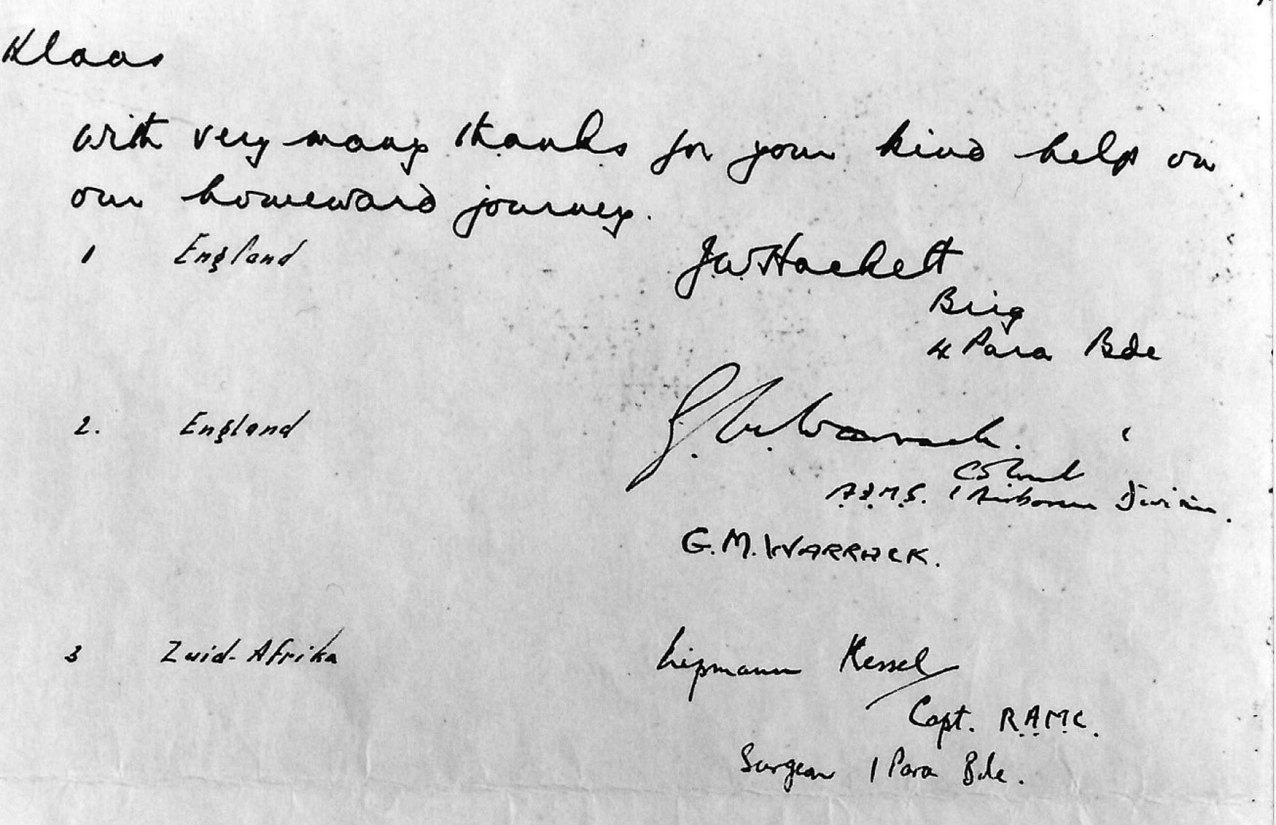
◐ The two Sliedrecht helpers' own lists for the Americans side with Kragt. Klaas Heijboer of Groot-Ammers, who led "the crossing group Lek", taking Allied men "over the river Lek through German lines via Groot-Ammers and then to Sliedrecht and ultimately to Noord-Brabant" in "constant communication" with Kragt, opens his list with "J.W.HACKETT, Brig.Gen.", "G.M.WARRACK, Colonel" and "LIPMANN KESSEL, Capt." (his file, p. 29), and Pieter Visser of Sliedrecht has the three of them received from "K. Heiboer, Gr. Ammers" (his file, p. 29). Neither list gives dates. Their thanks in Heijboer's guestbook are pictured above.
✓ A ferryman named. Johannes Boon, of Lekdijk B 73, Bergambacht (post Ammerstol), born 3 June 1893, married with two grown children, in no underground group, has a helper form in the Americans' files, filled in for him by Klaas Heijboer (the Dutch form, p. 4; image-checked). Its remarks say he "heeft 9 geallieerden overgezet over de Lek, o.a. Brig. Hackett" (took nine Allied men across the Lek, Brig. Hackett among them), but did not know they were Allied; when he found out "durfde hij het niet meer aan" (he no longer dared), though he went on taking over "onze koeriers" (our couriers); and that he crossed in a boat of the Rijkswaterstaat, the state water authority. The table names no one and gives no date: "De eerste 9, voorkomende op de lijst van 'Klaas' (K. Heijboer, gr. Ammers)" (p. 5). The typed English copy is stamped "received by mail" and "no award" (p. 2).
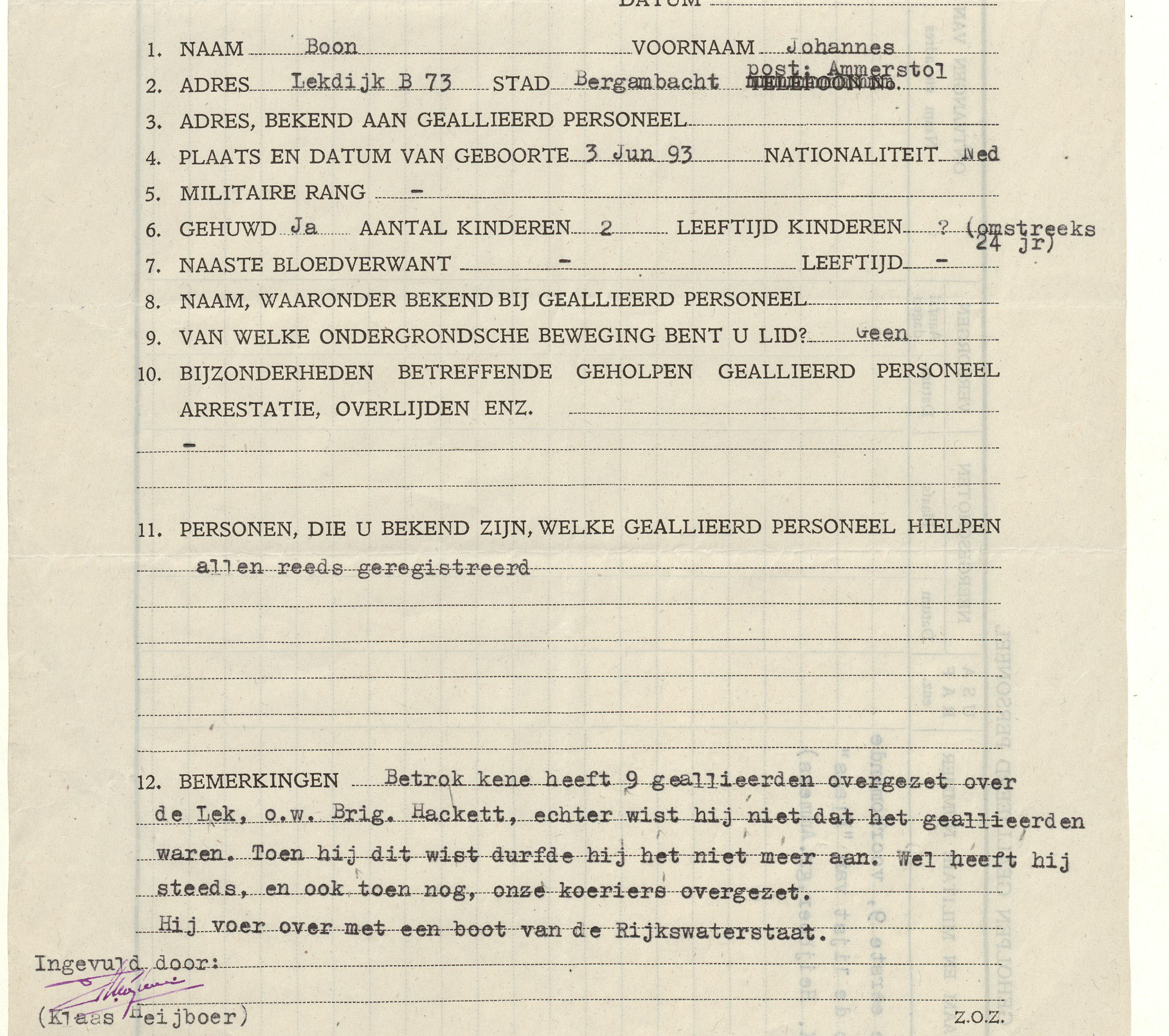
◐ Heijboer's own questionnaire lists among the helpers of his crossing group "BOON, Superintendent Rijkswaterstaat, Ammerstol Z.H." (his questionnaire, p. 2; image-checked): the two forms point to one man, but neither says so. ◐ If "the first 9" on Heijboer's list are the first nine names of his summary sheet, Boon took over Hackett, Warrack, Kessel, Capt. B. D. Carr, F/O A. G. Davies, Capt. Derek Ridler, Capt. Theo Redman, F/O Jack Goggin and F/O John Low (pp. 29–30); the form does not say it, and those nine did not cross on one night, since Ridler's group is at Sliedrecht on 13 February (the Volker-van Leeuwen table, p. 6).
✓ Three more Sliedrecht-side forms. Jan Jacobus de Heer, a guide on the land route from Molenaarsgraaf to Sliedrecht, lists "J.W. Hackett, 4e Parabrig., Brig. gen." at "3-6/2/45", received from "J. Snoek, Ede" and passed to "P. Visser, Sliedrecht", with Warrack and Kessel, three days each, received from "Dick Kay ("Frans")" (his table, p. 12; image-checked): the dates are the report's, 3 to 6 February, and the hand-over is Snoek at one end and Visser at the other. Jacobus Meyer of Sliedrecht "served as a guide from Sliedrecht underground to I.S. 9 Lage Zwaluwe", with the names of two, "Brig J. W. Hackett" and "F/O E. J. Blakemore RAF" (his summary, p. 2; image-checked). ◐ He may be the boatman "Piet", really Koos Meijer, of Hackett's book above; the form does not say, and has no date. Elsa Caspers's own statement of 31 July 1945, written six months after the crossing, puts the start at the house of "Henny" at Maarn and the day at 3 February: "on 3 Feb Elsa went, together with Hans from EDE, with the General to cross the Lek in the neighbourhood of GROOT-AMMERS. Just outside NIEUWPOORT they delivered the General at a farm", six hours by bicycle in horrible weather, and she lost a set of clothes (her enclosure, p. 5; image-checked). Her enclosure also says he was "released by a K.P. man", as De Jong has Kruyff.
◐ Warrack's side, and the lines. Warrack's Travel by Dark has Dick (Kragt) bring word, on the fourth day at the white house, that Hackett "was coming to Doorn soon" to plan a crossing "by a route which a friend of his had discovered"; the next day "Shan Hackett arrived", thin but in good spirits, and the plan was the Brigadier's with Jan, who knew Kees in Sliedrecht; Hackett would not let a bigger party risk the route; and from the other side of a canal Warrack, on his own road to Sliedrecht, saw "Shan Hackett and Jan cycling slowly", Hackett "travelling 'clean'", who "raised his hat politely to me" (1976 ed. pp. 229, 232, 240; full text). At Lage Zwaluwe "The Squadron Commander of the 11th Hussars came in with two officers", and "Next Shan Hackett appeared. 'Where's Lippy?' he asked. He looked worried" (the same, p. 249). Patrick Delaforce's history of 7th Armoured Division has "'D' Squadron, who rescued two distinguished Arnhem escapees - Brigadier Hackett, ex-8th Hussars, the wounded brigade commander, and the chief medical officer of 1st Airborne" (the snippets, p. 214; Archive full-text index, not read on the page). ✓ His own report names the regiment: "there I met an old friend at a Sqn. H.Q. of the 11th Hussars" (RAMP Reports, p. 16); ◐ that it was D Squadron is Delaforce's alone.
✓ De Jong has Hackett, "who had recovered his strength in Ede", and two other officers the first to take the Biesbos route to Sliedrecht in February, and thirty-seven other Airbornes after them, all safe; and that Kragt first rejected that route (deel 10b, p. 554; deel 14, p. 1083, both checked on the images). That fits Hackett's book, where Kragt is the guide, not the founder, and puts a number on the traffic that followed. Dick Kragt has the rest.
◐ A biography agrees on the last leg, from the Archive's full-text index and not read on the page: Roy Fullick's 'Shan' Hackett: the pursuit of exactitude (2003) has "two messengers from Sliedrecht, a young man and a girl dressed in the uniform" (the snippet stops there), who would "send guides the next day to bring the General to Sliedrecht", and "John and Shan would bicycle the relatively few miles to Sliedrecht on Monday, to a house where they could wait until" (the hits; the longer passages). ✓ John is John Snoek and Monday 5 February, as in Hackett's own book above. The same biography has him told at Arnhem that the commanding officer and second-in-command of 156 Para were among the killed (Richard des Voeux).
Later life
Link to the section Later lifeThe mention in despatches, 1945. ✓ He was mentioned in despatches on 20 September 1945 (London Gazette, p. 4685); ◐ the citation of 9 July under "Escape" above is very probably the one behind it, but the Gazette entry gives no citation.
In the Gazette after the war. ✓ Each notice is read on the Gazette's own page:
- Major, 1 July 1946 (2 July 1946, p. 3362); colonel, 5 November 1951 (29 January 1952, p. 565).
- C.B.E., Coronation Honours, as "Brigadier (temporary) John Winthrop HACKETT, D.S.O., M.B.E., M.C. (52752), late Royal Armoured Corps" (1 June 1953, p. 2948; heading p. 2947).
- General Officer Commanding, 7th Armoured Division, with the temporary rank of major-general, 24 March 1956 (27 March 1956, p. 1801); brigadier, 24 September 1956 (4 January 1957, p. 143); major-general, 31 March 1957 (23 April 1957, p. 2467).
- C.B., New Year Honours 1958 (1 January 1958, p. 3; heading p. 2).
- Commandant, Royal Military College of Science, 10 February 1958 (11 February 1958, p. 923), until 10 February 1961 (10 February 1961, p. 1009).
- Colonel Commandant, Corps of Royal Electrical and Mechanical Engineers, 4 February 1961 (24 March 1961, p. 2230), "tenure expired" 4 February 1966 (4 February 1966, p. 1251).
- General Officer Commanding-in-Chief, Northern Ireland Command, 18 July 1961 (18 July 1961, p. 5267), and lieutenant-general from that day (18 August 1961, p. 6087).
- K.C.B., Birthday Honours 1962 (2 June 1962, p. 4309).
- Deputy Chief of the Imperial General Staff, 4 February 1963 (5 February 1963, p. 1091), and a member of the Army Council the same year (5 February 1963, p. 1101).
- As "General Sir John Winthrop Hackett, G.C.B., C.B.E., D.S.O., M.C., B.Litt., M.A.", nominated Principal of King's College, London, in August 1968 (9 August 1968, p. 8753).
Later. He was made a CBE in the Coronation Honours of 1953 as a brigadier at Headquarters, Northern Army Group, at Bad Oeynhausen, "primarily responsible for budget estimates and expenditure amounting to £120 million"; General Gale, by then its Commander-in-Chief, wrote "Very strongly recommended" (WO 373/161/20, pp. 2–3).
◐ Two years after Arnhem, the Dutch forces' weekly De Pen en Gun in a retrospective on the battle printed a message it gave as Hackett's to "zijn bevelhebber" (his commander): "Dank U voor de tocht" (thank you for the trip), and that for his own part he would do it again at any moment of the day (De Pen en Gun, 19 September 1946; OCR only, the page images are not served). The paper gives no date for the message and does not name the commander.
The Dutch papers kept him in view. On 17 September 1949, the fifth anniversary, Het Parool's correspondent had "Brigadier J. W. Hackett, commander of the group of 260 'red-caps'" lay a wreath of poppies made of the division's parachute cloth at the foot of the monument at Oosterbeek, and close the speeches after General Sosabowski with the words "Altijd zullen wij blijven denken aan de moedige bevolking van Gelderland. Zelfs in die zware, troosteloze winter gedroegen zij zich als helden" (always we shall keep thinking of the brave population of Gelderland; even in that hard, dreary winter they behaved like heroes) (Het Parool, 17 September 1949; checked against the image). In November 1979, as Sir John, he was guest of honour and chief speaker at the Anglo-Netherlands Society's dinner in London with Lipmann Kessel present, and De Telegraaf retold how a German officer, inspecting the wounded with Kessel, pushed him over with his boot and said "Here there is no saving him, give him an injection" (De Telegraaf, 24 November 1979; the heading, opening and caption checked against the image; the caption names the men in the photograph, Hackett and Kessel among them).
In August 1966 De Telegraaf, reporting from Bielefeld on whether the British Army of the Rhine would be withdrawn, printed a portrait of its commander with a caption: "Generaal Sir John Winthrop Hackett (55)" "heeft naar alle waarschijnlijkheid zijn leven te danken aan leden van de Nederlandse Ondergrond" (in all likelihood owes his life to members of the Dutch Underground) (De Telegraaf, 6 August 1966, p. 9; the caption checked against the image; its account of the nursing is under "Where the sources disagree"). In September 1994, aged 83, he was to unveil the monument to the Dutch helpers at the Airborne Museum in Oosterbeek on the 14th, as the paper announced four days beforehand (Nieuwsblad van het Noorden, 10 September 1994; OCR only), and after the commemoration at the Airborne cemetery, on 18 September, was hurt in a car accident near Arnhem, treated for his ear at the hospital there and released the same day (Leeuwarder courant, 19 September 1994; OCR only).
Death. ✓ He died on 9 September 1997; the death notice in The Times of 10 September, for "General Sir John Winthrop Hackett, GCB CBE DSO MC MA B.Litt", set the funeral service for 16 September at St Giles' Church, Coberley (the notice, p. 20). The obituary the same day calls him Commander-in-Chief, British Army of the Rhine, 1966–68, and Principal of King's College, London, 1968–75, "died yesterday aged 86" (p. 21). Of the war it has:
He was seriously wounded at Arnhem and taken prisoner, but subsequently escaped. He was harboured for a while by a courageous Dutch family, to whom he was later to pay tribute in a moving account of his adventures, I Was a Stranger (1977), and helped to liberty via the Dutch Resistance. He was awarded a Bar to his DSO for his services at Arnhem.
— The Times · obituary, 10 September 1997, p. 21 · the paragraph and its last line, read on the page images of the lending copy
The obituary does not name the Dutch family, and "Resis-tance" runs across its columns.
◐ A Home Office certificate, R1/4393, of 30 June 1950, is catalogued in the name of a John Winthrop Hackett born 5 November 1910 in Australia (HO 334/452/4393). The entry's own markup calls the date a registration date and says nothing of what he was registered as. The date of birth is his, by his escape report, Who's Who and The Times (Before, above), and Who's Who has him schooled at Geelong; ◐ very probably the general, but the certificate has not been seen.
Where the sources disagree
Link to the section Where the sources disagree- The crossing with Warrack. Hackett's citation has him reach safety on 5 February 1945, the day he left Groot-Ammers, and his book has the canoes going down that night (WO 373/64/307, p. 2).
- De Telegraaf has Warrack, said by the Pegasus Archive to have crossed with him, at Lage Zwaluwe on 6 February (De Telegraaf).
- ◐ They fit if the citation gives the day of departure, the newspaper the day of arrival, and Hackett's book the night between (pp. 183, 195–198); the citation says "reached safety", so that is our reading, and the simpler one is that the citation is a day early.
- His own report, taken the next day, has the lines "which I reached on 6 Feb 45", at 02:30 at the Haven (RAMP Reports, p. 212; p. 231).
- Kessel's own account, as Noordman prints it, has his canoe leak on that first night, so that he went back to Sliedrecht and crossed on the night of 9/10 February (Noordman, pp. 316–320; Lipmann Kessel).
- What rank he was registered under in the hospital. "Brig. HACKETT got himself registered as a Major" in the citation (WO 373/64/307, p. 2); "ik lag er als korporaal" (I lay there as a corporal) in the 1994 interview (the interview); "Corporal Hayter" in Heaps (Heaps). ◐ The citation was written within a year of it and the interview fifty years on; not settled.
- When he left the hospital. Between a few days and two weeks after the operation, by who counts:
- "Na tien dagen" (after ten days) in the 1994 interview, which from 24 September makes about 4 October.
- 8 October in the citation and in his own report's Appendix A as the first day at Ede (RAMP Reports, p. 215); 9 October as the first day hidden in the de Nooij form's table (p. 5) and in J. M. Snoek's own form: "on 9 Oct 44 came to my Aunt's in EDE" (p. 13).
- In the 1977 Telegraaf column Kessel patches him up "zodanig weer op dat hij na een paar dagen ontsnappen kon" (so well that he could escape after a few days) (the column).
- ◐ The citation and the American forms are the nearest in time; none is checked against the hospital's records.
- How long at Torenstraat 5. Three, 3.7 and four months, by who counts:
- "3 months" on the awards conference's slips of 3 and 12 October 1945 (Action report).
- 112 days, 9 October to 30 January, in the form's own table (the table); 8 October to 30 January in his report.
- "vier maanden" with "een onderbreking van enkele dagen" (four months, with an interruption of a few days) in Boeree, "almost four months" in Army and "over four months" in 1994 (above).
- ◐ The form's 112 days is one short of the count of its own dates (9 October to 30 January is 113 days), and the slips' three months looks like a round figure; Boeree's interruption may be why his four months is not the form's, but no source says so.
- Who the women in the file were. The questionnaire names three; the awards slips name two:
- Wilhelmina, Cornelia and Johanna Gijsbertha on the form (p. 4); "W.C. & J.G.", with two birth dates, on the slips, one of which types "10-10-1839" where the form has 10.10.1889 (p. 6).
- ◐ The 1839 is a typing slip, since it would make her 105. The 1977 and 1994 pieces have four women in the house, and no source here says why the American forms have three or two.
- Farm or house. De Telegraaf of 1966 has him "in de verborgenheid van een boerderij verpleegd" (nursed in the seclusion of a farm) (the caption); his own report, the American file and Boeree all have the Torenstraat house in Ede. ✓ The caption is a journalist's summary under a photograph. ◐ A farm does come into his journey, the house of the farmer at Groot-Ammers in his book and the farm outside Nieuwpoort in Caspers's statement (above), and the caption may have run them together; it does not say.
- What boat took him over the Lek. His book has a "hired rowing boat" for the crossing near Schoonhoven (above); Boon's form has a boat of the Rijkswaterstaat (p. 4). ⚠︎ Not settled that Boon was the man of Hackett's own crossing, or that a hired boat and a Rijkswaterstaat boat are different boats: his form gives no date and names only "Brig. Hackett" of the nine.
- Where the doctors' house was. "Near MAARN", lodged with "a family called EDENBERG (?)" in the garage buildings of a home for the infirm, in his own report (RAMP Reports, p. 228); "Henny, huis te Maarn" in Caspers's statement; "Doorn" in Boeree, Warrack and his own book. ◐ The two villages adjoin, and the house is very probably the Idenburgs' Huis te Maarn: Kessel, in Noordman, has "Huis te Maarn … de familie Idenburg" (p. 314), which fits the report's "EDENBERG (?)" and Caspers's "Henny, huis te Maarn".
- Who set the day. Boeree has Frans Hals, on the Friday, propose Lobith and an aircraft, and Hackett decide to go on (p. 262); ✓ his report has the same plan, "The LOBIT crossing was promising but not yet finally arranged", and his agreement to go down with the others (RAMP Reports, p. 229).