Jan Rothuizen
Renkum 4 Jun 1919 – Sandbostel or Neuengamme 19 Apr 1945 ◐
About: A building draughtsman from Heelsum, taken by the SD on 19 December 1944 at Cornelis Verhoef's farm at Achterveld, in the SD's round-up which, by Huurdeman's account, followed the old billets of Gilbert Kirschen's Belgian SAS team, while Murphy was hidden at the Veerman farm. He died in the Neuengamme camps in April 1945.
Unit or role: "lid van het verzet, ondergedoken bij Cornelis Verhoef" (a member of the resistance, in hiding at Cornelis Verhoef's), in José Huurdeman's list of the dead (Huurdeman); by trade a bouwkundig tekenaar (building draughtsman) (his father's form).
Where: Ottoweg 9, Heelsum (Trouw, 1 August 1945); in hiding on the Klettersteeg, Achterveld (Huurdeman); the Willem III barracks at Apeldoorn, De Kruisberg at Doetinchem and Neuengamme (Doetinchem Herdenkt); his grave, section E, number 93, Loenen (the Foundation's page).
Evidence: ✓ Huurdeman, Ondergronds in de Tweede Wereldoorlog (2019), via the Oorlogsgravenstichting; ✓ Digitaal Monument Neuengamme; ✓ the War Graves Foundation's personal file on him, 1957–1973 (Nationaal Archief 2.19.255.01, 130926A); ✓ Doetinchem Herdenkt; ✓ civil records; ✓ his Neuengamme effects card.
He was born at Renkum on 4 June 1919, the son of Gerardus Cornelis Rothuizen and Catharina Wilhelmina Johanna Minderaa (civil records). Renkum is the municipality: Doetinchem Herdenkt and the Neuengamme memorial have him born at Heelsum, and the War Graves Foundation's forms at Doorwerth, both villages in it (Doetinchem Herdenkt; Digitaal Monument Neuengamme; the questionnaire of 1957). The Foundation's forms give his father as born at Doorwerth on 29 November 1883 and his mother at Amsterdam on 24 September 1895, living at Ottoweg 15, Heelsum, and Jan as Gereformeerd, a bouwkundig tekenaar, and "Ongehuwd" (unmarried) (the questionnaire; his father's form; the municipality's answer of 1959). Doetinchem Herdenkt calls him a bouwkundige living at Heelsum (Doetinchem Herdenkt).
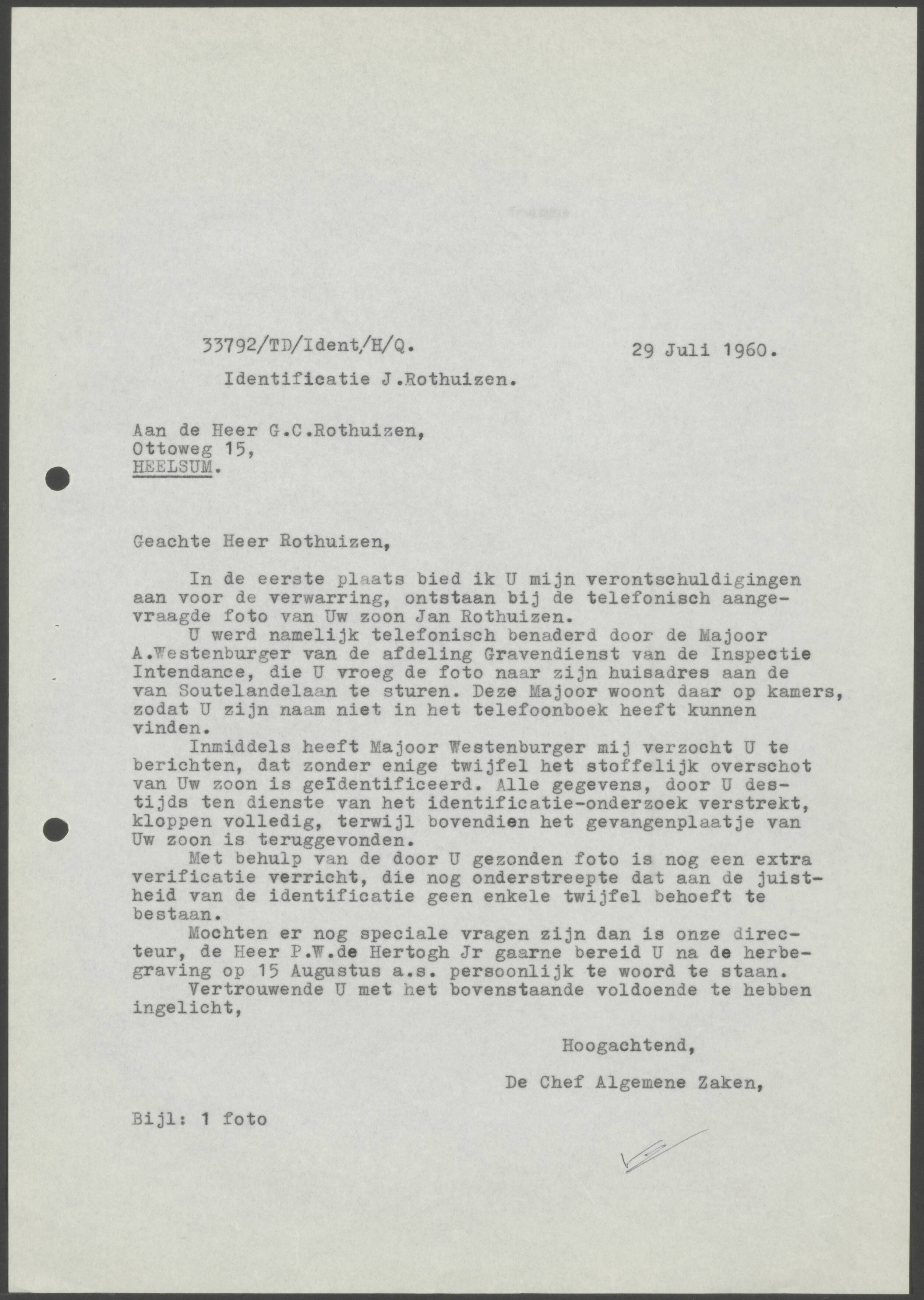
✓ His father's trade. The birth record gives his father as an architect (civil records), and his father still wrote on paper headed "G. C. ROTHUIZEN ARCHITECT, OTTOWEG 15 - HEELSUM" in 1960 (his letter of 22 July 1960, read on the image). The Staatscourant of 8 December 1920 has "Gerardus Cornelis Rothuizen, architect, te Heelsum" and Jan Rothuizen junior, architect, at Wageningen, dissolving on 3 December 1920 their partnership "J. Rothuizen en Zonen", founded in 1916 for furniture, joinery and masonry, building houses and other buildings, and architecture, and the same day forming a new partnership of the same name, to make furniture and joinery, with Jacob Rothuizen, both "fabrikanten" at Heelsum, and Jan Rothuizen junior, a "fabrikant" at Wageningen (the notices; OCR only, not checked against the page image). ◐ The Gerardus Cornelis Rothuizen of Heelsum is his father by name, village and trade; the notices do not say how Jan junior and Jacob are related to him.
⚠︎ School. A "Jan Rothuizen, Heelsum" passed the entrance examination to the Christelijk Lyceum at Arnhem in June 1932, and is in its promotion lists every July to 1936, when he moved from class 4B to 5B of the H.B.S. department (Arnhemsche Courant, 28 June 1932, 7 July 1933, 10 July 1934, 9 July 1935, 11 July 1936; OCR only).
- He could be our man, who was thirteen in June 1932.
- A second Jan Rothuizen was born at Renkum on 13 January 1921, the son of Jakob Rothuizen, fabrikant, and Christina Johanna Minderaa (his birth, index record), so a boy of Heelsum could be either of them.
- A third, of Velp, is in the same school's lists in 1933. No source ties the schoolboy to one of them.
No source says why he was in hiding.
With Murphy
Link to the section With MurphyNo source puts him with Murphy. He was taken in the SD's round-up of December 1944 around the old billets of Gilbert Kirschen's Belgian SAS team at De Glind and Scherpenzeel, which began while Murphy was hidden at the Veerman farm at Klein Achterveld (The December round-up, where the whole round-up is told).
The raid on the Klettersteeg, 19 December 1944. By Huurdeman's account, the SD, after taking Piet Veenendaal at his farm on 15 December, came for a man in hiding at Cornelis Verhoef's farm on the Klettersteeg at Achterveld: "Onder zware druk gaf Piet Veenendaal de naam van Joop Rothuizen door die bij Cornelis Verhoef aan de Klettersteeg bij Achterveld zat ondergedoken" (under heavy pressure Piet Veenendaal gave the name of Joop Rothuizen, who was in hiding at Cornelis Verhoef's on the Klettersteeg near Achterveld). Not finding Joop there on 19 December, the SD "arresteerde daarom alle jonge mannen" (therefore arrested all the young men): the men in hiding, Jan Rothuizen among them, Cornelis Verhoef's sons Jan and Johan, and across the road Laurens Liezenberg (Huurdeman). Huurdeman quotes the book on the raid:
On 19 December the SD took the heavily bleeding Piet Veenendaal to Cornelis Verhoef. In this raid the farm was surrounded by five men with rifles at the ready, after which two or three of them forced their way into the house. Two people in hiding ran away, and one of them, probably Joop Rothuizen, got away. The other was his brother or cousin Jan Rothuizen of De Glind, and he was arrested. The sons living at home, Jan and Johan, were arrested too. The sick Cornelis Verhoef was not arrested. A few months later, in March 1945, he would die of grief. In the same month, without his knowing it, both his sons died in a concentration camp.
Dutch originalOp 19 december nam de SD de hevig bloedende Piet Veenendaal mee naar Cornelis Verhoef. Bij deze inval werd de boerderij omsingeld door vijf man met het geweer in de aanslag, waarna twee of drie van hen het huis binnen drongen. Twee onderduikers vluchtten weg, waarbij er één – vermoedelijk was dat Joop Rothuizen – kon ontkomen. De ander was zijn broer of neef Jan Rothuizen uit De Glind en hij werd gearresteerd. Ook de thuiswonende zoons Jan en Johan werden gearresteerd. De zieke Cornelis Verhoef werd niet gearresteerd. Hij zou enkele maanden later, in maart 1945, van verdriet overlijden. In dezelfde maand stierven, zonder dat hij dat wist, zijn beide zoons in een concentratiekamp.
— José Huurdeman · Ondergronds in de Tweede Wereldoorlog (Historische Kring Leusden, 2019), quoted in Huurdeman's contribution to the Neuengamme memorial · the text
⚠︎ "broer of neef" (brother or cousin) is Huurdeman's; no record held names a Joop Rothuizen, and "uit De Glind" sits beside every other source's Heelsum (below). Doetinchem Herdenkt and the Neuengamme memorial also have him arrested on 19 December 1944, the memorial at Achterveld (Doetinchem Herdenkt; Digitaal Monument Neuengamme). His father's form from the Foundation (addressed "Vader: G.C. Rothuizen", sent out on 16 October 1959, unsigned; ◐ the archive's description has his father filling it in) has "19 dec. '44 tijdens razzia op boerderij meegenomen", taken along in a round-up at a farm on 19 December 1944, and the name of the arresting body is one illegible word (his father's form, image checked).
Achterveld's own accounts of the raid. The booklet made in 2025 by the exhibition committee of the Sint Jozefkerk at Achterveld tells it twice; Cornelis Verhoef has both in full.
- ✓ The unsigned account, headed 18 December 1944 but dating the raid "Maandag 16 December 1944" in its text: of two men in hiding who ran, one got away, and "De ander Jan Rothuizen wil zich verbergen onder de kippenhilt maar wordt naar de voorkamer verdreven" (the other, Jan Rothuizen, wants to hide under the hen roost but is driven into the front room).
- The Germans took "Johan en Jan Verhoef, Jan Rothuizen en vijf onderduikers wier namen onbekend zijn gebleven" (Johan and Jan Verhoef, Jan Rothuizen and five people in hiding whose names have stayed unknown), who stayed "bijna veertien dagen in het concentratiekamp Amersfoort" (almost fourteen days in Amersfoort camp) (the booklet, p. 31).
- ✓ Cor van de Burgwal's interview, dated 18 December 1944, has "in ieder geval een verzetsman Jan Rothuizen" (at any rate a resistance man, Jan Rothuizen) among those driven into the living room and taken away, and "Voor zover bekend, heeft niemand van de 4 mannen die op 18 december 1944 van de Klettersteeg werden afgevoerd het overleefd" (as far as is known none of the four men taken from the Klettersteeg on 18 December 1944 survived) (pp. 33–34).
- The booklet agrees with Huurdeman that Rothuizen was the second of the two who ran and was taken; it differs on the date and on where the men were held (below).
✓ Consecutive numbers. At Neuengamme he was prisoner 70940, Johan Verhoef 70941 and Laurens Liezenberg 70939 (Doetinchem Herdenkt; his number also on his effects card): the three men from the Klettersteeg who went by the Kruisberg train had consecutive numbers, so ◐ they were very probably registered together.
All the men taken on the Klettersteeg went first to the Willem III barracks at Apeldoorn; Liezenberg, Rothuizen and Johan Verhoef were then moved to De Kruisberg, the prison at Doetinchem, and put on its transport to Neuengamme "op 1 februari 1945", while Jan Verhoef went by Kamp Amersfoort (Huurdeman). Doetinchem Herdenkt tells that transport: on 1 February 1945 94 men were marched under heavy guard from De Kruisberg to Doetinchem station; the train left after midnight; between Doetinchem and Ruurlo 17 got out through a hole in one of the two cattle wagons, the Briton Peter Thorne among them, badly hurt; at Zutphen the men were given food, and the train went on by Deventer, Almelo and Hengelo to the border, reaching Neuengamme on 5 February, where "de 77 mannen" (the 77 men) were registered under numbers 70890 to 70972 (elsewhere on the same page "between 70890 and 70970"; its entry for Gerrit Slagman has 70972) (Doetinchem Herdenkt). Its entry for him: by the Willem III barracks to De Kruisberg, sent on by train to Neuengamme on 2 February 1945, camp number 70940, dead there on 19 April 1945 (same).
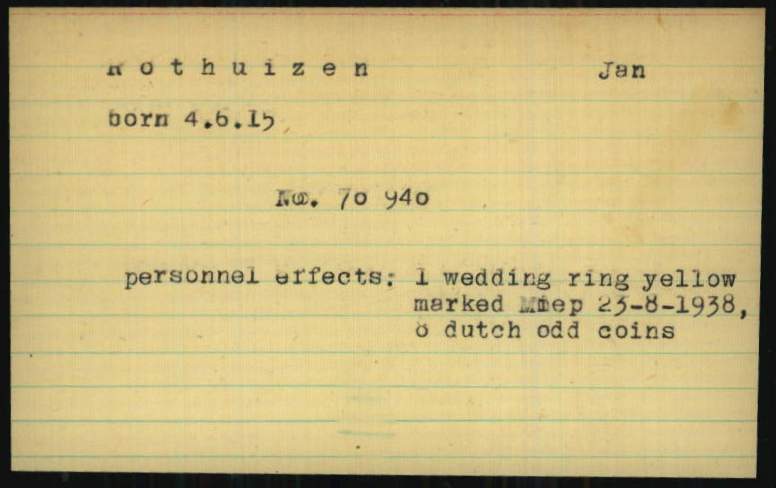
The camp's card for his effects reads "Rothuizen Jan, born 4.6.15, No. 70 940", and lists "1 wedding ring yellow marked M[?]ep 25-8-1938, 8 dutch odd coins"; the first letters of the name on the ring are typed over (the card, read on the image). ◐ The day of the ring's date is typed with the same flat-topped figure as the last figure of "4.6.15", so it reads 25, not 23 (the archived transcription has 23). A visitor's note of 2025 on the Foundation's page reads it as "Miep 23-8-1938" and remarks that the Foundation's papers make him seem unmarried (the Foundation's page); the municipality's answer to the Foundation in 1959 has "Ongehuwd" (unmarried) (the questionnaire). No source says whose ring it was.
The Neuengamme memorial has him arrested at Achterveld on 19 December 1944, at the Willem III barracks at Apeldoorn and then at the Kruisberg until 3 February 1945, reaching Neuengamme by train from Doetinchem on 5 February, and dying at Sandbostel on 19 April 1945; under illnesses it has "onbekend, Neuengamme maart 1945" (unknown, Neuengamme, March 1945) (Digitaal Monument Neuengamme). The War Graves Foundation's page has him dead on 19 April 1945 at "Kdo. Sandbostel, Neuengamme" (the Foundation's page). Huurdeman writes that the women taken at Hardeveld and the Moorsterweg (not on the Klettersteeg) were freed after seven weeks, "maar de mannen zijn allen omgekomen in Neuengamme of in een van de buitenkampen" (but the men all died at Neuengamme or in one of its subcamps) (Huurdeman).
Asking for news, 1945. On 1 and 2 August 1945 the same notice ran in Trouw, Het Parool and Het Vrije Volk, here in Trouw's words: "Inlichtingen verzocht over: JAN ROTHUIZEN, wonende Ottoweg 9, Heelsum. In Februari verblijf houdende in Neuengamme. Verder niets bekend. Inlichtingen aan H. G. Oldeboom, arts te Glanerbrug." (Information wanted about Jan Rothuizen … in Neuengamme in February; nothing more known; information to H. G. Oldeboom, doctor at Glanerbrug) (Trouw, 1 August; Het Parool, 2 August; Het Vrije Volk, 2 August). The notice does not say who Oldeboom was to him. His death, "19-04-1945 Neuengamme (Duitsland)", was registered at Renkum on 6 July 1951 (civil records).
Found and reburied, 1959–1960.
- On 2 January 1959 the Foundation wrote to his father that the remains might be among the Neuengamme victims buried at Sandbostel, and asked for particulars (◐ read from the typed OCR, not checked against the image) (the letter).
- In October 1959 his father, asked by the Foundation, knew of no grave and gave the day and place of death as "onbekend" (unknown) (his father's form).
- On 18 July 1960 the Foundation wrote that, working with the French exhumation service, it had identified the remains of a number of Dutchmen, his son among them; since burial in the Dutch war cemeteries in Germany met objections, the government had agreed to their transfer to the Foundation's central cemetery at Loenen (the letter, image checked).
- His father wrote back on 22 July 1960 asking "waaruit hebt U kunnen identificeren dat de stofelijke overschotten van onze zoon J.Rothuizen zijn" (how you were able to identify that the remains are those of our son J. Rothuizen; "stofelijke" as written) (his letter, read on the image). The Foundation passed it on 25 July to the officer who had done the identification, Major A. Westenburger of the Bureau Gravendienst (its reply, read on the image).
- On 26 July 1960, after a telephone call asking for a photograph of his son, his father posted one to the Foundation to be sent on, and asked for it back (his note, read on the image). The photograph is not in the file; the Foundation's letter of 29 July says it was used for an extra verification that underlined that the identification was beyond doubt, and lists "Bijl: 1 foto" (one photograph enclosed) (the letter, image checked).
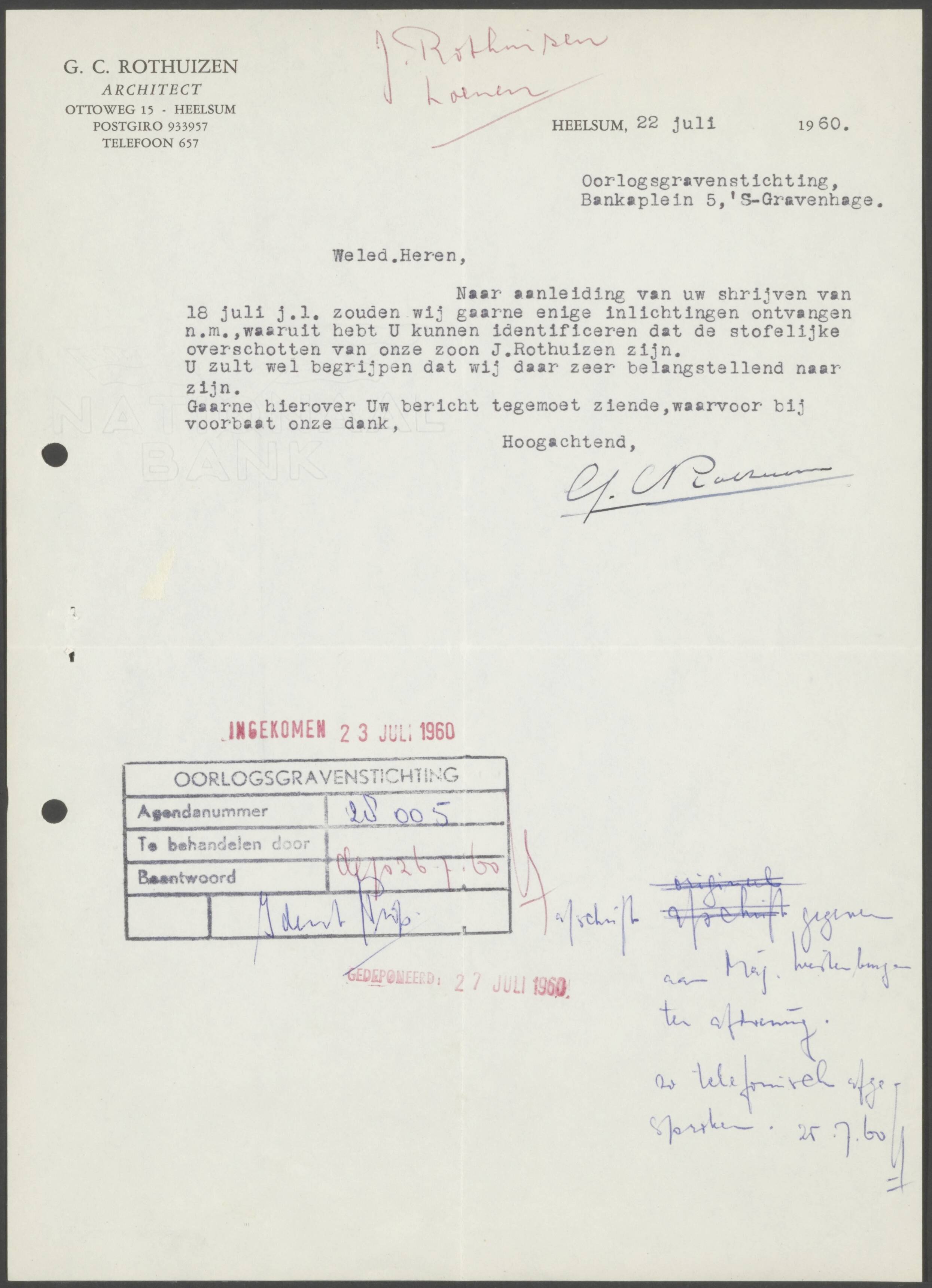
On 29 July 1960 the Foundation answered:
Meanwhile Major Westenburger has asked me to tell you that your son's remains have been identified without any doubt. All the particulars you gave at the time for the identification research agree completely, and your son's prisoner's tag has also been found.
Dutch originalInmiddels heeft Majoor Westenburger mij verzocht U te berichten, dat zonder enige twijfel het stoffelijk overschot van Uw zoon is geïdentificeerd. Alle gegevens, door U destijds ten dienste van het identificatie-onderzoek verstrekt, kloppen volledig, terwijl bovendien het gevangenplaatje van Uw zoon is teruggevonden.
— Oorlogsgravenstichting, Chef Algemene Zaken · letter of 29 July 1960 to G. C. Rothuizen · the letter
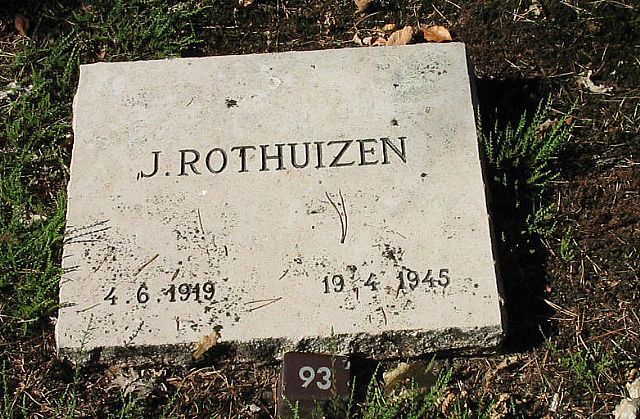
He was reburied at Loenen, on the Veluwe, on Monday 15 August 1960 at 14.15, "tesamen met enkele lotgenoten" (together with a few others who shared his fate), in a service led by a minister; the Foundation invited the family, and the letter adds that the Defence department would refund travel within the Netherlands, on application, for set categories of relatives: parents (foster, step and in-law parents too) and guardians, a widow who had not remarried, and under-age children over ten (the letter of 18 July 1960, image checked; its second page). His mother wrote to the Foundation on 17 August with "waarderende woorden" (words of appreciation), and it told her on 20 August that the minister who had led the service was Ds G. Melles of Voorst (the reply, read on the image). On 10 September 1960 it wrote to his father that his grave, section E, number 93, now had a flat stone with his name and particulars cut into it (the letter, read on the image).
Where the sources disagree
Link to the section Where the sources disagree- The day of the arrest. ⚠︎ 19 December 1944 in Huurdeman, Doetinchem Herdenkt, the Neuengamme memorial and his father's form of 1959, the contemporary record from his family; 18 December in the Achterveld booklet's heading and in Cor van de Burgwal's interview, and "Maandag 16 December 1944" in the text of the unsigned account (Huurdeman; Doetinchem Herdenkt; Digitaal Monument Neuengamme; his father's form; the booklet, pp. 31, 33). 18 December 1944 was a Monday, 16 December a Saturday.
- Where he was held before the Kruisberg. Huurdeman and Doetinchem Herdenkt have the Willem III barracks at Apeldoorn and then De Kruisberg at Doetinchem (Huurdeman has Jan Verhoef alone going by Amersfoort); the booklet's unsigned account has the prisoners almost fourteen days at Amersfoort camp (p. 31). ⚠︎ Nothing held settles it.
- His year of birth. 1919 in the civil birth record, on the Foundation's papers and on his gravestone; the Neuengamme effects card reads "born 4.6.15" (civil records; the card). The card's last figure is the flat-topped 5, not the round-topped 3 of its "1938"; ◐ so it reads 1915, a slip against 1919 or a misreading.
- Where he was born. Renkum in the civil birth record (the municipality); Doorwerth on the Foundation's forms, including his father's; Heelsum in Doetinchem Herdenkt and the Neuengamme memorial; the three are in Renkum municipality (the questionnaire; Doetinchem Herdenkt). Huurdeman's "uit De Glind" is a different place again (Huurdeman).
- Where and when he died. ⚠︎ Not settled.
- Neuengamme on the civil register, in Huurdeman and in Doetinchem Herdenkt; Sandbostel on the Foundation's page and the Neuengamme memorial (civil records; the Foundation's page; Digitaal Monument Neuengamme).
- 19 April 1945 on the register, the memorial and the stone; his father in 1959 knew neither day nor place (his father's form).
- On 2 January 1959 the Foundation wrote that his remains might be among the Neuengamme dead buried at Sandbostel; in July 1960 it wrote that they were identified, without saying where from (the letter of 2 January 1959; of 29 July 1960).
- His address. Ottoweg 9, Heelsum, in the notices of August 1945; Ottoweg 15 for his parents on every Foundation paper; Ottoweg 11 on one form, an apparent slip (Trouw; the questionnaire).
- When he left the Kruisberg. 1 February 1945 in Huurdeman; marched out on 1 February with the train leaving after midnight in Doetinchem Herdenkt's account of the transport, and 2 February in its entry for him; 3 February in the Neuengamme memorial; "eind januari of begin februari" (end of January or beginning of February) in his father's recollection of 1959 (Huurdeman; Doetinchem Herdenkt; Digitaal Monument Neuengamme; his father's form). Doetinchem Herdenkt and the Neuengamme memorial agree on arrival at Neuengamme on 5 February; Huurdeman and his father's form give no arrival date.
- Who he was to Joop Rothuizen. "broer of neef" (brother or cousin) in Huurdeman; no other source names Joop (Huurdeman).