Cornelis Verhoef
Barneveld 14 Oct 1871 – Barneveld 30 Mar 1945
About: A farmer on the Klettersteeg at Achterveld, and with Rengertje Blom the father of Jan and Johan Verhoef (the camp files; the sons' death registrations). The SD took both sons from his farm in December 1944; he was ill and was left behind, and he died on 30 March 1945, after both sons had died at Wöbbelin, without knowing it (Huurdeman; his death record).
Unit or role: Farmer (landbouwer), who took in people in hiding (his death record; Huurdeman). ◐ A Cornelis Verhoef, farmer of Barneveld, sat on the board of the Achterveld dairy in the 1920s (below).
Where: A farm on the Klettersteeg at Achterveld, in Barneveld municipality, in the hamlet "De Fliert" (the Achterveld booklet, p. 31); Klettersteeg 14 is his widow's address on the War Graves Foundation's forms (the grave form for Johan). Across the road stood the farm of Thiemen Verhoef (Digitaal Monument Neuengamme, on Laurens Liezenberg; the booklet, p. 33).
Evidence: ✓ his death in Barneveld's register; ✓ the War Graves Foundation's files on his sons, with Barneveld's forms of 1951 and 1957 (Johan; Jan); Huurdeman; the Achterveld booklet, pp. 31–35; the camp files
The round-up that took his sons is on Piet Veenendaal's page.
Cornelis Verhoef was born at Barneveld on 14 October 1871 and was a farmer; he married Rengertje Blom, born at Nijkerk on 28 April 1876, and the family was Catholic; Jan's German death certificate calls her "Regina geborene Blom", Johan's Rengertje, and the village booklet "Regina Blom" (the camp files; the booklet, p. 31; the Barneveld form of 1957; Barneveld's answer of 1951). His parents were Johannes Verhoef and Hendrika Voskuijlen (his death record). The civil records of the births of his sons Jan (7 December 1916) and Johan (3 March 1919), both at De Glind, give him as a landbouwer of 45 and 47 (Open Archieven, index only). The village booklet gives the family three children, "Jan, Johan en Riek" (the booklet, p. 31). ◐ The Achterveld war memorial lists the brothers as "J.H.J. VERHOEF Czn" and "J.W. VERHOEF Czn", Czn being the usual abbreviation for "son of Cornelis" (4 en 5 mei).
The Barneveld register has another farmer with the same parents' names: a Verhoef of 64, first name Wouterus, son of Johannes Verhoef and Hendrika van Voskuijlen, who died at Barneveld on 18 August 1934 (the record, index only). No record held calls the two men brothers; that they were rests on the parents' names alone. He is not the Wouterus Verhoef of Nieuw Bakelaar, who died at Neuengamme in 1944.
Thiemen Verhoef across the road. The Neuengamme memorial's page on Laurens Liezenberg, written by José Huurdeman, has the raid of December 1944 "aan de overkant van de boerderij van Thiemen Verhoef … bij Cornelis Verhoef (broer van Thiemen)" (across the road from Thiemen Verhoef's farm … at Cornelis Verhoef's, Thiemen's brother) (Digitaal Monument Neuengamme). The Doetinchem memorial site has Liezenberg taken at the farm next door, "bij zijn oom Thiemen Verhoef" (at his uncle Thiemen Verhoef's), "his" meaning one of the Verhoef sons (Doetinchem Herdenkt). The booklet has Thiemen's farm "tegenover die van Cornelis Verhoef" (opposite Cornelis Verhoef's) (the booklet, p. 33).
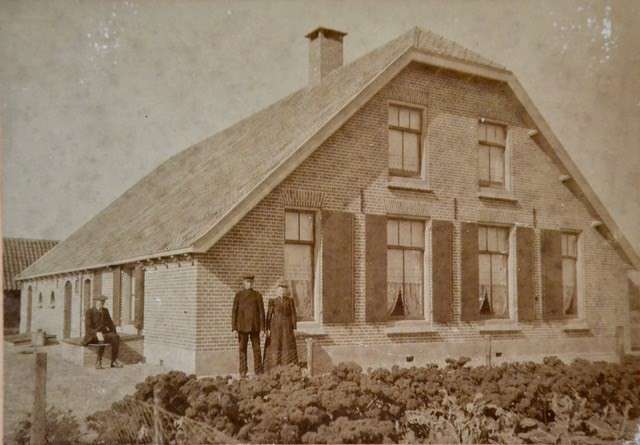
People in hiding. Huurdeman writes that "Verhoef had doorlopend onderduikers in huis" (Verhoef always had people in hiding in the house) (Huurdeman). The booklet's unsigned account of the raid has the family sheltering "zeven onderduikers waaronder minstens twee ondergrondse strijders en één Jood" (seven people in hiding, among them at least two underground fighters and one Jew), most of them under false names (the booklet, p. 31). In the booklet's interview, his grandson Cor van de Burgwal says the family sheltered Jewish people in hiding and resistance men, "maar maakten zelf, voor zover bekend, geen deel uit van het verzet" (but were not themselves, as far as is known, part of the resistance) (p. 33).
◐ The village dairy. A Cornelis Verhoef, farmer of Barneveld, sat on the board of the village dairy and mill. In notarial deeds of 21 April 1922 and 7 November 1927, amending the statutes of the Coöperatieve Stoomzuivelfabriek en Maalinrichting "Juliana" at Achterveld, municipality of Stoutenburg, "Cornelis Verhoef, landbouwer, wonende te Barneveld" appears with Wouter van den Hengel of Stoutenburg, who was chairman, Evert van den Brink of Barneveld and two men of Leusden; he is the secretary-treasurer in 1922 and the secretary in 1927, and signs "C. Verhoef" (the deeds; the 1922 opening checked on the image, the 1927 deed OCR only). This page has his farm on the Klettersteeg at Achterveld, and Barneveld's records for the family, and he was 50 in April 1922; but the deeds give no street, his birth or his wife, and the name is not rare, so the identity rests on the name, the occupation and the place.
With Murphy
Link to the section With MurphyNo source puts him with Murphy. By James Hardy's MI9 report, Murphy and Hardy were hidden at Jacob Veerman's farm near Achterveld for a month and moved on on 23 December 1944, so the raid on the Klettersteeg came while they were there (Hardy). ◐ Hardy gives no arrival date; the Veerman family's own lists have Murphy there from 25 November, and every date given for the raid (16, 18, 19 December) falls inside that month (Jacob Veerman).
Why the SD came. Huurdeman ties the raid to the old billets of a Special Air Service team under Gilbert Kirschen ("Captain King"), a Belgian (Kirschen). After the SD arrested the RVV leader Jan Thijssen, they found the team's former address at Piet Veenendaal's farm, raided it on 15 December 1944, and took Veenendaal; "Onder zware druk gaf Piet Veenendaal de naam van Joop Rothuizen door die bij Cornelis Verhoef aan de Klettersteeg bij Achterveld zat ondergedoken" (under heavy pressure Piet Veenendaal gave the name of Joop Rothuizen, who was hiding at Cornelis Verhoef's on the Klettersteeg near Achterveld) (Huurdeman). The SD brought Veenendaal with them:
On 19 December the SD took the heavily bleeding Piet Veenendaal to Cornelis Verhoef. In this raid the farm was surrounded by five men with rifles at the ready, after which two or three of them forced their way into the house. Two people in hiding ran away, and one of them, probably Joop Rothuizen, got away. The other was his brother or cousin Jan Rothuizen of De Glind, and he was arrested. The sons living at home, Jan and Johan, were arrested too. The sick Cornelis Verhoef was not arrested. A few months later, in March 1945, he would die of grief. In the same month, without his knowing it, both his sons died in a concentration camp.
Dutch originalOp 19 december nam de SD de hevig bloedende Piet Veenendaal mee naar Cornelis Verhoef. Bij deze inval werd de boerderij omsingeld door vijf man met het geweer in de aanslag, waarna twee of drie van hen het huis binnen drongen. Twee onderduikers vluchtten weg, waarbij er één – vermoedelijk was dat Joop Rothuizen – kon ontkomen. De ander was zijn broer of neef Jan Rothuizen uit De Glind en hij werd gearresteerd. Ook de thuiswonende zoons Jan en Johan werden gearresteerd. De zieke Cornelis Verhoef werd niet gearresteerd. Hij zou enkele maanden later, in maart 1945, van verdriet overlijden. In dezelfde maand stierven, zonder dat hij dat wist, zijn beide zoons in een concentratiekamp.
— José Huurdeman · Ondergronds in de Tweede Wereldoorlog (2019), via the Oorlogsgravenstichting · the text
Not finding Joop Rothuizen, the SD took all the young men: the sons Jan and Johan, Jan Rothuizen, and across the road Laurens Liezenberg, in hiding at Thiemen Verhoef's (Huurdeman). In the Neuengamme memorial's page on Liezenberg, Huurdeman adds "Ondertussen moest dochter Rieka eieren bakken voor de SD’ers" (meanwhile the daughter Rieka had to fry eggs for the SD men) (Digitaal Monument Neuengamme).
The village's two accounts. The booklet made in 2025 by the exhibition committee of the Sint Jozefkerk at Achterveld tells the raid twice.
- The unsigned account (p. 31) is headed 18 December 1944, but its text has the raid "tegen het middaguur Maandag 16 December 1944" (towards midday, Monday 16 December 1944). Among those gathered in the front room it also lists "een onderduiker van buurman Cornelis Verhoef die op het schieten was afgekomen" (a person in hiding of neighbour Cornelis Verhoef who had come to the shooting). ◐ On Cornelis's own farm "neighbour Cornelis Verhoef" is odd, and Thiemen Verhoef across the road sheltered Liezenberg, so it may be a slip for Thiemen; the text does not say.
- A German car drove into the yard and five soldiers ran into the house with rifles and revolvers drawn.
- Of two men in hiding who ran, one dodged the shots fired at him and got away; Jan Rothuizen tried to hide under the hen roost and was driven into the front room.
- Veenendaal, handcuffed, was beaten out of the car. The Germans took Johan and Jan Verhoef, Jan Rothuizen "en vijf onderduikers wier namen onbekend zijn gebleven" (and five people in hiding whose names have stayed unknown).
- Cor van de Burgwal's interview (p. 33) dates it 18 December 1944.
- The SD brought the badly wounded Veenendaal in the car to identify people, and Joop Rothuizen was not there.
- Everyone in the house, the women too, was driven into the living room; the SD took the two sons, "in ieder geval" (at any rate) Jan Rothuizen, and Liezenberg from Thiemen's farm.
- "Moeder Verhoef, haar dochter Rieka en haar zieke man Cornelis Verhoef bleven achter op de boerderij" (Mother Verhoef, her daughter Rieka and her sick husband Cornelis Verhoef stayed behind on the farm).
Cor van de Burgwal goes on:
The day after the raid the SD men came back to the farm. They seized everything, the horse, food, and even the pigs went too, probably out of frustration because they could not find the resistance man they were looking for.
Dutch originalDaags na de inval zijn de SD’ers teruggekomen op de boerderij. Zij namen alles in beslag, het paard, voedsel en zelfs de varkens gingen mee, waarschijnlijk uit frustratie omdat ze de gezochte verzetsman niet konden vinden.
— Cor van de Burgwal, his grandson, interviewed in Oorlogsverhalen om nooit te vergeten (Sint Jozefkerk Achterveld, 2025), p. 33 · the booklet
All the men taken on the Klettersteeg went first to the Willem III barracks at Apeldoorn; Liezenberg, Rothuizen and Johan were then moved to the Kruisberg prison at Doetinchem and, by Huurdeman, sent to Neuengamme on 1 February 1945 (Cor van de Burgwal has 3 February; see below), and Jan went to Kamp Amersfoort before he was deported to Neuengamme (Huurdeman).
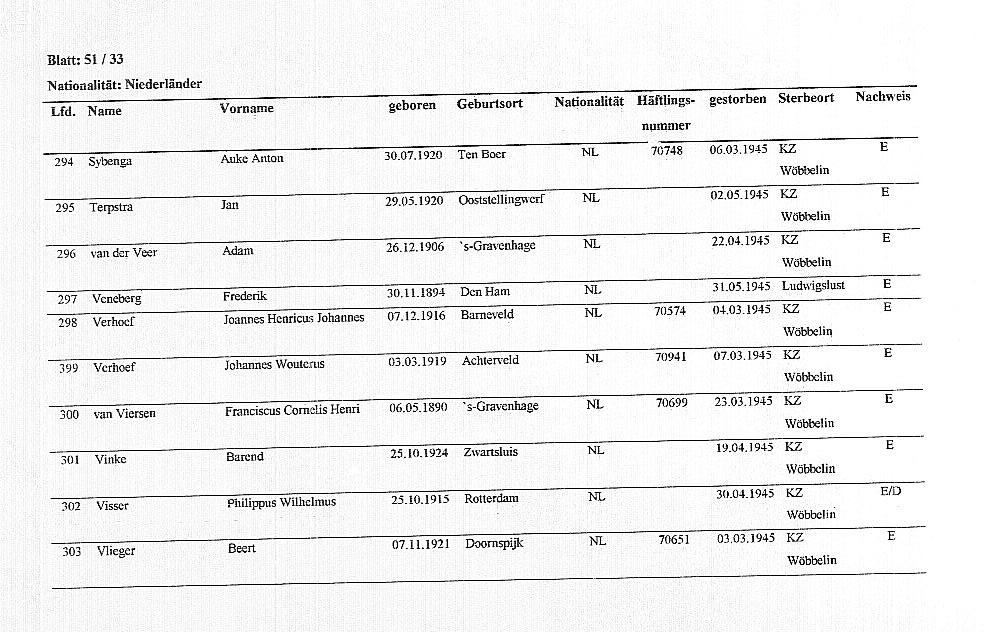
✓ Both sons died at the Wöbbelin camp: Jan on 4 March 1945 and Johan on 7 March 1945 (the Neuengamme list, Blatt 51/33; the camp files). The Dutch Red Cross's typed list of Dutch dead in Kreis Hamburg has the same two days for both (the list, p. 38).
The news. By the booklet's unsigned account, "Huisarts Braun kwam bij de familie Verhoef mededelen dat Jan en Johan in het gruwelkamp waren overleden" (the family doctor, Braun, came to tell the Verhoef family that Jan and Johan had died in the camp of horrors) (the booklet, p. 31). Cor van de Burgwal says of Cornelis, "Hij heeft nooit geweten dat zijn zoons in een Duits concentratiekamp zijn omgekomen. Twee maanden later ontving zijn vrouw het bericht" (He never knew that his sons had died in a German concentration camp. Two months later his wife received the news) (p. 34); the booklet does not say two months after what.
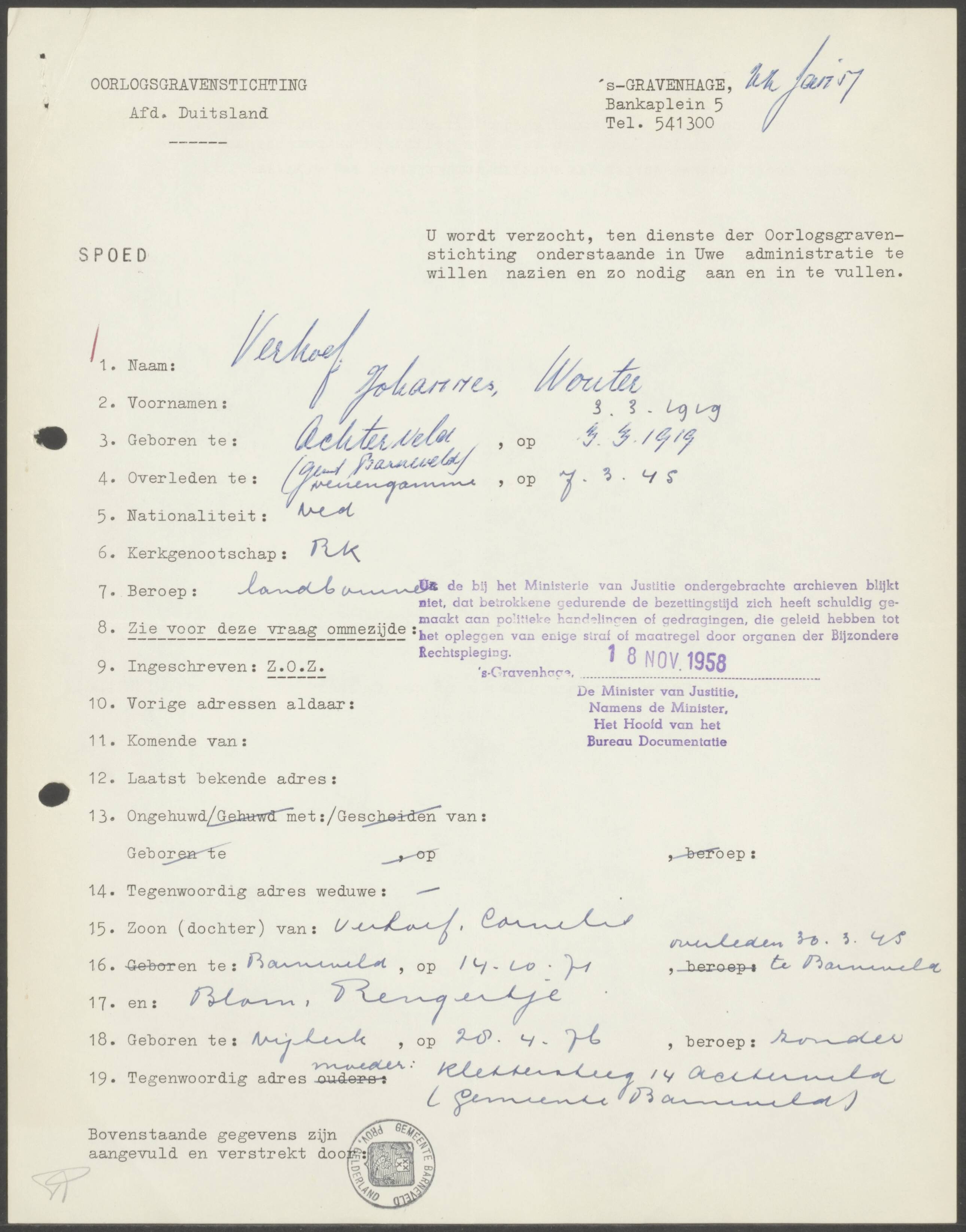
His death. ✓ He died at Barneveld on 30 March 1945, 73 years old, and the death was entered there on 3 April 1945 (deed 122), with his parents named as Johannes Verhoef and Hendrika Voskuijlen and Rengertje Blom as his wife (his death record, index only). Barneveld's own forms to the Foundation in 1957 give the same day, "overleden 30.3.45 te Barneveld" (the form for Johan, image checked). Huurdeman has him die of grief (above). Cor van de Burgwal says he was already sickly during the war, and that the family "is er daarom van overtuigd dat deze gebeurtenis meegespeeld heeft bij zijn overlijden" (is therefore convinced that this event played a part in his death) (the booklet, p. 34). The register gives no cause.
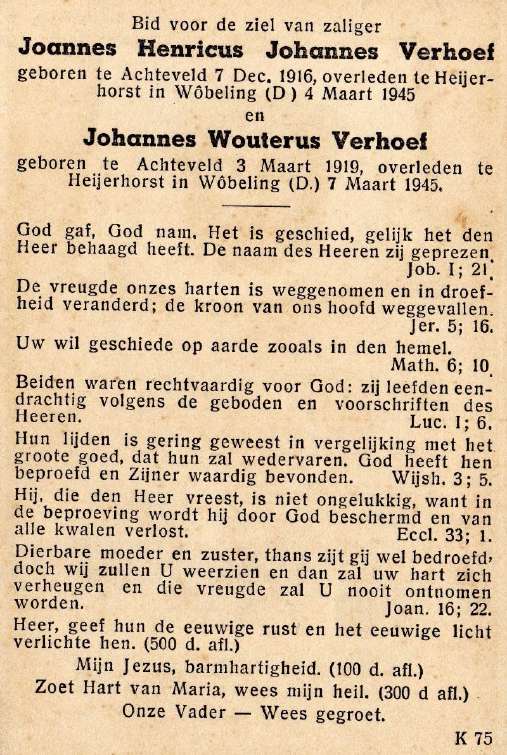
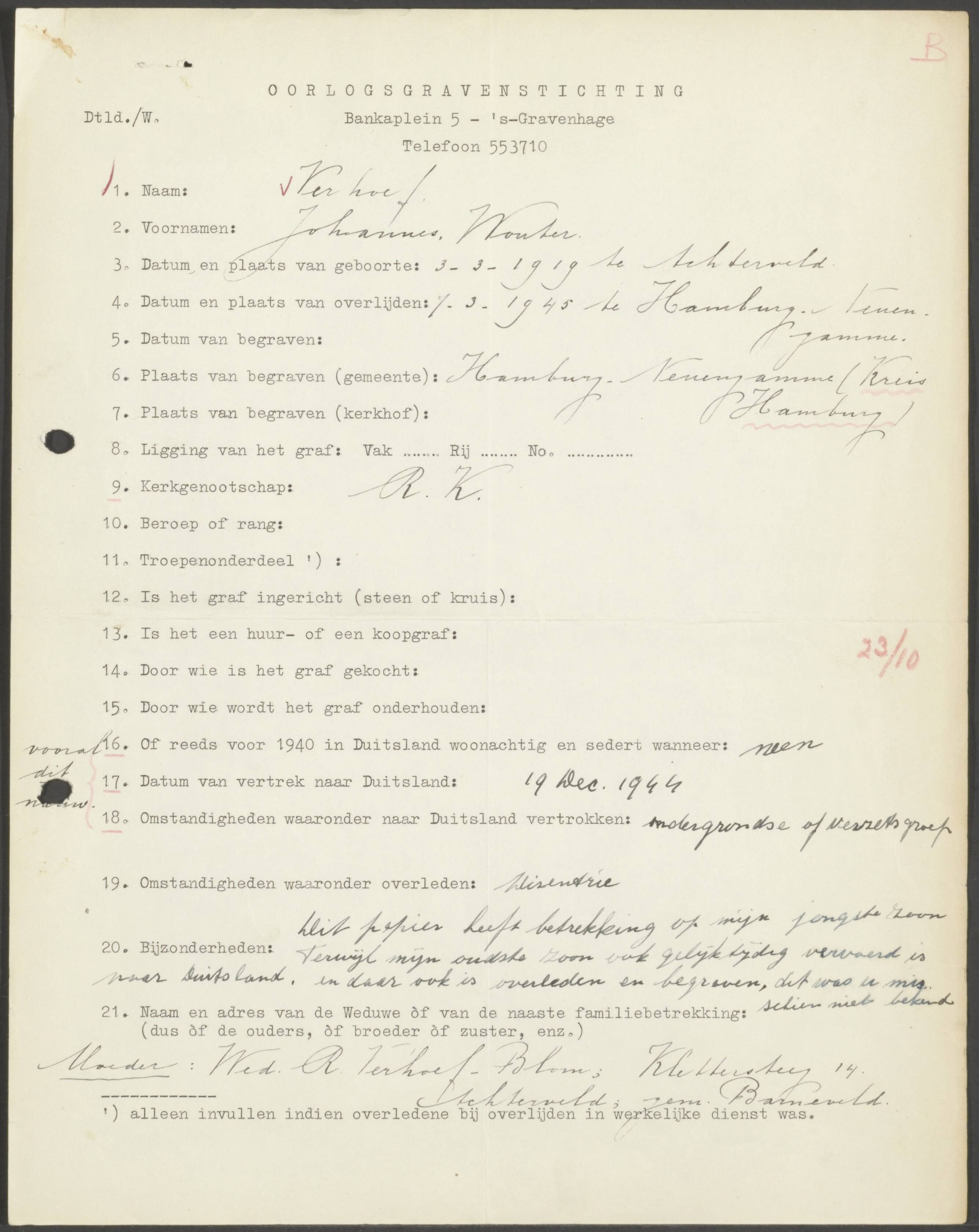
His widow and daughter. His widow stayed at Klettersteeg 14. About 1951 she filled in the Foundation's grave form for Johan and added a note on Jan: "Dit papier heeft betrekking op mijn jongste zoon terwijl mijn oudste zoon ook gelijktijdig verwoerd is naar Duitsland, en daar ook is overleden en begraven, dit was u mis-schien niet bekend" (this paper concerns my youngest son, while my eldest son was also carried off to Germany at the same time, and also died and was buried there; perhaps you did not know this); verwoerd is how our transcript reads the word, most likely her spelling of vervoerd (transported) (the grave form for Johan). The sons' memorial card, printed in the booklet, speaks to "Dierbare moeder en zuster" (dear mother and sister) (the card, the booklet p. 32).
In Cor van de Burgwal's interview, mother and daughter, "moeder Regina en haar dochter Rieka", kept the farm going with help from farmers round about, one of them Hendrik van de Burgwal of Hoogland, and "Rieka en Hendrik trouwden met elkaar in februari 1946" (Rieka and Hendrik married in February 1946) (the booklet, pp. 34–35). ◐ The Barneveld marriage register has a marriage on 13 February 1946 that fits: Hendrik van de Burgwal, 27, farmer, born at Hoogland, and Hendrika Johanna Cecilia Verhoef, 22, born at Barneveld, daughter of Cornelis Verhoef and Rengertje Blom (the marriage, index only). The booklet gives only Riek or Rieka. What joins her to the register's bride: the booklet has Rieka as the daughter of Cornelis and Regina (Rengertje) Blom, marrying Hendrik van de Burgwal of Hoogland in February 1946, and the register has Hendrika Johanna Cecilia, daughter of Cornelis Verhoef and Rengertje Blom, marrying on 13 February 1946 a Hendrik van de Burgwal born at Hoogland. Parents, groom, place and month agree, and Rieka is a usual short form of Hendrika, but no document gives both names, so the match is ours. Nothing held speaks against it, and the booklet names no other daughter.
✓ Rengertje Blom died at Barneveld on 10 April 1960, aged 83, her parents Johannes Blom and Johanna Malestein; the index lists Cornelis Verhoef as her (ex-)partner (her death record, index only). Barneveld's answer to the Foundation in 1951 calls her "wed. van C. Verhoef" (widow of C. Verhoef) (the answer). A Barneveld reply of June 1964 has the same date, in a handwriting we read, and Hendrik van de Burgwal, ◐ (schoonzoon), son-in-law, living at Klettersteeg 26, Achterveld; the name is clear, the bracketed word is our reading (the reply).
◐ A roll of March 1947. The Dutch Salesians' journal for the lay co-workers (Medewerkers) of Don Bosco, in its issue of 20 March 1947, lists among its "Overleden Medewerkers" (deceased co-workers) "Cornelis Verhoef, Achteveld. Joannes Verhoef, Achteveld. Johannes Verhoef, Achteveld." (the issue, p. 35; image-checked). ◐ The three names fit him and his sons Jan (Joannes) and Johan; the list gives no dates or places of death, and Achteveld may have had other Verhoefs. Jan has the page and the reading in full.
Where the sources disagree
Link to the section Where the sources disagree- The day of the raid. ⚠︎ Not settled. Huurdeman has 19 December 1944, and so does his widow's grave form for Johan, as the day Johan left for Germany (Huurdeman; the grave form). The booklet's two accounts have 18 December, and the unsigned one also has "Maandag 16 December 1944" in its text; 18 December 1944 was the Monday (the booklet, pp. 31, 33).
- The day of his death. ✓ 30 March 1945: the death register and Barneveld's forms (his death record). Huurdeman has only "in maart 1945"; Cor van de Burgwal has 31 March (the booklet, p. 34).
- "Of grief." ⚠︎ The cause is Huurdeman's (Huurdeman), and the family's conviction, as Cor van de Burgwal gives it, that the arrests played a part (p. 34); the death register gives none.
- Who was taken. Huurdeman: the two sons and Jan Rothuizen, and Liezenberg across the road. The booklet's unsigned account: the sons, Jan Rothuizen and five unnamed people in hiding, and it also names a person in hiding of "neighbour Cornelis Verhoef" among those in the room (above). Cor van de Burgwal: the sons, Jan Rothuizen and Liezenberg, "de 4 mannen" (the four men, p. 34), though the same page has "zijn zonen en de andere 5 mannen" (his sons and the other five men) (the booklet, pp. 31, 34).
- Where the men were held.
- Huurdeman: all first at Apeldoorn, then Jan at Amersfoort and the others at Doetinchem, and Johan, Rothuizen and Liezenberg on transport to Neuengamme on 1 February 1945.
- The unsigned account: "bijna veertien dagen in het concentratiekamp Amersfoort" (almost a fortnight in the Amersfoort camp) for all of them (the booklet, p. 31).
- Cor van de Burgwal agrees with Huurdeman on the places: Jan from Apeldoorn to Amersfoort, Johan to "de Kruitberg" at Doetinchem, "14 dagen" there. He has Johan put on transport to Neuengamme on 3 February 1945, arriving on 5 February (p. 34).
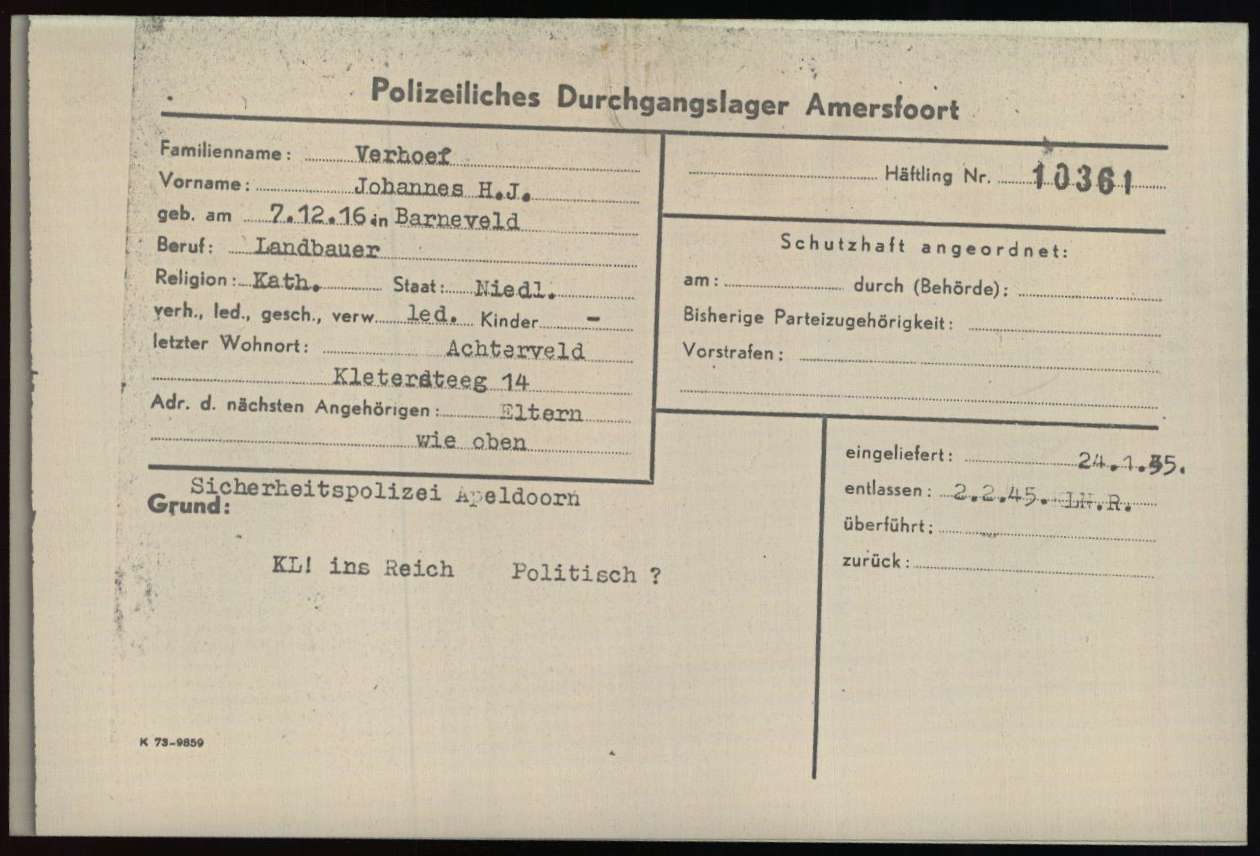
- ✓ Jan's Amersfoort card has him delivered on 24 January 1945 and released on 2 February, nine days at Amersfoort, five weeks after the raid (Jan; the card).
- On the place the unsigned account is the odd one out; its fortnight is close to Cor's 14 days.