Jan Thijssen
Bussum 29 Dec 1908 – Woeste Hoeve 8 Mar 1945
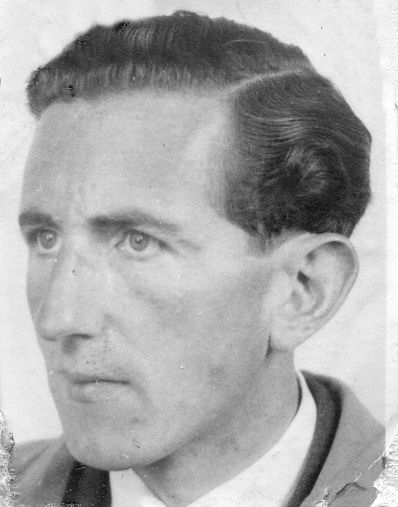
About: A founder of the Raad van Verzet, a Dutch resistance organisation, and a founder or co-founder of its radio service (◐ the sources differ: below), arrested in November 1944 and shot at the Woeste Hoeve in March 1945. After his arrest, by one local history, the SD found the old SAS billet where the December round-up near Murphy's hiding place began.
Unit or role: The Raad van Verzet (RVV), which he co-founded, and its radio service, which De Maasbode has him founding and De Tijd co-founding (◐ below) (De Maasbode, 15 September 1945); in the resistance "'Lange Jan' en 'Lange Karel'" (the Defence record); a reserve first lieutenant of the infantry (his award card); by trade an electrical technician in the service of the P.T.T. (scan 6).
Where: Vlietweg 16, Rijswijk, from 15 November 1938 until his arrest (Nijmeegsch Dagblad, 27 September 1945); after it the SD's office on the Binnenhof at The Hague (Haubrock, 1949, p. 1266) and the House of Detention at Zwolle (Overijsselsch Dagblad, 9 June 1948).
Evidence: ✓ Boeree, Kroniek van Ede (1947), pp. 89, 189 (checked on the page images); ◐ De Maasbode, 15 September 1945 (the KB's OCR, not checked on the image; its "Einde 1543" is read as 1943); Nijmeegsch Dagblad, 27 September 1945; Huurdeman; ✓ his Dutch award card; ✓ his death deed, Apeldoorn 1945, no. 888; ✓ the War Graves Foundation's file on him, 1950–1990 (Nationaal Archief 2.19.255.01, 153765A); ✓ his marriage at Nijmegen, 1940; ◐ Electron, 1946 and After the Battle, from the Archive's full-text index; Het Parool, 31 December 1945; De Tijd, 13 September 1945; ✓ the Enquêtecommissie's hearings of 1949 and Schreieder's statement (checked on the page images); ✓ his funeral notice, Het Parool, 8 September 1945 and the family's death notice, 5 June 1945 (checked on the image); ✓ Het Parool and De Volkskrant, 5 November 1955, on the Enquêtecommissie's final report (checked on the page images); ✓ the commission's hearings of Six, Van der Gaag and the commander-South; ✓ the press reports of his Medal of Freedom, April 1953; ✓ his father's death deed, Leiden 1944 (index only); ◐ De Jong, Het Koninkrijk der Nederlanden in de Tweede Wereldoorlog, deel 10b (1981), pp. 625–628 (PDF pages 632–635, read on the images); ✓ the Erelijst, p. 714
Family, work and marriage
Link to the section Family, work and marriageHe was born at Bussum on 29 December 1908 (his award card). In the resistance he went by "'Lange Jan' en 'Lange Karel'" (Tall Jan and Tall Karel), by the Defence Ministry's record of his award (the record, from the Wayback Machine). He was a co-founder and the secretary of the Raad van Verzet, "de eerste organisatie, die zich speciaal toelegde op sabotage en gewapend verzet tegen den vijand" (the first organisation to devote itself to sabotage and armed resistance against the enemy), and at the end of 1943 (the KB's OCR reads "Einde 1543", which we read as 1943) he also founded its radio service, which built transmitters from material taken from the Germans (De Maasbode, 15 September 1945). ✓ The Apeldoorn register of deaths has him dying there on 8 March 1945, aged 36, born at Bussum, "zonder beroep" (without occupation) in the index, the son of Hendrik Ernst Thijssen and Agatha Cornelia Visser (Apeldoorn 1945, deed 888; the record; index only). The Foundation's forms give the family: his father an accountant, born at Amsterdam on 3 February 1881 and died at Leiden on 7 September 1944; his mother born at Amsterdam on 17 August 1880 and living at Bredelaan 2a, Bussum, in 1954; and a wife, who was at Wassenaar in 1947–54 and later at Heelsum (she is named under his marriage, below) (scan 2; scan 4; scan 6). By the Bussum form he was a radio technician (radio technicus), and by the form his mother filled in an "Electr. Techn. P.T.T. ambtenaar", an electrical technician and civil servant of the P.T.T., the state post, telegraph and telephone service; the Foundation's own grave card adds, in another hand, "lid verzet" (member of the resistance) (scan 2; scan 6; scan 26). The Foundation's last known address for him is Rijswijk, as the page has it (scan 4). He lived at Vlietweg 16, Rijswijk, from 15 November 1938 until his arrest (Nijmeegsch Dagblad, 27 September 1945).
His militia enrolment and his marriage. ✓ The Noord-Holland militia register for 1928 has "Jan Thijssen", born at Bussum on 29 December 1908, among the Bussum men enrolled that year (North Holland Archives, militia registers, register 408, document 211; index only: the card itself, on militieregisters.nl and the Archive's proxy, refused a download from here with a 403) (the record); the birth date is the award card's. ✓ On 3 August 1940 at Nijmegen Jan Thijssen, 31, born at Bussum, "electrotechnisch ambtenaar" (electrotechnical civil servant), son of Hendrik Ernst Thijssen, accountant, and Agatha Cornelia Visser, married Cornelia Catharina Hermina Wilhelmina van de Weijer, 26, a saleswoman (verkoopster) born at Nijmegen (Gelders Archief 0207A, Nijmegen marriage register, deed 415; index only) (the record). ✓ She is the "Nn van de Weijer" of his death deed and the wife of the Foundation's forms, whom Het Parool has helping him. The occupation is the same as his mother's form gives (above).
His father's death. ✓ Hendrik Ernst Thijssen, the father of the Foundation's forms, died at Leiden on 7 September 1944, aged 63, born at Amsterdam, an accountant living at Hilversum; he is the husband of Agatha Cornelia Visser and the son of Samuel Jan Thijssen and Alida Figge (Leiden register of deaths 1944, deed 927, and the copy in the Noord-Holland register, deed 725; index only; the records). The deed agrees with the Foundation's forms on the day, the place and the trade, and names Jan Thijssen's paternal grandparents. It is two months before his arrest.
The radio service and the Raad van Verzet
Link to the section The radio service and the Raad van Verzet◐ A longer life is on the Foundation's page, in a contribution of 2014 taken from the website of the Stichting Monument Woeste Hoeve (we have not read the monument's own page): he was an electro-technical civil servant of the P.T.T. charged with tracing clandestine transmitters, and himself a keen radio amateur; at the end of 1941 he began to build an illegal inland radio network; in 1942 he met Jhr. J.P. Six, head of the O.D. (Ordedienst), who needed exactly that, and joined it; by early 1943 the whole network was ready, with links across the country and to England. Impatient of the O.D.'s waiting, he called a meeting of six others he knew from the resistance, and they founded the Raad van Verzet (the RVV), with himself as its commander and open to working with anyone who wanted active resistance, communists included; another contribution gives the founding date as 1 May 1943. In October 1943 a violent quarrel with Six ended in a complete break, he was put out of the O.D. and lost his radio service, and by the summer of 1944 had a new one in full operation, with action groups, "brigades", across much of the country (the page). Of the Binnenlandse Strijdkrachten, the umbrella organisation under Colonel Koot, it says he found its leadership as hesitant as the O.D.'s, refused the subordinate place Koot offered him, and was put out of his own RVV by Koot on 3 November 1944 (⚠︎ the commission's report, as the papers of 1955 give it, has Koot dismissing him as under-commander of the RVV forces and the RVV's own leaders removing him by a letter written on 7 November: below), although Prince Bernhard had said Koot was going too far (the page).
◐ A contribution on the Foundation's page, posted in January 2014 by the Foundation's archive coordinator and citing Guerilla in Rotterdam, pp. 427–428 (which we have not read), says more of the radio service: he was commander of the O.D. radio service, and after a quarrel with Jhr. P.J. Six, who was rebuilding the O.D., set it up a second time at the end of 1943; there was contact with the Allies and the liberated south; almost 500 telegraphic messages were sent, about sabotage projects and arms drops; the low point was the arrest of two operators, K.L. Timmer and Ch.G. Kranz, shot in January 1945; and after his own arrest his successors were Floor van der Laaken and Mr. Thom Schadd (the page). ◐ "Floor van der Laaken" is very probably the Floris van der Laaken ("Lex") whom Het Parool has shot at Hattem on 4 April 1945, the day and place Dirk Eskes was shot, and, by Noordman's account on Dirk Eskes's page (not Het Parool), the operator with whom Eskes was caught at the transmitter in February 1945.
◐ Nel Lind, who ran the Luctor et Emergo pilot group, wrote in her report to the Americans that she had news of two airmen at Weerselo "via mijn helaas gefusilleerde vriend Karel Thijssen, chef-marconist v.d. OD ('43)" (through my, alas, shot friend Karel Thijssen, chief radio operator of the O.D. ('43)) (her file, p. 15, checked on the image). ◐ This is very probably Jan Thijssen: he was "Lange Karel" as well as "Lange Jan" (the Defence record), the O.D.'s radio chief in 1943 (the Foundation's page), and shot. The Dutch radio amateurs' magazine Electron in 1946 says the same of "Karel" in its notice of him (below). The report calls him Karel, not Jan.
◐ Electron, the radio amateurs' magazine, printed him in a 1946 list of amateurs who "gave their lives for our freedom" (the notice, from the Archive's full-text index, not read on the page):
Jan Thijssen was head of the radio service for the domestic radio network during the illegality and one of our greatest resistance men. Numerous amateurs know "Karel" or "Lange Jan", as his code names were. At the end of 1944 he was arrested and on 8 March shot.
Dutch originalJan Thijssen was chef van den radiodienst voor het binnenlandsche radionet tijdens de illegaliteit en een van onze grootste verzetslieden. Talrijke amateurs kennen „Karel" of „Lange Jan", zooals zijn schuilnamen luidden. Eind 1944 werd hij gearresteerd en op 8 Maart gefusilleerd.
— J. A. Vredeveld · Electron, 1946, "In Memoriam" · the notice
It gives "Karel" and "Lange Jan" both as his code names, the radio service, the arrest at the end of 1944 (◐ it fits November) and the day of his death, 8 March.
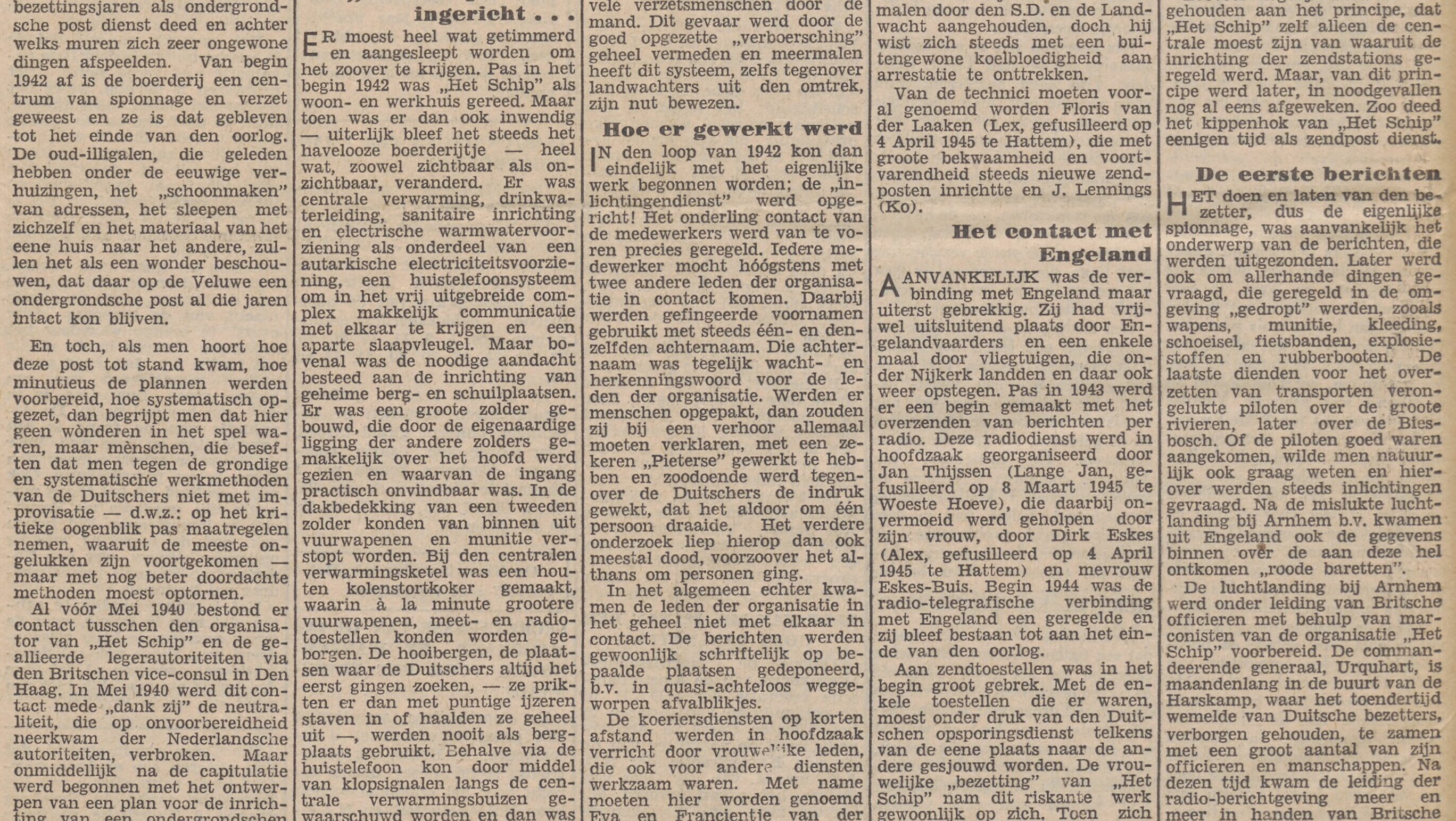
Het Parool of 31 December 1945, on the farm "Het Schip" on the Wencopperweg near Barneveld, the base of the radio service, names him as its organiser. Before 1943 the link with England ran almost wholly through Engelandvaarders and a few aircraft that landed near Nijkerk; only in 1943 did radio messages begin:
This radio service was organised in the main by Jan Thijssen (Lange Jan, shot on 8 March 1945 at the Woeste Hoeve), who was tirelessly helped in it by his wife, by Dirk Eskes (Alex, shot on 4 April 1945 at Hattem) and by Mrs Eskes-Buis. At the beginning of 1944 the radio-telegraph link with England was a regular one, and it stayed so to the end of the war.
Dutch originalDeze radiodienst werd in hoofdzaak georganiseerd door Jan Thijssen (Lange Jan, gefusilleerd op 8 Maart 1945 te Woeste Hoeve), die daarbij onvermoeid werd geholpen door zijn vrouw, door Dirk Eskes (Alex, gefusilleerd op 4 April 1945 te Hattem) en mevrouw Eskes-Buis. Begin 1944 was de radio-telegrafische verbinding met Engeland een geregelde en zij bleef bestaan tot aan het einde van den oorlog.
— Het Parool, 31 December 1945, "Een doodgewoon boerderijtje op de Veluwe" · the article
What others wrote of his part, 1945 to 1981. None of these is a record made at the time of the events; each is a later writer's account.
- ◐ Vrij Nederland, 23 June 1945. A radio talk by the Raad van Verzet's chairman, who was also a Vertrouwensman, printed under the name "J. Van Der Haag" (◐ Jacob van der Gaag is meant) (p. 650, checked on the image).
- It says the Raad van Verzet arose "dank zij het initiatief van Jan Thijssen en Willem Santema" (thanks to the initiative of Jan Thijssen and Willem Santema), "in de illegaliteit bekend onder de schuilnamen Lange Karel en Gerrie" (known in the illegality by the code names Lange Karel and Gerrie), and that both died before the liberation.
- It confirms "Lange Karel" as a code name (above) and is the only source here to name a second initiator.
- ◐ The first leaders. Norel and Terlaak Poot (1947) make Gerrit van der Veen and Thijssen the dominant figures among "de oprichters en eerste leiders" (the founders and first leaders) of the RVV (p. 560). Delleman (1949) has the RVV "aanvankelijk" (at first) under Thijssen and a second man, then under Gerben Wagenaar (p. 329). De Waarheid (1981), summarising De Jong, has it formed "in 1943 op initiatief van Thijssen als federatie" (in 1943 on Thijssen's initiative as a federation) (p. 4).
- ◐ A party monthly's view. Bakker, in the Communist Politiek en Cultuur of July 1958, has the Raad van Verzet founded by civilian people from the O.D. and Trouw circles, "De leider was eerst Jan Thijssen, reserve-officier" (the leader was at first Jan Thijssen, a reserve officer) who kept radio contact with London throughout, and calls him "een dapper man ... maar hij was 100% militair en regeringsman" (a brave man, but 100% a soldier and a government man) (p. 298, checked on the image; partisan).
- ◐ The radio service founded after a quarrel. Het Vrije Volk of 15 July 1950, in a long summary of the intelligence groups that quotes Six before the commission (p. 5, checked on the image; we have not read the report it draws on).
- The Radiodienst was "opgericht door Jan Thijssen (Lange Jan), nadat deze onenigheid in de O.D. had gehad" (founded by Jan Thijssen, after he had had a disagreement in the O.D.): the quarrel with Six that the monument text has above.
- London, thinking the RVV purely communist, was at first reserved towards the service until the London agent Wiedemann vouched for the groups.
- ◐ Who led the radio service, 1949. A witness who worked at Six's office after the liberation told the commission that "Van de radiodienst is het Jan Thijssen geweest" (of the radio service it was Jan Thijssen), for a time jointly with a chief radio operator, Van Schendel; he says what he knows dates from after the liberation, so it is hearsay (Verslag, deel 4C-I, p. 750, checked on the image).
- ◐ In Het grote gebod (1951). The book calls him "de chef operatie-centrum van RvV" (chief of the RvV's operations centre) and the RvV's "sabotageleider" (pp. 395 and 654, checked on the images); both pages give "Lange Jan" with his name, "(Jan Thijssen †)".
- ⚠︎ On p. 671 (same file) the book says that because of the conflict inside the RvV and with the CBS, Lange Jan went to Prince Bernhard's staff "in de nazomer" (in the late summer) but "heeft daar zijn plannen niet kunnen verwezenlijken" (could not carry out his plans there). P. 671 gives only "Lange Jan", and p. 400 likewise; that either is Thijssen is our reading from pp. 395 and 654.
- Van der Gaag told the commission that the Lange Jan who went south "bleek de andere Lange Jan te zijn" (turned out to be the other Lange Jan) (below), so the visit may not be Thijssen's. The book gives no source for it, and we have no other for it.
- ◐ Vrij Nederland, 1970. D. F. van de Pol's article of 2 May 1970 on an RVV reunion at Amersfoort, written from talks with four of its co-founders (pp. 21–22; OCR only, the KB shows the pages in its reading room only).
- It calls him "de man die als de ziel gold van de Raad van Verzet" (the man regarded as the soul of the Raad van Verzet), "een uit Bussum afkomstige radiotechnicus van de PTT die als reserve-luitenant in de Orde dienst (OD) had gezeten" (a PTT radio technician from Bussum who had been a reserve lieutenant in the OD).
- It says he left the O.D. "met medeneming van zijn eigenhandig opgebouwd zenderpark" (taking with him the transmitters he had built himself), and that where and when exactly the RVV was founded "is niet meer bekend" (is no longer known); a plaque at Stationsstraat 28b, Amersfoort, marks a founding "in april '43".
- ◐ The Stockholm link, 1943. Frank Visser's De zaak Antonius van der Waals (1974) has the Dutch in Stockholm badly needing contact with "de zendgroep van Jan Thijssen (,Raad van Verzet')" (Jan Thijssen's transmitter group) (p. 368, read on the image).
- ◐ Klinkenberg (1986). Wim Klinkenberg's political biography of Prince Bernhard (PDF p. 138, read on the image):
- It calls him "de tot de CPN toegetreden Jan Thijssen" (Jan Thijssen, who had joined the CPN, the Communist party), says that as soon as Koot became commander "ontdeed hij zich onmiddellijk van Thijssen" (he got rid of Thijssen at once), and that "Thijssen is door verraad in Duitse handen geraakt en terechtgesteld" (fell into German hands by betrayal and was executed).
- ⚠︎ No other source we hold has him join the CPN; Bakker's party monthly of 1958 (above) calls him "100% militair en regeringsman".
- ◐ Two hearings of 1949 speak to his politics, both from memory and neither a record of party membership:
- His secretary, asked "Was Thijssen communist?", answered "Neen, hij was, naar ik meen, S.D.A.P.-er" (No, he was, I believe, a Social Democrat) (the hearing of 7 June 1949, p. 1403, q. 56930, checked on the image).
- Haubrock said under oath that the Reichskommissariat "geconstateerd, dat Thijssen communist was, terwijl de mening van Schreieder en van ons was, dat hij socialist was en geen communist" (found that Thijssen was a communist, while Schreieder's and our view was that he was a socialist and no communist) (the hearing of 20 May 1949, q. 54098).
- The book's note for the passage cites the commission's hearings, deel 4C-II, pp. 1717–1723, for Koot's complaint against him, not for the party or the betrayal.
- ◐ Richardson (1987). A thesis on the resistance at Hengelo has the RVV "established nationally on 4 July 1943 by Jan Thijssen, a former member of the OD who had grown increasingly disillusioned by the group's ineffectiveness" (p. 97, read on the image).
- ◐ Partizanen (1999) (p. 229, read on the image; no year is printed on the page, and 1944 is our reading of the sequence):
- It has "de topman van de RVV, Jan Thijssen ('Lange Jan')" send London a telegram on 4 September: "'Ondergrondse strijders begroeten met vreugde z.k.h. prins Bernhard als hun opperbevelhebber.'" (underground fighters greet with joy H.R.H. Prince Bernhard as their commander-in-chief), which angered the national K.P. and the O.D.
- ⚠︎ It says an RVV brigade carried out the raid on a German car at Putten in the night of 30 September "Gevolg gevend aan een algemeen bevel van 'Lange Jan'" (carrying out a general order of Lange Jan). The book gives no source for the order, and the passage goes on to quote De Jong on the raid.
- ◐ That sentence gives only the nickname; the page names "Jan Thijssen ('Lange Jan')" once, in the paragraph on the telegram above it. That the order was Thijssen's is therefore our reading of the page, and it holds only if its "Lange Jan" is he and not "the other Lange Jan" of Van der Gaag's hearing (below).
- Beside it, two later accounts of the raid on the German car put the order higher up, neither naming Thijssen (Trouw, 4 October 1969; Vrij Nederland, 14 January 1978; Piet Oosterbroek):
- Trouw's report on Piet Oosterbroek has his group's orders come from the district commander, who had them from someone he did not know; Vrij Nederland gives that as his. The rest is the reporter's narrative: the district commander was "Piet Veluwe" of Ermelo, and the local commander "Ronald" brought the order for the action of 29 September, one he "van hogerhand gekregen zou hebben" (was said to have had from above), and led the night of 30 September. Trouw does not say who gave Ronald that order.
- ⚠︎ Vrij Nederland names Ronald as Ab Witvoet and prints his own statement of 1974: "Eind september kregen we de opdracht van het hoofdkwartier van de Binnenlandse Strijdkrachten (BS)" (at the end of September we got the order from the headquarters of the Binnenlandse Strijdkrachten). That is one man's statement; the magazine's suggestion that Prince Bernhard gave it is its own question, not a finding.
- ◐ Pidgeon (2003). A history of MI6's wireless communications says of the Dutch network at Eindhoven that sent traffic to the British (the pages give it no date) that "The network had been set up by Jan Thijssen of the Council of Resistance (RvV) and the Orde Dienst (OD)", and that "Most of the other operators and associates, including Jan Thijssen, were arrested and executed by the Germans" (pp. 308–309, read on the images).
Somer, who had been head of the Netherlands government's intelligence bureau in London (the title page, in the KB's OCR, says so) and whose bureau (B.I.) supplied the RVV, wrote of him in 1950, in the chapter Opmars naar de bevrijding (the advance to the liberation) (p. 195, checked on the image):
The latter organisation, the R.V.V., had in "Lange Jan" a tireless and capable worker, who kept the torch of blazing enthusiasm burning to the last. He too would in the end not escape the merciless arm of the S.D., which made the brave pioneer of the RVV one of its countless victims. The Netherlands and B.I. owe Jan Thijssen much, very much.
Dutch originalLaatstgenoemde organisatie bezat in „Lange Jan" een onvermoeid en bekwaam werker, die de fakkel van het laaiende enthousiasme tot het laatst toe brandende heeft gehouden. Ook hij zou tenslotte niet ontkomen aan de genadeloze arm van de S.D., welke de dappere pionier van de R.V.V. tot één van de talloze slachtoffers maakte. Nederland en B.I. hebben aan Jan Thijssen veel, zeer veel te danken.
— J. M. Somer · Zij sprongen in de nacht (1950), p. 195 · the page
Earlier in that chapter (p. 183, same file) Ausems, the RVV's envoy, who "persoonlijke relaties had met de leider van de radiodienst van de R.V.V., „Lange Jan"" (had personal relations with the head of the RVV's radio service, "Lange Jan"), made a warm plea ("een warm pleidooi") for sending material to the RVV, and B.I. hurried to supply it because the RVV's technical service had shown "uitmuntend werk" (excellent work) on radio links. ◐ This is very probably the Ausems of the hearing of 17 May 1949 (below), who knew Thijssen from Teuge.
◐ A study of the German military intelligence's Gruppe III in the Netherlands (2023) has two men, K. C. Simons and his uncle J. F. H. Kohlwey, "werkzaam voor de OD-radiodienst van Jan Thijssen (alias Karel)" (working for the OD radio service of Jan Thijssen, alias Karel), and Slokker, whom the study calls a signals instructor, arrested in August 1943 and sent back to infiltrate the O.D. at the Abwehr's urging, "men was vooral gebeten op Thijssen" (they were especially keen to get Thijssen) (the chapter, PDF pp. 18–19, from the text layer).
Autumn 1944: Kirschen, Koot and the last days
Link to the section Autumn 1944: Kirschen, Koot and the last days◐ In De Jong's history the SAS team led by the Belgian captain Gilbert Kirschen, "Captain King" (De Jong's "(Britse) Special Air Service-brigade", four men), dropped in the night of 14 to 15 September 1944, was received by Dijkman of the RVV's Veluwe brigade, "die gewaarschuwd was door Thijssen" (who had been warned by Thijssen), and put up at a farm at Scherpenzeel, where "hij kreeg daar op de avond van de 15de bezoek van Thijssen" (he had a visit from Thijssen there on the evening of the 15th) (deel 10a, p. 331, checked on the image; Berend Dijkman). Vrij Nederland of 14 January 1978 also has King in touch with "Jan Thijssen, een van de kopstukken van de Raad van Verzet" (one of the leading figures of the RVV) the day after the drop (the article; OCR only).
✓ Th. A. Boeree's Kroniek van Ede (1947) has his secretary on the courier line in the autumn of 1944: "Wim R.V.V., wiens eigenlijke naam was W. J. van Hoorn Alkema" (whose real name was W. J. van Hoorn Alkema) "was de secretaris van Jan Thijssen", and at Maarn "beheerde hij het centrale punt van de groote koerierlijn" (ran the central point of the big courier line), which kept him in regular touch with Captain King, Roelof and Bep (Boeree, p. 189, checked on the page image). Boeree goes on: "Jan Thijssen wilde hem met een speciale opdracht naar Prins Bernhard zenden" (Jan Thijssen wanted to send him to Prince Bernhard on a special mission). The crossing had first been planned at Tiel, but that line was blocked, and King gave him a tip that there would be a crossing at Ede on 17 November, with a recommendation to the Second Army's intelligence officer; the letters for Prince Bernhard were photographed and sewn into his clothes, and King added about ten reports (same page). ◐ Boeree gives no first name or description beyond "Jan Thijssen", and no date for Thijssen's order; the King link fits Gilbert Kirschen's page, where, in De Jong, Thijssen had warned Dijkman of the drop. Wim's part in the crossing is told there. Wim was wounded in the crossing and passed himself off as the English flight sergeant William Dave Macneill (Boeree, p. 190); he lay for some months at the prisoner-of-war hospital at Lingen in one room with Major Longland until the British freed them on 5 April (the page prints no year; ◐ 1945 is ours, the crossing being in November 1944) (Boeree, p. 191; Cedric Longland).
◐ De Jong goes on with the first days of November. Thijssen visited Kirschen at Maarn on 4 November (De Jong quotes Kirschen's notes of the visit, which call the visitor only "Lange Jan"; the identification with Thijssen is De Jong's), and on 5 November wrote to Van Bijnen ("Frank" of the K.P.) that he had had "een allemachtig smerige trap onder de riem" (an almighty dirty kick below the belt), believing Van Bijnen had pressed for his dismissal. De Jong presents the letter as an attempt to settle the conflict, "beseffend dat hij deze had gekwetst" (realising that he had hurt him), and says Thijssen also wrote that he had never meant to hurt Van Bijnen personally with his criticism of the Knokploegen in his memorandum of 24 October. Van Bijnen's reply of 13 November, written before he knew of the arrest, denied it (deel 10b, p. 625, PDF p. 632, read on the image). By De Jong's account he then drove to Amsterdam on 8 November, "zoals hij placht te doen, met een auto van het Rode Kruis, gedekt door valse papieren" (as he used to, in a Red Cross car, covered by false papers), with Tom Schadd and "Eskes" (◐ Dirk Eskes: De Jong gives no first name, and Haubrock's "dr. Eskes" is the man taken with Thijssen, below), for a talk with Colonel Koot, Six, Scheepstra, Doorn, Van der Gaag and Wagenaar, at which he was told once more to hand over and would not (p. 625).
With Murphy
Link to the section With MurphyNothing puts him with Murphy, and nothing we hold shows that either knew of the other. Their stories touch through the arrests that followed his own.
The round-up. ◐ José Huurdeman's history of the local resistance, as the War Graves Foundation prints it; it cites no source for the sequence, and the text does not say how the SD came to the address:
After the SD had arrested the RVV leader Jan Thijssen, in December 1944 the SD got hold of Kirschen's former lodging at Piet Veenendaal's address. Although the SAS team had been gone more than a month, the SD carried out a series of arrests.
Dutch originalNadat de SD RVV topman Jan Thijssen had gearresteerd, kreeg de SD in december 1944 de voormalig verblijfplaats van Kirschen op het adres van Piet Veenendaal in handen. Hoewel het SAS-team al meer dan een maand weg was voerde de SD diverse arrestaties uit.
— José Huurdeman · Ondergronds in de Tweede Wereldoorlog (2019), as printed on the Oorlogsgravenstichting's site · the page
Where Murphy was. The round-up ran from 15 December 1944 at Veenendaal's farm at Scherpenzeel to the Verhoef farm on the Klettersteeg at Achterveld on the 19th, Hardeveld at Leusden on 31 December and the gamekeeper's house next to it on 5 January 1945 (Huurdeman; ⚠︎ three other sources give 5 January for Hardeveld: Gerrit Kamphorst). By James Hardy's report of January 1945 he and Murphy stayed a month at the Veerman farm at Klein Achterveld and left it on 23 December (Hardy), so the round-up began while they were there. It is told in full on Piet Veenendaal's page and in Achterveld.
The arrest, 8 or 9 November 1944
Link to the section The arrest, 8 or 9 November 1944◐ In De Jong's history. After the Amsterdam talk of 8 November (above), Wagenaar told the commission he had warned him "ga niet met de auto!" (don't take the car!), and De Jong says he rejected the advice, trusting his false papers. The Red Cross car in which he and Eskes (◐ Dirk, as above) rode, posing as Red Cross officials, was stopped on the motorway from The Hague to Rotterdam: the V-Mann Brinkman had warned the SD officer Frank (not the K.P.'s "Frank") that an arms transport would pass on that road that day, and Frank had put Haubrock in charge of the check. "Ook de chauffeur en Eskes werden gearresteerd. Thijssen had de brief van 1 november bij zich waarmee kolonel Koot hem had afgezet." (The driver and Eskes were arrested too. Thijssen had with him the letter of 1 November by which Colonel Koot had removed him.) De Jong's note adds that the SD knew his name and had his photograph from the personal card filed with the state inspectorate of population registers (deel 10b, p. 626, PDF p. 633, read on the image). He does not print a date for the stop; his account runs on from the Amsterdam talk of 8 November.
◐ By the same monument text he was arrested by the SD on 8 November 1944 (◐ the commission's report, as two papers of 1955 give it, has 9 November: below), "waarschijnlijk door verraad" (probably by betrayal), questioned many times and, it says, never named anyone (⚠︎ the accounts below differ), and was held in the prison at Zwolle; the citation for his Bronze Lion has him captured in November 1944 as well (the page; the citation, below). It says that on 8 March 1945 he was shot at the Woeste Hoeve with 116 other resistance people, as a reprisal for the attack on Rauter of 6 March, that he was 36 and married, and that he was the only one of the victims who tried to escape at the place of execution (the page). The Foundation's own file gives neither the arrest nor the escape.
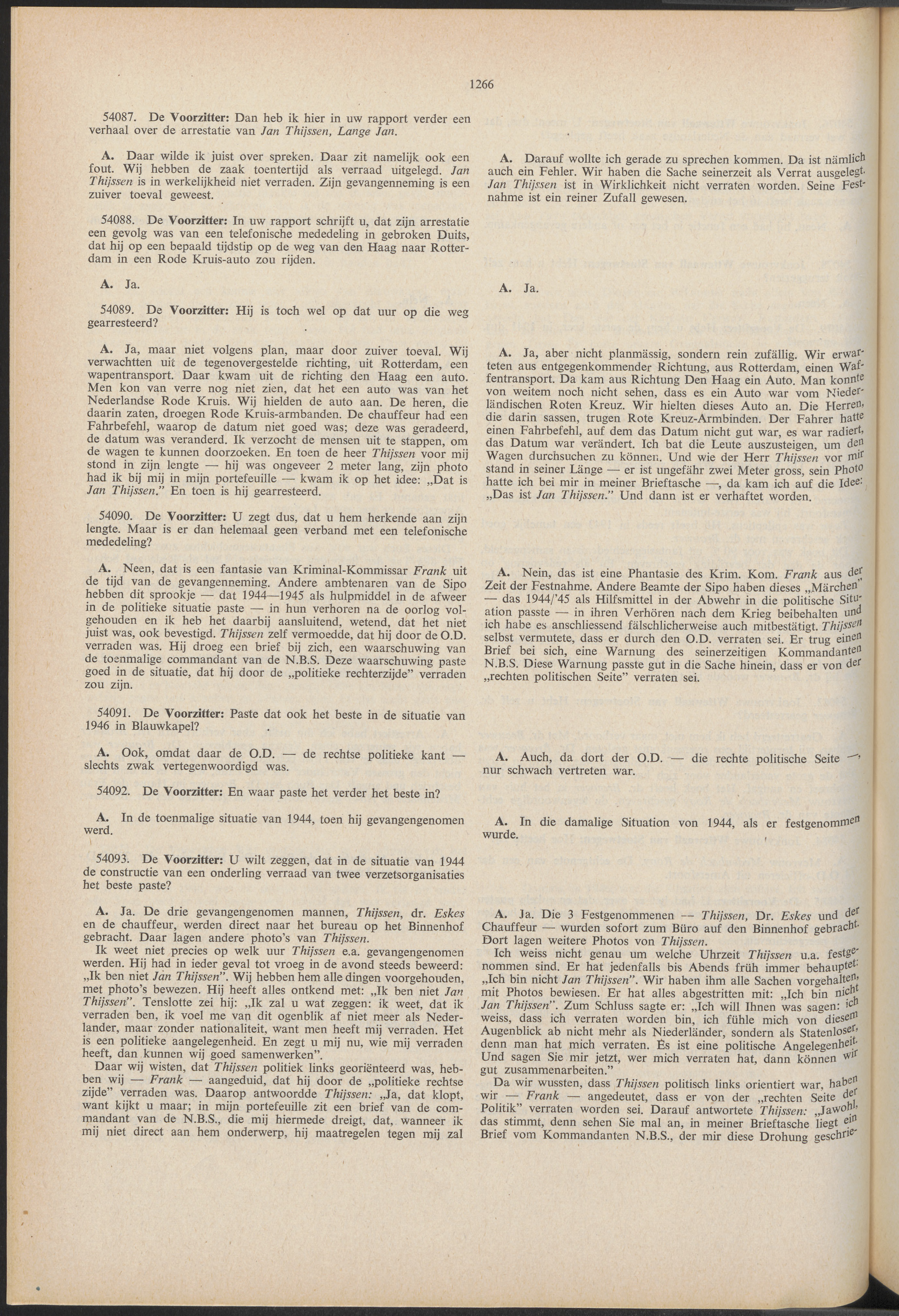
His arrest, as the Enquêtecommissie heard it (1949). The parliamentary commission on the wartime government's policy questioned the German officer who made the arrest, and Thijssen's own colleagues, in May to August 1949. ✓ Heinrich Karl Otto Haubrock, a Kriminalsekretär of the Sicherheitsdienst, then in prison at Rotterdam, was put his own report of 1946, in which Thijssen was caught after a telephone tip, in broken German, that he would be on the road from The Hague to Rotterdam in a Red Cross car. He told the commission, on oath, that this was wrong (the hearing of 20 May 1949, printed p. 1266, checked on the page image):
Jan Thijssen was in fact not betrayed. His capture was pure chance. [...] We were expecting an arms transport from the opposite direction, from Rotterdam. A car came from The Hague. From a distance one could not yet see that it was a car of the Netherlands Red Cross. We stopped it. The gentlemen in it wore Red Cross armbands. The driver had a Fahrbefehl on which the date was not right; it had been erased, the date had been altered. I asked the people to get out so that the car could be searched. And when Mr Thijssen stood in front of me in his length — he was about 2 metres tall, I had his photo on me in my wallet — I had the idea: "That is Jan Thijssen." And then he was arrested.
Dutch originalJan Thijssen is in werkelijkheid niet verraden. Zijn gevangenneming is een zuiver toeval geweest. [...] Wij verwachtten uit de tegenovergestelde richting, uit Rotterdam, een wapentransport. Daar kwam uit de richting den Haag een auto. Men kon van verre nog niet zien, dat het een auto was van het Nederlandse Rode Kruis. Wij hielden de auto aan. De heren, die daarin zaten, droegen Rode Kruis-armbanden. De chauffeur had een Fahrbefehl, waarop de datum niet goed was; deze was geradeerd, de datum was veranderd. Ik verzocht de mensen uit te stappen, om de wagen te kunnen doorzoeken. En toen de heer Thijssen voor mij stond in zijn lengte — hij was ongeveer 2 meter lang, zijn photo had ik bij mij in mijn portefeuille — kwam ik op het idee: "Dat is Jan Thijssen." En toen is hij gearresteerd.
— Haubrock, Sicherheitsdienst, to the Enquêtecommissie Regeringsbeleid, 20 May 1949 · Verslag, deel 4C-II, p. 1266 · the pages
- ✓ Who was taken. "De drie gevangengenomen mannen, Thijssen, dr. Eskes en de chauffeur" (the three men taken, Thijssen, Dr Eskes and the driver) were brought straight to the office on the Binnenhof; Thijssen kept saying until early evening that he was not Jan Thijssen, then said he knew he had been betrayed. Dirk Eskes is the Eskes of the radio service, released or escaped afterwards (the sources differ: his page) and taken again later (below).
- ✓ What Thijssen said, and what the Germans did with it. Haubrock says Thijssen thought the O.D. had betrayed him, and carried a letter from the N.B.S. commander threatening him; the Germans let that stand, and Haubrock says the telephone story was "een fantasie" of Kriminal-Kommissar Frank that other Sipo men kept up after the war and that he, "wetend, dat het niet juist was" (knowing it was not right), confirmed too (same page).
- ✓ Schreieder, 9 August 1949, in a separate statement at Munich (the statement, printed p. 82, checked on the page image):
- The arrest was the Frank commando's. Its informer Brinkman (alias Ab van Straaten) had reported an arms transport on the road from The Hague to Rotterdam, and the Red Cross car was stopped; Haubrock recognised Thijssen.
- The stop was "geheel toevallig" (entirely by chance) by what Frank told him. He never heard of the telephone tip and thinks it "volkomen uitgesloten" (completely excluded).
- Thijssen had meant only to arrange the transport's preparation at The Hague, and at The Hague "bleek hem, dat het wenselijk was" (it appeared to him that it was desirable) to arrange things at Rotterdam too, so that he decided on the trip to Rotterdam unexpectedly. Schreieder dates it "November 1943", which cannot be right.
- ✓ His colleagues (the hearing of 7 June 1949, pp. 1403 and 1407, checked on the page images):
- Christine van Hoorn Alkema–Schadd, his secretary, has him arrested in November 1944, and Dr Eskes "eerst met Jan gearresteerd — deze is gearresteerd met twee mensen — en daarna ... weer vrijgelaten, maar ... later nog eens gepakt" (first arrested with Jan, who was arrested with two people, then released, but caught again later).
- Her brother Tom Schadd, who took over the work, began his contact with Thijssen at the end of October 1944, "enkele weken een zeer intensief contact" (some weeks of very intensive contact), and says he was caught "op één van zijn tochten" (on one of his trips), shortly after a last talk with Wagenaar at which Dr Eskes was present.
- Her husband, W. J. van Hoorn Alkema (Boeree's "Wim R.V.V." above), told the commission that he "heeft Jan Thijssen het laatst gezien op 8 November" (last saw Jan Thijssen on 8 November) and learned of the arrest only after the war (the commission's summary, p. 431, checked on the image).
- ◐ Before the arrest. Ausems, who joined the radio service in 1943, had known Thijssen from the gliding field at Teuge and met him again at Jan Brouwer's house in January 1943 (the hearing of 17 May 1949, p. 1177, checked on the image).
- ⚠︎ His time in German hands. What he told the SD comes from two of its officers, Haubrock, who made the arrest, and Schreieder, who held him afterwards, and from De Jong, drawing on the SD's papers; nothing comes from Thijssen himself, and the accounts differ (Haubrock, 20 May 1949, pp. 1266–1268; Schreieder, 9 August 1949, p. 82; De Jong, deel 10b, p. 627, PDF p. 634, from the text layer).
- That he gave nothing away. Schreieder: "Jan Thijssen heeft zich zeer goed gehouden. Hij heeft niets prijs gegeven van hetgeen hij wist" (Jan Thijssen behaved very well; he gave away nothing of what he knew). De Jong quotes the SD's code man May, "hat jedoch keine Namen und keine Adressen von anderen Personen genannt" (named no names or addresses of others, so long as they were still free), and says he also kept Eskes's part in the RVV secret.
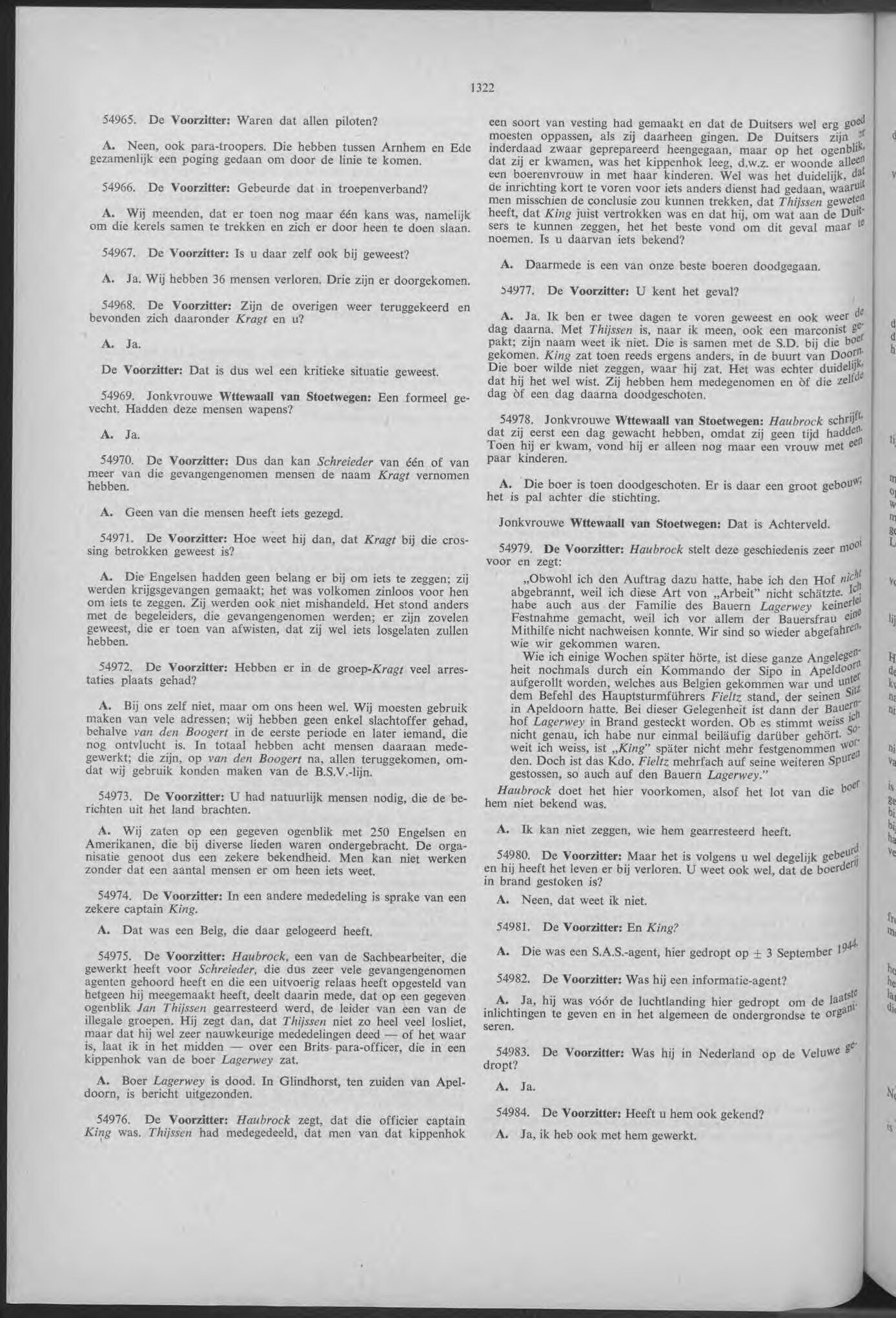
- Haubrock on a British officer in a hen-house. ◐ At the hearing of Joseph Piller the chairman put it that Haubrock had written that Thijssen "niet zo heel veel losliet, maar dat hij wel zeer nauwkeurige mededelingen deed" (did not give away very much, but did make very precise statements) about a British para officer in a hen-house of the farmer Lagerwey, and that this officer was Captain King; the "of het waar is, laat ik in het midden" (whether it is true I leave open) is the chairman's own remark.
- The chairman added that the hen-house was empty when the Germans came and asked whether Thijssen might have named it knowing King had just left.
- It is a German officer's report put as a question, a third statement beside Schreieder's and Haubrock's own on what he told the SD (Verslag, deel 4C-II, p. 1322, nos. 54975–54976, read on the image; Wuf Lagerweij; Gilbert Kirschen). Who raided the hen-house, and when, is not settled.
- Haubrock's version. From the moment he was taken, "waarop hij doorsloeg" (when he gave way), Haubrock says, Thijssen was no longer against the Germans, only against the political right; what he told them was aimed at the O.D., and the "geestelijke fundament" (spiritual foundation) of the German-made Vrij Nederland was his, if he wrote nothing himself (q. 54103–54105). Schreieder says that impression is wrong: Thijssen spoke to a Dr Isperth in general terms, named no names and did not know what it was for.
The quarrel with Koot and the arrest of 9 November, in the commission's report and the press of 1955. ◐ The Enquêtecommissie's final report came out in November 1955, and Het Parool and De Volkskrant of 5 November summarise what it says of him. We have read both on the page images, but not the report, so this is the papers' account of it. Het Parool gives the last days:
This dismissal letter of the RVV was written on 7 November. On 9 November Lange Jan had a talk about it with RVV leaders in Amsterdam. The same evening he was arrested near Leiden, and did not come back.
Dutch originalDeze ontslagbrief van het RVV werd op 7 November geschreven. Op 9 November had Lange Jan daarover een gesprek met RVV-leiders in Amsterdam. Diezelfde avond is hij bij Leiden gearresteerd, en niet meer teruggekeerd.
— Het Parool, 5 November 1955, p. 7 · "Gearresteerd (door verraad?) November '44" · the article
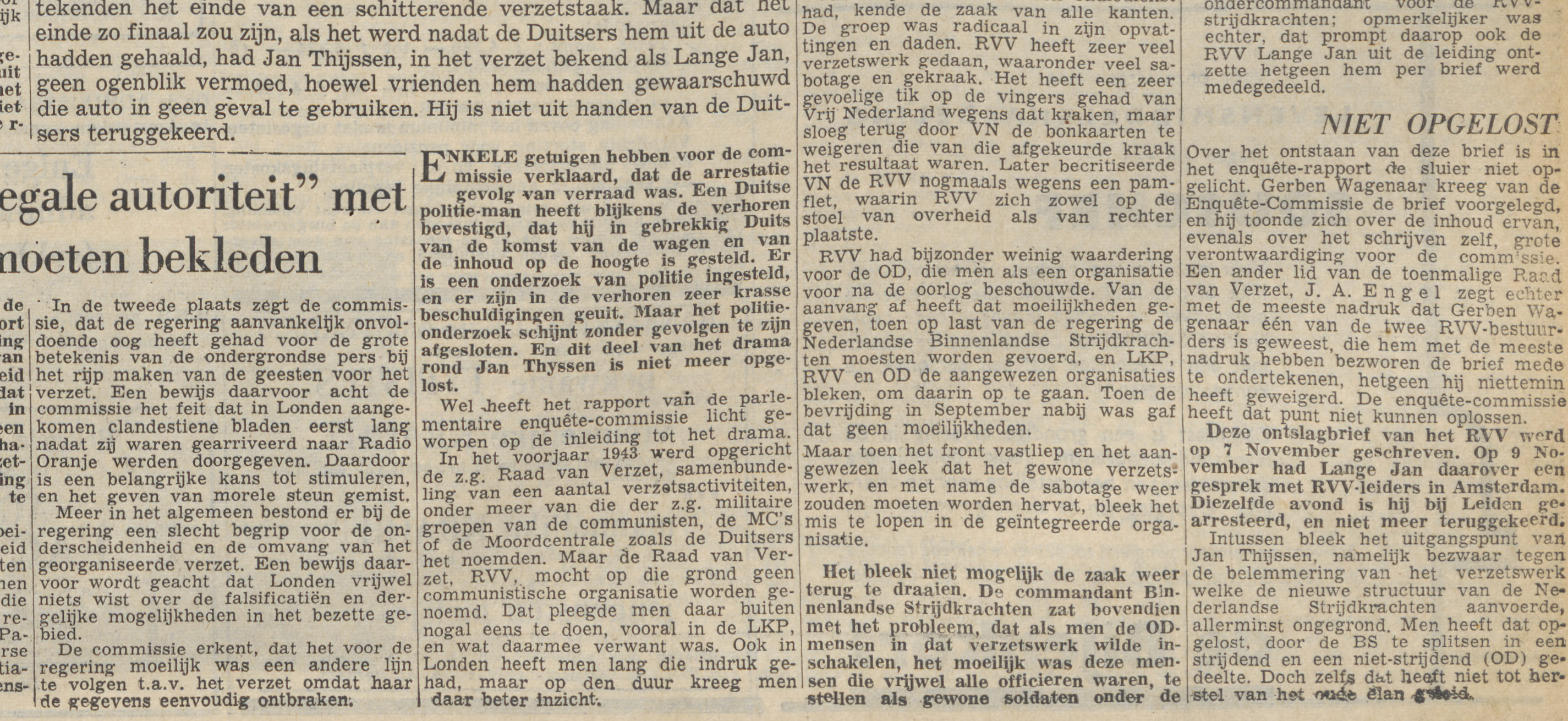
- ◐ What the two papers give (Het Parool; De Volkskrant).
- Het Parool: he protested on 24 and 26 October "in de scherpste bewoordingen" (in the sharpest terms) to General Koot, who dismissed him as under-commander of the RVV forces; "prompt daarop" (promptly after) the RVV also removed him from its leadership, by a letter.
- Het Parool: the commission could not settle how that letter came about, because two RVV leaders it heard gave opposing accounts.
- De Volkskrant: he "viel de Duitsers op 9 november 1944 in handen" (fell into German hands on 9 November 1944), and the conflict had run so high "kort voor de dag van Thijssens arrestatie" (shortly before the day of his arrest) that Koot felt compelled to take the command from him.
- ◐ How he was caught, in 1955.
- Het Parool: friends had warned him never to use the car; some witnesses told the commission it was betrayal; a German policeman confirmed that he was told "in gebrekkig Duits" (in broken German) of the car and its contents (◐ evidently the telephone tip in Haubrock's report of 1946, above).
- Het Parool: a police inquiry was opened, and it "schijnt zonder gevolgen te zijn afgesloten" (seems to have been closed without result).
- De Volkskrant, on the quarrel with Koot: "Over het algemeen" (in general) the witnesses told the commission that Koot had been "bijzonder soepel" (exceptionally accommodating) and had shown "eindeloos geduld" (endless patience) with Thijssen, whose quality he had several times respected.
- "Sommige ondervraagden" (some of those questioned) said Koot could have shown more understanding for Thijssen's great difficulties.
- Of Thijssen it says he "het maar niet verstouwen kon" (could not stomach it) that the leadership had been taken out of his hands, that his letters to Koot "in verschillend opzicht niet door de beugel konden" (were in several respects not acceptable), and that he was "een voortreffelijk illegaal werker met organisatorische talenten" (an excellent illegal worker with organising talents). The commission left the personal frictions out of its conclusions.
- ✓ The Prince's telegram of 2 November (Verslag, deel 4C-I, pp. 857-858, checked on the images).
- Six told the commission on 10 March 1949 that on 2 November a telegram came from Prince Bernhard giving the leadership to the O.D.'s chief of staff, "Jan R.V.V." and Frank of the K.P., with Koot as adviser holding the deciding vote. The text, which Six read out, has "Karel R.V." sitting in the Delta centre in person.
- ◐ "Karel" is Thijssen: Six himself says "Jan R.V.V.", and "Lange Karel" is his code name (above).
- On p. 857 Six says Thijssen, who had stayed out of the meeting that chose the name Delta in September, sent the Prince a telegram "op eigen houtje" (on his own account) about it.
- ◐ The command, in the news summary. The wire-service summary of the report, printed in five papers on 4 to 9 November 1955 (Tubantia, checked on the image; the other copies).
- It has the command put in the hands of "de heren Six „Frank" (Van Bijnen) en „Lange Jan" (Jan Thijssen)" with Koot as adviser with a deciding vote.
- Het Vaderland of the same day has Koot trying to end the rivalry but meeting "onvoldoende medewerking van de commandanten der K.P. en R.V.V." (insufficient cooperation from the commanders of the K.P. and R.V.V.), Frank and Thijssen (p. 16, checked on the image).
- ◐ From the LKP's side (pp. 400 and 654, Het grote gebod, checked on the images).
- P. 400 has "Lange Jan was geen persona grata meer" (no longer persona grata) when the Prince's staff weighed whom to name commander of the fighting part. ◐ It says only "Lange Jan"; p. 654, which names him, has the same quarrel.
- P. 654 has him "door zijn organisatie terzijde [werd] gesteld" (put to one side by his organisation) "nadat hij door De Klerk officieel buiten de BS was gesloten" (after De Klerk had formally shut him out of the BS). The book does not say who "De Klerk" is; its account has him commanding the BS, as the commission's papers have Koot.
- ✓ The dismissal of the commander-South, before the south was liberated (Verslag, deel 5C, p. 555; deel 5A, p. 370; both checked on the images).
- Dr Johannes Hoekstra told the commission on 18 July 1950 that he had been commander-South of the Raad van Verzet since the start of 1944 and that "een paar dagen vóór de inval, de bevrijding" (a few days before the invasion, the liberation) he was removed "Door Jan Thijssen", after a conflict in the Raad over organisational questions.
- He thought the dismissal valid in the illegal sense and stayed the first man in the south. The report (deel 5A) repeats it, and De Waarheid of 4 March 1959, a party paper, has it too (De Waarheid, checked on the image).
- ✓ The College of Vertrouwensmannen (Verslag, deel 5C, p. 482, checked on the image; deel 5A, p. 731).
- Van der Gaag told the commission on 31 March 1950 that Thijssen, not yet arrested, was "buitengewoon ontstemd" (extremely put out) when he heard Van der Gaag had been picked for the College, and said as RVV leader "De R.V.V. wil niets met het College van Vertrouwensmannen te maken hebben" (the RVV wants nothing to do with the College).
- Van der Gaag answered that it was a royal decree signed by the Queen; they talked it over at the Amsterdam zoo and shook hands. No date is given for any of it. De Waarheid of 13 June 1958 tells it too, as a party paper (De Waarheid).
- ⚠︎ Two men called Lange Jan.
- Van der Gaag said Koot feared that "Lange Jan" would go south on his own, and that "Er ging inderdaad een Lange Jan, maar dit bleek de andere Lange Jan te zijn" (a Lange Jan did go, but it turned out to be the other Lange Jan) (p. 483, checked on the image).
- Het grote gebod captions a different man, Binnert de Beaufort, "(Lange Jan)", on a page of KP-Amsterdam photographs (its caption says three of the five men there belonged to the KP-Amsterdam's detective bureau, without our being able to tell from the transcript whether he is one of them): shot in Amsterdam on 16 February 1945 (p. 539, checked on the image).
- So the nickname alone does not identify Thijssen. Most uses above are tied to his name by the source itself; four are not: Het grote gebod pp. 400 and 671, Partizanen's order for the Putten raid, and Van der Gaag's own "Lange Jan" (p. 483), which comes without a name. ◐ We read those as Thijssen's from their context, which leaves them open to Van der Gaag's "other Lange Jan". We do not know whether De Beaufort is the "other" Lange Jan.
Zwolle and the Woeste Hoeve
Link to the section Zwolle and the Woeste Hoeve◐ By De Jong's account Schreieder had him moved after some time to Zwolle, where the interrogations went on. De Jong quotes inscriptions he cut into the wall of his cell there: "Hier vervloekt men zichzelf" (here one curses oneself), which De Jong reads as about the Red Cross car; lines to his wife, "zijn dappere kameraad in het verzet" (his brave comrade in the resistance); William I's "Pas besoin d'espérer pour entreprendre, ni de réussir pour perséverer"; and "Ons slaat geen stormwind neder!" (no storm wind strikes us down). Schreieder could not save him when Kolitz had his name put on the list of men to be taken from Zwolle to the Woeste Hoeve after the attack on Rauter, and "Op de executieplaats trachtte Thijssen als enige te ontkomen. Dat mislukte." (At the place of execution Thijssen alone tried to get away. It failed.) (deel 10b, p. 628, PDF p. 635, read on the image.)
Prince Bernhard tried in vain to have him exchanged for a senior German officer. In March 1945 he was shot at the Woeste Hoeve "als represaille voor den aanslag op Rauter" (in reprisal for the attack on Rauter) (De Maasbode); the Raad van Verzet gave the date as 8 March 1945 (Nijmeegsch Dagblad), the day and place Abraham du Bois was shot.
In After the Battle. ◐ The British magazine's article on De Woeste Hoeve names him among the men shot there on 8 March 1945 (the passages, from the Archive's full-text index, not read on the page):
[A] prisoner tried to make a run for it. He was Jan Thijssen, the national leader of the Raad van Verzet, the Council of Resistance. His attempt failed and he was shot with the others. One man fell dead into one of the pits dug by the Wehrmacht for protection against air attack.
— After the Battle · the De Woeste Hoeve article · the passages
The same article says of those shot that Thijssen, "Resistance leader", "is special for two reasons": being the national head of the Raad van Verzet, "he was probably the most important and highest ranking Resistance fighter executed at De Woeste Hoeve", and, "of all the people brought to the place, he was the only one who tried to escape". ◐ That agrees with the monument text's escape attempt (above), and with De Jong's; the magazine's own source is not shown in the passages, and neither passage cites a record for it, so it is one account repeated, not two.
Burial and the grave
Link to the section Burial and the graveIn September 1945 he was reburied at Bussum with military honours, with wreaths from the Queen, Princess Juliana and Prince Bernhard (De Maasbode).
✓ The family's first notice, dated Nijmegen, 4 June 1945, has him fallen "voor zijn land" (for his country) at the Woeste Hoeve, aged 36, "Commandant Radio-dienst, Commandant Raad van Verzet", signed by his wife and his mother and, below them, his siblings and in-laws, whom this page does not name (Nijmeegsch Dagblad, 5 June 1945; checked on the image). The notice of the reburial, signed by his wife, gives his names as "(Lange Jan, Karel Grootegast)", calls him "Oprichter van den Raad van Verzet en Oprichter-Commandant van den Radiodienst" (founder of the Raad van Verzet and founder-commander of the Radio Service), has him "voorloopig begraven te Apeldoorn" (provisionally buried at Apeldoorn), and gives the funeral as 14 September at the general cemetery at Bussum, leaving from Gooilaan 12 (Het Parool, 8 September 1945; checked on the image). ◐ The L.O.'s bulletin of 22 September repeats both names and the burial, and says the procession had a delegate of the Princely couple, senior officers and delegates of many resistance groups, with a staff company of the B.S. and P. Brouwer speaking "namens alle naaste vrienden en medewerkers" (for all his closest friends and colleagues) (Mededeelingen van C.B.-L.O.; OCR only). ◐ The N.B.S. memorial book has a photograph of General-Major Koot, the commander who, by De Jong's account, had removed him (above), speaking for Prince Bernhard "aan de groeve van 'Lange Jan'" (at the grave of Lange Jan) on 14 September, and calls him leader of the radio section of the Binnenlandsche Strijdkrachten (Gedenkboek N.B.S. en Kon. Landmacht; OCR only, from a caption).
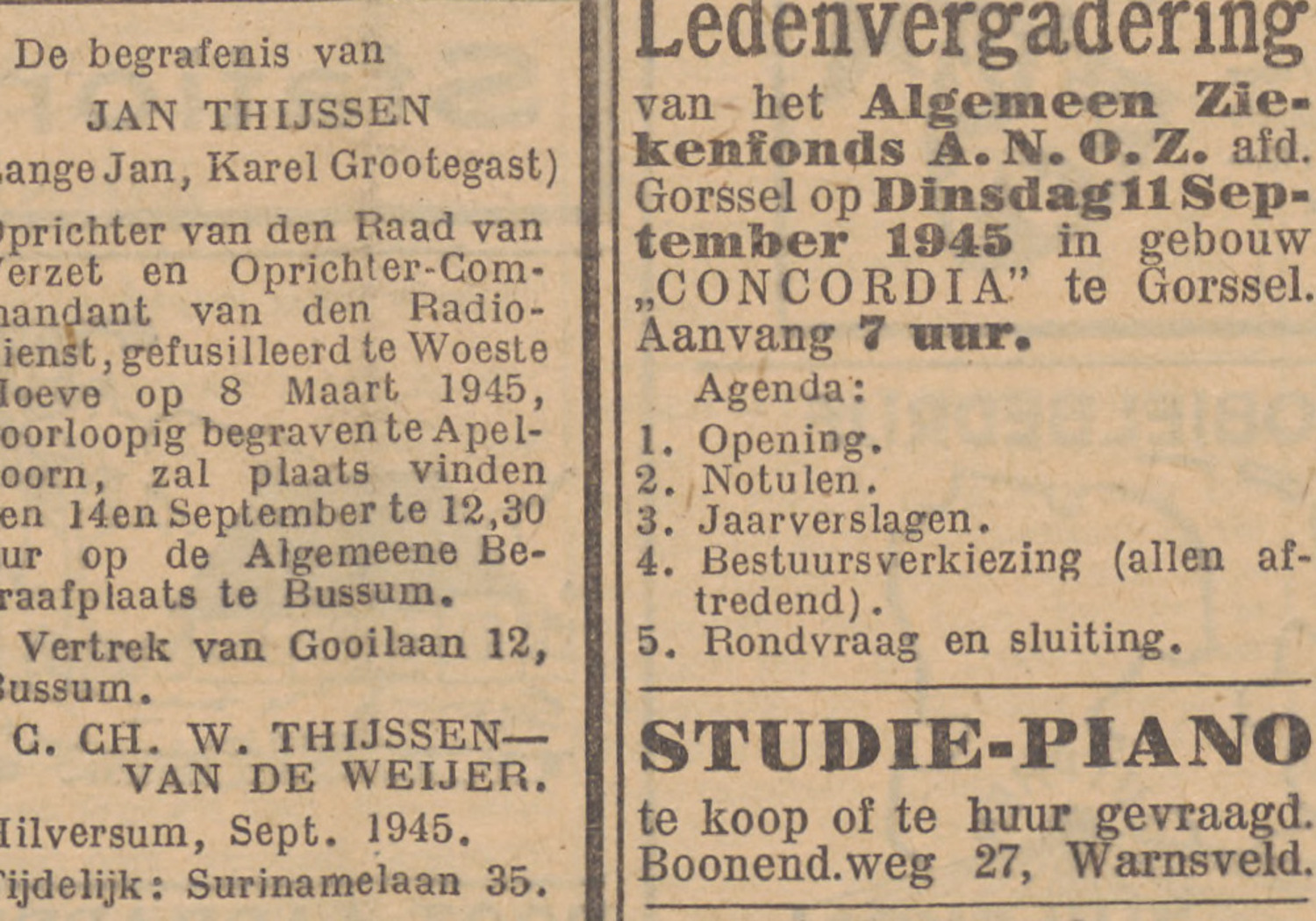
The grave. ✓ The Foundation's file has the rest. He was first buried at the Woeste Hoeve (the grave card's "Oorspronkelijk begraven te: Woeste Hoeve"), then at the general cemetery at Bussum on 14 September 1945, first class, no. 592, a purchased grave with a standing stone, the burial paid for by the state, a regerings-begrafenis (scan 6; scan 26). Bussum's burgomaster listed it first of the town's three graves of resistance victims on 15 September 1950, a private grave (scan 23). His widow wrote from Wassenaar in April 1947, glad that her husband's name would be on the Foundation's list (scan 24). In 1989–90 the family asked the Foundation to move him, and his mother, who had died on 15 July 1976 and was to be moved with him, to the Ereveld at Loenen. He was exhumed on Wednesday 4 April 1990 and reburied at Loenen, plot A, no. 859 (the grave card has the reburial on 5 April), and the Foundation's letter of 23 August 1990 to his widow says the stone was placed on 31 July (scan 10, read from its OCR, not transcribed). The exhumation and the reburial are from the exhumation list and the grave card (scan 17; scan 26); the letters of 1989–90 are typed copies and are not transcribed. The Ministry of Justice's stamp of 21 June 1954 finds no political act of his punished by the special courts (scan 3).
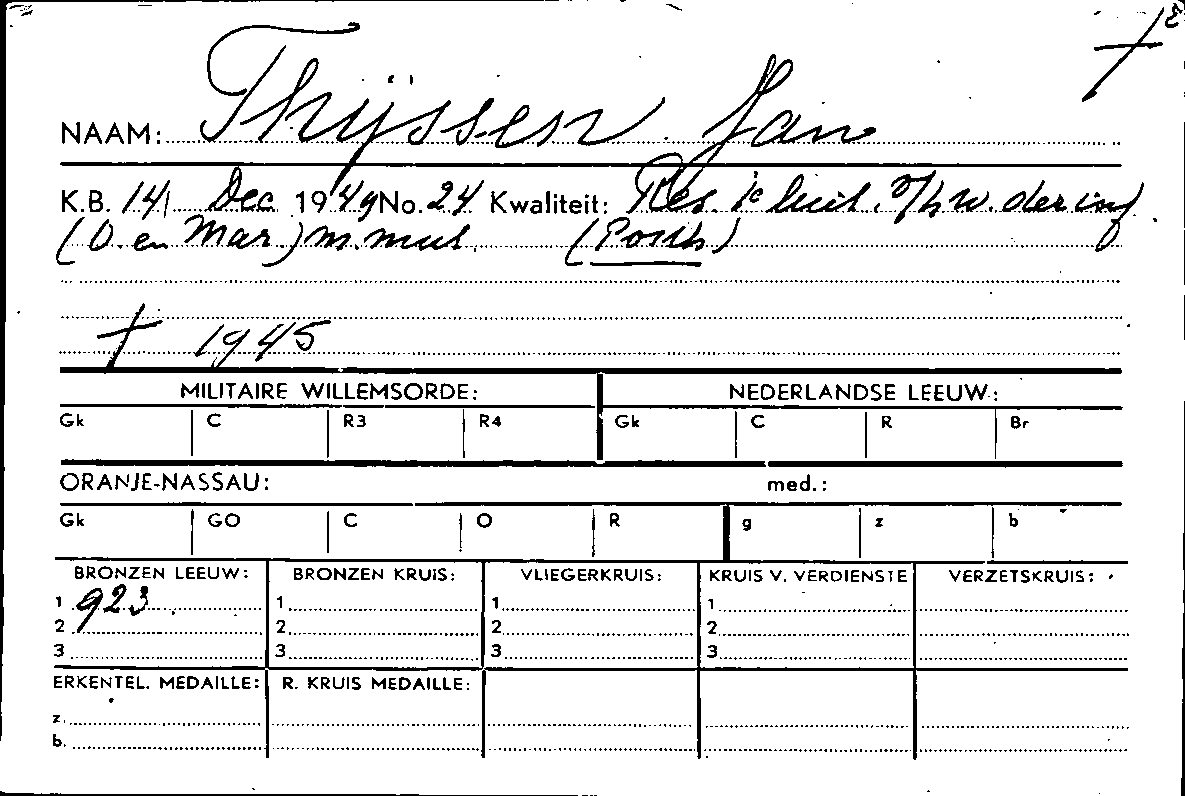
✓ The Netherlands gave him the Bronze Lion, posthumously, by royal decree of 14 December 1949, no. 24, as a reserve first lieutenant of the infantry; its register number is 923 (the card, Nationaal Archief 2.02.32; the Defence record). Stichting Kroon's list of awards gives the citation:
Distinguished himself by particularly brave and prudent deeds in the fight against the enemy, by acting during the occupation of the Netherlands as one of the leading figures in the illegal radio service and as one of the first who, at first still with his own sets, opened the wireless link with the Netherlands Government in London for one of the largest resistance groups. Further distinguished himself by developing radio communications within the resistance itself. Constantly running great risks in all this, he nevertheless kept it up with the utmost tenacity, often struggling against almost insurmountable difficulties, until he was captured by the enemy in November 1944 and shot in March 1945. By this conduct rendering important services to the Allied war effort and the Netherlands Government.
Dutch originalHeeft zich door het bedrijven van bijzonder moedige en beleidvolle daden in de strijd tegenover de vijand onderscheiden door tijdens de bezetting van Nederland op te treden als één van de leidende figuren in de illegale radiodienst en als één van de eersten, die, oorspronkelijk nog met eigen installaties, voor één van de grootste verzetsgroepen de radiografische verbinding met de Nederlandse Regering te Londen opnam. Voorts zich onderscheiden door het doen uitgroeien van de radioverbindingen ook in het verzet zelf. Bij een en ander steeds vele risicos lopende, dit nochtans op uiterst hardnekkige wijze te blijven voortzetten, dikwijls strijdend tegen schier onoverkomelijke moeilijkheden, totdat hij in November 1944 door de vijand werd gevangen genomen en in Maart 1945 werd gefusilleerd. Door dit optreden belangrijke diensten te bewijzen aan de Geallieerde oorlogvoering en de Nederlandse Regering.
— Citation for the Bronze Lion, royal decree of 14 December 1949 · as transcribed by Stichting Kroon, Decorandi, citing "BL/BK blz. 234" · the archived page (Wayback Machine, 2022)
◐ The text is Stichting Kroon's transcription, not a scan of the decree; the card holds no citation. The same list has the American Medal of Freedom with silver palm, presented at The Hague on 8 April 1953, posthumously (Decorandi; ⚠︎ the 1953 newspapers have the bronze palm, and 7 April for the presentation to the families: below).
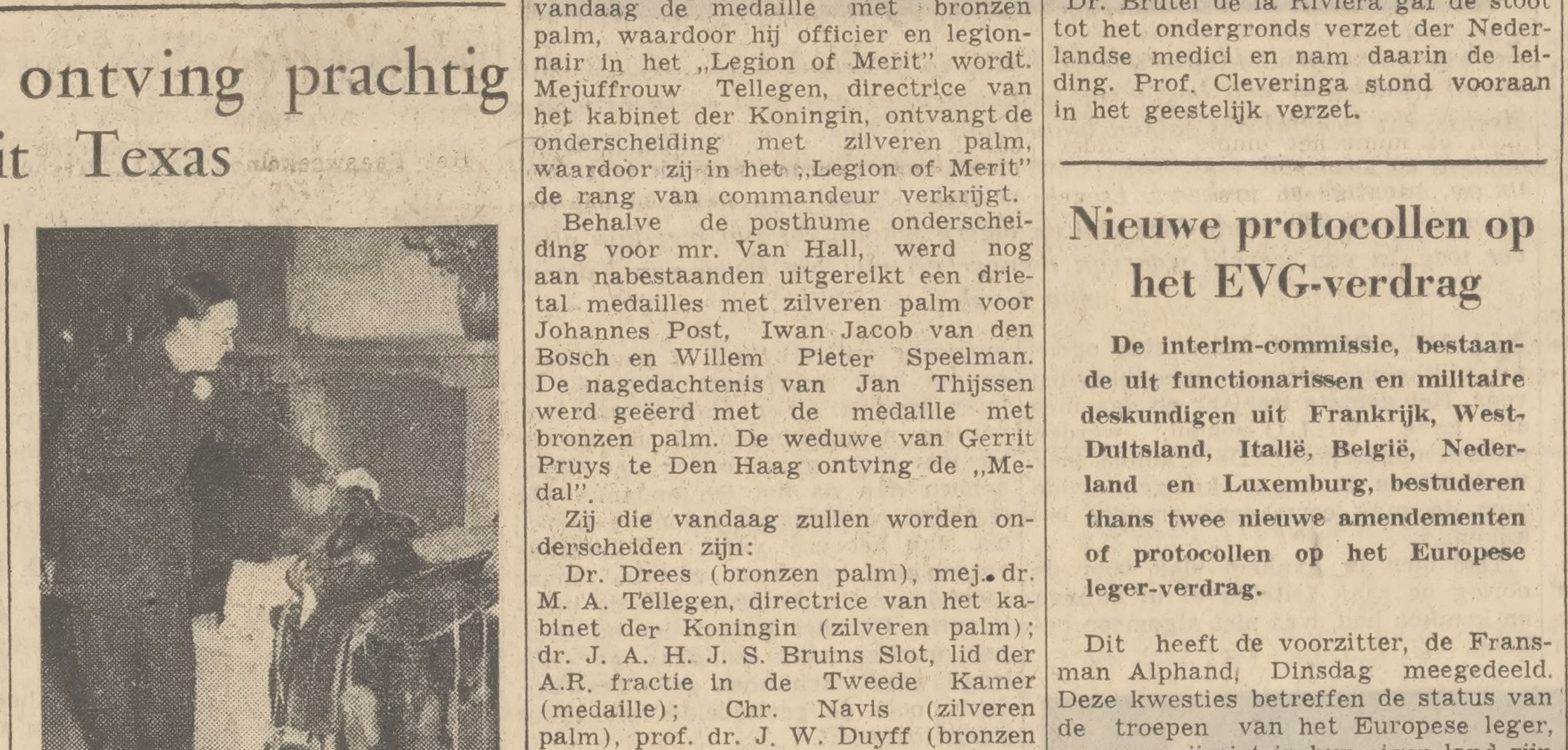
The Medal of Freedom, April 1953. ✓ The Dutch press reported the awards on 7 and 8 April 1953 from one wire-service text. Het Vaderland of 7 April: the American ambassador, Selden Chapin, had that morning at his residence given the medals to the next of kin of six men honoured after their deaths. Three silver palms went to Johannes Post, Iwan Jacob van den Bosch and Willem Pieter Speelman, the gold palm to Walraven van Hall (and to one man then living), and "De nagedachtenis van Jan Thijssen werd geëerd met de medaille met bronzen palm" (the memory of Jan Thijssen was honoured with the medal with bronze palm). The paper adds "J. Thijssen onderhield via zijn radio-installatie geregeld contact met Engeland. Vele malen ternauwernood ontsnapt volgde zijn executie tenslotte op 8 Maart 1945." (J. Thijssen kept regular contact with England through his radio installation; many times narrowly escaped, his execution finally followed on 8 March 1945) (Het Vaderland, 7 April 1953, p. 3; Arnhemsche courant, 8 April, p. 4; both checked on the images; the same text, with small differences, is in twenty more papers: the copies). Trouw of 8 April has a photograph of the ceremony, and its caption puts "de weduwe van mr. Jan Thijssen" (the widow of Mr Jan Thijssen) in the row: the ambassador, then the widows of Pruys, Thijssen, Van Hall and Post, the daughter of Van den Bosch and Speelman's father. It does not name her (Trouw, checked on the image); her name is in the marriage deed, above.
How he is remembered
Link to the section How he is rememberedOn 27 September 1945 the Raad van Verzet announced that the Vlietweg at Rijswijk would be renamed the Jan Thijssenweg at a ceremony in front of his house at 2 p.m. on Saturday 29 September; we have no report that it was held (Nijmeegsch Dagblad). ◐ In September 1974 Rotterdam named twenty streets in Hoogvliet and Portugaal after resistance dead, and the list of names in Het Vrije Volk of 9 September has "Jan Thijssen" in it, between Gerrit Kastein and H. M. van Randwijk; relatives laid flowers under the street signs on the Saturday. The paper does not say which Jan Thijssen: the list is of resistance dead and has Gerrit-Jan van der Veen, a founder of the RVV, in it (Het Vrije Volk, 9 September 1974, p. 7, checked on the image).
The Teuge window, 1948. ✓ Thijssen had been a glider pilot at the Teuge airfield, by Ausems (above). On Saturday 5 June 1948 the Teuge flying club unveiled a stained-glass memorial window in its clubhouse for four members killed in the war, and he is one of them. Its words "Gestreden, onversaagd" (fought, undaunted) are from a poem he wrote in his cell in the House of Detention at Zwolle "kort voor dat hij met 17 anderen werd weggevoerd en bij de Woeste Hoeve gefusilleerd" (shortly before he was taken away with 17 others and shot at the Woeste Hoeve) (Overijsselsch Dagblad, 9 June 1948; checked on the image). ◐ The Deventer Dagblad of 7 June has the club remembering "Jan Thijssen uit Rijswijk, een der leidende figuren uit de illegaliteit, organisator o.a. van de vermaarde weerberichtendienst voor de geallieerden" (organiser of the renowned weather-report service for the Allies), and his mother thanking the club for the families (the report; OCR only). Both papers write weerberichten (weather reports) where every other source has the radio service; we do not know whether that is the papers' word for it. The poem itself is not printed in either paper.
✓ The Erelijst of the fallen lists him on p. 714: "Jan Thijssen", born at Bussum on 29 December 1908, died at the Woeste Hoeve on 8 March 1945, "Ambtenaar" (civil servant), group "Verzet" (resistance) (the Erelijst's entry).
Where the sources disagree
Link to the section Where the sources disagree- The day and place of his death. ✓ 8 March 1945 at the Woeste Hoeve, in Apeldoorn municipality: the death deed, the Foundation's forms, the grave card, De Maasbode and Het Parool (the record; scan 3; scan 26; Het Parool). ✗ De Tijd of 13 September 1945, the day before the reburial, has him shot "8 Mei j.l." (8 May last) and buried "te Hilversum" (the notice; image-checked), a slip on both counts: May is after the war in Europe and the burial was at Bussum.
- Founder, commander or secretary. The monument text and its contributor have him commander of the RVV and its founder with six others; De Maasbode has him co-founder and secretary of the Raad van Verzet (the page; De Maasbode). ◐ The two need not conflict (co-founder with six others, then commander, and secretary), but no record has been seen.
- The founding of the radio service. The same De Tijd notice has him "oprichter van den Raad van Verzet en mede-oprichter van den Radiodienst" (founder of the Raad van Verzet and co-founder of the radio service). De Maasbode has him co-founder and secretary of the Raad van Verzet and the founder of the radio service at the end of 1943, and Het Parool has him organising it "in hoofdzaak" (in the main) with the Eskeses (De Maasbode; Het Parool). ◐ Founder or co-founder of the radio service; the notices are compressed, and none is a record.
- His occupation. "Radio technicus" (Bussum, 1954), "Electr. Techn. P.T.T. ambtenaar" (his mother) and "zonder beroep" (without occupation) in the death deed (scan 2; scan 6; the record). ◐ A radio technician in the P.T.T.'s service fits both forms; the deed's index gives him zonder beroep where it gives his parents geen beroep vermeld (no occupation stated).
- Where he was first buried. The Foundation's file has "Oorspronkelijk begraven te: Woeste Hoeve" on the grave card, and the family's notice of 1945 "voorloopig begraven te Apeldoorn" (provisionally buried at Apeldoorn) (scan 26; Het Parool). ◐ The Woeste Hoeve is in Apeldoorn municipality, so the two can be one place; no record of the first grave has been seen.
- His church. "NH" on Bussum's form, "geen" on the grave form and the exhumation list (scan 2; scan 6; scan 17). ⚠︎ Not settled; it matters to nothing else here.
- How he was caught. ◐ Not settled.
- The monument text has him arrested "waarschijnlijk door verraad" (probably by betrayal), and Thijssen himself believed the O.D. had betrayed him, by Haubrock's and Schreieder's accounts (the page; Haubrock, p. 1266; Schreieder, p. 82).
- Haubrock's report of 1946 had a telephone tip that he would be on the road to Rotterdam in a Red Cross car; the commission's chairman put that to him in 1949 (Haubrock, p. 1266).
- Haubrock on oath in 1949: pure chance, the telephone call "een fantasie" of Frank's, which he had confirmed after the war knowing it was untrue; he says the Germans let the betrayal story stand because it suited them in 1944 and again in 1946 (same page).
- Schreieder in August 1949, separately: the stop was by chance, though it was set for an arms transport after an informer's tip, and he never heard of the telephone call (p. 82).
- The commission left the question to its report on points g and h of its mandate, which we have not read (the summary, p. 427).
- ◐ The 1949 accounts agree with each other and run against Haubrock's own earlier report, which is a reason to prefer them; but both come from the officers who made the arrest, and no Dutch source from the time shows how the Germans knew to look for him. Chance and betrayal stay open.
- ◐ De Jong (1981) has the stop follow the V-Mann Brinkman's tip about an arms transport (above), and adds in a note (deel 10b, p. 627, note 1, read on the image):
- Brinkman spread word in RVV circles that an RVV man had betrayed Thijssen, while Thijssen himself, misled by Frank and Haubrock, believed Six had tipped off the SD; a girl in the next cell later passed Van Hoorn Alkema a message "dat hij nu wist wie hem verraden had, zonder te zeggen wie" (that he now knew who had betrayed him, without saying who).
- As his own opinion, De Jong sees no reason to doubt Haubrock's sworn statement, "niet in te zien dat er reden is tot twijfel aan de juistheid van de verklaring welke Haubrock onder ede heeft afgelegd", and holds that Six was "geenszins de man naar om een laaghartigheid te bedrijven" (in no way the man to commit a base act).
- ◐ Later writers; none gives a checkable source for a betrayal:
- Vrij Nederland (1970) has suspicions, "totnogtoe nooit bewezen" (never yet proved), that the O.D. had a hand in it; says "sommige verhoren van de Parlementaire Enquête Commissie" (some hearings of the parliamentary commission) ascribe it to Brinkman, the agent-provocateur; has others of the opinion, "zonder het te kunnen waarmaken" (without being able to substantiate it), that Colonel Koot was behind it; and ends "zijn dood is nooit opgehelderd" (his death has never been cleared up) (pp. 21–22).
- Vrij Nederland (1978) has friends who still believe in "verraad door de concurrerende ordedienst" (betrayal by the rival O.D.) (the article).
- Partizanen (1999) has him "verraden door de OD, zoals hij ten onrechte dacht" (betrayed by the O.D., as he wrongly thought) (p. 229); Klinkenberg (1986) has "door verraad" (above).
- When he was arrested. ◐ 9 November 1944 on the best evidence we hold, which is two newspapers' summary of a report we have not read; Boeree's October and the 8 November of the monument text, De Jong, Partizanen and the Biografisch Woordenboek remain.
- Electron 1946 has "Eind 1944", the end of 1944, which includes November and fits the monument text; it is a magazine's notice, not a record.
- The monument text has the SD arrest him on 8 November 1944 and the Bronze Lion citation has November (above).
- The Biografisch Woordenboek van Gelderland's entry on Berend Dijkman has Koot relieving Thijssen of his command at the end of October 1944 and, "Een week later, op 8 november 1944" (a week later, on 8 November 1944), the Germans getting him (the entry).
- The Enquêtecommissie has Mrs van Hoorn Alkema–Schadd, his secretary, giving November 1944, Haubrock "in November 1944, I think" (he does not remember exactly), and Tom Schadd his contact beginning at the end of October (some weeks of intensive work before the arrest); Wim van Hoorn Alkema last saw him on 8 November (Haubrock, p. 1268; the hearing, pp. 1403, 1407; the summary, pp. 427, 431). ⚠︎ The commission's chairman and Schreieder both say "November 1943" in the printed report, a slip for 1944 (Schadd's contact in October 1944 rules 1943 out).
- Boeree has "In October werd hij [Dirk Eskes] tegelijk met Jan Thijssen gevangen genomen" (in October he was arrested together with Jan Thijssen) (Boeree, p. 89, checked on the page image).
- His wife's account in Noordman has Dirk Eskes picked up in 1944 in the west with "Lange Jan" and held about four days at Scheveningen, with no month (Noordman; see Dirk Eskes).
- ◐ Boeree and Noordman agree that the two were taken together, and only the monument text and the citation give November; nothing here shows where either got its month.
- ◐ Het Parool and De Volkskrant of 5 November 1955, summarising the Enquêtecommissie's final report, give 9 November 1944, and Het Parool gives the evening and the place, near Leiden, after a talk with RVV leaders at Amsterdam that day (above). Van Hoorn Alkema's last sight of him on 8 November fits it, and both papers' 1944 settles the "November 1943" of the commission's chairman and Schreieder as a slip. The report is unread, so this is the best date we have, not a settled one (Het Parool; De Volkskrant; both checked on the page images).
- ⚠︎ Six told the commission that Thijssen "was de dag na de ontvangst van het telegram gearresteerd" (was arrested the day after the telegram was received), the Prince's telegram having come on 2 November (Verslag, deel 4C-I, p. 858, checked on the image). Taken literally that is 3 November, which the other sources rule out: the RVV's dismissal letter is dated 7 November, De Jong has him at Maarn on 4 November, and Van Hoorn Alkema saw him on 8 November. Six may mean a later telegram, or speak loosely; he gives no date for the arrest.
- ◐ De Waarheid of 4 March 1959 has him arrested the same day as a stormy meeting at which he was removed as leader, "onder zeer verdachte omstandigheden" (in very suspicious circumstances). It is a party paper's view and names no source, but it agrees with Het Parool on the day (De Waarheid, checked on the image).
- ◐ De Jong's narrative (1981) has him at the talk in Amsterdam on 8 November and the car stopped on his way on to The Hague and Rotterdam, with no separate date for the stop (deel 10b, pp. 625–626); Partizanen (1999) has "Op 8 november werd hij door de Duitsers gearresteerd" (on 8 November he was arrested by the Germans) (p. 229).
- ◐ Visser (1974) has Schreieder telling the informer Van der Waals that he had questioned "op 10 november in Den Haag de lang gezochte Jan Thijssen" (on 10 November in The Hague the long-sought Jan Thijssen) (p. 403, read on the image), which fits either day.
- Where he was stopped. ◐ Het Parool (1955) has the SD stopping a Red Cross car on the road from Amsterdam to Rotterdam, with him arrested that evening near Leiden; Haubrock had the car come from the direction of The Hague (above). The two do not obviously fit, and neither gives the exact spot. The paper's line is the commission's, which we have not read.
- Who put him out of the RVV, and when. ⚠︎ Not settled.
- The monument text has Koot putting him out of his own RVV on 3 November 1944 (above).
- Het Parool (1955): Koot dismissed him as under-commander of the RVV forces, no date; promptly after, the RVV removed him from its leadership by a letter written on 7 November. The commission could not tell how the letter came about, since two RVV leaders it heard gave opposing accounts. De Volkskrant has Koot taking the command from him shortly before the arrest.
- Het grote gebod has him "door zijn organisatie terzijde [werd] gesteld" (put to one side by his organisation) after "De Klerk" had shut him out of the BS (p. 654, checked on the image). The letter from the N.B.S. commander threatening him that Haubrock says Thijssen was carrying (above) fits an exchange of letters in those days.
- ◐ De Jong (1981) has Koot's letter of 1 November removing him, which he was carrying when he was caught, and his own letter to Koot of 2 November holding to his position (deel 10b, pp. 625–626, read on the images).
- ◐ Read together, Koot's dismissal and the RVV's letter are two acts, the first by 3 November on the monument text's date and the second by 7 November on Het Parool's; the monument text seems to have folded them into one. We hold no document for either.
- Who founded the Raad van Verzet, and what he was in it. ◐ The later writers above, in their own words:
- A second initiator with Santema (1945); a dominant founder and first leader beside Van der Veen (1947); the first leader beside a second man (1949); head of the RVV's radio service (1950); chief of its operations centre and its sabotage leader (1951); its first leader (1958); the initiator of a federation (1981).
- Together that is one of two or three founders and the first leader, which the monument text and De Maasbode already say. None is a record of the founding, and the roles are described, not documented.
- When the Raad van Verzet was founded. ◐ Not settled. A contribution on the Foundation's page gives 1 May 1943 (the page); Vrij Nederland (1970) a plaque at Amersfoort for April 1943, adding that the date is no longer known (pp. 21–22); Richardson (1987) 4 July 1943 (p. 97); De Jong (1990) "vanaf 1943" (from 1943) (p. 509). None is a record of the founding.
- The writer Theo Thijssen. ⚠︎ De Jong's De bezetting na vijftig jaar (1990) has the RVV formed "door een zoon van de schrijver Theo Thijssen, Jan Thijssen" (by a son of the writer Theo Thijssen, Jan Thijssen) (p. 509, read on the image). ✗ The records do not make him the writer's son: his father was Hendrik Ernst Thijssen, an accountant (his death deed, his marriage deed and his father's death deed, above).
- His father's parents were Samuel Jan Thijssen and Alida Figge (his father's death deed). Vrij Nederland of 14 November 1970 gives the writer, Theodorus Johannes Thijssen, born at Amsterdam on 16 June 1879, as the eldest child of "Samuel Jan Thijssen en Alide Fieggen" (p. 7; OCR only).
- The Amsterdam population register of 1874–1893 has a Theodorus Johannes Thijssen born on that day and Hendrik Ernst Thijssen, born on 3 February 1881, entered on the same three household pages (the index entries; index only).
- ◐ That would make the writer his father's brother. No source we hold says so in words, and the register pages themselves have not been read.
- The palm of his Medal of Freedom. ⚠︎ Not settled.
- Stichting Kroon's list has the Medal of Freedom with silver palm ("MoF.sp"), given at The Hague on 8 April 1953, with its own sources named (BL/BK p. 234, Six's book and the Foundation's site) and no American document (Decorandi).
- The press of 7 and 8 April 1953 has "de medaille met bronzen palm" (the medal with bronze palm) for him, and in the same sentence gives the silver palm to the three others, so the paper is distinguishing them. We read this on the images in Het Vaderland and the Arnhemsche courant; the KB's OCR of nearly all of twenty more copies has the same words (Het Vaderland; Arnhemsche courant; the copies).
- ◐ A report of the day of the award is better evidence than a compiled list, so bronze is the likelier; but we have not seen the American citation or order, and until we do it stays open.
- The day of the presentation. ◐ Stichting Kroon has 8 April 1953. The papers put the presentation to the six families on the morning of 7 April ("hedenmorgen" in Het Vaderland of 7 April, "gistermorgen" in the Arnhemsche courant of 8 April and the word for yesterday in the photograph captions of 8 April) and the presentation to the prime minister and thirteen others at noon on 8 April. Thijssen's was in the first, so the list's date looks like the second ceremony's (Het Vaderland; Arnhemsche courant; Trouw's caption; all checked on the images).