Gerrit Kamphorst
Barneveld 28 Dec 1926 – Wöbbelin 12 Mar 1945
About: A farmhand at Hardeveld, Leusden, one of the two billets of Gilbert Kirschen's Belgian SAS team, "Captain King", taken by the SD on 31 December 1944 (⚠︎ 5 January 1945 in three later records) in the round-up that was going on around the Veerman farm while Murphy was hidden there. He died at Wöbbelin, a subcamp of Neuengamme, on 12 March 1945, aged 18 (Huurdeman).
Where: The farm Hardeveld, on the Postweg at Leusden
Evidence: ✓ Huurdeman; the War Graves Foundation's file; Digitaal Monument Neuengamme; the civil death record; the Erelijst; his parents' notice; Arolsen Archives, his Amersfoort file and the Neuengamme list (the files); ◐ Boeree, Kroniek van Ede (1947), pp. 157–158 (checked on the page images)
A farmhand at Hardeveld, one of the two billets of Gilbert Kirschen's Belgian SAS team, "Captain King", from 15 September to 5 November 1944. After the SD arrested the RVV leader Jan Thijssen they got hold of the old billet in December and, though the team had been gone more than a month, carried out a series of arrests. On 31 December they came to Hardeveld and took the two farmhands, Gerrit Kamphorst and Hendrik van de Kuilen, with the maid; the Lagerweij couple of Hardeveld could not be found (Huurdeman, Ondergronds in de Tweede Wereldoorlog, via the Oorlogsgravenstichting); ⚠︎ a police report of 1957, his father's form of 1958 and the Neuengamme memorial's record all have 5 January 1945 (Where the sources disagree). Huurdeman writes that the women taken in the round-up were freed after seven weeks, "maar de mannen zijn allen omgekomen in Neuengamme of in een van de buitenkampen" (but the men all died at Neuengamme or in one of its subcamps) (Huurdeman). The round-up was going on around the Veerman farm while Murphy was hidden there.
◐ A State Police report of 1957 on Hendrik van de Kuilen names "zijn collega Kamphorst" (his colleague Kamphorst) as arrested with him. It gives no first name; that it is Gerrit rests on Huurdeman naming him as the other Hardeveld farmhand and on their consecutive Neuengamme numbers, 70620 and 70621 (below). By the report, W. Lagerweij and his wife had gone into hiding over their resistance work, and the two farmhands stayed on the farm at Leusden G.35 with a maid to run it, "hoewel ook zij in de illegaliteit werkzaam waren" (though they too were working in the resistance). On 5 January 1945 all three were arrested there by Germans and taken to a barracks in Apeldoorn; after "ongeveer 6 weken" (about six weeks), ✗ about three by the camp dates below, the two men went to the concentration camp at Amersfoort and a few days later on to Germany (the report, written for the War Graves Foundation; his page).
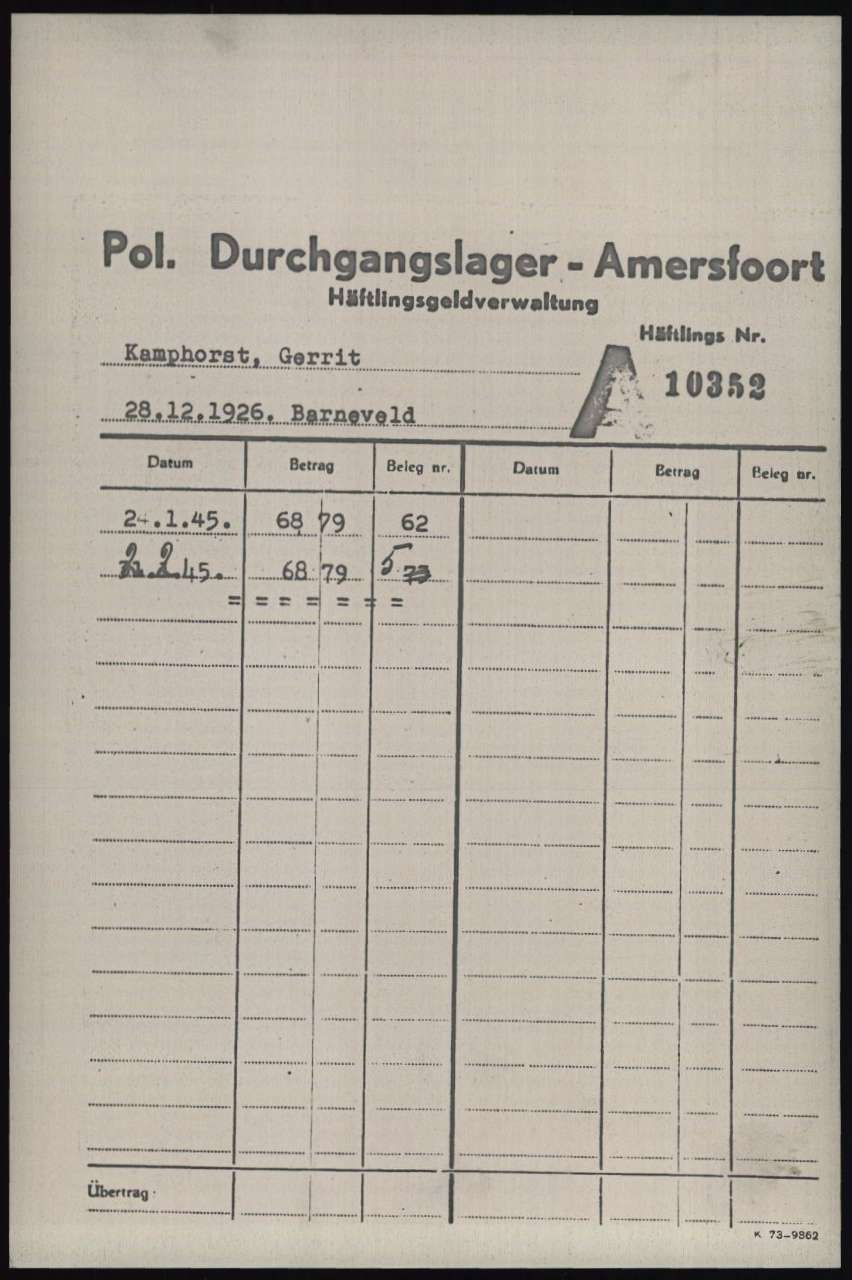
✓ He was held at Kamp Amersfoort as prisoner 10352. The camp's money card for "Kamphorst, Gerrit, 28.12.1926. Barneveld" has 68.79 paid in on 24 January 1945 and paid out on 2 February, the second date written by hand over a typed one (the card; his Amersfoort file). ◐ He was very probably sent to Neuengamme on the transport of 2 February: Hendrik van de Kuilen, taken with him at Hardeveld (on 31 December 1944 or 5 January 1945: Where the sources disagree), was at Amersfoort from 24 January to 2 February 1945, the same two dates (Digitaal Monument Neuengamme), Fokke Dijkstra's Amersfoort cards have him put "Op transport naar Neuengamme. 2.2.45" (on transport to Neuengamme, 2 February 1945), and Albert van Meerveld's has him released that day "KL ins Reich" (to a concentration camp in Germany) (the camp files).
The Neuengamme memorial's record agrees with the route: arrested at De Glind on 5 January 1945, held at the Willem III barracks at Apeldoorn from 5 to 24 January and at Amersfoort from 24 January to 2 February, and at Neuengamme from 4 February 1945, then Wöbbelin (Digitaal Monument Neuengamme). ◐ That is nineteen days at Apeldoorn, not the six weeks of the police report.
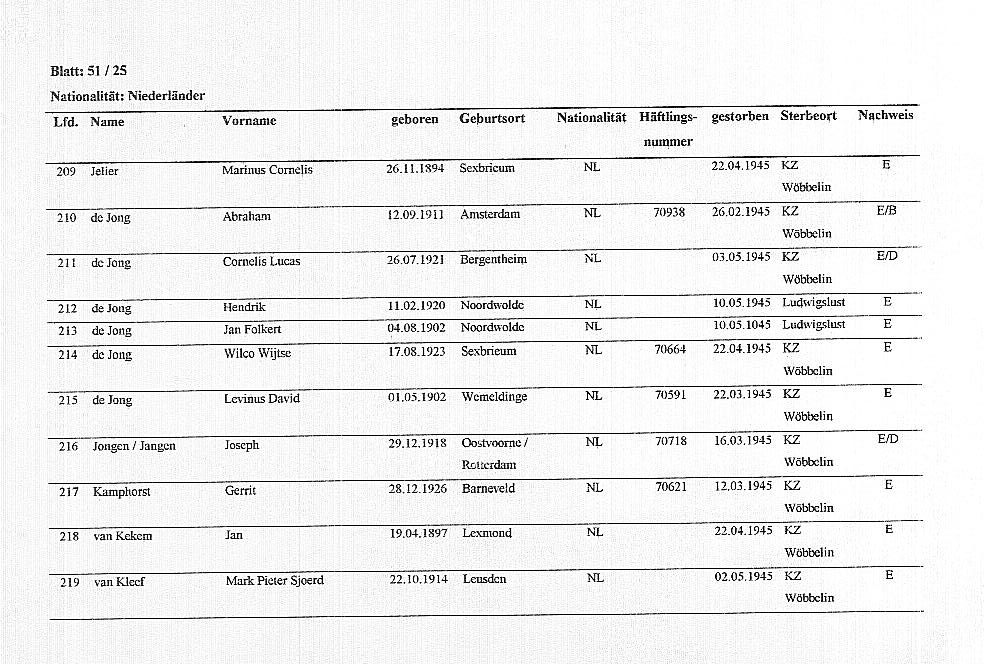
✓ At Neuengamme he was prisoner 70621, one number after van de Kuilen's 70620: the two farmhands from Hardeveld were registered one after the other (the Neuengamme list; van de Kuilen's card). The list, a typed post-war compilation with no date, transport or compiler on the page, has "Kamphorst | Gerrit | 28.12.1926 | Barneveld | NL | 70621 | 12.03.1945 | KZ Wöbbelin" (the list).
He died at Wöbbelin, a subcamp of Neuengamme near Ludwigslust, on 12 March 1945, aged 18 (Huurdeman). His parents announced it in May: "onze geliefde Zoon en Broeder, GERRIT KAMPHORST, den 12den Maart te Heierhorst Wöbelin (Duitsland) is overleden in den ouderdom van 18 jaar" (our beloved son and brother, Gerrit Kamphorst, died on 12 March at Heierhorst Wöbbelin, Germany, aged 18), signed by Joh. Kamphorst and E. Kamphorst-van Esveld, Postweg 12, Barneveld, on 23 May 1945 (Voor Waarheid, Vrijheid en Recht, 26 May 1945); the Van Esveld family of Voorthuizen, ◐ his mother's people, announced the death of "onze lieve neef" (our dear nephew) too (Nijkerksche Courant, 1 June 1945).
The War Graves Foundation took up his case in 1957. Barneveld's first answer, in August 1957, did not know where or when he had died and had his name first written "Koningshorst", struck through and corrected; the form gives his parents as Johannes Kamphorst (born Barneveld 4 May 1894) and Evertje van Esveld (born Nijkerk 25 May 1895) at Postweg 12, and that he moved from there to Leusden on 19 November 1943 (the questionnaire of 1957). Its answer of July 1958 had him dead at Wöbbelin on 12 March 1945, unmarried, last living at Leusden, and says "Na overval van Duitsers boerderij W. Lagerweij te Leusden is betrokkene, die daar werkzaam was, gedwongen weggevoerd en overgebracht naar een kamp in Duitsland" (after a raid by Germans on W. Lagerweij's farm at Leusden he, who worked there, was carried off by force and taken to a camp in Germany); the Ministry of Justice found nothing against him (the questionnaire of 1958). His father filled in the memorial questionnaire in August 1958: died "12 Maart 1945 te Heurhorst Wöbelin" (the camp was called Reiherhorst), no grave known, Reformed, Boerenarbeider, left for Germany "5 Jan 1945 eerst naar Apeldoorn daarna naar Amersfoort en toen naar Duitsland", arrested by the SD, "als illegaalwerker gearresteerd" (arrested as a resistance worker) (his father's form). The civil death record, drawn up at Leusden on 13 October 1951 on written notice from the Minister of Justice, has him dying at Wöbbelin on 12 March 1945, born at Barneveld on 28 December 1926, son of Johannes Kamphorst and Evertje van Esveld (Open Archieven).
In 1967 a conscript writing for the family asked the Foundation about Wöbbelin, and its letter of 26 June 1967 gives what it held:
There is no doubt that Gerrit Kamphorst died at Wöbbelin. His name appears on lists drawn up by survivors, copies of which are in the Foundation's archive. By the witness statements Gerrit Kamphorst died of dysentery on 12 March 1945 at 7.15 a.m. His body was likewise buried in the village churchyard at Wöbbelin.
Dutch originalHet lijdt geen twijfel dat Gerrit Kamphorst te Wöbbelin is overleden. Zijn naam komt voor op door overlevenden samengestelde lijsten, waarvan copieën in het archief der Stichting aanwezig zijn. Volgens de getuigenverklaringen is Gerrit Kamphorst op 12 maart 1945 te 07.15 uur aan dysenterie overleden. Zijn stoffelijk overschot werd eveneens begraven op het dorpskerkhof te Wöbbelin.
— Oorlogsgravenstichting · letter of 26 June 1967 to the soldier writing for the family · the letter
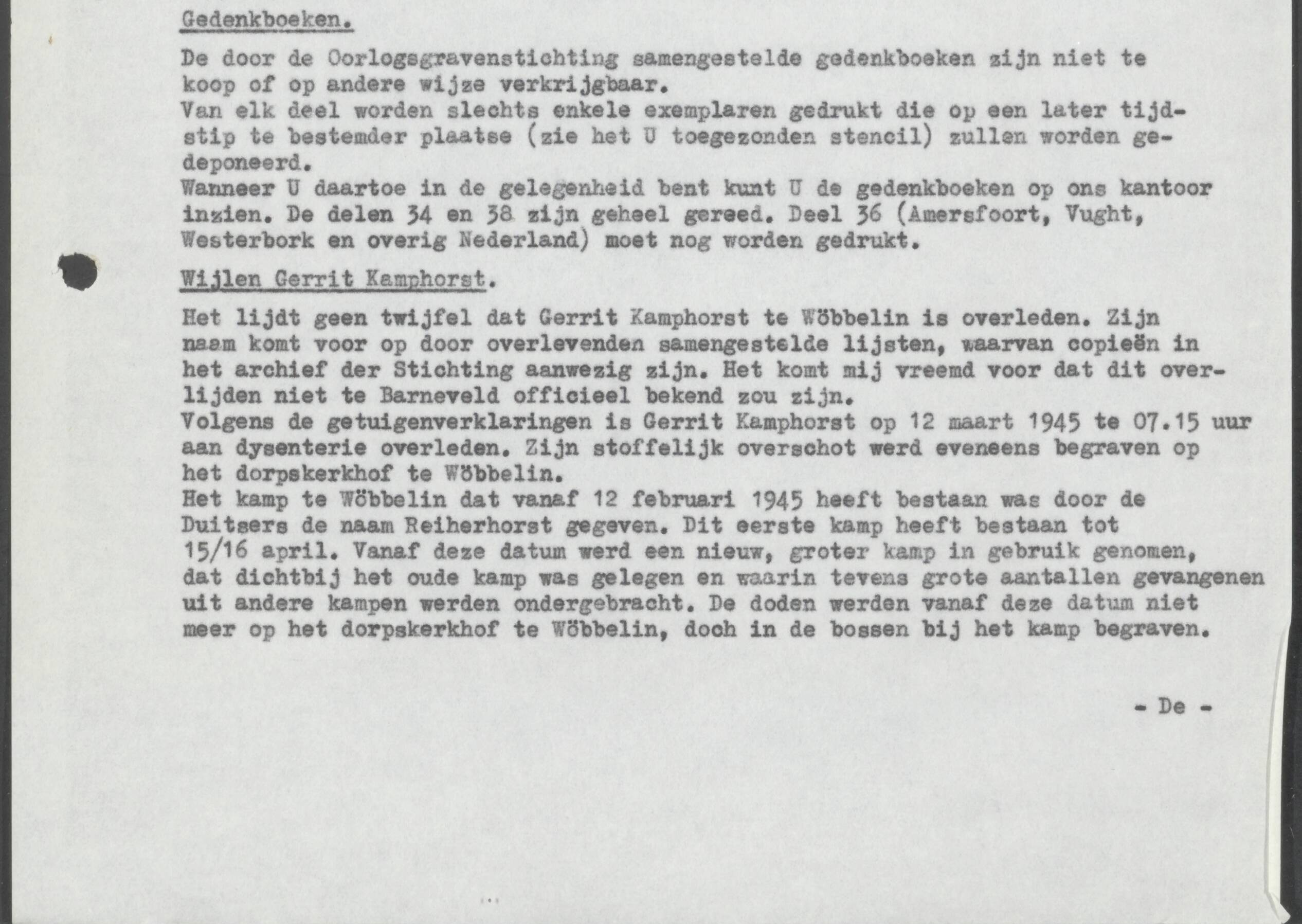
The letter adds that the Wöbbelin camp, which the Germans called Reiherhorst, ran from 12 February to 15 or 16 April 1945, and that the dead were buried in the village churchyard until then and in the woods by the camp after; exhumation was found practically impossible after the war. A second letter, of 10 October 1967, says that by the Foundation's register 159 Dutch people died at Wöbbelin-Ludwigslust and that the first Dutch prisoners are said to have arrived there on 12 February 1945 (the letter of 10 October 1967). The Oorlogsgravenstichting's page has him as a Boerenarbeider, lid verzet, died at Wöbbelin, Landkreis Ludwigslust (the page).
The round-up as a whole, and what it cost, is on Piet Veenendaal's page.
Hardeveld in Boeree's chronicle
Link to the section Hardeveld in Boeree's chronicle◐ Th. A. Boeree's Kroniek van Ede (1947) tells the farm's story under the name "Hartevelt onder Leusden" and names none of the farmhands. From 19 September 1944 it held Captain King's transmitter: "Op de boerderij waren twee knechts en een dienstmeisje" (on the farm were two farmhands and a maid), and all three kept silent until the maid, finding hidden Englishmen at her parents', told them the farm had Tommies too (p. 158). On 30 October a farmhand of Lagerweij's cycled after King's cart out of interest and brought a rug back that evening; he is one of the two, unnamed (same page). When King had gone, "het onweer brak een paar dagen later los over de achterblijvenden" (the storm broke a few days later over those left behind): "Het dienstmeisje verklapte bij het verhoor alles, de beide knechts zwegen en overleefden hun gevangenschap niet" (the maid told everything at the interrogation, the two farmhands kept silent and did not survive their imprisonment) (p. 158, checked on the page image). ◐ That reads as the Hardeveld household and the two men who died at Neuengamme, with Hendrik van de Kuilen the other farmhand; the date it implies does not agree with the others (below). The whole passage is on Wuf Lagerweij's page.
Where the sources disagree
Link to the section Where the sources disagreeHis Neuengamme number. The Arolsen Archives' online index gives everyone on his page of the list the number 70938, which is another man's on the same page; the typed list has 70621 against his name (the list).
When he was taken. ⚠︎ 31 December 1944 stands on Huurdeman alone; three other sources give 5 January 1945.
- 31 December 1944: the SD at Hardeveld, Wuf Lagerweij's farm at Postweg 8, Leusden (Huurdeman).
- 5 January 1945: the State Police report of 1957 on Hendrik van de Kuilen, which has "zijn collega Kamphorst" arrested with him at W. Lagerweij's farm, Leusden G.35, "door Duitsers" (the report); his father's form of 1958 (the form); and the Neuengamme memorial's record, which also has the barracks at Apeldoorn from that day (Digitaal Monument Neuengamme).
- ◐ The farm is the same under two addresses; the date is open. The report was written twelve years later, and 5 January is Huurdeman's date for the next raid, on the neighbour Bab van Garderen. Set out in full on Hendrik van de Kuilen's page.
The day he died. ✓ 12 March 1945: the Neuengamme list, his parents' notice, Barneveld's form of 1958, the Foundation's letter of 1967 and Leusden's late death deed of 1951 (the list; the notice; the deed). ⚠︎ 12 April 1945 in the state's roll of honour, the Erelijst, which has "Kamphorst, Gerrit, Barneveld 28·XII·1926, Landbouwer, Wöbbelin 12·IV·1945": the birth day and place are his, the death month is April (the roll, folio 551, read by eye; its website record). ◐ The roll's index and website both have his birth as 28 July, which the printed page does not, so the digital record is not clean. Nothing says where the roll took April from; the camp ran to mid-April, so the month is not impossible on that alone, but the witness statements the Foundation quotes (12 March, 7.15 a.m.), the list and the family's notice all have March.

Boeree's "a few days later". ⚠︎ Boeree has the storm break over the farm "een paar dagen later" than a move he dates "Woensdag 30 October" (p. 158), the first days of November 1944, where Huurdeman has 31 December and three records 5 January. ◐ Open; the points a reader can weigh are on Wuf Lagerweij's page. His Amersfoort card starts on 24 January 1945, which fits any of the dates.
Whether the family knew. The parents' notice of 23 May 1945 and the father's form of 1958 give the day and the camp (the notice). A letter of 8 July 1967 from the conscript writing for the family says the mother told him they had "nooit iets gehoord" of his death, that the Red Cross confirmed it to him, and that the parents were glad now to have certainty about his fate (the letter, read by us, gist only). ◐ The notice of 1945 shows the family had word of the death within ten weeks; the letter is about the circumstances and the burial, and is a second-hand report of what was said.
His grave. His father wrote in 1958 that no grave was known; the Foundation wrote in 1967 that by witness statements he was buried in the village churchyard at Wöbbelin, and that exhumation was practically impossible (his father's form; the letter).