Wuf Lagerweij
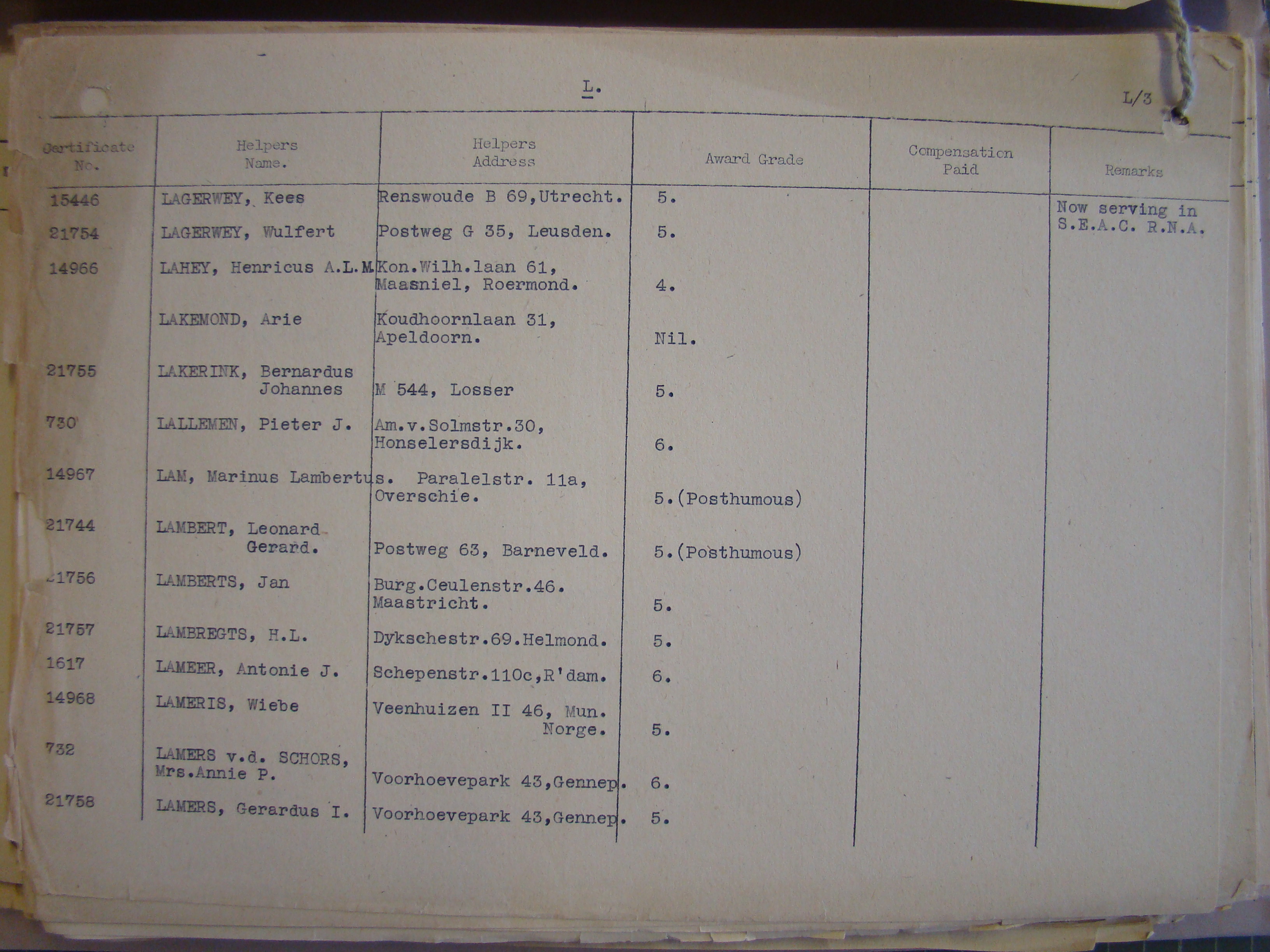
About: The farmer of Hardeveld at De Glind, Leusden, who fitted out the hen-house where Gilbert Kirschen's Belgian SAS team, "Captain King", lived and transmitted in September and October 1944. When the SD raided the farm, by Huurdeman and the police report he and his wife were in hiding, and by Boeree they had fled and the two farmhands and the maid were taken; Piller told the parliamentary inquiry that the SD shot the farmer, and what became of him is not settled.
Unit or role: Farmer; "a member of the Resistance" by Kirschen's own book (the search hits); a helper of Allied personnel, grade 5 in the British index (sheet L/3).
Where: The farm Hardeveld, Postweg 8, Leusden, by Huurdeman (Huurdeman); Postweg G 35, Leusden, in the British index (sheet L/3); Leusden G.35 in the police report of 1957 (the report); in the hamlet De Glind, north of Scherpenzeel, by Ede's wartime history (Ede manuscript, p. 39, PDF page 38). Other names for the place are under Where the sources disagree.
Evidence: ✓ the British helper index, sheet L/3 (read on the image); ✓ Huurdeman; ✓ the State Police report of 1957; ✓ the municipal form on Kamphorst; ◐ Boeree, Kroniek van Ede (1947), pp. 157–158 (checked on the page images); ✓ Ede's wartime history, pp. 39 and 49 (read on the images); ✓ the Enquêtecommissie's hearing of Piller, p. 1322 (read on the image); ✓ Kirschen, Six Friends Arrive To-Night (1949), p. 78, p. 95 and p. 99 (read on the page images); ◐ Heaps, The Grey Goose of Arnhem (1976), p. 25
The December round-up is on Piet Veenendaal's page.
His name. Boeree and Huurdeman call him Wuf Lagerweij, the police report of 1957 and the municipal form of 1958 W. Lagerweij (Boeree, p. 157; Huurdeman; the report; the form). ✓ The British index to Dutch helpers has "LAGERWEY, Wulfert", certificate 21754, "Postweg G 35, Leusden", grade 5 (sheet L/3, read on the image). ◐ That is the farm's address in the police report and on the Postweg, so the line is very probably his, and Wulfert his first name; no source says that Wuf is short for Wulfert. Kirschen calls him "the farmer, a member of the Resistance, going by the name of Wuf" (the search hits; snippets only), which may make Wuf a name he went by rather than his own.
✓ The hen-house before King. Boeree has Lagerweij turn a hen-house into a tidy dwelling for one of the evacuees, with a sitting room, a bedroom and a small kitchen, all electrically lit. The man hiding there with his family could not bear it any longer on Dolle Dinsdag and went back to Holland to join the underground, his wife and child following a few days later; on 19 September Lagerweij was asked to give it to a couple of evacuees from the Rudolphstichting, who moved in the same morning (Boeree, p. 157, checked on the page image).
With Murphy
Link to the section With MurphyNo source puts him with Murphy. The SD came to Hardeveld on 31 December 1944 by Huurdeman, or on 5 January 1945 by the police report of 1957, which has all three arrested then, while Kamphorst's father's form of 1958 gives 5 January as the day Kamphorst left, first to Apeldoorn (Huurdeman; the report; Kamphorst's father's form). By then Murphy had left the Veerman farm at Achterveld: the list in Jacob Veerman's helper file has him there 30 days from "25 Nov '45 [sic]", a slip for 1944, which the second copy writes as "25 Nov. 25 Dec. '44" (the list, p. 5; the second copy, p. 7). The raid on Hardeveld was one of the arrests of the round-up that began at Piet Veenendaal's farm at Scherpenzeel on 15 December, after the SD had found Kirschen's old billet there (Huurdeman).
Captain King in the hen-house, September and October 1944
Link to the section Captain King in the hen-house, September and October 1944The farm was the second billet of Gilbert Kirschen's SAS team, "de tweede verblijfplaats van het SAS-team" (Huurdeman). Huurdeman has the team at two addresses in De Glind, in Leusden and Scherpenzeel, from 15 September to 5 November 1944 (Huurdeman).
✓ The landing. Ede's wartime history has the four Belgians met on the ground by Berend Dijkman, the regional commander of the NBS, "die hen onderbracht in een kippenhok bij de boerderij van W. Lagerweij in de buurtschap "De Glind", ten noorden van Scherpenzeel" (who put them up in a hen-house at the farm of W. Lagerweij in the hamlet De Glind, north of Scherpenzeel) (Ede manuscript, p. 39, PDF page 38, read on the image; the OCR). ◐ De Jong, without naming the farm, has Kirschen "door Dijkman in een als woning ingericht kippenhok op een boerenerf bij Scherpenzeel" (put up by Dijkman in a chicken-house fitted out as a dwelling on a farmyard near Scherpenzeel), where the Canadian Leo Heaps was brought to him (deel 10b, p. 546, checked on the image; the extract).
✓ In Boeree. A friend from the underground, Bart, came to ask Wuf for the loan of a motorbike and then said he also wanted a place for a few men with a small transmitter. The new evacuees were sounded out in vague terms, agreed to go for better lodging, and King, who had been at Van Ee's on the road from Barneveld to Scherpenzeel, moved in at half past eleven that night; the transmitter was working the next afternoon (p. 157, continued on p. 158). Boeree gives the farm as "Hartevelt onder Leusden" (p. 157) and calls it "een brutaal stukje" (a cheeky bit of work): under 1,000 m from the Rudolphstichting, which was full of Germans (p. 158).
◐ In Kirschen's book. On p. 78 of Six Friends Arrive To-Night, the hen house was "a respectable little bungalow, which was perfectly habitable"; the hens had moved to two huts like it a few yards away; "Our living quarters had been very well fitted up by the farmer, a member of the Resistance, going by the name of Wuf", with a hall used as washhouse and bicycle shed, a living room where they ate and worked and the two operators slept, and his own room. "Mrs. Wuf used to bring us three meals a day and on top of that, numerous cups of coffee", and passers-by on "the cart track from Wuf's farm to Bart's" saw only "three isolated hen houses in the middle of the meadow" (p. 78, top half and bottom half, read on the page). The book gives no surname or farm name; ◐ very probably the same farm, by the name Wuf, the hen-house, Bart and the maid's talk that Boeree also has (Gilbert Kirschen).
◐ In Heaps. Leo Heaps's memoir has "the farm of Wuf Langerwey, outside the village of Glindhorst": in a large meadow "three shabby, unpainted chicken coops" alike from outside, Kirschen's with three rooms panelled with white acoustic boards, a feather bed, a stove and sofa, electricity and running water (Heaps, p. 25). He has the doctor Olliff, who had 29 medical orderlies with him, led on 25 September to "the chicken coop of Gilbert Sadi-Kirschen at the Langerwey farm near Barneveld" (pp. 78–79), himself arriving there on 2 October, "at the farm of Langerwey, about three miles to the west of Barneveld" (p. 128), and Lt-Col Dobie sleeping a night in Kirschen's feather bed there on his way south (p. 164). One man's account, written in 1976. Kirschen's own book has the doctor, spelt "Olyff", brought to the hen house on 1 October, not 25 September, and staying the night (p. 78, bottom half; Gilbert Kirschen).
✓ The maid. Boeree has the two farmhands and the maid all promise silence, until the maid, at her parents', found hidden Englishmen there and told them the farm had Tommies too, with a transmitter. After six weeks Lagerweij told King that everyone knew, and both saw it was time to part (p. 158, checked on the page image). Kirschen's diary, under 25 October: "The girl who worked at Wuf's farm was going round telling people that allied parachutists were living in her master's hen-run", which "meant a speedy removal" (p. 95, read on the page). The investigating officer's note in the American file of Jan Evers: "Owing to gossiping the Germans found out the address of King at the Grindhorst and he had to move to Evers" (Evers's file, p. 29, checked on the image).
✓ The move. On what Boeree dates "Woensdag 30 October" the contents went by flat wagon to Evers under Nederwoud; Lagerweij lent King a rug to cover the load, and his farmhand, who had cycled along out of interest, brought it back that evening with word that they had arrived safely (p. 158). The farmhand is one of the two, unnamed. Ede's history has the move on 31 October, "naar de boerderij van J. Evers aan de Schansweg in Lunteren" (to J. Evers's farm on the Schansweg at Lunteren), because King's presence "op de boerderij van Lagerweij in "De Glind"" had become widely known (Ede manuscript, p. 49, read on the image). ◐ Kirschen's book has them due to move on 1 November: "It was this evening, as soon as the carpenter had driven in his last nail, that we were supposed to move into our new hen-house" at Evers's (p. 96), and that evening the men were at Evers's house when the hen-house burned (p. 97); it does not date their leaving Wuf's (text layer).
Hendrik van Bentum of Woudenberg, who moved evaders, wrote in his letter to the Americans that "Capt. King too, has been at W. Lagerwey, Achterveld (for transmitting to England)" (his file, p. 18). His letter goes on: "He was transported to Ede, about the middle of December 1944. There, his place burnt down." ◐ The same farm by the farmer's name; his Achterveld is not the De Glind or Leusden of the other sources, and his mid-December move to Ede fits none of the other dates (below).
The Germans at the empty hen-house
Link to the section The Germans at the empty hen-house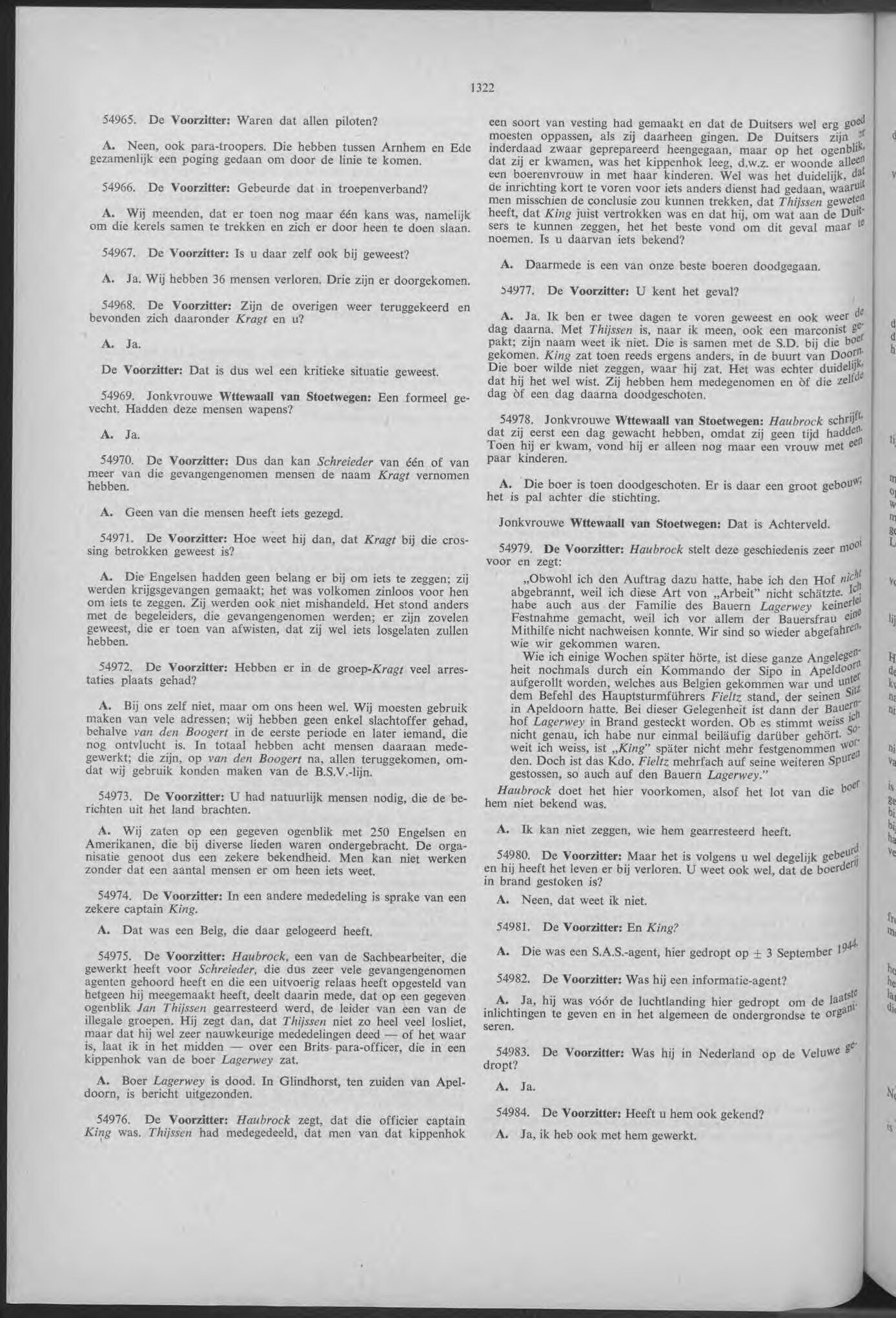
✓ Haubrock's visit. Ede's history quotes Haubrock, one of Schreieder's men, telling the parliamentary inquiry that he set out "één van de volgende dagen" (one of the following days) to take King in a hen-house near Scherpenzeel, put it off 24 hours for other work, and found it "precies vierentwintig uur van tevoren ontruimd" (cleared precisely 24 hours before), with "een vrouw met drie of vier kleine kinderen" (a woman with three or four small children) living in it (Ede manuscript, p. 49, read on the image). The aside between dashes inside the quotation, "hij ging hierbij uit van de 8e novmber [sic], de dag waarop … Jan Thijssen … was gearresteerd" (he took 8 November as his starting point, the day Jan Thijssen was arrested), is Ede's own gloss, not Haubrock's words. At his own hearing on 20 May 1949 Haubrock dated Thijssen's capture only as "denk ik, in November 1944" (no. 54107), and told the visit as above: a day late, the hen-house cleared "precies 24 uur van te voren", a woman with "3 of 4 kleine kinderen" in it (the hearing, nos. 54109–54111, OCR text).
◐ Kirschen's diary, 4 November. Lange Jan, very probably Jan Thijssen (De Jong, deel 10b p. 625, has Thijssen visiting Kirschen on 4 November and quotes Kirschen's own note on "Lange Jan": the extract, text layer only), told him that "Wuf's maid's chattering has had its effect, and the gallant S.S. with great ceremony surrounded the hen-run you'd lived in for the last few weeks", and that on searching it "they found no trace of you. Your place had been taken by an innocent family of Dutch refugees" (p. 99, top half for the diary date and Lange Jan's visit, bottom half for the words, read on the page; the book has Lange Jan arrested on 20 November, p. 103, where Jan Thijssen was taken on 8 or 9 November by the sources on his page, so the book's Lange Jan may be another man).
✓ The inquiry. The chairman put to Joseph Piller that Haubrock had written that Thijssen, arrested, "niet zo heel veel losliet, maar dat hij wel zeer nauwkeurige mededelingen deed — of het waar is, laat ik in het midden — over een Brits para-officer, die in een kippenhok van de boer Lagerwey zat" (did not give away very much, but did make very precise statements, about a British para officer who was in a hen-house of the farmer Lagerwey); the "of het waar is, laat ik in het midden" (whether it is true I leave open) is the chairman's own remark, not Haubrock's. The chairman added that the hen-house was empty when the Germans came, "er woonde alleen een boerenvrouw in met haar kinderen" (only a farmer's wife lived in it with her children), and asked whether Thijssen might have named it knowing King had just left (p. 1322, nos. 54975–54976, read on the image). It is a German officer's report, put as a question. Piller's first answer, to the passage about the hen-house, was "Boer Lagerwey is dood. In Glindhorst, ten zuiden van Apeldoorn, is bericht uitgezonden" (Farmer Lagerwey is dead. In Glindhorst, south of Apeldoorn, word was sent out) (no. 54975); to the question whether Thijssen knew King had just left, he answered only "Daarmede is een van onze beste boeren doodgegaan" (with that one of our best farmers died). Against the suggestion, at the hearing of 7 June 1949 Christine van Hoorn Alkema-Schadd said Captain King "was daar toen al lang weg … Er was al eens een keer [een] inval geweest. Het was dus onzin, dat Haubrock gezegd heeft, dat Jan dat zou hebben verraden" (was long gone by then … there had already been a raid once. So it was nonsense that Haubrock said Jan had betrayed it) (no. 56973, OCR text, rough in places), and Haubrock himself said "Thijssen kon niet weten, dat ik een dag te laat naar Scherpenzeel ging" (Thijssen could not know that I went to Scherpenzeel a day late) (no. 54110).
The chairman then read out Haubrock's own words:
Although I had orders to, I did not burn the farm down, because I did not care for that kind of "work". Nor did I make any arrest from the family of the farmer Lagerwey, because above all I could not prove that the farmer's wife had helped. So we drove off again as we had come. As I heard some weeks later, this whole affair was taken up again by a Sipo commando in Apeldoorn, which had come from Belgium and was under Hauptsturmführer Fieltz, who had his seat in Apeldoorn. On that occasion the farm Lagerwey was set on fire. Whether it is true I do not know for certain; I only heard of it once, in passing. As far as I know "King" was not taken later. But the Fieltz commando came upon his further tracks several times, and so upon the farmer Lagerwey too.
German original„Obwohl ich den Auftrag dazu hatte, habe ich den Hof nicht abgebrannt, weil ich diese Art von „Arbeit" nicht schätzte. Ich habe auch aus der Familie des Bauern Lagerwey keinerlei Festnahme gemacht, weil ich vor allem der Bauersfrau eine Mithilfe nicht nachweisen konnte. Wir sind so wieder abgefahren, wie wir gekommen waren. Wie ich einige Wochen später hörte, ist diese ganze Angelegenheit nochmals durch ein Kommando der Sipo in Apeldoorn aufgerollt worden, welches aus Belgien gekommen war und unter dem Befehl des Hauptsturmführers Fieltz stand, der seinen Sitz in Apeldoorn hatte. Bei dieser Gelegenheit ist dann der Bauernhof Lagerwey in Brand gesteckt worden. Ob es stimmt weiss ich nicht genau, ich habe nur einmal beiläufig darüber gehört. Soweit ich weiss, ist „King" später nicht mehr festgenommen worden. Doch ist das Kdo. Fieltz mehrfach auf seine weiteren Spuren gestossen, so auch auf den Bauern Lagerwey."
— Haubrock, as the chairman read it out · Enquêtecommissie Regeringsbeleid 1940–1945, Verslag deel 4C-II (1950), p. 1322, no. 54979 · the page
The raid. ✓ Huurdeman has the SD find the team's second billet after the arrests at Veenendaal's and at the Klettersteeg:
Meanwhile the SD tracked down the SAS team's second billet. That was at Wuf Lagerweij's of the farm Hardeveld (Postweg 8 in Leusden), where on 31 December 1944 the two young farmhands Gerrit Kamphorst and Hendrik van der Kuilen and the maid were arrested. The Lagerweij couple could not be found; they were in hiding.
Dutch originalInmiddels achterhaalde de SD de tweede verblijfplaats van het SAS-team. Dat was bij Wuf Lagerweij van boerderij Hardeveld (Postweg 8 in Leusden) waar op 31 december 1944 debeide [sic] jonge knechten Gerrit Kamphorst en Hendrik van der Kuilen evenals het dienstmeisje werden gearresteerd. Het echtpaar Lagerweij was onvindbaar, zij zaten ondergedoken.
— José Huurdeman · Ondergronds in de Tweede Wereldoorlog (2019), via the Oorlogsgravenstichting · the text
Because the farmhands took their working instructions from the neighbouring gamekeeper, Bab van Garderen, the SD went to his house next, on 5 January 1945 (same).
The State Police report of 1957 on Hendrik van de Kuilen, written for the War Graves Foundation, tells the same of "W. Lagerweij" and his wife: "In verband met de illegale werkzaamheden was genoemde W. Lagerweij en zijn echtgenote ondergedoken", because of their illegal work they had gone into hiding, and the two farmhands and a maid stayed on to look after the farm, "hoewel ook zij in de illegaliteit werkzaam waren", though they too were in the resistance; on 5 January 1945 all three were arrested there by Germans (the report). A municipal form of 1958 on Gerrit Kamphorst says the same farm in other words: "Na overval van Duitsers boerderij W. Lagerweij te Leusden is betrokkene, die daar werkzaam was, gedwongen weggevoerd", after a raid by Germans on W. Lagerweij's farm he, who worked there, was taken away by force (the form).
◐ Boeree: "King had zich tijdig uit de voeten gemaakt, het onweer brak een paar dagen later los over de achterblijvenden" (King had got clear in time; the storm broke a few days later over those left behind). The maid told everything at her interrogation, the two farmhands kept silent and "overleefden hun gevangenschap niet" (did not survive their imprisonment), and "Lagerweij was met zijn vrouw gevlucht" (Lagerweij had fled with his wife) (p. 158). That agrees with Huurdeman and the police report that the couple were away and the farmhands and maid were taken; the date does not (below).
His two farmhands, Gerrit Kamphorst and Hendrik van de Kuilen, died in the Neuengamme camps: Kamphorst at Wöbbelin on 12 March 1945, Van de Kuilen at Neuengamme on 18 February 1945 (Huurdeman).
What became of him. ⚠︎ Not settled.
- ⚠︎ Joseph Piller told the inquiry that the farmer was dead, shot by the SD (the block below). He dates nothing, says King had already gone to the neighbourhood of Doorn, and said he could not say who had arrested the farmer, nor that the farm was burned (p. 1322, nos. 54979–54980).
- Haubrock heard only in passing that the Fieltz commando burned the farm and "came upon" the farmer (the block above); he says nothing of a death.
- ⚠︎ A second voice in the same volume, hearsay: at the hearing of Christine van Hoorn Alkema-Schadd, a member of the inquiry (Wttewaall van Stoetwegen) put it that the farmer seems to have been arrested and shot on a later occasion, not because of Thijssen; the witness answered "Dat heb ik ook gehoord; niet naar aanleiding hiervan" (I have heard that too; not because of this) and that the timing does not fit Thijssen's having given it away (nos. 56974–56976, OCR text, rough in places; the page image is not held).
- Against Piller: Huurdeman has the couple in hiding and not found on 31 December, the police report of 1957 has them in hiding, and Boeree has Lagerweij fleeing with his wife (above). ◐ The British helper index gives no posthumous mark on Wulfert Lagerwey's line, where it marks others "(Posthumous)", and the address it gives is, by the hosting site's notes, where the helper was after the Liberation (sheet L/3; the notes). That points to his being alive after the war, if the line is his; no death record for him has been found.
Farmer Lagerwey is dead. … I was there two days before and again the day after. With Thijssen, I believe, an operator was caught too; I don't know his name. He came to that farmer together with the S.D. King was already somewhere else by then, near Doorn. The farmer would not say where he was. It was clear, though, that he knew. They took him along and shot him either that same day or the day after. … That farmer was shot then.
Dutch originalBoer Lagerwey is dood. … Ik ben er twee dagen te voren geweest en ook weer de dag daarna. Met Thijssen is, naar ik meen, ook een marconist gepakt; zijn naam weet ik niet. Die is samen met de S.D. bij die boer gekomen. King zat toen reeds ergens anders, in de buurt van Doorn. Die boer wilde niet zeggen, waar hij zat. Het was echter duidelijk, dat hij het wel wist. Zij hebben hem medegenomen en òf die zelfde dag òf een dag daarna doodgeschoten. … Die boer is toen doodgeschoten.
— Joseph Piller, answering the chairman · Enquêtecommissie Regeringsbeleid 1940–1945, Verslag deel 4C-II (1950), p. 1322, nos. 54975–54978 · the page
Other men named Lagerweij. Cornelis Lagerweij, a bricklayer of Ede born on 15 December 1923, son of Jan Pieter Lagerweij and Trientje Wolvis, died at Neuengamme at 0.30 a.m. on 1 February 1945; his German death certificate is among the camp files, and his is a separate arrest, not traced (the camp files). ◐ Two other Lagerweijs, Sander and Lammert, shared a cell at Apeldoorn in December 1944 with a man from Scherpenzeel who wrote home from Amersfoort (Oud Scherpenzeel, 2020, p. 15). The same magazine puts a Gerard, a Sander and a Lammert Lagerweij at the farm De Beek, raided on 16 December 1944, where Gerard and Sander were driven off in a lorry and Lammert, who joined the others later at Huize Scherpenzeel, is said to have got away. Noordman has that raid on Gerard Lagerweij's farm on the Lunterense Beek in Renswoude, with his brother Sander visiting (Noordman, pp. 164–165), and Robert Bailey's page has that visiting Sander as Sander Lagerwey of Renswoude, who sheltered Bailey and died at Neuengamme. So ◐ the Lagerweijs of the cell are very probably the Renswoude family, the household of Kees Lagerwey's form, B 69, Renswoude, and not Wuf's; nothing links any of them to Hardeveld. The letter and the magazine do not agree on Lammert (the letter has him in a cell with Sander at Apeldoorn, and Gerard in another).
Where the sources disagree
Link to the section Where the sources disagree- What became of him. Shot by the SD, by Piller, and by hearsay in the inquiry's other hearing; in hiding with his wife, by Huurdeman, the police report and Boeree; ◐ alive after the Liberation, if the helper-index line is his (above). ⚠︎ Open.
- When the SD came to the farm. ⚠︎ Open.
- Boeree has the storm break "een paar dagen later" than the move to Evers, which he dates "Woensdag 30 October", so in the first days of November 1944 (p. 158).
- Kirschen's diary has the SS surround the empty hen-run by 4 November, after the maid's talk, and find refugees there (p. 99); it tells of no arrests.
- Haubrock, in Ede's history and at his hearing, went one of the days after (Ede's gloss, not his: after 8 November) and found the hen-house cleared 24 hours before (Ede manuscript, p. 49; the hearing, nos. 54109–54111); he dates nothing himself.
- The move is dated three ways: Boeree 30 October, Ede 31 October, Van Bentum mid-December (plainly wrong against the rest); Kirschen's book has them due at Evers's new hen-house on the evening of 1 November and at his house that evening, and does not date their leaving Wuf's. ◐ If Ede's 31 October is right, King had left a week or more before Haubrock's visit, "24 hours" later; Kirschen's 1 November would put the empty hen-house in the first days of November.
- Huurdeman has the raid on 31 December 1944 (Huurdeman); the police report of 1957 and the Neuengamme memorial's record for Kamphorst ("Gearresteerd op 05-01-1945") have the arrest on 5 January 1945, and Kamphorst's father's form of 1958 gives it as the day he was taken away, first to Apeldoorn (the report; the father's form; Digitaal Monument Neuengamme), the day Huurdeman gives for the raid on Bab van Garderen's house. The memorial page also carries Huurdeman's text with 31 December, so it disagrees with itself.
- ◐ The November accounts (Kirschen, Haubrock) are of a search of the empty hen-house with no arrests, and Huurdeman's and the police report's of the arrests; that makes two visits, which no source states outright (Christine van Hoorn Alkema-Schadd told the inquiry "Er was al eens een keer [een] inval geweest", no. 56973, OCR).
- Boeree's weekday does not fit 1944 (30 October was a Monday), and his sentence is loose about time. ◐ The Wednesday of that week was 1 November, the evening Kirschen's book has them due at Evers's; Boeree's "Maandag 23 October" and "Zaterdagavond 28 October" (p. 157) fit 1944, so the day number may be the slip.
- Against an early-November arrest: the Barneveld registry has Van de Kuilen at Leusden G.35 from 20 November 1939 to 3 November 1943, back at Barneveld after that, and moving to Leusden G.35 again on 22 December 1944 (the Foundation's file, scan 2). ◐ A registration is not proof of when he was there: the police report has him working there "in 1944-1945", and Boeree has two farmhands at the farm during King's stay.
- Who lived in the empty hen-house. "An innocent family of Dutch refugees" (Kirschen, p. 99); "een vrouw met drie of vier kleine kinderen" (Haubrock, in Ede's history, p. 49); "een boerenvrouw ... met haar kinderen" and "een vrouw met een paar kinderen" (the chairman and a member of the inquiry, p. 1322). ◐ Boeree has evacuees in it before King and does not say who lived there after.
- King's arrival at the farm. Met on landing by Dijkman and put straight into the hen-house (Ede's history, p. 39); at Van Ee's first, then moved in at night through Bart, after evacuees had moved in on 19 September (Boeree, pp. 157–158); the house of "Bart the Calvinist" as the first night in Holland (Kirschen, p. 98); a hunting lodge the first night (Heaps, p. 25, by Gilbert Kirschen's page). Not reconciled.
- The farm's name and place.
- "Hartevelt onder Leusden" (Boeree, p. 157) and Hardeveld (Huurdeman), ◐ almost certainly one farm.
- Postweg 8 (Huurdeman), Postweg G 35 (the helper index) and Leusden G.35 (the police report); ◐ G 35 very probably the old numbering of the same house, not checked against a register.
- De Glind, north of Scherpenzeel (Ede's history); "outside the village of Glindhorst" and "about three miles to the west of Barneveld" (Heaps, pp. 25, 128); "Glindhorst" (Piller, p. 1322: "In Glindhorst, ten zuiden van Apeldoorn", south of Apeldoorn); "the Grindhorst" (Evers's file, p. 29).
- Achterveld (Van Bentum, p. 18), and ◐ Achterveld again in the inquiry: after Piller says the farmer was shot and that "Er is daar een groot gebouw; het is pal achter die stichting" (there is a big building there; it is right behind that foundation), the member answers "Dat is Achterveld" (p. 1322, no. 54978, read on the image). Van Bentum and the member give Achterveld, where Huurdeman, the police report, Ede and Boeree have De Glind or Leusden; the member's "Dat is Achterveld" is an answer to Piller's description, and Piller does not name the place.