Hendrik van de Kuilen
Barneveld 16 Jan 1916 – Neuengamme 18 Feb 1945
About: A farmhand at Hardeveld, one of the two billets of Gilbert Kirschen's Belgian SAS team, taken by the SD on 31 December 1944 in the round-up that followed (⚠︎ a police report of 1957 has 5 January 1945: Where the sources disagree). He was Hendrik van de Kuilen of Barneveld, born on 16 January 1916, who died at Neuengamme on 18 February 1945, aged 29 (Digitaal Monument Neuengamme).
Where: The farm Hardeveld, W. Lagerweij's, at Postweg 8, Leusden (Huurdeman); ◐ the "Leusden G.35" of the 1957 police report and of his registration, an address in the old numbering under the same farmer's name (the War Graves Foundation's file, scans 2 and 4).
Evidence: ✓ Huurdeman; ✓ Digitaal Monument Neuengamme; ✓ the War Graves Foundation's file on him, with the police report of 1957; the Neuengamme card; birth record; ◐ Boeree, Kroniek van Ede (1947), pp. 157–158 (checked on the page images)
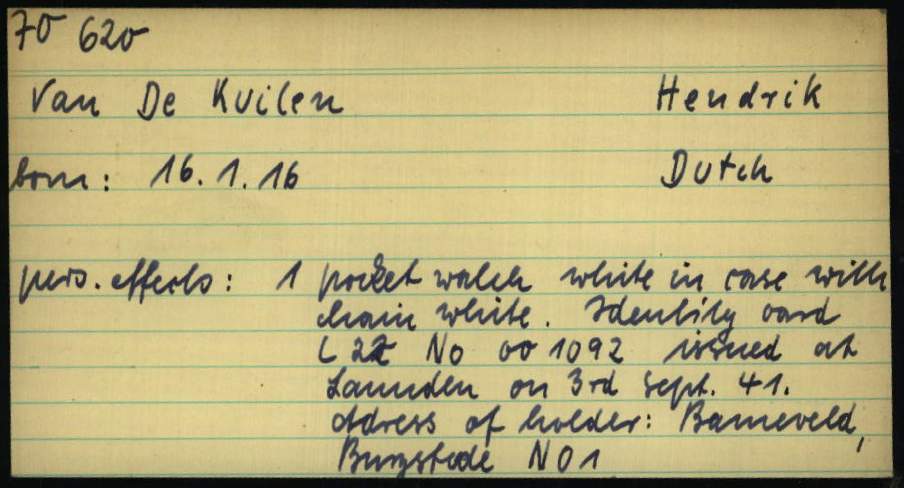
He was born at Garderbroek, in Barneveld, on 16 January 1916, the son of Gerrit Hendrik van de Kuilen, a day-labourer, and Geertje Rijswijk (birth record). His identity card, by the Neuengamme card below, was issued at Leusden on 3 September 1941 and gave his address as Burgstede 1, Barneveld.
✓ His brothers and sister are in the marriage and death registers, which each name Gerrit Hendrik van de Kuilen, later a farmer, and Geertje Rijswijk as the parents: Teunis, a thatcher born at Barneveld in about 1911, who married there on 15 November 1940 (the marriage); Gijsbert, a carter born in about 1913, married at Barneveld on 12 May 1944 (the marriage); Rijntje, born in about 1915, who married the garage owner Peter Kleijer at Barneveld on 19 January 1934 (the marriage); and Dirk, born in about 1917, a labourer who married at Ede on 11 February 1942 (the marriage) and died at Ede on 26 August 1949, aged 32 (the death). All index only. The brother who wrote in 1964 (below) gave his birth year as 1926 (the transcript leaves out his name), so he is not among them.
◐ The Barneveld registry's answer to the War Graves Foundation in 1957, handwritten and read by us, gives his moves: from Barneveld to Woudenberg on 24 December 1936, from Woudenberg to Leusden G.35 on 20 November 1939, back to Barneveld, Burgstedeweg 1, on 3 November 1943, and from Barneveld to Leusden G.35 again on 22 December 1944 (the Foundation's file, scan 2). Leusden G.35 was W. Lagerweij's farm, where the police report of 1957 has him a farmhand "in 1944-1945" (the report), so he had lived there before, from 1939 to 1943 (which fits an identity card issued at Leusden in 1941), and was registered there again nine days before the raid that Huurdeman dates 31 December.
With Murphy
Link to the section With MurphyNo source puts him with Murphy. Hardeveld, where he was a farmhand, was one of the two billets of Kirschen's Belgian SAS team, "Captain King", from 15 September to 5 November 1944. After the SD arrested the RVV leader Jan Thijssen they got hold of the old billet in December and, though the team had been gone more than a month, carried out a series of arrests. On 31 December they came to Hardeveld and took the two farmhands, Hendrik van de Kuilen and Gerrit Kamphorst, with the maid; the Lagerweij couple of Hardeveld could not be found (Huurdeman, Ondergronds in de Tweede Wereldoorlog, via the Oorlogsgravenstichting). A police report of 1957 tells the same arrest at Lagerweij's farm but dates it 5 January 1945 (The police report of 1957); either way it came after Murphy had gone. The December arrests began while Murphy was still hidden at the Veerman farm (15 and 19 December); Hardeveld was raided on 31 December, after he had left on the 23rd (The December round-up).
The round-up as a whole, and what it cost, is on Piet Veenendaal's page.
Huurdeman has all the men of that round-up dead in Neuengamme or its subcamps. ✓ He was Hendrik van de Kuilen, a day-labourer's son born at Barneveld on 16 January 1916, who died at Neuengamme on 18 February 1945, aged 29: the Neuengamme memorial's record for him carries Huurdeman's "Hendrik van de Kuilen, knecht op boerderij Hardeveld, overleden 18 februari 1945 in Neuengamme" (Digitaal Monument Neuengamme). He was held at Amersfoort from 24 January to 2 February 1945, reached Neuengamme on 4 February, and died there of enterocolitis (same). The War Graves Foundation has the same birth and death, with his occupation as "Landbouwer" (farmer) (Oorlogsgravenstichting). Huurdeman spells him "van der Kuilen".
Huurdeman writes that the women taken in the round-up were freed after seven weeks, "maar de mannen zijn allen omgekomen in Neuengamme of in een van de buitenkampen" (but the men all died at Neuengamme or in one of its subcamps) (Huurdeman).
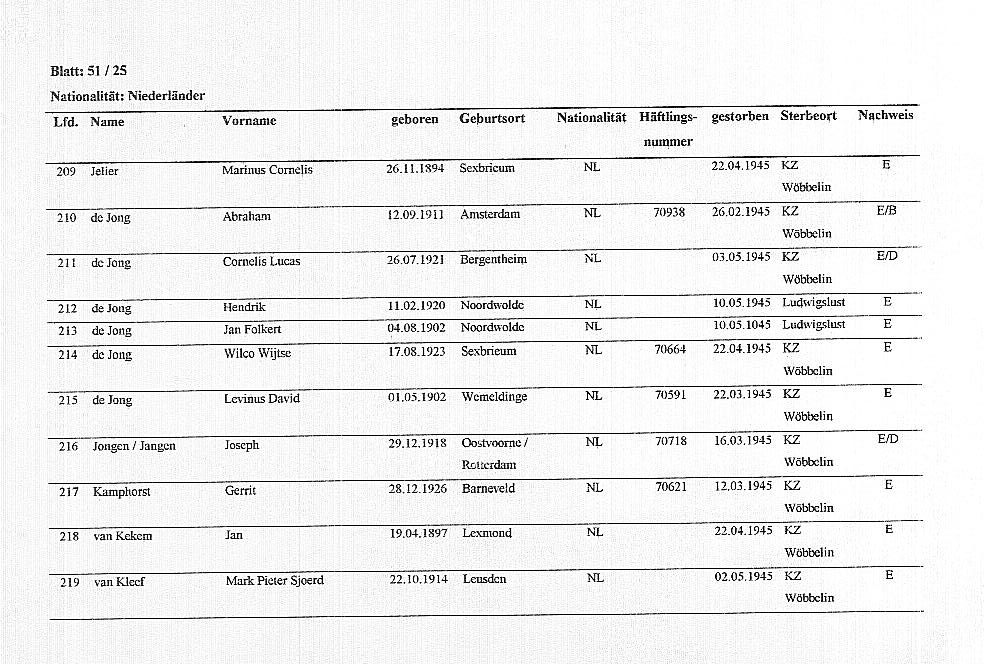
The Arolsen Archives hold his Neuengamme effects card, in the series documenting prisoners' deaths, for "Van De Kuilen Hendrik, born: 16. 1. 16, Dutch", prisoner 70 620: "1 pocket watch white in case with chain white. Identity card L 22 No 001092 issued at Leusden on 3rd Sept. 41. Address of holder: Barneveld, Burgstede No 1" (the card). The number is in the range of the men taken in the round-ups of that December (Jan Rothuizen, 70940). Gerrit Kamphorst, taken with him at Hardeveld, was 70621, the next number: the two were registered one after the other (the Neuengamme list). The Neuengamme memorial settles that he is the Hardeveld farmhand (the memorial), and the War Graves Foundation's own file, separately, has the same man, born at Barneveld on 16 January 1916, a farmhand on Lagerweij's farm arrested there with Kamphorst (the police report).
The police report of 1957
Link to the section The police report of 1957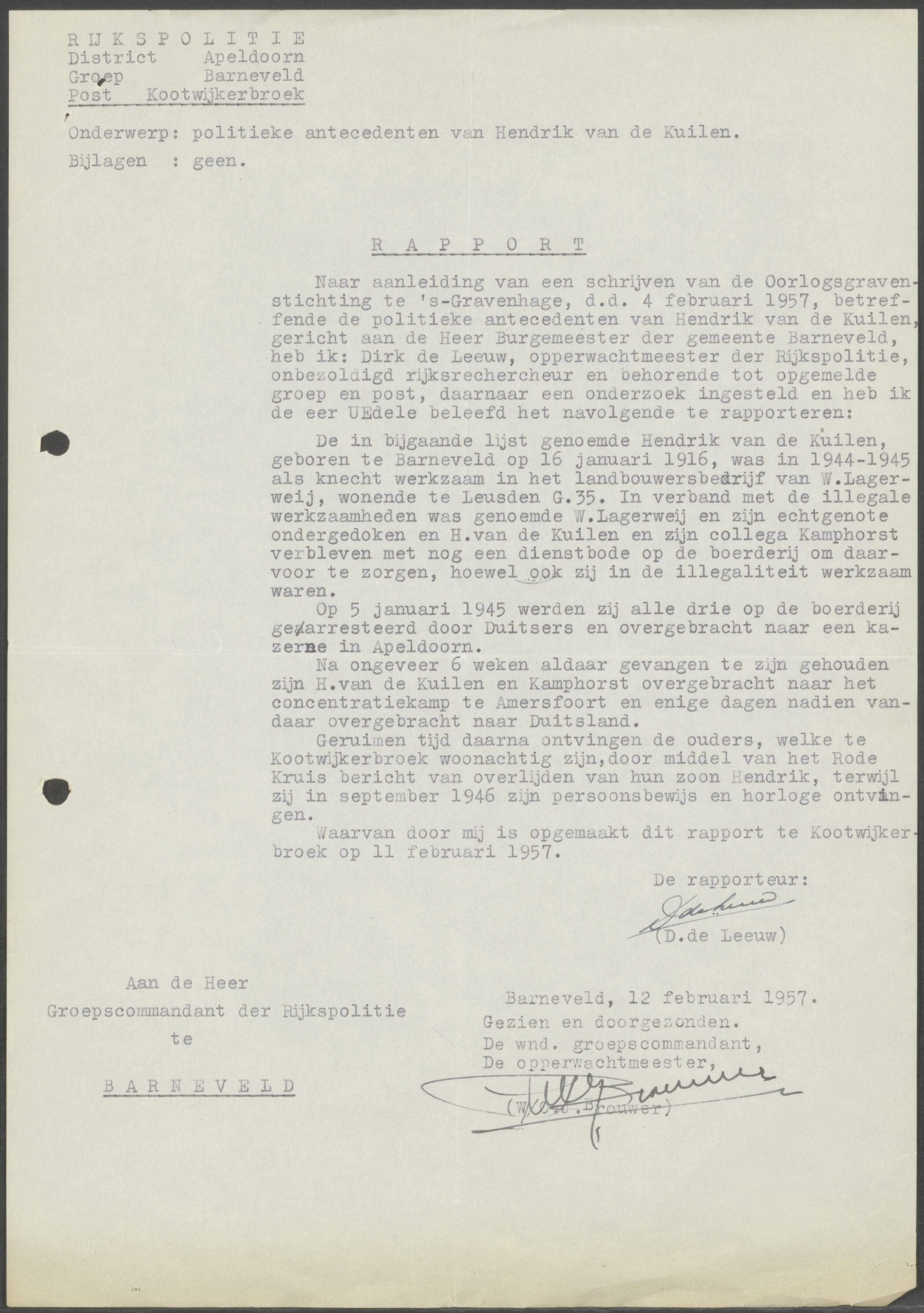
In 1957 the War Graves Foundation asked Barneveld about his "politieke antecedenten" (political background): its letter of 1951 notes that only the graves of the politically reliable were laid out and tended, though all were registered (the Foundation's file, scan 5). Its questionnaire of 4 February 1957 asked how he had gone to Germany, and the answer written in is "Zie rapport rijkspolitie" (see the State Police report) (scan 2). The report came from Dirk de Leeuw, senior constable at the Kootwijkerbroek post, a week later:
Hendrik van de Kuilen, born at Barneveld on 16 January 1916, worked in 1944-1945 as a farmhand on the farm of W. Lagerweij, living at Leusden G.35. Because of their resistance work the said W. Lagerweij and his wife had gone into hiding, and H. van de Kuilen and his colleague Kamphorst stayed on the farm with a maid to look after it, though they too were working in the resistance. On 5 January 1945 all three were arrested at the farm by Germans and taken to a barracks in Apeldoorn. After being held there for about 6 weeks, H. van de Kuilen and Kamphorst were taken to the concentration camp at Amersfoort and a few days later from there to Germany.
Dutch original… Hendrik van de Kuilen, geboren te Barneveld op 16 januari 1916, was in 1944-1945 als knecht werkzaam in het landbouwersbedrijf van W.Lagerweij, wonende te Leusden G.35. In verband met de illegale werkzaamheden was genoemde W.Lagerweij en zijn echtgenote ondergedoken en H.van de Kuilen en zijn collega Kamphorst verbleven met nog een dienstbode op de boerderij om daarvoor te zorgen, hoewel ook zij in de illegaliteit werkzaam waren. Op 5 januari 1945 werden zij alle drie op de boerderij gearresteerd door Duitsers en overgebracht naar een kazerne in Apeldoorn. Na ongeveer 6 weken aldaar gevangen te zijn gehouden zijn H.van de Kuilen en Kamphorst overgebracht naar het concentratiekamp te Amersfoort en enige dagen nadien vandaar overgebracht naar Duitsland.
— Rijkspolitie, Post Kootwijkerbroek · D. de Leeuw · report of 11 February 1957 · the report
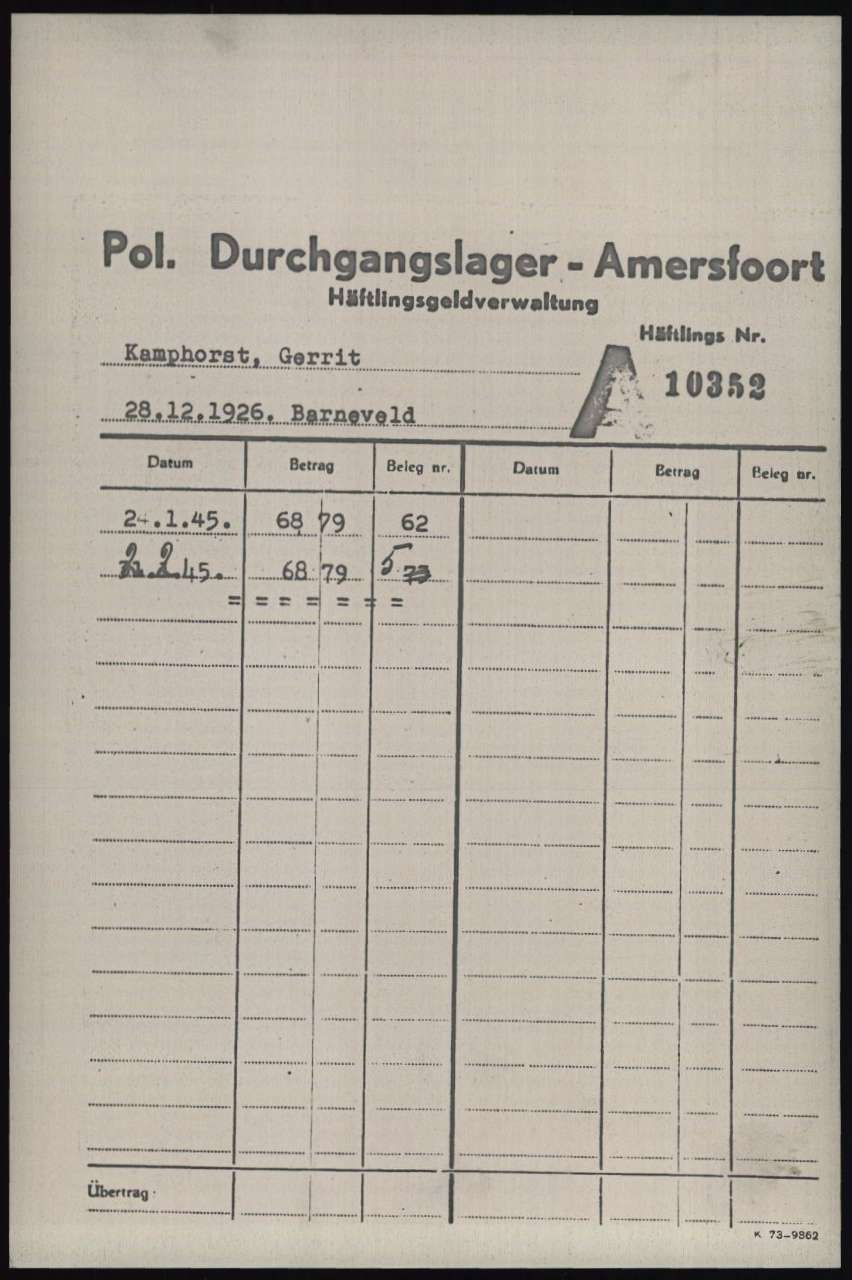
The colleague is ◐ Gerrit Kamphorst: the report gives no first name, but Huurdeman names him as the other farmhand taken at Hardeveld, and the two were registered at Neuengamme one after the other, 70620 and 70621 (Huurdeman; the Neuengamme list). The report does not name the barracks; Huurdeman has the men of the earlier December raids taken to the Willem III barracks at Apeldoorn (Huurdeman). Its date, and its six weeks at Apeldoorn, do not fit the other records (Where the sources disagree).
The report ends with his family. A good while after he was taken to Germany his parents, who in 1957 lived at Kootwijkerbroek, heard of his death through the Red Cross, and in September 1946 they received "zijn persoonsbewijs en horloge" (his identity card and watch) (the report): ◐ the two things listed on his Neuengamme effects card, a pocket watch with its chain and identity card L 22 No 001092 (the card).
The rest of the War Graves Foundation's file
Link to the section The rest of the War Graves Foundation's fileThe Foundation's file on him, fifteen scans at the Nationaal Archief, holds besides the report (the file):
- Its letter of 27 November 1951 asking Barneveld where his family lived, received there on 29 November (scan 5).
- Its questionnaire of 4 February 1957, marked "SPOED" (urgent), giving his birth, his death at Neuengamme on 18 February 1945, his church, "Geref. Gem.", and his occupation as farmer, with his moves in Barneveld's hand on the back (scans 1 and 2).
- Its grave-registration form: died 18 February 1945, "Hamburg Neuengamme", the burial lines left blank (scan 3).
- The papers of 1964: his sister, Mrs R. Kleijer-van de Kuilen, 50, and her husband P. Kleijer, 54, both of Veenderweg 67, Ede, applied (the form, scan 11, image-checked; the same pair as the marriage of 1934 above) for the Foundation's group journey number 8, "Hamburg en concentratiekamp Neuengamme", on 22 to 24 July 1964, at 60 guilders each, and the Foundation's rail tickets, Hengelo to Hamburg by Bentheim and Bremen, were stamped at The Hague station on 17 June 1964 (scans 7 to 11).
- A handwritten letter of 13 March 1964 from a brother at Kootwijkerbroek, asking whether he could come on the same visit to the grave of his brother Hendrik, who died there in 1945; the Foundation noted on 17 March 1964 that he could come and sent the form (the letter, scan 14, image-checked). The transcript does not name the writer, so he is not matched to the brothers above.
Hardeveld in Boeree's chronicle
Link to the section Hardeveld in Boeree's chronicle◐ Th. A. Boeree's Kroniek van Ede (1947) tells the farm's story under the name "Hartevelt onder Leusden" and names none of the farmhands. From 19 September 1944 it held Captain King's transmitter: "Op de boerderij waren twee knechts en een dienstmeisje" (on the farm were two farmhands and a maid), and all three kept silent until the maid, finding hidden Englishmen at her parents', told them the farm had Tommies too (p. 158). On 30 October a farmhand of Lagerweij's cycled after King's cart out of interest and brought a rug back that evening; he is one of the two, unnamed (same page). When King had gone, "het onweer brak een paar dagen later los over de achterblijvenden" (the storm broke a few days later over those left behind): "Het dienstmeisje verklapte bij het verhoor alles, de beide knechts zwegen en overleefden hun gevangenschap niet" (the maid told everything at the interrogation, the two farmhands kept silent and did not survive their imprisonment) (p. 158, checked on the page image). ◐ That reads as the Hardeveld household and the two men who died at Neuengamme, with Gerrit Kamphorst the other farmhand; the date it implies does not agree with the others (below). The whole passage is on Wuf Lagerweij's page.
Where the sources disagree
Link to the section Where the sources disagree- His surname: "van der Kuilen" in Huurdeman's account of the arrests and "van de Kuilen" in his list of the dead (Huurdeman); "van de Kuilen" on the camp card and in the birth record (the card).
- When and where he was taken. ⚠︎ Open; this page follows Huurdeman.
- 31 December 1944, by the SD, at Hardeveld, Wuf Lagerweij's farm at Postweg 8, Leusden, with Kamphorst and the maid (Huurdeman, from a local history of 2019; the excerpt online gives no source for the date).
- 5 January 1945, "door Duitsers" (by Germans), at W. Lagerweij's farm, Leusden G.35, with Kamphorst and a maid (the police report of 1957), written twelve years later by a constable who does not say who told him.
- 5 January 1945 also for his colleague Gerrit Kamphorst: in Kamphorst's father's form of 1958 ("5 Jan 1945 eerst naar Apeldoorn daarna naar Amersfoort", arrested by the SD) and in the Neuengamme memorial's record for Kamphorst, which has him at the Willem III barracks from 5 January (Kamphorst's father's form; Digitaal Monument Neuengamme). Kamphorst's municipal form of 1958 gives no date, only a raid on W. Lagerweij's farm (the form). ◐ So 31 December rests on Huurdeman alone, and 5 January on three other Dutch records, two of them forms written twelve to fourteen years after.
- ◐ The place is the same farm under two addresses, Lagerweij's in both; that G.35 is Postweg 8 is not checked against a register.
- 5 January is the date Huurdeman gives for the next raid, on the neighbouring gamekeeper Bab van Garderen, from whom the Hardeveld farmhands took their instructions (Huurdeman). Either date fits his reaching Amersfoort on 24 January.
- ⚠︎ A third date: Boeree has the storm break over the farm "een paar dagen later" than a move he dates "Woensdag 30 October" (p. 158), the first days of November 1944. ◐ Open. Against it, the Barneveld registry has him moving to Leusden G.35 on 22 December 1944 (above), though he had lived there before; for Boeree, his weekday is wrong (30 October 1944 was a Monday) and he does not say who the farmhands were or how the SD came. The rest is on Wuf Lagerweij's page.
- How long he was held at Apeldoorn. ✗ The police report has "ongeveer 6 weken" (about six weeks) there before Amersfoort (the report). The Neuengamme memorial has him at Amersfoort from 24 January to 2 February 1945 (the memorial), and Kamphorst's Amersfoort money card starts on 24 January (the card), so from either arrest date he was at Apeldoorn about three weeks. The report's "enige dagen nadien" (a few days later) on to Germany fits the nine days to 2 February.