Dirk Eskes
Deventer 16 Aug 1913 – Hattem 4 Apr 1945
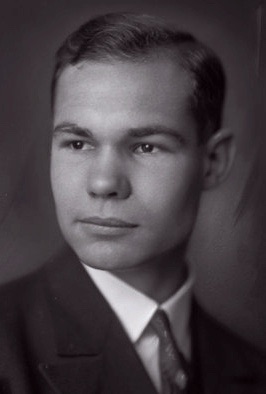
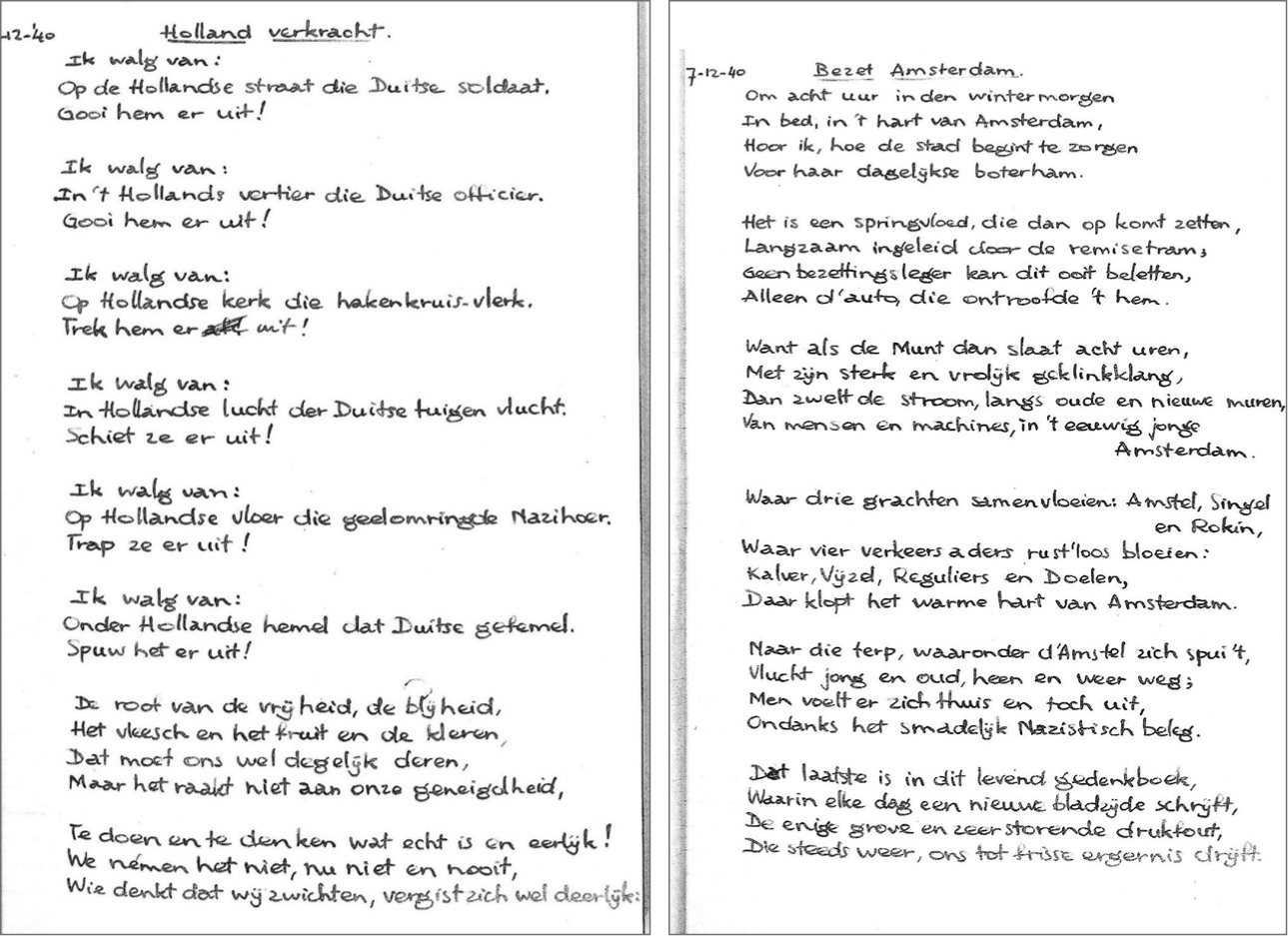
About: Dirk Eskes, a doctor in hiding, "Alex", Dr Kruimel's partner in the Veluwe pilot line and later, by his testament, his widow's notice and the War Ministry's card, commander of the radio service with the Netherlands Government (see "Where the sources disagree"), ◐ possibly the man who took Murphy and Walsh on from Dove Jan's farm in October 1944. Arrested at his transmitter in February 1945, he was shot by the Germans at Hattem on 4 April 1945, with 23 others from Zwolle prison, and lies at Garderen.
Unit or role: The pilot line with Kruimel; later "comm.dt. Radiodienst b. d. Ned. Regering", commander of the radio service with the Netherlands Government (his testament, Noordman, p. 23); by Boeree his radio work took him into the leadership of the Raad van Verzet (p. 88).
Where: 's-Gravelandscheveer 8, Amsterdam, until 1942 (the Amsterdam records below); in hiding at Garderen, Nieuw-Milligen ("Dr. Eskens N'Milligen" on Dove Jan's list) and Ommen; "Hoogeweg B 165, Hardenberg" on the Americans' list of 1946.
Evidence: ✓ Boeree, Kroniek van Ede (1947), pp. 88–89 and 204 (checked on the page images); ✓ the Amsterdam labour office's transport list and card and the police report of 27 April 1942 (Stadsarchief Amsterdam); ◐ Schaeffer's table, p. 5; Van den Top's table, p. 3; Van de Kamp's form, p. 2; ◐ Dove Jan's file, p. 4; ✓ the Van Nispens' file, p. 3; Noordman, pp. 7, 17–24, 307–311, 333; ✓ his helper file with the Americans, US National Archives 286653380 (p. 8); ✓ his death notice, Trouw, 28 May 1945; ✓ the War Graves Foundation's file on him, 1957–1994 (Nationaal Archief 2.19.255.01, 41274A); Het Parool, 31 December 1945; ◐ Bowman, Mosquito Mayhem, p. 76; ✓ the Enquêtecommissie's hearing of 20 May 1949 (his arrest with Jan Thijssen; checked on the page image); ✓ the helper form of Nol Burger and the Americans' lists of 1946–47 (30 July 1946; 22 January 1947); ◐ the helper forms of Elbert Bos and A. J. Koeslag; ⚠︎ B. Lulofs in De Telegraaf, 17 April 1982; ◐ Braakman, The War in the Corner, p. 114; ✓ his father's death notice, Algemeen Handelsblad, 17 February 1964
Dirk Eskes, a doctor, was born at Deventer on 16 August 1913 and married Nelly Margaretha Buis, also a doctor, born at Heiloo on 20 March 1917 (his testament, Noordman, p. 23). His parents, in Hattem's death register, were Dirk Eskes, a cargadoor (ship's broker), and Christina Cornelis Engelina Dixon (the register). ✓ His father's death notice of February 1964 is for Dirk Eskes, "weduwnaar van Christ. C. E. Dixon" (widower of Christ. C. E. Dixon), a knight of the Order of the Crown of Belgium and of the Order of Leopold and "Oud-consul van België te Makassar" (former consul of Belgium at Makassar), who died "Heden" (today) aged 76, the notice dated Doorn, 14 February 1964, with an address there; among those signing it are "N. Drijber—Buis", ✓ his son's widow, remarried (below; Noordman, p. 333, has her, under the remarried surname, and her son by the Eskes name opening the family archive) (Algemeen Handelsblad, 17 February 1964, checked on the page image).
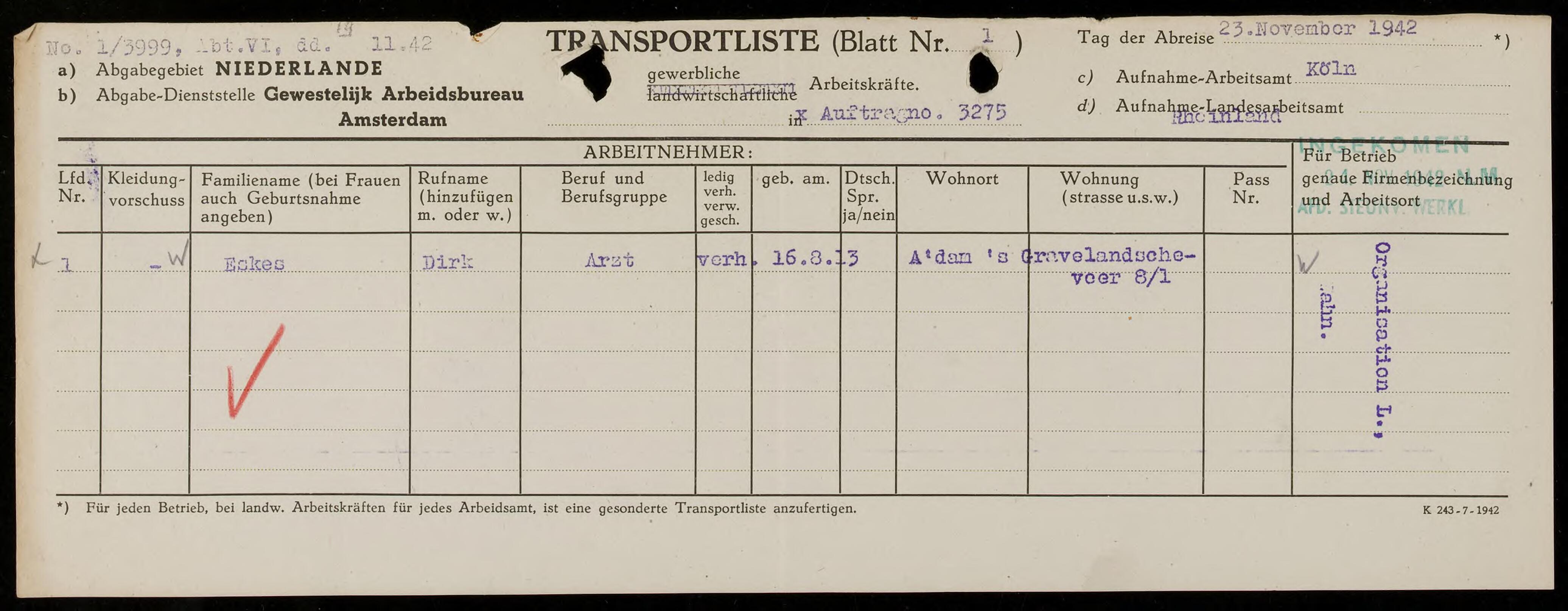
In Amsterdam, 1942. ✓ The Amsterdam City Archives' index of the men sent to work in Germany has two sheets for him, and its police reports a third. Both labour-office sheets give his birth as 16.8.13 and his address as 's-Gravelandscheveer 8, Amsterdam. The first is a German-language transport list of the Amsterdam labour office, for a transport leaving on 23 November 1942 for the labour office at Köln, with a single line: "Eskes", "Dirk", Arzt (doctor), married (the list; transcription; checked on the image). The second is the labour office's own card for him, marked "dokter" and married, with Wahn (by Köln) as the employer's place, "N. M. Eskes-Buis" as the person to be paid, and six ledger lines of family allowance and social supplement for two children, paid between 27 November and 22 December 1942 (the card; transcription; checked on the image; the typed departure month is overtyped, and the list and the archive's index give 23 November). ◐ Neither sheet says whether he boarded the transport. Noordman has him go into hiding instead (below), and the card shows the office paying his wife as if he had gone, which it would do whether or not he had.
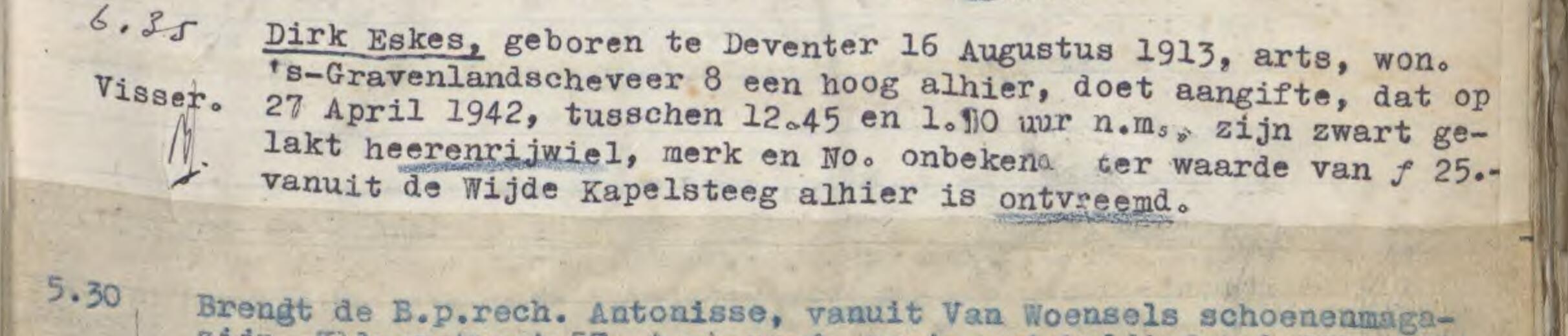
A stolen bicycle. ✓ The Amsterdam police log of Monday 27 April 1942 (report no. 117, Singel station) has him reporting that his black man's bicycle, worth 25 guilders, was stolen from the Wijde Kapelsteeg between 12.45 and 1.10 that afternoon, and writes him as "Dirk Eskes, geboren te Deventer 16 Augustus 1913, arts, won. 's-Gravenlandscheveer 8 een hoog" (born at Deventer on 16 August 1913, doctor, living at 's-Gravelandscheveer 8, first floor) (the report; transcription; the entry checked on the image). It has nothing to do with the war; it fixes his birth and his trade, and his home, six and a half months before the call-up, in a record that is not his family's.
His sister. A marriage at Baarn on 7 June 1947 is that of Avina Eskes, 32, born at Soerabaja, daughter of Dirk Eskes and Christine Dixon (Baarn deed 70, read on the scan; transcript). The deed adds that she was a medical analyst living at Baarn, that her father, Dirk Eskes, was a director of a warehouse company (Directeur van een Veem) living at Baarn, that her mother was dead, and that a witness was her brother, Charles Dickson Eskes, 31, a commercial clerk of Baarn. His parents in Hattem's death register are Dirk Eskes, a cargadoor, and Christina Cornelis Engelina Dixon (the register): the father's name and the mother's surname and first name agree, and a ship's broker's family fits a birth at a Java port. ✓ His father's death notice of 1964 joins them: the Dirk Eskes of that notice, "weduwnaar van Christ. C. E. Dixon", the initials of Hattem's Christina Cornelis Engelina Dixon, has among those signing "A. van Meir-Eskes" of Heemstede (the Baarn deed's groom was a van Meir), "Ch. D. Eskes" of Mill Valley, California, and "N. Drijber—Buis" (the notice). So Avina, born about 1914 or 1915 by her age, and Charles Dickson Eskes were his sister and brother. The Baarn deed calls the father Directeur van een Veem (director of a warehouse company), Hattem's register a cargadoor, and the notice a former Belgian consul at Makassar.
Into hiding, November 1942. By Nelly Eskes's account, which Noordman prints from 2004, their second son was born on 9 November 1942, and the next day a card came calling Dirk up as a doctor in the camps for labourers in Germany, to leave within ten days for "Wahn bij Keulen" (Wahn near Köln). They decided he would go into hiding while pretending to go; he even collected the travel money. Fourteen days after he left he telephoned to say he would come home one evening to talk; he had gone by Alkmaar and Leiden and through the Betuwe to the Veluwe. She then followed him with the two boys by train to Ermelo; after four days at the hotel De Zwarte Boer at Staverden they walked over the heath to Garderen, where "Joop", Dr Kruimel, lodged them with the carpenter Nol Burger, head of the resistance in Garderen, and his wife (Noordman, pp. 18–19; Nol Burger). Burger had made hiding places in Kruimel's house, where Kruimel was hiding a Jewish family and the doctor Ab Groen, and "Onze eerste vlieger die daar een goed onderkomen kreeg, was de Engelsman Neville Fearneyhough" (our first airman to find a good shelter there was the Englishman Neville Fearneyhough) (p. 19). The Amsterdam labour office's card has the same Wahn (above).
Nieuw-Milligen. After "a few things" happened near Garderen, Burger found them a converted wooden garage in the woods at Nieuw-Milligen, on the estate of a house whose caretakers had moved into the house itself. It became a stopping place for airmen on the way south; Dirk was often away, so caring for the airmen fell to her, and Burger dug a one-man and a two-man hide in the woods nearby. Some stayed days, some weeks; "De langste tijd – tien weken – bleven Larry en Robert, twee Canadezen, toen was de lijn naar het zuiden door verraad geblokkeerd" (the longest, ten weeks, were Larry and Robert, two Canadians, when the line to the south was blocked by betrayal); "Frank and Bill" stayed three weeks and were later caught on the way, Frank McGlinchey and Bill McDonald (Nelly Eskes's form names Frank B. McGlinchey and William Hosey Macdonald, with her from "19.11.'43 till 9.12.'43", and her letter says they "were caught somewhere in Belgium": p. 3, p. 7). The radio they listened to and "Het archief van de Raad van Verzet" (the Raad van Verzet's archive) were buried there; after the war she dug the archive up and handed it to the NIOD (Noordman, pp. 19–21). Noordman's own chapter on Kruimel's house has the Germans raid it four weeks after Fearneyhough came; Marianne Happ, the daughter of the Jewish family there, escaped to Burger's house, and Burger's wife sent her on to the Eskes family at Nieuw-Milligen to warn them; Fearneyhough and Ab Groen, after hiding eight hours in the loft, found their way back to "the people in Nieuw-Milligen who had helped us before" and were driven from there to a farm at Staverden (pp. 65–66).
Fearneyhough, May 1943. Nelly Eskes's letter dates the first airman to reach them to 3 May 1943: the wounded Lancaster navigator Neville Fearneyhough, for whom Nol Burger was asked to bring a doctor, and the next day "my husband (Alex), Joop (J.Kruimel, surgeon, Biltstraat 176, Utrecht) and I transported him to Joop's summer-house in Garderen" (her file, p. 6). Noordman has "De Amsterdamse arts Dirk Eskes, die de buurman was van de familie Van der Mast, heeft Neville onderzocht, voor kleding en schoeisel gezorgd en hem vervolgens overgebracht naar Garderen" (the Amsterdam doctor Dirk Eskes, who was the neighbour of the Van der Mast family, examined Neville, saw to clothing and shoes and then took him to Garderen) (Noordman, p. 65). ⚠︎ Nelly has the family staying at Garderen with Nol Burger that month, Noordman has Eskes as the Van Masts' neighbour at Nieuw-Milligen; both have him take the airman on to Garderen.
Eskes became a close colleague of Jan Thijssen, leader of the Raad van Verzet, and was part of "'De Driehoek' of 'Deltacentrum'", the body in which the resistance groups met to form the Binnenlandse Strijdkrachten (p. 17). He worked with Dr Kruimel on the Veluwe pilot line under the cover name "Alex": his wife wrote that Kruimel was working on a "Pilot-line" from Friesland to Belgium and "Alex and Joop took care of the men" (her file, p. 6), and Noordman, from the family's archive, has "Dirk Eskes gebruikte in het verzet de schuilnaam 'Alex'" and that he and Kruimel worked closely together (Noordman, p. 7).
Airmen at Nieuw-Milligen, 1943–44. ◐ Bowman prints the account of the Mosquito pilot F/O R.K. Bailey, shot down on 27/28 May 1944, who after meeting a Mr Van den Top of Stroe and "Dick, a British agent" and two days at Van den Top's house (Dick Kragt very probably) became "the guest of Dr Dirk Eskes and his wife in a small house in wooded country not far from Stroe": free of the grounds by day, at dusk "lowered into a hiding-place like a grave" with the trap-door closed, for a few weeks until word came "about mid-July" that his papers were ready (Bowman, p. 76; checked against the page image; Robert Bailey). Nelly Eskes's letter and form have him with them from 23 or 24 June to 24 or 25 July (her form has "23.6.'44 till 24.7.44", her letter "June 24 till july 25"), after the farm at Renswoude, not after two days at Van den Top's (her file, p. 3 and p. 7; the disagreement). His wife's own file with the Americans lists the men they hid, ending with McElroy and Gelfand, "31.7.44 till 11.10.44" (her file, p. 3); ◐ they are her "Larry and Robert, two Canadians" of ten weeks (above): the same form gives "10 wks." for McElroy and Gelfand, both RCAF, Canada, and Nol Burger's table has "Lawrence R. Mc Elroy" of Canada and Robert Gelfand together (below). The grade stays ◐ because Noordman has only the first names.
1943–44, on other helpers' forms. Five helpers' forms name him or "Alex", and Schaeffer's spells the alias out; his wife's letter tells the same months from their side.
- ◐ Assel, April and May 1944. Dr August Schaeffer Edler von Wienwald's table has two Americans, Sgt Eugene Glisynski of Chicago ("Apr. '44", Assel, "in het bosch gevonden", 5 days) and Lt Walter Mallard ("Mei '44", Meerveld, 6 days), passed on to "J.C. v. Oldenbarneveld, Kootwyk 2 en 'Alex' (Dr. Eskes)" (his table, p. 5; image-checked, the braces group both rows). So the form itself says who "Alex" is, and has him, with Dove Jan, the next stage for both men.
- Glisynski is also in his wife's letter, where he and Bill Lalley came down from one aircraft (her file, p. 7).
- Mallard went on to Kruimel at Staverden (Kruimel).
- ◐ On Noordman's print of the recollection of Maria Westerwoudt's daughter, after the raid on Dove Jan's farm the two Americans were hidden in the chapel at Assel, and "Op 6 juni, de dag dat de geallieerde invasie in Normandië begon, werden ze door Dirk Eskes (schuilnaam Alex) opgehaald en meegenomen" (on 6 June, the day the Allied invasion of Normandy began, Dirk Eskes (hiding name Alex) fetched them and took them away) (Noordman, pp. 140–141; Dove Jan).
- ⚠︎ Mallard's own letter after the war, written in English and printed by Noordman in Dutch, has "Nadat mevrouw ons naar 'Alex' gebracht had" (after the lady had taken us to 'Alex'), then Glisynski going to another address while Mallard stayed about two weeks with Alex (p. 183): there it is an unnamed lady who brings them to Alex, which does not say whether Alex fetched them.
- Nelly Eskes's letter has Mallard come to them from Van Oldenbarneveldt's house "till the sixth of June" (below).
- ◐ Stroe, June 1944. G. J. van den Top's table has "Conny O'BAR, Capt. THUNDERBOLT", U.S.A., shot down at Kampen, June 1944, 5 days, received from "Alex and van Oldenbarnevelt" and passed on to "Joop and Dick" (his table, p. 3; image-checked). The Alex of the form is ◐ Eskes, by the alias and by the same pairing with Dove Jan on Schaeffer's.
- Garderen, 1944: Nol Burger's table and letter.
- ✓ His table for the Americans has "Robert D. Fisher", U.S.A., down at Garderen on "19-5-44" ("May 13th. 1944" on Nelly Eskes's own form, p. 3), passed to "Dr. D. Eskes", and Walter Mallard Jr., received from "Johan van Oldenbarneveldt" and passed on with a ditto mark to the same (his table, p. 3, checked on the image).
- ✓ Further down, across the rows of "Lawrence R. Mc Elroy", Canada, 1944, and Robert Gelfand, it has "Collected with Dr. ESKES, Laren and transferred to Dr. KRUIMEL" (the same page).
- His list of helpers gives "Mrs. Dr. N.M. ESKES-BUIS, Hoogeweg B 165, Haardenberg" (p. 2), and his letter says of the Van der Masts, "Later on they helped Dr. Eskes with food etc." (p. 4).
- Laren, June 1944: A. J. Koeslag's table.
- ✓ Koeslag of Laren, in Gelderland, lists "L.R.M. Elroy" of Mattawa, Ontario, Canada, R.A.F., down on 1 June 1944 at Almen, hidden from June for "2mths", received from "Kolkman Buisweerd, Verwolde near Laren" and passed to "Kootwijk, "Alex" Post I" (his table, p. 14, checked on the image).
- ◐ Elroy may be Burger's Lawrence R. McElroy of Canada: the name, Mattawa and the Canadian airman fit, and two months from June runs to the time Nelly Eskes's list has McElroy and Gelfand with her from 31 July (her file, p. 3). But Koeslag has him down on 1 June at Almen, and her list and letter have McElroy and Gelfand jumping at Holten on 17 June 1944 (p. 3; p. 7), so the two dates and places differ.
- ◐ If they are one man, Burger's "Laren" may be this Laren, not the one in North Holland; no form says so.
- Staverden: Elbert Bos's table.
- ◐ Bos's form of 15 May 1946 has "Bil" and "Frank" passed to "Tijs Foppen and later on to Dirk Eskes", and lists among other helpers "Dr. D. ESKES, Amsterdam (shot by the S.D.)" (his table, p. 3, checked on the image; p. 2).
- Nelly Eskes's letter has them going the other way: "Frank and Bill stayed with us from the 19th of November till the ninth of December 1943; they couldn't stay any longer and we brought them to Thijs Foppen in Staverden" (her file, p. 7; the "19" written in ink over a struck number; Thijs Foppen).
- Her letter on the men of May and June 1944, by Nelly Eskes (p. 7):
- Robert Donovan Fisher, a B-24 pilot shot down at Garderen, was brought to them by Nol Burger and herself and stayed from 24 May to 19 June 1944.
- His co-pilot Walter Mallard, lodged by Johan van Oldenbarneveldt of Assel "till the sixth of June, it was dangerous there then", came to them and stayed to the 19th.
- William O'Bar spent one night with them before they took him to G. J. van den Top at Stroe.
- The four, Eugene Glisynski the fourth, left on 19 June "with Joop as guide".
- Papers and photographs, in Noordman.
- ◐ Of the papers made for O'Barr and Glisynski in June 1944, Noordman says "Dirk Eskes was hier expert in en had een arsenaal aan blanco persoonsbewijzen" (Dirk Eskes was an expert at this and had an arsenal of blank identity cards), and a good number of forged German stamps (p. 142).
- He prints the identity-card photographs of Fisher and Mallard as coming "uit het archief van Dirk Eskes" (from Dirk Eskes's archive), made for false identity cards (p. 184), and Mallard's postwar letter, as he gives it in Dutch, has them "ongeveer twee weken bij 'Alex'" (about two weeks with 'Alex'), where he met his pilot Fisher (p. 183).
- Of the doctor who examined the airman John Justice, Noordman has "De arts die John Justice onderzocht was Dirk Eskes, volgens de heer Van den Top uit Garderen" (the doctor who examined John Justice was Dirk Eskes, according to Mr Van den Top of Garderen) (p. 90).
With Murphy
Link to the section With MurphyDove Jan's own list for the Americans has the two escaped paratroopers with him for six days in October and then passed to "Dr. Eskens" ("Alex") of Nieuw-Milligen, ◐ Dirk Eskes (his file, p. 4). ⚠︎ Pieter Hoekstra's list has Hoekstra himself taking the pair on to Garderen, so Hoekstra may have moved them, or Eskes may have: the two forms disagree (October on the Veluwe). Murphy and Walsh are not on his wife's list (her file, p. 3). The Van Nispens' file names him among the men who brought evaders to De Ruif: "The Fliers were brought to the house by Dr Kruimel, Dr Eskes, Nol Burger … Mostly Dr Kruimel fetched them again" (the father's file, p. 3). Lipmann Kessel's party of four, by his account in Noordman, got out of the Willem III barracks on 16 October and met two farmhands on the morning of the 17th; Noordman puts Nelly Eskes's meeting with them "in de loop van die dag" (in the course of that day) (Noordman, p. 309; Lipmann Kessel). Her own words give no date:
So I met four senior officers, English I think, in the woods by Uddel … Once home I passed their presence on to my husband Dirk and Joop Kruimel. They were fetched by them that same evening and taken to 'De Ruif'.
Dutch originalZo heb ik vier hogere officieren, ik meen Engelsen, in het bos bij Uddel ontmoet … Eenmaal thuis heb ik hun aanwezigheid doorgegeven aan mijn man Dirk en Joop Kruimel. Ze zijn die avond nog door hen opgehaald en vervoerd naar ‘De Ruif’.
— Nelly Eskes · her account as Wolter Noordman prints it · Schuilplaats de Veluwe (2019), p. 309 · the book
⚠︎ Kessel's own book gives no date, and the dates on offer run from Noordman's 16–17 October to Walsh's "About 21 Oct it was arranged that we should move" (how Walsh's move relates to the medics' arrival is our reading), so the dates are not settled. His papers, with a longer list of the Allied men helped than Kruimel's, were opened to Noordman by the family (Noordman, pp. 7, 333); we have not seen them. His part is told on October on the Veluwe.
In Boeree's chronicle. ✓ Th. A. Boeree's Kroniek van Ede (Frouws, 1947), writing of the Garderen and Stroe helpers, gives him a short life: "Dr. Alex heette eigenlijk Dr. Dirk Eskes. Hij was in 1913 in Deventer geboren." (Dr Alex was really Dr Dirk Eskes. He was born at Deventer in 1913.) (Boeree, p. 88, checked on the page image.) The rest of the passage, pp. 88–89, in sum:
- He went into hiding at Garderen "in December" (the year is not on the page) as a reprisal for the doctors' refusal to join the artsenkamer, when he and a few colleagues were to be deported to Germany; he worked hard to help pilots and others in hiding, moved to Nieuw-Milligen when Garderen grew unsafe, and kept airmen in his house there.
- He joined the Raad van Verzet, where his radio work took him into its leadership.
- "In October werd hij tegelijk met Jan Thijssen gevangen genomen. Hij ontvluchtte en dook onder in de Achterhoek in de omgeving van Nijverdal." (In October he was arrested together with Jan Thijssen. He escaped and went into hiding in the Achterhoek, around Nijverdal.) Shortly before the liberation he was arrested again, on 6 February 1945, and shot at Hattem on 4 April with several others (p. 89, checked on the page image).
- On p. 204, introducing Berend Dijkman, "Piet van de Veluwe", Boeree says he had the strong support of Dr Kruimel, Dr Eskes, Thijssen and others (checked on the page image).
Boeree agrees with the records on the birth year and place, the arrest and the shooting at Hattem on 4 April 1945, and with Noordman on the arrest with Jan Thijssen, though Noordman gives only "In 1944", in the west of the country, with about four days in the Scheveningen prison and then a labour camp near Arnhem he walked away from (Noordman, p. 21); the month, October, is Boeree's alone. ⚠︎ Where he hid between the escape and the second arrest differs (see below).
Laren, November 1944. ◐ Jan Braakman's chronicle of Laren in Gelderland tells of the SD raid of 2 November 1944 on the Laren resistance (p. 109), which Appie Koeslag escaped:
The next day Appie got in touch with his brother Johan and "Uncle Jan" Berghuis, who had found a safe refuge with someone called Eskes. This may have been Dirk Eskes, a doctor born in Deventer who was a local resistance commander. Eskes was caught a week later on the way to The Hague in a Red Cross vehicle.
— Jan Braakman · The War in the Corner (2012, translated from the Dutch) · p. 114 · the page
The identification is the author's own and hedged, and he gives no source for it (read on the page image). A week after 2 November fits the witnesses' November for the arrest with Thijssen (below).
His arrest with Thijssen, in the Enquêtecommissie's volumes (1949). ✓ The German who made the arrest, Haubrock, told the commission under oath that the car stopped on the road from The Hague to Rotterdam was a Netherlands Red Cross car, and that "de drie gevangengenomen mannen, Thijssen, dr. Eskes en de chauffeur, werden direct naar het bureau op het Binnenhof gebracht" (the three men taken, Thijssen, Dr Eskes and the driver, were brought straight to the office on the Binnenhof); it was by chance, not on a tip (the hearing of 20 May 1949, printed p. 1266, checked on the page image; the story is told on Jan Thijssen's page). Haubrock names no date. ✓ Thijssen's secretary, Christine van Hoorn Alkema–Schadd, has him in the radio service's circle and says: "Die is eerst met Jan gearresteerd — deze is gearresteerd met twee mensen — en daarna is Eskes weer vrijgelaten, maar is later nog eens gepakt" (he was first arrested with Jan, who was arrested with two people, and then Eskes was released again, but was caught later once more), and the commission's summary of her evidence has the same (the hearing of 7 June 1949, p. 1403; the summary, p. 427; both checked on the page images). Her brother Tom Schadd, who took over the radio service, says that Dr Eskes was present at the last talk Thijssen had with Gerben Wagenaar of the Raad van Verzet shortly before his arrest (the hearing, p. 1407, checked on the page image). The witnesses give November 1944 for Thijssen's arrest; Boeree's "October" and the Enquête's November are both given on Thijssen's page.
The camp at Arnhem, in a column of 1982. ⚠︎ In April 1982 B. Lulofs, a columnist of De Telegraaf, disputing the war record of Reinder Zwolsman, wrote that Zwolsman had in November 1944, helped by six military policemen, brought six SD prisoners from The Hague to Arnhem, where they were made to dig German trenches at the Rhine front, and had exchanged them there for three other men. The column gives as one reason for telling it that Zwolsman himself writes about it in his letter, and that letter, as quoted, calls the earlier column a "nonsensverhaal"; near its end the column says its writer does not doubt Zwolsman had merits in the resistance, and then asks again which of his services was worth which other to the Sicherheitsdienst. Of Eskes the column says:
One of those six prisoners was Dr Dirk Eskes of Amsterdam. In Arnhem he was forced "to work as a camp doctor" in the death zone on the Rhine.
Dutch originalEen van die zes gevangenen was dokter Dirk Eskes uit Amsterdam. Hij werd in Arnhem gedwongen om in de dodenzone aan de Rijn „als Lager-arts te gaan werken".
— B. Lulofs · column headed BRIEF (letter) · De Telegraaf, 17 April 1982 · the column
He fled, it goes on, when the NSDAP Kreisleiter Quant let him go to fetch medical instruments from Apeldoorn; he was arrested again by the SD near Zwolle on 10 February 1945 and shot with 23 other Dutchmen on the Geldersedijk near Hattem on 4 April (De Telegraaf, 17 April 1982, p. T 7, checked on the page image). The column names no source. Zwolsman's letter, as the column quotes it, said he had worked from 1942 to 1945 for the OD, the L.O. and the Bureau Bijzondere Opdrachten in London. It agrees with Nelly Eskes's "werkkamp bij Arnhem" (labour camp near Arnhem) that he walked away from (above), and with the War Ministry's card on 23 others.
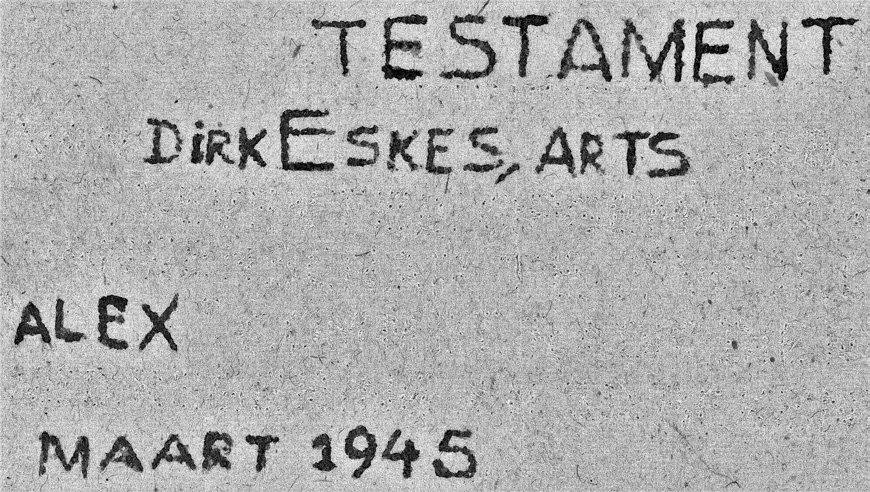
In the autumn of 1944 the family moved on, by Olst, to Ommen. In February 1945 he was caught by betrayal while transmitting from the Prenger farm at Hardenberg, with the operator Floris van der Laaken and the farmer, and held at Almelo and then in the SD prison at Zwolle. There he pricked a testament with a pin into twelve sheets of toilet paper, "Testament van Dirk Eskes, arts, geb. 16-8-1913 te Deventer, opgemaakt in S.D. Gevangenschap te Zwolle, als ALEX, comm.dt. Radiodienst b. d. Ned. Regering bekend. Maart 1945", asking to be buried at Garderen. On 4 April 1945 he was shot with "Bunny" (Austin) and others on the dyke at Hattem, "voor het vuurpeloton op de Geldersedijk in Hattem", and on 1 June 1945 he was reburied at Garderen from Nol Burger's house (Noordman, pp. 17, 21–24).
◐ A helper in Overijssel, where the family lived at Ommen, names him with the British agent "Maurits", whom Gradus van de Kamp of Den Ham sheltered, from whose house Maurits "sent news with his transmitter to England": van de Kamp "gave also news from Maurits to Dr. Eskes (Alex) and from Eskes to Maurits" (van de Kamp's form, 19 March 1946, p. 2; image-checked). The form has no date. It fits his radio work for the Raad van Verzet, but nothing else names Maurits.
Nol Burger wrote in March 1946: "It is a pity that Dr. Eskes is shot, the family Eskes did very outstanding work" (Burger's file, p. 4). Albert Groen, writing to Nevil Fearneyhough in August 1945, as Noordman gives the letter in Dutch: "Tijdens de laatste maanden van de oorlog zijn er veel verzetsmensen gearresteerd, onder wie onze vriend Dirk Eskes" (in the last months of the war many resistance people were arrested, among them our friend Dirk Eskes) (Noordman, p. 70).
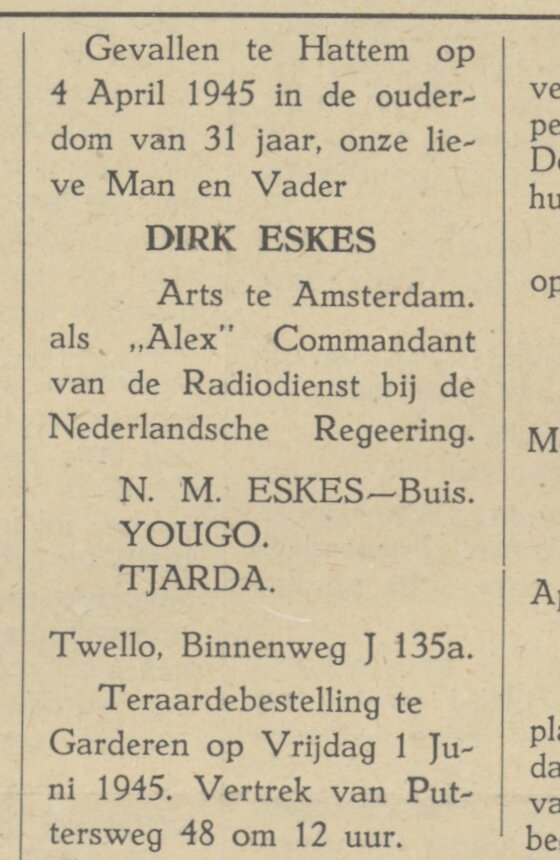
The notice. His widow's notice in Trouw of 28 May 1945 gives the day, the place and his work:
Het Parool of 31 December 1945 names him among those who ran the radio service from the farm "Het Schip" near Barneveld: "Dirk Eskes (Alex, gefusilleerd op 4 April 1945 te Hattem)", with Jan Thijssen and Mrs Eskes-Buis, and Floris van der Laaken (Lex), the technician, "gefusilleerd op 4 April 1945 te Hattem" the same day and place (the article; the column is on Jan Thijssen's page; the sentences naming Thijssen, Eskes and van der Laaken checked against the image). ◐ The same passage was printed again in Amigoe di Curaçao on 11 April 1946, as a search of the Internet Archive's OCR of that issue shows (the OCR reads "Dirk Eskes (Alcx, gefusilleerd op 4 April 1945 te Hattem).en me- vrouw Eskes-Buis", the "Alcx" being Alex; the snippets; OCR only, the page not read).
What the Foundation's file adds. ✓ unless marked.
- Shot with 23 others. The War Ministry's index card has him taken from Zwolle prison to Hattem on 4 April 1945 and "op de IJsseldijk gefusilleerd, tezamen met 23 anderen eveneens uit de Gevangenis te Zwolle" (shot on the IJssel dyke together with 23 others, also from the prison at Zwolle). It gives rank on 10 May 1940 corporal, general troops ("Kpl. Gen. Troepen"), "In dienst bij de BS: ILLEGAAL", function "Cdt. Radiodienst bij de Nedl. Regering", alias Alex, and leaves "Gearresteerd" blank (scan 29; image-checked).
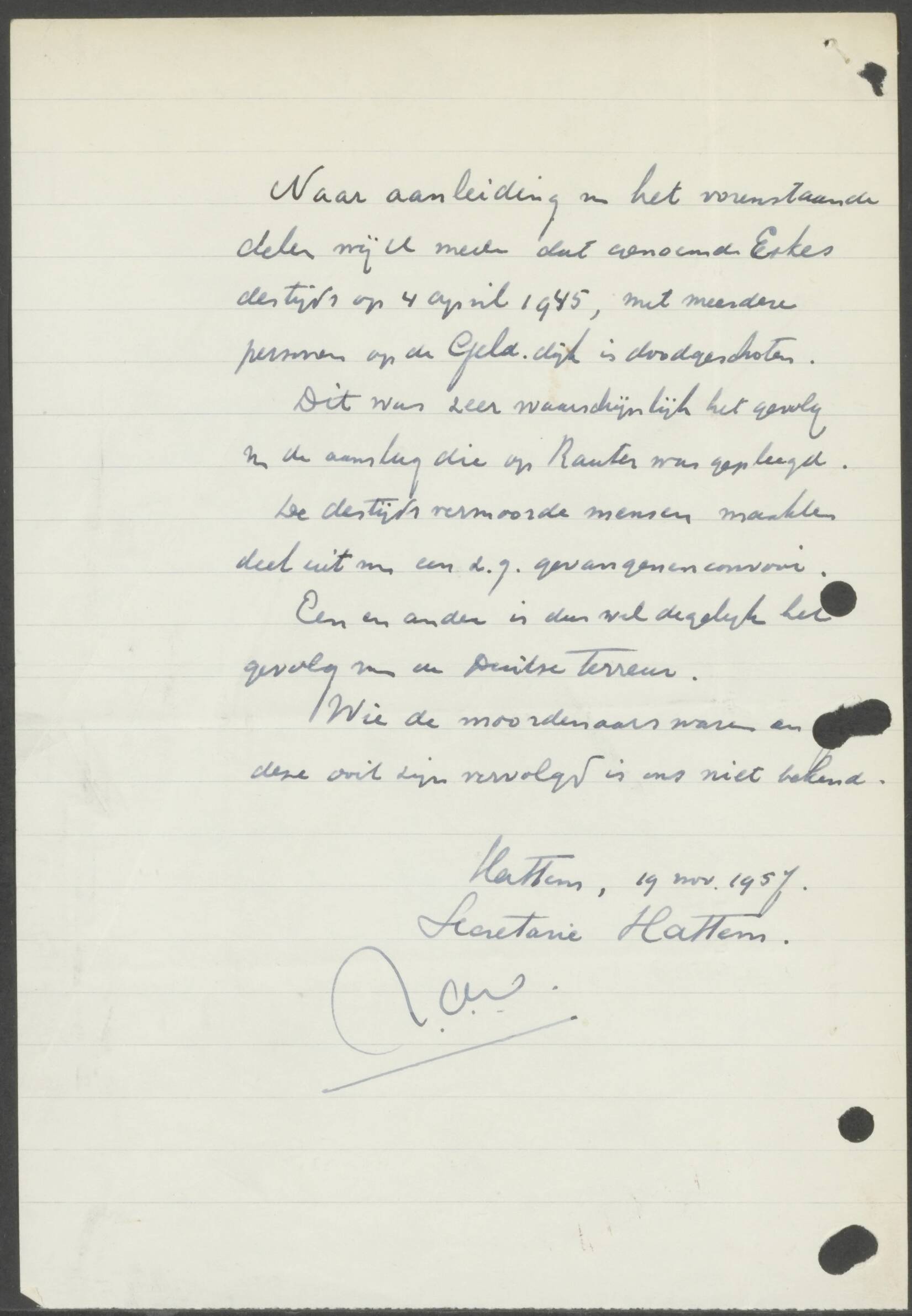
- A reprisal? The Hattem and Garderen forms link the shooting to the attack on Rauter.
- The secretary of Hattem wrote on 19 November 1957 that he was shot dead on the Gelderse dyke with several others, "zeer waarschijnlijk het gevolg van de aanslag die op Rauter was gepleegd" (very probably the result of the attack made on Rauter), the people killed being part of a convoy of prisoners (scan 9; image-checked).
- The church warden at Garderen has "neergeschoten op de Geld[erse] Dijk te Hattem na de aanslag op Rauter" (scan 5).
- ◐ The link is the two local forms' own, and neither gives a source. The Foundation's page on Jan Thijssen has the attack on Rauter "op 6 maart 1945" and Thijssen shot at the Woeste Hoeve on 8 March (the page; Het Parool has the same date, the article), and the Erelijst has Abraham du Bois there on 8·III·1945; 4 April is nearly a month later.
- The two dykes. The card says the IJssel dyke, the other forms the Gelderse dyke. ◐ Very probably one dyke along the river at Hattem under two names; the page's "Geldersedijk" is the Gelderse dyke.
- The grave. First buried in the churchyard at Hattem, re-buried at Garderen on 1 June 1945.
- The re-burial form has the grave bought by "de Heer A. Borger, Potterweg 48 Garderen (illegaliteit)" (scan 4).
- The church warden's form says "door illegale werkers is hem dit graf geschonken" (given to him by illegal workers), section 2 no. 72 of the special cemetery at Garderen (scan 5).
- ✓ "A. Borger" is Nol Burger: Putterweg 48 is his address on his own form, and the notice's Puttersweg 48 is the same house.
- The widow. Nelly Margaretha Buis remarried in 1946, as a note added by Hardenberg's municipality below Hattem's answer of 1957 records (scan 3). Two sons are named in the file and are not named here.
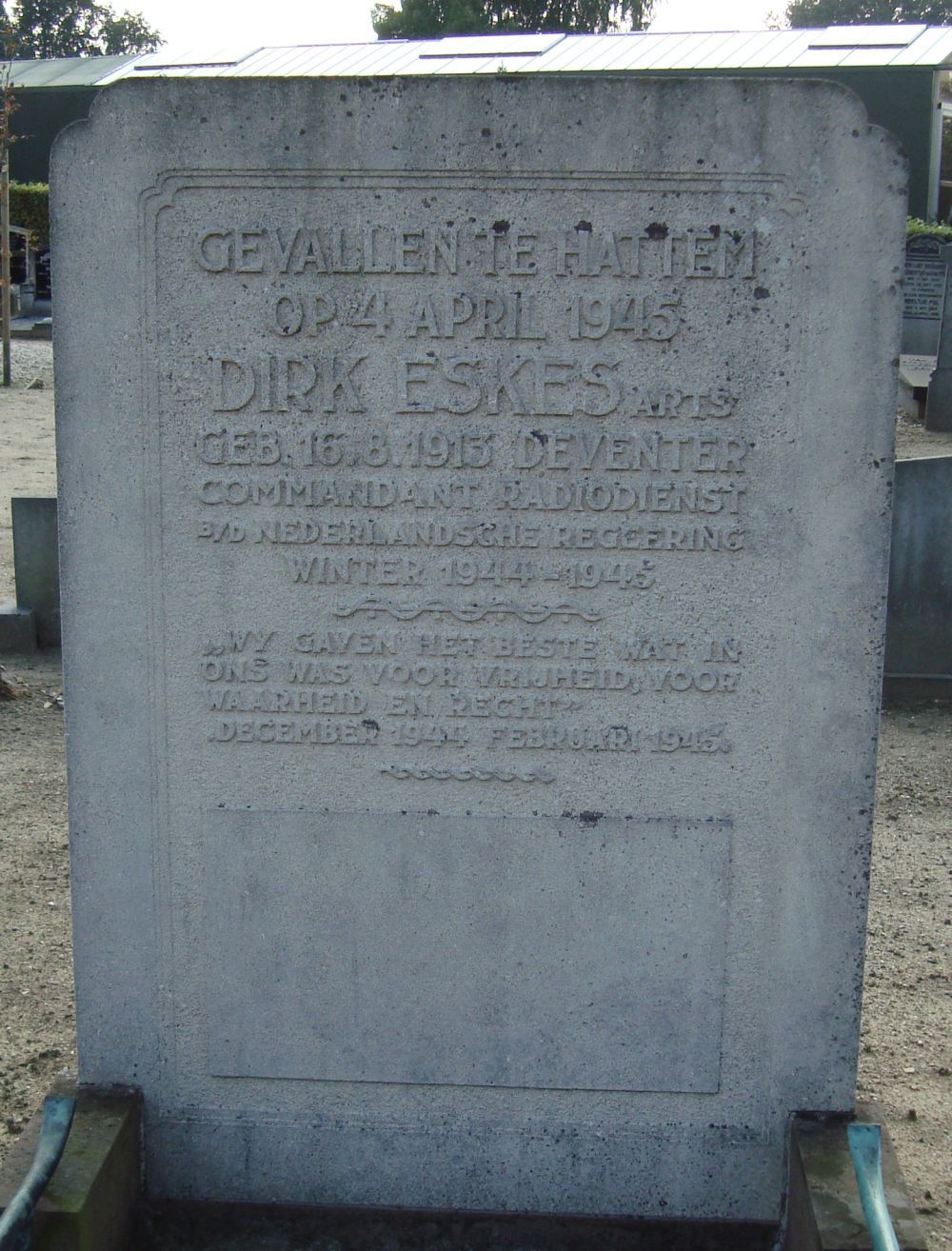
- The stone. His stone at Garderen, as pictured on the Foundation's page (read from the photograph), reads "Gevallen te Hattem op 4 april 1945", "Dirk Eskes arts, geb. 16.8.1913 Deventer", "commandant radiodienst b/d Nederlandsche Regeering, winter 1944–1945", and, in quotation marks, "Wy gaven het beste wat in ons was voor vrijheid, voor waarheid en recht", dated "december 1944 – februari 1945" (the photograph).
- The grave stays at Garderen. On 24 May 1994 the Foundation proposed moving him to the Ereveld at Loenen. His widow declined on 15 July 1994, because of his testament: "Garderen was onze eerste onderduikplaats" (Garderen was our first hiding place), and with her sons she wished to keep to his last wish; the Foundation agreed on 25 July (scan 20; scan 19; scan 21).
- A clean record. The Ministry of Justice's stamp of 20 November 1957 finds no political act of his penalised by the special courts (scan 3).
The Americans recommended him for the Medal of Freedom without palm, posthumously, for service "from May 1943 to November 1944", as "Dirk ESKES, Dutch civilian, Hardenberg … Nearest relative: Dr. N. M. Eskes-Buis (wife), Binnengasthuis, Amsterdam" (22 July 1946; p. 8; the recommendation, p. 6).
✓ On 30 July 1946 the Americans' Holland office sent the Ministry of the Interior a list of Dutch nationals for clearance by the Netherlands Government, by province; under Overijssel it has "Dirk Eskes, Hoogeweg B 165, Hardenberg" (the list, US National Archives, helper file of Alphonse Bergmans, pp. 11 and 13, read on the images; the covering letter). Hoogeweg B 165, Hardenberg, is the address Burger gave for his widow (above). ✓ On 22 January 1947 the same office sent the Palace a "lijst van personen aan wie posthuum een onderscheiding is uitgereikt of overhandigd zal worden" (list of persons to whom a decoration has been, or will be, presented posthumously), part A those whose families had already been asked to a ceremony, part B those for the next one; "D. ESKES", with "Mrs. Eskes-Buis", Binnengasthuis, Amsterdam, is in the second block of the list (the letter and the list, helper file of Hendrik Beernink, read on the faint images; a handwritten "A." stands at the top left of the list and a handwritten "B" beside the row of asterisks that opens the second block, the block with Eskes, so he is among those "who will be considered next time").
Where the sources disagree
Link to the section Where the sources disagree- Why and when he went into hiding.
- Noordman, from Nelly Eskes's account: called up in November 1942 to be a doctor in the labour camps in Germany, he went into hiding instead (Noordman, pp. 17–21).
- Boeree: he went under at Garderen "in December", as a reprisal for the doctors' refusal to join the artsenkamer, when he was to be deported with a few colleagues (p. 88).
- The Amsterdam labour office has him on the transport list for 23 November 1942 (above).
- ◐ These can be one event told three ways: a call-up to Germany for a doctor who would not enrol, ending in hiding.
- How the first arrest ended.
- Noordman: about four days in the Scheveningen prison, then a labour camp near Arnhem he walked away from (Noordman, p. 21).
- Boeree: arrested with Thijssen, escaped, and went under in the Achterhoek (Boeree, p. 89).
- Mrs van Hoorn Alkema–Schadd and the commission's summary: released ("weer vrijgelaten") after the arrest with Thijssen (the hearing, p. 1403).
- ⚠︎ Lulofs's column of 1982: handed over at Arnhem, made to work as a camp doctor in the Rhine line, and fleeing when allowed to fetch instruments from Apeldoorn (De Telegraaf).
- ◐ Escape, release and a walk away from a camp can be one event told by people who were not there; no record of his release has been seen.
- Where he hid after the escape of 1944. Boeree has him under in the Achterhoek, around Nijverdal, until the arrest on 6 February 1945 (p. 89); Noordman has the family move to Ommen and the arrest at the Prenger farm at Hardenberg, in Overijssel (Noordman, pp. 21–24). ◐ Nijverdal is in Overijssel, not far from Ommen, so "Achterhoek" looks like Boeree's loose word for the east; the month and year of the arrest agree.
- A decoration? ⚠︎ The Chancery of Orders' index has two entries for "Dirk Eskes" in the class Overige Buitenlandse Orden (other foreign orders), register nos. 6070 and 6773, with no first name, birth date or award (the entries, and). The Americans recommended him for the Medal of Freedom (above), so one may be his. ◐ But his father, also Dirk Eskes, was by his death notice a knight of two Belgian orders, the Crown and Leopold (the notice), which would also make two entries under foreign orders; the cards could not be opened on 14 October 2026, so it is not settled.
- The second arrest. Boeree: 6 February 1945 (p. 89); Lulofs: 10 February 1945, "in de buurt van Zwolle" (near Zwolle) (De Telegraaf); Nelly Eskes: February 1945, at the Prenger farm at Hardenberg (Noordman, p. 22). ◐ The day is not settled; Hardenberg, not Zwolle, is where his wife places it, and Zwolle is where he was held.
- "Frank and Bill". Nelly Eskes's letter has them brought from her house to Thijs Foppen in December 1943; Elbert Bos's table has them passed to "Tijs Foppen and later on to Dirk Eskes" (her letter, p. 7; Bos, p. 3). ◐ Her letter, written by the person who hid them, is the closer source.
- Head of the radio service. The testament and the widow's notice, in their own words, and the War Ministry's card give him as commander of the radio service with the Netherlands Government (scan 29). The Enquête's summary of the radio-service witnesses has Floor van der Laken take the lead after Thijssen's arrest, then Tom Schadd "tot het einde van de oorlog", and Eskes "een tijdlang in de kring van de Radiodienst" (the summary, p. 427); the Foundation's page gives the same successors (Jan Thijssen), and Het Parool has Thijssen organising the service, helped by Eskes. ⚠︎ Not settled.
- Who took Murphy and Walsh on from Dove Jan: Eskes on Dove Jan's list, Hoekstra on Hoekstra's (above).
- The day he was shot. 4 April 1945 on every source above and in Hattem's death register, which names his parents, Dirk Eskes, a cargadoor (ship's broker), and Christina Cornelis Engelina Dixon (the register); ⚠︎ the national roll of honour alone prints "Hattem 30·III·1945" (Erelijst, folio 823).
- When Kessel's party reached De Ruif: Nelly Eskes's memory against Kessel's book (above).
- Where on the dyke, and how many. "Geldersedijk" (the Noordman account, the church warden, Hattem), "IJsseldijk" (the War Ministry card); "Bunny" (Austin) and others (Noordman), 23 others (the card) (scan 29; Noordman, pp. 21–24). ◐ One dyke; the card and Lulofs's column (which names no source) both give 23 others, and no other source gives a count.
- His church. "NH" on the Hattem form, "geen" on the re-burial form, "niet bekend" on the warden's (scan 2; scan 4; scan 5). ⚠︎ Not settled.
- His service. The American award covers May 1943 to November 1944 (p. 6); Nelly Eskes dates their first airman to 3 May 1943 and his arrest to February 1945 (her file, p. 6; Noordman, p. 22).