Albert Groen
Haarlem 10 Dec 1910 – 10 Dec 1982
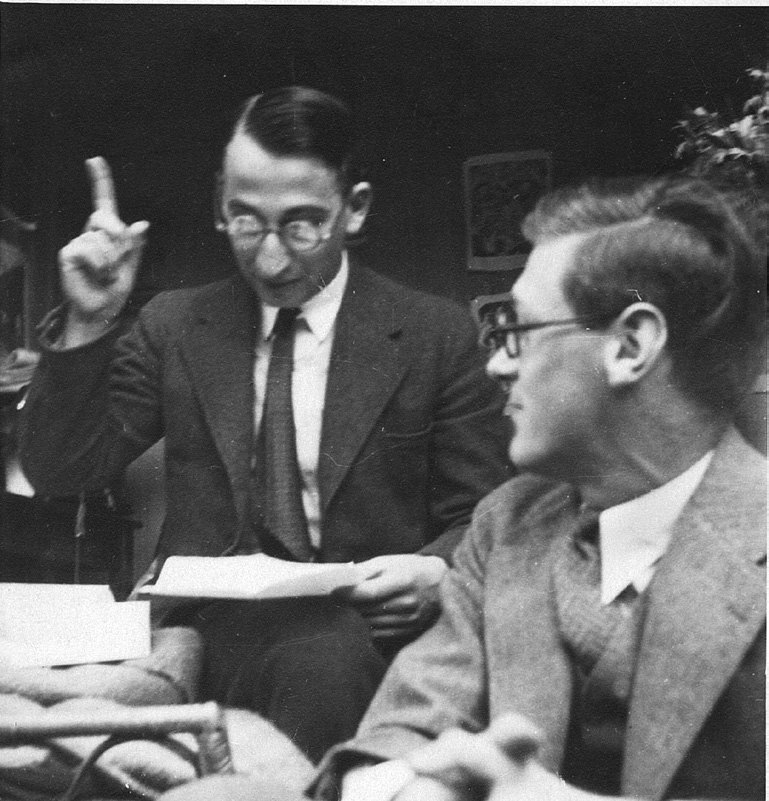
Albert Sidney Groen, doctor, of Amsterdam; "Ab" in Nelly Eskes's and Neville Fearneyhough's accounts
About: A Jewish doctor from Amsterdam who hid at Dr Kruimel's house De Ruif at Garderen in 1943 and then at the Bos farm at Staverden until October 1944, where, by his own letter, "a real Londoner" whom Noordman identifies as Tex Banwell came in October 1944; Banwell later joined Murphy's party. After the war he was a lung physician and lector at the University of Amsterdam.
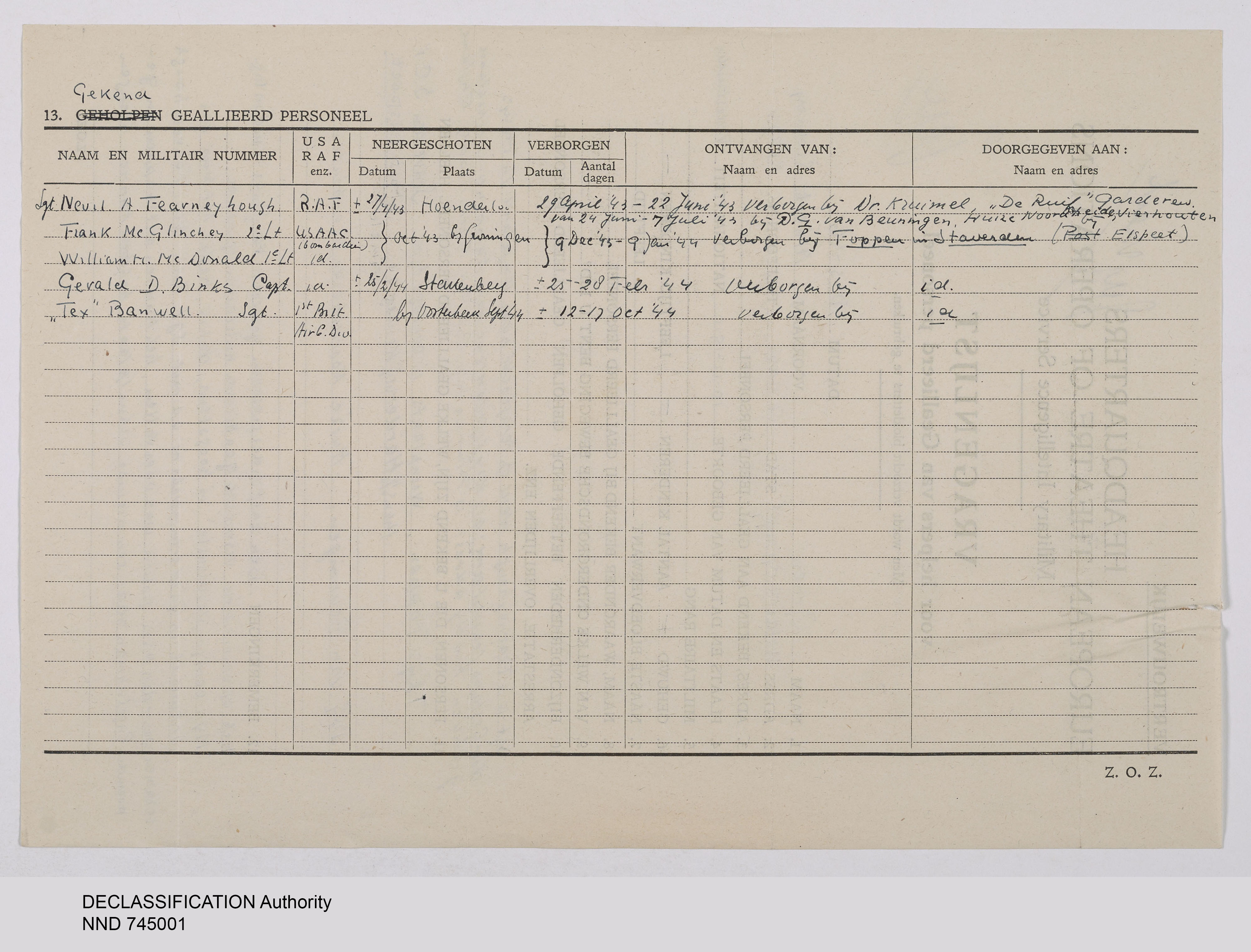
Unit or role: Doctor (arts), in hiding himself; he wrote "Gekend" (known) over "Geholpen" (helped) on his form for the Americans (p. 5). On the British index of Dutch helpers as certificate 562, grade 6 (the index page).
Where: Amsterdam; De Ruif, Garderen; a hut on Van Beuningen's estate at Vierhouten; the Bos farm, Staverden; Ermelo; after the war Waldeck Pyrmontlaan 17, Amsterdam-Zuid.
Evidence: ✓ his own form for the Americans, 10 March 1946: handwritten Dutch on pp. 4–5, with the Americans' typed English translation on pp. 2–3 (US National Archives 286656961); ✓ the Haarlem birth record; ✓ the University of Amsterdam's Album Academicum; ✓ his death notices (NRC Handelsblad, 15 December 1982); ◐ his letter of August 1945 to Neville Fearneyhough, Nelly Eskes's account and Fearneyhough's, all in Noordman's Dutch (Noordman, pp. 19, 65–70).
Family. Albert Sidney Groen was born at Haarlem on 10 December 1910, the son of Abraham Salomon Groen and Judith Henriette Sequeira (the birth record, North Holland Archives; index only).
- ✓ His father died at Haarlem on 19 September 1925, aged 63, born at Den Helder (the record), so he did not live into the occupation.
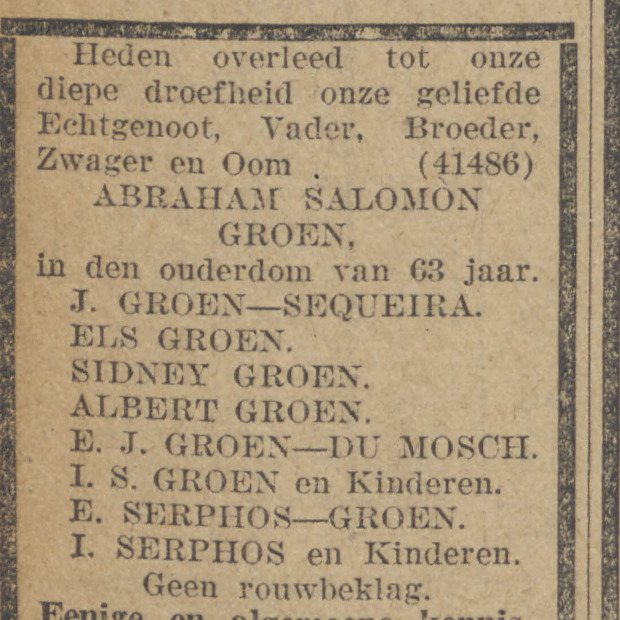
- The family's notice in the Algemeen Handelsblad of 20 September 1925 is signed first by "J. GROEN—SEQUEIRA", and among the others by "SIDNEY GROEN" and "ALBERT GROEN" (the notice, read on the page image).
- ◐ The notice does not say who each signer is; Albert Groen, with Sequeira as his mother's name, is very probably Albert Sidney.
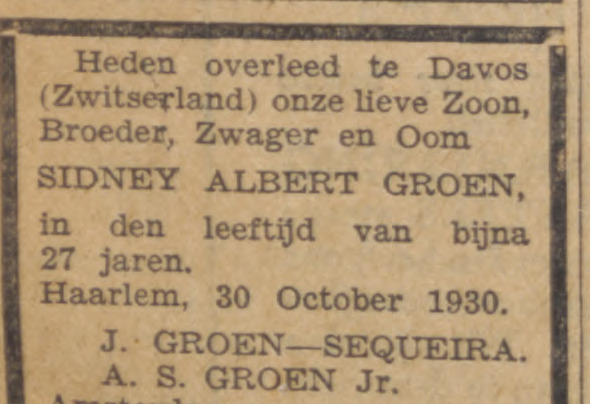
- A death in the family, 1930. ✓ The Algemeen Handelsblad of 31 October 1930 prints a family notice from Haarlem: "Heden overleed te Davos (Zwitserland) onze lieve Zoon, Broeder, Zwager en Oom SIDNEY ALBERT GROEN, in den leeftijd van bijna 27 jaren" (died today at Davos, Switzerland, our dear son, brother, brother-in-law and uncle, aged almost 27), dated Haarlem, 30 October 1930 (the notice; read on the page image).
- ◐ The family. The notice is signed by "J. GROEN—SEQUEIRA.", by "A. S. GROEN Jr.", and from Amsterdam by "E. WOLTER—GROEN.", "H. A. WOLTER." and a child; the notice does not say who any of them is, and "Groen" in the first Amsterdam signature suggests a sister of the dead man. Sequeira is the maiden name of Albert Sidney's mother on the Haarlem birth record, and the family is at Haarlem; the notice does not name the father, who had died in 1925, and does not name Albert Sidney.
- ◐ Two sons, not one. The man who died at Davos is Sidney Albert, not Albert Sidney: "bijna 27" in October 1930 puts his birth about the end of 1903, and Albert Sidney, born in December 1910, was 19. The 1925 notice has a Sidney and an Albert signing separately.
- ⚠︎ "A. S. GROEN Jr." carries the initials of Albert Sidney and of his father Abraham Salomon. The notice does not say who he is, so Albert Sidney is a likely signer and not a certain one.
A doctor. He passed the artsexamen, the final medical examination, at the University of Amsterdam on 12 June 1940 (Album Academicum). His card in the index of the Jewish Council at Amsterdam, stamped 12 July 1942, gives "Groen, Albert Sidney … A'dam, N. Amstellaan 286 … 10.12.10 Haarlem … Ned. … arts … ongehuwd" (a doctor, unmarried), and a later hand has added his address after the war (Arolsen). ⚠︎ What the "K" stamp and the red cross on the card mean is not known here. The Amsterdam register of passport applications has a passport, no. 913265, issued to A.S. Groen, born at Haarlem on 10 December 1910, on 27 August 1941 and valid to 27 August 1943 (the card, Stadsarchief Amsterdam, read on the image).
Into hiding. His own handwritten form says "Ben zelf ondergedoken geweest van Jan 43 - eind oorlog" (I was in hiding myself from January 1943 to the end of the war) (p. 4). Nelly Eskes, in her account as Noordman prints it, tells how he came to Kruimel's house at Garderen, where Kruimel was already hiding a Jewish couple with a son and a daughter:
Lien van Beverwijk, my friend from Amsterdam, had asked us to shelter Ab Groen, her future husband, a Jewish doctor. He had had TB and for that reason had been in a sanatorium in Bilthoven for a long time. There he was warned that his safety could no longer be guaranteed. So Ab Groen too was lodged in Joop Kruimel's house.
Dutch originalLien van Beverwijk, mijn vriendin uit Amsterdam, had ons gevraagd om Ab Groen, haar toekomstige man, een joodse arts, onder te brengen. Hij had tbc gehad en om die reden was hij lange tijd in een sanatorium in Bilthoven opgenomen geweest. Daar werd hij gewaarschuwd, dat voor zijn veiligheid niet meer kon worden ingestaan. Daarom werd Ab Groen ook ondergebracht in het huis van Joop Kruimel.
— Nelly Eskes · her account, 2004 · in Noordman, p. 19
Nol Burger had made hiding places in the house, and "Onze eerste vlieger die daar een goed onderkomen kreeg, was de Engelsman Neville Fearneyhough" (our first airman to find a good shelter there was the Englishman Neville Fearneyhough) (the same; Nol Burger; Dirk Eskes; Johannes Kruimel). ◐ The Amsterdam personal-cards index has a reference card for Albert Sidney Groen that says "ZIE" (see) the card of Magdalena Petronella Ina van Beverwijk, born at Amsterdam on 19 September 1914 (the card, read on the image; the rest is blacked out by the archive); that she is Nelly Eskes's Lien is our reading of the name.
De Ruif and the raid, 1943
Link to the section De Ruif and the raid, 1943Fearneyhough, an RAF sergeant, came to De Ruif in the spring of 1943 (the dates disagree: below). The Americans' typed English translation of his form, which is not his wording and puts the raid under item 10, where his handwriting has Fearneyhough's fate:
Sergeant R.A.F. Nevil Fearneyhough and I were both sheltered in Dr. Kruimel's house in Garderen. During a surprise-attack by the NSB I was able to escape, also found a new shelter for the above sergeant.
— the Americans' typed English translation of Albert Groen's form · 10 March 1946 · US National Archives 286656961, p. 2
His handwritten Dutch version calls that his only merit:
My only "merit" is at most that, after Dr Kruimel's house in Garderen, where I was together with, among others, Sgt. R.A.F. Nevil Fearneyhough, had been raided by the N.S.B. police, I was able to escape and to bring the said Englishman to a new hiding place.
Dutch originalMijn eenige "Verdienste" is hoogstens, dat ik, nadat het huis van Dr. Kruimel in Garderen - waar ik o.a. met Sgt. R.A.F. Nevil Fearneyhough samen was - door N.S.B. politie was overvallen, heb kunnen ontsnappen en genoemde Engelschman naar een nieuwe schuilplaats heb kunnen brengen.
— Albert Groen · his form for the Americans, handwritten Dutch version · 10 March 1946 · US National Archives 286656961, p. 4
Noordman has the raid fall four weeks after Fearneyhough came, by Germans: the daughter of the Jewish family, Marianne Happ, got out through the back door, and her parents and brother were taken and murdered at Sobibor on 2 July 1943 (Noordman, p. 65). Fearneyhough's own account, as Noordman prints it in Dutch, has "Ab Groen en ik" (Ab Groen and I) hide eight hours in the attic hiding place before they could get away, wander for a time, go back to the people at Nieuw-Milligen who had helped them before, and after a few hours be driven to "een boerderij ongeveer 25 kilometer verderop, in Staverden" (a farm about 25 kilometres on, at Staverden), and from there taken by bicycle to a shipowner's estate outside Ermelo (p. 66). Noordman identifies the farm as "boer Elbert Bos in Staverden" (Elbert Bos) and the estate as Daniël George van Beuningen's Noorderheide at Vierhouten (the same page).
The hut at Vierhouten, 1943
Link to the section The hut at Vierhouten, 1943Van Beuningen told the writer Th. A. Boeree after the war that in May 1943 he took over from "landbouwer E. Bos te Staverden" (the farmer E. Bos at Staverden) an English air observer "tezamen met de joodse arts, dokter Groen" (together with the Jewish doctor, Dr Groen), after a policeman had warned Bos that the SD would search his farm the next day; that evening Bos brought them to the watermill on the estate, where they stayed two days, and Van Beuningen, his gardener Willem van Putten and the two built a hut in the woods (Noordman, p. 66). Fearneyhough has the two of them there for two weeks, until he was taken to Amersfoort on a tandem about the middle of July 1943, and "Albert Groen bleef alleen achter in de hut in het bos en is daar nog twee weken gebleven" (Albert Groen stayed behind alone in the hut in the wood and stayed there two more weeks) (pp. 66–67). Groen's table has Fearneyhough with Van Beuningen from 24 June to 7 July 1943 (p. 3). Groen's own letter to Fearneyhough of August 1945:
(…) After our parting at the mill I stayed another fourteen days alone in our hut on the estate at Vierhouten. It was a safe but very lonely place, especially at night when the big boars snuffled round the hut and rooted up the ground. I kept the axe within reach then!
Dutch original(…) Na ons afscheid bij de molen, ben ik nog veertien dagen alleen in onze hut op het landgoed in Vierhouten gebleven. Het was een veilige – maar erg eenzame plek, vooral ’s nachts als de grote zwijnen rond de hut snuffelden en de grond omwoelden. Ik had dan de bijl onder handbereik!
— Albert Groen · letter to Neville Fearneyhough · August 1945 · in Noordman's Dutch · Noordman, p. 69
At the Bos farm, 1943–1944
Link to the section At the Bos farm, 1943–1944Then, in the same letter, he went back to the Bos farm:
Then I went back to my earlier hiding place, at the Bos family's farm in Staverden, and stayed there until October 1944. Several times I had company there, three American airmen in all, and in October 1944 even a real Londoner, who had been involved in Operation "Market Garden".
Dutch originalDaarna ben ik teruggegaan naar mijn eerdere onderduikadres, bij de boerderij van de familie Bos in Staverden en ben daar tot oktober 1944 gebleven. Diverse keren kreeg ik daar gezelschap van in totaal drie Amerikaanse vliegers en in oktober 1944 zelfs een echte Londenaar, die betrokken was geweest bij de operatie ‘Market Garden’.
— Albert Groen · letter to Neville Fearneyhough · August 1945 · in Noordman's Dutch · Noordman, p. 69
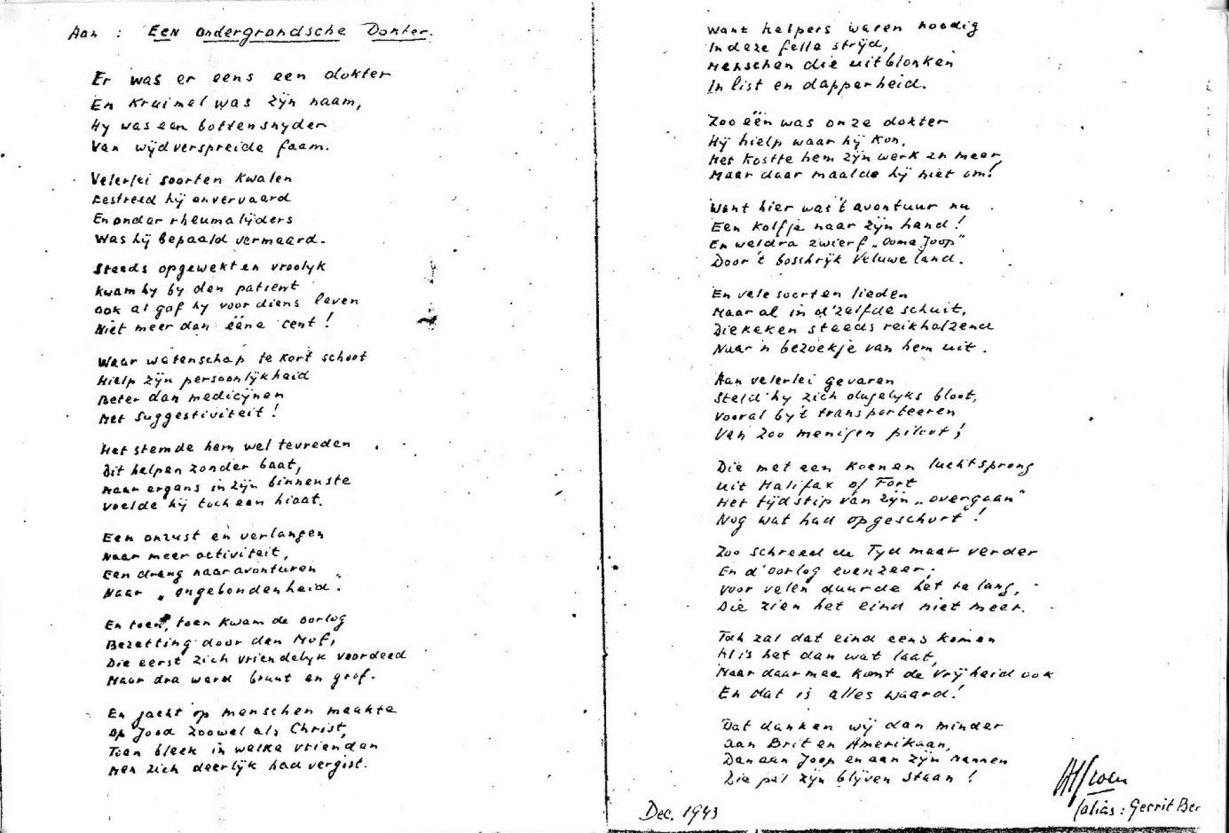
◐ His handwritten form names the airmen he knew there: "Frank McGlinchey 2e Lt" and "William M. McDonald 1e Lt", down "Oct '43 bij Groningen", "9 Dec '43 - 9 Jan '44 verborgen bij Foppen in Staverden", and "Gerald D. Binks Capt.", down "± 25/2/44 Stakenberg" (about 25 February 1944), "± 25 - 28 Feb '44 verborgen bij" the same (p. 5; the typed translation on p. 3 drops his "±"); ◐ three Americans, as in his letter. Noordman has Thijs Foppen living opposite Bos (p. 70); their stay is told on Thijs Foppen's page. In December 1943 he wrote a poem for Kruimel, "Aan: Een ondergrondsche Dokter" (To an underground doctor), in the Kruimel guestbook, ending "Dat danken wij dan minder / aan Brit en Amerikaan, / Dan aan Joop en aan zijn mannen / Die pal zijn blijven staan!" (for that we thank Briton and American less than Joop and his men, who stood firm), signed with his name and "(alias: Gerrit Ber", where the reproduction ends (read on the figure below).
With Murphy
Link to the section With MurphyNo source has Groen meet Murphy. His part in Murphy's story is Tex Banwell, who by Hardy's report joined Murphy's party on 29 October 1944 (Hardy).
⚠︎ Groen's account has Banwell leave De Ruif the day before the raid, after only a short stay. Groen wrote of "a real Londoner" who came to them in October 1944, having been "heel kort" (very briefly) at Kruimel's and left "precies op tijd" (just in time), since "een dag daarna" (a day later) the Germans raided the house and found the new hiding place under the stable, with a pilot's equipment and a radio transmitter; Noordman identifies the Londoner as Banwell (Noordman, pp. 69–70), and in his own chapter on Banwell has him at De Ruif only "voor korte tijd" (for a short time) (p. 292). Noordman bases that on Banwell's guestbook entry of 8 October 1944, a leaving note, with "Eduard" and 9 October in the margin (pp. 292–293). ◐ Noordman says the name Eduard, the cover name of Rengers Hora Siccama, was "eigenhandig geschreven" (written in his own hand) and, a few sentences later, that "De toevoegingen zijn van dokter Kruimel" (the additions are Dr Kruimel's), so whose hand wrote it is not settled. The raid on De Ruif was on 23 October 1944 (Holvoet "op die 23e October" in Boeree, the Airborne Magazine, and Tijding of 17 May 1945: Johannes Kruimel), so ◐ by our reading Groen's letter has Banwell leave about 22 October. The Airborne Magazine gives that date: it has him come to Kruimel after the attack of 30 September and leave on 22 October, the day before the raid (Airborne Magazine). ⚠︎ It may not be a second witness: the magazine lists Noordman, who prints Groen's letter, among six sources, and gives no source for the date itself. Kessel, who came to De Ruif in October 1944 and found Tex there, "very well established", is a third witness, and his account does not fit a stay that ended on 8 or 9 October (Kessel, pp. 93–98; Tex Banwell); these accounts do not agree on when Banwell was there. The quoted phrases are Noordman's Dutch rendering of Groen.
Groen's own form gives a different date. He struck out "Geholpen" (helped), wrote "Gekend" (known), and has a row for "Tex" Banwell, a sergeant of the "1st Brit Air C. Div", down "bij Oosterbeek Sept '44", hidden "± 12-17 Oct '44", "verborgen bij … id." (hidden with the same, Foppen at Staverden, as in the rows above) (p. 5, read on the image). Thijs Foppen's own form has "Banwell Parachute Regt." for "1 day", undated (Foppen, p. 3), and Elbert Bos's has "Tex", undated, from "Dr. Kruimel", passed to "Tijs Foppen and later on to Dirk Eisinga" (Bos, p. 3). The whole of Banwell's October is on his page and on Elbert Bos's.
Back to Amsterdam. His letter goes on:
In October 1944 I went to Ermelo and stayed there about five weeks, and then cycled back to Amsterdam with my fiancée on a tandem. For lack of food we had a terrible winter, but hiding in the capital was safer than on the Veluwe, where we went through several raids and where they even searched a house twice for my hiding place.
Dutch originalIn oktober 1944 ben ik naar Ermelo gegaan en ben daar ongeveer vijf weken gebleven en daarna met mijn verloofde op een tandem teruggefietst naar Amsterdam. Wegens gebrek aan voedsel hadden we een verschrikkelijke winter, maar het onderduiken in de hoofdstad was veiliger dan op de Veluwe, waar we verscheidene razzia’s hebben meegemaakt en waar men zelfs twee keer in een huis op zoek geweest is naar mijn schuilplaats.
— Albert Groen · letter to Neville Fearneyhough · August 1945 · in Noordman's Dutch · Noordman, p. 70
He added that their friend Dirk Eskes had been arrested in the last months of the war, that Nelly was working again as a GP in a village in the east of the country, and "Uit Garderen zijn alleen Joop Kruimel en Nol Burger door de oorlog gekomen" (from Garderen only Joop Kruimel and Nol Burger came through the war) (the same page).
His file with the Allies. On 5 March 1946 Capt. Franklin D. Coslett of the American MIS-X office at Wassenaar wrote to "Dr. A.S. Groen, Waldeck Pyrmontlaan 17, AMSTERDAM (Z)" that they had heard from the notary Mr A.M. Benders that he had helped Allied pilots, and sent him the questionnaire (p. 6; Frank Coslett). He returned it dated 10 March 1946, in handwritten Dutch (p. 4); the Americans typed an English translation (p. 2). It has Fearneyhough's later fate ("op terugtocht naar Engeland in Parijs door Gestapo gearresteerd", arrested by the Gestapo in Paris on the way back to England) and, as the helpers he knew, "Thijs Foppen" ("thans p/a Harderwijkerweg 96 Ermelo", now care of that address) and "D.G. van Beuningen. Huize Noorderheide, Vierhouten" (Thijs Foppen). The file's cover is marked "Grade 6" (p. 1), and the British index of Dutch helpers has "GROEN, Albert S.", Waldeck Pijrmontlaan 17, Amsterdam Z., certificate 562, grade 6 (the index page, read on the image).
Lung physician. He took his doctorate in medicine at the University of Amsterdam on 12 February 1953 with the thesis Over de bezinkingssnelheid der rode bloedlichamen in gedefibrineerd bloed (on the sedimentation rate of red blood cells in defibrinated blood) (Album Academicum). The university appointed "dr. A. S. Groen (56) uit Amsterdam tot gewoon lector in de kliniek der longziekten" (ordinary lector in the clinic of lung diseases) from 1 January 1967 (Het Parool, 31 December 1966), and he took up the post with the address "Tot stof door stof?" (To dust through dust?) (Het Vrije Volk, 26 January 1968); the Album Academicum dates the lecture 16 January 1968 and has him lector until 1 January 1979.
Death. He died on 10 December 1982, his 72nd birthday: "Tot ons verdriet overleed op 10 december 1982, na een hevig gevecht, Dr. A. S. GROEN Arts voor longziekten" (to our sorrow Dr A. S. Groen, physician for lung diseases, died on 10 December 1982, after a hard fight); the notice says the cremation had taken place privately. A second notice, "TEN AFSCHEID" (in farewell), gives "10 december 1910 — 10 december 1982" and is signed first by "M. P. I. van Beverwijk" of Amsterdam (NRC Handelsblad, 15 December 1982; the same in de Volkskrant; both read on the page images). ◐ Those are the initials of the Magdalena Petronella Ina van Beverwijk of his Amsterdam card (above). The Album Academicum has the same dates, and the Amsterdam personal-cards index marks him "Overleden: Ja" (deceased) (the entry).
Where the sources disagree
Link to the section Where the sources disagree- When Fearneyhough came to De Ruif.
- Groen's table: shot down at Hoenderloo "± 27/4/43" (about 27 April 1943), at De Ruif from 29 April to 22 June (p. 5, his handwriting; the typed translation on p. 3 drops the "±").
- Nelly Eskes's letter to the Americans, 22 May 1946: their first contact with him was "the third of May" 1943, his plane shot down "the night before", and he was taken to Kruimel's house at Garderen "the next day" (her file, p. 6).
- Fearneyhough in Noordman: shot down in the early morning of 1 May 1943 (Noordman, pp. 63–64), after both of Groen's dates. Not settled; more on Johannes Kruimel's page.
- Who raided De Ruif in 1943. "a surprise-attack by the NSB" and "N.S.B. politie" on Groen's form (p. 2, p. 4); Germans in Noordman (p. 65). Not settled.
- How he and Fearneyhough came to Van Beuningen. From Kruimel's house by way of Nieuw-Milligen and the Bos farm in Fearneyhough's account (p. 66); from Bos, the night of a policeman's warning, in Van Beuningen's (p. 66); Groen's table has Fearneyhough with Van Beuningen from 24 June 1943 and no stay with Bos (p. 5). Both of the others' forms conflict with that:
- Van Beuningen's own forms have "Nevile FARNBOROUGH" received from "C. BOS, STAVERDEN", "May - mid Jul 43, 70 days" (p. 4), and "May '43, 80 days" on a second table (p. 6).
- Bos's own table has "Nivel", "Hoenderlo", received from "v.d. Mast, Millingen" and passed to "v. Beuningen, Elspeet" (p. 3).
- See Elbert Bos.
- When the 1943 raid on De Ruif fell. Never dated in any one source; the pieces do not line up.
- Groen's table has Fearneyhough at De Ruif to 22 June and with Van Beuningen from 24 June, which puts the raid about 22 June (our reading, ◐; the table gives no raid date).
- Noordman has it four weeks after Fearneyhough came, so about the end of May (p. 65), and Van Beuningen has the handover from Bos "In mei 1943" (p. 66).
- Fearneyhough has two weeks in the hut before the tandem ride to Amersfoort about the middle of July (pp. 66–67).
- When Banwell left De Ruif.
- 8 October 1944 by his guestbook leaving note, 9 October in the margin (Noordman, pp. 292–293).
- ◐ About 22 October by our reading of Groen's letter ("een dag daarna" the raid of 23 October), which the Airborne Magazine also gives, though it lists Noordman among its sources.
- Kessel has Tex at De Ruif in October 1944, settled in; see Tex Banwell and above.
- When Banwell was at Staverden. "± 12-17 Oct '44" on Groen's own form; one undated day on Foppen's; Hardy has him join Murphy's party on 29 October (above).
- Lector or professor. Noordman has him "in 1967 benoemd tot hoogleraar in de geneeskunde" (appointed professor of medicine in 1967) (p. 70); the Album Academicum's appointment fields, Het Parool and Het Vrije Volk all have him appointed lector, although the Album's record is headed "professor, doctor, afgestudeerde" (graduate) (the record). ✓ Lector by the appointment itself.