Sgt Raymond Holvoet, “Bacon”
Kortrijk 20 Jan 1924 – the Katerveer 10 Apr 1945
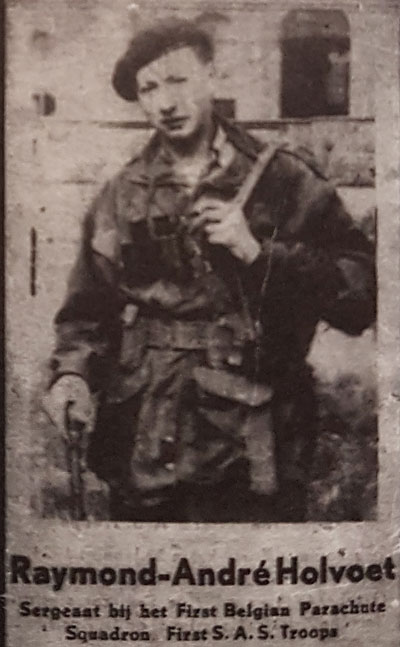
About: A Belgian SAS signaller from Kortrijk, the agent "Bacon", dropped near Garderen in October 1944 as radio operator to Abraham du Bois ("Ham") and taken first to Dr Kruimel's bunker at De Ruif, Murphy's hiding place that month. Arrested at Garderen on 27 October, he was shot at the Katerveer on the IJssel on 10 April 1945.
Unit or role: "Sergeant bij het First Belgian Parachute Squadron, First S.A.S. Troops" (his prayer card, above); "caporal-signaleur, Parachutist v/h Belg. Leger" on his Dutch award card (the card); "Sergeant", "5th SAS Reg.", on the War Graves Foundation's record (the record); "Bacon I recognised as Holvoet, a W.T. operator I had known in the Belgian S.A.S. squadron" (Kirschen, p. 90); "SAS" in Pieter Hoekstra's list. The rank is disputed (below).
Where: Kortrijk (born there; the Gentsteenweg address on his award card is care of his brother, ◐ not his own); De Ruif and Lambertus Huber's house, Garderen; Berend van Looyengoed's farm at Houtdorp, by Garderen; the Willem III barracks, Apeldoorn; Almelo prison; Zwolle; the Katerveer on the IJssel; found at Wilsum.
Evidence: ✓ Sonja Deen's own form, p. 3; ✓ Boeree, Kroniek van Ede (1947), pp. 161–166 (checked on the page images); ✓ van Looyengoed's file, pp. 2–3; ✓ Huber's file, pp. 3, 8 and 10; ✓ Burger's file, pp. 3–4; Hoekstra's file, pp. 4–9; his civil and church records; du Bois and Holvoet; Elspeet history; ✓ his Dutch award card; ✓ the War Graves Foundation's record; ◐ Franse para's in Drenthe (2020), p. 133 (read on the image); ◐ Kirschen, Six Friends Arrive To-Night (1949), pp. 90–109
Raymond André Holvoet was born at Kortrijk, in Belgium, on 20 January 1924, the son of Robert Camille Holvoet and Suzanne Helene Vermarcke (his records).
◐ Kortrijk, 1940–41. A thesis of 1999–2000 on the resistance in Kortrijk names a Raymond Holvoet, "alias Ray d'Arras", among the sixteen members at the end of October 1940 of the clandestine-press group B.A.T.-B.V.A., citing J. Vanbossele's Kortrijk tijdens de Tweede Wereldoorlog (1986). When the group's writer, Gabriël Devos, decided "op 13 februari 1941" (on 13 February 1941) to join the Belgian forces in Britain, Raymond Holvoet was among those of the group who, knowing that the German police had got wind of their clandestine press, "besloten naar Engeland te vluchten" (decided to flee to England) (Demeyere, PDF pp. 78–79; the thesis). ◐ Very probably he: the same name and town, and he was sixteen in October 1940. The thesis's 13 February 1941 is the day Devos decided to go; Boeree gives 13 February 1941 for Holvoet's leaving Belgium (below), the same date, though the thesis does not say when Holvoet himself left. The thesis then says that of those who wanted to flee to England only Jean Lammertijn succeeded (PDF p. 79), which does not fit (see Where the sources disagree).
✓ To England, and his missions (Boeree, p. 162, checked on the image).
- He left Belgium on 13 February 1941, crossed France and the Spanish border, and was held in the camp at Miranda from June 1941 to January 1942. The British consul freed him; he sailed from Gibraltar at the end of January and joined the Belgian SAS in England.
- He was dropped into Belgium on 10 February 1943 for three months near Liège, and on 8 August 1944 near Bourges, on a mission that kept him there six weeks, during which he also worked with the maquis on sabotage.
- His chief, Major Blondeel, hesitated to send him; Holvoet answered "Mij krijgen ze nooit" (they will never get me).
At Kew. Kew holds an SOE file from 1942–1943 on an earlier mission under his name, "BADGER mission: Raymond Holvoet" (HS 6/50, the catalogue); not digitised, and not read. ◐ The Belgian drop of 1943 may be that mission. ✓ Kew also lists his personal SOE file, HS 9/737/1, described as "Raymond André HOLVOET, aka VERMARCKE - born 20.01.1924" and covering 1939 to 1946; not digitised, and not read (the catalogue entry). ◐ Vermarcke is his mother's maiden name above, so the alias very probably follows it. ◐ Helen Fry's MI9 (2021) has "MI9 borrowed two ex-SOE agents, Raymond Holvoet and Abraham DuBois, to be dropped into Holland but both were captured" (the hits; search hits only); "ex-SOE" fits the Kew file.
◐ In the squadron. Kirschen, who had known him in the Belgian SAS squadron (p. 90, above), wrote on hearing of his capture that "Bacon was Raymond Holvoet, an old friend of Moyse", Kirschen's own operator, "very popular with the Squadron, this Flemish boy" (p. 95, read on the page).
The drop, October 1944
Link to the section The drop, October 1944✓ Boeree: du Bois and Holvoet came down at 2.55 on the morning of 17 October 1944 on the Boeschoten land at Garderen. The head teacher Tinus (J. A. van den Bovenkamp) and Nol (Nol Burger) took them to a bunker at the country house De Ruif, Kruimel's "Oome Joop"; that evening du Bois went to Nol's house and Holvoet to Huber, who took him in with his transmitter, as "Pieter". De Ruif was then lived in by the dismissed burgemeester Van Nispen van Sevenaer and his family (Boeree, pp. 161–162). The date is disputed: the sources range from September (Kragt) and about 12 to 18 October (below).
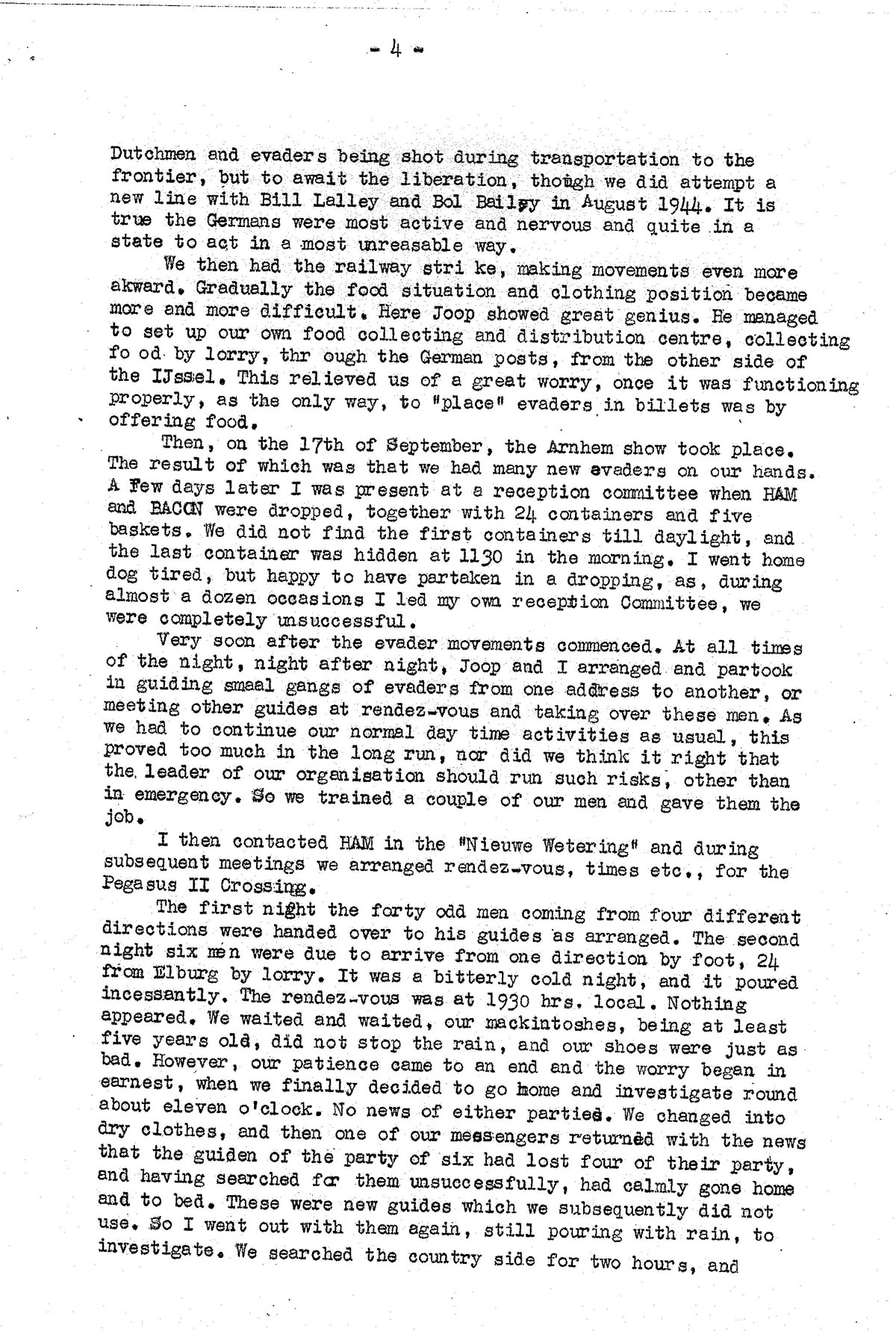
- Dick Kragt was at the reception: "A Few days later I was present at a reception committee when HAM and BACON were dropped, together with 24 containers and five baskets" (Kragt's report, p. 4, read on the image). "A Few days later" (as typed) follows his account of 17 September, the Arnhem landing; he adds that on almost a dozen occasions when he "led my own reception Committee" they were "completely unsuccessful".
- The Elspeet history dates the drop 16 October 1944 and has the radio damaged in the landing, so that Holvoet stayed at Garderen while du Bois went on to Ede (Elspeet history). The typescript the Elspeet site also carries, du Bois and Holvoet, reads as Boeree's chapter (the same passage as his pp. 161–162; the OCR names no author) and has the pair taken to Dr Kruimel's bunker at De Ruif on landing, so it is the same source as Boeree, not a second one.
- Kirschen's diary, under 22 October: "Two allied agents had been dropped, whose mission it was to look after escapes"; he went to see them, and "Bacon I recognised as Holvoet" (p. 90, read on the page image).
- Kirschen, in a boxed piece signed "Kapitein Gilbert Sadi Kirschen, Lamel, België" in a book of 1984 (the piece itself is undated), named the pair: "Luitenant Abraham du Bois, de Nederlandse S.A.S.-agent Martien, werd geassisteerd door de Belgische seiner Raimond Holvoet" (Lt Abraham du Bois, the Dutch SAS agent Martien, was assisted by the Belgian signaller Raimond Holvoet), "Hun codenamen waren Ham en Bacon" (their code names were Ham and Bacon) (Dekkers and Vroemen, p. 235; Gilbert Kirschen).
In the Dutch official history. L. de Jong, Het Koninkrijk der Nederlanden in de Tweede Wereldoorlog (NIOD edition, CC BY 3.0 NL; the passages, with translations), has no name for him in the text: on 18 October Neave had an MI9 agent, the Dutchman A. du Bois, dropped near Garderen "together with a radio operator whose name is not known", whose set failed after one day, so that du Bois could not help with Pegasus II (deel 10b, p. 551, note 1, checked on the image). The volume of corrections names him: "This was the Belgian Raymond Holvoet. He too was arrested in December '44; he was shot near Zwolle in April '45" (deel 13, p. 153, checked on the image). ✓ Belgian, April 1945 and Zwolle agree with the sources above; ⚠︎ December does not (see below).
Four books, from the Archive's full-text index. ◐ Search hits only, except where the page was read, and none of the books was borrowed.
- Jelle Hooiveld, Dutch Courage (2016), has du Bois "dropped near the town of Garderen on the night of 16/17 October. Assisted by an SAS radio operator, the Belgian R. (Raymond) Holvoet", to evacuate "the airbornes that had stayed behind after Market Garden", and "Radio operator Holvoet had already been captured in late October 1944", with an endnote that "Reisiger and Holvoet did not survive the war" (the hits; the longer passages). ◐ Late October fits the 27 October of van Looyengoed and Ede's history.
- Les Commandos S.A.S. dans la Seconde Guerre mondiale has "Le sergent Raymond Holvoet est parachuté le 17 octobre près de Garderen afin de servir d'opérateur-radio auprès de la résistance hollandaise" (Sergeant Raymond Holvoet is parachuted on 17 October near Garderen to serve as radio operator with the Dutch resistance) (the hits; the longer passage).
- Helen Fry, MI9 (2021), above.
- Franse para's in Drenthe: 8-12 april 1945 (2020), a book on the French paratroopers in Drenthe in April 1945, gives him a paragraph under a photograph credited to Peter Lanssens, in its chapter on civilian victims (p. 133, read on the image; the transcription).
- "Op 17 oktober 1944 was hij al per parachute in Nederland gearriveerd" (on 17 October 1944 he had already arrived in the Netherlands by parachute), to make contact with the local resistance and radio information to London.
- ⚠︎ With no other source, it calls him "een Jedburgh-operator" (a Jedburgh operator), like Arie Bestebreurtje and Carel Ruijsch van Dugteren.
With Murphy
Link to the section With MurphyNo source puts the two together. Murphy and Sam Walsh were at De Ruif until about 21 October, when they were moved to make room for a party of R.A.M.C. officers (Walsh's report), and Boeree has Holvoet brought to the bunker there on landing on 17 October and taken on to Huber's that evening (p. 161). ◐ So he may have passed through while Murphy was there; nobody says they met.
- ✓ Jeane van Galen's list of the men she helped at De Ruif runs "S.Walsh 4389314 | " T.Murphy 2756457 | " Maurits, Jupitair, Ham, Bacon" (her file, p. 3; Jeane van Galen).
- ✓ The son of the house told the Americans: "Besides pilots we also had the agents Ham (Dubois), Bacon (born in Flandria), Maurits, Jupitair", and that the last pilot left on 21.10.44 (Van Nispen's form, p. 2; Van Nispen tot Sevenaer).
- ✓ Lipmann Kessel met the pair at De Ruif, by his own book, which gives no date: two men in brand-new airborne smocks who introduced themselves as "Ham" and "Bacon" and had been "at a dance in Oxford" the night before (Kessel, 1959, pp. 90–101). ⚠︎ Noordman's chapter puts Kessel's arrival about 17 October, Walsh's dates about 21 October (Abraham du Bois).
His part is told on October on the Veluwe.
At Garderen
Link to the section At Garderen◐ At Huber's. Lambertus Huber, a sergeant-major ("onder officier bereden artillerie", an NCO of the horse artillery, in the Dutch of his form) and a member of the RVV, at the Kolthoornscheweg, Garderen, who went by the hiding-name Huub, told the Americans on 14 June 1946 that du Bois and "the Sgt. operator S.A.S. Raymond Henderson (real name Raymond Holvoet, a Belgium)" were dropped on the "Chimpansee" field "about Oct. 12th 1944", and that Henderson "stayed during 10 days till Oct. 23rd at Mr. Huber's house, and on account of safety transported to Berend Looyengoed", where the SD arrested him on 27 October (Huber's form, p. 8). The Dutch original of Huber's form has him arrested there "door een ongelukkige samenloop van omstandigheden" (through an unfortunate coincidence of circumstances) and put to death shortly before the liberation, "(10-4-'45)" (p. 10).
✓ His radio (Boeree, p. 162). Du Bois left him at Garderen to open contact with England. He listened at fixed hours for his call sign, "lu lu 4", and sent things useful to the RAF, such as the positions of ammunition ships on the IJsselmeer, and messages from du Bois and from Piet van de Veluwe. Pieter Hoekstra wrote for the Americans: "I helped Raymond Holvoet for 14 days with transmitter" (Hoekstra's file, p. 6; Pieter Hoekstra). The Elspeet history has him in regular contact with Captain King (Elspeet history).
✓ De Ruif burned (Boeree, p. 163). One of the young people at De Ruif thought the bunker too damp and lit a fire in it. The smoke was still rising through the open hatch when a Feldgendarmerie patrol, looking for hidden cars, arrived. They found hand grenades, some English uniforms and a radio, and burned the house; the family had fled from their lunch, and Kruimel's family was away. Holvoet, lodged close by, had to leave on 23 October. The Binnenlandse Strijdkrachten sent him to Berend Looyengoed's farm at Houtdorp, which had a good hiding place by the house.
At Looyengoed's farm. His host was Berend van Looyengoed of Nieuw Millingen, by Garderen, by his own form (p. 2), of the RVV, known as Berend de Stroper (Elspeet history). Van Looyengoed's own form for the Americans, of 20 March 1946, knew him as "Pieter": "Pieter (Raymond Holvoet) was in my house. with secret sender, I had a hiding place for the weapons. He was dropped and had munition with him"; his table has "Pieter Raymond Holvoet | RAF | 13-10-44 | Garderen", in the columns for when and where a man came down, then ten in the column for days hidden (its date-hidden box is blank), then "arrested" (van Looyengoed's file, pp. 2–3). ✓ Nol Burger of Garderen wrote on 8 March 1946 that Looyengoed "Sheltered also Sgt. Holvoet for some days; Holvoet was arrested in van Looyengoed's house", and his table has "Sgt. Raymond Holvoet, Belgian S.A.S.", "arrested." (Burger's letter, p. 4; his table, p. 3).
✓ Sonja Deen's form. The courier Sonja, who lived at Looyengoed's farm, filled in a helper's questionnaire on 28 April 1946 as "Sonja Deen, nurse", known to the Allied men as "Sonja Henny", of the RVV, with "Houtdorp H 5, Post Garderen" as the address known to the Allied men (her own address is a hospital at Amersfoort) (her form, p. 2). She wrote that she "helped Allied pilots with nursing and was courier, later on was arrested with SAS pilot", that her house "was a transmitting station and shelter for ammunition", that she had "been arrested for 8 months" and that the "SAS pilot was shot", and that every two days she helped with the transmitting to England; she names one other man, Robert Visser of New York (her table has him shot down at Garderen on 28 April 1944 and with her two days). Her table has "Raymond Andre Holvoet | RAF | 14-10-44 | Garderen | 14 [days] | arrested" (p. 3). ◐ She is very probably the Sonja Boeree names, who was at the farm with Holvoet when the Feldgendarmerie came and was sent to Westerbork (below): the same first name and the same arrest, but Boeree calls his Sonja a Jewish girl in hiding, and Deen's form has a nurse and courier born at Amsterdam in 1921. The two do not fit on length: her "arrested for 8 months" from 27 October 1944 would run to late June 1945, and Boeree has the Allies freeing her at Westerbork; not reconciled. Her 14-10-44 is in the table's column for when and where he came down, and the 14 in the column for days hidden: as a landing date it is one more for the drop (below), and fourteen days at the farm does not fit Huber's 23 October move or the arrest on 27 October; see "Where the sources disagree".
The arrest, 27 October 1944
Link to the section The arrest, 27 October 1944◐ Boeree (pp. 163–164, checked on the images), one chronicle of 1947 with no source given for any of this; no other source on this page mentions the soldier or the daughter-in-law, and Looyengoed's own form says only that the SD burned his house:
- At Looyengoed's farm lived his wife, a Jewish girl in hiding, Sonja, and, in the other half, his father. Boeree says a daughter-in-law who kept house for the father (he names her separately from Berend's wife) "nam het helaas niet al te nauwkeurig met de vaderlandsliefde" (was, sadly, not too exact about patriotism) and kept company with an older German soldier of a listening post.
- A boy whom the men of a K.P. near Garderen had stopped on suspicion of spying was found dead on 26 October. The Feldgendarmerie, looking into it, found the K.P.'s bunker at the children's home of Sister Jacqueline Kuyck and questioned a man left there and the adopted girl Elly.
- Boeree has the name Looyengoed given at that questioning, "vermoedelijk als afleidingsmanoeuvre" (probably as a diversion). Elly was made to show the Germans the farm, where they surprised Holvoet and Sonja over a cup of coffee. In fluent English he said he was Henderson, a paratrooper from Arnhem, in civilian clothes he had brought from England.
- On the way to the police office he ran, hit the fence, was shot in the thigh and taken again. Sonja went by Apeldoorn to Westerbork, where the Allies freed her.
- Boeree then has the German from the listening post hear it all from his girlfriend and go into the bunker; the Feldgendarmerie took the weapons and the transmitter and burned the farm and the children's home.
Van Looyengoed: "27-10-1944 Mr. Holvoet was arrested and brought to Apeldoorn, together with a courier female, who was in my house at that time"; the SD burned his house (p. 2). The Elspeet history: "Op 27 oktober werd Raymond Holvoet echter gearrestyeerd [sic] in Garderen door de Duitsers. Raimond heeft nog geprobeerd te ontkomen, maar viel gewond in handen van de Duitsers" (on 27 October Raymond Holvoet was arrested at Garderen by the Germans; Raimond still tried to escape, but fell wounded into German hands) (Elspeet history). Ede's history has him arrested at Garderen on 27 October by the Feldgendarmerie (Ede manuscript, p. 44); it does not mention De Ruif, whose burning Boeree puts on 23 October, four days earlier (p. 163). Hoekstra's row has him assisted "± 14 dagen waarna Holvoet gearresteerd" (about 14 days, after which Holvoet was arrested) (p. 9).
◐ Kirschen's diary, 24 October.
A messenger came and told us that Bacon had been caught. Quite by chance the Germans happened to visit the farm where he was hiding. They arrested him. He had tried to escape, but had been wounded and recaptured.
— Gilbert Sadi-Kirschen · Six Friends Arrive To-Night (1949), p. 95, diary for 24 October 1944 · the page, top half and bottom half
Moyse asked whether he had been in civilian clothes, and what his chances were; "Bacon was probably done for" (p. 95, read on the page). The diary's date is three days before the 27 October of the other sources.
⚠︎ Franse para's in Drenthe has another account, with no source given:
He was betrayed and so caught by the German SS on 17 October 1944 while he was transmitting. He managed to destroy his radio set and codes, and fled. Hit by a shot in the thigh he was taken …
Dutch originalHij werd verraden en daardoor op 17 oktober 1944 betrapt door de Duitse SS terwijl hij aan het seinen was. Hij slaagde erin zijn radiotoestel en codes te vernietigen en vluchtte. Getroffen door een schot in de dij werd hij opgepakt …
— Franse para's in Drenthe: 8-12 april 1945 (2020), p. 133 · the page
It names no one. Against it, Kirschen has the Germans come "Quite by chance", Huber "door een ongelukkige samenloop van omstandigheden", and Boeree tells the chain of events above.
⚠︎ Kessel's Surgeon at Arms (1959) has a third account, hearsay: in the Pegasus II barn of 16/17 November 1944 an unnamed American agent says of Bacon:
The poor devil's been caught. Some Dutch guy broke down under torture and gave away the name of the farm where he was hiding. … He made a run for it, but they shot him in the leg and carted him off.
— an unnamed American agent, quoted by Lipmann Kessel · Surgeon at Arms (1959), p. 126 · the extract
It names no one, and is closer to Boeree's name given at the questioning than to the betrayal while transmitting of Franse para's.
Held, October 1944 to April 1945
Link to the section Held, October 1944 to April 1945✓ Boeree (pp. 164–165, 192, 225):
- He was held in the Willem III barracks at Apeldoorn from 27 October 1944 to 24 February 1945 and interrogated by Sonderkommando May, which specialised in spying and radio. He kept to "Henderson", pretended not to understand Dutch, and kept his part when an English-speaking Dutchman was put in his cell. Piet van de Veluwe (Berend Dijkman) was questioned about him too.
- On 24 February he went to the Almelo prison. A detained doctor from Vroomshoop, Dr Oskam, declared him ill and brought him drinks, tobacco and English books, and he met Van Karnebeek, the burgemeester of Zwolle. On the evening of 2 April they were moved to Zwolle, handcuffed together by chance, and parted there for good.
- Of the "mysterious Henderson" another prisoner met at Willem III, Boeree writes "Wij weten, dat dit Holvoet was" (we know that this was Holvoet) (p. 192, in the story of an escaped soldier called Jansen); and p. 225 has Verhulsdonk answering Boeree's question about Piet van de Veluwe that he was still needed for information about "den Engelschen marconist Henderson", with whom he had worked, with Boeree's gloss "(Holvoet)".
⚠︎ A charge that he talked. Major P. J. S. Windham-Wright of the British Embassy, supporting Huber's claim for costs in November 1946, wrote that Huber "also sheltered Sgt. Henderson (S.A,S.Regt.) for 10 days", and that Huber and his wife "were arrested on Dec. 24th as a result of Henderson's confession after his arrest" (the memo, p. 3). That is one officer's statement for a payment claim, and no other source seen says it. Huber's own form says only that he and his wife were taken "on account of help to allied pilots" (p. 8); Boeree has him keep to his cover through the interrogations (above); and Franse para's in Drenthe has him ill-treated and questioned by the SS for months, "Hij weigerde steeds enige informatie te geven" (he refused throughout to give any information) (p. 133).
◐ The ransom. The Elspeet history has du Bois tell Kirschen on 3 December 1944 that he was in touch with a senior SD officer who might, for a large sum, treat Holvoet as a prisoner of war and not a secret agent; Kirschen warned him it might be a provocateur and asked London, and on 4 December came a telegram, "Laat "Ham" (Codenaam voor du Bois) onmiddelijk zijn besprekingen betreffende "Bacon" (codenaam voor Holvoet) stopzetten. Hij stelt zich persoonlijk aan gevaar bloot" (let Ham stop his talks about Bacon at once; he is putting himself in danger); it came too late, du Bois having just been arrested (Elspeet history). Kirschen's own diary, in the entries of 2 to 4 December, has Ham give him a rendezvous and say he had bribed a Gestapo chief to have Bacon treated as a prisoner of war, and on 4 December "Tell Ham discontinue negotiations concerning Bacon. Risks running own neck into noose." and "Too late, Ham's been arrested." (p. 109, top half and bottom half, read on the page: the bribe is told under 2 December, a day before the Elspeet history's 3 December). Kirschen, in the book of 1984: when the Germans took the signaller, du Bois came to ask whether Holvoet could be freed, and Kirschen put it to his chief in England and was told to be careful (Dekkers and Vroemen, 1984, p. 235). The episode is told from du Bois's side on his page.
The Katerveer, 10 April 1945
Link to the section The Katerveer, 10 April 1945✓ Boeree (pp. 165–166): on 10 April Rauch's subordinates proposed shooting the prisoners at the ferry landing at the Katerveer. Ten men were written down to die, Henderson among them. A Belgian fisherman, Lamache, slipped his rope and swam away and lived. On 25 April three bodies came ashore in the municipality of Wilsum: Egbert Jan Jacob Aan het Rot, a railway worker, and Aaldert Geerts, a wachtmeester of Olst, were identified; the third was Holvoet's. The Germans had taken his gold wristwatch and wallet and left him a gold ring and a rosary. The three were buried in the churchyard at Wilsum, and his brother, who made enquiries afterwards, knew him by the ring and the rosary.
◐ Wolter Noordman's book on the two last executions under the SD at Zwolle has fifteen men shot "op de Geldersedijk in Hattem en aan de Gelderse kant van het Katerveer" (on the Geldersedijk at Hattem and on the Gelderland side of the Katerveer) a few days before the liberation, among them "R.A. Holvoet"; he names him "Holvoet (alias 'Pieter', 'Bacon' of 'Henderson')" in the memories of the Belgian radio operator François Siffert. Because two Allied servicemen were among those killed, he writes, the War Crimes Investigation Unit opened the "Zwolle case", which began with "een onderzoek ... naar de executies van de twee geallieerden, Austin en Holvoet" (an investigation into the executions of the two Allied men, Austin and Holvoet) (Noordman, De vijftien executies, pp. 8–10, the publisher's preview; the preview).
On 15 June 1945 the commander of the Belgian SAS Regiment issued a special order of the day in memory of Raymond André Holvoet, who was held up to his comrades as an example. Its end: "Before his execution he was still able to entrust a message to a comrade, a message that was passed on to us later: If you see the red caps, tell them that I never failed, and bring them my last greeting: Who dares, wins. The Signals troop may be proud of him."
Dutch originalOp 15 Juni 1945 gaf de Commandant van het „Belgian S.A.S. regiment" een speciale dagorder uit, gewijd aan de nagedachtenis van Raymond André Holvoet, die aan zijn kameraden tot een voorbeeld werd gesteld. Het slot van deze dagorder luidde: „Vóór zijn terechtstelling kon hij nog aan een kameraad dit bericht toevertrouwen, een bericht dat ons later werd overgebracht: Als gij de roode mutsen ziet, zeg hun, dat ik nooit heb gefaald en breng hun mijn laatste groet toe: Who dares, wins. De Signaltroop mag fier over hem zijn."
— Th. A. Boeree · Kroniek van Ede gedurende de bezettingstijd · 1947, p. 166 · the book
◐ Franse para's in Drenthe has the message given not to a comrade but "aan de gevangenisdokter" (to the prison doctor): "Als ge de rode mutsen met bevleugeld zwaard- kenteken ziet zeg hen dat ik nooit heb gefaald en breng hen mijn laatste groet, Who dares wins." (If you see the red caps with the winged-sword badge, tell them I never failed and bring them my last greeting, Who dares wins.) Its commander is "majoor Eddy Blondeel", in "zijn dagorde te velde op 15 juni 1945" (his order of the day in the field of 15 June 1945) (p. 133). The order itself has not been found.
✓ The records of his death. Van Looyengoed: "10-4-1945 the pilot was shot at Zwolle" (p. 2). The War Graves Foundation's file on du Bois holds a photocopied page from a printed book on the Ede resistance (title not on the pages), checked on the image, which tells it much as the Elspeet history does: Raymond was arrested by the Germans on 27 October 1944, tried to escape but fell wounded into their hands, and was executed on 10 April 1945 "bij het Katerveer in Zwolle" (at the Katerveer in Zwolle) (the Foundation's file, scan 0009, Nationaal Archief 2.19.255.01, inv. 16496A, p. 173 of the book). The Elspeet history has him executed near Hattem on 10 April 1945 and his body thrown into the IJssel, and "Zijn lichaam is aangespoeld bij Wilsum op 25 april 1945, zijn broer uit Kortrijk kon hem herkennen aan zijn gouden ring en rozenkrans" (his body washed up at Wilsum on 25 April 1945; his brother from Kortrijk knew him by his gold ring and rosary) (Elspeet history). The civil register of IJsselmuiden records his death, aged 21, at Wilsum on 25 April 1945, the day he was found, registered on 31 May 1946; two Flemish prayer cards give 10 April 1945, at Zwolle (his records). The War Graves Foundation's record has him born at Kortrijk on 20 January 1924 and dead on 10 April 1945 "in Hattem", a Belgian war victim (the record).
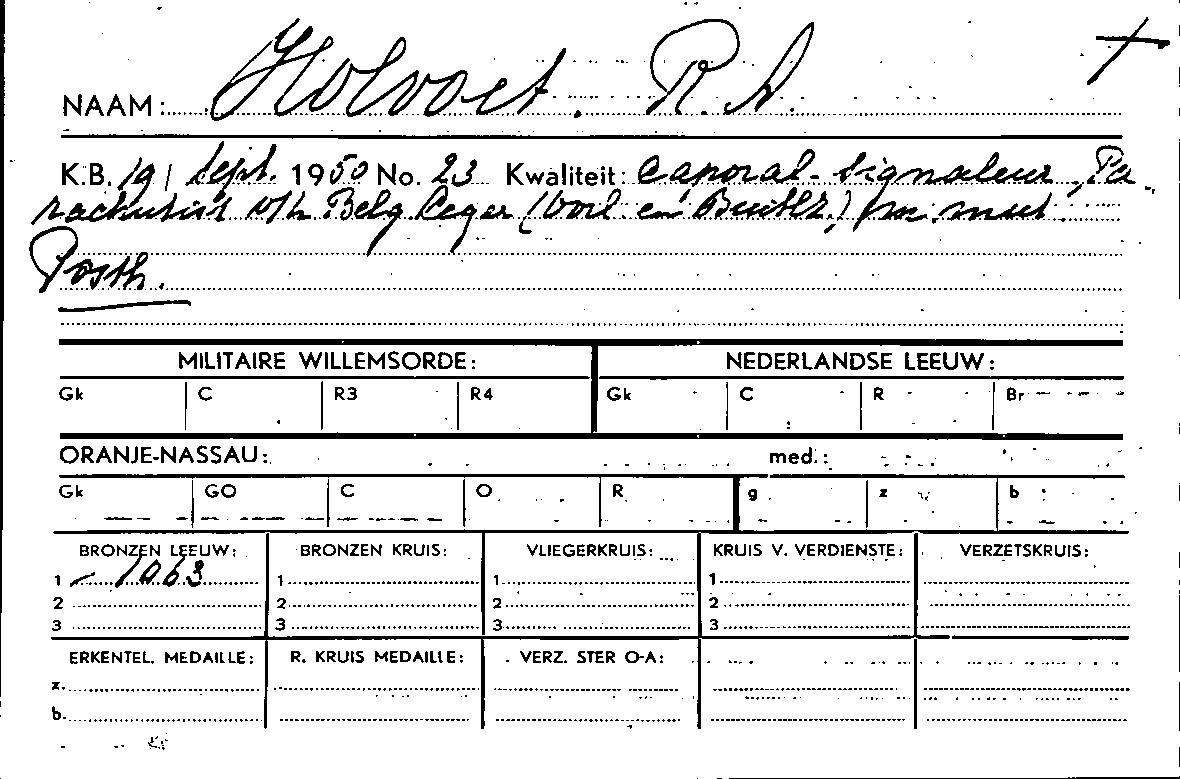
✓ The Bronze Lion. The Netherlands gave him the Bronze Lion, posthumously, by royal decree of 19 September 1950, no. 23, as "caporal-signaleur, Parachutist v/h Belg. Leger" (corporal signaller, parachutist of the Belgian Army), register number 1063. ◐ The card's bracketed "(Oorl. en Buitl. Z.)" is read in the archive's transcription, with a question mark, as the War and Foreign ministries, by comparison with other cards. The back of the card gives him as Raymond André, born at Kortrijk on 20 January 1924, "gefusilleerd Zwolle 10 April 1945" (executed at Zwolle on 10 April 1945), with the card's address, Gentsteenweg 20, Kortrijk, given care of his brother and sole heir, and the date 25 January 1951 (the card, Nationaal Archief 2.02.32); ◐ the date is most likely when the insignia went to the brother. The index of the Dutch Chancery of Orders lists a decoration for "Holvoet, Raymond Andre", without naming it (his records); his card names it. The card carries no citation, and none has been found. The War Graves Foundation's record gives the award as "BL." (the record).
Remembered. The War Graves Foundation's record has him also on the memorial at Hattem "bij de Oude IJsselbrug" (by the old IJssel bridge) (the record), and the Elspeet history has a commemoration held every year at Hattem at the memorial to the execution (Elspeet history). ◐ Noordman: when a new monument was unveiled at the Katerveer in 1980, "Er volgde een onderzoek naar de juiste naam van Raymond Holvoet, die onder zijn Engelse veldnaam 'Henderson' op het monument was vermeld" (there followed an inquiry into the right name of Raymond Holvoet, who was on the monument under his English field name, Henderson) (Noordman, p. 11). His family issued a prayer card with his photograph (above; Elspeet history). In 1947 Boeree gave him his chronicle's pp. 162–166, though he writes "Feitelijk bestaat er geen verder verband tusschen Ede en Holvoet" (in fact there is no further link between Ede and Holvoet); he gives two reasons for telling his story anyway, "alles zoo samenhangt met hetgeen er in onze naaste omgeving op de Veluwe voorviel" (everything is so connected with what happened in our immediate surroundings on the Veluwe) and "Ook wil ik het doen om de herinnering aan dezen jongen man levendig te houden. Vermoedelijk zal niemand anders zijn lotgevallen in druk vermelden." (I also want to do it to keep the memory of this young man alive. Presumably no one else will print his fate.) (Boeree, p. 162.)
Where the sources disagree
Link to the section Where the sources disagreeThe drop. 16 October (the Elspeet history), the night of 16/17 October (Hooiveld, from the full-text index), 17 October (Les Commandos S.A.S., the same; Franse para's in Drenthe, p. 133), the night of 17/18 October (Ede's history), 13 October in van Looyengoed's table (p. 3) and 14 October in Sonja Deen's (p. 3), both in the columns for when and where a man came down, "about Oct. 12th" in Huber's form (p. 8). Boeree has 2.55 on the morning of 17 October, on the Boeschoten land at Garderen (p. 161). De Jong has 18 October, near Garderen (deel 10b, p. 551); the book in the Foundation's file has 2.55 in the morning of 18 October, near Garderen, with du Bois (scan 0008, OCR only, not checked against the image); and a box in De zwarte herfst has du Bois dropped on 17 October near Garderen (Dekkers and Vroemen, p. 230). ◐ Boeree's 2.55 on 17 October and the 17/18 and 18 October of Ede and De Jong would be one night only if Boeree's 2.55 is the early hours of the 18th, which he does not say. Kragt puts the drop "a few days" after 17 September (p. 4). Hoekstra's row has "Boven Garderen afgesprongen" (jumped over Garderen) in the place column and "± 3 Oct '44" in the column for the date hidden, with the du Bois row "± 2 Nov '44" in the same column, so it is a date of help, not of the drop (p. 9).
The radio. The Elspeet history has it damaged in the landing, so that Holvoet stayed at Garderen while du Bois went on to Ede (Elspeet history); Ede's history has Holvoet stay at Garderen because "zijn zender was defect geraakt" (his transmitter had broken down) (p. 44); and De Jong has it fail after one day (deel 10b, p. 551). Boeree has him sending to England at fixed hours from Garderen and the transmitter found in the bunker by Looyengoed's house (pp. 162, 164); Hoekstra helped him with it for fourteen days, and Sonja Deen every two days with the transmitting (Hoekstra, p. 6; Deen, p. 2). ◐ One set can be damaged and mended, and Boeree names no date for the messages.
Whether he talked. ⚠︎ Major Windham-Wright's memo says Huber and his wife were arrested on 24 December "as a result of Henderson's confession" (above). Boeree has him keep to his cover of Henderson, the paratrooper, through the interrogations at Willem III from 27 October to 24 February, and does not mention a confession (p. 164); Franse para's in Drenthe has him refuse throughout to give any information (p. 133). ◐ Neither is a proof of silence, but they are two printed sources against the memo, which no other source supports.
How he was caught. By chance in Kirschen's diary ("Quite by chance the Germans happened to visit the farm") and in the Dutch of Huber's form ("door een ongelukkige samenloop van omstandigheden"); by a sequence of events in Boeree, from a dead boy to the K.P.'s bunker to Looyengoed's name (above); ⚠︎ "Hij werd verraden" (he was betrayed), caught while transmitting, in Franse para's in Drenthe, which names no source and no one; ⚠︎ an unnamed Dutchman who "broke down under torture and gave away the name of the farm", by an American agent's hearsay in Kessel's memoir (p. 126, above).
How long he was at the farm. Looyengoed's table has ten days hidden, then "arrested"; Sonja Deen's own table has 14 days, then "arrested" (p. 3); the 13 and 14 October beside them are in the columns for when and where he came down (above), and the date-hidden box is blank in both. Huber has him at his own house until 23 October and moved to Looyengoed's that day, and Boeree likewise has him leave Huber on 23 October; both have the arrest on 27 October. Burger has "some days" (p. 4). ⚠︎ Ten days and fourteen days before an arrest on 27 October would start on 17 and 13 October, so the farm's two helpers' counts do not fit Huber and Boeree, who have him there only from the 23rd; not reconciled, and 27 October is the arrest day the records that give one agree on, De Jong's December, Kirschen's 24 October and Franse para's's 17 October apart.
Who was taken with him. Van Looyengoed's form has "a courier female, who was in my house" (p. 2); Boeree has Sonja, the Jewish girl in hiding at the farm, who went to Westerbork (p. 164); and Sonja Deen's own form has her "arrested with SAS pilot" (p. 2). ◐ Very probably one woman (the same first name and the same arrest), though Boeree's Sonja is a Jewish girl in hiding and Deen's form a nurse and courier; she says herself she was a courier and nurse, not only in hiding; Boeree has Elly, the adopted girl, take the Germans to the farm but not arrested with him.
Where Looyengoed's farm was. Houtdorp in Boeree (p. 163) and as the address Looyengoed gave the Allied men, where he was also born (his form, fields 3 and 4); "Nieuw Millingen, post Garderen" as his own address in 1946 (Looyengoed's form, p. 2); "Speulde at Garderen" in Huber's list (Huber, p. 8). The Elspeet history names no place for him, only "Berend de Stroper (Berend Looyengoed)". ◐ Not reconciled: one farm or three names for a place by Garderen; Houtdorp has not been checked on a map here.
When he was arrested. 27 October in van Looyengoed's form, in Huber's, in the Elspeet history, in Ede's history and in the book in the Foundation's file; 24 October, the day the news reached him, in Kirschen's diary (p. 95); 17 October, the day of the drop, in Franse para's in Drenthe (p. 133); "in December '44" in De Jong's correction (deel 13, p. 153). ◐ De Jong's December may be the month du Bois was taken (1 December, his page); ◐ the 27 October of his hosts, of Ede's history and of the book is the likelier date for Holvoet.
The day and place he was shot. Hoekstra has 9 April 1945 at Zwolle (p. 8); van Looyengoed, Huber, the Elspeet history, Ede's history, both prayer cards, his Dutch award card (the card) and the War Graves Foundation have 10 April. The place: Zwolle on the card, the prayer cards and van Looyengoed's form; "bij Zwolle" in Ede's history ("Op 10 april 1945 werd hij bij Zwolle door de Duitsers doodgeschoten", p. 44); the Katerveer, in Boeree; "bij het Katerveer in Zwolle" in the book in du Bois's Foundation file; near Hattem in the Elspeet history and Hattem in the Foundation's record; "bij het Katerveer te Hattem" in Franse para's in Drenthe; the Gelderland side of the Katerveer in Noordman, whose cover has "bij het Katerveer in Oldebroek" (the preview). ◐ Zwolle, Hattem and Oldebroek may all be names for the one place at the Katerveer, seen from different towns; not checked on a map here. The civil record's 25 April is the day his body was found at Wilsum.
The day he was found. 25 April 1945 in Boeree, the Elspeet history and the IJsselmuiden register; "op 23 april bij Wilsum opgevist" (fished out at Wilsum on 23 April) in Franse para's in Drenthe (p. 133).
His last message. Given "aan een kameraad" (to a comrade) in the order of the day as Boeree prints it (p. 166); "aan de gevangenisdokter" (to the prison doctor) in Franse para's in Drenthe (p. 133).
His rank. Sergeant on his prayer card, in the War Graves Foundation's record, in the American files of Burger, Hoekstra and Huber, in Les Commandos S.A.S. and in Franse para's in Drenthe (all above); his Dutch award card has him a "caporal-signaleur", a corporal signaller, of the Belgian Army (the card). ⚠︎ Not settled; the card is the only official Dutch record seen, and his Belgian service record has not been seen.
What he was. A W.T. operator of the Belgian SAS squadron to Kirschen (p. 90), a signaller in 1984 (Dekkers and Vroemen, p. 235), an ex-SOE agent borrowed by MI9 in Fry, and ⚠︎ "een Jedburgh-operator" in Franse para's in Drenthe only (p. 133).
Whether he reached England from Kortrijk. ◐ The Kortrijk thesis, if its Raymond Holvoet is he, has him among those of the group who decided to flee in February 1941, and then says that of those who wanted to reach England only Jean Lammertijn succeeded (Demeyere, PDF p. 79); Boeree has him reach England by Miranda and Gibraltar (p. 162), and Kew's SOE files have him in British service. ◐ The thesis's line rests on one man's file (its note 240) and does not name him; a slip of the thesis, or two men of that name at Kortrijk, which no source says. The thesis also lists Raymond Holvoet among eight names it does not profile, because they were not found in the Kortrijk resistance files, and suggests those men were not born and raised in the town and/or settled elsewhere after the war ("niet in de stad Kortrijk geboren en getogen"); Holvoet was born at Kortrijk and died in 1945, so its explanation does not fit him (the thesis, section 2.4.1).
A Raymond Holvoet at Hannover. ⚠︎ An Arolsen list of foreign workers at Hannover, their names Flemish, has a "Holvoet, Raymond" at the goods office of Hannover's main goods station from 15 December 1940 to 21 March 1941, with no date or place of birth (the list, Arolsen Archives 2.1.2.1); he would have been sixteen then, and nothing on it shows that it is him. ◐ It overlaps the Kortrijk thesis's group of October 1940 to February 1941 and Boeree's departure from Belgium on 13 February 1941, which makes it less likely to be him.