Maria Westerwoudt
Amsterdam 18 Nov 1904 – before 7 Mar 1985
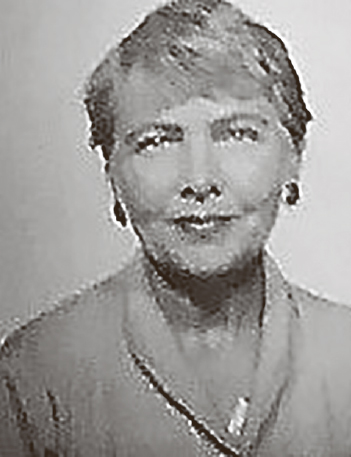
About: Maria Westerwoudt of Assel, "Heintje" to the Allied men, of the Raad van Verzet, who hid American and Canadian airmen and two paratroopers of Murphy's battalion on her family's estate in 1944–45. By Noordman's account (◐ p. 139; the evidence is on Dove Jan's page), his small farm, where Murphy and Walsh hid for a week in October 1944, was on that estate.
Unit or role: The R.v.V. (Raad van Verzet); known to the Allied men as "Heintje" (her questionnaire, p. 2). A courier, by her daughter's account, whose contact was Johan van Oldenbarneveld, Dove Jan (Noordman, p. 192).
Where: Assel 4, Apeldoorn (the address in the British index and on her own form); from the summer of 1944 a hut in the woods west of the chapel at Assel, by her daughter's account (Noordman, p. 192).
Evidence: ✓ The British helper index; ✓ her helper file with the Americans, US National Archives 286718498 (questionnaire, list); ✓ the forms of the other Assel helpers, August Schaeffer, Arnoldus van Zelst and Dove Jan; Noordman, pp. 139–141, 182–183, 191–192, 237–238, with her daughter's recollections; ✓ the civil records of her marriage, divorce and son's death (Open Archieven); ✓ the British Columbia Gazette, 7 March 1985, p. 336.
Maria Josepha Hendrika Westerwoudt was born at Amsterdam on 18 November 1904; an Amsterdam City Archives register entry has the same name, birthplace and day (the record, index only). In July 1945 she lived at Assel 4, had two children aged 14 and 9, and gave as her next of kin "Mr. W.M. Westerwoudt", 87 (her questionnaire, p. 2). The only fellow helper she named was "J.A.C. van Oldenbarneveld", Dove Jan (p. 2).
- ✓ Her mother, Maria Josepha Hendrika Povel, died at Apeldoorn on 5 May 1960, aged 80, the "(ex-)partner" being Willem Jan Maria Westerwoudt (the record).
- ✓ The "Mr. W.M. Westerwoudt, 87" of her 1945 questionnaire is her father. Willem Jan Maria Westerwoudt, "Mr. Dr." (as the notices of 1940 and 1943 style him), died on 10 May 1952 "in zijn 95ste levensjaar" (in his 95th year), the husband of Maria Povel and earlier of Anna Regout.
- That puts his birth between May 1857 and May 1858, so 87 or 88 in July 1945. The notice is signed by his wife, children and grandchildren, "M. Westerwoudt–Povel" first (Algemeen Handelsblad, 14 May 1952; checked on the image).
- ◐ A bouquet for the Queen, 1911.
- When Queen Wilhelmina and Prince Hendrik visited the Artis zoo at Amsterdam during the royal week of June 1911, "mr. W. J. M. Westerwoudt" was among the members of the society's board who received them, and "Jongejuffrouw Maria Westerwoudt bood H. M. een prachtige bouquet aan, die de Vorstinne onder het uitspreken van enkele sympathieke woorden van dank aanvaarde" (Miss Maria Westerwoudt offered Her Majesty a splendid bouquet, which the Queen accepted with a few kind words of thanks) (De Amstelbode, 12 June 1911, p. 2; the same words in De Tijd, p. 3; both read on the images).
- The Algemeen Handelsblad has the bouquet, of roses and orchids, handed to the Queen "door Jongejuffrouw Maria Westerwoudt" (p. 1, read on the image).
- ◐ She was six if she is the girl: the papers give no more than the name, and it is her father's initials on the board that make her very probably the one.
- ◐ To Port Said, 1925. The passenger list of the s.s. Koningin der Nederlanden, due to sail from Amsterdam on 28 February 1925, has among those for Port Said "W. J. M. Westerwoudt; mej. M. J. H. Westerwoudt" (Miss M. J. H. Westerwoudt) (De Avondpost, 27 February 1925, p. 3; the same list in the Algemeen Handelsblad, p. 15; read on the image of De Avondpost). Her initials, unmarried, beside her father's; the list, printed the day before the sailing, shows that they were booked, not that they went, and gives nothing more.
Marriage, divorce and her son's death
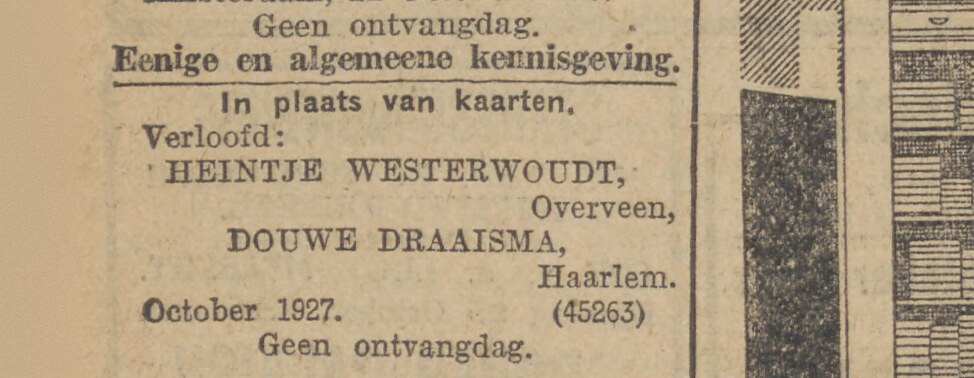
Link to the section Marriage, divorce and her son's death- ✓ Engaged, October 1927. The Algemeen Handelsblad of 22 October 1927 has an engagement notice, "In plaats van kaarten": "Verloofd: HEINTJE WESTERWOUDT, Overveen, DOUWE DRAAISMA, Haarlem. October 1927." (the notice; image-checked). ◐ Heintje is the name the Allied men knew her by (above); the notice has no other first name, but the man is the Douwe Draaisma she married on 8 February 1928, and Overveen is in Bloemendaal's municipality.
- ✓ On 8 February 1928 at Bloemendaal she married Douwe Draaisma, a musician born at Delft; she was 23, born at Amsterdam, the daughter of Willem Jan Maria Westerwoudt and Maria Josepha Hendrika Povel (the record, North Holland Archives; index only).
- ✓ The marriage was dissolved at Bloemendaal on 27 March 1941 (the entry); the court was the district court at Arnhem, which pronounced it on 28 November 1940, with her as the plaintiff and her address Overveen (Nederlandsche Staatscourant, 29 March 1941; OCR only), and Draaisma married again at Voorburg on 4 August 1941, the record listing her as his previous partner (the record); he died at Voorburg on 10 November 1950 (the entry). So the 1928 bride is the Maria Westerwoudt of 1945, who went by her maiden name again.
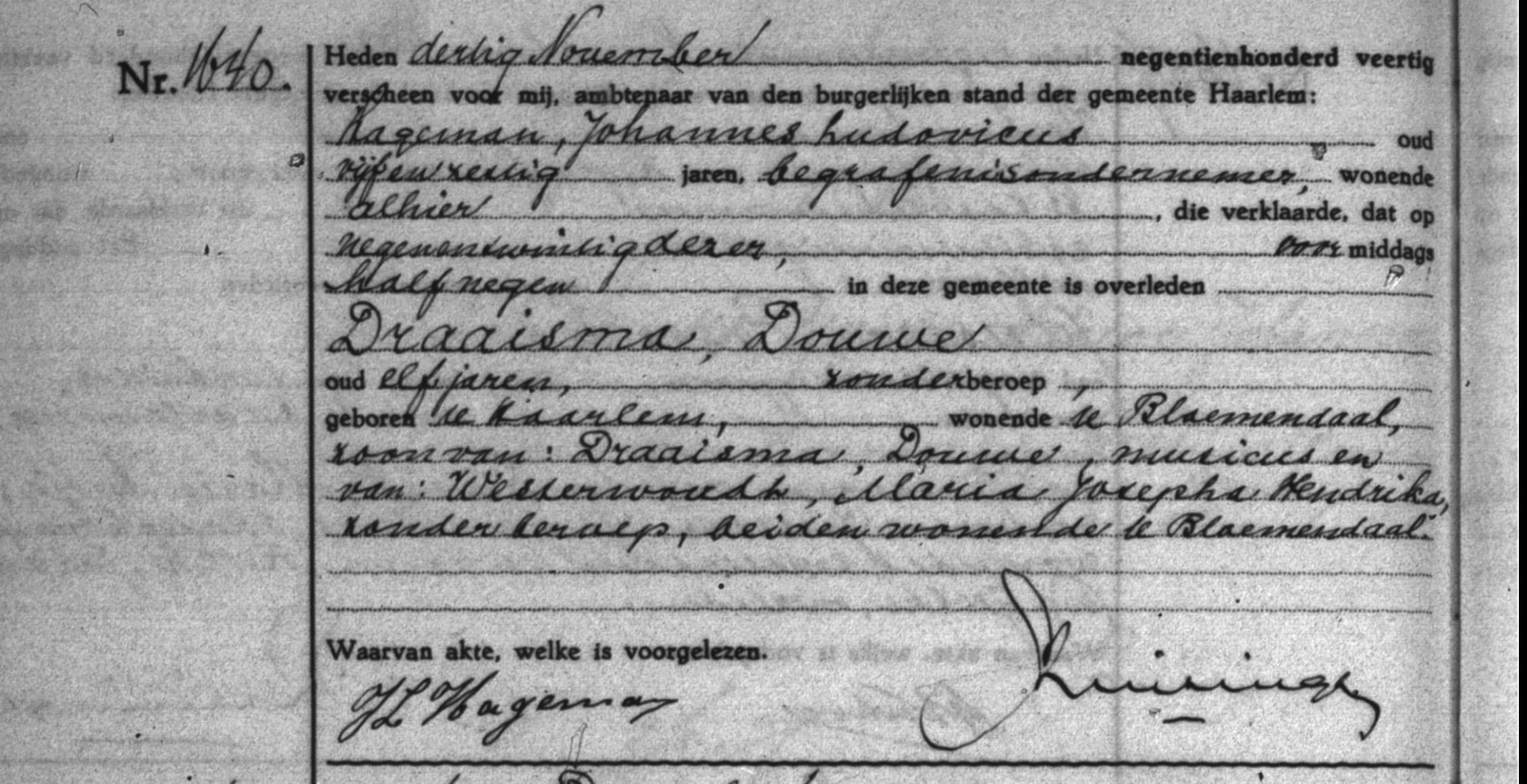
- ✓ Her son Duke, 1940. Douwe Draaisma, born at Haarlem, "Duke" in the family's notices, died at Haarlem on 29 November 1940 aged 11, the day after the Arnhem court pronounced his parents' divorce. The civil deed (Haarlem 1640) has him die at half past eight in the morning and names his father Douwe Draaisma, a musician, and his mother Maria Josepha Hendrika Westerwoudt, "zonder beroep", both of Bloemendaal; it was declared on 30 November by an undertaker (the record; the deed, read on the scan).
- Her notice, in De Maasbode of 2 December 1940 and the same text in the Algemeen Handelsblad and De Maasbode of 30 November and 1 December, says "na voorzien te zijn van de H.H. Sacramenten, rustig en kalm, na kortstondige ziekte", "mijn innig geliefd Kind en ons lieve Broertje", signed by her and by two more children, from Overveen (the notice, image-checked). The two are very probably the children aged 14 and 9 of her form of 1945 (above); they are not named here.
- Below it a second notice, from her parents and (◐ by the "Jr.") a brother and his wife, to whom the boy was Neefje (nephew), says he died in the Maria Stichting at Haarlem "na zeer korte hevige ziekte", "onze lieve Kleinzoon en Neefje", "Ons aller lieveling".
- The brother's wife is "Schaeffer, Edle von Wienwald"; ◐ that is the surname of the Dr August Schaeffer Edler von Wienwald of Assel below, and his own form of 1946 gives as his nearest blood relative ("naaste bloedverwant") a Mrs Westerwoudt-Schaeffer, aged 29 (his form, p. 4, read on the image). So a family tie between Schaeffer and the Westerwoudts is very probable; neither paper says what it is.
- The divorce had been pronounced on 28 November 1940, the day before; no paper held links the two.
The estate at Assel
Link to the section The estate at Assel✓ The Westerwoudt land at Assel is on paper from 1911: on 13 June 1911 Apeldoorn's burgomaster published the application of Mr Willem Jan Maria Westerwoudt, an insurance broker (assuradeur) of Amsterdam, to put up a farm barn with a petrol motor on a plot "gelegen nabij de halte Assel" (near the Assel halt) (Apeldoornsche Courant, 14 June 1911; checked on the image). By 1943 the family's address is "Westerwolde, Assel bij Apeldoorn", in the notice in which their children and grandchildren announce that "our dear parents", "Mr. Dr. W. J. M. Westerwoudt" and his wife, M. J. H. Westerwoudt–Povel, hope to mark their 40th wedding anniversary on 18 May 1943 (Algemeen Handelsblad, 7 May 1943; checked on the image). ✓ So the Westerwolde of the occupation was her parents' house, at Assel, where she gave her own address as Assel 4 (her form), and her father was buried "op zijn landgoed te Assel" (on his estate at Assel) on 13 May 1952, by the notice above. ◐ That the plot of 1911 is the land of Dove Jan's farm is not shown by any of these: the notice gives a cadastral number and the halt, and Noordman has the farm "op het landgoed van de familie Westerwoudt" (on the Westerwoudt family's estate) (p. 139).
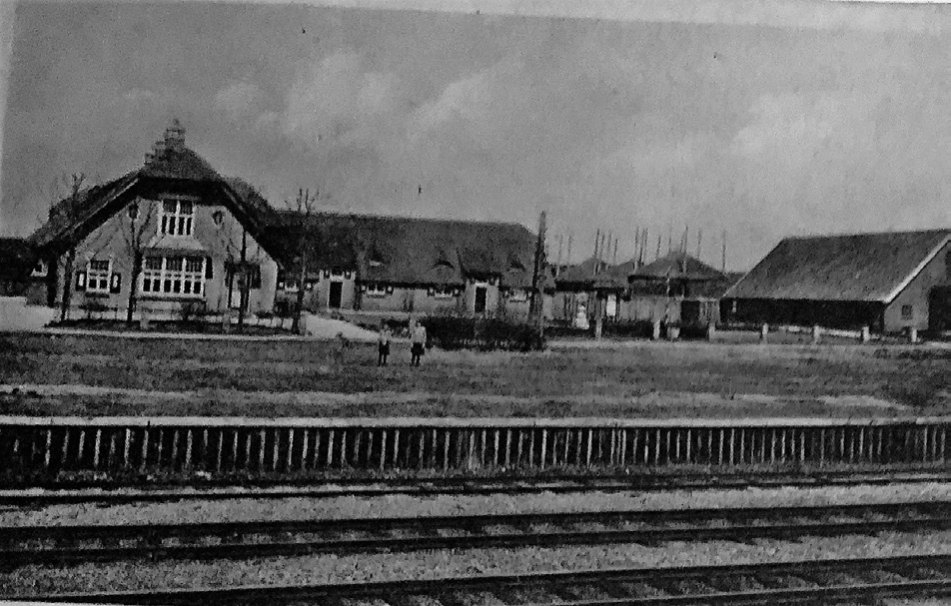
By her daughter's account the chapel at Assel was built by her grandfather, "Willem J.M. Westerwoudt", in 1941 and dedicated to the Holy Spirit, with water, a toilet and a loft above the sacristy reached through a hidden hatch (Noordman, p. 140).
Airmen at Assel, spring 1944
Link to the section Airmen at Assel, spring 1944Her daughter's recollections, printed by Noordman in 2019, are the only account from the family; the daughter was fourteen in 1945 by her mother's form, and is not named here.
- ◐ Walter Mallard.
- In the spring of 1944, coming home from the Gymnasium at Apeldoorn, the daughter saw a stranger in the trees by the road, watching German soldiers at Assel station, and took him to her mother, "die zijn uniform snel verwisselde voor burgerkleding" (who quickly changed his uniform for civilian clothes). He was Walter Mallard.
- He could not hide with them, "omdat er bij ons zes Duitse spoorwegbewakers waren ingekwartierd" (because six German railway guards were billeted on us), and that evening her mother took him to Johan van Oldenbarneveld's farm, where a Jewish family and another American airman, Gene Glisynski, were already hidden (Noordman, pp. 182–183). Mallard, Robert Fisher's co-pilot, had come down on 19 May 1944 (p. 181).
- ✓ The questionnaire made out for Dove Jan in July 1945 says "Mrs. Westerwoudt brought a co-pilot and a gunner" (his file, p. 5); ◐ the co-pilot is very probably Mallard and the gunner Glisynski, whom Noordman calls "copiloot" and "schutter" (Noordman, pp. 182, 138; more on Dove Jan's page). Schaeffer's list has the two passed on to "J.C. v. Oldenbarneveld, Kootwyk 2 en "Alex" (Dr. Eskes)" (his list, p. 5).
- ◐ The chapel. When the Germans raided Dove Jan's farm at the end of May, the two airmen escaped into the wood. The daughter:
Meanwhile we had heard of the raid, and my mother and I had gone looking for them and managed to find them. We waited until it was dark before crossing the closely guarded railway line with them and hiding them in the chapel.
Dutch originalInmiddels hadden we van de overval gehoord en waren mijn moeder en ik naar hen op zoek gegaan en wisten hen te vinden. We hebben gewacht tot het donker was alvorens met hen de streng bewaakte spoorlijn over te steken en hen te verstoppen in de kapel.
— Maria Westerwoudt's daughter · in Wolter Noordman, Schuilplaats de Veluwe (2019), p. 140 · the book
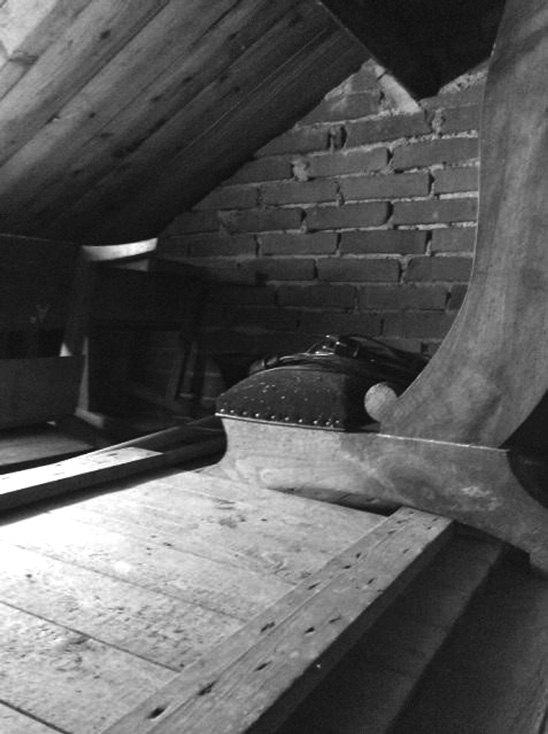
They brought the two food every day, and on 6 June, the day of the Normandy landings, by her account Dirk Eskes ("Alex") fetched them (Noordman, pp. 140–141; Dirk Eskes). ⚠︎ Mallard's own letter after the war, as Noordman prints it, has "Nadat mevrouw ons naar 'Alex' gebracht had" (after the lady had taken us to 'Alex'), then Glisynski going to another address while Mallard stayed about two weeks with Alex (p. 183): there it is the lady, not Alex, who brings them, and the letter says nothing of a chapel. Nelly Eskes-Buis's own table has Mallard received on 6 June 1944 from "J. van Oldenbarneveld, Assel" (her table, p. 15).
Summer 1944: the house burned
Link to the section Summer 1944: the house burnedBy her daughter's account, in the summer of 1944 the Germans were billeted in the house, which Typhoons then shot on fire and almost razed. The family scattered: her parents to Kootwijk, the daughter's uncle and his family to Radio Kootwijk, the farm manager Van Maanen to Stroe. She, her two children and "Gus" Schaeffer moved into "een soort schuurtje midden in het bos, even ten westen van de kapel" (a kind of shed in the middle of the wood, just west of the chapel), with no electricity or water. "Mijn moeder Maria was koerier voor de ondergrondse en haar contactpersoon was Johan van Oldenbarneveld" (my mother Maria was a courier for the underground and her contact was Johan van Oldenbarneveld) (Noordman, p. 192). No other source we hold dates the fire.
With Murphy
Link to the section With MurphyNothing puts her with Murphy himself. Dove Jan, Johan van Oldenbarneveld, whom her daughter names as her mother's contact in the resistance (above), lived on "een boerderijtje op het landgoed van de familie Westerwoudt" (a small farm on the Westerwoudt family's estate), and "'Dove Jan' heeft meer vliegers en para's opgevangen, onder anderen Tom Murhpy [sic] en Sam Walsh, die in oktober 1944 ontsnapt waren uit de Koning Willem III-kazerne" ('Dove Jan' took in other airmen and paras too, among them Tom Murphy and Sam Walsh, who had escaped from the King William III barracks in October 1944) (Noordman, p. 139). They were there from 7 to 14 October 1944 by Walsh's report (Walsh; October on the Veluwe). Neither Murphy nor Walsh names her, and her own list does not name them.
The five men from the train, November 1944 to February 1945
Link to the section The five men from the train, November 1944 to February 1945After the failed Pegasus II crossing of 18 November 1944, five of the men taken jumped from the prisoner train near Radio Kootwijk: two paratroopers of 156 Battalion, William Prince and Jack Lynch, the American gunner Werner Braun, and two Canadian airmen, Lawrence McElroy and Robert Gelfand (Noordman, pp. 190–191; Prince's account has the jump "In de vroege ochtend van 23 november", p. 237).
- ✓ Her own list. Werner G. Braun of Cold Water, Ohio, "Lawrence Mac. Elroy R. 82539 / Matawa Ont." and Robert Gelfand of Winnipeg, from "Nov. '44", 90 days each, passed to "Joop and Dick" (◐ very probably the line of Joop Piller and Dick Kragt: the form gives no surnames); "William Prince sgt. parach. 1st Airb. Div." and "Jack Lynch sold. Liverpool", 14 days each, passed to "van Oldenbarneveld" (her list, p. 3). The Americans' summary sheet has the same five and days (p. 5).
- ✓ Schaeffer. Dr August Schaeffer Edler von Wienwald of Assel 6, "Gus", of the R.V.V., listed Braun, Gelfand and McElroy, "escaped P.o.W.", from 23.11.1944 for 80 days, and Prince and Lynch from the same day for 14, all received from "Arnold v. Zelst, Assel/Apeld." and passed to "J.C. v. Oldenbarneveld, Kootwyk 2", and named his work as "Housing (in cooperation with Mrs. M.J.H. Westerwoudt), transport, supplying of clothing" (his form, p. 2; his list, p. 5, 18 January 1946).
- ✓ Van Zelst. Arnoldus van Zelst, the Assel helper who first took them in, wrote in March 1946:
On one of the first days of Nov. 1944 5 evaders who had just jumped out of a train with P/W's came to the farm where I was staying. … I … took them to a hiding place about 25 minutes from the house. This hiding place was made by Mr. von Cheffer and me. … The 2 Englishmen, 2 Canadians and one American stayed there for 6 weeks. After this we took them to Mrs. H. Westerwoudt who hid them in a church at Assel for another 6 weeks.
— Arnoldus van Zelst · his questionnaire for the Americans, 21 March 1946, p. 4 · the form (checked on the image)
- ◐ Her daughter's account (Noordman, pp. 237–238).
- "Ergens eind november verschenen op een vroege morgen vijf mannen bij ons aan de deur, Lawrence McElroy, Robert Gelfand, Bill Prince, Jack Lynch en Werner Braun" (some time at the end of November five men appeared at our door early one morning…).
- Two had lice from the prison camp, and her mother found the right remedy; she fed them by bartering wool she had spun herself; the men read from the family's stock of English books, rolled cigarettes and kept the stove going.
- "Toen de para's Lynch en Prince ongeveer zeventien dagen bij ons geweest waren, vond mijn moeder een nieuw adres dat hen over de Rijn zou kunnen brengen" (when the paras Lynch and Prince had been with us about seventeen days, my mother found a new address that could get them over the Rhine).
- ✓ Dove Jan's list has "Bill Prince" and "Jack Lynx" from "Mrs. Hein Westerwoudt Assel.", and sent on "To Laren (Gooi)" (his file, p. 4). Prince's report has the two leaving for Laren with two ladies on bicycles on 23 December (his report; William Prince). ◐ The report glosses that Laren as "17 kms S. of DEVENTER", which does not fit the Gooi; William Prince's page takes the gloss for the interviewer's and puts him at Laren in North Holland from the helpers' forms, so the report and Dove Jan's "(Gooi)" agree only through that step.
- ◐ The hole and the chapel (Noordman, pp. 191–192).
- McElroy's account in Noordman has the men taken to "een hol in het bos, waar we vijf weken zijn gebleven" (a hole in the wood, where we stayed five weeks), and "omstreeks de jaarwisseling" (around the turn of the year) to a chapel, where they hid six weeks above the sacristy.
- The daughter: with more German patrols in December, "moeder besloot omstreeks de jaarwisseling hen onder te brengen in de kapel" (mother decided around the turn of the year to put them in the chapel), the place where Glisynski and Mallard had been in June; they spent about six weeks there (p. 191).
- Noordman: the hole was reached from the shed where Maria Westerwoudt lived with her two children and "Austin Schaeffer ('Gus')" (p. 192).
- ◐ McElroy and Gelfand went on, from 16 February 1945, to a month with a farmer at Essen, and on 17 March to Amerongen, where they were liberated (p. 192). From Schaeffer's 23 November 1944 to 16 February 1945 is 85 days; Schaeffer gives the three 80 days and her list 90.
Afterwards
Link to the section AfterwardsListed in the British index to Dutch helpers as "WESTERWOUDT, Maria J.H.", certificate 14345, grade 5 (What the British recorded afterwards); the Americans also graded her 5 (p. 1; the summary sheet, which has "Capt. KAY" (◐ Kragt) and 8 December 1945 beside her name, p. 5). On 23 November 1945 she signed for a food parcel and overcoat and suit material from the American office (p. 4).
- ◐ Sailing, 1960. A Holland-America Line passenger statement for a sailing from Rotterdam on 17 June 1960 (the sheet's code "PW2"; Open Archieven indexes the ship as the Europa) has "Westerwoudt MJH" with the accommodation code "1a" (◐ a cabin code; every booking on the sheet is at $205 a head, six bookings for eight passengers, so the code need not mean first class), booked through the agent "Lislind Adoorn" (◐ Apeldoorn, which is our reading; the same agent booked another passenger, Watson), destination given only as "M" (the sheet, read on the scan; Rotterdam City Archives).
- A separate booking on the same sheet is in the name of "Endert W E", the name of the executor of 1985 (below).
- Her mother had died at Apeldoorn on 5 May 1960 (above).
- ◐ Kelowna, 1963. The Kelowna city directory of 1963 lists "Westerwoudt Mrs Maria J H prop Beach-" (the OCR breaks off at the line end; the cafe's own entry, "Beachcomber Cafe (Mrs M J H Westerwoudt) 3502 Lakeshore", completes it), with another Westerwoudt, a salesman, at the same address; the directory does not say how he was related (the Internet Archive's text; OCR only: the page image could not be borrowed).
- ◐ The US National Archives at Kansas City hold an immigration case file, A-File A6706162, for a Maria Westerwoudt born in the Netherlands on 18 November 1904, her birth date; it is not digitised (the catalogue entry).
- ✓ Her death. The British Columbia Gazette of 7 March 1985 called for claims against the estate of "Maria Josepha Hendrika Westerwoudt (also known as Mary or Misha Westerwoudt), deceased, formerly of Kelowna, B.C.", by 29 March 1985, to the executor "William E. Endert" at Sechelt (the Gazette, p. 336, read on the image). She had died before 7 March 1985; the notice gives no date or place of death.
Where the sources disagree
Link to the section Where the sources disagree- How long, and where.
- Van Zelst has all five in the hiding place he and Schaeffer made for six weeks and then with her "in a church at Assel" for another six (p. 4); McElroy has five weeks in a hole in the wood and six in the chapel, and the daughter about six weeks in the chapel from the turn of the year (Noordman, p. 191); her own list has Braun, Gelfand and McElroy for ninety days and Prince and Lynch for fourteen, and names no church (p. 3).
- Schaeffer has the three for eighty days from 23 November (his list, p. 5).
- ◐ The accounts agree on a hiding place in the wood and then the chapel; they differ on the weeks.
- When they came. Van Zelst has "one of the first days of Nov. 1944" on his form and 3 November 1944 in his table (p. 5), and Dove Jan's letter of 15 April 1946 "the end of October 1944" (p. 17); Schaeffer 23 November; Prince's account the early morning of 23 November; the daughter "eind november". ✓ The crossing they were taken on was on 18 November, so October and the first days of November cannot be right.
- How long Prince and Lynch were there.
- Fourteen days with her, passed to van Oldenbarneveld, on her list (p. 3).
- About seventeen days in her daughter's memory (Noordman, p. 238).
- About thirty days on Prince's own report, which has the two on "a farm (address unknown) near APELDOORN" from the escape on 23 November until 23 December, naming no one (Prince).
- Forty-two days on Van Oldenbarneveld's list, where he has them received from her (p. 4); and on the questionnaire made out for him, two parachutists "jumped out from the train and picked up by v.O. himself" (p. 5).
- ⚠︎ Not settled.
- Her address. Assel 4 on her own form and in the British index, "Assel 30" on Schaeffer's form and "Assel 5" on Van Zelst's (Schaeffer, p. 2; Van Zelst, p. 4). ◐ Her own form is the one to prefer.