Wim van der Mheen
Lunteren 16 Feb 1923 – Dodewaard Jan 1945 ◐
About: Willem "Wim" van der Mheen, a smith of Lunteren and a courier of the Ede and Lunteren resistance, who led the Lunteren men blowing the railway in September 1944, was with his brother Henk among the guides of the first crossing in Boeree and, by the Americans' summary, "had acted as a guide and assisted in carrying out the two Pegasus operations", met Hendrik van Loenen at his drop at the end of December, and took Pte William Gordon, by Gordon's report, to a garage owner at Amerongen in January 1945 (◐ Gerald Esveld's house, about a week after Murphy had left it). Sent over the Rhine with Henk at the end of January, he was found dead near Dodewaard in June 1945.
Unit or role: Resistance: "N.B.S." on his questionnaire for the Americans (his file, p. 14), "Verzet" on the roll of honour (Erelijst); a courier, by Boeree (p. 242). By trade a smid (smith) in his death deed (the index records), a machinebankwerker (machine fitter) on the roll of honour.
Where: Postweg 110, Lunteren, the family's address in the Americans' files and on the British index of helpers (his file, p. 14; page M/9); Nederwoud, by Boeree; in hiding with the Esvelds at Amerongen; found dead at Dodewaard.
Evidence: ✓ His helper file with the Americans, US National Archives 286703081 (his questionnaire, 10 October 1945), and his mother's, 286698514 (the summary on him, 18 December 1945; her letter of April 1946); ✓ the War Graves Foundation's files on him and his brother (Nationaal Archief 2.19.255.01, inv. 104013A, his mother's form; inv. 104012A, the note from the Dodewaard police report); ✓ his death deed (Dodewaard 1945, deed 14); ✓ Th. A. Boeree, Kroniek van Ede (1947), pp. 139, 155, 160, 242–245 (read on the page images); ✓ Pte William Gordon's report; ◐ Hendrik van Loenen's statement, which names "Wim van de Meent" (taken to be him, below) (p. 23).
Who he was
Link to the section Who he was✓ Willem van der Mheen was born on 16 February 1923: at Lunteren by his mother, who wrote that her two sons were "beiden te Lunteren geboren" (both born at Lunteren) (104013A, scan 4); at Ede by his questionnaire for the Americans and the roll of honour (p. 14; Erelijst). The Foundation filed both brothers under "Gem. Ede", the municipality of Ede (scan 4). His death deed names his father Hendrik and his mother Jacoba van Schothorst (the index records). ◐ The Ede register has a smith of his father's name, aged 51, whose partner was Jacoba Schothorst, died at Ede on 5 April 1939 (deed 99 of 1939): very probably his father, since his mother's questionnaire of 22 June 1945 has her as a widow ("Wid."), under her husband's initial H., and she gave her name as "Wed[uwe]" (widow) in her reply to the Americans' letter of 11 April 1946 (her questionnaire; her reply). His brother Hendrik, "Henk", was born on 14 July 1924 (their mother's form).
He was a smith by his death deed. ✓ Pte William Gordon, hidden at the house from October 1944, called it "a blacksmith's house somewhere between BARNEVELD … and LUNTEREN", the blacksmith's name being VAN DER MHEEN (Gordon); ◐ whether that blacksmith was Wim or another of the family, Gordon does not say. ⚠︎ A visitor's note of 2014 on the Foundation's page, whose writer calls himself a relative by marriage, says Wim was a smith, "opvolger van zijn vader in de smederij aan de Postweg te Lunteren" (his father's successor in the smithy on the Postweg at Lunteren) (Oorlogsgravenstichting). The house was on the Postweg at Lunteren: Postweg 110 in the Americans' files and on the British index, where the brothers' entries are bracketed "Brothers" (page M/9). Mrs Esveld called the family "the de MEENT family at 't Woud, near BARNEVELD" (her statement, p. 5), and Boeree "de gebroeders van der Mheen uit Nederwoud" (the van der Mheen brothers from Nederwoud) (p. 160).
The resistance, 1944
Link to the section The resistance, 1944The Americans' summary of 18 December 1945, which carries the name of Mr D. Wildeboer of Ede and the date 17 December 1945, says:
The subject was a very active worker of the underground group of Ede and Lunteren and for a considerable period of time in late 1944, following the Arnhem operation, he had helped with the provisioning and the care of the vast number of evaders in the Veluwe area of Gelderland province. He had acted as a guide and assisted in carrying out the two Pegasus operations of I.S. 9.
— Holland Office, 6801 MIS-X Detachment · summary on Willem van der Mheen · 18 December 1945 · his mother's file, p. 7
Boeree's chronicle of Ede has him in these:
- The railway, 30 September 1944. When the line was blown in two places before dawn on Saturday 30 September, the Lunteren section was done by "de jongens uit Lunteren" (the lads from Lunteren): "Die stonden onder leiding van Wim van der Mheen, die ook een voorraad springstoffen onder zijn berusting had" (they were led by Wim van der Mheen, who also had a stock of explosives in his keeping) (p. 139).
- A guide in the first crossing. For "De eerste rivierovergang" (the first river crossing), the Lunteren resistance group was to report with bicycles and civilian clothes at the Groote Voort on the Postweg, and among the men from Lunteren were "Henk en Wim van der Mheen"; "Allen moesten als gidsen fungeeren" (all were to act as guides) (p. 155). ◐ That this chapter is Pegasus I is our reading: it is the first of Boeree's two crossings.
- A courier. After Capt. King, Gilbert Kirschen, moved to Maarsbergen, "Het koerierswerk werd gedaan door de gebroeders van der Mheen uit Nederwoud" (the courier work was done by the van der Mheen brothers from Nederwoud), who brought the messages to Roelof and Bep's courier post (p. 160).
- The house on the Postweg in Pegasus II. On the night the men for Pegasus II were gathered, a party that Dirk, the Neerlangbroek policeman, had collected (picking up a few men at Amerongen on the way to the Walderveensche molen, where Tonny received them) rested "bij de Wed. van der Mheen aan de Postweg" (at the widow van der Mheen's on the Postweg) before going on to the assembly point at Wolfswinkel's chicken houses (p. 178). ◐ That the widow is his mother is our reading, by the street and her own signature as a widow.
The drop at the end of December
Link to the section The drop at the end of December✓ After a drop expected on Christmas eve failed, "Er verliepen twee dagen, toen kreeg King bericht, dat het die avond zou gebeuren. Inderhaast zond hij den koerier Wim van der Mheen uit" (two days passed, then King had word that it would happen that evening; in haste he sent out the courier Wim van der Mheen) to call the reception party (p. 242). "Wim van der Mheen beloofde bij zijn oom een paard en wagen te halen" (Wim van der Mheen promised to fetch a horse and cart from his uncle) to take the containers to a shed on the Nederwoudscheweg (p. 243). One parachute came down, the "body", "Capt. Henk van Loenen, bijgenaamd Bob" (nicknamed Bob), who floated off to the road from Lunteren to Ederveen (same page; van Loenen's own statement and Kluiters put the drop near Renswoude; which van Loenen it was is discussed on his page). "Henk en Wim moesten de parachute in de gaten houden, zij moesten Bob naar zijn logies brengen" (Henk and Wim were to keep an eye on the parachute and bring Bob to his lodging; ⚠︎ Boeree gives this Henk no surname, and names another Henk of the reception party in full a few lines later, so it may or may not be his brother), and when a container landed on the roof of a nearby farm, Wim and another man went with a pistol to get the household back indoors (same page). Then:
He looked round, and saw two men walking towards Steenbeek's farm. The one was Wim, the other must be the dropped agent. Barend went up to them and opened the talks with the usual "How do you do", to which the other said: "Ook goeien avond."
Dutch originalHij keek om zich heen, zag twee man naar de boerderij van Steenbeek loopen. De eene was Wim, de andere moest de gedropte agent zijn. Barend liep op hen toe en opende de besprekingen met het gebruikelijke „How do you do", waarop de andere zei: „Ook goeien avond."
— Th. A. Boeree, Kroniek van Ede gedurende de bezettingstijd (1947), p. 244 · the page, read on the image
"Bill stuurde daarop Wim met den parachutist naar het opgegeven adres" (Bill then sent Wim with the parachutist to the address given), about 5 km on foot, and Germans came up soon after (same page). Two farmers arrested afterwards were questioned by the SD, and "er waren twee personen herkend" (two people had been recognised), Wim one of them; the arrested farmer Mastenbroek was taken by an SD agent to "de boerderij van van der Mheen" (the van der Mheen farm) "om Wim op te scharrelen" (to round Wim up), "maar deze was er allang vandoor" (but he had long gone), and his brother Henk told them Wim had been missing for some time (p. 245).
Gordon, and the Esvelds' house
Link to the section Gordon, and the Esvelds' house✓ Pte William Gordon of the 156th Battalion, Murphy's battalion, was moved on the morning of 24 or 25 October 1944, ill, "by horse and cart to a blacksmith's house somewhere between BARNEVELD (E. 5496) and LUNTEREN. The blacksmith's name was VAN DER MHEEN", where for 10 or 11 weeks a Dutch doctor and nurse nursed him (Gordon). Boeree has Gordon, too ill to cross with the others on 23 October, staying "nog twee maanden in huis … bij de familie van der Mheen aan de Postweg" (two months more in the house of the van der Mheen family on the Postweg) (p. 129); his mother's form for the Americans has "William Gordon", "Par. R.", from 25 October 1944, 60 days (her file, p. 4). Then:
On 8 Jan, or thereabouts, the two brothers of VAN DER MHEEN - HANK and WILHELM - took me by cycle to AMERONGEN (E. 4480), where I stayed with the owner of the only garage in the town, a M. BEER.
— Pte William Gordon · his report to I.S.9 (WEA), 7 March 1945 · Pegasus Archive
◐ The garage was very probably the Esvelds'. Mrs Esveld has her "Bill, parachutist, Scotland", who had stayed a long time with "the de MEENT family at 't Woud, near BARNEVELD", arrive "on 9 Jan … with Henk and Wim at the house of Mrs. ESVELD" (her statement, p. 5), and Berend "Flip" Esveld's list of 1946 has "Bill Paratrooper" received from "v. d. Mheen. Lunteren" (p. 13). That Bill is Gordon is our match, by the date, the escort and the house (the London of Flip's list is near enough Gordon's home address at Hanworth, Middlesex), and it is not exact: Mrs Esveld's Bill is from Scotland, which nothing held tests, since no source held says where Gordon was born; Mrs Esveld's Bill is also wounded and suffering from dysentery, where Gordon's report mentions neither and has paralysis in both legs (illness fits, the wound does not appear); Flip has a "Bren gunner" arriving in mid-January and staying about a month, where Gordon has himself at the garage from about 8 January to 19 February, with a crossing attempt from 19 January (Gordon), while Mrs Esveld's 9 January to about the middle of February fits Gordon's dates. Murphy had been at that house from 23 or 24 December to 2 January, when he left it for a crossing "which did not succeed" (Mrs Esveld, p. 5; Hardy has the 23rd).
With Murphy
Link to the section With MurphyNo source puts him with Murphy. Their paths ran close three times:
- Pegasus II. The Americans' summary says he "had acted as a guide and assisted in carrying out the two Pegasus operations" (his mother's file, p. 7), which does not say he guided in the second; Boeree has the brothers as guides in the first only, and for the second only the widow van der Mheen's house as a resting place (above). Murphy was in the second, on 17 and 18 November 1944, and was lost with Hardy, Banwell and Branford when their guides drew ahead in the dark (Hardy; Pegasus II). No source says what Wim did that night.
- The Esvelds' house. ◐ If Gordon's host was the Esvelds (above), he and Henk brought Gordon there on about 8 or 9 January 1945, six or seven days after Murphy left it on 2 January (above), and they themselves "ondergedoken geweest bij Gerrit Esveld garagehouder te Amerongen" (had been in hiding at Gerrit Esveld's, the garage owner at Amerongen) (the note). No source dates their stay there.
- Coen Esveld. ◐ His last crossing was very probably made with Coen Esveld, whom Hardy names among the two who took Hardy and Murphy out of Amerongen on 2 January: "At 1300 hours we left on bicycles with KOEN and KEEK (?)" (Hardy) (below).
The crossing of January 1945
Link to the section The crossing of January 1945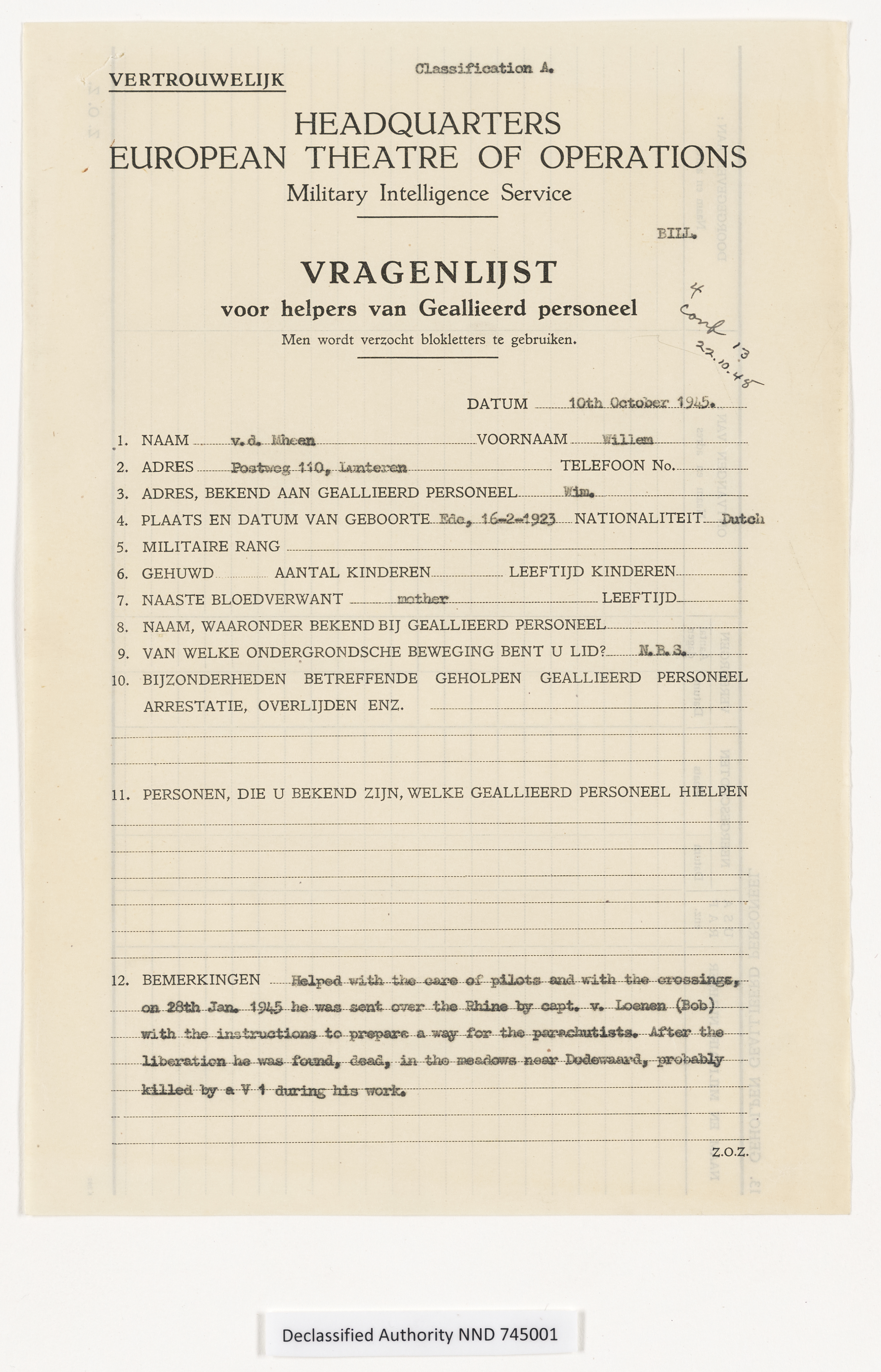
✓ His questionnaire says:
Helped with the care of pilots and with the crossings, on 28th Jan. 1945 he was sent over the Rhine by capt. v. Loenen (Bob) with the instructions to prepare a way for the parachutists. After the liberation he was found, dead, in the meadows near Dodewaard, probably killed by a V 1 during his work.
— Questionnaire for helpers of Allied personnel, Willem van der Mheen · 10 October 1945 · US National Archives, his helper file, p. 14 · the transcript
The form is in the third person ("he was sent over the Rhine", "he was found, dead") and was made out in October 1945 about a man found dead, so someone else filled it in. ◐ The man is probably D. Wildeboer of Ede: the claim form in Henk's file is signed by him at Ede on the same day, 10 October 1945 (Henk's file, p. 15), and the Americans' summaries carry his name. If so, the two questionnaires and the summaries are one informant, not separate witnesses. Both questionnaires are headed "BILL." and the claim form is signed "D. Wildeboer", "Bill," (Henk's questionnaire; Willem's; the claim form); what the word stands for the forms do not say, but it ties the forms to one hand, and whether that hand had van Loenen's account from van Loenen is not shown.
Hendrik van Loenen, the agent Wim had taken from his drop a month before, wrote in his own statement: "Lost 4 men by trying to discover opening in front. Names were: Wim and Henk van de Meent from Renswoude, Koen Esveld from Amerongen, George Andrews" (his file, p. 23; the copy in the Cornelisse-van Brink file, p. 16).
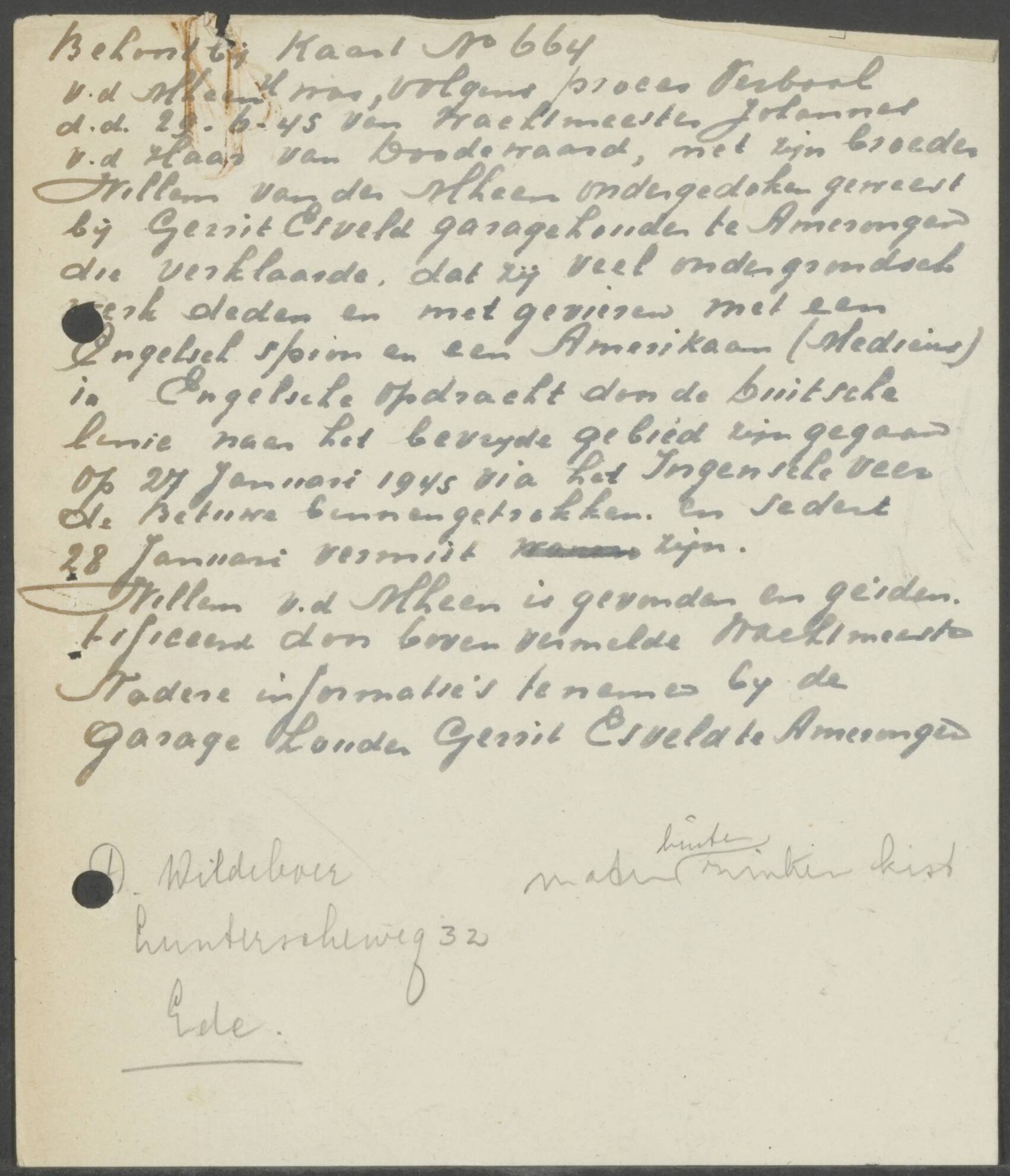
The police report of 29 June 1945, as noted for the identification service. ✓ The War Graves Foundation's file on his brother holds a handwritten note attached to Henk's identification card, No. 664, summarising a report by the Dodewaard policeman who found Wim:
According to the official report of 29-6-45 by Wachtmeester Johannes v.d. Haas of Doodewaard, H. v.d. Mheen had been in hiding with his brother Willem van der Mheen at the house of Gerrit Esveld, garage owner at Amerongen, who declared that they did a great deal of underground work and, four of them, with an English spy and an American (doctor), went on an English mission through the German line to the liberated area. On 27 January 1945 they went into the Betuwe by the Ingen ferry, and have been missing since 28 January.
Dutch originalv.d Mheen H was, volgens proces Verbaal d.d. 29-6-45 van Wachtmeester Johannes v.d Haas van Doodewaard, met zijn broeder Willem van der Mheen ondergedoken geweest bij Gerrit Esveld garagehouder te Amerongen die verklaarde, dat zij veel ondergrondsch werk deden en met gevieren met een Engelsch spion en een Amerikaan (Medicus) in Engelsche Opdracht door de Duitsche linie naar het bevrijde gebied zijn gegaan Op 27 Januari 1945 via het Ingensche Veer de Betuwe binnengetrokken. en sedert 28 Januari vermist zijn.
— Note attached to card No. 664 of the Dienst Identificatie en Berging · Nationaal Archief 2.19.255.01, inv. 104012A, scan 8 · the transcript
The note reads Haas; the last letter is not certain, and Haar is the other reading. It goes on: "Willem v.d Mheen is gevonden en geïdentificeerd door bovenvermelde Wachtmeester" (Willem v.d. Mheen has been found and identified by the policeman named above), and ends "Nadere informatie's te nemen bij de Garage Houder Gerrit Esveld te Amerongen" (further information to be had from the garage owner Gerrit Esveld at Amerongen). What it gives:
- Who declared it. "Gerrit Esveld garagehouder", ◐ the father, Gerald (Gerrit Hendrik) Esveld, whom Coen's death deed calls garagehouder, where Coen himself is monteur (Amerongen 1945, Nr. 48). The note names no Esveld among those who went.
- Who went. The brothers, "met gevieren met een Engelsch spion en een Amerikaan (Medicus)": four of them, with an English spy and an American, a doctor. Neither the spy nor the American is named. ◐ Met gevieren is literally "as a party of four", and the note does not say who the four are, so it does not settle the count:
- When. Into the Betuwe by the Ingen ferry on 27 January 1945, missing since 28 January.
The Gemeente Dodewaard, 1953. ✓ Answering the War Graves Foundation on 17 August 1953 about Coen Esveld, the municipality wrote that an inquiry made at the time had shown that Coen left "in gezelschap van 3 personen, vermoedelijk op 27 Januari 1945, naar de Betuwe" (in the company of 3 persons, probably on 27 January 1945, for the Betuwe) "teneinde een Engelse boodschap over te brengen" (to carry an English message), and that "De toen in gezelschap van Esveld zijnde personen zijn allen op 29 Juni 1945 in Dodewaard overleden bevonden" (the persons then with Esveld were all found dead at Dodewaard on 29 June 1945) (the letter). It names none of the three. ◐ That the police report is the inquiry "destijds" (at the time) the letter rests on is our reading of the matching dates, and ◐ that the brothers' party was Coen's is our match, by the dates and by the Dodewaard deeds, where Willem's deed 14 sits beside Coen's deed 13 (the index records). ⚠︎ The letter's one fact about the three, that they were found dead on 29 June 1945, fits Willem and not Henk, whose grave at Hien was opened on 30 July 1946 (Henk's page).
The other accounts.
- ◐ Berend "Flip" Esveld has "Captain" George Mikol, after the middle of February, crossing "with G.H. ESVELD, Wim and Henk from BARNEVELD. Since this nothing more has been heard of them" (his statement, p. 7). Whether Mikol was the note's spy, and whether van Loenen's George Andrews was its American, is not settled (George Andrews).
- ◐ Elsa Caspers, fifty years on: "On 29 January 1945 Coen made one more attempt to find an escape route. He went with two other Dutch boys and a South African soldier", their bodies found in June, "killed by a V-1 'doodle-bug' explosion" (To Save a Life, p. 66). She names none of them.
Boeree, in 1947, has the brothers alone:
On 29 January the brothers Henk and Wim van der Mheen went to the Betuwe to join the Allies. In the neighbourhood of Dodewaard they were already through the German lines. They were close to the Allies. That is the last that is known of them. Probably they were killed by a V 1 going off too soon. Their bodies were found later near Dodewaard.
Dutch originalOp 29 Januari gingen de broers Henk en Wim van der Mheen naar de Betuwe, om zich bij de geallieerden aan te sluiten. In de buurt van Dodewaard waren zij reeds door de Duitsche linies heen. Zij waren vlak bij de geallieerden. Het is het laatste wat van hen bekend is. Vermoedelijk zijn zij omgekomen door het ontijdig springen van een V 1. Hun lijken zijn later gevonden in de nabijheid van Dodewaard.
— Th. A. Boeree, Kroniek van Ede gedurende de bezettingstijd (1947), p. 245 · the page, read on the image
◐ He names no Esveld and no foreigner.
Who the brothers of these accounts were. ◐ The "Wim and Henk van de Meent from Renswoude" of van Loenen's list are very probably Willem and Hendrik van der Mheen of Lunteren; no source states it, and it rests on these links. For it: the first names; the questionnaires made out for them with the Americans (next of kin: their mother) say van Loenen, "Bob", sent the two brothers over the Rhine at the end of January (p. 14; Henk's file, p. 13), and the note puts the brothers van der Mheen in hiding with the Esvelds and on a crossing at the same days, where van Loenen lists Koen Esveld beside them. Against it: the surname and the place differ, and van Loenen received his fourth man, Andrews, only "Begin Februari" (p. 14), so his four were not all lost on 27 or 28 January. The questionnaires give "capt. v. Loenen (Bob)" with no first name, but their mother's form has "Amerongen, capt. H. v. Loenen" (her file, p. 4), an initial that fits Hendrik (and Herman Lucas); ◐ Boeree and van Loenen's own statement make him Hendrik, and the Ede archive's index to Boeree reads "Bob" on p. 243 as his brother Herman Lucas, a weak counter-reading (his page). The forms' "BILL." heading and Wildeboer's signature are set out under the questionnaire (above). The surname "van de Meent" and the place Renswoude are van Loenen's alone; ◐ "van de Meent" is very likely his misspelling, and Mrs Esveld's "de MEENT family" is the same name heard the same way. ◐ Flip Esveld's "Wim and Henk from BARNEVELD", who had brought Bill to him from "v. d. Mheen. Lunteren", are very probably the same pair (p. 7; p. 13).
His death and burial
Link to the section His death and burial- ✓ Found at Dodewaard.
- The note says the Dodewaard policeman named in it found and identified him; the note is undated, and only its account of the hiding and the departure is tied to the report of 29 June 1945 (above).
- His mother wrote on the Americans' letter of 11 April 1946: "mijn zoon Willem reeds 30 Jan. of 29 Jan. 1945 in de Betuwe bij Dodewaarde is gesneuveld, zijn stoffelijk overschot is 30 Juni aldaar gevonden en aldaar begraven" (my son Willem already fell on 30 Jan. or 29 Jan. 1945 in the Betuwe near Dodewaard; his remains were found there on 30 June and buried there) (her file, p. 10).
- ✓ The death deed.
- Dodewaard registered his death on 3 July 1945, deed 14, the deed after Coen Esveld's: Willem van der Mheen, 22, smid, born at Ede, died at Dodewaard on 29 June 1945; Ede copied it on 12 July (the index records).
- ◐ The deed's 29 June is the day of the police report, so very probably the day he was found, not the day he died: every other source has him dead at the end of January. The 1953 Dodewaard letter, about Coen's entry in the same register, reads "op 29 Juni 1945 is overleden bevonden" (was found dead on 29 June 1945) and says the death on 28 January was "aangenomen" (assumed) (the letter).
- His brother. Henk was not found with him: Henk's questionnaire of October 1945 has "Nothing is heard since from Henk" (Henk's file, p. 13), and in April 1946 their mother wrote that Hendrik had been "onvindbaar" (not to be found) since that date (her file, p. 6). Henk's grave, under a cross for an unknown civilian, was opened at Hien in Dodewaard on 30 July 1946 (his card; more on Henk's page).
- Where he lies. ✓ In the mausoleum on the Paasberg at Ede, with his brother, by his mother's form and the Foundation's page (104013A, scan 4; Oorlogsgravenstichting).
How he died, each source in its own words:
- his mother, for both sons, "onbekend hoe zij zijn overleden. Zij waren in opdracht van Verzetsgroep Ede op weg naar Dodewaard en zijn toen door beschieting [?] overleden" (unknown how they died; they were on their way to Dodewaard on the orders of the Ede resistance group and were then killed by [the word read as] firing) (104013A, scan 4);
- his questionnaire, "probably killed by a V 1 during his work" (p. 14); Boeree and Caspers, a V-1 (above);
- ⚠︎ a visitor's note of 2014 on the War Graves Foundation's page, citing "Onderzoek" (research): "Hij is bij poging om ddor de Betuwe naar bevrijd gebied te komen overleden, waarschijnlijk als gevolg van de inslag van eenartilleriegranaat vlak bij hem" [sic] (he died trying to get through the Betuwe to liberated territory, probably from an artillery shell landing close to him) (Oorlogsgravenstichting). The Foundation's page files him under "Gefusilleerd" (executed); no source held says he was executed.
- The British grade. ✓ The British index of Dutch helpers has "MHEEN,v.d. Henk" and "MHEEN,v.d. Willem", Postweg 110, Lunteren, each "4. Post.", bracketed "Brothers", and below them their mother, "v.d.MHEEN, Jacoba H.", grade 5 (page M/9). The Americans' action report of the conference of 22 October 1945 has "posthumous 4 Br. & Am. for both men" (his mother's file, p. 14).
- The Medal of Freedom. ✓ Awarded without palm by General Orders No. 224 of US Forces, European Theater, 3 August 1946, to "Willem van der Mheen, Dutch Civilian -- September, 1944 to January, 1945", on the line after his brother (Henk's file, p. 10), with the citation in his own file (p. 13). On 22 January 1947 the Americans listed him in group B of the posthumous awards, "diegene die een volgende keer in aanmerking komen" (those to be considered next time) (p. 4).
- Utrecht, 12 March 1947. ✓ At the presentation of Medals of Freedom in the Stadsschouwburg at Utrecht, the Utrechtsch Katholiek Dagblad reported, the applause was especially warm "voor Mevr. v. d. Mheen uit Lunteren, die een posthume hulde ontving voor twee harer zoons" (for Mrs v. d. Mheen of Lunteren, who received a posthumous honour for two of her sons); its list of those decorated ("Tot de onderscheidenen behoorden", among those decorated were) has "H. van der Mheen, Lunteren; W. van der Mheen, Lunteren" (the article, read on the page image).
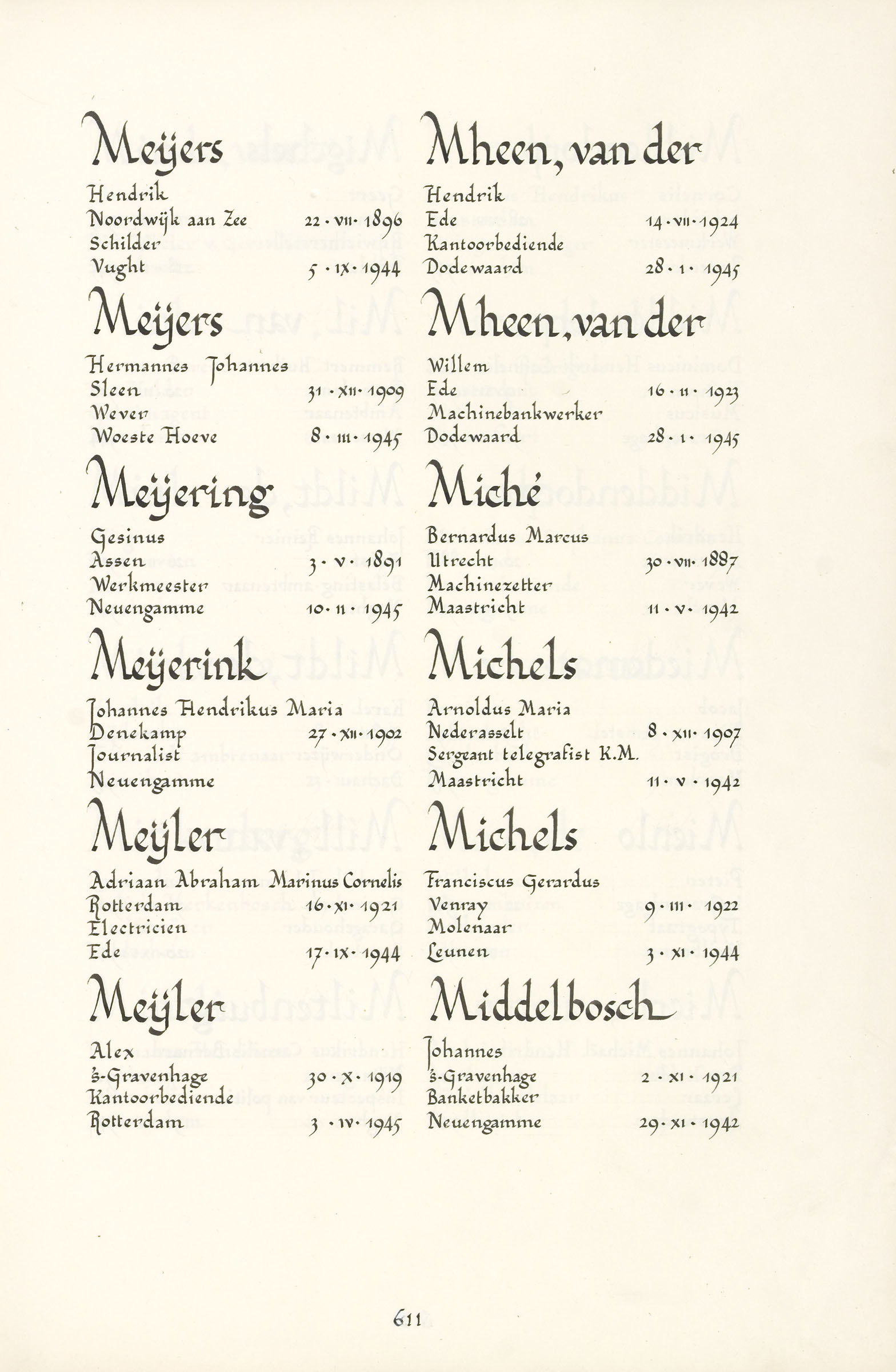
- The roll of honour. ✓ "Mheen, van der / Willem / Ede 16·II·1923 / Machinebankwerker / Dodewaard 28·I·1945" (Erelijst, p. 611).
Where the sources disagree
Link to the section Where the sources disagree- His name. Willem van der Mheen in the civil records, the Foundation's file, the Americans' files and the roll of honour; "Wim" to his questionnaire, Boeree and van Loenen; "WILHELM" to Gordon. Van Loenen alone has "van de Meent from Renswoude" (p. 23); ◐ very likely a misspelling, and no other source puts the family at Renswoude.
- His trade. Smid (smith) in his death deed; "Machinebankwerker" (machine fitter) on the roll of honour and the Foundation's page (Erelijst; Oorlogsgravenstichting).
- When they crossed. ⚠︎ Not settled:
- 27 January by the Ingen ferry, missing since the 28th (the note); probably the 27th (Dodewaard's letter);
- 28 January, sent by van Loenen (the brothers' questionnaires and summaries);
- 29 January (Boeree, p. 245; Caspers, p. 66); killed on 30 or 29 January (his mother);
- after the middle of February (Flip Esveld, p. 7); van Loenen dates nothing for the loss, and received Andrews only "Begin Februari" (p. 14).
- ◐ The cross on Henk's grave has 28 January and the Foundation's form has him buried on 30 or 31 January (Henk's scan 4, doubtful on other points), so the February date cannot be Henk's; our inference, which rests on those dates.
- His death. 28 January 1945 on the roll of honour and the Foundation's page; 29 January on his mother's form; 29 or 30 January in her letter of 1946; 29 June 1945 in his death deed (◐ the day he was found); his mother's letter has his remains found on 30 June.
- Which brother was found. The note, his questionnaire and Henk's of October 1945 have Wim found and Henk missing. ⚠︎ The Americans' summaries of December 1945 swap them: Wim's says "the body of his brother has been found" (his mother's file, p. 7), Henk's that his own body was found (Henk's file, p. 12). Henk's grave was opened only in July 1946, so ◐ the summaries very probably have the brothers the wrong way round.
- How he died. A V-1 (his questionnaire, Boeree, Caspers), "beschieting" (his mother), an artillery shell (⚠︎ a visitor's note of 2014). No record held settles it.
- Gordon's stay. 24 or 25 October 1944 to about 8 January 1945, 10 or 11 weeks (Gordon); two months (Boeree, p. 129); from 25 October, 60 days, passed on to "Amerongen, capt. H. v. Loenen" (his mother's form, p. 4). ⚠︎ Aart van de Heg's table has "W. Gordon" from "half Dec. 44", 14 days, received from "Widow v.d. Mheen, Lunteren" (his file, p. 6), which fits none of these.