Gerrit van Ee
Esveld, Barneveld 7 Feb 1918 – ?
Gerrit van Ee, Westerhuisweg 8, Kootwijkerbroek; Walsh's "GERD (?)"
About: A farmer's son of Kootwijkerbroek who was one of the guides on the evening Murphy's party set out for the Pegasus II crossing (17 November 1944 by Hardy's report; 18 November by Noordman, who has Van Ee confirming he was a guide), and carried the glider pilot Haller on his bicycle. On 1 December he took Walsh, Branford and Haller, the three who went on together when Murphy left them, to his own house for the night and moved them on, Walsh and Branford to Van de Braak's farm and Haller to another address; he visited Walsh with food through the winter.
Unit or role: O.D. (Ordedienst) (his file, p. 2); a guide for the evaders hidden round Kootwijkerbroek, and by his father's form a helper with transports (his father's file, p. 4); after the war a driver on Prince Bernhard's staff (the reserve captain's letter, p. 4), and, by the card for his decoration of 1953, a conscript private first class of the cavalry (award card).
Where: His parents' farm, Westerhuisweg 8, Kootwijkerbroek; in 1953 Amersfoortsestraat 182, Barneveld.
Evidence: ✓ Walsh's MI9 report; ✓ Boeree, Kroniek van Ede (1947), pp. 199, 201–203, 211, 214–215 (checked on the page images); ✓ his file and his father's in the US National Archives; Noordman, pp. 283–285, 304; ✓ Van de Braak's list; ✓ C. F. van Haeften's form; ✓ his birth and marriage records; ✓ his Dutch award card; the British helper index
✓ He was born on 7 February 1918 at Esveld, in the municipality of Barneveld, the son of Jan van Ee, a farmer, and Teunisje van den Hul (the birth record). His father's own form for the Americans, of 17 July 1945, gives Jan van Ee as born at Ede on 17 December 1886, of Westerhuisweg 8, Kootwijkerbroek, married to Teunisje v.d. Hul, 57, with six children aged 27, 26, 24, 22, 18 and 16 (his father's file, p. 4, checked on the image). Gerrit, 27 that summer, is the eldest.
The raid at Kootwijkerbroek. ✓ Th. A. Boeree's Kroniek van Ede has him at Kootwijkerbroek before Pegasus II, beside Ebens, the O.D.'s chief of staff, and the Van der Wiels; Boeree does not himself call him O.D. (the O.D. is his own questionnaire's answer, his file, p. 2). Of the evening of the raid there, which Boeree dates 15 November 1944 (p. 201), he writes that Ansems, a courier taken in the Apeldoorn arrests, was brought in bearing "alle kenteekeningen van zware mishandeling" (every mark of heavy mistreatment) and "Hij had blijkbaar veel verteld" (he had evidently told a lot) (pp. 213–214), and showed the raiders the way to a hiding place where he had once put weapons with Van der Wiel, "Maar van der Wiel en Gerrit van Ee hadden diezelfde avond de wapens elders opgeborgen" (but Van der Wiel and Gerrit van Ee had stored the weapons elsewhere that same evening) (p. 214). The next morning Ebens, the O.D.'s chief of staff, fled to Kootwijkerbroek, found both Van der Wiels gone, and "ging naar den vader van Gerrit van Ee" (went to Gerrit van Ee's father), where Ebens, Gerrit, the elder and the younger Van der Wiel and a Polish captain-pilot turned up one after another, "Alsof zij het hadden afgesproken" (as if they had arranged it) (p. 215; all checked on the page images).
With Murphy
Link to the section With MurphyThe ride of 17 November 1944
Link to the section The ride of 17 November 1944Hardy's party of six, himself, Murphy, Banwell, Branford, "Sgt. JOHN" and "the other Paratrooper" (◐ John is the glider pilot Haller by Walsh's and Noordman's naming, and Kragt's report of the same nights names a "John Haller" among his six (below); the paratrooper is Walsh, by Walsh's statement that his story is "the same" as Hardy's), had been waiting since 14 November by the Roekelsche Zand, where an ambulance had left them with a man called Jan, for the Pegasus II crossing; on the 16th Jan did not come, and next morning a poacher, in touch with the Underground but not a member, came to tell them Jan had been arrested. Hardy's report goes on, the "He" being the poacher:
He told us that someone would come for us that night and at about 1830 hours (17 Nov) 4 young men, all Underground members, arrived on bicycles. We walked a short distance and one of them, a lad of about 16, left us. The others went to a farmhouse nearby and returned with two more bicycles.
— MI9 · Pte J. Hardy · report of 13 January 1945 · the report
Two of the six rode on the guides' machines: "Sgt. JOHN and the other Paratrooper were taken on the bikes of two of our guides". ✓ Van Ee was one of those guides. Wolter Noordman, who talked to him, writes:
One of the guides that evening was Gerrit van Ee of Kootwijkerbroek. He remembered this cycle ride particularly well, and Hardy and the others getting lost. He had Haller on his carrier.
Dutch originalEen van de gidsen op die bewuste avond was Gerrit van Ee uit Kootwijkerbroek. Hij herinnerde zich deze fietstocht bijzonder goed en ook het verdwalen van Hardy en de anderen. Hij had Haller op zijn bagagedrager.
— Wolter Noordman · Schuilplaats de Veluwe (Omniboek, 2019), p. 283 · the book
Noordman adds that in those last days before the crossing Gerrit was out with the six by bicycle more than once (p. 304).
All three guides drew ahead in the dark, and at a fork part of the party took the wrong road. Who was lost is told two ways:
- Hardy: "BANWELL, BRENTFORD, MURPHY & I took the wrong fork and lost the rest of the party"; they searched for two or three hours and went back to the farm the bicycles had come from (Hardy).
- Walsh: "when we lost HARDY and P/O. BRENTFORD, our guides took Sgt. BANWELL … Sgt. HALLER, John … Pte. MURPHY and myself to a house" for the night, on the Plaggenweg at Kootwijkerbroek by his map reference, and to the rendezvous the next day (Walsh; the reference converted).
- ⚠︎ Not settled. By Walsh's account Murphy spent that night at a house the guides took them to; by Hardy's he did not. Walsh has the two groups meeting at the rendezvous the next day; Hardy, without saying when the others rejoined, has five of them leaving the wood together on 20 November (the reports above).
The organiser's view
Link to the section The organiser's viewDick Kragt, who ran the crossing's Frans Hals end, judged the guides of the party of six that night. He names no one but "John Haller" (p. 5), so ◐ that his six are Hardy's party is our reading (the match, with its dates):
… one of our messengers returned with the news that the guiden [sic] of the party of six had lost four of their party, and having searched for them unsuccessfully, had calmly gone home and to bed. These were new guides which we subsequently did not use.
— Frans Hals (Dick Kragt) · report on his activities, 22 July 1945, p. 4 · his file with the Americans, p. 34
- ◐ Noordman puts Van Ee among the guides who lost Hardy and the others, so Kragt's words may include him; neither says which of the guides did what.
- Beside it: Walsh has the guides taking four of the men to a house for the night, so on his count the guides had not lost four (Walsh); and "we subsequently did not use" is Kragt's own organisation, while Van Ee was guiding Walsh's party on 1 December and receiving the Van Haeften team's RAF men in the winter (below).
- "Lost four" agrees with Hardy's count, not Walsh's.
The men left in the wood, 20 November
Link to the section The men left in the wood, 20 November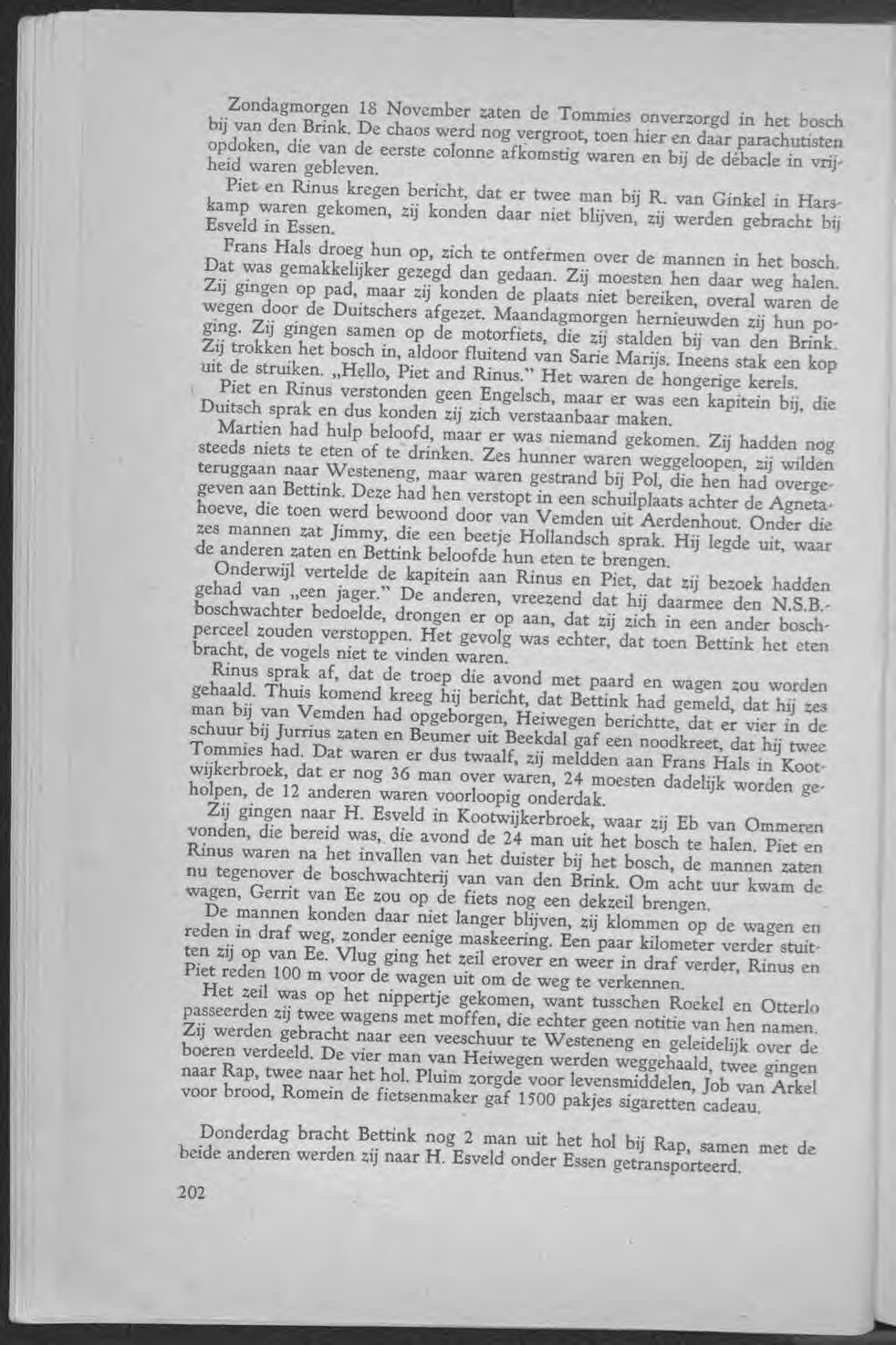
The main column of Pegasus II ran into German posts and the crossing failed: in the night of 17/18 November by Boeree (pp. 178, 201), a night later by Noordman, and not settled (Operation Pegasus II). Murphy's small party joined about twenty evaders left waiting in the woods for a lorry that never came; at about three in the morning of 20 November Hardy lists Branford, Murphy, "JOHN", "the other Paratrooper" and himself leaving, while Banwell stayed (Hardy); ◐ John is Haller and the paratrooper Walsh, as above.
✓ Boeree tells the fetching of those left. The Harskamp men Piet and Rinus (Willem van Dijk and Marten van Beek) reported to Frans Hals at Kootwijkerbroek that 36 men were left, 24 of them needing help at once, and went to H. Esveld's, where they found Eb van Ommeren ◐ (Eb van Omme), who would fetch them that evening (p. 202, checked on the image):
At eight o'clock the wagon came; Gerrit van Ee was to bring a tarpaulin on his bicycle as well. The men could not stay there any longer; they climbed onto the wagon and drove off at a trot, without any cover. A few kilometres further on they ran into Van Ee. The tarpaulin went over quickly and on again at a trot.
Dutch originalOm acht uur kwam de wagen, Gerrit van Ee zou op de fiets nog een dekzeil brengen. De mannen konden daar niet langer blijven, zij klommen op de wagen en reden in draf weg, zonder eenige maskeering. Een paar kilometer verder stuitten zij op van Ee. Vlug ging het zeil erover en weer in draf verder.
— Th. A. Boeree · Kroniek van Ede gedurende de bezettingstijd (Ede, 1947), p. 202 · the text
The tarpaulin came "op het nippertje" (just in time): between Roekel and Otterlo they passed two wagons of Germans, who took no notice. The men went to a cattle shed at Westeneng and were shared out among the farmers (same page). Noordman has the same night: "Deze groep is uiteindelijk op maandagavond 20 november door Eb van Omme en Gerrit van Ee met paard-en-wagen opgehaald" (this group was finally fetched with horse and wagon on the evening of Monday 20 November by Eb van Omme and Gerrit van Ee) (Noordman, pp. 284–285).
- ◐ Boeree heads the day before "Zondagmorgen 18 November", but 18 November 1944 was a Saturday; his Monday fits the 20th, which is Noordman's date.
- ◐ The wood was opposite the forester's house of H. van de Brink (Boeree's "van den Brink"). These were very probably the men Murphy's five had left that morning, Banwell among them (Operation Pegasus II); Boeree names none of them.
- ⚠︎ His father's form says Jan van Ee looked after "24 evaders , whome he looked after for a few days", the number Boeree gives for the men fetched that night (his father's file, p. 4, checked on the image). The form gives no date or place, and the remarks are struck through, so whether they are the same men is not shown.
Walsh, Branford and Haller, December 1944 to February 1945
Link to the section Walsh, Branford and Haller, December 1944 to February 1945After four nights in a dug-out near Roekel the party broke up. Hardy has himself and Murphy leaving on the morning of 24 November (Hardy); Walsh has a warning on the 25th that the man looking after them had been arrested, and the party splitting "into two parties of three", Branford, Haller and himself making for Valk, where a builder Walsh knew as "HANK" put them up for a week (Walsh). ◐ The two are not shown to be one event, though Walsh refers the reader to Hardy's report for "the story of my movements until 25 Nov", "the same except for one detail". Walsh's report goes on:
We stayed with HANK for a week and on 1 Dec a member of the Underground came to see us. His name was GERD (?) and he had been one of our guides on our previous abortive attempt to reach the RHINE. He took us to his own house which was in the area of KOOTWIJKKERBROEK (Sheet 2, 570972) and after staying there overnight he took P/O. BRENTFORD and me to a farm on the outskirts of VALK while Sgt. Haller was taken to another address in this area.
— MI9 · Pte S. Walsh · report of 7 March 1945 · the report
The farm was Evert van de Braak's, "a farmer, married, with one daughter aged about eight" (same report); ✓ the reverse of Evert van de Braak's population card at Ede has a daughter born in March 1939, so she was five that December (the card, reverse; Evert van de Braak). Haller told Noordman he went back to Heimen van Esveld at Kootwijkerbroek and stayed the winter there (Noordman, p. 271; Bernard Haller).
✓ "GERD" is Gerrit van Ee. Noordman says so, on Gerrit's own pocket-book and confirmation: "Met de persoon die op 7 februari zijn verjaardag vierde wordt Gerrit van Ee bedoeld. Gerrit heeft dit destijds in zijn zakboekje genoteerd, dat hij altijd bewaard heeft" (the man who celebrated his birthday on 7 February is Gerrit van Ee; Gerrit noted it at the time in his pocket-book, which he always kept), and "Ook is hij de persoon geweest die hen op 1 december vervoerd heeft" (he was also the one who moved them on 1 December) (p. 304). The records bear it out: he was born on 7 February (the birth record). Walsh's map reference 570972 converts to a point by the Wencopperweg at Kootwijkerbroek (the references converted); the family gave Westerhuisweg 8 in 1945, which the table does not convert.
✓ The host wrote him down too. Van de Braak's list has Branford, of Rottingdean, there "1.12.44 till 26.2.45", received from "Pilot club. / Gerrit van Ee c/o Jan van Ee. / Westerhuis. / Jan." and passed to "Gerrit van Ee. / Westerhuis, Jan , Dick , and / Wynand that are the names they / were known to us.", with Walsh in the same table (Van de Braak's list, p. 5).
His birthday, 7 February 1945. Walsh again:
GERD visited us frequently bringing extra food, tobacco, etc, and on the evening of 7 Feb we went over to his house to celebrate his birthday. Instead of going back to BRAAK'S that night I stayed with Pte's. McNAUGHT … and RILEY … who were living at a farm near GERD's place. Next morning GERD came and told us that we were to prepare to leave so he sent someone over to BRAAK's farm to collect my uniform etc, which I had left there.
— MI9 · Pte S. Walsh · report of 7 March 1945 · the report
- ◐ The farm was very probably Heimen van Esveld's: Frank McNaught's report has Walsh, "who had joined us the previous night", with him and Riley at the "ESVHEILT" farm on 8 February (McNaught). Noordman gives the sleeping address that night as "Heimen van der Ende", without naming a source for it (p. 304).
- McNaught has the word to move brought at about 1400 on 8 February by "a member of the Underground called JAN" who lived at the Esveld house; the three cycled to Barneveld with Jan and met Dick Kragt and two guides at a crossroads (McNaught). Walsh went out by the Sliedrecht line and reached safety on 7 March (Walsh; Sam Walsh).
- Branford stayed at Van de Braak's until 26 February by the list above; his way out is on his page.
The RAF men of the winter
Link to the section The RAF men of the winter✓ Two forms of a K.P. team that worked from the house of E. van Donkersgoed at Voorthuizen name him as the last stop for two RAF men.
- Carl Frederick van Haeften, an American civilian living at Deventer (his file, p. 7), lists F/Lt K. C. Parsons of 149 Staging Post, RAF, and E. Blakemore, "hidden Nov. 44 till March. Many transports. From underground Kootwijkerbroek. Last transport to G. van Ee at Kootwijkerbroek" (his form, p. 25, checked on the image). His memo of the journeys he made with the evaders has the fourteenth: "10 Km. Parsons and Blakemore on bicycle: From van Donkersgoed to G. van Ee at Kootwijkerbroek" (p. 28).
- Albert van Haeften, whose form "was filled out by C.F. van Haeften as his brother, on his request" (his form, p. 2), has the same two men hidden "Febr. 45", received from "E. van Donkersgoed, Voorthuizen" and passed to "G. van Ee, Kootwijkerbroek" (p. 3, checked on the image).
- ◐ This is probably Gerrit: the initial, the name and the village are his. ⚠︎ The brothers' forms differ on the men (Parsons shot down in June at Epe and Blakemore in July at Heerde on Carl's, the reverse on Albert's) and on the time ("Nov. 44 till March" against "Febr. 45"); the hand-over to "G. van Ee" is the same in both.

Other work in Boeree
Link to the section Other work in Boeree✓ Each passage checked on the page image of Boeree's Kroniek van Ede.
- Joop Balk (p. 211, no date given).
- Balk, the district commander of the R.V.V. at Apeldoorn, escaped from the camp at Amersfoort with three others and was delivered to the town hall at Leusden, "waar hij werd opgewacht door Gerrit van Ee, die hem op de motorfiets bracht naar Luttikhuizen te Kootwijkerbroek" (where Gerrit van Ee was waiting for him and took him on the motorcycle to Luttikhuizen at Kootwijkerbroek) (p. 211).
- Balk wanted to go straight on to Piet van de Veluwe at Ermelo, but Van Ee could not take him: there were too many Germans along the road, and his lamp was not in order (same page).
- The farmers of Westeneng (p. 199). Seven Tommies whom Van Dijk and Van Beek had brought from Ooilander's farm to Baron Mackay's were moved on to a hunting lodge in the Otterlo wood and then shared out among "de boeren van Westeneng (Esveld, van Braak, Veldhuizen, Rap, van Ee en anderen)" (p. 199). ◐ Boeree gives no first name, so which Van Ee is not shown.
- "Van Ee in Essen" (p. 203). After the raid at Otterlo and Roekel of 24 November, eight Tommies were brought on bicycles through Otterlo and "Allen werden opgeborgen bij van Ee in Essen" (all were put away at Van Ee's in Essen) (p. 203). ◐ Which Van Ee is not shown: Boeree gives no first name, and Essen is not the family's Westerhuisweg.
- ◐ The eight were very probably men of the dug-out Murphy had just left. Boeree has J. Bettink bringing bread to the men moved from Van Vemden's hole to a better hiding place behind Morren's house, and escaping the raid of 24 November because he was with them there (pp. 202–203); Hardy counts ten men in the dug-out and has himself and Murphy leaving on the morning of 24 November, which leaves eight (Hardy; J. van Vemde).
- Walsh has himself, Branford and Haller leaving on the 25th for Valk, not Essen, so at most some of the eight were Murphy's companions.
His file with the Allies
Link to the section His file with the Allies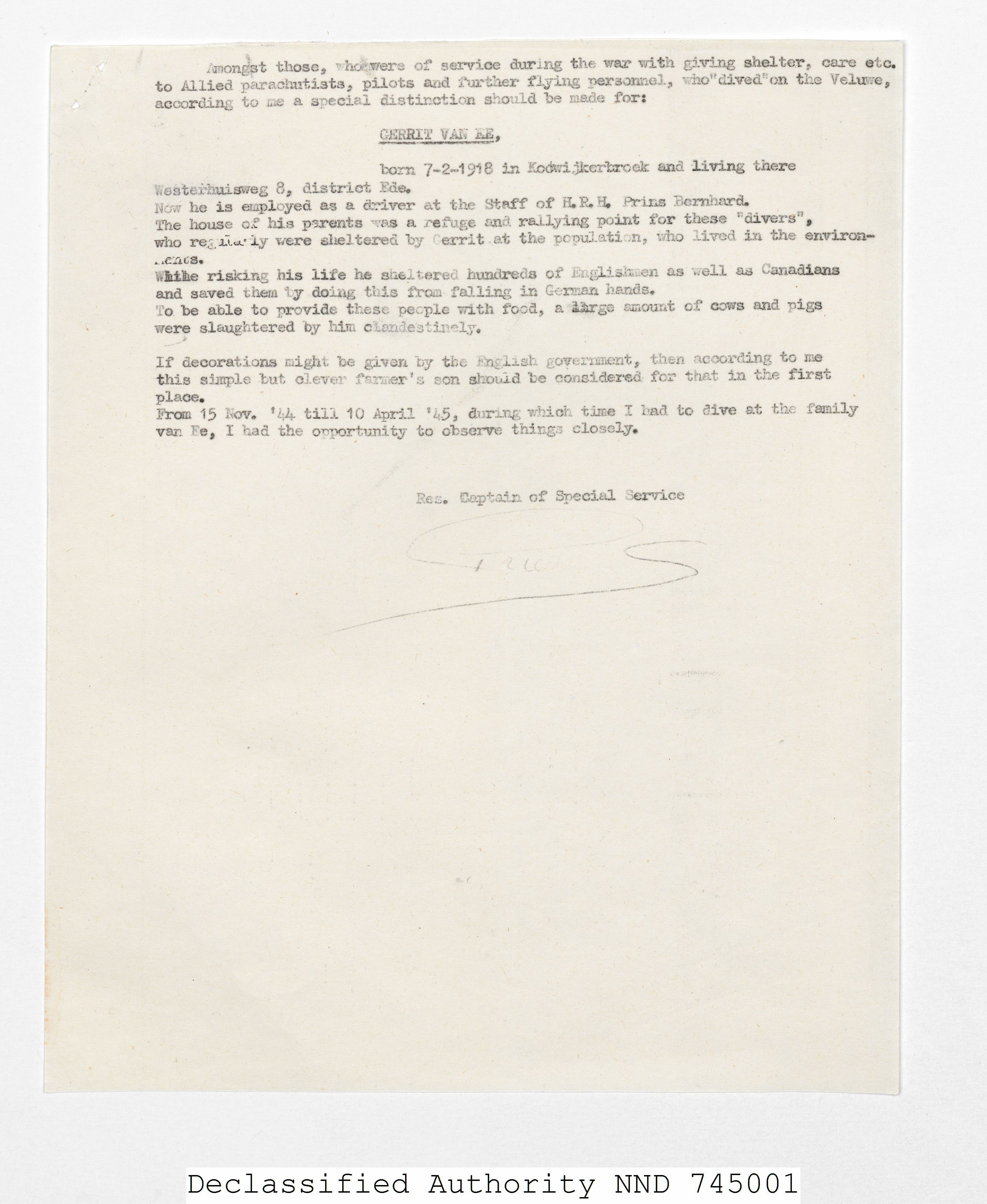
✓ The questionnaire in his name, of 22 August 1945, gives him at Westerhuisweg 8, Kootwijkerbroek, "distr. Ede", born at Kootwijkerbroek, unmarried, next of kin his parents, known to the Allies as Gerrit van Ee, of the O.D. (his file, p. 2, checked on the image). Its remarks are written in the third person ("by him") and end with the typed name "R. van Ginkel"; section 13, for the men he helped, is blank (p. 3). ◐ The remarks come from the letter in his file (the letter is undated, and the questionnaire's remarks are typed above van Ginkel's name), which reads:
The house of his parents was a refuge and rallying point for these "divers", who regularly were sheltered by Gerrit at the population, who lived in the environments. While risking his life he sheltered hundreds of Englishmen as well as Canadians and saved them by doing this from falling in German hands. To be able to provide these people with food, a large amount of cows and pigs were slaughtered by him clandestinely.
— a reserve captain of Special Service, signature not legible · undated letter in the helper file of Gerrit van Ee · US National Archives, RG 498 · p. 4
The writer gives his ground: "From 15 Nov. '44 till 10 April '45, during which time I had to dive at the family van Ee, I had the opportunity to observe things closely", and adds: "Now he is employed as a driver at the Staff of H.R.H. Prins Bernhard." (same page). ⚠︎ The "hundreds" is the captain's figure and no other source counts the men Van Ee helped. The folder cover has "Grade 6" and "Conf 25 / 4.1.46" (p. 1).
His father's form. ✓ The form for Jan van Ee, of 17 July 1945, signed "R. van Ginkel", has in its remarks, struck through on the page:
The son of the above mentioned Gerrit van Ee, old 27, helped with some transports and took some pilots to his home for a short time. Jan van Ee provided people, sheltered in the neighbourhood with food, as well as 24 evaders , whome [sic] he looked after for a few days. He was present at [?] or 2 droppings. Was a little afraid.
— R. van Ginkel · questionnaire for Jan van Ee, 17 July 1945 · US National Archives, RG 498 · his father's file, p. 4, read on the image; the first figure overtyped
The Americans' receipt No. 3101, of 23 November 1945, issuing officer "van Ginkel", is for one food parcel for "J. van Ee / Westerengweg 6 / Kootwijkerbroek" (p. 3, read on the image). The forms do not say who R. van Ginkel was; ◐ the receipt's issuing officer "van Ginkel" (no initial) is probably the same man.
The British index. The British index of Dutch helpers has "516 van EE, Gerrit"; the address "Westerhuisweg 8, Kootwijkerbroek" stands a line above his name, beside the previous entry, but the whole address column runs about a line high on this sheet (Ebbink's "Hoge Weide" too), and the grade beside his name is 5, with a 6 a line above. ◐ The address is his, by his own questionnaire; the grade column looks out of line as well, so 5 or 6 (the index page, read on the image; The National Archives, WO 208/5476).
✓ He married Gijsberta van de Beek at Barneveld on 28 March 1947; the record gives him as born at Barneveld, a chauffeur, son of Jan van Ee, farmer, and Teunisje van den Hul (the marriage record).
✓ The Netherlands gave him the Cross of Merit (Kruis van Verdienste), register number 2020, by royal decree of 20 January 1953, no. 17. The Chancellery's card gives his rank as "dpl. soldaat der eerste klasse b/h wapen der Cavalerie" (conscript private first class of the cavalry) and his army number as 18.02.07.006, its first six figures his birth date in year-month-day order; on the back, "Motorrijwielmonteur" (motorcycle mechanic), born at Barneveld on 7 February 1918, living at Amersfoortsestraat 182, Barneveld, in February 1953 (his award card, Nationaal Archief 2.02.32, read on the image). The card carries no citation, and none has been found.
His father, Jan van Ee, died at Ede on 8 September 1970, registered on the 10th: the index gives him as son of Gerrit van Ee and Dorothea Willemina Hebink, with Teunisje van den Hul, the mother named in Gerrit's birth record, as "(ex-)partner" (the index record; Ede deed 439; index only, no scan). ✓ The mother's name is what makes him the farmer of Kootwijkerbroek; the record names no farm or address.
⚠︎ When Gerrit van Ee died is not known. Noordman lists "Dhr. G. van Ee, Barneveld" among his informants (Noordman, sources, "Personen en instellingen"); ◐ very probably Gerrit himself, who would have been about 100 in 2019, and Noordman does not say when he spoke to him. His pocket-book of 1945, which Noordman says he always kept (p. 304), is not known to survive (Open questions).
Other men named Van Ee
Link to the section Other men named Van EeFive sources name a Van Ee near him without a first name, or with another one. None can be shown to be Gerrit.
- Martinus van Beek of Harskamp lists, among those who sheltered pilots and paratroopers, "J. van Ee Westenegg." (his form, p. 2). ◐ Gerrit's father was a J. van Ee, of Westerhuisweg 8, Kootwijkerbroek, and the Westeneng is by Harskamp, so this may be another man. But a receipt of November 1945 in the father's own file is made out to "J. van Ee / Westerengweg 6 / Kootwijkerbroek" (p. 3, read on the image), a "Wester-eng" address under his name, and it may be the place Van Beek wrote as "Westenegg".
- Christiaan Esendam of Apeldoorn, of the Paratroopers Transport Organization, lists "E. Brunekreeft and van EE both Kootwijkerbroek." among the helpers he knew (his form, p. 2). It could be Gerrit, his father or another man; nothing else on his form says what they did.
- Sidney Willig's escape report has "VAN EE, lived near STROE", a farmer of 40 with a wife and two sons of 20 and 11, who sheltered the two Americans on 23 November 1944, and in its appendix "VAN EE, Farmer who contacted Underground. WOLVERSEVEN. … STROE ,BARNEVELD" (E&E 2976; Sidney Willig). ✗ Not Gerrit, who was 26, nor his father, who was born in 1886 and had six children.
- Boeree puts Kirschen's first billet in September 1944 "bij van Ee aan de straatweg Barneveld—Scherpenzeel" (at Van Ee's on the Barneveld–Scherpenzeel road) (p. 158; Gilbert Kirschen). ◐ Another place from Westerhuisweg, and probably another family.
- "J. van Ee Westenegg" and Boeree's Westeneng farmers above may be one family; the sources do not say.
Where the sources disagree
Link to the section Where the sources disagree- The night of the ride. Hardy dates the bicycle ride to 1830 on 17 November (Hardy); Noordman, who says Van Ee confirmed it, has him guiding the six towards the Pegasus II rendezvous "in de avond van 18 november" (on the evening of 18 November) (Noordman, p. 304), though Noordman prints Hardy's account on p. 283 with the same sequence (the 16th, then "the next morning" and "that evening"). Hardy has a second ride on the 18th with "WILLEM and the Dutch Policeman", not with the four young men. ◐ The 17th, by the report written in January 1945.
- Who got lost. Hardy, Branford, Banwell and Murphy by Hardy; Hardy and Branford by Walsh, who has Banwell, Haller, Murphy and himself taken on by the guides to a house for the night (above). Kragt's "lost four of their party" agrees with Hardy's count, not Walsh's. ⚠︎ Not settled.
- His birthplace. Esveld, Barneveld, in the civil record of his birth; Kootwijkerbroek on the questionnaire and the reserve captain's letter; Barneveld on the award card (the records; his file; the card). ◐ Very probably one place named three ways: the birth was registered at Barneveld, and the record calls the place Esveld.
- The family's address. Westerhuisweg 8 on both 1945 questionnaires; "Westerengweg 6" on the receipt of November 1945 (his father's file; the receipt). ⚠︎ Not explained.