Johan Bettink
Ede 18 Mar 1914 – ?
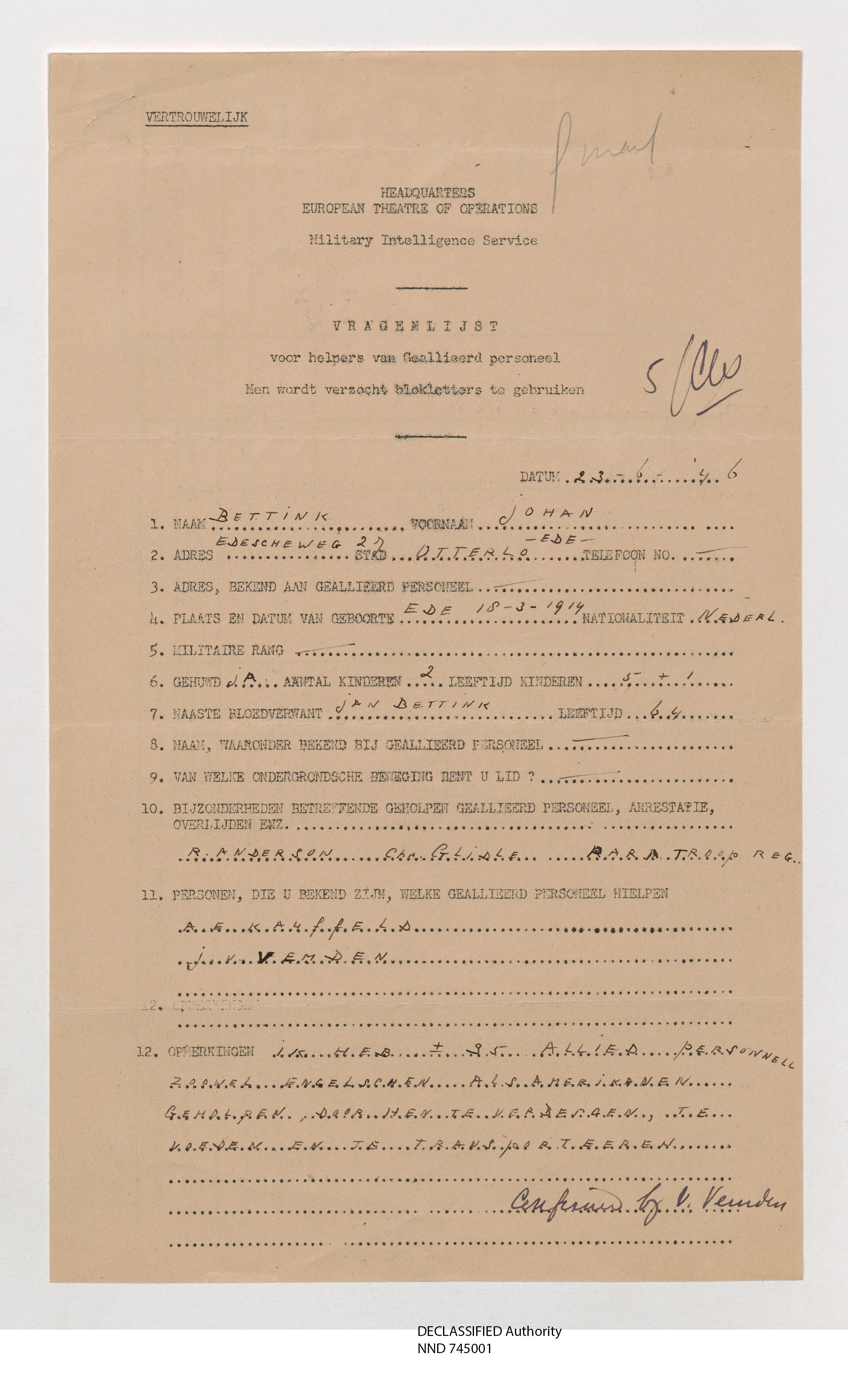
Johan Bettink of Edescheweg 27, Otterlo, in his own form for the Americans of 23 June 1946 (his file, p. 4)
About: Johan Bettink of Otterlo, who with J. van Vemde and Kauffeld hid, fed and moved Allied soldiers after Arnhem and after Pegasus II. By Boeree's chronicle he hid six men who had walked out of the wood after the failed crossing of November 1944, ◐ possibly Murphy's party, and after the SD arrests of 24 November he moved the men who were left.
Unit or role: A helper of Allied soldiers, naming no underground organisation (his form leaves the question blank); a landbouwer (farmer) at his marriage in 1940, and an eierhandelaar (egg dealer) in a local history of 2023. Grade 5 on the American list of helpers, "(349) BETTINK, Johan", and on the British index, certificate 15904 (below).
Where: Edescheweg 27, Otterlo, in the municipality of Ede, in 1946 (his form, p. 4; Van Vemde's letter, p. 8; the British index, sheet B/10). Van Vemde's own form has "OTTERLOOSCHEWEG 27 - OTTERLOO" (p. 4), and ◐ the local history has him living in, with his wife and children, at the Van Manen family's farm Nieuw Peppelenburg on the Apeldoornseweg (Vos, p. 31).
Evidence: ✓ his own helper file with the Americans, US National Archives 286637799 (his form, p. 4, and pp. 1–11, read on the images); ✓ his birth record and his card in Ede's population register (the card); ✓ Van Vemde's letter of 20 May 1946, p. 8; ✓ Boeree, Kroniek van Ede (1947), pp. 201–203, checked on the page images; ✓ the British index of Dutch helpers, sheet B/10; ◐ Jan A. Vos, Otterlo vóór, tijdens en na de Tweede Wereldoorlog (2023), chapter 1, p. 31.
- ✓ Birth. Johan Bettink was born at Ede on 18 March 1914, the son of Jan Bettink, 30, a landbouwer (farmer), and Gerritje van den Brink; the birth was registered on 20 March (the birth record, Gelders Archief 0207A, Ede, births 1914, act no. 154; what it says). His own form for the Americans gives the same day and place, "EDE 18-3-1914" (p. 4).
- ✓ His card at Ede. His personal card in the Ede population register has him born on 18 March 1914 at Ede, his father Jan born on 27 April 1883 at Barneveld and his mother Gerritje van den Brink on 29 April 1883 at Ede; the church entry "NH" is struck through and "GerGem" written below it (the card; what it says; read on the image).
- The identity rests on the birth date, place and parents. The card does not itself tie him to Otterlo: its address lines (Harskamp, "Eschoten" with a number 1b) carry dates whose meaning we have not worked out and are not used here, and its marriage boxes are empty.
- ✓ Marriage. At Ede on 10 July 1940 Johan Bettink, 26, born at Ede, a landbouwer, the son of Jan Bettink and Gerritje van den Brink, married Hendrikje van Voorst, 18, born at Ede (the marriage record, Ede, marriages 1940, act no. 130; index only). The parents are those of the birth record, so this is the same man.
- Not him. Another Johan Bettink, 23, born at Voorst, a slager (butcher), the son of Wouter Arend Bettink, married Elisabeth van de Craats at Ede on 23 May 1936 (the record; what it says).
Three paratroopers, September 1944
Link to the section Three paratroopers, September 1944- ✓ Van Vemde's account (his letter, p. 8).
- J. van Vemde wrote to the Americans in May 1946 that he found the first man on 18 September 1944, "Anderson" as far as he could remember, who had broken his kuitbeen (fibula), and with Kauffeld's help kept him hidden in a barn on Kauffeld's land.
- "Op 19 September werd door J.Bettink een andere in het bosch gevonden en eenige dagen later meldde zich nog een derde." (On 19 September J. Bettink found another in the wood, and a few days later a third turned up.)
- After Dr Beumer of Otterlo had treated the wounded man, the three were given civilian clothes after about three weeks and handed to "een zekere Edens van Harskamp" (one Edens of Harskamp).
- ✓ Bettink's own form names the men "R. ANDERSON CHR. GLIDLE PARA TROOP REG." (p. 4).
- His section 13 has "CHR. GLIDLE 5890766" and "R. ANDERSON", with, on Glidle's row, "LANDINGEN BY" in block capitals (it starts in the date column) and, on Anderson's row, "ARNHEM" in the place column; nothing else in the entry is filled (p. 5, read on the image). ◐ The two probably read as one entry, "landings near Arnhem", for both men, which is how the office's typed copy has it: "17 Sept. 1944" and Arnhem for both (p. 3).
- The summary card has "1 Wounded Broken leg. name Anderson." (p. 8).
- ✓ Van Vemde's form lists "MR. BETTINK - OTTERLOOSCHEWEG 27 - OTTERLOO. (FOOD, CLOTHING, TRANSPORT" among the people he knew who helped Allied men (p. 4, read on the image).
- ◐ The local history. Jan A. Vos's history of Otterlo (2023) has "Johan ‘Jo’ Bettink", an egg dealer, help paratroopers hiding in the woods round Otterlo after the battle of Arnhem (Vos, p. 31).
- He took them food "met steun van betrouwbare boeren uit de omgeving" (with the help of trustworthy farmers round about) to the paras hidden in huts in the wood; on 5 November 1944 the Germans suddenly surrounded the farm where he lived, but took no one away.
- Vos calls this "een samenvatting van de gebeurtenissen die o.a. door Martin Hijink in de Dorpspraet, nr.3., van maart 2016 besproken zijn" (a summary of the events discussed, among others, by Martin Hijink in the village paper Dorpspraet, no. 3, March 2016). The Dorpspraet article is not held.
With Murphy
Link to the section With MurphyThe days after the failed Pegasus II crossing of 17/18 November 1944 are told in full on Pegasus II and Roekel, on J. van Vemde, H. van de Brink and Kauffeld. From Bettink's side:
- ✓ Ready to help. With the helpers at Kootwijkerbroek in hiding after the arrests there of 15 November, "Gelukkig waren Kauffeld, van Vemden, Betting en Morren, die in de naaste omgeving woonden, tot helpen bereid." (Fortunately Kauffeld, Van Vemden, Betting and Morren, who lived close by, were ready to help.) (Boeree, p. 201, checked on the page image). "Betting" is his name misprinted (where the sources disagree, below).
- ✓ Six men from Pol's. On the Monday (◐ 20 November; see where the sources disagree) Piet and Rinus found the men in Van den Brink's wood hungry; six had walked off, meaning to go back to Westeneng (Boeree, p. 202, checked on the page image):
- they "waren gestrand bij Pol, die hen had overgegeven aan Bettink. Deze had hen verstopt in een schuilplaats achter de Agneta-hoeve, die toen werd bewoond door van Vemden uit Aerdenhout." (were stranded at Pol's, who had handed them over to Bettink. He had hidden them in a hiding place behind the Agneta-hoeve, then lived in by Van Vemden from Aerdenhout.)
- "Onder die zes mannen zat Jimmy, die een beetje Hollandsch sprak. Hij legde uit, waar de anderen zaten en Bettink beloofde hun eten te brengen." (Among those six men was Jimmy, who spoke a little Dutch. He explained where the others were, and Bettink promised to bring them food.)
- The men in the wood then moved to another plot, fearing that the "jager" (hunter) who had visited them was the NSB forester, "Het gevolg was echter, dat toen Bettink het eten bracht, de vogels niet te vinden waren." (The result, though, was that when Bettink brought the food, the birds were not to be found.)
- When Rinus got home that day, word was waiting "dat Bettink had gemeld, dat hij zes man bij van Vemden had opgeborgen" (that Bettink had reported that he had put six men away at Van Vemden's) (same page).
- ◐ Who the six might have been. No Dutch source names them.
- James Hardy's MI9 report has five men walk out of a wood at about three in the morning of 20 November, "P/O. BRENTFORD, Pte. MURPHY, JOHN, the other Paratrooper, and myself"; a farmer near Otterlo, to whom Branford, "who spoke Dutch", talked, gave them a meal and sent them with a young lad to "a dug-out in the woods near ROEKEL", where they found five more evaders (Hardy).
- So Boeree's six are possibly Hardy's five, Murphy among them (our reading, ◐ at most: no source ties Bettink to Murphy by name), and Boeree's Jimmy ◐ possibly Branford, though Hardy was a James too (H. van de Brink; James Hardy). The numbers differ (Boeree six, Hardy five), and Boeree has the six already with Bettink when Piet and Rinus reach the wood on the Monday morning, while Hardy's party left its wood at about three that morning and reached the farmer at the edge of Otterlo only at first light.
- ◐ The man who brought the food. Hardy writes that after four nights "I spoke to the man who had taken us there (and who brought us our food)", and that on the morning of 24 November he and Murphy left "with our friend" for the farm at Otterlo they had started from (Hardy). Hardy does not name him, and nothing found says whether he was Bettink.
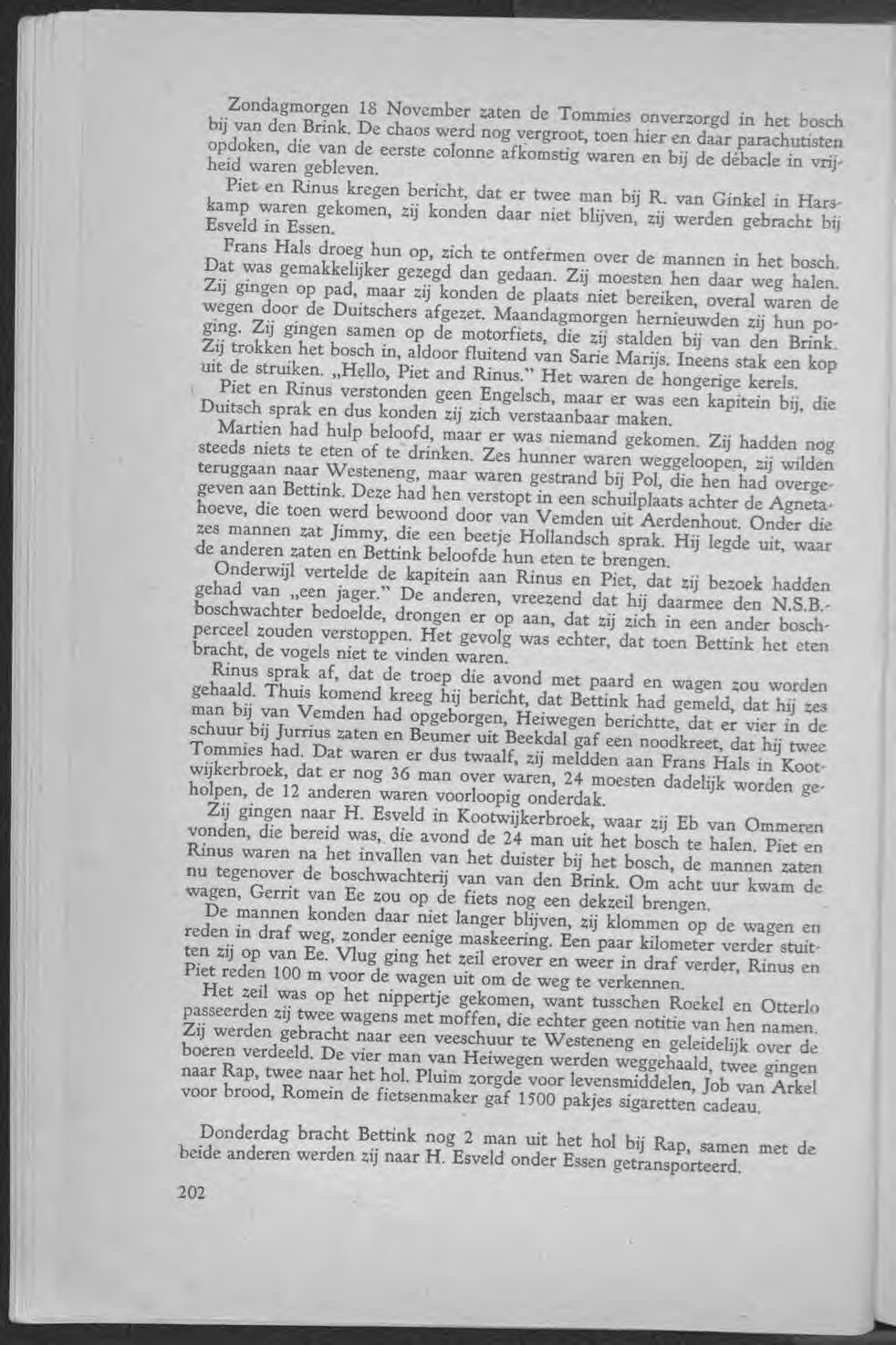
- ◐ Two men moved on (Boeree, p. 202).
- "Donderdag bracht Bettink nog 2 man uit het hol bij Rap, samen met de beide anderen werden zij naar H. Esveld onder Essen getransporteerd." (On Thursday Bettink brought 2 more men out of the hole at/to Rap's; with the other two they were taken to H. Esveld near Essen.)
- The sentence before it has "De vier man van Heiwegen werden weggehaald, twee gingen naar Rap, twee naar het hol." (The four men from Heiwegen were taken away, two went to Rap, two to the hole), so the hole is a place apart from Rap's. ◐ That favours the first of two readings: Bettink taking two more men from the hole to Rap's, to join the two already there, rather than taking two men out of the hole at Rap's; either way the four were then taken to H. Esveld near Essen (Heimen van Esveld).
- Boeree gives no date; ◐ the Thursday is 23 November, counting from the Monday.
- ✓ Bread in the mornings (Boeree, p. 203, checked on the page image).
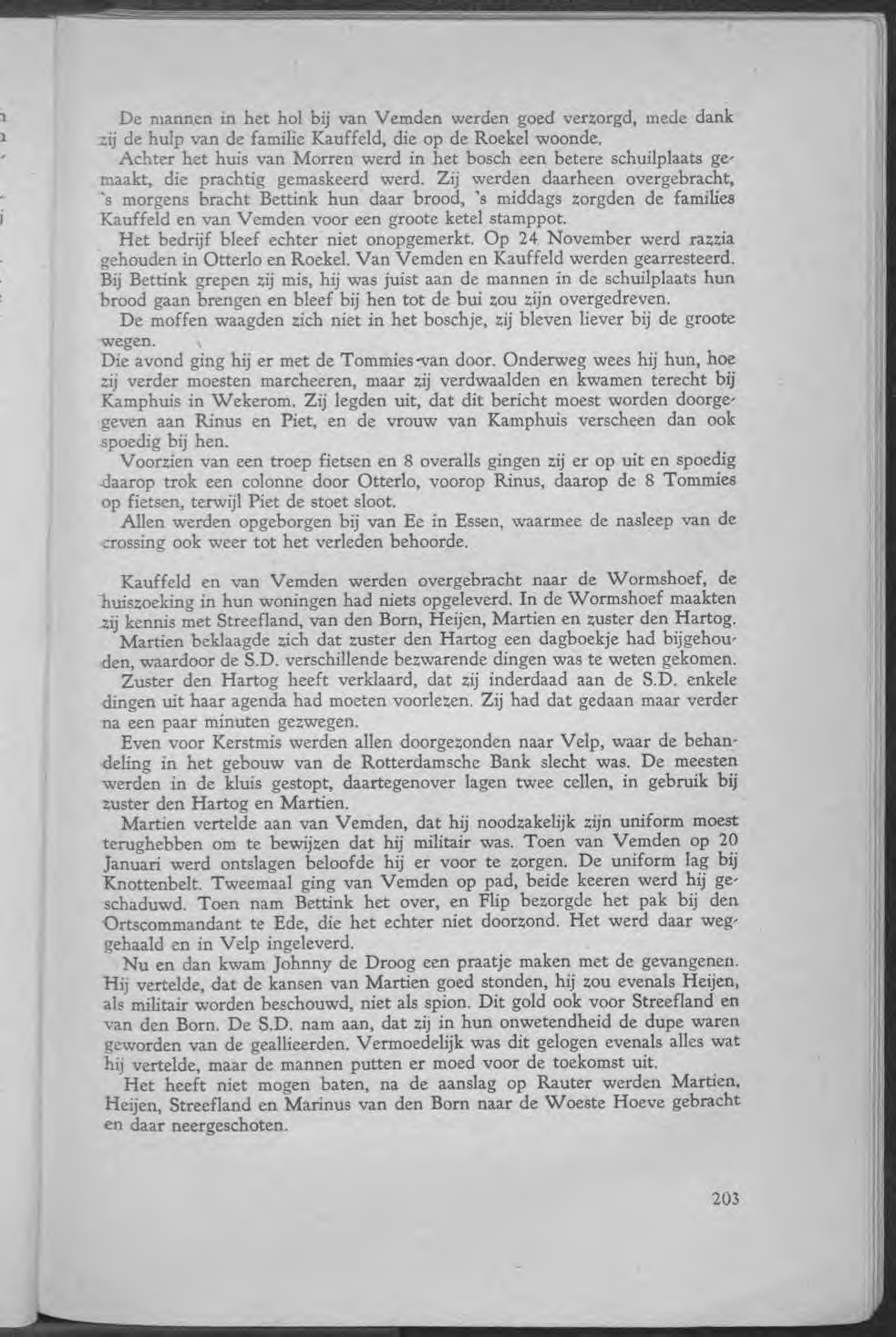
- "De mannen in het hol bij van Vemden werden goed verzorgd, mede dank zij de hulp van de familie Kauffeld, die op de Roekel woonde." (The men in the dug-out at Van Vemden's were well cared for, partly thanks to the help of the Kauffeld family, who lived at Roekel.)
- A better hiding place, "prachtig gemaskeerd" (beautifully camouflaged), was made in the wood behind Morren's house and the men were moved there; "'s morgens bracht Bettink hun daar brood, 's middags zorgden de families Kauffeld en van Vemden voor een groote ketel stamppot" (in the morning Bettink brought them bread there; at midday the Kauffeld and Van Vemden families provided a big pan of stamppot). Boeree gives no date for the move.
24 November 1944
Link to the section 24 November 1944✓ Boeree tells the day of the raid (Boeree, p. 203, checked on the page image):
On 24 November a raid was held at Otterlo and Roekel. Van Vemden and Kauffeld were arrested. At Bettink's they missed, as he had just gone to take the men in the hiding place their bread, and he stayed with them until the storm had blown over.
Dutch originalOp 24 November werd razzia gehouden in Otterlo en Roekel. Van Vemden en Kauffeld werden gearresteerd. Bij Bettink grepen zij mis, hij was juist aan de mannen in de schuilplaats hun brood gaan brengen en bleef bij hen tot de bui zou zijn overgedreven.
— Th. A. Boeree · Kroniek van Ede · 1947 · p. 203
The Germans did not venture into the copse and kept to the main roads (same page). That evening:
That evening he made off with the Tommies. On the way he showed them how to march on, but they lost their way and ended up at Kamphuis's at Wekerom.
Dutch originalDie avond ging hij er met de Tommies van door. Onderweg wees hij hun, hoe zij verder moesten marcheeren, maar zij verdwaalden en kwamen terecht bij Kamphuis in Wekerom.
— Th. A. Boeree · Kroniek van Ede · 1947 · p. 203
- ✓ To Essen (same page).
- The men asked for word to be passed to Rinus and Piet, and Kamphuis's wife soon came to them.
- "Voorzien van een troep fietsen en 8 overalls" (provided with a lot of bicycles and 8 overalls) they set out, and a column went through Otterlo, "voorop Rinus, daarop de 8 Tommies op fietsen, terwijl Piet de stoet sloot" (Rinus in front, then the 8 Tommies on bicycles, while Piet closed the procession); "Allen werden opgeborgen bij van Ee in Essen" (all were put away at Van Ee's in Essen). ◐ Which Van Ee is not shown (Other men named Van Ee).
- ◐ Hardy and Murphy had left the dug-out on the morning of 24 November (Hardy), so by Hardy's dates they were not among the eight.
✓ J. van Vemde gives the same day, and a different number:
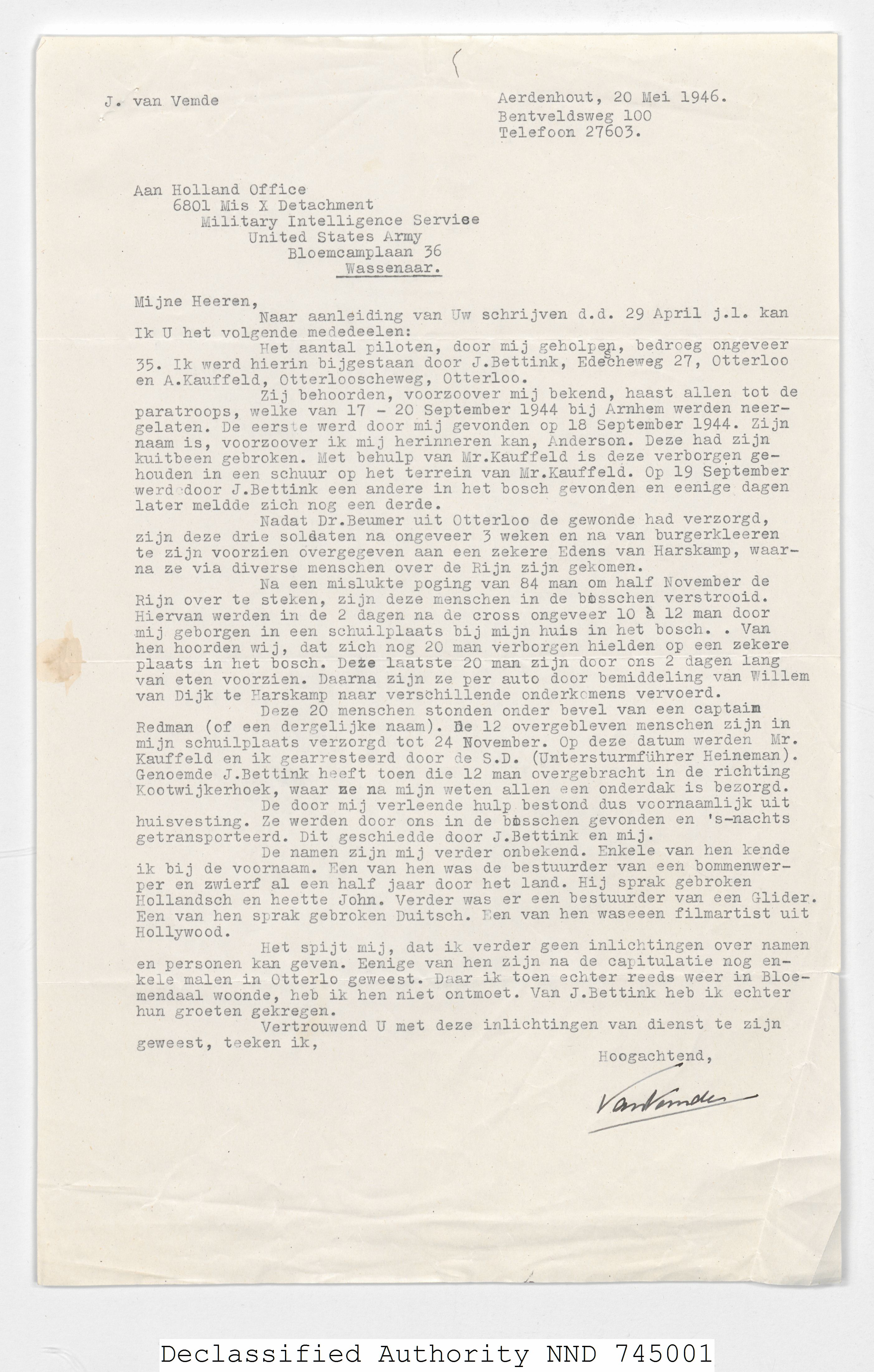
The 12 who were left were looked after in my hiding place until 24 November. On that date Mr Kauffeld and I were arrested by the SD (Untersturmführer Heineman). The said J. Bettink then moved those 12 men towards Kootwijkerhoek, where as far as I know they were all found shelter.
Dutch originalDe 12 overgebleven menschen zijn in mijn schuilplaats verzorgd tot 24 November. Op deze datum werden Mr. Kauffeld en ik gearresteerd door de S.D. (Untersturmführer Heineman). Genoemde J.Bettink heeft toen die 12 man overgebracht in de richting Kootwijkerhoek, waar ze na mijn weten allen een onderdak is bezorgd.
— J. van Vemde to the Americans · 20 May 1946 · his letter, p. 8
- ◐ "Kootwijkerhoek" is very probably Kootwijkerbroek, where the office's slip sends the men (below).
- ✓ He sums up his help: "De door mij verleende hulp bestond dus voornaamlijk uit huisvesting. Ze werden door ons in de bosschen gevonden en 's-nachts getransporteerd. Dit geschiedde door J.Bettink en mij." (My help consisted, then, mainly of housing. They were found by us in the woods and moved at night. This was done by J. Bettink and me.) (same page). ◐ Whether "Ze" means this group or all the men he helped is not clear from the letter.
- ◐ The local history has him, after Pegasus II, guide the scattered group "in kleine groepjes naar veilige plaatsen" (in small groups to safe places) and feed them there (Vos, p. 31).
- ⚠︎ Hunted. His own form says the men's names and details were lost: "VERDERE GEGEVENS ZIJN ZOEKGERAAKT TENGEVOLGE VAN DUITSCHE ACTIE. DE DUITSCHE S.D. HEEFT MY EENIGE MAANDEN GEZOCHT. MYN HUIS IS TOEN GROOTENDEELS [one word struck out] LEEG GEHAALD" (further particulars have been lost as a result of German action. The German SD looked for me for some months. My house was then for the most part [one word struck out] emptied) (p. 5); the office's typed copy has "The S.D.lokked for him for a few months, and in the meantime they looted his house" (p. 2).
- ◐ The local history has a second house search at the farm on 28 November 1944, after which his wife, heavily pregnant, fled with their small son to her parents-in-law at Barneveld, and went back to the farm when a bomb from an aircraft hit that house in February 1945 (Vos, p. 31).
- ✓ The uniform, January 1945. Abraham du Bois (Boeree's "Martien"), held by the SD at Velp, told Van Vemden that he had to have his uniform back to prove he was a soldier, and Van Vemden, released on 20 January 1945, promised to see to it; the uniform was at Knottenbelt's (Boeree, p. 203, checked on the page image).
Twice Van Vemden set out; both times he was followed. Then Bettink took it over, and Flip delivered the parcel to the Ortscommandant at Ede, who however did not send it on. It was fetched from there and handed in at Velp.
Dutch originalTweemaal ging van Vemden op pad, beide keeren werd hij geschaduwd. Toen nam Bettink het over, en Flip bezorgde het pak bij den Ortscommandant te Ede, die het echter niet doorzond. Het werd daar weggehaald en in Velp ingeleverd.
— Th. A. Boeree · Kroniek van Ede · 1947 · p. 203
The Ortscommandant was the local German commandant; Boeree does not say who Flip was.
- ✓ The men's greetings. Van Vemde wrote in 1946 that some of the men had come back to Otterlo several times after the capitulation, but "Daar ik toen echter reeds weer in Bloemendaal woonde, heb ik hen niet ontmoet. Van J.Bettink heb ik echter hun groeten gekregen." (As I was by then living in Bloemendaal again, I did not meet them. But I had their greetings from J. Bettink.) (his letter, p. 8).
His file with the Americans, 1946
Link to the section His file with the Americans, 1946✓ The papers in his helper file (US National Archives 286637799, read on the images). They are listed here by the date each was written, not in the file's own order, and two of them carry dates that do not fit that order: the summary card is dated "6-6-46", before Kauffeld's letter of 11 June and the office's of 13 June, and the folder cover is pencilled "18/6/46" (the day is hard to read, 18 or 10), before his form of 23 June. ◐ Why is not explained in the file.
- Kauffeld's letter, 11 June 1946. From Scheveningscheweg 56, The Hague, Kauffeld wrote to the Holland Office that "Bij mij in de buurt woont Johan Bettink, adres Edescheweg no.27, Otterloo (bij Ede)" (Johan Bettink lives near me), and that he had "een groot aantal parachutisten en piloten geholpen (verborgen, gevoed en getransporteerd)" (helped a great many paratroopers and pilots: hidden, fed and transported), and that "Ook bij mijn werk ten behoeve van geallieerd personeel Johan Bettink zeer daadwerkelijk" [sic: the verb is missing] (Johan Bettink [helped] very actively in my own work for Allied personnel too) (p. 11).
- The office's letter, 13 June 1946. Lt Felix Bilgrey, commanding, wrote to "den Heer J.Bettink, Edescheweg no.27, OTTERLOO" that he had heard from Kauffeld that Bettink had helped Allied airmen, and asked him to fill in the questionnaire enclosed (p. 9; a second carbon on p. 10).
- His form, 23 June 1946, in his own block capitals: "IK HEB ± 35 ALLIED PERSONNELL ZOOWEL ENGELSCHEN ALS AMERIKANEN GEHOLPEN, DOOR HEN TE HERBERGEN, TE VOEDEN EN TE TRANSPORTEEREN" (I helped about 35 Allied personnel, English as well as Americans, by housing, feeding and transporting them), naming "A.E. KAUFFELD" and "J. V. VEMDEN" as helpers he knew; a hand has added "Confirmed by v. Vemden" (p. 4). The office's typed English copy has "Helped about 35 pilots." (p. 2).
- The summary card, dated "6-6-46", has him working with "J. van Vemde Bentveldsweg 100 Aerdenhout.", "A. Kauffeld Otterloscheweg Ede." and "A. Morren" of Ede (p. 8, read on the image with the contrast raised; it is printed below).
- Two slips. One, headed "To Vemden (5): big report.", says Van Vemden "confirms help of J Bettink, in taking care of, providing with food, transport of 20 men in direction Kootwijk[erbroek]", "Transport at night in the woods by v Vemden en Bettink together", and suggests grade 5 (p. 6).
- The other asks Mr Wannée to "Write a letter for details (grading)" and notes "Kauffeld (5) same story of the 35 pilots. Doesn't mention him." (p. 7).
- ◐ The slip means Kauffeld's own questionnaire (it grades him 5); on the image the first word of that last sentence is overwritten by a looping stroke, who is meant by "him" is not explained, and Kauffeld's letter above does name Bettink.
- The grade. The folder cover is pencilled "Grade 5 Conf 58" (p. 1), and the Americans' list of Grade 5 (Eisenhower) certificates has "(349) BETTINK, Johan", at "Edescheweg 27 Otterloo" (the list, p. 16, image-checked).
The summary card ends:
Worked with this 3 persons together. In total sheltered and fed 34 paratroopers and pilots. Later we only transported them. van Vemde and Kauffeld were a rested [sic] by the SD.
— US Military Intelligence Service, Holland Office · summary card on Johan Bettink (◐ it speaks as "we", so apparently what he told the office) · dated 6-6-46 · his file, p. 8
- ✓ The British index. The British index of Dutch helpers has "BETTINK, Johan", "Edescheweg 27, OTTERLO", certificate 15904, grade 5 (sheet B/10, National Archives WO 208/5476, in John Howes's photograph of it; read on the image).
- ◐ The local history has him receive written thanks after the war from both the American and the British army commands (Vos, p. 31).
- ◐ In Michels's list. G. J. Michels, a police constable at Harskamp, listed "H.Bettink Otterlo" among the helpers he knew, as the typed copy has it (his file, p. 2); on the handwritten original the Bettink entry is squeezed in below G. Bloem's, the handwritten OTTERLO sits under HOENDERLO in the place column, and the initial is hard to read (H or J) (p. 4, read on the image).
- ◐ Probably this man, on the surname and the village. The trade is not settled: "LANDBOUWER" (farmer) stands between Bloem's line and Bettink's, and on the typed copy "farmer" is typed after Bloem's name and struck out.
Where the sources disagree
Link to the section Where the sources disagree- His name. "Betting" in Boeree's p. 201 and "Bettink" on pp. 202–203 (Boeree); "H. Bettink" in Michels's list (above).
- His address. Edescheweg 27 on his own form, the American list, Van Vemde's letter and the British index; "OTTERLOOSCHEWEG 27" on Van Vemde's form; a farm on the Apeldoornseweg in the local history (sources under Where, above). ◐ Which he lived at in 1944 is not settled.
- How many men in all. About 35 on his form and in Van Vemde's letter; 34 on the summary card; "the 35 pilots" on the slip about Kauffeld (sources above).
- The men moved after 24 November. Twelve in Van Vemde's letter and eight on bicycles in Boeree (sources above). Not settled.
- The slip's 20 men. The office's slip has "transport of 20 men in direction Kootwijk[erbroek]", undated. ◐ Van Vemde's letter has two groups: 20 men under "captaim Redman", fed for two days and moved by car through Willem van Dijk, and the 12 that Bettink moved towards Kootwijkerhoek on 24 November. The slip's number matches the first and its destination the second, so which it means is not settled.
- The six and the five. Boeree has six men reach Bettink's hiding place; Hardy has five walk out of the wood and find five more evaders in the dug-out (above).
- The day. ⚠︎ Boeree heads the morning in the wood "Zondagmorgen 18 November", but 18 November 1944 was a Saturday (p. 202). ◐ By Hardy the party left the wood at three in the morning of 20 November, which fits Boeree's Monday being the 20th. On p. 201 the morning after the crossing of the evening of 17 November is the 18th, which fits his date and not his weekday, so which of "Sunday" and "18" is the slip is not settled; the Monday is the 20th either way (Hardy; J. van Vemde).
- His father's age. 64 on his form and 65 on the summary card in June 1946; by the Ede card his father was born on 27 April 1883, so 63, and the birth record of 1914 has him 30 (sources above).