Gerrit Jan Michels
Deventer 7 Jun 1911 – after 1959
Gerrit Jan Michels, "AGENT VAN POLITIE 1e KLAS", in his own form for the Americans (his file, p. 4)
About: A constable of the Ede police, stationed at Otterlo in the war and at Harskamp after it, who by his own account helped Allied paratroopers in September 1944 and was thanked by the Roekel helper Kauffeld for his help around Kauffeld's arrest. ◐ He is one of the candidates, none proved, for the unnamed Dutch policeman who came with "Willem" for Murphy's party in November 1944.
Unit or role: Police constable, agent van politie 1e klas (constable first class) of the Ede municipal police, and "onbezoldigd ryksveldwachter" (unpaid rural constable of the State) in June 1946 (his report); hoofdagent (senior constable) from 13 February 1947 (Arnhemsche courant). Of the O.D. and the N.B.S. by his own form (p. 2).
Where: ✓ Otterlo in the winter of 1944–45 (Het Nieuwsblad voor de gemeente Ede, 6 November 1946, below); Laarweg 49, Harskamp, on his form for the Americans (p. 4), and the Dorpsstraat, Harskamp, in 1959 (Arnhemsche courant).
Evidence: ✓ his own helper file with the Americans, US National Archives 286674847 (the form, pp. 1–5, read on the images); ✓ his police report of 10 June 1946 (Gemeentearchief Ede 1006/888, PDF p. 76); ✓ Het Nieuwsblad voor de gemeente Ede, 6 November 1946 (Gemeentearchief Ede 1006/944, PDF p. 10); ✓ the Arnhemsche courant's profile of him, 3 April 1959 (the article, checked on the page image); ✓ his birth and the family card at Amersfoort (the records); ◐ Ede, manuscript "Het Verzet", p. 49 (Gemeentearchief Ede 1006/1160), for Kauffeld's thanks (a 1980s secondary account; the letter it reports has not been seen); ◐ Mel Rolfe, Looking into Hell (1996), p. 75 of the 2000 Cassell paperback (the archive's text).
Deventer and the military police
Link to the section Deventer and the military police✓ He was born at Deventer on 7 June 1911, the son of Jacob Michels, a paperhanger (behanger) of 25, and Aleida Wilhelmina Appelhof (his birth record; index record). His own form gives the same date and place, and as next of kin "J. MICHELS DEVENTER", aged 59 (p. 4); ◐ very probably his father, who was 25 in 1911.
✓ By the Arnhemsche courant's profile of 1959, "In april 1934 werd hij in de rang van korporaal aangesteld bij het toenmalige militaire politiekorps te Den Haag en tot mei 1940 diende hij in verschillende plaatsen van ons land" (In April 1934 he was appointed with the rank of corporal in what was then the military police corps at The Hague, and until May 1940 he served in various places in the country) (the article, checked on the page image). Amersfoort's population register has him there in November 1938 as a "korporaal pol. troepen" (corporal of the police troops) (the card, read on the image).
Marriage
Link to the section Marriage✓ The banns of "G. J. Michels en G. A. M. Kraaijenzang" are in the list of 12 November 1938 in the Haagsche courant (the list, checked on the page image). The Amersfoort family card has them married at Deventer on 24 November 1938: he came to Amersfoort on 16 November 1938 from "R'dam, Boschpolderplein 36" and she on 24 November from Deventer, "Gr. Overstr. 46"; his church is entered as "N.H." (Nederlands Hervormd) and hers as "R.K." (Roman Catholic) (the card; Archief Eemland's record).
✓ His wife, Geertruida Alberta Maria Kraaijenzang, was born at Raalte on 3 October 1911, the daughter of Antoon Kraaijenzang, a merchant (koopman), and Johanna Antonia Veldmaat (her birth record; index record). When her mother died in January 1958, the death notice (dated Deventer, 28 January) listed "Harskamp: G. A. M. Michels-Kraaijenzang / G. J. Michels" among the family; the notice does not say how they are related, and her birth record, above, names her mother as Johanna Antonia Veldmaat (Deventer dagblad, 29 January 1958, checked on the page image; the notice spells the mother "Veltmaat").
Otterlo
Link to the section Otterlo✓ When the military police corps was dissolved after the capitulation of May 1940, by the 1959 profile, he could join the municipal police of Amsterdam or of Ede: "Hij koos Ede en daar kreeg hij als standplaats Otterlo aangewezen" (He chose Ede, and there was given Otterlo as his post) (the article).
◐ The Lancaster at Otterlo, 1943. The book Looking into Hell (1996) by Mel Rolfe tells of the Lancaster "Q-Queenie" of 156 Squadron, lost on a raid on Essen; his account opens on the morning of 27 May 1943 and has the aircraft crash at half past midnight: "In their official report, Dutch policemen Wouter van Zwetselaar and Gerrit Jan Michels said the Lancaster had crashed near the village of Otterloo." By Rolfe's account the two found villagers and four German soldiers at the burning wreck; the Ortskommandant of Ede and the head of Ede's air-raid precautions service arrived, then a bus of German soldiers who guarded the wreck and closed the roads; and the policemen found none of the crew (Rolfe, p. 75; the Internet Archive's text, the page image not seen). The report itself has not been seen, and the passage we hold gives no source for it; this is the one claim on the page that no primary record yet backs, so it is held at ◐ as a popular book's retelling by way of OCR. What speaks for it is that the 1959 profile has him posted to Otterlo from 1940 (the article); nothing seen speaks against it. Gemeentearchief Ede 1006/85, which the finding aid describes as "Processen-verbaal, rapporten, correspondentie" with the registration of the Allied and German aircraft that came down in Ede (the finding aid), is a hit in archieval.nl's search for "Michels" (noted in the Rolfe file); it has not been read.
His own form
Link to the section His own form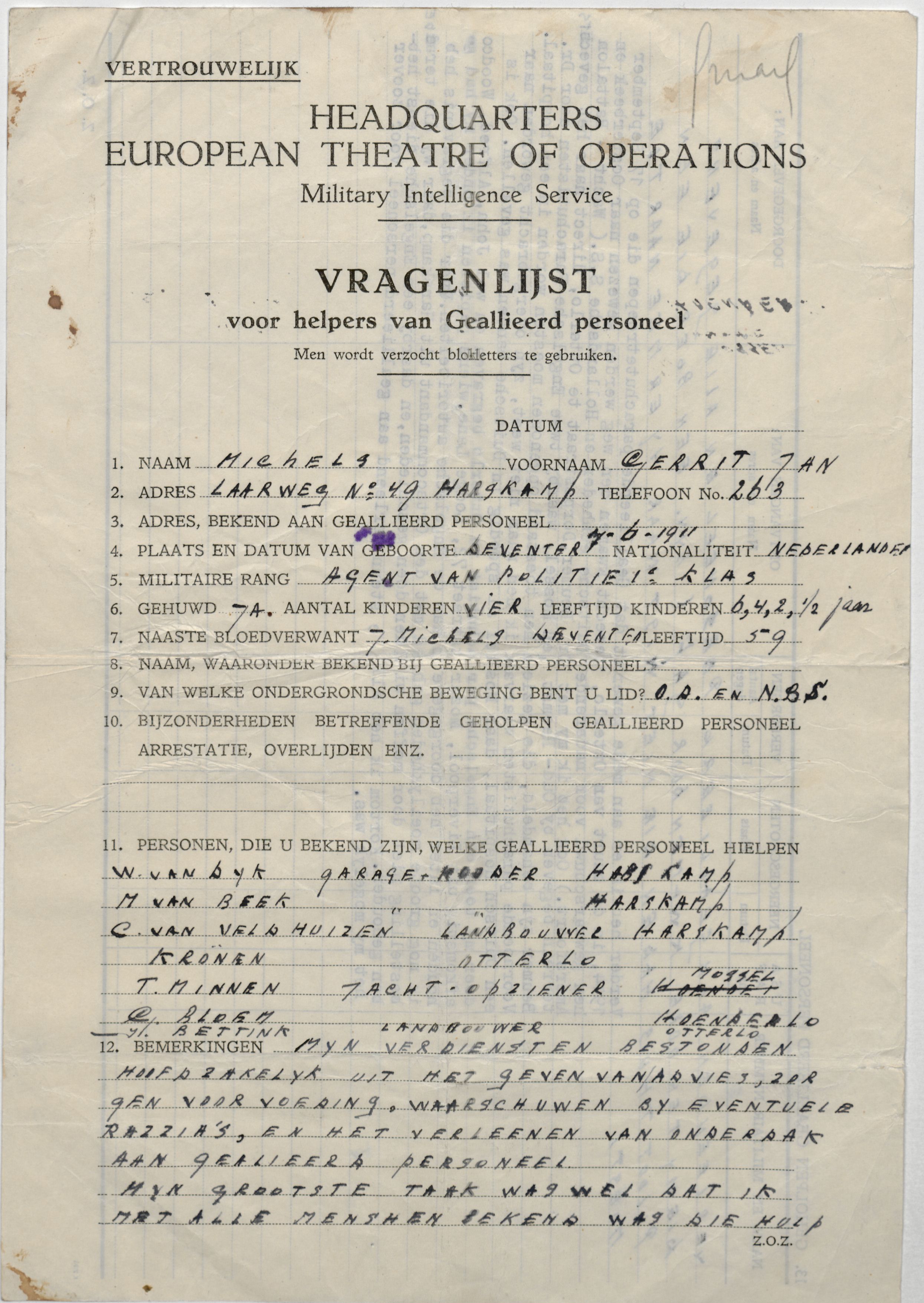
✓ The Americans' questionnaire for helpers survives in his own Dutch, handwritten, and in a retyped English copy; neither is dated, and the file's cover has "No Award" and "AGO 31-7-46" (the cover, p. 1; the English copy, p. 2; the Dutch original, p. 4). It gives Laarweg 49, Harskamp, telephone 263; born Deventer 7 June 1911; married, four children aged "6,4,2,½ jaar"; of the O.D. and the N.B.S.
- The helpers he knew (section 11), as the typed English copy has them (p. 2), with his Dutch original (p. 4, read on the image):
- "W.van Dijk, garage-keeper, Harskamp", Willem van Dijk, and under him "M.van Beek", Marten van Beek, for whom the Dutch original puts a ditto under "GARAGE-HOUDER" (garage-keeper);
- "C.van Veldhuizen, Farmer at Harskamp", "Kronen, Otterlo", "T. Minnen, game-keeper at Mossel", and G. Bloem of Hoenderloo;
- and, squeezed in below, "BETTINK" of Otterlo, whose initial is hard to read (the typed copy has "H.Bettink"); ◐ probably Johan Bettink of Otterlo, on the surname and the village only. The word "LANDBOUWER" (farmer) is written small between the Bloem and Bettink lines, so whose trade it gives is not clear; the typed copy first gave "farmer" to Bloem and struck it out (p. 4; p. 2).
- What he did, in the English copy: "Help consisted of giving advice, food and shelter. He warned the concerned people when razzia's would be held." He knew the names of the pilot helpers, so that he knew what to do when help was needed (p. 2).
- His Dutch original says his greatest task was that he knew everyone who gave help to Allied personnel, and passed on all the information that reached him, "( BYV. EEN BOER DIE EEN PILOOT THUIS HADEN [sic], DIE NIET WIST WAAR HY ER MEE NAAR TOE MOEST)" (a plural verb after the singular een boer) (for example, a farmer who had a pilot at home and did not know where to take him) (p. 5).
- ✓ The table of Allied men helped (section 13) is empty on both copies: he names no one he hid (p. 3; p. 5).
The form does not mention an ambulance, the Red Cross, Murphy or any of the men he was with.
September 1944
Link to the section September 1944✓ His form goes on, typed in Dutch across the empty table, about the airborne landings (p. 5; the English copy on p. 3):
- He helped to show Allied paratroopers who came down near Otterlo on 17 September 1944 the way to Oosterbeek, and warned them of approaching German units and of the Dutch SS (the Wacht-Bataljon Amersfoort).
- With Dr Beumer of the Dorpsstraat, Otterlo, he went straight to the fighting at Oud-Reemst and Mossel, where Beumer treated two English paratroopers who had to go to hospital; he did not know their names, and they were taken to a German hospital, "daar Mossel al spoedig in Duitsche handen was gevallen" (as Mossel had soon fallen into German hands).
- He buried an English paratrooper at Otterlo, "John, Alfred, Woodco afkomstig uit Liverpool, Mozartstreet 72, Lodge Lane", whose papers he kept and later handed to the English authorities.
- "Over die begravenis heb ik nog groote moeilykheden gehad met den Ortscommandant uit Harskamp, daar wy die teraardebestelling niet door moffen wilden doen geschieden, en daarby een Engelsche dienst hebben gehouden." (Over that burial I had great difficulties with the Ortskommandant from Harskamp, because we would not let the burial be done by the moffen, a slang word for the Germans, and held an English service at it.) The form gives no date for the burial; its "toen" (then) puts it in the same passage as the fighting.
◐ The paratrooper he buried. The surname is "Woodco" on both copies, and on the Dutch one it ends at the right-hand edge of the typing, where the typing runs into the margin and is overtyped, as other words there are too ("gevec…", "tera…"), so letters may be lost (p. 5, read on the image). The CWGC has Private John Alfred Woodcock, 1449239, 10th Battalion, The Parachute Regiment, died 25 September 1944 aged 23, "Son of John and Edith Roseina Woodcock, of Liverpool", now in Arnhem Oosterbeek War Cemetery, 29. A. 5.; the graves concentration forms of 10 November 1945 and 28 January 1946 give his previous grave as "OTTERLOO COM CEM. PROT" (presumably the Protestant communal cemetery at Otterlo; ◐ our reading of the abbreviations), the second with "PRES D/W" (presumed died of wounds), where the first had "K/A" (killed in action) in red and the date of death "U/K" (unknown), so the cause changed between the forms (CWGC records; the 1946 form). ◐ Very probably the same man: the forenames, Liverpool, a paratrooper, and a first grave at Otterlo. The CWGC records do not say who buried him or when.
With Murphy
Link to the section With MurphyThe policeman with "Willem", 14 and 18 November 1944
Link to the section The policeman with "Willem", 14 and 18 November 1944James Hardy's report to MI9 has two men of the underground come for the party hidden on Baron Mackay's estate at 18.30 on 14 November: "One was called WILLEM and the other was a policeman whose name I do not know." They took them to a "Red Cross" ambulance and handed them to a guide, "Jan (2)". On the evening of 18 November "WILLEM and the Dutch Policeman whom I had met before" came with bicycles to the farm where they had rested, which Hardy believed was near Otterlo, and led them off by bicycle that night (Hardy). Murphy was in the party (Hardy; Kijkuit and Harskamp).
- ◐ Michels is one candidate for that policeman, none proved. He was a constable stationed at Otterlo that winter (below), and two further links are each unproven:
- ⚠︎ No source puts him with "Willem" or with Murphy's party. Marten van Beek, Kragt's man in Harskamp, was in the Arnhem police and is another candidate (Ede manuscript, p. 43).
Kauffeld's thanks
Link to the section Kauffeld's thanks✓ The Roekel helper Kauffeld sheltered and fed men in the woods who, a typed slip in his file says, "came after the failed crossing from 18-11-'44" (the slip, p. 4; his own form, p. 7, has "the debacle of the 2nd Rhine crossing"), and the SD arrested him and J. van Vemde on 24 November 1944 (Van Vemde's letter, p. 8). By Ede's manuscript history, the two were sent on to the SD at Velp after fourteen days and released there on 20 January 1945 (p. 49). It goes on:
Finally, we would add that after the war, on 28 June 1945, Kauffeld wrote a letter to the acting chief of the Ede police, Inspector Van Kooten, in which he belatedly expressed his appreciation for the help he had received before, during and after his arrest from constable first class G.J. Michels of Harskamp. Van Kooten passed the thanks on to Michels.
Dutch originalTenslotte vermelden wij nog, dat Kauffeld na de oorlog, op 28 juni 1945, een brief schreef aan de waarnemend korpschef van de Edese politie, inspecteur Van Kooten, waarin hij alsnog zijn waardering uitsprak voor de hulp, die hij vóór, tijdens en nà zijn arrestatie van agent 1e klas G.J. Michels uit Harskamp had ontvangen. Die dank werd door Van Kooten aan Michels overgebracht.
— Ede, manuscript "Het Verzet" for the book Ede 1940–1945 · Gemeentearchief Ede 1006/1160, p. 49 · the page
- The manuscript does not say what the help was; Pegasus II and Roekel tells the same thanks in the story. Its note 45 gives as its source "Registratie 1940-1945, inv. nr. 256" (the notes, p. 78), which the archive's concordance turns into today's 1006/469, "Kauffeld, Fam." (the finding aid). The letter itself has not been seen.
- Neither Kauffeld's forms for the Americans nor Michels's own form mention the other (Kauffeld's file; Michels's).
Otterlo and the Miggels confusion
Link to the section Otterlo and the Miggels confusion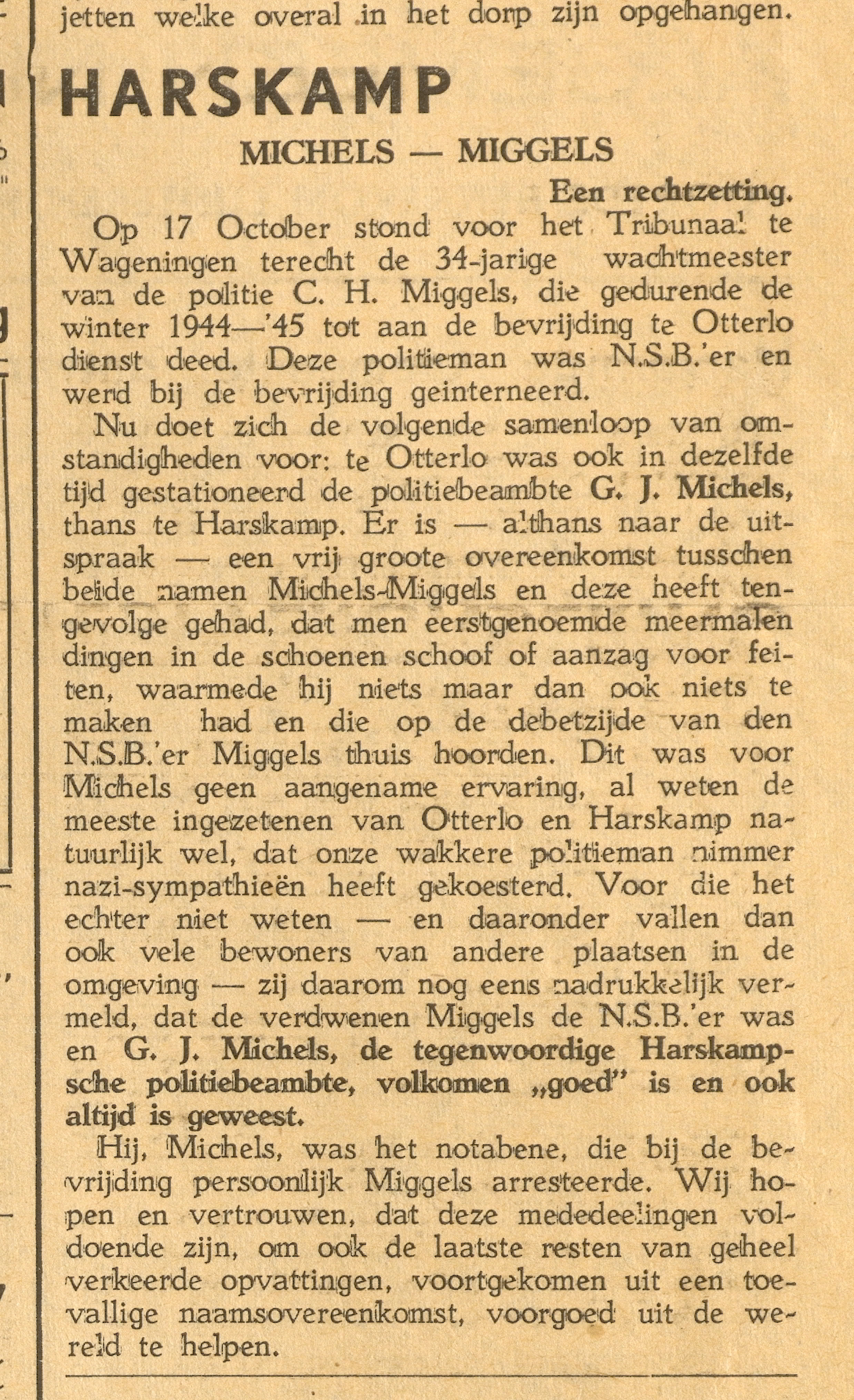
✓ In November 1946 the Ede paper printed a correction under the heading "Michels — Miggels". On 17 October the Tribunal at Wageningen had tried C. H. Miggels, 34, a police wachtmeester (sergeant) who had served at Otterlo "gedurende de winter 1944—'45 tot aan de bevrijding" (during the winter of 1944–45 until the liberation), and who, the paper says, "was N.S.B.'er en werd bij de bevrijding geinterneerd" (was a member of the NSB and was interned at the liberation). It goes on:
Now the following coincidence arises: stationed at Otterlo at the same time was also the policeman G. J. Michels, now at Harskamp. There is, at least in the way they are said, quite a close likeness between the two names Michels and Miggels, and this has meant that people several times blamed the first for things, or took for facts things, with which he had nothing, but really nothing, to do, and which belonged on the debit side of the NSB man Miggels.
Dutch originalNu doet zich de volgende samenloop van omstandigheden voor: te Otterlo was ook in dezelfde tijd gestationeerd de politiebeambte G. J. Michels, thans te Harskamp. Er is — althans naar de uitspraak — een vrij groote overeenkomst tusschen beide namen Michels-Miggels en deze heeft tengevolge gehad, dat men eerstgenoemde meermalen dingen in de schoenen schoof of aanzag voor feiten, waarmede hij niets maar dan ook niets te maken had en die op de debetzijde van den N.S.B.'er Miggels thuis hoorden.
— Het Nieuwsblad voor de gemeente Ede · 6 November 1946 · the transcription
The paper says "dat de verdwenen Miggels de N.S.B.'er was en G. J. Michels, de tegenwoordige Harskampsche politiebeambte, volkomen „goed" is en ook altijd is geweest" (that the vanished Miggels was the NSB man, and G. J. Michels, the present Harskamp policeman, is entirely "good" and always has been), and adds: "Hij, Michels, was het notabene, die bij de bevrijding persoonlijk Miggels arresteerde." (It was Michels, mark you, who personally arrested Miggels at the liberation.) The paper names no one who said otherwise, and no other source on the rumours has been found. ✓ The cutting's page has no masthead, but it carries a notice that speaks of Woensdag 6 Nov. (heden) (Wednesday 6 November, today), read on the image; the front page before it in the archive's file is issue No. 151 of 6 November 1946 (the transcription).
Harskamp
Link to the section Harskamp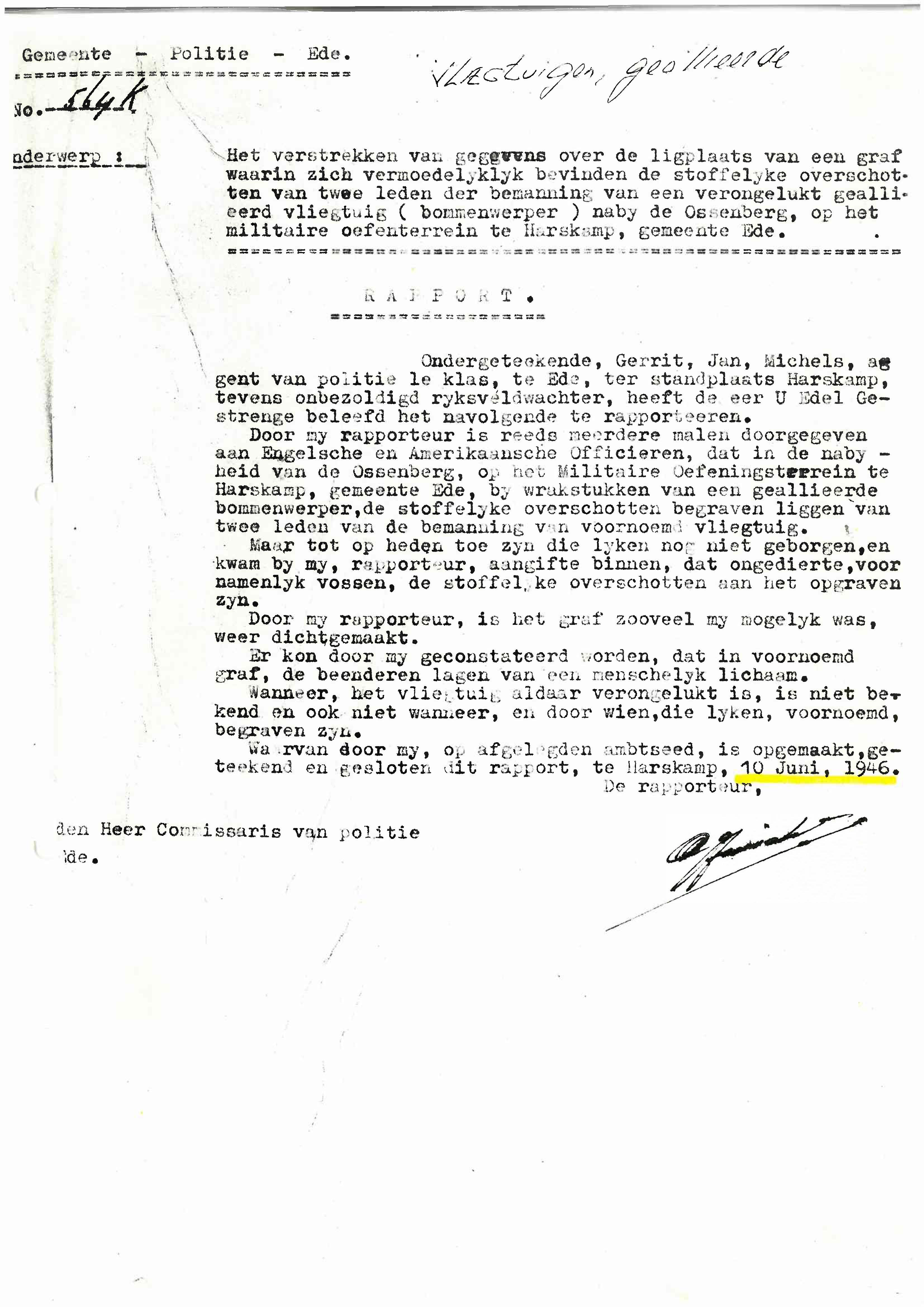
✓ "Na de bevrijding, in augustus 1945, volgde zijn bevordering tot hoofdagent en overplaatsing naar Harskamp" (After the liberation, in August 1945, came his promotion to hoofdagent and his move to Harskamp), by the 1959 profile (the article); on the promotion's date the sources disagree (below).
- ✓ The grave on the Ossenberg, 1946. On 10 June 1946, as "agent van politie le klas, te Ede, ter standplaats Harskamp", he reported to the Ede police commissioner that he had several times told English and American officers that two crew members of an Allied bomber lay buried by its wreckage near the Ossenberg, on the military training ground at Harskamp.
- They had not been recovered, and "aangifte" (a complaint) had reached him that "ongedierte, voornamenlyk vossen" (vermin, chiefly foxes) were digging up the remains; he filled the grave in as well as he could and found in it "de beenderen … van een menschelyk lichaam" (the bones of a human body, one body, though he reported two men buried there). When the aircraft crashed, and who buried the men, was not known (the report, PDF p. 76, read on the image).
- ✓ Helper's form. The cover of his file with the Americans is marked "No Award", "AGO 31-7-46" (the cover).
- ✓ Promotion. The Arnhemsche courant of 15 February 1947 lists "G. J. Michels" among the agenten of the Ede force promoted to hoofdagent from 13 February (the report, checked on the page image).
- ✓ Swimming diploma. On a Friday morning (◐ 12 September 1947, the day before the paper's date; the item gives the weekday and the morning, not the date) "Vele leden van het Edese politiekorps" (many members of the Ede police force) tried for the swimming diploma at the Ede pool, and "G. J. Michels" was one of thirteen who passed diploma II (Arnhemsche courant, 13 September 1947, checked on the image).
- ◐ Poachers, 1949. De Nederlandsche jager of 1949 has "de hoofdagenten van politie A. Noortman en G. J. Michels, gestationneerd te Otterlo en Harskamp", with "Th. Minnen, jachtopzichter van het Planken Wambuis", booking two men for hunting offences (the item; OCR, the page image not seen). ◐ The gamekeeper is probably the "T. MINNEN JACHT-OPZIENER" of his form's list.
- ✓ A son. Jan Michels, son of Gerrit Jan Michels and Geertruida Alberta Maria Kraaijenzang, died at Ede on 3 February 1951, aged 4 (the record; index record).
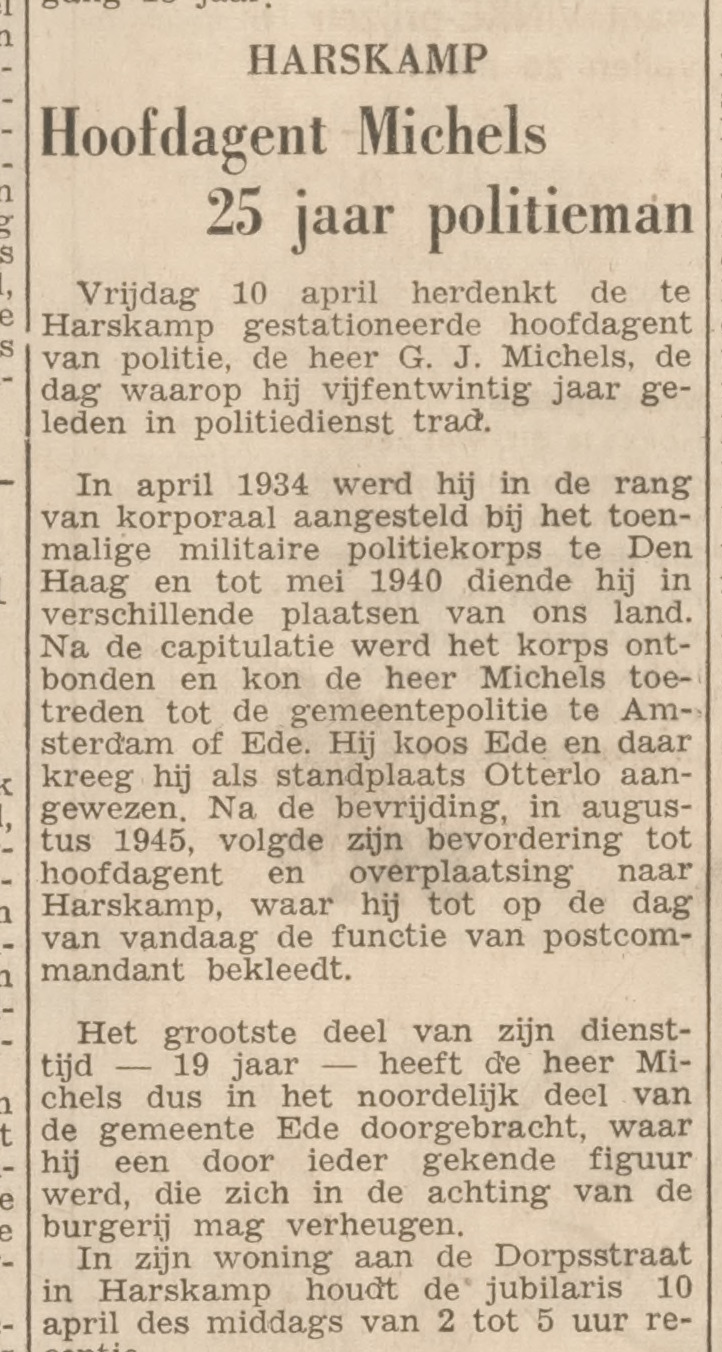
✓ Twenty-five years, 1959. The Arnhemsche courant of 3 April 1959 announced that on Friday 10 April "de te Harskamp gestationeerde hoofdagent van politie, de heer G. J. Michels" would mark twenty-five years in the police ("Vrijdag 10 april herdenkt …"), with a reception at his home from two to five that afternoon. He was then post commander (postcommandant) at Harskamp and lived on the Dorpsstraat, and had spent 19 years in the northern part of the municipality (the article, checked on the page image).
✓ His wife died at Ede on 29 September 1970; the index of her death lists him as her (ex-)partner (the record). His own death has not been found. Another Gerrit Jan Michels was in Ede's records in 1951, the (ex-)partner of a woman who died there aged 64, so an Ede record of the name needs a second detail before it is taken as his (the same README).
Where the sources disagree
Link to the section Where the sources disagree- Harskamp or Otterlo in 1944.
- Ede's manuscript has "agent 1e klas G.J. Michels uit Harskamp" (p. 49). The manuscript is undated; it was written for the book Ede 1940–1945, which the finding aid's introduction dates to 1990 (its own entry for the book reads "10/1985"), and its notes cite works of 1980 and 1982 and a letter of 24 September 1981 (the notes, pp. 77–78; the finding aid).
- The Ede paper of November 1946 has him stationed at Otterlo in the winter of 1944–45 (above); the 1959 profile has him posted to Otterlo from 1940 and to Harskamp from August 1945 (the article); ◐ Rolfe has him reporting a crash at Otterlo in 1943, on the archive's OCR of a popular book, with no police report seen (p. 75).
- ✓ The 1946 paper has him at Otterlo in the winter of 1944–45; ◐ so in November 1944 he was very probably there (the 1959 profile has him at Otterlo from 1940 to August 1945); the manuscript, written decades later, gives the post he held from 1945.
- When he became hoofdagent. August 1945 in the 1959 profile; 13 February 1947 in the Arnhemsche courant of 15 February 1947 (the report). His own form, in a file whose cover is stamped "AGO 31-7-46", has him "Police-man 1st cl." (p. 2), "AGENT VAN POLITIE 1e KLAS" (p. 4), and so does his report of 10 June 1946 (the report). ◐ 1947 fits the papers of 1946; the profile's August 1945 fits his move to Harskamp, not his promotion.
- The paratrooper's name. "Woodco" on his form, ending at the right-hand edge of the typing; Woodcock in the CWGC's records (above).