Martinus “Rinus” van Beek
Ede 16 Nov 1917 – ?
Martinus van Beek, "Rinus", of Molenweg 5, Harskamp
About: A Harskamp man in the Arnhem police, "Rinus", one of Dick Kragt's two trusted men at Harskamp with Willem van Dijk, his brother-in-law (◐ through Van Dijk's marriage in June 1945, very probably to Van Beek's sister), who moved evaders for Kragt's organisation and fetched the men left behind by Pegasus II. ◐ He may be the Dutch policeman who, with a "Willem", moved Murphy's party from Baron Mackay's estate on 14 November 1944 and fetched four of them again on the 18th; no source names him there.
Unit or role: Police constable, posted at Arnhem (Ede police report, 1947, p. 1; Boeree, p. 199); cover name "Rinus" (his form, p. 2; Boeree, p. 200). On his own form, a member of "L.O. B.S. P.T.S and R.V.V. with van Dyk" (p. 2). By 1947 a garage owner (garagehouder) (the 1947 report, p. 1).
Where: Molenweg 5, Harskamp, in the municipality of Ede (his form, p. 2; the 1947 report, p. 1).
Evidence: ✓ his questionnaire for the Allies, 17 February 1946 (US National Archives 286696852, pp. 2–3), and a second, undated one headed "van Amstel" (pp. 4–5); ✓ the Ede police report on him and Van Dijk, 4 April 1947; ◐ a researcher's note on him, unsigned and without sources (Gemeentearchief Ede 1006/217, read on the images); ✓ Boeree, Kroniek van Ede, pp. 199, 200, 201, 202 and 203 (checked on the page images, linked here as the images); ✓ his birth in Ede's register; ✓ the British index to Dutch helpers; ◐ Ede's war history, pp. 43–44 (Gemeentearchief Ede 1006/1160), and its research notes on Kragt (Ede 1006/493, p. 7); the forms of Edens, Van den Ham, Michels and Piller, and the letter he signed with Van Dijk. His identity as Hardy's policeman is ⚠︎ unproved.
✓ Ede's birth register has Martinus van Beek born at Ede on 16 November 1917, the son of Jan van Beek, 37, a farmer (landbouwer), and Hilletje Verhoef (the register, index only). His own forms for the Allies give the same date, at "Otterlo" on one and "Ede" on the other (p. 2; p. 4); Otterlo is a village of Ede municipality, which the register covers, so both can be right. His next of kin in 1946 were "Father,sisters, brothers", and he gave his address as Molenweg 5, Harskamp (p. 2).
His work, by the police in 1947
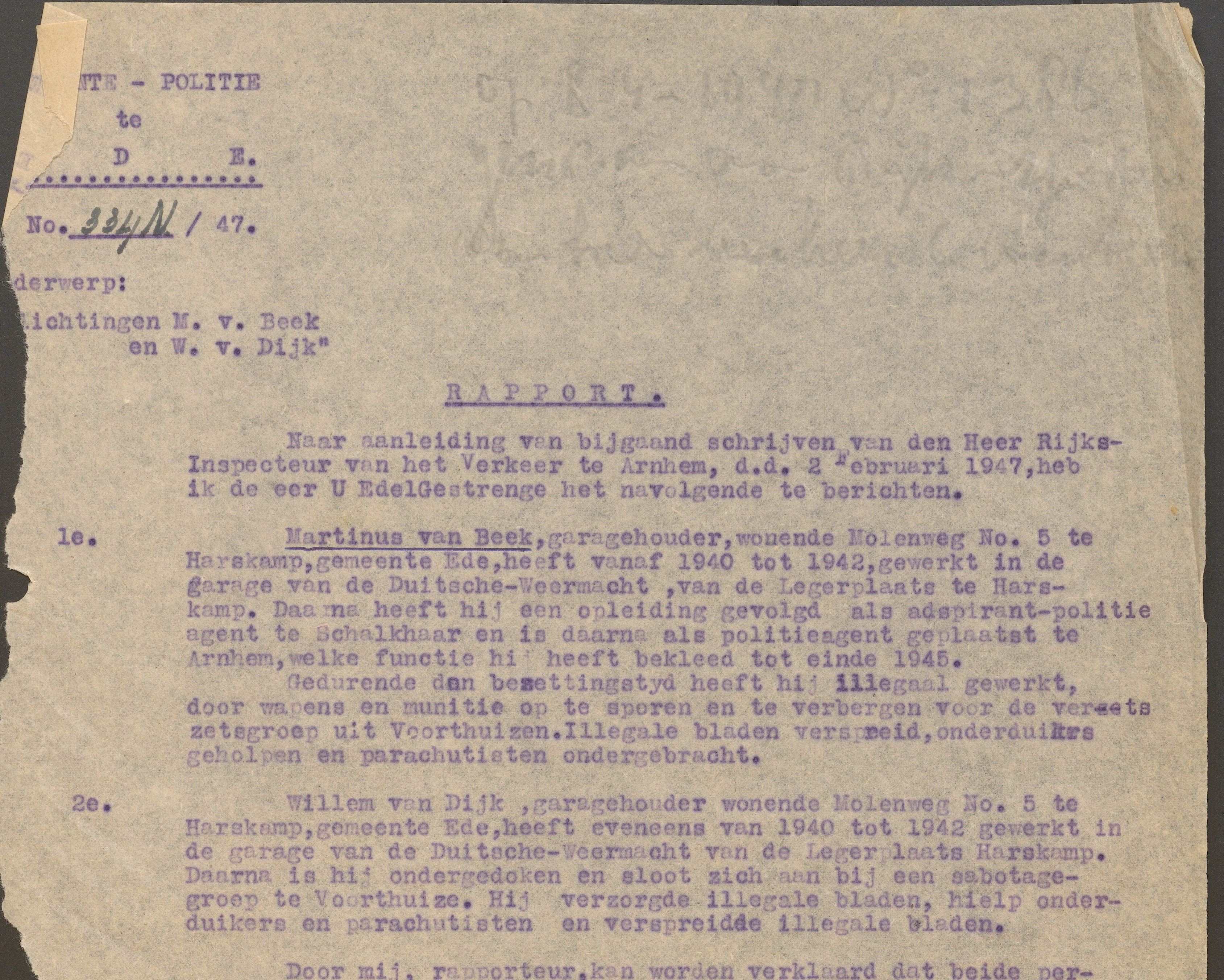
Link to the section His work, by the police in 1947✓ An Ede police brigadier, answering a letter of 2 February 1947 from the state traffic inspector at Arnhem, reported on his oath of office on 4 April 1947 that "Martinus van Beek,garagehouder,wonende Molenweg No. 5 te Harskamp" had worked from 1940 to 1942 "in de garage van de Duitsche-Weermacht ,van de Legerplaats te Harskamp" (in the garage of the German Wehrmacht at the Harskamp army camp); then trained as a probationary police constable at Schalkhaar and was posted as a constable at Arnhem, "welke functie hij heeft bekleed tot einde 1945" (which post he held until the end of 1945) (the report, p. 1). The same report says Van Dijk also worked in that garage from 1940 to 1942 (paragraph 2e; Willem van Dijk). The report does not say what the inspector's letter asked.
The report's account of his resistance work:
During the occupation he worked illegally, tracing weapons and ammunition and hiding them for the resistance group from Voorthuizen. Distributed illegal papers, helped people in hiding and sheltered paratroopers.
Dutch originalGedurende den bezettingstyd heeft hij illegaal gewerkt, door wapens en munitie op te sporen en te verbergen voor de verzets zetsgroep [sic] uit Voorthuizen.Illegale bladen verspreid,onderduikers geholpen en parachutisten ondergebracht.
— Ede municipal police · report no. 334/N/47, "Inlichtingen M. v. Beek en W. v. Dijk", Otterlo, 4 April 1947 · Gemeentearchief Ede 1006/217 · the transcription, p. 1
His own account, 1946
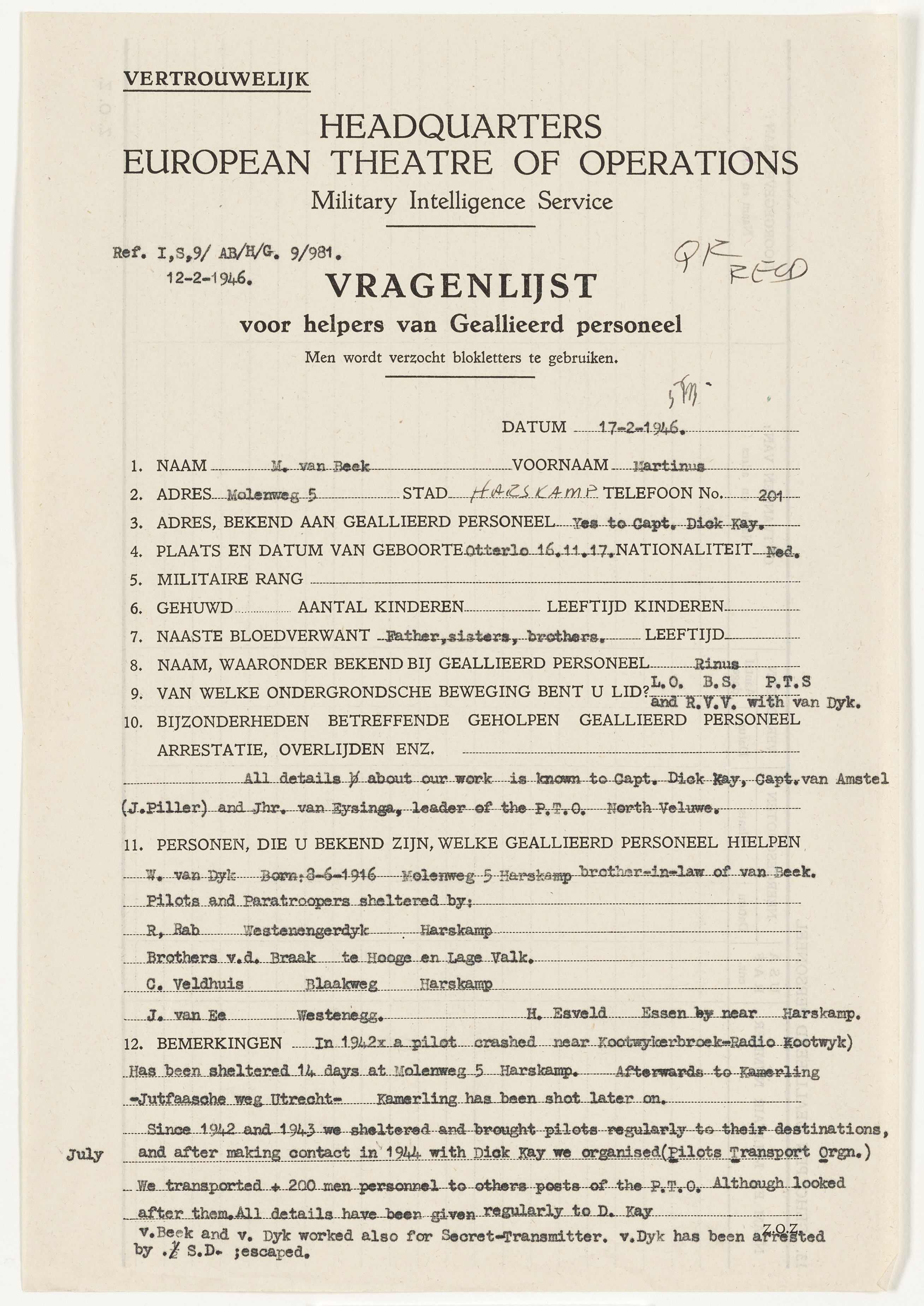
Link to the section His own account, 1946✓ His questionnaire for the Allies, dated 17 February 1946, is typed as "M. van Beek", first name "Martinus", known to Allied men as "Rinus" (p. 2, checked on the image). Under remarks:
- A pilot of 1942. "In 1942x a pilot crashed near Kootwykerbroek-Radio Kootwyk) Has been sheltered 14 days at Molenweg 5 Harskamp. Afterwards to Kamerling -Jutfaasche weg Utrecht- Kamerling has been shot later on." (the stray "x" and the closing bracket are on the form)
- Before Kragt. "Since 1942 and 1943 we sheltered and brought pilots regularly to their destinations".
- With Kragt. "and after making contact in 1944 with Dick Kay we organised(Pilots Transport Orgn.) We transported + 200 men personnel to others posts of the P.T.O.", "July" typed in the margin beside the line; "All details have been given regularly to D. Kay".
- The transmitter. "v.Beek and v. Dyk worked also for Secret-Transmitter. v.Dyk has been arrested by .[x'd out] S.D- ;escaped." (the bracket is our note of a strike-out).
Under item 10 he wrote that "All details about our work is known to Capt. Dick Kay, Capt.van Amstel (J.Piller) and Jhr. van Eysinga, leader of the P.T.O. North Veluwe": Dick Kragt, Joop Piller and Dirk van Eysinga. Under item 11 he listed "W. van Dyk Born:8-6-1916 Molenweg 5 Harskamp brother-in-law of van Beek", and as those who sheltered pilots and paratroopers R. Rab of the Westenengerdyk, "Brothers v.d. Braak te Hooge en Lage Valk", C. Veldhuis of the Blaakweg, J. van Ee, "Westenegg" (◐ Westeneng) and "H. Esveld Essen by near Harskamp" (p. 2).
A second, shorter questionnaire in his file, headed "van Amstel", gives "16/11/'17 Ede", "S.I.9" as his movement, and, typed, "C. Velthuizen Blaakweg 12" and "Rap. Westengedijk", then "and so on", with a pencilled 0 beside the first and a tick beside the second (p. 4). Its reverse has the table of men helped, which says only "He had always helped with transports and has always looked after pilots and paratroops and given them lodgings The number is not known bu [sic] it is very great about 50" (p. 5), almost word for word the table in Van Dijk's file (Willem van Dijk). ◐ It has no date: it matches Van Dijk's form of 8 June 1946 (the same "van Amstel" heading and the same two typed names and "and so on"), and the cover of this file has "Conf. 56 9/6/46", the next day.
A pilot in 1942 or 1943, with Van Dijk
Link to the section A pilot in 1942 or 1943, with Van Dijk✓ The reply "W. van Dijk & M. van Beek, Molenweg 5" to the American office's letter of 23 May 1946 about J. J. Minderhoud is signed by both, "W. v. Dijk" and "M. v. Beek" (the letter, p. 6, checked on the image).
- It says that in the summer of 1942 or 1943 they were handed a shot-down American pilot, "hebben hem toen een paar dagen onderdak gegeven, bij Baron Makay te Harskamp" (then gave him some days' shelter with Baron Mackay at Harskamp), and that, having asked Minderhoud for his car or whether he would himself take an acquaintance of theirs to Ede, they got in the back with the pilot and drove off "zonder dat Minderhoud wist wie of er in de auto zaten" (without Minderhoud knowing who was in the car).
- Minderhoud's own form says he found the airman and took him to Ede himself, and someone initialling F.B. wrote "Not true" beneath it (Minderhoud's form, p. 2, checked on the image; below).
- It is the only document we hold that the two wrote together, and it gives Baron Mackay's at Harskamp as one of their shelters, the estate where Murphy's party was hidden in November 1944.
A researcher's note on him
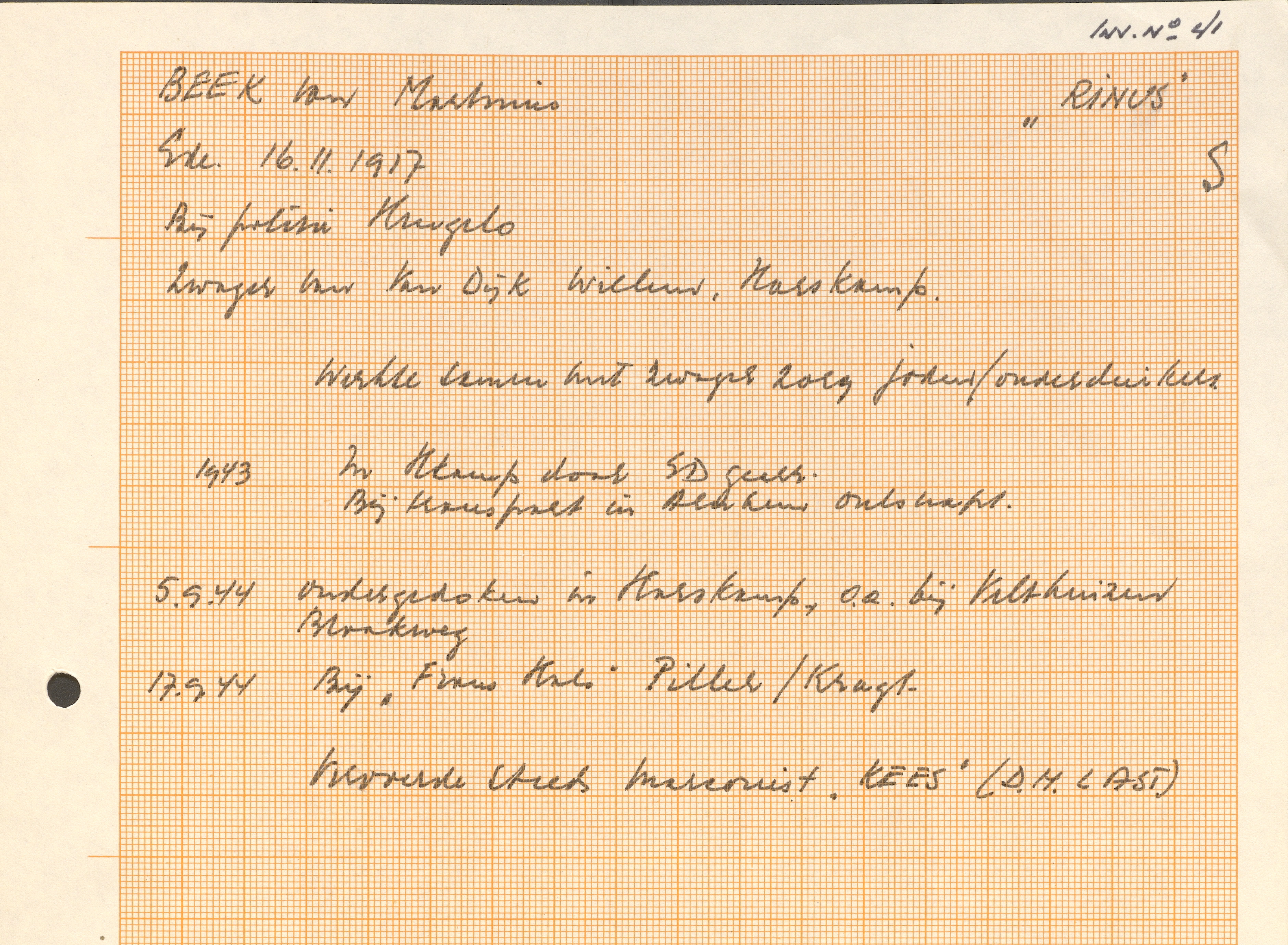
Link to the section A researcher's note on him◐ The same Ede folder holds a handwritten note on squared paper, made for the book Ede 1940-1945 by its compilers (unsigned; ◐ Lagerwij or Plekkringa), with no sources given. Read from the image, with the doubtful words marked:
- "BEEK van Martinus", "RINUS", "Ede. 16.11.1917", "Bij politie Hengelo [?]" (in the police, Hengelo [?]), "Zwager van van Dijk Willem, Harskamp" (brother-in-law of Willem van Dijk);
- "Werkte samen met zwager zorg [?] joden/onderduikers" (worked with his brother-in-law; care [?] of Jews/people in hiding);
- "1943 In H.kamp [?] door SD gearr. [?] Bij transport in Arnhem ontsnapt." (1943: arrested [?] by the SD in Harskamp [?]; escaped during transport in Arnhem); the note does not say whose arrest, though it stands on his sheet (below);
- "5.9.44 Ondergedoken in Harskamp, o.a. bij Velthuizen Blaakweg" (went into hiding at Harskamp, among other places with Velthuizen on the Blaakweg);
- "17.9.44 Bij „Frans Hals” Piller/Kragt";
- "Verzorgde [?] steeds [?] marconist „KEES” (D.H. LAST)" (looked after [?] the wireless operator "Kees", D.H. Last). ◐ J. C. Veldhuis, whose address known to Allied men was Blaakweg 12, Harskamp, wrote in 1946 that he "had a marconist “Keesje” pseudo Dick Last in my house" (his form, p. 2; Dick Kragt).
(Gemeentearchief Ede 1006/217, p. 3.)
With Murphy
Link to the section With MurphyMurphy's side of the Harskamp weeks is told on Kijkuit and Harskamp. Nothing in Van Beek's own file names Murphy.
Kragt's men at Harskamp
Link to the section Kragt's men at Harskamp◐ Ede's war history names "Marten van Beek en Willem van Dijk in Harskamp" among the trusted helpers Kragt found on the Veluwe: "Van Beek (“Rinus”) was bij de politie in Arnhem" (Van Beek, "Rinus", was in the police at Arnhem), and with Van Dijk, "Piet", he collected weapons left in the battle area after the fighting at Arnhem; "ze deden dat gekleed in politie-uniformen en kregen daardoor van de Ortskommandant in Harskamp alle mogelijke medewerking" (they did it dressed in police uniforms and so got every help from the German town commandant at Harskamp) (Ede manuscript, p. 43; p. 44). Its research notes on Kragt have "v. Beek en Willem v. Dijk in Harskamp" as his trusted men there (Ede 1006/493, p. 7).
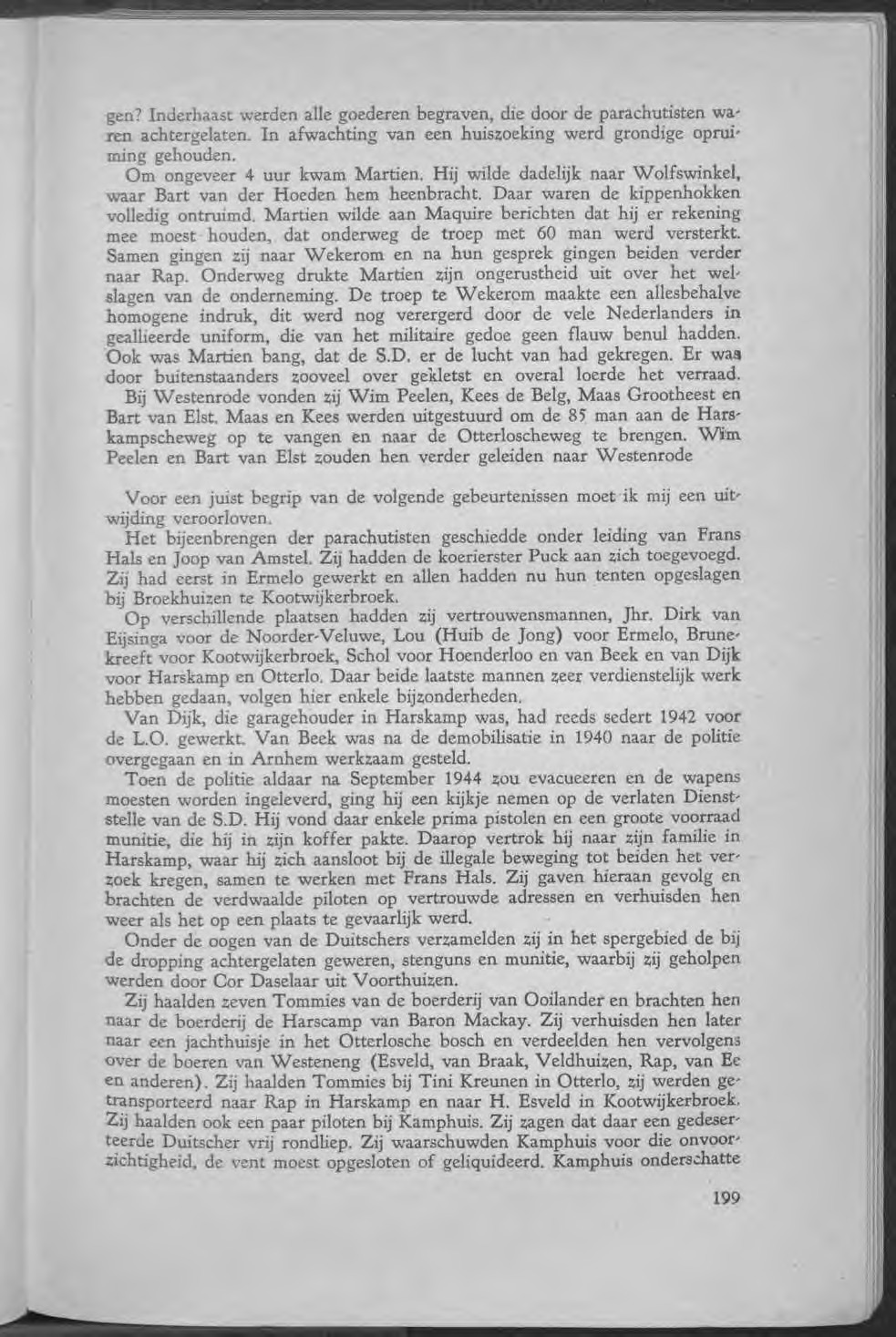
✓ Th. A. Boeree's printed chronicle (Frouws, Ede; the Koninklijke Bibliotheek dates it 1947) gives the trusted men of Frans Hals (Kragt) and Joop van Amstel (Piller) place by place, "van Beek en van Dijk voor Harskamp en Otterlo", who "zeer verdienstelijk werk hebben gedaan" (did very meritorious work), and their cover names, "Van Dijk en van Beek (alias Piet en Rinus)" (pp. 199–200). All the Boeree pages on this page are checked on the page images, and their links go to those images.
- ✓ His life, by Boeree. "Van Beek was na de demobilisatie in 1940 naar de politie overgegaan en in Arnhem werkzaam gesteld" (after the demobilisation of 1940 Van Beek went into the police and was posted at Arnhem) (p. 199).
- When the Arnhem police were to evacuate after September 1944 and hand in their weapons, he looked round the abandoned office of the SD, found "enkele prima pistolen en een groote voorraad munitie" (a few fine pistols and a large stock of ammunition) and packed them in his suitcase; he then went to his family at Harskamp and joined the underground there, until he and Van Dijk were asked to work with Frans Hals (p. 199).
- ✓ What the two did. They put stray pilots at trusted addresses and moved them when a place grew dangerous; collected, in the closed zone and under German eyes, the rifles, sten guns and ammunition left from the drops, helped by Cor Daselaar of Voorthuizen (p. 199).
- They fetched seven Tommies from Ooilander's farm to Baron Mackay's farm, de Harscamp, later to a hunting lodge in the Otterlo wood and then among the farmers of Westeneng ("Esveld, van Braak, Veldhuizen, Rap, van Ee en anderen"); and fetched men from Tini Kreunen at Otterlo, who went to Rap at Harskamp and H. Esveld at Kootwijkerbroek (p. 199).
- ◐ Boeree dates none of it, and the seven are not shown to be Murphy's party, which was six men, taken from Mackay's by ambulance to the Rockelsche Zand (Hardy).
- ◐ Kamphuis. Boeree has them also fetch a few pilots from Kamphuis, see a German deserter walking about freely there and warn Kamphuis about it; in Boeree's words, "de vent moest opgesloten of geliquideerd" (the fellow had to be locked up or liquidated) (p. 199).
- Boeree has "Kamphuis onderschatte het gevaar" (Kamphuis underestimated the danger); a few days later the German was caught in a raid and "vertelde hij prompt alles" (promptly told everything), and Kamphuis was arrested, made to wheel a barrow of ammunition to Voorthuizen and shot there by the post office as a terrorist (pp. 199–200). ◐ This is Boeree's account alone; it is undated, and no other source on Kamphuis has been read.
"WILLEM and a policeman", 14 and 18 November
Link to the section "WILLEM and a policeman", 14 and 18 NovemberJames Hardy's MI9 report has the six, Murphy among them, in a hut on Baron Mackay's estate at Harskamp from 7 November, and "at 1830 hours on 14 Nov two members of the Underground arrived. One was called WILLEM and the other was a policeman whose name I do not know"; they took the six to a "'Red Cross' ambulance" about a mile away, which drove them to the Rockelsche Zand (Hardy; Harskamp). After Hardy, Murphy, Banwell and Branford (Hardy: "Brentford") lost their guides on the night of the 17th, "At about 1730 hours (18 Nov) WILLEM and the Dutch Policeman whom I had met before, arrived bringing two extra bicycles"; "WILLEM and the Policeman recced the road" where "WILLEM said a lorry was to pick us up", and when it did not come they led the men to "another party of evaders, about 20 in all" (Hardy; H. van de Brink).
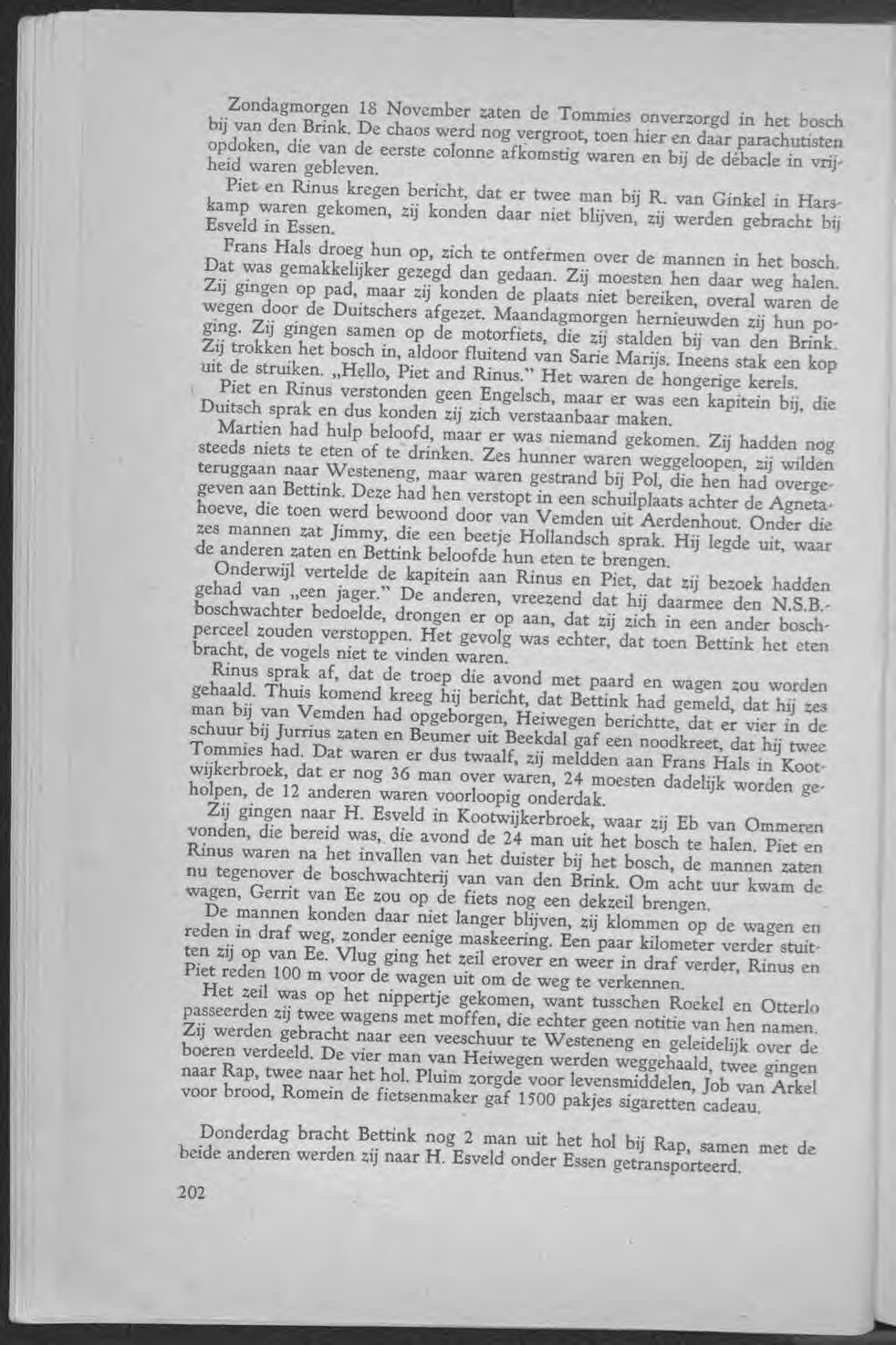
- ◐ A Harskamp man who went about in police uniform with Willem van Dijk fits Hardy's pair: Ede's history has the two in police uniforms, and Boeree "Rinus, die evenals altijd brutaalweg in politieuniform was" (Rinus, who as always was brazenly in police uniform) (p. 200, below).
- ⚠︎ No source puts Van Beek at Mackay's on 14 November or with Murphy's party on the 18th. A fit, not a proof. G. J. Michels, an Ede police constable (Otterlo in the war, Harskamp after) who knew both men, is another possible policeman (G. J. Michels).
Pegasus II, by Boeree
Link to the section Pegasus II, by Boeree- The plan. The men were to be gathered on "de avond van 17 November" at the forester Van de Brink's house at the foot of the Herteberg; "van Dijk en van Beek zouden daar de mannen brengen uit Harskamp en naaste omgeving" (Van Dijk and Van Beek were to bring the men from Harskamp and round about) (p. 200).
- "Van Dijk en van Beek (alias Piet en Rinus) waren blij, toen Puck hun het bericht bracht, waardoor een einde werd gemaakt aan het voortdurend verhuizen" (were glad when Puck brought the message, which put an end to the constant moving); they were to find 200 eggs, 200 sausages and bandages, and got the eggs from Baron Mackay (p. 200).
- The raid. After the Germans found a transmitter in the Huissen fire engine and raided Otterlo, "Piet en Rinus vluchtten naar Cees Veldhuizen aan de Blaakweg te Westeneng, terwijl zeven Tommies onverzorgd in een bosch op hen zaten te wachten" (Piet and Rinus fled to Cees Veldhuizen on the Blaakweg at Westeneng, while seven Tommies sat waiting for them, uncared for, in a wood); Piet Schuur fetched the men and handed them to the two on the way (p. 200).
- The night. They came out on the main road about 400 m past Van de Brink's house; "Piet bleef bij de mannen en Rinus, die evenals altijd brutaalweg in politieuniform was, zou eens kijken, waar Huisman met de Elburgers zat" (Piet stayed with the men, and Rinus, as always brazenly in police uniform, went to see where Huisman and the men from Elburg were) (p. 200).
- A car stopped halfway up the Herteberg and the men who got out were Germans; "Zij riepen hem aan, maar toen zij de uniform zagen, lieten zij hem verder rijden" (they called to him, but when they saw the uniform they let him ride on) (p. 200).
- At Van de Brink's he told Joop van Amstel and Frans Hals that the car had stopped a few hundred metres on with about twenty Feldgendarmerie in it; he rode back past the Germans, "die hem ongemoeid lieten" (who left him alone), to his men lying in the wood about 20 m from the road at the top of the Herteberg (p. 201).
- "Het was ongeveer tien uur en Rinus bracht zijn mannen bij Frans Hals" (it was about ten o'clock and Rinus brought his men to Frans Hals), too late to join the column, which had passed Westenrode an hour before; when the crossing was called off, "Piet en Rinus gingen naar huis" (Piet and Rinus went home) (p. 201).
- ◐ Boeree dates the march 17 November and Hardy the lorry that never came the 18th: the night of Pegasus II is disputed by a day (His own account, still open, item 16). Whether Boeree's night with the seven Tommies is Hardy's evening with Willem and the policeman is not settled.
The men left behind
Link to the section The men left behind- ✓ The weekend. Piet and Rinus heard that two men had come to R. van Ginkel's at Harskamp, and they were taken to Esveld at Essen ("zij werden gebracht bij Esveld in Essen"); Frans Hals told them to see to the men in the wood, but the roads were closed by the Germans and they could not get there (p. 202). Boeree opens this with "Zondagmorgen 18 November" (p. 202), but 18 November 1944 was a Saturday; H. van de Brink's page reads the Sunday as the 19th.
- ✓ The Monday. They rode together on the motorbike, "die zij stalden bij van den Brink" (which they left at Van den Brink's), went into the wood whistling Sarie Marijs, and were greeted with "Hello, Piet and Rinus."; the men were hungry, and a captain among them spoke German, so they could make themselves understood (p. 202).
- "Rinus sprak af, dat de troep die avond met paard en wagen zou worden gehaald" (Rinus arranged for the group to be fetched that evening by horse and wagon) (p. 202).
- Coming home he heard of twelve more men already sheltered, six at Van Vemde's, four in Jurrius's barn and two with Beumer (by the text Bettink reported the six, Heiwegen the four and Beumer of Beekdal the two), and they told Frans Hals at Kootwijkerbroek that 36 men were left, 24 needing help at once (p. 202).
- At H. Esveld's at Kootwijkerbroek they found Eb van Ommeren (◐ Eb van Omme), who agreed to fetch the 24 that evening; "Rinus en Piet reden 100 m voor de wagen uit om de weg te verkennen" (Rinus and Piet rode 100 m ahead of the wagon to scout the road), and the men were taken to a cattle shed at Westeneng and shared among the farmers (p. 202).
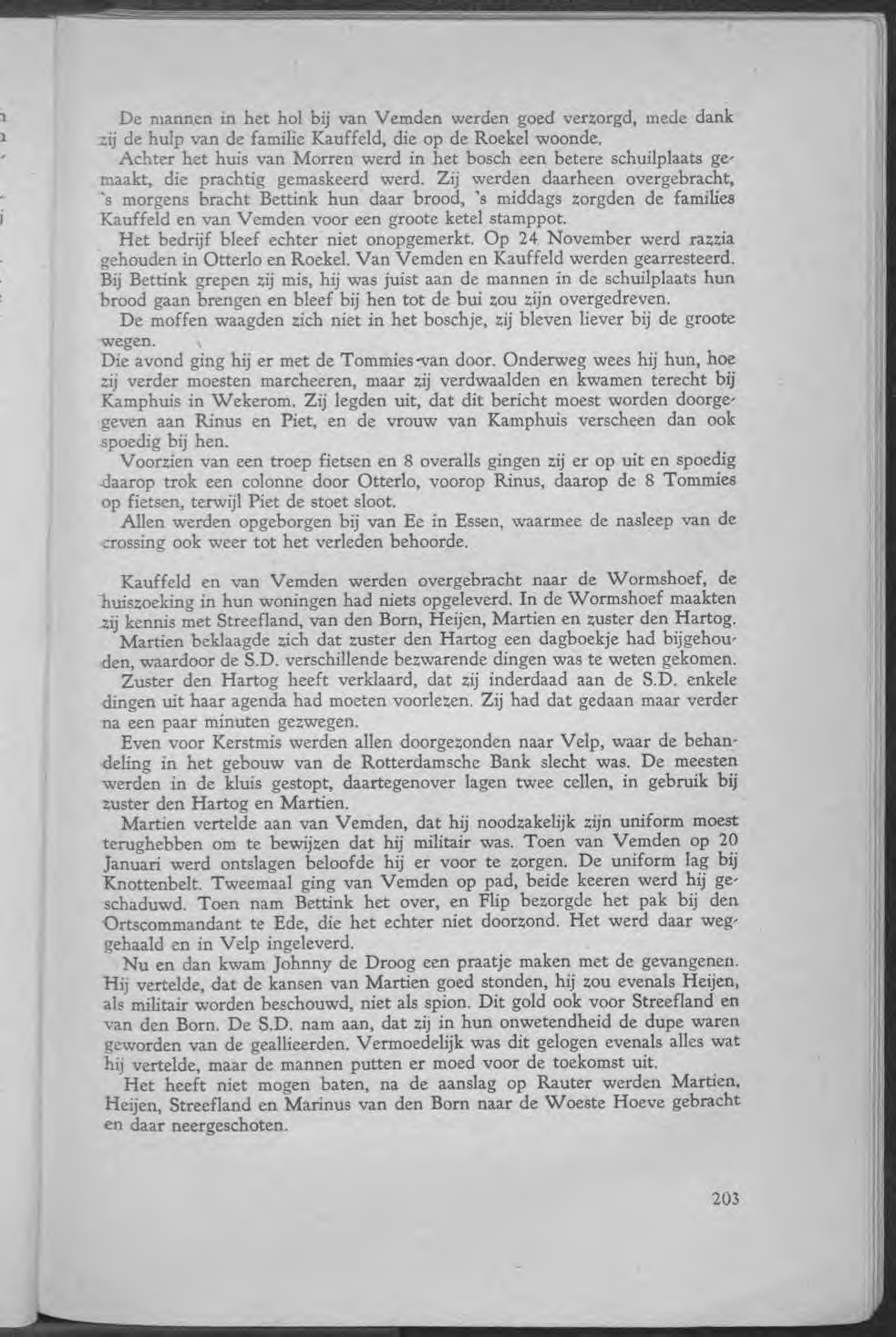
- ✓ After 24 November. After the raid on Otterlo and Roekel, the men from Bettink's hiding place lost their way and came to Kamphuis at Wekerom; they asked for word to be passed to "Rinus en Piet", and Kamphuis's wife soon came to them (◐ Boeree does not say whether this Kamphuis is the one shot at Voorthuizen, above).
- With bicycles and eight overalls "trok een colonne door Otterlo, voorop Rinus, daarop de 8 Tommies op fietsen, terwijl Piet de stoet sloot" (a column went through Otterlo, Rinus in front, then the 8 Tommies on bicycles, while Piet closed it), and all were lodged with "van Ee in Essen" (p. 203). ◐ Which Van Ee is not shown (Other men named Van Ee). Hardy and Murphy had left the dug-out on the morning of the 24th, so they were not in this column (Hardy).
Other helpers' forms that name him
Link to the section Other helpers' forms that name him- ✓ Pieter Hemmo Edens, police inspector of Ede, "Hemmo", of the Ede underground, lists "D. Wildeboer (BILL), W. van Dyk (WILLEM), C. van Tyen (CAREOL), M. van Beek, J. Klok" as the people with whom he helped several Army men who landed at Arnhem: "together with the above mentioned people we transported them over the Rhine to return them to their own Forces" (his form, p. 2, checked on the image; the archive lists the file as Edens, Berend). It does not say what Van Beek did in the group.
- ✓ Reinier van den Ham of Harskamp, of the Ede underground, lists "P.H. Edens, Ede. W. van Dijk and M. van Beek both at Harskamp. G. Rap at Harskamp" (his form, p. 3, checked on the image).
- ✓ G. J. Michels, an Ede police constable (Otterlo in the war, Harskamp after), lists "W. VAN DYK GARAGE-HOUDER HARSKAMP" and under it "M VAN BEEK" with a ditto mark under "GARAGE-HOUDER", at Harskamp (his Dutch form, p. 4, checked on the image; "M.van Beek[?]" in the English, p. 2; G. J. Michels). The form is undated.
- ✓ Joop Piller named him, as "Marinus van Beek", among the helpers who "hebben zich in dezen tijd bijzonder onderscheiden" (especially distinguished themselves at this time), the time he describes from September 1944: "Jan Roskam, Eb van Ommeren (overleden), Evert Bruinekreeft, Willem van Dijk en Marinus van Beek" (Piller's statement, p. 18; Joop Piller).
- ✓ His brother-in-law. On 27 June 1945 at Ede, Willem van Dijk married Lubertha van Beek, 24, born at Ede, the daughter of Jan van Beek and Hilletje Verhoef (the marriage, index only). ◐ Those are the parents of Martinus in Ede's birth register (his birth), so she was very probably his sister; his form of February 1946 calls Van Dijk "brother-in-law of van Beek" (p. 2).
- ✓ The police. By the 1947 report he served as a constable at Arnhem until the end of 1945, and by April 1947 he and Van Dijk, both at Molenweg 5, ran a garage business together under the name "FIRMA B E D I J K", employing "6 à 7 man personeel" (6 or 7 staff) (the report, p. 1).
- His grade. The cover of his American file has "Grade 5" and "Conf. 56 9/6/46" (p. 1). ✓ The British index to Dutch helpers has "v. BEEK, Martinus", "Molenweg 5, HARSKAMP", grade 5, compensation "Nil" (a ditto mark under the "Nil" at the top of the column) (the index page, checked on the image). The certificate column on that page runs out of line with the names, so his certificate number is ◐ 22045 or 15552.
- Ede's war collection. Ede's collection for the book Ede 1940-1945 has a folder in his name, "Beek, Martinus van" (Gemeentearchief Ede, toegang 1006, inv. 217), which holds the police report of 1947 (and a carbon copy) and the research note above (the folder). ✓ Inv. 215 in the same collection, "Beek, Marinus", is about a different man: November 1943 police reports on a Lunteren farmhand, born 1924, who had not reported for labour in Germany (the police's "contractbreker") (the folder, pp. 1 and 3, read on the images).
Where and when he died has not been found.
Where the sources disagree
Link to the section Where the sources disagreeHis name. Ede's war history calls him "Marten van Beek" (pdfpage 42, p. 43), and Piller "Marinus van Beek" (p. 18). His birth record, his own forms, the British index, the 1947 police report and Ede's own folder all have "Martinus" (the register; p. 2; the index; the report). ✓ Martinus.
When he joined the police. ⚠︎ Boeree has him go into the police after the demobilisation of 1940 (p. 199); the 1947 police report has him work in the Wehrmacht garage at Harskamp from 1940 to 1942 and only then train at Schalkhaar (the report, p. 1). Both are 1947 documents; neither gives a date for his posting at Arnhem. The research note's "Bij politie Hengelo [?]" is a doubtful reading and names a different town (p. 3).
When he left the police. ⚠︎ Boeree has him leave Arnhem for his family at Harskamp when the Arnhem police were to evacuate after September 1944 (p. 199), and the research note has him in hiding at Harskamp from 5 September 1944 (p. 3); the police report has him hold his post at Arnhem "tot einde 1945" (p. 1). They may describe a posting he kept on paper while away from it; no source says so.
An arrest in 1943. ⚠︎ The research note's line "1943 In H.kamp [?] door SD gearr. [?] Bij transport in Arnhem ontsnapt" stands on his sheet but does not say whose arrest it records (the note, p. 3). His own form of 1946 mentions no arrest of his own and says "v.Dyk has been arrested by .[x'd out] S.D- ;escaped." (p. 2); the statement in Van Dijk's file puts Van Dijk's arrest "a few months before the liberation" and his escape from prison with a hacksaw baked into a loaf (Willem van Dijk). Not settled.
The police. Ede's history and Boeree have him in the Arnhem police, and the police report confirms it (Ede manuscript, p. 43; Boeree, p. 199; the report, p. 1); his own forms do not say what he did. Michels's form puts a ditto for "GARAGE-HOUDER" beside his name (p. 4), the trade the 1947 report gives him.
The pilot of 1942 or 1943. ⚠︎ His own form has a pilot who crashed near Kootwijkerbroek in 1942 sheltered "14 days at Molenweg 5" and then passed to Kamerling at Utrecht (p. 2); the joint letter with Van Dijk has a pilot of "1942 of 1943" sheltered "een paar dagen" at Baron Mackay's and taken to Ede (p. 6). They may be two pilots; nothing says either way. Minderhoud's own form tells the second differently (his form, p. 2).