Sgt Bernard Haller
1 Jan 1922 – ?
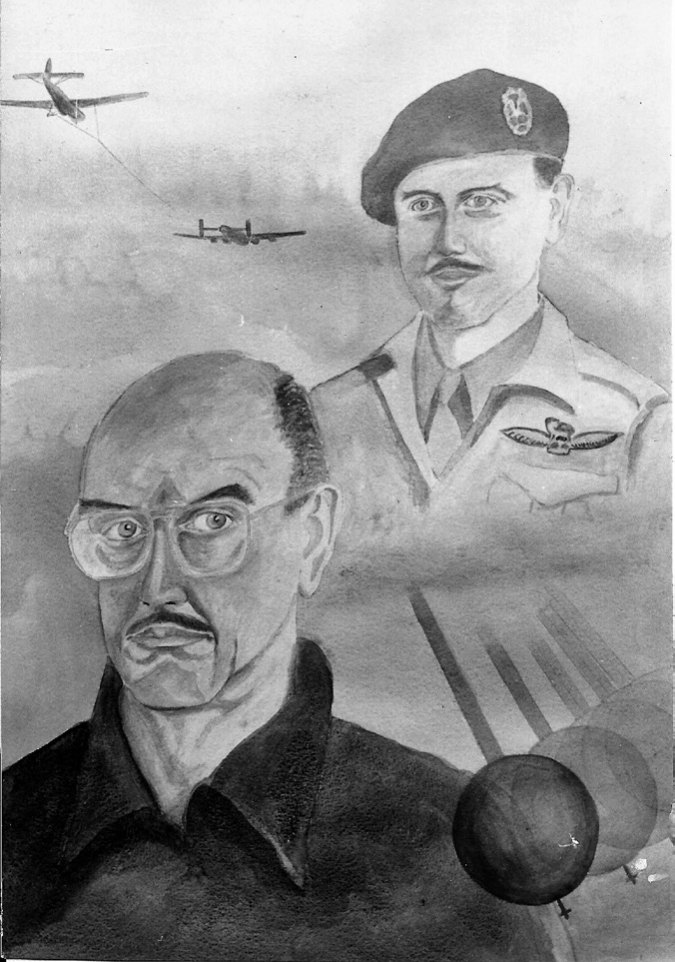
Sgt B. J. F. Haller (14291815)
About: The "Sgt John" of Hardy's and Walsh's reports, a glider pilot wounded at Arnhem who escaped from the Apeldoorn barracks with James Hardy on the night of 6/7 October 1944 and hid with Murphy's party on the Veluwe until Pegasus II failed. He then stayed hidden, mostly at Kootwijkerbroek, until he was freed at Goudriaan on 8 May 1945; Murphy calls him "John Bruce".
Unit or role: Sgt, 14291815, 24 Flight, "G" Squadron, No. 1 Wing, Glider Pilot Regiment; second pilot of a Horsa glider; a student before the war.
Where: Home at Bamford, near Sheffield, in his escape report. In hiding: Kijkuit in the Leuvenumse Bos, then the Veluwe villages of Harskamp, Otterlo and Roekel, Kootwijkerbroek and Valk, and, in 1945, Veenendaal, Rhenen and Amerongen on his way to the Alblasserwaard.
Evidence: ✓ his escape report (MI9/S/P.G.(H) 2991, 9 May 1945; Kew WO 208/3326/2991, catalogue entry); ✓ his mention in despatches (Kew WO 373/64/56) and the London Gazette, 1 November 1945, p. 5313; ✓ Noordman, ch. 19, pp. 268–272, with his own words; Dekkers and Vroemen, De zwarte herfst; ✓ Hardy's report and Walsh's; ✓ the helpers' files below; ⚠︎ Murphy's naming of him (notes)
✓ His escape report gives his date of birth as 1 January 1922, his peacetime profession as student, and his army service as since 17 September 1942 (his report). The Pegasus Archive's biography, on the same page, adds that he enlisted in the Bedfordshire and Hertfordshire Regiment, volunteered for the Glider Pilot Regiment in 1943, finished his flying training in 1944 and was one of the crews picked for the new No. 24 Flight of "G" Squadron; it is the archive's own text, with the questionnaire of 11 May 1945 cited for his occupation.
Arnhem. In a letter of 27 August 1997 to Bob Hilton, printed by the Pegasus Archive, he wrote that he was second pilot on the first lift of 17 September 1944, when the tow rope broke and the glider force-landed undamaged at South Cerney ("Down Ampney" in the archive's bracketed correction); on the second lift, on 18 September, he landed on the first lift's landing zone and drove to Divisional Headquarters at Hartenstein. On the 20th he joined a small group of glider pilots sent to the perimeter north of headquarters; on the 23rd a Tiger tank knocked out their position, and he and Sgt "Yanto" Evans were hit, he "through the arm", and both taken to a hospital in German hands (his letter). His report agrees: dropped near Wolfheze on 18 September, at Oosterbeek headquarters until the 20th, wounded on the 23rd "in an engagement with a tank", then hospitals at Oosterbeek on 23–24 September, Arnhem 24–25 and Apeldoorn from 25 September to 6 October (same). To Noordman he gave it as a shell splinter in his left forearm, in a clash with a German tank on 23 September, then the hospital at Oosterbeek, which was in German hands, a hospital at Arnhem on 24 September and the Willem III barracks at Apeldoorn on the 25th (Noordman, pp. 268–269). De zwarte herfst has him fight four days at Oosterbeek, wounded in a clash with a Tiger tank, and go by a German dressing station to the St Elisabeth hospital and a few days later to the barracks (p. 229). The hospitals are set side by side below.
The escape with James Hardy, 5 to 7 October. The citation for his mention in despatches, in the War Office's words:
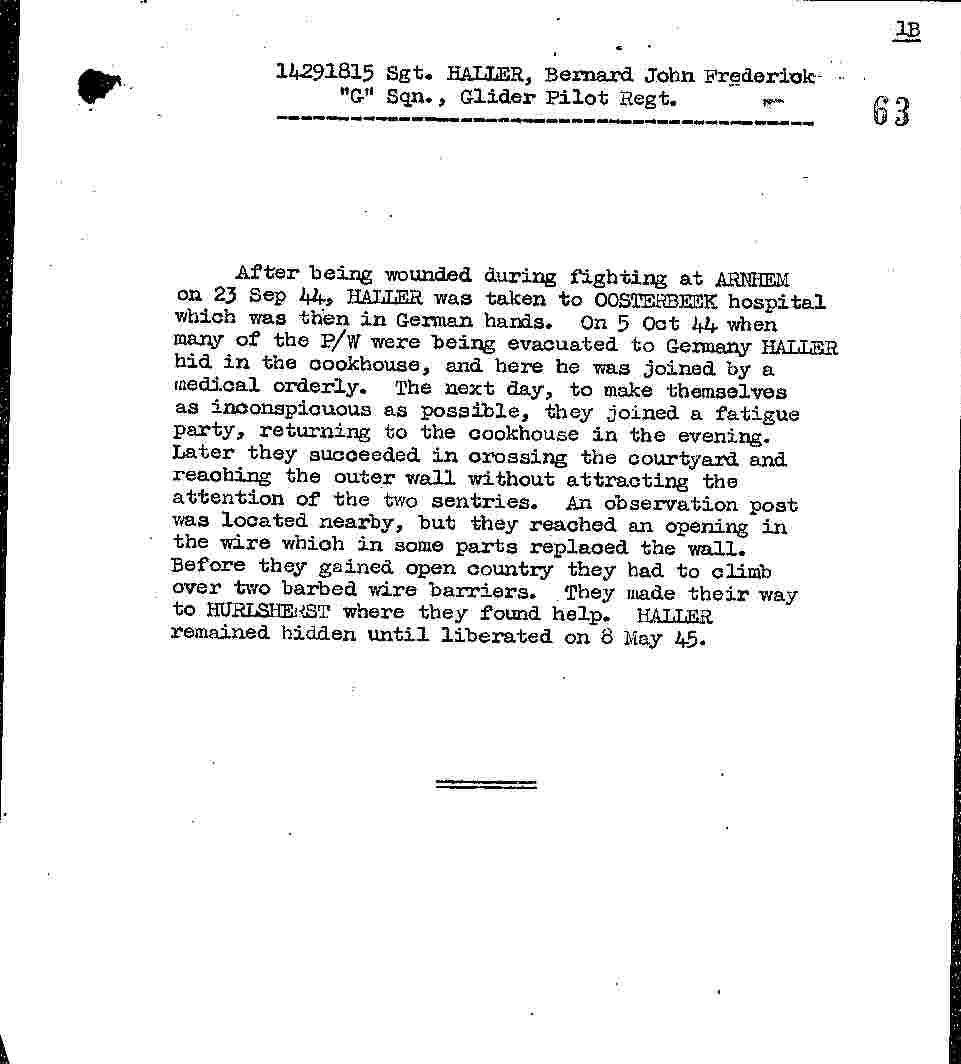
After being wounded during fighting at ARNHEM on 23 Sep 44, HALLER was taken to OOSTERBEEK hospital which was then in German hands. On 5 Oct 44 when many of the P/W were being evacuated to Germany HALLER hid in the cookhouse, and here he was joined by a medical orderly. The next day, to make themselves as inconspicuous as possible, they joined a fatigue party, returning to the cookhouse in the evening. Later they succeeded in crossing the courtyard and reaching the outer wall without attracting the attention of the two sentries. An observation post was located nearby, but they reached an opening in the wire which in some parts replaced the wall. Before they gained open country they had to climb over two barbed wire barriers. They made their way to HURLSHERST where they found help. HALLER remained hidden until liberated on 8 May 45.
— War Office · citation for a mention in despatches, September 1945 · The National Archives, Kew, WO 373/64/56 · the transcription
James Hardy's Military Medal citation tells the same escape in nearly the same words, the cookhouse on 5 October, the fatigue party, the two sentries, the wire and the two barriers, and Hulshorst, with "a paratrooper" beside him (Hardy's recommendation, p. 2): the medical orderly of Haller's citation is Hardy, ✓ as Haller's own escape report has the two of them together until about 24 November. His report has them hide in the mess hall "under a table" on the night of 6/7 October, go through the door "about midnight" while the two guards slept, crawl along a ditch to a weak spot in the wire he had seen the day before on a working party, and walk about 16 hours north-west by compass and a small map (his report). Dekkers and Vroemen's De zwarte herfst (1984, in copyright, so short quotations) has the same from him:
Together with the paratrooper Jim Hardy he saw a chance, on 6 October, to escape. With the help of a little compass and a piece of a map they made their way north-west. "It was probably a mad idea, but we meant to find the Zuiderzee and get on a fishing boat near Harderwijk. We wanted to get to England that way, but we had overlooked a few small things, such as the Afsluitdijk and the North Sea," writes John Haller.
Dutch originalSamen met paratrooper Jim Hardy zag hij op 6 oktober kans, te ontsnappen. Met behulp van een kompasje en een stukje van een landkaart zochten zij zich een weg in noordwestelijke richting. 'Het was waarschijnlijk een zotte gedachte, maar we waren van plan de Zuiderzee op te zoeken en in de buurt van Harderwijk op een vissersboot te stappen. Zo wilden we naar Engeland, maar we hadden een paar kleinigheidjes over het hoofd gezien, zoals de Afsluitdijk en de Noordzee,' schrijft John Haller.
— C. A. Dekkers and L. P. J. Vroemen · De zwarte herfst, 1984, p. 229 · the extracts
The stops on the way, from his report, Hardy's and Noordman's rendering of Hardy's, which gives the same days:
- ✓ Uddel, 7 to 9 October. They came to a farm at Uddel at about four in the afternoon of 7 October and were taken to a dug-out in the woods, where they stayed two nights (Hardy; Noordman, p. 277).
- Berend van Milligen, a widower of Heegderweg 42, Uddel, born there in 1888, has them in his table: "Pte Hardy J. R.A.M.C." and "Sgt. HALLER B.T.T. 14291815 Glider Pilot Regt.", "7/9 '10 '44", 2 days, "escaped from het Loo", and for where they went, "address given by J. van der Hoorn Hulsthorst, but it never arrived" (his table, p. 4).
- "After 2 days stay they went away, just before the razzia's started. According to rumours they arrived at Mr. van Beuningen in Vierhouten" (his questionnaire, p. 3).
- The same two men, the same days and the same Hulshorst address, in other words, were typed into section 13 of the form of A. J. A. Tjeenk Willink-Meinders of Brummen, who hid Major Hibbert, and struck out there in pen (that table, p. 3); ◐ by the look of it, a clerk's slip.
- The forester's hut, 9 to 11 October. A boy of about sixteen on a bicycle took them to his father, a gamekeeper in the forest, who put them in a camouflaged dug-out for two days and brought food.
- On the morning of 11 October he told them the Germans were combing the woods, and they hid in a thick clump of young trees while the search passed a few feet away: Haller told Noordman "jonge aangeplante sparren" (young planted spruces), Hardy has "very dense" undergrowth.
- They then went back to his house for food and walked on to Vierhouten, which they reached at about ten at night, and slept in a tobacco shed (Hardy; his report; Noordman, p. 269 for Haller's own words and pp. 277–278 for Hardy's).
- Hulshorst, 12 October. At a farm there "the son of the farmer put us in touch with an organisation" (his report).
- Hardy has a young woodcutter take them home, and his brother, who spoke good English, take them that night to two men of the Underground, and names the brothers "JAN (1)" and "EEVID (?)" and the two men "BRAM and JOOP (?)" (Hardy).
- Haller remembered two young men who fetched them, one small and dark and about eighteen, whose name he had forgotten and who he was told was shot by the Germans about March 1945, and a taller one who spoke good English and gave his name as Adriaan de Kok, whom he took for a student, and from whom he had a letter after the war (Noordman, p. 270).
- Noordman identifies the first as Bram Baar, shot at Varsseveld on 2 March 1945; the second is the name Haller gave, Adriaan de Kok, of whom Noordman says nothing more.
◐ Jan den Besten of Nunspeet listed "James Hardy Oxford." and "John Allen", found in the woods on 12 October 1944, "both landed near Arnhem members of the Airborne Troopers", of whom "one was Sgt. and pilot of the glider" (the two answers on p. 2 that these quotations come from are struck through on the form; the names in the table on p. 3 are not); Hardy went on to Joop Migchelsen near Hulshorst station (den Besten's file, pp. 2–3). Hardy's own report has him escaping with a glider-pilot sergeant whose first name was John, so "John Allen" is very probably Haller under another name.
With Murphy
Link to the section With MurphyKijkuit, 12 October to 6 November
Link to the section Kijkuit, 12 October to 6 NovemberThe two men, Hardy and Haller, were taken to the forester's house Kijkuit in the Leuvenumse Bos, where Bram Baar ("Brummager") of Joop Migchelsen's group looked after the men (Noordman, p. 278; Hardy). ✓ Hardy's report (whose "we" is ◐ himself and Haller: it does not name the glider pilot until 6 November) has the house already held by Eric Blok, a former Dutch second lieutenant, "Emmy", a girl of 19, a man called "Adrian", two Dutchmen in hiding and P/O Brentford, James Branford, who had checked Hardy's identity "on behalf of the Dutch helpers". Hardy left alone on the morning of 19 October, thinking to reach the lines, and came back to the house on the night of 26 October with Murphy and Sam Walsh; Tex Banwell joined on 29 October. So Haller was at Kijkuit from 12 October, a fortnight before Murphy came and until the party left on 6 November.
To Noordman, Haller said the two young men took them to a house in the wood, and described who was there:
I am sure that I met James Branford there, and later also Sammy Walsh and Tom Murphy. The last two were small. Like Hardy, Murphy came from Glasgow.
Dutch originalIk weet zeker dat ik daar James Branford, en later ook Sammy Walsh en Tom Murphy heb ontmoet. De laatste twee waren klein van stuk. Evenals Hardy kwam Murphy uit Glasgow.
— John Haller, in Noordman, Schuilplaats de Veluwe, p. 270
⚠︎ Murphy came from Kelty in Fife, not Glasgow. He also remembered a tall, fair Dutch helper who called himself "George", who sang cowboy songs to a guitar and carried a small pistol in a leather holster, and whom he found rather pleased with himself (same page); he gave no surname, and nothing here identifies him.
His first talk with Branford stayed with him. Branford questioned him closely to prove he was who he said, since he had no identity papers, a torn uniform and a camouflage jacket with one sleeve torn off at the elbow; Branford had no regional English accent, and they tried to talk about flying, Branford a Stirling bomb-aimer and Haller a glider pilot who knew the Stirling from the other end of the tow cable; he learned his first Dutch from him (Noordman, pp. 270–271). While at the forester's house Haller fell ill with what they took to be dysentery, chronic diarrhoea; with no doctor possible he had to keep himself going as best he could, and he remembered little of the journey to the Pegasus II assembly point, thinking the illness began in the house at Hulshorst, before it (same, p. 271).
Harskamp, 7 to 14 November
Link to the section Harskamp, 7 to 14 NovemberAt midnight on 6 November "Derek" and "Loew", in Noordman's rendering Dirk van Eysinga and "Lou", took the six, Banwell, Haller, Murphy, Branford, "the other Paratrooper" (Walsh) and Hardy, to Harskamp by way of the house of "a man called DICK (?)", which Noordman gives as Kragt's base at Kootwijkerbroek. There Baron Mackay hid them in a chicken hut on his estate from the evening of 7 November. Hardy's report names "the Sergeant Glider Pilot JOHN" among the eight, himself and the two guides counted in, and says the men never left the hut in the week they were there (Hardy; Noordman, pp. 281–282, 293–295). The hiding is told in full on the Baron's page, with Hardy's own words, and Boeree's account of the helpers who fetched them. At 1830 on 14 November two Underground men, "Willem" and a policeman, took them to a Red Cross ambulance, which drove them to the Rockelsche Zand (Hardy).
Pegasus II, 17 to 20 November
Link to the section Pegasus II, 17 to 20 NovemberHardy's report has the six men set off on bicycles at about 1830 on 17 November, two to a machine, with "Sgt. JOHN and the other Paratrooper" on the guides' bikes; Hardy, Branford, Banwell and Murphy took the wrong fork and lost the rest of the party (Hardy). Gerrit van Ee of Kootwijkerbroek, one of the guides, remembered the ride and the four getting lost, and that he had Haller on his carrier (Noordman, pp. 283–285).
⚠︎ Walsh puts Haller on the other side of the split: after Hardy and Branford were lost, "our guides took Sgt. BANWELL … Sgt. HALLER , John … , Pte. MURPHY and myself to a house at approx. posn 560984", where they stayed overnight, and moved the next day to the rendezvous. Hardy has Murphy lost with him; Walsh says his account is Hardy's "except for one detail" and does not say which; ◐ this is probably it. Which is right is not settled (Operation Pegasus II has both).
His own memory of the night is thin, because of the illness. By the Dutch authors' summary he took no part in the clash with the Germans or the chaotic end of the operation: an attack of dysentery kept him from keeping pace, and he heard what had happened from comrades who came back (De zwarte herfst, p. 229). ◐ By Hardy's report he was one of the six who set out with the guides on the evening of 17 November, and Kragt's report has "John Haller" almost embrace a German sentry at the next night's failed rendezvous (Kragt's report, p. 5; Operation Pegasus II), so the clash he missed was the main column's, not the late party's wandering. On the major in charge, Maj. H. P. Maguire, Haller says "Waarom zou ik harde kritiek leveren op een dapper man?" (why should I criticise a brave man harshly?): Maguire had forbidden them to carry weapons, as escaped prisoners who must keep to the Geneva Convention (pp. 229–230); a column with an armed detachment at its head "had kunnen afrekenen met de Duitse patrouille" (could have dealt with the German patrol) (p. 230).
By Hardy's report the party met about twenty other evaders at a spot on the night of 18 November, the lorry did not come, and "our small party" waited in the wood the rest of that night and all next day; at about three in the morning of 20 November the five, Branford, Murphy, "JOHN", the other paratrooper and Hardy, set off back towards Otterlo, as Banwell chose to stay with the larger party. At a farm on the edge of Otterlo, Branford, who spoke Dutch, talked to the farmer; he fed them and sent them with a boy to a dug-out in the woods near Roekel, where five more evaders already were, ten in all, in a dug-out so small that "we were very cramped". After four nights Hardy asked the man who brought their food to move him; on 24 November Hardy and Murphy left (Hardy). Haller's own report has Hardy separated from him "near EDE (20 km's N.W. of ARNHEM) about 24 Nov 44, when HARDY went off with another party" (Haller's report). ◐ J. van Vemde, who kept the dug-out, remembered among the men a glider pilot, and a bomber pilot "John", who had been on the run half a year (his letter of 20 May 1946, p. 8; Pegasus II). On 25 November, warned that the man looking after them had been arrested, the men split into two parties of three, and Haller went with Branford and Walsh towards Valk (Walsh); Haller told Noordman that he, Branford and Sam stayed together till after Pegasus II, then were separated for lack of room, and that since his Dutch was by then good enough to look after himself, they agreed Sam should stay with Branford (Noordman, p. 271).
Murphy's naming of him
Link to the section Murphy's naming of him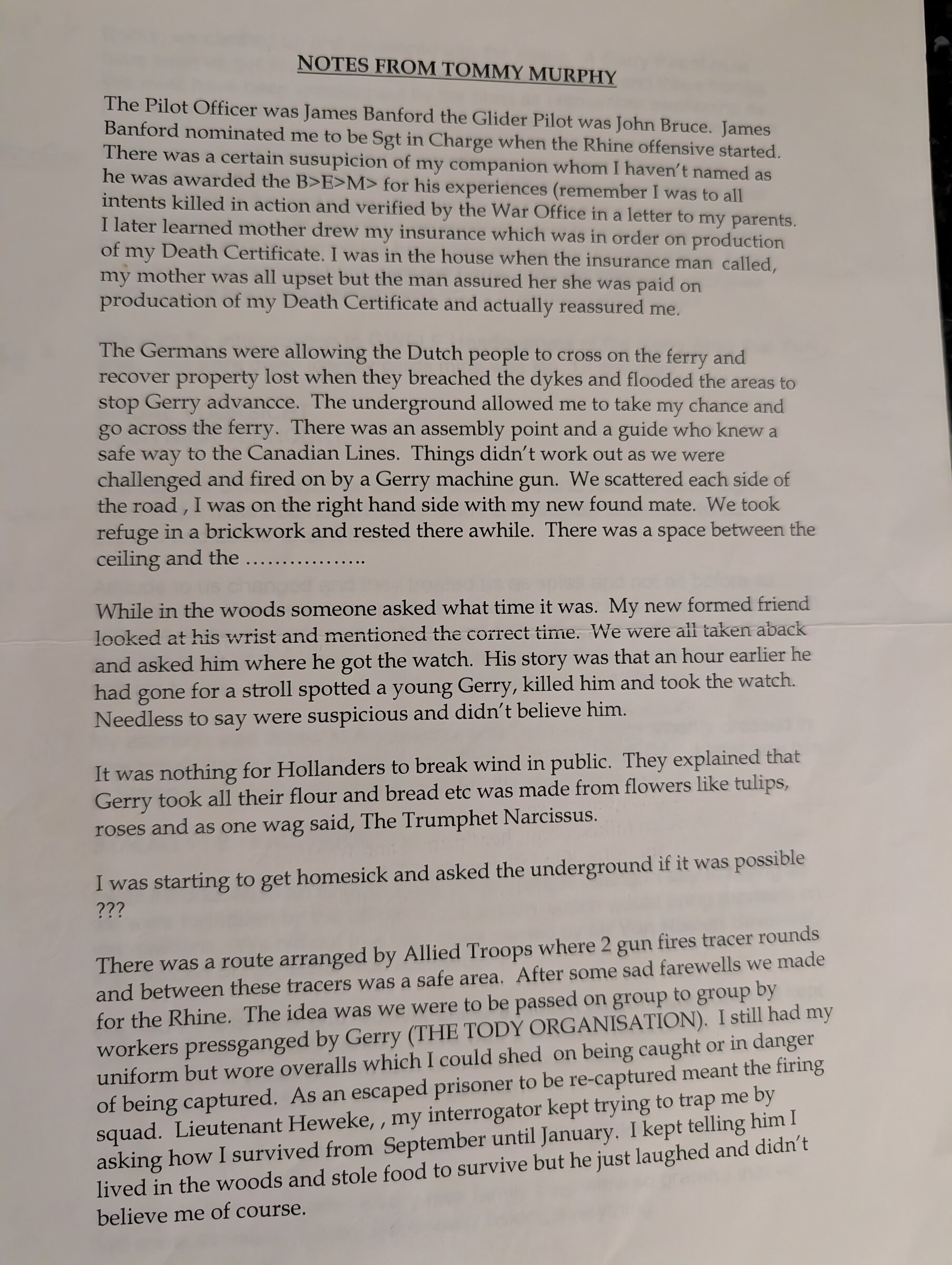
Murphy never names him as Haller. His typed notes open: "The Pilot Officer was James Banford the Glider Pilot was John Bruce", and in his Fallingbostel notes he writes only that "We teamed up later with a fighter pilot and a Glider Pilot" (notes; Stalag p. 1).
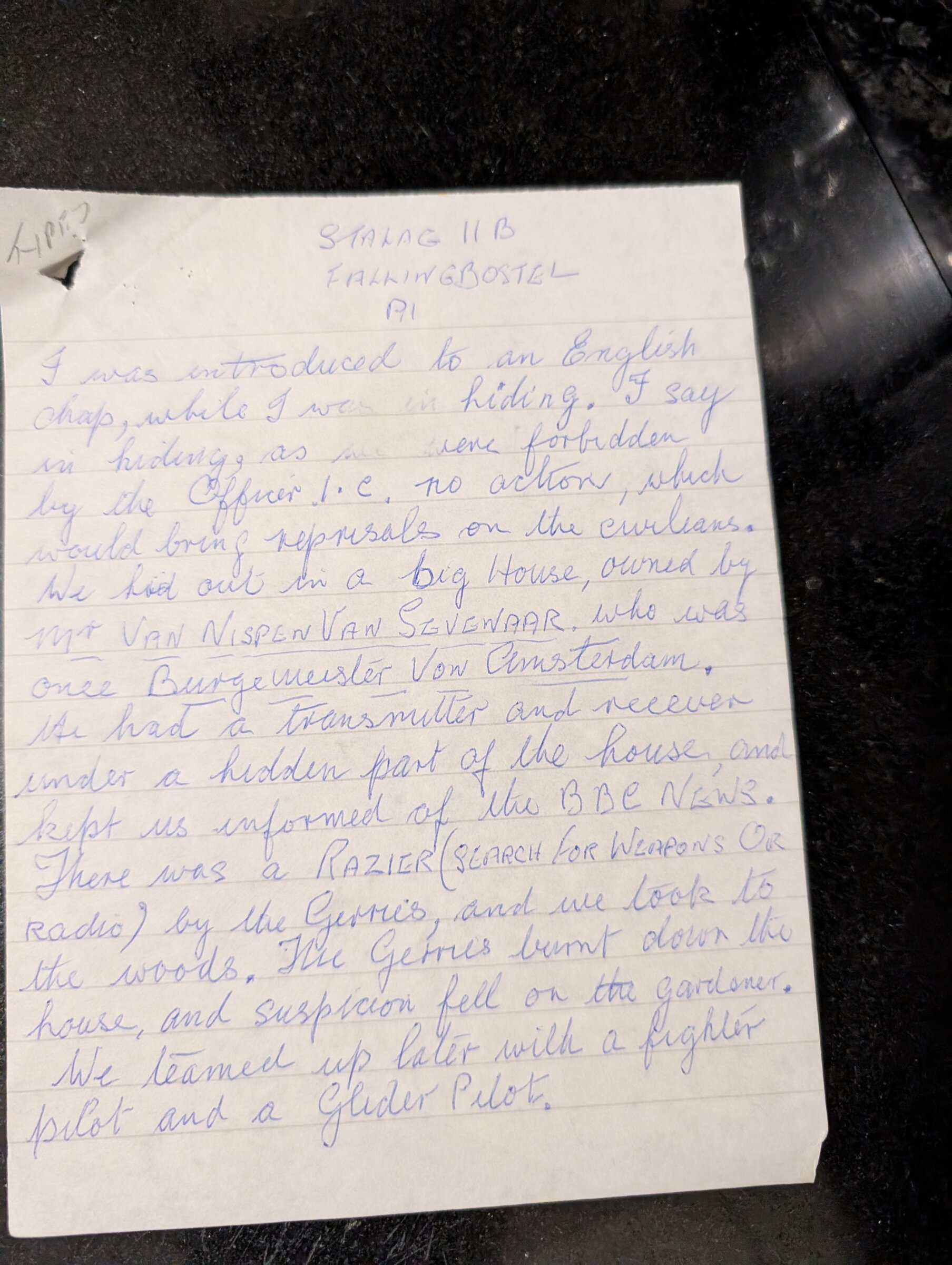
✓ The "John" is right: Hardy's and Walsh's reports, and the Dutch helpers' forms, call him John. ⚠︎ "Bruce" is Murphy's; no other source gives it. Haller's own names were Bernard John Frederick, and his helpers wrote "John Haller" or "B.J.F. Haller".
The banknote the six signed
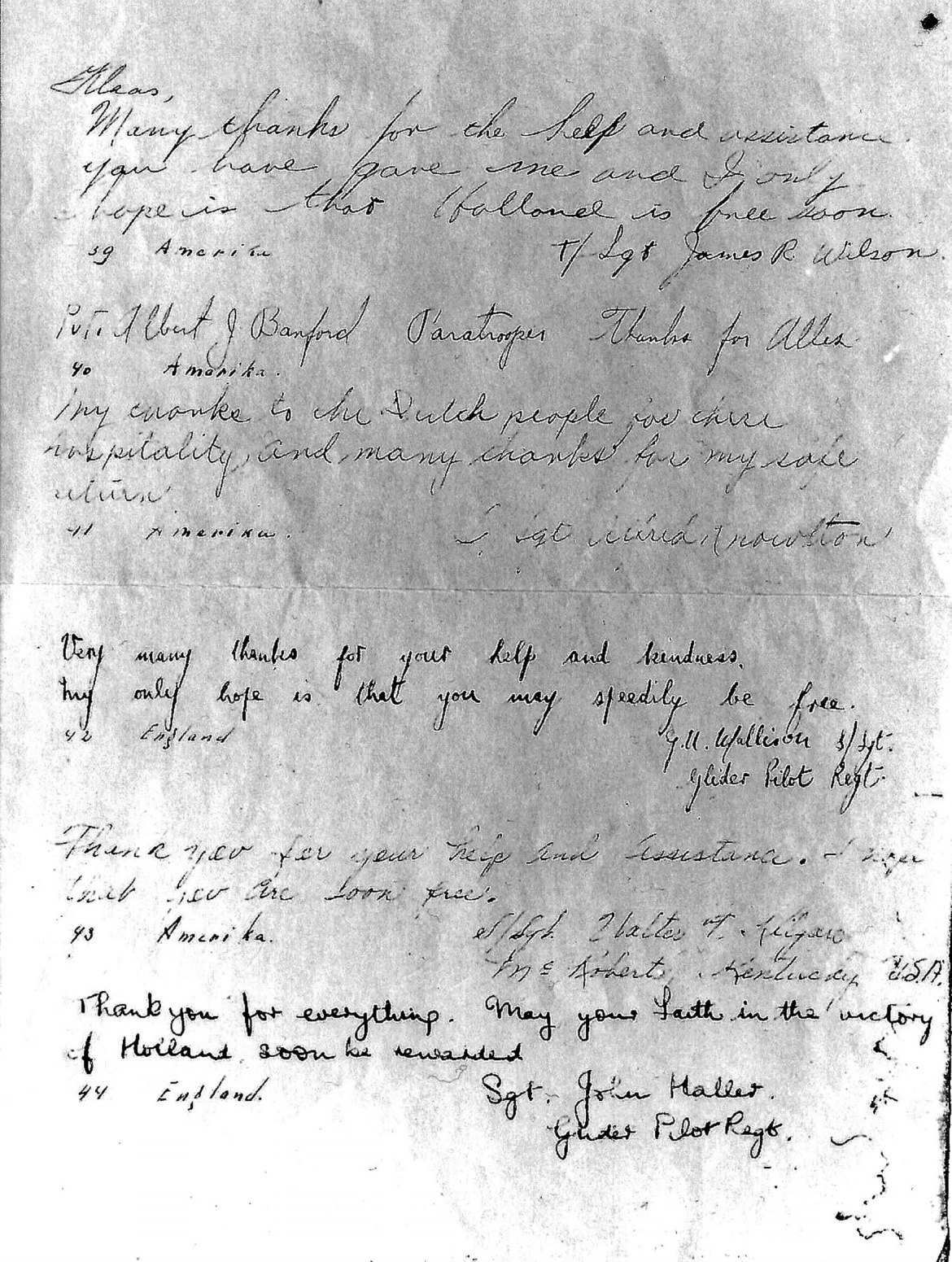
Link to the section The banknote the six signedThe Airborne Museum's archive, catalogued at the Gelders Archief, holds a one-guilder note of 1943 signed by six British soldiers, and the catalogue gives their names:
Six paras in a hole on the Veluwe. The late husband of the donor lived, or was in hiding, on the Veluwe as a young man in the last years of the war, and was involved in the Resistance. He supplied these six men with food and so on in the months after the battle, when they were hiding in the woods of the Veluwe, in a hole in the ground. … The "six men in a hole" were: Sergeant Keith D. (Tex) Banwell, 10th Battalion, The Parachute Regiment; Private Thomas Murphy, 156 Battalion, The Parachute Regiment; Corporal James Haidy, Royal Army Medical Corps; Private Edward C. Bradford, 1st Battalion, The Border Regiment; Sergeant John Haller, The Glider Pilot Regiment; Private S. (Sammy) Walsh, 156 Battalion, The Parachute Regiment.
Dutch originalZes para's in een hol op de Veluwe. Wijlen de echtgenoot van de schenkster … heeft als jongeman tijdens de laatste oorlogsjaren op de Veluwe gewoond dan wel ondergedoken gezeten. Daarbij was hij betrokken bij het Verzet. Hij heeft deze zes mannen van voedsel e.d. voorzien in de maanden na de Slag toen zij in de bossen van de Veluwe zaten ondergedoken, in een hol in de grond. … De 'Zes mannen in een hol' waren: Sergeant Keith D. (Tex) Banwell, 10th Battalion, The Parachute Regiment; Private Thomas Murphy, 156 Battalion, The Parachute Regiment; Corporal James Haidy, Royal Army Medical Corps; Private Edward C. Bradford, 1st Battalion, The Border Regiment; Sergeant John Haller, The Glider Pilot Regiment; Private S. (Sammy) Walsh, 156 Battalion, The Parachute Regiment.
— Gelders Archief · Airborne Museum collection, toegang 1604, item 350 · catalogue entry
The catalogue has his name and unit right, "Sergeant John Haller, The Glider Pilot Regiment"; it adds that nothing more is known of Bradford, Murphy, Haller and Walsh. ⚠︎ "Haidy" will be Hardy, and the museum's "Edward C. Bradford, 1st Border" stands where every other source has the RAF officer James Branford (Bradford's page). ◐ When it was signed is not stated, and nobody here has seen the signatures: the archive scans on request. The six were together from 29 October, when Banwell joined them at Kijkuit, until the early hours of 20 November, apart from the night of 17/18.
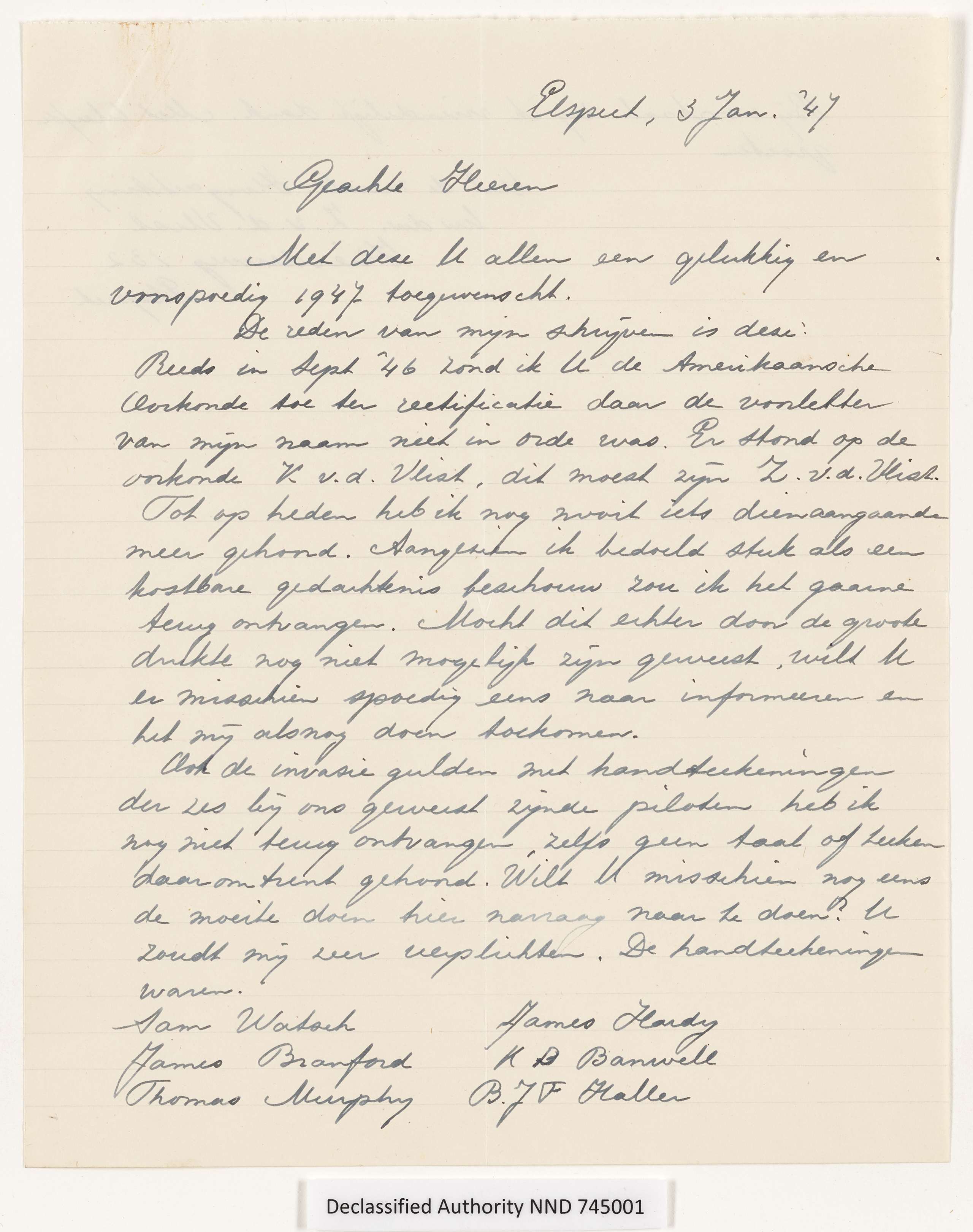
The forester at Kijkuit had a note of his own, or the same one. Z. van der Vlist, whose family lived in one half of the double house at Kijkuit, with the six in the other (Migchelsen's statement: his file, p. 3), asked the Americans in September 1946 after "een invasiegulden met zes handteekeningen van de piloten die hier vertoefden" (an invasion guilder with six signatures of the pilots who stayed here), sent to their office at Wassenaar about November 1945 by a Mr van Hattem of Elspeet; the office answered on 23 September 1946 that it had passed it to the British bureau I.S.9 (his file, pp. 13, 11). It never came back, and in January 1947 he wrote again, setting the signatures out as they stood:
Also the invasion guilder with the signatures of the six pilots who were with us I have still not had back … The signatures were: Sam Watsch, James Hardy, James Branford, K D Banwell, Thomas Murphy, B.J.F. Haller
Dutch originalOok de invasie gulden met handteekeningen der zes bij ons geweest zijnde piloten heb ik nog niet terug ontvangen … De handteekeningen waren. Sam Watsch, James Hardy, James Branford, K D Banwell, Thomas Murphy, B.J.F. Haller
— Z. van der Vlist to the American office, Elspeet, 3 January 1947; US National Archives, RG 498, helper file of Z. van der Vlist (the archive's copy, p. 9)
His name is the last of the six, with the initials he used on the forms. ◐ Whether the forester's note is the museum's is not settled: both are invasion guilders with six signatures from the same party, which fits one note; but his went to I.S.9 and had not come back by January 1947, while the museum's came from the widow of the man who fed the six in their hole in the ground, which is not the forester's house; and men in hiding often signed more than one. Either way, a letter of 1947 has "B.J.F. Haller" among the six signatures, and spells Branford's name right.
Hardy has himself and Murphy leave the Roekel dug-out on 24 November and Walsh has his party split into two threes on the 25th (◐ the two are not shown to be one event, though Walsh refers the reader to Hardy's report for "the story of my movements until 25 Nov", "the same except for one detail"; Hardy; Walsh); after Walsh's split the three spent a week at a builder's house at Valk. On 1 December "Gerd", Gerrit van Ee, who had been one of their guides, took them to his own house at Kootwijkerbroek, and next day took Branford and Walsh to Evert van de Braak's farm at Valk "while Sgt. Haller was taken to another address in this area" (Walsh). Haller told Noordman he went back to Heimen van Esveld at Kootwijkerbroek and stayed the whole winter; it was a very cold one, and on New Year's Day he skated on a pond with Harold Riley and Frank McNaught, and he got on well with Harold, since they shared the same Northern English humour (Noordman, p. 271). Two Dutch pieces in De zwarte herfst put him at the Van Esveld farm at Kootwijkerbroek, the "transit house" of some fifty Allied airmen: Harold Reley, a signaller of the 2nd Battalion, who stayed about two months and says that "there we also met John Haller and Bob Peatling", with Henk Brunekreef bringing food every other day (p. 210), and Peatling, who met there Reley, "the glider pilot John Haller" and the parachuted agent Dick Kragt, sleeping in a hay-rick in the field with a room-sized space inside (p. 212). ◐ That is the winter at Heimen van Esveld, by the place and by Haller's own account (Dekkers and Vroemen name only "the Van Esveld farm at Kootwijkerbroek"). When he came back in 1951, Mrs Van Esveld (◐ Heimen's wife, Janna, who lived until 1963) told him she had been struck by how thin he was in the short time before Pegasus II when he was with them, and that she had done all she could to build him up after he came back from the failed crossing (Noordman, p. 271).
The winter at Heimen van Esveld's is 84 days on Van Esveld's own list (Heimen van Esveld).
Veenendaal, Rhenen and Amerongen, January to March 1945
Link to the section Veenendaal, Rhenen and Amerongen, January to March 1945Seven helpers' forms of 1945 follow him from the Veluwe to the Rhine. Where they overlap the days do not agree (below), so each stage is given as its own form has it.
- ✓ Heimen van Esveld's, before it. Marten Schoemaker of the B.S., who had "been busy with John HALLER" for four weeks, wrote that "When HALLER came to AMERONGEN he had before that time been staying at van ESVELD at ESSEN (Gem. KOOTWYKERBROEK)", the Essen farm of Heimen van Esveld (Schoemaker's enclosure, p. 7; image-checked).
- ◐ Jagtenberg, 23 January, 2½ days. J. J. Jagtenberg's table has "John Haller / Sheffield", RAF, hidden from "23 Jan. 45" for 2½ days, and his remarks "De andere piloot, John Haller, Schevielt [Sheffield]. Huisvesting en levensmiddelen" (table, p. 3; form, p. 8). Schoemaker has Haller come to "JAGTEBERG at AMERONGEN" but unable to stay, "as they had quartered a man from the 'Landwacht'".
- ⚠︎ The Americans' note of 31 May 1946, from what A. Baars of Rhenen told them, has Jagtenberg an NSB member and a Landwächter, then in jail, and adds "There is something fishy about the story Baars tells"; the form is marked "No award" in pencil (the note, p. 5). The form gives Dwarsweg D 19, Veenendaal; the file's index card says Amerongen (p. 10). A helper to weigh with care.
- ◐ Albers and the Nieuwenhuis family, Veenendaal. Johan Albers: "Johnnie Haller from Sheffield" came "by way of a farmer in Barneveld", lived in the barn where Albers was housed "during a fortnight in Jan or Feb 45", and was then taken away by Schoemaker, "who brought him to Culemborg" (Albers's enclosure, p. 6). The Nieuwenhuis form, which refers to Albers's report, has "John Haller, Knoll House Banford, Nr. Sheffield" lodged "from 20 Febr. - 3 March 45 at Veenendaal", then "first to another family at Veenendaal and afterwards he crossed via Culemborg" (p. 2).
- ◐ The Put at Rhenen. W. G. Landzaat has "Sgt. Johnnie HALLER, glider pilot", who "arrived about the middle of February", having "got lost with a transport in the fog" and been picked up by a farmer in Overberg; he stayed in the "Put" and "was eventually handed over to Mr. HOOGLAND the first week in March" (Landzaat's enclosure, p. 5). ◐ Hoogland is very probably Nico Hoogland of Amerongen (the Hooglands). Schoemaker has him go from Albers to the Put, then to Henny Jansen's father at Veenendaal, "afterwards … to cross at AMERONGEN with Elsa".
- ◐ Amerongen, March. Cornelis (Kees) Niessen of the Rijnstraat has him, "wounded and captured during the Airborne landing near ARNHEM", escaped from hospital: "Kees received him in March from Chris, arranged for shelter for 4 days and then he crossed with Chris" (Niessen's enclosure, p. 7; NARA's own text of this page is blank, so this is read from the image). ◐ Chris is very probably Chris Cornelisse, the Amerongen ferryman.
- ◐ Vreeswijk, undated. B. van Zanten, who guided evaders over the lock at Schalkwijk and housed 16 men brought by Voges "in March and April 1945", lists "B.J.F. Haller. Glen Villa Bamford Nr. Sheffield. R.A.F." second among nine named men, after "Major Olchevsky. Polander." (the summary, p. 8; the enclosure, p. 10; the action report, p. 6). It gives no day for Haller. It fits a stage after the Rhine on his way to Sliedrecht and Goudriaan, but nothing says so.
He came through the Sliedrecht crossing group: "JOHN HALLER, Sergt., Glider Pilot" is on the list of Klaas Heijboer of Groot-Ammers, who took Allied men over the Lek to Sliedrecht (his file, p. 30), and "John Haller, Sgt., Glider Pilot", received from Heijboer, on Pieter Visser's of Sliedrecht, passed on to "Dr. Dekker Molen.graaf and then to Canad. Commandant Meerkerk", which fits his liberation in the Alblasserwaard (his file, p. 29). He is not on Jan Visser's lists (his file, pp. 15–25). Petrus Ingelse of Bleskensgraaf, whose home "was one of the transit centres of the I.S.9 water evacuations of the Sliedrecht area", has "B.J.F.HALLER R.A.F." on his list, with Walsh, McNaught, Riley and Craven (his summary, p. 14). The list in the file of Dirk Leendert van der Brugge of Babyloniënbroek, a section commander of the Binnenlandse Strijdkrachten who worked with the I.S.9 agents around Sliedrecht, has "J. HALLER, Sgt. R.A.F. Glider pilot Rgt.", received from "Dick Kay, S.A.S.", with nothing in the passed-on column, on the line below an American passed on to the "Canadian Comm. in Meerkerk (8-5-'45)" (p. 12). ◐ The Americans noted that the names on it "are those who were assisted by the organization with which the subject was in contact and do not represent personal service offered by the subject himself" (p. 9).
Liberated at Goudriaan in the Alblasserwaard on 8 May 1945, with others who had been helped by various underground organisations; he told Noordman they did not cross the Biesbosch (Noordman, p. 272). Hardy, he learned only then, had got back to the Allied lines on 5 January 1945 across the Betuwe (same). ◐ That is his memory: Schjelderup's report, which Hardy's follows, has the party set off from the Rhine on the evening of 2 January 1945, and Hardy's Military Medal recommendation has "the beginning of Jan.45" (Hardy; recommendation, p. 2). Kew's catalogue entry for his MI9 escape report (WO 208/3326/2991, dated 9 May 1945, former reference M.I.9/S/P.G.(H)2991, the report the Pegasus Archive prints) has him "interned or evaded" at Wolfheze on 18 September 1944, "escaped" in Holland on 8 May 1945, and lists one other name, "Private James Hardy" (the catalogue entry; catalogue text only, not digitised). It is the same report, so it adds no second witness; ✓ the Wolfheze landing on 18 September agrees with his own report and Noordman (above; De zwarte herfst has the date, not the place), and the one name is the man he escaped with. Kew also catalogues WO 208/3352/3047 for him, an entry that says his report there "has not survived" (the entry).
He was mentioned in despatches, gazetted on 1 November 1945, "14291815 Sgt. B. J. F. HALLER", Glider Pilot Regiment (London Gazette, p. 5313). The D.M.I. at the War Office had put him up for it "from the escape angle" on 5 September 1945, as a sergeant of "G" Squadron, and it went forward on 23 September (the recommendation, p. 1).
He transferred to the Royal Army Ordnance Corps on 26 September 1946 (Pegasus Archive). Noordman corresponded with him from 1987 to 1993 and interviewed him in 1994 (Noordman, p. 336); the self-portrait above is from about 1987. He wrote to Bob Hilton on 27 August 1997 that "It's a long story thereafter and I didn't get back to the UK until the end, but I still have a lot of Dutch friends" (Pegasus Archive). He told Noordman that Branford had been out of his life since the end of the 1940s and that he was sorry to hear he had died ("Het is erg jammer te horen dat hij inmiddels overleden is", p. 271).
Where the sources disagree
Link to the section Where the sources disagreeThe winter of 1944–45. ⚠︎ Not settled; the forms cannot all be right on days.
- Heimen's list has 84 days (his file, p. 8). From the party's split about 24 November to Jagtenberg's 23 January is about 60 days, so the 84 either counts two stays (Noordman has him at Van Esveld's before Pegasus II as well, p. 271) or runs into other stages.
- Landzaat has him at the Put from about the middle of February, and Nieuwenhuis at Veenendaal from 20 February; Schoemaker's order (Jagtenberg, Veenendaal, the Put, Jansen's father, Amerongen) puts the Put after Veenendaal.
- Albers has a fortnight "in Jan or Feb"; Jagtenberg 23 January; Niessen March, four days.
November 1944, Ede. ⚠︎ J. C. van Spronsen of Utrecht took six evaders to the quarter-master Wildeboer at Ede "in November 44": "a parachutist James, and a glider-pilot John HALLER from SHEFFIELD. James stayed in the 'Onderkomen' and John HALLER went to JANSEN at VEENENDAAL" (his enclosure, p. 5). ◐ It would fit Haller's own report, which has him part from Hardy near Ede about 24 November, with "James" then perhaps James Hardy; but a Veenendaal stage in November is not in any other form, which put Jansen's father in February or March, and Van Spronsen, writing in July 1945, "only remembers" the two names. The date may be a slip.
Where he was on 17 November. Hardy has him on a guide's bike, not among the four lost at the fork (Hardy, Branford, Banwell, Murphy); Walsh has him with Banwell, Murphy and Walsh, taken by the guides to a house at approx. posn 560984, ◐ near Kootwijkerbroek by the map reference (above). Both put him with the guides; they differ on Murphy and Banwell.
His home. De zwarte herfst has "John Haller of Sutton Coldfield"; his report and the helpers' forms have Sheffield, with "Knoll House, Bamford" (Nieuwenhuis, Niessen) and "Glen Villa, Bamford" (Van Zanten), and Niessen types his initials B.J.T. Schoemaker's form dates the fog to "February 44", a slip for 1945. ⚠︎ Not settled.
Where he escaped from. ✓ De zwarte herfst settles it for Apeldoorn: wounded at Oosterbeek, then the St Elisabeth hospital, then the Willem III barracks (Dekkers and Vroemen, p. 229). His citation has him taken to "OOSTERBEEK hospital" and escaping from there on 5–6 October 1944 (the recommendation, p. 2); Hardy's citation, telling the same escape, and Hardy's own report put it at the Willem III barracks at Apeldoorn (Hardy's recommendation, p. 2; James Hardy).
Which day he reached Apeldoorn. The Pegasus Archive's biography has him taken prisoner on 23 September and "transported to Apeldoorn on the 26th September"; his own report has Apeldoorn from 25 September (Pegasus Archive). ◐ The biography's line is the editor's, not his.