Eric Blok
Zutphen 9 Mar 1914 ⚠︎ – ?
About: A former Dutch Army second lieutenant in Joop Migchelsen's resistance group at Hulshorst, at the forester's house Kijkuit in October 1944, when Hardy was first there and, ◐ by Hardy's "same party", when Murphy and Walsh arrived. ⚠︎ Possibly the Eric Blok of Nunspeet, born in 1914, who was reported in March 1951 as emigrating to France.
Unit or role: "formerly a 2/Lt. in the Dutch Army and now a member of the Underground" (Hardy); one of the two men, with Migchelsen, to whom two helpers at Sterrehoveke handed on Murphy, Walsh and Hardy (Ima van Eysinga's file, p. 3; Liesbeth Verweij's file, p. 3).
Where: The forester's house Kijkuit, Leuvenumse Bos; Hulshorst; ◐ Nunspeet before the war.
Evidence: ✓ Hardy; ✓ Ima van Eysinga's file, p. 3; ✓ Liesbeth Verweij's file, p. 3; ✓ Liesbeth Verweij's account in Noordman, Schuilplaats de Veluwe, pp. 302–303; ◐ for his life outside the war, his birth record and De Telegraaf, 9 March 1951
◐ Who he was is not proven. No source on the war gives more than his name, his old rank, Hulshorst, his good English, the route he advised Hardy to take, and that Verweij already knew of him. An Eric Blok of Nunspeet, born in 1914, fits the name and the place, and the records below are about him or about an E. Blok of Nunspeet; nothing in any of them mentions the resistance or an army commission.
- ✓ An Eric Blok was born at Zutphen on 9 March 1914, the son of Johan Cornelis Blok, "medicinae doctor en arts" (doctor of medicine and physician), and Clara de Vries (the birth record, from Open Archieven; index only, no scan).
- ◐ In June 1931 "mej. E. Blok en de heer E. Blok, beiden Nunspeet" (Miss E. Blok and Mr E. Blok, both of Nunspeet) passed the final examination of the Christian lyceum at Harderwijk (De Standaard, 26 June 1931, p. 7, read on the page image); initials only.
- ✓ In June 1937 an "Eric Blok uit Nunspeet" gave evidence at a trial over a plot to have a man shot near Vierhouten: he had sold the accused a revolver in the autumn of 1935, and the accused had told him he wanted it because of the many break-ins at Vierhouten (Overijsselsch Dagblad, 25 June 1937, read on the page image). Another paper's report of the same day has "Getuige E. Blok te Nunspeet" (the witness E. Blok of Nunspeet) (Provinciale Overijsselsche en Zwolsche Courant, 25 June 1937, p. 5, read on the page image).
- ◐ The council of Ermelo let the shooting rights on "de gronden aan het IJsselmeer" (the grounds by the IJsselmeer) to "E. Blok voor f 5" (E. Blok, for 5 guilders) in 1937 (Provinciale Overijsselsche en Zwolsche Courant, 5 October 1937, p. 9), and in August 1941 the shooting rights on its municipal grounds to four men "te Nunspeet", E. Blok first, and two of Apeldoorn (De Banier, 27 August 1941, p. 5); both read on the page images, initials only.
- ◐ In April 1939 the Middelbare Landbouwschool (secondary agricultural school) at Groningen gave its diploma to "E. Blok. Nunspeet", with "Een eervolle vermelding … aan den leerling E. Blok te Nunspeet" (an honourable mention to the pupil E. Blok of Nunspeet) (Nieuwsblad van het Noorden, 7 April 1939, p. 14, read on the page image); initials only.
- ◐ In December 1939 an E. Blok married R. Cocksedge, with Windsor as the place the digest gives: "28 E. Blok en R. Cocksedge. Windsor." under December's marriages in Het Vaderland's digest of family notices (Het Vaderland, 30 December 1939, p. 4; the day's digit is soft on the page image; its place in the list puts it on the 27th or 28th), and "Eric Blok en R. Cocksedge, Windsor" in another paper's digest (Het nieuws van den dag, 2 January 1940, p. 10); both read on the page images.
- That this is the Nunspeet Eric rests on the death notice of 1969 below, which has an E. Blok and an R. Blok–Cocksedge among the signers of a notice for a Clara de Vries, the name of Eric's mother in his birth record.
No record has been found of his commission in the Dutch Army or of his part in the fighting of May 1940; Hardy's report is the only source for his rank.
With Murphy
Link to the section With Murphy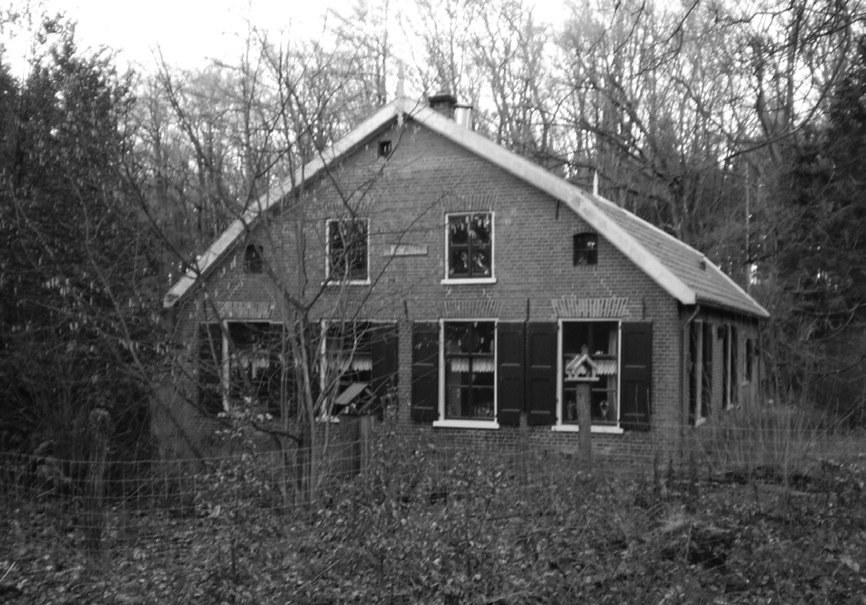
Kijkuit, 12 to 19 October 1944: Hardy's first stay
Link to the section Kijkuit, 12 to 19 October 1944: Hardy's first stayJames Hardy and Bernard Haller were brought to the forester's house Kijkuit in the Leuvenumse Bos by "BRAM" and "JOOP" (Bram Baar and Joop Migchelsen, by Noordman's reading) on the night of 12 October 1944, by the order of Hardy's report, which dates the search of the woods to 11 October and has them meet the underground the next evening (Hardy; Noordman, p. 278). Eric Blok was there; Hardy decided to leave after discussing it with him, and set off by the route Eric advised:
In this house there was Eric BLOK, formerly a 2/Lt. in the Dutch Army and now a member of the Underground; … I soon became restless as we heard that the Germans were still carrying out searches in the area and on several occasions we had to hide out in the woods during the day, returning to the house at night. After discussing the situation with Eric BLOK, who spoke good English, I decided to try and reach the Allied lines on my own, so on the morning of 19 Oct I set off intending to travel on the advice of ERIC by way of LEUVENUM (620130) and STAVERDEN (637118).
— MI9 · Pte J. Hardy, 16 Parachute Field Ambulance · IS9/WEA/1/270/2351 · 13 January 1945 · the report
Hardy's list of the household, in the part of the sentence cut above, has "EMMY, a girl of 19" (Emma Vroege, ◐ very probably), P/O "BRENTFORD" (James Branford), "ADRIAN" and two Dutchmen in hiding, with "BRUMMAGER" (Bram Baar) staying and "JOOP" leaving (Hardy). Haller, remembering the house in Noordman's book, names Branford, Walsh and Murphy and a Dutch helper "die zich George noemde" (who called himself George), and does not name an Eric (Noordman, p. 270).
Back to Eric, 26 October 1944
Link to the section Back to Eric, 26 October 1944Hardy reached Sterrehoveke at Elspeet, where Murphy and Walsh were hidden (Hardy; Noordman, pp. 301–302). Liesbeth Verweij, who lived there, remembered him talking of Eric on his first evening by the fire: "Zijn held was Eric met wie hij en nog een paar geallieerden ‘far away in a lovely wood’ gezeten had in ‘a hidden house’" (his hero was Eric, with whom he and a few other Allied men had sat "far away in a lovely wood" in "a hidden house") (Noordman, p. 302). When a house-to-house search was expected, in her account:
"I'm going back to Eric," said Jack. "There will be ten of us, but Eric will know what to do; he always does." "Only," he went on in despair, "How do I find Eric?" We would see to that. Eric was supposed to be at "de Kijkuit" in the Leuvenumse Bos, a forester's house of Mr Jurriaanse.
Dutch original‘I’m going back to Eric,’ zei Jack. ‘There will be ten of us, but Eric will know what to do; he always does.’ ‘Only,’ liet hij er wanhopig op volgen, ‘How do I find Eric?’ Hier zouden wij wel voor zorgen. Eric moest op ‘de Kijkuit’ zitten in het Leuvenumse Bos, een boswachterswoning van de heer Jurriaanse.
— Liesbeth Verweij, as Noordman prints her · Schuilplaats de Veluwe · 2019 · pp. 302–303
On the evening of 26 October Verweij and Dirk van Eysinga walked Hardy, Murphy and Walsh there, and at the path to the house Hardy said, "Let me alone now; I do not want Eric to know I have been taken here by a woman!" (Noordman, p. 303; Hardy, who has "DEREK and his aunt" walking ahead). Hardy found "The same party was still occupying the house"; Banwell was brought there on 29 October, and the men were taken away at midnight on 6 November (Hardy). ◐ Hardy's "same party" is the only first-hand statement that Eric was in the house while Murphy was. Verweij says that from Hardy's descriptions they soon knew where he had been, and that Eric "bleek ook … een bekende te zijn" (turned out to be someone they knew) (p. 302), and she expected him at Kijkuit; the helpers' forms hand Murphy on to him. None of them says he was there between 26 October and 6 November. No source records anything Eric did in those days.
The helpers' forms
Link to the section The helpers' forms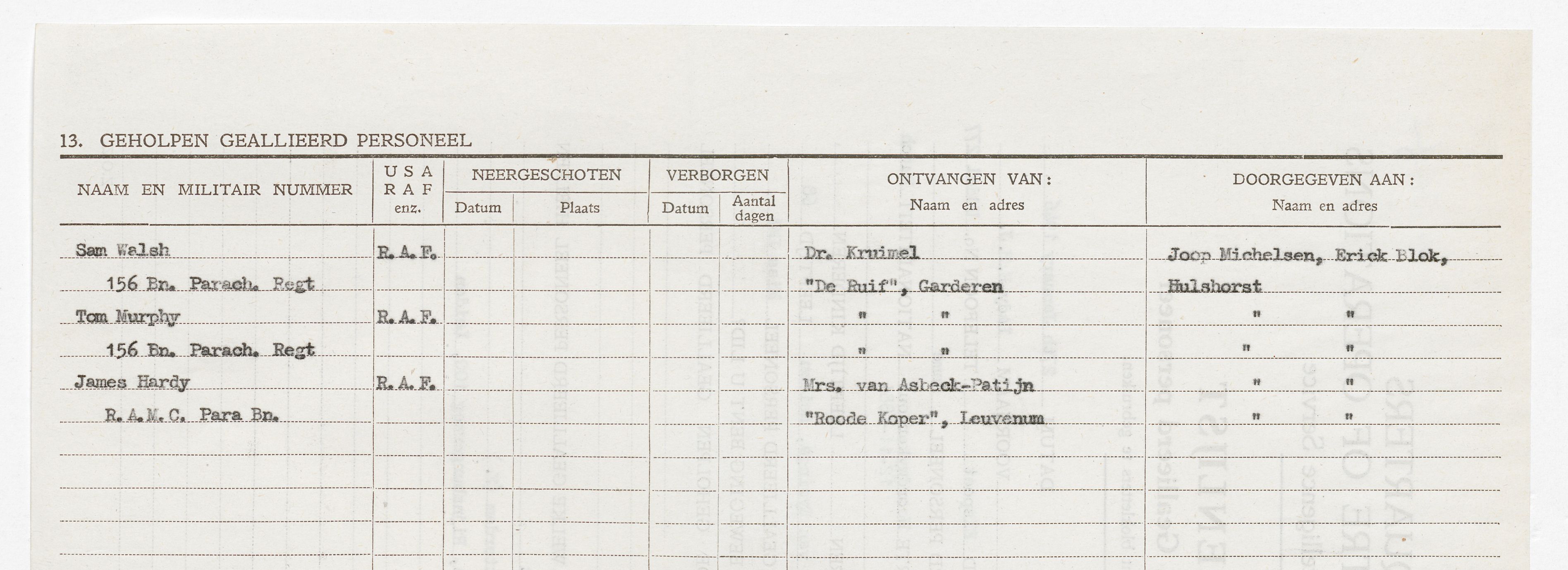
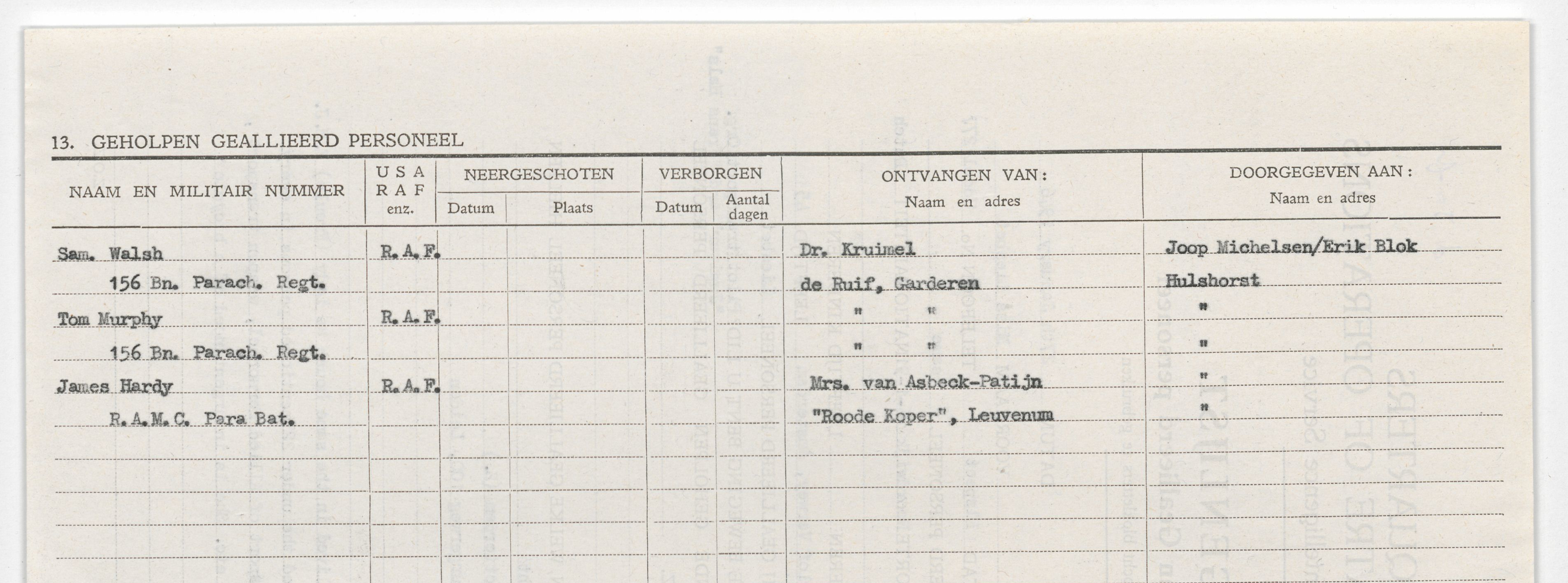
✓ Two helpers at Sterrehoveke, filling in the Americans' questionnaire after the war, name him beside Migchelsen as the men they handed Murphy, Walsh and Hardy on to. Ima van Eysinga's section 13 has Walsh and Murphy received from Dr Kruimel at De Ruif, Garderen, and Hardy from Mrs van Asbeck-Patijn at Leuvenum, all passed on to "Joop Michelsen, Erick Blok, Hulshorst" (her file, p. 3). Liesbeth Verweij's section 13 has the same three men from the same two helpers, passed on to "Joop Michelsen/Erik Blok Hulshorst" (her file, p. 3). Neither form gives dates.
✓ Migchelsen's own lists of the people who helped him, of 14 June and of August 1945, name Emma Vroege, Hilbrand Baar, Reinier Mooy and Balthazar Sibbes, and not Eric Blok (his file, p. 2; p. 4). A search of the US National Archives' catalogue for his name, in October 2026, found no helper file of his own.
◐ Again, these records are of the Nunspeet Eric Blok, and none mentions the war.
✓ Nunspeet's population register of 1939–1949 has an Eric Blok among the people who left the town (the index entry, from Open Archieven); the index gives no date.
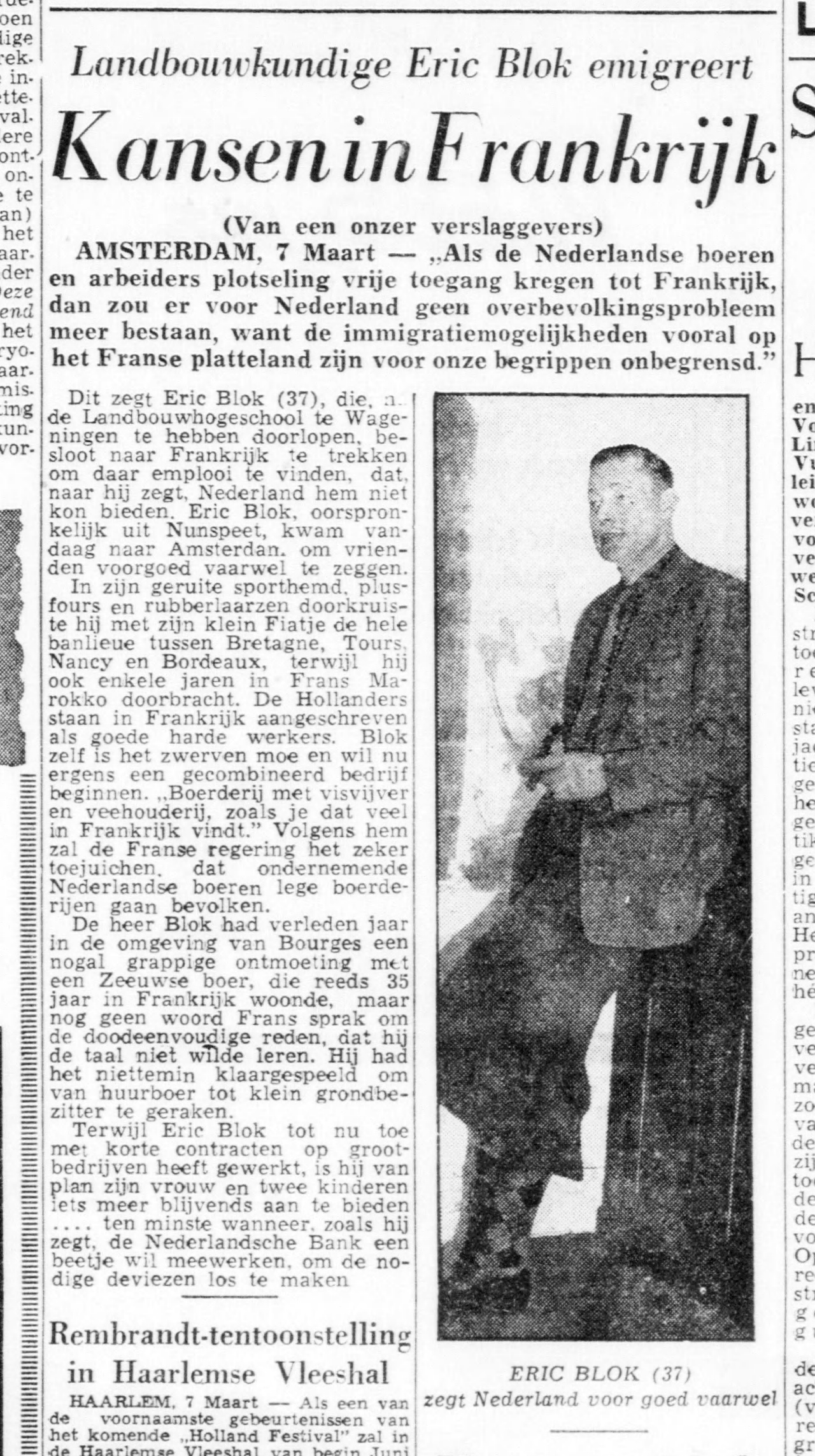
✓ In March 1951 De Telegraaf reported that "Eric Blok (37)", "oorspronkelijk uit Nunspeet" (originally from Nunspeet), who had been through "de Landbouwhogeschool te Wageningen" (the agricultural university at Wageningen), was leaving the Netherlands for good to farm in France. He had travelled the country between Brittany, Tours, Nancy and Bordeaux, spent some years in French Morocco, and worked on short contracts on large farms; he wanted to start a farm with a fish pond and livestock, and meant to offer "zijn vrouw en twee kinderen iets meer blijvends" (his wife and two children something more lasting) (De Telegraaf, 9 March 1951, p. 5; the last phrase read on the page image). The Nieuwe Courant printed the same report on 17 March (Nieuwe Courant, 17 March 1951, p. 3): one source, printed twice. The article, dated Amsterdam 7 March, gives his age as 37; the Eric Blok born at Zutphen turned 37 two days later, on 9 March 1951.
◐ Clara Simon Thomas–de Vries van Cronesteyn died on 18 November 1969, aged 81. Her death notice, dated at Nunspeet and written for "mijn lieve vrouw en onze moeder" (my dear wife and our mother), is signed, among others, by "Zeist: E. Blok / R. Blok—Cocksedge" (Algemeen Handelsblad, 24 November 1969, p. 8, read on the page image). The notice does not say how each signer was related to her; Eric's birth record names his mother as Clara de Vries (the birth record). If she is the same woman, the E. Blok of Zeist in 1969 is very probably Eric, and the R. Cocksedge he married in 1939 his wife.
No record of his death has been found.
Where the sources disagree
Link to the section Where the sources disagree- His first name. Hardy writes "Eric" (Hardy); Ima van Eysinga's form "Erick" (her file, p. 3); Liesbeth Verweij's form "Erik" (her file, p. 3). The 1914 birth record and the 1951 newspapers have "Eric".
- His schooling. De Telegraaf has the Nunspeet Eric Blok through the agricultural university at Wageningen (the article); the Groningen lists give an E. Blok of Nunspeet the diploma of the secondary agricultural school there in 1939 (Nieuwsblad van het Noorden, p. 14). Both may be true; neither mentions the other.