Capt. Roger Schjelderup
Smithers, British Columbia 16 Sep 1921 ◐ – London 29 Sep 1974
Capt. V. R. Schjelderup MC
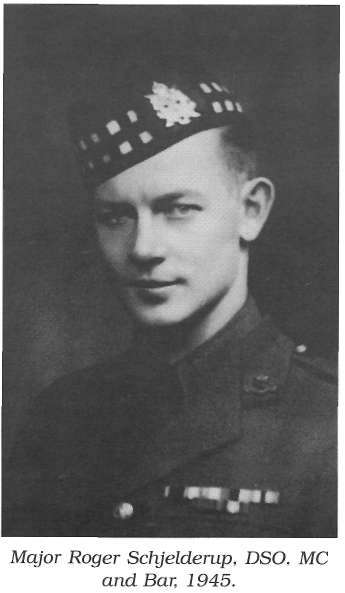
About: Captain Vilhelm Roger Schjelderup of Courtenay, British Columbia, commanded C Company of the Canadian Scottish at the Leopold Canal, was captured on 7 October 1944, cut his way out of the prisoner train at Utrecht on 23 October and was hidden at Groenekan until 22 December by his Appendix A (Before, his own MI9 report). He commanded the party of Canadians, with Murphy among them, that set out on foot from the Rhine at Amerongen on 2 January 1945, and was one of the three who reached British lines (With Murphy); Porter, who had hidden with him near Utrecht, calls him Roger.
Unit or role: Captain commanding C Company, 1st Bn The Canadian Scottish Regiment, 7th Canadian Infantry Brigade, 3rd Canadian Division; "Captain (acting Major)" in the Gazette of 31 May 1945 (p. 2746). He stayed in the army: commanding officer of 2nd Bn Princess Patricia's Canadian Light Infantry, 1957 to 1960, and a colonel at his death (After).
Where: Courtenay, Vancouver Island, British Columbia; the Leopold Canal, Oosthoek, October 1944; Groenekan, at Hermannus Rakers's house, 25 October to 22 December 1944 (his Appendix A); Amerongen, 23 December to 2 January 1945; London, where he died in 1974.
Evidence: ✓ the Gazette entries for his Military Cross (p. 4050), DSO (p. 2743) and bar (p. 2746) and the Kew recommendation for the MC; ✓ "Two Came Back!", the battalion's account, with his DSO recommendation; ◐ his MI9 escape report (transcript; the Kew original not seen); ✓ the Dutch helpers' forms (Van Brenk, Ponssen, Rakers); ✓ the MI9 liberation reports of Berry, Swartz and Briere; ✓ Hardy's report; ✓ his student records at UBC and the Nelson Daily News; ✓ The Patrician and ◐ The Times obituary for his death.
◐ Born 16 September 1921 (his MI9 report has "Date of Birth: 16 Sep 21", the transcript; and the report's catalogue entry, the catalogue entries), at Smithers, British Columbia, and raised at Courtenay, on Vancouver Island; he went to the University of British Columbia in 1939, left in 1941 to join the army, was a second lieutenant in the Canadian Scottish by December 1941 and went overseas in 1942 (The Patrician, 2008). ✓ The student paper bears out both ends: the U.B.C. contingent of the C.O.T.C. took "Schjelderup, V. R." on strength from 19 September 1939 (The Ubyssey, 14 November 1939, p. 3, read on the scan), and in September 1941 listed "Vilheim Schjelderup" among the students who had gone "To the Army" that summer (The Ubyssey, 23 September 1941, p. 4, read on the scan). ✓ The Daily Colonist of 25 July 1939 has "Vilhelm Roger Schjelderup" among the four Courtenay High School pupils listed as passed in that summer's provincial examinations (page 2, read on the scan). ✓ UBC's own lists have him too, read on the page images. The Calendar for 1940–41 lists "Schjelderup, V. Roger … Courtenay" in the first year of arts and science (printed p. 294), and the Calendar for 1941–42 lists the same name and town in the second year of applied science (printed p. 311); neither page says which session its list covers. The yearbook, the Totem, has "Schjelderup, V. R." in its 1940 name index (the page numbers are cut off in the scan) and "SCHJELDERUP, VILHELM R." in a 1941 list of names, p. 140 of the scan (the two entries).
◐ His family. His father was very probably Vilhelm "Bill" Schjelderup, a British Columbia land surveyor born at Kristiansand in 1885, of Burns Lake and from 1933 of Courtenay, whose obituary in the Daily Colonist of 22 March 1968 names two sons, one of them "Colonel V. R. Schjelderup, presently commander of CFB Calgary" (the obituary, read on the page). The father died at Comox on 16 March 1968, and his death registration has as informant a son, of "Canadian Forces Base Calgary"; he had married Minnie Edith Woods at Vernon on 2 May 1916 (BC Archives, the registrations, read on the images). The paper writes "V. R." and not Roger, so the tie is ours, by the initials, the rank and the base; no source held names Roger's mother.
Before Amerongen
Link to the section Before AmerongenThe Canadians in Murphy's last party were escapers too. Their story is told in "Two Came Back!", which is headed "a summary of the experiences of Capt V.R. Schjelderup, M.C. and Sgt Gri" (Gri) and signed "R.F. Bradley" (the scan), the battalion's diarist ("Diarist: R.F. Bradley" in the January war diary; "Pte R.F. Bradley" in the next appendix); page numbers below are its own.
D-Day. He won his first Military Cross on 6 June 1944, as a lieutenant with the 1st Bn Canadian Scottish in 7th Canadian Infantry Brigade, 3rd Canadian Division. His commanding officer, Lt Col F. N. Cabeldu, recommended him; the brigadier passed it on on 16 June, Maj. Gen. R. F. L. Keller of 3rd Canadian Division on 22 June and the corps commander on 11 July, and it was gazetted on 31 August 1944, "Lieutenant Vilhelm Roger Schjelderup, Canadian Infantry Corps" (London Gazette, p. 4050; WO 373/48/491):
On 6 June 1944 on the Assault and advance to the hinterland Lt. Schjelderup's outstanding leadership and courage when he and his platoon attacked at least four enemy M.G. positions in areas VAUX and ST. CROIX-SUR-MER was a decided inspiration to his men. Despite a wound received in this action he carried on until the night of D-day and left only when his platoon was safely dug in in its position for the night.
— Lt Col F. N. Cabeldu, 1st Bn The Canadian Scottish Regiment · recommendation for the Military Cross, June 1944 · The National Archives, Kew, WO 373/48/491 · the transcription
His platoon had landed 45 strong and ended the day with 19 (Times Colonist, 2016, quoting R. H. Roy's regimental history).
Taken at the Leopold Canal. The 1st Bn Canadian Scottish crossed the Leopold Canal behind flame-throwers at 05:30 on 6 October 1944, and by evening B and C Companies were among the buildings of Oosthoek (p. 1). At 04:45 on the 7th a silent German counter-attack, about 150 strong, came at C Company, which Schjelderup commanded. His company headquarters held out in a house for two and a half hours, with grenades coming through the windows; one wounded him in the back. Only when the Germans had put a demolition charge against the house, the building was burning and every round was gone did he give the order to surrender, about 07:30 (pp. 1–2; the recommendation for his DSO, war diary, January 1945, Appendix 22, PDF p. 51 of e011374613). CSM Wilfred Berry was with him at company headquarters, and Gri was taken fighting alone in 14 Platoon's house nearby (pp. 1–2).
This action lasted for two and a half hours: with the enemy throwing grenades in the windows, and firing tracer bullets into the building in an attempt to set it on fire. The small party under command of Captain Vilhelm Roger SCHJELDERUP (MC), continued to fight on, killing or wounding thirty of the enemy. Eventually the enemy succeeded in placing a demolition charge against the building which, had it been blown, would have meant the complete destruction of al [sic] the inmates. It was only then, with the building burning to the ground about them and all the ammunition expended, did Captain Vilhelm Roger SCHJELDERUP give the order to surrender, with the avowed intention of carrying on the fight at a later date.
— 1st Bn The Canadian Scottish Regiment · recommendation for the DSO, 7 January 1945 · war diary, January 1945, Appendix 22 · Library and Archives Canada
Oostburg to Utrecht. At Oostburg the prisoners were searched and robbed, and questioned one by one; shown a slip of paper with his name, rank and company, Schjelderup said he did not know the officer and, when pressed, that "the name is not spelled correctly" (p. 2). They were marched to Breskens, shipped by night to Flushing, and taken to Goes, where a girl of the Dutch underground pushed into the crowd of prisoners with fruit and he passed her a slip with his name and rank; it reached Brigadier F. N. Cabeldu, by then promoted from the lieutenant-colonel who had commanded the battalion in June 1944 (above; the Victoria Daily Times of 30 November 1944 calls him "Brig." Cabeldu, who "as a lieutenant-colonel took the Scottish to France on D-Day", the cutting), "thus informing him that the men were still alive" (p. 2). Moved back to Middelburg, they were kept in the hold of a canal barge; three guards were put on Schjelderup alone when the barge reached Dordrecht and they were loaded into a box-car (p. 3). ◐ At Dordrecht, on 15 October by his report, three privates of other regiments joined them, among them Trainor of the Essex Scottish: "The three Privates had been discharged from a hospital in DORDRECHT" (Schjelderup's MI9 escape report, Kew WO 208/3351/2349, 1 February 1945: a transcript shared by Lisan Koppenol; the original, not digitised, not seen). At Utrecht the car stood eight days in a siding, with soup once a day, no water for six days and no medical care for the wounded, while Typhoons rocketed the yard round it (p. 3). The yard was a repeated Allied target that autumn, and since 17 September Dutch railwaymen had been on strike, with German crews keeping the trains running (Erfgoed Utrecht; the strike). ◐ His own escape report gives the reason: from 18 to 23 October "Trains could not get out of the station on account of a strike. The yards were full of trains waiting to set off" (Schjelderup's MI9 escape report, Kew WO 208/3351/2349, 1 February 1945: a transcript shared by Lisan Koppenol; the original, not digitised, not seen); through October the German-run trains kept no regular timetable, which only began on 1 November (Spoorwegmuseum).
The box-car. With a pen-knife hidden from the German searches they cut a door in a dark corner of the car, leaving a thin shell, hiding the shavings and shading the cut with pencil (p. 3). His DSO recommendation says he hid the knife and cut the opening with Gri; Gri's own recommendation says the knife was Gri's (war diary, January 1945, Appendix 22, PDF pp. 51–52 of e011374613), and so does the Times Colonist (2016), in the journalist's own voice (the article). At 23:00 on 23 October, as the train pulled out for a Stalag near Hamburg, ten men dropped through: Schjelderup, Berry, Gri, Cpl Sjursen, Ptes Swartz, Adams, Cool and Briere of the Canadian Scottish, Capt Brownridge RCA, their artillery observer, and Pte Trainor of the Essex Scottish; twelve men, too weak or unwilling, stayed on the train (pp. 3–4). Flip Esveld's statement has Briere escaping "from the train near BILTHOVEN" (Flip's file, p. 7).
The weeks in hiding. Schjelderup, Brownridge and Trainor crawled into some bushes that turned out to screen a German anti-aircraft post, and lay there through the night and the whole of the 24th. Moving off after dark, Brownridge was caught on a road by a patrol and beaten; Schjelderup and Trainor got away and, after hours lying in a field, knocked at a farm, where the farmer's wife took them in and the underground fetched them that night (pp. 4–5). He was put to bed with a doctor and a nurse; pneumonia was followed by dry pleurisy, and for a time he was not expected to live (p. 5). Recovering, he drew sketches and maps for the underground, and most of the others waited for him before trying to cross (p. 5). On 23 December they were taken to the marshalling area by the Rhine (p. 5), which is how they came to be at Amerongen when Murphy arrived.
Who hid him. The Dutch helpers' own statements to the Americans fill in the names. The farm was G. van Brenk's at Groenekan, where two soldiers knocked about four in the morning of 25 October (he typed 1945); he fed them, sent for H. Rakers, the Maartensdijk field constable, gave each a civilian overcoat, and in 1946 still wanted to know whether they had got home (Van Brenk's file, p. 3). Rakers took them to Fort Ruigenhoek, whose guard, F. H. Ponssen, sheltered them; not knowing whether they were Canadians or German parachutists, Rakers "fetched at once a R.A.F. pilot, staying at his house, to interrogate these two men"; Ponssen does not name the pilot, and ◐ it was very probably Bob Porter, whom Schjelderup's report has "brought in to interrogate me" (the transcript). A doctor found pneumonia, and the two were taken to the Rakers house, Schjelderup on a bicycle (Ponssen's file, p. 4). He stayed there from 25 October to 24 December, sixty days by the family's count (the Rakers file, p. 3), and Dr R. Buisman of Groenekan "rendered medical help to Capt. R. SCHJELDERUP" (Buisman's file, p. 3). W. R. Kaars Sypesteyn helped move "evaders from GROENEKAN to AMERONGEN … on 22 and 23 Dec 44 … SCHJELDERUP, PORTER, etc." (his file, p. 3). Ponssen met him again after the war, "in the meantime promoted to Major" (Ponssen, p. 4). ⚠︎ The Rakers forms date the move to 24 December, a day after Hardy met him at Amerongen. A second Maartensdijk helper, B. A. J. A. van Randwijck, lists him in section 13 of his form: "capt. V.R. Schjelderup M.C. 1st Bn. Canadian Scottish Reg., Canadian Army Overseas B.W.E.F.", with "Escaped ca 22 Oct. 44. Had been arrested on 7-10-44 at Oostburg, at Maartensdijk fled out of the train, and hid by me, afterwards handed over" (Van Randwijck's file, p. 3; the date and place of the arrest agree with Two Came Back!). The form gives no hiding dates and does not say to whom he was handed on; Van Randwijck is not among the Groenekan helpers above, so where he hid him, and for how long, is not known. ⚠︎ "Ca 22 Oct." for the escape is a day before the 23 October of the battalion's account (Before Amerongen).
I, G. van Brenk, deiry farmer, declare: 25-10-1945 in the morning around 4 o'clock, 2 soldiers came to my house, I not understand them but gave them food. I sent a message to Mr. Rakers Local Police at Maartensdyk, I knew Mr. Rakers would help them. Mr. Rakers took those two soldiers with him after I gave them both a civilian overcoat. … I should like to know if you could inform me about it, if the two soldiers came save to their country.
— US National Archives · RG 498, helper file of G. van Brenk, Groenekan · statement, 24 April 1946 · the transcript; the archive's copy
The fort's guard told the rest:
Rakers fetched at once a R.A.F. pilot, staying at his house, to interrogate these two men. Everything soon appeared O-K, and the pilot told us that one of the men, named Schilderup, was wounded and had high temperature. … After liberation I met the Captain, in the meantime promoted to Major, once again, when he expressed his gratitude for all hospitality the Rakers had bestowed on him.
— US National Archives · RG 498, helper file of F. H. Ponssen, guard at Fort Ruigenhoek · statement, 5 April 1946 · the transcript; the archive's copy
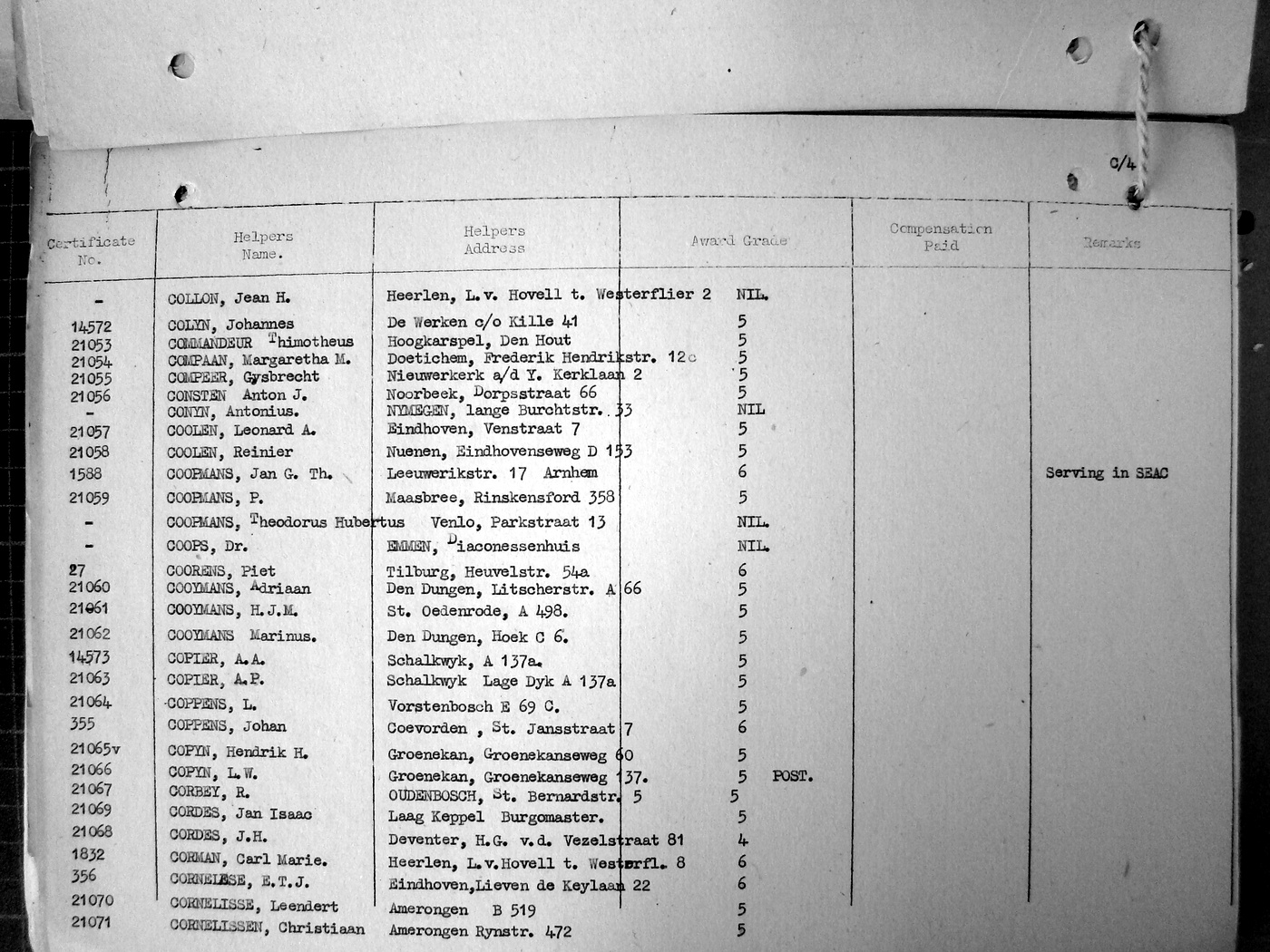
✓ What the British recorded afterwards. The British index of helpers, read on the sheet images, lists the households that hid him: "RAKERS, Hermannus", Utrechtscheweg 365, Maartensdijk, certificate 27036, "5. Post." (grade 5, posthumous), and, at the same address, his widow, "RAKERS-v.LIMBURG BROUWER, C.W.M.", certificate 22534, grade 5 (sheet R/1; the index's notes); and, at Amerongen, "CORNELISSEN, Christiaan", Rijnstraat 472, certificate 21071, grade 5 (sheet C/4). The index lists addresses after the Liberation; the Cornelissen entry is that household by its address, and Schjelderup's own report names only "Mr. CORNELISSEN, AMERONGEN" (Mr and Mrs Cornelissen).
His own MI9 report
Link to the section His own MI9 report◐ Schjelderup's MI9 report (transcript; the Kew original not seen) is I.S.9/WEA/1/271/2349, with Gri's 272/2350, Kew WO 208/3351/2349–2350; it is signed "E.P. Curtis, Capt. For Lieut-Colonel. I.S.9." on 1 February 1945, and its Appendix A of helpers is headed with an interview date of 13 January 1945. Kew's entries say Appendices A and C are both included (the catalogue entries); the transcript has only Appendix A. Its square brackets and its four footnotes are the transcriber's, not the report's. The bullets keep to what "Two Came Back!" above lacks or tells differently.
- The Leopold Canal. His company "was holding the left sector of the bridgehead", at map reference 034023 (Sheet 2). The German attack came "at approx. 0400 hrs"; at "0730 hrs approx." he was out of ammunition, "burnt out of our defensive positions in the houses" and surrounded, and surrendered. "Of my Company two platoons managed to make their way back", and he burned his maps and papers before giving himself up. The grenade left "pieces of shrapnel in the left side which was then semi-paralysed, and also pieces of shrapnel in the back".
- Captured. He refused to give up his watch, saying "being an Officer I was not to be searched by a Private soldier", and had a Schmeisser put to his head. The prisoners carried German wounded back "under fire of our own troops" to a point south of Aardenburg, then to a building at Oostburg, "what appeared to me to be a divisional H.Q.", where about 30 of them were locked in without food. At night a German officer "who spoke perfect English" woke men one by one to ask if they were from 8th Brigade.
- Interrogated, 8 October. The privates were questioned first, "N.C.O's and Officers last", by a captain whose "main concern was to know where the 8th and 9th Bdes were". The captain "was well informed as to who I was and of the strength of my Coy", which Schjelderup put down to men questioned before him. The battalion's account has him deny knowing the name on the interrogator's slip (p. 2); the report does not.
- The dates "Two Came Back!" leaves out.
- 8 October: marched at about 18:30 to Breskens (0918) and ferried that night to Flushing (1124), to a German barracks with wooden bunks and no blankets.
- 10 October: marched at about 08:00 to Goes (Sheet 3, 3329) through Middelburg, and put in a gymnasium; 11 October in Goes.
- 12 October: by truck back to Middelburg (1429), and onto the steel floor of a river barge.
- 13 October: 75 Italians of a labour battalion were put in with them, and at nightfall "shared their rations and tobacco with us. It was the first decent food we had had since capture."
- 14 October: left Middelburg in the late afternoon and Walcheren at nightfall, locked in the barge; the Germans "all had life belts and seemed very scared".
- 15 October: landed at Dordrecht (Sheet 4, 8761) and held in a warehouse "one km West of the Station".
- The hospital ship, 13 October. A German hospital ship came alongside. He "tried twice" to have three seriously wounded men moved and was told he would be shot if he tried again; "at last I managed to contact a German Nursing Sister" and the three were taken off.
- Dordrecht to Utrecht. The three privates of other regiments who joined at Dordrecht on 15 October, Trainor among them, came with a Canadian Typhoon pilot. The report names the pilot and two of the privates, and says it does not know the third, "from the Canadian Black watch".
- 16 and 17 October.
- 16 October: the party, "totalling 40", was marched at about 19:00 to the main station and put into "a smashed mail van riddled with bullets", with "not sufficient room for each one to sit down".
- At about 21:00 it was taken out to the third-class waiting room, where it spent the night; the report says it was not taken back to the warehouse that night because the guards "were afraid that many would escape under cover of darkness".
- 17 October: it went back to the warehouse, and at dusk boarded box-cars, "One guard to every prisoner, and three to every Officer"; "that night we set off for UTRECHT".
- The six days. The report dates the siding "18 Oct – 23 Oct 44" and calls it "that period of 6 days on railway siding in the main yard", with "very little food, no utensils for eating, very little straw to sleep on, no blankets, no water to wash or shave or drink". Once a day the men were lined up on the rails to dig a hole "with the heel", "in the view of German women and Officers who were also on the train and who were laughing at us".
- Four planned the escape. "Capt. R. BROWNRIDGE, 23 R.C.A.: Sgt. GRI, Pte. SWATRZ, H. No. K62742 and myself with a penknife prepared our escape", carving planks "2 ½ " thick leaving an eighth of an inch free on the outside" and keeping a man leaning against the cut. Gri and Swartz were two of the four; Berry and Briere do not appear in its account of the box-car or the jump. "The rest of the party were perfectly willing to go to a P/W camp and gave us no assistance whatsoever."
- The jump, 23 October. "At approx. 2200 hrs, about ½ hour after leaving UTRECHT en route for HAMBURG", he and Brownridge smashed the boards. He "worked my way out first and hung on the side until BROWNRIDGE, SWARTZ and GRI were clear, then I jumped", ½ mile south-west of De Bilt station (Sheet 2, 2695).
- After the jump. He and Gri walked back to the others, and "As we were leaving we were joined by Pte. TRAINOR." They split in two: himself, Brownridge and Trainor; Gri and Swartz. They had "no maps, compass, watch and also no knowledge of the Underground", and meant to walk south by the sound of the guns.
- 24 October. Setting off at about 00:30, his party at 03:00 "blundered right into a German Camp with dugouts, barbed wire, and sentries in pairs every 60 ft", crawled clear and lay in a bush all day. At dusk, crawling towards a road "in between two sets of double apron fences", they met a patrol of two: he and Trainor "froze behind some trees", and Brownridge "froze on the trail where the sentries were coming. He was caught, beaten up with the butts of their Schmiesers and dragged away."
- 24 October, evening. So ill by then from his wounds that he decided to give himself up "either to the Dutch or the Germans".
- 25 October, the farm. At about 05:00 he came to a farm "where there were many people buying their Black market milk": "I asked for help but nobody would hide or help me", until "a man appeared who told me to stay put and when everybody was gone he would take me with him". He was Hermannus Rakers of 393 Groenekaneweg, Groenekan (map 223942), "a sergeant of police".
- 25 October, the fort. Rakers took him to "the Underground fort (215956)", where he was to stay "until I could prove my bona fide". At about 08:30 "an R.C.A.F. sergeant from a bomber crew – Sgt. PORTER, R.E. No. R.133074, was brought in to interrogate me" and left, in the transcript's words, at "100 hrs (approx.)", "satisfied that I was a Canadian officer".
- At about 18:00 Rakers "brought us civilian clothes. He then took us to his house by bicycle"; he was put to bed and a doctor called at once.
- ◐ The "us" is very probably Trainor and himself, whom Ponssen has escorted to the Rakers house together, Schjelderup on a bicycle (Ponssen, p. 4); Trainor's page has the Dutch forms on where Trainor slept.
- Gri, that evening. "I learned that Sgt. GRI was in the vicinity. I scribbled a note to him telling him to stay in the district for a little while." Tjeerd Holwerda wrote in 1946 that Gri and Swartz, found in a hay-stack, meant to go to Rotterdam on their own and changed their plan "on the order of capt. Schelderup" (Holwerda's file, p. 7): ◐ the same message.
- At the Rakers house. "Owing to the state of my health they never thought that I would live." A private nurse, "special food such as eggs, preserved fruits, and good meat" from various farms, and two Underground men who came to ask his regiment; "When I left this house I was another man."
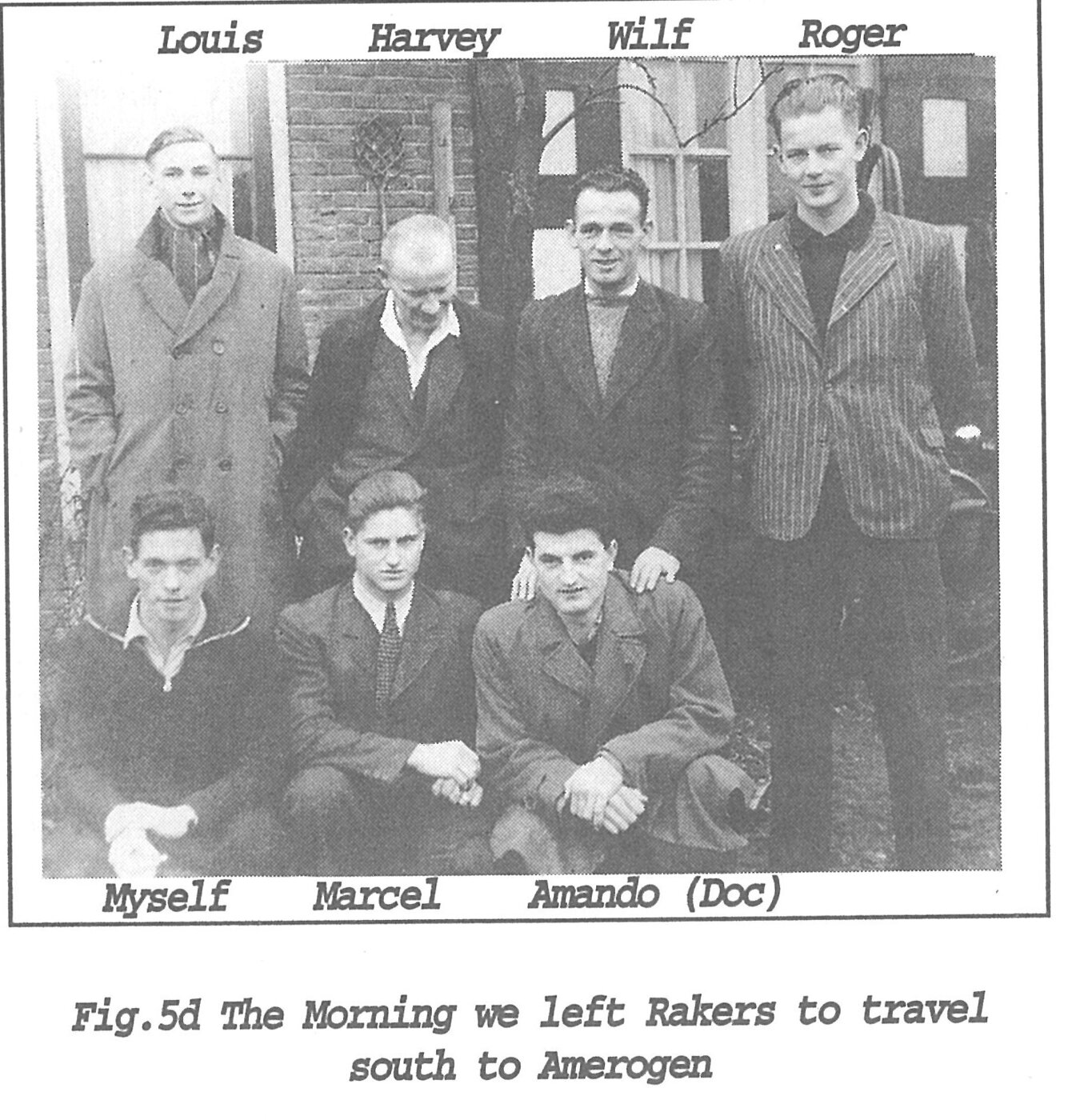
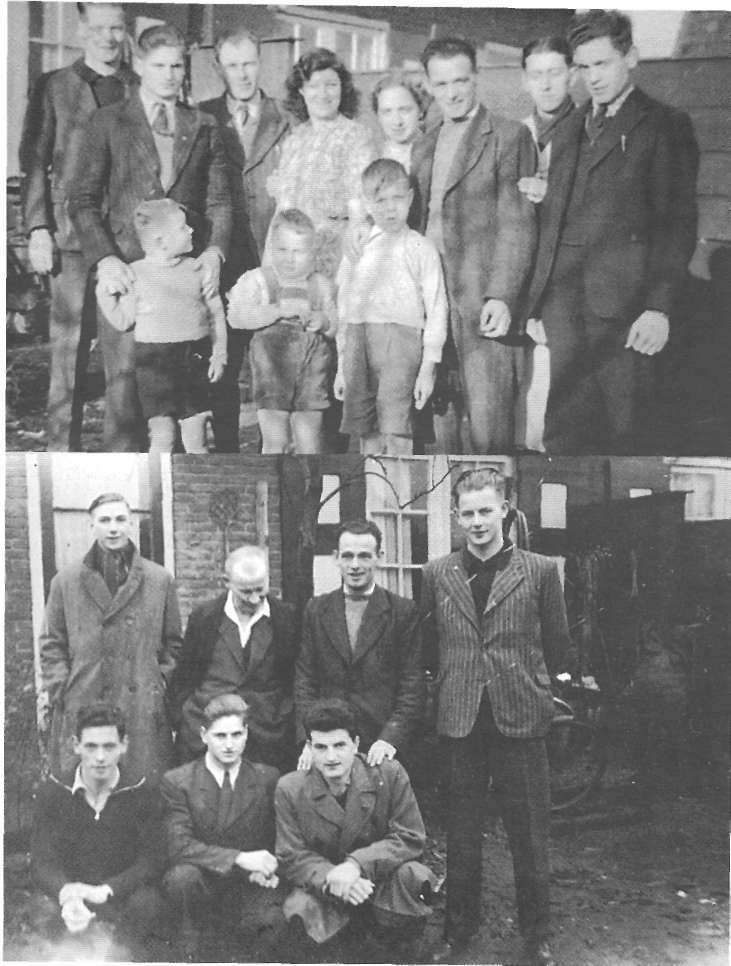
- What he learned there. He learned that "6 other men of my party had jumped out of the train after us", that Rakers "personally saw that all of them had billets" and "at one time had 4 Canadians in his house", and that "Sgt. PORTER had been living with him since the middle of June". ✓ The remarks on the form Rakers's widow filled in for him have "Porter, Briere, Schelderup and Berry were housed with us" (the form, box 12, p. 2); its table on p. 3 lists seven men, Trainor, Swartz and Gri included (the table).
- Appendix A. It names two helpers: "(1). 25 Oct – 22 Dec 44" Hermannus Rakers, "Food and shelter, civilian clothes, Attention while ill"; and "(2). 23 Dec 44 – 2 Jan 45" Mr Cornelissen (Chris Cornelisse and his wife Elisabeth) at Amerongen (Sheet 5, 4380), "Food and shelter for Source and Sgt. PORTER" (the columns of the table re-joined). The farmer, the fort's guard, the doctors and the nurse are not named; they are known only from their own forms, above.
- To Amerongen. "At 1245 hours approx., myself and three others were taken away by bicycle to AMERONGEN" and put up at Cornelissen's with Porter, the others "in nearby houses": "We were altogether eleven men brought down in three days from the UTRECHT area to AMERONGEN and awaiting to cross the lines." ◐ The four are very probably the four the Rakers family housed. The report gives no day for it; its Appendix A puts it on 22 or 23 December, which fits Hardy meeting him at Amerongen at about 16:30 on the 23rd (Hardy).
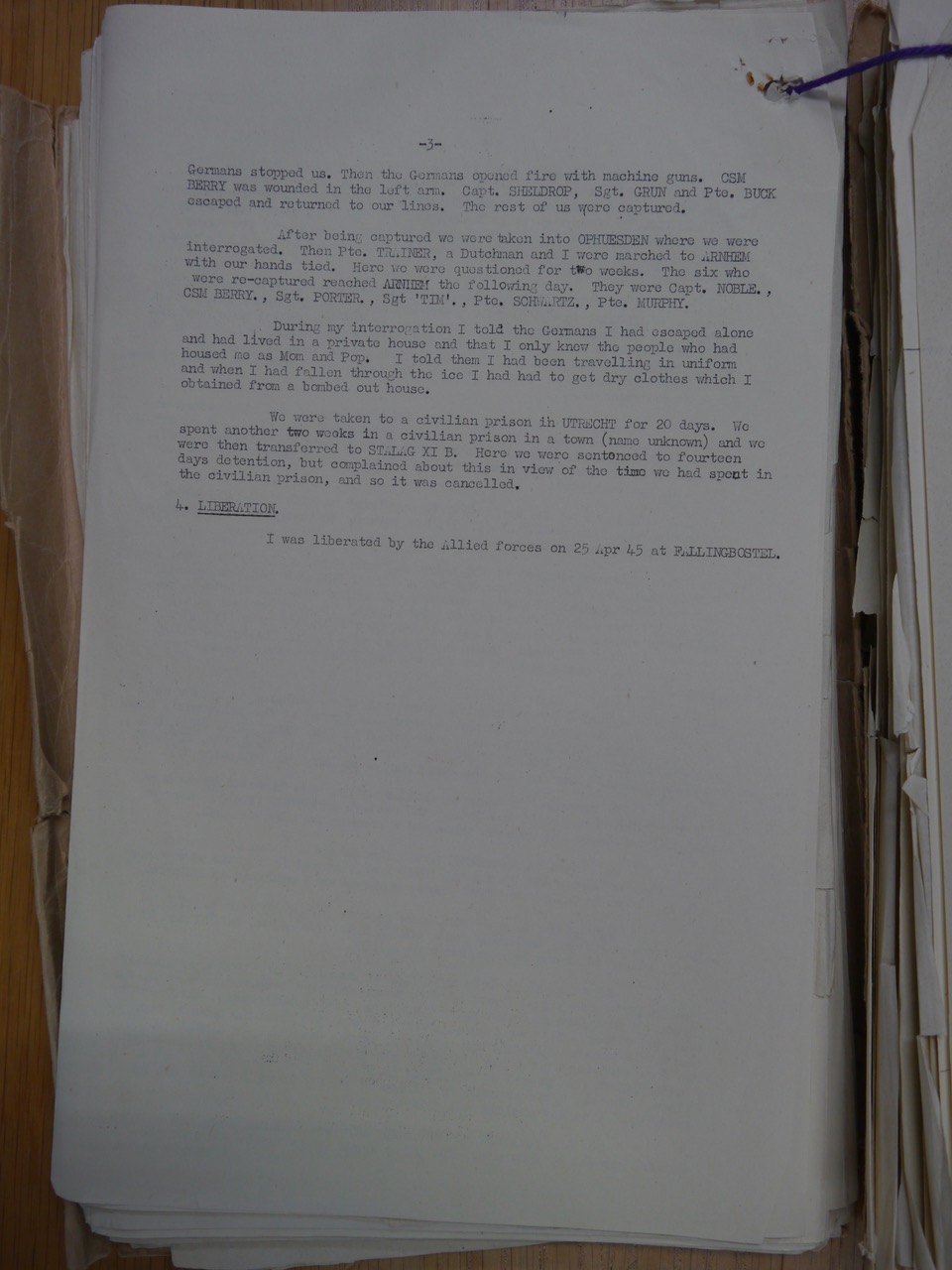
In the other Canadians' reports. ✓ The MI9 liberation reports of Berry, Swartz and Briere, photographed at Kew by the late John Howes, who passed them to Lisan Koppenol, and she sent them on, name him, each typed in its own way as "SHELDROP" (Swartz, Briere) or with the middle of the name blurred (Berry).
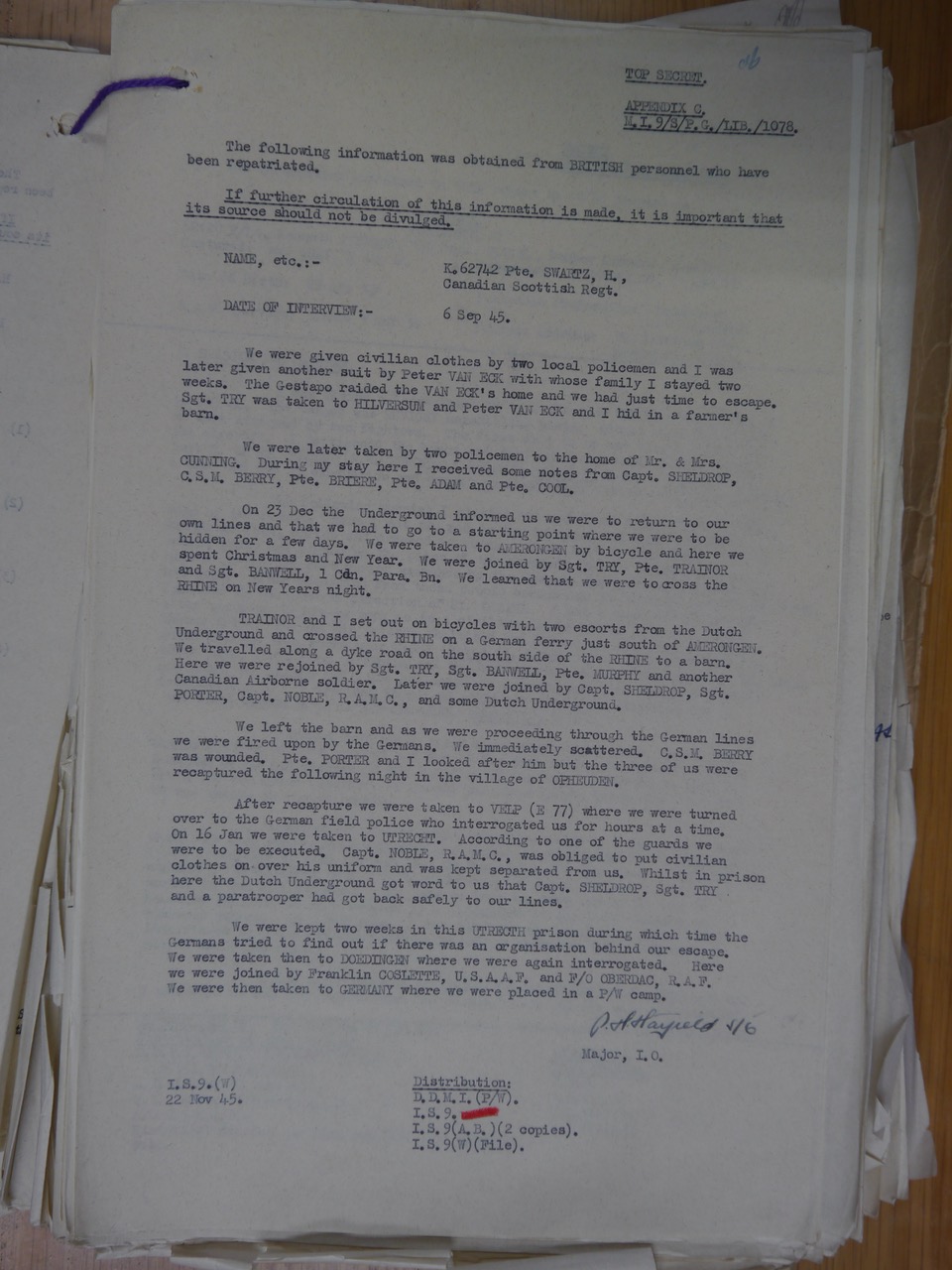
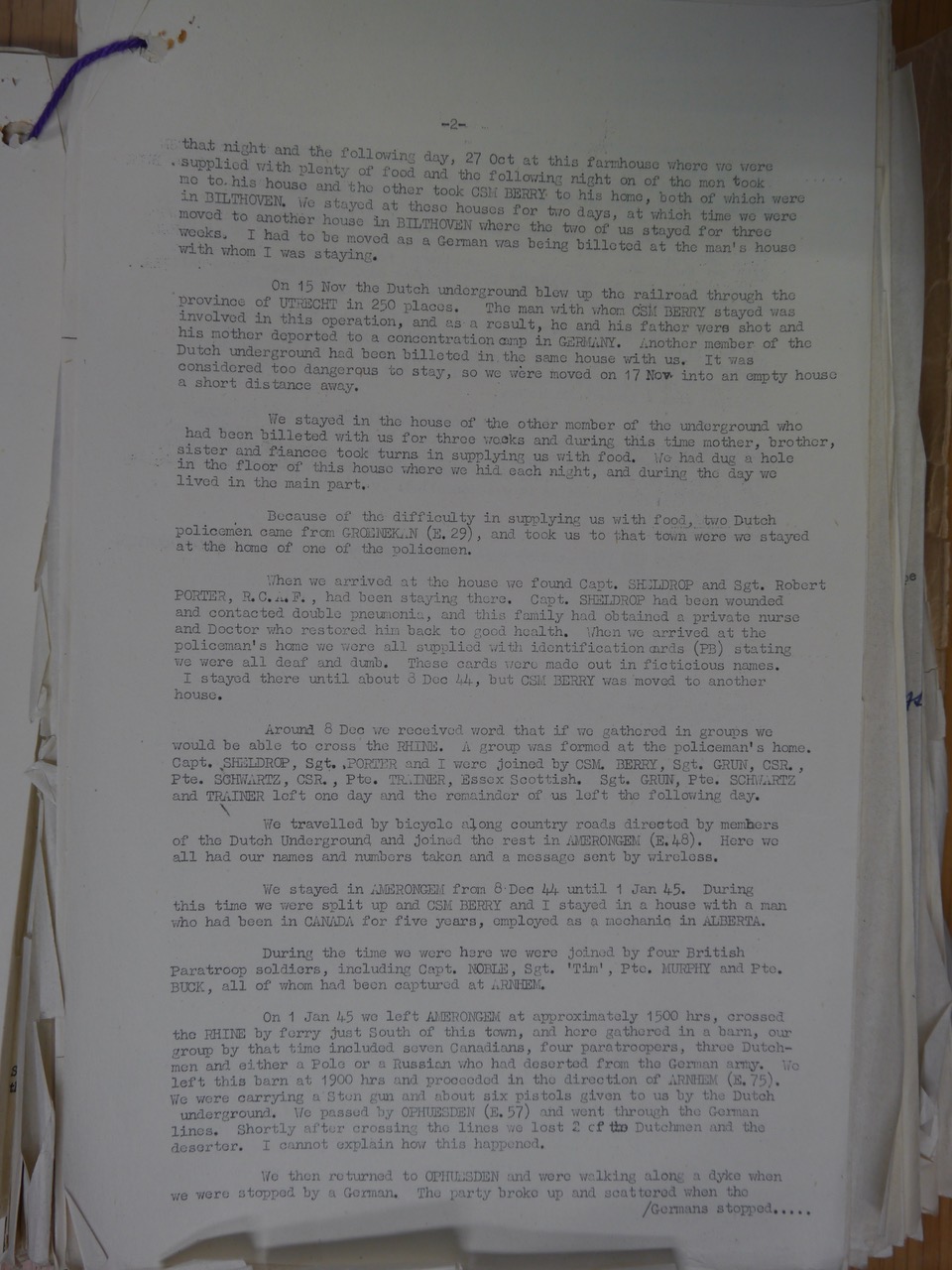
- The jump. Swartz has "Capt. SHELDROP and Capt. BROWNLEY, both Canadians" leaving the train at Blauwkanel on 23 October with Gri (Swartz, p. 1). Briere has "Capt. SHELDROP, C.S.R., and a Capt in the R.C.A.," cutting the hole in the car (Briere, p. 1); Swartz's page and Briere's page have the rest.
- At Rakers's. Briere found him and Porter at the policeman's house at Groenekan; he "had been wounded and contacted double pneumonia", and the family had got a private nurse and a doctor who "restored him back to good health" (Briere, p. 2). ✓ That is his own account above. Berry met him at Groenekan between 1 and 24 December (Berry, p. 2). Swartz, at Maartensdijk, "received some notes from Capt. SHELDROP" (Swartz, Appendix C).
- After the ambush. Briere has "Capt. SHELDROP, Sgt. GRUN and Pte. BUCK" escaping to the British lines (Briere, p. 3); Swartz heard in the Utrecht prison from the underground that "Capt. SHELDROP, Sgt. TRY and a paratrooper had got back safely to our lines" (Swartz, Appendix C). ✓ Both agree with his report and Hardy's.
With Murphy
Link to the section With MurphyMurphy is in the report once, in the list of the party that set out on foot from the Rhine on 2 January 1945, and once, by name, among the three men "lost". ◐ Everything below is from Schjelderup's MI9 report (transcript; the Kew original not seen); the Pegasus Archive prints the same crossing on Hardy's page.
By parties of one and two we moved on bicycles from AMERONGEN. I was with CORNELISSEN and DERRICK. We crossed the RHINE by ferry at (Sheet 5, 4378) by paying 10 cents. We assembled the whole lot of us in a brick factory at (Sheet 5, 4876). At 1830 hrs approx., we set off on foot: 11 Allied personnel, DERRICK, and 2 other Dutchmen as guides.
— Capt V. R. Schjelderup · MI9 escape report, I.S.9/WEA/1/271/2349, 1 February 1945 · the transcript (the Kew original not seen)
His list of the party has twelve entries, one of them an unnamed Polish soldier, though he says eleven: himself, "C.S.M. BERRY, W." (K.42160), "Sgt. GRI, A, M.M." (K.46862), "Sgt. PORTER, R.E. R.C.A.F." (R133074), "Pte. SWARTZ, H." (K.62742), "Pte. BRIERRE, M.", "Pte. TRAINOR, L.F." (F.82729), "A Polish soldier", "Pte. HARDY. Paratrooper.", "Pte. MURPHY, T. Paratrooper. 156 Para Bn.", "Capt. NOBLE. Paratrooper. 133 Fd Amb." and "Sgt. BANWELL, K. Paratrooper. 10 Bn." The footnotes against the paratroopers are the transcriber's; ⚠︎ the one against Murphy gives his number as 27566477, an error for 2756457 (WO 422/38420; his service number).
We moved as a patrol with DERRICK in command. The country was flooded and frozen and very difficult. At 2100 hrs approx., we bumped into a German patrol. We dispersed, lay down and froze. When the patrol had passed we pushed off rapidly, but we had lost the Polish soldier and the Dutchman who was the guide for the latter phase of the journey. … On reaching the road at 573739 we were shot at by automatic weapons at very close range. The party scattered, eight to the South for the road and then westwards. We were pursued but managed to shake them off. We lost, and never saw again, one Dutchman and the following three men: Capt. NOBLE, Sgt. TEX (?) [BANWELL], Pte. MURPHY. Sgt. Major BERRY was badly wounded in the left elbow.
— Capt V. R. Schjelderup · MI9 escape report, I.S.9/WEA/1/271/2349, 1 February 1945 · the transcript (the Kew original not seen; "[BANWELL]" is the transcriber's)
- Between the patrol and the road. "We kept going East until we hit a large demolished factory (Sheet 5, 571746) where we had a conference as to what was the best way to cross the line", and "decided to work Southwards". The Pegasus Archive's copy has "Sheet 4" for the same reference (Hardy's page).
- The second firing. At 568731 "we were again shot at by automatic weapons from three mutually supporting positions", with "Bren guns and British mortar flares". He, Gri and Hardy took cover; "The remainder panicked and ran madly onto the ice away from the weapon whenever it fired. I called them but they would not come back." ◐ By the report's own list the remainder were Berry, Porter, Swartz, Briere and Trainor.
- Hardy sent out. "I ordered HARDY to go onto the ice alone and bring the others back. His reply was simply 'Yes, Sir'." After about 20 minutes there was no sign of him, so Schjelderup and Gri went out and, knowing where Hardy had gone, "were able to pick him up": "We were the only three of the party of eleven men left."
- The centre post. Within 100 feet of the "German" centre post they "called out twice in English. No reply! I called out a third time and the reply was in German, two grenades and a spray of Schmeisser." He chose "South-South-East", "sending Sgt. GRI ahead all the time", and they reached the canal (569722), with German voices "three to four hundred yards to our right".
- The island. "Through Sgt. GRI's determined efforts" they found ice strong enough to reach "a small island in between the large and small canal", with "a demolished tool shed"; they lay up there for the day, took turns to sleep, and built a small raft but were "too weak to attempt a crossing" that day.
- Across the canal. The raft was taken to a crossing he had chosen. Gri "made several attempts and failed"; Hardy swam with a wire tied to him and "had the greatest difficulty in getting [out] on the other side on account of the overhanging ice" (the brackets are the transcriber's). Then "GRI and I crossed, one hand on the raft and the other paddling", and "[in] so doing we lost our shoes and socks".
- The houses. Across about 600 yards of ice, "continually falling through waist deep", they reached a partly demolished house and lit a fire in an upstairs room, with an American blanket over the window; they found "Preserved beans and five tins of M & V".
- The next day. Moving "from house to house in what we knew to be the 'No Mans Land'", they found American rations, a watch and "a German map of the area". He "also found a pair of shoes, but Sgt. GRI was not as lucky"; "There was a smell of dead bodies about so we had to push out."
- Dodewaard. "We approached DODEWAARD (Sheet 5, 5569), observed no movement and had just passed the crossroads in the town when HARDY, who was in the rear, yelled 'TOMMIES!'" A forward post of "the Recce Regt of 49 Div" picked them up, "dried us up, gave us hot tea and sent us back as quickly as possible to their Div H.Q."
In Noble's later account. ⚠︎ Charles Noble, lost from the party at the first firing, told the night again long after the war, in his own later account (unpublished private papers, shared with us privately). It is late memory, and it differs from this report in places:
- ◐ The ferry: "taken over uneventfully by the Germans to whom we paid a small amount of money", as in the report's "10 cents".
- ⚠︎ Who was to meet them: "we were to be met by fifteen Canadians. A platoon was coming from the Canadian line." The report says nothing of a meeting; Noble's own report of 1945 has a British patrol (Noble).
- ⚠︎ A V1 "malfunctioned, dropped near us and killed our second guide plus a cow", where this report has the guide for the latter phase lost when the German patrol passed.
- ⚠︎ Before the firing the party found a deserted dyke house "full of loose Canadian ammunition", took it to be held by the Canadians, "lit cigarettes and started shouting", and went on east along the dyke road until "a dug-in machine gun about forty yards away" opened fire; "none in the group was nick-nailed" [sic], where this report has Berry "badly wounded in the left elbow".
The report gives no calendar date for the arrival; its own count of days, from the firing on the night of 2 January, comes to 5 January (When he reached the British lines, under Where the sources disagree).
He reached British lines with Gri and Hardy, and was given the DSO for the Leopold Canal, "Lieutenant (acting Captain) Vilhelm Roger SCHJELDERUP, M.C." (Ottawa, 5 May 1945), and a bar to the Military Cross, "Captain (acting Major) Vilhelm Roger SCHJELDERUP, D.S.O., M.C." (Ottawa, 12 May 1945), to the MC he had won on D-Day; both were gazetted on 31 May 1945 (p. 2743; p. 2746).
He stayed in the army. He commanded the 2nd Battalion of Princess Patricia's Canadian Light Infantry from 2 December 1957 to 10 May 1960, and as a colonel ◐ commanded Canadian Forces Base Calgary in March 1968 (his father's obituary, above) and was Senior Military Advisor to the Canadian Defence Liaison Staff in London when he died suddenly in 1974, of what the regiment's journal calls a war-related injury (The Patrician, 2008). ◐ His obituary in The Times (Friday 11 October 1974, the sixteenth page of the scan; the Internet Archive files the issue under 12 October, but its front page reads "Friday October 11 1974, No 59,215"; read only through the Archive's OCR, the text, its search panel) gives the date: he "died suddenly on September 29 in a London hospital". It calls him "a superb fighting soldier whose quiet manner and personal courage inspired confidence and devotion in his men", and fills in his post-war career: after the war he graduated from the Royal Military College of Science at Shrivenham and the Staff College at Kingston, Ontario; ◐ one sentence, with a gap in the OCR before it, ends with the 2nd Battalion PPCLI "as the high point of his career", which we read as his command of it; in 1961 he was commanding officer of Canada's training mission to the Ghanaian forces and military adviser to the Canadian High Commissioner in Accra; he then served at Army Headquarters in Ottawa and commanded the Canadian Forces base at Calgary, and in August 1970 came back to Britain as Senior Army Liaison Officer at the Canadian High Commission. He is buried in a churchyard in Courtenay. Schjelderup Lake in Strathcona Park, near the Golden Hinde he had climbed at fifteen in 1937, is named after him (Times Colonist, 2016; The Patrician).
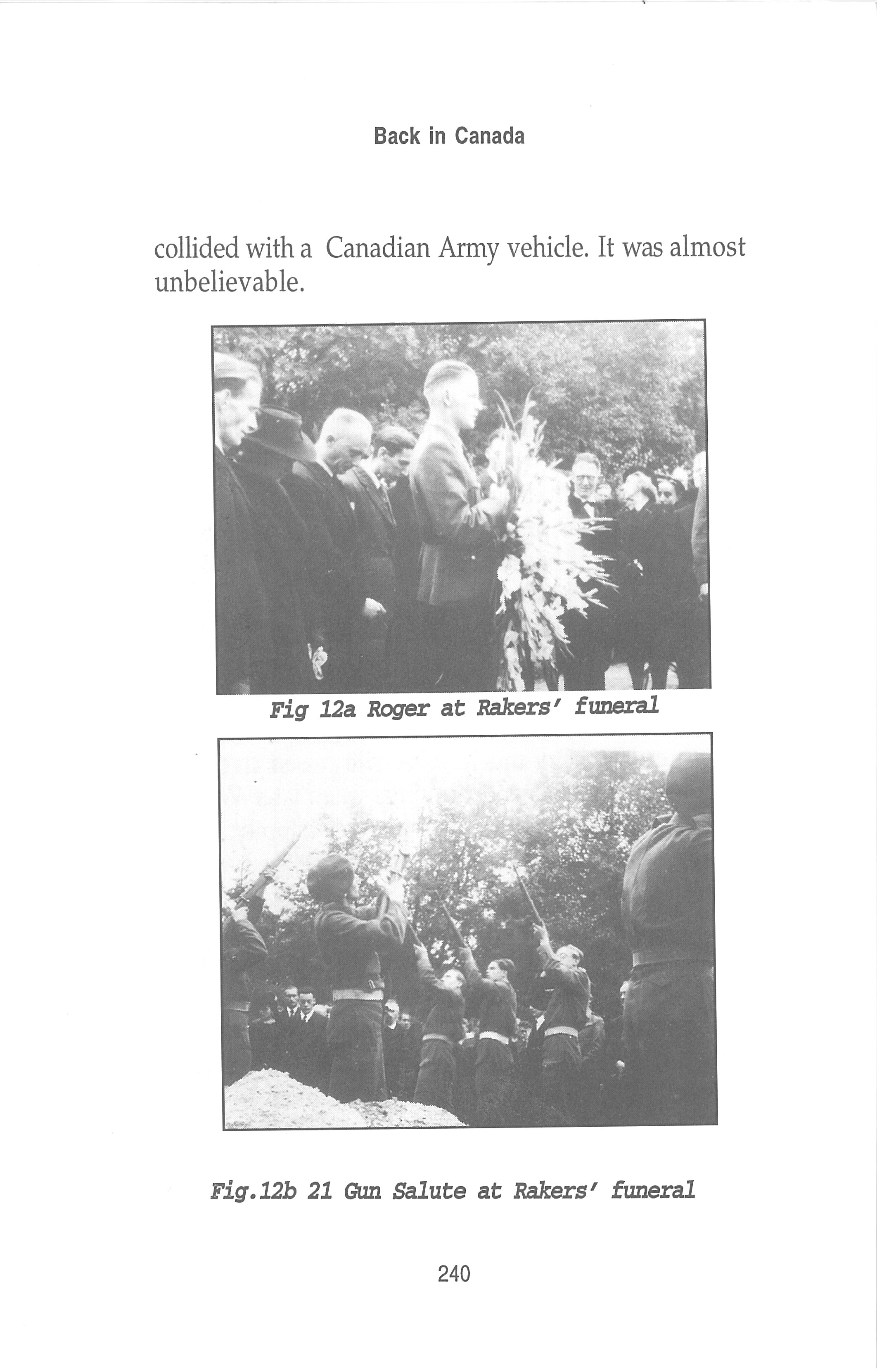
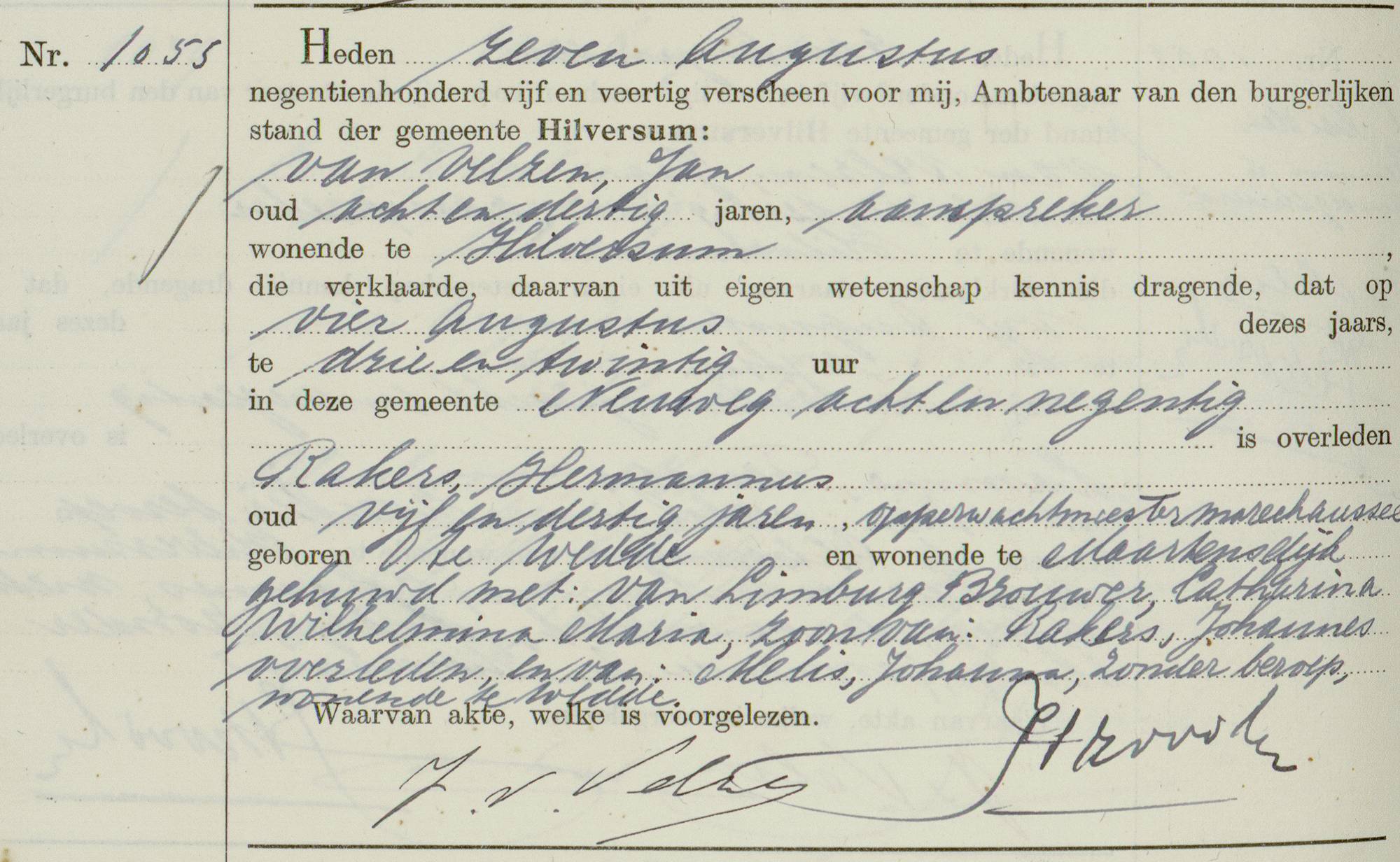
At Hermannus Rakers's funeral, August 1945. ⚠︎ Rakers, who had hidden him from 25 October to 22 December by his Appendix A, died on 4 August 1945 (the Hilversum death deed; his page). Porter, by then in Canada, had the news in "a very sad letter from Dicky" in the first part of August, saying Rakers had collided with a Canadian Army vehicle (pp. 239–240, chapter 12); he does not say where the funeral details came from, and calls it an "automobile accident" (p. 241). He writes: "Rakers was given full recognition with a 21 gun salute. Roger was a Captain then and represented the Canadian Army at the funeral. He spoke over the grave." (p. 241, chapter 12). He prints a photograph captioned "Roger at Rakers' funeral" (p. 240). The rank is not the one the papers gave him that summer, "Major" on 31 July 1945 (Nelson Daily News), and Porter gives neither the date nor the place of the burial; it is one man's account from afar.
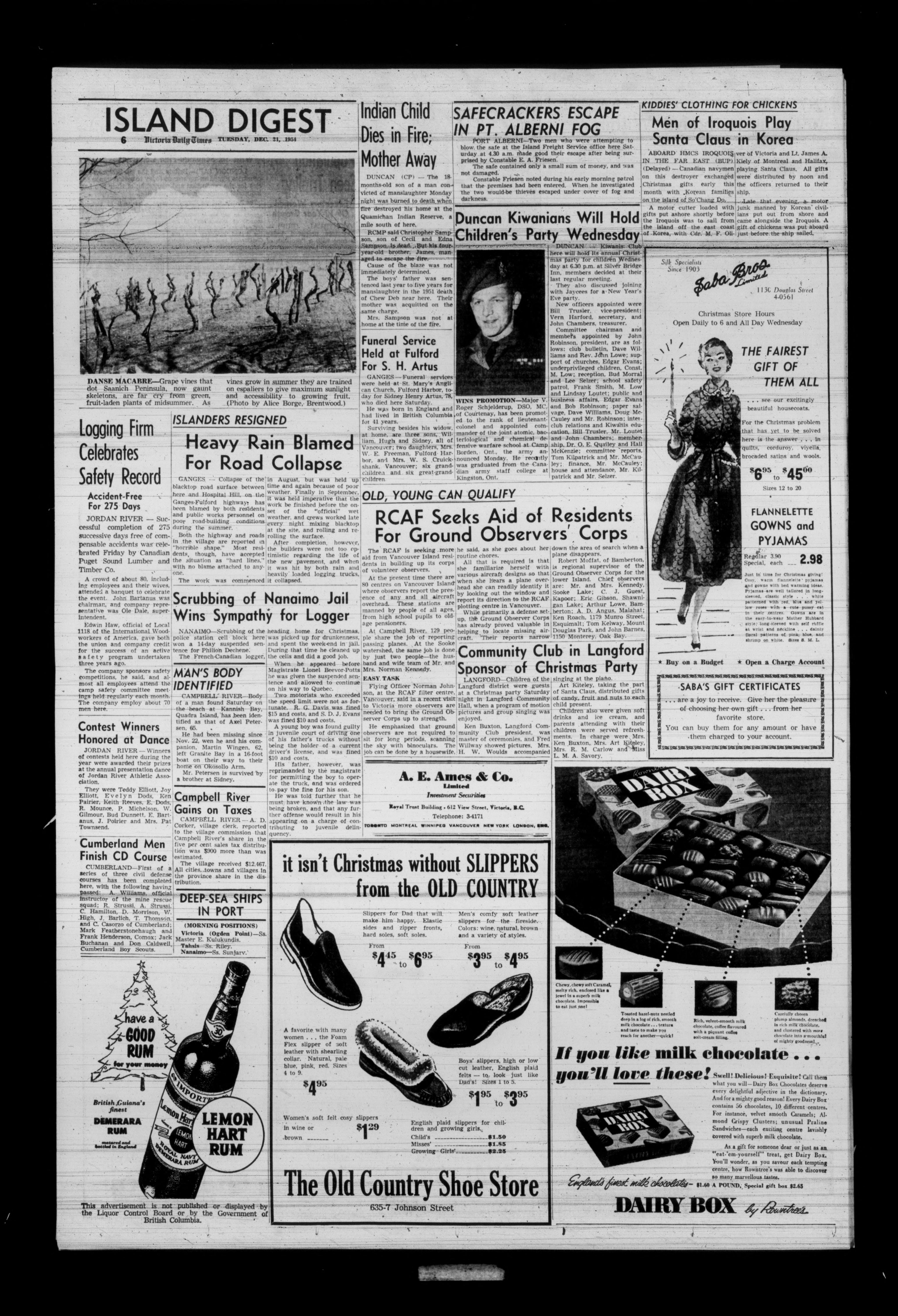
The career in the papers and the regiment's journal. ✓ Each read on the page image.
- 1950. "Major Roger Schjelderup, D.S.O., M.C. and Bar" represented the Canadian Scottish at the dedication of the Sandhurst Memorial Chapel, where the regiment's crest was set on the back of the Royal Scots pew, with the Duke of Gloucester present (Daily Colonist, 19 November 1950, p. 34).
- 1952. Back from a two-year course at the Military College of Science, Shrivenham, Berkshire, and "now stationed at army headquarters, Ottawa"; he and his wife spent August visiting Victoria and Courtenay (Daily Colonist, 1 August 1952, p. 13).
- 1954. Promoted lieutenant-colonel and appointed to command the joint atomic, bacteriological and chemical defensive warfare school at Camp Borden, Ontario, after graduating from the Canadian army staff college at Kingston (Victoria Daily Times, 21 December 1954, p. 6). This is the Shrivenham and Kingston of The Times obituary above, with the step between them.
- 1958. A lieutenant-colonel, "Lt.-Col. V R Schjelderup", is one of the pall bearers at the military funeral in Montreal of Brig. Andrew Hamilton Gault, who "founded the Patricia's in 1914", in a Canadian Press story (Nelson Daily News, 2 December 1958, p. 9). ✓ The date is inside his command of the 2nd Battalion PPCLI (December 1957 to May 1960, above); the article does not say that he was commanding it.
- 1964. A colonel, "Director of 'Q' Operations and Planning and former CO of 2 PPCLI", at Canadian Forces Headquarters; in mid-July he visited the sergeants' and officers' messes of the 1st Battalion in Germany (The Patrician, vol. 17, p. 26; the posting list, p. 97, has him at CFHQ).
- 1974. In January, as "senior Patricia serving in England", he was at Lady Patricia Ramsay's funeral at Windsor (The Patrician, vol. 27, p. 106). The In Memoriam list has "Schjelderup VR ... at London England, 29 Sep 74 serving with CDLS, Col, DSO, MC, CD" (p. 130), and on 5 October "a large number of our Members" of the PPCLI Association went to the Church of St. Anne, Bagshot, for the funeral service, six as honorary pallbearers: "Roger was a good friend to us all" (p. 127). The Courtenay burial above is not mentioned there.
Jean E. Portugal's We Were There: A Record for Canada, vol. 4 (1998), has a section on him, pp. 1996–2006, headed "Lt V.R. Schjelderup, DSO, MC & Bar (Immediate) C Company, 13 Platoon, The Canadian Scottish"; it follows the regimental history, "Two Came Back!" and the DSO citation closely and adds little to what is above (the extracts; ◐ OCR only from the Internet Archive's print-disabled copy, the page images not seen, so nothing here is quoted at length). What it adds:
- The ferry on 2 January 1945: "6 Canadians and 4 British paratroops crossed the Rhine by ferry" in broad daylight, in twos and threes, paying "10 cents for the trip", with some German soldiers helping to push the ferry from the dock (p. 2004). It does not name the British four; ◐ Hardy, Murphy, Banwell and Noble, on the story page's reading (The crossing and recapture).
- The last three: "Schjelderup's group consisted of himself, Sgt Gri and Pte 'Scotty' Hardy, a British paratrooper", reaching the forward outposts of the 41st Reconnaissance Squadron of the British 49th Division "on the afternoon of Jan. 5" (p. 2005).
- The Bar to the Military Cross has no citation: the Directorate of History's cards give only the gazette entry, and the cable recommending Schjelderup and Gri "for escape from enemy captivity" ends "No citations available". The author conjectures that details were held back "apprehension about revealing details of the assistance and cooperation provided by members of the Dutch Underground" (pp. 2005–2006). ◐ That fits the gazette entries below, which give no reasons.
- His end: "He became a Colonel in the postwar Active Force and died of an embolism during a routine operation in England" (p. 1996).
T. Robert Fowler's "Profiles of Valour: Roger Schjelderup", in Canadian Military History 5(2), Autumn 1996, pp. 99–105, tells his story from, among others, Porter's manuscript (notes 11, 12, 16), communication with W. Berry (note 10) and correspondence with Mrs Rakers (note 13), Elsa Caspers (note 14) and Mrs Nely Achterberg (Cornelisse) (note 15) (the article; its text). It gives the reason the train stood at Utrecht: "a Dutch rail strike caused the train to be shunted onto a siding. They remained there for six more days, with only one serving of soup daily". It prints two photographs taken at the Rakers house, one of them "The escapers, on the morning of 23 December 1944, when they left Rakers' home", and has him and Porter hidden at Amerongen "at the home of Chris Cornelisse, a member of the local Resistance"; on 2 January, at the abandoned brickyard south of Opheusden, "they were joined by other escapers until the group totalled 19", and after the ambush "Captain Schjelderup found himself with Sergeant Gri and a British paratrooper, Private J. Hardy". ⚠︎ It calls the failed November crossing "Pegasus III" and puts it in October; it was Pegasus II, on 17/18 November.
More books and a journal, from the Archive's full-text index. ◐ Search hits only, not read on the page, and none of the books was borrowed.
- T. Robert Fowler, Courage Rewarded (2008), tells him again: "Most of the escapers were captured, but Captain Schjelderup, Sergeant Armando Gri and a British paratrooper successfully concealed themselves"; "weakened by his ordeal, Roger Schjelderup had developed pleurisy"; and Gri "had been resourceful enough to hide a small penknife in his anklet" (the hits (the longer passage)).
- ⚠︎ Whose penknife it was is disputed: Fowler and Gri's own recommendation have it Gri's, while Schjelderup's DSO recommendation says he "successfully concealed his knife from the enemy search par[t]ies" (war diary, January 1945, Appendix 22, PDF p. 51 of e011374613; PDF p. 52 for Gri's).
- ⚠︎ It says Schjelderup "was later awarded a Bar to his Military Medal, in addition to his Distinguished Service Order": the Gazette has a bar to his Military Cross (p. 2746).
- Dave Brown, Faces of War, has a chapter on him: on Juno Beach "Schjelderup saw no footprints in the sand", and Gri is "identified in records only as Sgt. A. Gri" (the hits); its death date is under the disagreements below.
- Terry Copp, Cinderella Army, has only an endnote: for the "capture, imprisonment, and escape of Captain Roger Schjelderup, who commanded 'C' Company, see Fowler" (the hits (the longer passage)), so it is no second account of the escape.
- Canadian Military History, Spring 1997, has two letters on Fowler's article of Autumn 1996: one from its author about "a small detail regarding my article on Roger Schjelderup", and one from a man who "knew Roger during his time with the Canadian Scottish Regiment" (the hits (the longer passage)). The detail is not in the hits and the letters have not been read.
- Mark Zuehlke, Terrible Victory (2007), has the Leopold Canal from his company's side, from "Schjelderup correspondence", including his letter to the regimental historian R. H. Roy of 16 July 1957 (University of Victoria Special Collections); the book's index puts him on pp. 221–24, 226–28 and 290, and the hits are not placed on a page. "Company commander Major Roger Schjelderup had said: 'There will be nothing to this. The ...'"; he "told Lieutenant Marshall that his No. 15 Platoon should hug ...", and "capitalized on Marshall's toehold within Oosthoek" (the hits).
- Its account of the escape has "Schjelderup and Gri were among the escapees, reaching friendly lines".
- ◐ Snippets only; nothing in them clashes with the battalion's account above.
- Zuehlke, The Cinderella Campaign (2017), pp. 374–76 and 398 by its index, has him at Calais as "'C' Company's Major Roger Schjelderup": with "A" Company's Major Bill Matthews he "left their men at a crossroads and rashly set off to find Sangatte alone", and "five hundred yards east of Sangatte, Schjelderup reported being under heavy fire"; later he "saw 'no reason I would not be suitable for the job'" and was "guided into the fortified headquarters by a German officer" (the hits). ◐ Snippets only. It names him as C Company's commander at Calais, which Berry's page had as probable.
- Zuehlke, Juno Beach (2005; pp. 183–85 and 247) and Assault on Juno (2012; pp. 51–52 and 54): on D-Day, as the ramp went down, "Lieutenant Roger Schjelderup 'could see the open grey beach with not a person ...'"; he "led his men in a charge"; "Crofton sent Schjelderup to clear the remaining woods south of the chateau", and a later passage has Lieutenant Roger Schjelderup ordered "to close on the Germans with No. 13 Platoon" (the hits). ◐ Snippets only. ✓ The platoon number agrees with Portugal's heading above.
- Art Bishop, Canada's Military Heritage, vol. 2 (1992), p. 273 by its index, has an entry headed "Oosthoek" for him: after "train trip to Germany and to imprisonment, Schjelderup and his companions managed to escape", and "for these actions Schjelderup received the DSO".
- Land of Plenty: a history of the Comox district (1987) names "Comox District's Roger Schjelderup" as "in the thick of the action" on D-Day and "Lieutenant Colonel R. Schjelderup D.S.O., M.C. and Bar, C.D." (the hits).
- ◐ Snippets only, and both are summaries of what is above.
In UBC's alumni magazine, 1945. ✓ The Graduate Chronicle of 31 January 1945, p. 10 of the scan, in an alphabetical list of UBC people in the services reported killed, wounded, missing or prisoners: "Schjelderup, Vilhelm Roger, Captain, Army. Military Cross. Wounded in Normandy. Nov. 2, 1944--missing in action." (the page and the entry, read on the image). The wound and the Military Cross agree with his recommendation above; the date is under Where the sources disagree.
In the Nelson Daily News, 1944 to 1945
Link to the section In the Nelson Daily News, 1944 to 1945✓ Read on the page images of the Nelson Daily News, held by the University of British Columbia Library (BC Historical Newspapers). They are casualty lists from Ottawa and the Canadian Press story of Gri's return.
- Wounded, 14 July 1944. "Canada's Roll of Honor", Ottawa, 13 July, the 505th and 506th Army casualty lists: under "Wounded", "British Columbia Regiment: Schjelderup, Vilhelm Rodger, Lieut., Courtenay, B.C." (14 July 1944, p. 6). ◐ Very probably the wound of 6 June in his Military Cross recommendation (above), the list being five weeks later; the item gives no date or place for it. ✗ The list heads him with the British Columbia Regiment and never names the Canadian Scottish, which he served in; the next four names are under the same heading.
- Missing, 22 November 1944. The only officer in the Army "Missing" list of that day's "B.C.'s Roll of Honor" besides a Prince Rupert lieutenant: "Schjelderup, M.C., Vilhelm Rodger, Lieut., Courtenay, B. C." (22 November 1944, p. 10). The men's list below it has Berry, Gri and Swartz and fourteen others; he had been in the Rakers house since 25 October.
- Safe, 9 February 1945. "Previously reported missing, now reported safe: Schjelderup, (MC), Vilhelm Rodger, Capt., Courtenay" (9 February 1945, p. 7); Gri's name followed on 13 February.
- In Gri's citation, 1 June 1945. The printed DCM citation has Gri "materially assisted Capt. Vilhelm Roger Schjelderup in keeping up the morale of the others" in the goods van (1 June 1945, p. 5; the full text is on Gri's page).
- In Gri's homecoming story, 31 July 1945. Gri "escaped from the Germans with Major Roger Schjelderup, D.S.O., M.C. and Bar, of Courtenay, B. C.", who "took pneumonia, was nursed in a Dutch hospital under the noses of the Germans" (31 July 1945, p. 4).
Where the sources disagree
Link to the section Where the sources disagreeRank in the press. ◐ "Lieut." with the M.C. on 22 November 1944, "Capt." on 9 February 1945 and in Gri's citation, and "Major" with the D.S.O. and Bar to the M.C. on 31 July 1945; the battalion's own recommendations of January 1945 have him "Captain" (Gri's page). The Army's lists have "Rodger", and their first name is worn in all three prints: it reads "Vilhelm" or "Vilheim"; the Vancouver student paper printed "Vilheim" plainly in 1941 (above), and the citation prints "Vilhelm Roger".
The Dutch hospital. ⚠︎ The Canadian Press story of 31 July 1945 has him "nursed in a Dutch hospital under the noses of the Germans". His own report, Briere and Ponssen have him ill in the Rakers house at Groenekan, with a private nurse and a doctor who came to the house (above).
His missing date at UBC. ⚠︎ The Graduate Chronicle has "Nov. 2, 1944--missing in action". He was taken at the Leopold Canal on 7 October 1944 and out of German hands from 23 October, and the Nelson Daily News listed him missing on 22 November 1944. The Chronicle's 2 November matches none of these and is not used.
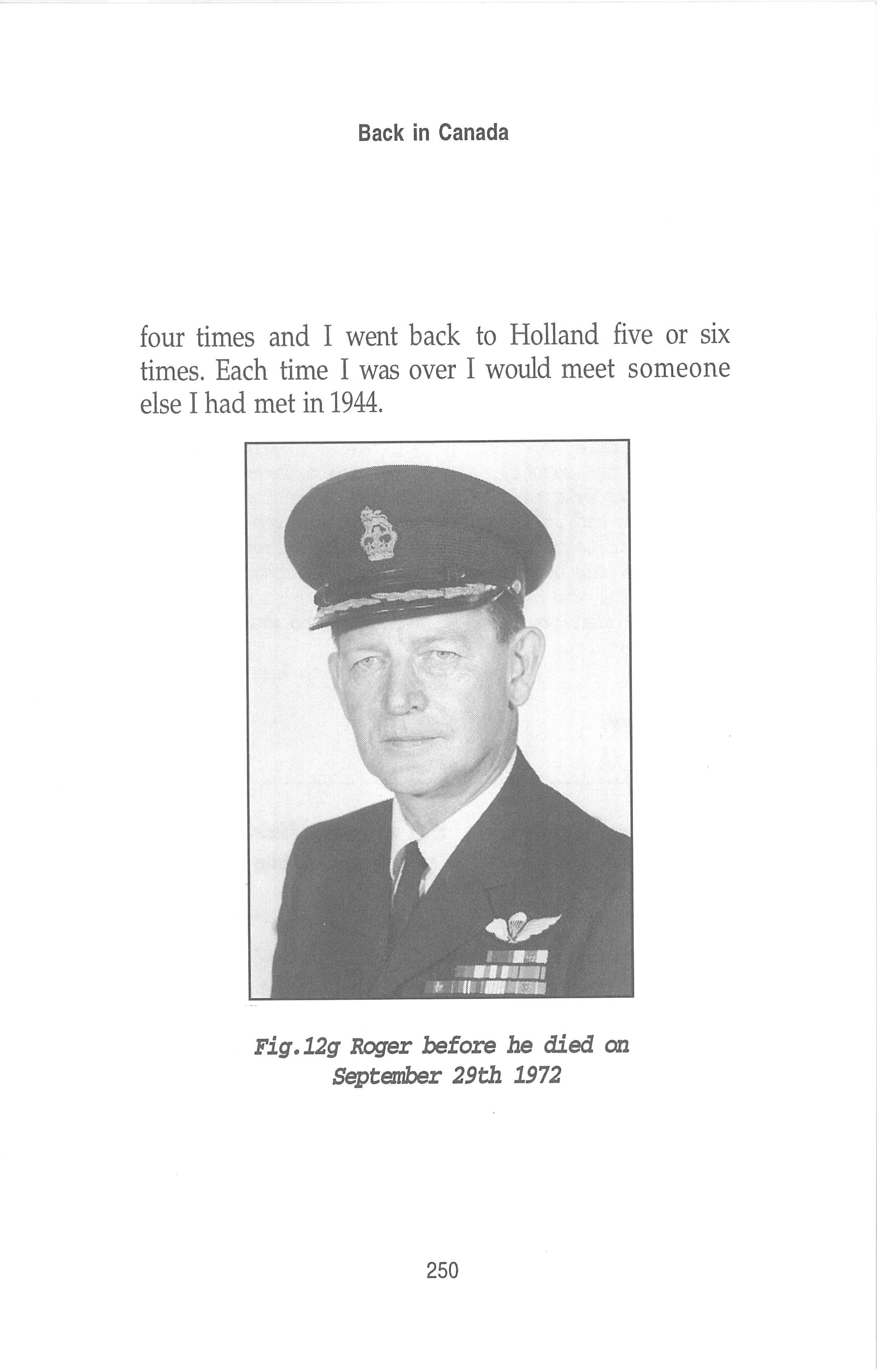
The year in Porter's caption. ✗ Porter's caption to his portrait has "Roger before he died on September 29th 1972" (p. 250): the day agrees with the other sources, the year does not; The Times, the regiment's own list and The Patrician have 1974 (below).
When he died. ✓ 29 September 1974, by The Times obituary of 11 October 1974 (the text; ◐ OCR only) and by the regiment's own list, "at London England, 29 Sep 74" (The Patrician, 1974, p. 130, read on the page), which agree with The Patrician's year in 2008. ✓ The General Register Office's death index has "SCHJELDERUP, VILHELM ROGER", born September 1921, registered at Westminster in the October to December quarter of 1974, and no Schjelderup death in England and Wales from March 1965 to September 1974, 1972 included (FreeBMD); the index gives the quarter, not the day. ✗ Dave Brown's Faces of War has him die "in 1975 at age 52", "military adviser to the Canadian High Commission in London" (the hits (the longer passage), from the full-text index): both are out by one, since born on 16 September 1921 he was 53 when he died.
The obituary's war. ⚠︎ The Times has him escape "from Germany" and regain the Allied lines "in February, 1945" (the text; the paragraph whole in the Archive's search panel). He was never taken into Germany: he cut his way out of a prisoner train as it left Utrecht on 23 October 1944, and he reached the British lines in the first days of January 1945 (Before Amerongen; When he reached the British lines, below).
How he died. The Patrician has him die suddenly in London in 1974, of what the regiment's journal calls a war-related injury (The Patrician, 2008); We Were There has "an embolism during a routine operation in England" (Portugal, p. 1996). ⚠︎ Not settled, and the second is OCR only; the two could describe the same death.
When he reached the British lines. ✓ 5 January. The 49th Division's situation report timed 2359 on 5 January has "One offr and two OR evaders crossed from enemy territory to A Sqn 49 Recce Regt about 1700 hrs", and 3rd Canadian Division told 7th Brigade at 2015 that evening that 49 Div "have picked up Capt R Scheldrup and Sgt Gri" (the 7th Brigade battle log, checked on the image, which also counts the days in Hardy's and Schjelderup's reports to 5 January). Roy has the afternoon of 5 January (The crossing and recapture), and "Two Came Back!" has "Jan 5, 1945" in its subtitle and "At 1400 hours, 5 Jan" on p. 8 (p. 8). ⚠︎ The outlier is 6 January, the date in the two recommendations and the printed citations ("returned to our lines over the ice and snow on the 6 January 1945, 75 days later", in his own recommendation, PDF p. 51 of e011374613; Gri's page). The Portugal section, which follows Roy, has both "Jan. 6", from the citation ("seventy-five days" after the box-car) and "Jan. 5", in the same pages (pp. 2002, 2005; OCR only).
His battalion command. The Patrician gives both "from 02 December 1957" and "in August 1957" for when he took command of the 2nd Battalion (The Patrician, 2008).
The Leopold Canal, 7 October. ◐ His report has the German attack "at approx. 0400 hrs"; "Two Came Back!" has Gri going to company headquarters "At 0445 hours" and the silent counter-attack beginning during their talk (p. 1, read on the scan). The two may describe different moments of the same dawn. Both put the surrender at 07:30 ("At 0730 hrs approx."; "It was now 0730 hours", p. 2, read on the scan).
The days in the siding. ⚠︎ His report has "6 days" at Utrecht, 18 to 23 October, which agrees with Fowler's "six more days" above; "Two Came Back!" has the car shunted into a siding "to remain for eight days" and the move to Germany "Eight days after arriving at UTRECHT" (p. 3, read on the scan). The report's own dates (left Dordrecht on the night of 17 October, jumped on the 23rd) leave six, which is also the "six days" the battalion's account gives for the time without water.
The jump. ⚠︎ The report has it "At approx. 2200 hrs, about ½ hour after leaving UTRECHT"; "Two Came Back!" "at 2300 hours 23 Oct" (p. 4). It has the plan made by four men with a penknife, the rest giving "no assistance whatsoever"; the battalion's account has the men of the Canadian Scottish deciding together, with good-byes said, and twelve staying, some because they were too weak to take part and others because they decided the risks were too great (pp. 3–4). His DSO recommendation and Gri's each credit their own man with hiding the knife; the report does not say whose it was.
Where Brownridge was taken. ◐ The report has the party blunder at 03:00 into "a German Camp with dugouts, barbed wire, and sentries in pairs every 60 ft" and Brownridge caught "in between two sets of double apron fences" by a patrol of two; "Two Came Back!" has the bushes screening an anti-aircraft post and Brownridge caught on a road by a wandering patrol (p. 4). Both have him beaten with the butts of their Schmeissers ("butts of their Schmiesers" in the report, "butts of their Schmeizers" in the battalion's account). Not settled whether it is one place told two ways.
How he reached help. ⚠︎ Three accounts of 25 October. His report has him at a farm where 20 to 30 people were buying black-market milk, with nobody willing to help until Rakers told him to wait; "Two Came Back!" has the two men knocking at a farm door, where the farmer's wife took them in and the underground came at night (pp. 4–5); G. van Brenk, the dairy farmer, says two soldiers came to his house about four in the morning, he fed them and sent for Rakers (his file, p. 3). The report puts the farm at about 05:00, the fort's guard has Rakers at his door "about 4 o'clock in the morning" with two soldiers (Ponssen, p. 4). The report also has him at the fort until about 18:00 and then at Rakers's house; Holwerda has the two at the fort and moved "in the night of the second day" (p. 7).
Rakers. ◐ The report calls him "Hermannus RAKERS", "a sergeant of police", of "393 Groenekaneweg". Holwerda writes "sgt. Rakers" (p. 7); Ponssen has "fieldconstable H.Rakers" and A. Baay's table "Gemeente Veldwachter, Maartensdijk" (Baay's file, p. 5): a municipal field constable, which the report may have rendered as a police sergeant. The form his widow filled in for him has "Harmannus" typed as his first name and Utrechtscheweg 365 as his address (the Rakers file, p. 2); her own form has 365 as his address and Utrechtsche Weg 393 as the one "known to Allied personnel" (her form, p. 8), so the report's 393 is the number the evaders knew. He died on 4 August 1945, after the report was written (her letter, p. 4).
When he left Rakers. ⚠︎ Appendix A has "25 Oct – 22 Dec 44" at Rakers's and "23 Dec 44 – 2 Jan 45" at Cornelissen's. The Rakers forms have him there until 24 December (the table, p. 3), which cannot be right if Hardy met him at Amerongen on the afternoon of the 23rd. His own table is the one that fits.
His wounds. ⚠︎ The report puts his illness down to the shrapnel in his left side and back; "Two Came Back!" has a grenade blast in the back, then pneumonia and dry pleurisy (p. 5); Dr van Veelen "told us that the wounds were not serious, but that the man had contracted pneumonia" (Ponssen, p. 4), and Mrs Rakers's form has "some shot-wounds and had pleurisy" (p. 8).
The hour of the patrol on 2 January. ◐ His report has the German patrol "At 2100 hrs approx.", as Hardy's does; "Two Came Back!" has it at 2300 (p. 6). The battalion's account also has the guides panic and leave at the patrol; the report loses only "the Polish soldier and the Dutchman who was the guide for the latter phase", with Derrick still "in command" at the road.
His boots. ⚠︎ In the report both he and Gri "lost our shoes and socks" crossing the canal, and later "I also found a pair of shoes, but Sgt. GRI was not as lucky"; the recommendation for Gri's DCM has Schjelderup alone losing his boots and Gri giving up his own (the recommendation, PDF p. 52); "Two Came Back!" has "one pair of boots" lost without saying whose, and Schjelderup, his feet "in very bad condition", using Gri's (pp. 7–8), as Fowler does (Fowler, 1996; Gri's page).