Adriaan Maljers
Veere 26 Jul 1918 – Amersfoort 5 Jan 1979
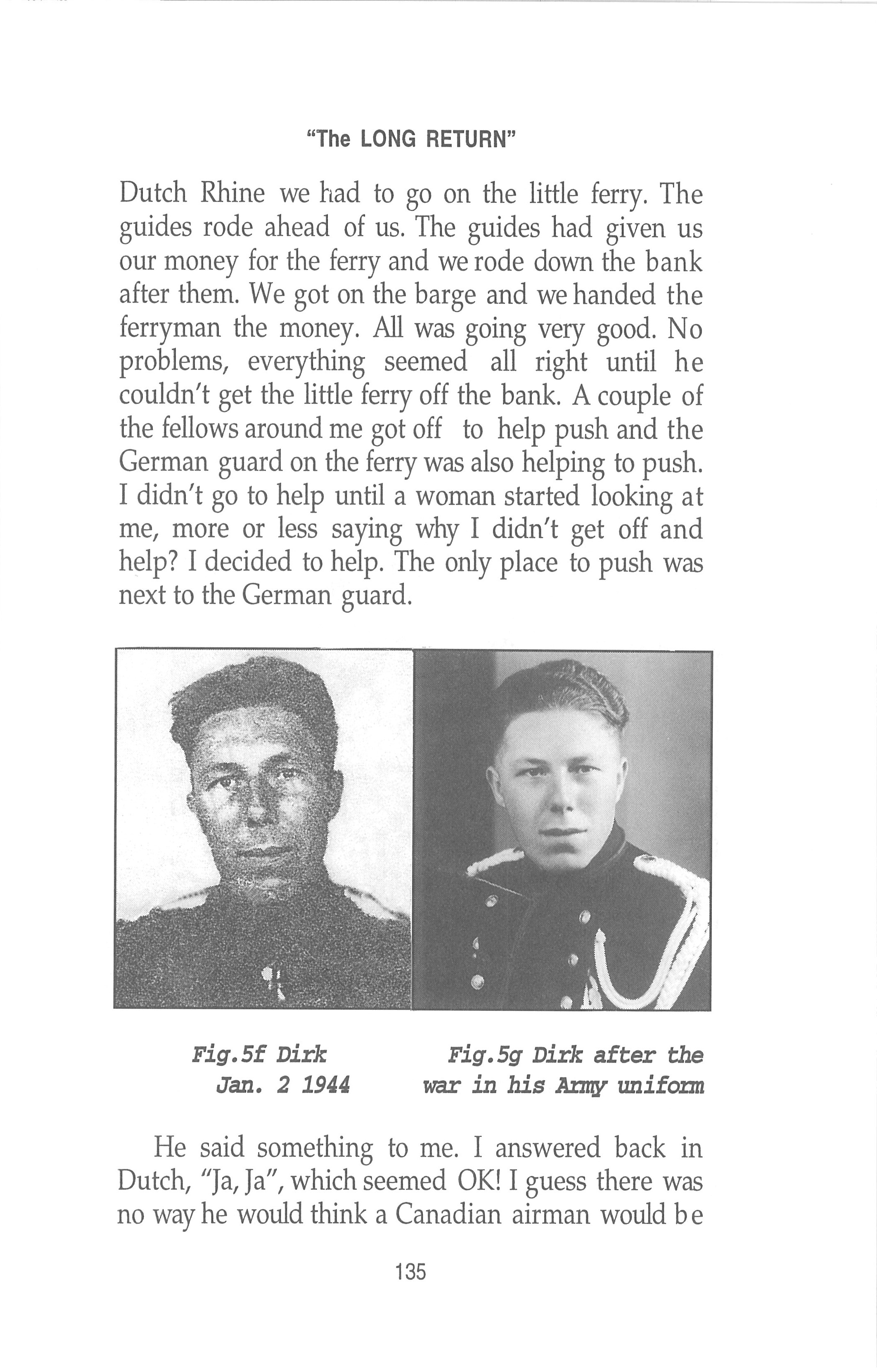
About: "Dirk", the guide who led Murphy's party out of Amerongen on 2 January 1945 and was taken at Opheusden, tortured at Velp and sentenced to death, then freed in the last weeks of the war. A policeman from Zeeland in hiding at Langbroek, he had run evaders over the rivers since the summer of 1944.
Unit or role: The K.P. (Knokploeg), then the link for the B.S. between the Allies and the underground in the province of Utrecht (his statement, p. 15). On his form he is "Mounted Police" and a member of the "N.B.S. K.P.", known to the Allies as "Dirk from Langbroek" (p. 11); the British record of his King's Medal has "Royal Military Consabulary [sic]", ◐ the Marechaussee (the catalogue entries).
Where: Langbroek (the barber G. de Jong's house, Langbroek A 200, where he lodged); the Betuwe; Amerongen, Rijnstraat B 472, in November 1945; Veere, Zeeland, Grapingscheweg B 107 in 1946; Amersfoort from 1947.
Evidence: ✓ his helper file, US National Archives 286673298, with his own record of service of 3 December 1945 (pp. 15–18; Dutch original pp. 19–22); ✓ the British helper index, certificate 9337; ✓ Oorlogsslachtoffers Betuwe-West; Porter; ✓ his King's Medal (the catalogue entries); ✓ his Dutch award card (the card); ✓ his marriage.
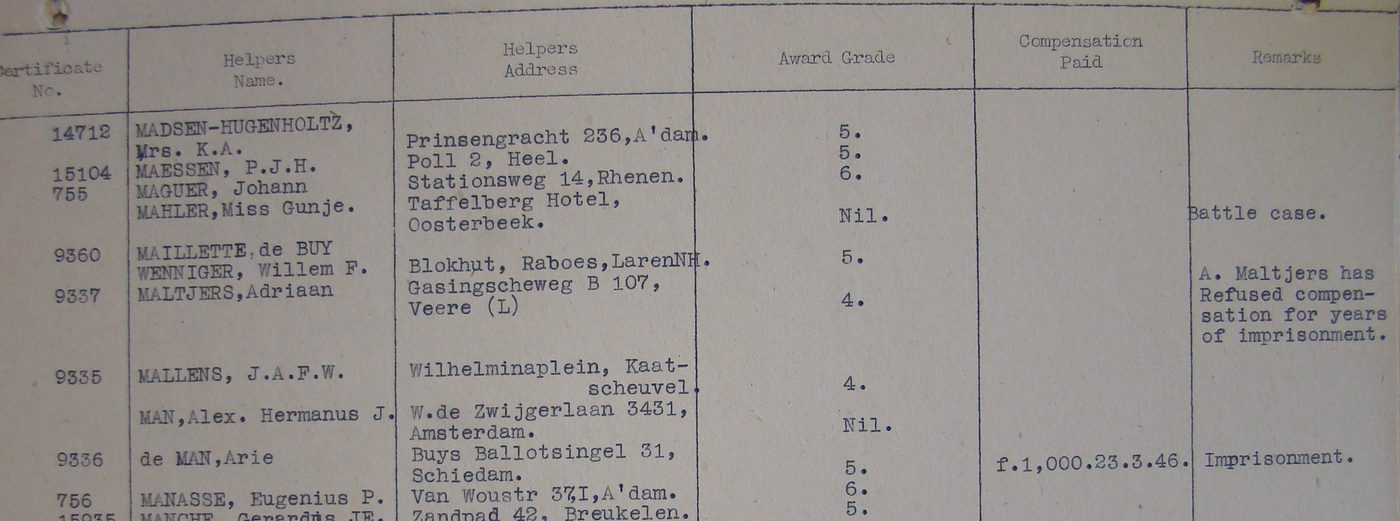
✓ Adriaan was his name and "Dirk" his name to the evaders. The British helper index has "MALTJERS, Adriaan" of Veere, certificate 9337, grade 4, with the remark "A. Maltjers has Refused compensation for years of imprisonment" (the sheet, read on the image).
✓ Civil records have an Adriaan Maljers born at Veere on 26 July 1918 (Open Archieven); the British record of his King's Medal gives the same date, "Adriaan Maljers, born: 26 July 1918; nationality: Dutch; occupation or Military: Royal Military Consabulary [sic]" (WO 208/5275/2394; the catalogue entries), and so does the Dutch Chancery of Orders' card for the soldier Adriaan Maljers, "VEERE, 26 JULI 1918" (the card), so the birth record is his. His own form of 3 July 1945 has "Veere 26-7-18" and his father as next of kin (p. 11). He was a son of Pieter Jacobus Maljers, a market gardener of Veere, and Maria van Slooten (his marriage deed).
His name varies. Caspers indexes him as "Maljers, Dirk", of Langbroek, a policeman from Zeeland who led a resistance group, and describes his capture at the Linge bridge near Opheusden station (Caspers, pp. 114, 175, 310), which is Porter's dedication, "Dirk Maljers (Langbroek)" (front matter). Noordman has "Dirk van Langbroek, alias voor Adriaan Maljers" (Dirk van Langbroek, alias of Adriaan Maljers), and again, in the chapter on Prince, "Dirks werkelijke naam was Adriaan Maljers" (Dirk's real name was Adriaan Maljers), which agrees with the Betuwe-West page (Noordman, pp. 236, 287). He signed "Dirk van Langbroek / A Maljers" (p. 14).
The line to the Waal, summer 1944. His own record of service, written for the Americans on 3 December 1945, begins about the end of June or the beginning of July 1944, when as a "K.P.-er" he met "Piet de Springer (Jan de Bloois)", who had been dropped from England. Together they ran a line for airmen through the Betuwe and Tiel over the Waal to Wamel, collecting the men at the widow Kok's at Maurik, about 25 in all, and in September 1944 the B.S. detailed him as the link between the Allies and the underground for the whole province of Utrecht (his statement, p. 15; the Dutch original, p. 19; Piet de Springer).
The three from the hospital at Utrecht, October 1944. His statement names, with their home addresses, "B. Schell" of Ardmore, Oklahoma, "J. Lynch" of Liverpool and "W. Prince" of Manchester (p. 18); in the Dutch original he says they were "uit het ziekenhuis te Utrecht gehaald" (taken out of the hospital at Utrecht) when he received them and placed them round Langbroek, and adds that "B. Schell", whom he calls a Canadian paratrooper, had jumped near Eindhoven and was then crossed by the Betuwe line and arrived safely (Dutch original, p. 22). The hospital was St Antonius, by William Prince's page and A. Hagopian's list of the men from it (Hagopian).
- ✓ "B. Schell" is Sgt Robert E. Shell of the 101st Airborne, who escaped with Lynch and Prince on 6 October: Shell's own report, writing of the move to Over Langbroek on 18 October, says "We had been brought down by DERRICK and a Dutch policeman", and has Derrick at the conference at the schoolmaster's house on 27 October (Shell's report, Appendix C). The schoolmaster Ten Wolde's form lists "Robert E. Shell, Ardmore, Oklahoma", landed near Eindhoven, passed on to Maljers, and has the three going away "via Dirk (00305)" (p. 3; p. 8; William Prince).
- ⚠︎ The Betuwe-West page asks whether "B. Schell" is Captain Noble; the Oklahoma address, the hospital and Prince's form say Shell.
- At the end of October, by Cramer's form, two of them came to Wijk bij Duurstede "by way of Dirk" and left with Dirk for Amerongen (Cramer's form, p. 5; Jack Lynch). Maljers's note of 3 July 1945 has "Bill, Jack and Bob" from Utrecht kept at Langbroek and Overlangbroek, and Jack and Bill taken with Dirk to Hoogland in Amerongen (p. 13).
The big crossing, November 1944. His record of service has him receiving 83 Allied soldiers from underground workers and sending them in a "Commando Raid" arranged with "Eddy from Ede", to cross about 250 men at once; he went "that day with a transport of 14 Canadians and Englishmen from Amerongen to the first rallying-point, together with Piet de Springer", and says he helped about 175 Allied soldiers over the Rhine that way (p. 15). He dates it 21 November on that page and, in the note of 3 July 1945, 22 November, for "the crossing at Renkum" (p. 13); the Dutch original has a transport of 12 men from Cornelisse's address to the Veluwe "naar ik meen 20 November" (as I think, 20 November) (p. 22). ◐ This is very probably the failed crossing of 17–18 November the site calls Pegasus II: Boeree has "Dirk de politieman uit Neerlangbroek" bring men to the Walderveen mill, and "Dirk haalde hen af, zij pikten in Amerongen nog enkele mannen op en zoo reden 10 geallieerden en 2 Nederlanders naar de Walderveensche molen" (Dirk fetched them, they picked up a few more men at Amerongen, and so 10 Allied men and 2 Dutchmen drove to the Walderveen mill), which is also 12 (Boeree, p. 178). The dates are not reconciled (below). Murphy had missed that night (Hardy).
The seven Canadians, and Amerongen. In his record of service he agreed with Cornelisse at Amerongen to bring the Canadians there, took over seven soldiers who had jumped from a prisoner train from a contact man of De Bilt, "Captain Scheldrop, Harry Zwarchz, Phorter" among them, and handed them to Cornelisse (p. 15; "Phorter" is Bob Porter, "Harry Zwarchz" Harvey Swartz by the Betuwe-West page). His note of 3 July 1945 has "these 7 persons went to 'dive under' at Cornelissen, Esveld Jr., Esveld Sr. and Hoogland" from just before Christmas until 2 January (p. 13); ◐ "Esveld Jr." is Flip or Coen, both being "Jr." on different forms (Flip, Coen, their father). "At the address of Hoogland 6 Canadians were sheltered in the month of December" (p. 18; Hoogland family).
On 30 December the Feldgendarmerie raided his base at Langbroek, the barber G. de Jong's; he got away, but Piet de Springer was caught and killed trying to escape (p. 16; p. 14). Caspers has his Ausweis, with his photograph, fall into German hands in the raid on the barber's shop, so that "Hij was nu ook een man die gezocht werd" (he was now a wanted man too); the snippet goes on "Daarom besloot hij het …" (so he decided to …) and breaks off, ◐ so that this is why he went with the party is our reading (Caspers, p. 175, snippet only).
With Murphy
Link to the section With MurphyThe guide who led the 2 January 1945 party; Schjelderup's "DERRICK". Murphy was one of the men he took out; none of the sources puts the two in conversation, and the guide's own statement does not name Murphy (p. 18).
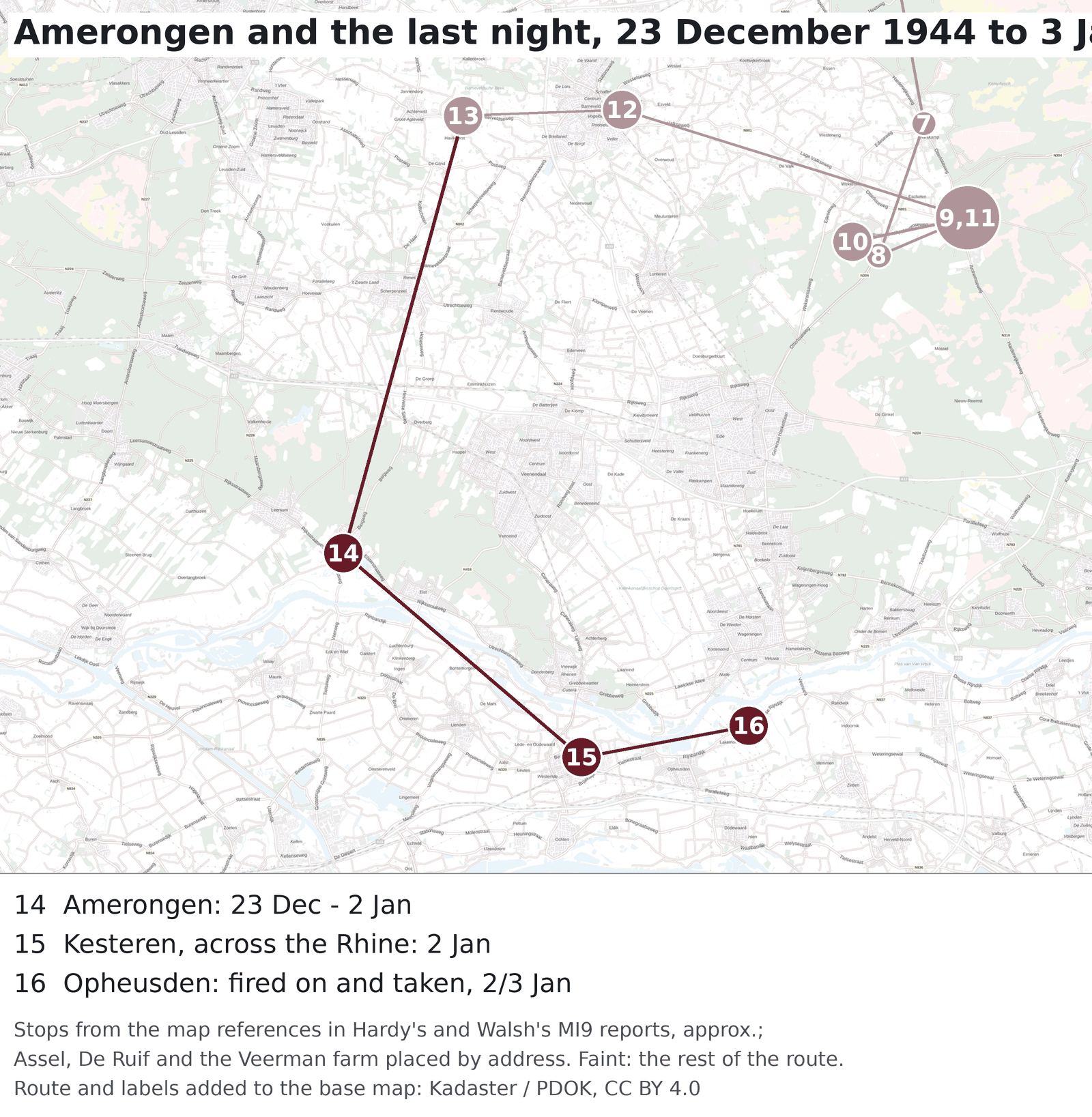
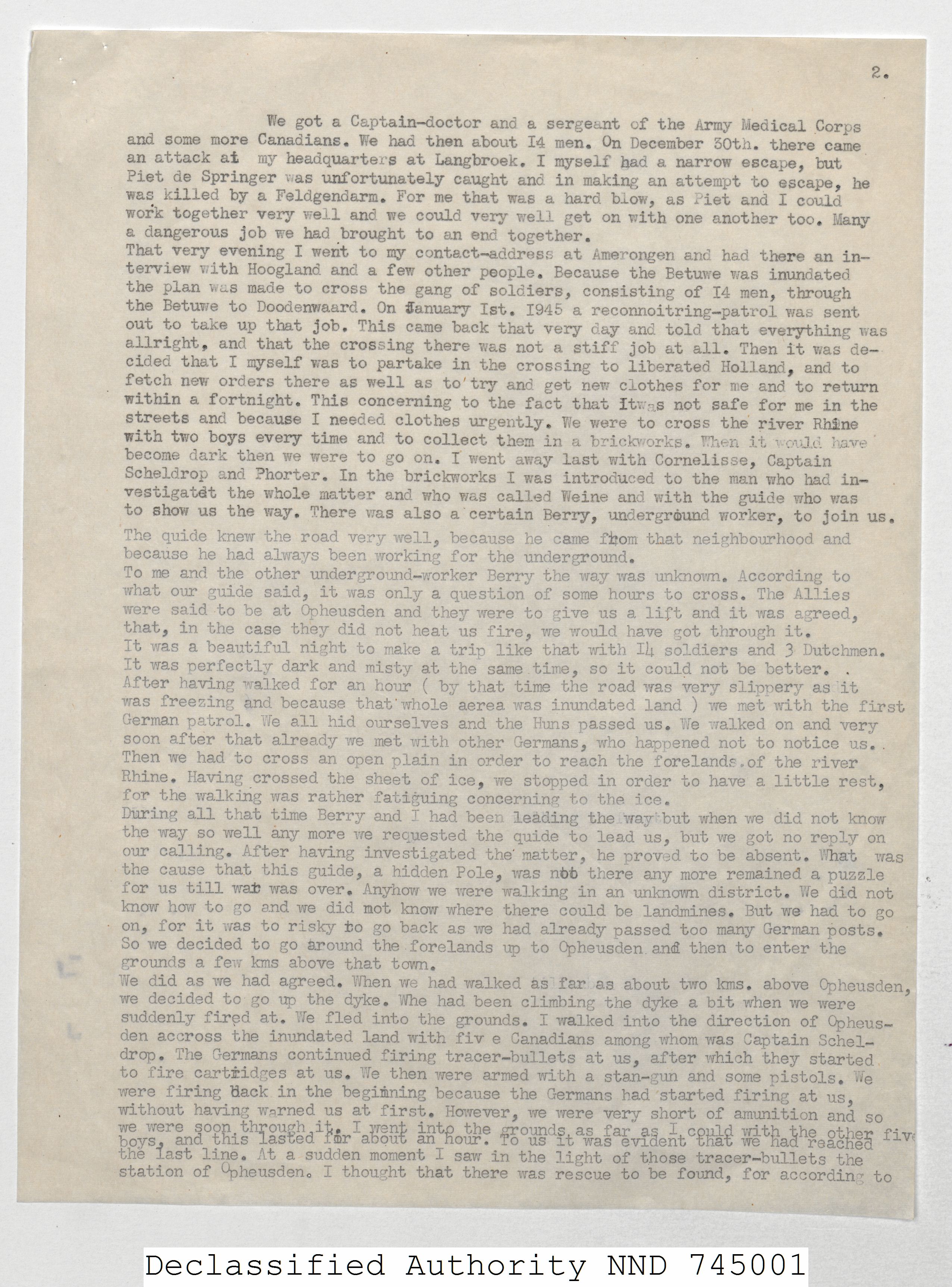
His own account. That evening, 30 December, he went to Amerongen to see Hoogland and others, and the plan was made to take the fourteen soldiers through the flooded Betuwe to Dodewaard; a patrol sent out on 1 January came back saying the way was easy, and he was to go across himself for orders and clothes. The men went over the Rhine two at a time to a brickworks; "I went away last with Cornelisse, Captain Scheldrop and Phorter." There he met the man who had scouted the route, "Weine", the guide, and "a certain Berry, underground worker", Berry Melis. After an hour on the frozen, flooded land they found the guide gone, in the English "a hidden Pole" and in his Dutch original "met een ondergedoken Pool" (with a Pole in hiding, p. 20); they went on round the forelands towards Opheusden, and when they climbed the dyke about two kilometres above it they were fired on. He went on across the flooded land with five Canadians, Schjelderup among them (his statement, p. 16). Seeing Opheusden station by the light of the tracer, and believing the town in British hands, he went ahead over a bridge and was taken:
I discovered a bridge and I went there as the first man to see if everything was safe. Standing in the middle of this bridge, I was detailed to lift my hands and when I looked around, I saw about 6 Huns around me. I was taken a prisoner and I would have been shot at that very moment, when they had not arrived with a Canadian with civilian clothes, who belonged to the transport.
— US National Archives · RG 498, helper file of A. Maljers · his record of service, Langbroek, 3 December 1945 · the archive's copy
The Dutch local-history account. Oorlogsslachtoffers Betuwe-West tells the same night from the guide's side, with thanks to, among others, Lisan Koppenol: a scouting patrol on 1 January, crossing the Rhine in groups of two, assembly at the stone works of Van Hesteren and Jansens at Lienden, a Dutch guide who vanished together with a Pole in hiding, and, after the fire opened about two kilometres north of Opheusden, the Germans lighting the ground with flares. It names the British paratroopers who lost their comrades in the chaos as Murphy, Noble and Banwell, from "Canadese en Britse bronnen" (Canadian and British sources), so the names are the MI9 reports read back into Dutch, not an independent record of him (the page).
In Schjelderup's MI9 report. ◐ Schjelderup's MI9 report (transcript; the Kew original not seen) (Kew WO 208/3351/2349) never gives him a name beyond "DERRICK". It has Schjelderup "with CORNELISSEN and DERRICK" crossing the Rhine by ferry (Sheet 5, 4378) for 10 cents, the whole party assembling in a brick factory (4876), and setting off at about 18:30 as "11 Allied personnel, DERRICK, and 2 other Dutchmen as guides", with "DERRICK in command". ✓ That is Maljers's own "I went away last with Cornelisse, Captain Scheldrop and Phorter". After a German patrol at about 21:00, "we had lost the Polish soldier and the Dutchman who was the guide for the latter phase of the journey"; at the road (573739) they lost, "never saw again, one Dutchman and the following three men", Noble, Banwell and Murphy. The report does not say which Dutchman that was, nor name Derrick again (Schjelderup's page). The brackets and footnotes in the transcript are the transcriber's.
In Porter's. ⚠︎ Porter, whose book is the one other account from a man in the party, names the guide "Dirk" (p. 134: on the road out of Groenekan the party, after about ten miles and "maybe another thirteen miles" on bicycles, was met by "our next guide, called Dirk", the one "that had organised our escape and was in charge of the operation", who "couldn't speak much English"; pp. 133–134). He has "the man in charge of the Underground in this area and Dirk" finishing the plan, and an arrangement with a German soldier to let them through where he would be on guard, which failed when the soldier was sent away (p. 140, the transcript). The party "started off, nineteen of us including Dirk and two other guides" (p. 143); after the machine-gun fire in the dark he "saw Dirk, the Dutch guide, who had been with us" among the prisoners (p. 149), and in the next weeks saw him "off and on" and then not again (p. 150) (Porter, chapter 6).
… but the Germans did not give him any shoes and his feet were bleeding badly. He had some old rags wrapped around them. They had also beaten him up severely. We had to totally ignore him as it wouldn't have done either of us any good to have recognised each other.
— Bob Porter, The Long Return, p. 150 · chapter 6
Caspers and the other guides. ✓ Caspers names the Dutchmen who took the party out: "Coen Esveld, Dirk Maljers en nog twee gidsen, in totaal negentien personen, op pad" (Coen Esveld, Dirk Maljers and two more guides, nineteen people in all, set out) (p. 175). Nineteen is Porter's count, "making nineteen of us" (p. 143); Schjelderup counted three Dutchmen. ◐ Coen Esveld was not taken with Maljers: Derksen's questionnaire has him on the Rhine on 25 January 1945, in a party of seven that Derksen rowed over (Derksen), and Caspers has him carrying a drawing of German defences, sewn into the lining of his coat, towards the Allied lines (p. 177, snippet only). Maljers himself names no Esveld in the party.
The other underground man. The man Maljers calls "the other underground-worker Berry", ◐ Berry Melis of Tilburg, told the Americans about the attempt. His file has it in the third person:
tried to pass the German lines near Opheusden together with 11 Canadians on 2th January 1945. The expedition was a failure 3 men came through but the others were scattered. M. himself swam across the Rijn
— US National Archives · RG 498, helper file of B.J.H. Melis, Tilburg · p. 3 · his file
The Betuwe-West page has Melis slip away and, by Maljers's memory, swim the Rhine again.
He burned the three films of the German defence line he was carrying, which the searchers missed, and was marched to Velp, where ten more men of the party were brought in; he told them not to say they had seen him before. Handed to the Gestapo at Velp, he was questioned daily for a week and tortured, tied to a chair with burning candles under his feet, to make him say that the Allied soldiers were "terrorists", and named no one. After four weeks he was taken with seven Allied soldiers to the Wolvenplein at Utrecht and told he was condemned to death, then to De Kruisberg at Doetinchem, where he gave a false name, met Captain Frank Coslett, and after some eight weeks was let go as the war drew to its end, and hid on a farm until a week after the liberation there (his statement, p. 17; Dutch original, pp. 21–22). The seven Canadians arrested with him were, he says, sent on from Doetinchem to a prisoner-of-war camp in Germany after about 14 days there (Dutch original, p. 22). After the war Schjelderup, by then a major, told him they were all safe and in England (p. 18). In his letter of 4 December 1945 he describes the same: "after having gone through many tortures was sentenced to death and after 3 months in solitary confinement was set free again because I had designed a plan and the war had made great progress" (p. 12).
Compensation and awards. In that letter, to Major P. J. S. Windham Wright of the British awards bureau, he declined the financial compensation offered for his imprisonment: "by accepting the compensation it would nullify my principle as an underground worker" (p. 12); the British index notes it. On 3 July 1945 he had asked to return to the mounted police near Amerongen, Driebergen, Leersum or Rhenen and for his pay as mounted police since the end of 1942, when he went into hiding, and the Americans' adviser wrote that he had "done very much good work" and was "in very weak health indeed" (p. 13). In November 1945, living at Rijnstraat B 472, Amerongen, the Cornelisses' house, he asked the Americans to remember the people who had sheltered men for him, among them the barber G. de Jong at Langbroek, whose house had been his transit address and had lost everything in the raid (p. 14); the same request, from Veere on 11 December, names his courier and the transporter at Langbroek (p. 24). The Americans graded him 4 (p. 1) and awarded him the Medal of Freedom without palm, for September 1944 to January 1945, when he was living at Grapingscheweg B 107, Veere (pp. 2–3; General Orders 268, 26 September 1946, p. 29). The British gave him the King's Medal, reference BM/4123 (WO 208/5275/2394; the catalogue entries). Stichting Kroon's list of awards has the Medal of Freedom presented at Maastricht on 18 January 1947, and the King's Medal at The Hague on 4 April 1949, to a "Wachtmeester" (a sergeant's rank; ◐ the unit is not given there, and his marriage deed of 1947 has wachtmeester cavalerie, below), living by then at Amersfoort (Decorandi); on 27 December 1946 he wrote from Veere, signing himself "Korporaal", that he hoped to attend (p. 26).
The rest of his life. ✓ He married at Amersfoort on 1 July 1947: Adriaan Maljers, 28, born at Veere, wachtmeester cavalerie (a cavalry sergeant), living at Amersfoort and lately at Veere, son of Pieter Jacobus Maljers, 57, a market gardener, and Maria van Slooten, 52, both of Veere; the bride was Catrina Willemina van Meeteren, 31, of Amersfoort (the deed, read on the scan). ✓ His mother's name ties to him the death notice for an Adriaan Maljers indexed by the Zeeuws Archief under Veere, 5 January 1979, "Zoon van M. Maljers-van Slooten" (son of M. Maljers-van Slooten) (the notice's index entry).
✓ He made the army his career. The silver Orange-Nassau medal the Nationaal Archief indexes under his name is his: the card gives him born at Veere on 26 July 1918, and the medal, with swords, by royal decree of 18 April 1958, no. 4, as "sergt. majoor-magazijnbeheerder" (sergeant-major and storekeeper) of the army's supply corps, register number 21619; his army number, 18.07.26.008, is his birth date written backwards (the card, Nationaal Archief 2.02.32; the index entry). ⚠︎ The card gives no reason; a medal of the order with swords to a serving NCO in 1958 reads as one for long service, not a wartime award, but that is our reading. He lived at Amersfoort, at the Breestraat and from 7 August 1978 the Mozartweg, and died there on 5 January 1979; the card names C. W. Maljers-van Meeteren as next of kin, ◐ presumably his wife, from the marriage of 1947 (the same card).
Where the sources disagree
Link to the section Where the sources disagree- Who left the party before the ambush. The English of Maljers's statement has the guide himself, "a hidden Pole", missing (p. 16), but his Dutch original has the guide gone "met een ondergedoken Pool", with a Pole in hiding (p. 20); Noordman has the guide Albert van Hattem going missing with a Polish soldier (Noordman, p. 287).
- ⚠︎ Charles Noble's own later account (unpublished private papers, shared with us privately), told long after the war, has "our second guide" killed by a V1 that "malfunctioned, dropped near us", where his report of 1945 has him lost in the confusion when a German patrol passed (Noble).
- The guides and the numbers.
- ◐ Schjelderup's report has a Polish soldier and the guide for the later part lost at the first patrol, a Dutchman lost at the road, and three Dutch guides in all, Derrick and "2 other Dutchmen" (the transcript). That fits Noordman's pairing of a guide with a Polish soldier, and Maljers's Dutch; "Two Came Back!" has all three guides panicking at the patrol and leaving (p. 6).
- Maljers has "14 soldiers and 3 Dutchmen" (p. 16); Schjelderup's report has 11 Allied personnel, Derrick and two other Dutchmen, and its own list has twelve Allied names. The counts do not agree (How many set out).
- His name: "Dirk Maljers" in Caspers and Porter's dedication; "Dirk van Langbroek, alias voor Adriaan Maljers" in Noordman; he signed "Dirk van Langbroek / A Maljers" (p. 14). The British index and Kew spell the surname "Maltjers", and his own address Grapingscheweg, Gapingscheweg or Gasingscheweg.
- When the Canadians came to Cornelisse. ⚠︎ His record of service puts the word that the seven were starving "the next day" after that crossing, and gives no date for their move to Cornelisse; the helpers' forms have the Canadians at Groenekan with Rakers until 22, 23 or 24 December (Hermannus Rakers), and Mrs Cornelisse has Porter brought "about 18 December". His own "just before Christmas" (p. 13) fits the forms. Not reconciled.
- The date of the big crossing. ⚠︎ 20 November (the Dutch original, p. 22), 21 November (p. 15) and 22 November (the note of 3 July 1945, p. 13), against 17 and 18 November in Hardy's report and in Boeree (Boeree, p. 178; Hardy). ◐ One operation remembered a few days late.
- How long he was held. ⚠︎ His own accounts differ.
- "After 3 months in solitary confinement" (his letter of 4 December 1945), and "from the 2nd January till the beginning of April" (the note of 3 July 1945, p. 13): about 13 weeks.
- His record of service has four weeks at Velp, about three at the Wolvenplein, three at Doetinchem and another five weeks there, 15 weeks in all, which from 3 January would reach about 18 April (p. 17); the Betuwe-West page has "ongeveer drie weken" (about three weeks) at Velp before the Wolvenplein (the page).
- "B. Schell". ⚠︎ See above: Shell, not Noble.