Piet de Springer
Maasland 23 Oct 1916 – Langbroek 30 Dec 1944
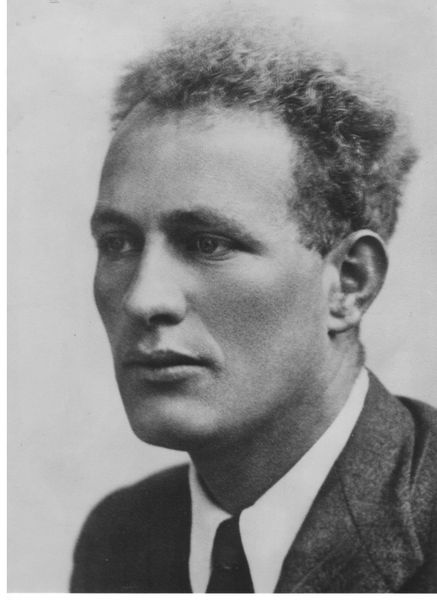
Jan de Bloois, "Piet de Springer", sergeant, Netherlands intelligence service
About: Jan de Bloois of Maasland, an England-farer dropped back into the Netherlands as an agent in May 1944, who as "Piet de Springer" guided evaders from Langbroek over the Rhine. Flip Esveld's lists name him as the man who handed him three of the men who crossed with Murphy on 2 January 1945 (see "With Murphy"; other sources point away from it), and he was shot dead in a raid on the barber's house at Langbroek on 30 December 1944.
Unit or role: Sergeant of the "Ned. Inlichtingendienst" by his father's form, "dpl. Sergt. tit." (tit. is titulair, honorary) and "Det. Londen" (Detachment London) by the War Ministry's card (scan 4; scan 12); liaison for the Raad van Verzet by Caspers (To Save a Life, p. 51).
Where: Oostgaag, Maasland (home: "Oostgaag 12" on the Foundation's forms, "C 12" on the War Ministry's card, "C 19" on his father's questionnaire and the family's notice of 1945); ◐ Wijk bij Duurstede, May–September 1944 (Takken's four months, counted back from 5 September); Langbroek, from September or the end of October 1944 (⚠︎ below).
Evidence: ✓ the War Graves Foundation's file on him, dossier years 1947–1994 by the archive's index (Nationaal Archief 2.19.255.01, 14815A); ✓ Langbroek's death register, deed 7 of 1947; ✓ Maljers's file, pp. 13–16, 19–24; ✓ Gerrit de Jong's file, pp. 4–10; ✓ the England-farers' record; ✓ Takken's form; ✓ Flip Esveld's list; Caspers, To Save a Life, pp. 51, 60–62, 94–97; Heaps, pp. 136–137; Het Laatste Nieuws, 30 May 1945; ✓ the Erelijst, p. 425; ◐ the Foundation's page with a visitor's account of 2014; ◐ Enquêtecommissie, Verhoren, pp. 1182–1183; ◐ Boeree, Kroniek van Ede, p. 178.
Family and home
Link to the section Family and home✓ The Foundation's file gives the family. Jan de Bloois was born at Maasland on 23 October 1916 (the form has a query mark beside the date; the War Ministry's index card has the same day), a market gardener (tuinder), Dutch Reformed and unmarried, who "vanaf geboorte tot zijn vertrek als Engelandvaarder" (from birth until his departure as an England-farer) lived at home at Maasland, the son of Pieter de Bloois, a pig dealer born at Maasland on 14 September 1883, and Maria van den Boogaard, born there on 26 November 1892, of Oostgaag 12 (scan 2; scan 12). Langbroek's corrected death deed has the same birth date and parents, the father "varkenskoopman" (pig dealer), "beiden wonende te Maasland" (the deed). The England-farers' index and the Erelijst give his trade as "veehouder" (cattle keeper) (the index; the Erelijst).
The Maassluis paper's Maasland column says that before he left he had been active in illegal work, a faithful seller of Trouw, and a board member of the Christian young men's society "Soli Deo Gloria" (Het Laatste Nieuws, 30 May 1945). ◐ A visitor's account on the Foundation's page, posted in 2014, whose own source line is "Kees ten Wolde was de vader van de schrijfster van deze bijdrage" (Kees ten Wolde was the father of this contribution's writer), the teacher it puts in the room at his death, adds that he came from a market-gardening family and belonged to the L.K.P. in the Westland (the page).
To England, October 1943
Link to the section To England, October 1943✓ The Nationaal Archief's "Reizen van Engelandvaarders" index has Jan de Bloois of Maasland, born at Maasland on 23 October 1916 and unmarried, leaving the Netherlands on 8 October 1943 and arriving in the United Kingdom on 9 October, by the North Sea, with the helper Anton Schrader, by way of "[Spui] Goudswaard" and Harwich (the record; index only). Kew holds his interrogation report as an Engelandvaarder, WO 208/3714/25 (21 October 1943, number 17106), with a second copy at WO 208/5495/41/1, giving the same departure and arrival "10 October 1943" and listing a map of the Maassluis neighbourhood and, in the catalogue's words, "a sketch of a dwelling van in the text"; neither is digitised (the catalogue entries).
Anton Schrader himself, in Paul van Beckum's Oranjehaven (1992), crossed "Op 9 oktober 1943 ... met elf andere mannen" (on 9 October 1943 with eleven other men), and is quoted: "Ik wist dat twee vrienden, die met mij in dezelfde boot waren meegevaren, Jan de Bloois en Tobs Biallosterski voor bijzonder werk in bezet Nederland waren opgeleid" (I knew that two friends who had sailed in the same boat with me, Jan de Bloois and Tobs Biallosterski, had been trained for special work in the occupied Netherlands) (Oranjehaven, p. 63, read on the page image).
Elsa Caspers, the courier at Langbroek, writes that he "was a farmer's son, and he lived near Rotterdam. On 8 October 1943 he escaped with eleven other young men in a small boat", was picked up by HMS Campbell and trained as a secret agent, taking the name Piet de Springer "because he would have to jump from an aeroplane" (Caspers, To Save a Life, 1995, p. 51; read from the text layer, not checked against the page image).
In England. The Maassluis paper's Maasland column has him meeting the Queen several times there and returning "na een korte opleiding als spion in Engelsche dienst" (after a short training as a spy in English service) (Het Laatste Nieuws, 30 May 1945). On 2 November 1945 De Schakel reported that on 26 October 1943 the Queen had been given grapes from A. van der Kooij's nursery "door den Engelandvaarder wijlen Jan de Bloois", who "menigmaal" visited her and "H.M. beschouwde als een moeder" (regarded Her Majesty as a mother) (De Schakel, 2 November 1945, page 1, read on the page image). ◐ The grapes and the visits are a local paper's account, which names no source for them; no record from England says it. ◐ The visitor's account on the Foundation's page has him arrive in England in September 1943 and be recruited there by the Bureau Inlichtingen and trained as an agent and radio telegraphist (the page); that puts the arrival before the crossing the index dates to October.
Dropped, May 1944
Link to the section Dropped, May 1944Caspers has "On the night of 7-8 May 1944 he parachuted down in the Province of Noord-Brabant", to work as a liaison officer and decoder for the RVV, which sent him to Langbroek in September 1944 (p. 51). ◐ The visitor's account has the same night, four radio sets all wrecked in the landing, a task of keeping contact between Jan Thijssen's Raad van Verzet and London and standing in if need be as operator for the spy group "Albrecht", and the BI agents Jacques van Loon and Sjef Adriaansen taking him in and finding him a new set (the page). Leo Heaps, whom he guided to the Rhine at Maurik, where a Dutch peasant rowed Heaps and Kettley across (Caspers dates it 5 October 1944, p. 60), wrote:
De Bloois, a peasant from Maasland, had escaped to England in 1941 and joined the Free Netherlands Forces. He had been parachuted near Breda in May 1944. He had been very active as a radio operator. Now he was a guide, one of the best.
— Leo Heaps · The Grey Goose of Arnhem (1976), p. 136 · the book
Four months at Wijk bij Duurstede. ✓ Gerrit Jan Takken of Wijk bij Duurstede, "Tinus", of the R.V.V. and L.O., wrote on 16 September 1946 that he "slechts een persoon geholpen" had: "de Engelandvaarder Jan de Bloois, schuilnaam Piet, die ik 4 maanden gehuisvest heb, en 30 December 1944 te Langbroek bij een ontvluchtingspoging is doodgeschoten" (the England-farer Jan de Bloois, code name Piet, whom I housed for four months, and who was shot dead at Langbroek on 30 December 1944 in an attempt to escape). In his remarks: de Bloois "was een Engelsche Spion en werkzaam bij de R.V.V., hij was, geloof ik in N. Brabant, per Parachute neergelaten, en kwam bij mij, gestuurd door Jan Thijsse, schuilnaam Lange Jan"; he went off on his bicycle by day and came back at all hours in the evening; and he left on Dolle Dinsdag (5 September 1944) "daar ik toen in het Politieblad kwam te staan" (because I was then put in the police gazette) (Takken's form, p. 2, checked on the image).
- ◐ Four months back from 5 September 1944 is early May 1944, the month of the drop in Caspers and in the visitor's account.
- ◐ "Jan Thijsse, schuilnaam Lange Jan" is Jan Thijssen ("Lange Jan", the RVV's radio chief): the surname is spelt Thijsse on the form, and the nickname alone does not identify him, since Van der Gaag told the commission of "the other Lange Jan" (see his page).
- ⚠︎ The visitor's account has him move to Langbroek only at the end of October 1944, taking over Herman Leus's hiding address; Caspers has September; Swaluwenberg has him coming to the farm "already often" before 26 September (below) and Van Kleef has evaders through him in September and October; Takken says nothing of where he went.
Carrying the coordination message, 1944. ◐ In 1949 the parliamentary inquiry into the government's wartime policy heard Andreas Ausems of Zaandijk, a mechanical-building engineer and an agent who, by the Bureau Inlichtingen list the Chairman read out, was dropped on the night of 29 February to 1 March 1944. He told how, after he had destroyed the material he carried (he threw it in the stove that evening, questions 52848–52849), he rode south with his fellow jumper "Kors" and handed in a telegram asking for everything to be sent over again, and that "Een dag of veertien (tot 6 weken bij nader inzien) later is een tweede springer gekomen" (a fortnight or so later, six weeks on second thought, a second jumper came) who brought the material back: "Dat was Piet de Springer, ik meen, Arie Bloois, uit Delft." Asked a little later who had brought him the first copies, before the wachtmeester Buunk, "Fopkonijn", was dropped on 5/6 July 1944, he said "Dat was Piet de Springer. Deze gaf mij de code en de coördinatieboodschap voor de 19 punten" (that was Piet de Springer; he gave me the code and the coordination message for the 19 points) (the hearing of 17 May 1949, printed pp. 1182–1183).
What was checked: the two pages on the images, 1182 and 1183, with questions 52848–52849 read on the 1182 image and in the whole-book OCR rather than the transcript. The drop date is the Chairman's reading of the Bureau Inlichtingen list in question 52762, on the hearing's first page, which was not read as an image.
- ◐ The witness's "Piet de Springer" is this man: it is the name Maljers gives, springer is Dutch for a parachutist, and Maasland lies near Delft, but "Arie" and Delft are his own half-remembered "ik meen" ("I think"), which is not what Maasland's and the Foundation's forms say.
- ⚠︎ The timing does not fit (see "Where the sources disagree").
The guide, summer and autumn 1944
Link to the section The guide, summer and autumn 1944The line to the Waal. ✓ Adriaan Maljers ("Dirk van Langbroek") wrote in his record of service of 3 December 1945 that about the end of June or the beginning of July 1944, as a "K.P.-er", he met "Piet de Springer ( Jan de Bloois) who informed me in confidence that he had been dropped from England in order to carry out work here for the Allies", and that "Together with Piet I then have been looking for a line which ran via the Betuwe, Tiel and the river Waal to Wamel", collecting the men at the widow Kok's at Maurik, "approximately 25 people at least" (Maljers's file, p. 15; the Dutch original, p. 19). The Dutch original adds that he ran an intelligence service "betreffende het verzamelen van belangrijke berichten welke dan verder door Piet werden verzonden" (collecting important messages, which Piet then sent on), and "Het meest heb ik samen gewerkt met Piet de Springer" (I worked most with Piet de Springer) (p. 22); Maljers's courier carried messages "voor Piet de Springer en voor mij" (p. 24).
- ✓ Maurik. Mrs R. P. Kok-Thyssen of Maurik, "Moeke", has the first evaders brought to her house at the end of September or the beginning of October 1944 by "blonden Piet" (Fair Peter), "Piet de Springer who was shot by the Germans at Neerlangbroek", and wrote that "All persons came from the Veluwe, Gelderland, via the late Mr. J. de Bloois, over the river Rhyn to my house" (her file, p. 6; p. 8).
- ✓ Venlo. Lambert Meyers of Venlo wrote: "Via Piet de Springer (dropped agent of the S.AS. ) I was contacted to Capt. King who asked me to help "dived" Allied Personnel of the 1st. Airborne Div. to bring them through the lines. I succeeded at three several points at the river Waal." (his form, p. 2, read on the image).
Langbroek. ✓ At the Swaluwenberg farm, where Dick Kragt's radio came on 26 September, "Before that time Piet de Springer came already often to Swaluwenberg, for dining and sleeping"; the farm was used "as a sort of going through centre by Piet de Springer", and in August 1945 the family asked for the radio set he had borrowed from them and never returned (Swaluwenberg's form, p. 2). The Van Kleefs of the Cotherweg, Langbroek, had five Allied evaders in September and October 1944: "They came and went via Piet de SPRINGER, who took them to Dirk (00305). The latter took care of the crossings." (A. G. van Kleef's form, p. 3, read on the image). The barber Gerrit de Jong's men were "Transported away to Tiel and Wageningen by "De Springer" or "Maljers"" (the office's note, p. 10, read on the image).
Over the Rhine. Caspers has him rowing the first evaders over the Rhine from near Langbroek, and later taking small groups by bicycle to "Den Duinen", a house in sand-dunes near the river between Amerongen and Wijk bij Duurstede, where "Piet or two local men - Coen (Esveld), in his twenties, and Chris Cornelisse, who was middle-aged - rowed them across" (Caspers, pp. 60–62, checked on the page images; Coen Esveld; Chris Cornelisse).
- ⚠︎ Dobie, 18 or 19 October 1944. Three accounts of how Lt Col D. Dobie came over the river.
- D. Wildeboer of Ede declared that he had Dobie taken from Ede to Scherpenzeel on 19 October 1944, and Gerard van Wijk took him on to "Neerlandbroek", where "he was taken over by Mr.Piet de Springer who crossed him over the Lek river"; Dobie then went on to Nijmegen alone (Wildeboer's statement in F. de Vilder's file, p. 4, read on the image).
- Heaps has a girl, Bep, lead Dobie by bicycle to "the clearing in the wood where Jan de Bloois (Piet de Springer) waited at the Van Kleef's farm", and "At the unguarded Rhine at Maurik, de Bloois rowed the Englishman across in a steel rowboat he had hidden in the rushes" (Heaps, pp. 164–165).
- Mrs Kok-Thyssen's list has "Lt. Col. David Dobie. - 18 Oct. 44" at her house at Maurik (p. 6), the day before Wildeboer has him leaving Ede for Scherpenzeel, so the two dates cannot both stand.
- ✗ Heaps adds "(Dobie would be the last evader de Bloois would escort before his death.)" (p. 164); the forms below have him moving men until December, and Caspers has him, on 30 December, as having "just taken two British soldiers across the Rhine" (p. 96).
- ✓ Shell, end of October 1944. Rob Shell lodged eight days with Visser at Langbroek, and "When he went away, Visser took him to a certain Albers (Dirk's future father in law) where he was taken over by Piet de Springer who crossed him" (Visser's file, p. 6, read on the image).
- ✓ Van den Bent, October 1944. D. Wildeboer wrote that Simon van den Bent of Ede was arrested by the Germans on 9 October 1944 while taking three parachutists from Ede to Wijk bij Duurstede, "to turn them over to Piet de Springer, who should cross them"; the same letter has the arrest at Amerongen on 10 October (Wildeboer's file, p. 30, read on the image).
- ✓ Gelfand and McElroy. Mrs Cornelisse at Amerongen had the Canadian airmen Robert Gelfand and Lawrence McElroy "brought by Piet" about 10 October 1944 (her account, p. 4); Maljers's note of 3 July 1945 has "Robert and Larry": "Together with Piet Dirk picked these 2 up from the street at Maarn. He took them to Chris Cornelissen at Amerongen" (p. 13). ◐ "Piet" of both is very probably Piet de Springer, Maljers's partner; neither gives a surname. The same two men are on Nol Burger's list, "Collected with Dr. ESKES, Laren and transferred to Dr. KRUIMEL" (Burger's list, p. 3).
- ◐ Pegasus II, November 1944. Two sources put him in the big crossing of November.
- Maljers's record has him going on 21 November "with a transport of 14 Canadians and Englishmen from Amerongen to the first rallying-point, together with Piet de Springer", for a crossing of about 250 men arranged with "Eddy from Ede", and back to Langbroek "together with Piet" afterwards (p. 15).
- Boeree's chapter on the failed crossing of 17–18 November 1944, which is Pegasus II, has "Tonny" told to bring together the men from Utrecht: "Hij nam contact op met Piet de springer" (he got in touch with Piet de springer), and "Dirk", a policeman from Neerlangbroek, was to bring 35 men to the Walderveen mill (Boeree, printed p. 178, checked on the image).
- ◐ Boeree's lower-case "springer" is read as this man, and "Dirk" as Adriaan Maljers; Boeree names neither further. Maljers's dates are 21 November in his record and 22 November in his note of 3 July 1945 (p. 13), against Boeree's 17–18 November (Adriaan Maljers).
With Murphy
Link to the section With MurphyNo source puts him with Murphy. Murphy and Hardy reached Amerongen on 23 December 1944, brought by a guide Hardy calls Han, and crossed with Maljers's party on 2 January 1945 (Hardy; Amerongen). Esveld's lists name him as the source of three of the men in that party, and Mrs Cornelisse's account has "Dirk and Piet" bringing two others, Porter and Schjelderup:
- ◐ Berry, Briere and Schjelderup. ✓ Esveld's lists name him for all three; ⚠︎ other sources point away from him (the ⚠︎ bullet below). They are Wilfred Berry, Marcel Briere and Capt. Roger Schjelderup.
- Flip Esveld's list for the Americans has "Berry Vernon, B.C. Can. Scott." and "Serg. Maj. Marcel Briere Albertville, Saskatchewan. Can. Red X.", 23 days each, received from "Piet de Springer (shot)", and took them himself to the English lines (the typed list, p. 10).
- His handwritten list has "Shelderup R. Major Can. Scottish" received from "Piet de Springer", and Berry's line "Piet de Springer (gefusill.)" (p. 13); the typed copy puts "Shelderup" on the line above, after K. Buckley.
- His statement of 28 May 1945 has "At the beginning of December 1944 BRIERE was taken by Dirk and Piet to Flip" (p. 7).
- ◐ Porter and Schjelderup. Mrs Cornelisse has "PORTER was taken away from ZEIST by Dirk and Piet and remained at Chris and Mam's till 3 Jan", about 18 December by her Dutch version (her account, p. 4; p. 11; Bob Porter).
- Of Schjelderup she has "Came, stayed and went on in the same way as PORTER" (p. 4; Dutch "Kwam, verbleef en vertrok op dezelfde wijze als Porter", p. 11).
- "Piet" is ◐ Piet de Springer by Esveld's lists, which name Piet de Springer for Briere, Berry and Schjelderup, and by his statement, which has "Dirk and Piet" bringing Briere; her account gives no surname.
- ⚠︎ When they came, and through whom. Berry's own report has him with Flip only from 24 December, after the policeman Rakers at Groenekan from 1 December (his Appendix A; Flip Esveld).
- The Americans' table for the Holwerda file has Berry "23-12-44, 1 | fam Rakers | B.Esveld" and Schjelderup "was always at fam. Rakers" (p. 23).
- Schjelderup's own report has "eleven men brought down in three days from the UTRECHT area to AMERONGEN", on the way to the crossing of 2 January, with no dates for the three days; Hardy has Schjelderup and Berry already at Amerongen on 23 December, and Schjelderup's Appendix A puts his move there on 22 or 23 December (Hardy's report; Roger Schjelderup).
- Cornelisse has Chris taking Porter to Opheusden on 3 January, a day later than the crossing of 2 January in Schjelderup's and Maljers's accounts (p. 4).
- Maljers's own record has him taking the seven Canadians over from a contact man of De Bilt and driving them to Amerongen himself, with no Piet named (p. 19).
Hardy, who came to Amerongen with Murphy, met Schjelderup and Berry there on the afternoon of 23 December, and was taken on with Murphy to the Esvelds after dark; he does not say Murphy was in the room (Hardy). Maljers wrote that the night of the raid at Langbroek, 30 December, he went to Amerongen and made the plan to cross the group of 14 men through the Betuwe (p. 16).
His death
Link to the section His deathOn December 30th. there came an attack at my headquarters at Langbroek. I myself had a narrow escape, but Piet de Springer was unfortunately caught and in making an attempt to escape, he was killed by a Feldgendarm. For me that was a hard blow, as Piet and I could work together very well and we could very well get on with one another too.
— US National Archives · RG 498, helper file of Adriaan Maljers · his statement of 3 December 1945 · the statement, p. 16
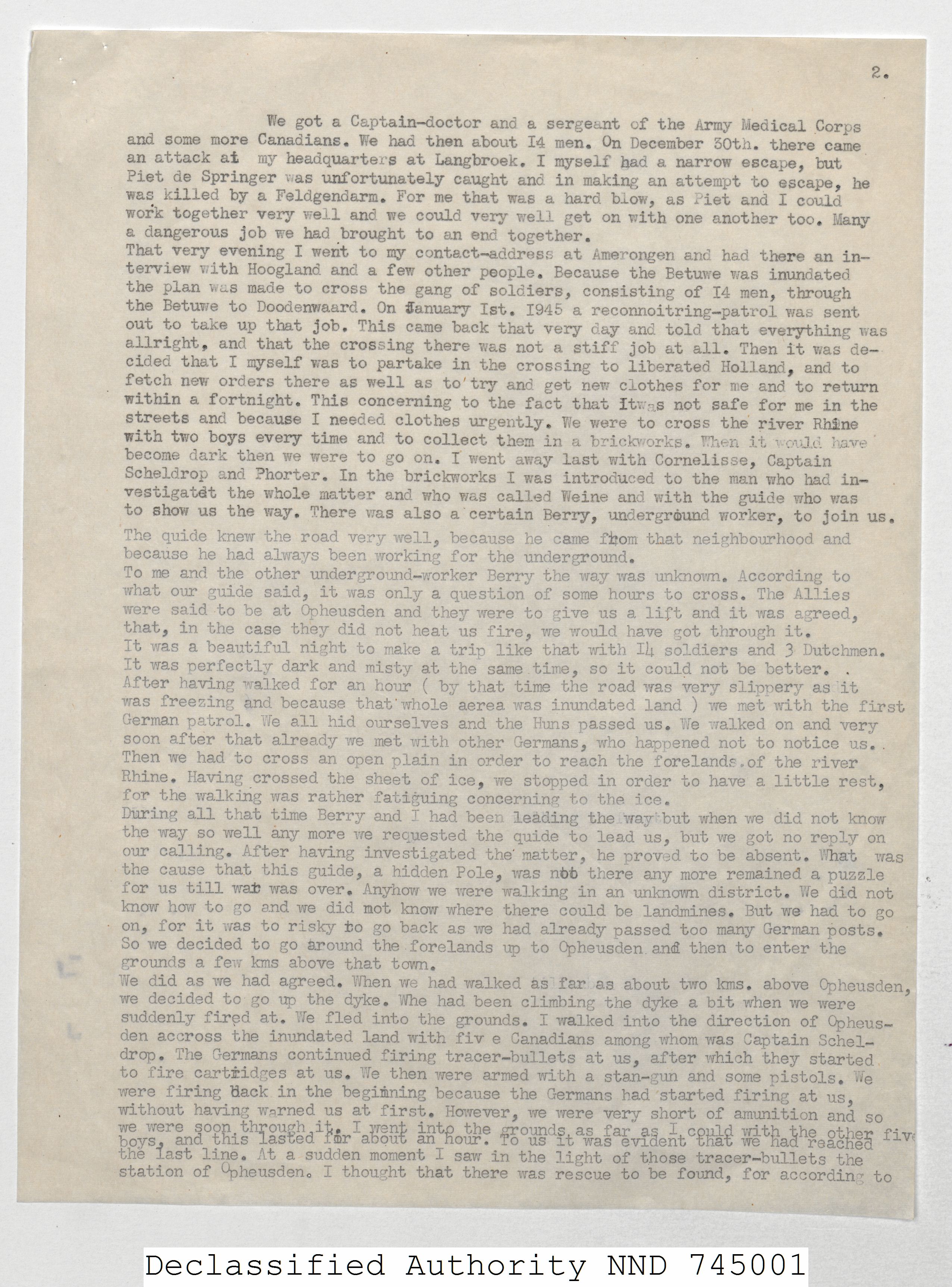
The barber's house. ✓ The headquarters was the house of the hairdresser Gerrit de Jong, Doornsche Weg 200 A, Langbroek (his own form, item 2: de Jong, p. 4; Maljers has "Langbroek A 200"), where Maljers hid (Maljers, p. 14, p. 24). De Jong's form for the Americans, which names the attackers as the Feldgendarmerie, has "The 30th of Dec. 44 there was a surprise attack in his house by the "Feldgendarmerie" from Doorn. Mr. de Jong escaped, his wife was taken prisoner and taken to Utrecht at the Wolvenplein where she was kept for 6 weeks", and under remarks "It was here that Piet de Springer was shot." (his form, p. 4, read on the image; the second form, p. 8, has "On this occasion Piet de Springen [sic] has been shot"). The police post at Langbroek's report of 26 July 1945 has the attack made "by several members of the established German "Feldgendarmerie" in Doorn" (p. 6). Maljers wrote that the raid "was om mij begonnen" (was on my account) (p. 14).
◐ The day, as the Langbroek group told it. Caspers has two Germans from Doorn search Gerrit de Jong's hairdresser's and tobacconist's shop for cigarettes and find ammunition, pistols and false permits, and De Jong slip away (pp. 94–95). Piet arrived at 3.30 p.m. with no idea the Germans were there, "just taken two British soldiers across the Rhine". He tried to get away on his bicycle, but "the road was like glass and the bike slipped"; he was hit in the back and "died instantly" (Caspers, To Save a Life, pp. 94–97; the first page checked against the image, the rest from the text layer).
◐ Heaps has him waiting for a haircut when German Green Police came to arrest the barber, pushing past them to his bicycle, with documents under the seat, skidding on the wet ground and shot in the back as he got up (Heaps, p. 137); he names Boeree only for the village learning the dead man's name afterwards, so the rest of his telling is unattributed.
◐ The visitor's account has him ask a teacher, Kees ten Wolde, to help him slip out, and the guard aim at his legs (the page); ◐ that is very probably Cornelis Jan ten Wolde of Langbroek, known to the Allies as "Kees" and called by Maljers "Ter Wolde, schoolmaster at Overlangbroek" (Maljers, p. 13); his own form, which gives his movement as "N.B.S." (the Americans' typed summary in English has "K.P. Langbroek", p. 8), names "Piet de Springer, toen te Langbroek, later doodgeschoten" (ten Wolde's file, p. 2). ◐ Caspers also puts a "Kees" in the house: "The German who had accompanied Kees heard the front door being opened, and he ran to it and fired" (pp. 96–97, text layer); she gives no surname, so it fits the visitor's account's Kees ten Wolde but does not name him. The two British soldiers of Caspers's account are named by no source.
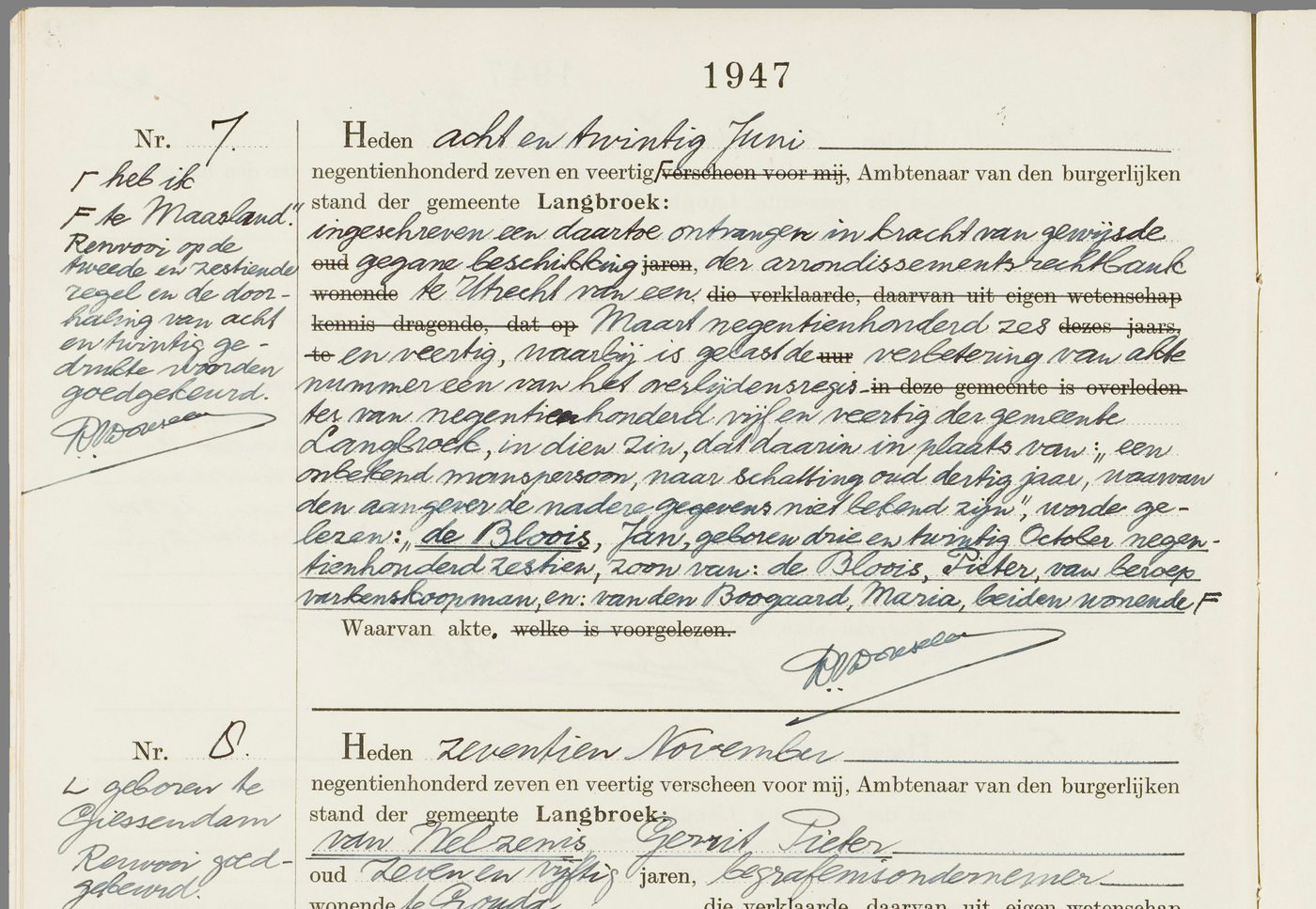
An unknown man. ✓ Langbroek registered his death as that of a stranger. Deed 7 of its death register, of 28 June 1947, enters a decision of the district court at Utrecht of 1 March 1946 ordering the correction of deed 1 of 1945, "in dien zin, dat daarin in plaats van: „een onbekend manspersoon, naar schatting oud dertig jaar, waarvan den aangever de nadere gegevens niet bekend zijn", worde gelezen: „de Bloois, Jan, geboren drie en twintig October negentienhonderd zestien" (so that in place of "an unknown man, estimated thirty years old, of whom the declarant does not know the further details" it shall read "de Bloois, Jan, born 23 October 1916") (the deed, read on the scan; the index dates deed 1 to 4 January 1945). The visitor's account has it that nobody at Langbroek knew his real name, so that he was identified only some time after the liberation (the page).
The Foundation's file. ✓ Maasland's form says "Doodgeschoten door de S.D. bij een razzia te Neder-Langbroek" (shot dead by the SD at a round-up at Neder-Langbroek) on 30 December 1944, and calls him "als spion in dienst van het vaderland" (a spy in the service of the fatherland) (scan 3; image-checked). His father's form, signed by him, says he died "ten gevolge van een door een Duits militair gelost schot" (as a result of a shot fired by a German soldier), on 30 December, was buried on 4 January [1945] at the general cemetery at Nederlangbroek, "midden op de begraafplaats", in a purchased grave with a sculpted memorial put up by a committee (scan 4; image-checked). The War Ministry's index card has "Doodgeschoten" and the same day and place (scan 12; image-checked). ◐ The visitor's account puts the memorial at 1948, by Johan van Zweden (the page). Swaluwenberg's form has "Dick" (◐ Dick Kragt) at the farm "till Newyear when Piet de Springer was shot by the Germans" (p. 2).
His home village. ✓ Het Laatste Nieuws of 30 May 1945 (a Maassluis paper with a Maasland column), in an "In memoriam", says the news reached his family "vorige week Woensdag" (last week on Wednesday, so the 23rd): that Jan, "de zoon, die in Oct. '43 naar Engeland was overgestoken", had been killed on 30 December 1944 "door een kogel van de Duitsche Sicherheitsdienst"; that he "werkte in de provincie Utrecht voor verkenning van de Grebbelinie", known there only as "Piet"; that he was buried "in alle stilte" in the Dutch Reformed churchyard at Neder-Langbroek; and that "Woensdag" (Wednesday) his friends there laid a wreath on the grave, which, since the paper is dated Wednesday 30 May, is the 23rd or the 30th (the notice; page 1, the item read on the page image). ◐ "Verkenning van de Grebbelinie" (reconnaissance of the Grebbe line) is the paper's wording; it does not say he was a radio operator.
The family's notice of thanks, signed "Fam. P. de Bloois", Oostgaag C 19, Maasland, July 1945, for the sympathy at the loss of "onzen lieven Zoon, Broeder, Zwager en Oom" (our dear son, brother, brother-in-law and uncle), was printed in Het Laatste Nieuws of 4 July 1945 (the notice; OCR only).
The Queen. ✓ De Schakel of 2 November 1945 reported that after he fell "tot haar het verzoek gericht om op denzelfden datum Haar weder van het zelfde bedrijf druiven te doen toekomen" (a request was addressed to her to have grapes from the same nursery sent to Her Majesty again on the date of the gift; the wording leaves open who asked, and of whom), and that she received his parents, with A. van der Kooij, for about five quarters of an hour, condoled with them, remarked that Mr de Bloois had fewer cattle than when his son was with her in England, and asked for a portrait of Jan (De Schakel, 2 November 1945, read on the page image; the same article in Het Laatste Nieuws of 2 November 1945 is OCR only and not archived, article MMMAAS01:210208037:mpeg21:a00007). Het Binnenhof of 10 November 1945 has the "jeugdige tuinder" (young market gardener) of Maasland crossing to England in 1943 with "een kistje Westlandse druiven" (a little box of Westland grapes) for the Queen, returning to the Netherlands several times and finding "de dood in Neder-Langbroek", and the Queen receiving "de echtgenote en den vader van Jan de Bloois" (the item; checked on the image; see "Where the sources disagree"). The Amigoe di Curaçao of 21 December 1945 prints the item in the same words (KB OCR, article KBDDD02:000210796:mpeg21:a0031; not read on the page, and not archived).
His father's form and letters. ✓ Pieter de Bloois Sr, "Oom Piet" to the Allied men, born 14 September 1883 and living at Oostgaag C 19, Maasland, filled in a helper's questionnaire on 20 November (no year written; ◐ 1945, the year of his letters): the Americans graded it 5, and in its table he listed three USA airmen, "Edwardsen", "Charvatt" and a third name that is not clear, shot down on 26 September (no year given) and hidden for 14 days (pp. 13–14; p. 14). ✓ The Americans' summary card for a Pieter de Bloois of the same address, born 14 July 1919, filed as Pieter de Bloois Jr., dates the same three, "Edwardsen, USA / Charwat, USA / Kasiewich, USA", to "14 days in September 1944" (his file, p. 4), so the year of the father's table is 1944; the table does not say whether the three came through Jan. The family went on asking the Americans about their son:
- on 25 December 1945 a handwritten letter asked "a friend" for news of "die brieven" (those letters) an American had taken from them with promises to return them soon (p. 10);
- on 19 January 1946 Capt. Franklin D. Coslett of the Holland office answered that the letters had been handed to an officer of the Bureau Inlichtingen, who "zou trachten iets naders voor Uw zoon te ondernemen" (would try to do something more for your son), and that efforts had not been given up (p. 12);
- on 11 September 1946 Lt Felix Bilgrey wrote from The Hague that he regretted not having been able to return "de brieven over Uw zoon" earlier (p. 11). All three letters checked on the images.
Honours and remembrance. The War Ministry's card records the Oorlogsherinneringskruis (War Commemorative Cross) (scan 12). The Foundation's page lists decorations "BL, BK", ◐ very probably the Bronze Lion and the Bronze Cross, our reading of the abbreviations (the page). ✓ The Erelijst van Gevallenen, the national roll of the fallen, has him on p. 425 under the resistance: "Bloois, de — Jan, Maasland 23.X.1916, Veehouder, Nederlangbroek 30.XII.1944" (the entry, read on the page scan). On 5 May 1955 Maasland unveiled its resistance monument on the Huis te Veldelaan, inscribed "De Vaderland getrouwe" 1940–1945 with two names, Jan de Bloois and Abraham Eijgenraam, and the words "In hen eren wij allen die vielen in de strijd tegen de overweldiger" (in them we honour all who fell in the struggle against the oppressor), accepted by the burgomaster (De Schakel, 13 May 1955; OCR only). The War Graves Foundation keeps a second, later file on him, 14815B (1995–2016), which has not been seen (the index entry).
Where the sources disagree
Link to the section Where the sources disagreeThe day. Maljers has 30 December 1944 (p. 16); Heaps "four days after Christmas", the 29th (p. 137); Swaluwenberg, New Year. ✓ The 30th is the day of de Jong's form and the police report (p. 4; p. 6), Langbroek's corrected deed (the deed), Takken's form, Caspers (p. 94), the Erelijst, and all four of the Foundation's documents (scan 3; scan 4; scan 12; the page). ✗ The 31st of the visitor's account on the Foundation's page, and of Het Vrije Volk of 5 May 1964 in a report on Maasland's Remembrance Day ("bij een razzia op 31 december 1944"; the article, OCR only; the page image would not decode), stands against those records.
Who shot him. The SD in a round-up (Maasland's form), a German soldier's shot (his father's form), a Feldgendarm (Maljers), the Feldgendarmerie from Doorn raiding the house (de Jong and the police report), the Green Police (Heaps), the SD's bullet (Het Laatste Nieuws), a guard at the barber's house (the visitor's account) (scan 3; scan 4; Maljers, p. 16; de Jong, p. 4; Heaps, p. 137). ◐ The police report of 26 July 1945 and de Jong's own form (dated 14.2., the year not read) both name the Feldgendarmerie from Doorn for the raid; neither says who fired the shot.
The burial. 4 January 1945 at the general cemetery at Nederlangbroek, five days after the 30th, by his father's form (scan 4); the death was registered, as that of an unknown man, in a deed the index dates to the same 4 January (the deed). Het Laatste Nieuws has the Dutch Reformed churchyard (the notice). Heaps, as the Algemeen Dagblad of 31 July 1976 gives him, has the Germans let nobody take the body, buried "pas na zes dagen" (only after six days) (the Algemeen Dagblad; the passage checked against the image); six days from the 29th, the paper's own date, is 4 January, the burial date on his father's form (six days from the 30th would be 5 January). Heaps's own sentence ends "Six days later and Germans carted de Bloois off and the corpse was tossed into an unmarked grave" (p. 137), against his father's form, which has a purchased grave and a memorial.
His escape and drop. Heaps has him escaping to England in 1941 and dropping "near Breda" in May 1944 (p. 136). ✓ The England-farers' index, Kew's catalogue and Schrader's account put the crossing in October 1943 (the index; Kew; Oranjehaven, p. 63), with Caspers. ⚠︎ The day is 8 October (the index's departure and Caspers) or 9 October (van Beckum's account of Schrader); the arrival 9 October (the index) or 10 October (Kew). Caspers and the visitor's account have the drop on the night of 7/8 May 1944; Caspers puts it in Noord-Brabant, Takken "geloof ik in N. Brabant" (I believe in N. Brabant), Heaps near Breda, and the visitor's account says only "boven bezet Nederland" (over occupied Netherlands). No record of the drop has been seen.
His trade. Tuinder (market gardener) on Maasland's form for the Foundation and in Het Binnenhof; Landbouwer (farmer) on his father's form, occupation "farmer" in Kew's catalogue, "a farmer's son" in Caspers; veehouder (cattle keeper) in the England-farers' index and the Erelijst; his father a pig dealer (varkenskoopman), and the Queen's remark about the cattle (scan 2; the Erelijst; De Schakel). ◐ Not settled; the family's business may have been both.
Wife or no wife. Het Binnenhof has the Queen receiving "de echtgenote en den vader van Jan de Bloois", his wife and father; De Schakel of 2 November 1945 has his parents; the Foundation's form and the Engelandvaarders index have him unmarried (Het Binnenhof; De Schakel). ◐ A slip in the short national item for moeder (mother), since the local paper that reports the visit itself has the couple; no source gives a wife.
When he came with the coordination message. The inquiry's witness has "Piet de Springer" arriving a fortnight to six weeks after he handed in his telegram, which followed his own drop of 29 February–1 March 1944, and the material back with him "nog in April" (still in April); Caspers, Takken's four months and the visitor's account have the drop in early May (the hearing; Caspers, p. 51). The Chairman's own list has an agent "De Alloys" dropped on 7/8 May and, for 10/11 April, only "Faber" and "Lette"; when the Chairman put "De Alloys" to him, the witness answered "Dat kan het niet zijn" (that cannot be it). ◐ "De Alloys" may be the list's spelling of de Bloois, our guess alone. ⚠︎ Not settled: the witness spoke five years on and cites his telegram list, which was not seen; either he misplaced the arrival, or the courier was dropped earlier than Caspers says, or the name belongs to someone else.