F/Sgt Bob Porter
1923 ◐ – ?
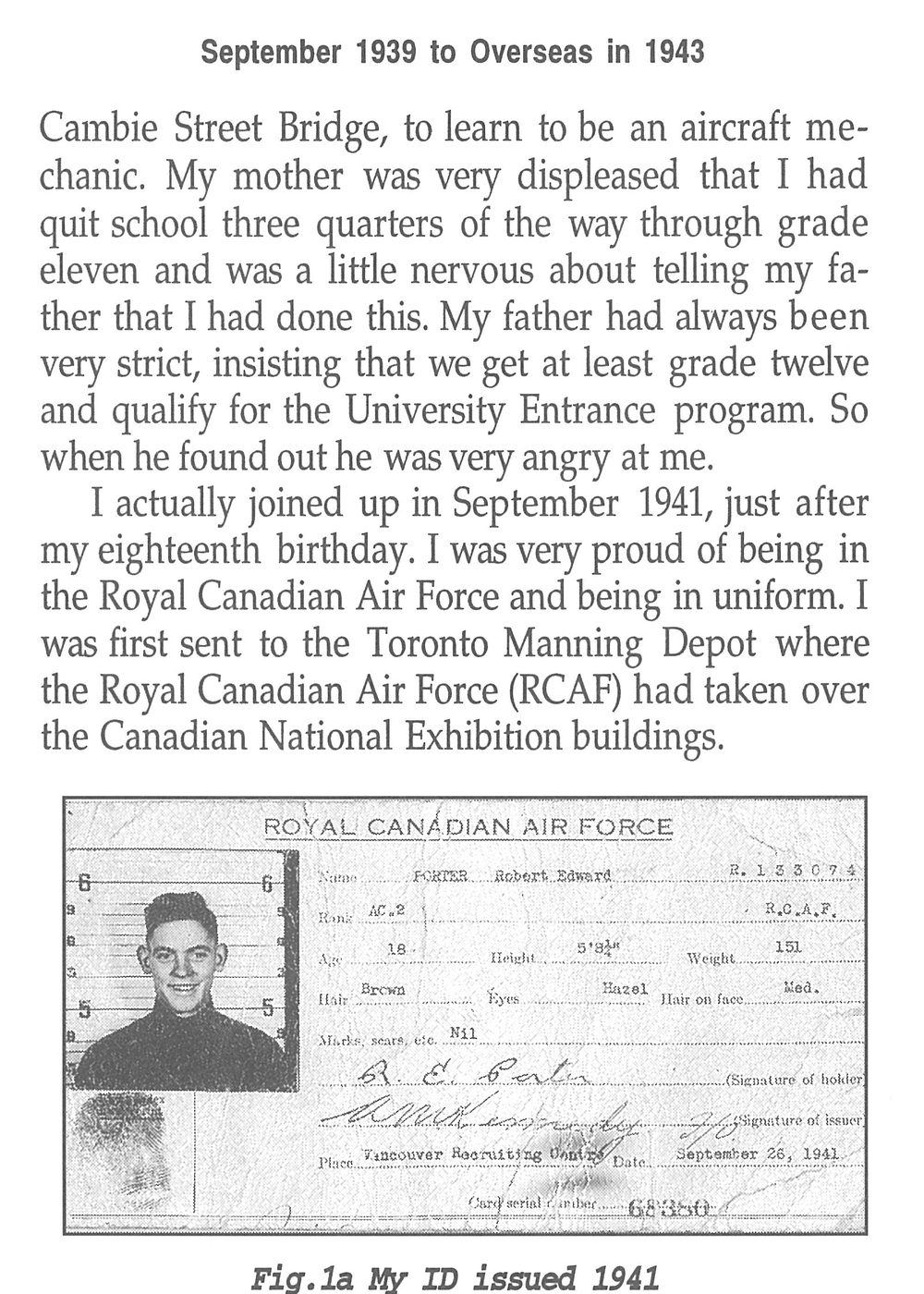
F/Sgt Robert Edward "Bob" Porter (R.133074).
About: A Canadian bomb-aimer of 419 Squadron shot down near Zeist on the night of 16/17 June 1944 and hidden for six months, most of them at Groenekan, who set out with Murphy's party on 2 January 1945 and was taken the next day with Berry. He was a prisoner in the Netherlands and Germany to the end, and in 1997 published The Long Return, which never names Murphy (Porter, p. 150).
Unit or role: RCAF, 419 Sqn (Porter, chapter 2), bomb-aimer (chapter 1); "419 Sqn. (Moose Sqd Eng.)" on Mrs Rakers's form (p. 8); ◐ Lancaster KB734 on one Dutch local history (Before, below).
Where: Burnaby, British Columbia; Driebergen and Utrecht, June and July 1944; Groenekan, with spells in Utrecht, until December 1944; Rijnstraat 472, Amerongen (Mrs Cornelisse's form, p. 5; the British helper index: "Amerongen Rynstr. 472"), over Christmas 1944; Arnhem, Utrecht and Doetinchem as a prisoner, January to March 1945; Nuremberg and Moosburg, March to May 1945.
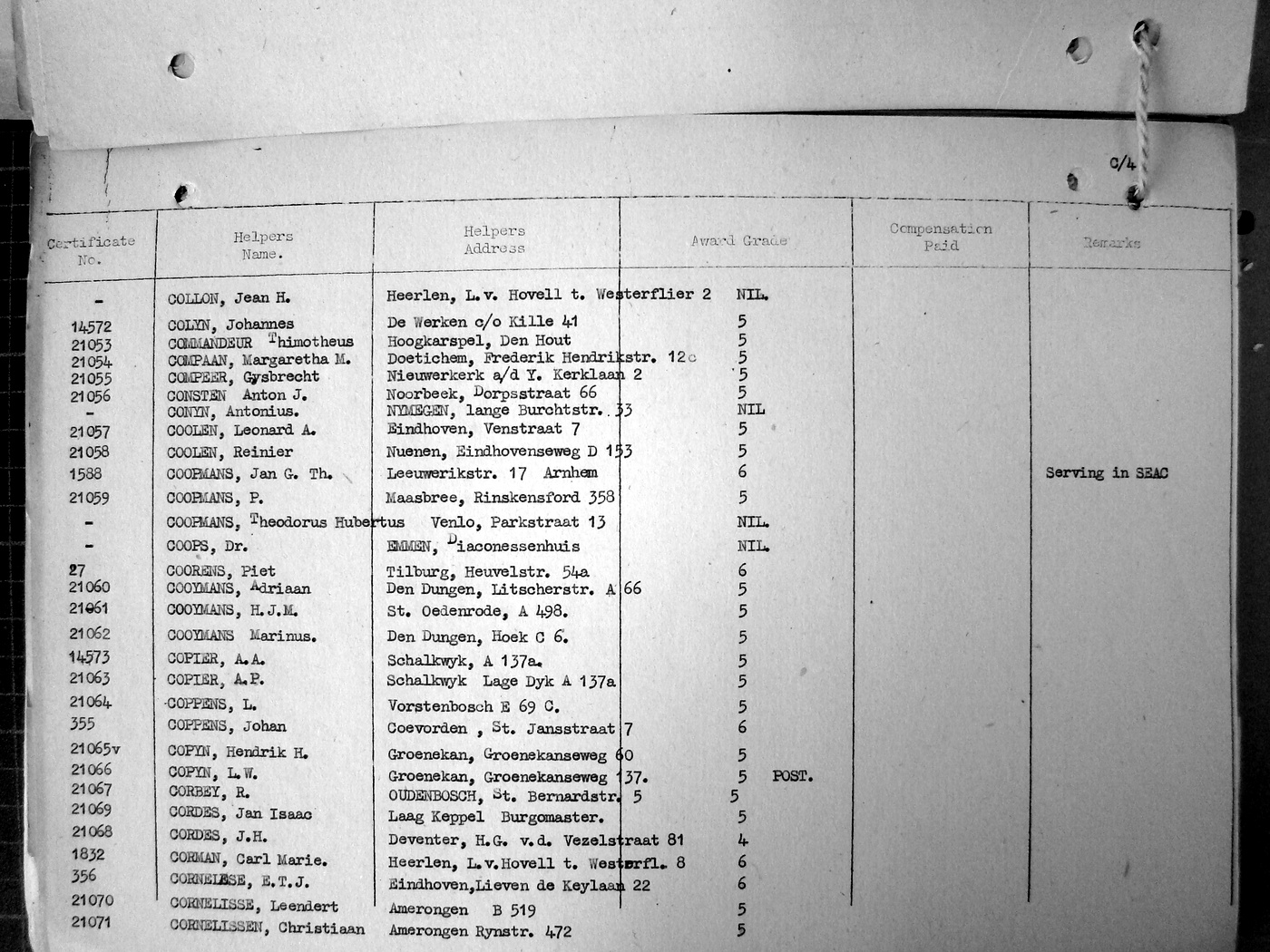
Evidence: ✓ Porter, The Long Return, with his letter of 15 May 1945 (chapter 11, pp. 221–229); ✓ the Rakers file; ✓ the Cornelisses' files; ✓ the Canadians' MI9 liberation reports (Swartz; Berry; Briere).
Burnaby and the air force. ◐ He was born in 1923, by his own figures: "just 16 years old" when Britain declared war on the Labour Day weekend of 1939, seventeen in April 1941, and joined the R.C.A.F. "in September 1941, just after my eighteenth birthday" (Porter, chapter 1, pp. 11–12); the card above, of 26 September 1941, gives his age as 18. The year is our arithmetic from those lines; no birth record has been found. His family had just moved back to Burnaby from Surrey, where his father had twenty acres (p. 11), and when he finished the book he lived in Burnaby, "a half a mile from where I was born" (chapter 13, p. 269).
He met his wife, a Welsh girl, at the operational training unit at Honeybourne, and married her at Tredegar, in South Wales (Porter, chapter 2, pp. 23, 31–32). ◐ The book has the move to Honeybourne in December and the wedding "in March the next year" (p. 23), and Christmas day 1943 follows at Honeybourne (p. 24), so March 1944. Mrs Cornelisse's account gives the Americans his address as "18 Llwyn Helyg, NANTYBWCH, Tredegar, Monmouthshire, Wales" (her account, p. 4). ◐ Porter's book has that house as his wife's: "The return address was my wife's home in South Wales", on his letter of 15 May 1945 headed "18 llwyn Helyg Nantybwch" (p. 221), and the R.C.A.F.'s letter is addressed to "Mrs. R.E. Porter, 18, Lewyn Helyg, Nantybwch, Tredegar" (p. 209, both chapter 11). That the hosts took the address from him is our inference.
The night of 16 June 1944. ✓ By his own account they had bombed Sterkrade and were going home across Holland, at 21,000 feet, when the wireless operator called out a fire in the fuselage; the pilot ordered the crew out, the escape hatch jammed, there was an explosion, and he came to falling without his parachute on his chest. The pack had swung up above his head and he pulled the cord; he came down in a tree (Porter, chapter 3, pp. 56–60). He learned after the war that two of the crew never left the aircraft, three were found dead on the ground, and the engineer was picked up by the Germans (p. 59). The Zeist police report he prints, signed on 18 June 1944 and witnessed by the Mayor of Zeist on 21 June, has a burning four-engined bomber crash at Utrechtseweg 48 at about 02:10 on 17 June, bodies found in two places, one survivor arrested in the Torenlaan, two airmen in the wreckage and "Two men of the airplane have still not been found" (Fig. 3o, p. 91, same chapter). His letter to his mother of 15 May 1945 tells it a little differently (Where the sources disagree): the Ruhr, 22,000 feet, the pilot and the rear gunner "killed and buried at Amersfoort" (chapter 11, pp. 221–222). ◐ A Dutch regional history of the Maljers crossings names the aircraft as Lancaster KB734 of 419 Squadron RCAF (the page); we have not seen a squadron or Bomber Command record of the loss. Chorley's 1944 volume, in the Internet Archive's search text only (the Porter line under Where the sources disagree), has KB734 in its serial index on the same leaf, which points to a Bomber Command entry we have not read on the page image.
Zeist, Driebergen and Utrecht, June and July 1944
Link to the section Zeist, Driebergen and Utrecht, June and July 1944His own account. ✓ The next morning, after an old couple who were afraid to help him gave him some bread, a young man on a bicycle with a briefcase stopped for him; Porter said in his phrase-book Dutch "I am English, can you hide me?", showed his wings, and the man asked "in perfect English, 'Are you Tommy?'" He took Porter on the back of his bicycle from Zeist to Driebergen, along the Arnhemse Bovenweg, to a corner store at 95 Loolaan; the man was "Frits", and the store was the Bos family's, where the son, Eep, "The Teacher", questioned him (Porter, chapter 3, pp. 66–70). That evening Eep Bos led him by bicycle to the house of Klaas van Middelkoop, "The Banker", above the bank in the Wilhelminastraat, Driebergen; if stopped he was to play deaf and dumb (pp. 71–73). After "about 10 days" the Middelkoops had to move him on (p. 80). Frits took him to meet a policeman in uniform who introduced himself as "Rakers"; Rakers put him in a car driven by Copyn to Utrecht, to the house of an older lady, "Mrs. De Baai" (pp. 81–82), and later came for him with a bicycle and rode with him to Groenekan (p. 86; Rakers).
The helpers' forms tell the same weeks piece by piece, each from one house, and do not agree on the dates (Where the sources disagree):
- Frits, in his helper form of 2 October 1945: "received Bob PORTER 'out of the air'" and "took PORTER at the back of his bicycle to E. BOS" (the form, p. 2). The form's surname is read "v.d. HAA[K or R]", with first initials "R.G." and the address Steven v.d. Hagenlaan 2, Amersfoort; the archive catalogues it as "v. d. Haak, K. G.".
- ◐ The same man, by the address and the initials "R.G.", wrote to Porter's parents on 3 June 1952, signing the letter Porter prints as "R.G. van der Haar". He had met a flyer coming "out of the bushes" between Zeist and Driebergen "about May-June '44", put him "on the back of my bicycle" and taken him to friends at Driebergen: "I believe that one of them, Mr. K. van Middelkoop, wrote to you" (chapter 12, pp. 247–248).
- Arrested some days later "for an other affair", he was let out after three months and saw Porter "occasionally at Groenekan … at the house of Mr. and Mrs. Rakers" (p. 248). Porter's book captions his photograph "Fig.3b Frits the man that picked me up. Died Aug. 1987" (p. 67).
- E. Bos of Driebergen, "Paul" to the evaders, has him coming "In April 44 … found by a friend of BOS", soaked, given underwear, a shirt and a suit but no shoes, staying one night and going on "to MAARTENSDIJK from where he crossed" (Bos's file, p. 5).
- Klaas van Middelkoop of Wilhelminastraat 5A, Driebergen: "During a fortnight at the beginning of 43 [sic] he lodged an evader: Bob Porter, Canadian, bombardeer, shot down in the neighbourhood of Zeist"; he "found Porter somewhere 'en route' and took him home with him. Afterwards Porter crossed with Chris from Amerongen" (his form, 14 August 1945; the year read on the image as 43). The award summary has "housing, food and shelter for Bob Porter, RCAF, for a period of 14 days" (p. 4).
- A. Baay of Ingenhouszstraat 43, Utrecht, has him from 22 June to 9 July 1944, 17 days:
- The typed table gives 22 June (Baay's file, p. 5); the handwritten original has "22/6/44 tot 9/7/44" (p. 7).
- J. A. Baay, of the same address, sent a second form on 26 April 1946 that says only "See QR on Baay, Antonie H." and, in another hand in ink, "Sheltered Sgt. Porter 17 days" (the typed form, p. 2, has "Jacob A."; the handwritten Dutch original, p. 4, has "Jacoba [sic] A."). ◐ Very probably Antonie's daughter, whom Antonie's own form names as "Mrs. J.A. Hartog-Baay" (his form, p. 4). The same 17 days as Antonie's table, so a second name on the same stay, not a second one; it adds no date or place.
- H. H. Copyn: "In June 1944 COPYN went together with RAKERS to DRIEBERGEN to fetch Bob PORTER" (Copyn's file, p. 4).
- Mrs Rakers's form: "PORTER was fetched by RAKERS and H. COPYN (whose report follows) from BAAY, Ingenhoekstraat 43, TUINDORP (Utr.) about mid June 44"; he had been a fortnight with Baay and before that "at EEP in ZEIST", and stayed with Rakers until 24 December; it names others who went to fetch him (her form, p. 8).
- Rakers's own table has him "received from K. Middelkoop", Driebergen, from 16 June (the table, p. 3).
Groenekan, June to December 1944
Link to the section Groenekan, June to December 1944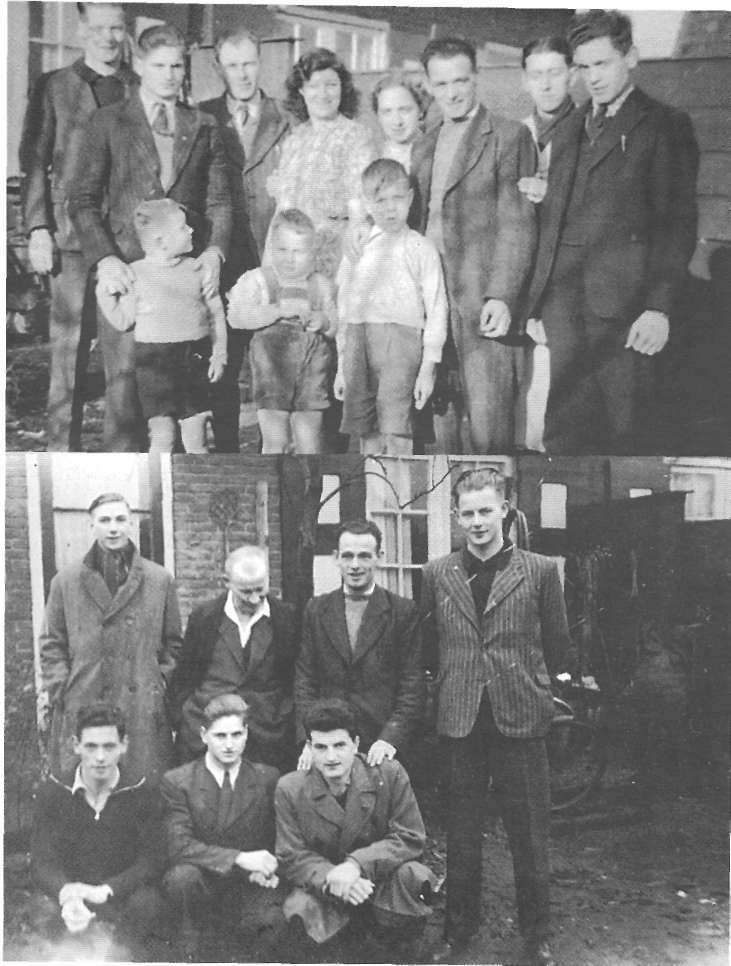
Who hid him: the policeman H. Rakers at Groenekan, "Pappa Rakers", from June to 24 December 1944, "27 weeks" by the family's table, which lists everyone in the house with him: Schjelderup, Briere and Berry, with Trainor, Swartz and Gri placed nearby (the Rakers file, p. 2; the table, p. 3). Mrs Rakers wrote in 1946 that they had "van Juni tot Dec '44 een Canadeesch vlieger in huis" (a Canadian airman in the house from June to December 1944) (her letter, p. 8). The Americans' action report on her of 22 October 1945 lists "Sgt. Robert Edward PORTER RCAF" first of the five evaders housed "for periods up to 6 months" (p. 11). More of the household is on Rakers's page.
At the Rakers house he had forged papers: a persoonsbewijs, the Dutch identity card, in the name of "Henk DeGraff" (his spelling; ◐ as a Dutch name it would be Henk de Graaf), which "stated that I was deaf and dumb", and papers saying he was a farmer exempt from labour in Germany, in the identity of a boy who had died years before. He never had to play deaf and dumb in front of Germans, but did in front of Dutch visitors nobody was sure of: for five days, when a man transferred from the south had to be put up in the house, he sat at meals nodding for what he wanted (Porter, chapter 4, pp. 100–101).
If he wasn't going to stay it was best that he didn't know who I was so I had to be deaf and dumb for five days. It was sure a hard job, requiring a lot of concentration. At meal times I would go to ask for something and then, remembering, would have to nod to someone for it or someone would go to speak to me. … However, I guess he just thought I was a bit stupid, not just deaf and dumb.
— Bob Porter, The Long Return (1997), p. 101 · chapter 4
The Heitingas in Utrecht. Mrs Rakers wrote that J. den Broesterd, who came to the house often, asked whether Bob would like a week's stay with the Heitinga family in Utrecht, since Mrs Heitinga and both daughters spoke English; "Na een week was Bob volgens afspraak weer terug" (after a week Bob was back, as agreed), and that between 5 and 20 December 1944 he stayed another four or five days with them (her letter, pp. 8–9). ◐ She dates the first week only by what follows it: "Ongeveer 2 weken later vond mijn man weer 2 Canadeesen" (about two weeks later my husband again found 2 Canadians), without naming them; if they are Schjelderup and Trainor, found on 25 October, the week was in early October, and if Briere and Berry, who reached Groenekan about 1 December (Berry, p. 2), mid-November. Heitinga's own table has "Robert E.Porter" with an address in New Westminster, hidden "aug.44 and dec.44", received from "Rakus, Groenekan" [sic], and taken prisoner in December (p. 5). ◐ By his own account a few weeks of that time were spent with the Heitingas, from the third week of November until Rakers fetched him back (Porter, chapter 5, pp. 125–126). ✓ Dr R. Buisman, who worked with Rakers, "helped with the transport of Bob PORTER from UTRECHT to GROENEKAN"; the form gives no date (Buisman's form, p. 3).
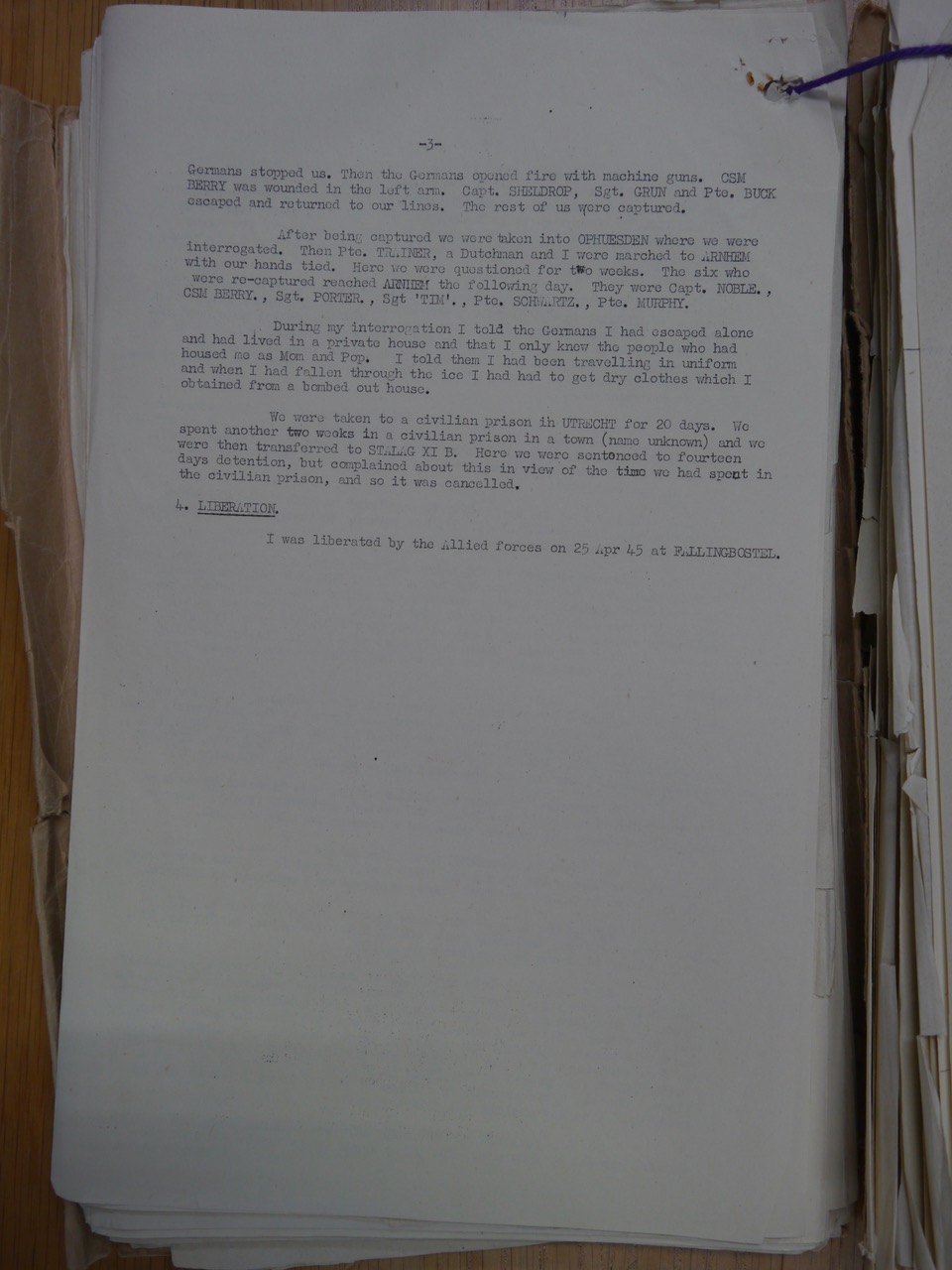
Questioning the newcomers. When Schjelderup and Trainor were brought to Fort Ruigenhoek in October, ◐ it was Porter whom Rakers fetched to question them: Ponssen has only "a R.A.F. pilot, staying at his house" (Ponssen's file, p. 4), and the name is Schjelderup's (his MI9 report, below). By late October 1944 he had been working with the underground for about four months since baling out in June; Two Came Back! has "six month's worthy work since parachuting from his plane", more than the dates allow. When Gri and Swartz reached the underground after jumping from a prisoner train at Utrecht, it was Porter, a Vancouver man, who questioned Swartz for about two hours on Vancouver before vouching for the two of them (Two Came Back!, p. 4; Roy, p. 371, has the two hours but names neither Porter nor Vancouver; Schjelderup's page). Swartz's own report has the two of them approach "a young farmer who was very suspicious of us. He brought a Canadian Sgt. named PORTER who was able to identify us" (Swartz, p. 1), and Briere found "Capt. SHELDROP and Sgt. Robert PORTER, R.C.A.F." at the policeman's house when he arrived there (Briere, p. 2).
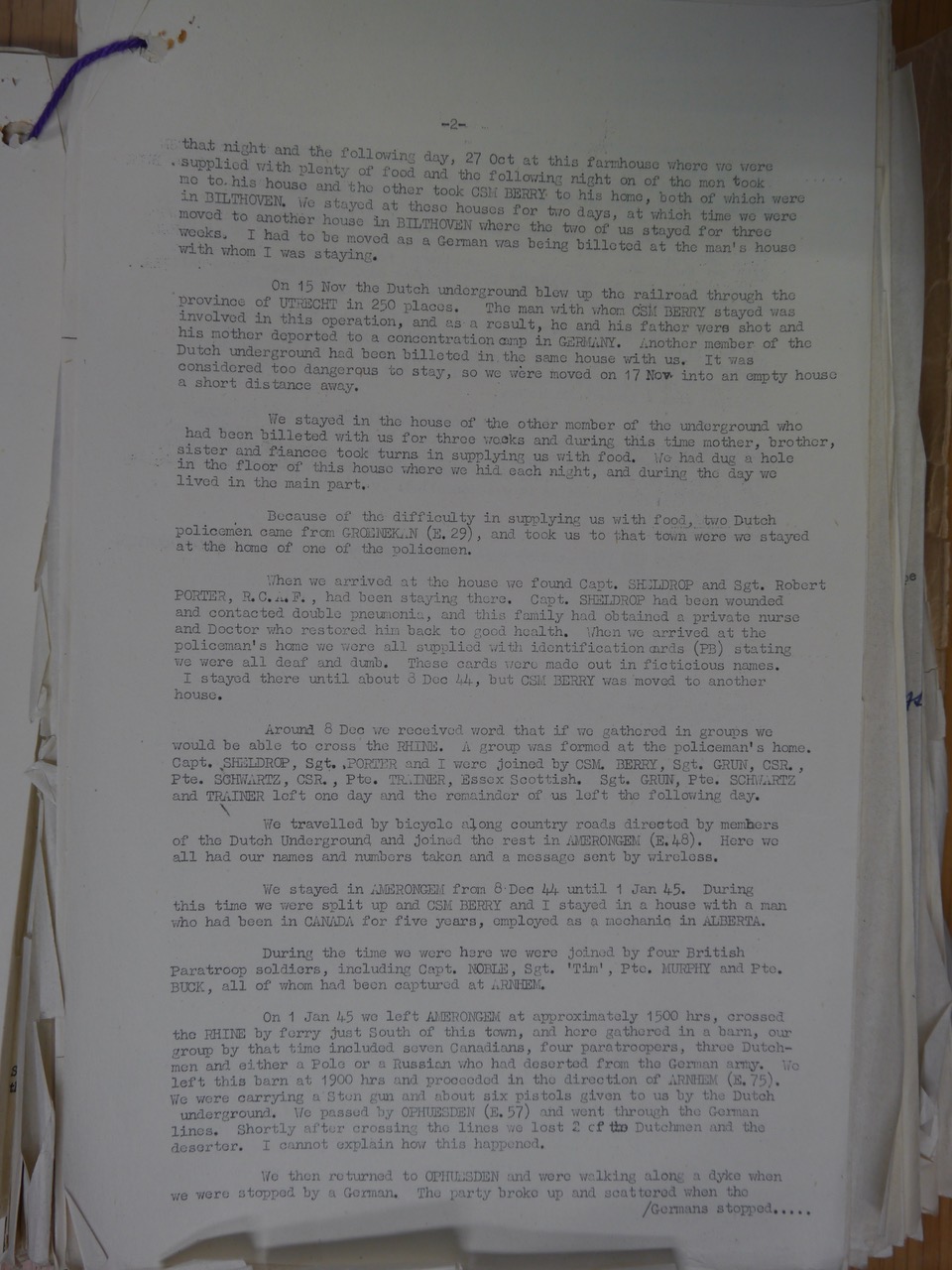
In Schjelderup's MI9 report. ◐ Schjelderup's MI9 report (transcript; the Kew original not seen) (Kew WO 208/3351/2349) names him in several places. The brackets and footnotes in the transcript are the transcriber's.
- At the fort, 25 October. At about 08:30 "an R.C.A.F. sergeant from a bomber crew – Sgt. PORTER, R.E. No. R.133074, was brought in to interrogate me" and left, in the transcript's words, at "100 hrs (approx.)" (as typed, with an hour's digit apparently missing), "satisfied that I was a Canadian officer" (Schjelderup's page). ✓ The fort's guard has Rakers fetch "a R.A.F. pilot, staying at his house" to question the two men (Ponssen, p. 4).
- At Rakers's. "Sgt. PORTER had been living with him since the middle of June." ✓ Rakers's table has him from 16 June (p. 3). Rakers "at one time had 4 Canadians in his house": ✓ Mrs Rakers's remarks on her husband's form name them: "Porter, Briere, Schelderup and Berry were housed with us" (the Rakers file, p. 2).
- At Amerongen. Appendix A has "23 Dec 44 – 2 Jan 45", Mr Cornelissen, Amerongen, "Food and shelter for Source and Sgt. PORTER" (the columns re-joined) (the Cornelissens). "At 1245 hours approx., myself and three others were taken away by bicycle to AMERONGEN", and ◐ Porter was very probably one of the three.
- 2 January. He is listed as "Sgt. PORTER, R.E. R.C.A.F." (R133074). ◐ By the report's own list he was one of the five (Berry, Porter, Swartz, Briere, Trainor) who "panicked and ran madly onto the ice" at the second firing (Schjelderup's page); the report does not mention his capture.
The comb letter. By his letter of May 1945, "a week before I left" (the letter does not say what he left; ◐ very probably Amerongen on 2 January) he wrote to his wife on rice paper, rolled into a hole drilled in a comb, for a courier going through the lines; the Germans got it, and it said he had lived with Schjelderup (chapter 11, p. 224; After, below).
With Murphy
Link to the section With MurphyTo Amerongen, December 1944
Link to the section To Amerongen, December 1944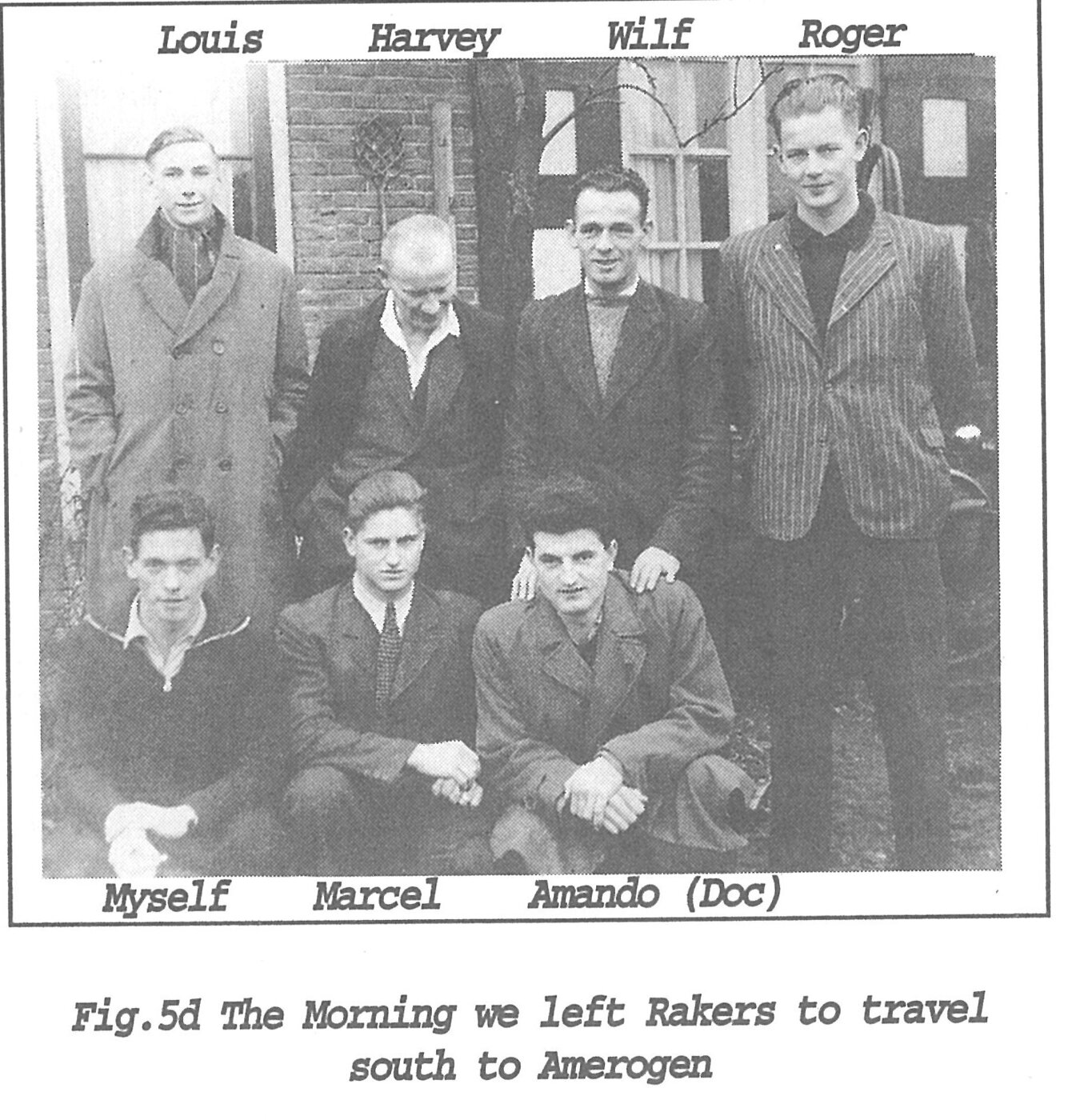
The seven Canadians left Groenekan for Amerongen a few days before Christmas (the day is not settled: Where the sources disagree). At the Rhine they went over on the little ferry, and when it would not come off the bank Porter got off to push, "next to the German guard", who did not know "there were seven of us" (Porter, pp. 135–136). At Amerongen he and Schjelderup were hidden by Chris Cornelisse and his wife at Rijnstraat 472 (Where, above), in the big attic: "Roger and I were taken into the house of Cornelissen", whose sixteen-year-old "daughter" Nellie spoke a little English (◐ Porter's word; Mrs Cornelisse's form has a foster child of 18 in May 1945, very probably the same girl, their page), while "two of the other fellows were taken to the family Esveld and the three others to the family of Hoogland" (p. 136). A Jewish man and a Dutchman were hiding in the same house, and they taught the Jewish man cribbage (pp. 136–137).
- Mrs Cornelisse's account has him brought from Zeist "by Dirk and Piet" and staying "at Chris and Mam's till 3 Jan, when he was taken to OPHEUSDEN by Chris" (her account, p. 4; Chris Cornelisse); ◐ "Dirk and Piet" are very probably the guide Adriaan Maljers and Piet de Springer.
- Chris Cornelisse's own list has "Mr. R.E. Porter" and Schjelderup "half Dec. 1944 till 3 Jan. 1945", "2 men for 3 weeks" (his list, p. 21), and the Americans' recommendation for him names "R. E. Porter" among the evaders he helped (p. 15).
- Joop Doornebosch's list at Leersum has "Mr. R.E. PORTER" with Schjelderup in a group it dates "about Feb/Mar" (p. 22; Joop Doornebosch). ⚠︎ That date cannot be right for him: Elisabeth Cornelisse-van Brink's supplement has Porter at Chris's "till 3 Jan, when he was taken to OPHEUSDEN by Chris" (p. 4), and he and Schjelderup were in the crossing of 2/3 January (The crossing and recapture).
Christmas. On Christmas Day, in the house where Berry and Briere stayed, there was "a Christmas tree for the little girl who lived in the house. Wilf, who was the Sergeant Major, had a Sten gun wrapped up under the tree so we could take it with us" (Porter, p. 138). Between Christmas and New Year's Eve he met "an English Private, a Sergeant and a Captain, (who was also a Medical Doctor Paratrooper,) who were also going to go with us" (Porter, p. 139). ◐ He names none of them; the party of 2 January had one doctor captain (Noble), one British sergeant (Banwell) and two British privates (Hardy and Murphy), so these are very probably men of that party, but ⚠︎ which private is not certain (Schjelderup's list; Christmas 1944).
The crossing, 2 January 1945
Link to the section The crossing, 2 January 1945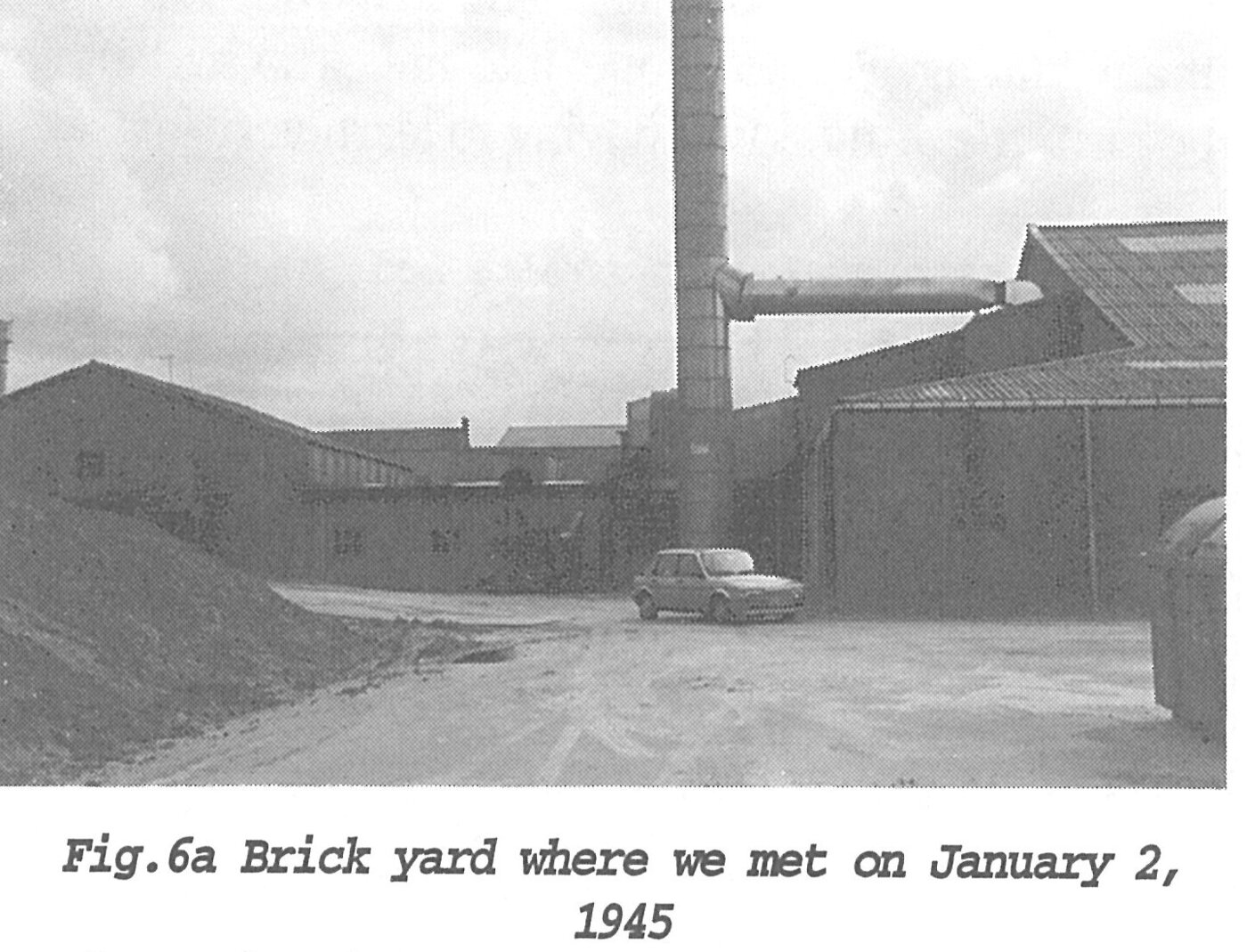
He was in the party of 2 January, and on the nominal list Schjelderup gave afterwards, "R133074. Sgt. PORTER, R.E. R.C.A.F." (The crossing and recapture; Schjelderup's report). Maljers dates the reconnoitring patrol 1 January and writes of the crossing to the brickworks, "I went away last with Cornelisse, Captain Scheldrop and Phorter" (Maljers's statement, p. 16); he gives no date for the departure, so 2 January is from the other sources. Swartz has "Sgt. PORTER" among those who joined the barn later, with Schjelderup and Noble:
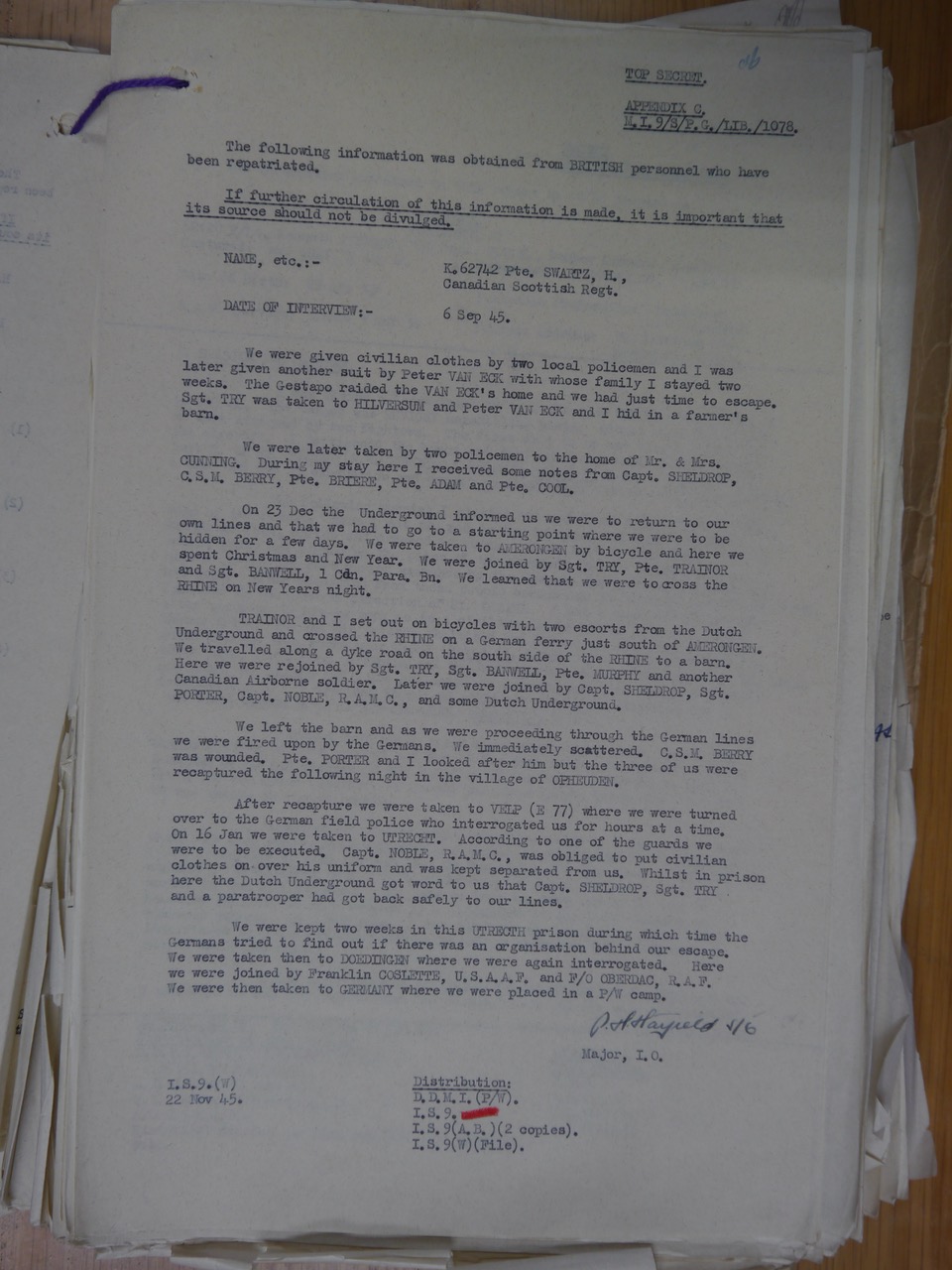
Here we were rejoined by Sgt. TRY, Sgt. BANWELL, Pte. MURPHY and another Canadian Airborne soldier. Later we were joined by Capt. SHELDROP, Sgt. PORTER, Capt. NOBLE, R.A.M.C., and some Dutch Underground.
— Pte H. Swartz, Canadian Scottish, on Murphy · MI9 liberation report, Appendix C · 1945 · the photograph
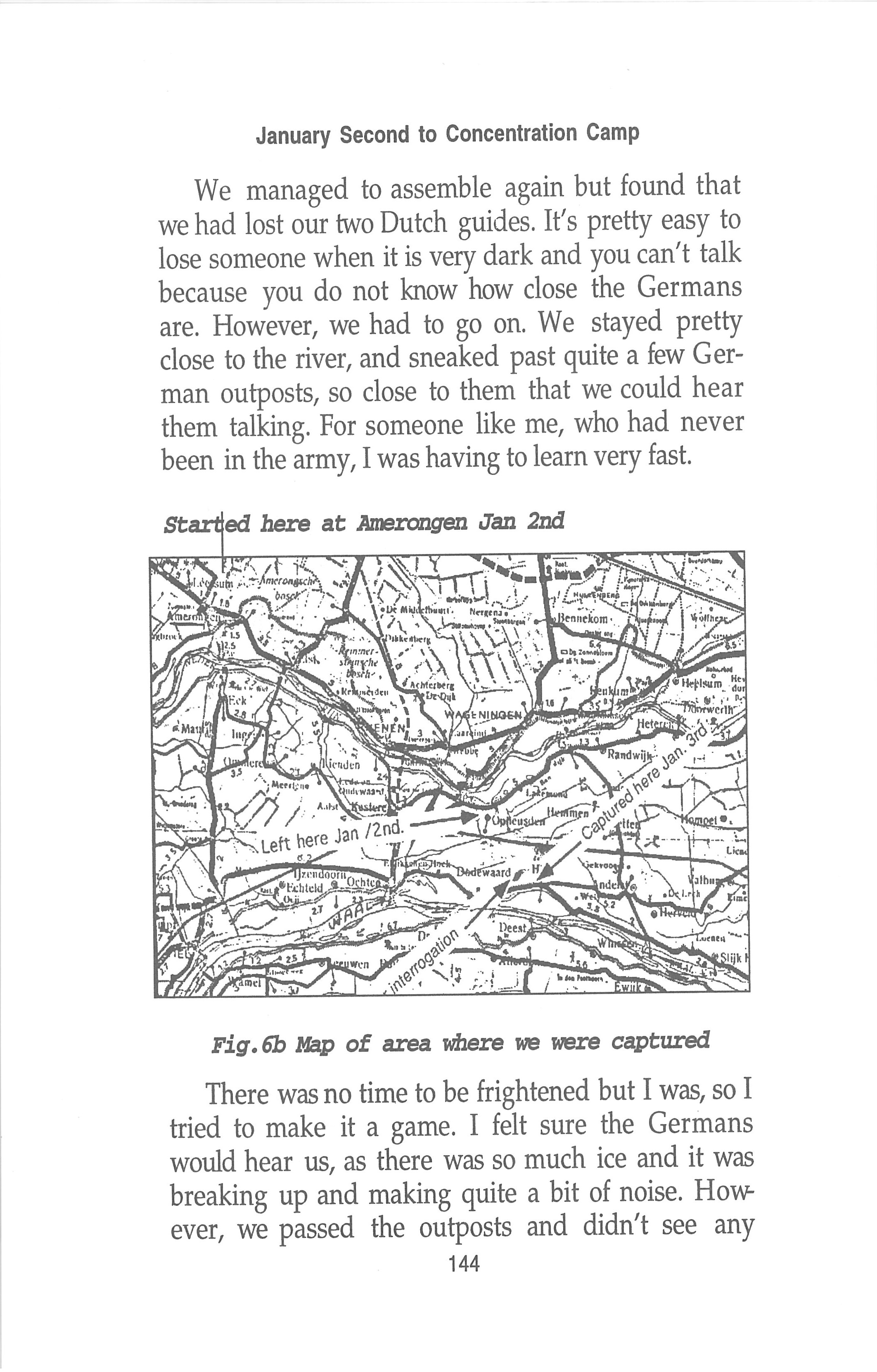
His book has the brickworks on the evening of 2 January: "There were seven of us plus the three paratroopers. Later another five plus our guides came along, making nineteen of us. No one introduced anyone" (pp. 142–143). The guide was "Dirk" (p. 143), which is Schjelderup's "DERRICK". A cyclist saw them on the road, "suddenly there was a shout and machine gun fire" (p. 145); he lost Schjelderup and ran with CSM Berry, who "had been shot in the arm" (p. 146) (Porter, chapter 6). ⚠︎ The counts of the party do not agree: nineteen in Porter and in a snippet of Caspers (Caspers), fourteen soldiers and three Dutchmen in Maljers (his statement, p. 16), eleven Canadians in Melis (his file), "11 Allied personnel, DERRICK, and 2 other Dutchmen as guides" in Schjelderup's report (its list has twelve entries, one of them "A Polish soldier"), thirteen in Gri's statement to the RCAF (p. 168, below), "about 15" and "There were 15 of us at the time" in Berry (p. 2), "seven Canadians, four paratroopers, three Dutchmen and either a Pole or a Russian", which makes fifteen, in Briere (p. 2), "13 Canadians and 1 Dutchman" on van Wijnen's form (p. 3), and, of the ferry, "six Canadians and four British paratroops" in Roy (pp. 372–373, extract) (How many set out).
✓ The regimental diarist's "Two Came Back!", from what Schjelderup and Gri told him, has him among those still together after the firing at about midnight: "All who were left were Capt Schjelderup, CSM Berry, Sgt Gri, Ptes Briere and Swartz of the Canadian Scottish; Pte Trainer of the Essex Scottish; Sgt "Bob" Porter, RCAF, and Pte Hardy of the 1st British Airborne Bn." (Two Came Back!, p. 6). What Schjelderup and Gri told the R.C.A.F. about him in February 1945:
Captain Schjelderup states: "On the night of 2nd/3rd January 1945, F/Sgt. Porter, myself and others set out to cross through the lines to freed Holland. The party was badly shot up, and on the second shooting, F/Sgt. Porter and others panicked. I last saw them crashing out across the ice in a badly flooded area under fire from three German machine gun posts. I never saw them again. I did not see F/Sgt. Porter shot."
— RCAF Overseas HQ to Ottawa · 24 February 1945, on F/Sgt R. E. Porter · reproduced in Porter, The Long Return, p. 168 · the page
Gri, in the same letter, had been "one of 13 people", fired on at about 23:30 on 2 January, after which all but himself and two others "moved off" (p. 168).
Taken, 3 January 1945
Link to the section Taken, 3 January 1945He told it twice, four months after it and fifty years after it. In his letter to his mother of 15 May 1945:
We were ready then, to keep fighting and try to get back. Then, we heard the British guns and rifles fire and we knew, they were close. In fact, about a kilometre away but we found we were on almost an island. As it had gotten warmer the ice melted, only one way off and we headed that way hoping it was to the English lines but it wasn't, it was in to the Germans lines. So we were taken prisoners, which was sure "hell" after waiting seven months to get back and get caught a kilometre away, that is bad luck.
— Bob Porter, letter to his mother, Tredegar, 15 May 1945 · printed in The Long Return (1997), p. 223 · chapter 11
The same letter has him run "with a Army Sergeant Major Wilf Berry and a Captain Roger Schjelderup", lose his shoes on the ice and go barefoot all night, and hide with Berry, "a bullet in his arm", in "a little shack until daylight"; and "We wore civilian clothes, and had a sten gun, with us. The Germans took a very dim view of this and we knew they could have legally shot us" (p. 223). After the capture "we were taken to Dodewaard and then to Felp", where the Germans "were trying to find out which Dutch people had hid us and helped us" (p. 224). His book, fifty years on, has him and Berry in a fruit shed, taken on 3 January by Wehrmacht troops who gave him wooden shoes and soup, before "the Field Army Police (Feld-Gendarmerie) soon took over" (p. 149); the Sten gun Berry had left in the shed was found afterwards (p. 148), and "They told us many times that, as we were captured in civilian clothes and armed, we were classified as spies so not protected by the Geneva Convention, so they could shoot us" (p. 150) (Porter, chapter 6; Tex Banwell). ⚠︎ His "we learned that four or five of our group had been killed" (p. 148) does not say from whom. The men's own reports name one man wounded, Berry, and no death: Noble's has "Only one person was wounded", and Berry's "Nobody was killed during the first attack", which says nothing of the second (Noble; Berry, p. 2; Schjelderup). Against them, the Air Ministry wrote to his wife on 10 March 1945 that "two members of the party were killed" (p. 171), and the RCAF to his mother on 10 May that "two other Royal Canadian Air Force personnel who were believed to be with your son" had been reported dead by the Germans through the Red Cross (p. 211); neither names them (chapter 7; chapter 11). A Dutch helper, Adrianus van Wijnen of Kesteren, wrote on his form of October 1945 that "several people were killed" (p. 3; Berry Melis). Noble's "8 killed" belongs to the British patrol the next morning, not the party (Noble; Porter's account).
The Canadians' reports put others with him:
- Swartz: "Pte. PORTER and I looked after him", of the wounded Berry, "but the three of us were recaptured the following night in the village of OPHEUDEN" (Swartz, Appendix C).
- Berry has himself, Swartz and "Sgt. PORTER, R.C.A.F." avoiding capture until about 13:00 on 3 January, under fire, through the ice and to a hut where they tried to dry their clothes (Berry, p. 2).
- Briere, who was marched to Arnhem ahead of them with Trainor and a Dutchman, has Porter among six who came after: "The six who were re-captured reached ARNHEM the following day. They were Capt. NOBLE., CSM BERRY., Sgt. PORTER., Sgt 'TIM'., Pte. SCHWARTZ., Pte. MURPHY." (Briere, p. 3). The report does not date "the following day", or say where or with whom each was taken (Tex Banwell).
- ◐ Four of the six put themselves at Velp, by Arnhem, in their own accounts: Noble, Berry, Swartz, and Porter in his letter ("Felp"); Murphy has his party taken to "GWELF" (Noble; Berry, p. 2; Swartz; GWELF). ⚠︎ "Tim" rests on Briere alone.
- ⚠︎ Porter's book has a different six: "Wilf, Louis, Harvey, Marcel Briere, the Army Doctor and myself were taken to Arnhem" (p. 151). That puts Briere and Trainor with him, where Briere has the two of them marched ahead, and has no Murphy and no "Tim". Not reconciled: Briere's is a report of June 1945, Porter's a book written fifty years on.
Murphy. He never names Murphy. After the capture "Louis, Marcel, Harvey, and the doctor from the Army all showed up, but we didn't see any of the others" (p. 150), and Murphy is not named at the Wolvenplein or the Kruisberg (Porter, chapter 6; Recapture, interrogation, captivity). He saw "Dirk, the Dutch guide" (p. 149), Adriaan Maljers, in the first days: ⚠︎ by his account beaten, his feet bleeding, and they had "to totally ignore him as it wouldn't have done either of us any good to have recognised each other" (p. 150; Adriaan Maljers).
Arnhem, Utrecht and Doetinchem, January to March 1945
Link to the section Arnhem, Utrecht and Doetinchem, January to March 1945His book has him kept near the front for a day or so, then taken to Arnhem with "Wilf, Louis, Harvey, Marcel Briere, the Army Doctor and myself", while "The Dutch fellows were taken to a concentration camp" (p. 151); held in a house at Arnhem with the doctor, a British medical officer captured in uniform whom the Germans treated as a proper prisoner (p. 153); called spies and threatened with shooting "many times" (p. 155); interrogated "at three or four o'clock in the morning" (p. 157); after a week or so moved by truck to "a big prison in Utrecht called 'Wolvenplein Prison'", "run by the German SS" (p. 159); and at the end of January taken with Berry, Trainor, Swartz and Briere to "a very well-guarded concentration camp. I believe that was the Kruisberge at Doetinchem", where he shared a cell with Berry (pp. 163–165) (Porter, chapter 6). Swartz has Velp, then Utrecht on 16 January, for himself, Berry and Porter (Appendix C).
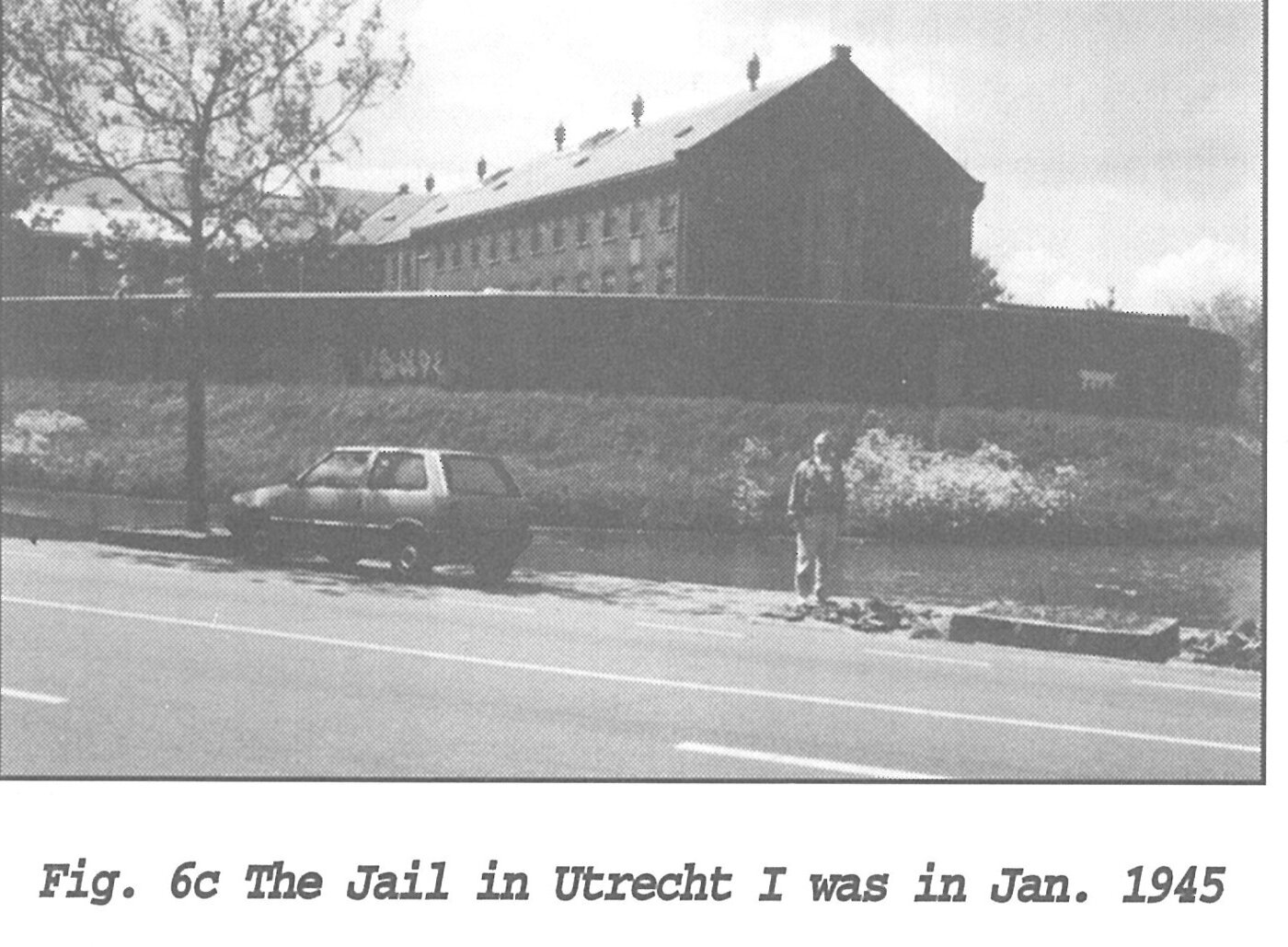
His letter of May 1945 has the road differently: "taken to Dodewaard and then to Felp", under "the German Army Secrete Police", about three weeks in solitary on a cup of soup and a piece of bread a day, interrogated "day or night" on "which Dutch people had hid us and helped us"; "We told nothing and said: they could shoot us" (chapter 11, p. 224). There the comb letter was put in front of him:
I had always told the Germans I had lived alone in a barn and knew no one, he jumped up, called me a damn liar and kicked me out of the room, a couple of hours later, he called me back, asked me: "Was I ready to tell the truth?". I said: "yes". He asked a few questions, including; had I written a letter? and had I lived alone? I told him I wrote none and lived alone. He sat down with on sarcastic smile. Passed me the letter that I had written, asked me: "Did I know Roger Schjelderup". It was sure a blow because it blew all my story.
— Bob Porter, letter to his mother, 15 May 1945 · printed in The Long Return (1997), p. 224 · chapter 11
He made up "a new story including Roger"; "Dutch men were being beaten in the next room. They never badly tortured us, but we were expecting it any day!" Then three weeks alone in a cell at Utrecht, then "another concentration prison in Germany", a cement cell with no heat, "all political prison, run by 'SS.' and 'Gestapo'", almost three weeks, with "a bath on December 23 and clean clothes" and then, "It was March tenth, I got my bath and clean clothes": a bath on 23 December, and the next on 10 March (pp. 224–225). At the Kruisberg, by the book, he was put in a dark cell in the basement in solitary, and at the end of March an SS interrogator asked him who would win the war (pp. 173–174, chapter 7).
⚠︎ Charles Noble's own later account (unpublished private papers, shared with us privately), told long after the war, has the Canadians of the party with him at Utrecht, naming none of them. At a first prison, "the wrong prison", the Canadians came in, whom he had not seen at Velp: "There were about five of them … These were the ones who had been on the dyke when we had been shot at". In the waiting room a German who took them for terrorists spat in Noble's face, until his guard said he was "an English doctor". At the Wolvenplein Noble was alone in a cell for three weeks: "The others were kept in two cells." At Doetinchem "There were Canadians who were in the cell next to me with two Americans and one Pole." The same account has Noble by day in a Feld Gendarmerie house at Arnhem, with "a Canadian sergeant pilot as my servant" to make his fire and his bed; ⚠︎ not identified, and Porter was a bomb-aimer, though his book has the doctor held "in the same house as us" (p. 153).
At home, posted missing. ✓ The book prints the letters. On 24 February 1945 the R.C.A.F. in London sent Ottawa Schjelderup's and Gri's statements (above). On 10 March the Air Ministry wrote to his wife that he had last been seen "running across the ice in a badly flooded area", that "A further report has reached us which states that two members of the party were killed", and that "grave consideration must be given to the possibility that he may have lost his life" (p. 171, chapter 7). On 10 May the R.C.A.F. wrote to "Mr. C.A. Porter" at 3406 Imperial Street, New Westminster, that he had been "one of a party of thirteen allied service men", that "it is reported that your son was shot" on the ice, and that "two other Royal Canadian Air Force personnel who were believed to be with your son … have now been reported by the Germans through the International Red Cross at Geneva to have lost their lives" (p. 211, chapter 11). ⚠︎ The letters do not name the two dead; no list of the party held here has another R.C.A.F. man in it (Schjelderup's list; Two Came Back!, p. 6).
Prisoner of war, March to May 1945
Link to the section Prisoner of war, March to May 1945✓ By his book: Berry, Trainor, Briere, Swartz and he were moved by truck into Germany, "back together again, just the five of us" (p. 176); at a holding camp he was separated from them, "I never saw Wilf again until a couple of years after the war", and classed at last as a prisoner of war (p. 177); about a week later, at an organised camp with Red Cross staff, he had his first shower and change of clothes in over three months (p. 182); then by box car to the camp at Nuremberg (p. 187) (chapter 8). His letter adds Münster, Frankfurt and "Wetslow" (◐ Wetzlar), with the first hot shower "about middle of March" (chapter 11, p. 226). On 2 April the camp marched out; after sixteen days and 120 kilometres they came to "Mooseburg #7A" (chapter 10, pp. 197, 202). On 28 April "General Patton and his soldiers came in the front gate" (p. 205, chapter 11). On 10 May he flew out of Germany to Reims, and that night to England; at Bournemouth he sent his mother a telegram (pp. 214–216, chapter 11). In London he was made warrant officer first class "right away" and put up for a commission, which they "would not back-date"; the book captions a document "I received my Commission dated May 10" (pp. 218–220).
In the Nelson Daily News, 1944 and 1945
Link to the section In the Nelson Daily News, 1944 and 1945✓ Read on the page images of the Nelson Daily News, held by the University of British Columbia Library (BC Historical Newspapers).
- Missing, 21 July 1944. The 940th R.C.A.F. casualty list, Ottawa, 20 July, six British Columbia men "Missing on Active Service After Air Operations": "Porter, Robert Edward, Sgt., New Westminster, B.C." (21 July 1944, p. 6), a month after the Lancaster came down near Zeist (above).
- Home safe, 17 May 1945. "Real Mother's Day at Burnaby", Burnaby, 16 May (17 May 1945, p. 1):
- "Mrs. Charles A. Porter of Burnaby" had a cable "from her son Flt.-Sgt. Bob Porter, 2[?], missing overseas for nearly a year", who "was posted as 'believed killed' a week ago by the Department of National Defence"; his telegram said "Safe in England. Good and healthy. Love, Bob."
- The piece adds that he "was the only survivor of a plane shot down in Holland last June 17" and has "been hiding in occupied territory". ◐ The age's last digit is worn on the page, and "only survivor" is the paper's belief ("It is believed"); the Zeist report and his own account have a survivor arrested in the Torenlaan and an engineer taken (Before, above). The 17 June date fits the police report's 02:10 on 17 June.
- His book has the same: the day before Mother's Day the letter "saying that they had given up hope"; on Mother's Day his telegram (chapter 11, p. 216).
- Freed, 19 May 1945. "B. C. Men Liberated", Ottawa, 18 May: the R.C.A.F. "issued today a list of 116 Canadian airmen freed from German prisoner of war camps", among them "Porter, Robert Edward, Flt.-Lt., New Westminster" (19 May 1945, p. 2).
In the liberation reports of the Canadians
Link to the section In the liberation reports of the Canadians✓ Three MI9 liberation reports, photographed at Kew by the late John Howes, who passed them to Lisan Koppenol, and she sent them on, name him: Swartz's, Berry's and Briere's, quoted above. Their own accounts are on Berry's, Swartz's and Briere's pages.
Back in Canada
Link to the section Back in Canada✓ By his own account he sailed from Gourock on the Ile de France on 8 July 1945, a day late for his orders, and crossed Canada by train from Halifax to Vancouver (chapter 12, p. 238). In August a letter from Mrs Rakers told him Rakers had been killed in a road accident, "just three months after the end of the war" (pp. 239–240; Rakers). On 11 September 1945 he had a medical discharge, "After four years less fifteen days in the service", his feet in bad shape "from being on the ice in bare feet the night I was captured" and his nerves very bad (p. 242), and spent the next few months in Shaughnessy Hospital, Vancouver (p. 245). In the early 1950s he met the Heitingas again in Toronto, and in 1952 Frits's letter reached him through his grandmother; in 1955 Frits visited him in Canada (p. 246). In 1958 he took his wife and their two children to Holland and met Klaas and Ans van Middelkoop again (p. 247).
His "About the Author" has it his own way: "discharged from the Airforce as a pilot Officer in September 1946", a few months in Shaughnessy Hospital, "a big problem settling down", "eventually apprenticed for a plumber and I ran my own plumbing business until the late 60s", then building and developing in British Columbia; he retired in 1995, living in Burnaby (chapter 13, p. 269). ◐ The Vancouver directory of 1970 lists "PORTER'S Plumbing Ltd, R E Porter pres, 7675 Edmonds, Bby" (Burnaby) (the entry, OCR only), which fits his own account.
Fifty years later. ✓ In May 1995 he went back to Holland for the fiftieth anniversary: the parade at Apeldoorn, his crew's graves at the Amersfoort cemetery on 4 May, a tour of the Wolvenplein prison, where he saw his cell and the "black hole" of his solitary confinement; the Middelkoops drove him to "the river where I crossed in the little boat" and to the brickyard; and at Amerongen he met Nellie and "her father Mr. Cornelissen", whom he gives as ninety-six (chapter 13, pp. 252–260; Mr and Mrs Cornelissen). He wrote it all down in The Long Return (1997).
Where the sources disagree
Link to the section Where the sources disagree- His rank in the press. ⚠︎ "Sgt." on 21 July 1944 and "Flt.-Lt." on 19 May 1945, against "Flt.-Sgt." on 17 May 1945, the F/Sgt of the page, the WO1 and commission of his book (pp. 218–220) and his own "pilot officer" on leaving. Nothing found has a promotion to flight lieutenant, so the rank may be the list's error.
- His home. ◐ New Westminster in both lists of the Nelson paper, in the R.C.A.F.'s letter to "Mr. C.A. Porter" and in Heitinga's table, and Burnaby in its piece of 17 May 1945 (his mother's town, and where he later lived); Bos has "VANCOUVER", as does Two Came Back!, and the Cornelisse account gives his wife's family's Welsh address and calls him a "pilot" (Bos, p. 5; Cornelisse, p. 4; Heitinga, p. 5).
- The night he was shot down. His book has Sterkrade, 21,000 feet, two of the crew still in the aircraft, three found dead and the engineer taken (pp. 56–60); his letter of May 1945 has "the Ruhr", 22,000 feet, the pilot and rear gunner killed and buried at Amersfoort, the mid-upper gunner killed, and nothing known of the other three (pp. 221–222). ◐ Sterkrade is in the Ruhr; the rest is not reconciled.
- How he reached the underground. His own book gives one road, Frits, the Bos store, the Middelkoops for about ten days, then Rakers and Copyn to the De Baais in Utrecht and on to Groenekan (Before, above). The forms give the pieces with dates that do not fit it or each other:
- Rakers's table has him "received from K. Middelkoop", Driebergen, from 16 June (the table, p. 3).
- Baay has 22 June to 9 July, and in the same row has Porter "received from" and passed back to "Mr. Raakers", the Maartensdijk policeman, so Rakers at both ends of his stay; Mrs Rakers has Rakers and Copyn fetching him from Baay "about mid June", after a fortnight there, and "before that he was at EEP in ZEIST"; Copyn has the two of them fetching him from Driebergen in June (above).
- Bos's form: "In April 44", found by a friend and brought to Bos, and one night only.
- Van Middelkoop's form: a fortnight "at the beginning of 43 [sic]"; Porter in 1958, "a couple of weeks in their house in 1944" (chapter 12, p. 247); the book, about ten days.
- ◐ Bos's April, Middelkoop's 1943 and Rakers's 16 June are each at odds with a crash on the night of 16/17 June; the book's order fits Frits's form and his 1952 letter.
- Frits's name. "v.d. HAA[K or R]" with "R.G." on his form, "K. G." in the archive's catalogue, and "R.G. van der Haar" heading the 1952 letter Porter prints, all at Steven v.d. Hagenlaan 2, Amersfoort (above). ◐ One man by the address; the spelling of the surname is not settled.
- When he was shot down. ⚠︎ Rakers's table has "8-6" in its shot-down column, with Zeist and him hidden from "16-6" (the table, read on the image). The Zeist police report has the crash at about 02:10 on 17 June and Porter's book the night of 16 June, so 8 June fits neither; ◐ most likely a slip, which the table does not explain.
- Holwerda's table has "R.E.Porten" shot down "July 44, near Zeist" (p. 23) and his statement has him come into Rakers's house "about May or June 1944" (p. 7); the R.C.A.F. letter of February 1945 quotes Schjelderup and Gri as "shot down in the North of Holland in July" (p. 168).
- His stays with the Heitingas. ⚠︎ Not settled. Mrs Rakers has one week, dated only relative to the next two Canadians her husband took in, and four or five days between 5 and 20 December; Heitinga's table has "aug.44 and dec.44"; Porter's book has a few weeks from the third week of November until Rakers fetched him back (Before, above). She and Heitinga agree on a second stay in December.
- When he was captured. Schjelderup's report and the page have him taken in the crossing of 2/3 January 1945.
- His book has both dates: "Captured here Jan 3rd" on its map (p. 144), and "the night I was captured on January second" in chapter 12 (p. 242).
- ⚠︎ W. R. Chorley's RAF Bomber Command Losses, 1944 volume, lists "Sgt R E Porter RCAF pow Captured December 1944" (the passage, the Internet Archive's search text only, from a column the OCR has run together with others: the lines either side of it are not in KB734's crew, and the placement is not confirmed on the page image); December is a few days early, and the book is a register built after the war, so the crossing stands.
- When he reached Amerongen. ◐ The Amerongen side has the earlier dates, the Groenekan side the later:
- Appendix A of Schjelderup's report has him at the Cornelissens' from 23 December to 2 January (the transcript).
- Mrs Cornelisse's account has him brought "by Dirk and Piet" and kept "till 3 Jan" (p. 4), and her Dutch original adds "ongeveer 18 Dec." (p. 11); her husband's list has "half Dec. 1944" (p. 21).
- The Rakers table has him in Groenekan until 24 December, and Berry's own report has the move from Groenekan on 24 December (Berry's page). Rakers's page reads the 24th as the day the forms count to, not the day the men left (◐).
- Fowler has the escapers brought together at Rakers's house "early on 23 December" and captions their photograph "the morning of 23 December 1944" (p. 102).
- Hardy met Schjelderup and Berry at Amerongen at about 16:30 on the 23rd (Hardy).
- Briere's report has "Around 8 Dec" the group gathered at the policeman's house and "We stayed in AMERONGEM from 8 Dec 44 until 1 Jan 45" (p. 2); Swartz has "On 25 Dec the Underground informed us we were to return to our own lines", and "We were taken to AMERONGEN by bicycle" (Appendix C); Roy has "On December 27 the men were taken to an area near the Rhine River" (p. 372, extract).
- So the dates run from 8 December (Briere) through the 18th and 23rd to the 24th, 25th and 27th, with no common day; Chris Cornelisse's "half Dec." is vaguer still.
- Who ran with him, and where he was taken.
- His letter of May 1945 has him run with Berry and Schjelderup, hide with Berry in "a little shack", and be taken leaving what was "almost an island", a kilometre from the British guns (p. 223).
- His book has him lose Schjelderup, run with Berry, and be taken in a fruit shed (pp. 146–149).
- Swartz has Porter, Berry and himself taken "the following night in the village of OPHEUDEN", Berry has the three of them out until about 13:00 on the 3rd, and Porter's map puts the capture east of Opheusden (above).
- The road after capture. ⚠︎ Not settled.
- His letter of May 1945 has Dodewaard, then Velp ("Felp") for about three weeks, then Utrecht for three weeks, then "another concentration prison in Germany" (pp. 224–225).
- His book has a house at Arnhem for a week or so, the Wolvenplein, and the Kruisberg at Doetinchem, in the Netherlands, from the end of January (pp. 151–165); Swartz has Velp, then Utrecht on 16 January (above).
- ◐ The letter's "in Germany" fits no other source for the third prison.
- When he left the air force. His book has a medical discharge on 11 September 1945 (p. 242); its "About the Author" has "discharged from the Airforce as a pilot Officer in September 1946" (p. 269). Not settled from what is held.