Joop Doornebosch
Deventer 25 Mar 1907 – Utrecht 10 May 1953
Johannes Albertus "Joop" DOORNEBOSCH, of M.C. Verloopweg B 212a, Leersum (his questionnaire for the Americans, 30 May 1945)
About: A storekeeper of Leersum in the K.P. and the CAWTON group, whose house and the Berghuis there were a transit point for evaders on their way to the river crossings in the winter of 1944–45. Among the first on his list were Capt. Charles Noble and a "Tex", ◐ Tex Banwell, who went on from Leersum to Amerongen and crossed with Murphy on 2 January 1945.
Unit or role: "K.P. LEERSUM. CAWTON Group." (his questionnaire, p. 2); "J. Doornebos (Joop) K.P.er, Leersum" (A.M.V. Stapper's form, p. 2); magazijnchef (storekeeper) by his own answer in 1946 (p. 17).
Where: M.C. Verloopweg B 212a, Leersum, and the Berghuis at Leersum (p. 22).
Evidence: ✓ his helper file, US National Archives 286651598: the questionnaire and his statement of 30 May 1945 (pp. 2, 22), the Americans' summary (p. 18) and the award papers; the forms of the men and women he worked with: Cornelis Dieckmann (p. 6), Mrs Stapper (p. 6), A.M.V. Stapper (p. 2), Herman Hendriks (p. 6), Th. C. Bakker (p. 7), Mrs Loudon (p. 6), Wouter Verbeek (p. 5) and Hendrik van Remmerden (p. 2); the civil registers' index records of his birth and death, under the spelling Doornebos (the records); the British index of Dutch helpers (page D/7); the Utrechtsch Katholiek Dagblad, 13 March 1947 (p. 3).
He was born at Deventer on 25 March 1907 (his questionnaire, p. 2; the summary, p. 18, has "25-3-1907, Deventer"). He was married, with no children entered on the form; his next of kin was his wife, typed "J.F. Klein Julent", aged 39 (p. 2). Asked again in April 1946, he wrote her in as Johanna Frederika, with a surname in ink that reads "Klein-" and then is not clear, and gave his own trade as magazijnchef (storekeeper) (p. 17).
✓ The civil registers spell the surname Doornebos, as the Americans, Stapper, Esveld and Dieckmann do, and Open Archives indexes him under it (28 October 2026; the index only, the akte scans were not opened). Johannes Albertus Doornebos was born at Deventer on 25 March 1907, the son of Harmen Jan Doornebos, a sawyer (houtzager), and Aleida Kamphuis (the birth; Deventer's population register), the date and place on his questionnaire. Johanna Frederika Klein Nulend was born at Deventer on 5 May 1906, so aged 39 on 30 May 1945 (her birth); ◐ the typed "Klein Julent" and the inked "Klein-…" read as that name. He died at Utrecht on 10 May 1953, aged 46, with the same parents and Johanna Frederika Klein Nulend as his partner; the death is entered at Utrecht on 12 May and again in the Leersum register on 22 May (Utrecht; Leersum). She died at Leersum on 18 July 1956, aged 50 (her death). The match rests on the name, the birth date and place, the parents and the wife's names and age. The index gives no occupation or address, and a search of Open Archives for either full name turned up no marriage record.
The Americans' summary of his case, typed on 8 January 1946 with "Mr. CORDES" and "22 October 1945" beneath his name and birth date, puts his work this way:
The subject was an active cooperator of two British intelligence agents who worked in the evasion picture, Lt. Dick Kragt whose primary task was guidance of evasion and Capt. B. van Loenen who became involved in evasion work during the time of his intelligence endeavors in Holland. Being in contact with both of these agents he placed his house and the home of certain of his contacts at their disposal for the housing of evaders. In most instances it was used merely as a transient point but at other times men stayed with him for periods of from 3 to 4 weeks. He assisted in transporting by bicycle and motor car and by boat over bodies of water. He was a real leader of the underground in his home community and participated in other underground activities than evasion.
— US National Archives, RG 498 · typed summary of 8 January 1946, with "Mr. CORDES" and "22 October 1945" beneath the name · p. 18
The two agents are Dick Kragt and ◐ Hendrik van Loenen, "Bob", whose page sets out the van Loenens of these files.
With Murphy
Link to the section With Murphy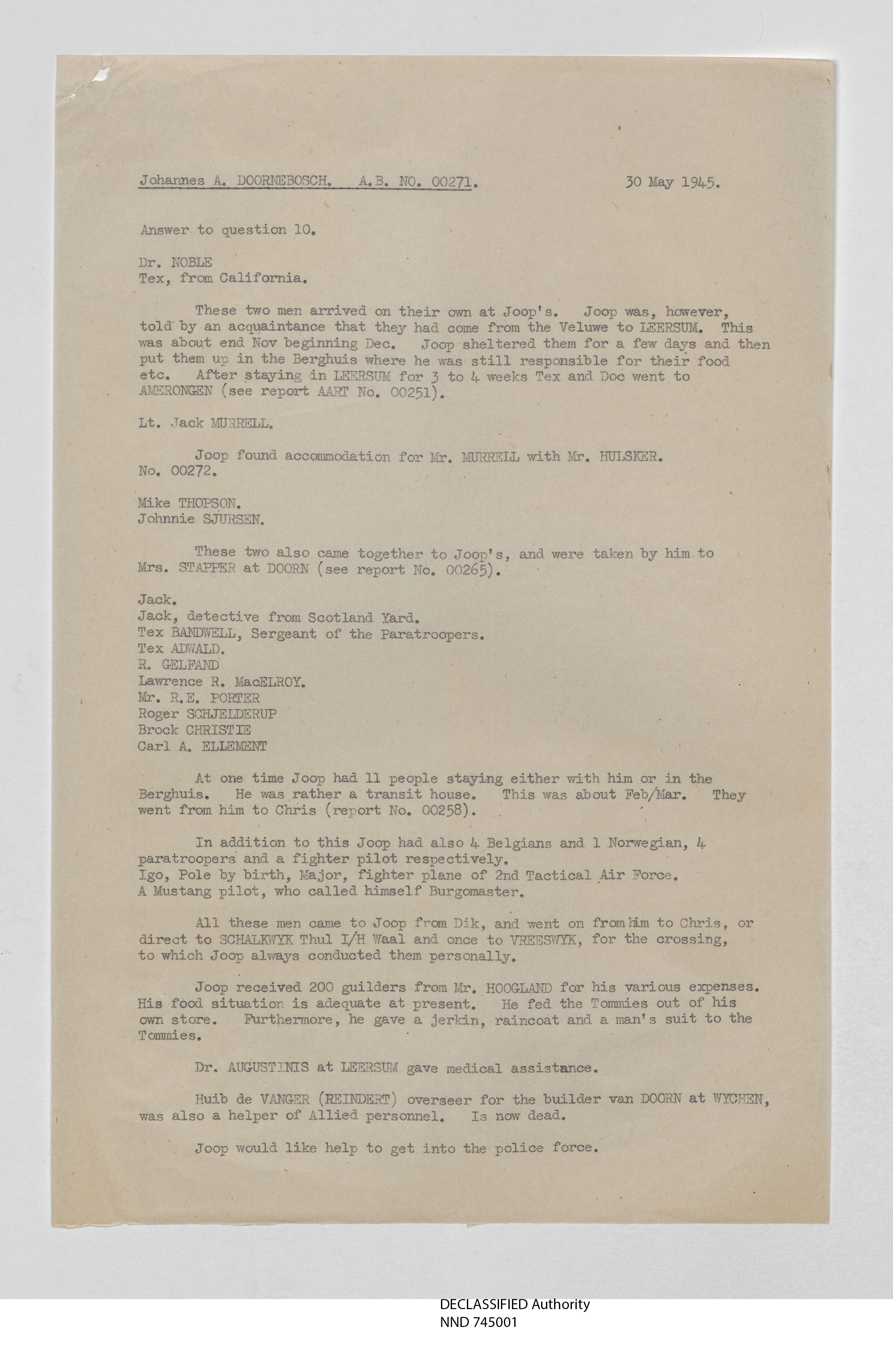
No source held puts Murphy at Leersum or names him in Doornebosch's papers. Doornebosch's part in Murphy's story is two of the men who crossed with him: Capt. Charles Noble and a "Tex", ◐ Tex Banwell.
His own account. His statement for the Americans, typed in the third person ("Joop sheltered them"), has them arrive at Leersum about the end of November or the start of December 1944, stay three to four weeks and go on to Amerongen:
These two men arrived on their own at Joop's. Joop was, however, told by an acquaintance that they had come from the Veluwe to LEERSUM. This was about end Nov beginning Dec. Joop sheltered them for a few days and then put them up in the Berghuis where he was still responsible for their food etc. After staying in LEERSUM for 3 to 4 weeks Tex and Doc went to AMERONGEN (see report AART No. 00251).
— Johannes A. Doornebosch · answer to question 10, 30 May 1945 · US National Archives, RG 498 · p. 22
⚠︎ His "Tex" is "from California", and the same page lists "Tex BANDWELL, Sergeant of the Paratroopers" again, in a group it dates "about Feb/Mar" (p. 22; below). The Tex with Noble is ◐ Banwell on the word of Noble and of Dieckmann, who both put Banwell with Noble at Leersum (Noble; Dieckmann, p. 6).
Dieckmann's account. Cornelis Dieckmann, "Frits", of Rhenen, whose enclosure to his questionnaire, typed in the third person, has Frits and Joop "all the time worked together", has the same two men as his first: "Capt. Noble. Med. Officer of the Paratroupers, Glasgow" (✓ Noble was born at Blantyre and qualified at Glasgow University, by the Royal College of Surgeons' obituary, the obituary, and was from Hamilton by his questionnaire, Noble) and "Sgt. Tex Bantwell of the paratroupers", who "lodged with Frits in the 'Berghuis' Leersum from about Half Dec.-2 Jan. 45", his parents taking food to the Berghuis (his statement, p. 6, 13 July 1945). The same typed page also has the sentence "We have to take his information with a grain of salt."; it does not say who typed the page or who "we" are (p. 6).
Noble's account. Noble's own report has him and Banwell moved from a farm near Scherpenzeel "about 16th Dec" to a farm at Ginkel near Leersum for two days, "then moved to an empty house in LEERSUM - the 'BERGHOF' where we spent 6 days. This was organised by the GINKEL Underground group whose leader was called 'NICK'", then himself to the Lindenhof at Amerongen for eight days (Noble). He does not name Doornebosch.
The crossing. On 2 January 1945 Noble and Banwell crossed the Rhine with Murphy in Capt. Roger Schjelderup's party. In the firefight that night Schjelderup "lost, and never saw again, one Dutchman and the following three men: Capt. NOBLE, Sgt. TEX (?) [BANWELL], Pte. MURPHY" (Schjelderup's report, transcript; Hardy). What became of them is on The crossing and recapture.
The Leersum crossings, January to April 1945
Link to the section The Leersum crossings, January to April 1945His list. The rest of his statement names the men who came through his hands (p. 22):
- Lt Jack Murrell, lodged with Mr Hulsker: "Joop found accommodation for Mr. MURRELL with Mr. HULSKER".
- "Mike THOPSON" and "Johnnie SJURSEN", who "also came together to Joop's, and were taken by him to Mrs. STAPPER at DOORN" (below).
- A list of ten names, among them "Tex BANDWELL", Gelfand, MacElroy, R.E. Porter, Roger Schjelderup, Brock Christie and Carl A. Ellement. The statement then says "At one time Joop had 11 people staying either with him or in the Berghuis. He was rather a transit house", about "Feb/Mar".
- "They went from him to Chris (report No. 00258)": ◐ Chris Cornelisse of Amerongen, 00258 being the number of his wife Elisabeth's report (her supplement).
- ⚠︎ His "Feb/Mar" cannot be right for Banwell, Porter and Schjelderup, who crossed on 2 January (see Where the sources disagree).
- "4 Belgians and 1 Norwegian, 4 paratroopers and a fighter pilot respectively"; "Igo, Pole by birth, Major, fighter plane of 2nd Tactical Air Force"; and a Mustang pilot "who called himself Burgomaster".
All these men came to Joop from Dik, and went on from him to Chris, or direct to SCHALKWYK Thul I/H Waal and once to VREESWYK, for the crossing, to which Joop always conducted them personally.
Joop received 200 guilders from Mr. HOOGLAND for his various expenses. His food situation is adequate at present. He fed the Tommies out of his own store. Furthermore, he gave a jerkin, raincoat and a man's suit to the Tommies.
— Johannes A. Doornebosch · answer to question 10, 30 May 1945 · p. 22
"Dik" is ◐ Kragt, our reading: the summary names "Lt. Dick Kragt" as one of his two agents but does not call him "Dik" (p. 18); and Mr Hoogland ◐ Nico Hoogland of Amerongen. The statement also names Dr Augustinis at Leersum, who "gave medical assistance", and "Huib de VANGER (REINDERT)", an overseer "for the builder van DOORN at WYCHEN", "also a helper of Allied personnel. Is now dead." The summary lists his evaders as "Tex Bandwell, Sgt, Paratroopers", "Tex Adwald", R. Gelfand, Lawrence R. MacElroy, R.E. Porter, Roger Schjelderup, V. Brock Christie, Carl A. Ellement, Lt Jack Murrell, Dr Noble, Mike Thompson and Johnnie Sjursen (p. 18).
With Frits. Dieckmann's statement gives the route from his side:
The evaders came to Frits and Joop (report No. 00271) from Scherpenzeel, stayed one or two nights at the Berghuis or at the Loudon's poultryhouse, and went on to Schalkwijk, Vreeswijk or sometimes Jutphaas, guided by Frits and Joop who all the time worked together.
— Cornelis Dieckmann · enclosure to his questionnaire, 13 July 1945 · US National Archives, RG 498 · p. 6
Dieckmann has Flight Lt Tapson "from Melbourne" "has also been some time at the Berghuis"; when it "was claimed by the Germans" the evaders went elsewhere, "11 of them at the moment", to Mrs Loudon's poultry-house (p. 6). He does not say whether Tapson was one of the 11; Bakker's enclosure has Tapson living a few days in Mrs Loudon's poultry-house (p. 7).
The Belgians' pistols. The enclosure above ends by explaining why a second report goes with it:
As we have sent you already a report concerning the loss or theft of a parabellum or a revolver, belonging to a Norwegian, we enclose herewith a report by C. Dieckmann pertinent to the matter in question. It is assumed that he is the delinquent, but of course in his own report it is somebody else.
— Typed, unsigned, at the end of Dieckmann's enclosure, 13 July 1945 · US National Archives, RG 498 · p. 6
◐ Read as grammar, "he" is Cornelis Dieckmann: his is the only name in the passage, and "his own report" is the one enclosed. Nothing on the page names Doornebosch in connection with the loss, and it does not say who typed it or who "we" are. Dieckmann's report of 14 July 1945, headed "Report concerning the so called stolen pistols and binocular of the evaders", opens by answering "our interview" of 13 July about "the so called stolen pistols and a binocular of Belgium and Norwegian evaders". In it Dieckmann told of a group of at least four men, "at least 3 Belgians of the Air-Born Division and one Norwegian", "Frank", of the RAF, who came "from Dick (E.A.O.) by means of Reindert via Scherpenzeel" and were lodged for about eight hours with "Mr. Bakker, Verlooweg, Rhenen" before being taken to Tull en 't Waal (p. 7). The Belgians agreed to give their pistols to the underground: "the pistol of the captaine was intended for my comrad, J.A. Doornebos (Joop)". "Joop and Chris, who had leaded the transport", had left 't Waal when Dieckmann got there, and "About two days later we were informed that Joop's pistol had arrived at Wout (the farmer, Verwey) at 't Waal. Joop fetched here the pistol" (p. 7). The Norwegian's parabellum, he wrote, was at Wout's, who told him that a crossing-group met further on had objected to armed evaders and made the men leave their weapons (p. 7); Dieckmann added that "neither Joop, nor Chris nor me had compelled them in some way to yield their weapons. If this might have happened furtheron, I do not know" (p. 8). Of the binoculars he wrote that the next morning "Joop was the owner of a 'Kelvinator' fieldglass. He told that one of the Belgians had given it to him", which Dieckmann "accepted … at once", the Belgians not caring much about their equipment, and he added that Joop is "the man who I learned to know very good, will never lower himself to a theft on evaders who he always has given his best forces" (p. 8). The report does not date the crossing. ◐ The group is probably Doornebosch's own "4 Belgians and 1 Norwegian"; the counts differ (Dieckmann at least four men, at least three of them Belgians; Doornebosch five, four of them Belgians) and neither gives a date.
The Stappers at Doorn. Mrs H.M. Stapper-Overdyk sheltered "John SJURSEN, Infantryman, Canadian" and "Mike THOPSON, Captain Australian Air Force" for eight days:
Both Tommies came to Mrs. Stapper's from BARNEVELD, via DOORNEBOSCH at LEERSUM, and were brought by Herman. John and Mike went from Mrs. Stapper's back to DOORNEBOSCH for the crossing Biesbosch.
— Mrs H.M. Stapper-Overdyk · answer to question 10, 29 May 1945 · US National Archives, RG 498 · p. 6
She "gave Mr. DOORNEBOSCH clothes for the Tommies, and in this way her husband, Mr. Stapper lost a jacket and a hat" (p. 6).
- Herman Hendriks of Rhenen, of the CAWTON group (his form, p. 2), wrote that a Canadian infantry corporal and an English RAF flight lieutenant "were brought by Herman from LEERSUM, where he had received them from van DOORNEBOSCH, and taken to the STAPPER family in DOORN. This was about the beginning of March" (p. 6). ◐ They are Mrs Stapper's two: Hendriks names neither man, but the route (Doornebosch, Herman, the Stappers) and the house are the same as in her form, which has Herman bringing both.
- Her husband, A.M.V. Stapper, filled in his own form in April 1946.
- His table has "FL/LT. TAPSON" of Melbourne and "CPL. SJURSON" of Vancouver, each hidden eight days from "29/2/44" [sic], "ONTVANGEN VAN" (received from) and "DOORGEGEVEN AAN" (passed to) "J. DOORNEBOS (JOOP)", Verloopweg, Leersum (p. 5).
- In a passage struck through on the form, he wrote that on 7 March 1945 "our house was billeted by the Germans Red Cross, while the allied personnel were in the house", and "my daughter and myself smuggled the men out of the house under the nose of the Germans and transported them back to Leersum" (p. 2).
- Sjursen was arrested on 10 March 1945 "during Rhinecrossing … on bridge near Vreeswijk" (p. 2).
- The British card on the Stappers has Tapson fed from "28 Feb - 6 Mar 45" (p. 6).
- On 29 May 1946 the Americans wrote to "den Heer J.Doornebos, Verloopweg, LEERSUM" asking him to confirm that Stapper had had two Allied airmen from him and given them back (p. 10). His answer of 5 June 1946 is his own words in the files:
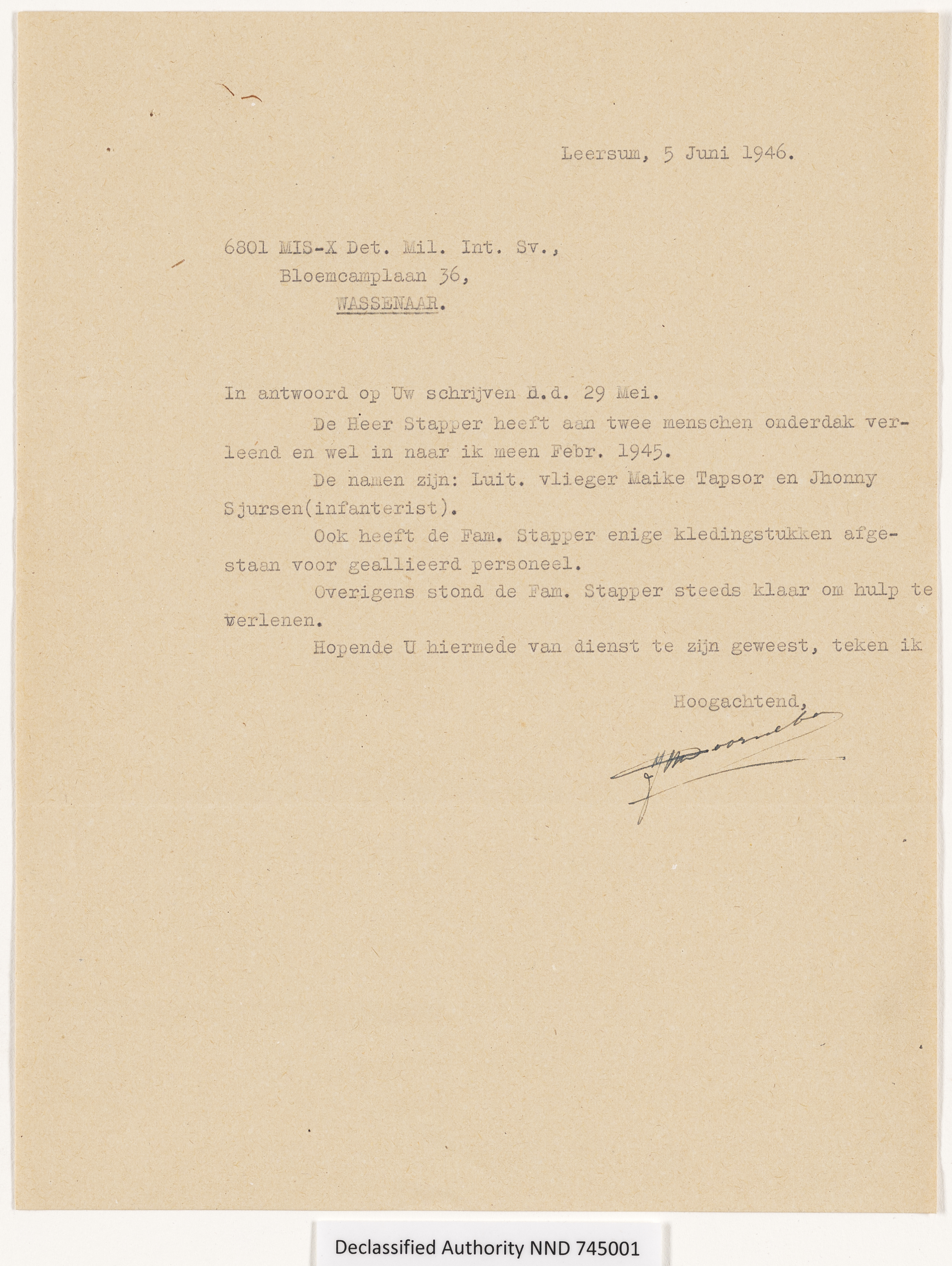
In answer to your letter of 29 May. Mr Stapper gave shelter to two people, in what I think was Feb. 1945. The names are: Lieut. airman Maike Tapsor and Jhonny Sjursen (infantryman). The Stapper family also gave up some clothes for Allied personnel. For the rest, the Stapper family was always ready to help. Hoping to have been of service to you, I sign, yours faithfully,
Dutch originalIn antwoord op Uw schrijven d.d. 29 Mei. De Heer Stapper heeft aan twee menschen onderdak verleend en wel in naar ik meen Febr. 1945. De namen zijn: Luit. vlieger Maike Tapsor en Jhonny Sjursen(infanterist). Ook heeft de Fam. Stapper enige kledingstukken afgestaan voor geallieerd personeel. Overigens stond de Fam. Stapper steeds klaar om hulp te verlenen. Hopende U hiermede van dienst te zijn geweest, teken ik Hoogachtend,
— J. Doorneb…, Leersum (signature partly legible; the letter answers one addressed to "J. Doornebos") · letter to the 6801 MIS-X Detachment, 5 June 1946 · US National Archives, RG 498, helper file of A.M.V. Stapper · p. 7
Tapson. ✓ His "Mike THOPSON" is Flight Lt Tapson. Mrs Loudon's form says so in as many words, "Lt. TAPSON (by mistake called THOPSON in 00265)", 00265 being Mrs Stapper's report, and Doornebosch's own letter of 1946 has "Tapsor" (Mrs Loudon, p. 6; the letter).
Two more Leersum houses. Mrs Loudon, of Verloopweg B 185, wrote on 28 June 1945 that "11 Allied men were lodged here during 2 days and 6 during some 10 days, in a poultry-house", fed "by way of Doornebosch (00271)" at the "end February - beginning March" (her form, p. 6). Th. C. (Thomas) Bakker, of B 210a, Leersum, born at The Hague on 11 June 1916, wrote on the same day that he and his wife "lodged during the whole winter 25 men of the allied airforce", one to three days each, depending on the moon, "Nearly all of them were pilots, Poles, Canadians, Americans, 4 Belgians, 1 Norwegian etc.", and "All these people came and went by way of Doornebosch." (his form, p. 3; his enclosure, p. 7).
- Bakker names two: Igor Olczewski, 17 March to 9 April 1945, who "came and left with the help of Joop Doornebosch", and Lt Tapson, February to early March, who "came by way of Doornebosch (No. 00271)". He fed the men from his own store: "Doornebosch gave indeed something, like potatoes, bread and a very small quantity of rye, but this can hardly be mentioned" (p. 7).
- ◐ Bakker's Olczewski is Doornebosch's "Igo, Pole by birth, Major": the first names are alike, but Bakker gives no rank and Doornebosch no date. Bakker's "4 Belgians, 1 Norwegian" are the same numbers as Doornebosch's (p. 22), and "No. 00271" is Doornebosch's report.
- ◐ Dieckmann's "Mr. Bakker, Verlooweg, Rhenen", who lodged the Belgians and the Norwegian, is probably this Bakker of Leersum, whose own form gives "B 210a, Leersum" with no street; the town Dieckmann gives is Rhenen (p. 7).
Doorn and Schalkwijk. Hendrik van Remmerden, "George", who took evaders on to "Tom in Schalkwijk" and the Biesbosch crossing after January 1945, wrote that "At first the starting place was Maarn, later Leersum (see Joop Doornebosch, report No. 00271)" (his form, p. 2, 12 June 1945). Wouter Verbeek of Doorn wrote that "After 8 March Wout took over command, with Frits from LEERSUM and Joop DOORNEBOSCH (as a result of the shooting of Mr. van DIJK. Report No. 00279)", and that his last crossing, at the end of March or the beginning of April, was to Vreeswijk "with about 10-12 men for GROOT-AMMERS, among them 6 parachutists from ARNHEM" (his form, p. 5, 13 June 1945). ◐ His Mr van Dijk is probably the Jaap van Dijk of Dorpsstraat 22, Doorn, whom Van Remmerden says "has been shot by the Germans" (p. 2).
The Americans' other helper forms list him among the helpers they knew: Berend Albert Esveld of Amerongen, whose address "known to Allied personnel" is in Leersum, names "J. Doornebos" (his form, p. 9), and A.M.V. Stapper "J. Doornebos (Joop) K.P.er, Leersum" (p. 2).
On 2 October 1945 the Holland Office asked him to come on 6 October to the house of "den Heer H. van Loenen, Kerbergenlaan 4b te Zeist", where Capt. Franklin D. Coslett wrote that it would be his pleasure to hand him "iets … waarop U zeer zeker prijs zult stellen" (something you will certainly value), and asked him to bring the letter as proof for the officer who would be there (p. 23); the letter does not say what. On 30 October 1945 a receipt records him receiving "one used service bicycle" (the signature on it is read with a query), issuing officer "H.L.van Loenen Lt" (p. 24). His statement of May 1945 ends "Joop would like help to get into the police force" (p. 22); nothing held says whether he did.
The British index of Dutch helpers has "21950 DOORNEBOSCH, Johannes", M.C. Verloopweg B 212a, Leersum, award grade 5, with no compensation entered (page D/7, read on the image).
The American medal. His file records the case going up and down (pp. 1, 4, 12–15, 25):
- Grade 4 on 22 October 1945 (p. 1). Recommended for the Medal of Freedom on 23 February 1946, for service "from Oct 1944 to April 1945" (p. 25).
- On 17 May 1946 the Holland Office dropped him to grade 5; a hand note on the extract says it was "agreed with Lt. Burke in conversation 1/6/46 that these names remain IV" (p. 13). On 28 June 1946 it asked for the recommendation to be withdrawn, and the answer of 8 July said his case had gone forward to USFET on 23 February and that "It is a very embarrassing thing to ask Frankfurt to withdraw a case" (p. 12).
- A second recommendation, of 7 August 1946, gives his service as "from November 1943 to March 1944" (p. 15). On 16 August his citation for award grade four was forwarded, "Clearance obtained" (p. 13).
- General Orders 238 of 21 August 1946 awarded the Medal of Freedom without palm to "Johannes A. Doornebosch, Dutch Civilian -- October, 1944 to April, 1945" (the order, in Herman Folmer's file, p. 16). General Orders 310 of 31 October 1946 revoked it, and the Holland Office was told to return his orders and citation to the Paris office, "returned 4-12-46" (pp. 13, 14).
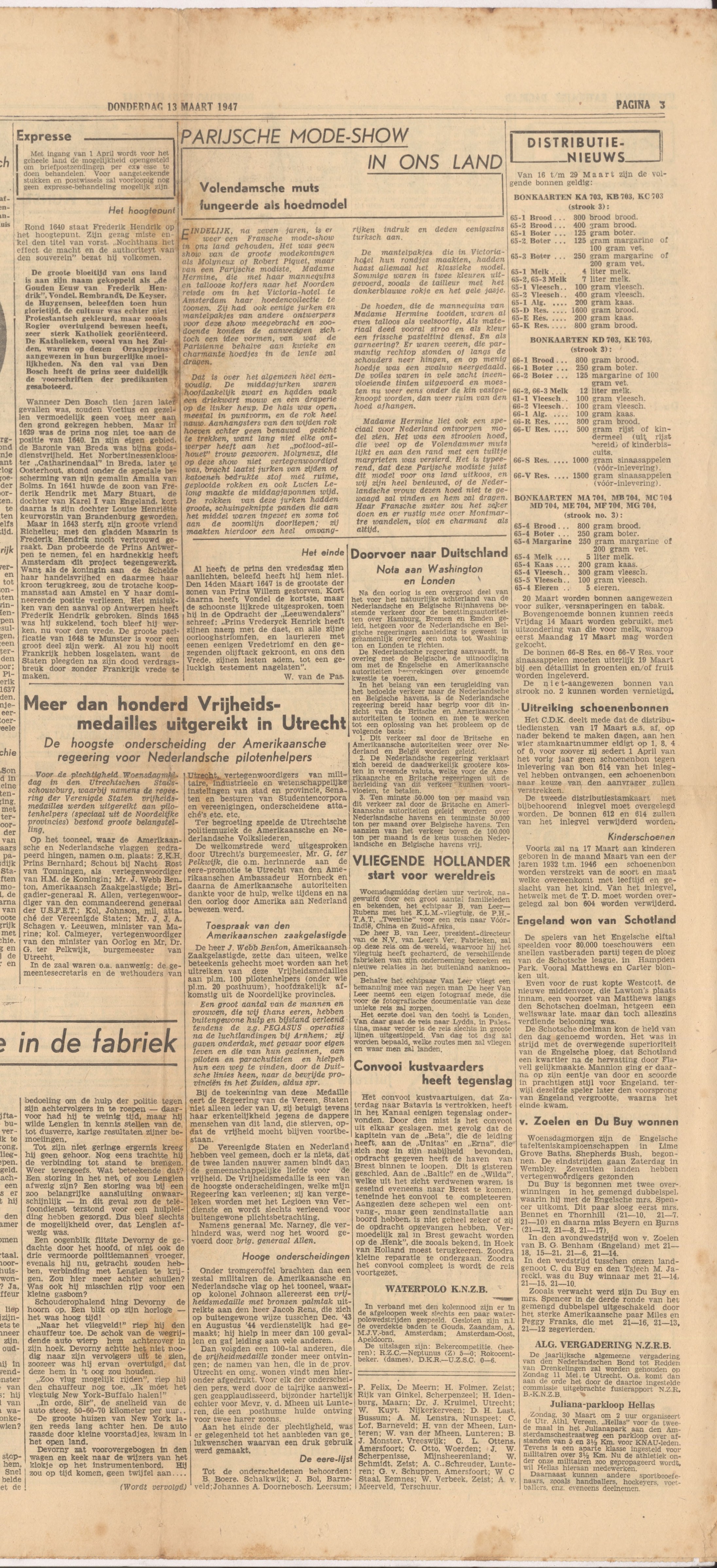
Utrecht, 12 March 1947. ✓ He received the medal all the same. The Utrechtsch Katholiek Dagblad of Thursday 13 March 1947 reported the ceremony "Woensdagmiddag" (on Wednesday afternoon) in the Utrecht Stadsschouwburg, where the medal was given, in the presence of Prince Bernhard, to about a hundred helpers of airmen, about twenty of them posthumously. The American chargé d'affaires, J. Webb Benton, said that "Een groot aantal van de mannen en vrouwen, die wij thans eeren, hebben buitengewone hulp en bijstand verleend tendens [sic] de z.g. PEGASUS operaties na de luchtlandingen bij Arnhem" (a great many of the men and women we honour today gave exceptional help during the so-called PEGASUS operations after the airborne landings at Arnhem). The paper's roll of honour for the province of Utrecht and around has "Johannes A. Doornebosch, Leersum", with ◐ Dr J. Kruimel of Utrecht and ◐ A. v. Meerveld of Terschuur (the article, read on the page image).
In June 1947 the Americans were still trying to learn whether the revocation had been "due to clerical error"; their memo says the medal "has been presented (without citation or GO)" to him and to two others named with him, Leonard C. Lambert and Christina van der Burg (p. 4); the 1946 return memos for GO 310 list a fourth name, Jan J.J. van Kluyve (pp. 13, 14). On 22 April 1948 the American military attaché at The Hague wrote that "J. A. DOORNEBOS" had asked about "the Medal of Freedom which was awarded him on 12 March 1947": he had not received the certificate that goes with it, and the attaché's office had no record of the award (p. 9). His papers were filed "without complete processing" in January 1948 (p. 6), and the folder is marked "REMAINS GRADE 4" (p. 1). He died at Utrecht on 10 May 1953, aged 46, six years after the ceremony (Utrecht; Leersum).
Where the sources disagree
Link to the section Where the sources disagree- When Noble and Tex were at Leersum. "About end Nov beginning Dec", for three to four weeks, in Doornebosch's statement (p. 22); "from about Half Dec.-2 Jan. 45" in Dieckmann's (p. 6); from about 16 December, two days at Ginkel and six at the "Berghof", then eight at Amerongen, in Noble's (Noble). Not reconciled. ◐ Doornebosch's and Dieckmann's "Berghuis" and Noble's "Berghof" are taken to be one house.
- Which Tex. "Tex, from California" with Noble, and "Tex BANDWELL, Sergeant of the Paratroopers" in the February group, on the same page (p. 22); Dieckmann has "Sgt. Tex Bantwell" with Noble (p. 6). ◐ Banwell, with Noble.
- When Porter's group came. His list dates the group with Banwell, Porter and Schjelderup "about Feb/Mar" 1945 (p. 22); all three had crossed on 2 January (The crossing and recapture). ◐ The list reads as names from several periods rather than one stay: Cornelisse's supplement has Porter and Schjelderup at Chris's until 3 January, Christie and Ellement arriving in early March, and Gelfland and McElroy leaving in November and coming back about 18 March (p. 4).
- Tapson. "Mike THOPSON, Captain Australian Air Force" (Mrs Stapper, p. 6); "Englishman, Flight Lieut. of the R.A.F." (Hendriks, p. 6); "Flight Lt. Tapson from Melbourne" (Dieckmann, p. 6); "FL/LT. TAPSON … R.A.F. … AFKOMSTIG VAN MELBOURNE" (A.M.V. Stapper, p. 5); "F/Lt Tapson, RCAF" (the Americans' summary sheet on Dieckmann, 5 February 1946, p. 2). One man by the name and the houses; ⚠︎ Australian, RAF or RCAF is not settled.
- Who took Tapson and Sjursen to Doorn. "Taken by him to Mrs. STAPPER at DOORN" in Doornebosch's statement (p. 22); "brought by Herman" in Mrs Stapper's (p. 6), and brought by Herman from Leersum "where he had received them from van DOORNEBOSCH" in Hendriks's (p. 6). Not reconciled.
- When Tapson and Sjursen were at Doorn. "About the beginning of March" (Hendriks); "29/2/44" [sic] for eight days (A.M.V. Stapper); fed "28 Feb - 6 Mar 45" (the British card, p. 6); "naar ik meen Febr. 1945" (I think February 1945), Doornebosch in 1946 (p. 7).
- The period of his service. "Oct 1944 to April 1945" in the recommendation of February 1946 and the General Order (p. 25; GO 238); "November 1943 to March 1944" in that of August 1946 (p. 15).
- The medal. Awarded by GO 238 and revoked by GO 310 in 1946 (pp. 4, 13); presented at Utrecht on 12 March 1947 by the newspaper and by his own inquiry of 1948 (the article; p. 9). Nothing held shows the revocation reversed.
- Jaap van Dijk's death. Verbeek ties his own taking over "After 8 March" to "the shooting of Mr. van DIJK" (p. 5); A.M.V. Stapper has "Fr. van Dijk (Jaap)" of the Dorpstraat, Doorn, "shot April 1945" (p. 2). ◐ One man; the dates do not agree.