CSM Wilfred Berry
Durham 12 Sep 1912 ◐ – Mission, B.C. 12 Jul 1997 ◐
CSM Wilfred Berry (K.42160), 1st Bn Canadian Scottish Regiment
About: Company sergeant major of the 1st Bn Canadian Scottish, of Vernon, B.C.: taken at the Leopold Canal on 7 October 1944, out of a prisoner train on 23 October, and hidden near Utrecht and at Amerongen. Wounded in the elbow when Murphy's party was fired on on the night of 2 January 1945, taken on 3 January, and freed near Lübeck on 2 May 1945.
Unit or role: Company sergeant major, 1st Bn Canadian Scottish Regiment; peacetime fruit farmer, army service from 25 August 1939 (his report, p. 1).
Where: Vernon, B.C., 420 Swift Street, on his report and on the Dutch forms (Flip Esveld's statement, p. 7, and his list, p. 10, which has only "Vernon, B.C."; Mrs Schuppert-Wolfert's table, p. 4); Kelowna in a Victoria paper. In hiding: Lage Vuursche, Bilthoven, Groenekan, De Bilt and Maartensdijk, October to December 1944; Amerongen, December 1944 to 2 January 1945.
Evidence: ✓ his MI9 liberation report, 21 May 1945, with Appendix A; ✓ Two Came Back!, the battalion's war diary appendix (cited by its own page numbers; the PDF opens with a cover note, so its page 2 is "Page 1"); ✓ the helpers' forms below; ◐ Schjelderup's MI9 report (a transcript; the Kew original not seen); Porter, The Long Return; Kew's catalogue entries WO 416/28/266 and WO 208/3331/751.
Calais. At Calais, where the garrison commander would not surrender until he had had his supper, "C Company commander, accompanied by CSM. Wilf Berry (Kelowna), supped with them, later fetching the battalion commander to receive the official surrender", by the battalion's own narrative, published in Victoria in November 1944 (Victoria Daily Times, 30 November 1944). ◐ C Company's commander was very probably Schjelderup, who had it at the Leopold Canal a week later; the article does not name him, but Zuehlke's The Cinderella Campaign has "'C' Company's Major Roger Schjelderup" at Calais (search snippets; Schjelderup's page). The article gives Berry's home as Kelowna, where the Dutch forms have Vernon.
D-Day. A book and a newspaper put a company sergeant major of the same name and battalion in the Normandy landing on 6 June 1944, in his own words. The Canadians at War 1939/45 (Reader's Digest) has "CSM. Wilf Berry, Canadian Scottish: 'We started with 138 men and at the end of the day we had 62 left.'", and a second passage from him that begins "We were supposed to take this chalet and to get to it we had to" (the snippet stops there); the book's index puts him on pp. 324 and 326 of the 1986 printing and pp. 438 and 440 of the other (the hits). The Globe and Mail of 4 June 1994, in its D-Day plus 50 series on Juno Beach, quotes "Sergeant-Major Wilf Berry, 1st Battalion, Canadian Scottish Regiment" with the same 138 and 62 (the hits). ◐ Snippets only, from a lending-only book (two printings) and an issue not opened; and the name, rank and battalion are all that ties them to this man: neither gives his company, home or number. The Globe's lines match the book's, so it may be quoting it. Schjelderup's D-Day company was C (his page), and the Victoria paper's Calais account has Berry with C Company's commander, so ◐ he may already have been C Company's sergeant major on D-Day; no source here says so.
The Leopold Canal and the train. He was taken at C Company headquarters at Oosthoek, by the Leopold Canal, early on the morning of 7 October 1944:
Capt Schjelderup and C.S.M. ("Wilf") Berry had organized the defences so that they bore the brunt of the attacks. The house was barricaded and they posted themselves at the door with automatic weapons.
— 1st Bn Canadian Scottish war diary · "Two Came Back!", Appendix 23 · January 1945 · p. 1
The attackers overran the position and took "the remaining men of Coy HQ" prisoner (p. 2). He escaped from a prisoner train as it left Utrecht on 23 October (Two Came Back!, pp. 1–4; Before Amerongen). In hiding the men taught the underground the Bren, Sten and PIAT (Roy, pp. 372–373), and Berry, Gri "and the others" became "trusted accomplices" of it, taking part in a raid in which a German supply railway "was destroyed in 18 places" (Two Came Back!, p. 5); Roy has only "a successful raid on a German supply train". The Kew catalogue entry of his German POW card, WO 416/28/266, gives his birth as 12 September 1912 at "Durham", capture on 7 October 1944 and "Dulag XIB", POW no. 201375; Kew's catalogue entry for the duplicate copy of his MI9 report (WO 208/3331/751) has 7 September 1912, the date on the report itself (the card's entry; the report's entry). The card itself has not been seen; it is one of only two German POW record cards found for the party, Noble's the other (the record; The National Archives, Kew).
Who hid him, 23 October to late December 1944. Berry went with Marcel Briere as far as Groenekan, where Briere's report has him "moved to another house" (Briere, p. 2), by the helpers' own forms:
- Lage Vuursche. He and Briere jumped "between den Dolder and AMERSFOORT", by W. van de Bunt's account, hid in a wood from the German search, went to Hilhorst for clothes, and spent three days in the Van de Bunt sons' hiding-hole in the garden before one of the sons took them to Bilthoven with "Piet VERBEEK" (◐ Piet ter Beek, who was later shot) (van de Bunt's file, p. 4).
- Bilthoven, Palestrinalaan 12. Mrs C. J. Schuppert-Wolfert took them in on 1 November (her file, p. 3; her table, p. 4):
- Two local commanders of the underground, H. van Hellendoorn and P. ter Beek (later shot), brought them: "Winfred Berry and Marcel Briere jumped from a P.o.W. train at height of Soesterberg".
- After a fortnight her house was no longer safe, because of the sabotage on the railway, and they were moved to an uninhabited house nearby (her form, p. 3); her table has twenty-eight days from 1 November, then Rakers at Groenekan (p. 4). H. M. Hopma took them to the empty house in the Obrechtlaan and from there they went to Rakers (Hopma's file, p. 2).
- In August 1945, she wrote, "Berry wrote us from Canada … He told that Briere was also in Canada".
- Groenekan, Maartensdijk, De Bilt. Four helpers' forms cover the weeks around Rakers's:
- The table of the policeman Rakers, Groenekan, has him from 28 November to 24 December (the table, p. 3, which types his number "R-42160 [sic]"; Holwerda's table types "K 62160"; the report has K.42160).
- In December he spent five days with H. H. Copyn at Groenekan and a week at "OOSTHOEK (a country house near DE BILT)" (Copyn's file, p. 4).
- H. P. Baron van der Borch tot Verwolde, burgomaster of De Bilt, lists him from the end of November to 25 December, received from and passed to Copyn (his file, p. 3).
- Willem Koele of Groenekan had him "a few days" in the middle of December (Koele's file, p. 3).
- Maartensdijk. Tjeerd Holwerda, who led the underground there, wrote that "Gri has slept in my house for one night and Berry also one night", and on his own form that he could take Berry in only near Christmas, his wife having just had a baby, and that the next day Berry had to leave suddenly to be taken to the Allied lines (Holwerda's file, p. 7; p. 29). His table has Berry there for one day, "23-12-44", received from "fam Rakers" and passed on to "B.Esveld" (p. 23).
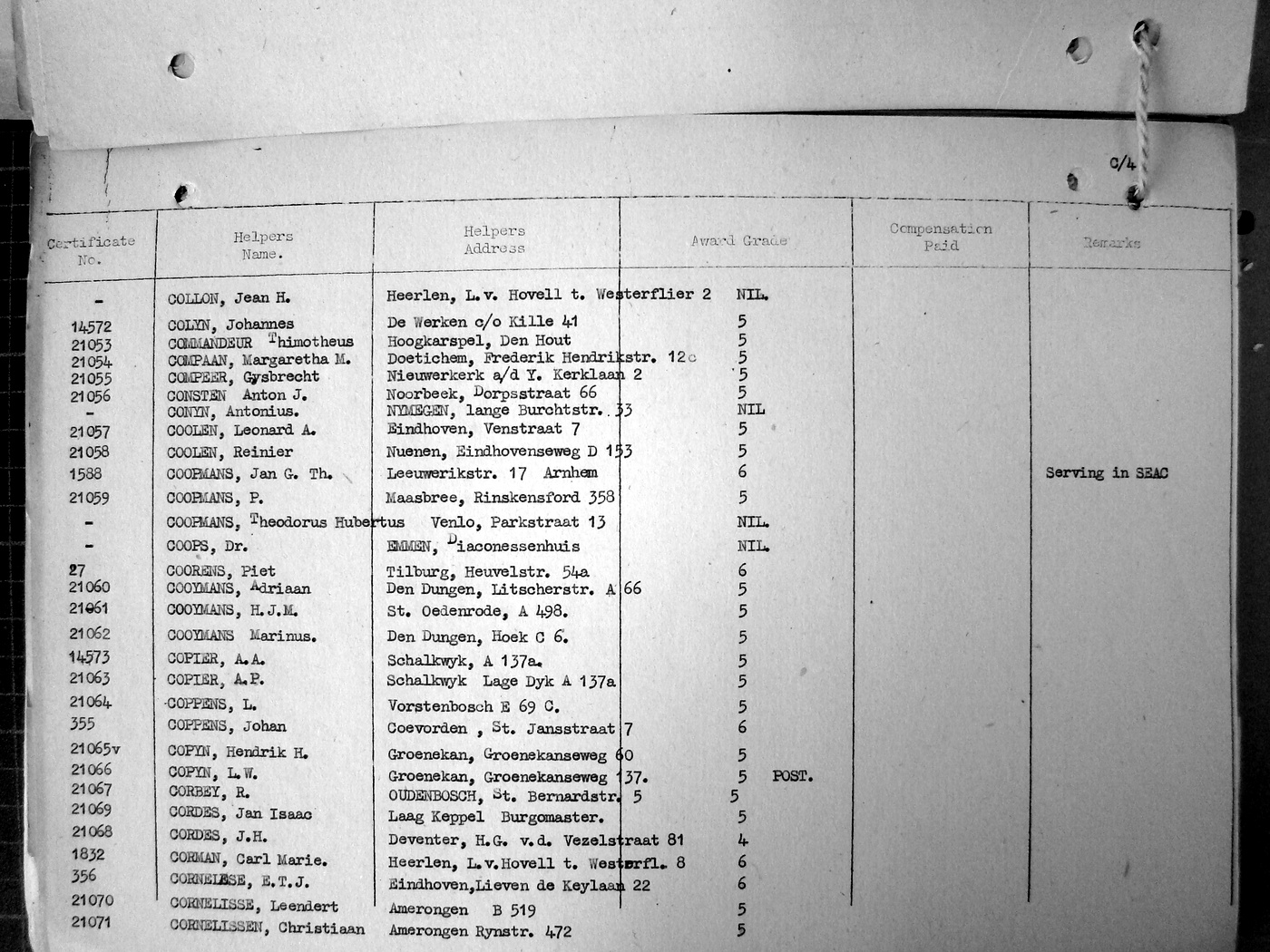
- How the British recorded them. ✓ The British index of Dutch helpers has Mrs Schuppert-Wolfert as certificate 9493, Hopma as 27080, Hellendoorn as 14763, Koele as 14918, Rakers as 27036 and Copyn (H. H.) as 21065, all Grade 5 (sheets S/8, H/18, H/8, K/10, R/1, C/4, each read on the image).
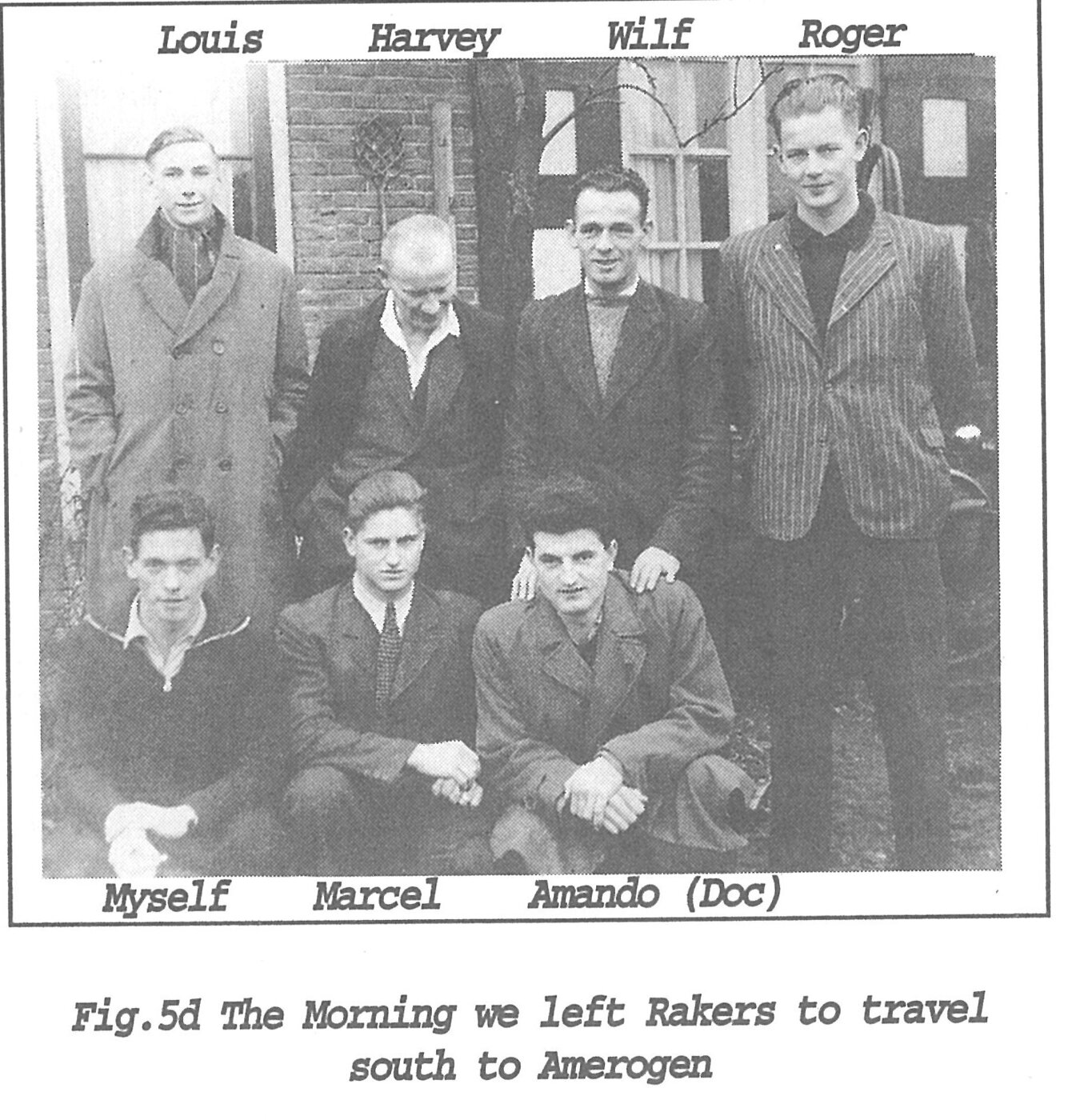
Porter, writing in 1997, has the same road in outline: Berry and Briere "met up with a group of teenagers who were hiding from the Germans", were introduced to a couple in the underground, "put up in Bilthoven" and "moved two or three times" (p. 117, chapter 5), then came to Rakers's house, where eight adults and four children now lived "including four of us Canadians" (p. 125, page).
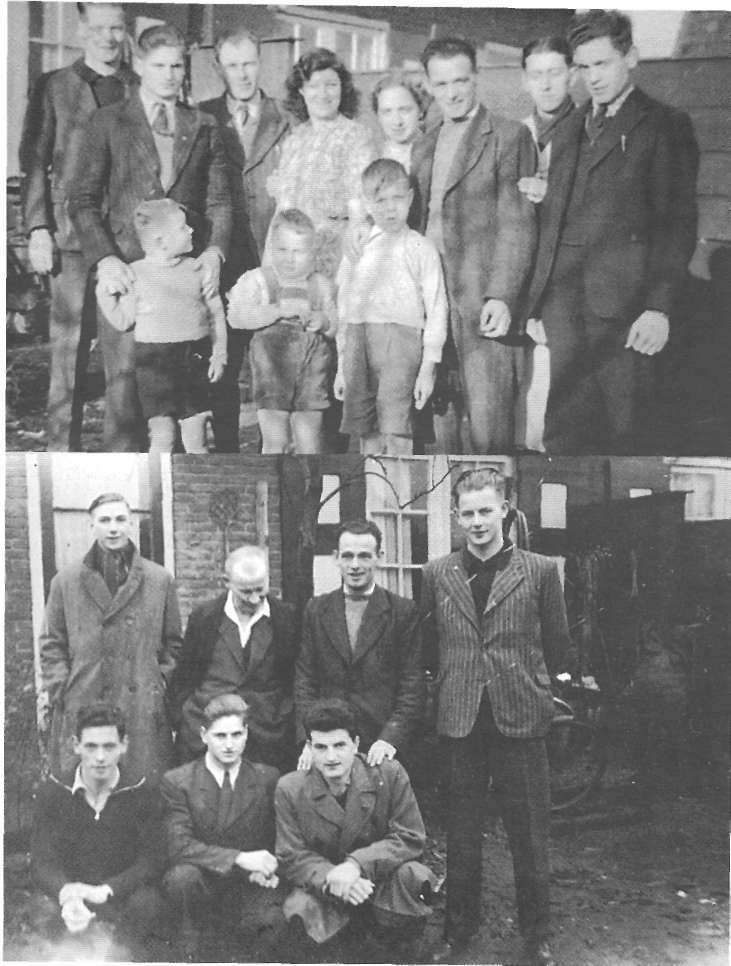
In Schjelderup's MI9 report. ◐ Schjelderup's MI9 report (transcript; the Kew original not seen) (Kew WO 208/3351/2349) lists him first after Schjelderup: "K.42160. C.S.M. BERRY, W." The brackets and footnotes in the transcript are the transcriber's.
- Not in the plan. It names four men who prepared the box-car escape, Brownridge, Gri, Swartz and Schjelderup, and Berry is not one; "Two Came Back!" has him among the ten who jumped (Schjelderup's page). Schjelderup learned at the Rakers house that "6 other men of my party had jumped out of the train after us", which fits Berry and Briere ◐, though the report does not name them there.
- At Rakers's. ✓ The Rakers table has him there from 28 November to 24 December (above).
With Murphy
Link to the section With MurphyNo source says outright that Berry and Murphy met before the barn on 2 January. Hardy, who reached Amerongen with Murphy on 23 December, met Berry at a house there and does not mention Murphy until the two of them are taken on to the Esvelds after dark. Berry's own report names Noble among the paratroopers and not Murphy; Swartz's and Briere's reports name Murphy, and Briere's list of the six recaptured men who reached Arnhem has both (Briere's page).
Amerongen, December 1944 to 2 January. The sources give five starts, set out under Where the sources disagree. Hardy met him there on the afternoon of 23 December: "We were then taken to a house where I met Capt. SCHJELDERUP, Canadian Scottish, C.S.M. BERRY and a Pte, also Canadian Scottish", before he and Murphy were taken on to the Esvelds (Hardy; Mr and Mrs Cornelissen). Berry's own report has the move on 24 December, "to a place near the RHINE-AMERONGEN (E 48), where we remained until 2 Jan 45 with another member of the garage" (page 2); ◐ the garage is Flip Esveld's. At Christmas, in the house where he and Briere stayed, "Wilf, who was the Sergeant Major, had a Sten gun wrapped up under the tree" (Porter, p. 138; Christmas 1944).
- To Amerongen. ◐ He was very probably one of "myself and three others" taken to Amerongen by bicycle at 12:45 (Schjelderup's report):
- The report gives no day; ◐ its Appendix A (Rakers to 22 December, the Cornelissens from 23 December) puts it on 22 or 23 December.
- Hardy's 16:30 on the 23rd is the other dated sighting (Hardy).
- Hans Hellendoorn of Bilthoven listed the six Canadians and "BOB", Porter, as "Allen doorgegeven aan 'Dirk' Langbroek en wel in Amerongen op Vrijdag en Zaterdag voor Kerstmis 1944" (all handed to "Dirk" of Langbroek, at Amerongen, on the Friday and Saturday before Christmas 1944; those are 22 and 23 December) (his file, p. 5).
- 2 January. "Sgt. Major BERRY was badly wounded in the left elbow" when the party was shot at on the road at 573739, and ◐ by the report's own list he was one of the five who "panicked and ran madly onto the ice" at the second firing (Schjelderup's page). "Two Came Back!" has the party reduced to Schjelderup, Berry, Gri, Briere, Swartz, Trainor, Porter and Hardy, "CSM Berry had suffered a wounded elbow when the party was shot up" (p. 6).
- Porter's account of the night (pp. 146–148, Porter):
- Porter lost track of Schjelderup and "found myself with Wilf Berry. Being a sergeant major in the Army, he gave me a very quick course on army life. When he said run, I ran." Berry "had been shot in the arm so we made up a bit of a sling".
- They spent the night in a fruit shed, where Berry's "arm was really hurting now" and "Wilf couldn't swim with a bullet in his arm"; Berry had left his Sten gun in the shed, and the Germans found it.
- Porter's letter to his mother of 15 May 1945, printed in the book, has "a Army Sergeant Major Wilf Berry and a Captain Roger Schjelderup" with him in the scatter and "The Sergeant Major Wilf Berry, had a bullet in his arm" (p. 223, chapter 11). Schjelderup's report has the captain with Gri and Hardy, not with Porter, so ⚠︎ the two Porter accounts differ on who else was with him (Schjelderup's page).
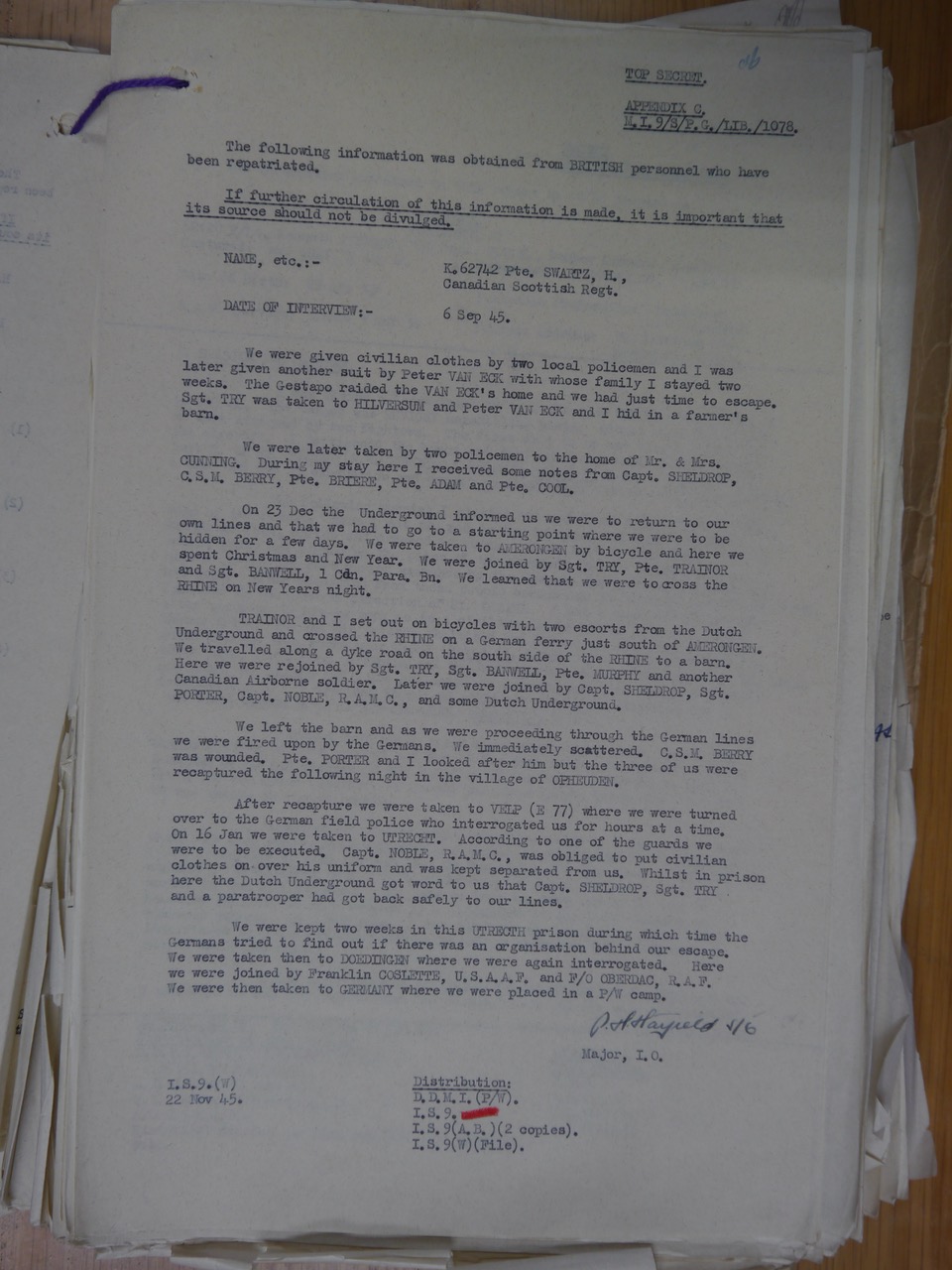
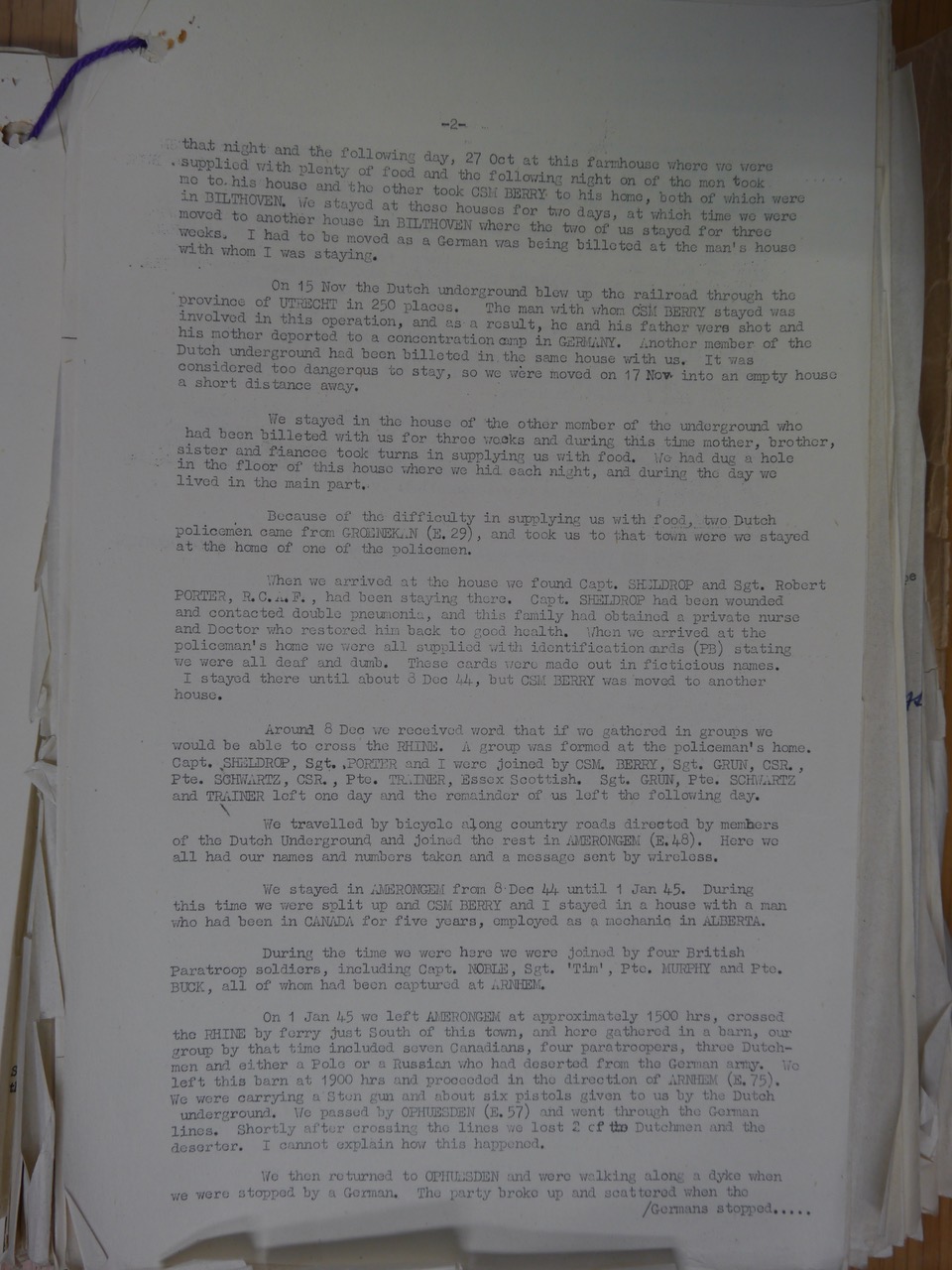
- The recapture. Berry's own report has him, Swartz and Porter avoiding capture until about 13:00 on 3 January, below. Swartz has the three of them recaptured "the following night in the village of OPHEUDEN", and Porter's page sets out the episode from Porter's side.
Arnhem to Doetinchem. Porter has Berry's arm seen by a doctor at the house in Arnhem, who "took the bullet out and put his arm in a cast, and used a paper bandage"; the prisoners pulled the paper out of the dressing to roll cigarettes from butts, until "his cast was eventually just flopping around" (pp. 154–155). The two shared a cell at Doetinchem from the end of January: "I was put in the same cell as Wilf", who "used to put his false teeth on the floor and say, 'Ache, you buggers, ache.'" (pp. 165–166, chapter 7). Porter has the five (Berry, Trainor, Briere, Swartz and himself) put on a truck into Germany after an interrogation that was "almost the end of March" (p. 174), and himself separated from the others at a holding camp: "I never saw Wilf again until a couple of years after the war" (pp. 176–177, chapter 8). ✗ Berry's own table has him in Germany by 25 to 28 February (below).
⚠︎ Charles Noble's own later account (unpublished private papers, shared with us privately), told long after the war, has the Canadians of the party with him at Utrecht, naming none of them. At a first prison, "the wrong prison", the Canadians came in, whom he had not seen at Velp: "There were about five of them … These were the ones who had been on the dyke when we had been shot at". In the waiting room a German who took them for terrorists spat in Noble's face, until his guard said he was "an English doctor". At the Wolvenplein Noble was alone in a cell for three weeks: "The others were kept in two cells." At Doetinchem "There were Canadians who were in the cell next to me with two Americans and one Pole."
Liberation. His report has him liberated near Lübeck on 2 May 1945, and Kew's catalogue entry agrees (the catalogue entries). Swartz and Briere were liberated at Fallingbostel on 16 April; Trainor's camp has not been found.
Home. Defence Headquarters' list of 9 May 1945 has him freed (below); by August 1945 he had written to Mrs Schuppert-Wolfert from Canada, as above.
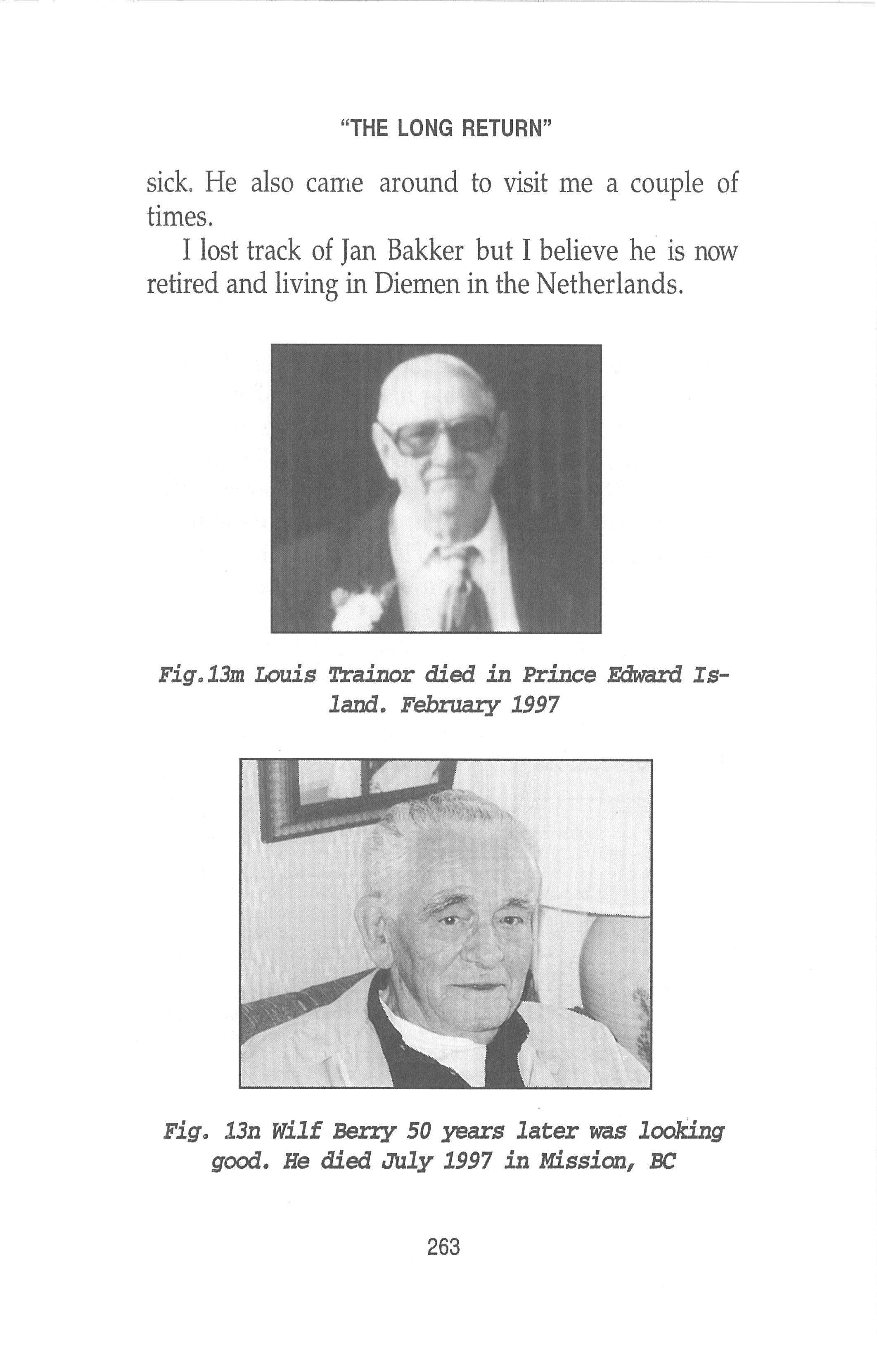
Later life. Porter met him again "a couple of years after the war" (p. 177), and his book prints a photograph captioned "Wilf Berry 50 years later" (p. 263; it does not say who took it). ◐ The caption gives his death as July 1997 in Mission, B.C.
- ◐ British Columbia's registers have a Wilfred Berry, born in England on 12 September 1912, who died at Mission Memorial, Mission, on 12 July 1997, a widower, his wife's name Jean Curror (BC Archives, the death registration read on the image).
- ◐ A Wilfred Berry, 33, divorced, born in England, of North Vancouver, "H.M. Forces", married Jean Ronald Curror, a school teacher of Port Kells, at Langley on 29 September 1945; father John Kingston Berry (BC Archives, the marriage registration read on the image). The wife's name ties the two records to one man.
- ◐ That he is the CSM rests on the name, the birth year, English birth and Mission in July 1997, where Porter's caption has him die; neither record names a regiment.
His own MI9 liberation report
Link to the section His own MI9 liberation report✓ His own statement, M.I.9/S/P.G./LIB./751, "K.42160 C.S.M. BERRY, Wilfred, Canadian Scottish Regiment, Cdn. Army", interviewed by I.S.9(W) on 21 May 1945, with Appendix A (his helpers) signed by a Major, I.O., on 17 September 1945. Kew holds it twice, as WO 208/3338/751 and WO 208/3331/751; the photographs, taken at Kew by the late John Howes, who passed them to Lisan Koppenol, and she sent them on, do not show which. Read on the page images: page 1, page 2, Appendix A.
The heading. Captured "AARDENBURG, 7 Oct 44"; liberated "Nr. LUBECK, 2 May 45"; born 7 Sep 12; peacetime profession fruit farmer; army service since 25 Aug 39; private address 420 Swift Street, Vernon, B.C. (page 1). ✓ The birth date is the 7 September of the report's own heading, repeated in the catalogue entry for its duplicate copy; the card's 12 September (above) is the other.
Capture. "I was captured near AARDENBURG ... on the Leopold Canal on 7 Oct 44. I was not wounded" (page 1). ◐ The same morning as Oosthoek, above; the report names the nearest town, not the farm.
His camps, as the report's table has them. On the march 7 to 23 Oct 1944; "Hospital (ELLECOMBE)" 3 to 14 Jan 1945; civilian prison "(VELP)" 14 to 19 Jan; "(UTTRECHT)" 19 to 24 Jan; "(DOTCECOMBE)" 25 Jan to 24 Feb; transit camp "(BUCHOLT)" 25 to 28 Feb; Stalag XI B "(FALLINGBOSTEL)" 1 Mar to 10 Apr 1945 (page 1). The spellings are the typist's. ◐ Swartz's list puts "DOEDINGEN" in the same weeks (Swartz's page).
The jump, 23 October. "Whilst in transit to GERMANY from HOLLAND I made an escape on 23 Oct 44. There were 10 of us, all Canadian, who got away at the same time", splitting into groups of two and three, with "Pte. BRIERE, M., from my regiment" with him. They had been about eight days at Utrecht, mostly in cattle trucks, and there prepared "a hole in the side of our cattle car which could be kicked out at the first opportunity"; on the night of 23 October they left through it "near the airport at SOESTERBERG (E 39)", were challenged by the airport guard "but got away without being recognised", walked until daylight and hid in a small wood (page 1).
First help. At about 10:00 they were surprised by about ten Dutch boys, one of whom spoke English and said he would help; the two stayed hidden until about 14:00, and later that day were taken to a place in the woods by a man whose name he did not know, a member of the underground, where they stayed about thirty hours and were given civilian clothing and food. At about 19:00 on the next day two more underground men took them to a farm about four miles away (page 2; a paper slip hides a few words at the top of the page).
Bilthoven. The next evening they were moved to Bilthoven (E 29) and split up. He stayed at the home of one of the men who had picked them up, then the next day went to another home in the same town, "owned by an artist" who "was not a member of the underground", and stayed there until about 1 December, with Briere "at that time"; both were supplied with food and clothing (page 2). ✓ The artist is Hopma, in Appendix A below.
News of the rest. In that time he heard that the rest of the party who escaped with them "were all safe in Dutch hands with the exception of Capt. BROWNRIDGE, R.C.A., who was caught and taken to a German P.W. Camp"; the village was very short of food, so they asked to be moved (page 2). ◐ Brownridge was taken on 24 October by Schjelderup's account (a transcript).
Groenekan, about 1 to 24 December. "On about 1 Dec the two of us were taken to GROENEKAN (E 29), a village about four miles away", to "the District Leader of the Underground", where they stayed until 24 December and were moved "from house to house". There he met "four other Canadians who had escaped": Capt. Schjelderup, Sgt. Gri, Pte. Swartz and Pte. Trainor (the captain's name is blurred on the photograph) (page 2). ✓ The Rakers table has him there from 28 November (above).
Amerongen, 24 December to 2 January. "On 24 Dec we were moved to a place near the RHINE-AMERONGEN (E 48), where we remained until 2 Jan 45 with another member of the garage. All six of us were in the same locality" (page 2).
The crossing, 2 January. "On 2 Jan in the afternoon we crossed the RHINE on the German ferry, again meeting in a barn four kms. from the ferry", where they stayed until about 18:30.
By that time our number had increased to about 15, some of them British paratroopers. There was also a British Medical Captain, Capt. NOBLE, R.A.M.C., amongst them.
— CSM W. Berry · MI9 liberation report · 21 May 1945 · page 2
He does not name Murphy (page 2). Swartz's and Briere's reports do, and Briere counts the party at the barn as seven Canadians, four paratroopers, three Dutchmen and a deserter, fifteen in all (Briere's page).
The ambush. They meant to get through to the Allied lines in the night; their information on the line "was very inadequate", and at a point three and a half to four kilometres from the barn "we thought that we had crossed No Man's Land and were inside our lines. We therefore started to walk openly on a main road." Then
a German machine gun opened up on us without any challenge. There were 15 of us at the time. Nobody was killed during the first attack and I only received a slight wound in my elbow. We dispersed at once and made our way across the ice of the swamps.
— CSM W. Berry · MI9 liberation report · 21 May 1945 · page 2
Recapture, 3 January. "Some of us were recaptured inside of about three hours." He, Swartz and "Sgt. PORTER, R.C.A.F." avoided capture "until 1300 hrs. on the next day, about 15 hours after we had been attacked". They were under fire several times, found themselves surrounded, broke through the ice several times so that their clothing "was frozen solid", and in the afternoon came to a little hut where they tried to make a small fire to thaw their clothes; "we were surrounded and again taken P.W. on 3 Jan 45" (page 2). The episode is on Swartz's page and Porter's page too, from Swartz's and Porter's sides.
After capture. They were taken to a front-line headquarters, where they had medical attention, dry clothing and food, and from there to Velp (E 55), "to a Brigade H.Q. where we were interrogated" (page 2). The table above has the hospital at "ELLECOMBE" for 3 to 14 January, so ◐ that is where his elbow was treated; the report does not say.
Liberation. "I was liberated near LUBECK on 2 May 45" (page 2). His table has him at Fallingbostel only until 10 April, six days before that camp was freed, which fits his release elsewhere.
Appendix A, his helpers. Headed "TOP SECRET", "obtained from BRITISH personnel who have been repatriated", with the instruction that the source must not be divulged (Appendix A). Names as typed:
- 25 to 27 Oct 44, "HANS", Bilthoven. "Food, shelter, clothing, and general assistance. District chief of the Dutch underground." ◐ Very probably H. van Hellendoorn, the local commander named on Hopma's form (p. 2).
- Same days, "PETE", Bilthoven. "Food, shelter, and clothing. Member of the underground. Later shot by the Germans for sabotage. PETE's father was also killed by the Germans and his mother deported into GERMANY." ◐ Very probably P. ter Beek, shot, on the same form. Briere gives the same fate for the man Berry stayed with (Briere's page).
- 28 Oct to 1 Dec 44, "Having HOPMA", Bilthoven. "Artist. Not a member of the underground. Food, shelter, and clothing." ✓ H. M. Hopma, whose own form gives his first names as "Having Menke" and has him moving Berry and Briere to an empty house in the Obrechtlaan (the form, p. 2). The list leaves out Mrs Schuppert-Wolfert, whose form has them from 1 November.
- 1 to 24 Dec 44, "RAKERS", Groenekan (E 29). "A Policeman and District Chief of the Dutch underground. Food, shelter, and clothing." ✓ H. Rakers, as above.
- 24 Dec 44 to 2 Jan 45, "FLIP", Amerongen (E 48). "Food, shelter, and clothing. Member of the Underground. Owner of garage." ✓ Flip Esveld.
In the Nelson Daily News, 1944 and 1945
Link to the section In the Nelson Daily News, 1944 and 1945✓ Read on the page images of the Nelson Daily News, held by the University of British Columbia Library (BC Historical Newspapers).
- Missing, 22 November 1944. In the Army "Missing" list of "B.C.'s Roll of Honor": "Berry, Wilfred, C.S.M., Vernon, B. C.", with Gri, Swartz and fourteen others, and Schjelderup and a Prince Rupert lieutenant the two officers listed missing above them (22 November 1944, p. 10). That is 46 days after the capture at the Leopold Canal on 7 October.
- Freed, 10 May 1945. "Trailite Freed", Ottawa, 9 May: Defence Headquarters "issued tonight a list of three officers and 67 other ranks freed by the Allies in Europe", and in the warrant officers' and men's part is "Berry, Wilfred, CSM., Vernon, B. C." (10 May 1945, p. 3). ✓ That is a week after his liberation near Lübeck on 2 May, by his own report.
Where the sources disagree
Link to the section Where the sources disagree- His birth. ◐ 7 September 1912 on his own report, and so in the catalogue entry for its duplicate copy (one document); 12 September 1912, at "Durham", in the catalogue entry of his POW card (the card's entry; the report's entry). The card has not been seen. ◐ British Columbia's death registration of the Wilfred Berry who died at Mission in 1997 also has 12 September 1912 (BC Archives), so 12 September is the better supported, if he is the same man.
- His home town. ◐ Vernon in both lists of the Nelson paper (22 November 1944, 10 May 1945), on Esveld's list and on his own report; the battalion's narrative printed in Victoria has "CSM. Wilf Berry (Kelowna)" (above). Neither source says why.
- When he jumped. ⚠︎ 23 October by his report, Swartz's and Schjelderup's, and "Two Came Back!" at 23:00; "ongeveer 15 October 1944" on Hellendoorn's table, which has the Canadians staying "tot circa 22 December" (Hellendoorn, p. 5); Briere types 24 October at 24:00 (Briere's page).
- When he went to Rakers's. ⚠︎ Six readings:
- 28 November to 24 December on the Rakers table.
- His widow's form has Briere arriving "in the last week of Nov 44" and "one week later BERRY came too", both there until 24 December (her form, p. 8).
- "About 1 Dec" on Berry's own report.
- "From medio November until Xmas" for Berry and Briere on Holwerda's report (p. 7).
- The end of November on Van der Borch's table.
- Porter's order of events (p. 125, then his own move to the Heitingas in the third week of November) puts the two with him earlier than that; Briere's own day-counts reach Groenekan only about 8 December (Briere's page).
- When he reached Amerongen. ⚠︎ Not settled; five starts, each from a source that was there or heard of it:
- 22 and 23 December: Schjelderup's report (no day is given for the bicycle party at 12:45; ◐ Appendix A's "25 Oct – 22 Dec 44" at Rakers's and "23 Dec 44 – 2 Jan 45" at the Cornelissens' put it on 22 or 23 December), Hellendoorn's Friday and Saturday before Christmas, and Kaars Sypesteyn's "22 and 23 Dec 44" (his form, p. 3);
- 23 December: Hardy met him at Amerongen at about 16:30, while Holwerda's table has Berry at Maartensdijk for one day, "23-12-44", then passed to B. Esveld (above); Two Came Back! has "On 23 Dec the men were guided to a 'Marshalling Area'" (p. 5), and Fowler has Berry and Gri among five Canadians "brought together at Rakers' house" "Early on 23 December" and sent off by bicycle (p. 102);
- 24 December: his own report ("On 24 Dec we were moved"), the Rakers table and widow's form, and Van der Borch's 25 December;
- 27 December: Roy has "On December 27 the men were taken to an area near the Rhine River" (Roy, pp. 372–373);
- Briere's own report has both of them at Amerongen "from 8 Dec 44 until 1 Jan 45" (Briere, p. 2; Briere's page). Hardy's house on the 23rd is ⚠︎ the Cornelissens' on Schjelderup's evidence alone (Mr and Mrs Cornelissen).
- Liberation. ✓ His own report has him freed near Lübeck on 2 May 1945 (page 1), and so does Kew's catalogue entry for the duplicate copy of it (the catalogue entries), the same document; Holwerda heard he was taken to Nuremberg and freed there by the Americans (p. 23): hearsay, and not in any of the three men's reports.
- When he went into Germany. ✗ Porter has the five put on a truck into Germany after an interrogation that was "almost the end of March" (pp. 174–176). His own report has the transit camp at "BUCHOLT" on 25 to 28 February and Stalag XI B from 1 March (page 1); Swartz's report has Bocholt on 21 to 22 February and Stalag XI B from 27 February, Briere's has Bocholt on 24 to 27 February and Stalag XI B from 3 March (Swartz; Briere).
- How badly he was hurt. Schjelderup's report has him "badly wounded in the left elbow". ⚠︎ He himself writes "I only received a slight wound in my elbow" (page 2); Swartz has him "wounded" and Briere "wounded in the left arm"; Porter has a bullet in the arm, taken out by a doctor at Arnhem, and a cast. The hospital stay of 3 to 14 January in his own table fits a wound that needed treatment.
- When he was taken. ⚠︎ Berry has the recapture at about 13:00 on 3 January; Swartz says "the following night in the village of OPHEUDEN", and Briere has Berry among six "re-captured" men who reached Arnhem "the following day", a day the report does not fix, with Noble, Porter, "Sgt 'TIM'", Swartz and Murphy; Porter's book has a different six, Berry, Trainor, Swartz, Briere, the army doctor and himself (p. 151, Porter's page) (Swartz's page; Briere's page). Berry names only Swartz and Porter with him.
- Where he was held in January. ⚠︎ Berry has Velp 14 to 19 January and Utrecht 19 to 24 January (page 1); the others differ:
- Swartz gives two figures. His page 1 table has Velp to 16 January and the Utrecht civilian prison from 16 January to 6 February (page 1; Swartz's page). His Appendix C has "We were kept two weeks in this UTRECTH [sic] prison", then Doetinchem (Appendix C); two weeks from 16 January is about 30 January, a week short of the table's 6 February.
- Holwerda has Berry among the men "from 16-1-45 until 9-2-45 in the prison at Utrecht" and, on p. 29, that "enkelen hunner" (some of them) were held in the Wolvenplein prison at Utrecht from 19 January to 9 February 1945, with no names (p. 23; p. 29).
- Noble, taken in the same scatter, has the Gestapo prison at Utrecht from 18 January to 7 February (Noble). ◐ Swartz's 16 January and Noble's 18 January are two readings of one arrival, which Berry's 19 January also covers (Noble's page).
- Nuremberg appears in none of the three men's reports.
- The helpers at Bilthoven. ◐ Appendix A has Hopma from 28 October to 1 December; Hopma's own form and Mrs Schuppert-Wolfert's have Hopma moving him only after a fortnight at her house from 1 November (above). The report's list leaves her out.
- The railway. ◐ Briere has the underground blow up the railway through the province of Utrecht "in 250 places" on 15 November, the man Berry stayed with being shot as a result; the raid in Two Came Back! (p. 5) destroyed a German supply railway "in 18 places", and Roy's raid on a supply train has no number. Whether these are the same night is not known.