Albert van Hattem
Albert van Hattem, the name Wolter Noordman gives the missing guide (Noordman, p. 287)
About: ⚠︎ The name one book gives to the Dutch guide who went missing, with a Polish soldier, when the party of 2 January 1945 met a German patrol in the flooded Betuwe, before the firing in which Murphy was lost to the rest. No other source names him.
Unit or role: Guide, in Schjelderup's words "the guide for the latter phase of the journey" (Schjelderup's report); to Adriaan Maljers, a guide who "came from that neighbourhood" and "had always been working for the underground" (Maljers's statement, p. 16).
Where: The Betuwe, on the night of 2 January 1945, from the brickworks where the party gathered after the Rhine ferry towards Opheusden.
Evidence: ⚠︎ Noordman, p. 287, the only source with his name, which gives no source for it; ✓ Schjelderup's MI9 report, as printed on Hardy's Pegasus Archive page and in the transcript; ✓ Adriaan Maljers's statement of 3 December 1945, p. 2 (file p. 16); "Two Came Back!", p. 6; Oorlogsslachtoffers Betuwe-West.
With Murphy
Link to the section With MurphyThe night of 2 January 1945
Link to the section The night of 2 January 1945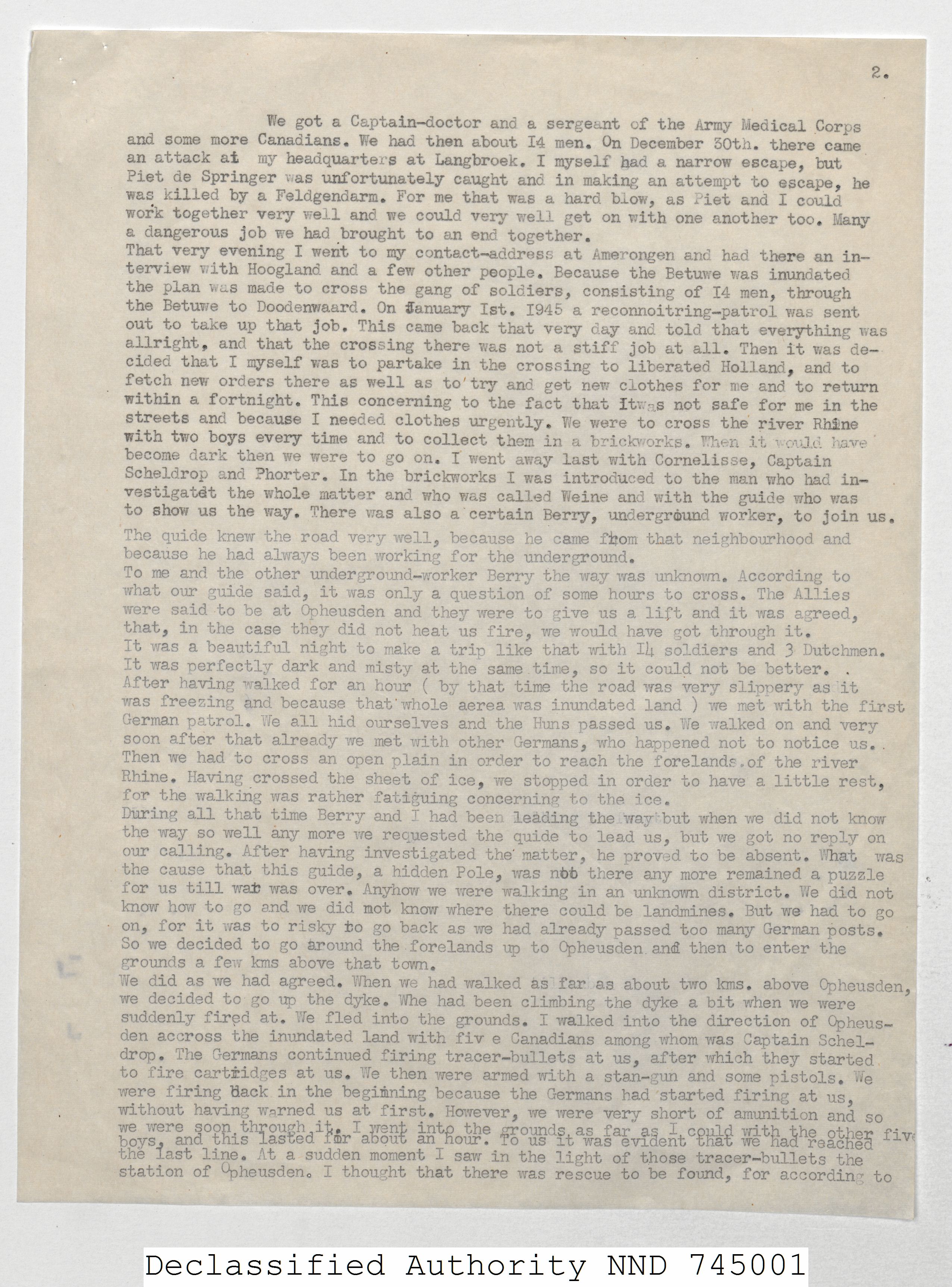
The party moved from Amerongen on bicycles "by parties of one and two" and crossed the Rhine by ferry "by paying 10 cents" (Hardy has them "ieder 10 cent", each, in Noordman, p. 287), and assembled in a brick factory on the far side (Schjelderup's report); Hardy, who left Amerongen with Murphy at 1300, has them cycle on to a barn beside a farmhouse at Kesteren, where seven more evaders joined them "during the course of the afternoon" (Hardy); the local-history page has the meeting place as "de steenfabrieken Van Hesteren en Jansens bij Lienden" (the Van Hesteren and Jansens brickworks near Lienden) (Oorlogsslachtoffers Betuwe-West). There, Maljers wrote, "I was introduced to the man who had investigated the whole matter and who was called Weine and with the guide who was to show us the way" (his statement, p. 16; Weine). At about 1830 they set off on foot, in Schjelderup's words "11 Allied personnel, DERRICK, and 2 other Dutchmen as guides", with "A polish soldier" on his list of the Allied men between Trainor and Hardy, and Murphy after Hardy (Schjelderup's report). Noordman says the "Dirk" of the passage is Dirk van Langbroek, an alias for Adriaan Maljers (Noordman, p. 287); ◐ the match with Schjelderup's "DERRICK" is ours, from Maljers's "I went away last with Cornelisse, Captain Scheldrop and Phorter" against Schjelderup's "with CORNELISSEN and DERRICK" (Maljers, p. 16; Maljers's page).
Schjelderup, in his report of 1 February 1945 (the transcript), has the guide lost at the first German patrol:
At 2100 hrs. approx. we bumped into a German patrol. We dispersed, lay down and froze. When the patrol had passed we pushed off rapidly, but we had lost the Polish soldier and the Dutchman who was the guide for the latter phase of the journey.
— Capt. V. R. Schjelderup, MI9 report · as printed on the Pegasus Archive · Hardy's page
Maljers, who walked at the front with Berry (Berry Melis), has the guide gone a little later, after the party had passed the first patrol and other Germans and crossed an open sheet of ice:
During all that time Berry and I had been leading the way but when we did not know the way so well any more we requested the guide to lead us, but we got no reply on our calling. After having investigated the matter, he proved to be absent. What was the cause that this guide, a hidden Pole, was not there any more remained a puzzle for us till war was over.
— Adriaan Maljers, statement of 3 December 1945, p. 2 · his file, p. 16
The English is a translation of Maljers's Dutch statement, kept beside it in his file, and the Dutch has the guide gone with a second man: "na onderzoek bleek onze gids met een ondergedoken Pool niet meer aanwezig te zijn" (on investigation our guide, together with a Pole in hiding, turned out to be no longer there) (the Dutch original, p. 20). "A hidden Pole" in the English reads the guide and the Pole as one man.
The local-history page tells it from the Dutch side, and says it is built on Maljers's memories, with Canadian and British sources and other researchers' work: when the two at the front asked the guide to lead again, there was no answer, and "Toen men terugkeek, bleek de gids verdwenen te zijn. Hij was er samen met een ondergedoken Pool vandoor gegaan." (When they looked back, the guide turned out to have disappeared. He had gone off together with a Pole in hiding.) (Oorlogsslachtoffers Betuwe-West). "Two Came Back!", the account of Schjelderup's and Gri's escape in the Canadian Scottish war diary, has three of the Dutchmen leading "the group of ten", the patrol sighted at 2300, and a judgement on all three guides: ⚠︎ "The guides had no knowledge of field-craft so panicked without a shot being fired." The rest, it says, lay in a frozen ditch by the road until the Germans had gone by, and went on without guides (p. 6, read on the scan). It is the only source that blames the guides. Against it, Schjelderup's report of 1 February 1945 loses only the Polish soldier and the one guide at the patrol, and Maljers, one of the three Dutchmen, led the party on after it to the dyke above Opheusden (Schjelderup's report; Maljers, p. 16).
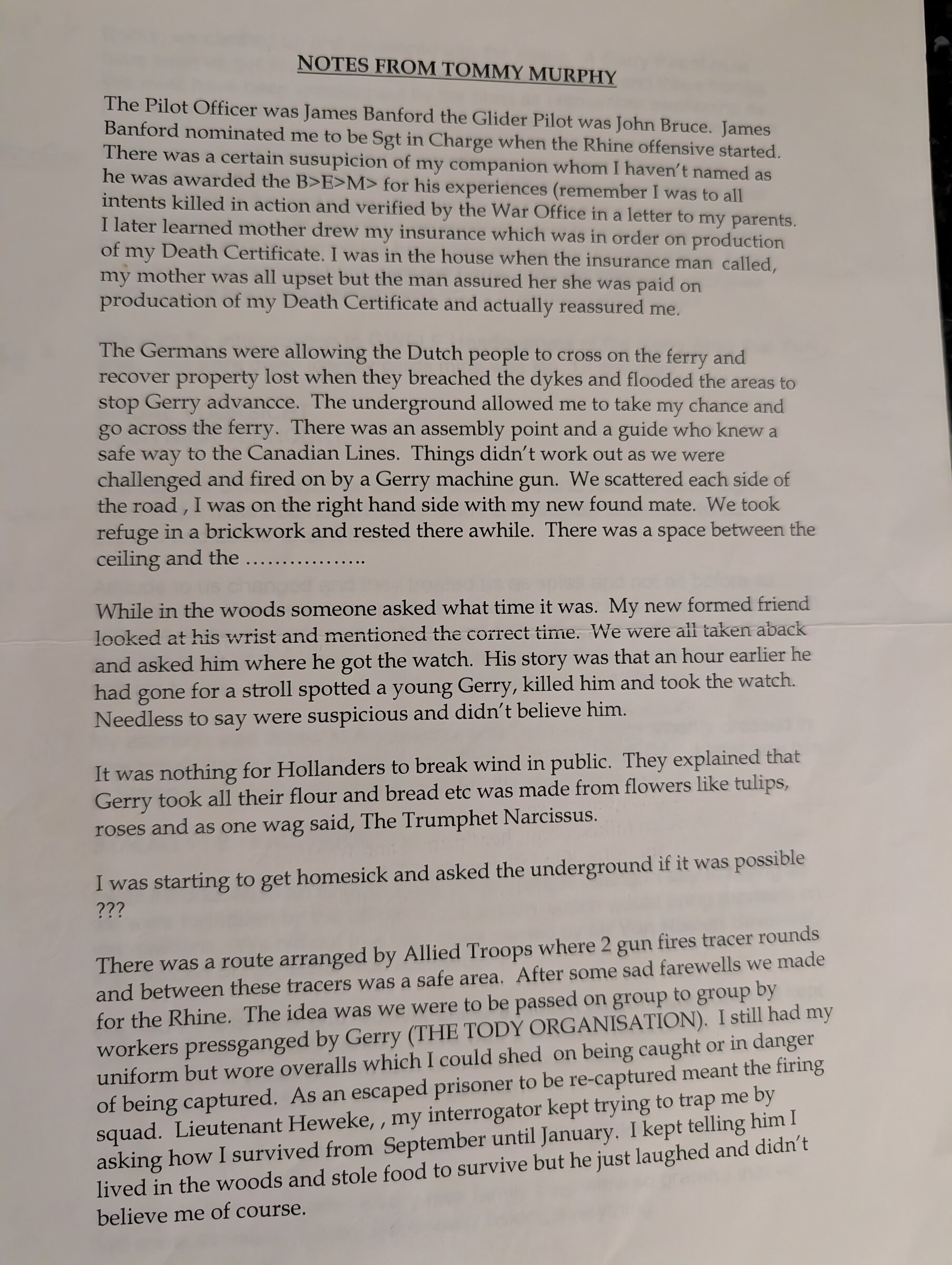
Murphy's own notes have "an assembly point and a guide who knew a safe way to the Canadian Lines", without a name, and then "Things didn't work out as we were challenged and fired on by a Gerry machine gun" (his typed notes); ◐ which guide he meant is not shown. In Schjelderup's report the party went on east, turned south, and was fired on at very close range on a road; there "We lost, and never saw again, one Dutchman and the following three men: Capt. NOBLE, Sgt. TEX (?) [Banwell], Pte. MURPHY" (the report). Murphy's recapture is told on Amerongen.
Noordman, after the passage of the report on the patrol, adds one sentence: "De Poolse soldaat en verdwenen gids, Albert van Hattem, bleken later te zijn teruggekeerd." (The Polish soldier and the missing guide, Albert van Hattem, turned out later to have returned.) He gives no source for it (Noordman, p. 287). Maljers wrote in December 1945 that the cause "remained a puzzle for us till war was over", and does not say what it was (his statement, p. 16).
Who he was
Link to the section Who he was⚠︎ Not known. Noordman sends readers for more on these Allied men to his earlier book, Ondergedoken op de Veluwe (p. 351 and following), which is not held here (Noordman, p. 287).
- The British index of Dutch helpers, on its page H-5, has three van Hattems and no Albert: Albertha, of Op de streek I 83, Post Elburg; Jan Pieter, of Gem. Buren G 19, Asch; and Steven H., of K 162, Kesteren, all grade 5 (the page, certificates 21128, 14697 and 21129, read on the image). The next line is a "van HATTUM, Dr. A.R." of Delistraat 34, Den Haag, grade 6; nothing shows him to be Albert.
- Steven H. van Hattem, born at Kesteren on 22 May 1922, of the L.O., "Helped with the transport of 2 wounded evaders from Opheusden to Kesteren" and lost his bicycle doing it; the man he sheltered was Cpl Russell M. Smith of the USAAF, shot down at Opheusden on 18 September 1944 and hidden from 18 to 20 September (his file, pp. 3–5).
- His next of kin was "A. van Hattem, father" (p. 3).
- ◐ Whether that father is the guide is not shown; nothing in the file touches January 1945. The party gathered at Kesteren on 2 January (Hardy) and Maljers's guide "came from that neighbourhood" (p. 16), but no source ties an A. van Hattem to the night.
- Jan Pieter van Hattem of Asch, born there on 25 October 1882, sheltered one RAF man, Gerald Percival, shot down at Buurmalsen in September 1944 and hidden six days (his file, pp. 2–3). Nothing in it touches the crossing.
- "Mr v. Hattem [?]" of Elspeet. ⚠︎ Z. van der Vlist, the Kijkuit forester, wrote to the Americans on 17 September 1946 that a "den Heer v. Hattem [?] wonende te Elspeet, Nunspeeterweg" had sent the guilder with six signatures of the pilots who stayed at Kijkuit to Wassenaar about November 1945 (his letter, file pp. 13–14, signed on p. 14). He is the one van Hattem in the sources who touches Murphy's party; nothing shows he is Albert, and Elspeet is on the Veluwe, not the Betuwe.
- The American file under "van Hattem, A." is a woman's: Aalbertha van Hattem of Elburg, born at Oosterwolde in 1918, who lent her bicycle to an RAF man on 6 February 1945 (her file, p. 2). It has nothing to do with the crossing.
Where the sources disagree
Link to the section Where the sources disagree- One man or two. The sources agree on two: a guide and a Pole.
- The English of Maljers's statement has the guide himself "a hidden Pole" (p. 16), but his Dutch original has the guide gone "met een ondergedoken Pool", with a Pole in hiding (p. 20); Schjelderup has a Polish soldier and a Dutch guide lost together (his report).
- ◐ The retellings are not independent of the first two: Noordman prints Schjelderup's report, and says the Polish soldier and Albert van Hattem were two men (p. 287); the local-history page, built on Maljers's memories, has a Dutch guide who left with a Pole in hiding (Betuwe-West).
- When. At the first German patrol, about 2100 (Schjelderup); at about 2300 ("Two Came Back!", p. 6); after the first patrol and a second party of Germans, on the far side of a sheet of ice (Maljers, p. 16).
- How many guides went. Schjelderup has Derrick and two other Dutchmen as guides, and loses one guide at the patrol and "one Dutchman" at the road; Maljers has "14 soldiers and 3 Dutchmen", ◐ presumably himself, Berry and the guide (he does not say); "Two Came Back!" has three guides who all left at the patrol (Schjelderup; Maljers, p. 16; "Two Came Back!", p. 6).
- Lost, or killed. ⚠︎ Charles Noble's own later account (unpublished private papers, shared with us privately), told long after the war, has a V1 that "malfunctioned, dropped near us and killed our second guide plus a cow", and "The first guide really only knew the first part of the journey". It names no guide.
- Noble's own report of 1945 has "the guide for the second stage of the journey" lost "in the confusion" when a German patrol passed (Noble), Schjelderup's has him lost at the patrol, Maljers's has him gone with a Pole, and Noordman has him return later (above).
- None of the men's own 1945 reports (Noble, Schjelderup, Berry) has anyone killed at that point. Adrianus van Wijnen's form of 18 October 1945 has "several people" killed because the guide of the second part ran away when a German patrol came in view (Berry Melis), and the Air Ministry wrote to Porter's wife in March 1945 that "two members of the party were killed", naming neither, where Porter's book, long after, has "four or five" (Porter's account).
- Whose words. Noordman prints the passage on the patrol and the lost guide as Hardy's ("James Hardy vervolgt", p. 287); on the Pegasus Archive page it is Schjelderup's, and Hardy's own report says that from Kesteren his story is "in the main details, the same as that narrated by Capt. SCHJELDERUP" (Hardy's page).