Jopie Veerman
Achterveld 1 Dec 1927 – Lembeek 9 Sep 1977
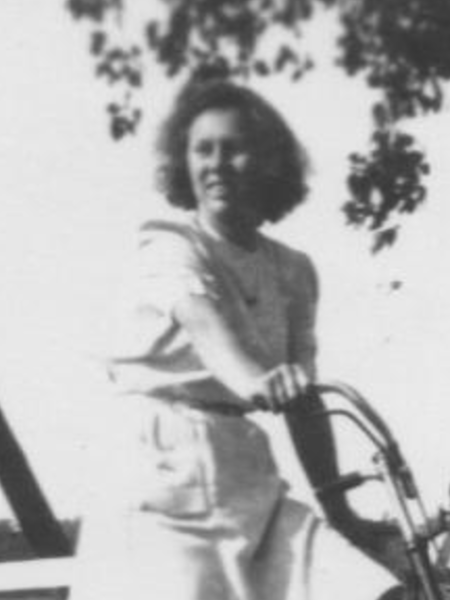
Johanna Maria "Jopie" Veerman, later Vanhaelen (TracesOfWar; her death notice)
About: The eldest daughter of the Klein Achterveld farm, a resistance courier at sixteen, who was there through the month Murphy and Hardy were hidden on it in 1944. When the SD came for her in February 1945 they took her father instead; she gave herself up to free him, was held at Westerbork and survived the Vrouwenmars, and met Murphy again at Loch Lomond in 1974.
Unit or role: Courier for the R.R., the resistance group whose courier address her father's house was (the form filled in for her father for the L.O.-L.K.P. foundation's book of the fallen, now in the NIOD's archive); in 1950 the Rijkspolitie at Barneveld recorded her as the eldest daughter, "die koeriersdiensten zou verrichtten,voor de illegaliteit" (who was said to be doing courier work for the resistance) (the report); no. 10 of the 116 women of the Vrouwenmars (the list).
Where: Klein Achterveld, Achterveldseweg 34; in hiding at Ede when the SD came for her; Westerbork; after the war Brussels, and Lembeek, near Halle, Belgium.
Evidence: ✓ TracesOfWar (citing Van Doorn and Sennema, Vrouwenmars 1945); ✓ the Stichting Vrouwenmars 1945's list; ✓ her death notice; ✓ the L.O.-L.K.P. form for her father, 1946; ✓ the Rijkspolitie's report on her father, Barneveld, 13 December 1950 (Gemeentearchief Barneveld 002/1546); her family's papers for the Americans (US National Archives 286713002); Digitaal Monument Neuengamme, the Dutch Vriendenkring Neuengamme's online memorial, quoting José Huurdeman's history of the local resistance, Ondergronds in de Tweede Wereldoorlog (2019); her sister Alie in the Achterveld booklet, p. 83; her son Jacques Vanhaelen's account, October 2026 (family knowledge); the Daily Express, 25 July 1974 (a cutting kept by her family).
She was born at Achterveld on 1 December 1927 (TracesOfWar), on the farm Klein Achterveld, the eldest of the seven children of Jacob Veerman and Aaltje Bakker (her son's account), ten months after their marriage, and carried her grandmother Johanna Maria Kok's names (the records). Her parents hid people on the farm, airmen from 1943 and Jews (Neuengamme online memorial).
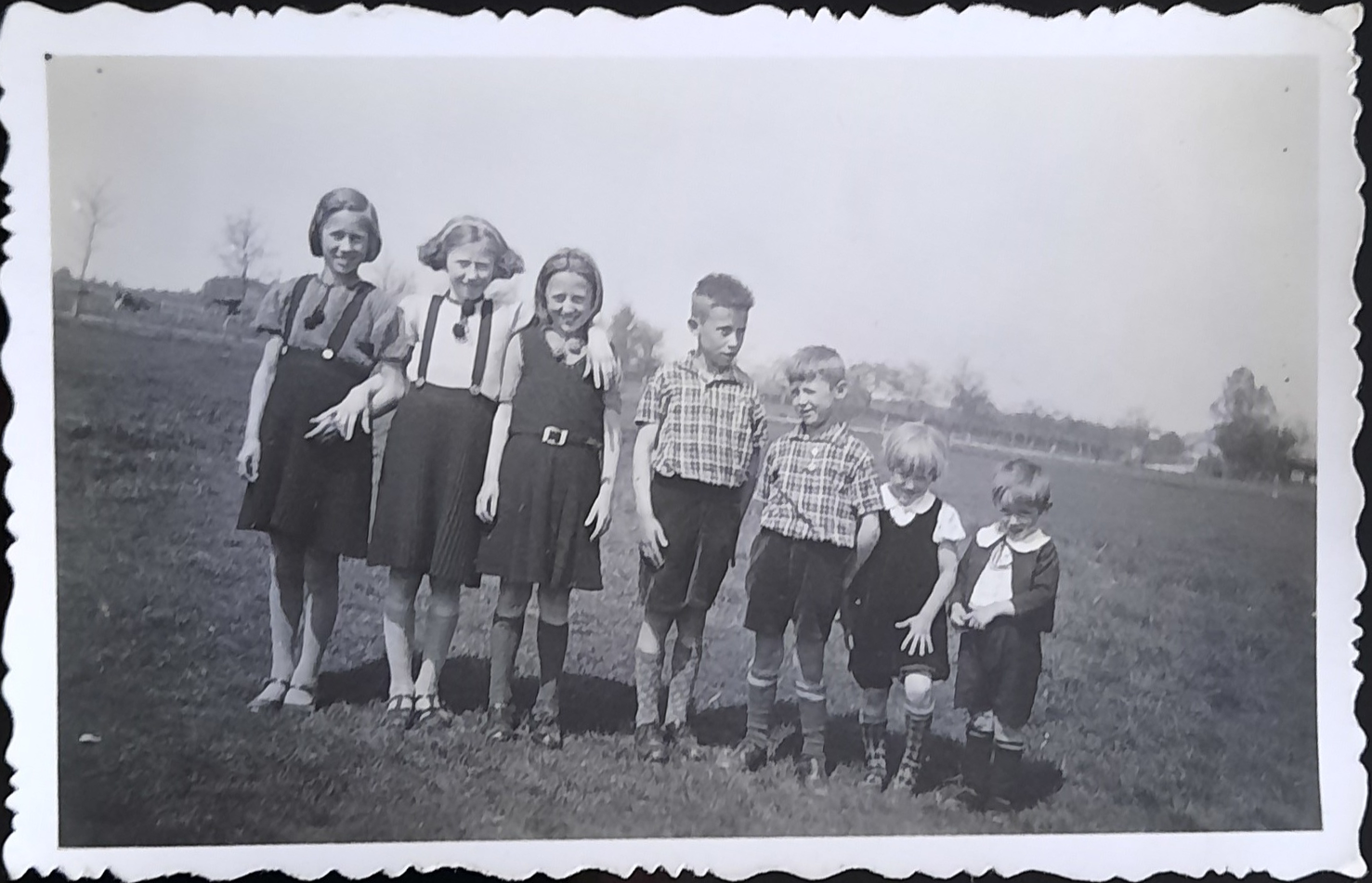
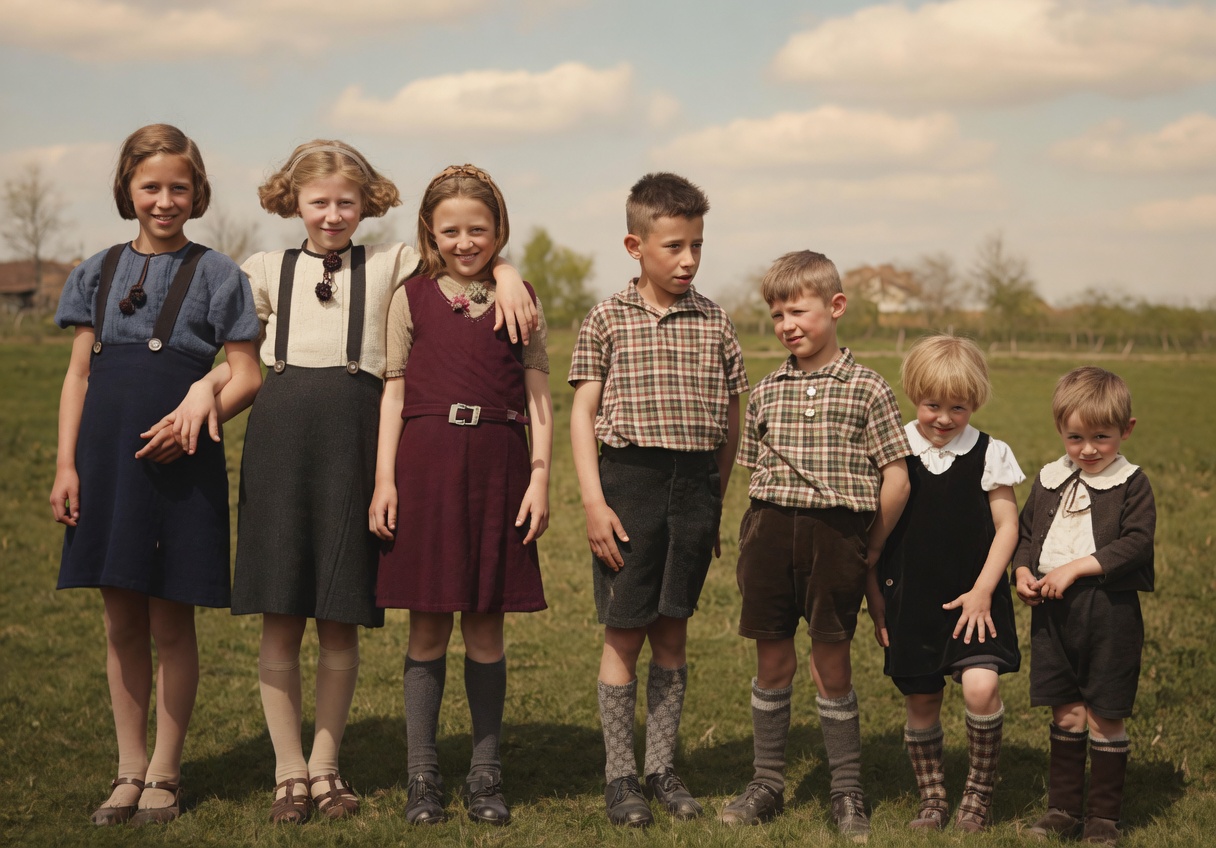
She joined the resistance at sixteen as a courier, carrying letters between Barneveld and Amersfoort (her son's account). The form her family filled in for the L.O.-L.K.P. foundation's book of the fallen in February 1946 puts it this way: "De dochter van Veerman was koerierster v. R.R. Het huis van Veerman was een koeriersstation" (Veerman's daughter was a courier for the R.R.; Veerman's house was a courier station) (the form).
With Murphy
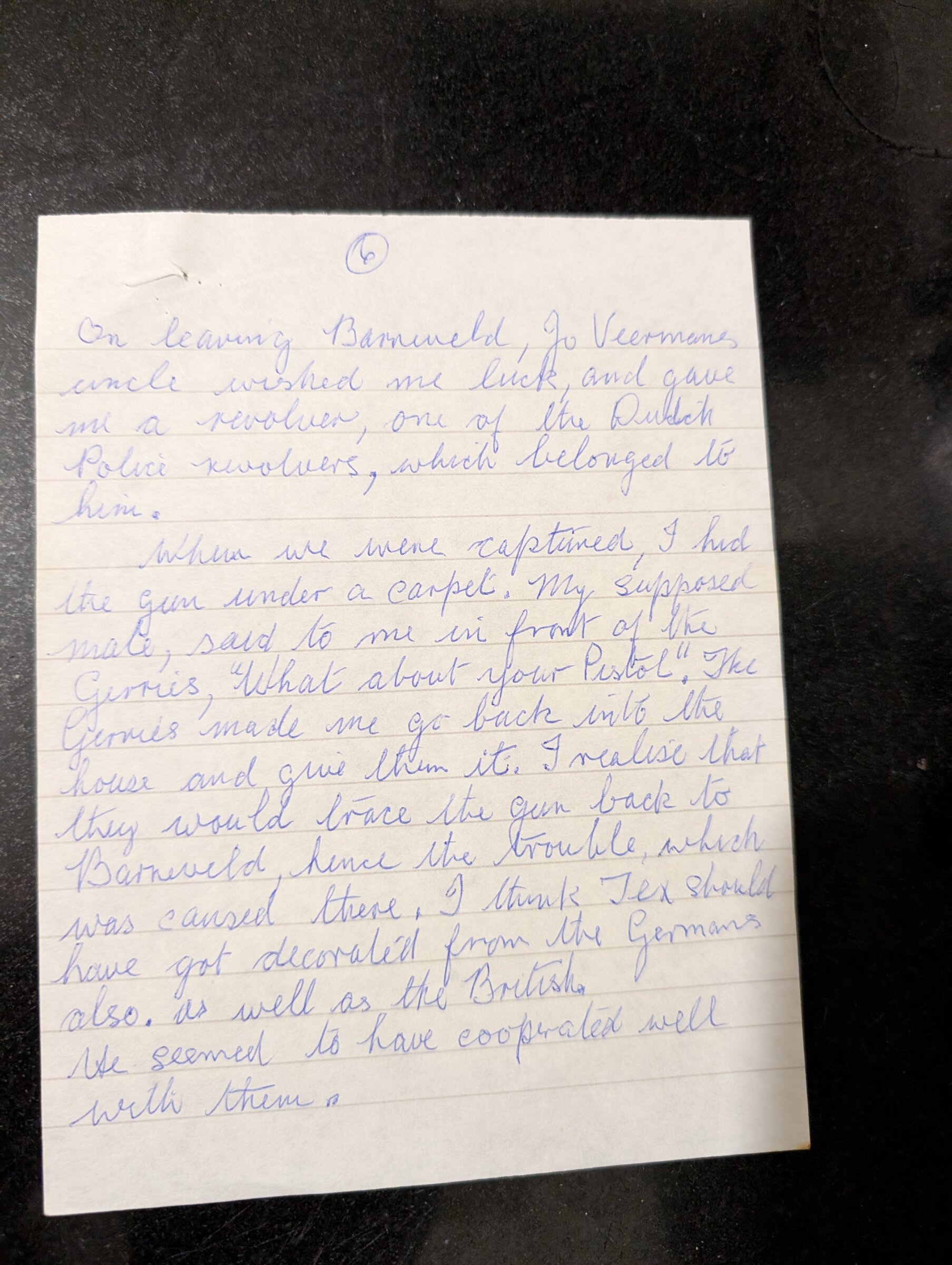
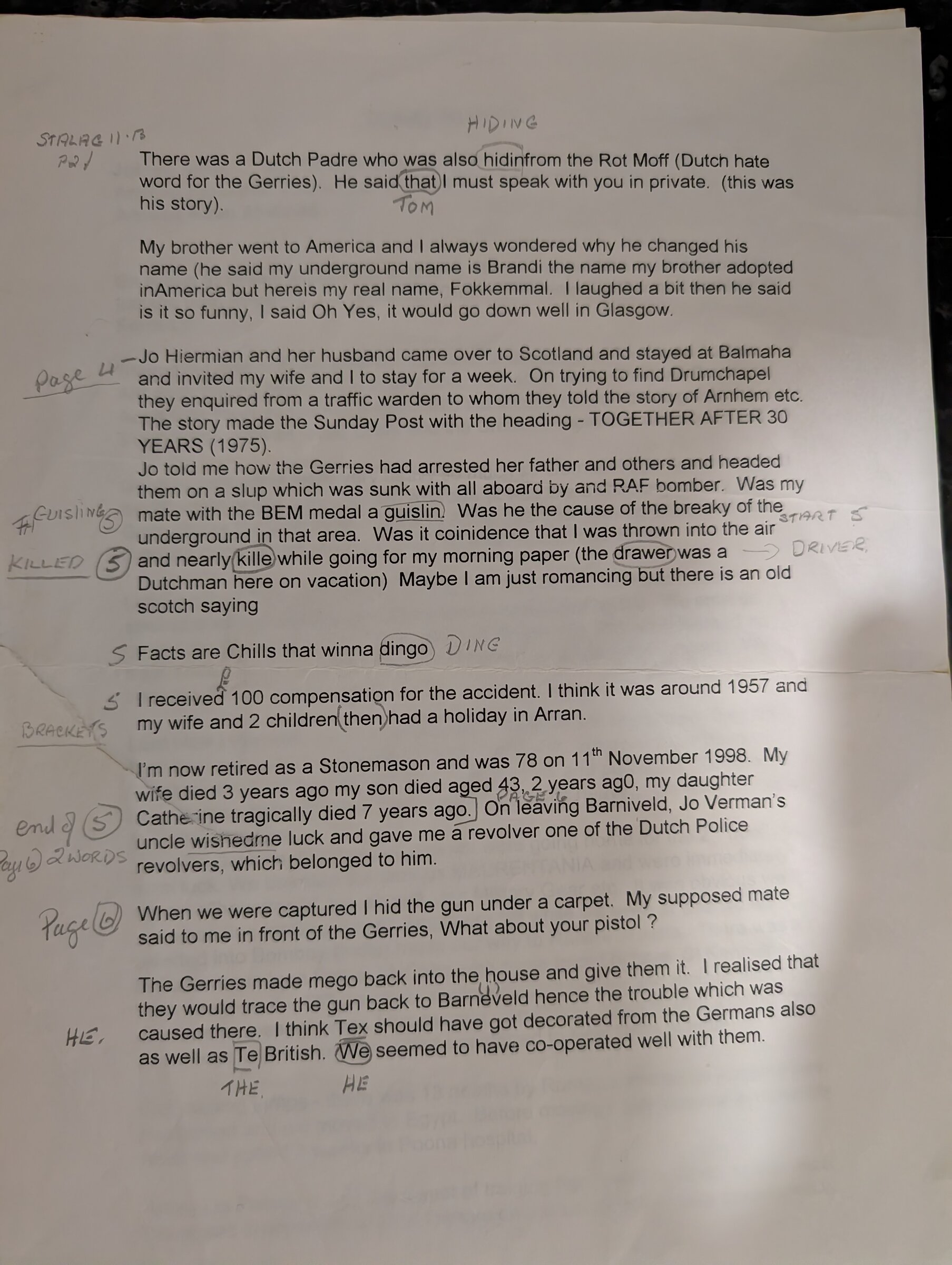
Link to the section With MurphyShe was sixteen when Gijs van Zijtveld brought Murphy and James Hardy to the farm on about 25 November 1944, and turned seventeen while they were there; Hardy remembered "the eldest a girl of 17 named JOANNA" (Hardy). They stayed a month, "very well fed and cared for", until 23 December (Hardy; Jacob Veerman). Thirty years later the Daily Express reported that the family hid him "during German searches" for four weeks (the cutting). Murphy, writing about 1998, knew the family by her name: the revolver he carried away came from "Jo Veermans uncle" (his notes, p. 6; typed as "Jo Verman's uncle" in the typed copy); ◐ the revolver was probably that of her father's brother Leendert Jan.
The family's papers, 1946
Link to the section The family's papers, 1946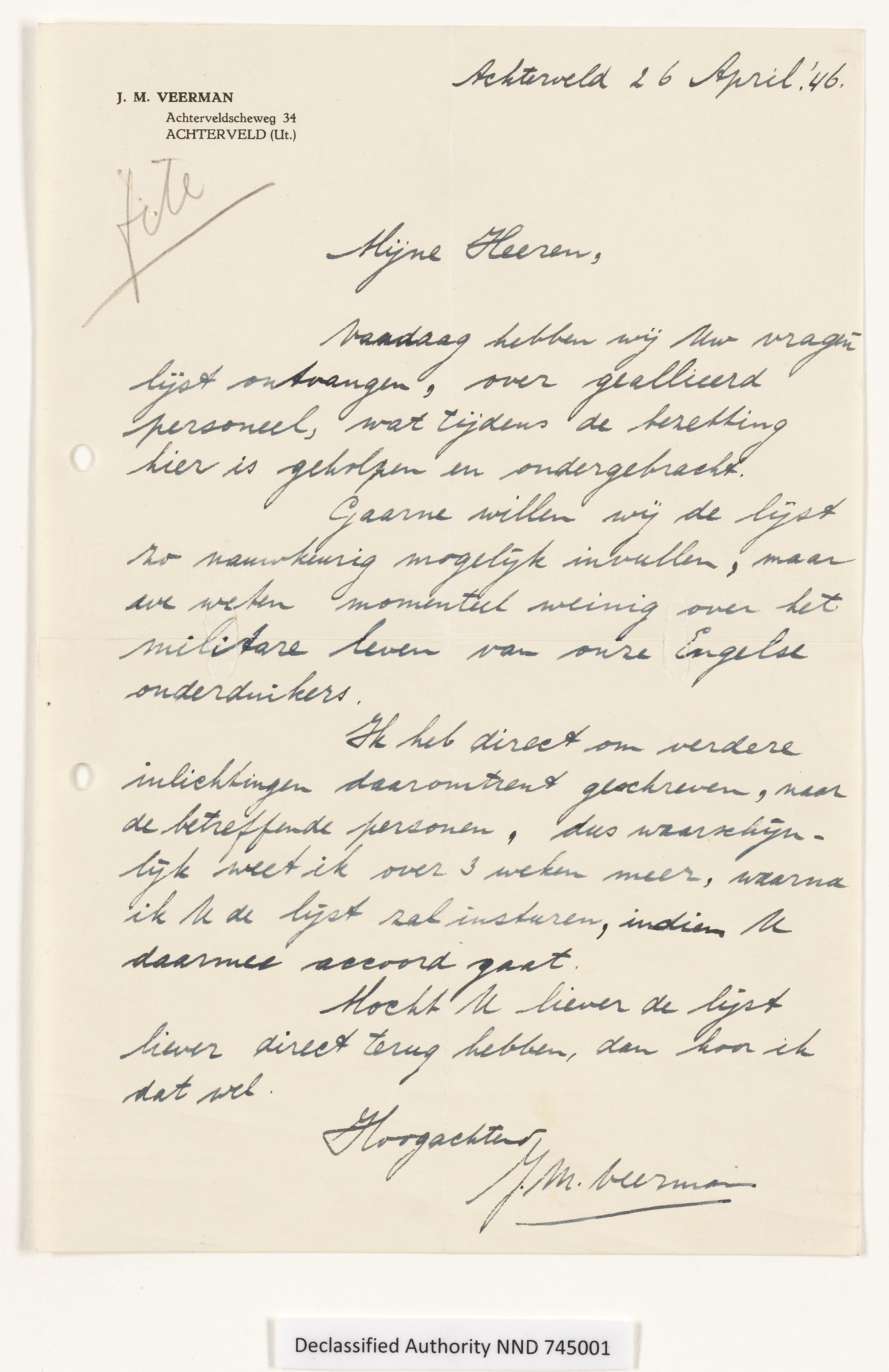
The Americans' questionnaire about the men the family had helped reached the farm in April 1946, and the letter that answered it, on paper headed "J. M. VEERMAN, Achterveldscheweg 34", is signed J.M. Veerman, ◐ Johanna Maria, Jopie herself:
Today we received your questionnaire about Allied personnel who were helped and sheltered here during the occupation. We would like to fill in the list as accurately as possible, but at the moment we know little about the military life of the English we hid. I have written at once to the people concerned for more information, so I shall probably know more in 3 weeks, and then I will send you the list, if you agree. …
Dutch originalVandaag hebben wij Uw vragenlijst ontvangen, over geallieerd personeel, wat tijdens de bezetting hier is geholpen en ondergebracht. Gaarne willen wij de lijst zo nauwkeurig mogelijk invullen, maar we weten momenteel weinig over het militaire leven van onze Engelse onderduikers. Ik heb direct om verdere inlichtingen daaromtrent geschreven, naar de betreffende personen, dus waarschijnlijk weet ik over 3 weken meer, waarna ik U de lijst zal insturen, indien U daarmee accoord gaat. …
— J.M. Veerman, Achterveld, 26 April 1946 · US National Archives, RG 498, helper file of Jacob Veerman · the archive's copy
The list went back in May with "THOMAS MURPHY No 2456457. parachutist." on it, hidden from 25 November for 30 days (the list writes the year as '45, a slip for 1944) (p. 5). The L.O.-L.K.P. form of 20 February 1946 is signed the same way, J.M. Veerman, ◐ for her mother, whose name is on it as the one who filled it in (the form).
The raid, and her father taken
Link to the section The raid, and her father taken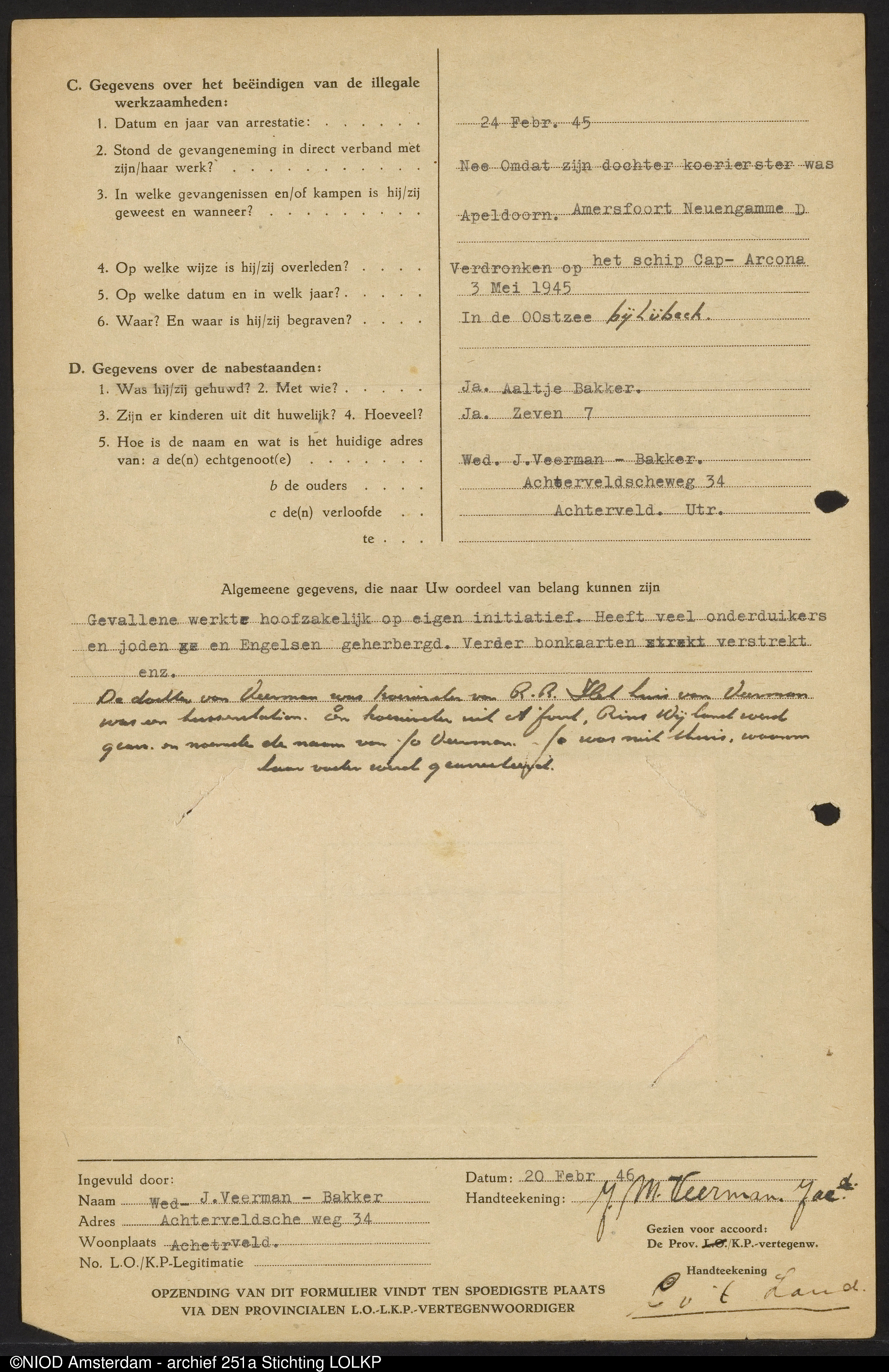
⚠︎ A handwritten note on the back of the L.O.-L.K.P. form says that a courier from Amersfoort had been arrested and gave Jo Veerman's name, and ends "Jo was niet thuis, waarom haar vader werd gearresteerd" (Jo was not at home, so her father was arrested; the last word read with doubt) (the form). The note is short and sits under the typed remarks; nothing else we hold records the courier's arrest or what the courier said. She went into hiding with her uncle Gerrit Broekhuizen (so her son spells it) at Ede (her son's account; Huurdeman, "bij haar oom Gerrit in Ede": Neuengamme online memorial), ◐ Gerrit Jan Broekhuis, the baker married to her father's sister, who lived at Ede.
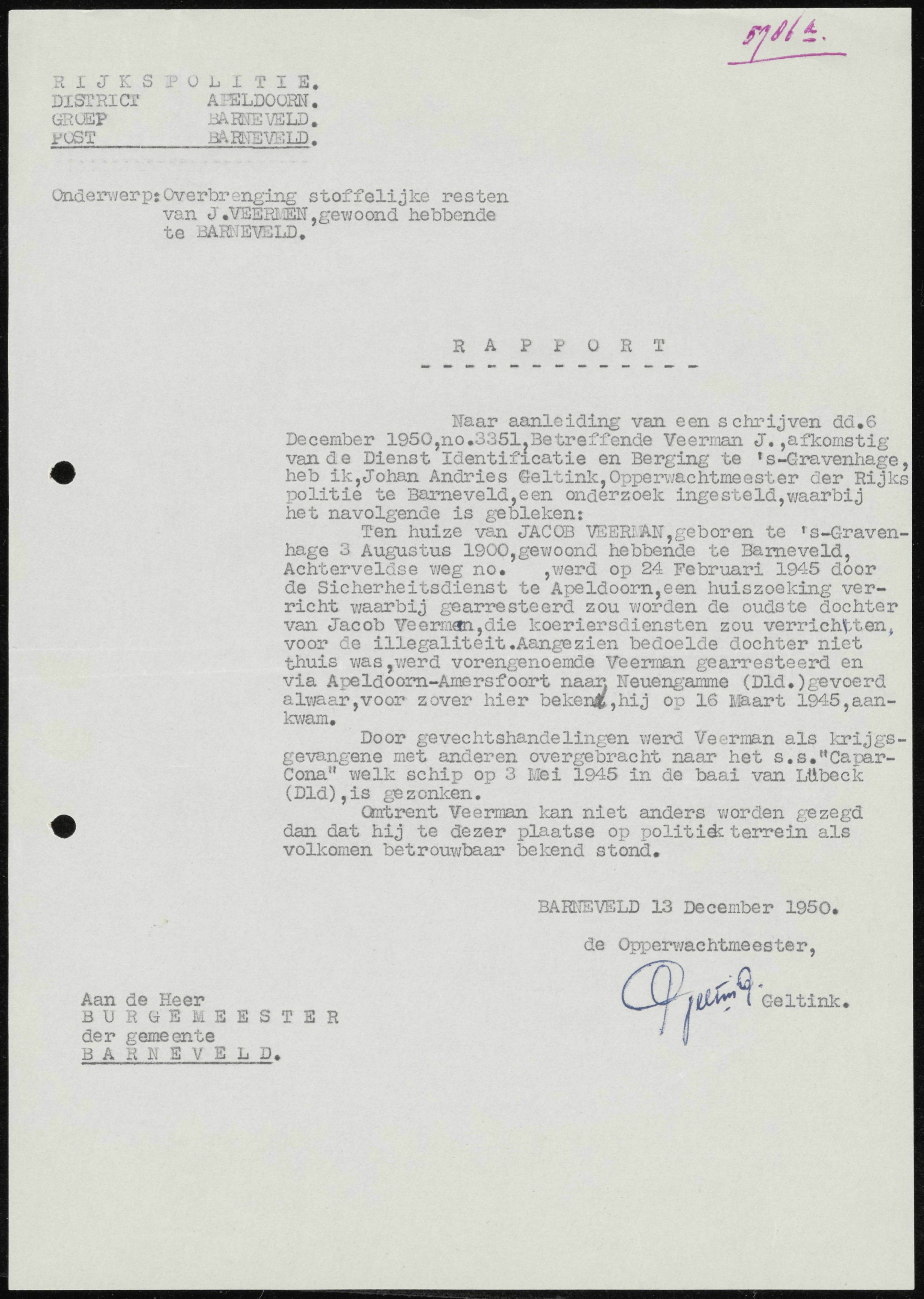
The SD came to the farm for her on 24 February 1945. The Rijkspolitie at Barneveld, asked in December 1950 about her father's political record, set down what had happened:
On 24 February 1945 the Sicherheitsdienst of Apeldoorn carried out a house search at the home of Jacob Veerman, born at 's-Gravenhage on 3 August 1900, who lived at Barneveld, Achterveldse weg no. [blank], in which Jacob Veerman's eldest daughter, who was said to be doing courier work for the resistance, was to be arrested. As that daughter was not at home, the said Veerman was arrested and taken by way of Apeldoorn and Amersfoort to Neuengamme (Germany), where, as far as is known here, he arrived on 16 March 1945.
Dutch originalTen huize van JACOB VEERMAN,geboren te 's-Gravenhage 3 Augustus 1900,gewoond hebbende te Barneveld,Achterveldse weg no. [ ],werd op 24 Februari 1945 door de Sicherheitsdienst te Apeldoorn,een huiszoeking verricht waarbij gearresteerd zou worden de oudste dochter van Jacob Veerman,die koeriersdiensten zou verrichtten,voor de illegaliteit.Aangezien bedoelde dochter niet thuis was,werd vorengenoemde Veerman gearresteerd en via Apeldoorn-Amersfoort naar Neuengamme (Dld.)gevoerd alwaar,voor zover hier bekend,hij op 16 Maart 1945,aankwam.
— Rijkspolitie, Post Barneveld · Opperwachtmeester J. A. Geltink · report of 13 December 1950 · Gemeentearchief Barneveld 002/1546, p. 343 · the file
✓ The resistance's memorial book of 1951 has her father among the fallen of the LO-Barneveld, "Tevens: RR." (also the RR), "Gearr. 24-2-'45 t.g.v. arr. in RR." (arrested 24-2-'45 as a result of arrests in the RR) (Het grote gebod, p. 237, read on the page); it does not say whose arrests.
Her sister Alie remembered the men who came as Dutch SS men, "Nederlandse SS’ers", the lorry on the yard, their father tied up on the floor for a good hour, and each of the children questioned separately: "Ze wilden weten waar mijn zus Jopie was" (they wanted to know where my sister Jopie was) (the booklet, p. 83). Marie Visser-Derksen, an evacuee lodging at Terschuur, near Achterveld, puts herself at the farm that day by her own account, the only source that has her there: she heard on 24 February 1945 that the Germans were taking Jacob Veerman's horses (⚠︎ her account alone), cycled over to look, and was searched by the Germans as soon as she rode in, and what she heard afterwards was that they took Jacob and Jopie (pp. 111–112). They let it be known her father would be released if she gave herself up (Neuengamme online memorial). She gave herself up: TracesOfWar has that she "meldde zich vrijwillig om haar gearresteerde vader vrij te krijgen. Dat mocht niet baten" (reported herself of her own accord to get her arrested father freed; it did no good) (TracesOfWar). A brother of hers, who is living, remembers that she did so that very same day; it is his own memory, passed on by Jacques Vanhaelen, and no record held dates her surrender (Jacques Vanhaelen's email, October 2026). ⚠︎ A rifle hidden on the farm comes up in the booklet (p. 83), and a radio and two guns in Jacques Vanhaelen's account, after Jacob's questioning at Apeldoorn; neither source connects them with Murphy's revolver (the detail is on Jacob's page).
My sister Jopie was a courier in the resistance. After father had been taken Jopie reported herself to get father freed, but that did not happen. She was taken and brought to Kamp Westerbork. She survived that. In May 1945 she came home, completely undernourished and swollen.
Dutch originalMijn zus Jopie was koerierster in het verzet. Nadat vader was opgepakt melde Jopie zich om haar vader vrij te krijgen maar dat gebeurde niet. Ze is opgepakt en naar kamp Westerbork gebracht. Dat heeft ze overleefd. In mei 1945 kwam ze thuis, helemaal ondervoed en opgezwollen.
— Alie Veerman, her sister, in Oorlogsverhalen om nooit te vergeten (Achterveld, 2025), p. 83 · the booklet
A compiled family genealogy says the same in short: she "deed koerierswerk voor de ondergrondse en heeft ook nog een tijdje vastgezeten" (did courier work for the underground and was held for a while too), ✓ which the records bear out; ✗ the same entry dates her father's arrest to 1944, a year early (BROBOL Genealogie, Jacob's entry).
⚠︎ The same brother remembers that a member of the NSB who had fled from the south of the Netherlands was also hiding at the farm, and that he tried to get their father released but came too late: he had already been deported to Germany (Jacques Vanhaelen's email, October 2026). Her father went from Apeldoorn to Amsterdam, Amersfoort and Neuengamme, and died when the Cap Arcona was sunk in the Bay of Lübeck on 3 May 1945, five days before VE Day (Neuengamme online memorial; Jacob Veerman).
Westerbork and the Vrouwenmars
Link to the section Westerbork and the VrouwenmarsShe was one of 116 women from resistance families of the central and north-eastern Netherlands brought to Kamp Westerbork between 21 March and 6 April 1945 from four SD prisons; about 75 of them, from Putten, Barneveld, Ermelo, Ede and round about, came from the Willem III Kazerne at Apeldoorn (TracesOfWar), the barracks Murphy had escaped from on 6 October 1944. ⚠︎ That she came by Apeldoorn is our inference: the SD that came for her was Apeldoorn's (the 1950 report), but TracesOfWar says only "Jopie belandde in Kamp Westerbork" (Jopie ended up in Kamp Westerbork). At Westerbork she was put to the unhealthy work of taking batteries apart for their materials (her son's account). On 11 April 1945 the 116 were marched out of Westerbork at gunpoint by retreating soldiers, three nights on foot towards Groningen, "probably as a human shield against the advancing Canadians" (her son's account), and they were freed near Grijpskerk on 14 April (Stichting Vrouwenmars 1945).
The marchers' list. The Stichting's own list of the 116, in march order, has her at number 10: Johanna Maria (Jopie), getrouwd Anwert / Vanhaelen, meisjesnaam Veerman, Achterveld (the list). Whose name "Anwert" is is not settled. Three women from round about are on it too: Jo Klooster-Kohnhorst of Barneveld at number 2 (✓ the wife of Dries Klooster, whose house was raided on 8 December 1944, by her names and town: the civil registers; ⚠︎ whether she was on the march is not settled: Diet Eman has her held at Apeldoorn and let go after 17 April (Eman, pp. 345–346; her page)), "A. Houtman" of Barneveld at 11, and "Tante Jacqui" Kuyck of Garderen at 12.
Home, and Belgium
Link to the section Home, and BelgiumThe Red Cross brought her home about a month after the march ended, "physically very weak" (her son's account), in May 1945 (Neuengamme online memorial). In Jacques Vanhaelen's account, fellow villagers called her a "Nazi" because she came back with a shaved head, and "it was thought that she had collaborated with the Germans". To start again she went to Belgium, and, in his words, "through an advertisement in the newspaper where she was employed", found work as an au pair with the family of the Reverend Hartkamp in Brussels. At the Reformed Church's youth movement there she met Jean-Baptiste Vanhaelen, born at Anderlecht on 17 September 1925, and they married in Brussels on 15 November 1950 (her son's account). They had four children; their eldest son was killed in a motorcycle accident in 1974, aged 22 (her son Jacques Vanhaelen's email, October 2026; family knowledge of his own brother). She became a teacher of religion at Lembeek, and she never spoke of Westerbork or of her courier work, "not even to her immediate family" (her son's account).
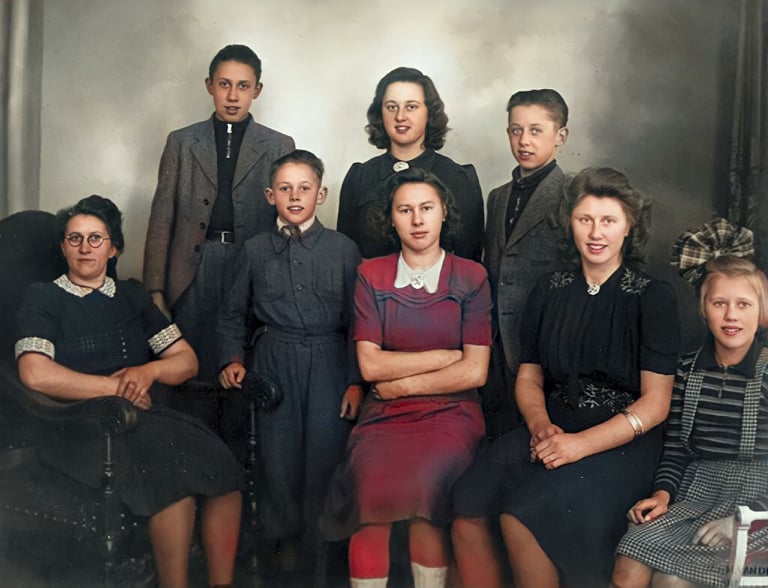
The reunion with Murphy
Link to the section The reunion with Murphy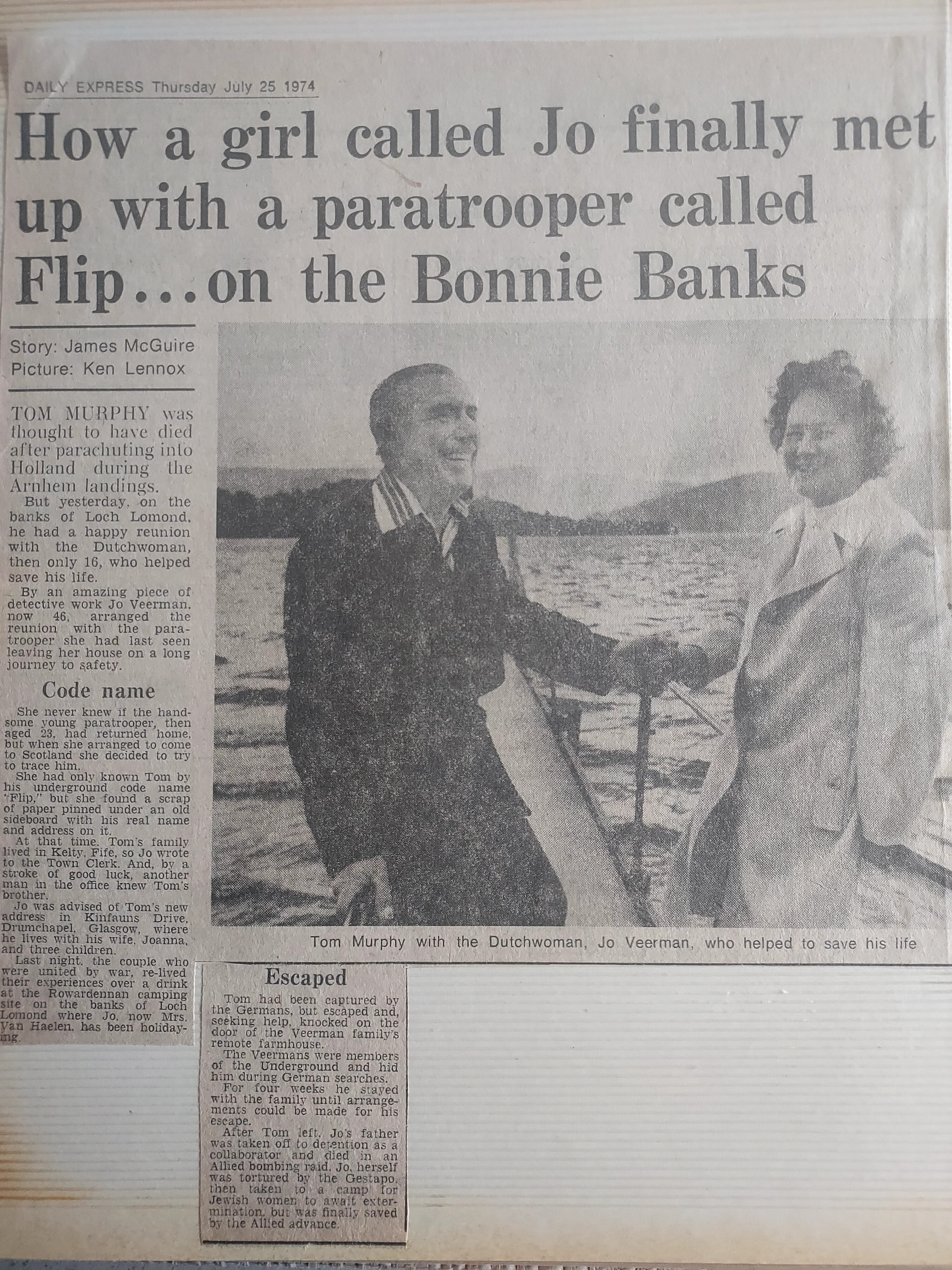
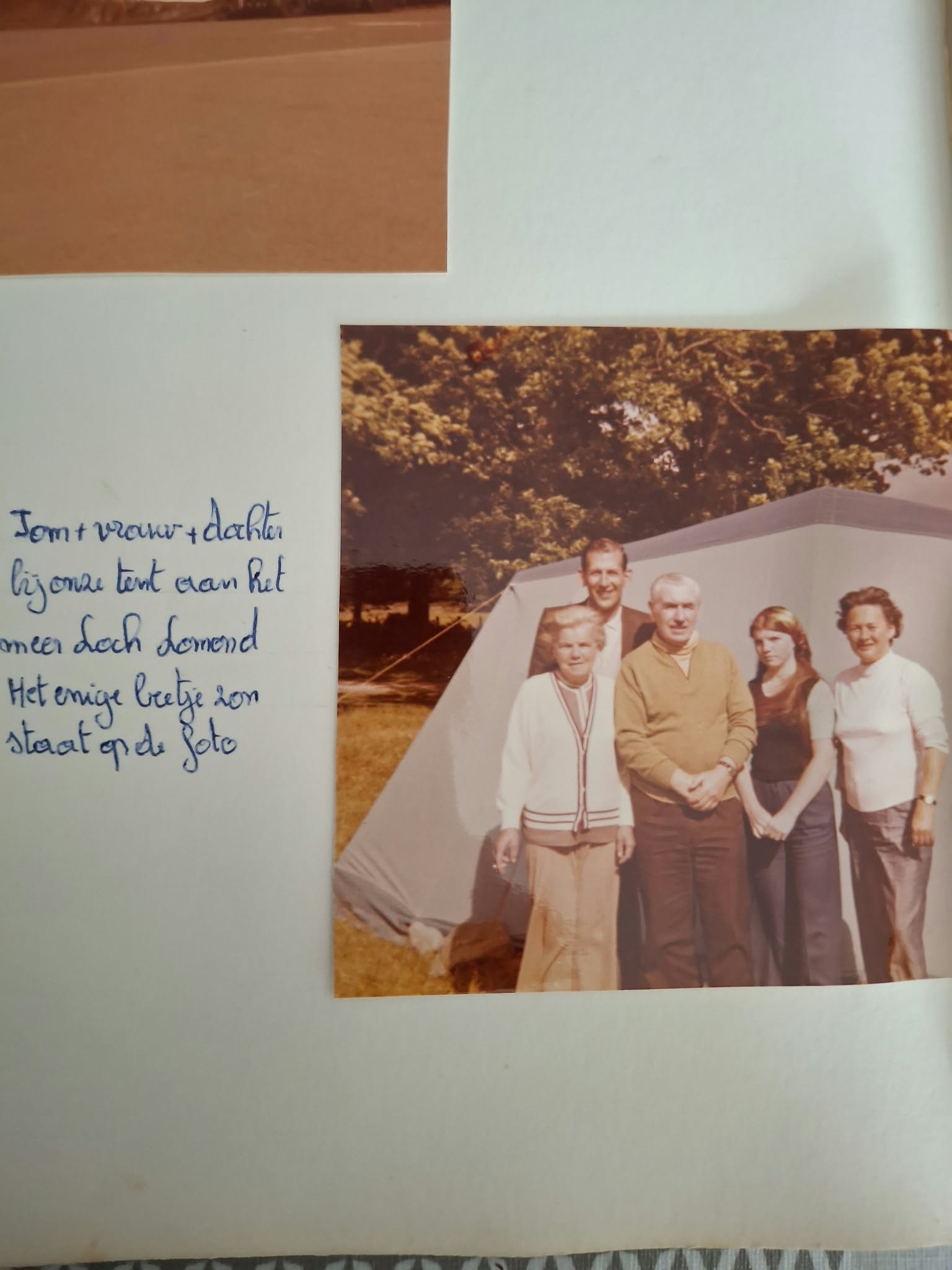
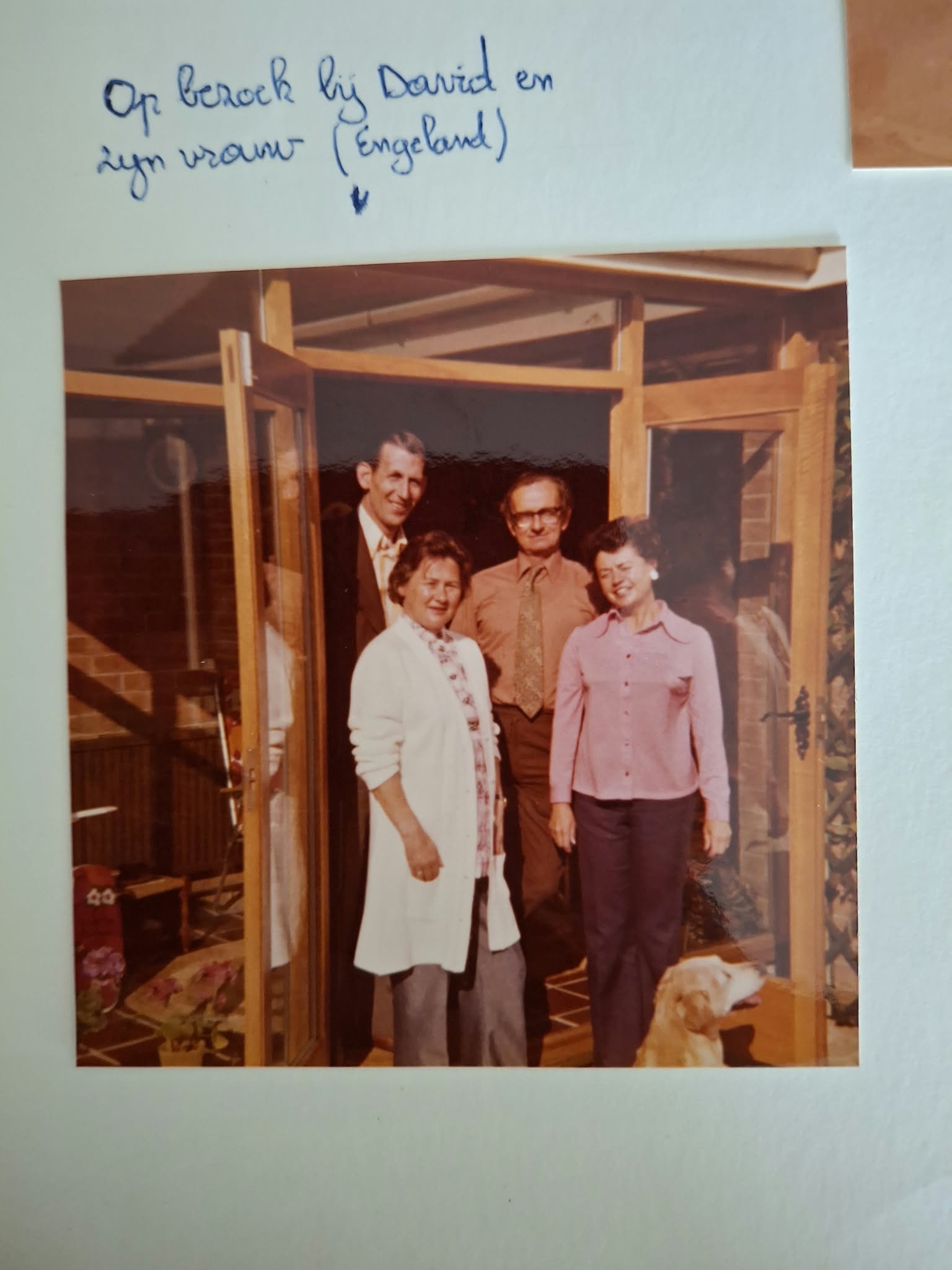
On 24 July 1974, on holiday in Scotland (with her husband, by Murphy's notes), she met Thomas Murphy again at the Rowardennan camping site on the banks of Loch Lomond. The Express has her find his name and address on "a scrap of paper pinned under an old sideboard" and write to the Town Clerk of Kelty, where his family had lived, where by luck another man in the office knew his brother, and she was given his address in Drumchapel. ⚠︎ A Scottish paper of 23 January 1972 (◐ the Sunday Post, by the account of Murphy's niece Liz Moore, who kept the cutting) tells much the same of Flip Esveld: he found a note with Murphy's name in the sideboard he inherited from his mother, and traced him through the Town Clerk of Kelty (the cutting). That night they "re-lived their experiences over a drink" (Daily Express, 25 July 1974, the cutting, kept by her family; After the war).
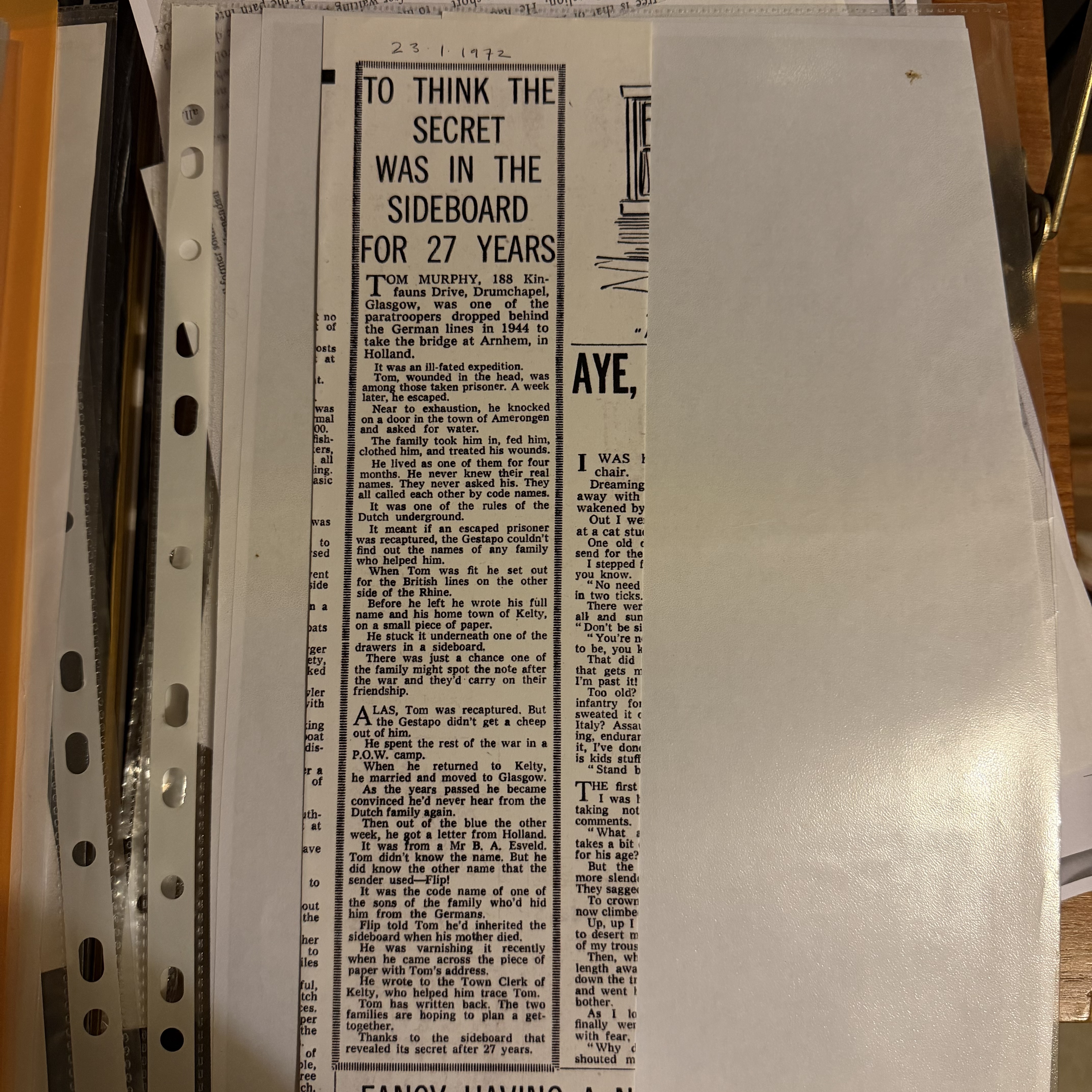
Murphy's own notes have her and her husband staying at Balmaha, a few miles down the same shore, asking a traffic warden the way to Drumchapel, and inviting the Murphys to stay a week with them; he remembered a Sunday Post piece headed "TOGETHER AFTER 30 YEARS", not yet found. By the same page, "Jo told me how the Gerries had arrested her Father, and others, and herded[?] them on to a ship, which was sunk with all aboard by an RAF Bomber" (his notes, p. 4, the bracketed query ours; After the war). A Book of Fife Heroes (1998) tells the same beginning, without saying who in the family found the address: "An address he left in a chest of drawers was discovered years later by a member of the family who had safeguarded him and a reunion took place" (p. 49).
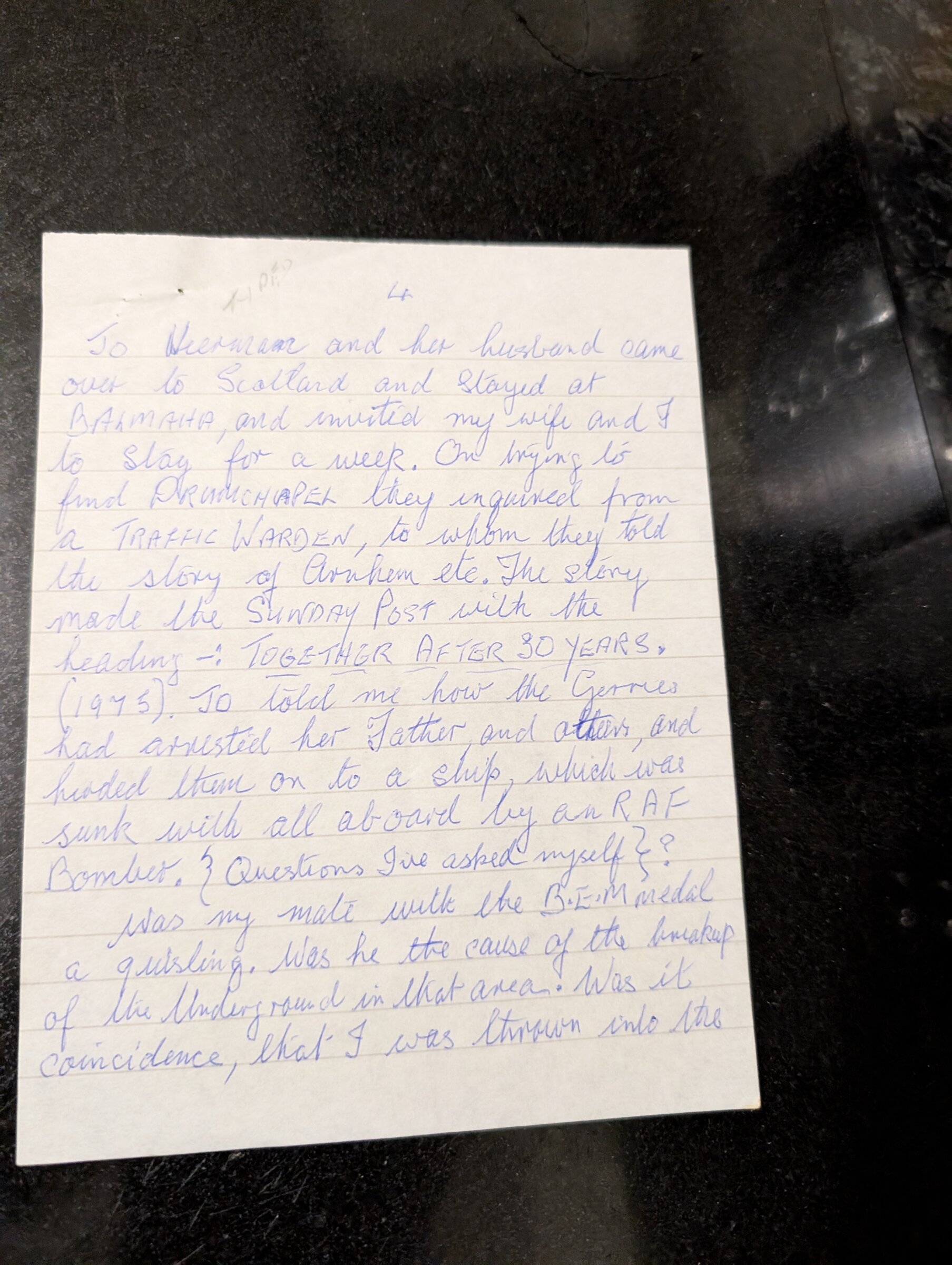
Her death
Link to the section Her deathShe died suddenly at Lembeek on 9 September 1977, aged 49, "na een vruchtbaar en toegewijd leven" (after a fruitful and devoted life), and the notice set her funeral for 14 September, a service in the Sint-Veronuskerk and burial in the churchyard at Lembeek (her death notice, Barneveldse Krant, 12 September 1977). The notice was signed by her husband, her children and grandchild, "Mijnheer en mevrouw Vaarkamp-Bakker, haar ouders" (her mother, remarried) and her mother-in-law, with Barneveld as the Dutch address for letters (the scan). Her husband died at Pepingen on 26 November 1998 (her son's account).
Where the sources disagree
Link to the section Where the sources disagree- The date her father was taken. Huurdeman has 24 January 1945 (Neuengamme online memorial). The family's forms (NARA p. 4), the L.O.-L.K.P. form (the form), the Rijkspolitie's report of 1950 and the burgemeester's letter of the same month (Gemeentearchief Barneveld 002/1546, pp. 343, 345), and Marie Visser-Derksen, by her own account at the farm that day, have 24 February, as does the resistance's memorial book of 1951 (Het grote gebod, p. 237: "Gearr. 24-2-'45", the page) (Jacob Veerman).
- When she reached Westerbork. Her son's account has February 1945; the Stichting Vrouwenmars has the women brought in from four SD prisons between 21 March and 6 April 1945 (TracesOfWar).
- Whether she was taken with her father.
- Marie Visser-Derksen, who by her own account cycled over to the farm on 24 February, heard afterwards that the Germans took Jacob and Jopie (the booklet, p. 112).
- The 1950 report has the daughter not at home (Gemeentearchief Barneveld 002/1546, p. 343).
- Huurdeman has her in hiding with her uncle at Ede when her father was taken, on a day the book gives as 24 January, and giving herself up when she heard (Neuengamme online memorial); her son's account has the same.
- Her sister Alie says only that the SS asked where she was and that she reported herself after their father was taken (the booklet, p. 83).
- "Anwert". The Stichting's list gives her a second surname beside Vanhaelen; her son's account has one marriage only, and whose name it is is not settled (Westerbork and the Vrouwenmars).
- The year and place of the reunion. It was 1974: the Daily Express of 25 July 1974 has it on 24 July at Rowardennan, and her son Jacques, who was there, confirms it ("in 1975 I got married", his email, October 2026). Murphy's memoir has 1975, a slip of memory (his notes, p. 4), and has Jo and her husband staying at Balmaha, a few miles down the same shore (After the war).
- The Daily Express of 1974.
- It has her "then only 16" (she turned seventeen on the farm), Murphy knocking on the door of the farmhouse himself (Hardy and the family's list have him brought by Gijs van Zijtveld: Hardy; the list, p. 5), her father taken "as a collaborator", herself "tortured by the Gestapo" and herself taken to "a camp for Jewish women to await extermination" (the transcript).
- The collaborator line is wrong (the L.O.-L.K.P. form and the 1950 report have him taken because his daughter was a courier); the last is wrong for her (she was held at Westerbork in 1945 with the women of the Vrouwenmars, above); nothing else records the torture.
- "Flip" as Murphy's code name is found nowhere else; Berend Esveld of Amerongen was "Flip".