Jo Klooster-Kohnhorst
Amsterdam 2 May 1896 – after 1955
About: The wife of Dries Klooster, whose Barneveld house hid Allied evaders, among them Tex Banwell and Charles Noble of Murphy's story. By Diet Eman's account the Germans took her in April 1945; she is no. 2 on the Vrouwenmars list.
Where: Amersfoortsestraat 71, Barneveld; ◐ the Willem III Kazerne at Apeldoorn, April 1945.
Evidence: ✓ the civil registers (Open Archieven) and the War Graves Foundation's file on her husband (Nationaal Archief 2.19.255.01, 79442A, scan 2); ✓ the household's form for the Americans, 24 August 1945 (US National Archives 286667328); ✓ the American report on Albert van Meerveld, of which she is one of the witnesses (p. 6); Noble and Kubly; ◐ Diet Eman, who lived in the house (Things We Couldn't Say); ⚠︎ one source for the march, the Stichting Vrouwenmars 1945's list.
✓ The War Graves Foundation's file on her husband gives her as Johanna Geertruida Köhnhorst, born at Amsterdam on 2 May 1896 (scan 2). Her parents were Adolf Andries Kohnhorst and Johanna Dogger (the marriage of 1920; the marriage of 1928, index only).
✓ At Meppel on 22 May 1920, aged 24, born at Amsterdam and "zonder" (without occupation), she married Georg Hendrik Bakker, 27, an "ambtenaar posterijen" (post-office official) born at Meppel (the marriage, index only). The court at Alkmaar granted the divorce by default (bij verstek) on 1 December 1927; the notice in the Staatscourant of 31 December 1927 has him a kantoorbediende living at Hoorn and her living at Lisserbroek, Haarlemmermeer (the notice), and Meppel's index of 1928, dated 3 January 1928, notes the divorce, with him a kantoorbediende at Hoorn and her living at Borne (Meppel's register, 1928, index only).
✓ She married Dries Klooster at Borne on 21 December 1928, she 32, born at Amsterdam, "gescheiden echtgenote van Georg Hendrik Bakker" (the divorced wife of Georg Hendrik Bakker), he 27, born at Doornspijk, a kantoorbediende (the marriage, index only). His registers have him coming "with his family" from Hoorn to Barneveld, Amersfoortschestraat 67, on 12 October 1933 (scan 3); the forms of 1945 and later that name the house give no. 71 (Dries Klooster lists them). The L.O.-L.K.P. form for her husband gives "J.G. Klooster-Kohnhorst" and "7 kinderen" (seven children) at "Amersf. str. 71, Barneveld" (the form); Diet Eman, who lived with them, writes of "the home of Jo and Dries Klooster, who had seven children" (Eman, p. 151).
With Murphy
Link to the section With MurphyNo source here links her to Murphy. Her house hid evaders of the same crossings, among them Tex Banwell, later captured with Murphy, and the doctor Charles Noble.
✓ The household's list. The form made out for her household in August 1945, with her as next of kin, lists thirteen men taken in from October to late November 1944 and passed on: among them "K.D. Barnwell | 1e Airb. Div. | 20-11-44" and "C.B. Noble", both from A. v.d. Heg (◐ Aart van de Heg) and sent on to the Rudolphstichting (◐ the children's village at De Glind, as Charles Noble's page has it), and Kubly and Murrell, Americans, with Sjursen of the Canadian Scottish, also from A. v.d. Heg and sent on to C. Lof (the household's file, p. 3; every man is on Dries Klooster).
✓ Noble's word for her. Noble, hidden in the house for ten days, wrote of it:
This man has since been killed in a grenade accident during the liberation. This man and his wife had hidden several Allied personnel in their house from time to time. No doubt other reports have mentioned them. It is to be hoped that something can be done for Mrs. KLOOSTER and the children. Latterly there were two USAAF officers and one Canadian private in the KLOOSTER's house.
— Capt. C. B. Noble, RAMC · escape report, 1945 · the Pegasus Archive's transcript
⚠︎ Noble's own later account (unpublished private papers, shared with us privately), told long after the war, does not name the Kloosters. After the barn it has him at "a house in the main street in Barneveld", whose people were "showing tremendous courage and taking great risks for what they thought was a right and proper cause", for "about two weeks with an RAMC other rank whose name I can’t remember". His report has ten days, and "two USAAF officers and one Canadian private" in the house at the end. ◐ That it is the same house rests on its place in his route.
The search Kubly tells of. ◐ Ray Kubly, one of the Americans, writing in 1992 of a morning he was not at the house, has the Germans come the morning after he and Murrell had moved to the Lof house:
The next morning the Germans came looking for us and, of course, the Kloosters denied anyone was there. Mr. Klooster hid under the stairway while the "Jerrys" were deciding what to do. The Sgt. went back to his headquarters while his aide stayed with Mrs. Klooster. While she served tea to the German in the kitchen Dries slipped out of the house.
— A. R. Kubly, 34th Bomb Group, USAAF · Mendlesham Memories · the Internet Archive's copy
The raid of 8 December 1944. ✓ The American report on Albert van Meerveld, written at The Hague on 24 May 1946, names her among its witnesses at Barneveld, with Mrs van der Woerd, Mrs van de Heg and G. van Schuppen of Amersfoort (p. 5, image-checked), and tells the raid in its own voice, giving her one sentence of it:
The fact is that on the 8th Dec. 1944, at abt. 4,30 A.M. , the Germans came to arrest Klooster, whose wife manoeuvred in such a way that the two men had time to destroy and hide compromising documents. Then Klooster disappeared in a specially prepared hiding-place. According to Mrs. Klooster, van Meerveld refused to go into this hiding-place saying that the germans had come to arrest Klooster and not him, as his real name was not known to them.
— American report on Albert van Meerveld · The Hague, 24 May 1946 · US National Archives, RG 498 · p. 6
The report then has her with Van Schuppen and Lokker for its finding that the Germans "never knew anything about van Meerveld's evasion-activities" (same, p. 6). Van Meerveld was taken and died at Wöbbelin on 14 March 1945 (his page). ◐ Kubly has the Germans come "the next morning" after he moved to the Lof house, whose table dates his arrival there 4 December; that search may be a different visit from this raid of 8 December (Dries Klooster).
Her arrest
Link to the section Her arrest◐ Diet Eman, who had lived in the house, has the Gestapo come back in April 1945, and take her when they found her husband gone:
That was in April 1945. At about the same time, the Gestapo returned to the home of Dries Klooster in Barneveld, trying to find him again, just as they had in December when they had arrested Ab van Meerveld, who happened to be there that time. … But that time the Gestapo again came to search for Dries and found him absent, they took his wife, Jo. The Gestapo often did this, because most men would have the impulse to return and save their spouses. There was no prison in Barneveld where they could put her, so they took Jo Klooster to Apeldoorn, the Willem III Armory, which had been turned into a Gestapo prison.
— Diet Eman with James Schaap · Things We Couldn't Say · p. 345 · the pages
She goes on that "all those kids were alone, their father in hiding and their mother arrested", and that she felt she should go to Barneveld to be with them; and that "The Gestapo thought Dries would turn himself in" (pp. 345–346, checked against the pages). The earlier part of that passage was in her serial in The Banner of 20 December 1993, before the book came out (p. 8); its continuation on p. 9, not read, is known only from search snippets, which have "There was no prison in Barneveld, so they took her to Apeldoorn" (the snippets). One source with the book. ◐ The Encyclopedia of the Righteous has it without a date or a prison: the Germans also seized Dries's wife, Jo, and imprisoned her, in the hope of making him come out of hiding (the entry; image-checked).
◐ The Willem III Kazerne is where about 75 of the 116 women of the Vrouwenmars, from Putten, Barneveld, Ermelo, Ede and round about, were held before they were brought to Kamp Westerbork between 21 March and 6 April 1945 (TracesOfWar, citing Van Doorn and Sennema, Vrouwenmars 1945). The Stichting Vrouwenmars 1945's numbered list of the 116 has at number 2 Johanna Geertruida (Jo), married name Klooster, maiden name Kohnhorst, of Barneveld (the list); Jopie Veerman, from the farm where Murphy was hidden, is number 10. The 116 were marched out of Westerbork on 11 April under guard and set free near Grijpskerk on 14 April (Stichting Vrouwenmars 1945). ⚠︎ How she came from Apeldoorn onto that list is not clear: by Eman she was still in the Apeldoorn prison on 17 April (below).
Her husband's death, and what is said of her release
Link to the section Her husband's death, and what is said of her release◐ Eman has her husband killed by a shell where he was hiding near Nijkerk, and then:
When the children heard the news from their pastor that their father had been killed, it was just shattering. The Underground sent a message to Apeldoorn on April 17, via the Red Cross, to the commandant of that Gestapo prison, asking them to free Mother Klooster because her husband had been killed. Even if the Germans wanted him, he had already been killed by Allied shelling, and there were seven children. They did let her go.
— Diet Eman with James Schaap · Things We Couldn't Say · p. 346 · the pages
Dries Klooster died at Nijkerk on 17 April 1945 (the death register, index only), at Appel near Nijkerk by his L.O.-L.K.P. form and the grave form; how he died is on his page. ◐ Eman's diary for Sunday 22 April 1945 asks about going to Barneveld because "Mother Klooster is so tired", which reads as her being out of prison by then: "To Barneveld now that Joop has to go back to the office and Mother Klooster is so tired?", and on 28 April "the family Klooster" among those asking for her help (Eman, pp. 353, 357).
A widow
Link to the section A widow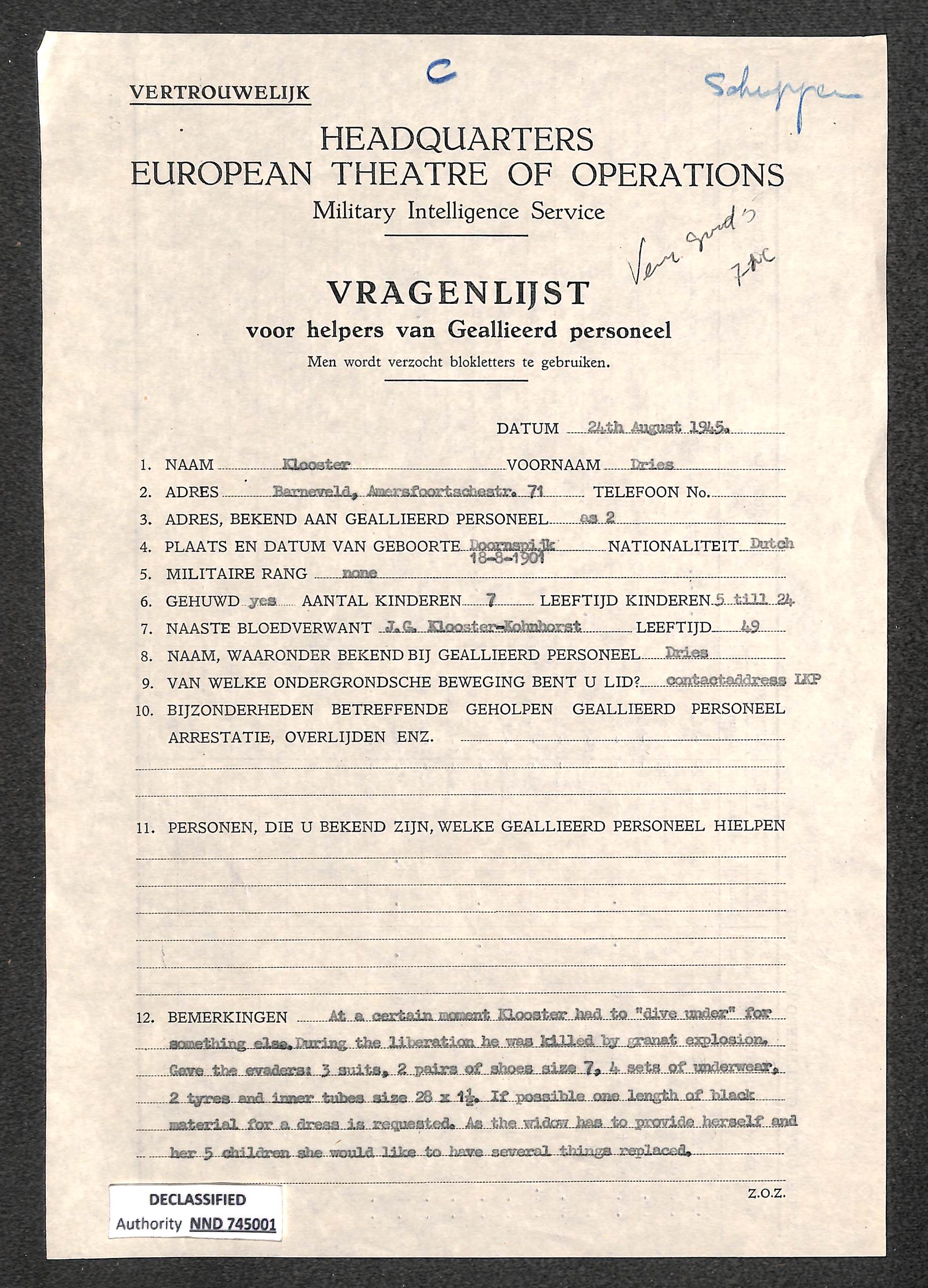
The family thanked everyone who had shown sympathy at the death of "onzen lieven Man en Vader" (our dear husband and father), signed "FAM. KLOOSTER. Barneveld, Mei 1945. Amersfoortschestraat 71" (Voor Waarheid, Vrijheid en Recht, 31 May 1945).
✓ The questionnaire made out for the household for the Americans on 24 August 1945 gives seven children, aged 5 to 24, and her as next of kin, "J.G. Klooster-Kohnhorst", aged 49. Its remarks list what the house had given the evaders and say the widow would like several things replaced:
Gave the evaders: 3 suits, 2 pairs of shoes size 7, 4 sets of underwear, 2 tyres and inner tubes size 28 x 1½. If possible one length of black material for a dress is requested. As the widow has to provide herself and her 5 children she would like to have several things replaced.
— Questionnaire for helpers of Allied personnel, Klooster, Dries · 24 August 1945 · US National Archives, RG 498 · p. 2
Born on 2 May 1896, she was 49 when it was made out. The Americans graded her husband Grade 5, posthumously, in May 1946 (the folder cover; Dries Klooster). The War Graves Foundation's file of 1955 has her his widow, "zonder" beroep, at "Barneveld, Amersf. str. 71" (scan 2). No record of her death has been found.
Where the sources disagree
Link to the section Where the sources disagreeWhen she was freed, and from where. ⚠︎ Not settled.
- Eman has her held at the Willem III barracks in Apeldoorn and let go after the Underground's message of 17 April 1945 (pp. 345–346).
- The Vrouwenmars list has her among the 116 women marched out of Westerbork on 11 April and freed near Grijpskerk on 14 April (the list; Stichting Vrouwenmars 1945).
- She cannot have been both at Westerbork until the 11th and released from Apeldoorn after the 17th. The list is a modern roll of the march; Eman wrote nearly fifty years on (her serial is of 1993, and the copy of the book read is catalogued 1999). The women's own accounts, or the Westerbork or Apeldoorn registers, would settle it.
When she was taken. Eman has April 1945, on a later visit (p. 345); the Encyclopedia tells it straight after the raid of 8 December 1944, without a date (the entry). ◐ If she was on the march, she was taken before Westerbork's last intake, 6 April (TracesOfWar).
How many children. Seven on the questionnaire's count, the L.O.-L.K.P. form and in Eman; "her 5 children" in the same questionnaire's remarks (p. 2; the form; Eman, p. 151). The questionnaire does not say why. ◐ The eldest child is 24 on the questionnaire; the name sweep lists a Meppel birth in each of 1921 and 1923 with her as mother, and her as mother of the groom at a marriage at Barneveld in 1945 (the sweep, index titles only), so the five may be those still at home.
Her name. Kohnhorst in the civil registers, Klooster-Kohnhorst on the questionnaire of 1945 and the undated L.O.-L.K.P. form; Köhnhorst in the War Graves Foundation's file of 1955 (the records; scan 2).