Jan Dijkstra
6 Oct 1921 – after 2014
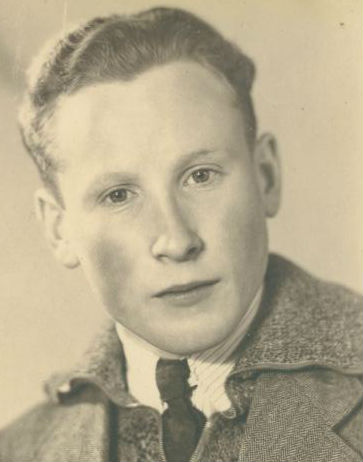
Jan DIJKSTRA, born 6 October 1921 (his own account, 2014), Hardy's "JAN (3)"
About: Son of the laundry boss at the De Glind children's village, who hid Major Coke at his father's house in 1944 and brought Allied men to the Veerman farm. Hardy's "Jan (3)", who met Murphy and Hardy outside Barneveld on 25 November 1944 and moved them on on 23 December.
Unit or role: Resistance man and guide, by his own account in the underground "straight away" in the war and in hiding from the end of 1943; a butcher by trade before it, a sports teacher after it.
Where: The Rudolphstichting at De Glind, next to Achterveld: Postweg 35 on the British index, "Postweg Achterveld" on the Veermans' form.
Evidence: ◐ his own account, published in 2014 (his memory, seventy years on) on the Rudolphstichting's centenary site, headed "100 jaar" (the four pages; the web page); ✓ Hardy's report, 13 January 1945; ✓ the Veerman family's forms for the Americans, May 1946 (p. 4, p. 5, p. 8); ✓ the British index of Dutch helpers, sheet D/13; ✓ Gerrit Hogeweg's form, 1945; ◐ his memory of Major Coke as ParaData prints it; ✓ Noordman, p. 286; ◐ Trouw, 18 July 1955 (OCR only)
De Glind
Link to the section De Glind✓ He was the son of Boke Dijkstra, the wasbaas, the laundry boss, of the Rudolphstichting children's village at De Glind. He wrote in 2014: "Op 6 oktober 2014 ben ik 93 jaar geworden. Het is nu 90 jaar geleden dat ik in De Glind kwam wonen" (on 6 October 2014 I turned 93; it is now 90 years since I came to live in De Glind), and "In 1924 kwamen wij er wonen. Mijn vader werd aangesteld als baas van de wasserij" (we came to live there in 1924; my father was appointed head of the laundry). He was three. His mother worked in the linen room, and the family took in foster children from the Stichting; his brother Fokke "omgekomen is in de oorlog" (died in the war) (his account, p. 1). The Stichting was "een gereformeerd instituut voor moeilijk opvoedbare kinderen" (a Gereformeerd institution for children hard to bring up) (De Telegraaf, 1994, OCR only).
At the De Glind primary school his teacher in his last years there was "meester Hogeweg", the later "bovenmeester Hogeweg" (headmaster Hogeweg) of his account, ◐ the Gerrit Hogeweg who sheltered Major Coke (below). Dyslexia, not then recognised, kept him down twice; he passed the entrance examination for the MULO two years after his friend did, but did not go (his account, pp. 1–2). He worked for an uncle who was a greengrocer in Groningen from August to January, three weeks in a bookshop at Amersfoort at about fourteen, and then as a butcher at Amersfoort, where he became manager of a new shop and learnt the trade, until 1940 (p. 2).
The war years, in his own words
Link to the section The war years, in his own wordsHe meant to go to the Indies and had passed the medical when the war came; he then worked for a Jewish butcher at Amersfoort (his account, p. 2):
In the end I came to a Jewish butcher. De Wolf was his name. I worked in his kosher butcher's shop until he was taken away. My father had offered that he could hide with us when the Germans started taking people away, but he did not dare to.
Dutch originalUiteindelijk kwam ik bij een Joodse slager terecht. De Wolf was zijn naam. In zijn koosjere slagerij heb ik gewerkt tot hij werd opgepakt. Mijn vader had aangeboden dat hij bij ons kon onderduiken als de Duitsers mensen op gingen pakken, maar dat durfde hij niet.
— Jan Dijkstra, Jan Dijkstra, de zoon van Boke Dijkstra, de wasbaas, 1924–1962, published on the Rudolphstichting's centenary site, 2014, p. 2 · the text
He took his butcher's diplomas at the trade school in Utrecht, went back to his old employer, and "Ik was slager en kok tot eind 1943 bij deze baas. En toen moest ik onderduiken" (I was butcher and cook for this boss until the end of 1943, and then I had to go into hiding). All that time he trained at a sports school in Amersfoort, in judo, jiu-jitsu and boxing, with Wim Boersma, who also lived at the Stichting (his account, p. 2). Trouw wrote in 1955 that "In de oorlog had hij een indrukwekkend aantal jiu jitsu-diploma's verzameld" (in the war he had collected an impressive number of jiu-jitsu diplomas) (Trouw, 18 July 1955, OCR only).
Of the resistance he wrote:
I myself was in the underground straight away in the war. Wim Boersma was in the resistance too and he was my mate. In the war we had onderduikers, of course, but later, after the battle of Arnhem, Englishmen and Scots as well. Wim Boersma and I took the Englishmen and Scots who had been hiding on the Veluwe across. … We placed them with someone, or we took them from their hiding address to the Betuwe, where the English were.
Dutch originalIkzelf zat in de oorlog meteen bij de ondergrondse. Wim Boersma zat eveneens in het verzet en hij was mijn maatje. Wij hadden in de oorlog natuurlijk onderduikers, maar later na de slag om Arnhem ook Engelsen en Schotten. Wim Boersma en ik brachten de Engelsen en Schotten die op de Veluwe gezeten hadden, over. … Wij plaatsten ze bij iemand of we brachten ze over van het onderduikadres naar de Betuwe, waar de Engelsen zaten.
— Jan Dijkstra, his account, 2014, pp. 2–3 · the text
Wim and he moved the men by bicycle, bikes requisitioned from the farmers, which he looked after. Towards the end of the war he had to go into hiding himself, "want de Duitsers kwamen bij ons te zitten" (because the Germans came to be quartered with us). He also wrote "Ik had de leiding van de verzetsgroep Scherpenzeel" (I led the Scherpenzeel resistance group) (p. 3). ⚠︎ That is his word; no other source here gives him a command.
Airmen for the Veerman farm
Link to the section Airmen for the Veerman farm✓ He brought airmen to Jacob Veerman's farm, Klein Achterveld: "Al in 1943 werden daar piloten gebracht door Jan Dijkstra uit De Glind. Drie keer zijn er piloten in tweetallen voor kortere of langere tijd op de boerderij opgevangen" (as early as 1943 airmen were brought there by Jan Dijkstra of De Glind; three times airmen were taken in on the farm in pairs, for shorter or longer stays) (Digitaal Monument Neuengamme, the Dutch Vriendenkring Neuengamme's online memorial, quoting Huurdeman). Jacob's daughter Alie remembered it: "Jan Dijkstra uit de Glind, die kwam ze halen en brengen" (Jan Dijkstra from De Glind, he fetched and brought them) (Oorlogsverhalen om nooit te vergeten, p. 83, the booklet). ◐ The year is not settled: the first pair Alie names, an Englishman and an Australian, are very probably the RAF men R.D. Ward and W.Q. McGeachin, whom the family's own forms put on the farm in October and November 1944 (see Where the sources disagree).
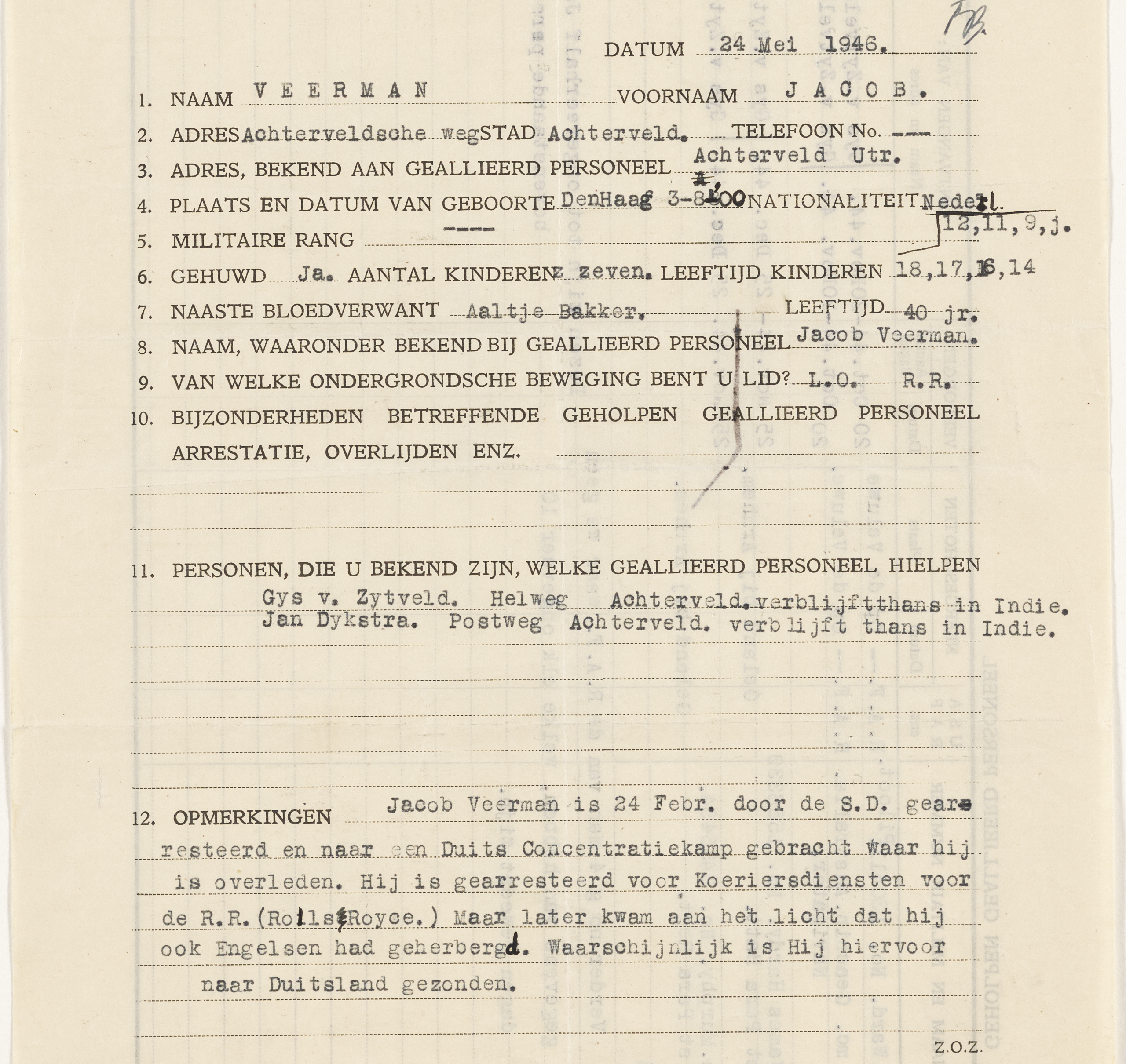
The family's handwritten table of 1946 has those two passed on to "J. Dykstra. Achterveld.", and adds four more RAF men whose names they did not know: "Allen zijn ontvangen en door gegeven aan bovenstaande adressen" (all were received and passed on to the addresses above; the table gives their stay as about a week on average) (p. 5). The later Dutch copy has the four "elk ongeveer 10 dagen" (each about 10 days) there, and ◐ (it seems to mean the four) "tot ongeveer half Januari" (until about the middle of January) and "door bovenstaande personen gehaald en gebracht" (fetched and brought by the persons above) (p. 9). The persons above are Gijs van Zijtveld and Jan; the forms do not say which of them brought which man.
A team of the Binnenlandse Strijdkrachten, September 1944
Link to the section A team of the Binnenlandse Strijdkrachten, September 1944◐ Huib van der Fange, an onderduiker at the Rudolphstichting and deputy commander of the Neder-Veluwe district of the Binnenlandse Strijdkrachten, the resistance's armed forces, wrote in his diary on 22 September 1944 that they had signed up to go and harry the Germans on the Veluwe, and on the 24th, after a night at Putten of which he wrote "We voelen weldra dat het niets wordt" (we soon feel it will come to nothing), that they reported to "Bart", Piet Veenendaal, had a railway line to reconnoitre ("De spoorlijn van A'foort naar Apeldoorn verkennen. Hij moet opgeblazen worden", reconnoitre the railway from Amersfoort to Apeldoorn; it must be blown up), and:
Our team keeps growing. It now consists of Barends (Jan Dijkstra), Piet (Wim Boersma), Flippie (Gerard van Wijk), Sjon, Fokke Dijkstra, Gerrit (Henk van Bentum), Rijndert (Huib van der Fange).
Dutch originalOnze ploeg breidt zich steeds uit. Hij bestaat nu uit Barends (Jan Dijkstra), Piet (Wim Boersma), Flippie (Gerard van Wijk), Sjon, Fokke Dijkstra, Gerrit (Henk van Bentum), Rijndert (Huib van der Fange).
— Huib van der Fange's diary, 24 September 1944, as printed in De Telegraaf, 17 September 1994 · the article (OCR only)
◐ The names in brackets are very probably the article's, not the diary's (the article does not say whose they are), and it does not say the two Dijkstras are brothers. ◐ It is very probably this Jan, as "Barends", with his brother Fokke, then seventeen: Van der Fange lived at the Rudolphstichting where the Dijkstras did, Jan's own account names Wim Boersma as his partner in the resistance (his account, p. 2), and the De Glind young men's society's notice of 1946 names Van der Fange and Gerard van Wijk beside Fokke (the notice; Fokke's page). Gerard van Wijk was at the De Glind primary school with Jan (his account, p. 1).
Major Coke, October and November 1944
Link to the section Major Coke, October and November 1944✓ He moved a wounded Arnhem officer, Maj. J. S. A'D. Coke (52602) of the KOSB, from Gerrit Hogeweg's house to his father's. Coke had broken out of the hospital at Paleis Het Loo with two glider pilots, by Zegers on the night of 10/11 October 1944 (ParaData has Saturday 14 October, Maj. John Coke) (Zegers's form, p. 3; Maj. John Coke). Gerrit Hogeweg of the L.O., whose form gives Rudolphlaan 6, Barneveld, with Achterveld as the post address, wrote on 27 September 1945:
In Oct 44 Major COKE lodged during a few days with Mr. HOGEWEG. Major COKE came down near ARNHEM in a glider on 17 Sep 44. He was brought to Mr. HOGEWEG by Jhr. O.R.A. van VALKENBURG … The Major was wounded and Dr. RENKENS of SCHERPENZEEL rendered medical service to him. He was taken away by Jan DYKSTRA for the Germans came to Mr. HOGEWEG's house. Jan DYKSTRA took the Major to his father. Later on it is told that in trying to pass the German lines the Major was shot.
— US National Archives · RG 498, helper file of Gerrit Hogeweg · questionnaire of 27 September 1945, section 10 · p. 2
The "father" is Boke Dijkstra, to whom Willem Zegers of Uddel passed Coke and the two glider pilots, "B. Dijkstra, Postweg 35, Glinden, Post Achterveld"; Zegers wrote that "the Major stayed behind in Glinden with fever caused by wounds" (Zegers's table, p. 4; his form, p. 3). Jan's own account of 2014 tells the move from his side:
I still remember headmaster Hogeweg coming over to ask whether Major Coke could stay with us a while longer, because the Germans were coming too close at his place. The Germans did not just come into the laundry, only once a week to shower. We also took an onderduiker to one of the Stichting's farms, at De Haan's, to make room for Major Coke, who was in our house.
Dutch originalIk weet nog dat bovenmeester Hogeweg naar ons toe kwam om te vragen of majoor Coke nog een poosje bij ons kon blijven, want bij hem kwamen de Duitsers te dichtbij. In de wasserij kwamen de Duitsers niet zomaar, alleen eens per week om zich te douchen. We hebben ook nog een onderduiker naar een van de stichtingsboerderijen gebracht bij De Haan om ruimte te maken voor majoor Coke die bij ons in huis zat.
— Jan Dijkstra, his account, 2014, p. 3 · the text
In the same account the German soldiers were quartered in the girls' pavilion opposite the Dijkstras' house, and one evening, walking Coke along the road, he met a patrol: "Dat waren gelukkig Oostenrijkers" (they were Austrians, luckily), guarding the German officers, "En die majoor Coke met zijn Engelse kop begon gewoon een praatje met die soldaten, want hij sprak beter Duits dan ik" (and that Major Coke with his English head simply started chatting to the soldiers, because he spoke better German than I did). Of the escape from Het Loo, "aan een stukje gordijnkoord" (by a piece of curtain cord), he wrote "Dat koord heb ik gekregen en het ligt nu in het bevrijdingsmuseum in Oosterbeek" (I was given that cord and it is now in the liberation museum at Oosterbeek) (his account, p. 3).
◐ ParaData prints a longer memory of his in English. Its profile of Coke is based on R. Sigmond's history of the battalion, Off at Last (2009), which we do not hold; ParaData does not say the memory comes from there:
My father was a laundryman at Rudolfstichting, and we lived in the annex of the laundry and bathing building. In the fourth year of the war we hid several Jews and Allied pilots who needed a place to stay overnight on their journey to safety. I remember John Coke very well. After the two glider pilots had left us, the Hoogeweg family had to make room for a German officer and the Major came to our house. There were many Germans in and around the girls’ pavilion. After the Battle there were also many captured British jeeps near our house. After supper the Major and I often took a walk to exercise his injured foot and we would walk right past the Germans in the girls’ pavilion. During the day the Major would sit by the window and would turn away only if German patrols passed by our house. He stayed for about six weeks and was upset that for medical reasons he was not allowed to join the first escape attempt. He was even advised not to join the second attempt but he insisted to go. So during one of the next Saturdays we took the Major to a rendezvous point. Before the Major left he gave me a piece of Royal Curtain Cord and used the rest of the rope to tie up his trousers. He also gave me and my brother Fokke a ten guilder bank note. Over his uniform he wore a long coat. He said goodbye to my parents and there we went on my bicycle with John on the back. Fokke accompanied us and another member of the Resistance was cycling about a 100 yards in front of us to warn us of any danger. Between the villages of Barneveld and Lunteren we met up with others of the Resistance and said goodbye to John.
— Jan Dijkstra, as quoted by ParaData (Airborne Assault Museum), "Major John Coke" · the page
◐ The "second attempt" was Pegasus II. Coke went on it as "de commandant van de achterhoede" (the commander of the rearguard), and by Boeree's chronicle of Ede was shot in a struggle at the house of Schriek Sr., "het stafkwartier van de batterij" (the battery's staff quarters) (Boeree, p. 183); the CWGC has his death on 18 November 1944 (CWGC). The night is not settled (Maj. John Coke). Jan wrote in 2014 that he "is later gesneuveld bij Renkum" (was later killed near Renkum) (his account, p. 3).
With Murphy
Link to the section With MurphyBack from Pegasus II
Link to the section Back from Pegasus IIMurphy's party was one of those that never reached the river on Pegasus II, the crossing of 17/18 November 1944 (Operation Pegasus II). Jan's account of 2014 goes on from Coke's death. ◐ It names no operation for the group of 60 men; that they are the Pegasus II men is our reading, since Coke died on Pegasus II:
Of that group of some 60 men, 20 were killed, 20 got across and 20 came back to the Veluwe again. And those I later took on to Veerman's in Achterveld again.
Dutch originalVan die groep van zo’n 60 man zijn er 20 gesneuveld, 20 overgekomen en 20 nog weer teruggekomen op de Veluwe. En die heb ik later weer bij Veerman in Achterveld gebracht.
— Jan Dijkstra, his account, 2014, p. 3 · the text
⚠︎ The figures are his own, seventy years on; the accounts of Pegasus II on its page differ from them. ◐ Murphy and Hardy came back to the Veluwe from the Pegasus II attempt (Hardy's report does not use the name; Operation Pegasus II), and are on the Veerman family's forms as passed on to Jan (below).
The ride to Achterveld, 25 November 1944
Link to the section The ride to Achterveld, 25 November 1944On the night of 24/25 November 1944 Murphy and James Hardy slept in a barn in the Otterlo area, ◐ J. van Essen's at Harskamp by Noordman, with Leslie Davison; the next evening helpers cycled the three of them, "pannier fashion", to the outskirts of Barneveld (Hardy; Noordman, p. 285). There Hardy's "JAN (3)" came to meet them:
We waited at this rendezvous about half an hour when we were joined by three more men, called GHYS, one JAN (3), and the other's names I do not know. They had with them three extra bikes besides their own so we continued our journey, our previous guides leaving us here. On approaching ACHTERVELD (Sheet 2, 470954) DAVISON left us with two of our guides while MURPHY and I continued our journey with GHYS.
— MI9 · Pte J. Hardy, 16 Parachute Field Ambulance · IS9/WEA/1/270/2351 · 13 January 1945 · the report
✓ Noordman names the two: by Jan and Gijs "worden Jan Dijkstra en Gijs van Zijtveld uit Achterveld bedoeld" (are meant Jan Dijkstra and Gijs van Zijtveld of Achterveld) (Noordman, p. 286; Gijs van Zijtveld). The Veerman family's forms bear the name out (below), and the De Glind man is the Jan of the forms: they give his address as "Postweg Achterveld" (p. 8), the British index has "DIJKSTRA, Jan" at Postweg 35, de Glind, with his father and brother (sheet D/13), and ◐ his own account reads as having him take the men back from Pegasus II to a Veerman at Achterveld (above; it names neither the operation nor Jacob). Jacques Vanhaelen, the son of Jopie Veerman, names a Jan Dijkstra, with a "Gijs Sijkveld", among Jacob Veerman's well-known contacts in that time, in his account of the family sent to Stewart in October 2026 (unpublished); it gives no place, so it does not itself identify the De Glind man.
Davison's own memoir, written in his words "after 56 years", has him taken in by the family of "the manager of the local public baths", "Dijkstra's (I only learned and named after the war)", with "four sons and a maid", two of whom, "Jan and Faulkner", were in the underground; he stayed about ten days (Davison). The cyclist who brought him there, and after the ten days took him on to Scherpenzeel, is "this man, who I know as Jan ter Wall", a different Jan, and "Jan and Faulkner" are two of the household's teenage sons; nothing in the memoir makes Jan Dijkstra one of the two guides who took Davison on from Achterveld on 25 November (Hardy, above). Jan's own account has "Freeman die later dat boek geschreven heeft, kwam bij ons samen met Davidson" (Freeman, who later wrote the book, came to us together with Davidson), one of the three who escaped from the palace, and has Freeman and "Davidson" cross on Pegasus I (his account, p. 3). ◐ The name is very probably Davison's, whom Noble's report also spells DAVIDSON (Noble), but Jan does not say so, and his sentence puts "Davidson" with Freeman on Pegasus I, the place Zegers gives to the second glider pilot, Sgt P.J.D. Mahoney (Zegers's table, p. 4); the identification is ours. The memoir brings Davison to the Dijkstras by a different road (see Where the sources disagree).
The month at the farm
Link to the section The month at the farmGijs took Murphy and Hardy on to the Veerman farm. During their month there, Hardy wrote, "GHYS and JAN (3) visited us on three occasions bringing us soap, shaving material, etc, and giving us the news" (Hardy).
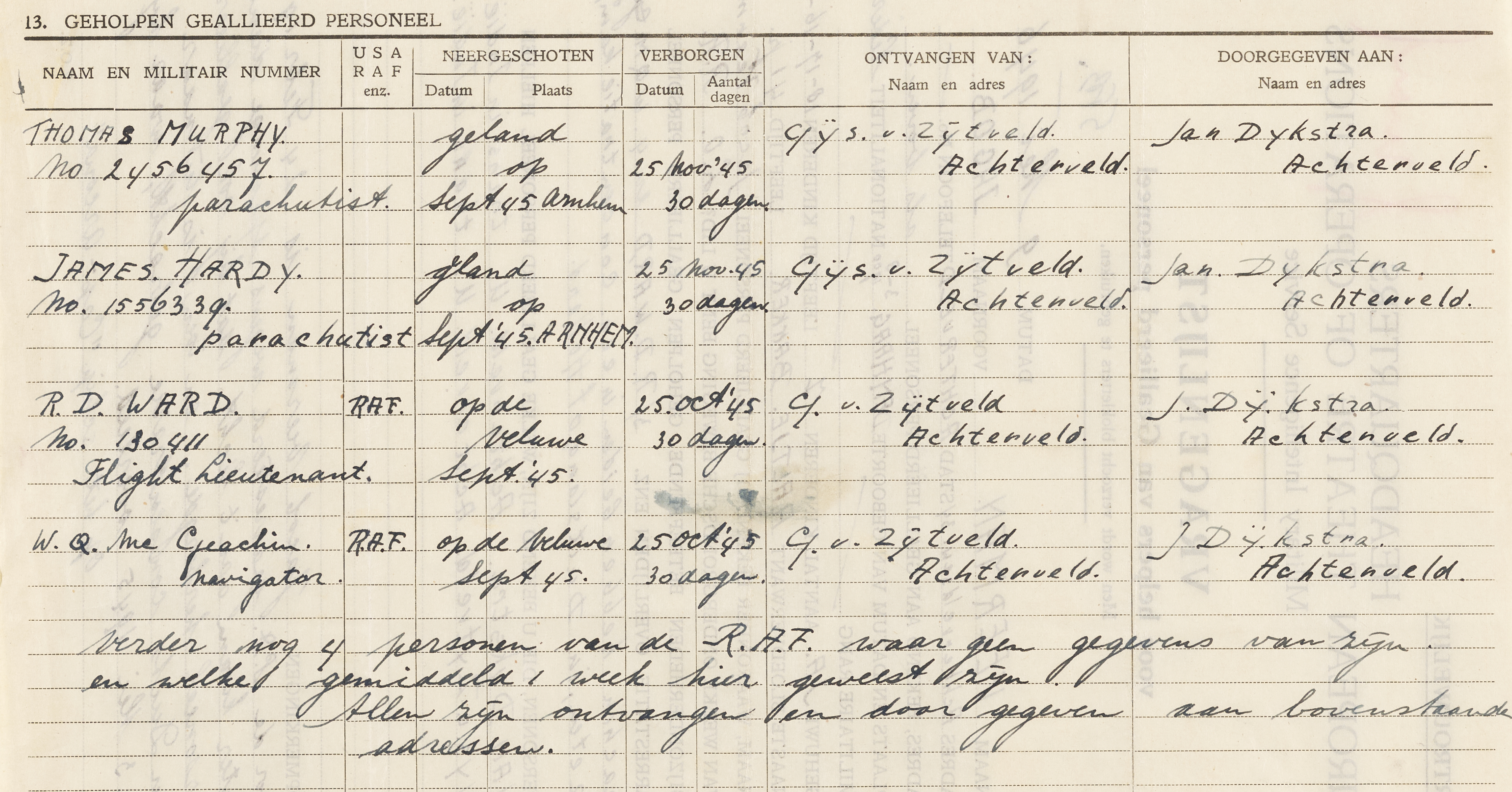
The Veermans wrote it down for the Americans in May 1946 (the transcripts write the hand's ÿ as y, so the handwritten quotes here carry y):
- the handwritten table: "THOMAS MURPHY No 2456457. parachutist." (his number is 2756457, by his Record Office letter and Jeane van Galen's page; the family's forms have it wrong) and "JAMES. HARDY. No. 1556339. parachutist", hidden from 25 November for "30 dagen" (30 days), each received from "Gys. v. Zytveld. Achterveld." and passed on to "Jan Dykstra. Achterveld." or "Jan. Dykstra. Achterveld."; the year is written '45 throughout, a slip for 1944 (p. 5);
- the two copies of 24 May 1946: in English "25 Nov. 25 Dec. '44", "1 month", received from "Gijs v. Zijtveld." and passed on to "Jan Dijkstra." (p. 7); in Dutch "25 Nov.44- 25 Dec. 44." for Hardy and "25 Nov.44. 25 Dec.44" for Murphy, passed on to "Jan Dykstra." and "Jan Dijkstra." (p. 9; The family's own record).
23 December: on to Amerongen
Link to the section 23 December: on to AmerongenAt about 1400 hours on 23 Dec, JAN (3) came and told us we were to move again, so we walked with him to the home of GHYS, about 10 minutes walk, where we picked up a bicycle each and we set off with HAN who took us to AMERONGEN (Sheet 5, 435803) ARRIVING THERE AT ABOUT 1630 HOURS.
— MI9 · Pte J. Hardy, 16 Parachute Field Ambulance · IS9/WEA/1/270/2351 · 13 January 1945 · the report
At Amerongen the two were taken that night to Gerald Esveld's house (Hardy; Amerongen). Noordman's Dutch text of the same passage has them ride to Amerongen with "Jan als begeleider" (Jan as escort) (Noordman, p. 286; see Where the sources disagree).
Charles Noble at the bath-house manager's, December 1944
Link to the section Charles Noble at the bath-house manager's, December 1944◐ The Dijkstra house very probably took in Charles Noble, the doctor who would be caught with Murphy, in early December, while Murphy was nearby at the Veermans'. Dries Klooster's household at Barneveld passed "C.B. Noble" (and "K.D. Barnwell") on to the Rudolphstichting, typed "Rüdolfstichting" with its first vowel overtyped (Klooster's file, p. 3), and Noble wrote that he was taken:
to ACHTERVELD nearby, to the house of the manager of the penal settlement bath-house (name unknown). It was his son who conducted me to the house. He was arrested the following week …
— Capt C.B. Noble, his report (Noble)
After three days he was "taken by another son of the bath-house manager to a farm near SCHERPENZEEL" where Tex Banwell was hiding (Noble). The son arrested is very probably Fokke, taken on 15 December (Fokke Dijkstra); which son took Noble to Scherpenzeel, Noble does not say. ⚠︎ No source names the Dijkstras as Noble's hosts. Davison's memoir has Noble in the same party of four, to be shared out among families that day ("captain Noble said he would go last"), with Davison going to the Dijkstras; it does not say where Noble went (Davison).
⚠︎ Noble's own later account (unpublished private papers, shared with us privately), told long after the war, does not name Achterveld or the bath-house. Between Barneveld and Scherpenzeel it has "about five days in another farm which was used as a collection point for the British agents who had been dropped and had radio communication with London", where his report has three days; it names no son and no arrest. ◐ That it is the same stay rests on its place in his route.
His brother's arrest, 15 December 1944
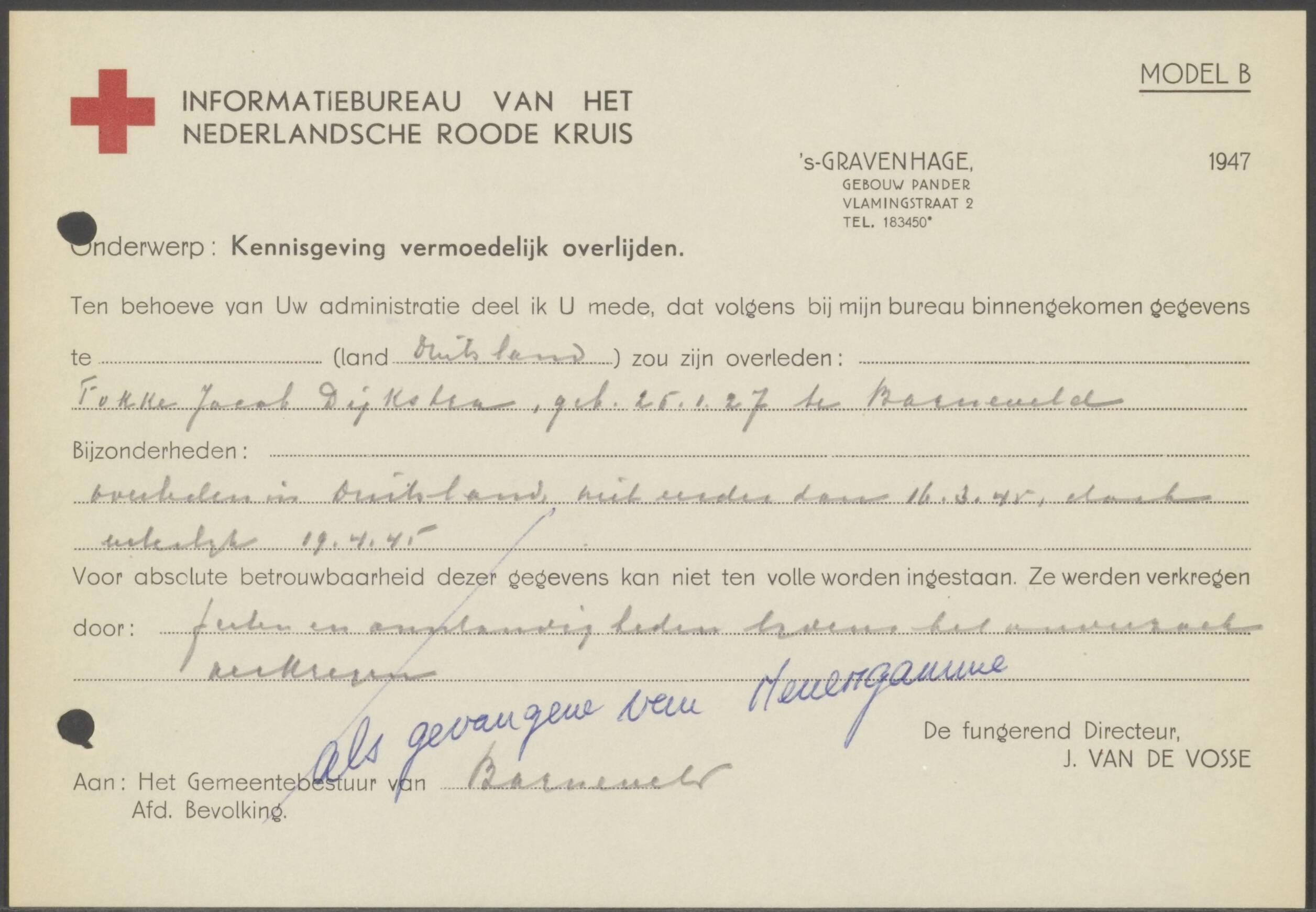
Link to the section His brother's arrest, 15 December 1944His brother Fokke, seventeen, a courier, was taken in the SD's raid on Piet Veenendaal's farm at Scherpenzeel on 15 December 1944 (Huurdeman; Digitaal Monument Neuengamme), sent from Amersfoort to Neuengamme on 2 February 1945 (Fokke's page), and died in Germany between 16 March and 19 April 1945 by the Red Cross (the Red Cross notice). Jan wrote in 2014:
My little brother was taken in a raid just behind the Stichting, at Piet Veenendaal's, a farmer who was the leader of the resistance, a former soldier. That business was rolled up and Wim Boersma and I managed to get away, but my brother had just been to Scherpenzeel with post for the resistance, and how exactly he was taken, nobody knows.
Dutch originalMijn broertje is bij een razzia opgepakt, net achter de stichting bij Piet Veenendaal, een boer die de leider was van het verzet, een oud militair. Die zaak werd opgerold en Wim Boersma en ik wisten te ontsnappen, maar mijn broertje was net met post voor het verzet naar Scherpenzeel geweest en hoe hij precies is opgepakt, weet niemand.
— Jan Dijkstra, his account, 2014, p. 3 · the text
He adds that Fokke was taken to Veenendaal's farm and "daar is hij gemarteld" (there he was tortured), and later to the concentration camp (p. 3). Fokke's own page has the camps and the dates.
Liberation, and the Indies
Link to the section Liberation, and the IndiesHe wrote that a week after the liberation he and Wim Boersma were asked to serve in Prince Bernhard's staff guard at Apeldoorn, "een erebaan" (an honorary post); after four weeks at the gate Wim volunteered for the Indies, and Jan cycled to Ede to sign up too (his account, pp. 3–4). ✓ By May 1946 he and Gijs van Zijtveld were both there: "JAN Dykstra. Achterveld. U. thans in Indië" (now in the Indies) (the Veerman file, p. 4), and on the copy of 24 May "Jan Dykstra. Postweg Achterveld. verblijft thans in Indie." (is now staying in the Indies) (p. 8); the English copy has "Jan Dijkstra. Postweg, " " (" " ")", the ditto marks standing for Achterveld and "in India now" (p. 6).
His certificates
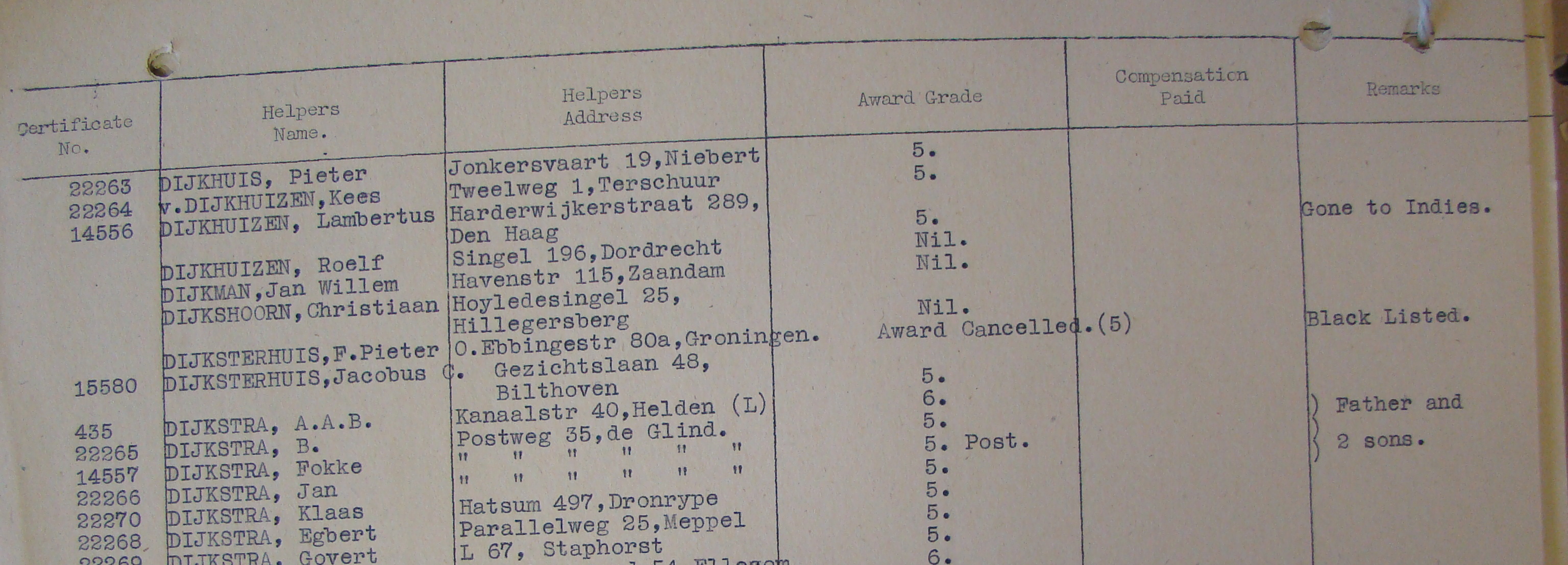
Link to the section His certificates- ✓ The British index. Sheet D/13 of the British index of Dutch helpers has "DIJKSTRA, B.", "DIJKSTRA, Fokke" and "DIJKSTRA, Jan" together, the address "Postweg 35, de Glind." with ditto marks for the two sons, and the remark "Father and 2 sons." standing beside the three, its brace not clearly reaching Jan's line. Jan's line has certificate 22266 and grade 5 (sheet D/13, read on the image; the index's notes). Grade 5 carried the Eisenhower certificate (same notes).
- ◐ The American list. The Americans' list of Grade 5 (Eisenhower) certificates has "(1111) DIJKSTRA, Jan / Rudolphestichting / Achterveld, The Netherlands", two entries after his brother's "(1109) DIJKSTRA, Fokke J. (Posthumous)" (the list, p. 45, image-checked). Very probably him, by the Rudolphstichting address (the list is alphabetical, so the place beside his brother says nothing).
- The catalogue of the Dutch helper files at the US National Archives has no file in his name: the name sweep of 17 October 2026 lists the Dijkstra and Dykstra files, his father's, his brother's and other men's (the name sweep).
Sport at De Glind
Link to the section Sport at De GlindBy his own account he came back from the Indies in January 1948, joined Wim Boersma, who had taken over the Amersfoort sports school where they had trained before and during the war, and in September 1948 began at the CIOS, the national sports teachers' college, in its first year. The Rudolphstichting then asked him to be its sports leader, and he worked there six years: the swimming pool in summer, football, jiu-jitsu and gymnastics in winter, for about ten groups (his account, p. 4). He also trained the Achterveld football club (p. 1). Trouw profiled him on 18 July 1955 as in charge of sport and recreation at the Rudolph Stichting "in de buurt van het Gelderse plaatsje Achterveld": born 6 October 1921, back from Indonesia in 1949 as a corporal, then the C.I.O.S., then a sports school in Amsterdam set up with a friend; the Stichting's swimming pool, open from 15 May to 15 September, was "het onbetwist domein is van Jan Dijkstra" (the undisputed domain of Jan Dijkstra), with gymnastics, games, handicrafts and drama in the winter (Trouw, 18 July 1955; OCR only, not checked against the page image).
He wrote that he lived at De Glind with his wife, and worked there as sports teacher, until 1962, and that he later took a government post in home-economics information ("huishoudelijke voorlichting") (his account, pp. 1, 4). He turned 93 on 6 October 2014 and wrote his memories after the reunion (p. 1); the Rudolphstichting's centenary site, headed "100 jaar", published them on 3 December 2014 (the web page). Nothing later has been found.
Where the sources disagree
Link to the section Where the sources disagree- Who rode with them to Amerongen on 23 December. Hardy's report has Jan walk them to Gijs's house and a guide he calls Han take them on (Hardy); Noordman's Dutch text has them cycle to Amerongen with "Jan als begeleider" (Jan as escort) (Noordman, p. 286).
- When he began bringing airmen to the farm.
- ⚠︎ Huurdeman has "Al in 1943", and Alie Veerman remembers the first pair, an Englishman and an Australian, in 1943 (Neuengamme online memorial; the booklet, p. 83).
- ◐ The family's own forms of 1946 have the RAF men R.D. Ward and W.Q. McGeachin, the second from Australia, there from October 1944 (p. 5; p. 9).
- Jan's own account has the Englishmen and Scots only "later na de slag om Arnhem" (later, after the Battle of Arnhem), after onderduikers earlier in the war, and gives no date (his account, pp. 2–3); his memory in ParaData has the Dijkstras hiding pilots "in the fourth year of the war" (ParaData).
- Ward and McGeachin. The family's handwritten table has the two RAF men passed on to Jan Dijkstra (p. 5); its later copies have them passed back to "Gys v. Zytveld", in English "same person- same address" (p. 7; p. 9).
- Achterveld or De Glind. The family's forms and Noordman have him "of Achterveld"; Huurdeman and Alie Veerman have "Jan Dijkstra uit De Glind"; the British index has Postweg 35, de Glind. De Glind lies next to Achterveld, and the Postweg address is the same on the family's form and the index, so these are one man.
- How Davison came to the Dijkstras.
- Hardy has Davison leave him and Murphy near Achterveld on 25 November with two of the guides (Hardy).
- Davison's memoir has him scattered from the main column of Pegasus II with Noble and two glider pilots, a night in a cow barn, and a helper taking him on a crossbar to the Dijkstras', and after about ten days on to a farm at Scherpenzeel; it calls the two sons who were in the underground "teenage", where Jan was 23 (Davison).
- Noordman has Davison taken from the ride to Wijnand van Veldhuizen's farm at Scherpenzeel, with no Dijkstras (Noordman, p. 286).
- Jan's own account has "Davidson" come to the Dijkstras with Freeman, one of the glider pilots of Coke's escape in October, and the two cross on Pegasus I (his account, p. 3). By Zegers (and ParaData) Freeman's companion was Sgt Mahoney (Zegers, p. 4). Davison stayed with the Dijkstras after Pegasus II by Hardy and his own memoir, so ◐ the account very probably puts Davison's name on Mahoney's place, or puts the two stays together (the identification is ours).
- Where Coke spent October, and in what order. Hogeweg's form has him lodged "a few days" with Hogeweg before Jan took him to his father; Zegers has the Major and two glider pilots four days at his house at Uddel and then at B. Dijkstra's; ParaData's memory of Jan has about six weeks with the Dijkstras (Hogeweg; Zegers, p. 4; Maj. John Coke; Boke Dijkstra).
- Where Coke was killed. Jan's account has "bij Renkum" (his account, p. 3); Boeree puts it at Schriek's house, the German battery's staff quarters, in his chronicle of Ede (Boeree, p. 183); more on his page.
- When he came back from the Indies. His own account: January 1948, and the CIOS from September 1948; Trouw, 1955: back in 1949, then the C.I.O.S. (his account, p. 4; Trouw, OCR only). His own account is the later, but gives the month.
- How long at the Stichting. His account has six years' work there, and also that he lived at De Glind with his wife, and worked there as sports teacher, until 1962; a photograph printed with his memories is captioned "Sportleraar J. Dijkstra bij de gym. demonstratie op 1 maart 1960" (sports teacher J. Dijkstra at the gymnastics display on 1 March 1960) (the photograph; his account, pp. 1, 4).