The Broekhuijzen family
About: The household of G. Broekhuijzen on the Essenerweg at Kootwijkerbroek, where, by Noordman, the British agent Dick Kragt and his helper Joop Piller had their headquarters in the autumn of 1944. By Noordman too, the six men led from Kijkuit, Murphy among them, stopped there on the morning of 7 November 1944.
Unit or role: ◐ Hosts, by Noordman and Boeree, of the headquarters of Kragt's "Frans Hals" organisation (Noordman, pp. 281, 311; Boeree, p. 199).
Where: The Essenerweg, Kootwijkerbroek (Noordman, p. 311); "Mr. G.J. BROEKHUIZEN, Essenerweg 70, Essen (district Barneveld)" in February 1946 (Noorlander's claim form, p. 5, read on the image).
Evidence: ◐ Wolter Noordman, Schuilplaats de Veluwe (2019), pp. 281 and 311 (the book); ✓ Th. A. Boeree, Kroniek van Ede (1947), p. 199 (the page); ✓ G. A. Noorlander's claim form for the Americans, 12 February 1946 (US National Archives 286677822, pp. 4–5); ✓ Joop Piller's helper file, 1945–46 (US National Archives 286680491, pp. 2, 13); Hardy's MI9 report; Lipmann Kessel's Surgeon at Arms, pp. 104–114 (the text); a 2010 oral-history interview at the Gemeentearchief Barneveld, not digitised (the catalogue).
The headquarters
Link to the section The headquarters◐ Wolter Noordman, glossing Lipmann Kessel's account of the house (below), gives Kragt's and Piller's headquarters as theirs:
With his wife Lies he worked together with Dick Kragt, first from Emst; later they moved their activities to Kootwijkerbroek. They had their headquarters at G. Broekhuijzen's on the Essenerweg in Kootwijkerbroek.
Dutch originalMet zijn vrouw Lies werkte hij samen met Dick Kragt, eerst vanuit Emst, later verplaatsten zij hun activiteiten naar Kootwijkerbroek. Zij hadden hun hoofdkwartier bij G. Broekhuijzen aan de Essenerweg in Kootwijkerbroek.
— Wolter Noordman, Schuilplaats de Veluwe (2019), p. 311 · the book
"He" is Joop Piller, "alias Joop van Amstel", whom Noordman calls "een gevluchte joodse zakenman uit Amsterdam" (a Jewish businessman who had fled from Amsterdam) (same page). Noordman gives no date for the move.
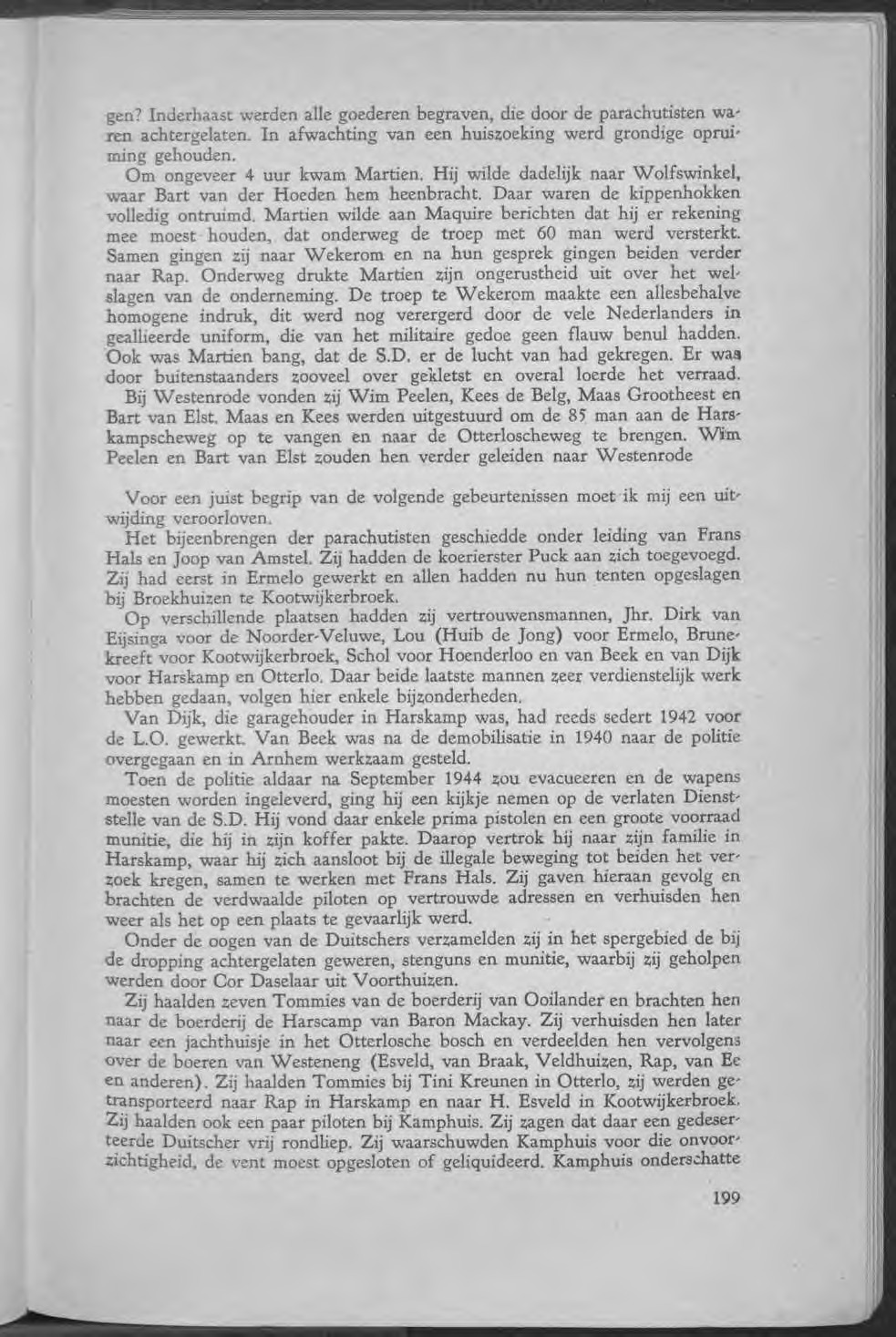
✓ Boeree's chronicle of Ede, printed in 1947, has Kragt and Piller based at "Broekhuizen's" at Kootwijkerbroek when the paratroopers were gathered for the Pegasus II crossing of November 1944:
The gathering of the paratroopers was done under the leadership of Frans Hals and Joop van Amstel. They had taken on the courier Puck. She had worked in Ermelo first, and all of them had now set up camp at Broekhuizen's at Kootwijkerbroek.
Dutch originalHet bijeenbrengen der parachutisten geschiedde onder leiding van Frans Hals en Joop van Amstel. Zij hadden de koerierster Puck aan zich toegevoegd. Zij had eerst in Ermelo gewerkt en allen hadden nu hun tenten opgeslagen bij Broekhuizen te Kootwijkerbroek.
— Th. A. Boeree · Kroniek van Ede (1947) · p. 199, checked on the page image
Frans Hals was Kragt's cover name and Joop van Amstel Piller's (Dick Kragt; Joop Piller). ◐ The two books very probably mean one household: the same village, the same two men, one surname spelt two ways.
The next paragraph of the same page names "Brunekreeft voor Kootwijkerbroek" among the organisation's trusted men (vertrouwensmannen), and a later one sends Tommies "naar H. Esveld in Kootwijkerbroek" (Boeree, p. 199). Neither is said to be connected to Broekhuizen.
The address in the records
Link to the section The address in the records- ✓ G. A. Noorlander of Kootwijkerbroek (the form, p. 2; the sex is not given: box 6 reads "widow") claimed from the Americans for "our 6 Volt vibrator set (Philips)", ◐ a battery radio (our reading), lent to "Captain D. Kay", one of Kragt's names, and gave as the two witnesses Kay and "Mr. G.J. BROEKHUIZEN, Essenerweg 70, Essen (district Barneveld)" (the form, 12 February 1946, p. 5; the surname is overtyped, but reads Broekhuizen on the image). ◐ Very probably Noordman's G. Broekhuijzen of the Essenerweg.
- ✓ Essenerweg 70 was Piller's own address: "Essenerweg 70 (Stationsweg 34) Barneveld" on his form of July 1945 (the Stationsweg number is faint on the carbon and could be 31) (p. 13), and "J. PILLER, Essenerweg 70, Barneveld" in the Americans' request for his clearance of 1 August 1946 (p. 2).
- ◐ K. Ch. F. Niermans, who worked for the Frans Hals organisation, "Was living in the house of capt. Kay and capt Piller at Essen, and later at Barneveld" (his form, p. 4). His form gives no owner's name; Essen is the place of the Essenerweg address on Noorlander's form.
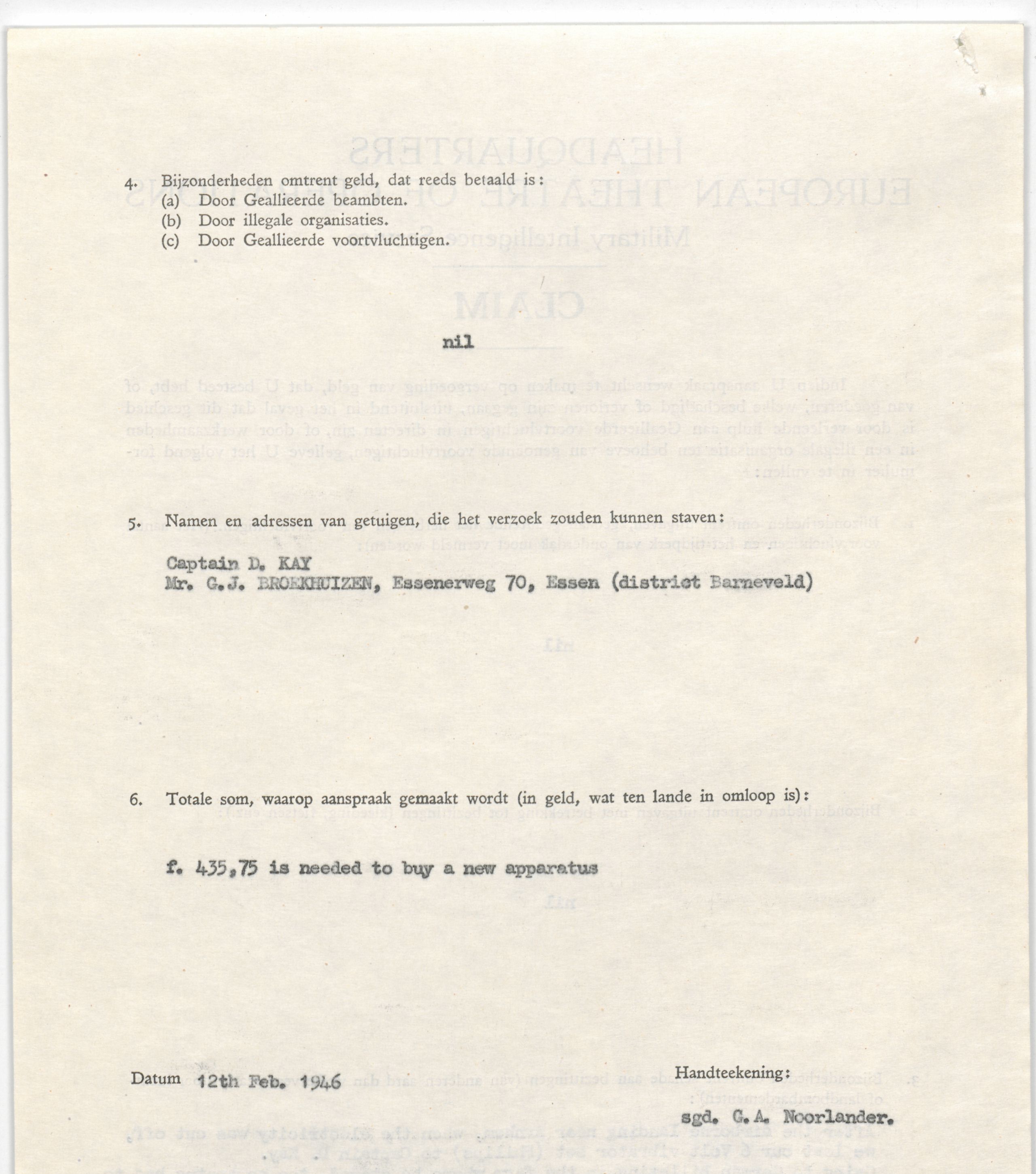
Noorlander's claim also says what the billeting cost the radio:
After the airborne landing near Arnhem, when the electricity was cut off, we lent our 6 Volt vibrator set (Philips) to Captain D. Kay. Owing to German billeting in the farm where he stayed, the apparatus had to be hidden in the ground for about one month and due to the dampness it was badly damaged.
— G. A. Noorlander, claim form for the Americans · 12 February 1946 · p. 4
The form does not name the farm where Kay stayed.
Lipmann Kessel's three weeks under the barn
Link to the section Lipmann Kessel's three weeks under the barnLipmann Kessel, the surgeon who had escaped from Apeldoorn, was brought with three others to the house where Frans Hals had his headquarters; ◐ the Broekhuijzens', by Noordman's gloss (p. 311, above). Noordman's caption to their thanks in the Kruimels' guestbook names the four as "Allenby, Lipmann-Kessel, Longland en Allen", written "voordat zij vanuit Garderen naar Kootwijkerbroek vertrokken" (before they left Garderen for Kootwijkerbroek) (fig. 197, p. 310). In Noordman's Dutch version of Kessel's account, "We bleven twee dagen in Garderen en werden toen overgebracht naar een huis in Kootwijkerbroek, waar de Britse agent Frans Hals zijn hoofdkwartier had" (we stayed two days in Garderen and were then taken to a house in Kootwijkerbroek, where the British agent Frans Hals had his headquarters) (p. 311).
Kessel's own book, Surgeon at Arms, describes the house: "a small farm-house" at the end of an avenue of trees (p. 104), where Joop and Lise, "who was evidently Joop's wife", lived in one half (pp. 105–106):
We gathered that Joop and Lise had only been there a short while, and that the farmer and his wife lived in the other half of the house. When I’d translated this to the others, Peter asked if the farmer knew about us. “Good heavens, no!” Joop thought this quite a joke. “That is, I certainly hope he doesn’t.”
— Lipmann Kessel · Surgeon at Arms · p. 106 · the text
The hide was under a farm building about thirty yards from the house, past a haystack (p. 108). Its entrance was "hidden by loose straw lying beneath a cart which always stood in the farm barn", an emergency exit led up into a hen-coop, and the men were to talk only in whispers "for fear of being detected by the farmer’s boy who was often in and out of the barn"; it "was to be our home for nearly three weeks" (p. 109). After dark they were let out for a meal in the house (p. 110); Kessel adds that the farm-house had "numerous visitors who called on underground business" (p. 110). In Noordman's version, for the last five days "mochten we de schuilplaats helemaal niet meer verlaten, omdat een Duitse artillerie-eenheid haar intrek genomen had in de boerderij naast onze schuilplaats" (we were not allowed to leave the hide at all, because a German artillery unit had moved into the farm next to our hide), and on 16 November at about half past seven in the evening they left it for the gathering before Pegasus II (p. 311).
With Murphy
Link to the section With MurphyOn the night of 6 to 7 November 1944 six men, Murphy among them, were walked from the forester's house Kijkuit towards Harskamp by Dirk van Eysinga and Huib de Jongh ("Lou"), with Joop Migchelsen leading the first stretch (Noordman, pp. 293–294, who has "de zes Britten"). Hardy's report lists them as Banwell, "the Sergeant Glider Pilot John", Murphy, "P/O. Brentford", "the other Paratrooper" and himself (Hardy); ◐ they are Tex Banwell, Bernard Haller, Murphy, James Branford, Sam Walsh and James Hardy, by Kijkuit and Harskamp and Noordman, who in his Dutch rendering of Hardy's list has "gliderpiloot Haller" (glider pilot Haller) and "James Branford" (p. 281) and names the unnamed paratrooper "Sammy Walsh" (p. 280) (Noordman). Noordman has the purpose: they were to go by night to the area of Kootwijkerbroek "en daar overgenomen zouden worden door Dick Kragt" (and be taken over there by Dick Kragt) (p. 293).
Liesbeth Verweij, governess to jonkvrouw Ima van Eysinga (Noordman, p. 293), wrote an account of the night that Noordman prints; she says she got up at six that morning "zodat ik nog kon genieten van zijn verslag" (so that I could still enjoy his report), when Dirk van Eysinga got home:
At about five the agreed whistle signal of 'Frans Hals' sounded. Our group was then resting in the bushes by signpost 215. At the host's in Kootwijkerbroek Lou had to talk a lot of lively Dutch at the 'six evacuees', to draw the villagers' attention away from their being Allied men.
Dutch originalTegen vijf uur klonk het afgesproken fluitsignaal van ‘Frans Hals’. Onze groep lag toen uit te rusten in het struikgewas bij paddenstoel 215. Bij de gastheer in Kootwijkerbroek moest Lou veel en druk Hollands praten tegen de ‘zes evacués’, om de aandacht van de dorpelingen af te leiden dat het om geallieerden ging.
— Liesbeth Verweij, in Noordman, Schuilplaats de Veluwe (2019), p. 294 · the book
Dirk turned back at the signpost and cycled home to Elspeet (same page), so ◐ neither he nor Verweij, at home in Elspeet, can have seen the scene at the host's (our inference). Verweij names no host and does not say where the scene at the host's came from.
Hardy's report has the stop from the evaders' side:
We arrived at HARSKAMP about 2100 hours on 7 Nov having broken our journey at the house of a man called DICK (?) for a meal and a rest on route. It was dark when we got there and I do not know where it was.
— MI9 · Pte J. Hardy, 16 Parachute Field Ambulance · IS9/WEA/1/270/2351 · 13 January 1945 · the report
◐ Noordman makes Dick's house the Broekhuijzens': "Het gezelschap uit de Kijkuit werd in de vroege morgen van 7 november opgepikt door evasion-agent Dick Kragt en meegenomen naar zijn onderkomen bij de familie Broekhuijzen in Kootwijkerbroek" (the party from Kijkuit was picked up early on 7 November by the evasion agent Dick Kragt and taken to his lodging with the Broekhuijzen family in Kootwijkerbroek) (Noordman, p. 281). Neither Hardy nor Verweij names the family; the name is Noordman's alone. That evening the six were taken on to Baron Mackay's estate at Harskamp (Noordman, p. 295; Hardy).
- ✓ In February 1946 Noorlander named G. J. Broekhuizen of Essenerweg 70 as a witness who could confirm his claim (above); nothing held shows he gave evidence.
- ◐ The Gemeentearchief Barneveld holds a 2010 oral-history interview, not digitised, catalogued as follows:
Interview with Mr Broekhuizen, J.H., (1926, 19 in 1945), then: Essenerweg 158, Kootwijkerbroek, people in hiding, among them Jews (Johan Beek), and secret agents (Joop Piller, Dick Kragt). German billeting. 2010.
Dutch originalInterview van de heer Broekhuizen, J.H., (1926, 19 in 1945), toen: Essenerweg 158, Kootwijkerbroek, onderduikers, waaronder joden (Johan Beek) en geheim agenten (Joop Piller, Dick Kragt). Duitse inkwartiering. 2010.
— Gemeentearchief Barneveld · toegang 376, Het Verleden Verteld, inv. 8 · the catalogue entry
The catalogue does not say how he was related to G. Broekhuijzen, if at all.
- Noordman lists a "Dhr. J.H. Broekhuizen, Essen, Kootwijkerbroek" among his informants in the Netherlands, in the sources at the back of his book (Noordman, p. 337). ◐ By the initials and the place, very probably the man of the 2010 interview.
Where the sources disagree
Link to the section Where the sources disagree- The spelling: Broekhuijzen in Noordman (pp. 281, 311); Broekhuizen in Boeree (p. 199), on Noorlander's form (p. 5), in the 2010 catalogue and in Noordman's own list of informants (p. 337).
- What the farmer knew: Kessel's book has Joop say he hoped the farmer, who lived in the other half of the house, did not know about the four men under the barn (p. 106). ◐ That farmer is a Broekhuijzen only by Noordman's gloss of the same account (p. 311). The 2010 catalogue entry has the interview cover secret agents, Piller and Kragt, among the people hidden (the catalogue). None of the sources held says what the family knew of the men hidden there.
- Where Kessel's hide was:
- Under "the farm barn" in Kessel's book (p. 109); "onder een schaapskooi" (under a sheepfold) in Noordman's Dutch version, at the house where Frans Hals had his headquarters (p. 311).
- The Gemeentearchief Barneveld catalogues a reconstruction photograph from Surgeon at Arms as "de schuilplaats voor onderduikers onder een schaapskooi in Essen (bij Heimen van Esveld?)", with the question mark, listed beside the entries for Heimen van Esveld (GB00299).
- The same catalogue has "De hooimijt van Heimen van Esveld" (GB00336) and his house (GB00341), each with "Na de slag om Arnhem zaten hier een aantal geallieerde militairen ondergedoken" (after the Battle of Arnhem a number of Allied soldiers were hidden here), Kootwijkerbroek, 1944–45 (catalogue); Kessel passes a haystack on the way to his hide (p. 108).
- The house number: Essenerweg 70 for G. J. Broekhuizen and for Piller in 1945–46 (Noorlander; Piller); Essenerweg 158 for J. H. Broekhuizen "then" in the 2010 catalogue. Nothing held says whether that is one house renumbered or two houses.
- Another G. J. Broekhuis: Gerrit Jan Broekhuis, a baker of Ede born at Barneveld in 1913, has the same initials and a surname close to it, and the Veerman account has Jopie hiding with her uncle Gerrit Broekhuizen in Ede (Jacques Vanhaelen's account of the family, October 2026). Nothing held shows he is the Essenerweg man.