Lt Peter Allenby
London ◐ 3 Oct 1918 – 21 Apr 1971 ◐
Lt Peter Allenby, 16 Parachute Field Ambulance, with S/Sgt Albert Allen.
About: The anaesthetist of 16 Parachute Field Ambulance who worked beside Lipmann Kessel at the St Elisabeth Hospital in Arnhem, left the Apeldoorn barracks with Kessel, Cedric Longland and Allen in October 1944, and reached De Ruif at Garderen. He marched on Pegasus II in November and was taken prisoner; ◐ he is probably the Salisbury doctor Peter Sewell Allenby, who died on 21 April 1971.
Unit or role: Lieutenant, RAMC, 16 Para Fd Amb; anaesthetist (Kessel, Surgeon at Arms, p. 13); service number 306749, prisoner of war No 53660, by Kew's catalogue of his German prisoner-of-war card (WO 416/5/332).
Where: Arnhem (St Elisabeth Hospital), Apeldoorn (Willem III barracks), De Ruif at Garderen, Kootwijkerbroek, the Barneveld district; Pegasus II on 17/18 November 1944; by Boeree the hospital at Hoenderloo, then Amersfoort; Oberursel in Germany by 27 November 1944; Stalag IX-C, Bad Sulza, by his German card (WO 416/5/332); ◐ later Salisbury.
Evidence: ✓ the De Ruif guestbook (his own signature); Kessel, Surgeon at Arms and Warrack, Travel by Dark, the two accounts that name him; Boeree, Kroniek van Ede, p. 179, p. 188 and p. 187 (PDF page 191 of the book); Van den Brand's and Piller's helper forms; Kew's catalogue entries for two escape reports that name him (Warrack's WO 208/5433/23; Kessel's WO 208/5419/25); ✓ Kew's catalogue entry for his German prisoner-of-war card, WO 416/5/332 (the entry; the card, which the entry lists as two, not seen); ✓ the Arolsen list, tied to him by the card (under After); ◐ the Lancet's obituary of 1971, resting on the identification below.
✓ Two German records give his birth as 3 October 1918 in London: a prisoner-of-war card and a hospital sick-book entry. Kew's catalogue of his German prisoner-of-war card has "Name: Peter S Allenby. Date of Birth: 3 October 1918. Place of Birth: London.", a lieutenant of the Royal Army Medical Corps, number 306749 (WO 416/5/332). The card is his by the name with its initial and by the rank and corps of his own signature, "Peter S. Allenby, Lieut RAMC" (below); the card is not digitised, so the date is read from the catalogue. The Arolsen list from the hospital at Oberursel has the same date and place, "3.10.18 London" (under After). ◐ That he was born in London: both records most likely took it from what he told the Germans, so they are one witness to the place, not two, and the GRO index registers the one Peter S. Allenby of 1918–19 at Headington, by Oxford (under After). No other record tied to him gives his life before Arnhem. ◐ The Lancet's obituary of the Salisbury doctor (see After) has him graduate in 1943 from St Thomas's Hospital; ⚠︎ that clause is held only in the reconstruction of the passage in the source file, not in any one of the snippets it lists (the Lancet, 22 May 1971; search snippets, the page itself not seen).
At the St Elisabeth Hospital in Arnhem Kessel shared "the little basement bedroom" with "Peter Allenby, my anaesthetist", at a time when the Airborne Division had retreated southwards (Kessel, p. 13). In Kessel's book Allenby stays at St Elisabeth after Longland has left with a convoy of wounded: Kessel "took the padre and Peter aside and explained the full situation", and "Peter agreed to get the next morning's escape party organised" (Kessel, p. 36); the book then has "Peter" with Kessel on arrival at Apeldoorn (below). No source dates this; the dates given for Longland's and Kessel's moves differ (Cedric Longland, Lipmann Kessel).
With Murphy
Link to the section With MurphyAt Apeldoorn the doctors were under Col. Graeme Warrack. Kessel's book has "Peter" (Allenby, p. 13) with him on arrival, asking the staff "Have any managed to break out?" (p. 62). After the meeting in which Warrack said that it was "our duty now to try and escape", "Shorty asked if I would team up with him and Peter", and the three planned the way out, with "Peter" asking "What about the river?" (pp. 63–64). Warrack's book puts Allenby among "those who had broken out of the Apeldoorn hospital on the Sunday night with Shorty and Lippy" (Warrack, p. 143; page image). Sunday was 15 October 1944. Kew's catalogue entry for Kessel's report has the escape on 15 October and names "Lieutenant P S Allenby" and "Staff Sergeant A Allen" (WO 208/5419/25); the account Noordman prints under Kessel's name has 16 October, the evening service (Noordman, p. 309). The date is argued on Kessel's page.
✓ Warrack's diary, ◐ near-contemporary (no source says it was written the same day), has his arrival: at 16.30 on 13 October "LIPPY, ALLENBY and Father McGOWAN turned up from ARNHEM with 16 orderlies and a certain amount of gen, all of which was most illuminating" (Warrack's diary, p. 45; typed transcript of about 1982, Wellcome Collection RAMC/1584). It has a church parade at 17.45 on Sunday 15 October and a count at 11.00 on the Monday "as some citizens appear to have gone absent" (p. 46), naming no one. He is not on the diary's roll of the medical staff at Apeldoorn, which is undated (the roll, pp. 51–55).
In the barn where the Pegasus II party was gathered, Allenby told Warrack how it went: after the evening service the party "got away as planned and had walked all night through the rain, taking their bearings by compass", lay up in a wood, and Kessel spoke Afrikaans to a labourer who fetched someone from the underground; the man "put them in touch with 'Dick', a British agent", and "For five days they lived in a barn with no light at all" (Warrack, pp. 143–144; page images 143, 144). That is Warrack's retelling, in his book of 1963, of what Allenby told him in the barn on the day the party gathered, before the briefing at 11 o'clock: the escapers' agent "Dick" had "brought them to the meeting-place tonight" (Warrack, p. 144; page image).
Four medical men came to De Ruif at Garderen, the house of Dr Johannes Kruimel: Walsh says that new guests, "vier medici" who had also made a successful escape, arrived, and that the house threatened to become too full, which was why he and Murphy had to leave; Noordman names the four as "Peter Allenby, arts, en Allen, een verpleger, beiden van de 16e Fieldambulance, en de chirurgen Longland en Lipmann-Kessel" (Noordman, p. 300). Allenby signed the guestbook as "Peter S. Allenby, Lieut RAMC, 16 Parachute Field Ambulance, Oct. 44". Omroep Gelderland's article on the guestbook and the Eskes papers lists the Willem III escapers whose names are in the Van Eysinga papers as "John Haller, Tom Murphy, James Hardy, Sammy Walsh, Lipmann-Kessel, Cerediq Longland, Allenby en Allan" (Omroep Gelderland); the article does not say which entry is whose. Whether Allenby and Murphy were in the house together is argued in Garderen and on Kessel's page.
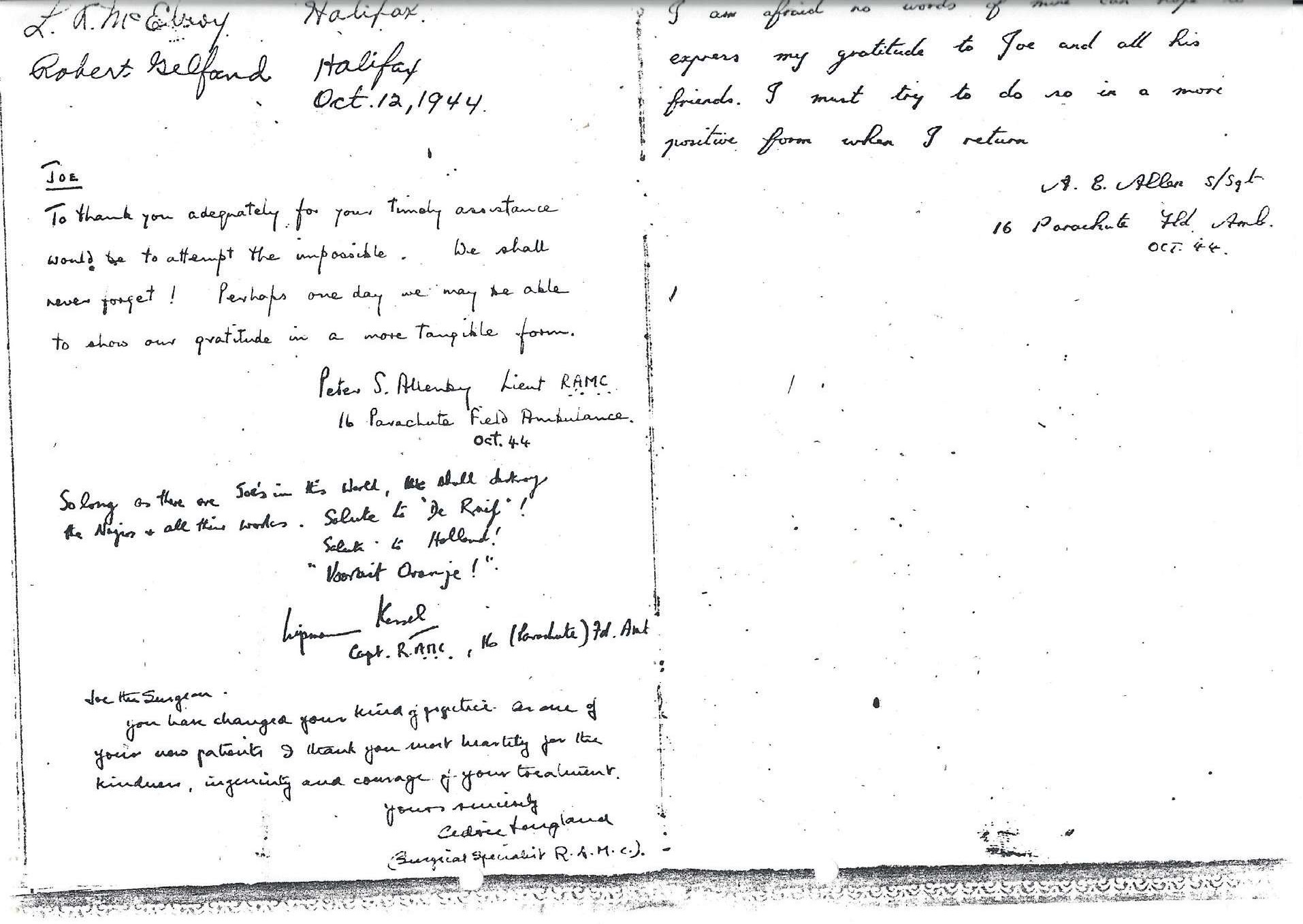
Who hid him. Gerrit van den Brand, Wesselscheweg 78, Kootwijkerbroek, born at Barneveld on 3 October 1907, "Provided food, shelter and clothing" for "Lt. Peter Allenby, RAMC, 14 days" and "S/Sgt Allen, RAMC, 14 days", with two RAF officers for eight weeks (van den Brand's file, p. 2). When is not recorded. Joop Piller's list has "P. S. ALLENBY Lt." with Longland and Allen, "dropped Arnhem"; ⚠︎ the number typed beside him is overtyped and repeats Sgt Simpson's, so it is probably not his (Piller's file, p. 14). Kessel, in the account Noordman prints, spent three weeks under a sheep-pen near Frans Hals's (Dick Kragt's) headquarters at Kootwijkerbroek, cared for by Joop and Lies (Noordman, p. 311); it has "we" after naming Longland, Allenby and Allen, and Noordman's caption to the guestbook has the four leave Garderen for Kootwijkerbroek, so ◐ Allenby was there with him, though the account does not name him again.
◐ Karel Niermans, a courier of the Frans Hals organisation, lists "lt. P.S.Allenby - paratrooper" with Longland, Kessel, Allen, Warrack and others as "known to capt. D Kay and capt. J. Piller" (Niermans's table, p. 5; checked on the image). It gives no dates and no place.
Before De Ruif, from the Dutch side. ◐ De zwarte herfst (1984) is about the doctors at the St Elisabeth Gasthuis in Arnhem and the Dutch junior doctors who worked beside them. From the Archive's full-text snippets, a Dutch doctor remembers "majoor Longland, kapitein Lipmann Kessel, kapitein Peter Allenby en nog een vierde" of the 16th Para Field Ambulance, and says that somebody "is uit Apeldoorn ontsnapt, samen met Longland en Allenby, die mij 'een paar uur tevoren in vertrouwen had genomen'", and that Allenby "had mijn naam" (had my name; the snippet breaks off there) (the snippets; not read on the page, and the speaker is not named in them).
Pegasus II. In Maguire's order of march for the night of 17 to 18 November 1944 there was a vanguard under himself, "een hoofdmacht onder de doktoren Longland en Allenby" (a main body under the doctors Longland and Allenby) of pilots and hospital staff, unarmed, and a rearguard under Major Coke (Boeree, Kroniek van Ede, p. 179, checked on the page image). Heaps lists "the doctors Longland, Allenby, Redman, Warrack and Kessel" in the column (Heaps, p. 193).
Five accounts say what became of him, two of them second-hand:
- Warrack, who was not at the crossing place, heard it from Tineke (Kroner) in the next days: "Shorty had been wounded in the thigh and Peter Allenby had remained behind with him and the other wounded" (Warrack, p. 165; page image).
- Kessel, back in hiding, "picked up scraps of information" from Kragt: "When Shorty was shot in the thigh, Peter had apparently insisted on staying with him and others who were wounded; Staff, too, had been recaptured" (Kessel, p. 153).
- Heaps has "Allenby and Maguire were caught and sent to Germany" (Heaps, p. 195), and Ede's wartime history has Maguire, Cedric Longland and "kapitein Allenby" (Captain Allenby) taken prisoner and "later als krijgsgevangenen naar Duitsland gevoerd" (later sent to Germany as prisoners of war) (Ede manuscript, p. 47; Operation Pegasus II).
- Boeree, on the page before the one below, has him with the wounded on the march, before the column reached the main road, and at the Hoenderloo hospital (Boeree, p. 187, PDF page 191, read on the image):
- "Een twaalftal mannen werd gewond en luitenant Allenby, die achter hen liep, verleende de eerste hulp" (about a dozen men were wounded and Lieutenant Allenby, who was walking behind them, gave first aid).
- One of them, Emile Kerkhoven, of the unarmed main body, was badly wounded; Allenby gave him some morphine to calm him, and refused when he begged for a heavy dose.
- "Er gingen zes uren voorbij, voordat hij door de Duitschers werd opgenomen" (six hours passed before the Germans took him in), and "Allenby vergezelde hem in gevangenschap. Zij werden overgebracht naar het Lazareth in Hoenderloo, waar Emile op 24 November aan zijn wond overleed" (Allenby went into captivity with him; they were taken to the hospital at Hoenderloo, where Emile died of his wound on 24 November). Allenby later wrote to the parents about him. Boeree does not say whether Allenby was still at Hoenderloo on the 24th, or on what day Allenby himself was taken.
Boeree, in Ede's history of 1947, has Thieme, a Dutchman held at Ede who had been given the name Charley Smith (p. 187), after his interrogation, brought to Amersfoort with the English prisoners of war, "waar de volgende dag ook Maquire [sic] en Allenby verschenen" (where Maguire and Allenby also turned up the next day), and sent on to Germany by way of Enschede (Boeree, p. 188, read on the image; more on Hugh Maguire's page). He gives no date there either.
In German hands. ✓ A post-war list of the medical records of the former reserve hospital at the Hohemark sanatorium, Oberursel, has among its English patients "Allenby | Peter S. | 3.10.18 London | m. | Krankenbuch | 27.11.44", an entry in its sick book on 27 November 1944 (the list, Arolsen Archives 2.1.1.1).
- It is the lieutenant, on two records: Kew's catalogue of his German prisoner-of-war card has the same name with its initial, the same birth date and the same birthplace, for a lieutenant of the Royal Army Medical Corps (WO 416/5/332). The initial S is his own: he signed the De Ruif guestbook "Peter S. Allenby, Lieut RAMC" (above), and Joop Piller's list has "P. S. ALLENBY Lt." (Piller's file, p. 14).
- The card has him held at "Stalag IXC Bad Sulza" as prisoner of war No 53660, with a date of capture of 26 November 1944 (same entry). No source we hold says when he went there or what he did there.
- ⚠︎ The card's date of capture, 26 November, is eight days after the night of 17/18 November and the day before the Oberursel entry. Not settled.
- Warrack, Kessel, Heaps and the Ede history have him left behind or caught at the Pegasus II crossing (above); none of the four gives a day.
- Boeree (p. 187, above) has Emile Kerkhoven picked up by the Germans some six hours after he was shot on the march, before the column reached the main road, and Allenby going into captivity with him to the Hoenderloo hospital, where Emile died on 24 November; ◐ so the card's date most likely records something later than the capture.
- The card has not been seen, and the catalogue does not say what the date records.
- The GRO birth index for England and Wales has one Peter S. Allenby in 1918–19, registered in the December quarter of 1918 at Headington, by Oxford, mother's maiden name Codington; the FreeBMD search of the surname for December 1918 to March 1919 lists no other Peter and no Allenby registered in London (FreeBMD). The quarter fits 3 October 1918, but both German records say London. ⚠︎ Whether that index entry is his is not settled; ◐ a search that found no Allenby registered in London cuts against London, unless he was registered under another spelling or the index missed him.
- A wider search on the given name Peter for 1918–19 is recorded in the note beside it as returning the same entry; its result page is not held.
◐ Later life, if the Salisbury doctor is the same man. The Lancet of 22 May 1971 prints an obituary headed "PETER SEWELL ALLENBY M.B.Lond.":
Dr. Peter Allenby, a general practitioner in Salisbury, died on April 21 at the age of 52. After graduating in 1943 from St. Thomas's Hospital he joined the parachute regiment, serving in Europe. He was dropped and later taken prisoner at Arnhem. He achieved the rank of lieut.-colonel before being officially discharged from the Army.
— The Lancet · obituary of Peter Sewell Allenby · 22 May 1971 · the snippets
It says he was survived by his wife and children, and that "Dr. Allenby was a wonderful and understanding colleague, with a charming personality, and he was a skilled and conscientious doctor". The obituary page is not available to read, so these are the Archive's search-inside snippets, chained into the passage above, and the printed page is 1079 or 1080. ⚠︎ Two clauses, "After graduating in 1943 from St. Thomas's Hospital he joined the parachute regiment, serving in Europe" and "before being officially discharged from the Army", are in the source file only inside that chained passage, not in a snippet it lists.
- Aged 52 on 21 April 1971 puts the birth between 22 April 1918 and 21 April 1919, which holds 3 October 1918, the date on his German records; so would any man born in those twelve months.
- The identification rests on the name ("Peter S." against "Peter Sewell"), on being dropped and taken at Arnhem, and on the age; nothing we hold ties the lieutenant of 16 Para Fd Amb to Salisbury.
- The obituary says he "joined the parachute regiment", where the guestbook and the other records here have Allenby a medical officer of the Royal Army Medical Corps in 16 Parachute Field Ambulance (the guestbook signature: "Lieut RAMC"); a loose obituary may explain it, but it is a difference.
- Molly Maidment's Chained to Sarum: what the Mayoress saw, 1958-9 (1991) has "Peter Allenby, our family doctor and stalwart friend" (the search snippet; the page is not available to read): a Salisbury doctor of that name in 1958–59, who is the Lancet's man, and so ours, only if the Lancet's is ours.
Where the sources disagree
Link to the section Where the sources disagree- What happened to him after Pegasus II. Warrack and Kessel have him staying behind with the wounded Longland; Heaps and the Ede history have him caught with Maguire and sent to Germany. These need not conflict; none of the four says where he was taken. Boeree has him taken with the wounded Emile Kerkhoven to the hospital at Hoenderloo (p. 187), and at Amersfoort the day after Thieme (p. 188); he has Longland in the prisoner-of-war hospital at Lingen and does not mention Allenby there (p. 191).
- Where he marched. Boeree has him with Longland in command of the main body; Warrack has Longland as his own liaison officer on the march (Warrack, p. 148; page image) and does not say what Allenby did.
- Who was Kessel's anaesthetist. ✓ Kessel's book has him share the basement bedroom with "Peter Allenby, my anaesthetist" (p. 13); Hackett's memoir has "Derek Ridler, who had been Kessel's anaesthetist" (p. 149), while Bol's second typed copy has "Derek Ridler Capt. dentist" (p. 17) and the account Noordman prints has "Derek Ridler, onze tandarts" (our dentist) (p. 312). ◐ Not reconciled: Kessel's own book is the better evidence for Allenby's role, which is ✓ on that book alone.
- The date of the escape is argued on Lipmann Kessel's page: Sunday 15 October (Warrack, Kew's entry) or 16 October (the account Noordman prints, ParaData).
- ✓ Herford's report of 1944 has "Three M.Os. and 2 Orderlies escaped" under 15 October (Lt-Col Martin Herford's report, Journal of the RAMC, vol. 98 (1952), p. 300, read on the page image); ◐ it names no one, but three doctors fit Kessel, Longland and Allenby. ◐ Herford and Hall (p. 186) count five who went, three MOs and two orderlies, one more than Kessel's party of four (Kessel, Longland, Allenby and Allen); Warrack's staff counts at 20.00 fall by four between the 15th and the 16th (141 to 137, diary pp. 46–47), which fits four. ⚠︎ Not settled.
- His birthplace. London on his German card as Kew catalogues it and on the Oberursel list; Headington, by Oxford, for the one Peter S. Allenby in the GRO index for 1918–19 (WO 416/5/332; the list; FreeBMD). ◐ London, on two German records that are his but are likely one declaration; the index search found no Allenby registered in London, so the Headington entry may be his or another man's.
- When he was taken. The night of 17/18 November 1944 or the days after, in the accounts of Pegasus II (none gives a day), and Boeree has Emile Kerkhoven taken some six hours after he was shot on the march, with Allenby going into captivity with him (above); 26 November 1944 as the date of capture on his German card; in the Oberursel sick book on 27 November (above). ⚠︎ Not settled until the card is seen; ◐ the card's date most likely records something later than the capture.
- His rank. Lieutenant in his own signature, on Piller's list, in Kew's entries for the escape reports and on his German card (WO 416/5/332), and "luitenant Allenby" in Boeree (p. 187); "kapitein" (captain) in the Ede history and in a snippet of De zwarte herfst (above). ✓ Lieutenant.