Pte Thomas Lorne
27 Jun 1919 or 1921 ⚠︎ – ?
Pte Thomas Lorne (5671590)
About: A private of 156 Parachute Battalion, Murphy's battalion, wounded and taken at Arnhem, who escaped from an ambulance on 26 September 1944 and was hidden by Dutch helpers from the Liemers to Eerbeek until Pegasus II, where he was shot through the knee in a party under Major Coke and taken. Kew has him liberated at Fallingbostel on 16 April 1945, the camp and day Murphy gives for his own liberation.
Unit or role: Pte, 5671590, 156 Parachute Battalion, Army Air Corps; ◐ 3 Platoon, A Company (ParaData).
Where: Arnhem and Oosterbeek (hospital), the Apeldoorn road, ◐ Zevenaar, Giesbeek and Groessen, Brummen, Eerbeek (Wolzak's camp centre "Coldenhove"), Loenen and Laag Soeren, the Wolfswinkel barns at Lunteren, the Hindekamp near Ede, Hoenderloo, Stalag XI-B Fallingbostel.
Evidence: ✓ the 1946 MI9 papers recommending his Mention in Despatches, read on the page images, and now also on Kew's own copy, WO 373/102/393 (p. 450, p. 452); ✓ the London Gazette, 6 June 1946, read on the page image; ✓ Wolzak's helper file, read on the page images (p. 3, p. 5, p. 6); ✓ Kew's catalogue entries (WO 208/3337/699, WO 208/3331/699, WO 416/227/520); ✓ seventeen Dutch helpers' 1945-46 questionnaires and cards (NARA RG 498), read on the page images, each linked under the place it belongs to; ◐ ParaData, which quotes him from O'Reilly's battalion history (not held).
He appears in Operation Pegasus II.
◐ ParaData, which says it rests on John O'Reilly's 156 Parachute Battalion: From Delhi to Arnhem (Thoroton, 2009), has him enlist in the Somerset Light Infantry in 1937 aged 16, volunteer for airborne forces and train as a parachutist at RAF Chaklala, in north-west India, and join 3 Platoon, A Company, 156 Para Bn in February 1943. He went with the battalion to Italy and back to England in November 1943, and jumped at Arnhem with the second lift on 18 September 1944 (ParaData).
✓ His number is 5671590. ParaData's page does not give it; the MI9 papers, the Gazette and Kew's catalogue do. Kew has two birth dates for him, one in each of two entries (Where the sources disagree).
Arnhem and the ambulance
Link to the section Arnhem and the ambulance- ◐ Wounded and taken. ParaData has him shot in the buttock and taken prisoner at Oosterbeek (ParaData). ✓ The MI9 account says the Germans captured him "when he was in hospital at OSTERBECK ... suffering from a bullet wound" and types the month as "September 1943", a slip for 1944 (p. 452).
- ✓ 26 September 1944, the ambulance. Kew's index of his escape report: "Attempted escape only from ambulance whilst being transferred from Osterbeck to Apeldoorn hospital, 26 Sep 1944" (WO 208/3337/699; the report is not digitised). The MI9 summary: he and two other wounded men escaped from the moving ambulance into woods, under fire from the guard (p. 452).
ParaData quotes his own account from O'Reilly's book:
I was on one of the last ambulances on the road, which was crowded with refugees and bordered by woods, together with Sergeant Thompson and Private Ross, both of my unit. We decided to try to escape. The ambulance was going too fast to jump so we clung onto the side and back until we thought it opportune to drop. When time came we were shot at by the guard on the ambulance but he missed and we managed to get through the throng of refugees and into the woods.
— Pte T. Lorne · quoted in ParaData's profile from John O'Reilly, 156 Parachute Battalion: From Delhi to Arnhem (Thoroton, 2009) · the page
- ◐ The three men. Sergeant Thompson and Private Ross, "both of my unit", that is 156 Para Bn. ParaData adds that Ross dressed Lorne's reopened wound and that they were helped by Dutch farmers with food, dressings and a map (ParaData). ✓ The MI9 summary has the companions render first aid, the party walk towards the Rhine, and a farm and a guide found "after several hours" (p. 452).
- ◐ Zevenaar. ParaData: after three days a Dutch guide took them across a river it spells "the Lissel", and in Zevenaar they were hidden in a farmhouse with a Jewish mother and child (ParaData). Zevenaar is confirmed by Dutch helpers' forms (next section); none of them mentions the Jewish mother and child.
- ✓ The Rhine. MI9: Lorne and one other reached the Rhine with Dutch help, the third man lost the day before "whilst avoiding a German soldier"; it was "impossible to swim the Rhine as it was floodlit and the Germans were dug in along the bank". The two were then sheltered by the Dutch "for the next six weeks" and "in time were joined by many other escapers" (p. 452). ◐ ParaData names the man lost as Sgt Thompson and has Lorne and Ross hide for three weeks in a hollowed-out straw stack, joined by an RAF sergeant.
Zevenaar, Giesbeek and Groessen
Link to the section Zevenaar, Giesbeek and GroessenThe MI9 summary passes over the weeks between the ambulance and the Rhine evaders with one sentence, "the next six weeks". Five of the Dutch helpers' files fill them in, with Pte Ross beside him, from the Liemers, the country east of Arnhem between the Rhine and the IJssel (Hopink's form spells it "Lijmers"). The forms are the helpers' own answers to the Americans in 1945 and 1946, typed up by the Americans, and the dates on them do not agree (Where the sources disagree).
- ✓ Goris, Meten, Zevenaar. Geertruida Goris's questionnaire of 10 April 1946 has "Thomas LORNE" and "William Ross", "17-9-44", hidden from "25-9-44" for "40 days", who "Came up to the house by themselves", and passed to "Harmsen, NBS commander of Zevenaar". The Dutch copy adds that they had an unsigned note asking for food and shelter, and that they went on "via Rode Kruis auto naar veilige linie", by Red Cross car to the safe line (p. 3; p. 5).
- ✓ A search after they left. Her form says her house was searched "just after the pilots had gone": the NSB's Lt. de Man led it and found "a well hidden bicycle" (p. 2).
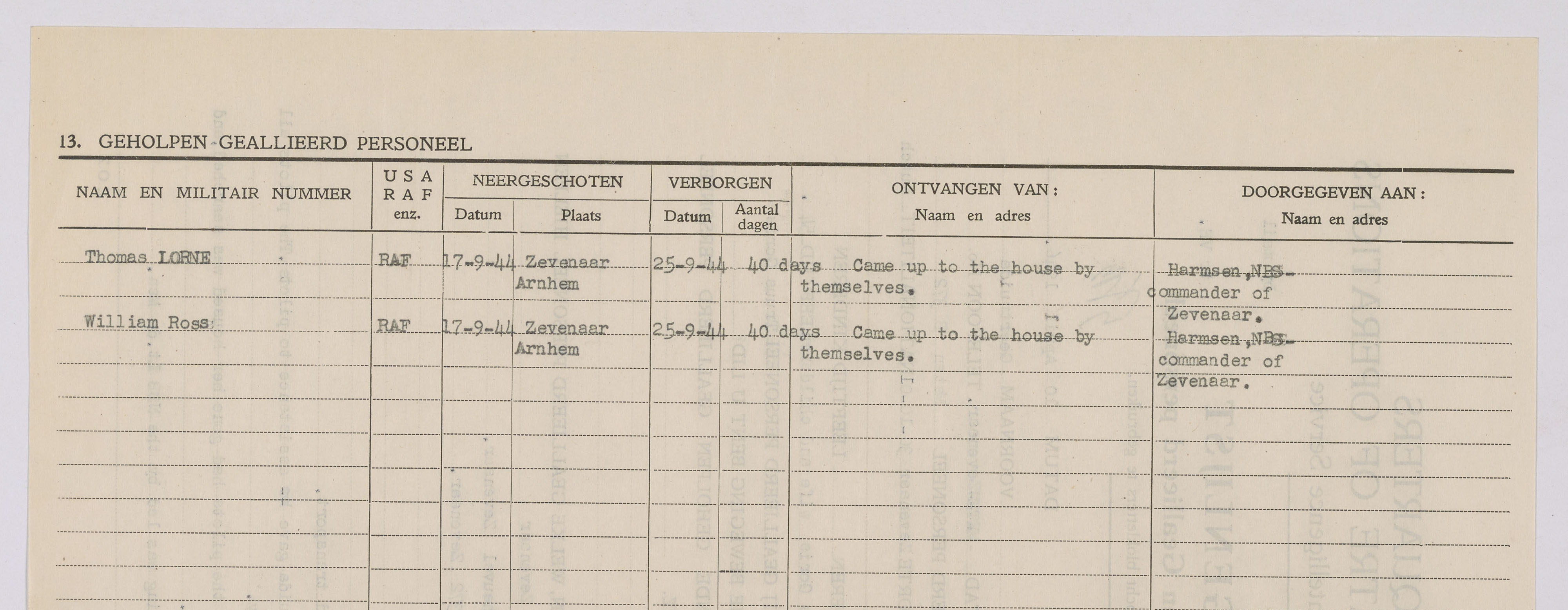
- ◐ A letter in the same file. Handwritten, Duiven, 8 March 1946, signed A. M. P. Goris of Duiven. It names nobody, but it is in the file of Lorne and Ross and has the same Red Cross car, so it is very probably their story; its haystack is the "straw stack" of ParaData's account.
- In September 1944, after the Arnhem landings, the writer was living at Zevenaar when two Allied soldiers came to the family of J. Goris at "Meten", Zevenaar, one morning wanting to reach the English lines.
- She fed them and hid them "some days" in a haystack about 3 km from the house, which held two German officers and about 150 OT men, until contact with the NBS got them away "per Rode-Kruis auto naar de veilige linie" (p. 6; p. 7).
- ◐ Reijmer, Klein Maat, Zevenaar. The widow M. Th. Reijmer's questionnaire of 28 February 1946 says the family "housed 2 pilots for 6 weeks" and handed them to the NBS commander at Giesbeek. Her table has "William Ross", "17-9" Arnhem, hidden "23-9" 1944, "42" days, "hid en on our farm", and beneath him "Thomas Lorne, military Number and address unknown", with no dates of his own (p. 2; p. 3).
- ◐ Her letter. Zevenaar, 19 January 1946, naming neither man: two English paratroopers "14 days after the landing at Arnhem", looked after "6 weeks"; a third man, an airman, joined them after three weeks; the farm held 170 Germans and 63 boys of a state institution, so the family built the men "a blockhut" near the house and took them hot food each evening; after six weeks the underground took them "safely behind the front" (p. 6). ParaData's three weeks in a straw stack, joined by an RAF sergeant, may be the same stay; neither says so.
- ✓ Hopink, Giesbeek. Reserve captain A. G. Hopink was "the header of the organization for giving assistance to pilots, etc. in the Lijmers". The Hop file in the same series holds a copy of his pages (p. 9).
- His form of 14 September 1945 lists "Lorne Prtv" among the paratroopers in a list of Handley (◐ Hindley), Robinson, Lorne, Moore, MacPherson and an American private, with "20.9.44" and Giesbeek in the "shot down" (neergeschoten) columns, "Picked him up" in "received from", and Harmsen sending them "to Brummen, Eerbeek, etc. according to instructions of Major Hibbert" (p. 9).
- His form of 29 December 1945 has the same list, with "Lorne, priv." received from "Harmsen" and "Spaan" and passed on "over the IJssel (Duren)" (p. 5). After the crossing the airmen "were sheltered in Eerbeek, then Hoenderloo and then crossed the Rhine" (p. 2).
- ◐ A hut near Giesbeek, 4 to 10 October. Peter Elliott's 2019 retelling of the escape of Capt. W. H. "Chippy" Robinson of the 3rd Parachute Battalion draws on Robinson's report to MI9 (Kew, WO 208/3325, not seen here) (Elliott).
- On 4 October Robinson and an American private were taken "to a hut near Giesbeek, where they remained, and were fed, until about 10th October, a further six days".
- There "they were able to make contact with a number of other Allied soldiers who were hiding in the same district" and "also established communication with Major Hibbert of the Para. Regt., who insisted that they should stay where they were".
- His footnote names them: "The others were: Privates Lorne and Ross, 156 Bn. Para. Regt.; Lieut. Hindley, Ist Para. Sqn,. R.E." (same).
- No first names; the pair "Lorne and Ross" of the 156th is the pair on the Dutch forms, so ◐ this is Thomas Lorne and William Ross.
- Robinson, Hindley, Lorne and Ross are also on Wolzak's and Kok's lists with Esparza, an American (Hopink's has Handley, Robinson, Lorne and Moore, and Hibbert too, as the man whose instructions sent the paratroopers on to Brummen and Eerbeek).
- Elliott has Robinson and Esparza taken over the IJssel on 10 October and Robinson one of the 138 men who crossed on Pegasus I (22 October); Esparza "also returned to his regiment". So men on Wolzak's list left on Pegasus I.
- It puts Lorne and Ross in the Giesbeek district in the first ten days of October, where Hopink's form has them.
- ✓ A. Katgert, Duiven. Albertus Katgert (b. 1879) says three men were brought to his house and he gave them "shelter and food for 3 days and 3 nights", then another Katgert took them on "up to the IJsel near Lathum". His table: "Ross William", 17-9-44 Oosterbeek, hidden 23-9-44, 3 days, received from Hendrik Katgert of Giesbeek; "Piet Lorne", Tunbridge Wells; and a third man, "was a W.O. RAF, Scottish" (p. 2; p. 3; Dutch copy, p. 5).
- The number line has "67159" on p. 3 and "No 671590" in the Dutch copy on p. 5: five or six digits against Lorne's seven.
- ✓ H. Katgert, Giesbeek. Hendrik Katgert's letter of 27 March 1946 names "Private Lorne, No. 5671590" and W. Ross, Lorne's number as Kew has it, and a third paratrooper he lost sight of (p. 4; p. 10).
- A marechaussee, W. Hassink, came one evening in October 1944 to say that three Englishmen at his boarding house had to be sent on quickly, as "nearly every house at Giesbeek had some Germans billeted on them". Hassink found bicycles, clothes and food.
- Katgert fetched them at half past six the next morning at the Giesbeek steam pumping station and cycled with them to his uncle at Groessen, near the Rhine, past German police and men digging a trench. The uncle "had already hidden 4 Jews". One of the other people in hiding there spoke English and was to take the men to the Rhine.
- The two stayed "some time" at the uncle's and left "in the direction IJssel" as billeting grew; a clerk pencilled "Transport 30 km" on the letter.
- His handwritten Dutch letter says he does not know the exact date but it was "about two or three weeks after the seventeenth of September" (p. 5).
- ◐ The uncle. Albertus Katgert's form names Hendrik as the man who brought him the three, so he is very probably the uncle at Groessen; neither form says so. ◐ The Rhine part partly matches the MI9 summary above: two men back from the Rhine, the third gone, though MI9 has the third lost the day before the Rhine and H. Katgert has him running off after the attempt. The Jews at Groessen are not tied by any source to ParaData's Jewish mother and child at Zevenaar.
Much later I heard that the three Englishmen had not succeeded in crossing the Rhine. The same evening two of them returned to my uncle's house. The third one had run away from the other two.
— H. Katgert · letter to the American helpers' office at Wassenaar · 27 March 1946 · p. 4
Brummen
Link to the section Brummen✓ Lorne is in a list in five of the Brummen files, none with dates of his own. Taken with Hopink's "to Brummen, Eerbeek" and Wolzak's "received from Brummen", they put the road Giesbeek, Brummen, Eerbeek.
- ✓ The Tjeenk Willink brothers. Hermanus D. ("Dick", b. 1919) and his brother Arend each list "Pte T. Lorne" under a block of names "who have been sent on immediately to Piet van Arnhem" (H. D., p. 4; Arend, p. 3).
- ◐ The dated rows above the block (26 September to 2 October 1944, "2 to 3 wks", received from "Hoping", passed to "Wolzak") may or may not be the same men: the transcription shows only that the named block, Lorne to Duffy, has no dates of its own and sits under the "Further about 10 soldiers" rows. The "conclusion" counts 1 in the house for five weeks, 13 "in shelter in woods" and 14 taken on by bicycle.
- Hermanus's remarks have 14 pilots and paratroopers carried from Lathum to Brummen eight times with his brother; "Most of the paratroopers escaped from German transit P.o.W. camps" (p. 3).
- ✓ Bierhof, Brummen. Christiaan Bierhof's card of 27 December 1945: "food housing and some clothing for allied personnel for 1 week", with "Pvt T. Lorne, Parachutists" in the list (p. 9). A second file, filed under "Gerdina" but a form in his name and at his address, D 189, of 28 August 1945, has "Pte. T. LORNE, Para.", "About 1 week", passed to "WOLZAK, EERBEEK" (p. 3; p. 2). ◐ The handwritten table of his form of 22 October 1945 has a faint "Lorne" in the rows handed by Munnik to Schut at Eerbeek (p. 6).
- ✓ Baron van der Feltz. Louis, Baron van der Feltz (b. 1906), deputy officer of justice at Brummen, is on a card of 31 January 1946 as having "participated in caring for the parachutists who dropped in the area and assisted in transporting them to other shelters", with "Pvt T. Lorne". His own form says he took care of the lodgings and "himself did not shelter one of these persons, but knew about it", about twelve in all, and Major Hibbert confirmed it (p. 4; p. 2).
Eerbeek
Link to the section Eerbeek✓ Lorne is on the helper file of C. A. Wolzak, local commander of the NBS at Eerbeek. The Americans' card on Wolzak, typed 17 January 1946 under "Capt Kay, 4 January 1946", says twelve evaders were housed "from October to December of 1944, this being consequent to the successful Pegasus 1 and the unsuccessful Pegasus 2", in a cottage on his grounds, his wife doing the cooking and nursing, and that he arranged their transport "to the next stop on their evasion tour". The list has "Pvt T. Lorne, 156 Para Regt" and, four lines below it, "Pvt W. Ross, Para"; the others include Lt. Rostron Hindley, PFC Santiago H. Esparza and Capt. W. H. Robinson, named in the Giesbeek hut below (Wolzak, p. 3).
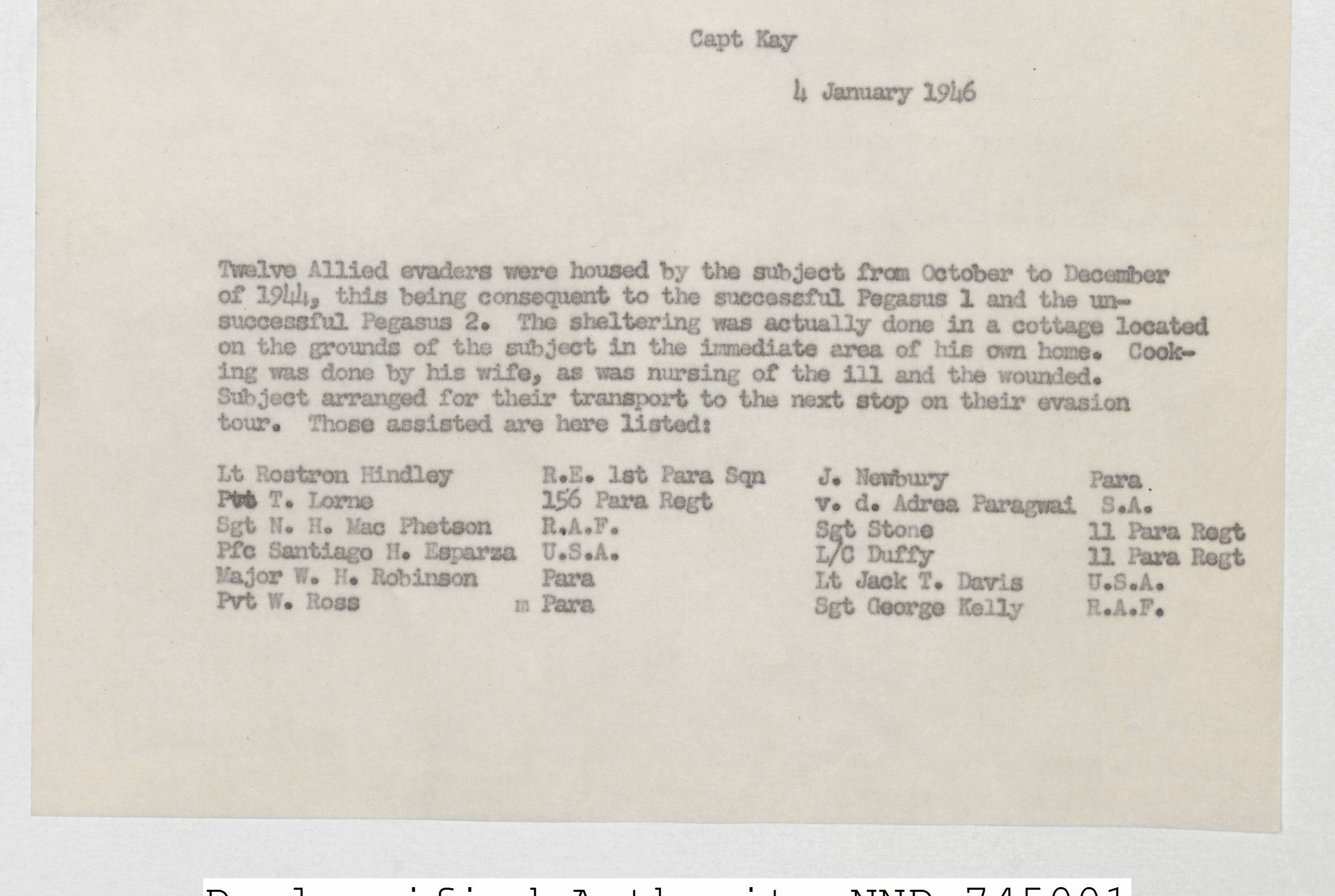
- ✓ His own questionnaire. Wolzak's form of 27 August 1945 gives the address "known to Allied personnel" as the "Camp-centre 'Coldenhove', Eerbeek", and his letterhead of 23 January 1946 is the "Kampeer-Centrum 'Coldenhove' N.V., Eerbeek (Veluwe)", a holiday camp with chalets (p. 5; p. 4). ParaData has Lorne and Ross moved to "Coldenhove", which is therefore Wolzak's place, so ◐ the Wolzak list and ParaData are one story.
- ✓ The table, p. 6. All twelve names carry one entry for "hidden", "Period October - December 1944", "received from" "Brummen", and "passed on to" "Hoenderlo", with "Pte T. Lorne, 156 Para Rgt., A-hem" in the second row (p. 6). "Hoenderlo" is where the Germans took the Pegasus II wounded, Lorne among them (After).
- ◐ The list mixes the two crossings: Robinson, one of the twelve, left on Pegasus I by Elliott's account (the hut near Giesbeek), so the twelve are not one group that went on to Pegasus II. The card does not say which of them were taken on 18 November.
- ✓ October to December is the house's period, not Lorne's. He escaped on 26 September and was taken on 18 November, so he was not there in December. ParaData has him miss the first crossing (Pegasus I, 22/23 October) because he and Ross were out collecting firewood when the Resistance came for the evaders, and wait a month for the second (ParaData). Wolzak's "consequent to the successful Pegasus 1" fits that; the Zevenaar forms do not (Where the sources disagree). ParaData's "missed Pegasus I" sits beside Elliott's Robinson, listed with Lorne, going on it.
- ◐ Ross. "Pvt W. Ross, Para" on Wolzak's list is very probably the Private Ross of Lorne's escape: same list, ParaData has them hidden together. The name is common and the initial comes from Wolzak alone, so nothing beyond that is claimed.
- ✓ Kok, Eerbeek. W. A. Kok's form of 22 August 1945 lists "Pte. T. Lorne", Para, "9-'44", Arnhem, "Oct.", beside "Pte. W. Ross", received "via Brummen"; the same table has Hindley, Esparza ("Nov.") and Capt. W. H. Robinson. He says he took the "flyers and parachutists" from the Brummen organisation to the camp centre "Coldenhove", and "When there were enough they were brought to Hoenderlo or Otterlo, whence they were brought farther. We think Ede" (p. 3; p. 4).
- ✓ Schut, Eerbeek. G. G. J. Schut's card of 12 January 1946, for 't Hungeling, Eerbeek: "Served as a transient house for allied personnel", with "Pvt W. Ross, Paratrooper" and "Pvt T. Lorne" in the list (p. 4).
- ✓ Dieren: the Reinders brothers. J. Reinders (b. 1915, a sergeant) says he "always helped Mr. Wolzak in Eerbeek"; his table lists "T. Lorne" and "W. Ross 156e Parachute Reg.", and his younger brother's file has the same table (p. 4; the other file, p. 4). The brothers were interpreters and guards in Wolzak's camp; the younger, born 1925, is not named here.
- ✓ Mrs Wolzak. G. W. Wolzak-van Buuren's form says she cooked for the parachutists and pilots and, "being a nurse", dressed the wounded, "October until the end of December 1944"; her table is "Twelve parachutists and pilots, October to 3d week of December incl." (p. 2; p. 3).
- ✓ van Schellen, Apeldoorn. W. van Schellen (b. 1920) was "with them in their shelterplace as a safe guard and fed them for 3 weeks". His table has "T. Lorne, Airborne, 17 Sept. 44, Arnhem", helped "together with C.A. Wolzak Eerbeek", and Lorne's home address; his remarks say the group "tried to cross the Rhine" and were made prisoner "beginning of Nov. 1944" (p. 3; p. 2).
Loenen and Laag Soeren
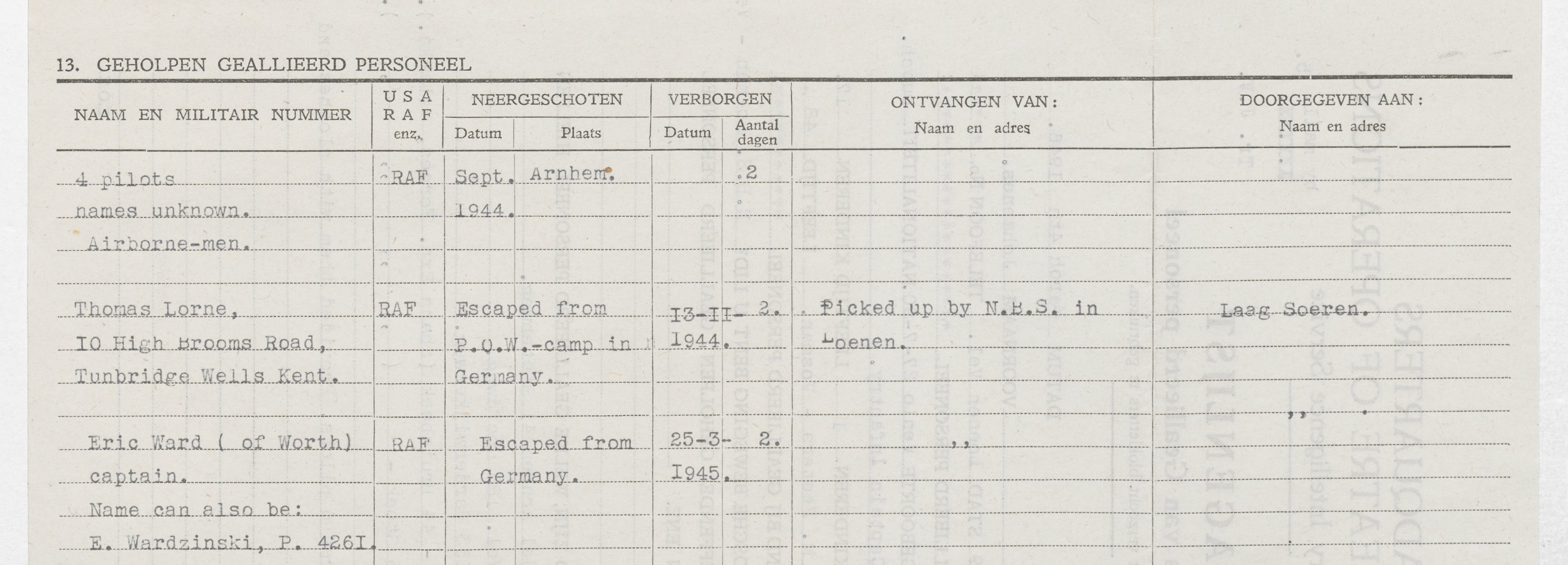
Link to the section Loenen and Laag Soeren- ◐ Peeters, Loenen. The questionnaire of J. H. Peeters, reserve captain and member of the Loenen NBS, has "Thomas Lorne", RAF, "Escaped from P.O.W.-camp in Germany", dated "13-11-1944" and "2" days, "Picked up by N.B.S. in Loenen" and passed to "Laag Soeren". The handwritten Dutch copy has "Parachutist Thomas Lorne", "ontvlucht uit Duitsche krijgsgevangenschap" (escaped from German captivity), "13/11-44", "door N.B.S. Loenen opgevangen" (p. 3; p. 5). The date and the "camp in Germany" do not fit what else we hold (Where the sources disagree).
- ✓ His letter. Peeters's letter of 6 January 1946 says that in September 1944 he and his wife hid four airborne men in a hut on his land, an RAF officer in October 1944 and an English captain on 23 March 1945; it names none of them (p. 6).
With Murphy
Link to the section With MurphyPegasus II was the crossing of the Rhine from Ede that Murphy's party set out for on 17 November and lost its guides on; Lorne was in the main column, which left from the chicken barns of the Wolfswinkel family at Lunteren (Operation Pegasus II; the Liberation Route puts 84 Allied men and Dutch civilians in the barns on Thursday 16 November, its account). ◐ ParaData has the evaders go to the barn by ambulance, "85 other evaders" waiting.
No source puts Lorne and Murphy together. They were in the same battalion, set out for the same crossing on the same night in different parties, and ◐ Kew has Lorne in Stalag XI-B, freed there on 16 April 1945, the camp and the day Murphy gives for his own liberation (the camp is Murphy's own word; After; Murphy).
Our party, under Major Coke, heard somebody walking in the wood so we laid down by the side of the Track and saw some Germans. They saw us in the obscurity and challenged us with the word: 'Halt!' Somebody in our party answered with the English word 'friend' and we were immediately swept with automatic fire.
— Pte T. Lorne · quoted in ParaData's profile from O'Reilly, From Delhi to Arnhem · the page
- ◐ Coke's party. The Ede manuscript, Boeree and the Liberation Route all have the rearguard of the column, the parachutists, under Maj. John Coke of the King's Own Scottish Borderers (Ede manuscript, p. 45; Boeree, p. 179), so Lorne's "our party" is very probably the rearguard. He does not say Coke was killed in front of him, or where.
- ✓ The challenge. Boeree's account of Coke's last minutes has a German sentry's "Werda", Coke answering "Yes" and then "Freund", and two men firing wildly into the dark ("in het wilde gevuurd"; "automatic fire" is Lorne's word, not Boeree's) (Boeree, p. 183). ◐ It may be the incident Lorne describes; neither says so.
- ✓ No firing back. Lorne has Colour Sergeant Cox of the 11th Battalion remind him "that we were not to use" the Stens. Maguire's order, as the Americans' summary of Ramlow's report has it, was that "under no circumstances was there to be any firing" (Ramlow, pp. 4–5), and the German account of the same night has the Germans finding that none of the prisoners had fired or even set his weapon to fire (Boeree, p. 196).
He then crawled to another track and, with Cox and another private, saw four Germans come down it with torches; the other private and Cox gave themselves up, and Lorne "lay still pretending to be dead". He was fired at and hit by a bullet "through the knee and leg", and they were taken out into a field, "lined up and searched", the wounded lying in the field (ParaData, quoting him). ✓ The MI9 summary has the same: "LORNE himself feigned death but the Germans shot him through the knee" (p. 452).
- ✓ Capture and Germany. The Germans took the party to the hospital at Hoenderloo the next morning, "Hounderloo Hospital" in his words, and after four days in it he was sent to Germany (ParaData; MI9: "put in a Hospital and 4 days later sent to Germany", p. 452).
- ✓ The disused cinema. "Near the frontier while left unguarded in a disused cinema LORNE and another soldier wanted to escape but the officer with them said he had given his word they would not" (MI9, same page); ParaData says the same of an officer travelling with him.
- ✓ Stalag XI-B and liberation. Kew's German prisoner card for him: Private, Army Air Corps, 5671590, captured 19 November 1944 in Holland, "Stalag XIB Fallingbostel", prisoner number 200021 (WO 416/227/520); his liberation report: liberated from "Fallingbostel (Stalag XI B)" on 16 April 1945 (WO 208/3331/699). ParaData and MI9 say only April 1945. Murphy's own account has Fallingbostel and 16 April.
-
✓ Mentioned in Despatches. The recommendation is for "his Escaping activities whilst a prisoner of war".
- The minute sheet: proposed by M.I.9/19 on 24 January 1946, "No comments" from the prisoner-of-war directorate (D.D.P.W.) on the 29th, "from the escape angle, he merits the award of Mention in Despatches" from the Director of Military Intelligence's office (D.M.I.) on 7 February, and "No comments" from D.Air on the 14th (p. 450). Kew's index entry is WO 208/5274/1916, reference BM/3115/46.
- The London Gazette of 6 June 1946 prints "5671590 Pte. T. LORNE" under Army Air Corps, P.R., in the War Office list of Mentions "in recognition of gallant and distinguished services in the field" (supplement 37595, p. 2741; read on the page image).
- Kew's WO 373/102/393 is the same recommendation in the awards series, now held from Kew itself (catalogue entry; the transcription, read on the page images). Its pages 450 and 452 read the same as ParaData's copy, and it adds the page between them:
- Folio 451 is a fifth minute, "May this recommendation now go forward?", signed for the Director of Military Intelligence and dated 8 March 1946; ◐ a pencil date at the foot of folio 450 reads "12.3.46", which would be the answer, but it is faint and is not settled.
- The writers: M.I.9/19's "Lt.Col., G.S." (24 January), "for D.D.P.W." (29 January), a brigadier "for D.M.I." (7 February) and a brigadier "for D.Air." (14 February). Every signature is a scrawl, read only tentatively in the transcription ("G R Way [?]" and "A L Davies [?]", both Brig.).
-
✓ Home in 1946. Four helpers' forms of 1946 give his address as 10 High Brooms Road, High Brooms, Tunbridge Wells, Kent: Peeters's, A. Katgert's and H. Katgert's (who adds the number 5671590) and van Schellen's, which has it on the line for the men's private addresses (Peeters; A. Katgert; H. Katgert; van Schellen). A. Katgert's form calls him "Piet Lorne"; no other source gives him that name.
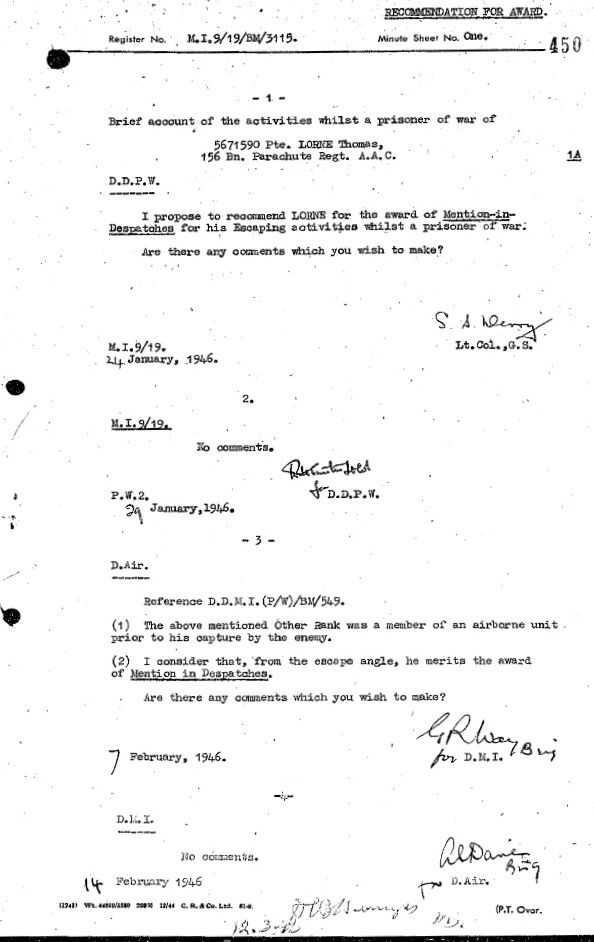
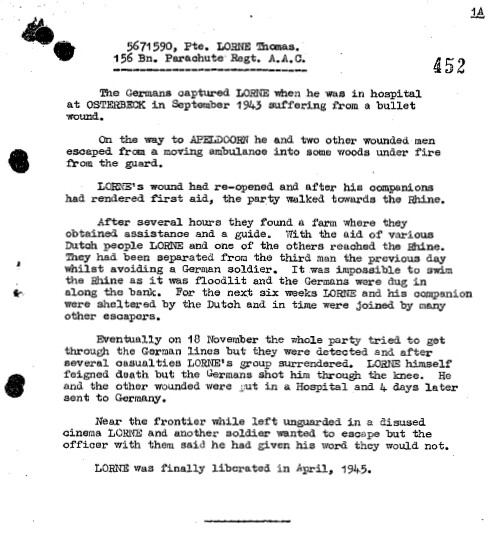
His Mention in Despatches papers, 1946, pages 450 and 452. Shown by ParaData, Airborne Assault Museum.
Nothing we hold says what became of him after 1946. ParaData's page has two family photographs of him, in 1937 and 1942; they are the family's, held in the archive, and not shown here.
Where the sources disagree
Link to the section Where the sources disagree- The day he was taken. ✓ The MI9 summary and ParaData have 18 November 1944; ⚠︎ Kew's German prisoner card has "19 November 1944" (WO 416/227/520). The Ede accounts have the column fired on in the night of 17/18 November and the wounded found at dawn, which gives the 18th; but Boeree's German-side "Zaterdagavond" for the fight and the burial on the Sunday leave it on 18/19 November, which would fit the card (John Coke). Not settled; the card is a German record made later.
- Where he was held. ⚠︎ ParaData says "Stalag 6C in Munster" (ParaData); Kew's card and liberation report both say Stalag XI-B Fallingbostel, and only the card gives a prisoner number. He may have been in more than one camp; no source says so.
- His birth. ⚠︎ Kew's liberation report has "27 June 1919", the German prisoner card "27/06/1921", place "Mott Hill" (WO 208/3331/699; WO 416/227/520). ParaData's "enlisted in 1937 aged 16" fits 1920 or 1921, not 1919. The day and month agree.
- The year of capture. ⚠︎ The liberation report's entry has "Place captured: Arnhem, date: 26 September 1943" and the MI9 summary "September 1943"; both are one year out, as the escape report's entry (WO 208/3337/699) puts the ambulance escape on 26 September 1944.
- The Gazette date and heading. ⚠︎ Kew's WO 373 entry gives "25 June 1946" as the date of the announcement; the Gazette page is dated 6 June 1946, as ParaData has it, and the entry sits under "in the field", not the separate list "while Prisoners of War" on p. 2740, though the recommendation is for escaping (supplement 37595, p. 2740).
- Where he was between 26 September and mid-November. ⚠︎ The Dutch forms give starts and lengths that cannot all be his, and nothing here picks between them.
- Start: Kew has him out of the ambulance on 26 September (WO 208/3337/699). Goris has him at Zevenaar from "25-9-44", A. Katgert's dittoed row from "23-9-44" and Reijmer has Ross from "23-9": all earlier than the 26th. H. Katgert has them "about two or three weeks after" 17 September.
- Hopink's "20.9.44" is in his shot-down column, with "Giesbeek", and the hidden column is blank, so it is the date and place the men came down, not a date at Giesbeek. It fits Lorne, who jumped on 18 September and was wounded at Oosterbeek, no better.
- Length: Goris "40 days" and Reijmer "42", both ending about 4 November, and MI9's "next six weeks", against A. Katgert's 3 days, Bierhof's "about 1 week", the letter in Goris's file ("some days") and the Tjeenk Willinks' "sent on immediately" (the block has no dates of its own; the dated rows above it, 26 September to 2 October, may or may not be the same men).
- Hands: Goris has the NBS commander at Zevenaar taking them by Red Cross car, Reijmer the NBS at Giesbeek, Hopink, Kok and the Tjeenk Willinks the road to Brummen and Eerbeek.
- The Giesbeek hut. ⚠︎ Elliott's footnote puts Lorne and Ross in a hut near Giesbeek from 4 to about 10 October 1944 with Robinson, Esparza and Hindley (Elliott); Goris has them at Zevenaar from 25 September for 40 days, Reijmer has Ross from 23 September for 42 days, and A. Katgert has the pair for 3 days from 23 September. Zevenaar and Giesbeek are different places, and Elliott draws on a report we have not seen.
- Pegasus I. ⚠︎ If Goris's 40 days from 25 September or Reijmer's 42 from 23 September are right, he was at Zevenaar until about 4 November; ParaData has him at Eerbeek, out collecting firewood when the evaders left on 22/23 October. Both cannot stand, and the ParaData account rests on a book we do not hold.
- "Reached the allied lines". ⚠︎ Goris's form says "The pilots all reached the allied lines safely", and her Red Cross car goes "to the safe line"; Lorne was taken on 18 November and H. Katgert has the three not crossing the Rhine, which is what MI9 says.
- The third man. ◐ MI9 has him lost the day before they reached the Rhine; H. Katgert has all three at Groessen and the third running off from the other two; A. Katgert calls him a Scottish "W.O." (an NCO, "onderofficier" in his Dutch copy); Reijmer's third was an airman who joined after three weeks; Lorne's own account names Sgt Thompson. No source ties these together or says whether Thompson was Scottish.
- ⚠︎ A. Katgert's item 10 says one of the three "Came down at Rijnovergang and was made P.O.W.", was "nursed in hospital and foot amputated" and has been back in England since 15 October 1945 (p. 2); it does not say which man, and Lorne was shot through the knee after Pegasus II.
- Taken "beginning of Nov. 1944". ⚠︎ van Schellen's form has the group made prisoner at the beginning of November (p. 2); MI9 and ParaData have Lorne taken on 18 November, Kew's card the 19th.
- Peeters's 13 November. ⚠︎ His table has Lorne escaping on "13-11-1944" from a "P.O.W.-camp in Germany" and spending two days at Loenen (p. 3). By MI9 he was shot and taken on 18 November, and reached Germany only after Hoenderloo; the Dutch copy says "escaped from German captivity", with no place, which fits the ambulance escape. If 13 November is right it falls in the Eerbeek weeks, three days before the column left Lunteren.
- The house's months. ✓ Wolzak's "October to December 1944" covers all twelve men; it does not put Lorne at Eerbeek in December. See Eerbeek.
- O'Reilly. Everything marked ◐ from ParaData rests on a book we do not hold. Its page says Lorne "describes what happened" there, and quotes him twice; where the MI9 papers and Wolzak's file cover the same ground, they agree with it.